
MARKET INTELLIGENCE BRIEF (MIB)
Monday, July 27, 2026
Oil cratered 8.25% as US-Iran strikes paused a second day, flipping Energy (-2.41%) from best sector to worst. Hike odds for Wednesday’s FOMC slid to one-in-three, yet VIX rose to 18.67 — nobody is de-risking. Durable goods rose 0.3% versus 2.5% expected. Nvidia fell 4.99% on reports it may backstop $250B of OpenAI’s data-center financing; chips shed five percent. Apple retook the most-valuable crown at $4.94T. The Dow gained 0.51% but transports fell 1.83% — a Dow Theory non-confirmation.
TABLE OF CONTENTS
A. EXECUTIVE SUMMARY
B. MARKET DATA
C. HIGH-IMPACT STORIES (5)
D. MODERATE-IMPACT STORIES (6)
E. ECONOMY WATCH (5)
F. EARNINGS WATCH (1)
G. WHAT’S NEXT
H. CHART OF THE DAY
A. EXECUTIVE SUMMARY -> TOP
Monday’s tape looked calm and was not: the S&P 500 closed +0.02% and the Dow +0.51% while WTI collapsed 8.25% on a two-day pause in US-Iran strikes, a cross-asset signature that marks a risk-premium unwind, not a demand shock. The market’s refusal to treat it as relief is the more important tell — hike odds for Wednesday’s FOMC fell to one-in-three, yet VIX rose to 18.67 and the 2s10s curve flattened to 32 basis points instead of steepening, the configuration of a market that moved the hike rather than removing it. Beneath the indices, the day’s real repricing was in how AI capacity gets financed: reports that Nvidia may backstop $250 billion of OpenAI’s data-center obligations took the chip complex down five percent. Breadth was defensive — Consumer Defensive +1.56% and Communication Services +1.55% led while Energy -2.41% and Utilities -1.02% lagged, the latter now trading as an AI power proxy rather than a bond substitute.
• WTI settled at $81.94, -8.25%, and Brent at $85.35, -6.90% after a second consecutive strike-free day; Energy was the worst S&P 500 sector at -2.41% yet remains +29.40% year to date, so today cut against the trend rather than confirming a turn.
• Nvidia fell 4.99% to $196.51 on reports it is in early talks to guarantee up to $250 billion of OpenAI’s lease and construction financing; AMD -5.17%, Lam Research -4.46%, Applied Materials -3.61%, KLA -3.40%, Technology -0.90%.
• Apple reclaimed the world’s-most-valuable-company title at roughly $4.94 trillion against Nvidia’s $4.75 trillion, closing at a record on a gain of just over 1% — arithmetic, not a rally.
• June durable goods orders rose 0.3% against 2.5% consensus while the July Dallas Fed index hit a five-month high of 1.3 — national data soft, regional survey firm, and the Committee has to reconcile them by Wednesday.
• Dow Transports fell 1.83% to 22,065.7 against a +0.51% Dow — a 2.34-point Dow Theory non-confirmation into an 8% fuel-cost decline, with no transport-specific catalyst found. UPS reports Tuesday pre-bell.
• Trump publicly demanded rate cuts two days before a live FOMC, praising Chair Warsh but calling the Board “very political.” Target stands at 3.50-3.75%; Wednesday is a non-SEP meeting, decision 2:00pm ET, press conference 2:30pm ET.
1. The AI trade’s question shifted from demand to credit — Intel was punished Friday for open-ended capital intensity behind a blowout quarter; today the same test ran one level up the chain, at the supplier. A vendor guaranteeing its customer’s ability to pay means Nvidia’s reported revenue and its contingent liabilities would grow from the same transaction, and that is a discount-rate change rather than a demand change. Oracle expressed the identical trade inside one name: +4.27% on up to $7 billion of contracted Department of War work, against a Wisconsin ruling that could force more than $7 billion of collateral on its planned data center. Contracted backlog rewarded, open-ended commitments penalised.
2. The oil crash is a timing change, not a level change — the front end is the maturity most exposed to a near-term hike, and it barely moved (2-year -1.1bps versus 10-year -3.8bps); the curve flattened and hedges stayed on. With September still priced near 80%, the hike was moved, not removed, so today is not a duration buy signal. Note also that the two legs of the move have very different half-lives: a strike pause resting on one quiet weekend is reversible, while restored Caspian loadings and a maintained OPEC+ increase into a contracting EIA demand forecast are not.
3. Rate hedges are not behaving as designed going into Wednesday — Utilities fell 1.02% and Real Estate 0.22% on a 3.8 basis-point yield decline, exactly reversing Friday’s session when Real Estate led all eleven sectors on a smaller move. Two opposite responses to the same directional signal in two days is enough to conclude the rate channel drove neither. Utilities now trade as an AI power-demand proxy, which means duration held as an FOMC hedge is quietly carrying AI-financing risk instead — and Microsoft and Meta capex guidance lands the same day as the decision.
 — Leading economic indicators. Accurate market forecasts. Apply for membership at join.recessionalert.com
B. MARKET DATA -> TOP
A pause in US-Iran hostilities sent crude oil into its steepest one-day slide in months, dragging the entire energy complex lower and flipping last week’s biggest sector winner into today’s worst laggard. Equities told a narrow, tech-only story: the Dow held firm on defense and financials strength while the Nasdaq lagged as chipmakers sold off on renewed AI-capex and circular-financing anxiety ahead of this week’s hyperscaler earnings. The sharpest anomaly was Dow Transportation’s 1.83% drop despite cheaper crude, breaking from the Dow Industrials’ gain. Treasury yields eased modestly on the de-escalation, but VIX ticked up rather than falling — a muted signal that hedging demand has not fully unwound.
CLOSING PRICES – Monday, July 27, 2026:
MAJOR INDICES
DJIA (+0.51%) and DJTA (-1.83%) split by 2.34 points today — transports sold off despite cheaper crude, the most actionable divergence in the tape. Separately, the S&P 500 has now outpaced the Nasdaq 100 on a 10-session basis for a third straight session, a sustained broadening-rotation signal as chip-driven growth leadership narrows. Russell 2000 stayed within range of the S&P — no small-cap breadth signal fired.
| Index | Close | Change | %Move | Why It Moved |
|---|---|---|---|---|
| S&P 500 | 7,413.24 | +1.26 | +0.02% | Roughly flat as oil-driven energy losses offset defense/financials strength |
| Dow Jones | 52,209.69 | +262.44 | +0.51% | Led by financials and defense-contractor strength (AXP, RTX) |
| DJ Transportation | 22,065.7 | -410.4 | -1.83% | Diverged from Industrials despite falling fuel costs; no confirmed catalyst found |
| Nasdaq 100 | 28,039.21 | -89.13 | -0.32% | Semiconductor selloff on AI-capex and circular-financing concerns |
| Russell 2000 | 2,948.55 | +18.55 | +0.63% | Outpaced mega-cap indices as domestic small-caps sidestepped the chip selloff |
| NYSE Composite | 24,098.84 | +107.96 | +0.45% | Broad-market gain confirms breadth beyond the Nasdaq’s tech-led weakness |
VOLATILITY & TREASURIES
The 10Y fell further than the 2Y (-3.8bps vs -1.1bps), modestly flattening the curve as the long end absorbed most of the geopolitical risk-premium unwind. VIX rose slightly even as equities were roughly flat to higher — a muted disconnect suggesting hedging demand has not fully faded despite the Iran de-escalation. DXY held essentially flat.
| Instrument | Level | Change | Why It Moved |
|---|---|---|---|
| VIX | 18.67 | +0.09 (+0.48%) | Ticked up despite mixed-to-higher equities; hedging demand only partly unwound |
| 10-Year Treasury Yield | 4.641% | -3.8 bps | Long-end yields eased as Iran war-risk premium unwound |
| 2-Year Treasury Yield | 4.320% | -1.1 bps | Modest decline; short end little-changed on rate-path expectations |
| US Dollar Index (DXY) | 101.51 | +0.04 (+0.04%) | Essentially flat session |
COMMODITIES
Precious metals were mixed rather than moving as a bloc — gold held a modest bid while silver slipped, a split that argues against a pure safe-haven read given the broader risk-on tone from the Iran pause. Platinum outpaced both, and Bitcoin’s small gain tracked the mixed equity tape rather than decoupling into its own narrative.
| Asset | Price | Change | %Move | Why It Moved |
|---|---|---|---|---|
| Gold | $4,079.10/oz | $+8.30 | +0.20% | Modest bid despite broader risk-on tone |
| Silver | $58.71/oz | $-0.19 | -0.33% | Slipped, diverging from gold’s modest gain |
| Copper | $6.40/lb | $+0.04 | +0.67% | Modest gain, in line with steady industrial demand |
| Platinum | $1,630.75/oz | $+26.65 | +1.66% | Outpaced other precious metals |
| Bitcoin | $65,036 | $+361 | +0.56% | Tracked the mixed equity tape rather than decoupling |
ENERGY
WTI and Brent fell in lockstep (-8.25% / -6.90%), confirming the drop is a global supply-risk unwind rather than a regional dislocation. Natural gas sold off alongside crude on both sides of the Atlantic — Henry Hub -4.09%, Dutch TTF -7.67% — showing the de-escalation hit the entire energy complex, not just oil. Oil falling while equities held roughly flat is a demand-neutral, pure risk-premium story rather than a growth signal.
| Asset | Price | Change | %Move | Why It Moved |
|---|---|---|---|---|
| Crude Oil (WTI) | $81.94/bbl | $-7.37 | -8.25% | US-Iran strike pause after 13 consecutive nights of attacks |
| Crude Oil (Brent) | $85.35/bbl | $-6.33 | -6.90% | Global benchmark tracked WTI lower on the same de-escalation |
| Natural Gas (Henry Hub) | $2.77/MMBtu | $-0.12 | -4.09% | Sold off with the broader energy complex |
| Natural Gas (Dutch TTF) | $19.56/MMBtu | $-1.62 | -7.67% | European gas fell alongside crude on reduced Middle East risk premium |
S&P 500 SECTORS
Energy’s -2.41% session is a sharp reversal from its status as the market’s best-performing sector on every longer horizon (+7.81% 1M, +18.63% 6M, +29.40% YTD, +33.14% 12M) — today’s oil crash cut directly against a persistent uptrend. Communication Services was today’s second-best sector (+1.55%) yet the worst performer over the past week (-5.08%) and quarter (-6.82%), a notable short-term reversal.
| Sector | 1-Day | 1-Week | 1-Month | 3-Month | 6-Month | YTD | 12-Month |
|---|---|---|---|---|---|---|---|
| Consumer Defensive | +1.56% | +0.52% | +0.86% | -0.02% | +1.74% | +8.20% | +6.17% |
| Communication Services | +1.55% | -5.08% | -0.48% | -6.82% | -4.62% | -3.96% | +12.65% |
| Consumer Cyclical | +1.12% | -4.10% | -0.58% | -7.25% | -11.34% | -8.57% | -2.98% |
| Financial | +0.95% | +1.73% | +5.62% | +10.98% | +7.81% | +7.01% | +13.59% |
| Healthcare | +0.50% | +2.21% | +3.65% | +11.32% | +3.20% | +5.68% | +20.28% |
| Basic Materials | +0.30% | +3.30% | -1.62% | -8.13% | -7.38% | +8.01% | +27.45% |
| Industrials | +0.13% | +1.91% | -5.02% | -0.33% | +5.04% | +13.18% | +15.60% |
| Real Estate | -0.22% | +0.96% | +2.91% | +5.26% | +10.21% | +13.11% | +8.53% |
| Technology | -0.90% | -0.90% | -2.90% | +5.00% | +15.32% | +15.61% | +25.20% |
| Utilities | -1.02% | +1.18% | -0.84% | -3.52% | +4.84% | +6.47% | +10.73% |
| Energy | -2.41% | +0.84% | +7.81% | +0.12% | +18.63% | +29.40% | +33.14% |
TOP MEGA-CAP MOVERS:
GAINERS
| Company | Ticker | Close | Change | Why It Moved |
|---|---|---|---|---|
| Palantir Technologies Inc | PLTR | $131.53 | +7.00% | Won a new Defense Intelligence Agency contract, extending its run of government AI wins |
| Oracle Corp | ORCL | $119.90 | +4.27% | Disclosed a Department of War software deal that could reach $6.99B in total value |
| American Express Co | AXP | $335.39 | +2.83% | Rose with broad financial-sector strength; no company-specific catalyst confirmed |
| RTX Corp | RTX | $218.42 | +2.65% | Extending its post-earnings rally on a record $289B backlog and fresh Navy contract wins |
| Alphabet Inc | GOOG | $326.57 | +2.34% | Rebounded with mega-cap tech on continued Gemini/AI adoption momentum |
DECLINERS
| Company | Ticker | Close | Change | Why It Moved |
|---|---|---|---|---|
| Advanced Micro Devices Inc | AMD | $494.95 | -5.17% | Led the chip-sector selloff on AI-capex and circular-financing anxiety ahead of hyperscaler earnings |
| NVIDIA Corp | NVDA | $196.51 | -4.99% | Leveraged, margin-driven selling amid renewed AI infrastructure spending concerns |
| Lam Research Corp | LRCX | $291.61 | -4.46% | Caught in the broad semiconductor-equipment selloff |
| Applied Materials Inc | AMAT | $516.89 | -3.61% | Semiconductor-equipment selloff alongside chip peers |
| KLA Corp | KLAC | $203.36 | -3.40% | Semiconductor-equipment selloff alongside chip peers |
— Institutional-grade intelligence for serious investors. Apply for membership at join.recessionalert.comC. HIGH-IMPACT STORIES -> TOP
UNCERTAIN
1. Oil Posts Its Steepest One-Day Drop in Months as US-Iran Strikes Pause, Flipping Energy From the Market’s Best Sector to Its Worst
The core facts:WTI settled at $81.94 a barrel, down 8.25%, and Brent at $85.35, down 6.90%, after the United States and Iran refrained from military strikes for a second consecutive day over the weekend of July 25-26, ending thirteen straight nights of attacks. The entire energy complex moved together: Henry Hub natural gas fell 4.09% to $2.77/MMBtu and Dutch TTF fell 7.67% to $19.56/MMBtu. Energy was the worst-performing S&P 500 sector at -2.41% against a Dow Jones Industrial Average that gained 0.51% and an S&P 500 that closed essentially flat at +0.02%. Crude loadings resumed at the Caspian Pipeline Consortium terminal on Russia’s Black Sea coast, adding a supply-side driver alongside the diplomatic one. Strait of Hormuz shipping remains heavily disrupted despite the pause.
Why it matters:The cross-asset signature identifies this as a risk-premium unwind rather than a demand signal, and that distinction determines how it should be traded. Crude fell 8% while equities held flat to higher and the 10-year yield eased only 3.8 basis points — a growth scare would have produced a far larger bond rally and a red tape. What makes the move fragile is its foundation: the entire retracement rests on the absence of strikes across a single weekend, not on any agreement, ceasefire framework, or negotiation. Energy’s -2.41% session sits against a sector that is still +29.40% year to date and +33.14% over twelve months, meaning today cut against a persistent uptrend rather than confirming a turn. The tell that markets have not accepted the de-escalation is VIX, which rose 0.48% to 18.67 on a session when oil collapsed and the Dow rallied — hedging demand did not unwind alongside the risk premium.
What to watch:Whether the pause survives a full week without renewed strikes, and whether WTI holds below the $85 area into Wednesday’s FOMC decision — the level at which the energy-inflation channel effectively drops out of the policy debate.
BEARISH
2. Nvidia Reportedly in Talks to Backstop $250 Billion of OpenAI’s Data-Center Financing, Triggering a Five-Percent Chip-Complex Selloff
The core facts:Nvidia is in early talks to guarantee up to $250 billion in lease and construction financing so that OpenAI can take capacity at a SoftBank-led, $500 billion, 10-gigawatt campus in southern Ohio, built on a decommissioned uranium-enrichment site roughly 50 miles south of Columbus. The reporting, originating with the Wall Street Journal and corroborated by CNBC and Quartz, specifies that the $250 billion covers lease and construction obligations only — chips are excluded — while a parallel negotiation to fund OpenAI’s chip purchases could reach $350 billion. The backstop is required because OpenAI is not yet profitable and cannot secure an investment-grade rating on its own. Terms are not final and the arrangement could collapse. Chip and chip-equipment names sold off across the board: Nvidia fell 4.99% to $196.51, Advanced Micro Devices 5.17%, Lam Research 4.46%, Applied Materials 3.61% and KLA 3.40%. Technology closed -0.90% and the Nasdaq 100 fell 0.32% while the Dow rose 0.51%.
Why it matters:This converts the AI trade’s central question from one about revenue quality into one about balance-sheet quality. A vendor guaranteeing its customer’s ability to pay is circular financing in its most explicit form, and it means Nvidia’s reported revenue and Nvidia’s contingent liabilities would grow from the same transaction. The market applied exactly this test to Intel on Friday, punishing a genuine blowout quarter because the capital intensity behind it looked open-ended; today it applied the same test one level up the supply chain, to the supplier rather than the builder. The direction of travel is consistent and it is a discount-rate change, not a demand change — the reported deal exists precisely because AI capacity demand exceeds what the buyer can independently finance. For portfolio construction the implication is that the capex-heavy semiconductor complex now carries a counterparty-credit component that its multiples have not been discounting.
What to watch:Microsoft and Meta capital-expenditure guidance on Wednesday July 29 and Amazon’s AWS capex line later in the week — hyperscaler-funded capacity is the alternative to vendor-financed capacity, and the split between the two determines whether a backstop of this scale is needed at all. Also watch for confirmation or denial of terms from either party.
UNCERTAIN
3. Markets Refuse to De-Risk Into a Live FOMC: VIX Rises on an Eight-Percent Oil Crash and the Curve Flattens Rather Than Steepens
The core facts:With hike odds for Wednesday’s decision easing to roughly one-in-three on the crude collapse while the September meeting remains priced near 80%, the cross-asset reaction was the opposite of a relief trade. VIX rose 0.48% to 18.67 on a session when oil fell 8.25% and the Dow gained 0.51%. The 10-year Treasury yield fell 3.8 basis points to 4.641% while the 2-year fell only 1.1 basis points to 4.320%, compressing the 2s10s spread to roughly 32 basis points from 34 on Friday — a flattening, not the steepening a genuine inflation-risk reprieve would produce. The dollar closed unchanged at 101.51. Gold held a modest bid at +0.20% while silver slipped 0.33%, ruling out a clean safe-haven read in either direction. Section E carries the full policy-odds and Fed-independence framing.
Why it matters:Positioning, not narrative, is what this session reveals. Had markets genuinely concluded that the energy-inflation channel had closed, the front end would have rallied hardest — it is the maturity most exposed to a near-term hike — and volatility would have come off as the event risk deflated. Instead the long end did the work and the hedges stayed on. That combination is consistent with a market that has priced the July hike out without pricing the hiking cycle out, and the September figure near 80% is the confirming evidence: the hike was moved, not removed. For portfolio construction the conclusion is direct — today’s oil collapse is not a duration buy signal, because the curve told you the market treated it as a timing change rather than a level change. The risk into Wednesday is therefore concentrated in the press conference and the forward guidance rather than in the decision itself.
What to watch:Whether the 2s10s spread continues compressing below 30 basis points into Wednesday, and whether VIX breaks below 18 after the decision — a failure to fall on a hold would confirm the risk sits in the September path rather than this week’s meeting.
BEARISH
4. Trump Demands Rate Cuts Two Days Before a Live FOMC and Calls the Fed Board “Very Political”
The core facts:Speaking to reporters aboard Air Force One on Monday, President Trump called on the Federal Reserve to lower rates, saying the United States “should have the lowest interest rate in the world” and that “Rates should be lowered… We have other countries that are paying less interest rates.” On the Chair he said: “Kevin is fantastic, but he’s got a board, and the board members are very political.” The federal funds target stands at 3.50-3.75%, set at Kevin Warsh’s first meeting as Chair in June. Wednesday’s decision lands at 2:00pm ET and is a non-SEP meeting, meaning no updated dot plot accompanies it; the press conference follows at 2:30pm ET. The remarks were reported by Reuters, US News and AOL. Section E carries the fuller independence narrative.
Why it matters:The timing is what converts this from rhetoric into a market variable. Public presidential pressure for cuts has arrived at the precise moment futures have been pricing a hike, which means any hold on Wednesday becomes readable two ways — as a data-driven decision or as accommodation of political pressure — and the Fed has no mechanism to control which reading the long end adopts. That ambiguity is a term-premium problem rather than a policy-rate problem, and it is not currently being charged for: the dollar closed flat at 101.51 and the curve flattened rather than steepened. The asymmetry runs one way. A hold paired with a dovish press conference from a Chair the President has publicly praised is the single configuration most likely to steepen the curve on independence concerns rather than on growth expectations, and a steepening driven by that channel is not one equity duration can hedge.
What to watch:The 10-year yield and the dollar in the thirty minutes after Wednesday’s 2:30pm ET press conference — a long-end selloff on a dovish message, rather than the rally a dovish message would normally produce, would confirm the market has begun pricing an independence discount.
BEARISH
5. Dow Transports Fall 1.83% While Industrials Gain 0.51% — a 2.34-Point Dow Theory Divergence on Collapsing Fuel Costs
The core facts:The Dow Jones Transportation Average fell 410.4 points, or 1.83%, to 22,065.7, while the Dow Jones Industrial Average rose 262.44 points, or 0.51%, to 52,209.69 — a same-day divergence of 2.34 percentage points between the two indices Dow Theory requires to confirm one another. The decline came on a session in which WTI crude fell 8.25%, a large and direct reduction in the sector’s single largest variable cost. Three separate searches across today’s research failed to surface any confirmed transport-specific catalyst: no sector downgrade, guidance cut, labor action, regulatory event, or company announcement was identified. The Industrials GICS sector, which excludes most pure transport names, closed +0.13%.
Why it matters:Transports selling off into an eight-percent fuel-cost decline eliminates the cost explanation, and with no company-specific catalyst identified, the remaining candidate is demand. Dow Theory treats a divergence of this kind as a non-confirmation — goods are being produced, but the market doubts they are being moved — and a non-confirmation carries weight precisely because the two indices normally track the same underlying activity from different points in the chain. The honest caveat is that a single session proves nothing and no catalyst was found, so this is an observation requiring confirmation rather than a conclusion. It is nonetheless the largest unexplained anomaly in today’s tape, and it is the configuration that has historically preceded turns in the freight cycle rather than followed them.
What to watch:United Parcel Service reports before the bell on Tuesday July 28 — the cleanest available read on whether freight demand is deteriorating. A second consecutive transports decline alongside a UPS guidance cut would convert today’s divergence from noise into a signal.
— Quantifying recession risk so you don’t have to guess. Apply for membership at join.recessionalert.comD. MODERATE-IMPACT STORIES -> TOP
BULLISH
6. Apple Retakes the World’s-Most-Valuable-Company Title From Nvidia at a Record Close
The core facts:Apple closed at a record high on Monday, up just over 1%, lifting its market capitalisation to roughly $4.94 trillion against Nvidia’s $4.75 trillion and reclaiming the top spot in the US market. The move was too small to qualify for today’s mega-cap movers table, which requires a ±1.5% threshold. Apple is up more than 22% year to date, outperforming the rest of the Magnificent Seven. Nvidia fell 4.99% on the same session.
Why it matters:The leadership change was arithmetic rather than narrative — Apple did not rally to the top, Nvidia fell to second — and that is what makes it the cleanest available measure of what the market actually repriced today. The gap between the two largest US companies closed by roughly six percentage points in a single session on a report about who guarantees whose data-center leases. Apple’s restrained AI capital spending, criticised through 2025 as a strategic failure, is now the specific characteristic being paid for, and the crown changed hands on the exact day the alternative model was reported to require a $250 billion vendor backstop. For index-level risk the practical implication is narrow but real: concentration at the top of the S&P 500 is unchanged, only the identity of the largest holding has shifted, and it has shifted toward a company whose cash-flow profile carries no comparable financing contingency.
What to watch:Apple’s own capital-expenditure commentary on the Thursday July 30 earnings call — any signal that it intends to fund AI infrastructure directly would remove the precise characteristic that just returned it to first place.
UNCERTAIN
7. Oracle Books Up to Roughly $7 Billion of Department of War Software Work, Offset the Same Day by a Wisconsin Collateral Ruling
The core facts:Oracle rose 4.27% to $119.90 after securing a ten-year Department of War enterprise software agreement worth up to roughly $7 billion, alongside a five-year US Navy IDIQ contract with a $3.31 billion base value and options that could lift it to $6.99 billion across software, SaaS and consulting. Working against that, Wisconsin regulators upheld strict credit rules that could require Oracle to post more than $7 billion in collateral for its planned AI data center in the state, adding over $100 million in annual financing costs.
Why it matters:The two items are the same story read from opposite ends of the balance sheet: Oracle secured contracted, government-underwritten revenue on the same day a state regulator raised the cost of the infrastructure required to serve it. That is precisely the distinction the market applied across the whole session — contracted backlog rewarded, open-ended capital commitments penalised — and Oracle’s 4.27% gain against a five-percent decline in the chip complex is that trade expressed within a single name. The Wisconsin ruling also carries implications well beyond Oracle. If state utility regulators can impose multi-billion-dollar collateral requirements on data-center developers, the financing cost of the AI buildout becomes a state-by-state variable rather than a national one, and site selection stops being an engineering decision and becomes a regulatory arbitrage.
What to watch:Whether other states with large pending data-center interconnection requests adopt comparable collateral rules, and whether Oracle quantifies the drawdown pace on the Department of War ceiling at its next earnings call.
UNCERTAIN
8. Rate-Sensitive Sectors Ignore a 3.8 Basis-Point Yield Decline: Utilities Fall 1.02%, Real Estate 0.22%
The core facts:The 10-year Treasury yield fell 3.8 basis points to 4.641% and the 2-year fell 1.1 basis points to 4.320%, yet both classic rate-sensitive sectors closed red — Utilities down 1.02% and Real Estate down 0.22%. This directly reverses Friday’s configuration, when Real Estate led all eleven sectors at +2.08% on a smaller two basis-point yield decline. Today’s leadership went instead to Consumer Defensive at +1.56%, Communication Services at +1.55% and Consumer Cyclical at +1.12%, with Financials adding 0.95%.
Why it matters:Two consecutive sessions produced opposite sector responses to the same directional move in yields, which is sufficient to conclude the rate channel is not what drove either. The more coherent explanation is that Utilities have become an AI power-demand proxy rather than a bond substitute: on the day the market repriced how AI infrastructure gets financed, the sector that would supply power to that infrastructure fell hardest among the defensives, while genuinely defensive Consumer Defensive names led. Real Estate’s fade after Friday’s 2.08% surge looks like the unwind of a one-session rotation rather than the expression of a rate view. The practical consequence matters into Wednesday: anyone holding these sectors as duration hedges going into the FOMC now has two sessions of evidence that the hedge is not behaving as designed.
What to watch:Utilities’ response to Wednesday’s decision — if the sector tracks hyperscaler capex guidance from Microsoft and Meta rather than the 10-year yield, the decoupling from the rate complex is confirmed rather than coincidental.
UNCERTAIN
9. Manufacturing Signals Split as Durable Goods Orders Miss Badly While the Dallas Fed Hits a Five-Month High
The core facts:June durable goods orders rose 0.3% against a 2.5% consensus, with ex-transport orders up 0.6% versus 0.8% expected, while the Dallas Fed general business activity index climbed to a five-month high of 1.3 in July from 0.0 in June. Section E carries the full breakdown of both releases. The equity response was close to nil: Industrials closed +0.13% and Basic Materials +0.30%, both effectively in line with the S&P 500’s +0.02%. The Dow’s 0.51% gain came from financials and defence names rather than from cyclicals.
Why it matters:The non-reaction is the information. A national durable goods print missing consensus by more than two percentage points would ordinarily move industrial cyclicals, and it did not — because the July regional survey pointed the other way and because markets are treating June hard data as stale two days before an FOMC decision. That leaves the manufacturing picture genuinely unresolved at the worst possible moment: soft June national data, firmer July survey data, and an energy-price collapse that arrived after both were collected. A committee weighing a hike is therefore being asked to set policy on a data set that does not yet agree with itself, which raises the probability that Wednesday’s message leans on optionality rather than direction and pushes the real decision to September.
What to watch:The ISM manufacturing survey at the start of August as the first national July reading — whether it confirms the Dallas Fed’s improvement or the June national weakness will settle which signal the Fed is actually working from.
BEARISH
10. Caspian Pipeline Loadings Resume and OPEC+ Meets Tuesday, Adding a Supply-Side Leg to the Crude Collapse
The core facts:Alongside the US-Iran strike pause, crude loadings resumed at the Caspian Pipeline Consortium terminal on Russia’s Black Sea coast, restoring a supply route that had been offline. OPEC+ approved a 188,000 barrel-per-day August output increase last week and analysts expect the alliance to hold that line at its summit on Tuesday July 28. Separately, the EIA forecasts global oil consumption falling an average 1.2 million barrels per day across 2026, with Chinese gasoline demand destruction estimated near 180,000 barrels per day and roughly 70% of that judged unlikely to return even after markets normalise. Strait of Hormuz transits remain heavily impaired despite the pause in hostilities.
Why it matters:The diplomatic headline explains the timing of today’s 8.25% decline; the supply and demand data explain why it travelled so far. A restored Caspian route and a maintained OPEC+ increase both add barrels into a demand forecast that is contracting, and that is a materially more durable bearish configuration than a strike pause capable of reversing within days. The distinction is directly relevant to the inflation path the Fed is weighing on Wednesday: risk-premium unwinds are reversible and supply additions into falling demand are not, so the two components of today’s move carry very different half-lives. It also inverts the read on Hormuz — with transits still impaired, the market is now discounting a physical supply constraint it was paying a premium for barely a week ago, which is either a genuine reassessment or an overshoot that the physical market will correct.
What to watch:Tuesday’s OPEC+ summit outcome — any increase beyond the 188,000 barrels per day already approved would confirm the alliance is defending market share into a softening demand forecast rather than supporting price.
UNCERTAIN
11. Monday’s Analyst Slate: Alphabet and Ford Upgraded, Vale Cut, Warner Bros. Discovery Downgraded
The core facts:Alphabet was upgraded to Buy from Accumulate at Phillip Securities with the price target trimmed to $425 from $450; the shares closed +2.34% at $326.57, ranking fifth among today’s mega-cap gainers. Ford was upgraded to Buy from Hold at Jefferies with the target raised to $17.50 from $14.50. Vale was cut to Neutral from Buy at Goldman Sachs, target to $16 from $18, and Warner Bros. Discovery was downgraded to Neutral from Buy at Seaport Research. Additional calls included Rivian to Overweight at Piper Sandler with a $20 target, Sirius XM to Equal Weight at Wells Fargo at $30, and Clean Harbors initiated at Buy by BofA with a $360 target.
Why it matters:The Alphabet call is the one carrying information, because it is an upgrade accompanied by a lower price target — the analyst is buying the stock while marking down its valuation, which is a statement about entry price rather than about the business. That pattern appearing on the same session the chip complex fell five percent is consistent with the day’s dominant trade: capital moving toward AI exposure that does not require the holder to underwrite the infrastructure. The Warner Bros. Discovery downgrade is the second negative development for that name in two sessions, following Friday’s court-ordered freeze of the Paramount Skydance transaction until as late as June 2027, and it signals the Street is beginning to mark the standalone case rather than the deal case.
What to watch:Whether other Warner Bros. Discovery analysts shift to standalone valuations over the coming sessions, which would confirm the Street no longer treats the Paramount transaction as the base case.
— Separating signal from noise since 2007. Apply for membership at join.recessionalert.comE. ECONOMY WATCH -> TOP
Monday’s data captured the divergence defining Fed week: national durable goods orders rose just 0.3% in June, badly missing the 2.5% consensus and confirming still-soft manufacturing demand, even as the Dallas Fed’s regional gauge climbed to a five-month high of 1.3. The bigger swing factor was geopolitical — a weekend US-Iran pause sent Brent down more than 7% to near $91, unwinding much of the oil-driven inflation risk that had pushed Polymarket’s Fed hike odds to 72%. Wednesday’s decision is a genuine coin flip (former KC Fed president George: 50-50), a call further complicated by fresh Trump pressure on Chair Warsh.
Durable Goods Orders Rise Just 0.3% in June, Badly Missing 2.5% Consensus (Census Bureau, July 27, 2026)
What they’re saying:Headline durable goods orders rose 0.3% month-over-month in June, a fraction of the 2.5% consensus estimate and only a partial rebound from May’s revised -4.5% decline. Orders excluding transportation rose just 0.6% versus 0.8% expected, while the core capex proxy — nondefense capital goods orders excluding aircraft — ticked up 0.9%, led by a 3.1% gain in computers and electronic products.
The context:The miss confirms national manufacturing demand remains soft even as regional surveys such as the Dallas Fed (below) show pockets of strength. Treasury yields eased modestly on the report, though the bigger driver of Monday’s bond move was the weekend Iran de-escalation. The soft print adds a growth-side data point to weigh against tariff-driven inflation risk ahead of Wednesday’s Fed decision.
What to watch:ISM Manufacturing PMI, Friday, August 1; July durable goods report due late August.
Dallas Fed Manufacturing Index Climbs to 1.3, Five-Month High as Outlook Improves (Federal Reserve Bank of Dallas, July 27, 2026)
What they’re saying:Texas factory activity improved in July, with the Dallas Fed’s general business activity index rising to 1.3 from 0.0 in June. The production sub-index jumped to 10.1 from 4.1 and the company outlook index surged 11 points to 13.4 as uncertainty eased, though employment and hours worked softened even as the wages and benefits index climbed.
The context:The improvement stands in contrast to the national durable goods miss above, underscoring a regional-versus-national divergence that has persisted through the summer. Firms continue to expect stronger activity over the next six months even as current employment metrics lag the production recovery.
What to watch:National ISM Manufacturing PMI, August 1, to confirm whether regional strength is broadening.
Oil Slides 5-7% as US and Iran Pause Strikes Over the Weekend (CNBC / Reuters, July 26-27, 2026)
What they’re saying:Brent crude fell more than 7% intraday to a low near $90.90 a barrel and WTI dropped as much as 7% to touch $84 after the US and Iran refrained from military strikes for a second straight day over the weekend; an Iranian army spokesperson confirmed Tehran halted its own attacks in step with the US pause. The reversal unwinds much of the spike that had pushed Brent above $100 earlier this month.
The context:The de-escalation matters directly for Wednesday’s Fed decision — the run-up in oil prices had been a primary driver pushing rate-hike odds higher (Polymarket’s “hike in 2026” market held near 72% Monday, unchanged from Thursday’s baseline). A sustained pullback in energy prices removes some of the hawkish inflation risk the Committee has been weighing, though the pause is explicitly conditional and unverified beyond two days.
What to watch:Whether the pause holds through Wednesday’s FOMC decision; any resumption of strikes would quickly reverse the oil move.
Fed’s Wednesday Decision a Genuine Coin Flip, Says Former KC Fed President George (CBS News / CNBC, July 27, 2026)
What they’re saying:With the FOMC set to announce its rate decision Wednesday at 2:00pm ET, former Kansas City Fed president Esther George said there is roughly a 50-50 chance the committee holds rates at 3.50-3.75% or delivers a hike — one of the least certain calls in years. A cooler recent inflation print supports a hold, while the Iran-driven oil spike earlier this month had bolstered the hawkish case; Monday’s ceasefire news partially unwinds that pressure.
The context:This is a non-SEP meeting — no updated dot plot or economic projections accompany the decision — leaving the statement language, vote count, and Chair Warsh’s press conference as the primary signals for markets. Polymarket’s “Fed rate hike in 2026” market has held near 72% for several sessions, reflecting the market’s own split read.
What to watch:FOMC statement and vote count, Wednesday, July 29, 2:00pm ET; Chair press conference, 2:30pm ET.
Trump Pressures Fed Chair Warsh for Rate Cuts, Calls Board “Very Political” (Pool reports, July 27, 2026)
What they’re saying:Speaking to reporters aboard Air Force One Monday, President Trump renewed calls for the Fed to cut interest rates, praising Chair Kevin Warsh’s performance as “fantastic” but criticizing the broader Federal Reserve Board as “very political” and suggesting some members may have “bad intentions.” The remarks come two days before Warsh’s second rate decision as chair.
The context:The pressure adds a political dimension to an already-uncertain meeting; questions about Fed independence have periodically weighed on long-end Treasury yields and the dollar this year when they resurface. Markets have so far treated the commentary as noise rather than a near-term catalyst, but a visibly split vote Wednesday would sharpen the independence narrative.
What to watch:Vote count and dissent pattern in Wednesday’s FOMC statement; any market reaction in long-end yields or the dollar to renewed independence concerns.
— Know the probability before the market prices in the risk. Apply for membership at join.recessionalert.comF. EARNINGS WATCH -> TOP
YESTERDAY AFTER THE BELL (Markets Reacted Today)
No major earnings yesterday after the bell from companies with >$100B market cap.
TODAY BEFORE THE BELL (Markets Already Reacted)
No major earnings before the bell from companies with >$100B market cap.
TODAY AFTER THE BELL (Markets React Tomorrow)
BULLISH
12. Welltower (WELL): +4% AH | FFO and Revenue Beat With a Guidance Raise and a 15% Dividend Increase
The Numbers:Released AMC, July 27 (conference call July 28). Normalized FFO and revenue both beat, against consensus of $1.55 per share — a 21.1% year-over-year increase — on revenue of roughly $3.43 billion. Same-store NOI rose 15.5%, led by 20.5% growth in the Seniors Housing Operating portfolio. Full-year 2026 normalized FFO guidance was raised to $6.36-$6.44 per diluted share from $6.21-$6.35, lifting the midpoint to $6.40 from $6.28. The quarterly dividend was raised 15% to $0.85 per share, and the company completed $6.3 billion of pro rata gross investments during the quarter. Market cap $175.31 billion. Shares rose about 4% in after-hours trading.
The Problem/Win:The Seniors Housing Operating portfolio did the work. It delivered 9.2% organic same-store revenue growth built on 330 basis points of average occupancy gain and 5.2% growth in revenue per occupied room — the combination that matters most for an operator, because occupancy and rate rose together rather than one being purchased with the other. That is what allowed the guidance raise to be a genuine operating raise rather than a beat-and-maintain, and it is why management paired it with a 15% dividend increase.
The Ripple:Welltower is the largest US healthcare REIT and its print lands on a session when the Real Estate sector closed down 0.22% despite a 3.8 basis-point decline in the 10-year yield. A 4% after-hours gain on operating fundamentals rather than on rates supports the read in Story 8 above — that Real Estate’s recent moves have not been rate-driven. Peer senior-housing and healthcare REIT names should take a positive read-through on the occupancy and rate data specifically.
What It Means:The senior-housing demographic thesis is now producing measurable operating leverage rather than promise, and Welltower is compounding it with $6.3 billion of quarterly deployment. The main risk is that the stock is priced for that leverage to continue at an unusually high rate of change.
What to watch:The July 28 conference call for occupancy-growth guidance in the back half — the 330 basis-point gain is the metric the guidance raise rests on, and any indication it is decelerating would matter more than the FFO number itself.
WEEK AHEAD PREVIEW:
Q2 2026 earnings season is roughly 27% through the S&P 500 and now entering the busiest week of the quarter, with four mega-cap technology reports and an FOMC decision landing inside three sessions.
Coca-Cola (KO) — BMO, Tuesday July 28 — consensus $0.93 EPS on roughly $13.17B revenue. Key focus: pricing versus volume mix, and any quantified pass-through estimate from the Section 301 forced-labor duties that took effect Friday on an import-reliant ingredient and packaging chain. The company has beaten EPS in every quarter of the past year and still moved 4.55% on the last print, so the bar is in the guidance rather than the beat.
Boeing (BA) — BMO, Tuesday July 28 — consensus a loss of $0.28 per share on roughly $24.26B revenue, with negative free cash flow already guided by management. Key focus: whether the cash burn lands inside that guidance and what the 737 MAX and 787 delivery rates imply for the second-half cash inflection.
S&P Global (SPGI) — BMO, Tuesday July 28 — consensus $4.81 EPS on roughly $4.12B revenue. Key focus: ratings and debt-issuance volumes, which are directly exposed to the rate path the FOMC sets the following afternoon. The stock is down 19.5% year to date despite beating last quarter and seeing EPS estimates raised over the past year.
Corning (GLW) — BMO, Tuesday July 28 — consensus $0.76 EPS on roughly $4.63B revenue. Key focus: optical-communications demand tied to data-center buildout. The options market implies an 11.30% move, a notable step up in expected volatility, with roughly $14.6B of market value at stake — the most leveraged single read on AI infrastructure demand reporting this week.
Visa (V) — AMC, Tuesday July 28 — consensus $3.23 EPS on roughly $11.40B revenue. Key focus: cross-border volume growth and any revision to the FY2026 EPS path currently consensus at $13.15. Visa beat by 6.77% last quarter and the shares gained 8.14% on it, so positioning into the print is not defensive.
KLA Corp (KLAC) — AMC, Tuesday July 28 — -3.40% today — consensus $1.00 EPS on roughly $3.61B revenue after four straight beats. Key focus: the wafer-fab-equipment spending outlook. This is the first hard read on whether today’s AI-capex repricing is showing up in actual chip-equipment order books or only in multiples.
Microsoft (MSFT) — Wednesday July 29 — fiscal 2027 capital-expenditure guidance and Azure constant-currency growth. The most consequential print of the week, and today’s report that Nvidia may backstop $250B of OpenAI’s data-center financing sharpens the question of who is funding capacity and on whose balance sheet it sits.
Meta Platforms (META) — Wednesday July 29 — 2026 and preliminary 2027 capital-expenditure guidance, plus AI infrastructure commitments including the reported Oracle cloud agreement.
Amazon (AMZN) — Wednesday or Thursday, July 29-30 (exact day not confirmed) — AWS growth reacceleration and the capital-expenditure line.
Apple (AAPL) — Thursday July 30 — whether the asset-light AI approach that just carried it back to the world’s-most-valuable-company title holds, alongside iPhone unit trends and Section 301 exposure across an import-reliant hardware supply chain.
The FOMC decision lands Wednesday July 29 at 2:00pm ET with the press conference at 2:30pm ET, sitting directly between the Tuesday and Wednesday earnings blocks.
— US market commentary trusted by family offices and institutions. Apply for membership at join.recessionalert.comG. WHAT’S NEXT -> TOP
UPCOMING RELEASES:
| Date | Event | Why It Matters |
|---|---|---|
| Tue, Jul 28 | CB Consumer Confidence (expected 92.2) | The last major demand-side read before Wednesday’s decision. A soft print strengthens the hold case the Committee is already leaning toward; the expectations sub-index also carries the first consumer response to this month’s energy-price round trip. |
| Tue, Jul 28 | OPEC+ summit | Analysts expect the alliance to hold its approved 188,000 bpd August increase. Any increase beyond that would confirm OPEC+ is defending market share into a contracting demand forecast, converting today’s risk-premium unwind into a durable supply story. |
| Tue, Jul 28 | Goods Trade Balance, advance (expected -$101.3B) | Feeds directly into Thursday’s advance GDP net-exports line. A wider-than-expected deficit trims the 2.1% GDP estimate and would compound the soft signal from June durable goods. |
| Tue, Jul 28 | S&P/Case-Shiller Home Price YoY (expected 1.3%) | Housing is the clearest transmission channel for a 4.64% 10-year yield. Sub-2% price growth confirms the sector is already absorbing restrictive policy, an argument against adding to it on Wednesday. |
| Tue, Jul 28 | ADP Employment Change, weekly (prior 16.5K) | The highest-frequency labour read available. With the Dallas Fed showing production improving while employment softened, this is the fastest check on whether hiring is lagging the activity recovery nationally. |
| Tue, Jul 28 | API Crude Oil Stock Change | First inventory read since crude fell 8.25%. A build alongside restored Caspian loadings would support the supply-side interpretation of the selloff rather than the diplomatic one. |
| Wed, Jul 29 | Fed Interest Rate Decision, 2:00pm ET (expected hold at 3.50-3.75%) | A genuine coin flip narrowed to roughly one-in-three hike odds by the oil collapse. Non-SEP meeting, so no dot plot — the statement language and the vote count are the only quantitative signals, and a visibly split vote sharpens the independence narrative after Monday’s presidential pressure. |
| Wed, Jul 29 | Fed Press Conference — Chair Warsh, 2:30pm ET | With September still priced near 80%, the risk sits in forward guidance rather than the decision. Watch the 10-year and the dollar in the following thirty minutes: a long-end selloff on a dovish message would signal the market has started charging an independence premium. |
| Wed, Jul 29 | EIA Crude Oil Stocks Change | The official confirmation of Tuesday’s API figure, landing hours before the Fed decision. Physical data pointing to ample supply while Hormuz transits remain impaired would test whether the retracement is a reassessment or an overshoot. |
| Thu, Jul 30 | PCE Price Index YoY (expected 3.7%) and Core PCE YoY (expected 3.3%) | The Fed’s preferred gauge, arriving one day after the decision. Core at 3.3% remains well above target, and a firmer print would validate the hawkish camp regardless of Wednesday’s outcome — the reason September odds have stayed near 80% while July’s faded. |
| Thu, Jul 30 | Q2 GDP Growth Rate QoQ, advance (expected 2.1%); GDP Price Index (expected 3.6%) | First estimate of Q2 activity. A 2.1% print with a 3.6% deflator is the uncomfortable combination for a committee weighing a hike — adequate growth with price pressure still running above 3%, and no dot plot published to anchor the path. |
| Thu, Jul 30 | Personal Spending MoM (expected 0.3%); Personal Income MoM (expected 0.3%) | Consumption is carrying the expansion while manufacturing stalls. Spending matching income growth at 0.3% means households are not drawing down savings to sustain demand — a deceleration here is the sequence that would turn the manufacturing softness into a broader growth problem. |
| Thu, Jul 30 | Initial Jobless Claims (expected 204K); Continuing Claims | Claims near 204K are historically tight and give the Committee room to prioritise inflation. Continuing claims are the better tell for whether the softening employment components in July regional surveys are showing up in the national data. |
KEY QUESTIONS:
1. If the Committee holds on Wednesday after two days of public presidential pressure for cuts, can it control whether the long end reads that as data-driven or as accommodation — and does the 10-year sell off on a dovish press conference rather than rally, which is what an independence discount would look like?
2. Do Microsoft and Meta capex guidance on Wednesday show hyperscaler balance sheets funding AI capacity directly, or do they confirm the buildout has outrun what the buyers can finance — the condition that makes a $250 billion vendor backstop necessary in the first place?
3. Does the strike pause survive a full week, and does WTI hold below $85 through the OPEC+ summit and the FOMC — or does a market still discounting an impaired Strait of Hormuz find it has priced out a physical constraint that has not actually gone away?
— US market commentary trusted by family offices and institutions. Apply for membership at join.recessionalert.comH. CHART OF THE DAY -> TOP
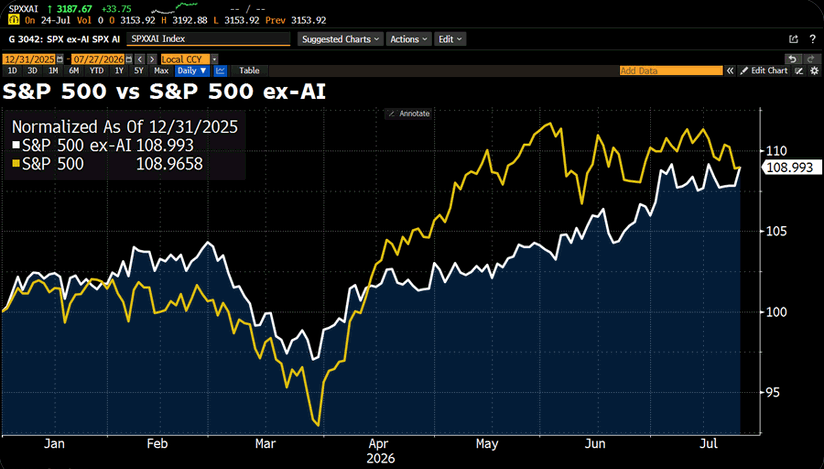
AI’s contribution to the S&P 500’s 2026 return has gone to zero and just crossed into negative — a regime marker, not a rounding error. Seven months, roughly nine percent, and every basis point of it belongs to the other ~490 names. The mechanism is a sign flip on capex. Guidance that in 2024 read as a demand signal now reads as a claim on free cash flow — every incremental dollar of guided spend compresses the multiple instead of extending it, which is why 23 July erased near $780bn from the Magnificent 7 in a single session. Microsoft at roughly -20% and Meta at -12% are multiple stories, not demand stories. Owning that risk paid nothing. Roughly three points worse at the March trough, five better at the May peak, level today — all of the variance, none of the premium. The unwind arrived as a handoff, not a crash. Equal weight runs more than two percentage points ahead of cap weight and closed the first half up 12.1%, with financials, healthcare, industrials and the small-cap tail absorbing the flow the megacaps gave up. The concentration risk everyone underwrote resolved without the accident. Microsoft, Meta, Amazon and Apple report within days. Three years of index performance were an AI story — the next quarter decides whether that sentence needs a past tense — or an obituary.
Market Intelligence Brief (MIB) Ver. 18.45
For professional investors only. Not investment advice.
© 2026 RecessionALERT.com

Comments are closed.