
MARKET INTELLIGENCE BRIEF (MIB)
Tuesday, July 28, 2026
China cracked the last chip chokepoint — domestic lithography in mass production — and the semiconductor index fell a fourth straight day, now 20% off its high. Yet the equal-weight S&P 500 closed at a record: rotation, not retreat. Oil broke below $80 on a Gulf-backed Hormuz plan. Consumer confidence missed a third month; hiring slowed a fifth week. J&J settled talc for $5.5B and closed at a record. Apple touched $5 trillion, then let it go — Fed decides tomorrow.
TABLE OF CONTENTS
A. EXECUTIVE SUMMARY
B. MARKET DATA
C. HIGH-IMPACT STORIES (5)
D. MODERATE-IMPACT STORIES (6)
E. ECONOMY WATCH (5)
F. EARNINGS WATCH (7)
G. WHAT’S NEXT
H. CHART OF THE DAY
A. EXECUTIVE SUMMARY -> TOP
The Dow gained 1.03% to 52,747.53 and the equal-weighted S&P 500 closed at a record while the Nasdaq 100 fell 0.99% — a split that marks a competitive repricing rather than a risk-off session. China’s move to mass-produce domestic immersion DUV lithography removes the export-control chokepoint underwriting the Western semicap investment case, and it was memory, the commodity end of the chain, that took the heaviest losses. Crude’s 4.20% slide to $79.14 on a Gulf-backed Omani plan to formalize Hormuz transit strips the most awkward variable from tomorrow’s FOMC table, and the market responded by taking hedges off — VIX -2.52%, both yield wings down roughly four basis points in parallel, precious metals lower as a bloc — into a decision still priced one-in-three for a hike. Breadth was genuinely broad rather than defensive: seven of eleven sectors advanced with Financials and Real Estate joining Consumer Defensive (+2.19%) and Healthcare (+2.00%), against Technology’s -1.49%.
• The PHLX Semiconductor Index fell for a fourth consecutive session and now sits more than 20% below its June 22 record after a Shanghai state-backed firm began mass-producing immersion DUV lithography tools; Micron -8.85%, AMD -8.15%, Applied Materials -7.82%, Lam Research -7.54%, SanDisk -14.25%. Roughly $3.3 trillion of global chip value has been erased since June 22.
• The FOMC decides tomorrow at 2:00pm ET with futures at roughly 64% for a hold at 3.50-3.75% and about 35% for a 25 basis-point hike; Hammack and Logan are expected to dissent hawkish. This is a non-SEP meeting, so no dot plot accompanies the statement — press conference 2:30pm ET.
• Consumer Confidence fell to 90.8 against 92.3 consensus, a third straight monthly miss, while ADP’s weekly tracker showed hiring decelerating a fifth consecutive week to roughly 15,000 per week from 16,500. The tape rallied anyway, and Coca-Cola reported global unit case volume +5% with raised guidance the same morning.
• Johnson & Johnson closed at a record, up roughly 2.3%, on a $5.5 billion proposal to resolve about 76,000 ovarian talc claims — 99.75% of those remaining — with no payment before 2027. The deal is conditioned on plaintiff firms representing 95% of claimants signing on.
• Apple touched $5.036 trillion intraday, the second company ever to reach the threshold, but needed $340.43 to close there and did not, finishing near $4.97 trillion. Fiscal Q3 results land Thursday July 30.
• The FCC barred Chinese humanoid robots and connected power inverters on communications-security grounds, a licensing instrument rather than a trade one, with the tariff regime on its third legal iteration in six months. Inverters are grid-interconnection hardware for data centers.
1. Two sessions, two different repricings of the same trade — Monday repriced how AI capital expenditure gets financed, on reports Nvidia might backstop $250 billion of OpenAI’s obligations. Today repriced what that expenditure earns. A 28nm domestic Chinese tool does not threaten leading-edge logic and will not for years; what it removes is the export-control chokepoint that underwrote the Western semicap investment case. The risk was never that China builds better chips, it is that China builds enough of them into markets where price is set at the margin — which is why memory took the largest losses. A capital-structure question and a competitive question arriving twenty-four hours apart is the standard mechanism by which multiple compression begins, and Apple’s run at $5 trillion is the same trade seen from the other side: restrained AI capex, criticised through 2025, is now the characteristic being paid for.
2. The rotation is real, and transports are the one piece that does not fit — an equal-weight record on a 1.49% technology decline requires unusually broad participation everywhere else, and this was not a defensive huddle: Financials +0.71% and Real Estate +0.43% advanced alongside staples and healthcare, with gainers spanning IT services, biotech, insurance and life sciences. The exception is the Dow Transportation Average, down 0.80% for a second consecutive session into a two-day decline of roughly 12% in crude. A sector selling off as its largest input cost collapses is not telling a cost story, and with no company-specific catalyst identified, freight demand is the residual explanation.
3. A de-hedged market walks into a live decision — hedges stayed on through Monday’s 8% oil crash and came off today without any new information about the decision arriving. Two features mark this as position reduction rather than a changed view: the yield move was parallel rather than concentrated in the front end, and the precious complex fell as a bloc rather than splitting safe-haven from industrial. The asymmetry is now unusually clean. A hold is substantially priced and should produce little; a hike arrives into thinner protection than existed twenty-four hours ago. With no dot plot, every ounce of repricing weight falls on the statement language and the press conference, where what actually gets set is the September path rather than tomorrow’s level.
 — Leading economic indicators. Accurate market forecasts. Apply for membership at join.recessionalert.com
B. MARKET DATA -> TOP
A deepening semiconductor rout — fresh signs of Chinese progress in advanced memory and lithography compounding AI-capex sustainability fears — made Technology the day’s worst sector (-1.49%) and dragged the Nasdaq 100 down 0.99%, even as the Dow surged 1.03% to a fresh 10-session high on Coca-Cola’s earnings beat and raised FY guidance. Seven of eleven sectors gained as defensives (Consumer Defensive +2.19%, Healthcare +2.00%) led over Technology and Energy. Oil extended its slide (WTI -4.2%, Brent -4.6%) as the US-Iran strike pause held, while gold and yields eased ahead of Wednesday’s FOMC decision — a rare session where equities, oil, and gold all softened outside chip-selloff refugees.
CLOSING PRICES – July 28, 2026:
MAJOR INDICES
DJIA’s 1.03% gain against DJTA’s 0.80% decline is today’s clearest same-day Dow Theory split — industrials confirmed, transports did not, undercut by the chip-driven Nasdaq slide’s limited transport exposure. Over the past 10 sessions, the S&P 500 has now outpaced the Nasdaq 100 by roughly 4.7 points for a third consecutive session, a sustained broadening-rotation pattern favoring value/cyclicals over mega-cap growth. NYSE Composite breadth (+0.54%) tracked closer to the S&P than the Dow, signaling the blue-chip pop was concentrated rather than universally broad.
| Index | Close | Change | %Move | Why It Moved |
|---|---|---|---|---|
| S&P 500 | 7,431.43 | +18.19 | +0.25% | Mixed session — blue-chip/defensive strength offset by chip-sector drag |
| Dow Jones | 52,747.53 | +537.45 | +1.03% | Coca-Cola earnings beat, raised FY guidance; fresh 10-session high |
| DJ Transportation | 21,889.9 | -176.4 | -0.80% | Did not confirm Dow’s rally — Dow Theory same-day divergence |
| Nasdaq 100 | 27,763.13 | -276.08 | -0.99% | Global semiconductor rout on China chip-progress reports, AI-capex fears |
| Russell 2000 | 2,952.40 | +4.36 | +0.15% | Tracked broad market, muted small-cap participation |
| NYSE Composite | 24,229.67 | +130.83 | +0.54% | Broad-market breadth tracked closer to S&P than Dow’s mega-cap pop |
VOLATILITY & TREASURIES
VIX’s 2.5% decline alongside falling yields (10Y -4bps, 2Y -4bps) reads as calm ahead of Wednesday’s FOMC decision rather than fear, despite the chip-sector rout. The 2Y and 10Y fell in tandem, leaving the curve’s shape largely unchanged; DXY’s modest 0.13% dip suggests no meaningful safe-haven dollar bid despite the Asian chip selloff bleeding into US tech.
| Instrument | Level | Change | Why It Moved |
|---|---|---|---|
| VIX | 18.20 | -0.47 (-2.52%) | Options markets calm heading into FOMC despite chip-sector rout |
| 10-Year Treasury Yield | 4.600% | -4.1 bps | Yields eased into Wednesday’s rate decision |
| 2-Year Treasury Yield | 4.279% | -4.4 bps | Front-end tracked 10Y lower ahead of FOMC |
| US Dollar Index (DXY) | 101.41 | -0.13 (-0.13%) | Little safe-haven bid despite Asian chip selloff |
COMMODITIES
Gold, silver, and platinum all fell together (-1.2% to -2.3%) — precious metals moving in lockstep rather than splitting on safe-haven vs. industrial demand, consistent with pre-FOMC de-risking rather than a growth-scare narrative. Copper’s shallower 0.65% decline kept pace with the broader risk-off mood without confirming an industrial-demand shock. Bitcoin’s 1.6% slide tracked equities’ chip-driven weakness rather than decoupling into its own narrative.
| Asset | Price | Change | %Move | Why It Moved |
|---|---|---|---|---|
| Gold | $4,025.70/oz | -$51.30 | -1.26% | Trading below $4,100 ahead of FOMC rate decision |
| Silver | $57.362/oz | -$1.350 | -2.30% | Tracked gold and platinum lower in a precious-metals-wide pullback |
| Copper | $6.3375/lb | -$0.0415 | -0.65% | Modest pullback with the broader risk-off tone |
| Platinum | $1,613.05/oz | -$19.15 | -1.17% | Fell alongside gold and silver in precious-metals-wide pullback |
| Bitcoin | $63,963.0 | -$1,032.0 | -1.59% | Tracked equities’ chip-driven weakness, no idiosyncratic catalyst |
ENERGY
WTI and Brent fell in near-lockstep (-4.2%/-4.6%), confirming the US-Iran strike-pause de-escalation as a global supply story rather than a regional one. Natural gas sat out the crude story entirely — Henry Hub’s 3.8% drop to 3-month lows reflects record domestic production and weak LNG feedgas demand, a purely domestic oversupply dynamic. With the Dow still higher, falling oil reads as supply relief, not demand destruction — a bullish, non-stagflationary signal.
| Asset | Price | Change | %Move | Why It Moved |
|---|---|---|---|---|
| Crude Oil (WTI) | $79.14/bbl | -$3.47 | -4.20% | US-Iran strike pause holds; Trump says talks going well |
| Crude Oil (Brent) | $81.92/bbl | -$3.95 | -4.60% | Global supply-risk premium unwinding alongside WTI |
| Natural Gas (Henry Hub) | $2.682/MMBtu | -$0.106 | -3.80% | 3-month low on record production, weak LNG feedgas demand |
| Natural Gas (Dutch TTF) | $19.05/MMBtu | -$0.37 | -1.89% | Softer than Henry Hub’s decline; European dynamics decoupled from US glut |
S&P 500 SECTORS
Technology was both the session’s (-1.49%) and the week’s (-5.16%) worst sector on the chip rout — but with 3-month/6-month/YTD gains of +3.27%/+12.75%/+13.87%, this reads as a sharp short-term flush within a longer uptrend, not a structural break. Consumer Defensive and Healthcare topped both the 1-day and 1-week leaderboards, confirming a classic defensive rotation beneath the Dow’s blue-chip pop.
| Sector | 1-Day | 1-Week | 1-Month | 3-Month | 6-Month | YTD | 12-Month |
|---|---|---|---|---|---|---|---|
| Consumer Defensive | +2.19% | +3.71% | +2.08% | +3.38% | +4.07% | +10.58% | +8.28% |
| Healthcare | +2.00% | +3.23% | +2.96% | +14.05% | +4.81% | +7.78% | +22.14% |
| Communication Services | +1.65% | -2.70% | +1.28% | -5.99% | -4.14% | -2.37% | +14.73% |
| Consumer Cyclical | +1.07% | -3.12% | -1.08% | -5.63% | -9.74% | -7.59% | -2.58% |
| Financial | +0.71% | +1.83% | +6.07% | +11.16% | +7.98% | +7.77% | +13.86% |
| Real Estate | +0.43% | +1.30% | +1.80% | +6.30% | +10.92% | +13.63% | +8.99% |
| Basic Materials | +0.11% | +1.15% | -1.29% | -7.67% | -7.29% | +8.13% | +27.10% |
| Industrials | -0.32% | +0.52% | -4.00% | -0.66% | +4.87% | +12.82% | +14.02% |
| Utilities | -0.59% | +0.53% | -2.20% | -4.02% | +3.70% | +5.83% | +9.92% |
| Energy | -0.98% | -1.44% | +7.27% | -0.76% | +17.42% | +28.14% | +32.39% |
| Technology | -1.49% | -5.16% | -3.42% | +3.27% | +12.75% | +13.87% | +22.95% |
TOP MEGA-CAP MOVERS:
GAINERS
| Company | Ticker | Close | Change | Why It Moved |
|---|---|---|---|---|
| International Business Machines Corp | IBM | $227.55 | +5.21% | Rotation into Tech IT-services amid semiconductor selloff; specific catalyst unconfirmed |
| Coca-Cola Co | KO | $88.27 | +5.00% | Q2 EPS beat ($0.97 vs. $0.93 est.), raised FY26 comparable EPS growth outlook to 9-10% |
| Amgen Inc | AMGN | $392.89 | +4.42% | Healthcare defensive rotation; specific catalyst unconfirmed |
| Berkshire Hathaway Inc | BRK-B | $512.37 | +3.06% | Financial defensive rotation amid tech selloff; specific catalyst unconfirmed |
| Thermo Fisher Scientific Inc | TMO | $576.41 | +3.02% | Healthcare defensive rotation; specific catalyst unconfirmed |
DECLINERS
| Company | Ticker | Close | Change | Why It Moved |
|---|---|---|---|---|
| Micron Technology Inc | MU | $820.53 | -8.85% | Chip-sector rout on China memory/lithography progress; SK Hynix (-14.7%), Samsung (-13.4%) led Asian selloff |
| Dell Technologies Inc | DELL | $392.10 | -8.15% | AI-server supply-chain exposure caught in broad memory/chip selloff |
| Advanced Micro Devices Inc | AMD | $454.62 | -8.15% | Same chip-sector rout; AI-capex demand-sustainability concerns |
| Applied Materials Inc | AMAT | $476.46 | -7.82% | Semiconductor-equipment exposure to the broader chip selloff |
| Lam Research Corp | LRCX | $269.61 | -7.54% | Same semiconductor-equipment rout |
— Institutional-grade intelligence for serious investors. Apply for membership at join.recessionalert.comC. HIGH-IMPACT STORIES -> TOP
BEARISH
1. China Breaks the Last Chokepoint: Domestic Immersion Lithography Enters Mass Production, Tripping a Kospi Circuit Breaker and a Fourth Straight Loss for US Chips
The core facts:The Information reported that a Shanghai-based, state-backed company has begun mass production of homegrown immersion deep-ultraviolet lithography machines — the one link in the chip supply chain China could not previously build. The firm assembled development teams from other Chinese companies including Shanghai Yuliangsheng Technology, linked to Huawei’s SiCarrier investment vehicle; the tool has been under evaluation at SMIC since September 2025, is initially targeted at 28nm, and was engineered with the option to reach 7nm or 5nm through complex multipatterning. Asian markets absorbed it first: South Korea’s Kospi fell 10.8%, its biggest one-day decline since March, triggering a 20-minute circuit breaker, with Samsung Electronics down 13.4% in its worst session in almost two decades, SK Hynix down 14.7%, Japan’s Kioxia down 18.3% and Taiwan’s MediaTek down almost 10%. In the US the PHLX Semiconductor Index fell as much as 6% in a fourth consecutive losing session, its longest streak this year, and now sits more than 20% below its June 22 record. Micron closed -8.85%, Dell -8.15%, Advanced Micro Devices -8.15%, Applied Materials -7.82%, Lam Research -7.54% and SanDisk -14.25% in a third straight double-digit slide. Technology was the worst of eleven sectors at -1.49% and the Nasdaq 100 fell 0.99% to 27,763.13, roughly 9.7% below its record high. Some $3.3 trillion of global chip market value has been erased since June 22.
Why it matters:Yesterday’s chip selloff was about who pays; today’s is about who competes, and the two are not the same repricing. A domestic Chinese immersion DUV tool at 28nm does not threaten leading-edge logic — it is several generations behind ASML’s EUV and will stay there. What it removes is the export-control chokepoint that underwrote the entire Western semicap investment case. The danger was never that China builds better chips; it is that China builds enough chips, adding trailing-edge and memory capacity into markets where price is set at the margin. That is precisely the pattern the tape drew: memory and memory-adjacent names took the largest losses — Micron -8.85%, SK Hynix -14.7%, Samsung -13.4%, Kioxia -18.3%, SanDisk -14.25% — because memory is the commodity, and commodity capacity additions are a pricing problem rather than a technology problem. The sequencing is what makes this consequential. Monday repriced how AI capital expenditure gets financed; Tuesday repriced what that expenditure earns. A capital-structure question and a competitive question arriving twenty-four hours apart is the standard mechanism by which multiple compression begins, and a fourth consecutive down session with the index more than 20% off its high says the market has started treating this as a de-rating rather than a drawdown.
What to watch:Lam Research reports after the bell tomorrow, Wednesday July 29 — its China revenue mix and wafer-fab-equipment commentary is the first direct management read on whether domestic Chinese tool production is already displacing orders. A guidance cut citing China would convert today’s report from a headline into a revenue event.
BEARISH
2. Gulf States Back an Omani Plan to Institutionalise Hormuz Passage, Converting a Strike Pause Into a Structural Settlement and Driving WTI Below $80
The core facts:WTI settled at $79.14 a barrel, down 4.20%, and Brent at $81.92, down 4.60%, a second consecutive session of heavy losses that takes the US benchmark below $80 for the first time since the escalation began. The fresh catalyst is a Gulf-backed Omani proposal under which Iran would collect voluntary transit fees from ships using the Strait of Hormuz and jointly manage the waterway with Oman — which controls the opposite shore — rather than exercising sole authority. The scheme is explicitly modelled on the Strait of Malacca arrangement, where Indonesia, Malaysia and Singapore invite voluntary contributions that fund navigation services, environmental protection and search-and-rescue. President Trump separately said talks were going well, following his weekend halt of a two-week US air campaign after commanders reported its objectives had been met. Energy closed -0.98%, the second-worst sector of eleven. Washington and Tehran continue to dispute the terms of the June framework agreement governing Hormuz navigation, and Lloyd’s List Intelligence tracked only 78 Hormuz transits in the week of July 13-19 against 174 the week before. Section E carries the fuller energy-inflation framing.
Why it matters:Monday’s 8% collapse rested entirely on the absence of strikes across a single weekend — a fact pattern capable of reversing in an afternoon. Today’s development is categorically different, because a named sponsor, a named mechanism and a working precedent are the ingredients that convert a pause into an arrangement. Markets are not pricing peace here; they are pricing the removal of one specific, quantifiable premium — the possibility that Hormuz closes entirely. That distinction is what makes the two-session decline of roughly 12% in WTI more durable than the first day alone justified. For the committee concluding its meeting tomorrow it removes the single most awkward variable on the table: an energy shock that the Chair has publicly argued should not automatically trigger a hike no longer requires that argument to be made at all, which is a materially easier position to hold than the one he occupied a week ago. The caveats are real and they are structural rather than rhetorical. Voluntary means unenforceable, the June framework remains disputed, and transits are still running at under half their pre-escalation rate — so the physical constraint the market is now discounting has not actually been lifted.
What to watch:Whether Iran responds publicly to the Omani proposal, and whether weekly Hormuz transit counts recover toward the 174 recorded before the escalation. Transit volumes, not diplomatic headlines, are the test of whether this arrangement is real.
UNCERTAIN
3. FCC Bars Chinese Humanoid Robots and Connected Power Inverters, Moving the AI Supply Chain From a Tariff Question to a Licensing One
The core facts:The Federal Communications Commission on Tuesday released measures barring Chinese imports of new humanoid and quadruped robots along with connected power inverters — the devices that link renewable generation, battery storage and data-centre equipment to the grid. The FCC stated the devices “could create supply chain vulnerabilities that could disrupt U.S. economic and national security and could create a cybersecurity risk that threatened American critical infrastructure.” The stated rationale spans disruption, data theft and cyberattack risk, alongside an explicit intent to push firms to reshore manufacturing. The measures sit alongside the GUARD Act framework, which would place such systems on the FCC’s Covered List and strip their wireless licences. The action was first reported by Reuters and carried by CNBC and MarketScreener. It arrives with the administration’s tariff authority under active challenge: the Supreme Court struck down the IEEPA tariffs in February and the Section 122 surcharge in May, and two lawsuits filed on July 24 at the Court of International Trade now contest the Section 301 forced-labor duties that replaced them.
Why it matters:The instrument matters more than the target. A tariff taxes a good and can be absorbed, re-routed or litigated away; a Covered List designation revokes the authorisation to operate the device on US networks, which is a binary exclusion no price adjustment can engineer around — and, critically, one that rests on communications-security authority rather than the trade authority the courts have twice struck down. Read against a tariff regime on its third legal iteration in six months, this is the administration substituting a durable instrument for a contested one. Extending it to power inverters is the consequential half. Inverters are grid infrastructure, and the binding constraint on the US AI buildout is increasingly electrical rather than computational; removing the cheapest supplier of grid-interconnection hardware raises the delivered cost of every gigawatt of data-centre capacity at precisely the moment the market has begun questioning whether that capacity earns its return. The policy is defensive in intent and inflationary in effect, and it lands on the same session the chip complex fell for a fourth straight day on fears of Chinese competition — the two stories are the same story, one told through prices and one through law.
What to watch:Whether the final rule reaches inverters already installed rather than only new imports — a retroactive designation would force replacement capital expenditure across existing solar and storage fleets. Domestic inverter and grid-equipment manufacturers are the direct offsetting beneficiaries.
UNCERTAIN
4. Markets Take Their Hedges Off on the Eve of a Live Fed Decision: VIX Falls 2.5%, Both Yield Wings Drop Four Basis Points, Gold Sheds 1.3%
The core facts:With the FOMC’s two-day meeting opening today and the decision landing tomorrow at 2:00pm ET, the cross-asset configuration inverted from Monday’s. VIX fell 2.52% to 18.20. The 10-year Treasury yield fell 4.1 basis points to 4.600% and the 2-year fell 4.4 basis points to 4.279% — a near-parallel shift that left the 2s10s spread broadly unchanged around 32 basis points, in contrast to Monday’s flattening. Gold fell 1.26% to $4,025.70 an ounce, silver 2.30% and platinum 1.17%, the three precious metals moving as a bloc. The dollar index eased 0.13% to 101.41 and bitcoin fell 1.59%. Futures put roughly 63.5% to 65% on a hold at 3.50%-3.75% and about 35% on a surprise 25 basis point increase, with a half-point move priced as effectively impossible. This is a non-SEP meeting, so no updated dot plot accompanies the statement; the press conference follows at 2:30pm ET. Section E carries the full policy-odds and dissent detail.
Why it matters:Monday’s session showed hedges staying on through an 8% oil crash; today they came off without any new information about the decision itself arriving. Two features identify this as position reduction rather than a changed view. The yield move was parallel rather than curve-directional — a genuine repricing of near-term policy risk concentrates in the front end, and this did not. And the precious complex fell as a bloc rather than splitting between safe-haven and industrial demand, which is what de-risking looks like and what a growth or inflation signal does not. The risk this creates is specific and uncomfortable. A market that de-hedges into an event still priced at roughly one-in-three for a hike has withdrawn protection against precisely the outcome it regards as most disruptive, and the asymmetry is now unusually clean: a hold is substantially priced and should produce little, while a hike arrives into thinner hedging than existed twenty-four hours ago. The absence of a dot plot compounds it by concentrating every ounce of repricing weight into the statement language and the press conference, where what actually gets set is the September path rather than tomorrow’s level.
What to watch:VIX in the hour following tomorrow’s 2:30pm ET press conference. A failure to fall on a hold would confirm the risk has migrated to September rather than resolved — and would leave a de-hedged market carrying it.
BULLISH
5. The Equal-Weight S&P 500 Closes at a Record While the Nasdaq 100 Falls a Percent — the Broadening Is Now Doing the Index’s Work
The core facts:The Dow Jones Industrial Average gained 537.45 points, or 1.03%, to 52,747.53, its highest level in at least ten sessions, while the Nasdaq 100 fell 276.08 points, or 0.99%, to 27,763.13. The S&P 500 split the difference at +0.25% to 7,431.43 — and the equal-weighted S&P 500 closed at a record high, meaning the cap-weighted index’s modest print concealed genuinely strong breadth beneath it. Seven of eleven sectors advanced, led by Consumer Defensive at +2.19% and Healthcare at +2.00%, against Technology at -1.49% and Energy at -0.98%; Financials added 0.71% and Real Estate 0.43%. Over the past ten sessions the S&P 500 has now outpaced the Nasdaq 100 by roughly 4.7 points, a third consecutive session of that pattern. Among mega-caps, IBM rose 5.21%, Coca-Cola 5.00%, Amgen 4.42%, Berkshire Hathaway 3.06% and Thermo Fisher 3.02%. The NYSE Composite added 0.54%. The Dow Jones Transportation Average fell 0.80% to 21,889.9, a second consecutive failure to confirm the industrials.
Why it matters:The equal-weight record is the load-bearing fact, and it changes the interpretation of everything around it. A session in which the average stock makes a new high while the largest stocks fall is capital reallocating within the market rather than leaving it — which is the configuration bulls have wanted for two years and have largely not been given. The arithmetic sharpens the point: with Technology carrying roughly a third of S&P 500 weight, reaching an equal-weight record on a 1.49% technology decline requires unusually broad participation everywhere else, and that is why the cap-weighted index still closed higher while its heaviest sector fell hardest. Nor is this a pure defensive huddle, which is the obvious alternative reading — Financials and Real Estate both advanced alongside Consumer Defensive and Healthcare, and the gainers list spans IT services, staples, biotech, insurance and life sciences rather than clustering in one bond-proxy trade. The one piece the rotation thesis cannot absorb is transports, which have now fallen on consecutive sessions into a two-day decline of roughly 12% in crude, their single largest input cost. A sector selling off as its costs collapse is not a cost story, and with no company-specific catalyst identified, the residual candidate is freight demand.
What to watch:Whether the equal-weight index holds its record through tomorrow’s Fed decision, and whether the Dow Transportation Average confirms or diverges for a third straight session. A third decline on falling fuel costs would narrow the read from broad rotation to something more selective.
— Quantifying recession risk so you don’t have to guess. Apply for membership at join.recessionalert.comD. MODERATE-IMPACT STORIES -> TOP
BULLISH
6. Johnson & Johnson Proposes $5.5 Billion to End a Decade of Talc Litigation and Closes at a Record High
The core facts:Johnson & Johnson announced after Monday’s close an agreement for comprehensive resolution of the ovarian talc litigation with the plaintiff firms leading the federal multidistrict litigation and related state proceedings. The structure is per-claim payments against a $5.5 billion company commitment, with a first payment of no more than $3 billion in 2027 and no further payments due before 2028. It covers roughly 69,000 cases consolidated in federal court in New Jersey plus related state cases — about 76,000 claims in total, or 99.75% of remaining talc claims — and is conditioned on participation by plaintiff firms representing at least 95% of remaining claimants before it becomes final. Shares rose 1.2% in Monday’s after-hours session to $269.00 and added roughly 2.3% today to a record high, a sixth consecutive gain, leaving the stock up more than 30% year to date. Healthcare closed +2.00%, the second-best sector. J&J stopped selling talc-based baby powder in the US in 2020.
Why it matters:The headline number is not what moved the stock. Against a market capitalisation above $600 billion, $5.5 billion is under one percent, and the payment schedule defers the first outflow into 2027 — the cash cost is close to immaterial. What the agreement removes is the tail. Three attempts at a bankruptcy-based resolution failed, and a $1.5 billion single-plaintiff verdict in December 2025 established that individual trials could produce awards an order of magnitude above any plausible settlement average. Unquantifiable liability with no ceiling and no procedural route to one is exactly the exposure equity holders discount most severely and least precisely, and capping it is worth considerably more than the capping costs. The 95% participation condition is where the genuine risk now sits, and it is not trivial: the deal is not final until holdouts fall below that threshold, and the plaintiff firms holding the strongest individual cases have the weakest incentive to sign. Today’s record close prices the agreement as done rather than proposed.
What to watch:The participation rate as plaintiff firms sign on. A stall below 95% reopens precisely the tail the announcement closed, and the December 2025 verdict is the template for what individual trials can produce.
BULLISH
7. Apple Touches $5 Trillion Intraday to Become the Second Company Ever to Reach It — Then Fails to Hold It Into the Close
The core facts:Apple shares reached a session high of $342.89, lifting the company’s market capitalisation to $5.036 trillion and making it the second company in history to touch the threshold, after Nvidia. The stock needed to close above $340.43 to cross $5 trillion on a closing basis and did not, finishing with a capitalisation estimated between $4.96 trillion and $4.98 trillion. The milestone comes weeks after Apple reclaimed the most-valuable-company title from Nvidia, and less than a year after it first passed $4 trillion in October 2025. The move was below the 1.5% threshold required for today’s mega-cap movers table. Apple reports fiscal third-quarter results on Thursday July 30.
Why it matters:The timing carries more information than the milestone. Apple approached $5 trillion on the same session that memory and semicap names fell 8% and the chip index booked a fourth consecutive loss — the capital lifting Apple is, in meaningful part, capital leaving companies whose AI exposure obliges them to finance the infrastructure themselves. Apple’s restrained AI capital spending, criticised through 2025 as a strategic failure, has become the specific characteristic being paid for, and it has been rewarded on consecutive sessions as the alternative model was first revealed to need a $250 billion vendor backstop and then to face a new competitive threat. The intraday failure is worth as much attention as the print: it took a two-session rout in the largest AI-infrastructure names to carry Apple to $5.036 trillion, and it still could not close there. For index construction the practical consequence is narrow but real — concentration at the top of the S&P 500 is unchanged in degree while shifting in character, toward a balance sheet that carries no comparable financing contingency.
What to watch:Apple’s capital-expenditure commentary on Thursday’s earnings call. Any signal that it intends to fund AI infrastructure directly would remove the precise characteristic that just carried it to the threshold.
UNCERTAIN
8. Trump Says He “Doesn’t Care” About Updating USMCA — “I’d Rather Be Independent”
The core facts:Asked on Fox News whether he would update the United States-Mexico-Canada Agreement, President Trump replied “I don’t care” and “I’d rather be independent,” adding that “Mexico and Canada need us. We don’t need them. The deal is important for them. It’s not important for us.” He separately said the new tariffs are “doing the same thing” as the ones struck down by the Supreme Court. The context is that the United States declined at the mandated July 1 joint review to renew USMCA for a further sixteen years — Canada and Mexico both backed extension — triggering annual reviews under Article 34.7.4 that now run until the pact’s built-in July 1, 2036 expiry. The agreement remains fully in force, and a sixteen-year extension is available at any time by written confirmation of the three heads of government. Separately, three proclamations signed July 20 under Section 338 of the Tariff Act of 1930 — the first-ever use of that authority — impose an additional 50% tariff on lists of Canadian imports spanning wine, hockey sticks, cement and motor vehicles, effective August 19 and applying regardless of whether goods qualify under USMCA.
Why it matters:North American manufacturing capacity is financed on multi-decade assumptions, and the July 1 non-renewal already swapped a sixteen-year planning horizon for a rolling one-year one. Today’s remarks close off the most plausible route back — restoring the long horizon requires only written confirmation from three heads of government, which is to say it requires only political will, and the President has just stated he has none. What converts this from rhetoric into a pricing problem is its interaction with Section 338. A first-ever use of 1930 authority that explicitly overrides USMCA origin rules demonstrates that qualifying under the agreement no longer insulates a good from tariff action, which means the agreement’s remaining term is no longer the binding variable — the willingness to bypass it is. Capital allocation for auto and industrial capacity in Canada and Mexico now carries a renewal risk that reprices every twelve months and an origin-rule protection that has already been shown to be optional. Markets have not charged for any of this: the dollar closed down 0.13% and the tape rallied, which is the characteristic response to trade risk with a distant effective date.
What to watch:The August 19 effective date for the Section 338 Canadian tariffs, and whether Ottawa or Mexico City announces retaliatory measures before it. Auto and machinery names with Canadian and Mexican manufacturing footprints carry the direct exposure.
BEARISH
9. Consumer Confidence Misses for a Third Straight Month and Weekly Hiring Decelerates for a Fifth — and the Tape Rallies Anyway
The core facts:Conference Board Consumer Confidence fell to 90.8 in July against a 92.3 consensus, a third consecutive monthly decline, while ADP’s weekly tracker showed hiring decelerating for a fifth straight week to roughly 15,000 per week from 16,500 prior. Section E carries the full breakdown of both releases. The equity response ran the other way: the Dow gained 1.03%, Consumer Defensive led all eleven sectors at +2.19% and Consumer Cyclical added 1.07%. Treasury yields fell across the curve, the 10-year by 4.1 basis points to 4.600% and the 2-year by 4.4 basis points to 4.279%.
Why it matters:Markets treated softening consumer and labour data as a rate story rather than an earnings story — and today supplied an unusually direct test of whether that is right. Coca-Cola reported global unit case volume up 5% before the bell, actual volume rather than price, and raised full-year guidance on the same morning confidence printed its third consecutive miss. Where survey-based sentiment and observed consumption diverge, consumption has by far the better forecasting record, and the gap is now wide enough to matter for how the committee weighs its own dual mandate a day before deciding. The labour signal is the more serious half and points the other way. A fifth consecutive week of decelerating hiring is a trend rather than a print, and it arrives with the front end already rallying — meaning the market has positioned for the employment side of the mandate to dominate the inflation side. That is not obviously the conclusion a committee facing 4.2% year-on-year CPI will reach, and the gap between what the curve has priced and what the statement may say is the exposure heading into tomorrow.
What to watch:ADP’s own fiscal fourth-quarter results before the bell tomorrow, where the pays-per-control employment metric offers a direct read on the same client payrolls that feed the weekly tracker. A soft reading there would make five weeks of deceleration much harder to characterise as noise.
UNCERTAIN
10. Case-Shiller Home Prices Reaccelerate to 1.6% Year on Year, Beating Estimates — While Real Home Values Fall for a Twelfth Straight Month
The core facts:The Case-Shiller 20-City Composite rose 1.6% year on year in May, beating the 1.3% estimate and accelerating from April, even as real home values adjusted for roughly 4.2% CPI fell for a twelfth consecutive month. Section E carries the full data breakdown. Real Estate closed +0.43%, a middling seventh-place finish among eleven sectors, on a session when the 10-year Treasury yield fell 4.1 basis points to 4.600%.
Why it matters:The nominal beat and the real decline are one fact expressed in two units, and which unit governs depends entirely on who holds the asset. For a leveraged owner servicing a fixed nominal mortgage, 1.6% nominal appreciation against 4.2% inflation is a real erosion of equity that nonetheless services the debt without strain. For a homebuilder, nominal is what clears inventory and the beat is unambiguously good. For the Federal Reserve, a twelfth consecutive month of falling real home values is the shelter channel finally transmitting — and shelter is the largest and stickiest component of the very CPI basket the committee is meeting on today. The muted sector response reinforces a pattern that has now held for three sessions: Real Estate managed only 0.43% on a four-basis-point yield decline, having led all sectors at +2.08% on a smaller two-basis-point decline last Friday. Rate-sensitive sectors are no longer trading the rate, which should trouble anyone holding them as duration hedges into tomorrow. The release lag is the necessary caveat — this is May data arriving in late July, predating both the oil collapse and the current mortgage-rate configuration entirely.
What to watch:Whether the shelter component of the next CPI release decelerates in line with the real-value decline. Shelter is where a twelve-month trend in home values eventually surfaces in the inflation measure the Fed actually targets.
BEARISH
11. Henry Hub Natural Gas Falls to a Three-Month Low on Record US Production, Decoupling Entirely From the Crude Story
The core facts:Henry Hub natural gas fell 3.80% to $2.682 per MMBtu, its lowest level in roughly three months, on record domestic production, ample storage and weak LNG feedgas demand. Dutch TTF fell only 1.89% to $19.05 per MMBtu over the same session, while WTI crude fell 4.20% and Brent 4.60%. Separately, Cheniere Energy received approval to introduce gas into the final train at its Corpus Christi LNG facility. Utilities closed -0.59%, ninth of eleven sectors.
Why it matters:The divergence within the energy complex is the information, not the decline itself. Crude fell on a geopolitical risk-premium unwind that can reverse on a single headline; Henry Hub fell on domestic supply, which cannot. A US benchmark at a three-month low while the European benchmark declines by less than half as much confirms a North American oversupply condition rather than a global energy repricing — and oversupply does not un-produce itself. For the industrial and utility complex that makes this a durable input-cost decline rather than a headline one, which sits awkwardly against Utilities closing down 0.59%, since that is the sector positioned to benefit most directly. The Cheniere approval points to how the imbalance eventually resolves: incremental LNG export capacity is the only mechanism by which domestic surplus reaches global pricing, and each new train narrows a Henry Hub-to-TTF spread currently running above seven times. Until that capacity ramps, US industrial energy costs remain structurally advantaged against European competitors — a quiet but persistent margin tailwind for domestic manufacturing that the market has largely stopped pricing.
What to watch:The weekly EIA natural gas storage report and whether Henry Hub holds $2.60. A break below that level with production at records would signal the surplus is outrunning export-capacity additions rather than being absorbed by them.
— Separating signal from noise since 2007. Apply for membership at join.recessionalert.comE. ECONOMY WATCH -> TOP
Consumer-facing data cracked today: confidence fell to an eight-month low (90.8, missing consensus) and ADP’s weekly tracker showed hiring decelerating for a fifth straight week, even as June’s trade deficit narrowed on falling imports — a demand-side signal, not strength — and May home prices reaccelerated to 1.6% annually while still losing ground to inflation in real terms. The data lands a day ahead of Wednesday’s FOMC decision, where Warsh is expected to hold at 3.50%-3.75% despite two hawkish dissents from Hammack and Logan. The split — softening consumer sentiment against a still-divided, inflation-wary Fed — keeps Thursday’s GDP/PCE prints as the week’s pivotal read on which signal wins out.
Consumer Confidence Falls to 90.8 in July, Missing Consensus (Conference Board / Bloomberg, July 28, 2026)
What they’re saying:The Conference Board’s Consumer Confidence Index fell to 90.8 in July from 92.2 in June, missing the 92.3 consensus estimate. The Present Situation Index dropped 3.6 points to 114.9 — a third straight monthly decline — while the Expectations Index held at 74.7, still in negative territory.
The context:The miss reflects growing consumer unease about business conditions and the labor market rather than near-term geopolitical noise (the survey window closed as Mideast tensions eased). It’s the third consecutive monthly deterioration, arriving one day before the Fed’s rate decision and adding to the case that household demand is cooling faster than forecasters had priced in.
What to watch:Friday’s Michigan Consumer Sentiment Final (July 31) and the August Conference Board release for confirmation of the trend.
Goods Trade Deficit Narrows to $101.5B in June, Just Missing Forecast (Census Bureau / Bloomberg, July 28, 2026)
What they’re saying:The advance goods trade deficit narrowed to $101.5B in June from $105.9B in May, versus a $100.0B consensus. Exports fell $3.8B to $204.7B while imports fell a larger $8.2B to $306.2B.
The context:The narrower gap was driven by falling imports rather than export strength — a demand-side signal, not a competitiveness one — and the deficit still missed the consensus narrowing. Trade remains a modest drag on growth heading into Thursday’s Q2 GDP advance estimate.
What to watch:Thursday’s GDP Growth Rate QoQ Advance (July 30) — trade will be scrutinized as a component of any growth downgrade.
Case-Shiller Home Prices Post Broadening 1.6% Annual Gain in May, Ahead of Estimates (S&P Dow Jones Indices, July 28, 2026)
What they’re saying:The Case-Shiller 20-City Composite rose 1.6% year-over-year in May, beating the 1.3% estimate and accelerating from 1.2% in April; the National Index gained 1.1% YoY, up from 0.9%. FHFA’s House Price Index also topped forecasts.
The context:Nominal home-price growth is reaccelerating for the first time in months, but with CPI running near 4.2%, real home values fell for a 12th straight month — an affordability signal that cuts against the “housing recovery” headline. Regional divergence is stark: Chicago +6.9% YoY versus Las Vegas -1.9% YoY.
What to watch:August’s Case-Shiller release and the mortgage-rate path following tomorrow’s Fed decision.
ADP Weekly Tracker Shows Hiring Slowing for a Fifth Straight Week (ADP / Bloomberg, July 28, 2026)
What they’re saying:ADP’s NER Pulse shows private employers added an average of 15,000 jobs per week over the four weeks ending July 11, down from 16,500 the prior week — the fifth consecutive weekly deceleration.
The context:The high-frequency slowdown corroborates today’s consumer confidence miss and reinforces a labor-market-cooling narrative that has been building gradually rather than through a single sharp break, giving the Fed’s hold case additional support.
What to watch:Friday’s Employment Cost Index (July 31) and next week’s official July nonfarm payrolls report.
Fed Preview: Warsh Seen Holding Rates Wednesday Despite Two Hawkish Dissents (CNBC, July 28, 2026)
What they’re saying:Consensus expects the FOMC to hold its benchmark rate at 3.50%-3.75% Wednesday — a fifth straight hold — with Cleveland’s Hammack and Dallas’s Logan expected to dissent in favor of a hike. Chair Warsh, who dropped forward-guidance language from the post-meeting statement in June, is expected to offer only minimal color on the internal debate.
The context:The expected dissents crystallize the “family fight” inside the Fed between hawks pointing to inflation running above target for five years and a base case that cooling June CPI/PPI and today’s soft consumer and labor signals justify staying put. A hold-with-dissent outcome would be a lower-drama resolution than the “coin flip” framing some forecasters used last week.
What to watch:Wednesday’s 2:00pm ET rate decision and 2:30pm press conference; watch the dissent count and any shift in Warsh’s tone on the inflation-transitory debate.
— Know the probability before the market prices in the risk. Apply for membership at join.recessionalert.comF. EARNINGS WATCH -> TOP
YESTERDAY AFTER THE BELL (Markets Reacted Today)
BULLISH
12. Welltower (WELL): +4.5% AH | FFO Up 25%, Guidance Raised a Second Time, Dividend Lifted 15%
The Numbers:Released AMC Monday July 27. Normalized funds from operations of $1.60 per diluted share, up 25% year on year and ahead of consensus. Full-year 2026 normalized FFO guidance raised to $6.36-$6.44 per share against roughly $6.32 consensus — the second consecutive quarterly increase. Quarterly dividend lifted 14.9% to $0.85 per share. Shares rose approximately 4.5% in Monday’s extended session and reached a new twelve-month high today.
The Problem/Win:The win is the senior housing operating portfolio, where occupancy and rate are both still climbing off a pandemic-era base, and management is aggressively reallocating capital to concentrate on it. Welltower acquired the Amica Senior Lifestyles portfolio — 38 communities for $1.91 billion — while disposing of $7.2 billion of outpatient medical properties, a decisive rotation out of medical office and into senior housing. A 15% dividend increase alongside a second guidance raise is the clearest signal management can send that it regards the FFO trajectory as durable rather than cyclical.
The Ripple:Real Estate closed +0.43% today, a middling result that shows Welltower’s strength did not generalise to the sector — the outpatient medical assets it sold at scale are exactly the property type other healthcare REITs remain heavily weighted to. This is a property-type call rather than a rate call, which matters given the sector’s broader failure to respond to a four-basis-point decline in the 10-year yield.
What It Means:Twenty-five percent FFO growth from a REIT of this size is a demographic story rather than a rate story, and it is one of the few genuinely non-cyclical growth profiles available in real estate. The risk is concentration: management has now bet the portfolio on a single property type at the top of its cycle.
What to watch:Equinix reports after the bell tomorrow — the other >$100B REIT this week, and the test of whether sector strength is property-type specific or genuinely broad.
TODAY BEFORE THE BELL (Markets Already Reacted)
BULLISH
13. Coca-Cola (KO): +5.00% | Volume Up 5% and Guidance Raised — Demand, Not Just Pricing
The Numbers:Released BMO. Comparable EPS of $0.97 against $0.93 consensus, a 4.07% beat; GAAP EPS of $1.03 against $0.93, an 11.11% beat. Net revenue of $13.37 billion against $13.17 billion expected, up 7% year on year and a 1.53% beat. Organic revenue grew 6%, comprising a 4% increase in concentrate sales and 2% from price/mix. Global unit case volume rose 5%. Full-year 2026 guidance raised: organic revenue growth of approximately 5%, at the high end of the prior range, and comparable EPS growth of 9-10% against a prior 8-9%.
The Problem/Win:The win is the volume line, and it is not close. Five percent global unit case growth means people bought 5% more physical product — the composition of the 6% organic gain, 4 points from concentrate sales and only 2 from price/mix, confirms this quarter was driven by demand rather than the price-led arithmetic that has carried consumer staples for three years. A staples company growing volume at 5% while raising full-year guidance is running a fundamentally different business from one defending margin through pricing.
The Ripple:Coca-Cola’s 5.00% gain was the second-largest among mega-caps and the single largest contributor to the Dow’s 537-point advance to a ten-session high. Consumer Defensive led all eleven sectors at +2.19%, and the read-through lands directly on Procter & Gamble, which reports before the bell tomorrow into the same question about whether staples volumes have genuinely turned.
What It Means:This is the most direct contradiction available to the consumer-weakness narrative that Conference Board confidence printed its third consecutive miss on the same morning. Where sentiment surveys and observed consumption diverge, consumption has the better record — and the Fed is deciding tomorrow on data that does not agree with itself.
What to watch:Procter & Gamble’s organic sales growth before the bell tomorrow. Two consecutive staples volume beats would make the confidence-survey deterioration much harder to take at face value.
UNCERTAIN
14. Boeing (BA): +4.76% | Deep EPS Miss, Best Deliveries Since 2018, and Cash Flow Turns Positive
The Numbers:Released BMO. Adjusted loss per share of $0.76 against a $0.28 expected loss, a 170.66% miss; GAAP loss per share of $0.67 against $0.04 expected, on a net loss of $428 million versus $612 million a year ago. Revenue of $24.56 billion against $24.26 billion expected, up 8% year on year and a 1.22% beat. Free cash flow of $631 million against an expected $177 million burn, versus a $200 million burn a year earlier. Full-year free cash flow guidance maintained at $1-3 billion. Commercial deliveries of 171 aircraft, up 14% from 150, including 129 737 MAX and 25 787 Dreamliners — the highest quarterly total since 2018.
The Problem/Win:The market looked straight past a triple-digit-percentage EPS miss because Boeing is not an earnings story yet — it is a cash and certification story, and both inflected. Free cash flow swung to $631 million against expectations for a burn; the 737 programme began transitioning to a rate of 47 per month and activated low-rate initial production on a new 737 North Line in July; certification flight testing is complete on both the 737-7 and 737-10 with certification still expected in 2026; and the 777X received FAA approval to begin certification flight testing under TIA 4B. Each of those removes a specific gate between the current production rate and the one the backlog requires.
The Ripple:Boeing’s 4.76% gain was a meaningful contributor to the Dow’s 1.03% advance, and it did so on the same session the Dow Transportation Average fell 0.80% — the manufacturer of the aircraft rallied while the companies that operate them did not. Aerospace suppliers geared to 737 rate increases are the direct read-through; Amphenol and General Dynamics both report tomorrow into a defence and aerospace tape that has been the industrials complex’s only consistent strength.
What It Means:Positive free cash flow with deliveries at a seven-year high is the first quarter in years where the turnaround is visible in cash rather than in narrative. The EPS miss says the fixed-cost base still overwhelms current volume — which is precisely what a rate increase to 47 per month is designed to fix.
What to watch:737-7 and 737-10 certification, still guided to 2026. Certification is the gate that converts the current delivery run rate into the backlog conversion the $1-3 billion cash flow guidance depends on.
BEARISH
15. S&P Global (SPGI): -3.52% | Benchmarks Grew 15%, Adjusted EPS Missed by 15%, Guidance Came In Light
The Numbers:Released BMO. Adjusted EPS of $4.08 against $4.81 consensus, a 15.16% miss; GAAP EPS of $4.12 against $4.11, a 0.34% beat. Revenue of $4.15 billion against $4.12 billion expected, up 10.4% year on year and a 0.52% beat. Total revenue grew 11%, recurring revenue 8%, and benchmark-business revenue 15%. Full-year EPS guidance came in below expectations. The 2026 share repurchase target was raised to more than $7 billion.
The Problem/Win:The operating business performed well and the earnings line did not, which is a cost and mix problem rather than a demand problem. Ratings, Indices and the Platts energy franchise — collectively about 65% of revenue and 80% of operating profit — grew 15%, comfortably ahead of the 11% total, meaning the highest-margin businesses outgrew the company. That a 15% benchmark gain still produced a 15% adjusted EPS miss points squarely at spending below the revenue line, and a full-year guide below consensus says management does not expect it to reverse this year. Raising the buyback to more than $7 billion is the standard response when the earnings shortfall is not operational.
The Ripple:S&P Global’s 3.52% decline made it a rare red mark in a Financials sector that closed +0.71%, and it did not spread to the exchange and data peers — this read as company-specific rather than a repricing of the financial-data model. Note the Platts strength arriving as crude falls 12% over two sessions: energy benchmark revenue tracks trading activity and volatility, not price level, and a violently repricing crude market is good for it.
What It Means:The franchise is intact and the cost base is not being managed to match it. A missed quarter with a light full-year guide and a larger buyback is the configuration that compresses the multiple rather than the earnings.
What to watch:Whether the ratings business decelerates as issuance responds to tomorrow’s Fed decision. Ratings revenue tracks debt issuance volume, and a hike would slow the pipeline that carried this quarter.
UNCERTAIN
16. Corning (GLW): -12.10% | Beat Both Lines With Amazon and Nvidia Wins, Punished for a One-Percent Guidance Shortfall
The Numbers:Released BMO. Core EPS of $0.78 against $0.76 consensus, a 3.26% beat; GAAP EPS of $0.64 against $0.72, a 10.98% miss. Revenue of $4.74 billion against $4.63 billion expected, up 17% year on year and a 2.33% beat. Optical Communications sales rose 32% to $2.07 billion with net income up 77% to $438 million, and Enterprise Networks within that segment grew 65%. Third-quarter revenue guidance of $4.9-5.0 billion against roughly $5.0 billion consensus.
The Problem/Win:Corning beat both headline lines, grew its AI-levered segment 32%, and disclosed two marquee customer wins — a multiyear, multibillion-dollar agreement to supply Amazon’s US data centres with optical fibre, cable and connectivity, and an Nvidia partnership to expand US optical connectivity manufacturing capacity tenfold. It then lost 12.10% because the midpoint of next-quarter revenue guidance sits roughly one percent below consensus. Nothing in the quarter deteriorated; the guide simply failed to accelerate.
The Ripple:This is today’s clearest evidence of how the AI trade has changed, and it is not a semiconductor stock. On a session when the chip complex fell for a fourth day on Chinese competition fears, a fibre-optics supplier with Amazon and Nvidia contracts in hand was cut 12% for a rounding error in guidance. The market is no longer paying for AI exposure — it is charging for anything short of acceleration, and that test now extends past semis into the physical infrastructure layer.
What It Means:A 12% decline on a beat with two anchor AI customers signals positioning was crowded and expectations were priced for perfection. The underlying franchise strengthened this quarter; the valuation tolerance for it did not.
What to watch:Microsoft and Meta capital-expenditure guidance after the bell tomorrow. Corning’s optical demand is downstream of hyperscaler data-centre spend, and the guide it just issued assumes that spend holds.
TODAY AFTER THE BELL (Markets React Tomorrow)
BULLISH
17. Visa (V): AH little changed | Revenue Up 14%, Volumes Up 10%, and 2,600 Jobs Cut on the Same Day
The Numbers:Released AMC, fiscal third quarter. Net revenue of $11.6 billion against $11.40 billion expected, up 14% year on year. Non-GAAP net income of $6.3 billion, or $3.32 per share against $3.23 expected, up 8% and 11% respectively. Payments volume grew 10% on a constant-dollar basis; total processed transactions reached 71.7 billion, up 10%; cross-border volume excluding intra-Europe rose 12% on a constant-dollar basis, with total cross-border volume up 13%. Visa returned $6.2 billion to shareholders in the quarter, repurchasing about 14.5 million Class A shares at an average $330.71 for $4.9 billion, and declared a quarterly dividend of $0.670 payable September 1.
The Problem/Win:Revenue grew 14% against 10% volume growth, meaning yield expanded — Visa is earning more per dollar transacted, with cross-border at 13% doing the heavy lifting since those transactions carry the highest take rate. The complication announced the same day is a reduction of roughly 2,600 roles, about 7% of the workforce, concentrated in technology and product teams. A company posting 14% revenue growth does not usually cut 7% of staff, and the concentration in technology and product is the detail worth sitting with.
The Ripple:Cross-border volume up 13% is a clean read on global travel and commerce that cuts directly against the Conference Board confidence miss reported this morning — consumers are transacting, and transacting internationally, while telling surveyors they feel worse. Mastercard is the immediate peer read-through, and the payments complex sits inside a Financials sector that closed +0.71%.
What It Means:A beat on both lines with double-digit volume, transaction and cross-border growth, delivered alongside a 7% headcount reduction, describes a business choosing to expand margin from a position of strength rather than necessity.
What to watch:Whether management frames the 2,600 role reductions as AI-driven automation on the call. That distinction — cost discipline versus technological displacement — determines whether this is a Visa story or a services-employment story.
BULLISH
18. KLA Corp (KLAC): AH: n/a | Beat and Guided Above Consensus on the Day the Market Decided Semicap Was Broken
The Numbers:Released AMC, fiscal fourth quarter. Non-GAAP EPS of $1.05 against $1.00 consensus, a five-cent beat; GAAP diluted EPS of $1.04 against $0.98 expected, on GAAP net income of $1.36 billion. Revenue of $3.66 billion against $3.61 billion expected. For full fiscal 2026, ended June 30, KLA reported revenue of $13.58 billion, GAAP net income of $4.83 billion and GAAP diluted EPS of $3.66. September-quarter guidance of $3.8-4.2 billion in revenue, a midpoint of roughly $4.0 billion against approximately $3.91 billion consensus, with EPS guided to $1.06-$1.26 against $1.13.
The Problem/Win:KLA beat both lines and guided the current quarter’s revenue midpoint above consensus, citing accelerating AI chip demand — on the same session that the semiconductor-equipment complex was routed on fears that Chinese domestic tool production will displace Western suppliers. Applied Materials fell 7.82% and Lam Research 7.54% today; KLA’s own results say process-control demand is accelerating, not decelerating. That is a direct, dated contradiction of the day’s dominant narrative from inside the affected industry.
The Ripple:This is the first hard data point against the China-displacement thesis that erased $3.3 trillion of global chip value since June 22, and it arrives the night before Lam Research reports into the same question. Process control is also the least substitutable segment of semicap — inspection and metrology at advanced nodes is where the Chinese domestic toolchain is furthest behind, which is why KLA’s numbers and Applied’s share price can diverge this sharply.
What It Means:Fundamentals and price action separated today. KLA’s guide says orders are accelerating; the tape says the market has stopped believing orders are the relevant variable. One of the two resolves over the next several sessions.
What to watch:Lam Research after the bell tomorrow. Two consecutive semicap beats with solid guidance would make the 20%-plus chip-index drawdown look like positioning rather than fundamentals.
WEEK AHEAD PREVIEW:
Q2 2026 earnings season is roughly 27% reported and enters its heaviest stretch tomorrow, with twelve US companies above $100 billion reporting on Wednesday July 29 alone — the single densest mega-cap day of the season, landing on the same afternoon as the FOMC decision.
Microsoft (MSFT) — AMC, Wednesday July 29 — consensus $4.24 EPS on $87.62B revenue. Key focus: Azure constant-currency growth and, above all, the capital-expenditure line. After Monday’s report of a $250 billion vendor backstop for OpenAI’s data-centre financing, hyperscaler-funded capacity is the alternative to vendor-financed capacity, and the split between them is now the central question in the AI trade.
Meta Platforms (META) — AMC, Wednesday July 29 — consensus $7.19 EPS on $60.22B revenue. Key focus: 2026 capex guidance against a $115-135 billion range, plus any detail on the reported plan to resell surplus AI compute as a cloud service, with disclosed third-party capacity contracts with CoreWeave and Nebius totalling $62.2 billion.
Procter & Gamble (PG) — BMO, Wednesday July 29 — consensus $1.41 EPS on $21.38B revenue. Key focus: organic sales growth and gross margin from productivity savings, read directly against Coca-Cola’s 5% volume beat this morning. Two staples volume beats in two sessions would materially undercut the consumer-weakness narrative.
Lam Research (LRCX) — -7.54% today — AMC, Wednesday July 29 — consensus $1.69 EPS on $6.66B revenue. Key focus: the most important report of the week for the chip complex. China revenue mix and wafer-fab-equipment commentary are the first management read on whether domestic Chinese lithography production is displacing orders, and KLA’s beat tonight sets up a direct comparison.
Amphenol (APH) — BMO, Wednesday July 29 — consensus $1.18 EPS on $8.26B revenue. Key focus: IT datacom interconnect growth, the segment carrying AI infrastructure demand — and, after Corning’s 12% fall on a one-percent guidance shortfall today, whether the market extends that same intolerance to the connector layer.
Qualcomm (QCOM) — AMC, Wednesday July 29 — consensus $2.24 EPS on $9.69B revenue. Key focus: handset chipset demand and the diversification into automotive and IoT, reported into a semiconductor tape that has fallen four consecutive sessions and now sits more than 20% below its June record.
Starbucks (SBUX) — AMC, Wednesday July 29 — consensus $0.66 EPS on $9.17B revenue. Key focus: comparable-sales momentum under the “Back to Starbucks” strategy, with management having indicated transaction growth across all dayparts and morning traffic recovering toward 2022 levels, plus the China business restructuring. The options market is pricing a 5.51% move.
Fortinet (FTNT) — AMC, Wednesday July 29 — consensus $0.75 EPS on $1.89B revenue. Key focus: whether the FortiOS 8.0 and FortiGate G Series firewall refresh cycle sustained Q1’s 41% product revenue growth and 31% billings growth, with demand increasingly tied to AI infrastructure and operational-technology environments. Fortinet enters with 24 consecutive quarters without an EPS miss.
General Dynamics (GD) — BMO, Wednesday July 29 — consensus $3.96 EPS on $13.52B revenue. Key focus: Marine Systems and the Columbia-class submarine programme, given the Pentagon today cleared the path for the Virginia-class contract, alongside Gulfstream deliveries expected to hold near a record first quarter before rising in the second half. Record backlog across segments.
Automatic Data Processing (ADP) — BMO, Wednesday July 29 — consensus $2.59 EPS on $5.44B revenue, with Employer Services revenue seen at roughly $3.7 billion. Key focus: the pays-per-control employment metric — a direct read on the same client payrolls behind the weekly tracker that has now shown five consecutive weeks of decelerating hiring, released hours before the Fed decides.
Vertiv Holdings (VRT) — BMO, Wednesday July 29 — consensus $1.42 EPS on $3.38B revenue. Key focus: data-centre power and thermal-management orders and backlog. Vertiv sits at the electrical bottleneck of the AI buildout, making its order book a cleaner read on committed capacity than any chipmaker’s revenue line.
Equinix (EQIX) — AMC, Wednesday July 29 — consensus $4.73 EPS on $2.59B revenue. Key focus: bookings, interconnection revenue and any change to the data-centre development pipeline. Also the sector test for whether Welltower’s strength tonight was property-type specific or genuinely broad across REITs.
Amazon (AMZN) — Thursday July 30 — key focus: AWS revenue growth and the capital-expenditure line against a roughly $200 billion 2026 plan, completing the hyperscaler capex picture alongside Microsoft and Meta the prior evening.
Apple (AAPL) — Thursday July 30 — key focus: capital-expenditure commentary above all. Apple touched $5 trillion intraday today precisely because it has not committed to funding AI infrastructure directly; any signal that it intends to would remove the characteristic the market is currently paying for.
Note: this preview covers names confirmed for Wednesday July 29 from the earnings calendar plus carried-forward Thursday reporters. Thursday and Friday rosters beyond those named will be confirmed in tomorrow’s report.
— US market commentary trusted by family offices and institutions. Apply for membership at join.recessionalert.comG. WHAT’S NEXT -> TOP
UPCOMING RELEASES:
| Date | Event | Why It Matters |
|---|---|---|
| Wed, Jul 29 | Fed Interest Rate Decision, 2:00pm ET (expected hold at 3.50-3.75%); press conference 2:30pm ET | The session’s dominant catalyst. Futures put roughly 64% on a hold and 35% on a hike, with Hammack and Logan expected to dissent hawkish. No dot plot accompanies this non-SEP meeting, so the statement language and Warsh’s press conference carry the entire September repricing — into a market that removed hedges today. |
| Thu, Jul 30 | Core PCE Price Index (expected +0.2% MoM, 3.3% YoY); headline PCE (expected -0.1% MoM, 3.7% YoY) | The Fed’s preferred inflation gauge, arriving the day after the decision. A negative headline print would confirm energy disinflation feeding through, but core at 3.3% remains well above target — the number the hawkish dissenters will point to. |
| Thu, Jul 30 | Q2 GDP Growth Rate QoQ Advance (expected 2.1%); GDP Price Index (expected 3.6%); Real Consumer Spending (expected 0.5%) | The first read on Q2 output. Trade was a modest drag after June’s goods deficit narrowed on falling imports rather than export strength. Real consumer spending at 0.5% is the direct test of whether three months of deteriorating confidence has reached actual consumption. |
| Thu, Jul 30 | Personal Income MoM (expected 0.3%); Personal Spending MoM (expected 0.3%) | Income and spending advancing in line means the savings rate holds. With hiring decelerating for a fifth straight week, any shortfall in income growth is where a cooling labor market first reaches household demand. |
| Thu, Jul 30 | Initial Jobless Claims (expected 200K) | The highest-frequency labor signal available. Claims have stayed low while hiring slows — a low-firing, low-hiring configuration. A move above 200K would mark the point at which deceleration becomes contraction. |
| Fri, Jul 31 | Employment Cost Index QoQ (prior 0.9%); wages (expected 0.8%), benefits (expected 1.2%) | The cleanest measure of labor-cost inflation and a key input to the services-inflation debate. A wage print at 0.8% would extend the deceleration and strengthen the case that inflation above target is not wage-driven. |
| Fri, Jul 31 | Chicago PMI (prior 56.7) | Regional manufacturing activity that has run firm against softer national data. With Henry Hub at three-month lows and crude down 12% in two sessions, input costs are falling for domestic industry — this is where that shows up first. |
| Fri, Jul 31 | Michigan Consumer Sentiment Final (expected 54.0); Inflation Expectations Final (prior 4.6%) | The confirmation read on this week’s Conference Board miss. Inflation expectations at 4.6% remain the more consequential half: an anchored consumer lets the committee look through energy volatility, while a drift higher removes that option. |
KEY QUESTIONS:
1. With no dot plot to anchor it, does Wednesday’s statement language move the September path — and how many hawkish dissents accompany a hold before the market stops treating it as a settled base case?
2. Is China’s domestic lithography a trailing-edge capacity problem or something closer to leading edge? Lam Research reports after Wednesday’s close, and its China revenue mix is the first direct management read on whether domestic tool production is already displacing orders.
3. Can the equal-weight S&P 500 hold its record through the Fed decision while the Dow Transportation Average declines for a third session on collapsing fuel costs — broad rotation, or a narrowing one with a freight-demand problem underneath?
— US market commentary trusted by family offices and institutions. Apply for membership at join.recessionalert.comH. CHART OF THE DAY -> TOP
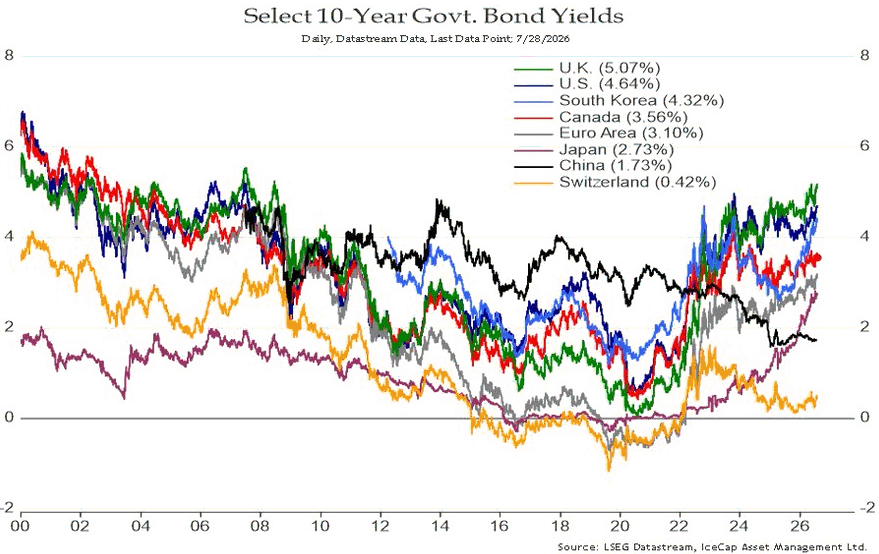
The “safe” 40% is where the money burned. For a generation, balanced funds leaned on bonds as ballast — the sleeve that gains when stocks stumble. That premise died in 2022: the classic 60/40 fell -17.5%, its worst year since 1937, and the wound came from the bond side, not equities. The mechanism is no longer a central-bank story, and that’s what the tape is still learning. QE, ZIRP and yield-curve control are over; yields now answer to inflation, fiscal supply and a rebuilding term premium, with Brent past $100 the July accelerant — and the US 10-year, grinding toward a 5% test, is leading the reversal of a 25-year bull. Worse, the rate shock reprices both legs at once: in an inflation regime the stock-bond correlation flips positive, so the ballast is now correlated to the 60% it was meant to offset. 2022 wasn’t a bad year — it was a regime change. Meanwhile the picture inverts abroad: China has collapsed to 1.73% into outright deflation — Japanification — now yielding less than Japan itself. But the center of gravity is here, in the 40% Americans were told they could trust. The ballast was never the shock absorber — it was the shock.
Market Intelligence Brief (MIB) Ver. 18.45
For professional investors only. Not investment advice.
© 2026 RecessionALERT.com

Comments are closed.