
MARKET INTELLIGENCE BRIEF (MIB)
Monday, November 16, 2026
Chips led a broad selloff the day before Nvidia reports: Micron (-7.62%), Intel (-7.02%) and Nvidia (-4.12%) dragged the Nasdaq 100 down 2.67%. Bessent demanded an outside Nvidia CEO; Trump “would certainly not mind” Huang’s return. Commerce closed the remote-access route to US AI chips. Warsh and Barr put an AI-valuation reversal on the record. Empire State manufacturing sank to 7.8 against 18 expected. Crude fell about 4%; the dollar hit its highest close since at least April 15.
TABLE OF CONTENTS
A. EXECUTIVE SUMMARY
B. MARKET DATA
C. HIGH-IMPACT STORIES (5)
D. MODERATE-IMPACT STORIES (8)
E. ECONOMY WATCH (5)
F. EARNINGS WATCH (0)
G. WHAT’S NEXT
H. CHART OF THE DAY
A. EXECUTIVE SUMMARY -> TOP
Chips led a broad selloff the day before Nvidia’s first results since Jensen Huang’s ouster, as three separate pressures landed on the AI trade in one session: Treasury Secretary Bessent demanding an outside CEO at Nvidia, a Commerce rule closing remote access to US AI chips through third-country data centres, and Chair Warsh and Governor Barr setting out how an AI-valuation reversal could unfold. Treasuries rallied, with the 2-year yield down 3.3 bps, so this was de-risking rather than a rates scare, even as Hammack and Collins kept further hikes on the table. Crude’s 4% slide on surplus forecasts eases the energy side of the Fed’s inflation problem, but Schmid’s 3% ex-energy estimate argues it will not end the tightening alone. Breadth was poor: ten of 11 sectors fell, led by Technology’s 3.35% drop, and only Consumer Defensive (+0.26%) rose, extending a quarter-long rotation into defensives.
• Chips led the selloff: Micron (MU) -7.62%, Intel (INTC) -7.02%, Dell (DELL) -6.96%, Lam Research (LRCX) -6.68% and AMD -5.58% were the worst US mega-caps; Technology fell 3.35% and the VIX rose 18.55% to 22.88.
• Nvidia leadership split: Bessent wants an outside CEO and, per Investing.com, board answers within 10 days on chip sales to Chinese entities; Trump “would certainly not mind” Huang’s return. NVDA fell 4.12% as CLSA cut its target to $255 from $425, UBS cut to $240 from $300 and Mizuho cut to $220 from $250; results come after Tuesday’s close, with consensus EPS about $2.48.
• Commerce chip rule: BIS closed the remote-access route to advanced US AI chips, added licence requirements for Indonesia, Malaysia, Singapore, Thailand and Brazil, with an exemption for qualifying US-headquartered users, and rescinded the AI Diffusion Rule; Federal Register publication is scheduled for Thursday.
• AI financing shifts: Oracle (ORCL) fell 4.99% on a report that Applied Digital wants multibillion-dollar guarantees before signing new leases; AWS agreed to sell 75% of 13 data-centre shells to Blackstone’s BXDC for about $5 billion and lease them back.
• Data and the Fed: Empire State manufacturing fell 18 points to 7.8 against 18 expected, while its employment index rose to 18.1, the highest since June 2022; Hammack sees more hikes needed, and Polymarket prices a 97% chance of another hike in 2026.
• Cross-asset: WTI fell 3.99% to $83.81 and Brent fell 4.23% to $91.79 on surplus forecasts; the dollar index rose 0.16% to 103.58, its highest close since at least April 15, while silver fell 4.51%.
1. Nvidia Reports Into a Regulatory Question, Not Just an Earnings One — Bessent’s questions about chip sales to Chinese entities, the Commerce rule licensing AI data centres in Malaysia, Singapore and three other countries, and UBS’s cut to its calendar 2028 revenue estimate, to $885 billion from $985 billion on possible scrutiny of sales into markets such as Singapore and Malaysia, all point at the same revenue channel. CLSA’s move to 15 times fiscal 2028 earnings from 25 times shows how far the multiple can travel on that doubt. Technology’s 10.40% three-month decline, the worst of the 11 sectors, lowers the bar into Tuesday, but the call now has to quantify exposure to the five named countries as well as deliver the quarter.
2. The Cost of the AI Build-Out Is Moving Onto Balance Sheets — A developer reportedly asking Oracle to guarantee its leases and AWS selling finished data-centre shells to lease them back are two versions of the same shift in who carries the risk. Barr put the seven largest AI firms’ off-balance-sheet obligations above $3 trillion, with on-balance-sheet debt expected to exceed $800 billion, and said he worries less about direct losses than about leveraged hedge funds forcing fire sales on a sharp reversal. Warsh’s staff now model an AI-disappointment scenario, and a San Francisco Fed letter puts the S&P 500’s CAPE at 40.5, exceeded among the prior peaks it shows only by the first quarter of 2000. The portfolio risk is concentration and leverage in valuations, not credit losses.
3. Hikes Stay on Track Even as the Inputs Soften — Empire State missed by 10.2 points with prices paid easing to 45.9, and crude fell about 4%, yet Hammack sees more hikes needed, Collins backs a “steady, gradual path” of increases, and Schmid said inflation would be running at 3% even setting energy aside. The 2-year yield fell 3.3 bps to 4.832% on a haven bid while the dollar posted its highest close since at least April 15, and Consumer Defensive’s 9.50% three-month gain shows the rotation away from rate- and growth-sensitive equities is already well advanced. Tuesday’s retail sales (expected +0.2%) and Wednesday’s minutes test whether the debate is about the pace of tightening or its end.
 — Leading economic indicators. Accurate market forecasts. Apply for membership at join.recessionalert.com
B. MARKET DATA -> TOP
A semiconductor-led selloff took the Nasdaq 100 down 2.67% and the S&P 500 down 1.92% in what Investing.com described as an unwind of bets on Nvidia’s rivals ahead of Nvidia’s results after Tuesday’s close, its first since Jensen Huang’s ouster as CEO last week. The damage was concentrated in chips and AI hardware rather than spread evenly: only Consumer Defensive finished higher. DJ Transportation went the other way, rising 0.27% as the Dow Jones lost 1.41%. Crude fell about 4% as Gulf exports recovered, Treasury yields eased, and the dollar closed at its highest since at least April 15, pushing gold and silver to their lowest closes over the same span.
CLOSING PRICES – Monday, November 16, 2026:
MAJOR INDICES
This was a chip and AI-hardware selloff, not a uniform rout: the Nasdaq 100’s 2.67% drop was nearly double the NYSE Composite’s 1.46%. DJ Transportation rose 0.27% against the Dow Jones’s 1.41% fall, a 1.68-point split. Over the past 10 sessions transports sit within 0.87% of their high while the Dow Jones is 3.28% below its own, so transports are leading but industrials are unconfirmed, a signal that emerges today.
| Index | Close | Change | %Move | Why It Moved |
|---|---|---|---|---|
| S&P 500 | 7,416.59 | -145.08 | -1.92% | Technology (-3.35%) led a 10-of-11-sector decline; Micron and Intel were the index’s worst performers as chip stocks fell ahead of Nvidia’s results Tuesday after the close |
| Dow Jones | 51,608.17 | -739.38 | -1.41% | Caterpillar (-4.95%) and Nvidia (-4.12%) were the worst Dow performers; Procter & Gamble and UnitedHealth the best |
| DJ Transportation | 20,649.67 | +55.60 | +0.27% | Rose against the broad decline; no transport-specific catalyst identified |
| Nasdaq 100 | 27,197.15 | -746.58 | -2.67% | Semiconductors and AI hardware led the drop, which Investing.com tied to traders unwinding bets on Nvidia’s rivals before its earnings |
| Russell 2000 | 2,742.94 | -47.55 | -1.70% | Fell with the broad market; no small-cap-specific catalyst identified |
| NYSE Composite | 24,164.01 | -356.82 | -1.46% | Broad decline, but shallower than the tech-heavy indices |
VOLATILITY & TREASURIES
VIX jumped 18.55% while both yields fell, a risk-off signature rather than an inflation scare. The 2-year (-3.3 bps) fell faster than the 10-year (-1.8 bps), steepening the 2s10s curve 1.5 bps to 30.5 bps. The dollar still posted its highest close since at least April 15, so the haven bid reached both Treasuries and the greenback.
| Instrument | Level | Change | Why It Moved |
|---|---|---|---|
| VIX | 22.88 | +3.58 (+18.55%) | Jumped as the chip selloff deepened ahead of Nvidia’s results Tuesday |
| 10-Year Treasury Yield | 5.137% | -1.8 bps | Eased as equities sold off |
| 2-Year Treasury Yield | 4.832% | -3.3 bps | Fell further than the 10-year; no discrete same-day catalyst identified |
| US Dollar Index (DXY) | 103.58 | +0.17 (+0.16%) | Highest close since at least April 15 |
COMMODITIES
Precious metals parted company with Treasuries: yields fell, which usually supports gold, yet gold and silver slid to their lowest closes since at least April 15 as the dollar firmed. Silver’s loss was more than six times gold’s and copper fell too, so the industrial side of the metals complex took the heavier hit. Bitcoin was flat on the day after a weekend slide.
| Asset | Price | Change | %Move | Why It Moved |
|---|---|---|---|---|
| Gold | $3,859.05/oz | $-27.25 | -0.70% | Lowest close since at least April 15; pressured by the firmer dollar |
| Silver | $46.908/oz | $-2.214 | -4.51% | Lowest close since at least April 15; fell far harder than gold; no discrete same-day catalyst identified |
| Copper | $5.9860/lb | $-0.1045 | -1.72% | No discrete same-day catalyst identified |
| Platinum | $1,447.55/oz | $-42.15 | -2.83% | Fell with silver; no discrete same-day catalyst identified |
| Bitcoin | $65,400.0 | $+159.0 | +0.24% | Flat on the UTC day; about 4.7% below Friday afternoon’s $68,594 after a 6.09% Saturday slide |
ENERGY
WTI and Brent fell in near lockstep, each about 4%, and oil fell alongside equities; Reuters reported Gulf shipments through the Strait of Hormuz nearly restored to pre-war levels. Gas fell on both sides of the Atlantic, with Dutch TTF’s 7.60% drop more than double Henry Hub’s 3.41%.
| Asset | Price | Change | %Move | Why It Moved |
|---|---|---|---|---|
| Crude Oil (WTI) | $83.81/bbl | $-3.48 | -3.99% | Fell on expectations of a supply surplus as Hormuz shipments recovered, per Reuters; the IEA on Friday forecast a fourth-quarter surplus. Quoted on the January contract |
| Crude Oil (Brent) | $91.79/bbl | $-4.05 | -4.23% | Same supply-recovery drivers as WTI; change measured from Friday’s $95.84 settle |
| Natural Gas (Henry Hub) | $3.120/MMBtu | $-0.110 | -3.41% | No discrete same-day catalyst identified |
| Natural Gas (Dutch TTF) | $27.090/MMBtu | $-2.229 | -7.60% | European gas fell as U.S. shipping waivers outweighed Middle East tensions, per an Investing.com report (unverified) |
S&P 500 SECTORS
Ten of 11 sectors fell, with Consumer Defensive (+0.26%) the lone holdout; it also leads the one-week and three-month columns, a defensive bid built over a quarter. Technology’s 3.35% slide deepened a 10.40% three-month decline, the worst three-month showing of the 11, while Energy fell 2.24% with crude.
| Sector | 1-Day | 1-Week | 1-Month | 3-Month | 6-Month | YTD | 12-Month |
|---|---|---|---|---|---|---|---|
| Consumer Defensive | +0.26% | +1.91% | +5.37% | +9.50% | +5.95% | +18.52% | +19.74% |
| Utilities | -0.10% | +0.03% | +3.45% | -0.06% | -1.17% | +1.97% | -1.43% |
| Real Estate | -0.22% | -1.36% | +4.36% | -2.52% | +0.21% | +7.32% | +6.17% |
| Healthcare | -0.78% | -1.24% | +6.00% | +7.08% | +22.94% | +15.98% | +16.70% |
| Financial | -1.06% | -0.55% | +2.54% | -2.21% | +9.25% | +5.98% | +10.50% |
| Industrials | -1.84% | -2.47% | -1.51% | -9.29% | -6.60% | +4.76% | +7.95% |
| Consumer Cyclical | -1.95% | -2.92% | +3.47% | -0.54% | -1.19% | -4.10% | -2.60% |
| Energy | -2.24% | +1.33% | -8.09% | -2.30% | -0.41% | +34.88% | +33.28% |
| Communication Services | -2.55% | -1.52% | -9.76% | -7.69% | -17.13% | -10.18% | -4.89% |
| Basic Materials | -2.91% | -7.52% | -6.09% | -8.83% | -8.09% | +4.38% | +12.36% |
| Technology | -3.35% | -3.94% | -9.38% | -10.40% | -5.38% | +10.40% | +10.14% |
TOP MEGA-CAP MOVERS:
GAINERS
| Company | Ticker | Close | Change | Why It Moved |
|---|---|---|---|---|
| Procter & Gamble | PG | $173.02 | +1.90% | No discrete same-day catalyst identified; the Dow’s best performer on a day Consumer Defensive was the only sector higher |
| UnitedHealth Group | UNH | $412.02 | +1.12% | No discrete same-day catalyst identified; rose with managed-care peers Molina (+11.27%) and Centene (+4.91%) |
| Costco Wholesale | COST | $1,113.74 | +0.68% | Moved with Consumer Defensive, the only sector higher; no discrete same-day catalyst identified |
| Walmart | WMT | $128.41 | +0.25% | Moved with Consumer Defensive ahead of its results Thursday before the open |
| Coca-Cola | KO | $99.48 | +0.23% | Moved with Consumer Defensive; no discrete same-day catalyst identified |
DECLINERS
| Company | Ticker | Close | Change | Why It Moved |
|---|---|---|---|---|
| Micron Technology | MU | $719.02 | -7.62% | No company-specific catalyst identified; led a chip selloff that Investing.com tied to traders unwinding bets on Nvidia’s rivals before its results |
| Intel | INTC | $55.47 | -7.02% | Fell with the chip complex; a shareholder lawsuit over its August stock sale was reported Sunday evening, not established as the cause |
| Dell Technologies | DELL | $320.55 | -6.96% | No company-specific catalyst identified; fell with the AI-hardware complex |
| Lam Research | LRCX | $210.83 | -6.68% | No company-specific catalyst identified; chip-equipment names fell with the semiconductor complex |
| Advanced Micro Devices | AMD | $504.28 | -5.58% | Traders unwound last week’s bets that AMD would take share from Nvidia after Huang’s exit, per Investing.com |
— Institutional-grade intelligence for serious investors. Apply for membership at join.recessionalert.comC. HIGH-IMPACT STORIES -> TOP
BEARISH
1. Chip and AI-Hardware Stocks Lead a Broad Selloff a Day Before Nvidia Reports: Micron Falls 7.62%, Intel 7.02%, and the Nasdaq 100 Drops 2.67%
The core facts:Technology fell 3.35%, the worst of the 11 S&P 500 sectors, and pulled the Nasdaq 100 down 2.67% to 27,197.15 and the S&P 500 down 1.92% to 7,416.59. Micron (-7.62%), Intel (-7.02%), Dell (-6.96%), Lam Research (-6.68%) and AMD (-5.58%) were the five largest decliners among US mega-caps, and Nvidia itself fell 4.12%. Ten of 11 sectors closed lower, with only Consumer Defensive (+0.26%) higher. The VIX jumped 18.55% to 22.88. Investing.com attributed the chip slide to traders unwinding last week’s bets that Nvidia’s rivals would take share after Jensen Huang’s exit, ahead of Nvidia’s results after Tuesday’s close; no other outlet was found confirming that explanation. Intel’s drop came after a shareholder lawsuit over its August stock sale was reported on Sunday evening, though no source ties the move to the suit.
Why it matters:The selloff was concentrated rather than general. The Nasdaq 100’s fall was nearly double the NYSE Composite’s 1.46%, and DJ Transportation rose 0.27% as the Dow fell 1.41%. Three separate pressures landed on the same group in one session: a Treasury Secretary demanding new leadership at Nvidia (Story 2), a new Commerce rule closing remote access to US AI chips through third-country data centres (Story 3), and two Fed officials publicly modelling an AI-valuation reversal (Story 5). Treasury yields fell, the 2-year by 3.3 bps, so this was risk reduction rather than a rates scare. Technology’s three-month decline has now reached 10.40%, the worst of the 11 sectors over that span, which means Nvidia reports into a group that has already de-rated rather than one priced for perfection.
What to watch:Nvidia’s fiscal third-quarter results after Tuesday’s close, with the call at 5:00 PM ET; consensus is EPS of about $2.48. A VIX holding above 22 into the print would signal that the options market expects a large move either way.
UNCERTAIN
2. Bessent Calls for a “Dramatic Shake-Up” and an Outside CEO at Nvidia as Trump Says He “Would Certainly Not Mind” Huang’s Return; the Board Is Reported Not to Be Considering It
The core facts:Treasury Secretary Scott Bessent said on Fox News on Sunday that Nvidia’s leadership needs a “dramatic shake-up” and that its next CEO should come from outside the company, according to the Associated Press; Investing.com reported that he also wants answers from the board and outside counsel within 10 days on concerns about chip sales to Chinese entities. On Monday President Trump said Huang “learned a big lesson” and that he “would certainly not mind” if Huang were reinstated, as a “Stand with Jensen” petition gathered signatures including Elon Musk’s. A person familiar with the board’s thinking told the AP that the board is not currently considering Huang’s return. Nvidia said on Sunday it is running an independent investigation into reports that Huang was the target of a foreign intelligence effort; Chief Financial Officer Colette Kress is interim CEO. Analysts cut targets on Monday: CLSA to $255 from $425 with a downgrade to Outperform, UBS to $240 from $300, and Mizuho to $220 from $250. Nvidia closed down 4.12%.
Why it matters:The administration is now publicly split over who should run Nvidia, the Treasury Secretary wanting an outsider and the President open to the ousted founder, and that split lands a day before Nvidia’s first report without Huang. CLSA’s cut takes its valuation to 15 times fiscal 2028 earnings from 25 times, and UBS lowered its calendar 2028 revenue estimate to $885 billion from $985 billion on possible scrutiny of sales into markets such as Singapore and Malaysia. That is the market-relevant shift: the debate has moved from who runs Nvidia to whether part of its revenue base is exposed to regulators. Bessent’s 10-day window, if Investing.com’s account is accurate, would run past the earnings call and keep the overhang in place after it.
What to watch:Whether Kress or the board addresses the CEO search, the Treasury’s questions or China-linked revenue on Tuesday’s 5:00 PM ET call, and any board statement before Bessent’s deadline.
BEARISH
3. Commerce Closes the “Remote Access” Route to Advanced US AI Chips, Adds Licence Requirements for Malaysia, Singapore and Three Other Countries, and Rescinds the AI Diffusion Rule
The core facts:The Bureau of Industry and Security issued an interim final rule on Monday that, in its words, aligns protections on remote access to advanced computing with existing controls on physical shipments. A new end-use control requires a licence where advanced AI chips or servers are destined for a data centre giving more than 12,000,000 aggregate TPP of compute to companies headquartered in Macau or a Country Group D:5 destination, which includes China. It adds a licence requirement for Indonesia, Malaysia, Singapore, Thailand and Brazil, with an exemption for US-headquartered end users that meet new monthly reporting. Existing data centres serving such companies have 90 days to obtain a licence. The rule formally rescinds the never-enforced AI Diffusion Rule and removes License Exceptions AIA and LPP, the Data Center VEU authorisation and the model-weights control. It takes effect on publication in the Federal Register, with comments due 60 days later. NPR reported the rule comes as Singapore-based Megaspeed, which operates data centres in Malaysia, is suspected of selling remote access to US AI chips to Chinese companies; Megaspeed says it conducts lawful business.
Why it matters:The rule converts a specific scandal into a standing constraint on how US AI capacity is sold abroad. The five newly listed countries are where much of Southeast Asia’s data-centre build-out sits, so chip vendors and the operators that rent their capacity now face licensing and verification costs on business that previously needed neither. Rescinding the diffusion framework removes a broader regime the industry opposed, but the replacement is aimed squarely at the channel analysts are now questioning in Nvidia’s revenue. The rule was public during Monday’s session, as chip stocks led the market lower (Story 1).
What to watch:Federal Register publication, scheduled for Thursday, Nov 19, which starts both the 90-day licensing clock and the 60-day comment period, and whether Nvidia quantifies exposure to the five named countries on Tuesday’s call.
BULLISH
4. Crude Falls About 4% as Surplus Forecasts Outweigh Weekend Attacks Around Hormuz: WTI Closes at $83.81 and Brent at $91.79
The core facts:WTI (January contract) closed at $83.81, down 3.99%, and Brent at $91.79, down 4.23%; Energy was the S&P 500’s fourth-worst sector at -2.24%. Bloomberg reported that growing global supply outweighed Middle East tensions, and Saxo Bank’s Ole Sloth Hansen said “the prospect of a growing supply surplus appears to carry more weight than the risk of another disruption.” Goldman Sachs, in a Sunday note reported by Reuters, sees a surplus of about 2 million barrels a day in 2027 and Brent easing to $78 by the end of that year. Reuters reported shipments through the Strait of Hormuz nearly restored to pre-war levels. Attacks did not stop: Iranian media claimed tankers hit mines over the weekend, claims Reuters could not verify, and UKMTO reported a projectile striking an outbound tanker on Monday. A third US carrier strike group entered the region, and Vice President Vance said the US would not let the Iran war become a long-term commitment.
Why it matters:The oil market is now pricing supply rather than risk: a weekend that brought mine claims, a drone attack on a US radar in Bahrain and a third carrier still produced a 4% fall. Lower crude is the main relief valve for a Fed that has framed its tightening around an energy-driven inflation shock, and Kansas City Fed President Schmid said on Sunday that inflation would be running at 3% if energy were set aside (Story 7). Diesel remains the exception: AAA’s national diesel average only slipped just below $6 a gallon, and Sparta Commodities’ June Goh called diesel “the key oil watch point as we head into the winter.”
What to watch:EIA weekly petroleum data on Wednesday, Nov 18 at 10:30 AM ET, and the OPEC+ ministerial meeting on Nov 29, which sets 2027 policy after Monday’s OPEC meeting on its review of members’ maximum sustainable capacity.
UNCERTAIN
5. The Fed Puts an AI-Valuation Reversal on the Record: Warsh’s Staff Model an Equity Bust, Barr Warns of Fire Sales, and an SF Fed Letter Puts CAPE at 40.5
The core facts:On the day chip stocks led the market lower, three Federal Reserve publications addressed the risk of an AI unwind. Chair Warsh said Board staff are modelling a scenario in which AI disappoints and equity valuations fall, alongside two others, while declining to forecast; Governor Barr warned that a sharp reversal could produce self-reinforcing fire sales (both detailed in Section E). Separately, a San Francisco Fed Economic Letter by Kevin Lansing and Federico Nucera put the S&P 500’s cyclically adjusted price-earnings ratio at 40.5 in the third quarter. Their model fits a CAPE of 35.8, and only 21.4 once the low structural unemployment rate is removed from it. The authors wrote that the model’s fit “does not guarantee that the current CAPE ratio of 40.5 is sustainable.” Among the prior peaks they show, only the first quarter of 2000, at 43.1, was higher.
Why it matters:None of this is a policy signal. Warsh offered no rate guidance and Barr said he avoids commenting on market moves. But it is unusual for a Fed Chair, a Governor and a regional bank’s research to describe an equity-led downside on the same day, and the SF Fed’s arithmetic is the sharpest of the three: on its own model, current valuations rest heavily on the labour market staying tight. That makes the valuation case hostage to the same jobs data the Fed is watching for a reason to keep hiking. No source links the publications to Monday’s selloff, but they give the bear case an official vocabulary just as Nvidia prepares to report.
What to watch:Barr speaks again on Wednesday, Nov 18 and Thursday, Nov 19, and the FOMC minutes at 2:00 PM ET Wednesday will show whether financial-stability concerns about AI entered the October policy discussion.
— Quantifying recession risk so you don’t have to guess. Apply for membership at join.recessionalert.comD. MODERATE-IMPACT STORIES -> TOP
BEARISH
6. Oracle Falls 4.99% After a Report That Applied Digital Wants Multibillion-Dollar Guarantees Before Signing New Leases
The core facts:Oracle closed down 4.99%. According to Investing.com, Bloomberg reported on Monday that data-centre developer Applied Digital is demanding multibillion-dollar financial guarantees from Oracle before it signs new leases. The Bloomberg report itself could not be read, and neither the size of the guarantees nor the capacity involved has been confirmed. Applied Digital already builds capacity leased to Oracle, including a campus funded by a $2.15 billion bond sale in March.
Why it matters:A developer asking the tenant to stand behind the build is a change in who carries the risk of the AI buildout. Until now developers have funded construction against long leases; a guarantee requirement moves that exposure onto Oracle’s balance sheet, which is already heavily indebted, as Governor Barr warned the same day about the scale of off-balance-sheet AI obligations (Story 5). If other developers follow, hyperscalers face either more visible leverage or slower capacity additions.
What to watch:Any confirmation of terms by Applied Digital or Oracle, and whether similar demands surface in other developers’ lease negotiations.
UNCERTAIN
7. The Dollar Closes at Its Highest Since at Least April 15 and Silver Drops 4.51% as Schmid Says Inflation “Has Been Running Too Hot”
The core facts:The dollar index rose 0.16% to 103.58, its highest close since at least April 15, while gold fell 0.70% to $3,859.05 and silver 4.51% to $46.908, each at its lowest close over the same span. Treasury yields fell rather than rose: the 2-year by 3.3 bps to 4.832% and the 10-year by 1.8 bps to 5.137%. Kansas City Fed President Jeffrey Schmid said on Sunday that “inflation has been running too hot,” put three-month annualized CPI at 5.7%, and said that “if we set aside energy prices, inflation would be running at 3 percent.” He added that “the Fed does have the tools to address inflation” but gave no rate preference. Cleveland’s Hammack and Boston’s Collins also pointed to further increases (Section E).
Why it matters:The dollar rose while front-end yields fell, so the session’s strength was a haven bid during an equity selloff rather than a fresh repricing of Fed hikes; reports linking gold’s fall to rising hike bets are not supported by the 2-year’s decline. The Fed’s own message stays one-directional, though: Schmid’s ex-energy figure, still a point above target, argues that falling crude alone will not end the tightening cycle. A firm dollar and high real yields are a direct headwind for precious metals and for US multinationals’ overseas earnings.
What to watch:October retail sales on Tuesday, Nov 17 at 8:30 AM ET and the FOMC minutes on Wednesday for how many officials favoured larger increments; a 2-year yield back above 4.9% would show hike pricing reasserting itself.
UNCERTAIN
8. CMS Proposes the “CRUSH” Anti-Fraud Rule, Expanding Medicare Advantage Audits and Claiming Nearly $90 Billion in Savings, on a Day Managed-Care Stocks Rallied
The core facts:The Centers for Medicare & Medicaid Services on Monday proposed the CRUSH rule across Medicare, including Medicare Advantage and Part D, Medicaid, CHIP and the ACA Marketplace, estimating nearly $90 billion of taxpayer savings over 10 years. For insurers, it would expand Risk Adjustment Data Validation audits to recover payments tied to diagnoses unsupported by medical records, require Medicare Advantage and Part D sponsors to report suspected fraud to CMS, and require certain Medicare Advantage providers to enroll in Original Medicare. Comments are due January 19, 2027. CMS did not state the release time. Managed-care stocks rose on the day: Molina +11.27%, Centene +4.91%, Elevance +3.86%, Humana +2.50% and UnitedHealth +1.12%, while the Healthcare sector fell 0.78%. No catalyst for the rally was found, and none of the moves can be attributed to the rule.
Why it matters:Expanded risk-adjustment audits are the provision with direct earnings exposure, because they target the coding practices that lift Medicare Advantage payments. A proposed rule with a 60-day comment window will not change 2027 economics quickly, but it adds recovery risk to a group that has been rebuilding margins. That the insurers rallied hard on the same day is the open question: the size of Molina’s move points to a sector-specific catalyst that has not yet surfaced.
What to watch:Publication of the rule in the Federal Register on Thursday, Nov 19, and any company or analyst explanation of Monday’s managed-care rally.
BULLISH
9. Healthcare Deal Monday: J&J Buys Ollin Biosciences for $2.2 Billion Upfront, Lilly Agrees to Acquire Calytrix for Up to $1.5 Billion, and Medtronic Buys Contego Medical
The core facts:Johnson & Johnson agreed to buy privately held Ollin Biosciences for $2.2 billion upfront plus up to about $1.125 billion in regulatory and commercial milestones, gaining OLN324, a Phase 3 bispecific antibody for wet age-related macular degeneration and diabetic macular edema; Blackstone Life Sciences will pay $750 million over several years to fund its Phase 3 programme, and closing is expected before the end of 2026. Eli Lilly agreed to acquire Calytrix Bio for up to $1.5 billion in cash, including milestones, for a preclinical antibody targeting the blood cancers essential thrombocythemia and myelofibrosis. Medtronic agreed to buy Contego Medical for $380 million plus possible later payments, adding carotid-artery devices, and expects the deal to be minimally dilutive to adjusted EPS in fiscal 2027 and 2028.
Why it matters:None of the three is large relative to its buyer, but together they show mega-cap healthcare buying pipeline through bolt-ons rather than transformative deals. J&J’s structure is the notable one: shifting part of the late-stage trial cost to Blackstone in exchange for future payments is a way to buy a Phase 3 asset without carrying all of its development risk. For smaller biotechs, three strategic buyers in one morning supports private and public valuations.
What to watch:Whether J&J discloses the total value of the Blackstone funding arrangement, and the closing of the Ollin deal before year-end.
UNCERTAIN
10. AWS Sells 75% of 13 Data-Center Shells to Blackstone’s BXDC for About $5 Billion and Leases Them Back
The core facts:Amazon Web Services agreed to sell a 75% interest in 13 newly built data-center powered shells on two campuses to Blackstone Digital Infrastructure Trust for about $5 billion, at a 7.0% initial capitalisation rate. AWS keeps 25% and leases all of the space back on a triple-net basis for an initial 12-year term, extendable to 32 years. It is BXDC’s first investment, funded from its IPO proceeds, and is expected to close in the fourth quarter of 2026.
Why it matters:This is the hyperscaler version of the financing shift in Story 6: instead of a developer asking Oracle to guarantee its leases, Amazon is recycling capital out of buildings it has already finished and committing to rent them back. It frees cash for chips and new capacity while keeping control of the sites, and the 7.0% cap rate gives the market a price for stabilised AI-era data-centre real estate. It also adds to the long-dated lease obligations that the Fed’s Financial Stability Report and Governor Barr have begun to count.
What to watch:Whether Microsoft, Alphabet or Meta announce similar sale-leasebacks, and the pricing of further acquisitions by BXDC.
UNCERTAIN
11. Oil Deals Continue as Crude Falls: Chevron Nears a Majority Stake in Beacon Offshore at About $5 Billion and Diamondback Buys Double Eagle V’s Midland Assets
The core facts:Chevron is closing in on a deal for a majority stake in Blackstone-backed Beacon Offshore Energy at a valuation of roughly $5 billion, the Financial Times reported on Monday, according to Reuters. Beacon holds 70 deepwater Gulf of Mexico leases covering about 400,000 gross acres; Chevron has moved ahead of rival bidders and declined to comment, and no deal has been signed. Separately, Diamondback Energy agreed to buy Double Eagle V’s Midland Basin subsidiaries for about 15.56 million shares plus $2.15 billion in cash, adding about 176,000 net acres, with closing expected December 21; media reports value the deal at about $5 billion.
Why it matters:Both deals were struck on a day crude fell about 4% on surplus forecasts (Story 4), which says producers are buying long-life acreage on a multi-year price view rather than on this month’s spike. Chevron’s interest fits its stated aim of lifting Gulf of Mexico output to 300,000 barrels of oil equivalent a day by year-end. For the sector, buying proven inventory remains cheaper than drilling for it, a support for valuations even as the near-term price outlook softens.
What to watch:A signed Chevron-Beacon agreement and its terms, and Diamondback’s closing on December 21.
UNCERTAIN
12. Online Banking Outages Hit Chase, Bank of America, Wells Fargo and Others; Chase Blames a Software Bug With “No Evidence” of a Cyberattack
The core facts:User reports of outages spiked on Downdetector on Monday at Chase, Bank of America, US Bank, Zelle, Wells Fargo, Capital One, Citi, TD Bank, USAA, American Express and Navy Federal, and later at Charles Schwab, Chime and Ally. JPMorgan Chase said it had a temporary issue “related to a software bug in on-premise hardware systems” and that there is “no evidence this is cyber-related,” adding that some transactions were taking longer than usual while customers kept access to their accounts and funds. Reports were easing at 4:00 PM ET but remained elevated. The causes at the other banks, and any link to Chase, were not disclosed. After the close, United Airlines reported a widespread system outage affecting departing flights.
Why it matters:Simultaneous failures across many institutions point either to a shared dependency or to knock-on effects through payment links, and either way the incident is an operational-resilience question for regulators rather than a credit event. It is the latest in a run of technology failures that includes last week’s Microsoft Outlook outage and Friday’s nationwide FAA ground stop, a pattern that raises the profile of legacy-infrastructure risk across finance and transport.
What to watch:Whether Chase confirms full restoration, any statement from bank regulators, and whether United’s outage disrupts Tuesday’s schedule ahead of the Thanksgiving travel peak.
UNCERTAIN
13. Berkshire’s Third-Quarter 13F: A New Bending Spoons Stake, Lennar Roughly Doubled, and Cuts to Bank of America, Capital One and VeriSign
The core facts:Berkshire Hathaway’s 13F for the quarter ended September 30, filed on Monday’s deadline, shows a new position of 20,689,655 shares in Bending Spoons valued at $689.4 million. Its Lennar holding rose to 26,587,436 shares from 13,409,858. It cut Bank of America to 455,860,908 shares from 483,394,015, about 5.7%, Capital One to 1,150,000 from 3,000,000, and VeriSign to 5,922,136 from 8,989,880. It added to Delta Air Lines (64.45 million shares from 57.32 million) and trimmed Kroger (35 million from 39 million). Apple, Alphabet, American Express, Coca-Cola and Chevron were unchanged, and there were no full exits. The reported portfolio was valued at $304.2 billion.
Why it matters:Doubling Lennar is a bet on US homebuilding while existing-home sales are at their lowest since 2010 and the 10-year yield is above 5.1%, a contrarian view on housing at the point of maximum rate pain. The continued reduction in Bank of America and the large Capital One cut extend Berkshire’s retreat from banks. Because the filing reflects positions as of September 30, it says nothing about what Berkshire has done since.
What to watch:Lennar’s and the homebuilders’ reaction on Tuesday, and Bending Spoons’ results on Friday, Nov 20.
— Separating signal from noise since 2007. Apply for membership at join.recessionalert.comE. ECONOMY WATCH -> TOP
The Fed is weighing an inflation problem that has not cooled against an AI boom whose financing it is now scrutinising out loud. Hammack and Collins both point to further tightening, while Jefferson calls the inflation path “the more important signal” with core PCE at 3.1%. Barr then spelled out how leveraged the AI buildout has become, putting off-balance-sheet obligations above $3 trillion, on a day chip stocks led the Nasdaq 100 down 2.67%. The first hard data point of the week leaned soft: Empire State manufacturing fell to 7.8 against an expected 18, though employment hit its highest level since June 2022, leaving Tuesday’s October retail sales as the next test.
Empire State Manufacturing Index Drops 18 Points to 7.8, Far Below the 18 Expected, as Prices Paid Fall to 45.9 (New York Fed, Nov 16)
What they’re saying:The New York Fed’s headline general business conditions index “remained positive but fell eighteen points to 7.8” in November, against a consensus of 18 and October’s 25.5, which had been the highest reading since December 2021. New orders came in at 3.0 and shipments at 8.8, both still positive. The prices paid index fell to 45.9 and prices received to 27.2. The number of employees index rose to 18.1, its highest level since June 2022.
The context:The miss is large, 10.2 points under consensus, but the detail is mixed rather than recessionary. Activity is still expanding, firms are adding workers at the fastest pace in more than four years, and the six-month outlook index rose eight points to 28.9. The easing in prices paid is the part that matters most for a Fed weighing further hikes. Treasury yields closed lower on the day, with the 2-year down 3.3 bps to 4.832%, though the equity selloff also drove that move.
What to watch:The Philadelphia Fed Manufacturing Index on Thursday, Nov 19 (expected 19.2, prior 20.9) will show whether the slowdown is regional or broader. October industrial production on Tuesday, Nov 17 (expected +0.1%, prior +0.7%) gives the national hard-data read.
Hammack Says More Rate Hikes Are Needed as Collins Backs a “Steady, Gradual Path” and Jefferson Calls Inflation “the More Important Signal” (Seeking Alpha / Federal Reserve, Nov 13–16)
What they’re saying:Cleveland Fed President Beth Hammack said on Monday that financial conditions “aren’t constraining investment for both AI and non-AI,” keeping inflation above the 2% goal, and Seeking Alpha reported she sees more rate hikes as needed to bring it down. Boston Fed President Susan Collins said on Saturday that a “steady, gradual path seems appropriate” of modest rate increases. On Friday, asked about a 50 basis point hike, she told Bloomberg Television that “a careful adjustment of policy is appropriate at this time.” Vice Chair Jefferson said on Friday that inflation readings “show persistent price pressures” and that he sees “the trajectory of inflation as providing the more important signal.”
The context:The live question is the pace of tightening, not its direction: Collins pushed back on a 50 bp move without disputing that rates go higher. Jefferson put 12-month PCE inflation at 3.6% and core at 3.1% in September, with unemployment at 4.1% in October, a level he views as consistent with maximum employment. That leaves little labor-market case for restraint. Polymarket priced a 97% chance of another Fed rate hike in 2026, unchanged from Friday.
What to watch:The FOMC minutes on Wednesday, Nov 18 at 2:00 PM ET, for how many participants favour larger increments. Hammack speaks again on Tuesday, Nov 17 and Thursday, Nov 19, and Waller on Tuesday, Nov 17 and Friday, Nov 20.
Barr Puts AI Off-Balance-Sheet Obligations Above $3 Trillion and Warns a Sharp Reversal Could Trigger “Self-Reinforcing Fire Sales” (Federal Reserve, Nov 16)
What they’re saying:Governor Michael Barr, recapping the Financial Stability Report issued on Friday, said on-balance-sheet debt of the seven largest AI firms “is expected to exceed $800 billion before year’s end.” He said the potential maximum nominal value of their off-balance-sheet obligations “now exceeds $3 trillion.” He also cited more than $100 billion of hyperscaler and GPU-maker equity investments in AI labs and cloud start-ups, a form of “circular financing” used to buy back the investors’ own chips and compute.
The context:Barr said that “given the still-limited amount of debt backing the current boom, I’m less concerned about direct losses.” He warned, however, that with hedge-fund leverage and risk appetite “apparently quite high, a sharp reversal could lead to rapid deleveraging and, potentially, self-reinforcing fire sales.” He also noted that lower-rated firms dependent on external funding have seen their cost of capital “rise significantly in recent months.” The speech landed as Technology fell 3.35% and Micron, Intel and Dell each lost about 7%.
What to watch:Nvidia’s results after Tuesday’s close are the nearest test of the AI-investment expectations Barr describes. Barr speaks again on Wednesday, Nov 18 and Thursday, Nov 19.
Warsh Sets Out Fed Staff Scenarios for “Super Intelligence,” From Broad Gains to a Valuation Bust, While Declining to Forecast (Federal Reserve, Nov 16)
What they’re saying:Opening the Fed’s Productivity and Jobs Task Force conference in San Francisco, Chair Kevin Warsh said Board staff have begun modelling “illustrative scenarios, not forecasts.” In the first, productivity gains are shared broadly and the U.S. “stays close to full employment.” In the second, growth rises but automation could “push the jobless rate above levels consistent with full employment.” In the third, AI disappoints, “equity valuations could fall, leading to an economic slowdown and a more notable rise in unemployment.”
The context:The remarks carried no near-term policy signal. Warsh said the Fed is not there “to make predictions” and that its role is “neither advocacy nor opposition,” while the technology will have “important implications for monetary policy down the road.” He noted that productivity growth has been “reasonably strong” in recent quarters but “hasn’t yet broken out definitively and structurally to the upside.” A Chair naming an equity-led slowdown as one modelled outcome is notable on a session the Nasdaq 100 fell 2.67%.
What to watch:Any further publication of the staff scenarios from the task force, and whether FOMC minutes on Wednesday, Nov 18 reference AI-driven productivity in the policy discussion.
Jefferson Finds AI’s Productivity Contribution “Limited” So Far as Daly Sees “Less Need to Hire” Rather Than Displacement (Federal Reserve / Seeking Alpha, Nov 13)
What they’re saying:Vice Chair Jefferson said roughly 25% of U.S. firms were using generative AI in at least one business function, about 40% in professional services and information and around 10% in mining and leisure and hospitality. Labor productivity growth averaged 2.2% from 2020 to 2025, against 1.5% over the prior cycle, but the surge “began before the debut of popular AI chatbots in 2022.” San Francisco Fed President Mary Daly said, “You don’t see a lot of displacement from AI yet, but you do see less need to hire additional people.”
The context:Jefferson judged AI’s contribution to aggregate productivity “limited, but with the potential to grow quite substantially.” He said that, for now, the AI buildout is adding to demand and pushing up prices for inputs such as memory chips. That is the inflationary side of the boom, ahead of any supply-side relief. Daly’s point locates the labor cost in slower hiring rather than layoffs, which a 4.1% unemployment rate would not capture.
What to watch:Weekly initial jobless claims on Thursday, Nov 19 (expected 196K, prior 200K) and the ADP weekly employment change on Tuesday, Nov 17, for any sign that slow hiring is turning into job losses.
— Know the probability before the market prices in the risk. Apply for membership at join.recessionalert.comF. EARNINGS WATCH -> TOP
YESTERDAY AFTER THE BELL (Markets Reacted Today)
No major earnings yesterday after the bell from companies with >$100B market cap.
TODAY BEFORE THE BELL (Markets Already Reacted)
No major earnings before the bell from companies with >$100B market cap.
TODAY AFTER THE BELL (Markets React Tomorrow)
No major earnings after the bell from companies with >$100B market cap.
WEEK AHEAD PREVIEW:
Q3 2026 earnings season is nearly complete, with 91% of the S&P 500 reported as of November 13, per FactSet. The next five sessions carry seven in-scope reporters above $100 billion: Nvidia, Home Depot and Disney on Tuesday, November 17; Palo Alto Networks, TJX and Lowe’s on Wednesday, November 18; and Walmart on Thursday, November 19.
NVIDIA (NVDA) — AMC, Tuesday, November 17 — -4.12% today; consensus EPS about $2.48 and about $108.9 billion of revenue, against company guidance of $108.0 billion, plus or minus 2%; key focus: the first report under interim CEO Colette Kress, any word on the CEO search after Treasury Secretary Bessent called for an outside successor, exposure to the five countries named in Monday’s remote-access chip rule, and data-center revenue after $89.0 billion (+117%) last quarter, with CLSA, UBS and Mizuho all cutting targets on Monday.
Home Depot (HD) — BMO, Tuesday, November 17 — consensus EPS $3.84 and about $42.8 billion of revenue; key focus: whether comparable sales build on the second quarter’s 1.7% gain against full-year guidance for comparable sales flat to up 2%, with existing-home sales at their lowest since August 2010 and the 10-year yield above 5.1%, after Zelman & Associates cut the stock to Underperform on Monday.
Walt Disney (DIS) — BMO, Tuesday, November 17 — consensus EPS about $1.67 and about $25.2 billion of revenue; key focus: delivery on guidance for about $4.9 billion of fourth-quarter segment operating income, softer domestic streaming advertising, weaker Asian park attendance, and the first fiscal 2027 outlook.
Palo Alto Networks (PANW) — AMC, Wednesday, November 18 — consensus EPS $0.97 and about $3.31 billion of revenue, in line with company guidance; key focus: Next-Generation Security ARR against guidance of $9.54 billion to $9.56 billion, AI-driven security demand and margins, after KeyBanc’s upgrade to Overweight on Friday.
TJX Companies (TJX) — BMO, Wednesday, November 18 — consensus EPS $1.34 and about $15.8 billion of revenue; key focus: third-quarter comparable sales against guidance of up 2% to 3%, after a 4% second-quarter gain, and whether growth at the Marmaxx division has steadied, after Gordon Haskett’s cut to Hold on Friday.
Lowe’s (LOW) — BMO, Wednesday, November 18 — consensus EPS about $2.88 and about $22.4 billion of revenue; key focus: comparable sales against a roughly flat full-year outlook, the drag from weak housing activity, and Pro demand as the Foundation Building Materials acquisition is integrated, after Stifel’s cut to Sell on Friday and Zelman’s to Underperform on Monday; read it against Home Depot’s figures from the previous day.
Walmart (WMT) — BMO, Thursday, November 19 — +0.25% today; consensus EPS $0.64 and about $187.3 billion of revenue, against company guidance of $0.62 to $0.64 and net sales growth of 3% to 3.75% in constant currency; key focus: Walmart U.S. comparable sales after the second quarter’s 2.6% gain missed expectations, fuel costs the company expects to exceed its original plan by more than $2 billion this fiscal year, and the drag from drug-pricing rules.
No in-scope company above $100 billion reported on Friday after the close, over the weekend, or on Monday; Monday’s largest reporter was Tyson Foods ($22.05 billion, BMO). Excluded as ADRs: Mitsubishi UFJ Financial ($238.62 billion) and Mizuho Financial ($123.47 billion), both after Friday’s close, and Alibaba Group ($225.44 billion) and PDD Holdings ($111.18 billion), both BMO on Thursday, November 19. No in-scope company above $100 billion reports on Friday, November 20 or Monday, November 23. Intuit ($92.35 billion, AMC Thursday, November 19) is below the threshold.
— US market commentary trusted by family offices and institutions. Apply for membership at join.recessionalert.comG. WHAT’S NEXT -> TOP
UPCOMING RELEASES:
| Date | Event | Why It Matters |
|---|---|---|
| Tue, Nov 17 | Retail Sales (Oct; expected 0.2%, prior 0.8%; control group expected 0.4%, prior 0.1%) | The week’s high-impact data release: firm spending would support Hammack’s view that financial conditions are not restraining demand, and a soft print would echo Empire State’s miss. |
| Tue, Nov 17 | Import Prices (Oct; expected 0.7%, prior 1.1%) and Export Prices (Oct; expected 0.3%, prior 2.2%) | Shows how much of crude’s decline is reaching traded-goods prices, against Schmid’s estimate that inflation would still run at 3% with energy set aside. |
| Tue, Nov 17 | Industrial Production (Oct; expected 0.1%, prior 0.7%) and NAHB Housing Market Index (Nov; expected 29, prior 29) | The national hard-data check on Empire State’s 18-point drop, and builder sentiment with the 10-year yield above 5.1% after Berkshire roughly doubled its Lennar stake. |
| Tue, Nov 17 | Fed speeches: Musalem (7:30 AM ET), Waller (9:20 AM ET), Hammack (9:30 AM ET) and Williams (2:25 PM ET) | Four officials on the pace of tightening after Collins pushed back on a 50 bp move, and the first Fed voices since Barr’s warning on AI leverage. |
| Wed, Nov 18 | Housing Starts (Oct; expected 1.27M, prior 1.221M), Building Permits (Oct; expected 1.38M, prior 1.398M) and Pending Home Sales (Oct; expected -2.3%, prior -7.3%) | Whether high mortgage rates are reaching construction and contract signings, the backdrop to Berkshire’s contrarian homebuilder bet. |
| Wed, Nov 18 | EIA Crude Oil Stocks (10:30 AM ET; prior 4.657M) | Tests the surplus case that took crude down about 4% despite weekend attacks around Hormuz. |
| Wed, Nov 18 | FOMC Minutes (2:00 PM ET), with Barr speaking at 1:35 PM ET | The week’s key event: how many officials favoured larger increments, and whether AI-related financial-stability concerns entered the policy discussion. |
| Thu, Nov 19 | Initial Jobless Claims (expected 196K, prior 200K) and Philadelphia Fed Manufacturing (Nov; expected 19.2, prior 20.9) | Shows whether Empire State’s slowdown is regional or broader, and whether Daly’s “less need to hire” is turning into job losses. |
| Thu, Nov 19 | Federal Register publication of the Commerce AI-chip rule and the CMS CRUSH rule (scheduled) | Starts the chip rule’s 90-day licensing clock for existing data centres and its 60-day comment period; the CRUSH rule’s expanded Medicare Advantage audits add recovery risk for managed care. |
| Fri, Nov 20 | Michigan Consumer Sentiment, Final (Nov; expected 52, prior 48.0), with Waller (8:25 AM ET) and Cook (12:15 PM ET) speaking | A read on how households are absorbing rising rates and an equity drawdown, and two more Fed voices after the minutes. |
KEY QUESTIONS:
1. Will Nvidia’s call on Tuesday quantify its exposure to Malaysia, Singapore and the other newly licensed countries and address the CEO search, or leave the regulatory overhang in place past Bessent’s 10-day window?
2. Will Wednesday’s minutes show a committee leaning toward larger increments, and did AI-related financial-stability concerns enter the discussion before Warsh and Barr described an AI-led downside in public?
3. Will Tuesday’s retail sales and Thursday’s Philadelphia Fed survey confirm Empire State’s slowdown, or show demand strong enough to send the 2-year yield back above 4.9%?
— US market commentary trusted by family offices and institutions. Apply for membership at join.recessionalert.comH. CHART OF THE DAY -> TOP
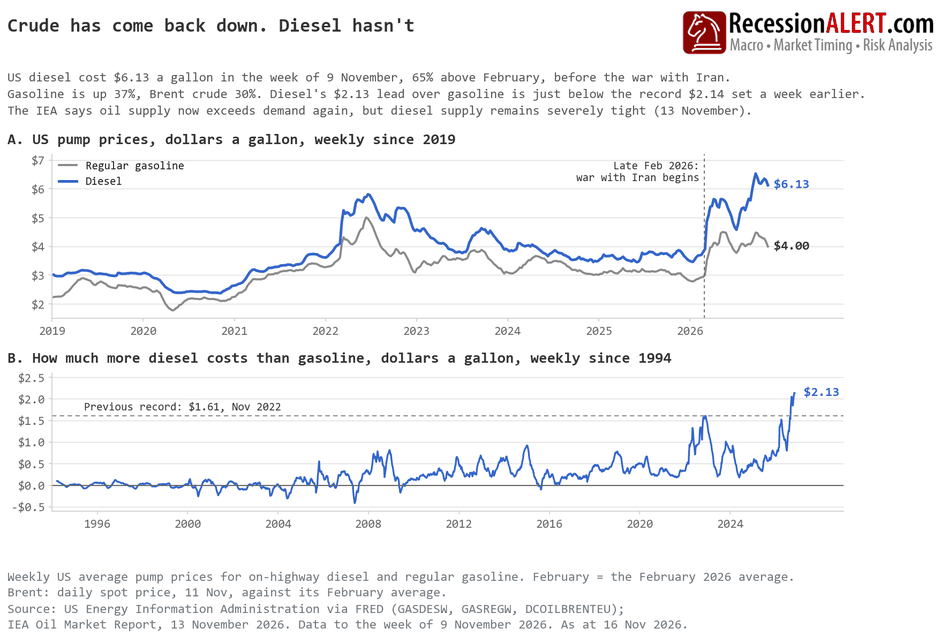
The oil shock has not ended; it has moved down the barrel. Against February, before the war, Brent crude is up 30% and diesel 65%, and diesel now costs 1.53 times as much as gasoline, the highest ratio on record; all ten of the widest weekly gaps since 1994 have come since early September. The IEA said on 13 November that the world again produces more oil than it uses, yet “the severe tightness in product supply, especially for diesel, remains the overriding concern”, blaming attacks on Russian energy infrastructure that “continue to choke off the country’s diesel supplies.” The squeeze sits in the step that turns crude into fuel, and the price of that step shows it: New York Harbor diesel sells for about $84 a barrel more than Brent, against about $38 before the war. Which fuel carries the squeeze decides who feels relief: households mostly fill up with gasoline and have felt some. Diesel moves freight, farms and building sites, so its cost reaches them later, in what goods cost to grow and deliver. Treasury Secretary Bessent says the energy shock is “coming down”, and for crude and gasoline it is. But diesel is only 6% below its September peak, so his case fits the fuels drivers buy, not the one freight runs on. The relief is at the pump, where shoppers see the price every week; the shock has moved into the supply chain, where they never do.
What it means: For households, the relief at the gasoline pump is real. But diesel’s cost reaches food, building and delivered goods with a lag, so it can keep pushing prices up after pump prices ease. For stock investors, the gap favours refiners, whose margin on diesel has roughly doubled, and squeezes truckers, farms and builders that cannot pass costs on quickly. For the economy, the energy shock is not over while freight still pays a record premium over drivers. The read changes if diesel’s lead over gasoline falls back below the old $1.61 record.
Market Intelligence Brief (MIB) Ver. 20.06
For professional investors only. Not investment advice.
© 2026 RecessionALERT.com

Comments are closed.