
MARKET INTELLIGENCE BRIEF (MIB)
Tuesday, November 17, 2026
Every S&P 500 sector fell as the index slid 1.03% to its lowest close since July 29 ahead of Nvidia’s results. Nvidia’s board ruled out reinstating Jensen Huang and created an export-control oversight committee, as the WSJ reported an SEC disclosure probe. Musalem wants “several” rate increases before spring 2027 after import prices rose 1.1% for a second month. US jets struck an IRGC site on Qeshm and Brent rose 1.14%. Nike sank 6.3%; builder sentiment hit a 14-year low.
TABLE OF CONTENTS
A. EXECUTIVE SUMMARY
B. MARKET DATA
C. HIGH-IMPACT STORIES (5)
D. MODERATE-IMPACT STORIES (5)
E. ECONOMY WATCH (6)
F. EARNINGS WATCH (3)
G. WHAT’S NEXT
H. CHART OF THE DAY
A. EXECUTIVE SUMMARY -> TOP
Stocks extended their slide into Nvidia’s after-close results, but Tuesday’s damage ran through blue-chips and small-caps rather than mega-cap tech, with the S&P 500 down 1.03% to its lowest close since July 29 and the Dow down 1.64% to its lowest since June 10. The backdrop turned more hostile on two fronts at once: St. Louis Fed President Musalem called for “several interest rate increases before the spring of 2027” on a day import prices rose 1.1% for a second straight month, and Brent rose 1.14% to $93.49 after a US strike on an IRGC missile site on Qeshm Island. Investors bought duration rather than dollars or gold, as the 2-year yield fell 4.3 bps and the VIX rose 11.13% to 25.46, so the hawkish message has yet to be priced at the front end. All 11 sectors fell, from Industrials (-0.16%) to Financials (-1.75%), a macro de-risking rather than a rotation, with staples offering no shelter.
• Broad de-risking: S&P 500 -1.03% to 7,340.53, Dow -1.64% to 50,759.42, Russell 2000 -1.50% to its lowest close since at least April 15; Nasdaq 100 fell least at -0.72%. UNH -5.42%, IBM -4.71% and ORCL -3.43% led mega-cap losses.
• Nvidia governance: The board “does not intend to reinstate Jensen as CEO,” has hired a search firm and created a National Security and Export Control Oversight Committee. The WSJ reported an SEC civil probe of Nvidia’s disclosures (not independently confirmed), while DOJ and Commerce said Nvidia supplied records and cut off Megaspeed in June 2025.
• Fed hawks: Musalem wants a real policy rate “solidly between 2% and 2.5%” before spring 2027; Williams said the Fed may need to raise rates again but sees no need for “dramatic action.” Traders expect a quarter-point increase at the Dec 8-9 FOMC.
• Mixed data: Import prices +1.1% (vs +0.7% expected), retail control group +0.6% (vs +0.4%), industrial production -0.4% (vs +0.1%), NAHB builder sentiment down 4 points to 25, a 14-year low. GDPNow eased to 3.4% for Q4.
• Hormuz escalation: US jets struck an IRGC missile launch site on Qeshm Island; Iran’s claim that three tankers hit mines is unconfirmed. Brent +1.14% to $93.49 while WTI was flat at $84.41 (-0.07%), widening the spread to about $9.
• Corporate: NKE -6.3% after its investor day pushed a return to sales growth out to fiscal 2029; HD -2.45% as CFO Richard McPhail is named CEO from Nov 23; PEP -3.01% on a Bernstein downgrade to Underperform.
1. The bond market chose safety over the hawks — Fed officials made the case for more tightening, with Musalem’s real-rate target implying further increases beyond the December move already priced, and the data gave them ammunition: import prices rose 1.1% for a second month and nonfuel prices rose 0.8%, so the pressure is not confined to energy. Yet the 2-year yield fell 4.3 bps as equities sold off, because a flight to quality outweighed the policy message. That leaves the front end exposed to a repricing once risk appetite steadies, with Wednesday’s FOMC minutes the first test.
2. Prices are doing the work while volumes stall — Retail sales beat at the control-group level, but the series is not adjusted for prices and Stifel described retail growth as “barely growing in real terms.” The equity tape agreed: Bernstein cut PepsiCo on earnings risk, Kimberly-Clark’s target was lowered, Nike pushed its sales recovery to fiscal 2029, and builder sentiment fell to a 14-year low with the 10-year yield above 5.1%, the backdrop Home Depot’s new management inherits. Consumer-facing names that can no longer lean on pricing are being marked down.
3. AI risk is shifting from chips to governance and financing — Nvidia’s overhang now turns on who leads the company and what it disclosed, not whether it can ship: the board has ruled out Huang’s return, moved export compliance to board level, and the government’s own timeline places it on the cooperating side of the Megaspeed case. Meanwhile SpaceX’s reported $40 billion plan to fund Vera Rubin chips through an off-balance-sheet lease vehicle, unconfirmed by the company, shows how far AI capex now leans on credit markets. With Technology down 11.50% over the month, the AI complex remains the market’s pressure point.
 — Leading economic indicators. Accurate market forecasts. Apply for membership at join.recessionalert.com
B. MARKET DATA -> TOP
Stocks extended Monday’s selloff ahead of Nvidia’s results after the close, in what Investing.com described as caution over the AI trade, leaving the S&P 500 at its lowest close since July 29. This time the damage was broad rather than chip-led: every sector finished lower, the Nasdaq 100 fell least of the major indices, and the Russell 2000 slid to its lowest close since at least April 15. UnitedHealth and IBM led the mega-cap decliners with no discrete same-day catalyst identified for either. Treasuries rallied and the VIX rose 11% to 25.46, yet gold could not hold a bid and closed at its lowest since at least April 15.
CLOSING PRICES – Tuesday, November 17, 2026:
MAJOR INDICES
Monday’s selloff was concentrated in chips; Tuesday’s was not. The Nasdaq 100 fell least while the Dow Jones, the Russell 2000 and the NYSE Composite all lost around 1.5%, so the weakness ran through blue-chips and small-caps rather than mega-cap tech. DJ Transportation fell in step with the Dow Jones, leaving no Dow Theory split, and no ten-session breadth or leadership signal crossed its threshold.
| Index | Close | Change | %Move | Why It Moved |
|---|---|---|---|---|
| S&P 500 | 7,340.53 | -76.06 | -1.03% | Lowest close since July 29; all 11 sectors fell ahead of Nvidia’s results after the close |
| Dow Jones | 50,759.42 | -848.75 | -1.64% | Lowest close since June 10; the weakest of the major indices |
| DJ Transportation | 20,337.03 | -312.64 | -1.51% | Fell in step with the Dow Jones, reversing Monday’s gain |
| Nasdaq 100 | 27,001.79 | -195.37 | -0.72% | Smallest decline of the major indices after Monday’s chip-led slide |
| Russell 2000 | 2,701.87 | -41.07 | -1.50% | Lowest close since at least April 15 |
| NYSE Composite | 23,813.10 | -350.90 | -1.45% | Broad decline, with every sector lower |
VOLATILITY & TREASURIES
The VIX rose while both yields fell, the flight-to-quality pattern rather than an inflation scare, in which yields would rise with volatility. The 2-year fell slightly more than the 10-year, widening the 2s10s spread by about a basis point to 31.5 bps. The dollar closed unchanged, so the haven bid went to Treasuries, not the currency.
| Instrument | Level | Change | Why It Moved |
|---|---|---|---|
| VIX | 25.46 | +2.55 (+11.13%) | Highest close since November 6, ahead of Nvidia’s results after the close |
| 10-Year Treasury Yield | 5.104% | -3.3 bps | Eased alongside the equity selloff |
| 2-Year Treasury Yield | 4.789% | -4.3 bps | Fell slightly more than the 10-year; no discrete same-day catalyst identified |
| US Dollar Index (DXY) | 103.55 | +0.00 (+0.00%) | Unchanged |
COMMODITIES
Gold again failed to act as a haven: yields fell, volatility jumped and the dollar was flat, yet it edged to a fresh lowest close since at least April 15. The precious metals split, with silver rebounding nearly 1% after Monday’s sharp drop while platinum fell 1.70%. Copper was little changed, and Bitcoin was flat rather than trading as a risk proxy on a down day for equities.
| Asset | Price | Change | %Move | Why It Moved |
|---|---|---|---|---|
| Gold | $3,851.70/oz | $-1.30 | -0.03% | Lowest close since at least April 15, on a fractional decline |
| Silver | $47.288/oz | $+0.429 | +0.92% | Rebounded after Monday’s sharp drop; no discrete same-day catalyst identified |
| Copper | $5.9955/lb | $-0.0120 | -0.20% | Little changed |
| Platinum | $1,423.90/oz | $-24.60 | -1.70% | No discrete same-day catalyst identified |
| Bitcoin | $65,006.0 | $+126.0 | +0.19% | Flat on the day |
ENERGY
Brent rose while WTI was flat, widening the spread between the two benchmarks to about $9 a barrel. Henry Hub outpaced both crudes with a 2.37% gain and Dutch TTF rose more modestly. Brent rose on a down day for equities after crude fell alongside them on Monday.
| Asset | Price | Change | %Move | Why It Moved |
|---|---|---|---|---|
| Crude Oil (WTI) | $84.41/bbl | $-0.06 | -0.07% | Flat; settled $84.39, down 0.1%, per Investing.com. Quoted on the January contract |
| Crude Oil (Brent) | $93.49/bbl | $+1.05 | +1.14% | Rose as investors weighed attacks on ships in the Strait of Hormuz and U.S.-Iran tensions, per Investing.com; settled $93.02, up 0.6%, per the same report |
| Natural Gas (Henry Hub) | $3.196/MMBtu | $+0.074 | +2.37% | No discrete same-day catalyst identified |
| Natural Gas (Dutch TTF) | $27.556/MMBtu | $+0.238 | +0.87% | European gas futures climbed as recovering oil exports outweighed shipping attacks, per Investing.com |
S&P 500 SECTORS
All 11 sectors closed lower, a macro flush rather than rotation; Industrials (-0.16%) held up best. Financials (-1.75%) were the day’s weakest sector. On the week only Energy (+0.74%) and Consumer Defensive (+0.52%) are up, while Technology (-11.50%) and Communication Services (-11.05%) carry the deepest one-month losses, so the AI complex remains the month’s pressure point.
| Sector | 1-Day | 1-Week | 1-Month | 3-Month | 6-Month | YTD | 12-Month |
|---|---|---|---|---|---|---|---|
| Industrials | -0.16% | -2.58% | -1.39% | -8.32% | -5.48% | +4.65% | +7.83% |
| Energy | -0.43% | +0.74% | -7.83% | -2.61% | -1.39% | +34.29% | +31.16% |
| Basic Materials | -0.65% | -6.16% | -6.46% | -12.62% | -6.33% | +3.69% | +12.72% |
| Consumer Cyclical | -0.79% | -3.78% | +0.58% | -3.37% | -0.83% | -4.90% | -2.66% |
| Technology | -1.09% | -3.88% | -11.50% | -10.76% | -5.84% | +9.19% | +8.28% |
| Consumer Defensive | -1.17% | +0.52% | +4.67% | +7.42% | +4.44% | +17.14% | +18.58% |
| Communication Services | -1.26% | -2.55% | -11.05% | -9.40% | -16.90% | -11.31% | -5.36% |
| Healthcare | -1.26% | -2.49% | +4.99% | +2.36% | +20.76% | +15.64% | +18.37% |
| Real Estate | -1.41% | -2.43% | +4.19% | -4.87% | -1.44% | +5.80% | +4.44% |
| Utilities | -1.52% | -1.18% | +3.78% | -1.63% | -3.37% | +0.36% | -2.89% |
| Financial | -1.75% | -2.50% | +1.64% | -3.05% | +8.51% | +4.13% | +9.28% |
TOP MEGA-CAP MOVERS:
GAINERS
| Company | Ticker | Close | Change | Why It Moved |
|---|---|---|---|---|
| Space Exploration Technologies | SPCX | $141.70 | +3.16% | No single confirmed catalyst; Nvidia’s quarterly holdings filing, reported Tuesday, showed it raised its SpaceX stake to 130.5M shares, per Investing.com, after Citi raised its target to $280 on Monday following Starship Flight 15 (neither confirmed as the driver) |
| Broadcom | AVGO | $341.60 | +2.46% | No discrete same-day catalyst identified; rose against a 1.09% decline in Technology |
| GE Vernova | GEV | $779.91 | +2.14% | No discrete same-day catalyst identified |
| Gilead Sciences | GILD | $170.26 | +1.60% | No discrete same-day catalyst confirmed; management presented at the UBS Global Biopharma Conference on Tuesday, per Investing.com |
| RTX | RTX | $198.00 | +1.60% | No discrete same-day catalyst identified |
DECLINERS
| Company | Ticker | Close | Change | Why It Moved |
|---|---|---|---|---|
| UnitedHealth Group | UNH | $389.68 | -5.42% | No discrete same-day catalyst identified; fell with managed-care peers, Humana down about 5% intraday, per Investing.com |
| IBM | IBM | $231.09 | -4.71% | No discrete same-day catalyst identified |
| Oracle | ORCL | $115.00 | -3.43% | No discrete same-day catalyst identified; continuation of Monday’s slide on a Bloomberg report about data-center developer Applied Digital, per Investing.com |
| Wells Fargo | WFC | $82.69 | -2.53% | Fell with Financials, the day’s weakest sector (-1.75%); no discrete same-day catalyst identified for the bank or the sector |
| Home Depot | HD | $339.01 | -2.45% | Earnings-driven; the company also named finance chief Richard McPhail CEO from November 23, per Reuters |
— Institutional-grade intelligence for serious investors. Apply for membership at join.recessionalert.comC. HIGH-IMPACT STORIES -> TOP
BEARISH
1. Every Sector Falls Ahead of Nvidia’s Results: The S&P 500 Drops 1.03% to Its Lowest Close Since July 29 and the Dow Loses 1.64%
The core facts:The S&P 500 fell 1.03% to 7,340.53, its lowest close since July 29, and the Dow Jones Industrial Average fell 1.64% to 50,759.42, its lowest since June 10. The Russell 2000 lost 1.50% to 2,701.87, its lowest close since at least April 15, while the Nasdaq 100 fell least of the major indices at -0.72%. All 11 S&P 500 sectors closed lower, from Industrials (-0.16%) to Financials (-1.75%). The VIX rose 11.13% to 25.46, the 10-year Treasury yield fell 3.3 basis points to 5.104%, the 2-year fell 4.3 basis points to 4.789%, and the dollar index closed unchanged at 103.55. The heaviest mega-cap losses came outside chips: UnitedHealth fell 5.42%, IBM 4.71%, Oracle 3.43% and Wells Fargo 2.53%, with no discrete same-day catalyst identified for UnitedHealth or IBM.
Why it matters:Monday’s decline was a chip-led unwind; Tuesday’s was a broad de-risking, with blue-chips and small-caps falling further than mega-cap tech on the day Nvidia reported after the close. Falling yields alongside a rising VIX is the flight-to-quality pattern rather than an inflation scare, which matters on a day when Fed officials were openly discussing further rate increases: investors bought duration for safety despite the hawkish talk. Gold could not hold a bid in that setting and closed at its lowest since at least April 15, so the haven demand went to Treasuries alone. UnitedHealth’s slide came a day after CMS proposed its CRUSH rule expanding Medicare Advantage audits, but no fresh trigger was found for Tuesday’s move.
What to watch:Whether Nvidia’s after-hours gain carries into Wednesday’s session and lifts the S&P 500 back above Monday’s 7,416.59 close; the FOMC minutes follow at 2:00 PM ET.
UNCERTAIN
2. Nvidia’s Board Says It “Does Not Intend to Reinstate Jensen as CEO” and Creates a National Security and Export Control Oversight Committee
The core facts:Nvidia board chair Harvey Jones opened Tuesday’s earnings call by saying Jensen Huang “voluntarily resigned” as president, CEO and director on November 12 “after disclosure of personal behavior inconsistent with the company’s code of conduct,” and that the board “unanimously accepted his resignation and does not intend to reinstate Jensen as CEO.” The board has retained an executive search firm and will consider internal and external candidates; Jones said it wants a permanent CEO “as quickly as possible” but will not rush the choice, and the company would take no questions on the resignation or “the ongoing investigation.” Earlier on Tuesday the board created a standing National Security and Export Control Oversight Committee, chaired by Suzanne Nora Johnson with Stephen C. Neal and John O. Dabiri, which will meet at least quarterly; Nvidia’s National Security and Global Trade Compliance teams will report to it and to Interim CEO Colette Kress. Huang issued his first public statement since resigning earlier in the day.
Why it matters:The board has ruled out a return that President Trump had said he “would certainly not mind,” so the leadership question now runs through a formal search rather than a reinstatement. The new committee is the board’s answer to the export-control questions that have weighed on the stock since the resignation: it moves national-security compliance to board level a day after Commerce closed the remote-access route to advanced chips. Kress’s message on the call, “From a business perspective, it’s business as usual,” framed the quarter as operationally intact, and the results reported alongside it (Story 13) gave that claim numbers; the governance overhang is now about who leads the company, not whether it can deliver.
What to watch:Any announcement of a permanent CEO, and whether the new committee’s first disclosures address the company’s exposure to the countries named in Commerce’s remote-access rule.
UNCERTAIN
3. The SEC Is Reported to Have Opened a Civil Probe of Nvidia’s Disclosures, as DOJ and Commerce Issue a Rare Joint Statement on the Megaspeed Investigation
The core facts:The Wall Street Journal reported Tuesday that the SEC has opened a civil probe into whether Nvidia’s disclosures misled investors; the scope was not described, the report has not been independently confirmed, and no Nvidia comment was included in the coverage read. Separately, the Justice and Commerce Departments issued a joint statement on their investigation of Singapore-based Megaspeed to “address inaccurate information circulating in public reporting.” Per the statement, Commerce opened the probe in 2024 over possible export-control violations; in May 2025 it requested records from Nvidia on direct or indirect sales to Megaspeed, and in June 2025 Nvidia placed Megaspeed on its “no sell” list. Bureau of Industry and Security agents, working with Singaporean police, interviewed Megaspeed’s CEO in June 2025, after which the Justice Department took the lead on a criminal investigation. No charges were announced, and the statement describes Nvidia as a source of records rather than a target.
Why it matters:The two items cut in opposite directions. A disclosure probe, if confirmed, opens a securities-law front that is independent of the export-control questions and can run for years. The joint statement narrows the export-control front: by setting out a timeline in which Nvidia supplied records and cut off Megaspeed in mid-2025, the government has publicly placed the company on the cooperating side of the case. The departments rarely comment on live investigations at all, so the decision to do so signals that they judged public reporting to be overstating Nvidia’s role. Combined with the board’s new committee (Story 2), the regulatory story is now about disclosure and governance more than about diverted chips.
What to watch:Whether Nvidia’s quarterly 10-Q discloses an SEC inquiry, and any charging decision by the Justice Department in the Megaspeed case.
BEARISH
4. Musalem Sees “Several Interest Rate Increases Before the Spring of 2027” and Williams Says the Fed May Need to Raise Rates Again, but Without “Dramatic Action”
The core facts:In remarks prepared for a Central Bank of Argentina conference in Buenos Aires, St. Louis Fed President Alberto Musalem said “further removal of monetary policy accommodation will be necessary soon” and that the economy will likely require “several interest rate increases before the spring of 2027.” He estimated the real policy rate at “the lower end of the 1% to 1.5% range today” and called for “a real policy rate solidly between 2% and 2.5% before the spring of 2027,” adding that “moving sooner, while inflation expectations are anchored, has a better chance of succeeding.” He estimated October headline and core PCE inflation at 3.8% and 3.2%. In the afternoon, New York Fed President John Williams told the Axios BFD summit there is no need for “dramatic action” and that “what we’ve been doing over the last, past few months … is working well,” while saying inflation “is not moving in the right direction.” Reuters reported that traders broadly expect a quarter-point increase at the December 8-9 FOMC meeting, from the current 3.75%-4% range.
Why it matters:Musalem’s real-rate target implies roughly a percentage point or more of further tightening by spring, beyond the December move already priced, and he wants it delivered early. Williams, whose view usually tracks the leadership, endorsed continued tightening but signalled a steady pace rather than a jump to larger increments. The day’s import-price surprise, a second straight 1.1% monthly gain, supports the hawks’ case that goods inflation is building rather than fading. Yet Treasuries rallied, with the 2-year falling 4.3 basis points to 4.789%, because the equity selloff dominated the session; the hawkish message has not been fully priced at the front end, which leaves room for a repricing once risk appetite steadies.
What to watch:Wednesday’s 2:00 PM ET FOMC minutes for how many officials favoured a faster pace, and whether the 2-year yield moves back above 4.83% once the minutes are out.
BEARISH
5. US Jets Strike an IRGC Missile Site on Iran’s Qeshm Island as Iran Claims Three Tankers Hit Mines in Hormuz; Brent Rises 1.14% to $93.49
The core facts:A US official said American fighter jets “used precision munitions to strike an Islamic Revolutionary Guard Corps (IRGC) missile launch site” on Qeshm Island in the Strait of Hormuz on Tuesday, describing the strike as self-defense against “aggression targeting US personnel and assets.” Hormozgan’s deputy governor said “The situation on Qeshm island is under control,” and Iran’s IRNA reported five to six explosions on the island. Iran’s Revolutionary Guards said their drones attacked a US-operated radar system at Sheikh Isa Air Base in Bahrain, and Iranian armed forces said three oil tankers “struck naval mines” while transiting Hormuz; the US military says it has cleared all mines from the main routes, and the Iranian claims are unconfirmed. Oman’s foreign minister met Iran’s Abbas Araghchi on maritime security, in talks Oman said aim to “prevent the crisis and its repercussions from escalating.” Brent closed at $93.49, up 1.14%, while WTI was flat at $84.41 (-0.07%), widening the spread to about $9 a barrel.
Why it matters:A direct US strike on Iranian territory in the strait marks an escalation from escorting tankers to hitting launch sites, and Brent’s gain on a day when equities fell shows the risk premium rebuilding after Monday’s surplus-driven drop. The Brent-WTI split matters for the US economy: the premium is attached to seaborne Gulf barrels, so US refiners and consumers face a smaller direct price shock than importers in Europe and Asia; Dutch TTF gas rose 0.87%. With Fed officials already citing energy in their inflation concerns, a sustained move in Brent would add to the case for further rate increases.
What to watch:Whether Brent holds above $93 as Oman’s mediation continues, and Wednesday’s 10:30 AM ET EIA inventory report.
— Quantifying recession risk so you don’t have to guess. Apply for membership at join.recessionalert.comD. MODERATE-IMPACT STORIES -> TOP
UNCERTAIN
6. Home Depot Names Finance Chief Richard McPhail CEO From November 23; Ted Decker Steps Down as CEO and Stays Chair
The core facts:Home Depot said Tuesday that Richard McPhail, its chief financial officer since September 2019 and a company veteran since 2005, will become CEO and join the board on November 23. Ted Decker, who has returned from a temporary medical leave of absence, steps down as president and CEO and remains chair. In the same reshuffle Ann-Marie Campbell, a 41-year veteran, becomes president and chief operating officer, and Jordan Broggi, most recently executive vice president of interconnected retail, becomes CFO. Decker said he has “tremendous confidence that they will further position the company to win market share and drive growth.” The stock fell 2.45% to $339.01.
Why it matters:The change formalises the arrangement that ran the company during Decker’s leave and promotes from within at a $338 billion retailer, so it is a continuity choice rather than a strategy reset. It arrives with housing at its weakest in years: builder sentiment fell to a 14-year low the same day, and the 10-year yield is above 5.1%, which caps the big-ticket remodelling demand the new management team inherits. Investors will judge the leadership on whether the Pro business, built out through acquisitions, can carry growth while do-it-yourself demand stays soft.
What to watch:Lowe’s results before the open on Wednesday, November 18, the direct read-across on home-improvement demand.
BEARISH
7. Nike Falls 6.3% After Its Investor Day Pushes a Return to Sales Growth Out to Fiscal 2029
The core facts:At its investor day on Tuesday, Nike set fiscal 2031 targets of a 12% to 14% operating margin and $3.00 to $3.50 of adjusted earnings per share, with about $5 billion of incremental revenue from a fiscal 2027 base, roughly $4 billion from performance sports and $1 billion from sportswear. It expects sales to fall through fiscal 2028 and growth to return in fiscal 2029. The shares rose 6.12% before the open after the framework was presented, then reversed to close down 6.3% at $35.85 on volume about 2.4 times the 20-day average. RBC Capital Markets said the targets “leave little room for near-term upside surprises.”
Why it matters:The reversal from a pre-market gain to a 6.3% loss shows investors reading past the long-range margin target to the two further years of declining sales that precede it. For a bellwether of global discretionary spending, a turnaround dated to fiscal 2029 is a sign that brand repair takes longer than the market had allowed for, and it adds to a run of guidance this season in which consumer companies are pushing recoveries out rather than pulling them in.
What to watch:Nike’s fiscal second-quarter results on December 17, the first quarter to be judged against the new framework.
UNCERTAIN
8. Bernstein Cuts PepsiCo to Underperform and JPMorgan Lowers Kimberly-Clark’s Target, While HSBC Upgrades Cisco to Buy and Stifel Starts Walmart at Buy
The core facts:Bernstein downgraded PepsiCo to Underperform from Market Perform and cut its target to $128 from $131, saying it expects the company to miss earnings expectations over the next 12 months; PepsiCo fell 3.01% to $142.02. JPMorgan resumed Kimberly-Clark at Neutral with a $113 target, down from $129, after updating its model for the Kenvue acquisition, and Kimberly-Clark fell 2.87%; the same bank cut Tyson Foods to Neutral. In the other direction, HSBC upgraded Cisco to Buy from Hold with a $133 target, up from $120, citing strong fiscal first-quarter results and raised fiscal 2027 earnings guidance, and Morgan Stanley upgraded Nucor to Overweight with a $310 target on tighter steel supply. Stifel began covering US retail with Buy ratings on Walmart ($145 target) and Costco, saying nominal retail growth “looks strong” but is “barely growing in real terms.” Piper Sandler upgraded Medtronic to Overweight.
Why it matters:The staples calls go against the sector’s role as a haven: Consumer Defensive is one of only two sectors up on the week, yet it fell 1.17% on Tuesday as PepsiCo was downgraded on earnings risk and Kimberly-Clark’s target was cut. Stifel’s point about real versus nominal growth is the macro thread connecting them, as price increases are doing more of the work in consumer revenues while volumes stall, which flatters reported sales and pressures the companies that can no longer push prices. The Cisco upgrade on capex-light growth is the counterpoint, with analysts rewarding technology names that benefit from AI spending without having to fund it.
What to watch:Walmart’s results before the open on Thursday, November 19, for whether its US comparable sales confirm Stifel’s view of the consumer.
UNCERTAIN
9. SpaceX Could Begin Selling $4 Billion of Bonds This Week as Part of a Reported $40 Billion Plan to Finance Nvidia Chips Off Balance Sheet
The core facts:Bloomberg reported Tuesday that SpaceX could begin selling $4 billion of bonds as soon as this week, the first part of a $40 billion financing plan to buy Nvidia’s next-generation Vera Rubin chips for its AI computing business. Per 24/7 Wall St.’s account of the report, a special-purpose company managed by Atlas SP would buy the chips and lease them to SpaceX for five years, keeping the borrowing off SpaceX’s balance sheet and protecting its investment-grade ratings. SpaceX has not commented, so the financing is unconfirmed. SpaceX shares rose 3.16% to $141.70, the day’s largest gain among mega-caps; separately, Nvidia’s quarterly holdings filing showed it raised its SpaceX stake to 130.5 million shares as of September 30, per Investing.com. No single catalyst for the move has been confirmed.
Why it matters:The structure is the story. Lease financing through a special-purpose vehicle lets a company buy AI compute at hyperscaler scale without the debt appearing on its own balance sheet, which is the kind of off-balance-sheet AI obligation Fed Governor Barr warned about on Monday. A $40 billion program for one company’s chip purchases also shows how far AI capital spending now depends on credit markets rather than operating cash flow. For Nvidia it is a demand signal for Vera Rubin, and for bond investors it is a test of how much AI-linked paper the market will absorb at investment-grade spreads.
What to watch:Whether the first $4 billion tranche launches this week, and its pricing relative to other investment-grade AI infrastructure debt.
BULLISH
10. Trump and Thailand’s Anutin Sign a Reciprocal Trade Statement in Manila; Trump Says Thailand Will Eliminate Tariffs on US Exports
The core facts:President Trump and Thai Prime Minister Anutin Charnvirakul signed a joint statement on reciprocal trade on Tuesday at a brief ceremony on the sidelines of the ASEAN summit in Manila. As Trump described it, Thailand will eliminate all tariffs on US exports, remove “substantial” non-tariff barriers on US vehicles, medical devices, pharmaceuticals, ethanol and poultry, and buy an estimated $2.6 billion of additional US agricultural products. Both leaders said it is not yet a final agreement: Trump said he looks forward to “finalizing the details of our formal agreement in the coming weeks,” and Anutin said there is “a little more to do.” The US tariff rate on Thai goods under the statement was not disclosed in the coverage read.
Why it matters:The sectors named, autos, medical devices, pharmaceuticals and farm goods, map onto US exporters that have faced Thai barriers, and the farm-purchase commitment adds to a run of Asian purchase pledges that support US agricultural demand. The bigger signal is timing: the signing opens a week in which Trump meets Xi Jinping, so a completed agreement with an ASEAN partner strengthens the administration’s hand on trade going into those talks.
What to watch:Publication of the formal agreement text, including the US tariff rate on Thai goods, and the Trump-Xi meeting later this week.
— Separating signal from noise since 2007. Apply for membership at join.recessionalert.comE. ECONOMY WATCH -> TOP
Tuesday’s releases split the economy along a familiar fault line: consumers are still spending while price pressure keeps building. Retail sales rose 0.2% as forecast, but the control group gained 0.6% against 0.4% expected, and import prices climbed 1.1% for a second month, above the 0.7% consensus, with Polymarket pricing a 97% chance of another Fed rate hike this year. Production and housing gave ground: industrial output fell 0.4% on utilities and mining, and builder confidence dropped to 25, a 14-year low. GDPNow eased only to 3.4% for the fourth quarter, so growth is not yet the binding constraint on policy; inflation is, and Wednesday’s FOMC minutes are the next read on how the committee weighs it.
Industrial Production Falls 0.4% in October Against a Forecast Gain as Utilities and Mining Slide (Federal Reserve, Nov 17)
What they’re saying:Industrial production decreased 0.4% in October after a 0.7% gain in September, against a consensus forecast of +0.1%. Utilities output fell 4.3% after a 4.4% rise and mining dropped 0.8%, while manufacturing rose 0.3% on a 4.4% jump in motor vehicles and parts. Capacity utilization dropped to 76.4%, 3.0 percentage points below its 1972–2025 average.
The context:The miss sits in the volatile utilities and mining components, but the factory gain is narrower than it looks: manufacturing excluding motor vehicles and parts edged down 0.1%. August and September index levels were revised down by about 0.2 points each, and total output stood 2.1% above its year-earlier level. Utilization 3 points below its long-run norm points to slack in the industrial base rather than capacity pressure.
What to watch:The Philadelphia Fed Manufacturing Index on Thursday, Nov 19 (consensus 19.2, prior 20.9), the next regional read on factory activity.
Import Prices Rise 1.1% for a Second Straight Month, Topping the 0.7% Forecast (BLS, Nov 17)
What they’re saying:U.S. import prices increased 1.1% in October, matching September’s advance and above the 0.7% consensus; the BLS said higher prices for nonfuel imports drove the rise. Fuel import prices climbed 3.6% and nonfuel prices 0.8%. Export prices rose 1.1% against 0.3% expected, after 2.4% in September, and are up 9.9% over 12 months.
The context:Two consecutive 1.1% monthly gains point to goods-price pressure building at the border, and a 0.8% nonfuel increase means it is not confined to energy. The BLS did not publish a 12-month import price change because October 2025 data are unavailable owing to the 2025 federal government shutdown. The print lands with Polymarket pricing a 97% chance of another Fed rate hike in 2026.
What to watch:The October PCE price index on Wednesday, Nov 25 (prior 3.6% year on year), the Fed’s preferred inflation gauge.
Retail Sales Rise 0.2% as Expected While the Control Group Beats at 0.6% (U.S. Census Bureau, Nov 17)
What they’re saying:Advance retail and food services sales rose 0.2% in October to $748.2 billion, in line with consensus, and September’s 0.8% gain was unrevised. Sales excluding autos rose 0.6% against 0.4% expected, excluding autos and gas 0.5%, and the control group that feeds GDP gained 0.6% against 0.4% expected. Sales were 6.8% above October 2025.
The context:Autos held the headline down; the control-group beat shows core goods spending holding up into the holiday quarter. The Census Bureau notes that the 0.2% headline’s confidence interval of ±0.4% includes zero. The series is not adjusted for prices, so it does not separate higher prices from higher volumes, a distinction that matters with import prices up 1.1% in the same month.
What to watch:The final University of Michigan consumer sentiment reading on Friday, Nov 20 (consensus 52, prior 48.0), and Conference Board consumer confidence on Tuesday, Nov 24 (prior 91.7).
Homebuilder Sentiment Falls Four Points to 25, a 14-Year Low (NAHB, Nov 17)
What they’re saying:The NAHB/Wells Fargo Housing Market Index fell four points to 25 in November from 29, against a consensus of 29, and NAHB said builder confidence “has dropped to a 14-year low.” The association cited high mortgage rates, ongoing inflation pressure, elevated energy and material costs, rising labor shortages and hesitant buyers.
The context:A reading of 25 is far below the break-even level of 50 that separates good from poor conditions. Builder sentiment tends to lead single-family construction, so the drop is an early warning for residential investment, and the Atlanta Fed’s GDPNow trimmed its fourth-quarter investment nowcast on the same day.
What to watch:October housing starts and building permits on Wednesday, Nov 18 (consensus 1.27M and 1.38M), and pending home sales the same day (consensus -2.1%).
Atlanta Fed GDPNow Edges Down to 3.4% for the Fourth Quarter (Atlanta Fed, Nov 17)
What they’re saying:The GDPNow model estimates fourth-quarter real GDP growth at a 3.4% annual rate as of Nov 17, down from 3.5% on Nov 9. After the day’s releases, the nowcast for real consumer spending growth eased to 2.5% from 2.6% and for real private domestic investment to 10.2% from 10.7%, partly offset by a rise in real government expenditures growth to 1.6% from 1.2%.
The context:The retail control-group beat did not lift the consumption nowcast, which moved lower, so the model read the day’s data as slightly softer in aggregate. At 3.4%, tracking growth remains well above trend, which keeps the Fed’s policy debate centred on inflation rather than growth.
What to watch:Wednesday’s housing starts (consensus 1.27M) feed the residential investment nowcast; the third-quarter GDP second estimate follows on Wednesday, Nov 25 (consensus 3.4%).
Hammack Sets Out Principles for Fed Interventions in the Treasury Market (Cleveland Fed, Nov 17)
What they’re saying:At a Brookings Institution panel on Treasury market resilience, Cleveland Fed President Beth Hammack argued that policymakers should agree principles for intervening in the Treasury market before a crisis. She said “the bar for intervention should be high,” that “the presumption should be that the action is temporary and targeted,” and that “Fed communications should clearly distinguish policy actions from market-functioning actions.” She said the views were her own.
The context:The speech addressed the plumbing beneath monetary policy, not the rate path, and did not discuss inflation. Its point is that a future backstop should not be mistaken for a change in policy stance while the committee is raising rates. Governor Waller spoke the same morning on tokenization in payments, without comment on policy; St. Louis Fed President Musalem and New York Fed President Williams also spoke, but neither bank had posted a prepared text by the close.
What to watch:The FOMC minutes on Wednesday, Nov 18 at 2:00 PM ET, and Hammack’s next remarks on Thursday, Nov 19 at 8:50 AM ET.
— Know the probability before the market prices in the risk. Apply for membership at join.recessionalert.comF. EARNINGS WATCH -> TOP
YESTERDAY AFTER THE BELL (Markets Reacted Today)
No major earnings yesterday after the bell from companies with >$100B market cap.
TODAY BEFORE THE BELL (Markets Already Reacted)
UNCERTAIN
11. Home Depot (HD): -2.45% | Comparable Sales Up 2.2% and a Beat on Both Lines, but Gross Margin Narrows
The Numbers:Released: BMO. Third-quarter fiscal 2026 sales of $43.40 billion, up 4.9% year on year, against a $42.80 billion estimate; adjusted EPS of $3.86, up 3.2%, against $3.84 expected; GAAP EPS $3.72. Comparable sales rose 2.2%, and 2.2% in the US. Gross margin was about 32.8% against about 33.4% a year earlier, and operating margin was 12.6% against 12.9%. Updated fiscal 2026 outlook: total sales growth of about 4.5%, comparable sales growth of about 1.4%, gross margin of about 33.0% and adjusted EPS growth of about 2.0% from $14.69.
The Problem/Win:The win was volume: a 2.2% comparable gain topped the 1.7% of the second quarter and sat above the top of the company’s earlier flat-to-2% full-year range, and incoming CEO Richard McPhail said “results in the third quarter exceeded our expectations.” The problem was margin, which fell about 60 basis points, so the sales beat converted into only a two-cent EPS beat. Goldman Sachs kept its Buy rating but trimmed its target to $371 from $377, calling the comparable gain “the strongest growth in almost four years” while flagging the gross-margin decline.
The Ripple:Home Depot fell 2.45%, more than three times Consumer Cyclical’s 0.79% decline, and was the fifth-largest decline among mega-caps. It sets the bar for Lowe’s, which reports before the open on Wednesday into the same housing backdrop of a 14-year low in builder sentiment.
What It Means:Demand at the largest home-improvement retailer is firming, but it is costing margin to deliver, and a full-year earnings growth outlook of about 2% leaves little cushion if housing activity weakens further.
What to watch:Lowe’s comparable sales and gross margin on Wednesday, November 18, as a test of whether the margin pressure is industry-wide.
UNCERTAIN
12. Walt Disney (DIS): -1.48% | Adjusted EPS Up 59% With Every Segment Growing, and a $9 Billion Buyback Target for Fiscal 2027
The Numbers:Released: BMO. Fourth-quarter fiscal 2026 revenue of $25.95 billion, up 16%, against a $25.16 billion estimate; adjusted EPS of $1.77, up 59% from $1.11, against $1.67 expected; GAAP EPS $1.51. Segment operating income: Experiences $2.25 billion (+20%), Sports $1.39 billion (+53%) and Entertainment $1.33 billion (+92%), with Entertainment streaming operating income of $824 million against $402 million a year earlier. Full-year adjusted EPS was $7.02, up 18%. Fiscal 2027 guidance: double-digit adjusted EPS growth excluding the 53rd week, about $9 billion of share repurchases and about $9 billion of capital expenditures.
The Problem/Win:The win was breadth: all three segments grew operating income by double digits, combined segment operating income of about $5.0 billion was ahead of the roughly $4.9 billion the company had guided, and streaming profit roughly doubled. The problem is visibility: Disney said it will stop disclosing the streaming operating income figure, removing the metric that showed the business’s turnaround, and the first fiscal 2027 outlook restated double-digit growth rather than raising it.
The Ripple:Disney fell 1.48%, slightly more than Communication Services’ 1.26% decline on a day when all 11 sectors fell, so the stock traded with the market rather than reacting to the quarter.
What It Means:The quarter supports the case that Disney’s parks, sports and streaming now grow together, and a buyback target of about $9 billion signals management confidence; the fading disclosure means investors will have less data to verify it.
What to watch:Whether Disney’s next quarterly report keeps segment operating income growing by double digits without the streaming disclosure.
TODAY AFTER THE BELL (Markets React Tomorrow)
BULLISH
13. NVIDIA (NVDA): +4.13% AH | Revenue Up 103% to $115.8 Billion and a Fourth-Quarter Guide Above Consensus in the First Report Under Interim CEO Kress
The Numbers:Released: AMC. Third-quarter fiscal 2027 revenue of $115.84 billion, up 103% year on year, against a $108.97 billion estimate; adjusted EPS of $2.68 against $2.48 expected. Data Center revenue was $107.6 billion against about $101.9 billion expected, and Edge Computing revenue $8.2 billion, up 42%. Fourth-quarter revenue guidance of $127.4 billion to $132.6 billion compares with an analyst estimate of about $125.3 billion. The shares closed at $155.46, down 0.44%, before the release and were up 4.13% at $161.88 in after-hours trading at 7:32 PM ET.
The Problem/Win:The win was the forward picture: Interim CEO Colette Kress said the cloud revenue backlog has reached $2.5 trillion, up from $2 trillion three months ago, and raised the fiscal 2028 outlook to about 75% revenue growth from 70%, while saying total CPU revenue will double in fiscal 2028. The problem is the balance sheet behind the growth: by Yahoo Finance’s tally, Nvidia’s purchase, buyback and investment commitments rose to nearly $670 billion, it guarantees $118 billion of other companies’ obligations, and unpaid receivables reached $81 billion, or 64 days of sales. Kress said the company is “rigorously evaluating future investments, commitments, and guarantees.” Nvidia also said it is no longer shipping Hopper chips to China.
The Ripple:AMD and Broadcom rose more than 1% after hours and Taiwan Semiconductor about 2%, reversing part of the semiconductor selloff of the past two sessions. The result lands after a session in which every S&P 500 sector fell, so it is the first clear support for the AI trade since Huang’s resignation.
What It Means:The quarter shows the business running ahead of expectations through the leadership change, which addresses the question that drove the sector’s selloff; the vendor financing and guarantees behind that demand are now the risk investors will scrutinise.
What to watch:Whether the after-hours gain holds through Wednesday’s regular session, and the 10-Q’s detail on guarantees and receivables.
WEEK AHEAD PREVIEW:
Q3 2026 earnings season is nearly complete, with 91% of the S&P 500 reported as of November 13, per FactSet. The next five sessions carry seven in-scope reporters above $100 billion: Palo Alto Networks, TJX and Lowe’s on Wednesday, November 18; Walmart on Thursday, November 19; and Dell Technologies, Analog Devices and Medtronic on Tuesday, November 24.
Palo Alto Networks (PANW) — AMC, Wednesday, November 18 — consensus EPS $0.97 and about $3.31 billion of revenue, in line with company guidance; key focus: Next-Generation Security ARR against guidance of $9.54 billion to $9.56 billion and AI-driven security demand, with Nvidia’s after-hours beat setting the tone for AI-exposed software.
TJX Companies (TJX) — BMO, Wednesday, November 18 — consensus EPS $1.34 and about $15.8 billion of revenue; key focus: third-quarter comparable sales against guidance of up 2% to 3%, after a 4% second-quarter gain, and whether off-price keeps taking share as Stifel flags weak real growth in retail.
Lowe’s (LOW) — BMO, Wednesday, November 18 — consensus EPS about $2.88 and about $22.4 billion of revenue; key focus: comparable sales and gross margin against Home Depot’s 2.2% comparable gain and roughly 60-basis-point margin decline on Tuesday, Pro demand as the Foundation Building Materials acquisition is integrated, and the drag from a 14-year low in builder sentiment.
Walmart (WMT) — BMO, Thursday, November 19 — consensus EPS $0.64 and about $187.4 billion of revenue, against company guidance of $0.62 to $0.64; key focus: Walmart U.S. comparable sales after the second quarter’s 2.6% gain missed expectations, fuel costs the company expects to exceed its original plan by more than $2 billion this fiscal year, and Stifel’s new Buy rating with a $145 target.
Dell Technologies (DELL) — AMC, Tuesday, November 24 — consensus EPS $6.60 and about $49.25 billion of revenue, against company guidance of $49 billion, plus or minus $500 million, and $6.50 of adjusted EPS; key focus: AI server revenue against a fiscal 2027 outlook of $74 billion, the AI server backlog, and the cost of GPUs and high-bandwidth memory as supply stays tight.
Analog Devices (ADI) — BMO, Tuesday, November 24 — consensus EPS $3.89 and about $4.32 billion of revenue, against company guidance of about $4.3 billion and $3.86 of adjusted EPS; key focus: whether demand that strengthened across regions in the third quarter holds into the first-quarter outlook, and how much of this year’s price increases flow into margins.
Medtronic (MDT) — BMO, Tuesday, November 24 — consensus EPS about $1.33 and about $9.48 billion of revenue, against company guidance of $1.32 to $1.34; key focus: organic revenue growth against fiscal 2027 guidance of 7.25% to 7.75%, the timing of the diabetes business separation, and Hugo robotic procedure volumes, after Piper Sandler’s upgrade to Overweight on Tuesday.
No in-scope company above $100 billion reported on Monday after the close; Monday’s largest reporter was Tyson Foods ($21.95 billion, BMO). Excluded as ADRs: Alibaba Group ($215.56 billion) and PDD Holdings ($110.16 billion), both BMO on Thursday, November 19. No in-scope company above $100 billion reports on Friday, November 20 or Monday, November 23. Intuit ($85.73 billion, AMC Thursday, November 19) is below the threshold.
— US market commentary trusted by family offices and institutions. Apply for membership at join.recessionalert.comG. WHAT’S NEXT -> TOP
UPCOMING RELEASES:
| Date | Event | Why It Matters |
|---|---|---|
| Wed, Nov 18 | Housing Starts & Building Permits, Oct, 8:30 AM ET (expected 1.27M and 1.38M; prior 1.221M and 1.398M) | The first hard construction data after builder sentiment fell to a 14-year low of 25; a weak permits print would confirm that 5%-plus long yields are reaching residential investment, which GDPNow already trimmed. |
| Wed, Nov 18 | Pending Home Sales, Oct, 10:00 AM ET (expected -2.1% MoM, prior -7.3%) | A second straight decline after September’s 7.3% drop would extend the housing slowdown into existing-home demand. |
| Wed, Nov 18 | EIA Crude Oil Inventories, w/e Nov 14, 10:30 AM ET (prior +4.657M bbl) | WTI was flat while Brent rose 1.14% on the Qeshm strike; another large US build would keep the Brent-WTI spread near $9 and the energy shock concentrated on seaborne barrels. |
| Wed, Nov 18 | FOMC Minutes, 2:00 PM ET | The key event of the week: how many officials favoured a faster pace of increases will show whether Musalem’s call for “several” hikes before spring 2027 is a minority view or the committee’s direction. |
| Wed, Nov 18 | Fed Barr Speech (1:35 PM ET) and Williams Speech (2:30 PM ET) | Williams speaks half an hour after the minutes, a day after saying the Fed may need to raise rates again without “dramatic action”; Barr warned Monday about off-balance-sheet AI obligations. |
| Thu, Nov 19 | Initial Jobless Claims, w/e Nov 14, 8:30 AM ET (expected 196K, prior 200K) | Claims near 200K keep the labour market tight enough to support further tightening; a jump would be the first sign the growth scare is spreading to jobs. |
| Thu, Nov 19 | Philadelphia Fed Manufacturing Index, Nov, 8:30 AM ET (expected 19.2, prior 20.9) | The next regional factory read after October industrial production fell 0.4% and manufacturing excluding autos edged down 0.1%. |
| Thu, Nov 19 | Fed speakers: Hammack (8:50 AM ET), Goolsbee (12:30 PM), Barr (2:15 PM), Barkin (4:00 PM), Paulson (6:30 PM) | Five officials the day after the minutes give the market a full read on whether the committee backs a steady quarter-point pace or something faster. |
| Fri, Nov 20 | Michigan Consumer Sentiment, Final Nov, 10:00 AM ET (expected 52, prior 48.0) | Tests whether the retail control-group beat reflects consumer confidence or simply higher prices, with inflation expectations the component the Fed watches. |
| Fri, Nov 20 | Fed Waller Speech (8:25 AM ET) and Cook Speech (12:15 PM ET) | Two governors close the week’s Fed commentary ahead of the December 8-9 meeting, where traders expect a quarter-point increase. |
| Tue, Nov 24 | Conference Board Consumer Confidence, Nov, 10:00 AM ET (prior 91.7); S&P/Case-Shiller Home Prices, Sep (prior 2.7% YoY) | A second consumer read heading into the holiday quarter, alongside a house-price gauge for a housing market where builder confidence is at a 14-year low. |
KEY QUESTIONS:
1. Will Wednesday’s FOMC minutes show enough support for a faster pace of increases to push the 2-year yield back above 4.83% and unwind Tuesday’s flight-to-quality rally?
2. Does Nvidia’s after-hours gain carry into Wednesday’s session and lift the S&P 500 back above Monday’s 7,416.59 close, or do the reported SEC probe and the open CEO search keep the AI complex under pressure?
3. With import prices up 1.1% for a second straight month and Brent back above $93, how much of the inflation pressure the hawks are citing is energy, and how much is the 0.8% rise in nonfuel goods?
— US market commentary trusted by family offices and institutions. Apply for membership at join.recessionalert.comH. CHART OF THE DAY -> TOP
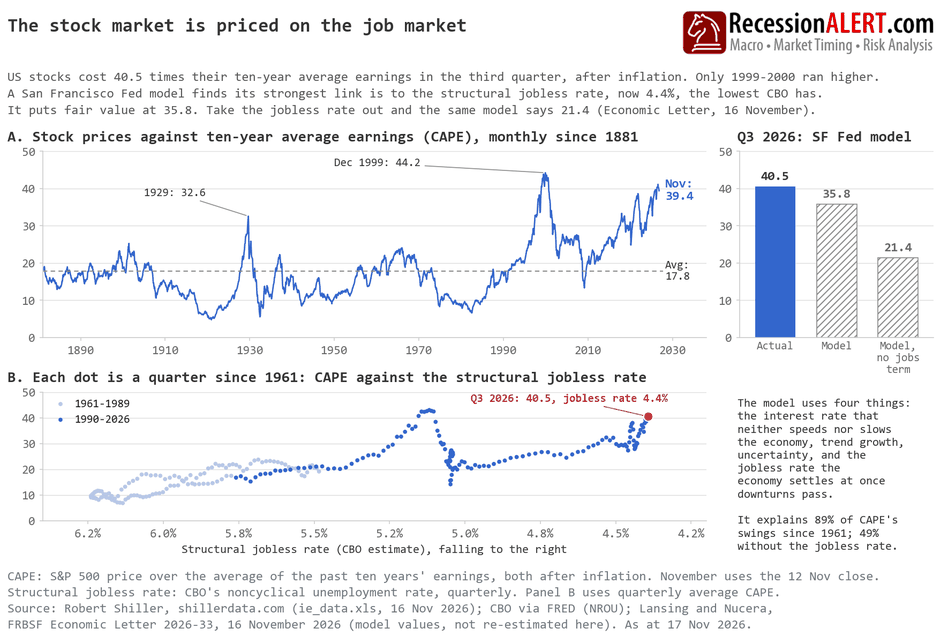
The strongest prop under US share prices, on one new reckoning, is not interest rates but the job market, which also pays the wages of the people who own them. Monday’s San Francisco Fed Economic Letter explains CAPE (price against ten years of average after-inflation earnings) since 1961 with four inputs, and finds the most important is the structural jobless rate, the rate the economy settles at once downturns pass. With it, the model’s fair value is 35.8 against an actual 40.5; without it, the same model says 21.4. The Letter’s reason, citing Hall (2017), is that employers value the future benefits of hiring much as investors value a stock’s future cash flows: a firm deciding whether to hire and an investor pricing its shares weigh the same future. CBO puts that rate at 4.4%, the lowest in a series starting in 1949, and that moves where the risk sits. At the 1999-2000 peak both versions sat below the actual ratio, a price fundamentals could not explain; today the model accounts for most of the run-up since late 2022. Of the illustrative AI scenarios Fed Chair Warsh set out the same day, only broadly shared gains near full employment would keep that prop standing. If automation lifted joblessness lastingly above full employment, the prop would erode just as paychecks went; if AI disappointed, in his words, “equity valuations could fall.” A worker who owns the index has not hedged against losing their job. They have bet on keeping it twice.
What it means: For households, a lasting AI-driven rise in unemployment would cut income and stock savings at once, hitting hardest those whose retirement money sits mostly in US shares. For stock investors, the price sits 13% above what the model’s inputs explain, so a lasting rise in the structural jobless rate would remove support it counts on. For the economy, the link runs both ways: in Warsh’s third scenario, falling share prices would slow growth and lift unemployment. The read changes if the jobless rate climbs above 4.5%, last seen in 2021, and stays there while stocks hold.
Market Intelligence Brief (MIB) Ver. 20.07
For professional investors only. Not investment advice.
© 2026 RecessionALERT.com

Comments are closed.