
MARKET INTELLIGENCE BRIEF (MIB)
Friday, October 2, 2026
September payrolls rose 29,000 against roughly 90,000 expected, unemployment hit 4.2% and October hike odds sank to about 23%. Stocks cheered: S&P 500 +0.73%, Nasdaq 100 at a record. Bonds didn’t, with the 2-year up 4.0 bps after Dallas Fed’s Logan called for 50 bps or more of further hikes. The G7 agreed a 100 million-barrel reserve release and WTI fell 1.9%, but a sixth vessel since Sunday was struck in Hormuz. TSLA rose 4.65% on a delivery beat.
TABLE OF CONTENTS
A. EXECUTIVE SUMMARY
B. MARKET DATA
C. HIGH-IMPACT STORIES (5)
D. MODERATE-IMPACT STORIES (6)
E. ECONOMY WATCH (5)
F. EARNINGS WATCH (0)
G. WHAT’S NEXT
H. CHART OF THE DAY
A. EXECUTIVE SUMMARY -> TOP
Stocks read September’s payrolls miss (+29,000 against roughly 90,000 expected) as a reprieve from an October hike and sent the Nasdaq 100 to a record, but Treasuries priced the destination rather than the delay: the 2-year rose 4.0 bps and the 10-year rose 3.2 bps to 5.276%. October hike odds fell to about 23% while futures still price a December increase as highly likely, and Dallas Fed voter Lorie Logan’s call for “an additional 50 basis points or more” kept the debate on inflation. The long end set the week’s tone, with the 10-year up about 11 bps, the S&P 500 down 0.27% and the Dow down 1.26% for the week, while the G7’s 100 million-barrel reserve release cut WTI 1.9% as a sixth vessel since Sunday was struck in Hormuz. Breadth was near total, with ten of eleven sectors up and Industrials leading at +1.89%, but against an -8.37% three-month record that is a bounce, not a trend.
• Jobs: Payrolls rose 29,000 against roughly 90,000 expected, July and August were revised down a combined 60,000, unemployment rose to 4.2% and annual wage growth slowed to 3.0%; CME FedWatch odds of an October hike fell to about 23%.
• Fed: Dallas Fed voter Logan estimated rates need to rise “an additional 50 basis points or more”; Kashkari still sees one more hike in 2026 but holds no strong view on October; Goolsbee said inflation is “where the problem is.”
• Bonds: The 10-year traded as low as 5.154% before closing up 3.2 bps at 5.276%, and the 2-year rose 4.0 bps to 4.829%; on the week the 10-year rose 10.9 bps, steepening 2s10s to 44.7 bps from 30.3.
• Oil: The G7 agreed a 100 million-barrel IEA release of diesel and crude and Trump dropped the diesel export-ban threat; WTI fell 1.9% to $91.11. A sixth vessel since Sunday was struck in Hormuz, and Saudi Arabia is planning an offensive to retake the Bab el-Mandeb from the Houthis.
• Movers: Tesla (TSLA) rose 4.65% on third-quarter deliveries of 486,532 against roughly 462,000 expected. Seagate fell 13% and Western Digital fell 12% by midday on Toshiba’s plan to double hard-drive capacity, and Sandisk (SNDK, -3.79%) and Micron (MU, -2.05%) were the session’s largest mega-cap decliners.
• Week: Friday’s gain still left the S&P 500 down 0.27% and the Dow down 1.26% for the week, while the Nasdaq 100 rose 0.65% and closed at a record; the FDA granted Lilly’s Jaypirca traditional approval in first-line CLL/SLL late in the session.
1. Timing, Not Direction — The payrolls miss bought equities a reprieve the front end will not grant. October hike odds fell to about 23%, but Logan’s estimate of “50 basis points or more,” Kashkari’s projection of another hike in 2026 and Goolsbee’s warning on inflation all keep the target on prices, with the Fed’s measure at 3.4% in August, and the 2-year closed at 4.829% after touching 4.712%. Rallies that assume a lasting dovish turn are exposed: the gap between the Nasdaq 100’s record and the 2-year’s close narrows only when September CPI lands ahead of the October 27-28 meeting.
2. The Long End Is the Binding Constraint — The 10-year rose 10.9 bps on the week to 5.276% while the 2-year fell 3.5 bps, a steepening that reflects investors demanding more for duration rather than pricing more hikes, and it left the S&P 500 and Dow lower for the week with only the Nasdaq 100 at a record. The same yields are biting elsewhere: Freddie Mac’s 30-year rate rose to 7.28%, pending sales are down 4.1% from a year ago on Realtor.com’s count, and Amazon’s reported $8 billion Nvidia-chip sale-leaseback will test what debt investors charge to fund AI hardware with the 10-year near 5.3%. Seagate’s 13% and Western Digital’s 12% midday drops on a modest Toshiba capacity plan show how little it takes to shake a crowded AI trade.
3. Policy Can Ease Diesel, Not the Chokepoints — US diesel futures fell 3.25% to $4.49 a gallon on reports of the G7 release talks and WTI fell 1.9%, but Brent’s more than $11 premium over WTI shows where the risk sits: a sixth vessel struck in Hormuz since Sunday, a planned Saudi offensive to retake the Bab el-Mandeb, and an OPEC+ 2027 capacity review pushed to mid-November. Energy Aspects called the deal “a political statement rather than a specific and binding commitment.” With ISM’s prices index at 77.9, an energy-driven inflation impulse is what keeps the Fed’s hawks focused on prices whatever payrolls do.
 — Leading economic indicators. Accurate market forecasts. Apply for membership at join.recessionalert.com
B. MARKET DATA -> TOP
A soft September jobs report set the tone: payrolls rose just 29,000 against 89,000 expected and unemployment ticked up to 4.2%, cutting the odds of an October Fed hike to about 23% and lifting stocks broadly, with ten of eleven sectors higher and the Nasdaq 100 at a record close. Bonds did not follow: Treasuries rallied early, then reversed, leaving the 10-year 3.2 bps higher at 5.276% even as the VIX fell 6.59%. The Dow Transports jumped 2.07% to close above 20,000, outrunning the Dow by more than 1.5 points. In crude, futures settled lower after Europe agreed to release diesel reserves, with WTI down 1.9% and Brent nearly unchanged, widening the gap between the two benchmarks to more than $11.
CLOSING PRICES – Friday, October 2, 2026:
MAJOR INDICES
The advance was broad rather than narrow: the NYSE Composite (+0.54%) confirmed the S&P 500’s gain, and the Nasdaq 100’s 1.00% rise carried it to a record close above September 22’s 30,732.40. The Dow Transports (+2.07%) outran the Dow (+0.49%) by 1.58 points, a split with no identified catalyst. With both averages now within 2% of their 10-session highs, a Dow Theory bull confirmation emerges today.
| Index | Close | Change | %Move | Why It Moved |
|---|---|---|---|---|
| S&P 500 | 7,722.72 | +56.27 | +0.73% | Rose after September payrolls (+29,000 vs 89,000 expected) cut October Fed-hike odds to about 23% (CME FedWatch); closed back above 7,700 |
| Dow Jones | 51,176.96 | +250.40 | +0.49% | Gained on the softer jobs data and closed back above 51,000, but lagged the S&P 500 and the Transports |
| DJ Transportation | 20,009.75 | +405.24 | +2.07% | No discrete same-day catalyst identified; first close above 20,000 since September 18 |
| Nasdaq 100 | 30,807.93 | +306.37 | +1.00% | Record close, topping the September 22 record of 30,732.40 after an intraday high of 31,017.53; chipmakers and Tesla led |
| Russell 2000 | 2,832.90 | +26.27 | +0.94% | Rose with the broad market as Fed-hike odds fell after the payrolls miss |
| NYSE Composite | 23,654.31 | +127.47 | +0.54% | Broad breadth: ten of eleven sectors rose, with only Healthcare (-0.02%) slipping |
VOLATILITY & TREASURIES
Stocks and bonds disagreed. The VIX fell 6.59% as hike odds faded, but Treasuries gave back an early rally: the 10-year traded as low as 5.154% before closing 3.2 bps higher, and the 2-year rose 4.0 bps. The bond market declined to confirm the dovish read, leaving the rate path unsettled. The 2s10s curve was little changed at 44.7 bps, and the dollar slipped 0.18%.
| Instrument | Level | Change | Why It Moved |
|---|---|---|---|
| VIX | 15.31 | -1.08 (-6.59%) | Fell as stocks rallied and October Fed-hike odds dropped after the payrolls report |
| 10-Year Treasury Yield | 5.276% | +3.2 bps | Fell to an intraday low of 5.154% on the soft payrolls, then reversed to close higher |
| 2-Year Treasury Yield | 4.829% | +4.0 bps | Reversed an early drop to 4.712% and closed higher even as October hike odds fell to about 23% |
| US Dollar Index (DXY) | 101.92 | -0.18 (-0.18%) | Eased after the weaker-than-expected jobs report |
COMMODITIES
Gold fell 0.75% despite a weaker dollar and lower hike odds, reversing from an intraday high of $4,256.50, and silver and platinum followed it lower; no catalyst was identified for the precious-metals decline. Copper rose 0.81% alongside equities, splitting from gold. Bitcoin finished nearly flat, sitting out the equity rally.
| Asset | Price | Change | %Move | Why It Moved |
|---|---|---|---|---|
| Gold | $4,170.65/oz | $-31.65 | -0.75% | Reversed from an intraday high of $4,256.50; no discrete same-day catalyst identified |
| Silver | $60.798/oz | $-0.377 | -0.62% | Followed gold lower; no discrete same-day catalyst identified |
| Copper | $6.5910/lb | $+0.0530 | +0.81% | Rose alongside equities; no discrete same-day catalyst identified |
| Platinum | $1,710.40/oz | $-12.40 | -0.72% | Fell with the precious-metals complex; no discrete same-day catalyst identified |
| Bitcoin | $84,429.0 | $-215.0 | -0.25% | Nearly flat; did not join the equity rally; no discrete same-day catalyst identified |
ENERGY
Crude futures settled lower after Europe agreed to release diesel reserves at President Trump’s request (Reuters), with WTI down 1.9% and Brent nearly unchanged, widening the gap between the benchmarks to more than $11. Gas moved the other way, with Henry Hub up 2.60% and Dutch TTF up 3.58% in dollar terms; no catalyst was identified for either.
| Asset | Price | Change | %Move | Why It Moved |
|---|---|---|---|---|
| Crude Oil (WTI) | $91.40/bbl | $-1.47 | -1.58% | Settled down $1.76 at $91.11 after European leaders agreed to release diesel reserves (Reuters); price shown is the late-afternoon last against Thursday’s $92.87 settle |
| Crude Oil (Brent) | $102.78/bbl | $+0.47 | +0.46% | Settled down 6 cents at $102.25 on the same diesel-reserve news (Reuters), then rose after the settlement; price shown is the late-afternoon last against Thursday’s $102.31 settle |
| Natural Gas (Henry Hub) | $3.044/MMBtu | $+0.077 | +2.60% | No discrete same-day catalyst identified; no scheduled EIA storage report on Fridays |
| Natural Gas (Dutch TTF) | $25.24/MMBtu | $+0.87 | +3.58% | Rose 3.47% in euros, with the euro’s 0.11% gain adding to it in dollar terms; no discrete same-day catalyst identified |
S&P 500 SECTORS
A near-total breadth sweep: ten of eleven sectors rose, with Healthcare (-0.02%) the lone holdout. Industrials led (+1.89%) against a -8.37% three-month record, a bounce rather than a trend. Technology (+1.25%) added to the only sizeable sector gain of the week (+1.81%), while Utilities’ rise did little to dent an -11.46% quarter.
| Sector | 1-Day | 1-Week | 1-Month | 3-Month | 6-Month | YTD | 12-Month |
|---|---|---|---|---|---|---|---|
| Industrials | +1.89% | +0.70% | +0.79% | -8.37% | +3.03% | +9.94% | +11.36% |
| Basic Materials | +1.38% | -2.18% | -7.73% | +0.57% | -2.28% | +10.80% | +18.65% |
| Technology | +1.25% | +1.81% | +7.89% | +10.04% | +40.54% | +32.67% | +31.49% |
| Consumer Cyclical | +1.08% | -0.70% | -4.00% | -5.87% | +2.04% | -8.80% | -10.86% |
| Communication Services | +0.79% | -1.68% | +1.84% | -2.07% | +7.78% | +0.38% | +5.96% |
| Utilities | +0.52% | +0.70% | -5.64% | -11.46% | -13.59% | -6.61% | -8.36% |
| Energy | +0.48% | +0.73% | -3.37% | +15.00% | +1.96% | +36.18% | +37.01% |
| Real Estate | +0.35% | -2.10% | -6.77% | -8.51% | -1.27% | +0.59% | -3.52% |
| Consumer Defensive | +0.27% | -2.21% | -4.31% | -4.34% | -3.62% | +2.49% | +2.74% |
| Financial | +0.22% | -2.62% | -6.27% | -4.21% | +9.98% | +1.58% | +5.97% |
| Healthcare | -0.02% | -2.60% | -4.60% | -0.46% | +10.12% | +5.87% | +13.47% |
TOP MEGA-CAP MOVERS:
GAINERS
| Company | Ticker | Close | Change | Why It Moved |
|---|---|---|---|---|
| SpaceX | SPCX | $158.96 | +7.35% | No discrete same-day catalyst identified; a Stocktwits report attributed the gain to three launches on Thursday and the start this month of SpaceX’s AI-computing contract with Alphabet (unverified) |
| Tesla | TSLA | $370.59 | +4.65% | Reported third-quarter deliveries of 486,532 vehicles (SEC 8-K), above the roughly 462,000 consensus cited by Investing.com |
| Texas Instruments | TXN | $293.80 | +4.44% | No discrete same-day catalyst identified; analog peer Analog Devices rose 3.10% |
| Dell Technologies | DELL | $562.52 | +3.84% | No discrete same-day catalyst identified; rose with AI-hardware and chip names in a Technology-led session |
| Broadcom | AVGO | $355.14 | +3.35% | Bloomberg reported Friday that Broadcom’s bank syndicate is starting to raise $60 billion of financing to benefit Anthropic and other AI companies; its weight in the move is unverified |
DECLINERS
| Company | Ticker | Close | Change | Why It Moved |
|---|---|---|---|---|
| Sandisk | SNDK | $1,719.99 | -3.79% | Fell as storage stocks sold off on a Nikkei report that Toshiba plans to double hard-drive capacity, which sent Seagate and Western Digital down by double digits; Sandisk makes flash memory, not hard drives, so the read-across is indirect |
| Micron Technology | MU | $1,074.89 | -2.05% | No discrete same-day catalyst identified; slipped alongside Sandisk’s storage-led decline, two sessions after its September 30 earnings report |
| IBM | IBM | $222.64 | -1.32% | No discrete same-day catalyst identified; lagged a Technology sector that rose 1.25% |
| Netflix | NFLX | $67.06 | -1.16% | No discrete same-day catalyst identified |
| Amgen | AMGN | $403.04 | -1.04% | No discrete same-day catalyst identified, though Amgen’s own press-release page could not be read, so an issuer release was not ruled out; Healthcare was the only sector to close lower |
— Institutional-grade intelligence for serious investors. Apply for membership at join.recessionalert.comC. HIGH-IMPACT STORIES -> TOP
UNCERTAIN
1. Soft Payrolls Push an October Hike Off the Table and Lift the Nasdaq 100 to a Record, but Treasuries Reverse and Close Higher
The core facts:Friday’s September payrolls miss (+29,000 against roughly 90,000 expected, with unemployment up to 4.2%) cut CME FedWatch odds of an October rate hike to about one in four, while futures still price an overwhelmingly high probability of a December increase, Reuters reported. Equities took the dovish read: the S&P 500 rose 0.73% to 7,722.72, ten of eleven sectors gained, the VIX fell 6.59% to 15.31 and the Nasdaq 100 closed at a record 30,807.93. Bonds did not: the 10-year yield fell as low as 5.154% before reversing to close 3.2 bps higher at 5.276%, and the 2-year finished 4.0 bps higher at 4.829%. No source established what drove the reversal.
Why it matters:The report moved the timing of the next hike, not its likelihood. Reuters reported that policymakers were already leaning against a second straight hike in October, and JPMorgan’s Michael Feroli wrote that “It would now take a very strong CPI to make the October meeting live,” while still forecasting a December hike. Reuters also noted that the rise in unemployment was driven by new entrants to the workforce, with low jobless claims pointing to no broad increase in layoffs. That is why the front end did not rally: with inflation by the Fed’s targeted measure at 3.4% in August, a softer labor market defers tightening rather than reversing it. Equities priced the reprieve and the 2-year priced the destination, and the gap between the two narrows only when the September CPI arrives just before the October 27-28 meeting.
What to watch:The 2-year yield against its 4.712% intraday low, and the FOMC minutes on Wednesday, October 7 at 2:00 PM ET for how many participants backed further increases.
BEARISH
2. Dallas Fed’s Logan Says Rates Need to Rise “an Additional 50 Basis Points or More,” and Goolsbee Says Inflation Is “Where the Problem Is”
The core facts:Dallas Fed President Lorie Logan, a 2026 FOMC voter, said Thursday evening at the Dallas Fed’s “Voices of the Eleventh District” event: “I currently estimate the target range needs to rise an additional 50 basis points or more to appropriately balance the outlook.” She added that “a balanced labor market and inflation trending above target mean the stance of policy has been offsides,” and that inflation is “trending toward the mid-2’s, not all the way to the FOMC’s 2 percent goal.” On Friday, after the payrolls report, Chicago Fed President Austan Goolsbee told Fox Business that “There is plenty of room for anything to be on the table” and that “the inflation side of the Fed’s job, that’s where the problem is… We can’t let that get even more out of control,” according to Reuters.
Why it matters:Logan’s estimate is the most explicit hike count yet from a sitting voter after September’s 25-basis-point increase: 50 basis points or more implies at least two further moves. She spoke before Friday’s report and anchored her labor-market view on a 4.1% unemployment rate that is now 4.2%, so the jobs data tests her framing directly. Goolsbee’s same-day remarks show the soft print did not shift the policy debate away from inflation. Together they explain why the 2-year yield closed higher on a day when October hike odds fell: the market is repricing the timing of the next hike, not abandoning it.
What to watch:Logan’s next remarks on Tuesday, October 6 at 7:00 PM ET, for whether the payrolls miss changes her estimate of 50 basis points or more.
BULLISH
3. G7 Agrees a 100 Million-Barrel Release of Diesel and Crude Through the IEA, and Trump Drops the Diesel Export-Ban Threat; WTI Settles Down 1.9%
The core facts:Group of Seven leaders agreed on Friday to “a coordinated release through the IEA of 100 million barrels” of diesel and crude oil from emergency reserves, beginning immediately and running four months, with a substantial amount of diesel to be released within 20 days, Reuters reported. Members also pledged to refrain from energy export restrictions among themselves. The agreement followed a US pressure campaign that had threatened a ban on US diesel exports; President Trump told reporters the US would not impose one. The statement did not break down volumes by product or name participating countries. WTI settled down $1.76, or 1.9%, at $91.11, and Brent settled 6 cents lower at $102.25, per Reuters.
Why it matters:Diesel is the binding constraint for US freight, farming and goods inflation, and the deal removes the tail risk of a US export ban that could have cut supply to Europe and disrupted the transatlantic product market. US diesel futures fell 3.25% to $4.49 a gallon on reports of the release talks, and European diesel futures fell 5.75%, according to LSEG data cited by Reuters. The relief is narrower for crude: Brent ended the session above Thursday’s settle, and it is uncertain how much of the 100 million barrels is new rather than drawn from the 400 million-barrel March pact. Energy Aspects called it “a political statement rather than a specific and binding commitment,” and Reuters reported the White House is preparing an executive order on record-high US diesel prices that could come as early as next week.
What to watch:The IEA meeting “in the coming days” on possible additional diesel releases, and the OPEC+ online meeting on November quotas on Sunday, October 4.
BEARISH
4. A Sixth Vessel Is Struck in the Strait of Hormuz Since Sunday as Saudi Arabia Plans an Offensive to Retake the Bab el-Mandeb From the Houthis
The core facts:The master of a tanker reported being struck by an unknown projectile during an outbound transit of the Strait of Hormuz at 1122 UTC on Friday, causing “a small fire and a blackout onboard,” according to UKMTO via gCaptain; the fire was extinguished, the vessel continued underway and no casualties were reported. At least six vessels have been struck in the strait since Sunday, September 28, and UKMTO has neither named the tanker nor attributed any of the attacks. Separately, Reuters reported Friday, citing six people with knowledge of the preparations, that Saudi Arabia is organizing an offensive against the Houthis to retake the Red Sea shipping route, through a coastal push or an assault on multiple fronts; more than 100,000 Yemeni troops could be mobilized, with timing estimates ranging from within a week to after the US midterm elections.
Why it matters:Both of the Gulf’s maritime chokepoints are now contested at once: Hormuz under repeated strikes, and the Bab el-Mandeb, which the Houthis seized last month, now facing a planned ground offensive. That is the physical backdrop to the G7’s stock release and to Brent’s more than $11 premium over WTI, and it is why emergency barrels can ease prices only at the margin. A Saudi offensive could reopen the Red Sea route over time, but it raises near-term escalation risk to tanker traffic and insurance costs, keeping a risk premium in crude and in the inflation expectations the Fed is watching.
What to watch:UKMTO incident reports for further Hormuz strikes, and any confirmation of the Saudi offensive’s start, which Reuters’ sources said could come within a week.
UNCERTAIN
5. Friday’s Rally Is Not Enough: the S&P 500 and Dow Close the Week Lower as the 10-Year Yield Rises About 11 bps, While the Nasdaq 100 Posts a Weekly Gain
The core facts:Measured against the September 25 closes, the S&P 500 finished the week down 0.27% (7,722.72 from 7,743.41), the Dow down 1.26% (51,176.96 from 51,828.62) and the Russell 2000 down 0.16%, despite Friday’s broad advance. The Nasdaq 100 rose 0.65% on the week and closed at a record. The 10-year Treasury yield rose 10.9 bps over the week to 5.276%, while the 2-year fell 3.5 bps to 4.829%, steepening the 2s10s curve to 44.7 bps from 30.3 bps.
Why it matters:The week’s damage came from the long end, not from the Fed path: the 2-year ended lower while the 10-year rose, a bear steepening consistent with investors demanding more compensation for holding duration rather than pricing additional hikes. That pressure capped the broad market, leaving the Dow the weekly laggard, while the Nasdaq 100’s chip and AI leaders were strong enough to outrun it. A record in the growth index alongside weekly losses in the S&P 500 and Dow is a narrow advance, and it remains exposed to any further rise in long yields.
What to watch:Whether the 10-year holds below Friday’s 5.276% close into the FOMC minutes on Wednesday, October 7, and whether the S&P 500 can reclaim its September 25 close of 7,743.41.
— Quantifying recession risk so you don’t have to guess. Apply for membership at join.recessionalert.comD. MODERATE-IMPACT STORIES -> TOP
BULLISH
6. Tesla Delivers 486,532 Vehicles in the Third Quarter, Beating the Roughly 462,000 Consensus; Shares Rise 4.65%
The core facts:Tesla reported third-quarter deliveries of 486,532 vehicles in an SEC filing on Friday, comprising 478,237 Model 3/Y and 8,295 other models, above the roughly 462,000 consensus cited by Investing.com. Deliveries were about 2.1% below the 497,099 of the third quarter of 2025, which remains the company’s quarterly record. The shares rose 4.65% to $370.59, the second-largest gain among mega-caps. Third-quarter financial results are scheduled for Wednesday, October 21 after the close.
Why it matters:A beat of roughly 24,500 units against expectations matters more than the small year-over-year decline, because it eases the main concern about demand at a time when high rates and fuel costs are squeezing consumer budgets. With Tesla among the Nasdaq 100’s largest weights, the move was one of the leaders of the index’s record close. The test now shifts to margins: deliveries say nothing about pricing, and the October 21 results will show what it cost to hit the number.
What to watch:Automotive gross margin in Tesla’s third-quarter results on Wednesday, October 21.
BEARISH
7. Toshiba Plans to Double Hard-Drive Capacity, Sending Seagate and Western Digital Down by Double Digits and Pulling Sandisk and Micron Lower
The core facts:Toshiba plans to invest about ¥60 billion ($380 million) to double its hard-disk-drive production capacity by fiscal 2027 to meet demand for storage from AI data centers, according to Nikkei. Seagate and Western Digital were down 13% and 12% respectively by midday Friday, according to Investing.com, after large gains this year. Among mega-caps, Sandisk fell 3.79% and Micron 2.05%, the session’s two largest mega-cap declines. Citi’s Asiya Merchant said the expansion may have a limited impact on overall supply because Toshiba relies on outside suppliers for key components such as media and heads, and LYNX Equity Strategies also argued it is unlikely to dent the shortage meaningfully.
Why it matters:Storage has been one of the most crowded AI trades this year because of tight supply, and the selloff shows how sensitive those valuations are to any sign of new capacity, even a modest one. The read-across to Sandisk and Micron is indirect, since they make flash and DRAM rather than hard drives, which suggests the selling was positioning rather than a reassessment of their own supply. The analysts’ point that component suppliers would also need to expand is the case for the decline being overdone.
What to watch:Whether hard-drive component suppliers announce matching capacity additions, which would determine whether Toshiba can actually double output.
BULLISH
8. FDA Grants Lilly’s Jaypirca Traditional Approval in First-Line CLL/SLL After a Phase 3 Trial Cut the Risk of Progression by 80%
The core facts:The FDA granted Eli Lilly’s Jaypirca (pirtobrutinib) traditional approval for adults with previously untreated chronic lymphocytic leukemia or small lymphocytic lymphoma with no known 17p deletion, Lilly announced at 3:05 PM ET Friday. In the Phase 3 BRUIN CLL-313 trial against bendamustine plus rituximab, Jaypirca showed a progression-free survival hazard ratio of 0.20 (95% CI 0.11-0.37; p<0.0001), with median progression-free survival not reached versus 33.5 months, and an overall response rate of 94% versus 81%. Lilly describes Jaypirca as the first and only approved non-covalent BTK inhibitor.
Why it matters:The approval moves Jaypirca from later-line use into the first-line setting, the largest segment of the CLL market, where it competes directly with the covalent BTK inhibitors ibrutinib, acalabrutinib and zanubrutinib. It broadens Lilly’s growth beyond its obesity and diabetes franchise and adds pressure on incumbent BTK sellers. The announcement came late in the session, so the market reaction is still to come.
What to watch:Lilly’s and the incumbent BTK makers’ share moves on Monday, October 5, the first full session after the late Friday announcement.
UNCERTAIN
9. Amazon Seeks to Move About $8 Billion of Nvidia Chips Into an Investor Vehicle and Lease Them Back, the FT Reports
The core facts:Amazon is seeking to offload about $8 billion of Nvidia Grace Blackwell chips into a special-purpose vehicle that would raise debt from outside investors and lease the chips back to Amazon, the Financial Times reported Friday, according to Reuters. Amazon has held talks with investors in recent weeks and plans to offer an equity stake of up to 10% in the vehicle. The chips, bought or leased by Amazon, are installed in more than a dozen US data centers across five states, including Nevada and Virginia. Amazon and Nvidia did not immediately comment.
Why it matters:A cash-rich hyperscaler moving AI hardware off its balance sheet signals that even the largest buyers want to share the cost of the buildout as chip spending outruns operating cash flow. Sale-leasebacks of fast-depreciating GPUs shift that risk to private credit and debt investors, so the structure and pricing of this deal will be read as a gauge of investor appetite for AI-hardware debt at a time when the 10-year yield sits near 5.3%.
What to watch:Any confirmation of the deal’s size and pricing from Amazon.
UNCERTAIN
10. OPEC+ Delays the Capacity Review Behind Its 2027 Quotas to Mid-November After the Iran War Disrupts Expansion Projects, Reuters Reports
The core facts:OPEC+ has delayed a production-capacity review used to set members’ 2027 output quotas, which was due by the end of September, to mid-November, two sources told Reuters in an exclusive report Friday. The war on Iran has disrupted projects to expand capacity across the Middle East, and not all members have submitted the required data. Consultant DeGolyer and MacNaughton, which is estimating capacity for all members except Russia, Iran and Venezuela, will not submit its report until mid-November, still in time for the group’s late-November meeting.
Why it matters:Capacity assessments set each member’s baseline in quota negotiations, so the delay keeps the alliance’s 2027 supply framework unsettled into year-end. With the UAE having left OPEC+ in May and Iraq seeking a higher quota, an exercise that puts a number on each member’s capacity risks further cohesion strains, and that uncertainty over future supply discipline is another source of volatility for crude and US inflation expectations.
What to watch:The OPEC+ online meeting on November quotas on Sunday, October 4.
UNCERTAIN
11. Oracle Commits to Buy Point Beach Nuclear Power for Its Wisconsin AI Data Center and Absorb About $300 Million in Rising Fuel Costs
The core facts:Oracle said Friday it plans to subscribe to a portion of the Point Beach Nuclear Plant’s output and absorb approximately $300 million in rising fuel costs to shield more than 1 million Wisconsin utility customers from price increases. The arrangement requires approval from the Public Service Commission of Wisconsin and complements Oracle’s “Project Lighthouse” data center development in Port Washington. “By absorbing approximately $300 million in rising energy costs, we are helping protect Wisconsin ratepayers,” said Mahesh Thiagarajan, executive vice president of Oracle Cloud Infrastructure.
Why it matters:Power access has become the gating factor for AI data centers, and political resistance to higher utility bills is growing. Oracle paying to protect ratepayers is a template for how hyperscalers may have to buy local approval: by taking on energy-cost risk themselves. That adds a new cost line to AI infrastructure budgets, while supporting the economics of existing nuclear plants.
What to watch:Oracle’s filing with the Public Service Commission of Wisconsin and the commission’s decision on the arrangement.
— Separating signal from noise since 2007. Apply for membership at join.recessionalert.comE. ECONOMY WATCH -> TOP
Labor demand is stalling while the Fed’s hawks keep further tightening on the table. September payrolls rose just 29,000, revisions removed 60,000 from July and August, and annual wage growth slowed to 3.0%, leaving the three-month average near 51,000. That pulled the odds of an October rate hike down to about 23%, yet the 2-year yield closed 4.0 bps higher at 4.829%, and Kashkari, a day earlier, still saw more hikes ahead while declining to commit on October. Outside the labor market, activity is holding: construction spending beat with a 0.9% gain and factory orders were steady, but housing demand is rate-bound, with pending sales down 4.1% from a year ago.
Payrolls Rise Just 29,000 in September vs. About 90,000 Expected as Unemployment Ticks Up to 4.2% and Revisions Cut 60,000 (BLS, Oct 2)
What they’re saying:Nonfarm payrolls rose 29,000 in September, well short of the roughly 90,000 consensus, with private employers adding 46,000 against 85,000 expected and government payrolls falling 17,000. July was revised to a 10,000 loss from a 21,000 gain and August to 133,000 from 162,000, a combined downward revision of 60,000. The unemployment rate rose to 4.2% from 4.1%, and average hourly earnings rose just 0.1% (5 cents, to $37.81) against 0.3% expected, slowing annual wage growth to 3.0% from 3.1%, below the 3.2% forecast.
The context:After revisions, payroll gains have averaged about 51,000 a month over the past three months. The rise in unemployment came as labor-force participation climbed to 61.8% from 61.6%, consistent with new entrants accounting for part of the increase, while the broader U-6 underemployment rate edged down to 7.6% from 7.7%. Health care (+17,000), construction (+11,000) and manufacturing (+9,000) added jobs; financial activities shed 7,000. Equities read the report as removing the case for an October move: CME FedWatch odds of an October rate hike fell to about 23%, the S&P 500 rose 0.73% and the Nasdaq 100 closed at a record. Treasuries did not follow through: the 2-year yield reversed an early drop to 4.712% and closed 4.0 bps higher at 4.829%, and the 10-year finished up 3.2 bps at 5.276%.
What to watch:Initial jobless claims on Thursday, October 8 (prior 197,000), for whether layoffs stay low as hiring slows; the FOMC minutes on Wednesday, October 7 at 2:00 PM ET; and the Fed’s October 27-28 decision.
Fed’s Kashkari Still Expects More Rate Hikes but Holds No Strong View on an October Move (FXStreet, Oct 1)
What they’re saying:Minneapolis Fed President Neel Kashkari, a 2026 FOMC voter, said on Thursday that he does not have a strong view on whether the Fed should raise rates at its October 27-28 meeting, according to FXStreet. He reiterated that his September projections penciled in one more rate hike in 2026 and another in 2027.
The context:His remarks came the afternoon before the jobs report and frame the question that report now presses: whether further tightening is needed at all is not in doubt for him, but its timing is open. Prediction markets agree on direction: Polymarket prices a 2026 Fed rate hike at 100% and at least one 2026 rate cut at about 4%. On timing, the soft payrolls print pulled CME FedWatch odds of an October rate hike down to about 23%.
What to watch:The FOMC minutes on Wednesday, October 7 at 2:00 PM ET, for how many participants backed further increases, and Dallas Fed President Logan’s remarks on Tuesday, October 6 at 7:00 PM ET.
Construction Spending Rises 0.9% in August, Beating Flat Expectations, as Private Residential and Nonresidential Both Gain About 1% (Census Bureau, Oct 1)
What they’re saying:Construction spending rose 0.9% in August to a seasonally adjusted annual rate of $2,203.1 billion, from a revised $2,184.5 billion in July, against a consensus of no change. Private construction rose 1.1% to $1,655.3 billion, with residential up 1.1% to $882.3 billion and nonresidential up 1.0% to $773.0 billion; public construction rose 0.2% to $547.8 billion.
The context:The beat is real but modest: spending remains 1.7% below August 2025’s $2,242.0 billion, and the Census Bureau puts the monthly change’s margin of error at ±1.0 percentage point, so the gain is not statistically significant on its own. It fed straight into growth tracking: after that morning’s Census and ISM releases, the Atlanta Fed raised its third-quarter nowcast for private investment growth to 21.4% from 20.7%, holding overall GDPNow at 3.7%. August’s residential gain also came before mortgage rates jumped to 7.28% from 7.03% in Freddie Mac’s October 1 survey.
What to watch:August trade balance on Tuesday, October 6 (prior -$88.6 billion), the next input into third-quarter growth tracking.
Factory Orders Edge Up 0.1% in August, Matching Forecasts, as Shipments Stall After Eight Monthly Gains (Census Bureau, Oct 2)
What they’re saying:New orders for manufactured goods rose $0.7 billion, or 0.1%, to $663.5 billion in August, matching the 0.1% forecast after a 0.8% July gain; excluding transportation, orders rose 0.3%. Shipments were virtually unchanged at $658.6 billion, ending eight consecutive monthly increases, while unfilled orders rose 0.6% to $1,609.6 billion and inventories rose 0.5% to $972.4 billion, their eleventh straight gain.
The context:Inventories outpaced flat shipments, lifting the inventories-to-shipments ratio to 1.48 from 1.47, while the backlog kept building, with the unfilled-orders-to-shipments ratio rising to 6.87 from 6.81 and unfilled orders up in 25 of the last 26 months. The print fits Thursday’s ISM Manufacturing reading of 54.5: factories are still expanding, but output has stopped accelerating while input prices climb, with the ISM prices index at 77.9.
What to watch:ISM Services PMI on Monday, October 5 at 10:00 AM ET (expected 55.7, prior 55.4), for whether the larger services side is holding up.
Realtor.com: Price Cuts Reach a Yearly High as Pending Sales Fall 4.1% From a Year Ago and Inventory Nears Pre-Pandemic Levels (Realtor.com, Sept 30)
What they’re saying:Realtor.com’s September housing report showed active listings up 5.4% from a year earlier to 1,161,615 homes, with 20.8% of listings carrying a price reduction, up 0.9 percentage point. Pending sales fell 4.1% year over year, new listings slipped 0.7% to 394,830, and the median list price fell 1.4% to $419,250. The inventory gap with the 2017-2019 pre-pandemic market narrowed to 9.1%, the first time it has been below 10%.
The context:Supply is normalizing but demand is not following. “September’s housing data shows that buyers are gaining leverage, but higher mortgage rates are limiting how much of that opportunity they can use,” said chief economist Danielle Hale. That constraint has tightened since: Freddie Mac’s 30-year rate rose to 7.28% from 7.03% on October 1, and the 10-year Treasury yield closed at 5.276% on Friday.
What to watch:The MBA 30-year mortgage rate on Wednesday, October 7 (prior 7.3%), and the University of Michigan’s preliminary October consumer sentiment on Friday, October 9 (prior 48.1).
— Know the probability before the market prices in the risk. Apply for membership at join.recessionalert.comF. EARNINGS WATCH -> TOP
YESTERDAY AFTER THE BELL (Markets Reacted Today)
No major earnings yesterday after the bell from companies with >$100B market cap.
TODAY BEFORE THE BELL (Markets Already Reacted)
No major earnings before the bell from companies with >$100B market cap.
TODAY AFTER THE BELL (Markets React Tomorrow)
No major earnings after the bell from companies with >$100B market cap.
WEEK AHEAD PREVIEW:
Q3 2026 earnings season has barely begun, with FactSet now expecting S&P 500 earnings growth of 29.5%; one mega-cap reports in the next five sessions.
PepsiCo (PEP) — BMO, Thursday, October 8 — Consensus EPS $2.30 on revenue of $24.97B. Key focus: North America Foods volume and whether net revenue stabilises as price investments annualise; PepsiCo Beverages North America volume and margin; and, with diesel at record highs, how much freight and input-cost inflation is reaching packaged-goods margins. Consensus EPS estimates have been cut about 5% over the past 90 days against an easy comparison with a soft Q3 2025.
Large-bank Q3 results begin mid-October, with Bank of America on Wednesday, October 14.
— US market commentary trusted by family offices and institutions. Apply for membership at join.recessionalert.comG. WHAT’S NEXT -> TOP
UPCOMING RELEASES:
| Date | Event | Why It Matters |
|---|---|---|
| Sun, Oct 4 | OPEC+ online meeting on November quotas | The first supply decision since the G7’s 100 million-barrel reserve release, held with the 2027 capacity review delayed to mid-November and Brent more than $11 over WTI; any quota restraint would offset the release. |
| Mon, Oct 5 | ISM Services PMI, Sep (10:00 AM ET; expected 55.7, prior 55.4) | Tests whether the larger services side is holding up as hiring stalls; a firm reading, especially in prices, would support the hawks’ case after a soft payrolls print. |
| Tue, Oct 6 | ADP Weekly Employment Change (8:15 AM ET; prior 20K) | The first private read on hiring after September’s 29,000 payrolls gain and a three-month average near 51,000. |
| Tue, Oct 6 | Trade Balance, Aug (8:30 AM ET; prior -$88.6B) | The next input into third-quarter growth tracking, with GDPNow held at 3.7% after Thursday’s construction and ISM data. |
| Tue, Oct 6 | Fed’s Logan speaks (7:00 PM ET) | Her first remarks since the payrolls miss; she anchored her call for “an additional 50 basis points or more” on a 4.1% unemployment rate that is now 4.2%. |
| Wed, Oct 7 | EIA Crude Oil and Gasoline Stocks, week of Oct 3 (10:30 AM ET; prior crude +0.922M, gasoline -1.684M) | The first inventory read after the G7 release agreement, with record-high US diesel prices drawing a possible White House executive order. |
| Wed, Oct 7 | FOMC Minutes (2:00 PM ET) | Shows how many participants backed further increases after September’s 25 bp hike, and whether the committee’s case rests on inflation or on labor-market strength that Friday’s report undercut. |
| Thu, Oct 8 | Initial Jobless Claims, week of Oct 3 (8:30 AM ET; prior 197K) | Low claims are the evidence that slow hiring has not become layoffs; a rise would turn September’s unemployment uptick from new entrants into a weakening signal. |
| Fri, Oct 9 | University of Michigan Consumer Sentiment, Oct preliminary (10:00 AM ET; prior 48.1) | Gauges how fuel costs, 7%-plus mortgage rates and slowing wage growth are weighing on households, along with the survey’s inflation expectations. |
KEY QUESTIONS:
1. Can September CPI, due before the October 27-28 meeting, make October live again, or has the 2-year’s close at 4.829% already priced a December hike that no single soft print can dislodge?
2. Does Logan hold to “50 basis points or more” on Tuesday now that unemployment is 4.2%, and do Wednesday’s FOMC minutes show how widely that view is shared?
3. Can the G7’s 100 million barrels and a possible White House diesel order keep US diesel near $4.49 a gallon while vessels are still being struck in Hormuz and a Saudi offensive on the Bab el-Mandeb looms?
— US market commentary trusted by family offices and institutions. Apply for membership at join.recessionalert.comH. CHART OF THE DAY -> TOP
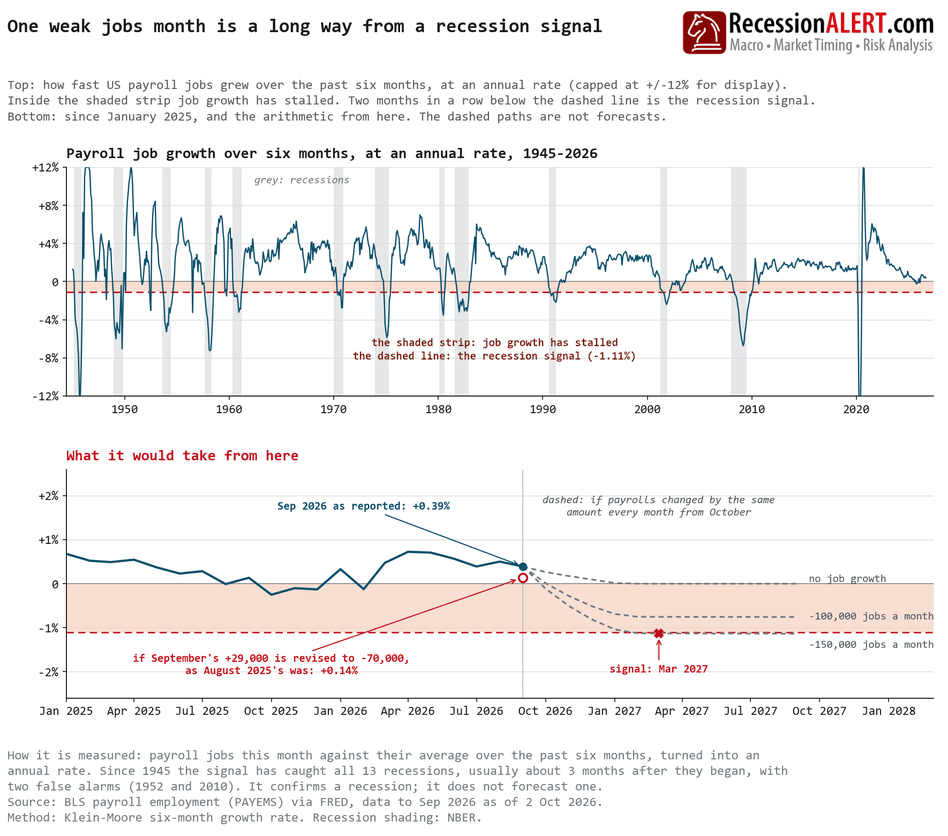
September’s jobs report is noise for one question and news for another. For the recession call, a 29,000 gain against about 84,000 expected barely registers. The gauge weighs this month’s payroll count against its six-month average, so one month is diluted six ways; revisions typically move it about a quarter of a percentage point, while +0.39% sits 1.5 points — six times that — above the recession line. September may not even stay positive: since 1979, gains first reported at 100,000 or less later became losses about one time in six. Yet revise it to -70,000, as August 2025’s +22,000 was, and the rate only slips to +0.14%; just reaching zero, the top of the stalled strip, would need about -125,000. Reaching the line itself would mean losing roughly 143,000 jobs every month; even 100,000 a month for a year stops at -0.76%. But for the pace of hiring, it is news. Job gains have averaged 45,000 a month over the past year, today’s revisions erased 60,000 jobs — more than a typical month adds — and unemployment rose to 4.2%. People looking for work feel that long before a gauge built to confirm recessions, not foresee them, would signal one. The gauge asks whether jobs are disappearing, and for now the answer is no; a job seeker asks whether they are appearing, and the answer is barely.
What it means: For households, the months ahead look like a slow job market, not a layoff wave: finding work gets harder, but most jobs stay safe. For the economy, hiring of about 45,000 a month leaves little cushion: two months of losing 50,000 jobs would already push the gauge into the stalled strip. For stock investors, hiring that cools without collapsing lowers the odds of another rate rise without raising recession risk, which is how markets traded this morning. What would change that: two months in a row below the dashed line.
Market Intelligence Brief (MIB) Ver. 19.79
For professional investors only. Not investment advice.
© 2026 RecessionALERT.com

Comments are closed.