
MARKET INTELLIGENCE BRIEF (MIB)
Thursday, October 1, 2026
Brent jumped 4.3% to $102.22 as Chinese refiners suspended October fuel exports. The 10-year yield touched 5.34% intraday, its highest since 2002, then closed down 4.8 bps; UK 30-year gilts topped 6%. Fed Vice Chair Jefferson called energy “the predominant factor” in rising inflation as ISM’s prices gauge leapt to 77.9. Freddie Mac’s 30-year mortgage rate hit 7.28% and junk CDS widened to April levels. Anthropic eyes a November IPO at up to $2 trillion.
TABLE OF CONTENTS
A. EXECUTIVE SUMMARY
B. MARKET DATA
C. HIGH-IMPACT STORIES (5)
D. MODERATE-IMPACT STORIES (7)
E. ECONOMY WATCH (6)
F. EARNINGS WATCH (2)
G. WHAT’S NEXT
H. CHART OF THE DAY
A. EXECUTIVE SUMMARY -> TOP
Equities absorbed a global long-end rout: the S&P 500 recovered from morning losses to gain 0.19% after the 10-year yield touched about 5.34%, its highest since 2002, then closed 4.8 bps lower as French and UK yields hit multi-decade highs. The front end led the bond rally, with the 2-year down 10.2 bps, while Fed speakers signalled patience on timing rather than a change of direction; Reuters reports traders still expect at least three more hikes before mid-2027. The tension is energy: Vice Chair Jefferson named it the predominant driver of headline inflation on a day Brent jumped 4.27% to $102.22 on China’s refined-product export halt and ISM’s prices gauge leapt 6.8 points to 77.9. Breadth was thin, with four of eleven sectors higher: Energy and Technology led on oil and Micron’s chip rally, while rate-sensitive Real Estate and Financials fell beside an unexplained Healthcare slide.
• Oil: Brent rose 4.27% to $102.22 and WTI rose 2.70% to $92.86 after PetroChina and Zhejiang Petrochemical suspended October diesel, gasoline and jet fuel exports; the Brent-WTI spread widened to $9.36. Treasury added 26 Iran-linked designations and sectoral sanctions on autos and rail.
• Bonds: The 10-year touched about 5.34% intraday, its highest since 2002, before closing at 5.244% (-4.8 bps); the 2-year fell 10.2 bps to 4.789%, steepening 2s10s to 45.5 bps from 40.1. Britain’s 30-year gilt yield topped 6% for the first time since 1998.
• Fed: Jefferson called energy “the predominant factor” in the headline inflation pickup and tied next moves to “trends in the data”; Cook named the AI build-out a top 2027 inflation risk; Schmid said higher long rates are starting to hit home prices as Freddie Mac’s 30-year rate jumped to 7.28% from 7.03%.
• Data: ISM manufacturing slipped to 54.5 (consensus 55.0) while new orders rose to 55.3 and prices jumped to 77.9; initial claims fell to 197,000; Challenger job cuts dropped 18.2% to 43,281.
• Credit: A high-yield CDS index hit its widest since early April; Evercore ISI and Truist both cut Bank of America targets to $62 ahead of Q3 results, with the KBW bank index more than 13% below its mid-August peak.
• AI: Anthropic targets a mid-November IPO at up to $2 trillion, which would be the largest on record; its prospectus shows Broadcom (AVGO, -2.15%) agreeing to lend it up to $42 billion. Micron (MU) rose 3.03% after earnings, alongside gains of about 3.5% in Lam Research and Applied Materials.
1. Energy Is the Inflation Risk the Fed Cannot Wait Out — The oil shock is in refined products, the channel that reaches US consumers and freight first, and it arrives with ISM’s prices index at 77.9 and a labor market Jefferson calls “near maximum employment,” with claims at 197,000 and unemployment at 4.1%. Thursday’s front-end rally priced patience on the next hike’s timing, not an end to tightening. That relief is fragile: a Brent price held above $100 into the October 27-28 meeting raises the bar for a pause, so positioning that leans on lower short rates is exposed to Friday’s payrolls and to Beijing’s export decision next week.
2. The Long End Is Tightening Conditions on the Fed’s Behalf — A synchronised selloff in US, French and UK long bonds points to a global repricing of term premium rather than a US-specific shock, and its transmission is now visible: mortgage rates up 25 bps in a week, Schmid flagging pressure on home prices and commercial lending, and junk CDS at their widest since early April. Real Estate is down 7.57% and Financials 5.38% over the past month. If officials conclude long yields are doing the work, the case for patience strengthens, but credit spreads are where a bond rout becomes a growth problem; bank Q3 results from mid-October are the next test.
3. AI Is Both the Market’s Leadership and a Source of Rate Pressure — Technology is up 30.99% YTD and the Nasdaq 100 has beaten the S&P 500 by more than three points over 10 sessions, yet Cook and Barkin both tie AI capital demand to higher inflation and rates. The financing is becoming the story: Broadcom lending Anthropic up to $42 billion adds a supplier funding its own customer, and a $2 trillion listing would be supply the AI complex must absorb. Concentrated tech exposure now carries a duration risk as well as a valuation one.
 — Leading economic indicators. Accurate market forecasts. Apply for membership at join.recessionalert.com
B. MARKET DATA -> TOP
A volatile first session of October ended in a narrow, chip-led recovery: stocks erased morning losses as the 10-year yield backed off an intraday multidecade high and semiconductors rallied behind Micron’s earnings-driven gain, leaving the S&P 500 up 0.19% and the Dow flat. Breadth was thin, with only four of eleven sectors higher and Healthcare sliding without an identified catalyst. The sharpest divergence came from crude: Brent jumped more than 4% on reports that China suspended fuel exports and that the US is sending more forces to the Middle East, yet Treasury yields fell, led by a 10 bp drop in the 2-year, and the dollar posted its highest close in more than five months.
CLOSING PRICES – Thursday, October 1, 2026:
MAJOR INDICES
The headline gain rested on a thin base: the Nasdaq 100 outran a flat Dow, and the NYSE Composite’s 0.15% rise trailed the S&P 500. Transports rebounded 1.15% from Wednesday’s close, their lowest in more than five months, and the Russell 2000 reclaimed 2,800. Over the past 10 sessions the Nasdaq 100 (+3.58%) has beaten the S&P 500 (+0.38%) by more than three points, a concentrated tech/growth leadership pattern now entrenched for a sixth straight session.
| Index | Close | Change | %Move | Why It Moved |
|---|---|---|---|---|
| S&P 500 | 7,666.45 | +14.91 | +0.19% | Recovered from morning losses as Treasury yields retreated from intraday highs and semiconductors rallied after Micron’s earnings |
| Dow Jones | 50,926.56 | +20.51 | +0.04% | Near-flat; gains in Industrials and Technology offset a broad Healthcare selloff |
| DJ Transportation | 19,604.51 | +222.42 | +1.15% | No discrete same-day catalyst identified; rebounded from Wednesday’s close, its lowest in more than five months |
| Nasdaq 100 | 30,501.56 | +93.06 | +0.31% | Micron and the chip-equipment makers led; Broadcom, Alphabet and Netflix declines capped the gain |
| Russell 2000 | 2,806.63 | +9.76 | +0.35% | Edged up as yields eased, closing back above 2,800 from Wednesday’s 2,796.86 |
| NYSE Composite | 23,526.84 | +36.05 | +0.15% | Narrow breadth: only four of eleven sectors rose, with Energy and Industrials offsetting Healthcare and Basic Materials |
VOLATILITY & TREASURIES
Yields fell even as crude surged: after the 10-year touched an intraday multidecade high near 5.34%, bonds rallied and the 2-year led (-10.2 bps vs -4.8 bps), steepening the 2s10s curve to 45.5 bps from 40.1. The VIX ended essentially unchanged despite an intraday jump to 17.59. The dollar’s 0.56% gain alongside falling yields is the anomaly, a move that mirrored the euro’s 0.77% slide rather than any rate support.
| Instrument | Level | Change | Why It Moved |
|---|---|---|---|
| VIX | 16.38 | +0.04 (+0.24%) | Essentially unchanged after an intraday spike to 17.59 in a volatile session |
| 10-Year Treasury Yield | 5.244% | -4.8 bps | Touched about 5.34% early Thursday, its highest since 2002 per Yahoo Finance, then reversed to close below Wednesday’s 5.292%; no single catalyst identified for the reversal |
| 2-Year Treasury Yield | 4.789% | -10.2 bps | Led the bond rally; Fed Vice Chair Jefferson said the Fed will need time to judge the rate outlook, though the link to the move is unverified |
| US Dollar Index (DXY) | 102.02 | +0.57 (+0.56%) | Highest close in more than five months as EUR/USD fell 0.77%; no discrete same-day catalyst identified |
COMMODITIES
Precious metals firmed, with silver (+1.31%) outpacing gold (+0.49%) and platinum (+0.83%), while copper slipped 0.65%: a split between the monetary metals and the industrial bellwether. Bitcoin rose 1.18%, moving with equities on the day Citi lifted its base-case forecast.
| Asset | Price | Change | %Move | Why It Moved |
|---|---|---|---|---|
| Gold | $4,207.12/oz | $+20.42 | +0.49% | Modest gain; no discrete same-day catalyst identified |
| Silver | $61.362/oz | $+0.796 | +1.31% | No discrete same-day catalyst identified |
| Copper | $6.5783/lb | $-0.0432 | -0.65% | No discrete same-day catalyst identified |
| Platinum | $1,733.20/oz | $+14.30 | +0.83% | No discrete same-day catalyst identified |
| Bitcoin | $84,649.0 | $+985.0 | +1.18% | Citi raised its base-case Bitcoin forecast to $113,000 from $82,000 on Thursday morning (Yahoo Finance) |
ENERGY
Both crude benchmarks jumped on reports that China suspended fuel exports and that the US is sending more forces to the Middle East, with Brent outrunning WTI and the spread widening to $9.36 from $7.61 at Wednesday’s settles. Natural gas went the other way, Henry Hub falling 2.58%, while Dutch TTF was nearly flat in dollar terms as a weaker euro offset its gain in euros.
| Asset | Price | Change | %Move | Why It Moved |
|---|---|---|---|---|
| Crude Oil (WTI) | $92.86/bbl | $+2.44 | +2.70% | Reversed an early 1% drop after Reuters reported Chinese refiners suspended fuel exports and a WSJ report said the US is sending a third carrier and up to 10,000 troops to the Middle East; settled at $92.87 (Reuters) |
| Crude Oil (Brent) | $102.22/bbl | $+4.19 | +4.27% | Same drivers; the new front-month December contract settled at $102.31, up $4.28 (Reuters) |
| Natural Gas (Henry Hub) | $2.948/MMBtu | $-0.078 | -2.58% | Fell on the day EIA reported a 64 Bcf storage injection, leaving stocks 79 Bcf above the five-year average; no consensus comparison was verified, so the report is not established as the cause |
| Natural Gas (Dutch TTF) | $24.06/MMBtu | $+0.03 | +0.13% | Rose 0.91% in euros, nearly all offset in dollar terms by the euro’s 0.77% decline; no discrete same-day catalyst identified |
S&P 500 SECTORS
Only four of eleven sectors rose: Energy (+1.35%), Technology (+0.99%), Industrials (+0.51%) and Utilities (+0.43%). Technology remains the standout across horizons (+6.93% 1M, +30.99% YTD). Basic Materials’ -2.26% is distorted by Corteva’s 84% drop, which reflects its split into two companies rather than a collapse in value, while Healthcare’s -1.44% extended a week in which it has lost 2.21%.
| Sector | 1-Day | 1-Week | 1-Month | 3-Month | 6-Month | YTD | 12-Month |
|---|---|---|---|---|---|---|---|
| Energy | +1.35% | -0.71% | -3.67% | +14.20% | +2.68% | +35.53% | +36.44% |
| Technology | +0.99% | +1.40% | +6.93% | +10.39% | +39.59% | +30.99% | +30.99% |
| Industrials | +0.51% | -0.41% | -1.08% | -9.46% | +0.86% | +7.90% | +9.24% |
| Utilities | +0.43% | +0.57% | -5.99% | -12.65% | -13.53% | -7.10% | -8.08% |
| Consumer Cyclical | -0.11% | -1.67% | -4.76% | -5.74% | -0.43% | -9.70% | -11.01% |
| Financial | -0.25% | -2.02% | -5.38% | -3.19% | +9.79% | +1.36% | +4.82% |
| Consumer Defensive | -0.38% | -2.08% | -4.35% | -5.48% | -3.35% | +2.21% | +2.09% |
| Real Estate | -0.64% | -2.67% | -7.57% | -9.49% | -0.32% | +0.24% | -3.73% |
| Communication Services | -1.13% | -3.02% | +2.21% | -1.29% | +6.89% | -0.40% | +4.23% |
| Healthcare | -1.44% | -2.21% | -3.74% | -1.46% | +9.72% | +5.90% | +16.70% |
| Basic Materials | -2.26% | -4.63% | -8.86% | -2.61% | -5.47% | +7.65% | +15.25% |
TOP MEGA-CAP MOVERS:
GAINERS
| Company | Ticker | Close | Change | Why It Moved |
|---|---|---|---|---|
| GE Vernova | GEV | $987.45 | +3.89% | No confirmed discrete catalyst; Evercore ISI reiterated Outperform ($1,350 target) with raised estimates on Thursday, too modest to confirm as the driver of a move this size |
| Lam Research | LRCX | $340.10 | +3.53% | Rallied with the memory complex after Micron’s earnings; a capacity read-through from Micron’s outlook for tight memory supply is the likely link but is unverified as the driver |
| Applied Materials | AMAT | $529.30 | +3.50% | Same chip-equipment move as Lam Research; Micron read-through likely but unverified |
| Micron Technology | MU | $1,097.39 | +3.03% | Earnings-driven: fiscal fourth-quarter results reported after Wednesday’s close |
| KLA | KLAC | $200.33 | +2.77% | Chip-equipment rally alongside Lam Research and Applied Materials; Micron read-through unverified |
DECLINERS
| Company | Ticker | Close | Change | Why It Moved |
|---|---|---|---|---|
| Amgen | AMGN | $407.27 | -3.38% | No discrete same-day catalyst identified; fell with a broad Healthcare selloff (-1.44%) that also lacked an identified cause |
| Thermo Fisher Scientific | TMO | $652.51 | -3.34% | No discrete same-day catalyst identified; no company release on Sept 30 or Oct 1; Healthcare sector weakness |
| Netflix | NFLX | $67.85 | -2.49% | No discrete same-day catalyst identified; a reported Guggenheim price-target increase to $80 points the other way |
| Johnson & Johnson | JNJ | $258.66 | -2.30% | No discrete same-day catalyst identified; moved with the Healthcare sector (-1.44%) |
| Broadcom | AVGO | $343.64 | -2.15% | Fell the day Reuters reported, from Anthropic’s IPO filing, that Broadcom agreed to lend Anthropic up to $42 billion, the kind of reciprocal AI financing skeptics question; the link to the move is unverified |
— Institutional-grade intelligence for serious investors. Apply for membership at join.recessionalert.comC. HIGH-IMPACT STORIES -> TOP
BEARISH
1. Brent Jumps 4.3% to $102.22 as Chinese Refiners Suspend October Fuel Exports and Treasury Widens Iran Sanctions
The core facts:Brent crude rose 4.27% to $102.22 a barrel and WTI gained 2.70% to $92.86, with WTI reversing an early 1% decline. Reuters reported from Singapore on Thursday that PetroChina and Zhejiang Petrochemical have suspended October exports of diesel, gasoline and jet fuel to all destinations other than Hong Kong and Macau, as Beijing prioritises domestic supply; it is unclear whether exports resume after the National Day holiday ends on October 7. Kpler data cited in the report put China’s commercial diesel and gasoil stocks about 20 million barrels below their pre-war level and gasoline about 9 million barrels short. Reports of a further US military build-up in the Middle East added to the bid. Separately, the Treasury designated 26 entities and individuals under “Operation Economic Outcast,” including Iran Khodro, SAIPA, the Islamic Republic of Iran Railway Company and Mobarakeh and Khouzestan Steel, and issued two sectoral determinations exposing any entity operating in Iran’s automotive and rail sectors to sanctions.
Why it matters:The supply shock is in refined products, not crude, which is where US consumers and freight feel it first: China exported 1.4 million tonnes of diesel, 500,000 tonnes of gasoline and more than 2 million tonnes of jet fuel in September, mainly into Asian markets that must now source those cargoes elsewhere. Brent outran WTI, widening the spread to $9.36 from $7.61, a sign the squeeze is centred outside the US. Energy was the session’s best sector at +1.35%. For the Fed, the move lands on the same day Vice Chair Jefferson named energy prices as the predominant driver of the recent pickup in headline inflation, so a sustained move above $100 directly raises the bar for the patience bond markets priced in on Thursday.
What to watch:Whether Beijing authorises product exports when the holiday ends on Wednesday, October 7, and the EIA’s weekly petroleum report the same morning for US distillate inventories.
UNCERTAIN
2. Jefferson Puts Energy at the Center of the Inflation Fight While Cook Flags AI; the 2-Year Yield Falls 10.2 Basis Points
The core facts:Fed Vice Chair Philip Jefferson said at the University of Virginia’s Darden School that energy is the predominant factor behind the recent pickup in headline inflation and that future policy adjustments should follow trends in the data, without committing to the timing of a further move. Governor Lisa Cook, speaking at the New York Fed, named the AI build-out as a top inflation risk for 2027 (Reuters). The 2-year Treasury yield fell 10.2 basis points to 4.789%, more than twice the 10-year’s 4.8 basis-point decline, steepening the 2s10s curve to 45.5 basis points from 40.1.
Why it matters:The front end led the bond rally, the part of the curve most sensitive to the near-term policy path, two weeks after September’s hike and a day after softer August inflation data. The message from Thursday’s speakers is patience on timing rather than a change of direction: Reuters reports traders still expect at least three more Fed hikes before mid-2027, even after Wednesday’s cooler inflation data pushed back near-term expectations. Both named risks, energy and AI-driven demand, are ones the Fed cannot offset by waiting, which leaves a later hike open even as an October move looks less likely. The bull steepening gives equities some relief at the front end while doing nothing for mortgage and corporate borrowers priced off the long end.
What to watch:Friday’s September payrolls report (consensus 90,000) and the minutes of the September FOMC meeting on Wednesday, October 7, ahead of the October 27-28 meeting.
UNCERTAIN
3. Global Bond Rout Lifts the 10-Year Yield to 5.34% Intraday, Its Highest Since 2002, Before Buyers Step In; French and UK Yields Hit Multi-Decade Highs
The core facts:The 10-year Treasury yield rose to 5.34% early Thursday, its highest since 2002 (Reuters), after the biggest quarterly rise in yields this century in the three months to September. Bargain hunters stepped in during the late US morning and the 10-year closed at 5.244%, down 4.8 basis points from Wednesday’s 5.292%, so the session did not set a closing high. The selling was global: France’s 10-year yield hit its highest since 2002, near 5%, as the government presented a 2027 budget bill, with the French-German spread near its widest since the euro-zone debt crisis, and Britain’s 30-year gilt yield rose above 6% for the first time since 1998.
Why it matters:A synchronised long-end selloff across the US, France, the UK and Japan points to a global repricing of term premium driven by energy-fed inflation and AI-driven capital demand, not a US-specific shock, which limits how much any single Fed message can cap it. The intraday reversal is the more constructive signal: the S&P 500 recovered from morning losses to close up 0.19% as yields eased. But a 10-year above 5.2% keeps pressure on equity multiples, housing and fiscal arithmetic. The Institute of International Finance estimates advanced economies paid more than $3.3 trillion in interest on internationally traded government debt over the past year.
What to watch:Whether the 10-year closes above Wednesday’s 5.292%, and the French 2027 budget’s passage through parliament as a gauge of how far the long-end selloff spreads in Europe.
UNCERTAIN
4. Anthropic Targets a Mid-November IPO at Up to $2 Trillion as Its Prospectus Shows Broadcom Lending It Up to $42 Billion
The core facts:Bloomberg reported Thursday that Anthropic could begin marketing its initial public offering as soon as the week of November 9, putting a debut before Thanksgiving, at a targeted valuation of up to $2 trillion. That would be the largest IPO on record. A follow-up report said the company will meet prospective investors on October 14. Separately, Reuters reported from Anthropic’s IPO prospectus that Broadcom has agreed to lend Anthropic up to $42 billion for its infrastructure build-out, that Anthropic leans on Broadcom for equipment leasing and financing, and that Anthropic is expected to become Broadcom’s largest compute customer by 2027. Broadcom closed down 2.15% at $343.64.
Why it matters:A listing of this size would be a liquidity event for the whole AI complex, both as supply that index and growth funds must absorb and as a public mark on the private valuations behind Amazon’s, Alphabet’s and Microsoft’s AI stakes. The Broadcom disclosure adds a chip designer to the list of suppliers financing their own customers, the circular arrangement that already worries investors in the AI trade. Broadcom fell on a day the Technology sector rose 0.99%, though no source has established the report as the cause of the decline. Prospectus disclosures will now be scrutinised for how much of Anthropic’s compute spending rests on vendor credit.
What to watch:The investor meeting on Wednesday, October 14, and a public S-1 filing ahead of marketing the week of Monday, November 9.
BEARISH
5. Rate Pressure Spreads to Credit: Junk CDS Hit Their Widest Since April as Evercore ISI and Truist Cut Bank of America Targets Ahead of Q3 Results
The core facts:An index of high-yield credit default swaps reached its highest level since early April on Thursday (Reuters), as the global bond selloff spilled into credit. Evercore ISI’s Glenn Schorr cut his Bank of America price target to $62 from $67 (Outperform), and Truist’s John McDonald cut his to $62 from $65 (Buy), both on October 1, as analysts revised expectations ahead of third-quarter bank earnings. Yahoo Finance reported the KBW Nasdaq Bank Index fell as much as 2.4% intraday on concern about the past month’s sharp rise in rates, leaving it down more than 13% from its mid-August peak. The Financial sector closed down 0.25%.
Why it matters:A sustained rise in long-term yields reaches banks through securities marks and deposit costs, and wider junk CDS show the same pressure moving into corporate credit. Target cuts from bullish analysts who kept their ratings suggest a lower earnings bar rather than a call on solvency, but they reset expectations before results at the point when higher long-end yields are already squeezing mortgage origination and commercial real estate borrowers. The Financial sector is down 5.38% over the past month, and credit spreads are the channel through which a bond rout turns into tighter financial conditions for the broader economy.
What to watch:High-yield CDS against their April wides, and the opening of large-bank Q3 reporting, with Bank of America scheduled for Wednesday, October 14.
— Quantifying recession risk so you don’t have to guess. Apply for membership at join.recessionalert.comD. MODERATE-IMPACT STORIES -> TOP
BEARISH
6. Fed’s Schmid Says Rising Long-Term Rates Are Starting to Hit Home Prices and Commercial Lending as Mortgage Rates Jump to 7.28%
The core facts:Kansas City Fed President Jeff Schmid told Axios on Thursday that the rise in long-term rates is creating friction for long-term borrowers, pointing to multifamily housing and commercial lending, and that higher mortgage rates are starting to affect home prices. He spoke at a Richmond Fed conference in Asheville, North Carolina, alongside Richmond Fed President Tom Barkin, who said a trillion-dollar AI build-out makes higher rates unsurprising, and Boston Fed President Susan Collins. The remarks came the same day Freddie Mac’s 30-year mortgage rate jumped to 7.28% from 7.03%.
Why it matters:Schmid’s remarks are a direct acknowledgement from a regional Fed president that the long-end selloff is feeding through to asset prices in housing and commercial real estate, the transmission the Fed watches when deciding whether markets are tightening on its behalf. If officials judge that long yields are doing the work, it strengthens the case for patience on further hikes. For equities, the read-through is negative for homebuilders, mortgage lenders and CRE-exposed regional banks: Real Estate fell 0.64% and is down 7.57% over the past month.
What to watch:The MBA mortgage-rate survey on Wednesday, October 7 (prior 7.30%), and whether other Fed officials echo Schmid’s financial-conditions argument before the October 27-28 meeting.
BULLISH
7. SEC Proposes a Crypto Custody Pathway for Investment Advisers and Funds, Letting State Trust Companies Act as Qualified Custodians
The core facts:The SEC on Thursday proposed rules (Release 2026-100) that would let registered investment advisers and regulated funds self-custody crypto assets under specified conditions, allow state-chartered trust companies to serve as qualified custodians, update financial-statement audit requirements and modernise broker-dealer custody standards. Chairman Paul Atkins said existing custody rules have not kept pace with crypto’s growth into a multi-trillion-dollar asset class and that the proposal offers a compliant pathway. Comments are due 60 days after Federal Register publication. Bitcoin rose 1.18% to $84,649.
Why it matters:Custody has been the main operational barrier to direct crypto holdings by registered advisers and funds. A rule permitting qualified custody at state trust companies widens the set of eligible providers beyond federally chartered banks, which could bring institutional assets onto regulated platforms and lift fee income for custodians and exchanges. It is a proposal, not a final rule, so the near-term market effect is sentiment rather than flows.
What to watch:Federal Register publication, which starts the 60-day comment clock.
BEARISH
8. Florida Sues Pfizer and CEO Albert Bourla Over COVID-19 Vaccine Safety Claims, Seeking Fines and Disgorgement
The core facts:Florida Attorney General James Uthmeier filed suit in state court on Thursday against Pfizer and CEO Albert Bourla, alleging the company told consumers its COVID-19 vaccine was safe while failing to disclose risks including heart inflammation, and promoted transmission benefits it never tested. The complaint also accuses Pfizer of unfair market tactics, citing more than $80 billion in vaccine sales and a per-dose price that rose to $110-$130 in 2023 from $30. Florida seeks an injunction, fines of $10,000 per violation ($15,000 where seniors or disabled people were harmed) and disgorgement of profits. Pfizer shares traded roughly 1% lower on Thursday (Investing.com).
Why it matters:Per-violation penalties under a consumer-protection statute can scale with the number of doses administered in a state of Florida’s size, and the suit names the CEO personally as well as the company. Florida joins Texas and Kansas, which sued Pfizer on similar theories in earlier years. The filing landed on a day Healthcare was the weakest sector after Basic Materials, at -1.44%, though no source links the sector’s decline to the suit.
What to watch:Pfizer’s formal response and any motion to remove the case to federal court, and whether other state attorneys general file parallel suits.
BULLISH
9. McKesson and Cardinal Health Extend Their CVS Distribution Contracts Through June 2032 and Reaffirm Fiscal 2027 Guidance
The core facts:Cardinal Health signed a binding letter of intent on Thursday to extend its distribution agreement with CVS Health through June 30, 2032, at its current scope, and reaffirmed fiscal 2027 adjusted EPS of $12.40-$12.60 (13%-15% growth) against a $12.04 consensus. McKesson signed an agreement extending its CVS partnership across mail-order, specialty and retail pharmacies and distribution centres through June 2032, and reiterated fiscal 2027 adjusted EPS of $44.20-$45.00. By late morning McKesson was up 4.28% at $890.35 and Cardinal up 2.94% at $229.05 (Benzinga).
Why it matters:CVS is one of the largest pharmaceutical customers in the US, and renewals of this length remove the main contract-loss risk from both distributors’ multiyear outlooks, and both paired the renewals with guidance reaffirmations. The gains stood out on a day when Healthcare was among the weakest sectors.
What to watch:Conversion of Cardinal’s letter of intent into a definitive agreement, and any change to the contracts’ economics disclosed at the companies’ next quarterly results.
BULLISH
10. Sanofi Pays Regeneron $1 Billion Upfront, With Up to $7 Billion in Milestones, to Add Four Long-Acting Antibodies to Their Dupixent Alliance
The core facts:Sanofi and Regeneron announced on October 1 an expansion of their antibody collaboration, adding four next-generation long-acting antibodies to the alliance: REGN20423, a clinical-stage long-acting IL-13 antibody; a long-acting IL-4xIL-13 bispecific; and two pre-clinical programmes. Regeneron receives $1 billion upfront and is eligible for up to $7 billion in milestones, with the companies sharing development and commercialisation costs and profits equally. More than 1.5 million people currently receive Dupixent across nine indications.
Why it matters:Dupixent is the economic core of both companies’ immunology franchises, and long-acting versions of its IL-4/IL-13 mechanism are the natural line extension ahead of eventual loss of exclusivity. The deal keeps that successor pipeline inside the alliance rather than making Regeneron a competitor to Sanofi’s biggest drug, and the upfront cash comes without diluting Regeneron’s share of future profits.
What to watch:Clinical milestones for REGN20423 and the dosing interval the long-acting candidates can achieve compared with Dupixent’s current regimen.
UNCERTAIN
11. Tencent Reportedly Leases 100,000 AI Chips From Oracle in a Roughly $7 Billion Deal Run Through Southeast Asian Data Centers
The core facts:The Financial Times reported late Wednesday, after the US close, that Tencent has agreed to lease capacity on 100,000 AI chips from Oracle in a deal valued at about $7 billion, with the hardware housed in Oracle data centres in Southeast Asia. Reuters and Benzinga carried the report on Thursday. Neither Oracle nor Tencent has confirmed it, and the chip vendor and model have not been disclosed.
Why it matters:If confirmed, it would add a sizeable third-party customer to Oracle’s cloud backlog at a time when investors are questioning how much AI capacity demand rests on a few US labs. It also tests the boundary of US export controls: leasing compute located outside China to a Chinese company is a route policymakers have scrutinised, so the deal carries regulatory risk as well as revenue. That two-sided exposure is why the read-through is uncertain rather than clearly positive.
What to watch:Any confirmation or disclosure from Oracle, and any Commerce Department statement on offshore compute leasing to Chinese firms.
UNCERTAIN
12. onsemi Switches Its Synaptics Deal to All Cash at $123 a Share After an Unsolicited Rival Proposal
The core facts:onsemi and Synaptics amended their merger agreement after Thursday’s close, replacing the all-stock structure announced on June 25 with $123 per share in cash, an aggregate value of about $5.7 billion, against roughly $7 billion when the original deal was announced. The revision followed an unsolicited competing proposal from an unnamed third party. onsemi will fund the deal with cash on hand and fully committed Morgan Stanley debt, with no financing condition. The FTC has already cleared the transaction, and closing is expected by mid-2027, subject to Synaptics shareholder approval and other regulatory approvals. onsemi said the revised terms are expected to be immediately accretive to non-GAAP EPS on closing.
Why it matters:Moving to cash removes dilution for onsemi shareholders and gives Synaptics holders a fixed price to weigh against the rival bidder, but it also adds leverage to onsemi’s balance sheet as borrowing costs hit multi-decade highs. A competing approach for a mid-cap edge-AI chip designer is a sign that strategic buyers still see value in connectivity and processing assets despite the rate backdrop.
What to watch:Whether the third-party bidder is named or returns with a higher offer, and the Synaptics shareholder vote date.
— Separating signal from noise since 2007. Apply for membership at join.recessionalert.comE. ECONOMY WATCH -> TOP
The fourth quarter opened with a labor market that refuses to crack and price pressure that refuses to fade: initial claims held at 197,000 and announced layoffs fell to 43,281, while the ISM manufacturing index barely slipped to 54.5 as its prices gauge jumped 6.8 points to 77.9. Vice Chair Jefferson framed the Fed’s dilemma: 4.1% unemployment is “near maximum employment,” while energy is “the predominant factor” behind inflation that has run above target for more than five years. Households are already paying, with the 30-year mortgage rate up 25 basis points in a week to 7.28%. Friday’s September payrolls report, expected at 90,000, tests whether hiring is holding up as well as layoffs are.
ISM Manufacturing Edges Down to 54.5 as Prices Index Jumps to 77.9 (ISM, Oct 1)
What they’re saying:The ISM manufacturing PMI slipped to 54.5 in September from 54.6, below the 55.0 consensus, but demand firmed: New Orders rose to 55.3 from 53.7, Backlog of Orders to 56.4 from 51.8 and Employment to 52.7 from 51.2. Production eased to 56.7 from 58.3, and the Prices Index jumped 6.8 points to 77.9 from 71.1.
The context:Manufacturing has now expanded for nine consecutive months, and the headline miss came from slower production and thinner inventories (48.6 from 50.6) rather than weaker demand. The price surge is the inflation signal: ISM said pricing volatility featured in 46% of respondents’ negative comments, tariffs in 34% and the Iran war in 30%. It lands the same day Vice Chair Jefferson warned that energy prices risk feeding a broader rise in inflation.
What to watch:ISM Services PMI on Monday, October 5 (prior 55.4), and the manufacturing payroll component of Friday’s September jobs report.
Fed’s Jefferson: Energy Is “the Predominant Factor” in the Inflation Pickup, Next Moves Hinge on “Trends in the Data” (Federal Reserve, Oct 1)
What they’re saying:Speaking at the University of Virginia’s Darden School, Vice Chair Philip Jefferson said “the predominant factor driving the recent pickup in headline inflation is energy prices” and “I remain concerned about the risk of higher energy prices leading to a persistent rise in inflation more broadly.” On policy, he said “any future adjustments in policy should be determined by carefully examining trends in the data,” without committing to timing.
The context:Jefferson cited 12-month PCE inflation of 3.4% in August and noted inflation “has remained above our 2 percent target for more than five years,” while calling 4.1% unemployment “near maximum employment” and expecting near-term growth close to the first half’s 2.4% pace. His energy warning came on a day Brent rose 4.27% to $102.22. The 2-year Treasury yield fell 10.2 basis points to 4.789%, though no direct link to the speech has been established.
What to watch:Minutes of the September FOMC meeting on Wednesday, October 7 at 2:00 PM ET, and Dallas Fed President Logan’s remarks on Friday, October 2 and Tuesday, October 6.
Initial Jobless Claims Dip to 197,000, Below 200,000 Forecast (Labor Department, Oct 1)
What they’re saying:Initial jobless claims fell to 197,000 in the week ended September 26 from an upwardly revised 198,000, below the 200,000 consensus. The four-week average fell 2,500 to 200,000, and continuing claims dropped 11,000 to 1.701 million in the week ended September 19, with the insured unemployment rate steady at 1.1%.
The context:Claims have now printed below 200,000 in back-to-back weeks, a sign that layoffs remain contained two weeks after the Fed’s first rate hike in more than three years. The low layoff count contrasts with expectations for Friday’s payrolls report, where consensus looks for hiring to slow to 90,000 from 162,000.
What to watch:Nonfarm payrolls and the unemployment rate (expected 4.1%) on Friday, October 2; the next weekly claims report on Thursday, October 8.
Challenger: September Job Cuts Fall 18% to 43,281 as Hiring Plans Jump (Challenger, Gray & Christmas; Trading Economics, Oct 1)
What they’re saying:US employers announced 43,281 job cuts in September, down 18.2% from August’s 52,881 and 19.9% below the 54,064 announced in September 2025. Announced hiring plans rose to 90,787 from 12,325 in August, while technology led cuts with 10,799.
The context:Year-to-date cuts of 573,195 are 39% below the 946,426 announced in the first nine months of 2025, and third-quarter plans of 129,591 were 43% below the second quarter’s 226,242. Andy Challenger described “a wait-and-see period right now,” citing high energy costs, the war in Iran, the rate hike and rising healthcare costs as the pressures employers are weighing.
What to watch:Friday’s September payrolls report, which will show whether announced hiring plans are turning into actual hires.
30-Year Mortgage Rate Jumps to 7.28% From 7.03% in a Week (Freddie Mac, Oct 1)
What they’re saying:Freddie Mac’s weekly survey put the average 30-year fixed mortgage rate at 7.28%, up from 7.03% a week earlier and 6.34% a year ago. The 15-year rate rose to 6.60% from 6.42%. Seeking Alpha described the level as a three-year high.
The context:The 25 basis-point weekly jump came as long Treasury yields climbed: the 10-year touched about 5.34% early Thursday, its highest since 2002 per Yahoo Finance, before closing down 4.8 basis points at 5.244%. At 94 basis points above a year ago, the rate puts housing affordability under pressure from both September’s Fed hike and the selloff at the long end of the curve; the MBA’s 30-year contract rate reached 7.30% in Wednesday’s survey.
What to watch:The MBA 30-year mortgage rate on Wednesday, October 7 (prior 7.30%), and whether the 10-year yield revisits Thursday’s intraday high near 5.34%.
Atlanta Fed GDPNow Holds Third-Quarter Tracking at 3.7% After a 1.3-Point Cut (Atlanta Fed, Oct 1)
What they’re saying:The Atlanta Fed’s GDPNow model estimates third-quarter real GDP growth at a 3.7% annual rate as of October 1, unchanged from September 30 after rounding. Following Thursday’s Census Bureau and ISM releases, a rise in the investment nowcast to 21.4% from 20.7% was offset by a cut in the consumer spending nowcast to 3.3% from 3.5%.
The context:The estimate stood at 5.0% on September 25. Wednesday’s update cut it to 3.7% after Census Bureau and BEA releases that included the wider August goods trade deficit: the consumer spending nowcast fell to 3.5% from 4.2% and the net-exports drag deepened to 2.60 percentage points from 1.37. Even after the downgrade, the model tracks third-quarter growth well above the final 2.2% second-quarter print, with business investment rather than consumers carrying the estimate.
What to watch:The August trade balance on Tuesday, October 6, which will refine the net-exports drag, and ISM Services on Monday, October 5.
— Know the probability before the market prices in the risk. Apply for membership at join.recessionalert.comF. EARNINGS WATCH -> TOP
YESTERDAY AFTER THE BELL (Markets Reacted Today)
BULLISH
13. Micron Technology (MU): +3.03% | Record $54.2 Billion Quarter at an 87% Gross Margin; Guides Next Quarter to $61.5 Billion
The Numbers:Released: AMC, Wednesday, September 30, 2026. Fiscal Q4 revenue $54.23B vs $51.33B estimate (+5.6%), up from $11.32B a year earlier and $41.46B in the prior quarter. Non-GAAP EPS $33.42 vs $31.77 estimate (+5.2%); GAAP EPS $32.87. Non-GAAP gross margin 87.0% (GAAP 86.8%). Operating cash flow $43.97B; net capex $10.77B. Fiscal 2026 revenue $133.19B vs $37.38B in fiscal 2025. Fiscal Q1 2027 guidance: revenue $61.5B ± $1.5B, non-GAAP gross margin about 86.25%, non-GAAP EPS $38.15 ± $1.00. Quarterly dividend $0.15. Shares closed at $1,097.39.
The Problem/Win:A beat on every line plus a guide that implies another roughly 13% sequential revenue step. Margins near 87% show memory pricing power still running ahead of costs, and CEO Sanjay Mehrotra pointed to the company’s strategic customer agreements as the basis for confidence that the earnings are durable rather than cyclical.
The Ripple:Chip-equipment makers led the mega-cap gainers: Lam Research +3.53%, Applied Materials +3.50% and KLA +2.77%. A capacity read-through from Micron’s outlook is the likely link but is not established as the driver. Technology rose 0.99% and the Nasdaq 100 0.31%.
What It Means:Micron remains the clearest public read on AI-driven memory demand, and a guide that steps up again keeps the semiconductor leadership that has carried the Nasdaq 100 intact. A 3% move on results this strong also suggests much of the upside was already priced.
What to watch:Whether memory-equipment orders follow, and the gross-margin trajectory against the 86.25% guide when Micron next reports.
TODAY BEFORE THE BELL (Markets Already Reacted)
BULLISH
14. Accenture (ACN): +15.78% | Revenue Tops the High End of Guidance; Fiscal 2027 Outlook Calls for 3%-6% Local-Currency Growth
The Numbers:Released: BMO, Thursday, October 1, 2026. Fiscal Q4 revenue $18.68B vs $18.03B estimate (+3.6%), up 6% in US dollars and 7% in local currency. EPS $3.30 vs $3.18 estimate (+3.7%); GAAP EPS $3.29. New bookings $22.2B (+4% USD); GAAP operating margin 15.3%. Fiscal 2026 revenue $74.2B, new bookings $84.5B. Fiscal 2027 outlook: local-currency revenue growth of 3%-6%, GAAP EPS $14.39-$14.81, operating margin 15.9%-16.1%, free cash flow $11.0B-$11.8B and at least $9.5B returned to shareholders. Fiscal Q1 2027 revenue guide $18.95B-$19.60B. Quarterly dividend raised 5% to $1.71.
The Problem/Win:Revenue came in above the top of the company’s own guided range, with growth across every geographic market, industry group and type of work. It was paired with a full-year outlook that keeps local-currency growth positive and guides operating margin higher, to 15.9%-16.1% from 15.4% in fiscal 2026.
The Ripple:Accenture is the first large read on enterprise IT-services budgets for the quarter. Technology rose 0.99% on the day; no peer reaction was established as a response to the print.
What It Means:A near-16% move on a 3.6% revenue beat is large relative to the surprise, suggesting positioning had been skewed against the stock going into the print; the fiscal 2027 guide now sets the bar the shares will be measured against.
What to watch:Fiscal Q1 2027 revenue against the $18.95B-$19.60B guide, and new-bookings growth as the leading indicator of fiscal 2027 revenue.
TODAY AFTER THE BELL (Markets React Tomorrow)
No major earnings after the bell from companies with >$100B market cap.
WEEK AHEAD PREVIEW:
Q3 2026 earnings season has barely begun (about 1.8% of the S&P 500 had reported as of FactSet’s September 25 update), and the next five sessions bring one mega-cap reporter.
PepsiCo (PEP) — BMO, Thursday, October 8 — consensus EPS $2.30 on revenue of $24.97B. Key focus: North America Foods volume and whether net revenue stabilises as price investments annualise; PepsiCo Beverages North America volume and margin; consensus EPS estimates have been cut about 5% over the past 90 days against an easy comparison with a soft Q3 2025.
No other reporters above $100B are scheduled from Friday, October 2 through Wednesday, October 7. Large-bank Q3 results begin mid-October.
— US market commentary trusted by family offices and institutions. Apply for membership at join.recessionalert.comG. WHAT’S NEXT -> TOP
UPCOMING RELEASES:
| Date | Event | Why It Matters |
|---|---|---|
| Fri, Oct 2 | September Jobs Report (8:30 AM ET) — Nonfarm payrolls exp. 90K (prior 162K); unemployment rate exp. 4.1%; average hourly earnings exp. +0.3% m/m | The test of whether sub-200K claims and falling layoffs translate into hiring. A firm print with steady wage growth would revive October hike pricing after Thursday’s 10.2 bp drop in the 2-year; a miss would reinforce the patience Fed speakers signalled. |
| Fri, Oct 2 | Dallas Fed President Logan Speaks (10:00 AM ET; speaks again Tue, Oct 6) | The first Fed reaction to payrolls, and a read on whether officials share Schmid’s view that higher long-term rates are already tightening financial conditions. |
| Mon, Oct 5 | ISM Services PMI (Sep; prior 55.4) | Services prices will show whether the energy shock behind manufacturing’s 6.8-point prices jump is spreading beyond goods — the broader inflation risk Jefferson flagged. |
| Tue, Oct 6 | Trade Balance (Aug; prior -$88.6B) | Refines the net-exports drag, which deepened to 2.60 points in the update that helped cut the Atlanta Fed’s GDPNow third-quarter estimate to 3.7% from 5.0% on September 25. |
| Wed, Oct 7 | China’s National Day Holiday Ends | The first opportunity for Beijing to authorise refined-product exports after PetroChina and Zhejiang Petrochemical suspended October cargoes; an extended halt would keep Asian diesel and jet fuel tight and Brent above $100. |
| Wed, Oct 7 | EIA Weekly Petroleum Status Report (10:30 AM ET; crude prior +0.922M bbl, gasoline prior -1.684M bbl) | US distillate and gasoline inventories show how exposed domestic pump and freight prices are to the loss of Chinese product exports. |
| Wed, Oct 7 | FOMC Minutes, September Meeting (2:00 PM ET) | The committee’s appetite for further hikes after September’s move, and how much weight it places on energy versus core inflation, ahead of the October 27-28 meeting. |
| Thu, Oct 8 | Initial Jobless Claims (week of Oct 3; prior 197K) | A third straight sub-200K print would confirm layoffs remain contained despite 7%+ mortgage rates and the September rate hike. |
KEY QUESTIONS:
1. Does Beijing resume fuel exports when the National Day holiday ends on Wednesday, or does a refined-product squeeze keep Brent above $100 into the Fed’s October 27-28 meeting?
2. Can Friday’s payrolls reconcile sub-200K claims with a consensus that expects hiring to slow to 90K — and does a strong print undo Thursday’s front-end rally?
3. Is the long end now tightening on the Fed’s behalf, and does the 10-year hold below Wednesday’s 5.292% close as junk CDS test their April wides ahead of bank earnings from October 14?
— US market commentary trusted by family offices and institutions. Apply for membership at join.recessionalert.comH. CHART OF THE DAY -> TOP
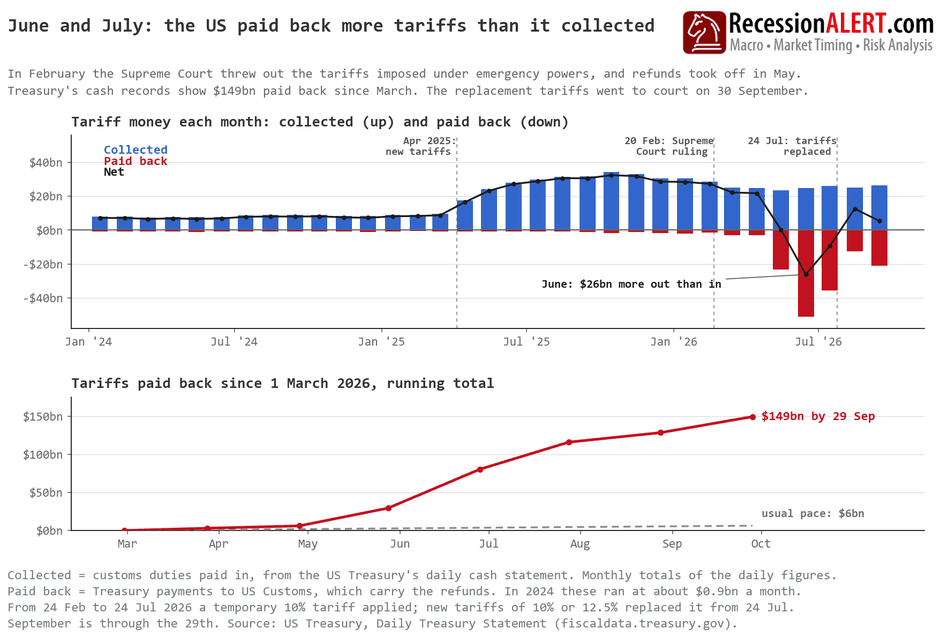
Since refunds took off in May, the US has paid back more in tariffs than it collected in total, even with about $25bn a month still coming in. From May through September $143.3bn went out through US Customs, most of it refunds, against $125.8bn in duties: a net outflow of $17.5bn. The two flows belong to different tariffs. What comes in is duty charged now, including a temporary 10% tariff and then its replacement; what goes out repays the tariffs imposed under emergency powers, which the Supreme Court struck down in February. So importers are billed at the border and reimbursed by the Treasury in the same months — which is how the fiscal year just ended raised about $117bn more than the last yet kept about $30bn less. The reimbursement looks like a round trip, but it runs back through only half the pipe that carried the tax: it stops at the business that paid the duty, not the shopper, and nothing in it lowers a price. Paid from a budget already in deficit, it is borrowed money handed to companies. Now the replacement is on trial, with a ruling expected within weeks. If it is struck down too, part of what is coming in today is not revenue at all — it is the next refund, held on deposit.
What it means: For households, the refunds will not show up at the till. What matters for what you pay is the roughly $25bn a month still being charged, and whether the court lets it stand. For stock investors, refunds are one-off cash for companies that import heavily, not a lasting lift to profits, and a court loss could hand them a second round. For the government, every refund is borrowed, so the deficit will run wider than tariff headlines suggest. The sign the refunds are done: monthly payouts back near $1bn, against about $21bn in September.
Market Intelligence Brief (MIB) Ver. 19.78
For professional investors only. Not investment advice.
© 2026 RecessionALERT.com

Comments are closed.