
MARKET INTELLIGENCE BRIEF (MIB)
Thursday, June 25, 2026
Micron (MU +15.74%) posted $41.5B in Q3 revenue — quadruple year-over-year — lifting semiconductors while Apple (-6.12%) and Microsoft (-3.46%) fell on AI memory-driven hardware price hikes. Core PCE hit 3.4% YoY, highest since Oct 2023; Williams and Goolsbee hawkish, September hike window rising. Q1 GDP revised to 2.1% but consumer spending +0.5%, weakest since 2022; GDPNow cut Q2 to 2.5%. Russell 2000 closed at an all-time record as capital fled mega-cap tech. Bitcoin breached $60K, now 50% off its 2026 peak.
TABLE OF CONTENTS
A. EXECUTIVE SUMMARY
B. MARKET DATA
C. HIGH-IMPACT STORIES (6)
D. MODERATE-IMPACT STORIES (6)
E. ECONOMY WATCH (5)
F. EARNINGS WATCH (1)
G. WHAT’S NEXT
H. CHART OF THE DAY
A. EXECUTIVE SUMMARY -> TOP
Micron’s fiscal Q3 blowout — revenue quadrupling year-over-year to $41.5 billion on AI memory demand — split markets sharply: the semiconductor complex surged while Apple (−6.12%) and Microsoft (−3.46%) announced hardware price hikes in response to AI-driven memory cost inflation, creating winners and losers within the same technology supply chain. The S&P 500 finished essentially flat, masking a constructive rotation — Industrials (+1.63%), Healthcare (+1.39%), and DJ Transportation (+1.50%) led, while Consumer Cyclical (−1.56%) and Communication Services (−1.04%) lagged, extending a sixth consecutive session of small-cap and value outperformance over mega-cap technology. May Core PCE printed at 3.4% year-over-year — the highest since October 2023 — and both Fed Presidents Williams and Goolsbee delivered hawkish commentary reinforcing a September rate hike window, yet the bond market looked through it: 10-year yields fell 1.3 basis points, declining to price additional tightening on a day when AI infrastructure growth narratives dominated equity price action.
• Micron (MU) +15.74%, SanDisk (SNDK) +21.97%, Applied Materials (AMAT) +13.42% — fiscal Q3 revenue $41.5B (4× year-over-year), EPS $25.11 vs $20.78 est; Q4 guidance ~$50B; HBM fully booked through 2027; $22B in customer deposit commitments underpin unprecedented revenue visibility
• Apple (AAPL) −6.12%, Microsoft (MSFT) −3.46%, Dell (DELL) −5.67% — AI memory cost surge forces consumer hardware price hikes ($100–$300 on Mac, iPad, Xbox); AAPL explicitly deferred iPhone pricing; gross margin compression risk extends to the full PC and device supply chain
• Core PCE 3.4% YoY (highest since Oct 2023) — income and spending both +0.7% MoM; Fed’s Williams: “inflation unquestionably elevated”; Goolsbee: “going the wrong way”; December rate hike probability rising toward 40%; September FOMC increasingly in play
• Q1 GDP final 2.1% (beat vs 1.6% est) but hollow — revision driven by import compression, not domestic demand; real consumer spending +0.5% (weakest since Q1 2022); real final sales at a three-year low; Atlanta Fed GDPNow cuts Q2 to 2.5%
• Russell 2000 closes at all-time record 3,007 — Nasdaq four-day losing streak; Dow sets intraday record; sixth consecutive session of small-cap/value rotation away from mega-cap tech; initial jobless claims 215K (17-week low), Sahm Rule at 0.10
• Bitcoin breached $60K (−5%+ in 24hrs), now 50% below 2026 peak — IRGC reversed three tankers at Hormuz despite US–Iran accommodation, introducing crude supply uncertainty; WTI +1.91% on demand narrative but the geopolitical binary remains open
1. AI Memory as Market Divider — Micron’s blowout did not lift all boats. It bifurcated the market: semiconductor hardware and equipment suppliers surged on AI memory pricing power while hardware OEMs (AAPL, MSFT, DELL) fell as those same costs transmitted into consumer price hikes. The AI infrastructure buildout is simultaneously validating the growth thesis and creating a new input cost headwind for downstream consumer technology — a split that will widen as AI capex accelerates into 2027.
2. Fed Convergence on Higher for Longer — Core PCE at 3.4% plus income beating at +0.7% eliminates residual FOMC dovishness. Williams and Goolsbee’s afternoon unanimity — from opposite ends of the FOMC spectrum — signals institutional consensus has shifted to hike-risk. The bond market’s muted response (10Y −1.3 bps) represents complacency: if June inflation data does not soften materially, the rate repricing will be abrupt, hitting rate-sensitive sectors (utilities, REITs, long-duration growth) hardest.
3. Structural Rotation Beneath the Flat Headline — The S&P 500’s flat close understates Thursday’s message: Russell 2000 ATH, Nasdaq four-day losing streak, and a sixth straight session of small-cap/industrial outperformance constitute durable rotation evidence, not noise. Capital is moving from Technology dominance (−2.35% 1-month, −1.79% 1-week) into Industrials (+10.88% 3-month) and domestic cyclicals — a shift that historically signals confidence in US domestic economic durability over global technology narratives.
 — Leading economic indicators. Accurate market forecasts. Apply for membership at join.recessionalert.com
B. MARKET DATA -> TOP
Micron Technology’s fiscal Q3 blowout — revenue quadrupling year-over-year to $41.5 billion on AI memory demand — split markets sharply: the semiconductor complex surged while Apple (-6.12%) and Microsoft (-3.46%) fell as both announced price hikes on hardware in response to surging memory costs. The S&P 500 finished flat as Industrials (+1.63%), Healthcare (+1.39%), and Basic Materials (+1.24%) offset Technology’s -0.19% drag; the Russell 2000 and DJ Transportation each outperformed for a 6th consecutive session, confirming entrenched small-cap and transport breadth. May PCE at 4.1% annually (Core: 3.4%, slightly above the 3.3% estimate) landed without triggering bond stress, with 10-year yields easing 1.3 bps — the bond market declining to price additional Fed hawkishness. Bitcoin’s -2.40% diverged from the muted equity gains, underscoring the session’s selective, hardware-driven risk appetite.
CLOSING PRICES – Thursday, June 25, 2026:
MAJOR INDICES
The S&P’s flat close masks a binary rotation: Technology’s -0.19% drag from AAPL and MSFT offset the semiconductor surge, while Industrials and Healthcare led. The DJ Transportation’s +1.50% stood as the session’s standout — economic optimism driving transport above headline indices. Market History Signal: Russell 2000 has now outperformed the S&P 500 by 4.74% over the past 10 sessions (RUT +5.99% vs SP500 +1.25%), extending a 6-session streak well above the >2% confirmation threshold for broad market participation. No Dow Theory trend signal fired; same-day DJIA/DJTA divergence (1.36%) remained below the 1.5% threshold.
| Index | Close | Change | %Move | Why It Moved |
|---|---|---|---|---|
| S&P 500 | 7,358.01 | -0.21 | 0.00% | Micron-led semiconductor surge neutralized by AAPL/MSFT hardware price-hike selloff; gap-up open faded as consumer tech dragged through the session |
| Dow Jones | 51,920.93 | +72.03 | +0.14% | Industrial blue-chips led (CAT +4.42%, HON +2.69%); limited mega-cap tech exposure relative to S&P cushioned the AAPL/MSFT drag |
| DJ Transportation | 21,932.4 | +323.4 | +1.50% | Session’s standout index; Industrials surge and economic optimism drove transport names well above broader benchmarks |
| Nasdaq 100 | 29,440.32 | +220.27 | +0.75% | Semiconductor market-cap gains (MU +15.74%, SNDK +21.97%) outweighed AAPL and MSFT declines in the cap-weighted index |
| Russell 2000 | 3,007.02 | +20.39 | +0.68% | Small-cap outperformance theme extends to 6th consecutive session; minimal mega-cap tech exposure insulated from AAPL/MSFT drag |
| NYSE Composite | 23,610.72 | +117.17 | +0.50% | Broad market driven by Industrials, Healthcare, and Basic Materials gains; broader composition than S&P reflects the session’s underlying strength |
VOLATILITY & TREASURIES
A textbook bond non-participation signal: 10-year yields fell 1.3 bps despite May Core PCE landing at 3.4% — slightly above the 3.3% estimate — the bond market declining to price in additional Fed tightening. VIX’s +1.45% tick to 18.90 reflects AAPL and MSFT selloff uncertainty rather than macro fear; in a true inflation scare yields would rise, not fall. The 2Y-10Y spread held at 26 bps positive — no curve signal.
| Instrument | Level | Change | Why It Moved |
|---|---|---|---|
| VIX | 18.90 | +0.27 (+1.45%) | AAPL/MSFT selloff created pockets of uncertainty despite benchmark indices holding; mixed session signaling elevated hedging at the margin |
| 10-Year Treasury Yield | 4.387% | -1.3 bps | Bond market looking through above-expected Core PCE (3.4% vs 3.3% est); June 17 Fed hold reinforced — no imminent rate change being priced |
| 2-Year Treasury Yield | 4.127% | -1.0 bps | Same driver; Fed’s rate path seen as stable despite PCE beat; Micron’s growth signal overrode inflation data in risk-asset pricing |
| US Dollar Index (DXY) | 101.43 | -0.18 (-0.17%) | Mild dollar weakness on balanced macro picture; EUR/USD +0.12% from euro strength offset by PCE data’s modest hawkish tilt |
COMMODITIES
Gold’s +0.81% gain on a day of above-expected Core PCE is the inflation hedge at work; Silver’s -0.39% strips out the industrial demand component, confirming pure safe-haven positioning rather than a growth trade. Copper’s +2.10% tells the opposite story — AI data center buildout and semiconductor capex (Micron’s capacity expansion) lifting industrial metals. Bitcoin’s -2.40% diverged from both equities and commodities, a standalone crypto signal with no equity-side catalyst.
| Asset | Price | Change | %Move | Why It Moved |
|---|---|---|---|---|
| Gold | $4,041.15/oz | +$32.35 | +0.81% | PCE inflation hedge; safe-haven demand on above-expected Core PCE with the Fed’s rate path still uncertain for late 2026 |
| Silver | $57.863/oz | -$0.225 | -0.39% | No industrial demand bid relative to gold; divergence from copper confirms the precious metals move is pure safe-haven, not a growth signal |
| Copper | $6.0735/lb | +$0.1250 | +2.10% | AI/semiconductor capex demand; Micron’s capacity expansion and Qualcomm’s revenue upgrade reinforce data center infrastructure buildout |
| Platinum | $1,595.90/oz | +$14.00 | +0.89% | Auto catalyst demand; followed precious metals complex and Industrials strength |
| Bitcoin | $59,539 | -$1,467 | -2.40% | Decoupled from equity gains; no crypto-specific catalyst; profit-taking in a session where risk appetite was narrowly concentrated in semis and industrials |
ENERGY
WTI (+1.91%) and Brent (+1.85%) moved in near-lockstep, holding a $3.56 spread — a demand-driven rather than supply-disruption signal. Critically, oil rose alongside equities (Industrials +1.63%, DJ Transportation +1.50%) — this is a growth/demand narrative, not a cost-pressure stagflation read. Natural gas sat out with Henry Hub +0.31%; Dutch TTF was flat in euro terms, gaining +0.12% purely from EUR/USD appreciation.
| Asset | Price | Change | %Move | Why It Moved |
|---|---|---|---|---|
| Crude Oil (WTI) | $71.68/bbl | +$1.34 | +1.91% | Demand optimism on Industrials/GDP strength; OPEC+ compliance; mild dollar weakness; summer seasonal bid |
| Crude Oil (Brent) | $75.24/bbl | +$1.37 | +1.85% | Same demand drivers; $3.56 spread vs WTI maintained — consistent with normal global demand premium, no regional disruption |
| Natural Gas (Henry Hub) | $3.271/MMBtu | +$0.010 | +0.31% | Summer cooling demand; modest uptick without supply catalyst; diverged from crude’s stronger move |
| Natural Gas (Dutch TTF) | $13.63/MMBtu | +$0.02 | +0.12% | Flat in euro terms (0.00% move); marginal gain driven entirely by EUR/USD +0.12% appreciation; no European gas catalyst |
S&P 500 SECTORS
A sharp reversal of the 3-month leadership theme: Technology (+25.36% over 3 months) lagged today (-0.19%) as Micron’s memory surge inverted the intra-sector hierarchy. Industrials (-1.02% 1-week, +1.63% today) and Basic Materials (-5.07% 1-week, +1.24% today) staged notable 1-day reversals. Consumer Cyclical is the session’s structural laggard: -1.56% today, -7.24% 1-month, -7.88% YTD — pressure deepening across every horizon.
| Sector | 1-Day | 1-Week | 1-Month | 3-Month | 6-Month | YTD | 12-Month |
|---|---|---|---|---|---|---|---|
| Industrials | +1.63% | -1.02% | +3.21% | +10.88% | +17.19% | +19.30% | +29.18% |
| Healthcare | +1.39% | +4.12% | +5.18% | +7.39% | +1.24% | +1.94% | +17.81% |
| Basic Materials | +1.24% | -5.07% | -5.95% | +1.30% | +7.64% | +9.83% | +36.33% |
| Energy | +0.73% | -1.36% | -7.54% | -10.84% | +21.48% | +20.03% | +26.73% |
| Utilities | +0.64% | +3.21% | -0.03% | +0.77% | +7.70% | +7.35% | +14.63% |
| Real Estate | +0.27% | +2.44% | +0.63% | +10.42% | +9.69% | +9.93% | +6.74% |
| Financial | -0.07% | -0.58% | +3.06% | +10.55% | +0.31% | +1.31% | +11.99% |
| Technology | -0.19% | -1.79% | -2.35% | +25.36% | +18.66% | +19.05% | +37.12% |
| Consumer Defensive | -0.92% | +0.46% | -0.14% | +1.71% | +6.83% | +7.26% | +4.21% |
| Communication Services | -1.04% | -4.40% | -10.28% | +3.64% | -3.11% | -3.56% | +18.37% |
| Consumer Cyclical | -1.56% | -2.44% | -7.24% | +0.75% | -9.90% | -7.88% | +1.14% |
TOP MEGA-CAP MOVERS:
GAINERS
| Company | Ticker | Close | Change | Why It Moved |
|---|---|---|---|---|
| Sandisk Corp | SNDK | $2,335.00 | +21.97% | Micron earnings read-through for NAND flash memory; SNDK’s own Q3 beat ($5.95B revenue) and Q4 guidance ($7.75–8.25B) reinforce AI memory supply tightness thesis |
| Micron Technology | MU | $1,213.56 | +15.74% | Fiscal Q3 blowout: EPS $25.11 vs $20.78 expected; revenue $41.5B quadrupling YoY from $9.3B; AI data center demand driving unprecedented memory pricing power |
| Applied Materials | AMAT | $668.00 | +13.42% | Semiconductor equipment benefits directly from Micron’s capacity expansion; Micron’s capex ramp implies multi-year deposition/etch equipment orders for AMAT |
| KLA Corp | KLAC | $258.80 | +7.62% | Same driver as AMAT; process control equipment demand tied directly to memory chipmaker expansion cycles |
| Lam Research Corp | LRCX | $401.82 | +7.21% | Etch and deposition equipment maker lifted by Micron capex guidance; memory fab expansion directly drives Lam’s order book |
DECLINERS
| Company | Ticker | Close | Change | Why It Moved |
|---|---|---|---|---|
| Apple Inc | AAPL | $275.15 | -6.12% | Announced price hikes on iPad and Mac amid surging memory costs; margin compression concern as AAPL is forced to pass through input costs to consumers |
| Dell Technologies | DELL | $409.45 | -5.67% | PC/server hardware maker hit by rising memory cost narrative; same input cost headwind as AAPL, with thin hardware margins leaving little buffer |
| Palantir Technologies | PLTR | $107.27 | -5.49% | Rotation out of high-multiple software (P/E 121) into semiconductor hardware; AI spending shift toward physical infrastructure and away from software platforms |
| Microsoft Corp | MSFT | $352.83 | -3.46% | Announced Xbox price hikes due to rising memory costs; Mag 7 rotation selling added to hardware-driven pressure |
| Oracle Corp | ORCL | $152.46 | -3.22% | Enterprise software rotation; AI capex narrative shifted toward hardware names today, pressuring high-multiple software platforms with no near-term memory tailwind |
— Institutional-grade intelligence for serious investors. Apply for membership at join.recessionalert.comC. HIGH-IMPACT STORIES -> TOP
BEARISH
1. Apple and Microsoft Raise Hardware Prices as AI Memory Surge Flows Through to Consumers; AAPL -6.1%, MSFT -3.5%
The core facts:Apple and Microsoft announced sweeping consumer hardware price increases Thursday, citing the AI-driven surge in DRAM and NAND memory costs as the direct cause. Apple raised prices across its Mac and iPad lineup effective immediately: the entry-level MacBook Neo rose $100 to $699; the MacBook Air 13-inch 512GB jumped $200 to $1,299; the 1TB M5 MacBook Pro increased $300; the base iPad rose $100 to $449 with iPad Pro models up $200; and the Apple TV increased $70 to $199. Apple did not raise iPhone, Watch, or AirPods prices but signaled further adjustments are possible. Microsoft raised the Xbox 512GB console by $100 to approximately $500. AAPL fell 6.12% to $275.15 and MSFT fell 3.46% to $352.83. Dell (DELL) fell 5.67% on margin compression read-through as the largest S&P 500 components by weight — AAPL and MSFT combined — delivered their worst single-session decline since early 2025.
Why it matters:This is the moment AI infrastructure costs become visible to every consumer with an Apple product. The $100–$300 price hikes represent the first direct transmission of the AI memory supercycle — which drove Micron to $41.5B quarterly revenue — into consumer hardware economics. For Apple: the decision not to raise iPhone prices suggests demand elasticity concerns are acute in its highest-volume, highest-margin product; the hardware that got price increases are mid-tier and premium SKUs where the memory cost burden is most concentrated. The market reaction reflects two bearish reads: (1) Apple’s inability to fully absorb memory cost increases without passing them through signals margin pressure at the gross line; (2) consumer demand destruction risk if hardware sticker shock slows the already-decelerating upgrade cycle. AAPL’s -6.12% single-day move on a market cap exceeding $4 trillion represents approximately $250 billion in market value destruction — enough to drag the S&P 500 and Nasdaq materially. Combined with MSFT’s -3.46%, the two companies together account for roughly 12% of S&P 500 weight, creating meaningful index-level drag. For the broader consumer technology sector: Dell’s -5.67% reaction confirms the market expects the AI memory premium to compress margins across the full PC and device supply chain well into 2027.
What to watch:iPhone price announcement as a secondary shock signal — Apple explicitly deferred it; any iPhone hike would reset consumer expectations significantly. Q3 FY2026 gross margin guidance from Apple’s next earnings (late July) for quantification of the memory cost absorption problem.
BULLISH
2. Semiconductor Sector Surges on Micron Blowout — AMAT +13.4%, SNDK +22.0%, KLAC +7.6%, LRCX +7.2%; AI Memory Supercycle Confirmed
The core facts:Micron’s after-hours Q3 FY2026 earnings blowout (reported June 24 after close) triggered a broad semiconductor sector rally on June 25 that stands as one of the largest single-session moves in chip equipment names in years. Applied Materials (AMAT) surged 13.42%; SanDisk (SNDK) rose 21.97%; KLA Corporation (KLAC) gained 7.62%; Lam Research (LRCX) advanced 7.21%; and the SOXX semiconductor ETF closed up 3.94%. Micron itself opened sharply higher and closed up 15.74%. The catalyst: Micron’s Q3 FY2026 results showed data center revenue of $25 billion (the quarter), revenue of $41.46 billion against a $35.91 billion estimate (+15.4% beat), Non-GAAP EPS of $25.11 versus $20.86 estimated (+20.4% beat), and Q4 FY2026 guidance of approximately $50 billion — a ~20% sequential step-up against a $44 billion consensus expectation. HBM3E and HBM4 are fully booked through calendar 2027, with demand extending into 2028. Micron has signed strategic customer agreements representing $22 billion in cash deposits and related financial commitments.
Why it matters:Micron’s results constitute the clearest single-quarter validation of the AI memory supercycle thesis since the cycle began. Revenue quadrupled year-over-year (from approximately $8.7 billion in Q3 FY2025 to $41.46 billion) driven almost entirely by data center DRAM and HBM demand — a pace of growth with no precedent in the memory industry’s history. The $22 billion in strategic customer deposits is particularly significant: it means hyperscalers and AI infrastructure companies have pre-committed capital to Micron specifically, providing revenue visibility unprecedented in what has historically been a deeply cyclical commodity business. HBM bookings through 2027 confirm supply tightness persists for at least 18 more months. For semiconductor equipment companies — AMAT, LRCX, KLAC — this is a sustained capex cycle read. If Micron is ramping HBM4 production “twice as fast as HBM3E,” equipment orders must follow. The SOXX’s +3.94% confirms the market is treating this as a sector-wide re-rating event rather than a single-company outcome. The dual signal from Micron (AI memory supply tight through 2027) and Apple/Microsoft’s price hikes (AI memory costs reaching consumer devices) confirms the same underlying dynamic from both sides of the supply chain simultaneously.
What to watch:Micron Q4 FY2026 guidance delivery versus the ~$50 billion target when reported approximately September 2026; SK Hynix’s upcoming $29.4 billion Nasdaq ADR listing (targeted July 10) as the next AI memory sector valuation benchmark; NVIDIA earnings call for corroboration of HBM demand continuity.
BEARISH
3. Core PCE 3.4% YoY — Highest Since October 2023 — Reprices Fed September Rate Hike to 40% Probability; Bonds Sell Off
The core facts:The Bureau of Economic Analysis released May personal income and spending data Thursday morning (8:30 AM ET), confirming Core PCE at 3.4% year-over-year — the highest reading since October 2023. Headline PCE came in at 4.1% year-over-year. Personal income rose 0.7% month-over-month (a significant beat versus the 0.4% consensus), and spending rose 0.7% MoM. JPMorgan’s Chief Economist Bruce Kasman issued a note Thursday calling inflation “stickier than people perceive,” and markets repriced the Federal Reserve’s September and December FOMC meetings: CME FedWatch probability for a December rate hike rose to approximately 40%. Rate-sensitive sectors — utilities, REITs, and homebuilders — came under renewed pressure following the release.
Why it matters:The PCE print eliminates any remaining ambiguity about the Federal Reserve’s near-term posture. Fed Chair Warsh already dropped the easing bias and raised the median dot at the June 17 FOMC to signal potential hike readiness; Thursday’s core reading at 3.4% — 70 basis points above the 2% target — validates that posture. The income beat (+0.7% versus +0.4% expected) creates a compounding concern: consumers are earning more and spending more, sustaining demand-side price pressure precisely when the Fed needs demand to moderate. The combination of AI-driven memory cost inflation (visible in today’s Apple/Microsoft price hikes) and services-sector persistence creates a dual-engine inflation dynamic that the Fed cannot resolve through rate stability. For fixed income: the 40% December hike probability repricing from near-zero six months ago represents a fundamental shift in the rate path. Treasury durations become structurally more vulnerable as each data point confirms the “higher for longer” scenario is transitioning to “possibly higher, definitely for longer.” For equity portfolios: growth and dividend-paying sectors carry the highest rate sensitivity; a September or December hike would require further discount rate adjustments.
What to watch:June CPI (released approximately July 15) and June PCE (released approximately July 31) as the two data points that will determine whether September is live; Fed Chair Warsh’s first post-PCE public communication for direct policy signaling.
UNCERTAIN
4. GDP Q1 Final Revised to 2.1% — Beats 1.6% Consensus but Import Compression Does the Work; Consumer Spending at 3-Year Low, GDPNow Q2 Cut to 2.5%
The core facts:The Bureau of Economic Analysis released the Q1 2026 GDP final revision Thursday: 2.1% SAAR versus the 1.6% consensus expectation. The headline beat was driven entirely by import compression — the import growth rate was revised sharply lower (to 11.8% from the previously reported 21.1%), which mechanically inflates the GDP calculation rather than reflecting underlying demand strength. Real consumer spending grew just 0.5% — the weakest since Q1 2022. Real final sales to private domestic purchasers hit a three-year low. Corporate profits were the sole genuine bright spot: +0.5% versus a -0.4% consensus expectation. The Atlanta Fed simultaneously cut its GDPNow Q2 2026 real-time estimate from 3.0% to 2.5% in response to Thursday’s income and spending data, suggesting the Q1 headline strength does not carry into Q2.
Why it matters:The Q1 final GDP revision is an archetypal “hollow beat” — a headline number that looks better than expected but that reflects accounting arithmetic rather than demand vitality. Import compression inflates GDP mechanically when imports fall; this is the direct statistical effect of tariffs reducing US import volumes, not evidence of domestic activity acceleration. The domestic demand signals embedded in the report — consumer spending at a three-year low, real final sales to private domestic purchasers at their weakest level since 2023 — tell a fundamentally different story than the 2.1% headline suggests. For portfolio positioning: the corporate profits beat (+0.5% versus -0.4% expected) is genuinely constructive for earnings expectations and partially explains today’s defensive value sector outperformance. The GDPNow Q2 cut from 3.0% to 2.5% is the more forward-relevant signal: it suggests the Q1 “beat” reflects base effects, not momentum. Treasury Secretary Bessent’s June 24 forecast of “GDP returning to 3% before year-end” faces a more difficult proving ground given the actual domestic demand trajectory. Market reaction was mixed — initial rally on the headline, followed by reassessment as internals emerged — which explains the Nasdaq’s -0.46% decline despite a Dow intraday record: growth stocks price off forward earnings, which are sensitive to consumer demand trajectory; value stocks and industrials benefit from the corporate profits beat.
What to watch:Atlanta Fed GDPNow Q2 estimate path over the next 30 days as real-time domestic demand signal; Q2 consumer spending data (July advance retail sales and PCE) to determine whether Q1’s 0.5% consumer slowdown is a trough or trend.
BEARISH
5. Fed’s Williams and Goolsbee Both Hawkish Thursday — Inflation “Unquestionably Elevated” and “Going the Wrong Way”; September Rate Hike Window Stays Open
The core facts:Two Federal Reserve regional presidents delivered public remarks Thursday in the first official Fed communication following the Core PCE print. New York Fed President John Williams (3:40 PM ET) described inflation as “unquestionably elevated” and characterized current monetary policy as “well positioned” — language that explicitly pushes back against any near-term pivot to rate cuts. Chicago Fed President Austan Goolsbee (6:30 PM ET) was more blunt: inflation is “going the wrong way” and he remains “focused on price pressures.” Neither official signaled any imminent policy move, but both explicitly rejected the market’s earlier assumption that the next FOMC action would be a cut. Markets are now pricing a possible September rate hike under Chair Warsh, with December increasingly in view.
Why it matters:The Williams and Goolsbee comments are significant for their unanimity and timing. Two officials from opposite ends of the Fed’s regional spectrum — Williams (a permanent FOMC voter, NY Fed) and Goolsbee (Chicago, historically a centrist dove) — delivering hawkish commentary on the same afternoon eliminates any remaining “transitory” dissent within the FOMC. If a historically dove-leaning official like Goolsbee characterizes inflation as “going the wrong way,” the signal is that the Committee’s consensus has shifted materially toward the hike-risk scenario. For markets: the language also matters as a political economy signal. Amid Senator Warren’s “Fed in a box” narrative (June 24), both officials are visibly reinforcing Fed independence by maintaining hawkish positions despite political pressure from the executive branch. This credibility maintenance is itself a market signal — it means the Fed will not be moved by political pressure to cut rates prematurely, supporting the long-end Treasury rate floor. For rate-sensitive equities (utilities, REITs, long-duration growth stocks), the Williams-Goolsbee one-two reinforces the “no relief before September FOMC” baseline and keeps the terminal rate debate alive.
What to watch:Fed Chair Warsh’s next scheduled public appearance as the policy decision-maker; the September FOMC (September 15–16) as the first live hike window; any shift in Fed Funds futures implying probability above 50% for a September hike as the key threshold for equity re-pricing.
UNCERTAIN
6. IRGC Reverses Three Tankers at Hormuz — WTI Volatile in 4th Straight Losing Session as Iran Deal Friction Resurfaces
The core facts:Iran’s Revolutionary Guard Corps (IRGC) issued a warning Thursday against using non-IRGC-approved transit routes through the Strait of Hormuz, causing at least three oil tankers tracking toward the strait on the Oman-hugging southern route to turn back; three additional vessels diverted to the Iran-designated northern route skirting the Iranian coast. The incident occurred despite an interim US–Iran accommodation that released approximately 20 million barrels of bottlenecked oil over the past week, briefly driving WTI below $70 for the fourth consecutive session. Saudi Arabian tankers had been en route to restart Gulf exports from Ras Tanura for the first time since March. Overall Hormuz traffic remained elevated — 70 ships transited Wednesday, representing a 105% day-on-day increase — suggesting the IRGC route enforcement is a partial friction rather than a full resumption of blockade conditions. Energy equities underperformed for a fourth consecutive session.
Why it matters:The tanker reversals introduce meaningful uncertainty about whether the US–Iran accommodation is durable or represents a temporary commercial window that the IRGC can selectively reopen and close. The distinction between an IRGC-approved northern route and the traditional Oman-hugging southern route is not operationally neutral — the northern route requires tankers to transit closer to Iranian territory, creating ongoing leverage for the IRGC to extract “transit fee” compliance through operational friction. For oil markets: WTI’s four-session decline to and below $70 has priced the deal scenario aggressively; any signals that the deal is unraveling or that Iranian crude (potentially 1–1.5 million bpd) will not flow to market as expected would produce a sharp technical recovery. The current oil pricing is essentially binary — it depends on the deal holding. IRGC tanker reversals are the first concrete signal of non-deal behavior, which may place a floor under WTI even as structural supply concerns dominate. For energy sector equities: the XLE has fallen four consecutive sessions on Iran deal expectations; a deal deterioration would produce a sector bounce, while continued compliance extends the bearish trend.
What to watch:Tanker tracking data through the Strait of Hormuz over the next 48–72 hours as the real-time signal of deal compliance; any direct US State Department or CENTCOM response to the IRGC route enforcement; the 60-day sanctions waiver expiration timeline as the hard binary event for Iranian crude market access.
— Quantifying recession risk so you don’t have to guess. Apply for membership at join.recessionalert.comD. MODERATE-IMPACT STORIES -> TOP
BULLISH
7. Initial Jobless Claims Fall to 215K — 17-Week Low — Sahm Rule at 0.10; Labor Market Resilience Keeps Fed Hike Option Alive
The core facts:Initial jobless claims for the week ended June 20 fell to 215,000 — a 17-week low, down 12,000 from the prior week’s 227,000 and significantly below the 225,000 consensus expectation. Continuing claims edged slightly higher to 1,821,000 versus the 1,800,000 consensus but remain well within historical normal ranges. The Sahm Rule recession indicator sits at 0.10, far below the 0.50 threshold that has historically signaled recession onset.
Why it matters:The 215K print represents the intersection of two competing market narratives. Bullishly: labor market resilience at 215K — a 17-week low — suggests the economy is absorbing the tariff shock and rate environment without triggering layoffs, supporting consumer income and spending capacity. The Sahm Rule at 0.10 (versus the 0.50 recession threshold) confirms that the labor market’s structural tightness remains intact. Bearishly: a tight labor market with 215K claims is precisely the condition under which the Federal Reserve feels least constrained from hiking rates. With Core PCE at 3.4% and income growing +0.7% MoM, labor market strength is an inflation-sustaining dynamic rather than a pure positive. The market reads 215K claims as validation that the Fed has room to hike without triggering an unemployment crisis — which is incrementally hawkish for fixed income and rate-sensitive equity sectors.
What to watch:July 3 claims report (first post-June 25 read); any acceleration in claims above 240K as the leading indicator of labor market deterioration that would shift the Fed’s calculus.
BULLISH
8. Core Capex Orders +1.6% MoM — Business Investment Beat Signals AI and Industrial Infrastructure Cycle Intact Despite Tariff Headwinds
The core facts:May durable goods orders data released Thursday showed nondefense capital goods ex-aircraft (the “core capex” proxy) rose 1.6% month-over-month — more than double the 0.6% consensus expectation. Headline durable goods orders fell 4.5% (in line with consensus, driven by a large transportation equipment component decline). Core capex’s outperformance reflects continued strength in semiconductor equipment, industrial machinery, and cloud infrastructure investment categories.
Why it matters:The +1.6% core capex result is the clearest business-side counterweight to Thursday’s consumer spending softness (Q1 real consumer spending +0.5%). Corporate America is investing despite tariff uncertainty, rate pressure, and slowing consumer demand — a pattern consistent with an AI-driven capital spending cycle that is structurally separate from the cyclical consumer economy. For industrial sector equities: the beat validates the Caterpillar (+4.42% today) and Honeywell (+2.69%) moves as grounded in actual capital goods order data rather than pure sentiment rotation. Companies supplying AI infrastructure (semiconductor equipment, data center buildout materials, energy grid) are seeing sustained order activity that the durable goods data now confirms. For fixed income: the corporate profits beat in GDP (+0.5% versus -0.4% expected) combined with strong core capex creates a “corporate sector healthy, consumer sector softening” configuration that complicates the Fed’s dual mandate — strong business investment argues against recession risk even as consumer data deteriorates.
BULLISH
9. Russell 2000 Hits All-Time Closing Record 3,007.86 as Capital Rotates Out of Mega-Cap Tech into Value; Dow Sets Intraday High
The core facts:The Russell 2000 closed at 3,007.86 Thursday — an all-time closing record, with an intraday peak of 3,033.75. The Dow Jones Industrial Average closed at 51,920.62 (+0.14%), setting an intraday record, with Caterpillar (+4.42%), J&J (+1%), and Honeywell (+2.69%) leading. The Nasdaq closed at 25,358.60 (-0.46%) in its first four-day losing streak since February. The S&P 500 was approximately flat at 7,357.49. The divergence reflects a visible capital rotation: approximately $3 trillion in mega-cap tech and software market capitalization has declined on a month-to-date basis, with investors shifting into financial services and consumer cyclical value names. The SOXX semiconductor ETF gained 3.94% (AI hardware specifically, contrasting with software and hyperscaler weakness).
Why it matters:A Russell 2000 all-time closing record on the same day the Nasdaq records a four-day losing streak is a structural signal, not merely a daily footnote. Small-cap outperformance versus large-cap tech is historically associated with “risk-on rotation” phases where investors see economic durability sufficient to support smaller, domestically-oriented businesses — companies more sensitive to domestic GDP growth and less exposed to international tariff risk or AI infrastructure capex cycles. The rotation is multi-factor: declining long-term yields (modest), strong labor market data (215K claims), and corporate capex beat all support the case for domestic cyclical names. For portfolio managers: the Russell 2000 ATH alongside a Nasdaq four-day losing streak creates a tactical allocation question — does the mega-cap tech underperformance represent a temporary digestion of the AI infrastructure cost narrative (Apple/Microsoft price hikes), or the beginning of a more durable rotation away from technology dominance? The Dow intraday record alongside the Russell ATH suggests the rotation is broad-based across value categories, not confined to a single sector.
What to watch:Russell 2000 follow-through or reversal Friday as technical confirmation test; S&P 500 equal-weight versus cap-weighted performance divergence over the next two weeks as the rotation breadth indicator.
BEARISH
10. Commerce Dept Forces Polestar Out of US — Connected Vehicle Rule Bans Chinese Software Components; EV Sector Watches China Tech Policy
The core facts:The US Department of Commerce denied Polestar’s operational authorization under the federal Connected Vehicle Rule, effectively forcing the Swedish-branded but Geely/Volvo-controlled EV manufacturer to wind down US sales operations by next year. The rule prohibits vehicles using Chinese software in vehicle connectivity systems, infotainment, cameras, and autonomous driving components from operating in the US market. Polestar shares fell 9.2% on the announcement. The company has been under regulatory scrutiny since the rule was finalized in late 2025 due to the extent of Chinese-sourced software embedded in its architecture.
Why it matters:The Polestar ruling is the first high-profile enforcement action under the Connected Vehicle Rule and establishes the precedent for how the Commerce Department will apply it to Chinese-affiliated manufacturers. The market implications extend well beyond Polestar, which is a relatively small market participant. The direct question for the broader EV and auto sector is which additional brands are vulnerable: Volvo (majority Geely-owned), certain Volkswagen platforms with joint venture software sourcing, and any automaker that has purchased Chinese-developed autonomous driving or connected-vehicle technology faces potential compliance risk. For US automakers (GM, F, RIVN), the rule is competitively positive — it removes Chinese-affiliated competition from the EV market — though it also limits consumer choice and could accelerate Chinese automakers’ EU market pivot. For the technology sector, the ruling confirms that software origin and supply chain provenance are now regulatory variables for physical products sold in the US market, consistent with the broader US-China technology decoupling trajectory.
What to watch:Commerce Department’s next enforcement actions under the Connected Vehicle Rule — specifically whether Volvo-branded vehicles (also Geely-controlled) receive similar scrutiny; any legal challenge from Polestar on constitutional or trade-treaty grounds.
BEARISH
11. Bitcoin Breaks $60,000 Floor — More Than 5% Decline in 24 Hours, 50% Below Peak; Risk Appetite Canary Under Stress
The core facts:Bitcoin fell more than 5% in a 24-hour period, breaching the psychologically and technically significant $60,000 level to trade near $58,000 before recovering partially. At $58,000–60,000, Bitcoin sits approximately 50% below its peak of $126,000 reached earlier in 2026 during the peak crypto regulatory optimism period. The decline follows a period of sustained pressure from rising real rates (Core PCE at 3.4% increases the opportunity cost of holding non-yielding crypto assets), the Iran-driven safe-haven unwind (gold -3.21% June 24), and broader risk asset de-risking from technology-sector volatility.
Why it matters:Bitcoin’s >5% intraday decline qualifies as a meaningful market signal under the institutional risk framework given the scale of crypto’s penetration into spot ETF portfolios and treasury allocations. At 50% off peak, Bitcoin has retraced more than half of its 2026 bull run — a level historically associated with either capitulation (accelerating the decline) or a base-building consolidation period before renewed accumulation. The $60,000 break is particularly notable because that level represented the floor of the prior 2024–2025 trading range and carried strong support on multiple tests. For institutional allocators who entered Bitcoin ETFs during the 2025–2026 appreciation phase, positions from above $80,000 are now deeply underwater, creating potential redemption pressure on spot ETF holders. The macro driver — rising real rates as Core PCE exceeds expectations and the Fed signals potential hikes — is precisely the environment in which Bitcoin’s “digital gold” narrative competes with actual rising real yields, and the comparison is unfavorable. The decoupling from gold (which is down from $4,600 but for geopolitical Iran deal-related reasons) means Bitcoin is not benefiting from the same “store of value” bid that sustained gold above $3,000 during the conflict period.
What to watch:Bitcoin closing price relative to $60,000 over the next 48 hours as the technical confirmation level; any spot ETF outflow data for the week (released by issuers on a lag) as quantification of institutional redemption pressure.
UNCERTAIN
12. Onsemi Acquires Synaptics in $7B All-Stock Deal — Edge AI Platform Bet; SYNA Rallies, ON Takes Dilution Hit
The core facts:Onsemi (ON) announced an agreement to acquire Synaptics (SYNA) in an all-stock transaction valued at approximately $7 billion. Under the terms, Synaptics shareholders will receive 1.350 shares of Onsemi common stock per share — representing approximately a 19% premium based on the prior 10-day average closing prices. The deal targets closing in mid-2027 pending regulatory approvals, with anticipated annual synergies of approximately $200 million and is expected to be accretive to non-GAAP EPS within 18 months of closing. The strategic rationale centers on adding Synaptics’ Edge AI compute architecture and human-machine interface portfolio to Onsemi’s power semiconductor and sensing platform, targeting intelligent systems for automotive, industrial IoT, and smart home markets.
Why it matters:The Onsemi–Synaptics transaction is the latest consolidation move in the mid-cap semiconductor space as companies race to add AI inference capability at the edge — the layer of computing that occurs in devices and vehicles rather than in cloud data centers. Onsemi, historically a power and sensing semiconductor company serving automotive and industrial markets, is acquiring Synaptics’ differentiated edge AI and connectivity portfolio to compete in the emerging “physical AI” market where AI processing occurs in the physical world (robots, autonomous vehicles, smart infrastructure). The $7 billion all-stock deal creates the typical M&A dynamic: SYNA shareholders benefit immediately from the 19% premium; ON shareholders face dilution risk and integration execution risk on a deal targeting synergies approximately three years from announcement. The $200 million synergy target and 18-month EPS accretion timeline are aggressive for a deal that requires 12–18 months to close, compressing the execution window significantly. For the broader semiconductor sector, the deal confirms the bifurcation between data center AI (Micron, NVIDIA, AMAT — today’s big movers) and edge AI (onsemi, Synaptics, Qualcomm) as distinct investment themes requiring separate positioning frameworks.
What to watch:FTC/DOJ antitrust review timeline given semiconductor sector consolidation scrutiny; mid-2027 closing target as the execution clock; ON’s next earnings call for updated synergy and integration guidance post-announcement.
— Separating signal from noise since 2007. Apply for membership at join.recessionalert.comE. ECONOMY WATCH -> TOP
Today’s data delivered a hawkish paradox: nominal strength everywhere, real demand eroding beneath the surface. Q1 GDP was revised up to 2.1% — entirely on lower imports, not consumer firepower — as real personal consumption fell to just 0.5%, the weakest quarterly read since Q1 2022. Core PCE hit 3.4% YoY (highest since October 2023), validating the June FOMC’s hawkish pivot under Chair Warsh and cementing September as the market’s favored window for a first hike. Labor held firm (claims 215K, a 17-week low), providing the Fed cover to stay patient or move higher — but Atlanta Fed’s GDPNow just cut its Q2 real spending nowcast from 2.7% to 2.0%, signaling a quiet consumer downshift beneath the strong nominal prints.
U.S. Q1 GDP Revised Up to 2.1% — Beat Masks Weakest Consumer Spending Since Q1 2022; GDPNow Q2 Cut to 2.5% (BEA / Atlanta Fed, June 25, 2026)
What they’re saying:The Bureau of Economic Analysis revised Q1 2026 real GDP growth to 2.1% SAAR, well above the 1.6% consensus. The upward revision was driven almost entirely by a large downward revision to import growth (to 11.8% from 21.1%) — a statistical tailwind that lifted net exports, not domestic demand. Corporate profits beat sharply: +0.5% QoQ vs. an expected -0.4%. Responding to the data, Atlanta Fed’s GDPNow revised its Q2 2026 nowcast down to 2.5% from 3.0%, primarily cutting real personal consumption expenditure growth from 2.7% to 2.0%.
The context:The headline 2.1% number deceives. Real personal consumption — the engine of 70% of U.S. GDP — was revised to just 0.5%, the weakest quarterly read since Q1 2022. Real final sales to private domestic purchasers fell to a three-year low. The upward revision reflects less spending on foreign goods (import compression) rather than more spending at home. The structural read is a consumer sector running below potential; GDPNow’s same-day downgrade of Q2 real PCE growth from 2.7% to 2.0% confirms the weakness is carrying forward into Q2 even as the Q1 headline pleased.
What to watch:Atlanta Fed GDPNow updates as Q2 data accumulates; Q2 GDP Advance Estimate (expected late July 2026) — real consumer spending trajectory will determine whether the 2.1% Q1 print was a stabilization or a peak before deceleration.
Core PCE 3.4% YoY — Highest Since October 2023; Income +0.7% and Spending +0.7% Beat but Real Purchasing Power Erodes (BEA, June 25, 2026)
What they’re saying:The BEA’s May Personal Income and Outlays report showed core PCE inflation rising 0.3% MoM (in-line with consensus) and 3.4% YoY — the highest annual rate since October 2023. Headline PCE rose 0.4% MoM (slightly softer than the 0.5% consensus) and 4.1% YoY. Personal income surged +0.7% MoM (vs. +0.4% expected) and personal spending rose +0.7% MoM (vs. +0.6% expected). The personal saving rate ticked up to 3.0%. JPMorgan’s chief global economist Bruce Kasman remarked today that underlying inflation is “stickier than people perceive.”
The context:Today’s print validates the Fed’s hawkish June 16-17 FOMC pivot under Chair Warsh — who dropped the easing bias, raised the 2026 PCE forecast to 3.6%, and shifted the median dot to imply a potential hike. Markets now price September or December as the most likely window for a first increase; a 40% probability of a December hike has been priced in since the FOMC meeting. The income and spending beats are nominally encouraging but mask real fragility: with headline PCE running at 4.1% YoY, the +0.7% nominal spending gain represents a real purchasing power loss. GDPNow’s same-day Q2 downgrade confirmed real consumption is fading even as nominal figures impress.
What to watch:Fed Williams (3:40 PM ET) and Goolsbee (6:30 PM ET) speeches today for any refinement of the rate hike timeline; August CPI (due mid-August) as the key disinflation test before the September FOMC.
Initial Jobless Claims Fall to 215K — 17-Week Low Confirms Labor Market Remains Tight (DOL, June 25, 2026)
What they’re saying:Initial unemployment claims for the week ended June 20 fell to 215,000 — down 12,000 from the prior week’s 227,000 and well below the 225,000 consensus. The 4-week moving average held at 224,250. Continuing claims edged slightly higher to 1,821,000 vs. 1,800,000 expected, suggesting marginally slower re-employment for those already out of work. The Sahm Rule indicator stands at just 0.10 — well below the 0.50 threshold that historically signals recession onset.
The context:With claims at their lowest since February 2026, employers continue to refrain from layoffs even as GDP growth shows underlying consumer softness. Today’s reading is consistent with the +0.7% personal income beat in the BEA data — the labor market is still generating income and supporting nominal consumption floors. However, a tight labor market with inflation at 3.4% core works against rate cuts and reinforces the Fed’s posture of holding or hiking; it limits the magnitude of any consumer pullback even as real purchasing power erodes at current PCE levels.
What to watch:Continuing claims trend over the next 2-3 weeks for signs of slowing re-employment; next initial claims release July 2.
Chicago Fed National Activity Index Snaps Negative in May — Below-Trend Growth Signal Flashes (Chicago Fed, June 25, 2026)
What they’re saying:The Chicago Fed National Activity Index (CFNAI) fell to -0.10 in May, reversing from +0.19 in April. A reading below zero indicates that U.S. economic activity is growing below its historical trend. The CFNAI is a composite of 85 monthly economic indicators spanning production and income, employment and hours, personal consumption and housing, and sales, orders, and inventories.
The context:The swing from +0.19 to -0.10 is a meaningful single-month reversal — April’s above-trend reading was the best since late 2024, making May’s dip more pronounced by comparison. A single negative month is not alarming on its own (the 3-month moving average is the more reliable signal), but it corroborates the broader picture from today’s GDP revision and GDPNow update: real domestic demand is growing below potential even as headline prints beat. The CFNAI negative, alongside Q1’s weakest real consumer spending since Q1 2022 and GDPNow’s Q2 downgrade to 2.5%, forms a consistent below-trend signal across multiple independent measurement approaches.
What to watch:CFNAI 3-month moving average — a sustained read of -0.70 or lower correlates with recession onset; June CFNAI release (expected ~July 27) for trend confirmation.
Core Capex Proxy +1.6% vs. +0.6% Consensus — Business Investment Intact Beneath Durable Goods Headline Noise (Census Bureau, June 25, 2026)
What they’re saying:May durable goods orders fell -4.5% MoM, matching the -4.5% consensus and reversing April’s +7.9% surge — the headline dominated by a transportation equipment swing. Beneath the surface: durable goods ex-transportation rose +1.3% MoM vs. +0.6% expected. Nondefense capital goods orders excluding aircraft — the Federal Reserve’s preferred proxy for core business capital expenditure — rose +1.6% MoM, more than double the +0.6% consensus estimate.
The context:Core capex is the cleanest read on business investment intentions, stripping out defense contracts and commercial aircraft orders whose timing distorts the headline. A +1.6% beat against a +0.6% consensus indicates corporations are still committing capital — a signal that AI infrastructure spending, industrial automation, and data center buildout remain active investment themes. This provides a partial offset to the consumer softness narrative: sustained business investment generates employment income and supports the labor floor that today’s jobless claims also confirmed. April’s core capex was revised modestly lower, so the two-month trend is broadly stable rather than accelerating.
What to watch:June durable goods and core capex orders (late July) for follow-through; Q2 GDP Advance Estimate’s business fixed investment component for a quantified read on whether capital spending is accelerating or plateauing.
— Know the probability before the market prices in the risk. Apply for membership at join.recessionalert.comF. EARNINGS WATCH -> TOP
YESTERDAY AFTER THE BELL (Markets Reacted Today)
BULLISH
13. Micron Technology (MU): +15.74% | AI Memory Supercycle Confirmed — Revenue Quadruples, HBM Booked Through 2027
The Numbers:Q3 FY2026 revenue: $41.46B vs. $35.91B estimated (+15.4% beat); Non-GAAP EPS: $25.11 vs. $20.86 estimated (+20.4% beat); Data center revenue: $25B for the quarter; Enterprise SSD revenue: $5B (20% of data center); Gross margin: 81%+; Q4 FY2026 guidance: ~$50B (±$1B) vs. ~$44B consensus (~20% sequential step-up). Released: AMC June 24, 2026.
The Problem/Win:Micron reported the most decisive AI memory cycle validation quarter in the industry’s history. Revenue quadrupled year-over-year (from approximately $8.7B in Q3 FY2025) driven almost entirely by HBM3E and HBM4 demand from AI hyperscalers and cloud providers. HBM4 12-high volume ramp is tracking twice as fast as the prior-generation HBM3E 12-high ramp. Both HBM3E and HBM4 are now fully booked through calendar 2027, with demand signals extending into 2028. In an unprecedented move for what has historically been a commodity memory business, Micron has secured $22 billion in cash deposits and related financial commitments under strategic customer agreements — effectively pre-selling a multi-year portion of its production capacity.
The Ripple:The Micron blowout reset the entire semiconductor equipment and memory sector. Applied Materials (AMAT) surged 13.42% on sustained capex outlook; SanDisk (SNDK) +21.97% on AI storage demand read-through; KLA Corporation (KLAC) +7.62% and Lam Research (LRCX) +7.21% on equipment cycle extension. The SOXX semiconductor ETF gained 3.94%. The result also provided the causal link for Apple and Microsoft announcing hardware price hikes Thursday — AI memory tightness has now reached consumer device pricing, completing the transmission from data center to consumer.
What It Means:Micron’s Q3 FY2026 report eliminates the “AI bubble” thesis for the memory segment specifically — the booked-through-2027 reality, the $22 billion in committed deposits, and the 4.75x YoY revenue growth create fundamental earnings visibility that cannot be dismissed as speculation. For institutional allocators, the question shifts from “is AI memory demand real?” to “how much of the cycle is already priced in at current semiconductor valuations?” The Q4 guide of ~$50 billion implies the cycle is accelerating, not plateauing.
What to watch:Q4 FY2026 earnings (approximately September 2026) for guidance delivery versus the ~$50B target; SK Hynix’s July 10 Nasdaq listing as the next AI memory competitive benchmark and ETF rebalancing event.
TODAY BEFORE THE BELL (Markets Already Reacted)
No major earnings before the bell from companies with >$100B market cap.
TODAY AFTER THE BELL (Markets React Tomorrow)
No major earnings after the bell from companies with >$100B market cap.
WEEK AHEAD PREVIEW:
Q1 2026 earnings season is effectively complete — with 89% of S&P 500 companies reported and a blended growth rate of +27.7% YoY (highest since Q4 2021), the season ranks among the strongest in the post-pandemic era. No mega-cap reporters (>$100B market cap) are scheduled for Friday, June 26, and the remaining Q1 reporters this week are sub-$1B market cap names with no systemic implication.
Q2 2026 earnings season opens in mid-to-late July 2026. Given today’s dual data signals — Core PCE at 3.4% (inflationary pressure) and Q1 GDP consumer spending at a 3-year low — the Q2 earnings season will be the first fundamental test of whether corporate America is absorbing the AI memory cost cycle and tariff environment into margins or passing costs through to consumers.
— US market commentary trusted by family offices and institutions. Apply for membership at join.recessionalert.comG. WHAT’S NEXT -> TOP
UPCOMING RELEASES:
| Date | Event | Why It Matters |
|---|---|---|
| Fri, Jun 26 | Michigan Consumer Sentiment Final Jun (exp 50.0; prior 44.8) | If confirmed, the 11.5-point rebound from April’s depression-era lows validates consumer resilience and supports the domestic cyclical rotation; a miss would amplify the Q1 consumer spending warning (+0.5%, weakest since 2022) and undercut the Russell 2000’s ATH thesis |
| Fri, Jun 26 | Michigan 5-Year Inflation Expectations Final Jun (exp 3.4%; prior 3.9%) | The Fed’s most-watched long-run expectations gauge; a confirmed 50 bps drop from April’s spike would be the clearest signal that consumer inflation psychology is re-anchoring — potentially softening the September hike case even as Core PCE printed at a 3-year high on Thursday |
| Fri, Jun 26 | Goods Trade Balance Advance May (exp −$85.0B; prior −$83.0B) | Sequential widening adds pressure to Q2 GDP estimates; given Q1’s 2.1% headline was driven almost entirely by import compression, further trade deficit expansion would complicate the Atlanta Fed’s GDPNow Q2 nowcast already cut to 2.5% on Thursday |
| Fri, Jun 26 | Fed Williams Speech (10:30 AM ET) | First NY Fed communication post-PCE after Thursday’s “unquestionably elevated” inflation framing; markets will parse for refinement into explicit September guidance or any concession to the bond market’s muted reaction — either outcome moves CME FedWatch probabilities |
| Fri, Jun 26 | Fed Kashkari Speech (11:30 AM ET) | Minneapolis Fed president’s first post-PCE public appearance; Kashkari’s track record of directness on inflation makes this a meaningful signal — compounding Williams’ morning tone, any September commentary would sharpen the hike probability debate ahead of the next data window |
KEY QUESTIONS:
1. Will Friday’s Michigan 5-year inflation expectations final confirm the expected drop to 3.4% from 3.9%? A larger-than-expected decline would give the Fed evidence that long-run expectations remain anchored — potentially softening the September hike case despite Thursday’s core PCE print at the highest level since October 2023.
2. Does Williams’ Friday morning speech push Thursday’s “unquestionably elevated” hawkishness into explicit September guidance, or does the bond market’s non-reaction to PCE (10Y −1.3 bps) signal the Fed can afford to wait for more data before committing to a specific timeline?
3. Can the Russell 2000’s all-time record and sixth-session small-cap outperformance streak hold through Friday’s data and Fed commentary, or does a combination of hawkish Fed signals and below-consensus Michigan sentiment trigger profit-taking in domestic cyclicals after an extended run?
— US market commentary trusted by family offices and institutions. Apply for membership at join.recessionalert.comH. CHART OF THE DAY -> TOP
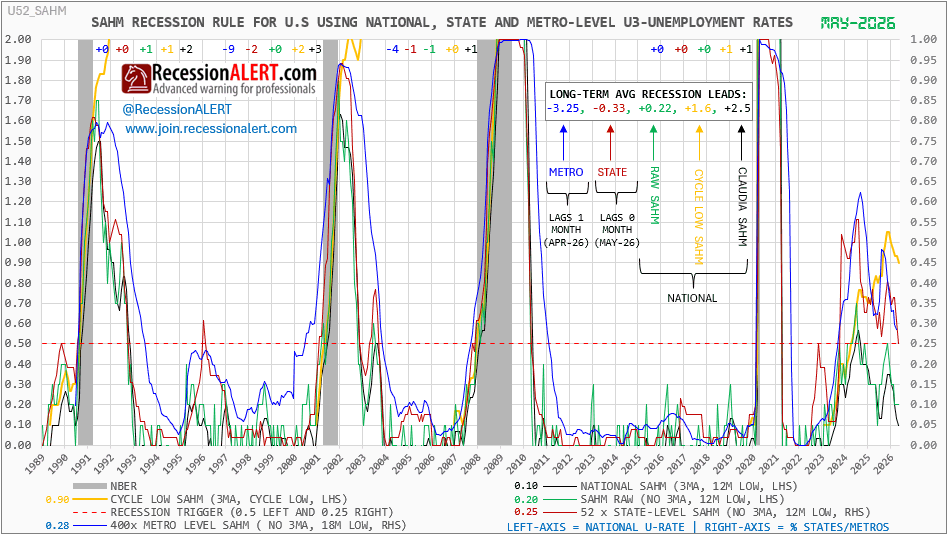
The national Sahm rule has stood down to 0.10 — a fifth of the way to its 0.50 trigger — and yet a quarter of states and 28% of metros still sit at or above their own trigger lines. That gap is the whole story. The headline reads all-clear; the geography reads localized labor breaks that haven’t aggregated into the national 3MA. The mechanism is mechanical: Claudia’s trailing-12-month reference low ratcheted upward as unemployment plateaued, collapsing a gap the cycle-anchored variant (still 0.90) preserves. Same labor market, 0.10 versus 0.90 — an 0.80 spread that is measurement, not economics; the headline is amnesia. We have seen this misfire before: in 2024 Claudia peaked at 0.57 with breadth far higher, and no recession came — the first clean false positive from the rule that called every postwar downturn. That scare has since unwound everywhere, even the artifact-immune cycle-low climbing down 1.05 to 0.90. But trajectory has turned, not level. And the layer flashing first is the one that leads: metro turns -3.25 months ahead of onset while Claudia lags +2.5. A Fed reading 4.3% and 0.10 sees room it may not have — proof only that nothing has broken everywhere at once, yet.
Market Intelligence Brief (MIB) Ver. 18.40
For professional investors only. Not investment advice.
© 2026 RecessionALERT.com

Comments are closed.