
MARKET INTELLIGENCE BRIEF (MIB)
Wednesday, June 24, 2026
Iran’s nuclear deal drove WTI to $69.87 (-4.56%), splitting markets: consumer and defensives gained while ORCL -4.62% (10-K capex shock) and storage names bled pre-Micron. All 32 banks cleared the Fed stress test, unlocking $200–300B in buybacks. The 10-year yield fell 9.6 bps with VIX simultaneously -4.41% — disinflation, not recession. Lockheed won a $35B THAAD contract, bringing 24-hour missile defense awards to $43B. Gold -3.21% ($4,016) as Iran war premium unwound. Thursday: Core PCE, GDP Final, durable goods.
TABLE OF CONTENTS
A. EXECUTIVE SUMMARY
B. MARKET DATA
C. HIGH-IMPACT STORIES (5)
D. MODERATE-IMPACT STORIES (5)
E. ECONOMY WATCH (5)
F. EARNINGS WATCH (1)
G. WHAT’S NEXT
H. CHART OF THE DAY
A. EXECUTIVE SUMMARY -> TOP
Iran’s nuclear deal progress and free tanker traffic through the Strait of Hormuz sent WTI crude to $69.87/bbl (-4.56%), cleaving equities into oil-deflation beneficiaries — Dow (+0.35%), Russell 2000 (+0.47%), consumer, and defensives — versus tech and growth names pressured by Oracle’s capex shock and pre-Micron earnings anxiety. The session’s defining macro signal: 10-year yields fell 9.6 bps to 4.392% simultaneously with VIX dropping 4.41% — the rare dual decline that distinguishes a disinflation read from a recession scare, directly compressing the Fed’s rate-hold argument heading into Thursday’s Core PCE. All 32 large US banks cleared the Fed’s 2026 stress test, unlocking an estimated $200–300B buyback and dividend cycle with capital buffer requirements frozen through 2027. Six of 11 S&P sectors finished positive: Healthcare (+0.96%), Utilities (+0.86%), and Consumer Cyclical (+0.73%) led; Energy (-2.18%) and Basic Materials (-1.44%) absorbed the deflation cost.
• Oil/Iran: WTI $69.87/bbl (-4.56%), briefly below $70 intraday — Iran nuclear deal progress + Hormuz tanker resumption overwhelm a bullish 6.1M bbl EIA crude drawdown; WTI now ~40% below wartime peak and approaching US shale full-cycle breakeven ($65–72/bbl)
• Banks clear: All 32 US large banks pass the 2026 Fed stress test ($708B hypothetical losses absorbed, 1.6pp CET1 drawdown); SCB requirements frozen through 2027; dividend and buyback announcements expected Thu–Fri from JPM, WFC, BNY Mellon, USB, STT
• Tech drag: ORCL -4.62% after 10-K reveals FY2026 capex $55.7B with FCF -$23.7B, FY2027 capex projected $95B + $20B equity raise; storage names STX -4.37%, WDC -4.01% on pre-Micron anxiety; Micron Q3 FY2026 reports after the bell tonight
• Housing split: May new home sales 580K vs. 640K consensus — widest miss of 2026; homebuilder ETF ITB +6.15% driven by Housing Act auto-enactment optimism (July 3–4 deadline); Trump’s cancellation of the signing ceremony introduces pocket veto risk that reverses the move
• Precious metals collapse: Gold -3.21% ($4,016/oz), silver -7.39% ($57.49/oz), platinum -4.78% — Iran war premium unwinding; gold briefly broke $4,000 intraday; $3,900 is the next technical support floor
• Defense procurement: LMT wins $35B THAAD contract (quadruples interceptor production to 400/yr across 20+ facilities); combined with Tuesday’s $8.4B PAC-3 MSE award = $43.4B in LMT missile defense contracts in 24 hours
1. Disinflation Trade Rotation — Oil’s collapse is compressing the inflation premium across asset classes simultaneously: 10-year yields fell 9.6 bps, VIX fell 4.41%, and gold gave back 3.21% of its geopolitical war premium — all consistent with a disinflation read, not recession fear. The rotation is mechanical: Energy (-2.18%) and Basic Materials (-1.44%) absorb the deflation cost while Consumer, Healthcare, and rate-sensitive small-caps benefit. Thursday’s Core PCE is the data test that validates or punctures the bond market’s call.
2. AI Capex Burden vs. AI Hardware Demand — Oracle’s 10-K is the starkest illustration of AI infrastructure economics: the hyperscale capex cycle ($55.7B FY2026, $95B FY2027 projected) is producing deeply negative FCF at even the most profitable enterprise software franchises, with a $20B equity raise looming. Meanwhile, SK Hynix’s $29.4B Nasdaq IPO (target July 10) and Qualcomm’s Dragonfly data center ambition signal robust AI hardware demand — but the investment cycle is front-running revenue by 2+ years, creating execution-risk valuation overhangs across the stack.
3. Capital Return Cycle Opens — All 32 banks cleared stress tests with a historically thin 1.6pp capital drawdown; SCB requirements frozen through 2027 give bank CFOs two-year buyback planning certainty. With 10-year yields falling and Financials sitting on quarters of accreted excess capital, the conditions for a $200–300B aggregate US bank buyback cycle are now fully authorized — creating a structural demand tailwind for Financial sector equities heading into Q3 earnings season.
 — Leading economic indicators. Accurate market forecasts. Apply for membership at join.recessionalert.com
B. MARKET DATA -> TOP
Oil’s continued slide to a new multi-month low ($69.87/bbl, -4.56%) — Iran peace progress and tankers transiting the Strait of Hormuz — cleaved markets: the Dow (+0.35%) and Russell 2000 (+0.47%) gained on lower energy costs, while the Nasdaq 100 (-0.43%) was dragged lower by a technology selloff. Technology had its own catalyst: Oracle’s 10-K filing disclosed capex surging to $55.7B with deeply negative FCF, compounding pre-Micron earnings anxiety that hit storage names (STX -4.37%, WDC -4.01%). The standout cross-market signal: 10Y Treasury yields fell -9.6 bps while VIX dropped -4.41% simultaneously — a disinflation read, not recession fear — yet gold tumbled -3.21% and silver -7.39% as the Iran geopolitical safety premium unwound.
CLOSING PRICES – Wednesday, June 24, 2026:
MAJOR INDICES
Index split continues: Dow (+0.35%) diverging from Nasdaq (-0.43%) as oil’s collapse rotates leadership toward consumer and industrial names. Russell 2000 (+0.47%) outperforms while S&P barely turns negative (-0.09%), with NYSE Composite (+0.13%) confirming breadth holds. Market History Signal: RUT outperforms SP500 by 4.71% over the past 10 sessions — entrenched small-cap leadership now in its 5th consecutive session, confirming sustained broad-market participation beneath the headline chop. Dow Theory: no trend signal fires — DJIA holds 0.3% below its 10-session high, but DJTA remains 4.4% below its own, denying confirmation.
| Index | Close | Change | %Move | Why It Moved |
|---|---|---|---|---|
| S&P 500 | 7,358.49 | -6.97 | -0.09% | Tech sector selling (ORCL capex shock, storage names ahead of Micron earnings) offset by consumer/industrial gains on oil deflation; Energy sector -2.18% added additional drag |
| Dow Jones | 51,848.90 | +182.06 | +0.35% | Limited tech exposure; blue-chip industrials (GE Aerospace +2.64%, GEV +2.19%) and consumer names (HD +5.67%) led; oil deflation narrative boosted consumer spending outlook |
| DJ Transportation | 21,609.0 | -22.5 | -0.10% | Modest decline despite lower jet fuel costs; freight names cautious on demand uncertainty as rapid oil deflation signals potential economic slowing |
| Nasdaq 100 | 29,220.06 | -127.22 | -0.43% | Tech-heavy index under pressure from ORCL -4.62% (10-K capex disclosure), storage names (STX -4.37%, WDC -4.01%) ahead of Micron earnings, and QCOM -3.29% |
| Russell 2000 | 2,989.47 | +13.99 | +0.47% | Domestic small-caps outperforming as falling energy costs and lower Treasury yields improve the outlook for domestically focused businesses and rate-sensitive borrowers |
| NYSE Composite | 23,493.55 | +29.92 | +0.13% | Positive breadth signal; broad market holding despite headline index weakness — consumer, healthcare, and utilities gains outweighing energy and tech declines |
VOLATILITY & TREASURIES
Rare dual decline: VIX -4.41% and 10Y yield -9.6 bps simultaneously — a disinflation signal, not recession fear. Oil’s crash is removing the inflation premium; the long end fell faster than the short end (bull flattening, ~4 bps). Bond markets are validating the equity rotation into consumer and rate-sensitive names. DXY +0.16% alongside falling yields reflects safe-haven demand rather than a hawkish policy repricing — the dollar should soften if the disinflation narrative holds.
| Instrument | Level | Change | Why It Moved |
|---|---|---|---|
| VIX | 18.63 | -0.86 (-4.41%) | Fear receding despite index weakness; markets pricing orderly rotation, not systemic risk — oil deflation seen as a controlled macro tailwind |
| 10-Year Treasury Yield | 4.392% | -9.6 bps | Oil’s collapse reducing long-term inflation expectations; bond market signaling disinflation; sharpest single-session yield drop in weeks |
| 2-Year Treasury Yield | 4.148% | -5.2 bps | Near-term rate cut expectations rising modestly as oil deflation ripples into the near-term CPI outlook; 10Y falling faster = bull flattening curve |
| US Dollar Index (DXY) | 101.61 | +0.17 (+0.16%) | Modest safe-haven bid alongside falling yields; residual positioning from June 23 hawkish Fed commentary; likely to fade if disinflation narrative solidifies |
COMMODITIES
Precious metals hit simultaneously: gold -3.21%, silver -7.39%, platinum -4.78% — Iran peace progress unwinding the geopolitical safety premium that drove these names higher through the conflict. Silver’s amplified move reflects dual exposure: safe-haven selling plus industrial metal weakness. Copper -2.65% confirms the industrial demand headwind (dollar strength, China demand concerns). Bitcoin’s -2.77% tracked the commodity risk-off — no independent crypto signal; risk assets moving in unison.
| Asset | Price | Change | %Move | Why It Moved |
|---|---|---|---|---|
| Gold | $4,016.40/oz | -$133.00 | -3.21% | Iran peace progress unwinding war-risk geopolitical premium; dollar strength adding pressure; gold traded near $4,000 intraday — lowest level since ~November 2025 |
| Silver | $57.485/oz | -$4.585 | -7.39% | Amplified by dual exposure — safe-haven premium unwind plus industrial demand headwinds; silver’s higher beta to gold magnifies the geopolitical premium selloff |
| Copper | $5.99/lb | -$0.16 | -2.65% | Dollar strength and China demand concerns weighing on industrial metals; renewable energy and electronics demand only partly offsetting weakness |
| Platinum | $1,582.60/oz | -$79.40 | -4.78% | Broad precious metals selloff; auto-catalyst demand concerns on weaker industrial outlook; tracking gold/silver lower on Iran geopolitical premium unwind |
| Bitcoin | $60,876 | -$1,737 | -2.77% | Tracking broad commodity and risk-asset selloff; no crypto-specific catalyst — Iran geopolitical risk-off unwind affecting all alternative stores of value |
ENERGY
WTI and Brent in near-lockstep (-4.56%/-4.51%) as the Strait of Hormuz reopening extends — geopolitical supply premium compressing; WTI briefly dipped below $70 intraday. Natural gas decoupled: Henry Hub +2.51% on domestic demand/weather, Dutch TTF -2.73% reflecting lingering Iran benefit in European markets. Unlike June 12’s energy-sector/crude divergence, today the Energy sector (-2.18%) fully tracked crude lower — no defensive bid, straightforward capitulation.
| Asset | Price | Change | %Move | Why It Moved |
|---|---|---|---|---|
| Crude Oil (WTI) | $69.87/bbl | -$3.34 | -4.56% | Iran nuclear deal progress + tankers now transiting Strait of Hormuz freely; supply premium continues unwinding; WTI briefly below $70 intraday; ~40% below wartime peak |
| Crude Oil (Brent) | $73.34/bbl | -$3.46 | -4.51% | Same Hormuz/Iran catalyst as WTI; near-lockstep movement confirms this is a global supply-premium unwind, not a regional demand story |
| Natural Gas (Henry Hub) | $3.264/MMBtu | +$0.080 | +2.51% | Decoupling from crude on domestic seasonal demand; US nat gas driven by summer cooling demand and LNG export volumes, not Hormuz dynamics |
| Natural Gas (Dutch TTF) | $13.60/MMBtu | -$0.39 | -2.73% | European gas markets pricing additional Iran peace dividend; modest decline as storage levels remain supportive; diverging from Henry Hub’s domestic demand spike |
S&P 500 SECTORS
Healthcare leads today (+0.96%) and the past month (+3.04%, 3M: +7.28%) — institutional accumulation after a flat H1. Energy’s collapse (-2.18% today, -11.50% 3M) traces directly to Iran peace progress unwinding the crude geopolitical premium, converting the year’s 6-month leader into its worst 3-month name. Communication Services deepens its multi-week breakdown (-6.19% 1W, -8.45% 1M) despite a +21.35% 12-month track record.
| Sector | 1-Day | 1-Week | 1-Month | 3-Month | 6-Month | YTD | 12-Month |
|---|---|---|---|---|---|---|---|
| Healthcare | +0.96% | +1.75% | +3.04% | +7.28% | +0.66% | +0.57% | +17.83% |
| Utilities | +0.86% | +1.16% | -0.26% | +0.70% | +7.38% | +6.67% | +14.62% |
| Consumer Cyclical | +0.73% | -3.33% | -5.44% | +3.64% | -7.89% | -6.36% | +4.09% |
| Consumer Defensive | +0.58% | -0.72% | -0.67% | +3.35% | +7.23% | +8.25% | +5.11% |
| Industrials | +0.55% | -3.58% | +3.51% | +10.07% | +16.72% | +17.38% | +28.12% |
| Real Estate | -0.02% | -0.30% | +0.85% | +10.13% | +10.01% | +9.64% | +6.82% |
| Technology | -0.51% | -1.92% | -0.53% | +26.47% | +19.52% | +19.21% | +40.05% |
| Communication Services | -0.59% | -6.19% | -8.45% | +5.00% | -1.55% | -2.55% | +21.35% |
| Financial | -0.62% | -0.94% | +3.53% | +11.21% | +1.43% | +1.38% | +13.83% |
| Basic Materials | -1.44% | -7.90% | -4.79% | +2.26% | +8.43% | +8.48% | +34.99% |
| Energy | -2.18% | -3.39% | -10.33% | -11.50% | +21.57% | +19.17% | +24.50% |
TOP MEGA-CAP MOVERS:
GAINERS
| Company | Ticker | Close | Change | Why It Moved |
|---|---|---|---|---|
| Home Depot | HD | $342.86 | +5.67% | Sharp relief rally on oil deflation narrative — lower energy costs ease contractor/homebuilder input pressures; June 23 Wolfe Research downgrade absorbed; consumer spending optimism as gasoline prices fall |
| GE Aerospace | GE | $365.88 | +2.64% | Aerospace/defense sector strength; engine services backlog execution and global air traffic recovery supporting maintenance revenue outlook; Industrials sector broadly outperforming today |
| Amphenol Corp | APH | $162.78 | +2.57% | Electronic components demand driven by AI infrastructure buildout and data center connectivity; benefiting from the same AI capex cycle that is pressuring ORCL’s FCF |
| GE Vernova | GEV | $1,057.65 | +2.19% | Grid infrastructure and energy transition demand; gas turbine and power plant orders underpinning growth; AI data center power demand strengthening the power equipment order book |
| Dell Technologies | DELL | $434.06 | +1.47% | AI server demand supporting enterprise infrastructure sales; outperforming tech sector peers despite broader Nasdaq weakness — enterprise AI buildout offsetting PC cycle softness |
DECLINERS
| Company | Ticker | Close | Change | Why It Moved |
|---|---|---|---|---|
| Oracle Corp | ORCL | $157.53 | -4.62% | FY2026 10-K (filed June 22) revealed capex surged to $55.7B (from $21.2B), FCF deeply negative at -$23.7B; FY2027 capex projected $95B with $20B equity financing raising dilution concerns; ~21,000 job cuts ($1.84B severance) |
| Seagate Technology | STX | $993.25 | -4.37% | Pre-Micron earnings anxiety weighing on storage/memory names; HDD demand cycle and NAND supply concerns front-running Micron’s after-bell results; hawkish Fed pressure on high-multiple tech |
| Western Digital | WDC | $643.83 | -4.01% | Same Micron-adjacent sentiment as STX; NAND flash and HDD storage under pressure; Micron earnings seen as the next AI memory demand bellwether for the storage sector |
| Qualcomm | QCOM | $197.41 | -3.29% | Semiconductor sector pressure on hawkish Fed residual and Nasdaq weakness; mobile chip demand uncertainty; pre-Micron anxiety spilling into adjacent chip names |
| Palantir Technologies | PLTR | $113.50 | -2.74% | High-multiple software selloff on hawkish Fed residual; profit-taking in AI software names; rotation out of growth/momentum names toward consumer and defensive sectors |
— Institutional-grade intelligence for serious investors. Apply for membership at join.recessionalert.comC. HIGH-IMPACT STORIES -> TOP
UNCERTAIN
1. Iran Peace Progress Sends WTI to $70.34 and Below $70 Intraday; Energy Sector -2.18% as Hormuz Tanker Traffic Resumes
The core facts:WTI crude fell 3.92% to settle at $70.34/bbl Wednesday — briefly trading below the $70 threshold intraday (session low ~$69.87) for the first time since before the regional conflict — as tanker traffic through the Strait of Hormuz resumed following Iran nuclear deal progress and the announcement of a 60-day US sanctions waiver on Iranian oil purchases (negotiations led by Kushner and Witkoff in Switzerland, with VP Vance expected to follow). Brent settled at $73.74, down 4.33%. Oil is now approximately 40% below its wartime peak. Compounding the supply-side signal: OPEC+ simultaneously proceeded with a +188,000 bpd July output increase, and Saudi Arabia and Kuwait cut their Official Selling Price premiums to Asia — a coordinated acceleration of global crude supply. The EIA’s weekly petroleum report added a bullish-yet-overwhelmed data point: commercial crude inventories fell 6.1 million barrels (vs. -4.5M expected) to 412.1M bbl (lowest since early 2025), with Cushing hub inventories near a 12-year low — a drawdown signal that would ordinarily be bullish for oil prices but was entirely swamped by the Iran peace demand-expectations repricing. The Energy sector (XLE) fell 2.18% — the worst-performing sector Wednesday — and is down 11.5% over three months.
Why it matters:At $70.34, WTI has entered the zone closely associated with US shale full-cycle breakeven costs ($65–$72/bbl range across major basins), where marginal producers begin to defer new drilling programs and E&P cash flow projections require downward revision. For the energy sector — approximately 3.8% of the S&P 500 — major operators (XOM, CVX, COP, independent E&Ps) built 2026 capital plans at $80+ WTI; the ~12% decline from those planning levels creates a meaningful drag on free cash flow and dividend coverage projections. If the Iran 60-day bridging period holds and transitions to a full nuclear deal, the structural supply overhang from Iranian crude (potentially 1–1.5 million bpd returning to market) would keep WTI anchored below $75 for the foreseeable future. The bullish counterforce is significant: WTI at $70 removes an estimated 40–50 basis points from core PCE’s energy component over 12 months — directly supporting the Fed’s inflation fight and reducing the case for additional rate hikes. The 10-year Treasury yield’s 9.6 bps decline Wednesday (see Story 3) reflects markets already pricing this disinflationary transmission. The net equity impact is genuinely uncertain: lower energy inflation benefits the broad consumer and rate-sensitive sectors, but energy sector earnings compression and geopolitical uncertainty during the 60-day period create offsetting drags. The EIA crude drawdown — a historically bullish supply signal — being overwhelmed by demand-side peace expectations also illustrates that the Iran narrative now dominates all oil-market price discovery.
What to watch:WTI holding above or breaking below $65–68 (the US shale full-cycle breakeven band); progress or setbacks in Iran nuclear deal negotiations during the 60-day bridging period; next Wednesday’s EIA crude inventory report for first evidence of Iranian crude appearing in US import statistics.
BULLISH
2. All 32 Banks Clear the 2026 Fed Stress Test; Capital Buffers Frozen Through 2027 Unlocks Dividend and Buyback Cycle
The core facts:The Federal Reserve released its annual 2026 bank stress test results at 4:00 PM ET Wednesday: all 32 participating large US banks passed the severe adverse scenario (assumptions: 10% unemployment, -30% residential home price decline, -39% commercial real estate collapse). The system absorbed $708 billion in hypothetical loan losses while aggregate common equity tier 1 (CET1) capital fell only 1.6 percentage points — remaining well above regulatory minimums across every institution. The Fed simultaneously froze stress capital buffer (SCB) requirements through 2027, giving banks two-year planning certainty. Vice Chair for Supervision Michelle Bowman stated results “underscore the strength of the banking system.” JPMorgan, Wells Fargo, BNY Mellon, US Bancorp, and State Street each confirmed plans to increase dividends and expand buyback programs. Financial sector equities moved positively on the release.
Why it matters:The all-pass result is the green light that large-bank capital return programs have been waiting for. With SCB requirements now frozen through 2027, CFOs at JPM, WFC, BAC, C, GS, and MS can structure multi-year buyback programs with full regulatory visibility — removing the quarterly uncertainty that has historically caused banks to underpromise and bank excess capital. The largest money-center institutions have been accreting capital for several quarters: JPMorgan’s CET1 ratio has run materially above its SCB-adjusted minimum, creating a buyback firepower that the stress test results now fully authorize. For equity investors: the near-term catalyst is the dividend and buyback announcement cycle typically completing within 24–48 hours of results. For fixed income: all-pass results reduce the probability of any regulatory capital requirement tightening in the near term and compress bank-credit spread risk premiums marginally. The two-year SCB freeze is the most consequential structural item: it means 2026 and 2027 capital return plans can be sized with precision rather than conservatism, supporting a potential $200–300 billion aggregate US bank buyback cycle.
What to watch:Individual bank dividend and buyback announcements expected Thursday–Friday; the aggregate scale of capital return authorizations across the majors as a forward indicator of bank confidence in the economic outlook; any Basel III Endgame rule final language that could subsequently modify SCB calculations despite today’s freeze.
BULLISH
3. 10-Year Treasury Yield Falls 9.6 bps to 4.392%; VIX -4.41% — Rare Dual Decline Signals Genuine Disinflation, Not Recession Fear
The core facts:The 10-year Treasury yield fell 9.6 basis points to 4.392% Wednesday — the largest single-session decline in over a month — as WTI oil settling at $70.34 drove a broad disinflation repricing across the yield curve. The 2-year yield fell 5.2 basis points to 4.148%, producing a bull flattening configuration (both yields decline, but longer-dated yields fall more). Simultaneously, the VIX volatility index fell 4.41% — an unusual combination that sharply distinguishes this yield move from a growth-scare rally. The DXY dollar index edged up 0.16%, mildly reflecting the cross-asset disinflation read without triggering the flight-to-USD pattern typical of risk-off sessions.
Why it matters:The dual fall in 10-year yields (-9.6 bps) AND the VIX (-4.41%) is the critical distinguishing signal for portfolio positioning. In a genuine risk-off / growth-scare episode, Treasuries rally while the VIX surges — as investors flee equities for safety. Wednesday’s configuration — yields and volatility falling together — confirms the market is reading the oil price collapse as a disinflation event, not an economic slowdown event. The phase1_hints note this explicitly: “rare dual decline confirming disinflation read, NOT recession fear.” For equity portfolios: lower long-term yields compress the discount rate on growth-stock and technology earnings multiples — a direct re-rating benefit for the highest-duration equity names. At 4.392%, the 10-year remains historically elevated, but the directional change (from 4.49% pre-session toward 4.39%) represents meaningful multiple expansion math at prevailing P/E ratios. The bull flattening also typically benefits regional bank net interest margins in a different way than a bear steepening: it signals the market’s conviction that short rates are not going higher, removing one headwind for variable-rate commercial lending. Thursday’s Core PCE (May, consensus +0.3% MoM / +3.4% YoY) will be the first major data test of whether the disinflation narrative has fundamental legs — a beat to the downside (lower-than-expected PCE) would extend Wednesday’s yield rally.
What to watch:Thursday’s Core PCE May at 8:30 AM ET (consensus +0.3% MoM, +3.4% YoY) as the first major validation or refutation of the disinflation narrative; 10-year yield holding below 4.40% as the near-term technical confirmation line.
BEARISH
4. Gold -3.21% Below $4,016; Silver -7.39% — Iran Peace Unwinds the $600+ Geopolitical War Premium Built Over 18 Months
The core facts:Gold fell 3.21% to $4,016.40/oz Wednesday — briefly trading below the $4,000 psychological threshold intraday, its lowest level since approximately November 2025. Silver plunged 7.39% to $57.485/oz. Platinum fell 4.78% to $1,582.60/oz. The broad and synchronized precious metals selloff reflects the coordinated unwinding of the geopolitical war-risk premium that had driven gold from approximately $3,400 (pre-conflict baseline) to a peak above $4,600 during peak Iran conflict intensity — a $1,200+/oz premium over 18 months. The dollar’s 0.16% gain provided secondary pressure. The selloff spans all three major precious metals simultaneously, which rules out idiosyncratic single-metal dynamics and confirms the driver is systematic: Iran peace progress reducing demand for hard-asset safe-haven positions.
Why it matters:The scale of today’s move — gold -3.21%, silver -7.39% — indicates institutional positions accumulated during the conflict era are being actively reduced, not merely hedged. For multi-asset portfolios that added precious metals allocations as geopolitical insurance: the question now is how much of the $3,400→$4,600 appreciation was fundamental (inflation hedge, dollar debasement concern) versus conflict premium. If the Iran de-escalation holds through the 60-day bridging period, the conflict premium (estimated at $300–$600/oz at peak) could continue unwinding toward the $3,500–$3,800 range, even if the inflation-hedge premium holds. Silver’s larger decline (-7.39% vs. gold’s -3.21%) reflects dual exposure: safe-haven selling plus weak industrial demand signals from China (construction, consumer appliances below capacity), amplifying the selloff beyond what pure safe-haven de-risking explains. For commodity-sector equities: gold miners (GDX, GDXJ, NEM, AEM, Barrick) face a significant valuation reset — at $4,016/oz, all-in sustaining costs for major miners remain profitable, but the negative price-to-NAV trajectory will compress mining multiples. The $4,000 level is critical: sustained breach below that threshold triggers systematic CTA de-risking from commodity-trend funds that had established long gold positions above $4,000.
What to watch:Gold’s ability to hold above $3,900 — the next major technical support after $4,000 — as the line between an orderly premium unwind and a momentum-driven breakdown; Friday’s CFTC Commitments of Traders report for institutional futures positioning data that will reveal the scale of systematic selling vs. discretionary rebalancing.
BEARISH
5. New Home Sales Miss by 60K — 580K SAAR vs. 640K Consensus; Widest Shortfall of 2026 Confirms Affordability Demand Destruction
The core facts:May new home sales came in at 580,000 SAAR — a 60,000-unit miss versus the 640,000 consensus and the widest shortfall of 2026. Sales declined 7.3% month-over-month from April’s 626,000. The miss is affordability-driven, not supply-constrained: the MBA 30-year mortgage rate remains at 6.59%, median new home price was $424,900, and inventory rose 2.3% to 496,000 units — indicating supply is available but buyers are unable or unwilling to transact at prevailing price-and-rate combinations. Homebuilder stocks showed a complex reaction: despite the weak underlying data, the homebuilder ETF (ITB) surged +6.15% and D.R. Horton, Lennar, PulteGroup, and Toll Brothers each advanced 6–8% — driven not by the sales data but by the separate legislative development of the 21st Century Road to Housing Act (covered in Section D).
Why it matters:The bifurcated market reaction — weak new home sales data yet homebuilder equities surging — reflects the market pricing two simultaneous and contradictory narratives: near-term demand destruction from unaffordable rates (bearish) versus long-term supply reform optimism from pending housing legislation (bullish). For the Fed: housing is the most rate-sensitive component of domestic demand. A 60,000-unit miss at 6.59% mortgage rates — with inventory actually building — demonstrates that housing market activity is being structurally compressed by the rate environment, not just cyclically dampened. This reinforces the Pantheon Macroeconomics argument (June 23) that shelter cost disinflation will flow through to core PCE with a 12–18 month lag from current demand weakness. For home improvement retailers and mortgage servicers: the lock-in effect (homeowners holding 3% mortgages unwilling to sell into 6.5%+ market) and new construction demand weakness are compressing revenue visibility well into 2027. The Wolfe Research downgrade of Home Depot (June 23, Peer Perform) cited exactly this: “stalled housing turnover and delayed home improvement recovery until mid-2027.”
What to watch:Thursday’s Core PCE May (8:30 AM ET) for confirmation that housing cost disinflation is transmitting to the broader price index; weekly MBA mortgage application data for real-time housing demand tracking; July new home sales (released late August) to assess whether rate relief from today’s Treasury rally translates to improved buyer activity.
— Quantifying recession risk so you don’t have to guess. Apply for membership at join.recessionalert.comD. MODERATE-IMPACT STORIES -> TOP
UNCERTAIN
6. Housing Act Passes Congress — Trump Cancels Signing Ceremony; Homebuilder ETF +6.15% on Auto-Enactment Speculation
The core facts:The 21st Century Road to Housing Act — described as the largest housing affordability bill in decades — passed the House 358-32 Tuesday (June 23) and the Senate the prior Monday (June 22). The bill streamlines federal housing financing regulations without new federal spending. President Trump canceled the scheduled signing ceremony Wednesday (June 24), reiterating demands for the broader SAVE America Act before signing. Under the Constitution, a bill passed by both chambers becomes law automatically within 10 days (excluding Sundays) if the President neither signs nor vetoes it — placing the auto-enactment date around July 3–4, 2026. Markets reacted as if enactment is highly probable: the homebuilder ETF (ITB) surged +6.15%, with D.R. Horton (DHI) +6%, Lennar (LEN) +6%, PulteGroup (PHM) +8%, and Toll Brothers (TOL) +6.7%.
Why it matters:The binary outcome — auto-enactment around July 3–4 versus a pocket veto if Congress enters recess — is the pivotal risk for homebuilder positions entering July. The market’s 6–8% rally reflects the probability-weighted view that Trump will allow the bill to become law: vetoing a 358-32 bipartisan measure would carry a significant political cost and is complicated by the current Congressional calendar. For institutional investors: the bill’s regulatory streamlining — reducing federal financing approval timelines for residential development — would lower project uncertainty costs for large homebuilders, improving return-on-capital projections for new communities. At a time when new home sales are running 60,000 units below consensus (Section C), structural supply reform is the credible long-term bullish catalyst for homebuilders even in a demand-constrained environment. However, the risk is binary: a Trump pocket veto (possible if Congress adjourns ahead of July 3–4) would likely reverse today’s 6–8% gains rapidly. The position therefore carries meaningful event risk around the auto-enactment date.
What to watch:Any White House statement clarifying signing/veto intent before the July 3–4 auto-enactment deadline; whether Congress enters recess (enabling a pocket veto); July 3–4 auto-enactment calendar date as the binary resolution event for homebuilder positions.
BULLISH
7. Lockheed Martin Wins $35B THAAD Contract — Seven-Year UCA to Quadruple Interceptor Production from 96 to 400 Per Year
The core facts:The US Department of Defense awarded Lockheed Martin (LMT) a seven-year undefinitized contract action (UCA) worth up to $35 billion Wednesday for Terminal High Altitude Area Defense (THAAD) interceptors — one of the largest missile defense contracts in US history. The contract will quadruple THAAD interceptor production capacity from 96 to 400 units per year and includes investment across more than 20 new or modernized manufacturing facilities nationwide. The award was structured under the DoD’s Acquisition Transformation Strategy and is described as one of the first full-scale transitions from framework agreement to contract execution under that initiative. THAAD is the only US system designed to intercept ballistic missile threats both inside and outside the atmosphere.
Why it matters:Combined with Tuesday’s $8.4 billion PAC-3 MSE contract, Lockheed Martin has secured approximately $43.4 billion in missile defense contracts within 24 hours — a pace of defense procurement not seen since the 1980s buildup. For the defense complex: the $35B THAAD UCA represents approximately five years of LMT’s missile defense segment revenues, dramatically scaling the production base with multi-year cost and delivery visibility. The quadrupling of production capacity (96→400 interceptors/year) implies LMT’s domestic and allied customer backlog extends through at least the early 2030s. The 20+ new or modernized US facilities embedded in the contract are a direct employment and industrial-base commitment across multiple states — reducing Congressional budget risk. For portfolio managers: LMT’s performance during yesterday’s broad market selloff (S&P -1.44%, LMT +2.04%) and today’s THAAD award confirm the defense sector’s defensive equity characteristics. The contract also signals US commitment to layered missile defense even as the Iran de-escalation reduces immediate conflict risk — suggesting defense procurement reflects a structural doctrine shift (peer-competitor deterrence) rather than transient war-driven spending. RTX (Patriot radar, THAAD-compatible) and NOC (command-and-control integration) are secondary beneficiaries.
What to watch:LMT’s next earnings call for THAAD UCA revenue recognition timeline and initial production ramp visibility; FY2027 defense appropriations for THAAD line-item confirmation; allied government purchase agreements (NATO, Japan, UAE) that would extend the program beyond the domestic footprint.
UNCERTAIN
8. Qualcomm Targets $40B Non-Handset Revenue by FY2029 with Dragonfly C1000 CPU and Meta/Microsoft as Early Customers; QCOM -5.15%
The core facts:Qualcomm (QCOM) held its 2026 Investor Day Wednesday, unveiling the Dragonfly portfolio for data centers: the Dragonfly C1000 CPU (chiplet design, 250+ cores, PCIe Gen7, CXL, LPDDR memory), the Dragonfly AI300 inference accelerator, and High Bandwidth Compute (HBC) products. Meta Platforms and Microsoft were announced as early customers, with Meta committing to a multi-generation Dragonfly C1000 collaboration supporting Meta’s expanding compute footprint. Qualcomm nearly doubled its FY2029 non-handset revenue target to $40 billion from a prior $22 billion projection. The critical caveat: Dragonfly C1000 production begins H2 2028, creating a 2.5-year gap between today’s announcements and material revenue contribution. QCOM fell 5.15% to $193.61 during regular trading — reflecting market skepticism around a ~$4 billion Modular Systems acquisition announced concurrently and the long-horizon ramp — before partially recovering in extended hours as investors reassessed the $40B target against current valuation.
Why it matters:Qualcomm’s Investor Day represents the company’s most direct challenge to the AMD–Intel–NVIDIA data center oligopoly using ARM architecture. The Meta and Microsoft commitments — both hyperscalers with enormous and growing compute footprints — provide meaningful customer validation that ARM-architecture CPUs are a credible alternative to x86 in the data center workload. However, the market’s -5.15% regular-session reaction correctly identifies the core risk: the 2028 production start means FY2029 is the earliest year Dragonfly C1000 contributes materially to the $40B target, providing AMD, Intel, and NVIDIA 2+ years to respond and customers 2+ years to alter roadmap commitments. For portfolio managers: Qualcomm remains principally a smartphone-chip company (~$8B annual mobile revenue) today; the $40B non-handset target is a near-5x step-up from the current non-handset base representing a stretch multi-year execution task. The Meta/Microsoft wins provide legitimate strategic optionality, but until revenue is visible the position functions as a call option on execution at current valuation. The AH recovery suggests some institutional investors see the $40B target as mispriced at today’s levels, while the regular-session selloff reflects those who view the 2028 ramp as too distant to drive near-term earnings.
What to watch:Pre-production sampling announcements and customer trial timelines for Dragonfly C1000 (expected 2027); FY2027–28 non-handset revenue as a leading indicator of whether the $40B target is tracking; competitive responses from AMD (EPYC next-gen) and Intel’s data center roadmap for the same period.
UNCERTAIN
9. SK Hynix Targets $29.4B Nasdaq ADR Listing by July 10 — Potential Second-Largest US IPO in History Reshapes AI Memory Investment Universe
The core facts:SK Hynix — the South Korean memory chipmaker and NVIDIA’s primary HBM4 supplier — announced plans Wednesday to raise approximately $29.4 billion (45.45 trillion won) via an American Depositary Receipt listing on Nasdaq, targeted for July 10, 2026. The offering of 17.79 million new shares would rank as the second-largest US IPO in history if fully subscribed, surpassing Alibaba Group’s $21.8 billion 2014 record. Proceeds are earmarked for a new memory chip factory in Yongin, an advanced packaging facility in Cheongju, and EUV lithography equipment procurement. DRAM spot prices rose approximately 4% Wednesday in response to SK Hynix’s publicly disclosed capital commitment to expanded HBM4 production capacity ahead of Micron’s Q3 FY2026 earnings tonight.
Why it matters:The SK Hynix Nasdaq listing has two distinct and partially contradictory implications for US investors. On one hand, it creates the first direct US-market access to the world’s primary HBM4 supplier — providing AI infrastructure investors a tradeable alternative to Micron (MU) and indirect plays (LRCX, KLAC, NVDA) for HBM4 supply exposure. This is unambiguously positive for the investable AI hardware universe. On the other hand, a $29.4B offering is large enough in absolute size to generate supply pressure on existing semiconductor ETF holdings in the weeks before July 10: ETF rebalancing requirements and active fund participation in the offering may require position reduction in MU, LRCX, KLAC, and related names to fund SK Hynix allocation. The DRAM price increase (approximately 4%) reflects the market reading SK Hynix’s capital commitment as a signal of sustained HBM4 demand — constructive for the AI memory cycle broadly. The listing timing — immediately following tonight’s Micron Q3 FY2026 report — effectively resets the benchmark for AI memory sector valuation, with two public US-market comparables now visible.
What to watch:July 10 Nasdaq listing date: whether the offering meets, exceeds, or prices below the $29.4B target (investor demand is a direct confidence read on AI memory cycle durability); rebalancing flows in SMH and SOXX semiconductor ETFs in the 10 trading days before listing; how Micron’s Q3 results tonight position the AI memory competitive narrative heading into SK Hynix’s investor roadshow.
BEARISH
10. Sen. Warren: Trump Has Put Fed Chair Warsh “In a Box” — Political Pressure Narrative Escalates Fed Independence Risk
The core facts:Senator Elizabeth Warren (D-MA) stated Wednesday that President Trump has put Fed Chair Kevin Warsh “in a box” on interest rate policy — the latest escalation of political pressure on Federal Reserve decision-making independence. Warren’s framing references the structural tension between the executive branch’s preference for accommodative monetary conditions and Warsh’s public commitment to addressing above-target inflation — a tension also highlighted by former NY Fed President Dudley (June 23: “reliance on market views for policy is a mistake,” and “the case for cutting rates is very, very weak”). The statement came as CME FedWatch odds for year-end rate stability were repricing on today’s disinflation signals from the oil crash, with the probability of any 2026 hike fading modestly from BofA’s recent 3-hike call scenario.
Why it matters:Political pressure on the Federal Reserve from both parties defines the systemic risk factor most difficult to price in standard risk models. Warsh’s “box” has two walls: (1) cutting rates too early or holding rates when the data supports tightening risks appearing to yield to executive pressure — destroying inflation-fighting credibility as Dudley warned explicitly on June 23; (2) hiking aggressively against political preference risks being framed as deliberately constraining economic activity for non-monetary reasons. Both outcomes damage institutional credibility in different ways. For fixed income: the credibility-premium embedded in long-term yields — the additional yield demanded by investors who believe the Fed’s inflation commitment may be compromised — historically adds 15–30 basis points to the 10-year rate when the independence-risk narrative reaches consensus. Today’s 9.6 bps yield decline reflects oil disinflation, not credibility improvement; if the political pressure narrative intensifies through August–September, the credibility premium could widen even as near-term inflation expectations fall, creating a ceiling on the Treasury rally. For equity markets: Fed credibility erosion historically increases long-run discount rate uncertainty — bearish for duration-sensitive equity valuations even in a disinflation environment.
What to watch:Any public response from Fed Chair Warsh to the political pressure narrative — his next major speech would carry significant market weight; September FOMC meeting as the focal decision point where the market determines whether Warsh acts independently of executive preferences; Thursday’s Core PCE as the data event that Warsh will likely reference in any September communication.
— Separating signal from noise since 2007. Apply for membership at join.recessionalert.comE. ECONOMY WATCH -> TOP
Wednesday split between financial resilience and housing-market crosscurrents. All 32 large banks cleared the Fed stress tests — capital declined just 1.6pp under a severe-recession scenario — opening the door to increased buybacks and dividends. Offsetting that, New Home Sales dropped to 580K in May (-7.3% MoM), missing the 640K consensus as 6.59% mortgage rates keep buyers sidelined; Congress’s passage of the largest housing affordability bill in decades drove homebuilder stocks +6–8%, but Trump’s signing cancellation introduces a 10-day legal ambiguity. The Q1 current account deficit widened to -$226.8B vs. -$217.5B expected — tariffs not yet narrowing the trade gap. Thursday’s Core PCE and GDP Final are the critical inputs: Bessent’s 3% year-end growth call must reconcile with the Fed’s own 2.2% projection.
All 32 Large Banks Clear 2026 Fed Stress Tests; $708B in Hypothetical Losses Absorbed, Capital Down Just 1.6pp (Federal Reserve, June 24, 2026)
What they’re saying:The Federal Reserve released annual stress test results Wednesday, with all 32 large U.S. banks maintaining capital above minimum requirements under a severe hypothetical recession: 10% unemployment, -30% home prices, -39% commercial real estate. Aggregate capital fell just 1.6 percentage points while absorbing over $708 billion in hypothetical losses — including $200 billion in credit card losses and $160 billion in commercial and industrial loans. Current capital buffer requirements remain unchanged through 2027.
The context:The clean sweep clears the path for increased shareholder returns — bank-by-bank buyback and dividend announcements are expected imminently. Vice Chair Bowman stated the results “underscore the strength of the banking system.” The tested scenario was more severe than the 2008 financial crisis, making the thin 1.6pp capital drawdown a stronger signal than prior years. With capital requirements frozen through 2027, the largest banks face no near-term balance sheet pressure from regulatory constraints.
What to watch:Individual bank buyback and dividend announcements over the coming days. Track the KBW Bank Index (BKX) and XLF for capital-return-driven upside. Monitor any individual outlier banks that posted materially higher loss rates than sector averages.
New Home Sales Slump to 580K in May, Widest Miss of the Year vs. 640K Consensus as Mortgage Rates Sideline Buyers (Census Bureau, June 24, 2026)
What they’re saying:US new single-family home sales fell to a seasonally adjusted annual rate of 580,000 in May, down 7.3% from April’s 626,000 and 6.8% below May 2025 levels — missing the 640,000 consensus by 60,000 units, the widest consensus miss this year. Despite the volume slump, the median new home price rose to $424,900 (+2.0% from April), while inventory edged up to 496,000 units (+2.3%). The MBA 30-year mortgage rate held at 6.59% on Wednesday.
The context:Rising inventory without a corresponding sales uptick signals demand fatigue, not supply-side normalization — buyers are priced out, not uninterested. At 580K annually, the sales pace sits below the rate required to meet household formation demand, making this a structural affordability signal rather than seasonal noise. The combination of rising prices, elevated rates, and falling volume echoes early 2023 dynamics that preceded an extended housing freeze. The 60K miss against consensus is the sharpest of 2026.
What to watch:Thursday’s Personal Spending (exp. +0.6%) will indicate whether housing demand weakness is spreading into broader consumer activity. Monitor weekly MBA mortgage applications for any demand response to the housing bill passage. Friday’s Goods Trade Balance advance provides a broader demand signal.
Congress Passes Largest Affordable Housing Bill in Decades 358-32; Trump Cancels Signing Ceremony, Homebuilders Surge 6–8% (Congress / White House, June 23–24, 2026)
What they’re saying:The 21st Century Road to Housing Act passed the House 358-32 Tuesday, following bipartisan Senate approval Monday — described as the largest housing affordability legislation in decades. The bill streamlines federal financing regulations for homebuilders and creates incentives for local governments to accelerate construction approvals without allocating new federal spending. President Trump canceled Wednesday’s planned signing ceremony, reiterating demands for the SAVE America Act instead; the bill becomes law automatically if Trump takes no action within 10 days.
The context:The immediate market verdict was bullish: D.R. Horton and Lennar each surged ~6%, PulteGroup gained 8%, Toll Brothers advanced 6.7%, and the ITB homebuilder ETF surged 6.15% — among the strongest single-day sector moves since January. However, Trump’s cancellation introduces a 10-day binary: a formal veto kills the legislation; inaction makes it law. The bill’s supply relief also depends on local government follow-through on zoning reform — impacts are measured in years, not quarters.
What to watch:White House action (signature, veto, or inaction) over the next 10 calendar days — deadline falls around July 3–4. Monitor homebuilder stocks for sustained follow-through vs. reversal as legal ambiguity resolves. Any Trump statement on the bill is an early veto signal.
Treasury Secretary Bessent: GDP Can “Return to 3%” Before Year-End — Diverges from Fed’s 2.2% Projection (CNBC, June 24, 2026)
What they’re saying:Treasury Secretary Scott Bessent said Wednesday on CNBC that US GDP growth “can have something with a three in front of it this year,” citing a strong underlying economy and characterizing Trump’s tariffs as “an aggressive approach forcing trading partners to the negotiating table.” Bessent reiterated his “3-3-3” plan: 3% growth, 3% deficit-to-GDP, and 3 million barrels/day increase in domestic oil production — all still achievable in his view despite growth slowing in recent quarters.
The context:Bessent’s 3% target stands in direct tension with the June FOMC’s revised 2026 GDP projection of 2.2% — issued one week ago — alongside a raised inflation forecast of 3.6% headline and nine members projecting one to three rate hikes this year. Atlanta Fed GDPNow tracks Q2 at 3.0%, technically validating near-term momentum, but Q1 GDP Final (Thursday, consensus +1.6%) reflects prior weakness, and the policy mix needed for sustained 3% growth without further rate pressure remains unresolved.
What to watch:Thursday’s GDP Final Q1 (consensus +1.6%) and Core PCE May (+3.3% YoY expected) are the two data points that most directly test Bessent’s narrative. Watch for any Fed Chair Warsh response that explicitly pushes back on a growth trajectory inconsistent with the Fed’s own projections.
US Current Account Deficit Widens to $226.8B in Q1, Misses $217.5B Consensus as Primary Income Turns Negative (BEA, June 24, 2026)
What they’re saying:The US current account deficit widened $5.8 billion (2.6%) to $226.8 billion in Q1 2026, according to the Bureau of Economic Analysis — missing the $217.5B consensus and widening from $221.1B in Q4 2025. The deficit represents 2.9% of current-dollar GDP, up from 2.8% in Q4. The widening reflected a shift in the primary income balance from a surplus in Q4 to a deficit in Q1, partially offset by a reduced goods deficit as some import demand was pulled forward into Q4 2025 ahead of tariff implementation.
The context:The wider-than-expected deficit is notable given the Trump administration’s tariff rationale — one stated goal was compressing the trade gap. Instead, Q1 saw the deficit widen both sequentially and versus consensus. A 2.9%-of-GDP current account deficit increases the economy’s reliance on foreign capital inflows to finance domestic activity — a structural vulnerability that carries more weight as global rate differentials compress and dollar strength cannot be assumed. The primary income deterioration (investment return flows reversing) is a less visible but potentially persistent drag.
What to watch:Friday’s Goods Trade Balance advance estimate for May (consensus -$85.2B, prior -$83.0B) — the first read on whether tariff effects are compressing goods flows in Q2. Monitor 10-year Treasury auction demand and the dollar index for any external financing pressure signals.
— Know the probability before the market prices in the risk. Apply for membership at join.recessionalert.comF. EARNINGS WATCH -> TOP
YESTERDAY AFTER THE BELL (Markets Reacted Today)
No major earnings yesterday after the bell from companies with >$100B market cap. (FedEx at $75.7B and Cerebras Systems reported June 23 AMC — both below the $100B threshold.)
TODAY BEFORE THE BELL (Markets Already Reacted)
No major earnings before the bell from companies with >$100B market cap. (Paychex at $34.5B reported BMO — below the $100B threshold.)
TODAY AFTER THE BELL (Markets React Tomorrow)
BULLISH
11. Micron Technology (MU): +~13% AH | Record $41.5B Revenue Demolishes Estimates; $50B Q4 Guide Confirms AI Memory Supercycle Intact
The Numbers:Revenue $41.46B vs. $35.91B estimate (+15.4% beat); Non-GAAP EPS $25.11 vs. $20.86 estimate (+20.4% beat); GAAP EPS $24.67 vs. $20.55 GAAP estimate. Q4 FY2026 guidance: ~$50B revenue (implying another ~20% sequential step-up). Operating cash flow $25.39B; adjusted free cash flow $18.3B; cash and investments $30.2B. Data center revenue $11.5B (up more than 7x year-over-year). Cloud memory $13.77B (up more than 300% year-over-year). Released: AMC June 24, 2026.
The Problem/Win:The win is comprehensive and across every dimension. HBM4 shipments for NVIDIA’s Vera Rubin platform began in March 2026 and are ramping at approximately twice the pace of the prior HBM3E 12-high generation, with yield improvements running ahead of expectations — eliminating the execution risk that was the primary bear case on Micron’s AI positioning. The data center revenue figure ($11.5B, up more than 7x year-over-year) and the $50B Q4 guidance — the strongest revenue quarter in Micron’s history if achieved — are the decisive validation that AI infrastructure memory demand is not decelerating. Yesterday’s -13.2% selloff (driven by Korean ETF forced-unwind contagion, not any Micron-specific negative) is now identifiable in retrospect as a pure financial dislocation rather than a fundamental signal.
The Ripple:The report broadly validates the AI memory demand thesis across the semiconductor sector. Western Digital (WDC) and Seagate (STX) — which sold off 4–4.5% alongside MU yesterday on contagion — should recover as the AI storage cycle receives fundamental confirmation. LRCX and KLAC, down 9%+ yesterday on the Korean ETF event, face a re-rating as Micron’s HBM4 ramp confirms the wafer fabrication equipment demand pipeline is intact. SK Hynix’s timing of its $29.4B Nasdaq listing (July 10) now has a powerful fundamental tailwind: MU’s $50B Q4 guide is the clearest possible validation of the AI memory capital cycle that SK Hynix is raising $29.4B to fund.
What It Means:Micron’s Q3 FY2026 report removes the single most important remaining uncertainty in the AI infrastructure investment thesis: whether HBM4 demand is durable. A $41.5B revenue quarter with a $50B forward guide — against a backdrop of a -13.2% selloff the prior day on non-fundamental contagion — represents one of the most compelling reward-to-risk setups visible in the semiconductor sector entering Thursday’s session. The combination of record margins, accelerating HBM4 yields, and a guide implying continued supercycle conditions through at least Q4 FY2026 is unambiguously bullish for AI hardware broadly.
What to watch:Whether MU opens Thursday with the full +13% AH gain intact or whether sector rotation reduces the carry-through; SK Hynix July 10 Nasdaq listing pricing as the next AI memory valuation benchmark; NVIDIA’s next earnings report for HBM4 Vera Rubin demand commentary confirming Micron’s ramp visibility.
WEEK AHEAD PREVIEW:
Q1 2026 earnings season is effectively winding down at 89% reported with blended EPS growth of +27.7% YoY — the strongest since Q4 2021. The near-term calendar is light: no US-domiciled mega-cap reporters (>$100B market cap) are visible through the remainder of this week. Thursday’s reporters include Darden Restaurants ($24.5B), TD Synnex ($22.8B), McCormick ($12.8B), and Acuity ($9.3B) — all below the Section F threshold. Wise Group (WSE, $13.2B) reports AMC Thursday but is a UK-domiciled Plc and therefore excluded.
The next significant earnings cycle is Q2 2026 season, expected to open approximately mid-to-late July 2026. FactSet’s next S&P 500 earnings update is anticipated around July 11, 2026 — coinciding with the early Q2 2026 reporting window. Tonight’s Micron result ($41.5B revenue, $50B Q4 guide) is the de facto closing statement of Q1 2026 earnings season for the AI hardware complex.
— US market commentary trusted by family offices and institutions. Apply for membership at join.recessionalert.comG. WHAT’S NEXT -> TOP
UPCOMING RELEASES:
| Date | Event | Why It Matters |
|---|---|---|
| Thu, Jun 25 | Core PCE Price Index May (MoM exp. +0.3%; YoY exp. +3.4%) | The Fed’s preferred inflation gauge — critical test of whether oil’s disinflationary impulse is transmitting to core prices; a below-consensus print accelerates the rate-cut narrative and validates today’s 9.6 bps Treasury rally; above-consensus firms the Fed’s rate-hold posture and likely reverses it |
| Thu, Jun 25 | GDP Growth Rate QoQ Final Q1 (exp. +1.6%) | Final revision of Q1 weakness; with Atlanta Fed GDPNow tracking Q2 at +3.0%, confirms a two-speed economy; validates or undercuts Bessent’s 3%-growth-before-year-end call against the FOMC’s 2.2% projection issued one week ago |
| Thu, Jun 25 | Initial Jobless Claims w/e Jun 20 (exp. 225K) | Near-real-time labor market read; elevated claims compound today’s housing demand weakness signal and reduce the Fed’s rationale for further rate hikes; a clean print sustains soft-landing confidence heading into Q3 |
| Thu, Jun 25 | Durable Goods Orders May (exp. -4.3%) | Boeing order volatility dominates the headline; ex-transportation durables reveal the true business capex picture; a soft ex-transportation read compounds the housing miss and raises Q2 business investment concerns ahead of GDP |
| Thu, Jun 25 | Personal Income & Spending May (exp. +0.4% / +0.6%) | Consumer engine check — spending growth above income implies savings drawdown and fading consumer resilience; decelerating spending validates today’s 60K new home sales miss as a broader demand signal; feeds directly into Friday’s trade balance narrative |
| Thu, Jun 25 | Fed Williams (3:40 PM ET) & Goolsbee (6:30 PM ET) | First Fed commentary post-oil collapse and post-stress test clean sweep; markets will parse for any shift in the rate path narrative in response to today’s disinflation signals and the political pressure escalation from Sen. Warren’s “in a box” framing |
| Fri, Jun 26 | Goods Trade Balance Advance May (exp. -$85.2B) | First Q2 read on whether Trump tariffs are compressing goods flows; follows today’s Q1 current account miss ($226.8B vs. $217.5B consensus); critical for dollar and bond market positioning on external financing demand |
| Fri, Jun 26 | Michigan Consumer Sentiment Final Jun (exp. 50.3) | Sentiment running near cycle lows; confirms whether lower gasoline prices from oil’s collapse are transmitting to consumer confidence; a reading below 50 would be the lowest since 2022 and an unambiguous demand-destruction signal |
| Fri, Jun 26 | Fed Williams (10:30 AM ET) & Kashkari (11:30 AM ET) | Second consecutive day of Fed speakers; watch for coordinated messaging on the disinflation outlook versus the Fed independence pressure narrative — any explicit response to Warren’s “Warsh in a box” framing would be a significant market event |
KEY QUESTIONS:
1. Will Thursday’s Core PCE (+3.4% YoY consensus) print below expectations — validating the bond market’s disinflation call after today’s 9.6 bps yield drop — or does sticky services inflation cap the Treasury rally at 4.39% and force the Fed to hold rates through September?
2. Will President Trump allow the 21st Century Road to Housing Act to auto-enact around July 3–4, or will a pocket veto unwind today’s 6–8% homebuilder rally — and what does the resolution signal about the White House’s broader legislative posture heading into H2?
3. Can WTI hold above the $65–68 US shale full-cycle breakeven range during the 60-day Iran bridging period — or does Iranian crude returning to market accelerate Energy sector EPS compression below consensus, extending the sector’s -11.5% three-month slide?
— US market commentary trusted by family offices and institutions. Apply for membership at join.recessionalert.comH. CHART OF THE DAY -> TOP
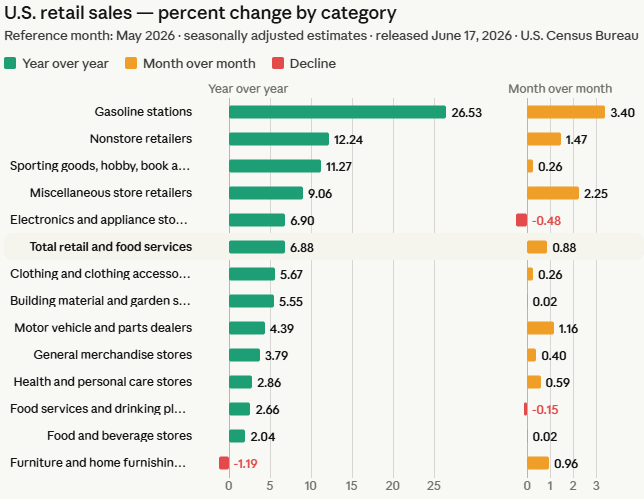
Gasoline isn’t lifting this chart so much as draining it — the leader line is the cause of the laggards. A near-inelastic necessity that jumped roughly +$1.16/gallon (~30%) since the Hormuz shock, fuel gets paid first; whatever’s left funds everything else. That mechanical sequencing is visible in the ranking itself: gasoline-station receipts surge +26.53% YoY on pure price, levitating the nominal Total to +6.88% — while the categories furthest from the pump bleed at the margin, furniture -1.19% YoY the lone outright decliner, restaurants -0.15% MoM the first discretionary line households defer when the tank costs more. Because the series are nominal, every dollar siphoned into a costlier fill-up counts as “retail growth” even as it buys less; the Total doesn’t measure demand, it measures a wallet reallocated toward a necessity at gunpoint. The strong total and the weak discretionary core are the same households seen twice — the fuel tax falling hardest on the lowest-income, who surrender the rest of the cart. Read at face value, that same print keeps the Fed cautious and the soft-landing story alive, and that is the trap: the danger is not a strong consumer the Fed must cool, but a constrained one the print is hiding.
Market Intelligence Brief (MIB) Ver. 18.40
For professional investors only. Not investment advice.
© 2026 RecessionALERT.com

Comments are closed.