
MARKET INTELLIGENCE BRIEF (MIB)
Tuesday, July 14, 2026
June CPI cooled sharply to 3.5% y/y, crushing July Fed hike odds to 17% from 42%, as Chair Warsh’s first House testimony struck a hawkish note. Markets rallied broadly (S&P +0.39%, Nasdaq +1.10%) despite IBM’s historic 25% crash, its worst day since 1987, as enterprise clients pivot spend toward AI hardware — hammering software (Oracle -2.7%) while cybersecurity soared (CrowdStrike +12%). Goldman Sachs surged 9.16% on record trading. Oil jumped over 2% as Trump narrowed the Hormuz blockade to Iran-linked shipping.
TABLE OF CONTENTS
A. EXECUTIVE SUMMARY
B. MARKET DATA
C. HIGH-IMPACT STORIES (5)
D. MODERATE-IMPACT STORIES (5)
E. ECONOMY WATCH (5)
F. EARNINGS WATCH (6)
G. WHAT’S NEXT
H. CHART OF THE DAY
A. EXECUTIVE SUMMARY -> TOP
Today’s rally reflects markets seizing on the sharpest inflation surprise since Chair Warsh’s hawkish repositioning began, collapsing July hike odds from 42% to 17% — yet Warsh’s inaugural testimony pointedly declined to endorse that dovish repricing, and Chicago Fed’s Goolsbee separately warned against reading too much into “one data point.” Beneath the calm index-level move, IBM’s historic 25% collapse crystallized a live debate over whether AI infrastructure spending is cannibalizing enterprise software budgets, with cybersecurity’s sharp outperformance (CrowdStrike +12%, Palo Alto +7%) the clearest emerging exception. Oil’s advance reflects Trump narrowing his Hormuz blockade to Iran-linked shipping only, defusing the more inflationary blanket-toll scenario that spooked Monday’s session, though the underlying conflict remains unresolved and keeps a geopolitical premium embedded in crude. Breadth was narrower than headline gains suggest: Nasdaq’s 1.10% advance outpaced the Dow’s flat close, while the broader NYSE Composite actually fell — a crack beneath the rally worth monitoring.
• CPI cools, Fed stays cautious: June CPI -0.4% m/m, annual rate to 3.5% (core 2.6%); July hike odds collapsed to 17% from 42%, but Chair Warsh’s testimony stayed hawkish and Chicago Fed’s Goolsbee cautioned against overreacting to “one data point.”
• Bank earnings diverge sharply: Goldman Sachs +9.16% on a record $7.42B trading quarter; JPMorgan and Bank of America both beat and rose ~2%; Citigroup -5.28% and Wells Fargo -2.65% despite EPS beats.
• IBM’s historic plunge reshapes tech: IBM -25.21% (worst day since 1987, ~$68B market cap erased) on enterprise spend shifting to AI hardware; software broadly hit (Oracle -2.71%, plus Workday, Salesforce, Autodesk, Microsoft) while cybersecurity diverged higher (CrowdStrike +12.14%, Palo Alto Networks +6.84%).
• Oil rises as Hormuz blockade narrows: WTI +2.16% to $79.83, Brent +2.50% to $85.38 as Trump scoped his reinstated naval blockade to Iran-linked shipping only, easing (but not resolving) the US-Iran conflict’s inflation risk.
• Chips rebound from Monday’s rout: Semiconductor ETF SMH +2.5%, Micron +5%, SK Hynix ADR +3.7%, reversing part of Monday’s NAND-oversupply-driven crash; Wolfe Research lifted its AMD target to $650.
• Labor market keeps cooling: ADP’s weekly pulse averaged ~19,750 jobs/week over the four weeks to June 27, a third straight deceleration, reinforcing the soft-landing narrative alongside today’s CPI print.
1. Inflation data is beating Fed rhetoric — for now — A blowout disinflation print collapsed near-term hike odds, but Chair Warsh’s hawkish testimony and Goolsbee’s “one data point” pushback signal the Fed wants a longer run of soft prints before validating the market’s dovish repricing. Wednesday’s PPI and Beige Book are the next test of which read wins.
2. AI capex is reshuffling winners inside tech, not just across sectors — IBM’s plunge is a concrete data point that enterprise budgets are rotating from software toward AI hardware and infrastructure (also visible in Nvidia’s cooling-technology talks with Mitsubishi Heavy), while cybersecurity looks like a durable exception. Portfolios exposed to enterprise software face read-through risk into upcoming SAP, ServiceNow, and Adobe reports.
3. The geopolitical risk premium is narrowing, not gone — Trump’s retreat from a blanket Hormuz toll removed the worst-case inflationary scenario that drove Monday’s selloff, but the underlying US-Iran conflict, oil’s residual bid, and Europe’s outsized LNG exposure (Dutch TTF +4.52%) mean the premium persists and could snap back quickly if Iran escalates.
 — Leading economic indicators. Accurate market forecasts. Apply for membership at join.recessionalert.com
B. MARKET DATA -> TOP
Markets rallied broadly after June CPI cooled far more than expected (-0.4% m/m, 3.5% y/y vs. 3.8% forecast), even as Fed Chair Warsh’s hawkish House testimony and simultaneous Q2 bank earnings added crosscurrents. Growth led blue-chips — Nasdaq 100 +1.10% versus the Dow’s flat +0.02% — as IBM’s 25% earnings-warning plunge, tied to enterprise spend shifting toward hardware and cybersecurity, lifted CrowdStrike, Palo Alto, Dell and SanDisk while pressuring Oracle. Goldman Sachs surged 9.16% on record trading revenue even as earnings-beating peers Citigroup and Wells Fargo slipped. Oil jumped over 2% on escalating US-Iran conflict around the Strait of Hormuz — a supply shock, not a demand signal, coinciding with rather than driving today’s equity gains.
CLOSING PRICES – Tuesday, July 14, 2026:
MAJOR INDICES
Dow Theory bull confirmation is in force and now in its 4th session — DJIA sits just 1.0% off its 10-session high while DJTA closed at a fresh 10-session high today, confirming industrial strength. Growth led breadth: Nasdaq 100’s 1.10% gain outpaced the Dow’s flat 0.02% close as cybersecurity and storage names surged. The lone divergence: NYSE Composite fell 0.16% even as the S&P, Dow, Nasdaq and Russell 2000 all advanced — a breadth crack beneath the broadest tape worth watching.
| Index | Close | Change | %Move | Why It Moved |
|---|---|---|---|---|
| S&P 500 | 7,544.63 | +29.29 | +0.39% | Cooler June CPI (3.5% y/y vs. 3.8% est.) sparked broad risk-on buying |
| Dow Jones | 52,508.66 | +10.02 | +0.02% | IBM’s 25% earnings-warning plunge offset bank-earnings gains, capping the blue-chip advance |
| DJ Transportation | 22,237.9 | +27.1 | +0.12% | Tracked the broad market higher; closed at a fresh 10-session high |
| Nasdaq | 29,586.29 | +322.19 | +1.10% | Growth/tech led on cooling-inflation relief; cybersecurity and storage names surged |
| Russell 2000 | 2,965.84 | +12.67 | +0.43% | Domestic small-caps advanced with the broad market on cooler CPI |
| NYSE Composite | 23,857.16 | -38.89 | -0.16% | Broadest NYSE tape slipped even as headline indices gained — a breadth divergence |
VOLATILITY & TREASURIES
VIX and yields fell together — a textbook cooling-inflation reaction, not a recession scare. The 2Y’s 7.6bp drop outpaced the 10Y’s 2.6bp decline, steepening the curve modestly as markets trimmed September hike odds to 63% from roughly 75%. DXY eased in step with yields, with no safe-haven dollar bid despite the Iran headlines — Treasuries and gold, not the dollar, are absorbing today’s geopolitical risk premium.
| Instrument | Level | Change | Why It Moved |
|---|---|---|---|
| VIX | 16.52 | -0.63 (-3.67%) | Vol eased as cooler CPI reduced near-term inflation uncertainty |
| 10-Year Treasury Yield | 4.584% | -2.6 bps | Yields eased on the cooler-than-expected CPI print |
| 2-Year Treasury Yield | 4.187% | -7.6 bps | Front-end led lower as markets trimmed near-term Fed hike odds |
| US Dollar Index (DXY) | 100.92 | -0.33 (-0.32%) | Dollar softened in line with lower yields |
COMMODITIES
Gold, silver, platinum and copper all rose together — an unusual same-direction move since gold typically reflects safe-haven demand while copper tracks industrial growth. Cooling-CPI rate-cut relief and Iran-driven safe-haven flows both pushed gold higher, while copper’s parallel gain suggests broader risk-on positioning rather than a growth-vs-fear split. Bitcoin’s 3.78% gain tracked the equity rally, with no distinct crypto-specific catalyst.
| Asset | Price | Change | %Move | Why It Moved |
|---|---|---|---|---|
| Gold | $4,061.10/oz | $+55.40 | +1.38% | Rate-cut relief and Iran-driven safe-haven demand both bid gold higher |
| Silver | $59.115/oz | $+1.143 | +1.97% | Tracked gold’s gain, outperforming on industrial-demand optimism |
| Copper | $6.3683/lb | $+0.0873 | +1.39% | Gained alongside the broader risk-on tone following cooler CPI |
| Platinum | $1,642.55/oz | $+28.95 | +1.79% | Tracked the precious-metals complex higher |
| Bitcoin | $64,537 | $+2,352 | +3.78% | Tracked the equity risk-on rally; no distinct crypto catalyst |
ENERGY
Oil’s 2%+ jump is a supply shock, not a demand signal, even though equities also rallied today — Brent leading WTI confirms the Strait of Hormuz conflict is a global shipping-route risk rather than a US-specific issue. Dutch TTF surged far more than Henry Hub as Europe’s LNG-import exposure to the same chokepoint decoupled it from the domestic gas benchmark, a coincidental co-movement with equities that masks a stagflationary undertone if the conflict persists.
| Asset | Price | Change | %Move | Why It Moved |
|---|---|---|---|---|
| Crude Oil (WTI) | $79.83/bbl | $+1.69 | +2.16% | Surged on escalating US-Iran conflict around the Strait of Hormuz |
| Crude Oil (Brent) | $85.38/bbl | $+2.08 | +2.50% | Global benchmark led WTI, confirming a global shipping-route risk |
| Natural Gas (Henry Hub) | $2.922/MMBtu | $+0.025 | +0.86% | Modest gain, largely decoupled from crude’s geopolitical spike |
| Natural Gas (Dutch TTF) | $17.87/MMBtu | $+0.77 | +4.52% | European gas outpaced Henry Hub on Strait of Hormuz LNG-shipping risk |
S&P 500 SECTORS
Basic Materials reversed sharply — today’s second-best sector (+1.47%) despite being the worst 3-month performer (-9.32%), a potential inflection after a prolonged slide. Healthcare stayed the session’s and the week’s laggard (-1.60% today, -4.14% 1-week), a persistent rather than one-day weakness. Financials’ modest +0.46% masks wide dispersion beneath the surface — Goldman’s earnings-driven surge offset declines at Citigroup and Wells Fargo.
| Sector | 1-Day | 1-Week | 1-Month | 3-Month | 6-Month | YTD | 12-Month |
|---|---|---|---|---|---|---|---|
| Technology | +1.87% | +2.65% | +1.00% | +20.40% | +19.82% | +21.29% | +34.66% |
| Basic Materials | +1.47% | +0.17% | -3.70% | -9.32% | +0.69% | +8.22% | +28.58% |
| Communication Services | +1.18% | -0.65% | +1.41% | +5.57% | +2.80% | +5.12% | +34.93% |
| Financial | +0.46% | +0.44% | +6.76% | +9.39% | +4.10% | +6.02% | +15.01% |
| Energy | +0.39% | +4.00% | -0.71% | -3.01% | +23.85% | +26.69% | +28.86% |
| Utilities | +0.13% | +0.44% | +3.49% | -2.88% | +6.46% | +7.01% | +13.82% |
| Industrials | +0.02% | -2.02% | -1.24% | +0.93% | +8.22% | +14.34% | +19.63% |
| Consumer Cyclical | -0.03% | -0.28% | +0.53% | +1.41% | -8.08% | -4.08% | +3.44% |
| Real Estate | -0.15% | -0.75% | +0.38% | +4.48% | +8.61% | +10.15% | +8.11% |
| Consumer Defensive | -1.14% | -1.67% | -2.26% | -0.26% | +4.37% | +6.23% | +4.63% |
| Healthcare | -1.60% | -4.14% | +3.72% | +6.21% | +0.83% | +3.28% | +18.41% |
TOP MEGA-CAP MOVERS:
GAINERS
| Company | Ticker | Close | Change | Why It Moved |
|---|---|---|---|---|
| Crowdstrike Holdings Inc | CRWD | 210.73 | +12.14% | Cybersecurity rally on cooling CPI; IBM’s spend-shift commentary boosted peers |
| Goldman Sachs Group Inc | GS | 1,141.19 | +9.16% | Record $7.42B trading quarter and IB fee rebound beat Q2 estimates |
| Dell Technologies Inc | DELL | 457.57 | +7.13% | Storage/memory rally as IBM cited enterprise spend shifting to hardware |
| Palo Alto Networks Inc | PANW | 352.89 | +6.84% | Cybersecurity rally alongside CrowdStrike on cooling inflation/IBM read-through |
| Sandisk Corp | SNDK | 1,757.82 | +5.01% | Storage/memory beneficiary of IBM’s hardware-spend-shift commentary |
DECLINERS
| Company | Ticker | Close | Change | Why It Moved |
|---|---|---|---|---|
| International Business Machines Corp | IBM | 217.05 | -25.21% | Q2 earnings warning; clients shifting spend to AI infrastructure/hardware, away from software |
| Citigroup Inc | C | 133.28 | -5.28% | Q2 profit beat estimates but shares slipped as investors rotated into Goldman’s standout quarter |
| Oracle Corp | ORCL | 127.97 | -2.71% | Software peer pressured by IBM’s spend-shift-away-from-software commentary |
| Wells Fargo & Co | WFC | 85.35 | -2.65% | EPS beat estimates but shares fell amid mixed bank-earnings-day reaction |
| Merck & Co Inc | MRK | 120.80 | -2.60% | Broader Healthcare sector weakness; patent-expiry/generic-competition overhang, no fresh catalyst |
— Institutional-grade intelligence for serious investors. Apply for membership at join.recessionalert.comC. HIGH-IMPACT STORIES -> TOP
BULLISH
1. June CPI Cools Sharply, Fed July Hike Odds Collapse to 17%
The core facts:June CPI fell 0.4% month-over-month against expectations, pulling the annual rate to 3.5% from May’s 4.2%; core CPI was flat on the month. The report triggered a sharp repricing of Fed policy expectations, with July hike odds collapsing to 17% from 42% on Monday. The 2-year Treasury yield fell roughly 7-10 bps and the 10-year fell about 5 bps, while the Nasdaq 100 rose as much as 1.25% intraday on the news, with growth stocks leading gains.
Why it matters:This is the most consequential inflation surprise since the Fed’s hawkish repositioning began under Chair Warsh, essentially taking a near-term rate hike off the table after Monday’s Waller-driven scare pushed July odds above 40%. It hands Warsh a considerably easier backdrop for today’s testimony, and reopens the door to the market’s preferred September-cut narrative — though Warsh’s own remarks today show the Fed isn’t ready to declare victory.
What to watch:Wednesday’s June PPI report and the Fed’s Beige Book for confirmation the disinflation trend is broadening beyond the CPI print.
UNCERTAIN
2. Fed Chair Warsh’s Inaugural Testimony Strikes Hawkish Tone Despite Cooler Inflation
The core facts:In his first semiannual Monetary Policy Report testimony to the House Financial Services Committee, Fed Chair Kevin Warsh said the FOMC has “no tolerance for persistently elevated inflation” and pledged a policy “regime change” to end the “inflation tax” — delivered the same day June CPI cooled to 3.5%. Warsh gave no forward guidance on the rate path, continuing his break from the Fed’s prior communication style, and called AI-driven business investment “the most striking feature of the economy right now.” He reaffirmed the Fed’s independence from political pressure.
Why it matters:A hawkish tone delivered the same day as an unambiguously dovish inflation print is a deliberate signal: Warsh appears determined not to let one soft CPI reading reopen the door to premature easing expectations, especially with Wednesday’s PPI and his Senate testimony still to come. His refusal to offer forward guidance keeps markets guessing meeting-by-meeting, a distinct departure from his predecessor’s approach.
What to watch:Warsh’s Senate Banking Committee testimony Wednesday, and Wednesday’s PPI report and Beige Book for whether the hawkish framing persists as more data arrives.
UNCERTAIN
3. Oil Rises as Trump Retreats From Hormuz Toll but Presses Ahead With Iran-Targeted Blockade
The core facts:President Trump walked back his proposed 20% toll on all cargo transiting the Strait of Hormuz, clarifying Tuesday that the strait remains “open to ALL Ship traffic except for Iran” and that the reinstated naval blockade applies only to vessels calling at Iranian ports or carrying Iranian-linked cargo. The blockade took effect at 4:00pm ET Tuesday. The retreat followed a third consecutive day of US-Iran military exchanges, with US forces striking more than 80 targets inside Iran over the weekend. WTI settled up roughly 1.5-2% near $79-80/bbl, with Brent touching a one-month intraday high above $86 before easing; both benchmarks extended Monday’s sharp gains.
Why it matters:Narrowing the blockade to Iran-linked shipping rather than a blanket toll on all global cargo removes the more inflationary, market-wide shipping-cost scenario that had spooked markets Monday, which is why equities held up far better today than during Monday’s 9% oil spike and broad selloff. The underlying military conflict remains unresolved, however, keeping a geopolitical risk premium embedded in crude prices and leaving room for renewed escalation.
What to watch:Whether Iran responds to the narrowed blockade with further attacks on shipping or regional US assets, and today’s 4:30pm ET API crude stock data for early confirmation of shipping-disruption effects on inventories.
UNCERTAIN
4. Bank Earnings Propel Financials to Records as IBM’s Historic Plunge Triggers Software Selloff
The core facts:Q2 bank earnings and IBM’s earnings-driven collapse pulled markets in opposite directions Tuesday. Goldman Sachs surged over 9% to a record high on a blockbuster $7.42 billion trading quarter, while JPMorgan and Bank of America both beat and rose roughly 2%. Separately, IBM plunged roughly 25% — its worst single-day drop since 1987, erasing about $68 billion in market value — after warning that enterprise clients are shifting spend from software toward AI hardware and memory. The read-through hit software broadly: the iShares Expanded Tech-Software ETF fell 4.5%, with Workday -10%, Salesforce -6.2%, Autodesk -5%, Microsoft -3%, and Oracle -2.1%, while security names CrowdStrike (+9.4%) and Palo Alto Networks (+6.6%) diverged higher.
Why it matters:The offsetting moves kept headline indices roughly flat-to-higher (Dow +0.02%, S&P +0.38%, Nasdaq +0.90%) despite one of the largest single-stock market-cap losses in years, illustrating how much index-level calm can mask underneath. More importantly, IBM’s specific framing — clients diverting quarterly capex toward servers, storage, and memory instead of enterprise software — is a tangible data point in the broader debate over whether AI infrastructure spending is cannibalizing traditional enterprise software budgets.
What to watch:Whether other enterprise software names (SAP, ServiceNow, Adobe) face similar read-through pressure into their upcoming reports, and whether cybersecurity’s apparent immunity (CRWD, PANW) holds as a durable distinction.
BULLISH
5. Chip Stocks Rebound as Cooling Inflation Offsets Monday’s NAND-Driven Crash
The core facts:The VanEck Semiconductor ETF (SMH) rose 2.5% Tuesday, reversing part of Monday’s steep NAND-oversupply-driven selloff. Micron rose roughly 5%, SanDisk rose about 4%, and SK Hynix’s Nasdaq-listed ADR rebounded 3.7% after dropping more than 8% intraday; AMD and Intel both rallied, aided by a Wolfe Research price-target increase on AMD to $650 from $450. Analysts attributed the reversal chiefly to Monday’s plunge reflecting profit-taking, ADR arbitrage, and broad risk aversion toward South Korean equities rather than a fundamental deterioration in memory demand, with cooling CPI further easing rate-driven pressure on high-multiple chip names.
Why it matters:The rebound suggests Monday’s rout was more a repricing of positioning and country-specific risk than confirmation of an actual NAND oversupply cycle, but it does not resolve the underlying question the market raised Monday — whether memory pricing can sustain the capex assumptions embedded in hyperscaler AI spending plans. The sharp round-trip in a 24-hour span underscores how sensitive this trade remains to headline risk.
What to watch:SK Hynix’s actual Q2 earnings release for confirmation or denial of Monday’s profit-miss call, and whether Wednesday’s session holds the recovery or reverts to Monday’s selling pressure.
— Quantifying recession risk so you don’t have to guess. Apply for membership at join.recessionalert.comD. MODERATE-IMPACT STORIES -> TOP
UNCERTAIN
6. ADP Weekly Hiring Pulse Slows for a Third Straight Week
The core facts:ADP’s weekly NER Pulse data showed private employers added an average of roughly 19,750 jobs per week over the four weeks ended June 27, down from 21,000 in the prior reading — a third consecutive weekly deceleration. The trend follows ADP’s June national report showing 98,000 jobs added, the lowest in three months and below the 113,000 forecast.
Why it matters:A cooling labor market alongside today’s cooler CPI reinforces the market’s preferred “soft landing” narrative — slower job growth without a sharp deterioration — and adds to the case for the Fed’s eventual pivot back toward cuts, even as Chair Warsh’s testimony today kept the door open to a hike. Continued softening bears watching against Warsh’s characterization of the economy as “expanding at a solid pace.”
What to watch:The next weekly ADP Pulse release and Thursday’s initial jobless claims for confirmation the labor-cooling trend is broadening.
BULLISH
7. NVIDIA Explores Data Center Cooling Partnership With Mitsubishi Heavy Industries
The core facts:Nvidia is reportedly in discussions with Mitsubishi Heavy Industries to collaborate on cooling systems, air conditioning, emergency power equipment, and energy-management technology for Nvidia’s “AI factory” data centers. No deal terms or financial details have been disclosed; the talks follow Nvidia’s existing partnership with SK Group to build an AI factory in Japan by 2028-2029.
Why it matters:Power and cooling — not chip supply — are increasingly the binding constraint on how much AI compute a data center can actually deploy, and Nvidia striking infrastructure partnerships with established industrial players signals the AI buildout’s next bottleneck is shifting toward energy and thermal management. A formal tie-up would extend Nvidia’s ecosystem strategy beyond silicon into the physical infrastructure layer.
What to watch:Confirmation of a formal agreement and any disclosed capacity or investment figures.
BEARISH
8. Writers Guild Sues to Block $111 Billion Paramount-Warner Bros. Discovery Merger
The core facts:The Writers Guild of America West and East filed suit Tuesday in the U.S. District Court for the Northern District of California seeking to block Paramount Skydance’s proposed $111 billion acquisition of Warner Bros. Discovery, alleging the deal would suppress writers’ wages and reduce employment opportunities in violation of federal antitrust law. The WGA suit follows a lawsuit filed a day earlier by 12 Democratic state attorneys general challenging the deal on separate antitrust grounds. Paramount said Tuesday it still plans to close the merger by the end of September despite the legal challenges.
Why it matters:A second, distinct legal challenge — this one from a major labor union rather than state regulators — broadens the deal’s legal exposure beyond a single theory of antitrust harm and adds to the list of obstacles Paramount must clear before its targeted close date. Two separate suits filed within 24 hours of each other signal coordinated opposition is building around the transaction.
What to watch:Whether Paramount’s September closing timeline holds as both lawsuits proceed, and whether additional parties join the opposition.
BEARISH
9. KeyBanc Slaps Rare Underweight Rating on Apple, Citing Slowing Hardware Demand
The core facts:KeyBanc Capital Markets downgraded Apple to Underweight from Sector Weight with a $250 price target, citing proprietary spending data showing indexed Apple spending fell 2% month-over-month in June versus a three-year average of 9% growth. Analyst Brandon Nispel flagged recent price increases across iPad ($100-200), MacBook ($100-300), and Mac Studio ($500-1,300) as pushing demand into a zone of greater-than-one price elasticity, alongside risks to iPhone builds, 2027 estimates, and Services revenue growth. The call also cited Apple’s 33x forward earnings multiple as unwarranted relative to its 10-year average of 23x.
Why it matters:The downgrade directly conflicts with Citi’s bullish $365 price-target call on Apple made just yesterday, underscoring a genuine Street divide on whether Apple’s pricing power can offset a slowing device replacement cycle heading into its July 30 earnings report. A rare outright bearish call from a major bank on one of the market’s largest names is itself a notable sentiment data point.
What to watch:Apple’s July 30 earnings report for confirmation of unit demand trends and Services growth, and whether other analysts follow KeyBanc’s spending-data-driven bear thesis.
UNCERTAIN
10. Morgan Stanley, Barclays Trim Netflix Price Targets Ahead of Thursday’s Earnings
The core facts:Morgan Stanley cut its Netflix price target to $90 from $115 while maintaining an Overweight rating, and Barclays similarly lowered its target ahead of Netflix’s Q2 report due Thursday, July 16. The cuts reflect credit-card panel data showing a larger-than-usual churn spike following recent price hikes, though Morgan Stanley called the engagement concerns “largely overblown” and pointed to the potential for Netflix’s live sports and events slate to support second-half results.
Why it matters:A price-target cut paired with a maintained bullish rating is a distinctly different signal than an outright downgrade — it reflects near-term churn caution rather than a change in long-term conviction, two days before the actual print will test which view is correct.
What to watch:Netflix’s Q2 earnings release Thursday after the bell for subscriber and engagement metrics that confirm or refute the churn concerns.
— Separating signal from noise since 2007. Apply for membership at join.recessionalert.comE. ECONOMY WATCH -> TOP
June CPI delivered the year’s sharpest disinflationary surprise — headline prices fell 0.4% and core inflation was flat, both blowing past consensus, pulling the 10-year yield to 4.58% and cutting July Fed hike odds from 42% to 17%. Yet Fed Chair Warsh’s inaugural testimony refused to declare victory, calling the improvement “not mission accomplished” while holding the funds rate at 3.50%-3.75%, a stance Chicago’s Goolsbee echoed by warning against reading one soft print as a trend. Underneath, labor cooled further (ADP’s weekly pulse near 19,750, a third straight deceleration) even as foreign investors poured a net $232.7B into US securities in May. The Fed isn’t ready to call the inflation fight over.
June CPI Cools Sharply, Fueling Fed Rate-Hike Retreat (CNBC / Bloomberg, July 14, 2026)
What they’re saying:Headline CPI fell 0.4% in June — a much bigger decline than the -0.1% consensus — pushing the annual rate down to 3.5% from 4.2% in May, versus 3.8% expected. Core CPI was flat month-over-month (vs. 0.2% expected), pulling core annual inflation down to 2.6% from 2.9%.
The context:The across-the-board miss immediately repriced Fed expectations — the market’s implied probability of a 25bp July hike collapsed from 42% Monday to 17%, per CME FedWatch, though traders still assign roughly 60% odds to a hike by September. The 10-year Treasury yield fell more than 2bp to 4.583%, the 2-year fell over 5bp to 4.204%, and the S&P 500 opened up 0.2% with the Nasdaq up 1%.
What to watch:Wednesday’s PPI print (core PPI expected +0.4% MoM) feeds the next core PCE estimate; the Fed’s next rate decision falls in late July.
Fed Chair Warsh Tells Congress Inflation Fight Isn’t Over Despite Cool CPI (Federal Reserve / CNBC, July 14, 2026)
What they’re saying:In his first semiannual Monetary Policy Report testimony as the 17th Fed Chair, Kevin Warsh told the House Financial Services Committee the Committee “has no tolerance for persistently elevated inflation,” pledging the “inflation surge of the last five years will be a thing of the past” if policy is set correctly. He held the funds rate at 3.50%-3.75% and cited a surge in AI-driven data-center and equipment investment as “the most striking feature” of the current economy.
The context:The testimony landed hours after the cooler CPI print, and Warsh’s refusal to declare the fight won — paired with five new internal task forces reviewing the Fed’s data, communications, and inflation approach — signals the Fed intends to stay cautious rather than front-run the market’s dovish repricing.
What to watch:Warsh testifies again Wednesday before the Senate Banking Committee; watch for any shift in tone after that morning’s PPI release.
Chicago Fed’s Goolsbee Warns Against Overreacting to Single CPI Print (Seeking Alpha, July 14, 2026)
What they’re saying:Chicago Fed President Austan Goolsbee said June’s benign CPI reading “is just one data point,” cautioning against reading too much into a single month’s disinflation.
The context:The comment came the same day markets slashed July hike odds on the CPI miss — Goolsbee’s pushback signals FOMC voters want a longer run of soft prints before treating the disinflation as durable, tempering the market’s dovish reaction alongside Chair Warsh’s own caution.
What to watch:The next CPI print (July data, released mid-August) and whether other FOMC voters echo the “one data point” framing ahead of the July decision.
ADP Weekly Pulse Shows Hiring Slowing for a Third Straight Week (ADP, July 14, 2026)
What they’re saying:ADP’s NER Pulse showed U.S. private employers added an average of 19,750 jobs per week over the four weeks ending June 27 — the third consecutive weekly deceleration in the preliminary hiring gauge.
The context:The slowdown adds a labor-side data point to today’s broader disinflation narrative — cooling hiring alongside cooling prices reinforces the case for the Fed eventually easing, even as Warsh and Goolsbee both pushed back on declaring an all-clear today.
What to watch:The next NER Pulse update on July 21, and Thursday’s initial jobless claims (expected 217K).
Foreign Investors Ramp Up Purchases of US Securities in May (U.S. Treasury Department, July 14, 2026)
What they’re saying:Treasury’s TIC data for May showed net long-term inflows of $232.7 billion, well above the $128 billion expected and roughly double April’s pace; overall net capital flows rose to $132.2 billion and foreign bond investment reached $56.6 billion.
The context:Sustained, strengthening foreign demand for US securities — even amid ongoing fiscal-deficit and tariff-policy headlines — supports the case that international capital still views US assets as a safe destination, a supportive backdrop for Treasury yields and the dollar.
What to watch:The next TIC release (covering June data) in mid-August, and whether foreign buying holds up as the Fed’s rate path clarifies.
— Know the probability before the market prices in the risk. Apply for membership at join.recessionalert.comF. EARNINGS WATCH -> TOP
YESTERDAY AFTER THE BELL (Markets Reacted Today)
No major earnings yesterday after the bell from companies with >$100B market cap.
TODAY BEFORE THE BELL (Markets Already Reacted)
BULLISH
11. JPMorgan Chase (JPM): +2.53% | Q2 Beat Fueled by $4.6B Visa Gain, Investment Bank Revenue Surges 27%
The Numbers:EPS $7.70 vs. $5.59 est. (+37.84%); revenue $57.35B vs. $50.72B est. (+13.06%), boosted by a $4.6 billion Visa share-exchange gain; Commercial & Investment Bank revenue rose 27%.
The Problem/Win:A one-time Visa gain flattered headline EPS, but underlying strength in the Commercial & Investment Bank and continued trading momentum point to genuine operating strength beyond the accounting boost.
The Ripple:Set a strong tone for the day’s bank earnings slate and helped offset IBM’s historic decline in keeping headline indices stable.
What It Means:JPMorgan’s scale and diversified revenue base continue to deliver consistent beats even excluding one-time items, reinforcing its position as the sector bellwether.
What to watch:Management commentary on 2027 NII guidance for confirmation the underlying (ex-Visa) growth trend continues.
BULLISH
12. Bank of America (BAC): +1.91% | Trading Revenue Jumps 34% to Record on Equities Strength
The Numbers:EPS $1.21 vs. $1.13 est. (+7.19%); revenue $31.56B vs. $30.78B est. (+2.54%). Sales and trading revenue rose 34% to a record $7.1B, with equity trading up 70% to $3.6B; investment banking fees rose 50% to over $2.1B; net interest income rose 9% to $16.2B.
The Problem/Win:Broad-based strength across trading, investment banking, and net interest income, with equity trading the standout line item.
The Ripple:Reinforces the same Wall Street trading boom that drove Goldman’s record quarter, adding to evidence of a genuine capital-markets upcycle across large banks.
What It Means:Bank of America’s results confirm the trading and dealmaking strength is broad-based across large banks, not confined to Goldman’s specialist franchise.
What to watch:Net interest income trajectory into Q3 as the market weighs the path of Fed policy following today’s CPI and Warsh commentary.
BULLISH
13. Goldman Sachs (GS): +9.16% | Record $7.42B Trading Quarter Sends Stock to All-Time High
The Numbers:EPS $20.98 vs. $14.51 est. (+44.62%); revenue $20.34B vs. $16.22B est. (+25.35%). Global Banking & Markets revenue rose 53% to $15.52B, with Equities revenue up 72% and Equity Underwriting up 130%.
The Problem/Win:A third consecutive quarterly record in equities trading, with quarterly trading revenue alone now exceeding Goldman’s full-year 2019 total — an extraordinary run driven by elevated market volatility around AI and the Iran conflict.
The Ripple:The scale of the beat pulled the stock to a fresh all-time high and helped anchor the financials sector’s outperformance against a falling software complex.
What It Means:Goldman’s trading franchise is capturing outsized benefit from the same volatility (AI-driven equity swings, geopolitical risk) that is pressuring other parts of the market, a genuine hedge characteristic within a diversified portfolio.
What to watch:Whether elevated trading volumes and volatility persist into Q3 or normalize as the Iran conflict and AI-capex debate resolve one way or another.
UNCERTAIN
14. Wells Fargo (WFC): -2.65% | Beats on Wealth and IB Fees, but CEO’s Cautious Tone Weighs on Shares
The Numbers:EPS $2.00 vs. $1.72 est. (+16.58%); revenue $22.62B vs. $21.86B est. (+3.48%), driven by higher wealth management and investment banking fees.
The Problem/Win:Despite beating on both lines, shares fell as CEO Charlie Scharf’s cautious forward commentary overshadowed the quarter’s results.
The Ripple:Wells Fargo’s decline despite a clean beat set the pattern later repeated at Citigroup — evidence that markets are scrutinizing bank guidance more than headline results this earnings season.
What It Means:Investors are pricing bank stocks on forward trajectory, not backward-looking beats, a discipline worth watching across the rest of the sector’s reports this week.
What to watch:Follow-up analyst commentary clarifying the specific source of Scharf’s caution — expense growth, NII trajectory, or credit costs.
UNCERTAIN
15. Citigroup (C): -5.28% | Best Revenue in a Decade, but Cost Warnings Trigger Sell-the-News Reversal
The Numbers:EPS $3.15 vs. $2.74 est. (+15.01%); revenue $24.77B vs. $23.74B est. (+4.32%) — the bank’s highest quarterly revenue in a decade, driven by record equity-trading revenue.
The Problem/Win:Management said it would accelerate job cuts and technology investment spending, raising near-term cost concerns even as the CFO acknowledged Citi’s equities franchise still trails larger rivals — a combination that overshadowed an across-the-board beat.
The Ripple:Citigroup’s reversal despite record revenue mirrors Wells Fargo’s decline, reinforcing that guidance and cost trajectory are driving today’s bank-stock dispersion more than the headline prints.
What It Means:Citi’s multi-year turnaround remains on track operationally, but the market is demanding clean visibility on costs before rewarding the stock further, especially at its now-richest-in-the-group valuation.
What to watch:Third-quarter commentary on the pace and cost of the accelerated technology investment and job-cut program.
BEARISH
16. IBM (IBM): -25.21% | Worst Day Since 1987 as Clients Divert Spend From Software to AI Hardware
The Numbers:EPS $2.93 vs. $3.01 est. (-2.74%); GAAP EPS $2.27 vs. $2.58 est. (-11.90%); revenue $17.20B vs. $17.86B est. (-3.70%).
The Problem/Win:CEO Arvind Krishna acknowledged execution missteps and said enterprise clients are aggressively redirecting quarterly capex away from software and mainframes toward AI infrastructure, storage, and memory purchases, with several major deals failing to close in the quarter.
The Ripple:Triggered a broad software-sector selloff (iShares Expanded Tech-Software ETF -4.5%, Workday -10%, Salesforce -6.2%, Microsoft -3%, Oracle -2.1%) while cybersecurity names CrowdStrike (+9.4%) and Palo Alto Networks (+6.6%) diverged higher, and dragged the Dow.
What It Means:The magnitude and specificity of IBM’s capex-diversion commentary make this more than a company-specific miss — it is a data point the market will weigh heavily in the broader debate over whether AI infrastructure spending is displacing traditional enterprise software budgets.
What to watch:Whether peer enterprise software names (SAP, ServiceNow, Adobe, Salesforce) echo similar capex-diversion commentary in their upcoming reports.
TODAY AFTER THE BELL (Markets React Tomorrow)
No major earnings after the bell from companies with >$100B market cap.
WEEK AHEAD PREVIEW:
Q2 2026 earnings season is just getting underway, with a heavy slate of financials, healthcare, and industrials due out over the next two sessions.
Johnson & Johnson (JNJ) — BMO, Wed Jul 15 — Consensus $2.86 EPS / $25.02B revenue; watch Innovative Medicine growth (Darzalex, Tremfya, Carvykti) as shares trade near all-time highs.
Morgan Stanley (MS) — BMO, Wed Jul 15 — Consensus $2.73 EPS, +28% YoY; wealth management scaling and fee-based revenue durability are the key narrative.
BlackRock (BLK) — BMO, Wed Jul 15 — Consensus $12.65 EPS / $6.74B revenue; watch AUM net inflows, iShares ETF platform growth, and Aladdin technology commentary.
Progressive (PGR) — BMO, Wed Jul 15 — Consensus $4.58 EPS on $23.1B revenue; reports two days after JPMorgan downgraded the stock to Neutral today.
Bank of New York Mellon (BNY) — BMO, Wed Jul 15 — Consensus $2.16 EPS, +11% YoY; has beaten estimates for four consecutive quarters.
PNC Financial (PNC) — BMO, Wed Jul 15 — Consensus $4.41 EPS / $6.39B revenue; watch NII growth and FirstBank integration progress.
UnitedHealth Group (UNH) — BMO, Thu Jul 16 — Consensus $4.85 EPS / $110.8B revenue; medical cost ratio trends and Medicare Advantage margin recovery are the key focus.
Netflix (NFLX) — AMC, Thu Jul 16 — Reports two days after Morgan Stanley and Barclays trimmed price targets on post-price-hike churn concerns; watch subscriber and engagement metrics for confirmation or refutation.
Q2 bank earnings continue through the week alongside the first wave of healthcare and industrial reporters.
— US market commentary trusted by family offices and institutions. Apply for membership at join.recessionalert.comG. WHAT’S NEXT -> TOP
UPCOMING RELEASES:
| Date | Event | Why It Matters |
|---|---|---|
| Wed, Jul 15 | June PPI (headline expected 0%, core expected +0.4% MoM; headline YoY 6.2%, core YoY 5.2%) | Feeds the next core PCE estimate and tests whether Tuesday’s CPI disinflation is broadening upstream — the confirmation the Fed said it needs before validating rate cuts |
| Wed, Jul 15 | Fed Chair Warsh Senate Banking Committee Testimony | Second leg of Warsh’s semiannual testimony after Tuesday’s hawkish House appearance; markets will watch for any softening once Wednesday’s PPI is in hand |
| Wed, Jul 15 | NY Empire State Manufacturing Index (expected 8.8) | Early regional read on whether industrial momentum is holding alongside the disinflation trend |
| Wed, Jul 15 | Fed Beige Book; Williams, Cook & Musalem speeches | Anecdotal regional conditions plus three voting members’ public remarks, which could reinforce or push back against Warsh’s cautious framing |
| Thu, Jul 16 | Retail Sales (headline expected +0.2% MoM; ex-autos -0.1%; control group +0.5%) | Direct read on consumer spending; a soft print alongside cooling CPI and slowing ADP hiring would harden the soft-landing narrative, while an upside surprise complicates the market’s dovish repricing |
| Thu, Jul 16 | Initial Jobless Claims (expected 217K) | Weekly check on whether the labor-cooling trend flagged by ADP’s Pulse data is broadening into official claims data |
| Thu, Jul 16 | Philadelphia Fed Manufacturing Index (expected 13) | Second regional manufacturing gauge of the week; corroborates or contradicts Wednesday’s Empire State reading |
| Thu, Jul 16 | NAHB Housing Market Index (expected 35) | Homebuilder sentiment gauge testing whether lower Treasury yields are translating into housing optimism |
| Thu, Jul 16 | Pending Home Sales MoM (expected -0.5%) | Forward-looking housing-transaction indicator testing whether cooling rates are yet feeding into contract signings |
| Thu, Jul 16 | Fed Logan Speech | Additional voting-member remarks, another data point on how broadly the Fed’s cautious post-CPI tone is shared |
KEY QUESTIONS:
1. Does Wednesday’s PPI confirm the disinflation trend is broadening beyond the CPI print, or does Chair Warsh’s hawkish tone prove prescient when he returns to testify before the Senate that same day?
2. Can enterprise software names (Oracle, Salesforce, Workday) stabilize, or does IBM’s spend-shift warning mark the start of a durable capex rotation toward AI hardware ahead of their own reports?
3. Does Thursday’s Retail Sales report support the soft-landing narrative building from cooling CPI and slowing ADP hiring, or does a stronger-than-expected print reopen the case for a near-term Fed hike?
H. CHART OF THE DAY -> TOP
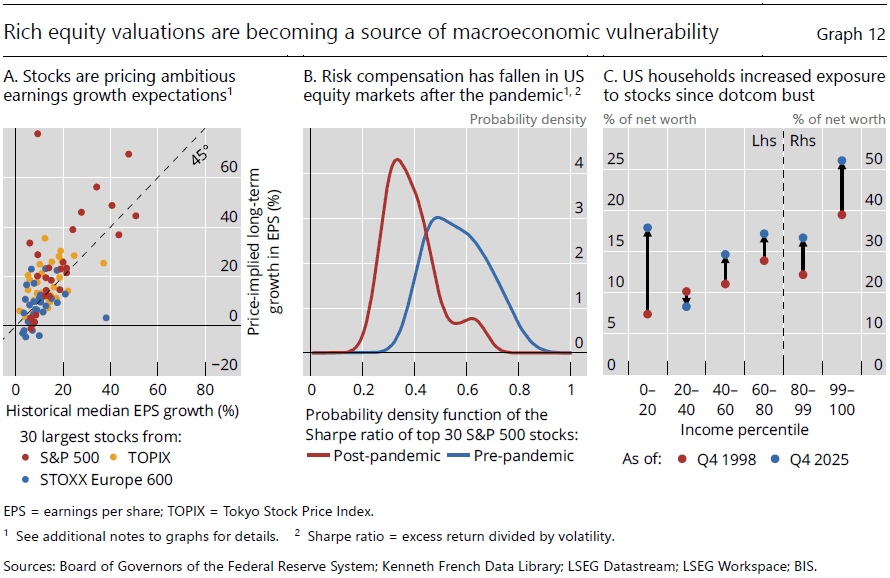
The market spent five years asking more of these companies and paying less to own them. The left panel’s vertical axis is not a forecast anyone published — it is the forecast already inside the price. Invert the Campbell–Shiller present-value identity and today’s multiple resolves into one number: the long-run EPS growth that must arrive for the stock merely to earn its cost of capital. The 45° line is not a valuation opinion but a solvency test on that assumption, and above it sits growth these firms have never sustained — against a bar that is their own golden age, since the historical medians begin in February 2003 and already contain the entire boom. Compensation for carrying the assumption fell as the assumption rose: the post-pandemic Sharpe distribution shifted left, mode near 0.33 against 0.48 before Covid. The bar rose while the cushion thinned, and nothing in the price is charging for the forecast it contains. That would be a desk problem, except the holder changed. The eye goes to the top 1% on its own axis, but that loss stays paper. The consequential move is at the other end — the bottom quintile’s equity share of net worth has roughly tripled since 1998, the chart’s largest proportional shift, landing in the cohort with the highest marginal propensity to consume. A drawdown 1998 routed into portfolios now routes into spending. Forecasts are settled quarterly — and this one settles at the checkout.
Market Intelligence Brief (MIB) Ver. 18.42
For professional investors only. Not investment advice.
© 2026 RecessionALERT.com

Comments are closed.