
MARKET INTELLIGENCE BRIEF (MIB)
Wednesday, July 15, 2026
Cooler June PPI fueled a rate-cut rally — S&P 500 +0.38%, Apple (+4%) hit a record high on China’s AI approval. Chip stocks reversed hard: Micron -8%, Dell -9.8%, on fresh Chinese memory-competition fears. Stripe and Advent lobbed a $53B bid for PayPal, sending shares up 16-17%. The Fed split publicly — Williams says inflation “has peaked,” Cook is “prepared to act.” Iran’s conflict widened as US strikes resumed, pushing Brent toward $86. European gas jumped 4% on a Qatari LNG halt.
TABLE OF CONTENTS
A. EXECUTIVE SUMMARY
B. MARKET DATA
C. HIGH-IMPACT STORIES (6)
D. MODERATE-IMPACT STORIES (5)
E. ECONOMY WATCH (6)
F. EARNINGS WATCH (6)
G. WHAT’S NEXT
H. CHART OF THE DAY
A. EXECUTIVE SUMMARY -> TOP
The S&P 500 (+0.38% to 7,572.42) and Dow (+0.29%) posted modest gains as a cooler-than-expected June PPI (-0.3% MoM) pushed July-hold odds to 87.7%, pulling the VIX down 5% and yields lower — even as the Nasdaq 100 slipped 0.28% on a sharp AI-hardware reversal. The calm headline tape masked a genuinely split Fed (Williams: inflation “has peaked”; Cook: “prepared to act”) aired alongside Chair Warsh’s contentious Senate testimony, while a widening Iran conflict pushed Brent toward $86 and European gas up 3.8% on a Qatari LNG halt — a fuel-cost risk the Fed’s own Beige Book flagged today. Apple’s record high on China’s AI approval and a $53 billion Stripe/Advent bid for PayPal offset fresh Chinese memory-competition fears that sent Micron, Dell, and SanDisk down 8-10%. Breadth was narrow, not broad: megacap software and small-caps led while AI-hardware and healthcare (Pfizer downgrade, XLV -1.7%) lagged — rotation, not uniform risk-on, drove the day.
• S&P 500 +0.38% to 7,572.42, Dow +0.29% — Nasdaq 100 -0.28% as chip weakness offset megacap tech gains
• June PPI -0.3% MoM (vs. flat expected) pushes July Fed-hold odds to 87.7%; VIX -5% to 15.67, 10Y -3.4 bps to 4.551%
• Chip stocks slide — Micron -8%, Dell -9.8%, SanDisk -8.1% on Chinese memory-competition fears (CXMT)
• Apple +4% hits record high near $327.50 on China’s approval of Apple Intelligence
• PayPal surges 16-17% on $53B, $60.50/share takeover bid from Stripe and Advent International
• Iran conflict escalates — US strikes resume, Brent nears $86, Dutch TTF gas +3.8% on Qatari LNG halt
1. A Fed Publicly at War with Itself — Williams’ “inflation has peaked” stance against Cook’s “prepared to act” warning, aired the same day as Warsh’s contentious Senate testimony, signals genuine committee disagreement heading into September. Expect continued two-way volatility around Fed commentary rather than a clean directional signal.
2. The Chip Sector’s Credibility Problem — today’s reversal is the third sharp memory/AI-hardware swing in a week (Monday’s NAND-glut selloff, Tuesday’s rebound, now a China-competition scare), suggesting investors are recalibrating AI-infrastructure valuations against a genuine competitive threat rather than short-term positioning.
3. Geopolitical Energy Risk Reasserting Itself — the widening Iran conflict and Qatari LNG halt reintroduce a stagflation-adjacent wrinkle just as disinflation data (PPI, Empire State) otherwise supports a soft-landing narrative — a tension the Beige Book itself explicitly flagged today.
 — Leading economic indicators. Accurate market forecasts. Apply for membership at join.recessionalert.com
B. MARKET DATA -> TOP
A cooler June PPI (-0.3% MoM vs. flat consensus) drove broad rate-cut optimism, pulling the VIX down 5% and yields lower as the S&P 500 and Dow posted modest gains. The rally was narrow beneath the surface: megacap software leaders — Apple (new record, +4%), Alphabet, and Meta — surged on inflation relief, while memory and AI-hardware names cratered on supply-glut and Chinese-competition fears, with Dell, Micron, and SanDisk down 4-10%. European natural gas jumped nearly 4% after Washington ordered a renewed Iranian port blockade and Qatari LNG disruption concerns resurfaced — a geopolitical story that left Henry Hub untouched. Platinum’s 2.9% surge against flat gold underscored commodities decoupling from the equity narrative.
CLOSING PRICES – July 15, 2026:
MAJOR INDICES
Nasdaq 100 lagged the S&P and Dow today as AI-hardware weakness offset megacap tech strength — a split, not a broad risk-off. Dow Theory’s bull confirmation is now entrenched, in its 10th consecutive session with both DJIA and DJTA within 2% of their highs. Beneath the surface, the S&P 500 has outpaced the Nasdaq 100 by 2.2% over the past 10 sessions — a broadening rotation toward value and cyclicals that the memory-chip selloff today only reinforces.
| Index | Close | Change | %Move | Why It Moved |
|---|---|---|---|---|
| S&P 500 | 7,572.42 | +28.83 | +0.38% | Cool PPI fueled rate-cut optimism; megacap tech gains offset chip-sector weakness |
| Dow Jones | 52,658.52 | +150.25 | +0.29% | Broad-based gain on inflation relief; less exposed to AI-hardware selloff than Nasdaq |
| DJ Transportation | 22,111.1 | -128.5 | -0.58% | Lagged as logistics/freight names tracked the broader tech-hardware pullback |
| Nasdaq 100 | 29,502.60 | -83.69 | -0.28% | Memory/AI-hardware rout (Dell, Micron, SanDisk) outweighed megacap software gains |
| Russell 2000 | 2,977.46 | +12.70 | +0.43% | Small-caps advanced with the broader rate-cut-optimism trade |
| NYSE Composite | 23,872.53 | +15.37 | +0.06% | Muted but positive breadth, in line with the modest headline gains |
VOLATILITY & TREASURIES
VIX’s 5% drop alongside falling yields is a clean rate-cut-optimism signal, not inflation fear — cooler PPI let both retreat together. The 2-year fell further than the 10-year, steepening the curve as front-end rate-cut bets firm up. DXY’s decline confirms the market read this as monetary easing, not a safe-haven flight.
| Instrument | Level | Change | Why It Moved |
|---|---|---|---|
| VIX | 15.67 | -0.83 (-5.03%) | Eased on cooler PPI and rate-cut optimism |
| 10-Year Treasury Yield | 4.551% | -3.4 bps | Fell on cooler inflation data |
| 2-Year Treasury Yield | 4.137% | -5.6 bps | Led yields lower as rate-cut bets firmed |
| US Dollar Index (DXY) | 100.49 | -0.47 (-0.47%) | Softened as rate-cut expectations built |
COMMODITIES
Precious metals split sharply — gold held flat while silver fell 1.7% and platinum surged 2.9%, an unusual divergence suggesting industrial-demand jitters in silver against isolated positioning strength in platinum rather than a coherent safe-haven trade. Copper’s flat print shows no read-through to global growth. Bitcoin’s modest 0.3% gain simply tracked the broader risk tape.
| Asset | Price | Change | %Move | Why It Moved |
|---|---|---|---|---|
| Gold | $4,067.05/oz | -$2.65 | -0.07% | Flat; no strong safe-haven bid today |
| Silver | $58.100/oz | -$1.004 | -1.70% | Industrial-demand jitters diverging from gold |
| Copper | $6.3830/lb | +$0.0050 | +0.08% | Essentially flat |
| Platinum | $1,689.70/oz | +$47.00 | +2.86% | Standout gainer; idiosyncratic positioning strength |
| Bitcoin | $64,902.0 | +$174.0 | +0.27% | Tracked the broader modest risk-on tone |
ENERGY
WTI and Brent split — WTI’s 1.1% gain against Brent’s 0.6% decline suggests a US-specific supply factor rather than a global crude story. Natural gas told a purely regional tale: Dutch TTF spiked nearly 4% on a renewed Iranian port blockade and Qatari LNG disruption fears, while Henry Hub barely moved — a European geopolitical risk with no domestic transmission.
| Asset | Price | Change | %Move | Why It Moved |
|---|---|---|---|---|
| Crude Oil (WTI) | $80.24/bbl | +$0.90 | +1.13% | US-specific factors lifted crude modestly |
| Crude Oil (Brent) | $85.07/bbl | -$0.55 | -0.64% | Global benchmark slipped, decoupling from WTI |
| Natural Gas (Henry Hub) | $2.921/MMBtu | +$0.017 | +0.59% | Modest move; unaffected by European supply story |
| Natural Gas (Dutch TTF) | $18.48/MMBtu | +$0.68 | +3.84% | Surged on renewed Iranian port blockade and Qatari LNG disruption fears |
S&P 500 SECTORS
Technology’s -0.52% today masks a bifurcated day — megacap software gains couldn’t offset the memory-chip rout, even as the sector remains the quarter’s biggest winner (+17.80% 3M). Energy also slipped despite being the year’s top performer (+25.86% YTD), a one-day pullback within a still-dominant trend. Communication Services extended its leadership across every horizon from 1-day to 12-month.
| Sector | 1-Day | 1-Week | 1-Month | 3-Month | 6-Month | YTD | 12-Month |
|---|---|---|---|---|---|---|---|
| Communication Services | +2.65% | +3.31% | +3.66% | +5.17% | +5.12% | +7.90% | +37.36% |
| Consumer Cyclical | +1.33% | +2.22% | +1.81% | +0.52% | -7.27% | -2.85% | +4.14% |
| Financial | +0.85% | +3.13% | +6.25% | +9.74% | +5.38% | +6.92% | +15.33% |
| Healthcare | +0.33% | -2.61% | +4.24% | +5.69% | +1.25% | +3.50% | +18.52% |
| Real Estate | +0.29% | +1.10% | -0.23% | +3.83% | +8.67% | +10.45% | +7.73% |
| Consumer Defensive | -0.04% | -1.25% | -3.03% | -0.10% | +2.82% | +6.17% | +4.37% |
| Industrials | -0.17% | -1.16% | -1.82% | +0.14% | +7.10% | +14.12% | +18.64% |
| Basic Materials | -0.31% | +2.20% | -6.13% | -9.84% | -1.46% | +7.89% | +28.88% |
| Technology | -0.52% | +0.87% | -0.02% | +17.80% | +18.47% | +20.64% | +34.08% |
| Energy | -0.66% | +1.65% | -1.92% | -1.63% | +22.94% | +25.86% | +29.14% |
| Utilities | -0.86% | +0.09% | +1.59% | -4.17% | +5.58% | +6.08% | +12.36% |
TOP MEGA-CAP MOVERS:
GAINERS
| Company | Ticker | Close | Change | Why It Moved |
|---|---|---|---|---|
| Apple Inc | AAPL | 327.50 | +4.01% | Hit new all-time high on cooler PPI/rate-cut optimism driving megacap tech |
| Alphabet Inc | GOOG | 370.21 | +3.60% | Rallied with megacap tech on inflation relief |
| Oracle Corp | ORCL | 132.49 | +3.56% | Rallied with the broader software/enterprise tech complex on rate-cut optimism |
| Alphabet Inc | GOOGL | 370.92 | +3.17% | Rallied with megacap tech on inflation relief |
| Meta Platforms Inc | META | 681.31 | +3.07% | Rallied with megacap tech on inflation relief |
DECLINERS
| Company | Ticker | Close | Change | Why It Moved |
|---|---|---|---|---|
| Dell Technologies Inc | DELL | 412.68 | -9.80% | AI-hardware selloff on memory supply-glut and Chinese-competition fears |
| Sandisk Corp | SNDK | 1,615.00 | -8.12% | Memory supply-glut fears and Chinese competition |
| Micron Technology Inc | MU | 904.28 | -8.02% | Renewed fears over Chinese memory-chip competition |
| Arista Networks Inc | ANET | 171.92 | -5.83% | Swept up in the AI-infrastructure hardware selloff |
| Cisco Systems Inc | CSCO | 111.77 | -4.54% | Swept up in the AI-infrastructure hardware selloff |
— Institutional-grade intelligence for serious investors. Apply for membership at join.recessionalert.comC. HIGH-IMPACT STORIES -> TOP
BULLISH
1. June PPI Cools Sharply, Fed Rate-Hike Odds Retreat Further
The core facts:June PPI fell 0.3% month-over-month against expectations of no change, pushing CME FedWatch odds of a July hold to 87.7%. The Russell 2000 had the sharpest reaction among major benchmarks, while the S&P 500 closed up 0.38% to 7,572.40 with megacap tech leading — Apple +4%, Alphabet +3.2%, Meta +3.1%, Amazon +3%, Microsoft +2.8%.
Why it matters:Coming one day after Chair Warsh’s hawkish House testimony, the report reopens room for the market’s preferred rate-cut narrative later this year even though today’s gains were concentrated in growth/tech names. By contrast, semiconductors reversed sharply on a separate China-competition scare, underscoring how divergent today’s winners and losers were beneath a calm headline tape.
What to watch:Thursday’s retail sales and jobless claims data, and whether Fed officials — already publicly split today between Williams’ dovish and Cook’s hawkish framing — converge or diverge further as more data arrives.
BEARISH
2. Chip Stocks Reverse Sharply as Chinese Memory Competition Fears Resurface
The core facts:Micron fell 8-9% to roughly $903.50, while Intel, AMD, and Marvell Technology declined 6%, 6%, and 7% respectively; the iShares Semiconductor ETF (SOXX) fell about 4%. The trigger was a Barron’s report flagging intensifying competition from Chinese DRAM producer ChangXin Memory Technologies (CXMT), which has been climbing the memory-chip ranks quickly.
Why it matters:This is the second sharp reversal in memory/AI-hardware names in three sessions — Monday’s NAND-oversupply selloff, Tuesday’s rebound, and now a fresh Wednesday leg down on a distinct China-competition threat — underscoring persistent unease about whether AI infrastructure valuations can withstand a genuine long-term competitive challenge rather than just short-term positioning. Micron’s pullback follows a powerful rally to record highs after its blowout June earnings, so today’s move erases only part of that gain.
What to watch:Any management response from Micron or peers to the CXMT competitive threat, and whether the sector stabilizes Thursday or extends the slide.
BULLISH
3. Apple Hits Record High on Landmark China AI Approval
The core facts:Apple shares rose about 4% to a new all-time high near $325.65 after China’s Cyberspace Administration approved Apple Intelligence for the Chinese market, ending a roughly 22-month regulatory wait. The China rollout will run on Alibaba’s Qwen models and Baidu technology; Alibaba shares surged on the Qwen integration news. The approval follows data showing Apple’s Q2 mainland iPhone shipments up 24.4% even as the broader Chinese smartphone market slipped 4.3%.
Why it matters:Removing the AI-feature gap in Apple’s largest international market directly addresses the core bear case — that Apple was losing share to domestic AI-enabled rivals like Huawei — and comes just one day after KeyBanc’s rare Underweight call cited slowing hardware demand. Today’s move is the market’s clearest rebuttal yet to that thesis, though regulators gave no specific launch date.
What to watch:Confirmation of an actual China launch date for Apple Intelligence, and whether the approval shows up in iPhone unit demand data ahead of Apple’s July 30 earnings report.
BEARISH
4. Iran Conflict Escalates as US Strikes Resume, Oil and European Gas Surge
The core facts:The US launched a second round of strikes on Iranian targets within 12 hours Wednesday, with Trump saying he may hit power plants and bridges next week absent a negotiated deal. Brent crude pushed toward $86/bbl and WTI traded near $80, extending a move of more than 15% since Sunday, while Dutch TTF natural gas futures jumped 3.35% after Qatar froze Ras Laffan LNG shipping activity amid the Strait of Hormuz blockade — Europe’s July LNG imports are now tracking to their lowest monthly volume since September 2024.
Why it matters:The widening scope of the conflict — a second consecutive night of US strikes, an explicit threat against Iranian infrastructure, and a fresh Qatari LNG halt — keeps a structural energy-inflation risk embedded in markets even as today’s cooler PPI print offered near-term relief. The Fed’s own Beige Book explicitly flagged this same tension today, noting elevated uncertainty around fuel costs tied to the renewed hostilities. US equities are absorbing the oil move far better than during Monday’s spike, but a broadening blockade raises the stakes for both US retail gasoline prices and European gas security ahead of winter restocking season.
What to watch:Whether Iran responds to the threatened infrastructure strikes, the Treasury waiver for Iranian-oil transactions expiring 12:01am EDT July 17, and Thursday’s jobless claims/retail sales for early evidence of energy-cost pass-through to consumers.
UNCERTAIN
5. Fed Chair Warsh Faces Warren Grilling Over Independence in Senate Debut
The core facts:In his first Senate Banking Committee testimony as Fed Chair, Kevin Warsh confirmed he is in “regular communication” with the Trump administration but said it does not compromise his independence, drawing sharp questioning from Sen. Elizabeth Warren over an internal Fed ethics matter (an inspector-general probe into Governor Bowman) and the propriety of his White House contacts. The hearing also revealed a genuinely split FOMC: Williams said inflation “has peaked” and backed holding rates steady, while Governor Cook said she is “prepared to act” if inflation doesn’t soon cool, citing AI-investment and tariff/energy price risks.
Why it matters:The Senate hearing adds a distinct governance/independence storyline beyond yesterday’s House testimony and today’s PPI-driven rally, and the public Williams-versus-Cook split — with Hammack and Kashkari reportedly leaning toward Cook’s camp — shows the committee itself unresolved on whether a 2026 hike remains on the table, a genuine source of policy-path uncertainty heading into the September meeting.
What to watch:Whether Warren’s ethics questions prompt any formal Fed response, and Thursday’s data (retail sales, jobless claims, Philly Fed) for which camp — Williams’ or Cook’s — the incoming evidence favors.
BULLISH
6. Stripe, Advent Make $53 Billion Takeover Bid for PayPal
The core facts:PayPal shares surged 16-17% to roughly $55 after Reuters reported that Stripe and private-equity firm Advent International offered $60.50 per share — a 28% premium to Tuesday’s close — to acquire PayPal in a deal valuing the company at more than $53 billion, with Stripe and Advent each taking a 50% stake and roughly $50 billion in committed bank financing already lined up. PayPal’s board is expected to meet as soon as July 20 to discuss the offer; neither company has commented publicly.
Why it matters:A formal, financed bid for one of the largest independent payments platforms — from its most direct fintech rival — would be one of the largest deals in payments-industry history and signals real acquisition appetite even at current valuations. The premium size also suggests PayPal’s board may face pressure to engage rather than dismiss the approach outright, though nothing is confirmed or agreed.
What to watch:Confirmation or denial from PayPal’s board, and any regulatory read-through given Stripe and PayPal’s combined share of US online payments processing.
— Quantifying recession risk so you don’t have to guess. Apply for membership at join.recessionalert.comD. MODERATE-IMPACT STORIES -> TOP
BULLISH
7. NY Empire State Manufacturing Index Surges to 15.6, Crushes Estimates
The core facts:July’s headline index jumped to 15.6 from June’s 5.7, well above the 8.8 consensus estimate, with new orders, shipments, and employment sub-indices all posting broad-based gains alongside today’s cooler PPI print.
Why it matters:A strong regional manufacturing read landing the same day as soft producer-price data is a textbook soft-landing combination — solid growth without renewed inflation pressure — reinforcing today’s bullish tone, though a single regional survey should not be over-extrapolated to the national data due later this month.
What to watch:The national ISM Manufacturing PMI later this month for confirmation the regional strength is broadening.
BEARISH
8. SpaceX Falls Below $135 IPO Price for the First Time
The core facts:SpaceX shares closed around $135.27, dipping about 1-2% and falling below their $135 IPO price for the first time since the June 12 listing — the largest IPO in history at a $1.77 trillion valuation. The stock is now down roughly 34% from its post-listing highs on its fourth consecutive down session; analysts cite continued profit-taking, unwind of early-investor positions, concerns over $25 billion in newly issued debt, and higher-for-longer Fed rate expectations pressuring high-multiple names.
Why it matters:Crossing below the offer price is a symbolically important threshold for the largest-ever US IPO and raises questions about how early investors and lockup-restricted employees will react as the stock searches for a floor. The pressure also reflects broader caution toward richly-valued, debt-funded growth names even as the megacap tech complex rallied today.
What to watch:Whether the stock stabilizes above or continues to break below the IPO price, and any SpaceX commentary on the recently issued $25 billion debt load.
BEARISH
9. Pfizer Downgraded by HSBC as Healthcare Sector Rotation Deepens
The core facts:HSBC cut Pfizer to Hold from Buy and lowered its price target to $28 from $32, contributing to a roughly 2.3% decline in the stock. The move came amid a broader healthcare-sector pullback (XLV -1.7% to -1.9%) as investors rotated out of the sector and into tech, with high-beta biotech names underperforming defensive large-cap pharma more broadly.
Why it matters:A major-bank downgrade of a bellwether pharma name adds a fundamental catalyst to what is otherwise a broad, rotation-driven sector move, reinforcing that healthcare — one of the market’s weakest sectors today — faces both a positioning headwind and stock-specific analyst skepticism simultaneously.
What to watch:Whether other banks follow HSBC’s more cautious framing on Pfizer ahead of its next earnings report.
UNCERTAIN
10. Fed Beige Book Signals Improving Inflation but Flags Iran-War Fuel Cost Risk
The core facts:The Fed’s Beige Book, released today, found economic activity increasing slightly-to-moderately and inflation “may have improved” across most districts, but several districts explicitly flagged elevated uncertainty around fuel costs tied to the renewed Iran conflict — a reversal from last month’s brief cooling when a preliminary US-Iran peace agreement had temporarily lowered energy prices.
Why it matters:The report captures precisely the tension in today’s session — disinflationary data (PPI) coexisting with a live geopolitical energy-price risk (Iran) that the Fed itself now explicitly acknowledges could reaccelerate inflation. It gives ammunition to both the Williams (rates-steady) and Cook (hike-risk) camps depending on which line of the report one emphasizes.
What to watch:Whether next month’s Beige Book confirms fuel-cost pressures broadening into shipping, packaging, and grocery prices as they did during the earlier phase of the conflict.
UNCERTAIN
11. Fed Officials Williams and Cook Publicly Diverge on Inflation Outlook
The core facts:NY Fed President John Williams said Wednesday there are “encouraging reasons to expect inflation has peaked,” projecting it falls to around 3.25% by year-end and reaches the 2% target by 2028, backing a steady-rates stance. Governor Lisa Cook said separately she is “prepared to act” if inflation doesn’t soon slow, citing AI-investment-driven demand and tariff/Middle-East-war price pressures as risks still “strongly weighted toward higher inflation” — a view reportedly shared by Cleveland’s Hammack and Minneapolis’s Kashkari.
Why it matters:Two sitting FOMC voters publicly staking out opposite policy conclusions on the same day is a rare and explicit signal of committee disagreement, adding to the uncertainty already highlighted in today’s Warsh Senate testimony over the Fed’s near-term rate path.
What to watch:The September FOMC meeting for which camp’s read on incoming data prevails, and any further public remarks from Hammack or Kashkari.
— Separating signal from noise since 2007. Apply for membership at join.recessionalert.comE. ECONOMY WATCH -> TOP
Today split cleanly: hard data cooled while Fed officials stayed wary. June PPI fell 0.3% (vs. flat expected) and core PPI decelerated to 4.7% y/y, pushing CME FedWatch’s July-hold odds to 87.7%. Yet Governor Cook said she’s “prepared to act” absent further disinflation, and Chair Warsh’s Senate testimony revealed a still-split FOMC — Waller and Williams open to a hike — even as the Beige Book showed resilient growth across 11 of 12 districts alongside tariff- and Middle East-driven price pressures, while a tariff-refund-driven widening in the fiscal deficit adds a quieter second risk. The disinflation trade is intact; the Fed isn’t confirming it yet.
June PPI Cools Sharply, Missing Expectations Across the Board (BLS / CNBC, July 15, 2026)
What they’re saying:Producer prices for final demand fell 0.3% in June, well below the flat reading expected and reversing May’s 0.6% gain; core PPI (ex-food & energy) rose just 0.2% m/m against a 0.4% estimate. Year-over-year, headline PPI decelerated to 5.5% from 6.0% in May, undershooting the 6.2% consensus, while core PPI YoY eased to 4.7% from 4.9%.
The context:A 12% drop in gasoline prices drove the bulk of the miss, with final demand goods prices down 1.4% even as services ticked up 0.2%. The print reinforces yesterday’s cool CPI read and pushed CME FedWatch’s odds of a July hold to 87.7%, with the rate-sensitive Russell 2000 posting the sharpest reaction among major benchmarks.
What to watch:June PCE inflation, due later this month, will be the next test of whether disinflation is broadening beyond energy-driven components.
NY Empire State Manufacturing Index Surges to 15.6, Crushing Estimates (NY Fed, July 15, 2026)
What they’re saying:The Empire State general business conditions index jumped to 15.6 in July from 5.7 in June, far exceeding the 8.8 consensus estimate. New orders (22.2) and shipments (24.4) both accelerated sharply, and the employment sub-index rose to 11.4 from 9.6.
The context:The broad-based beat — orders, shipments, and hiring all improving together — suggests regional manufacturing is reaccelerating even as producer-price growth cools, a combination consistent with a soft-landing setup rather than demand destruction. Input-cost growth eased slightly even as selling prices continued to rise.
What to watch:The Philadelphia Fed Manufacturing Index, due Thursday, will show whether the strength is regional or broadening across Fed districts.
Fed’s Beige Book Shows Broadening Growth, but Tariff and Mideast Price Pressures Persist (Federal Reserve, July 15, 2026)
What they’re saying:The Fed’s Beige Book reported economic activity increasing at a slight-to-moderate pace in 11 of 12 districts in late May and June, with one district flat. Employment rose on balance, with five districts reporting modest-to-solid gains, while prices increased moderately overall.
The context:Contacts tied cost pressures to both the Middle East conflict and tariffs, and several districts flagged elevated uncertainty around fuel costs going forward — a reminder that today’s cooler PPI print reflects backward-looking June data, not necessarily where prices are headed. Growth breadth argues against near-term recession risk even as inflation risk stays two-sided.
What to watch:The next Beige Book, ahead of the September FOMC meeting, will show whether tariff- and energy-driven cost pressures are still building.
Fed’s Cook Says She’s “Prepared to Act” if Inflation Doesn’t Cool Soon (Federal Reserve / Bloomberg, July 15, 2026)
What they’re saying:Speaking to the Exchequer Club in Washington, Fed Governor Lisa Cook said the risk of persistent inflation now outweighs labor-market weakness, citing the AI investment boom, tariffs, and the Middle East war as price pressures. “If we do not see signs of disinflation soon, I am prepared to act,” she said, while calling it prudent to wait a bit longer.
The context:Cook’s remarks are among the more hawkish from a historically dovish-leaning governor, landing just hours after a cooler-than-expected PPI print — underscoring that today’s Fed commentary is not treating one soft data point as a green light to ease. It reinforces the FOMC dot plot split, where nine participants now project at least one hike this year.
What to watch:Whether other historically dovish FOMC members echo Cook’s tone ahead of the September meeting.
Fed Chair Warsh’s Senate Testimony Exposes Divided FOMC on Rate Path (Federal Reserve / CNBC, July 15, 2026)
What they’re saying:In his second day of semiannual testimony — before the Senate Banking Committee after Tuesday’s House appearance — Warsh reaffirmed the Fed’s inflation-fighting commitment, noting price growth has topped the 2% target for 63 straight months, while giving little indication of the near-term policy path. He also said he meets “often” with the Trump administration but defended the Fed’s independence.
The context:The testimony confirmed a genuinely split committee: Governor Waller and NY Fed President Williams have both said a hike may be necessary this year, while other officials favor holding steady. Sen. Elizabeth Warren used the hearing to criticize Warsh’s contacts with the administration, adding a political-independence subplot to the rate debate.
What to watch:Any shift in Waller’s or Williams’ tone at upcoming public appearances would be the clearest signal of where the FOMC majority is drifting.
Tariff Refunds Widen US Budget Deficit for First Time This Fiscal Year (Treasury / Bloomberg, July 13, 2026)
What they’re saying:The Treasury Department’s Monthly Statement showed the FY2026 cumulative deficit reached $1.4 trillion through June, 3% above the same point last year, including $120 billion borrowed in June alone. A wave of refunds tied to tariff increases the Supreme Court ruled illegal was the primary driver of the first deficit-gap widening since the fiscal year began.
The context:Net interest on public debt rose 36% ($31 billion), the largest driver of new spending, and the nation is now on pace to borrow $2 trillion-plus this fiscal year, with CBO projecting a $1.9 trillion FY2026 shortfall (5.8% of GDP). The reversal ends a period where tariff revenue had been narrowing the gap versus 2025.
What to watch:Whether Congress funds the government for the next fiscal year before current authority lapses, and any further court rulings affecting tariff revenue.
— Know the probability before the market prices in the risk. Apply for membership at join.recessionalert.comF. EARNINGS WATCH -> TOP
YESTERDAY AFTER THE BELL (Markets Reacted Today)
No major earnings yesterday after the bell from companies with >$100B market cap.
TODAY BEFORE THE BELL (Markets Already Reacted)
UNCERTAIN
12. Johnson & Johnson (JNJ): -2.69% | Adjusted Beat Masked by GAAP Miss on Charges
The Numbers:Q2 sales rose 6.6% to $25.3B; adjusted EPS of $2.90 beat the $2.85 estimate (+1.59%), but GAAP EPS of $2.27 missed the $2.66 estimate (-14.56%). Innovative Medicine sales +7.8% to $16.38B, led by DARZALEX, CARVYKTI and TREMFYA; MedTech sales +4.5% to $8.93B. Raised full-year 2026 guidance to ~$101.1B in sales (+7.3% at the midpoint) and adjusted EPS of $11.68 (+8.2% at the midpoint).
The Problem/Win:The win is broad-based operational strength across Innovative Medicine and MedTech with raised full-year guidance; the problem is a wide GAAP-to-adjusted gap, most likely reflecting one-time litigation or restructuring charges, that overshadowed the operational beat.
The Ripple:The GAAP miss weighed on sentiment toward other large-cap pharma names already under rotation pressure today, including Pfizer, which fell separately on an HSBC downgrade.
What It Means:The market is discounting one-time charges more heavily than the underlying operational beat, suggesting investors want more clarity on the GAAP-adjusted gap before rewarding the raised guidance.
What to watch:J&J’s Q3 report for confirmation the GAAP/adjusted gap was a one-time item rather than a recurring drag.
BULLISH
13. Morgan Stanley (MS): +0.39% | Record Trading and Wealth Management Revenue Fuel Blowout Quarter
The Numbers:EPS of $3.46 crushed the $2.94 estimate; revenue of $21.35B beat the $19.64B estimate. Equities trading revenue hit a record $6.3B (~$1.9B above estimates) on a 69% surge; fixed income trading rose 13% to $2.46B. Wealth Management revenue hit a record $8.86B (+14% YoY) with $148.1B in net new assets. Investment banking revenue surged 58% to $2.44B.
The Problem/Win:The win is a genuine across-the-board beat — trading, wealth management, and investment banking all outperformed simultaneously, a rare alignment reflecting both strong markets activity and durable fee-based growth.
The Ripple:Reinforces today’s broader bank-earnings strength alongside BlackRock, BNY Mellon, and PNC, though the muted stock reaction suggests much of the good news was already priced in after Tuesday’s sector-wide bank rally.
What It Means:Morgan Stanley’s diversified model — trading, wealth, and banking all firing together — reduces dependence on any single revenue stream heading into a still-uncertain rate environment.
What to watch:Whether the newly reached $10 trillion client-asset milestone attracts continued net-new-asset momentum into Q3.
BULLISH
14. BlackRock (BLK): +6.63% | Record $15.3 Trillion AUM on Broad-Based Inflows
The Numbers:Adjusted EPS of $13.91 beat the $12.69 estimate (+9.60%); revenue rose 31% YoY to $7.1B, beating the $6.73B estimate. AUM reached a record $15.3 trillion on $868B of trailing-twelve-month net inflows; Q2 net inflows totaled $192B, part of a record first-half total of $321B. Operating margin expanded to 45.9%.
The Problem/Win:The win is broad-based, multi-channel inflow strength (ETFs, private markets, fixed income) driving both AUM and margin higher simultaneously; a modest offsetting note is $41B of institutional-channel outflows, more than compensated by retail and ETF flows.
The Ripple:BlackRock’s strength in private markets and ETFs is a read-through positive for the broader asset-management sector’s fee-based growth story.
What It Means:Record inflows across multiple, uncorrelated channels reduce reliance on any single product line and support continued margin expansion.
What to watch:Whether institutional outflows persist or reverse in Q3.
UNCERTAIN
15. Progressive Corp (PGR): -9.43% | Underwriting Margin Deterioration Overshadows Earnings Beat
The Numbers:EPS of $5.67 beat the $5.30 estimate; revenue of $21.08B beat the $19.49B estimate (+8.16%). Combined ratio deteriorated to 87.3% from 86.2% a year ago (~110 bps worse), though it remains well below the 100% underwriting-profitability threshold. Net premiums written rose 5% to $21.1B; net premiums earned grew 6% to $21.6B.
The Problem/Win:The problem is the margin deterioration — investors focused on rising claims and expense costs relative to premiums rather than the top- and bottom-line beats, driving a sharp selloff despite better-than-expected results.
The Ripple:The reaction raises a caution flag for peer auto/property insurers ahead of their own upcoming reports, given the read-through on sector-wide claims-cost trends.
What It Means:Even a clean beat-and-raise quarter can sell off hard when a core profitability metric moves the wrong direction — margin trajectory, not headline EPS, is driving the stock reaction.
What to watch:Peer insurer earnings in the coming weeks for confirmation of whether claims-cost pressure is industry-wide or Progressive-specific.
BULLISH
16. Bank of New York Mellon (BNY): +5.08% | Record Revenue and 27% EPS Growth on Custody Strength
The Numbers:EPS of $2.45 beat the $2.23 estimate (+9.83%), up 27% YoY; revenue rose 13% to a record $5.7B, beating the $5.40B estimate. Assets under custody/administration reached $59.3 trillion. Pretax margin expanded to 40%; the company returned ~$1.5B to shareholders and raised its quarterly dividend 19% to $0.63/share.
The Problem/Win:The win is a clean beat across EPS, revenue, and margin, with the world’s largest custody bank showing durable fee growth alongside a sizable dividend increase.
The Ripple:Adds to today’s strong custody/asset-servicing read-through alongside BlackRock’s record AUM results.
What It Means:BNY’s scale advantage in global custody continues to translate into margin expansion and shareholder returns even in a mixed rate environment.
What to watch:Full-year guidance execution against the 10-11% revenue growth target.
BULLISH
17. PNC Financial Services (PNC): +0.90% | Record Revenue on Strong Commercial Loan Growth
The Numbers:EPS of $4.81 beat the $4.46 estimate (+7.77%); adjusted EPS of $4.85. Total revenue rose 21% YoY to $6.875B; net interest income rose 16% to $4.11B on commercial loan growth, the FirstBank deal, and lower deposit costs, with net interest margin expanding 16 bps to 2.96%. Average loans grew 13% YoY to $363.2B. PNC raised its full-year 2026 outlook and raised its dividend 18% to $2.00/share.
The Problem/Win:The win is broad-based — NII, loan growth, deposit costs, and margin all moved favorably, with the FirstBank acquisition already contributing to growth.
The Ripple:Reinforces today’s overall strength in regional/large-cap bank earnings alongside Morgan Stanley, BlackRock, and BNY Mellon.
What It Means:PNC’s commercial loan momentum and FirstBank integration progress support continued NII growth into the back half of 2026.
What to watch:Full-year NII guidance execution as the FirstBank integration matures.
TODAY AFTER THE BELL (Markets React Tomorrow)
No major earnings after the bell from companies with >$100B market cap.
WEEK AHEAD PREVIEW:
Q2 2026 earnings season is underway, with today’s session dominated by banks and insurers. Thursday’s slate widens to healthcare, industrials, and media.
UnitedHealth Group (UNH) — BMO, Thu Jul 16 — Medical cost trends and Medicare Advantage margins will draw extra scrutiny after Progressive’s combined-ratio deterioration this week raised sector-wide claims-cost questions; watch for full-year guidance commentary.
GE Aerospace (GE) — BMO, Thu Jul 16 — Momentum in Commercial Engines and Services (spare-parts orders +40% YoY) and the $170B services backlog; consensus expects EPS of $1.86 (+12% YoY) and revenue of $11.82B (+16.9% YoY), with analysts watching whether a rich valuation caps further upside.
Netflix (NFLX) — AMC, Thu Jul 16 — Subscriber and engagement metrics that will test Morgan Stanley’s and Barclays’ price-target cuts on post-price-hike churn concerns; management’s live sports and events slate is the key offsetting catalyst to watch for second-half guidance.
Abbott Laboratories (ABT) — BMO, Thu Jul 16 — Diagnostics growth (consensus +41.6% YoY) and Medical Devices momentum (FreeStyle Libre, cardiovascular) sustaining double-digit growth while expanding margins; consensus EPS $1.28 on $12.52B revenue.
Intuitive Surgical (ISRG) — AMC, Thu Jul 16 — da Vinci procedure volume growth (FY guide 13.5-15.5%) and da Vinci 5 adoption/utilization trends versus pricing and tariff headwinds on margins.
Friday, July 17 has no confirmed >$100B US-domiciled reporters at this time.
— US market commentary trusted by family offices and institutions. Apply for membership at join.recessionalert.comG. WHAT’S NEXT -> TOP
UPCOMING RELEASES:
| Date | Event | Why It Matters |
|---|---|---|
| Thu, Jul 16 | Initial Jobless Claims (expected 217K) | Fresh labor-market read as Fed weighs whether disinflation is broadening beyond June’s cooler PPI/CPI prints |
| Thu, Jul 16 | Retail Sales MoM (expected 0.2%) | Tests consumer resilience against tariff/energy price pressures the Fed’s Beige Book flagged today |
| Thu, Jul 16 | Philadelphia Fed Manufacturing Index (expected 13) | Will show whether today’s Empire State strength is regional or broadening across Fed districts |
| Thu, Jul 16 | NAHB Housing Market Index (expected 35) | Gauges homebuilder sentiment amid still-elevated mortgage rates |
| Thu, Jul 16 | Fed Speakers: Logan, Jefferson | More Fed voices could tip today’s Williams-vs-Cook split toward one policy camp ahead of September |
| Fri, Jul 17 | Building Permits Prelim (expected 1.40M) / Housing Starts (expected 1.31M) | Key housing-sector health check as rate-cut odds firm following today’s PPI miss |
| Fri, Jul 17 | Michigan Consumer Sentiment Prelim (expected 51) | Consumer inflation expectations component will show whether Iran-driven energy fears are feeding into household psychology |
| Fri, Jul 17 | Industrial Production YoY (expected 1.7%) | Broader growth read alongside the housing data to round out the week’s activity picture |
KEY QUESTIONS:
1. Does Thursday’s retail sales and jobless claims data tilt the FOMC toward Williams’ “inflation has peaked” camp or Cook’s “prepared to act” stance ahead of September?
2. Will Iran respond to the threatened US infrastructure strikes, and does the Treasury oil-waiver expiration (12:01am EDT July 17) accelerate energy-price pass-through into Friday’s Michigan inflation-expectations data?
3. Does the memory/AI-hardware sector stabilize Thursday, or does the Micron/Dell/SanDisk selloff extend as investors continue reassessing Chinese competitive risk to AI-infrastructure valuations?
— US market commentary trusted by family offices and institutions. Apply for membership at join.recessionalert.comH. CHART OF THE DAY -> TOP
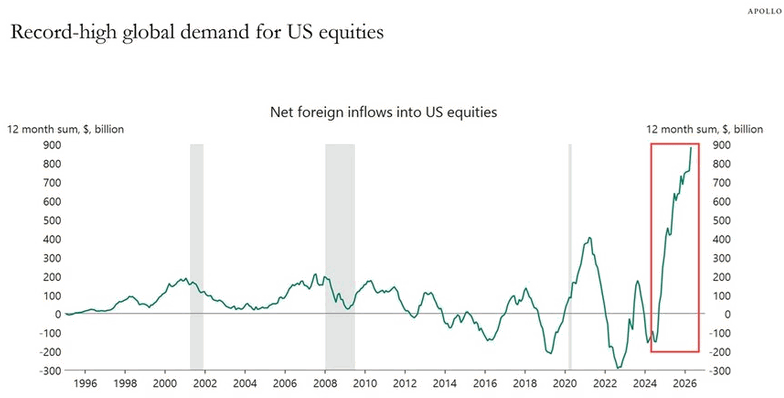
Foreign demand for American stocks reads as a vote of confidence — and that is the trap. These inflows are a momentum gauge dressed as a fundamental one, and momentum peaks when conviction does. The record is unforgiving: the ~$200B highs of 2000 and 2007 sat atop those cycles, the ~$430B of 2018 landed just before the fourth-quarter rout, the 2021 bump gave way to a bear market. Foreign capital shows up last, buying the story after the numbers have run. What bent this line vertical to near $850B — roughly twice the prior peak — is the AI magnet: there is no European Nvidia, no home-market proxy for the Mag-7, so an overseas allocator who wants AI has one door, marked America. Passive plumbing amplifies it, routing every “world” dollar into the same winners. So this is not the diversification the sell-America crowd feared — it is one crowded AI bet wearing an index’s clothing. And it arrived overwhelmingly unhedged: these holders are long US equities and long the dollar on the same ticket. If AI merely disappoints, they sell the stock and the currency in one motion. Watch the derivative, not the level. The rollover is the tell, and the currency is the collateral no one agreed to post.
Market Intelligence Brief (MIB) Ver. 18.42
For professional investors only. Not investment advice.
© 2026 RecessionALERT.com

Comments are closed.