
MARKET INTELLIGENCE BRIEF (MIB)
Tuesday, October 20, 2026
Housing cracked under 5.1% Treasury yields: September starts fell 5.2% to 1.221M against a 1.30M consensus and pending sales plunged 7.3%. A Reuters poll now has nearly all economists expecting a December Fed hike. Healthcare led a rotation out of tech, lifting the Dow 1.02% to its highest close since September 11, while Brent reversed from a $111.99 intraday high. Anthropic’s draft IPO filing showed $16.3B first-half revenue and ~$450B of cloud commitments. Salesforce agreed to buy Braze; BRZE +51.7%.
TABLE OF CONTENTS
A. EXECUTIVE SUMMARY
B. MARKET DATA
C. HIGH-IMPACT STORIES (6)
D. MODERATE-IMPACT STORIES (6)
E. ECONOMY WATCH (3)
F. EARNINGS WATCH (7)
G. WHAT’S NEXT
H. CHART OF THE DAY
A. EXECUTIVE SUMMARY -> TOP
Stocks rotated rather than retreated: the Dow rose 1.02% to its highest close since September 11 and the Russell 2000 gained 1.65%, while the Nasdaq 100 slipped 0.13% as chip-equipment names fell into the season’s heaviest week of tech earnings. The backdrop is a Fed repricing, with a Reuters poll showing nearly all economists now expect a December hike after an October hold, and the curve flattened to 33.0 bps as the 2-year edged up and the 10-year fell 3.2 bps to 5.113%. The long end eased on lower crude and weak housing data, with Brent reversing from a $111.99 intraday high to settle down 0.58% on US-Iran mediation headlines even as the IEA saw no credible path to normalisation in 2027. Healthcare’s 2.46% gain led eight of 11 sectors higher and Real Estate rose 1.82%, defensive, rate-sensitive breadth that leaves the rally exposed to any reversal in the 10-year.
• Housing: September starts fell 5.2% to a 1.221 million pace against a 1.30 million consensus and single-family permits fell 4.0%, while NAR’s pending home sales index plunged 7.3% against an expected 0.5% dip, with signings down 11.3% from a year earlier. The Atlanta Fed’s GDPNow trimmed its Q3 estimate to 3.5% from 3.6%.
• Fed: In a Reuters poll taken October 16-20, 94 of 100 economists expect a hold at the October 27-28 meeting and nearly all expect a December hike, up from fewer than half a month earlier; nearly 60% see the policy rate peaking at 4.00%-4.25%. The 2s10s spread narrowed to 33.0 bps from 36.9 bps.
• Energy: Brent touched $111.99 intraday, a five-month high, before settling at $108.92, down 0.58%, as Pakistan’s army chief met Iran’s president in Tehran. After the settle, the API reported a 4.93-million-barrel crude draw against an expected 1.3-million-barrel decline.
• AI supply and demand: ByteDance, Alibaba and Tencent have ordered more than three million Nvidia RTX PRO 5500 cards, above $35 billion at sticker price, according to Reuters, but Nvidia says it cannot guarantee supply. Anthropic’s draft IPO prospectus, viewed by the WSJ, shows first-half revenue of $16.3 billion, an $80.7 billion net loss (about $72 billion of it non-cash) and about $450 billion of noncancelable cloud commitments.
• Healthcare and deals: Healthcare rose 2.46%, with Eli Lilly up 3.49%, Amgen up 3.29% and Merck up 3.25%; the FDA approved GSK’s Hibsago for chronic hepatitis B and the FAA certified Boeing’s 737-10, which carries 1,555 orders. Salesforce agreed to buy Braze for $47.50 a share in cash, an enterprise value of about $5.66 billion, and Braze rose 51.70%.
• Chips and Apple: Lam Research fell 3.21%, KLA fell 2.80% and Applied Materials fell 1.97% with no company-specific trigger identified. Apple fell 1.00% to $339.50 after Loop Capital downgraded it to Hold with a $330 target, as the Nasdaq 100 was the only major index lower.
1. Housing is absorbing the tightening, and that keeps the Fed hiking — Starts, pending sales and Monday’s builder sentiment at its lowest since June 2012 all point the same way, yet GDPNow still tracks 3.5% third-quarter growth with consumer spending revised up. Weak housing alone does not cool services inflation, which is why a December hike went from a minority view to the economists’ consensus in a single month. For portfolios, Real Estate’s 1.82% gain was a long-end yield trade rather than a fundamental one, and brokerage, mortgage origination and home-related spending face weaker turnover into November.
2. AI’s constraint is supply, and the bill is concentrated — Nvidia’s Chinese customers want more than six million RTX PRO 5500 cards against a reported ceiling of about three million globally in 2027, and Anthropic’s draft prospectus acknowledges seeking more capacity than the hyperscalers were willing to supply. The same filing puts $252 billion of contracted demand with Alphabet, Amazon and Microsoft from a single customer that lost about $8.7 billion in six months excluding financing charges and drew about a fifth of its revenue from two clients. Yet the tape sold chip equipment and bought healthcare, so Meta’s capital-spending guidance and Lam Research’s orders commentary on Wednesday are the test of whether investors are doubting the spending or simply rebalancing.
3. Mediation caps oil’s spikes, but the floor keeps rising — Brent’s reversal from $111.99 shows headlines can still knock crude back intraday, but it settled at $101.10 on October 6 and is near $109 now. The IEA sees no credible pathway to normalisation in 2027, says 80% of March’s 400-million-barrel emergency release has already been issued, and points to diesel prices that have doubled since before the war, the inflation channel that matters a week before the FOMC. Dips help cost-sensitive names, as the Dow Transports’ 0.94% gain showed, but with Tehran demanding sanctions relief before any talks they look like trading opportunities rather than a change of trend.
 — Leading economic indicators. Accurate market forecasts. Apply for membership at join.recessionalert.com
B. MARKET DATA -> TOP
A rotation out of AI-linked technology and into healthcare lifted the Dow back above 52,000 while the Nasdaq 100 slipped, as earnings-driven surges in Equifax, Hasbro and 3M offset another unsettled session for chip stocks. Breadth was wider than the mixed headlines suggest: small caps and the NYSE Composite outran the S&P 500, and Healthcare led eight of 11 sectors higher. The sharpest divergence was in chip equipment, where Lam Research, KLA and Applied Materials fell 2-3% with no company-specific trigger identified. Crude reversed an early surge, with Brent touching $111.99 intraday before settling lower as Iran’s president met Pakistan’s army chief, a key US-Iran mediator, while the 10-year yield eased and the 2-year edged up.
CLOSING PRICES – Tuesday, October 20, 2026:
MAJOR INDICES
Breadth outran the headline: the Russell 2000 and NYSE Composite beat the S&P 500, the Dow posted its highest close since September 11, and the Nasdaq 100 was the only major index lower. Dow Theory bull confirmation is back in force, with the Dow at a 10-session high and transports within 1.1% of theirs. The S&P 500 has outperformed the Nasdaq 100 by 4.2 points over the past 10 sessions, a broadening rotation toward value and cyclicals now in its fifth straight session.
| Index | Close | Change | %Move | Why It Moved |
|---|---|---|---|---|
| S&P 500 | 7,712.57 | +21.84 | +0.28% | Earnings-driven gains in Equifax and Hasbro (each about +11%) and a healthcare rally offset AI-linked tech weakness; closed back above 7,700 |
| Dow Jones | 52,495.88 | +529.85 | +1.02% | Healthcare strength plus 3M’s earnings-driven rally, the Dow’s top percentage gainer; back above 52,000 at its highest close since September 11 |
| DJ Transportation | 19,885.50 | +184.31 | +0.94% | Airlines gained as crude reversed lower (American +3.7%, United +2.3%, per AP) |
| Nasdaq 100 | 29,490.28 | -39.06 | -0.13% | Chip-equipment names (Lam Research, KLA, Applied Materials) fell as AI-linked stocks stayed unsettled; recovered from a deeper intraday loss |
| Russell 2000 | 2,773.42 | +45.12 | +1.65% | Small caps led as gains broadened beyond mega-cap tech; no single catalyst identified |
| NYSE Composite | 24,190.62 | +223.55 | +0.93% | Broad gains led by healthcare, real estate and utilities; closed back above 24,000 |
VOLATILITY & TREASURIES
The curve flattened: the 10-year fell 3.2 bps while the 2-year edged up 0.7 bps, compressing 2s10s to 33.0 bps from 36.9 bps. The long end eased as crude reversed, while the front end held firm a week before the October 27-28 FOMC meeting; no discrete rates catalyst was identified. A 6.13% drop in the VIX alongside a softer dollar describes a calmer risk tone rather than a haven bid.
| Instrument | Level | Change | Why It Moved |
|---|---|---|---|
| VIX | 17.31 | -1.13 (-6.13%) | Fell as the early oil spike reversed and gains broadened across indices |
| 10-Year Treasury Yield | 5.113% | -3.2 bps | Long end eased as crude reversed lower; no discrete rates catalyst identified |
| 2-Year Treasury Yield | 4.783% | +0.7 bps | Front end edged up ahead of the October 27-28 FOMC meeting; no discrete catalyst identified |
| US Dollar Index (DXY) | 101.71 | -0.27 (-0.27%) | Softer alongside lower long-end yields; no discrete catalyst identified |
COMMODITIES
Precious metals split: gold slipped while silver and platinum firmed, and copper edged higher, so the industrially exposed metals outperformed the haven on a session when equity breadth widened. Bitcoin’s modest gain tracked the positive equity tape rather than any crypto-specific development.
| Asset | Price | Change | %Move | Why It Moved |
|---|---|---|---|---|
| Gold | $4,141.01/oz | $-19.09 | -0.46% | Eased; no discrete same-day catalyst identified |
| Silver | $58.005/oz | $+0.732 | +1.28% | Rose against gold’s dip; no discrete same-day catalyst identified |
| Copper | $6.6130/lb | $+0.0375 | +0.57% | Firmer with the broader risk tone; no discrete same-day catalyst identified |
| Platinum | $1,658.75/oz | $+10.55 | +0.64% | Firmer alongside silver; no discrete same-day catalyst identified |
| Bitcoin | $82,745.00 | $+725.00 | +0.88% | Tracked the positive equity tape; no crypto-specific catalyst identified |
ENERGY
WTI and Brent gave back early gains in near lockstep, leaving the Brent-WTI spread little changed near $11, while Henry Hub and Dutch TTF both fell. Crude declined as equities rose. Reuters attributed the reversal to Iran’s president meeting Pakistan’s army chief, a key US-Iran mediator, weighed against continued Houthi attacks on Saudi infrastructure.
| Asset | Price | Change | %Move | Why It Moved |
|---|---|---|---|---|
| Crude Oil (WTI) | $98.06/bbl | $-0.48 | -0.49% | December contract settled $97.82 (-$0.72) per Reuters after an early surge reversed; the expiring November contract settled $101.79 |
| Crude Oil (Brent) | $108.92/bbl | $-0.63 | -0.58% | Touched $111.99 intraday, which Reuters called a five-month high, then settled $108.79 as Iran-Pakistan mediation talks were weighed against Houthi attacks |
| Natural Gas (Henry Hub) | $2.997/MMBtu | $-0.061 | -1.99% | No discrete same-day catalyst identified; no EIA storage report on Tuesdays |
| Natural Gas (Dutch TTF) | $28.467/MMBtu | $-0.463 | -1.60% | Fell back from Monday’s close, its highest since at least mid-April; no discrete same-day catalyst identified |
S&P 500 SECTORS
Healthcare led eight of 11 sectors higher and extended a week-long run (+5.58% 1W), while Technology slipped again and is down 4.96% on the week, a rotation out of tech that Consumer Defensive (+4.22% 1W) is sharing. Rate-sensitive Real Estate and Utilities gained as the 10-year eased. The three decliners were Communication Services (-0.62%), Technology (-0.16%) and Basic Materials (-0.07%).
| Sector | 1-Day | 1-Week | 1-Month | 3-Month | 6-Month | YTD | 12-Month |
|---|---|---|---|---|---|---|---|
| Healthcare | +2.46% | +5.58% | +4.23% | +8.86% | +17.05% | +12.81% | +20.75% |
| Real Estate | +1.82% | +1.16% | -1.68% | -7.40% | -3.85% | +3.33% | -0.10% |
| Utilities | +1.16% | -0.00% | +2.51% | -8.67% | -7.57% | -2.30% | -8.29% |
| Financial | +1.04% | +0.76% | -2.26% | -1.91% | +6.19% | +3.81% | +10.89% |
| Consumer Cyclical | +0.76% | +1.89% | +1.64% | +0.51% | -3.19% | -4.72% | -3.24% |
| Consumer Defensive | +0.29% | +4.22% | +7.41% | +4.92% | +5.25% | +12.21% | +10.08% |
| Energy | +0.16% | +0.91% | +7.16% | +10.89% | +14.83% | +46.08% | +52.60% |
| Industrials | +0.10% | -1.84% | -2.59% | -4.54% | -6.07% | +6.37% | +8.31% |
| Basic Materials | -0.07% | -0.30% | -3.04% | +1.73% | -5.33% | +10.54% | +17.54% |
| Technology | -0.16% | -4.96% | -4.99% | +2.93% | +15.62% | +23.15% | +21.63% |
| Communication Services | -0.62% | -3.45% | -4.29% | +0.44% | -2.21% | -0.53% | +4.57% |
TOP MEGA-CAP MOVERS:
GAINERS
| Company | Ticker | Close | Change | Why It Moved |
|---|---|---|---|---|
| Eli Lilly | LLY | $1,283.66 | +3.49% | Positive Phase 3 pediatric ulcerative colitis data for Omvoh and an AI drug-delivery collaboration with JT Therapeutics, both reported Monday evening per an Investing.com explainer (unverified against Lilly’s own release); healthcare-sector rally |
| Amgen | AMGN | $438.94 | +3.29% | Amgen and AstraZeneca reported positive trial results for Tezspire in eosinophilic esophagitis (69% remission at the 420 mg dose vs 3.5% on placebo) |
| Merck & Co | MRK | $148.30 | +3.25% | Rose with the healthcare-sector rally; no discrete same-day catalyst identified |
| UnitedHealth Group | UNH | $419.26 | +3.04% | Rose with the healthcare-sector rally; no discrete same-day catalyst identified |
| IBM | IBM | $241.92 | +2.34% | No discrete same-day catalyst identified; reports Q3 results Wednesday after the close |
DECLINERS
| Company | Ticker | Close | Change | Why It Moved |
|---|---|---|---|---|
| GE Aerospace | GE | $299.87 | -3.67% | Earnings-driven; Q3 results reported before the open |
| Lam Research | LRCX | $263.45 | -3.21% | No discrete same-day catalyst identified; fell with chip-equipment peers as AI-linked stocks stayed unsettled; reports Q3 Wednesday after the close |
| KLA Corp | KLAC | $161.74 | -2.80% | No discrete same-day catalyst identified; fell with chip-equipment peers |
| GE Vernova | GEV | $890.33 | -1.99% | No discrete same-day catalyst identified |
| Applied Materials | AMAT | $404.98 | -1.97% | No discrete same-day catalyst identified; fell with chip-equipment peers |
— Institutional-grade intelligence for serious investors. Apply for membership at join.recessionalert.comC. HIGH-IMPACT STORIES -> TOP
UNCERTAIN
1. Crude Reverses From a Five-Month High as Pakistan’s Army Chief Carries US-Iran Mediation to Tehran, While the IEA Warns 2027 Will Not Bring Normalisation
The core facts:Brent touched $111.99 a barrel intraday, which Reuters called a five-month high, before settling at $108.92, down 0.58%. WTI closed at $98.06, down 0.49%, while the expiring November WTI contract settled at $101.79. The reversal came as Pakistani Field Marshal Asim Munir, a key US-Iran mediator, met Iranian President Masoud Pezeshkian in Tehran. Iranian state media reported that Pezeshkian told him the US “must lift threats and sanctions before any talks,” and Qatar said communication between Washington and Tehran “has not stopped.” A Qatari outlet’s report of a Qatar-Pakistan compromise built around roughly $6 billion of frozen Iranian funds could not be confirmed, and neither government acknowledged it. Separately, IEA Executive Director Fatih Birol told the Financial Times Energy Transition Summit in London that he does not see “any credible pathway that 2027 will be a year of normalisation.” He warned that the Strait of Hormuz “can be closed again” and said IEA members “will not hesitate to look into the option of releasing further stocks.” Of March’s 400-million-barrel emergency release, 80% has been issued. After the settle, the American Petroleum Institute reported a 4.93-million-barrel crude draw against a 1.3-million-barrel expected decline.
Why it matters:Crude’s failure to hold $110 shows that mediation headlines can still cap the war premium intraday, but the floor keeps rising: Brent settled at $101.10 on October 6 and is now near $109. Birol’s point that diesel prices have doubled since before the war, with demand seasonally rising into refinery maintenance, is the more important one for US inflation than the crude print itself, and it lands a week before an FOMC meeting where markets are already debating a December hike. Tehran’s insistence on sanctions relief before talks, along with Reuters-reported comments from Iranian officials that it is prolonging negotiations ahead of the November 3 midterms, argues against a near-term breakthrough that would remove the premium. The intraday reversal helped cost-sensitive airlines, with the Dow Transports up 0.94%.
What to watch:The EIA weekly petroleum report on Wednesday, October 21 at 10:30 ET (consensus a 0.3-million-barrel draw) to confirm the API’s larger draw, and whether Brent can settle above today’s $111.99 intraday high.
BULLISH
2. Healthcare Leads a Rotation Out of Tech That Lifts the Dow 1.02% Back Above 52,000, Its Highest Close Since September 11
The core facts:The Dow rose 529.85 points, or 1.02%, to 52,495.88, its highest close since September 11. The S&P 500 gained 0.28% to 7,712.57, the Russell 2000 1.65% and the NYSE Composite 0.93%, while the Nasdaq 100 slipped 0.13% and was the only major index lower. Healthcare rose 2.46% to lead eight of 11 sectors higher, and is up 5.58% over the past week against Technology’s 4.96% decline. Eli Lilly gained 3.49%, Amgen 3.29%, Merck 3.25% and UnitedHealth 3.04%. Amgen’s move came as it and AstraZeneca presented full results from the CROSSING trial of Tezspire in eosinophilic esophagitis, following the August 27 topline: remission of inflammation at 24 weeks in 65% (210 mg) and 69% (420 mg) of patients versus 3.5% on placebo, with benefits maintained through 52 weeks. One explainer attributed Lilly’s gain to pediatric ulcerative colitis data and a new collaboration; that link could not be independently confirmed. At the other end of the market, Lam Research fell 3.21%, KLA 2.80% and Applied Materials 1.97% with no company-specific trigger identified. AI-linked stocks stayed unsettled after South Korean AI firm Elice fell 32% on its Seoul debut and the Kospi dropped 3.7%.
Why it matters:This was a rotation rather than a risk-off session: money left chip equipment and flowed into defensive growth, small caps and the broad NYSE, with the VIX down 6.13% to 17.31. The S&P 500 has now outperformed the Nasdaq 100 by 4.2 points over the past 10 sessions, and with the Dow at a 10-session high and the Transports within 1.1% of theirs, Dow Theory’s bull confirmation is back in force. The breadth is healthier than an index led by a handful of AI names. The risk is that it rests on the defensive and rate-sensitive groups at a time when the 10-year yield sits above 5.1%, and it now meets the season’s heaviest week of technology earnings.
What to watch:Wednesday’s after-the-bell reports from Meta, Tesla, Lam Research, Texas Instruments and IBM. Lam’s orders commentary is the direct test of whether today’s 2-3% chip-equipment selloff was positioning or a signal.
BULLISH
3. ByteDance, Alibaba and Tencent Order More Than $35 Billion of Nvidia’s Export-Compliant RTX PRO 5500 Cards, but Nvidia Says It Cannot Guarantee Supply
The core facts:ByteDance, Alibaba and Tencent have ordered more than three million of Nvidia’s new RTX PRO 5500 graphics cards at about $11,400 each, a combined sticker price above $35 billion, according to a Reuters exclusive citing people familiar with the matter. Total orders from Chinese customers exceed six million cards. Nvidia has told customers and partners it cannot guarantee fulfilment. One source said partners might receive only 5% to 10% of the quantities requested, and another said Nvidia had indicated it can produce no more than three million cards globally in 2027. Early samples are expected in December, with commercial deliveries from the first quarter of 2027, as much of Nvidia’s 2027 capacity at TSMC is expected to go to its next-generation Rubin platform. The RTX PRO 5500 is a workstation chip and among the most powerful Nvidia products still available to Chinese buyers. Neither Nvidia nor the buyers confirmed the order sizes, and the Commerce Department’s Bureau of Industry and Security did not comment. An Nvidia spokesperson said US firms “continue to be restricted by a combination of outdated U.S. export controls” and China’s own limits on US imports.
Why it matters:The report points to a sizeable China market for Nvidia after its CEO said US restrictions cut its share of China’s AI data-center chip market from a near monopoly to effectively nothing. Demand is clearly not the constraint: supply is, so the upside is capped by capacity rather than by orders. Even at the three-million-card global ceiling one source described, the line would be worth roughly $34 billion at the reported unit price, material for Nvidia and for TSMC’s non-Rubin capacity. It also shows how far US curbs have tightened China’s compute supply, which keeps the export-policy question live: a workstation chip absorbing data-center inference demand is exactly the kind of product Washington could revisit. Nvidia was not among the session’s mega-cap movers, so the report did not lift the chip complex.
What to watch:Any Commerce Department statement on the RTX PRO 5500’s export status, and China commentary in Wednesday’s Lam Research and Texas Instruments reports.
BEARISH
4. A December Hike Becomes the Consensus: Nearly All Economists in a Reuters Poll Expect the Fed to Skip October Then Raise Rates, as the Yield Curve Flattens
The core facts:A Reuters poll conducted October 16-20 found 94 of 100 economists expect the Fed to hold its 3.75%-4.00% target range at the October 27-28 meeting, and nearly all expect a hike in December, up from fewer than half in the previous month’s poll. Nearly 60% see the policy rate peaking at 4.00%-4.25%, and 38 of 92 forecast at least two more hikes. PCE inflation is not expected back at 2% until at least 2028. Mizuho’s Alex Pelle said: “They’ll go 25 in December, but the risk is greater they end up going 50 than they don’t go at all.” In Treasuries, the 2-year yield edged up 0.7 basis points to 4.783% while the 10-year fell 3.2 basis points to 5.113%, compressing the 2s10s spread to 33.0 basis points from 36.9. The Fed has been in its pre-meeting communications blackout since October 17, and no official spoke.
Why it matters:In a single month a December hike has moved from a minority view to the consensus, and the curve is behaving accordingly: the front end holds firm on policy expectations while the long end eases on softer growth data and lower crude. That combination is the classic late-tightening shape, and it puts the rate-sensitive parts of the economy, housing above all, in the firing line (see Story 5). Morgan Stanley’s Michael Gapen framed the asymmetry: “The risks are in the direction of a Fed that ultimately needs to hike rates more than we expect.” Equities have so far absorbed the repricing through rotation rather than retreat, but a 50-basis-point December debate would test that.
What to watch:The FOMC decision on Wednesday, October 28 at 14:00 ET and the press conference language on December, then the Q3 GDP advance estimate and September PCE on Thursday, October 29 at 08:30 ET.
BEARISH
5. Housing Breaks Under 5% Yields: A Starts Miss and a Plunge in Pending Sales Make Real Estate Activity the Clearest Casualty of Higher Rates
The core facts:Tuesday’s September housing starts missed consensus badly and NAR’s pending home sales index fell 7.3% against an expected 0.5% dip (full data in Section E), a day after builder sentiment dropped to its lowest since June 2012. NAR’s Lawrence Yun blamed “fast-rising mortgage rates.” The Atlanta Fed’s GDPNow trimmed its third-quarter estimate to 3.5% from 3.6% after the releases, with private fixed investment among the components marked lower. Markets did not trade the data as a growth scare: the 10-year yield eased 3.2 basis points to 5.113%, and the S&P 500 Real Estate sector rose 1.82%, the second-best sector of the day.
Why it matters:Housing is absorbing the tightening while the broader economy so far is not, which is exactly the split that keeps the Fed on a hiking path: weak housing alone does not cool services inflation. Pending sales are contract signings that close one to two months later, so the drop points to weaker existing-home turnover into November, a drag on brokerage, mortgage origination and home-related spending. With the economists in Story 4 now expecting a December hike, there is no rate relief in sight for buyers. The sector’s gain on the day reflects the lower long-end yield, not better fundamentals, and it is vulnerable to any reversal in the 10-year.
What to watch:The MBA 30-year mortgage rate on Wednesday, October 21 (last at 7.5%) and September new home sales on Tuesday, October 27.
UNCERTAIN
6. Anthropic’s Draft IPO Filing Shows First-Half Revenue of $16.3 Billion, an $80.7 Billion Loss and About $450 Billion of Noncancelable Cloud Commitments to Google, Amazon and Microsoft
The core facts:A draft of Anthropic’s IPO prospectus viewed by The Wall Street Journal, reported at 3:30 p.m. ET, shows first-half 2026 revenue of $16.3 billion, up from $1.1 billion a year earlier. The net loss was $80.7 billion, of which about $72 billion was non-cash accounting charges tied to convertible notes and other financing instruments. Spending on computing capacity and infrastructure reached nearly $9 billion in the half, more than the $7.3 billion it spent in all of 2025. The company is committed to roughly $450 billion of noncancelable cloud agreements over the next decade, including $111 billion with Google Cloud, $110 billion with Amazon Web Services and $31 billion with Microsoft. It said it could spend $750 billion in the coming years on computing capacity, including deals still under negotiation. About 20% of first-half revenue came from two customers, and the draft says a limited client base will continue to generate a significant share of revenue for the foreseeable future. It also acknowledges seeking more capacity than the hyperscalers were willing to supply, which has pushed it toward third-party data-center developments, and warns that damages from a severe AI-related incident could exceed available insurance. The draft is not a public filing. A September draft reviewed by Reuters had shown a 2025 net loss of about $42 billion on revenue of about $4.6 billion. Separately, OpenAI is reportedly racing to raise about $30 billion at a valuation near $1.4 trillion before Anthropic’s expected mid-November listing.
Why it matters:This puts a counterparty-level number on the AI spending debate for the first time: $252 billion of contracted demand sits with Alphabet, Amazon and Microsoft from a single customer. That is multi-year revenue underpinning their cloud backlogs and the capital spending built against them. The revenue line, up nearly fifteenfold year over year, is the strongest evidence yet that frontier AI is monetizing, a direct answer to the bear case that the industry’s spending has no revenue behind it. The other side is concentration. Those obligations rest on a company that lost about $8.7 billion in six months excluding the financing charges, that relies on two customers for a fifth of its revenue, and that needs public equity to keep funding the build-out. A stumble at the IPO would therefore run straight into the hyperscalers’ growth assumptions. The capacity friction it discloses also confirms that compute, not demand, is the binding constraint, the same message as today’s Nvidia China orders. The report came 30 minutes before the close, and no market move could be tied to it.
What to watch:Meta’s 2027 capital-spending guidance on Wednesday, October 21, the first hyperscaler read after the disclosure, and the public flip of Anthropic’s registration statement, expected after the November 3 midterms.
— Quantifying recession risk so you don’t have to guess. Apply for membership at join.recessionalert.comD. MODERATE-IMPACT STORIES -> TOP
BULLISH
7. Salesforce Agrees to Buy Braze for $47.50 a Share in Cash, About $5.66 Billion; Braze Soars 51.7%
The core facts:Salesforce signed a definitive agreement to acquire customer-engagement platform Braze for $47.50 per share in cash, an enterprise value of approximately $5.66 billion, it said in an 8:00 a.m. ET release. The deal needs Braze shareholder and regulatory approval and is expected to close in Salesforce’s fiscal 2028. Salesforce said “there is no anticipated change” to its fiscal 2027 guidance. Braze closed up 51.70% at $45.57, about 4% below the offer, and rival Klaviyo rose about 8%. Salesforce closed essentially flat at $242.43 after trading as low as $235.60.
Why it matters:Salesforce is buying the real-time data layer its Agentforce AI agents need: Braze ingests live customer signals that Salesforce intends to feed into Marketing Cloud, Data 360 and Agentforce. The tight spread to the offer says the market expects completion, and Klaviyo’s sympathy move shows investors repricing other mid-cap marketing-software names as targets. The flat reaction in a roughly $200 billion acquirer, and the unchanged guidance, frame the deal as a bolt-on rather than a strategic bet.
What to watch:The Braze shareholder vote and the antitrust review timetable, and whether the spread to $47.50 narrows or widens.
BULLISH
8. FAA Certifies the Boeing 737-10, Clearing Deliveries of the Largest 737 MAX to Begin in the Coming Months
The core facts:The FAA approved the amended type certificate for the 737-10, Boeing said on October 20. Deliveries can begin “in the coming months.” More than 30 customers have ordered 1,555 of the aircraft, over 30% of the 737 MAX program’s current order book. The FAA certified the smaller 737-7 earlier this year. The approval follows the FAA’s decision last month to hold off on certifying the 737-10 until a newly disclosed software issue was resolved. Stephanie Pope, president and CEO of Boeing Commercial Airplanes, said completing certification “clears the path for us to deliver” the aircraft.
Why it matters:The 737-10 was the largest remaining certification overhang on Boeing’s backlog. Converting 1,555 orders into deliveries unlocks cash from a variant that accounts for more than 30% of MAX orders and gives its customers long-awaited capacity. It also extends the delivery runway for engine and aerostructure suppliers on the program. The approval lands a week before Boeing’s third-quarter report, giving management a clean answer on its most-asked program question.
What to watch:Boeing’s third-quarter results before the open on Tuesday, October 27, for a first 737-10 delivery date and any update on 737 production rates.
BULLISH
9. FDA Approves GSK’s Hibsago, the First Antisense Treatment for Chronic Hepatitis B
The core facts:The FDA approved GSK’s Hibsago (bepirovirsen) on October 20 for certain adults with chronic hepatitis B without cirrhosis. It is for patients who have taken antiviral therapy for at least six months, have suppressed viral levels and have HBsAg at or below 3,000 IU/mL, and it is used alongside existing antivirals. In trials, 24% of patients on Hibsago met the criteria to stop their existing medicine, versus none on placebo, and 19% still had the virus controlled, with HBsAg undetectable, 24 weeks after stopping all treatment. The drug received Fast Track, Breakthrough Therapy and Priority Review designations and carries a boxed warning for serious liver reactions and low platelet counts. Roche’s Elecsys HBsAg assay is the companion diagnostic. GSK’s US-listed shares rose 2.37% and partner Ionis 2.30%, in line with a broad pharma rally.
Why it matters:Hibsago is the first therapy cleared in the US that offers some hepatitis B patients a path off lifelong antivirals, a finite-treatment model that changes the commercial profile of a disease long served by cheap daily pills. The patient population is narrowed by the HBsAg cut-off and the boxed warning, so the near-term revenue opportunity is modest relative to GSK’s size. The approval adds to a run of US regulatory wins for GSK, after Jemperli’s accelerated approval in rectal cancer on Monday, as healthcare leads the market.
What to watch:GSK’s launch pricing and any update on the US rollout in its third-quarter results.
BEARISH
10. Loop Capital Downgrades Apple to Hold and Cuts Its Target to $330 From $370; Shares Fall 1.00%
The core facts:Loop Capital downgraded Apple to Hold from Buy and cut its price target to $330 from $370, MT Newswires reported at 7:01 a.m. ET. The same morning MoffettNathanson cut its target to $283 from $304 and kept a Neutral rating, according to a broker-moves roundup. Apple closed down 1.00% at $339.50, above both new targets. Loop’s rationale was not available. Separately, Apple named Perryman Company (up to $100 million over three years for titanium for the iPhone Duo) and Qnity Electronics as partners in its American Manufacturing Program.
Why it matters:Two brokers set targets below the current price on the same day, a downgrade cluster of the kind that tends to cap a mega-cap’s multiple into earnings. Apple is among the largest weights in the S&P 500 and the Nasdaq 100, and its decline came on a day the Nasdaq 100 was the only major index lower. The manufacturing announcements are policy positioning on tariffs rather than a near-term earnings driver.
What to watch:Whether further brokers follow before Apple’s fiscal fourth-quarter report, and the stock’s hold of the $330 level Loop now sets as fair value.
BULLISH
11. Rubio Says a US-India Trade Deal Is “About as Close as You Can Be Without Having Executed the Agreement”
The core facts:Secretary of State Marco Rubio, speaking in Mumbai during talks with Foreign Minister S. Jaishankar, said on Tuesday: “We’re very, very close. I would say we’re about as close as you can be without having executed the agreement.” He added that “there’s a small number of items left to wrap up.” The US tariff on Indian goods stands at 18% under a February framework, down from up to 50% imposed in August 2025. India wants a final rate in line with competing manufacturers such as Vietnam. Rubio noted India still gets a large share of its energy from Russia and said “it’s hard to pivot from one day to the next.” He visits Reliance’s Jamnagar refinery, the world’s largest refining complex, on Wednesday.
Why it matters:A signed deal would lock in, and possibly lower, the tariff rate for the main alternative manufacturing base for US companies diversifying away from China, from smartphones to generic drugs. It would remove one source of the trade-policy uncertainty that has weighed on multinationals’ margin guidance this season. Russian oil remains the sticking point that has stalled talks for months, so Wednesday’s Jamnagar visit is symbolically pointed.
What to watch:Rubio’s comments at Jamnagar on Wednesday, October 21, and any announcement of a first tranche, which India’s commerce minister has said is in its final stages.
UNCERTAIN
12. Importer Files a Class Action at the Court of International Trade to Stop the Section 338 Tariffs on Canada and Win Refunds
The core facts:Gellert Global Group, a family-run New Jersey food importer, sued in the US Court of International Trade on October 20 for itself and a proposed class of American importers, challenging the additional 50% tariffs and import bans on certain Canadian goods imposed under Section 338 of the Tariff Act of 1930. Cheeses Gellert imports were added on September 8, with collection from September 15. The suit seeks a declaration that the tariffs are unlawful, an order stopping collection and refunds with interest, and was filed with motions for a preliminary injunction and summary judgment. It argues that tariff power belongs to Congress, that Section 301 of the Trade Act of 1974 superseded or limits Section 338, that the statute applies only to offset foreign discrimination against US commerce, and that the administration skipped the required 30-day waiting period for newly added products.
Why it matters:The suit says Section 338 had not been used to impose tariffs before this year, which makes the case an early test of whether the administration’s alternative tariff authority survives the courts. The class structure and the refund claim give it potential balance-sheet consequences for importers of Canadian goods. A preliminary injunction would cut the effective tariff on affected categories and ease input costs for food, beverage and auto-adjacent supply chains. A loss would entrench Section 338 as a durable tool for future trade disputes.
What to watch:The court’s scheduling of the preliminary-injunction motion, and whether other importers join the proposed class.
— Separating signal from noise since 2007. Apply for membership at join.recessionalert.comE. ECONOMY WATCH -> TOP
The economy is splitting along the interest-rate line: aggregate growth is holding up while housing buckles under borrowing costs. Housing starts slid 5.2% to a 1.221 million annual pace in September, well short of the 1.30 million consensus, and pending home sales fell 7.3% against an expected 0.5% dip, which NAR’s Lawrence Yun blamed on “fast-rising mortgage rates.” Yet the Atlanta Fed’s GDPNow still tracks third-quarter growth at 3.5%, trimmed by only a tenth, as weaker private fixed investment outweighed firmer consumer spending. With the 10-year yield at 5.11% a week before the October 27-28 FOMC meeting, housing is absorbing the tightening and the broader economy so far is not.
Housing Starts Fall 5.2% to 1.221 Million in September, Missing the 1.30 Million Consensus (Census Bureau, Oct 20)
What they’re saying:Privately-owned housing starts ran at a seasonally adjusted annual rate of 1,221,000 in September, 5.2% below the revised August pace of 1,288,000 and 7.4% below September 2025’s 1,319,000. Single-family starts fell 4.6% to 859,000, and starts in buildings of five units or more were 349,000. Building permits held at 1,400,000, in line with the 1.39 million consensus and 0.2% below August, but single-family authorizations fell 4.0% to 845,000.
The context:This is a second straight monthly decline in starts, after a 5.9% drop in August, and the miss against consensus came even though August was revised up from its initial 1,275,000. The Census Bureau’s ±11.8% confidence interval means the monthly change alone is not statistically significant, so the single-family permits decline, the forward-looking series, is the cleaner signal of a builder pullback. Completions rose 2.2% to 1,192,000 but remain 14.0% below a year earlier.
What to watch:September New Home Sales on Tuesday, October 27 (prior 0.684 million), and the final September building permits revision the same morning.
Pending Home Sales Plunge 7.3% in September as Mortgage Rates Climb (NAR, Oct 20)
What they’re saying:The National Association of Realtors’ pending home sales index fell 7.3% month over month in September, against a consensus expectation of a 0.5% decline and after a 0.3% gain in August. Contract signings were down 11.3% from a year earlier, deepening from a 4.7% annual decline the month before, and fell both month over month and year over year in all four major regions. NAR Chief Economist Lawrence Yun said “market conditions weakened in September due to fast-rising mortgage rates.”
The context:Pending sales are contract signings, which typically close one to two months later, so the drop points to weaker existing-home closings into October and November. It compounds Monday’s NAHB builder sentiment reading of 29, the lowest since June 2012, and leaves housing as the clearest casualty of higher rates, with the MBA 30-year contract rate at 7.5% in its latest weekly reading and the 10-year Treasury yield at 5.113%.
What to watch:The MBA 30-year mortgage rate on Wednesday, October 21 (prior 7.5%), and the S&P/Case-Shiller home price index on Tuesday, October 27 (prior 2.5% year over year).
Atlanta Fed GDPNow Trims Third-Quarter Growth Estimate to 3.5% from 3.6% (Atlanta Fed, Oct 20)
What they’re saying:The Atlanta Fed’s GDPNow model estimates third-quarter real GDP growth at a 3.5% seasonally adjusted annual rate as of October 20, down from 3.6% on October 15. Following releases from the Census Bureau, the Bureau of Labor Statistics, the Bureau of the Fiscal Service and the Federal Reserve Board, modest increases in the nowcasts of real personal consumption expenditures and private inventories were more than offset by modest declines in real private fixed investment, real net exports and real government expenditures.
The context:The trim is small, and 3.5% annualized growth carries no recession signal; Polymarket’s odds of a US recession by the end of 2026 stand at 8%. The composition matters more than the size: the private fixed investment component, which includes residential construction, is where today’s housing data weighed, while the consumer, the economy’s largest engine, was revised up.
What to watch:September Durable Goods Orders on Tuesday, October 27 (prior 0%), the main input to the equipment side of the investment nowcast.
— Know the probability before the market prices in the risk. Apply for membership at join.recessionalert.comF. EARNINGS WATCH -> TOP
YESTERDAY AFTER THE BELL (Markets Reacted Today)
No major earnings yesterday after the bell from companies with >$100B market cap.
TODAY BEFORE THE BELL (Markets Already Reacted)
BULLISH
13. GE Aerospace (GE): -3.67% | Orders Jump 49% and Guidance Is Raised Across the Board, but Free Cash Flow Falls 14% and the Shares Slide
The Numbers:Released: BMO. Adjusted EPS $2.25 vs. $2.01 estimate (+12.0%); GAAP continuing EPS $2.32. Adjusted revenue $13.29B vs. $12.88B estimate (+18% y/y); GAAP revenue $14.12B. Total orders $19.0B (+49%). Adjusted operating profit $2.99B (+30%), margin 22.5% (+220 bps). Free cash flow $2.04B (-14%). Full-year 2026 guidance raised: adjusted EPS $8.00-$8.10 (from $7.65-$7.85), operating profit $10.9-$11.0B (from $10.55-$10.75B), free cash flow $9.1-$9.4B (from $8.9-$9.2B), adjusted revenue growth about 19%-20% (from high-teens).
The Problem/Win:Win: Commercial Engines & Services orders rose 58% to $15.27B and revenue 21% to $10.34B, with services up 17%, internal LEAP shop visits up more than 40% and equipment revenue up 38%. CEO Larry Culp said the company is “raising our 2026 guidance across the board.” Problem: free cash flow fell 14% even as profit rose, the GAAP profit margin slipped 80 bps to 19.9%, and LEAP deliveries grew only 5%. The cause of the share decline was not established.
The Ripple:GE was the largest decliner among mega-caps on a day the Dow rose 1.02%, while defense peers rallied on their own results (Northrop Grumman +4.57%, RTX +0.64%). The same-day FAA certification of Boeing’s 737-10 lengthens the delivery runway for the LEAP-1B engine family.
What It Means:The aftermarket engine remains intact and accelerating, so the decline tests valuation rather than demand. Cash conversion is the number the next quarter has to repair.
What to watch:Boeing’s 737 production-rate commentary on October 27, which governs GE’s LEAP delivery growth into 2027.
BULLISH
14. RTX (RTX): +0.64% | Backlog Hits $340 Billion on Over $81 Billion of Awards, and the Full-Year Outlook Is Raised on Every Measure
The Numbers:Released: BMO. Adjusted EPS $2.26 vs. $1.78 estimate (+27.0%), including $0.25 from IEEPA tariff cost recovery; GAAP EPS $1.89. Sales $24.97B vs. $24.11B estimate (+11% reported, +12% organic). Free cash flow $2.12B vs. $4.03B a year earlier. Backlog $340B ($176B commercial, $164B defense). 2026 outlook raised: adjusted sales $97.0-$97.5B (from $95.0-$96.0B), organic growth 10%-11% (from 8%-9%), adjusted EPS $7.65-$7.75 (from $7.10-$7.25), free cash flow $9.0-$9.2B (from $8.50-$8.75B).
The Problem/Win:Win: all three segments grew double digits. Raytheon’s sales rose 14% to $8.03B (14.1% adjusted margin), Collins Aerospace 10% to $8.38B (21.3%) and Pratt & Whitney 10% to $9.23B (10.5%). The quarter brought multi-year production contracts for Tomahawk and AMRAAM. Problem: excluding the $0.25 tariff recovery, EPS was $2.01, still a beat but a smaller one, and Pratt & Whitney took a $363M customer-bankruptcy charge that cut its reported margin to 6.6%.
The Ripple:Defense held up on a rotation day: Northrop Grumman rose 4.57% on its own results, while GE Aerospace fell 3.67% despite its raise. Lockheed Martin reports Thursday.
What It Means:A $340B backlog split almost evenly between commercial and defense gives RTX multi-year visibility on both sides of aerospace. The raise is driven by organic growth, not just tariff recovery.
What to watch:Lockheed Martin’s munitions commentary on Thursday, October 22, and whether the Tomahawk and AMRAAM awards are definitized.
TODAY AFTER THE BELL (Markets React Tomorrow)
BULLISH
15. SpaceX (SPCX): AH: n/a | Revenue Up 161% to $14.6 Billion as the AI Segment Overtakes Starlink, With Its First Operating Profit as a Public Company
The Numbers:Released: AMC. Revenue $14.58B vs. $12.87B estimate (+13.2%), up 161% year over year. Adjusted EPS $0.45 vs. $0.13 consensus; GAAP EPS $0.35. Operating income $2.79B. AI segment revenue $7.56B; connectivity revenue, mostly Starlink, up 69% to $5.25B. Market cap about $2.0 trillion. No after-hours move was confirmed at the time of writing.
The Problem/Win:Win: the AI business, which roughly tripled, is now the largest revenue line and delivered the company’s first operating profit since listing. Problem: Starlink added 1.6 million consumer subscribers against 2.29 million expected, per Fortune, taking the base to 13.6 million. The growth engine has shifted from connectivity to AI compute, which carries heavier capital needs.
The Ripple:At roughly $2 trillion, SpaceX sets the tone for Wednesday’s AI-heavy reports from Meta and Tesla. Its AI revenue scale is another read on demand for Nvidia-class compute, alongside today’s China order report.
What It Means:A large beat on both lines answers the profitability question that hung over the August report. The valuation debate now turns on AI capital intensity rather than subscriber growth.
What to watch:Wednesday’s opening reaction and any 2027 capital-spending commentary from the call.
UNCERTAIN
16. Netflix (NFLX): -6% AH | Profit Beats, but a Soft Fourth-Quarter Outlook and Lower Ad-Revenue and Cash-Flow Targets Weigh
The Numbers:Released: AMC. EPS $0.87 vs. $0.82 estimate (+6.0%); net income $3.66B. Revenue $12.87B, in line with the $12.87B estimate, the slowest growth in nearly three years. Q4 guidance: revenue $13.44B vs. about $13.5B consensus, EPS $0.67 vs. $0.73. Full-year 2026 revenue now about $51.1B. Free-cash-flow outlook cut to about $12.0B from $12.5B, and ad-revenue forecast to about $2.7B from about $3B. Shares fell roughly 5%-6% in extended trading; Reuters cited $68.69.
The Problem/Win:Win: the margin-driven profit beat. Problem: the top line has stalled at consensus and the advertising tier, the main new growth lever, is tracking about 10% below the company’s own earlier target.
The Ripple:Communication Services was already the weakest sector today (-0.62%, -3.45% on the week). A lower ad-revenue path is an early, if small, read on digital advertising ahead of Meta on Wednesday.
What It Means:Netflix is now valued as a margin story with slowing growth. Two cut targets in one report undercut the advertising narrative that supported the multiple.
What to watch:Meta’s advertising commentary on Wednesday, October 21, as a check on whether the ad shortfall is Netflix-specific.
UNCERTAIN
17. Intuitive Surgical (ISRG): AH: n/a | Placements Jump to 546 Systems and EPS Beats, but Procedure Growth Slows to 14% and Instrument Pricing Is Cut
The Numbers:Released: AMC. Adjusted EPS $3.00 vs. $2.65 estimate (+13.2%); GAAP EPS $1.49 after a $450M litigation settlement charge. Revenue $3.05B vs. $2.91B estimate (+4.9%), up about 22%. Worldwide procedures +15% (da Vinci +14%, Ion +31%). 546 da Vinci systems placed vs. 427 a year earlier, including 315 da Vinci 5. 2026 da Vinci procedure growth now expected at about 14%-15%, closer to the midpoint.
The Problem/Win:Win: a 28% jump in system placements driven by da Vinci 5, which seeds future instrument revenue. Problem: management said instrument pricing changes will cut da Vinci instrument and accessory revenue per procedure by roughly 3%-5% once fully implemented, and it flagged tariff exposure on its Mexico and Germany manufacturing.
The Ripple:Arrives after healthcare’s 2.46% sector gain; the pricing change is a read for surgical-robotics competitors and hospital capital budgets.
What It Means:The volume story is intact. Lower revenue per procedure trades near-term instrument revenue for adoption, a mixed signal for a stock priced on recurring revenue.
What to watch:Wednesday’s opening reaction and the timing of the instrument pricing rollout.
UNCERTAIN
18. Chubb (CB): AH: n/a | Record $7.66 Core EPS Beats, but Premium Growth Slows to 1.9% and the Combined Ratio Rises to 84.1%
The Numbers:Released: AMC. Core operating EPS $7.66, a record, vs. $6.79 estimate (+12.8%); net income EPS $7.30. Core operating income $2.98B (-2.2%); net income $2.84B (+1.5%). Consolidated net premiums written $15.1B (+1.9%); P&C net premiums written $13.18B (+1.9%). P&C combined ratio 84.1%, against a record 81.8% a year earlier. Adjusted net investment income $1.89B (+6.3%).
The Problem/Win:Win: a large per-share beat and rising investment income at higher yields. Problem: premium growth of under 2% and a higher combined ratio point to a softening commercial pricing cycle, and dollar core income fell year over year.
The Ripple:W.R. Berkley’s report on Monday and Chubb’s slow top line together sharpen the question of how far property and casualty pricing has peaked.
What It Means:Earnings are being carried by investment income rather than underwriting growth, a late-cycle mix for insurers.
What to watch:Management commentary on commercial rate trends on the call.
BULLISH
19. Capital One (COF): AH: n/a | Adjusted EPS of $6.69 Beats by 22% as Discover Integration Continues
The Numbers:Released: AMC. Adjusted EPS $6.69 vs. $5.50 estimate (+21.7%); GAAP EPS $5.61, vs. $4.83 a year earlier and $4.73 in the second quarter. Net income $3.5B. Adjusting items: $483M pre-tax acquisition amortization ($0.60 a share) and $338M pre-tax Discover integration expenses ($0.42 a share).
The Problem/Win:Win: a sizeable beat and sequential earnings growth as the Discover combination scales. Problem: integration costs remain a recurring drag on reported earnings. Credit metrics, including provisions and charge-offs, were not available at the time of writing.
The Ripple:Synchrony fell 1.19% after its own beat before the open. Capital One’s credit commentary is the read-through for American Express on Friday.
What It Means:The earnings power of the combined card-and-network franchise is showing through. The consumer-credit verdict rests on charge-off trends.
What to watch:The card net charge-off rate and reserve build disclosed with the results, and American Express’s card credit on Friday, October 23.
WEEK AHEAD PREVIEW:
Q3 2026 earnings season reaches its heaviest stretch, with 30 companies above $100 billion reporting over the next five sessions, led by Meta and Tesla on Wednesday as the AI trade comes off a week of rotation into healthcare and defensives.
Meta Platforms (META) — AMC, Wednesday, October 21 — Consensus EPS $6.64. Key focus: 2027 capital-spending guidance and how it is financed, and advertising growth after Netflix trimmed its own ad-revenue outlook today.
Tesla (TSLA) — AMC, Wednesday, October 21 — Consensus EPS $0.45. Key focus: automotive margins and deliveries, and AI and robotics spending after SpaceX’s AI-led quarter.
Lam Research (LRCX) — AMC, Wednesday, October 21 — Consensus EPS $2.18. Key focus: memory and leading-edge wafer-fab equipment orders and China exposure; -3.21% today, among the session’s top mega-cap decliners.
Philip Morris International (PM) — BMO, Wednesday, October 21 — Consensus EPS $2.30. Key focus: smoke-free volumes (IQOS, ZYN).
Thermo Fisher Scientific (TMO) — BMO, Wednesday, October 21 — Consensus EPS $6.40. Key focus: bioprocessing and pharma services demand, and academic and government funding.
Texas Instruments (TXN) — AMC, Wednesday, October 21 — Consensus EPS $2.43. Key focus: the industrial and automotive analog recovery, China demand and fourth-quarter guidance.
IBM (IBM) — AMC, Wednesday, October 21 — Consensus EPS $2.85. Key focus: software growth, consulting demand and AI bookings; +2.34% today, among the session’s top mega-cap gainers.
Abbott Laboratories (ABT) — BMO, Wednesday, October 21 — Consensus EPS $1.42. Key focus: medical devices growth, led by diabetes care.
NextEra Energy (NEE) — BMO, Wednesday, October 21 — Consensus EPS $1.20. Key focus: renewables backlog, data-center power contracts and the regulatory path for its Dominion merger in Virginia.
AT&T (T) — BMO, Wednesday, October 21 — Consensus EPS $0.60. Key focus: postpaid phone and fibre net additions and free-cash-flow guidance.
Danaher (DHR) — BMO, Wednesday, October 21 — Consensus EPS $1.92. Key focus: the bioprocessing recovery and China diagnostics.
CME Group (CME) — BMO, Wednesday, October 21 — Consensus EPS $2.99; market cap $106.2 billion, close to the $100 billion threshold. Key focus: interest-rate and energy futures volumes as December-hike expectations firm and crude swings.
Procter & Gamble (PG) — BMO, Thursday, October 22 — Consensus EPS $1.88. Key focus: volume versus pricing and input-cost pressure from higher energy prices.
Union Pacific (UNP) — BMO, Thursday, October 22 — Consensus EPS $3.47. Key focus: freight volumes and fuel surcharges, with the Dow Transports up 0.94% today.
Blackstone (BX) — BMO, Thursday, October 22 — Consensus EPS $1.26. Key focus: real-estate marks and fundraising with the 10-year above 5.1%.
Lockheed Martin (LMT) — BMO, Thursday, October 22 — Consensus EPS $7.52. Key focus: missile and munitions production after RTX’s $340 billion backlog and multi-year Tomahawk and AMRAAM contracts.
Valero Energy (VLO) — BMO, Thursday, October 22 — Consensus EPS $21.07. Key focus: refining margins with diesel prices doubled since before the war, per the IEA.
Spotify Technology (SPOT) — BMO, Thursday, October 22 — Consensus EPS $3.14; market cap $108.3 billion (US-listed ordinary shares, not an ADR). Key focus: subscriber growth and gross margin.
Western Digital (WDC) — AMC, Thursday, October 22 — Consensus EPS $4.09. Key focus: storage pricing and AI data-center demand.
Newmont (NEM) — AMC, Thursday, October 22 — Consensus EPS $1.96. Key focus: margins with gold near $4,140 an ounce, and all-in sustaining costs.
American Express (AXP) — BMO, Friday, October 23 — Consensus EPS $4.58. Key focus: billed-business growth against its raised 10% full-year revenue growth guidance, and card credit after Capital One’s beat.
Verizon Communications (VZ) — BMO, Monday, October 26 — Consensus EPS $1.27. Key focus: postpaid phone net additions against full-year guidance of 750,000 to 1 million, churn, and adjusted EPS guidance of $4.95-$4.99.
Welltower (WELL) — AMC, Monday, October 26 — Consensus EPS $0.64. Key focus: senior-housing occupancy and same-store NOI growth against a full-year normalised FFO midpoint of $6.40, raised in July.
Visa (V) — AMC, Tuesday, October 27 — Consensus EPS $3.44. Key focus: cross-border volume growth, which ran at 13% in the fiscal third quarter, and fiscal 2027 net revenue guidance after low-double-digit growth in fiscal 2026.
Coca-Cola (KO) — BMO, Tuesday, October 27 — Consensus EPS $0.88. Key focus: organic revenue growth and price/mix against full-year guidance of about 5% organic growth and 9%-10% comparable EPS growth, raised in July.
Boeing (BA) — BMO, Tuesday, October 27 — Consensus EPS -$0.25. Key focus: a first 737-10 delivery date after today’s FAA certification, 737 production rates and cash burn.
S&P Global (SPGI) — BMO, Tuesday, October 27 — Consensus EPS $4.43. Key focus: ratings revenue as debt issuance holds up, in its first quarter reported excluding the spun-off Mobility business.
Corning (GLW) — BMO, Tuesday, October 27 — Consensus EPS $0.88. Key focus: optical communications growth from AI data centers against third-quarter guidance of $0.85-$0.89 core EPS, and progress toward its Springboard sales targets.
HCA Healthcare (HCA) — BMO, Tuesday, October 27 — Consensus EPS $6.66; market cap $100.8 billion, at the $100 billion threshold. Key focus: admissions volume and payer mix after a second-quarter beat.
Seagate Technology (STX) — AMC, Tuesday, October 27 — Consensus EPS $7.41. Key focus: results against fiscal first-quarter guidance of about $4.1 billion in revenue and $7.30 in EPS, nearline supply allocated into 2028, and the HAMR ramp.
The Fed’s October 27-28 decision lands in the middle of the season’s peak, and the following days bring the Q3 GDP advance estimate and September PCE on October 29.
— US market commentary trusted by family offices and institutions. Apply for membership at join.recessionalert.comG. WHAT’S NEXT -> TOP
UPCOMING RELEASES:
| Date | Event | Why It Matters |
|---|---|---|
| Wed, Oct 21 | MBA 30-Year Mortgage Rate (prior 7.5%) | September starts missed and pending sales fell 7.3%, which NAR blamed on “fast-rising mortgage rates.” The weekly rate shows whether Tuesday’s 3.2-bp drop in the 10-year to 5.113% is giving buyers any relief. |
| Wed, Oct 21 | EIA Crude Oil and Gasoline Stocks (crude expected -0.3M, prior -8.557M; gasoline prior +3.518M) | The API reported a 4.93-million-barrel crude draw after Tuesday’s settle against an expected 1.3-million-barrel decline. An EIA confirmation would add domestic tightness to a Brent price that touched $111.99 intraday. |
| Thu, Oct 22 | Initial Jobless Claims (expected 200K, prior 199K) | The last weekly labour reading before the October 28 decision. Claims near 200K would show the labour market is not yet sharing housing’s strain, keeping the December hike economists now expect on track. |
| Fri, Oct 23 | University of Michigan Consumer Sentiment, Final Oct (expected 46.3, prior 48.1) | How households are absorbing Brent near $109 and diesel prices the IEA says have doubled since before the war, and whether inflation expectations are firming into the Fed meeting. |
| Tue, Oct 27 | Durable Goods Orders, Sep (prior 0%; ex-transportation prior 0.3%) | The main input to the equipment side of GDPNow’s private fixed investment nowcast, one of the components marked lower in Tuesday’s trim of the Q3 estimate to 3.5%. |
| Tue, Oct 27 | New Home Sales, Sep (prior 0.684M, +6.4% MoM); S&P/Case-Shiller Home Prices, Aug (prior 2.5% YoY); final September Building Permits | The next test of how far the housing slowdown has spread, after pending resale contracts fell 7.3% and single-family permits fell 4.0% in September while new-home sales had risen 6.4% the month before. |
| Tue, Oct 27 | Conference Board Consumer Confidence, Oct (prior 81.9) | A second read on household confidence as the two-day FOMC meeting opens, following Friday’s final Michigan reading. |
| Wed, Oct 28 | FOMC Rate Decision, 14:00 ET (target range 3.75%-4.00%; 94 of 100 economists in a Reuters poll expect a hold) | The press-conference language on December is the event: nearly all economists now expect a December hike, and Mizuho’s Alex Pelle says “the risk is greater they end up going 50 than they don’t go at all.” |
KEY QUESTIONS:
1. Will Meta’s 2027 capital-spending guidance and Lam Research’s orders commentary after the close on Wednesday, October 21, confirm that compute supply rather than demand is the constraint, or show that Tuesday’s 2-3% chip-equipment selloff was a signal rather than positioning?
2. With housing breaking under a 5.113% 10-year yield while GDPNow still tracks 3.5% growth, does the FOMC on Wednesday, October 28, endorse a 25-bp December hike, or open the door to the 50 bps Mizuho calls the bigger risk?
3. Can Pakistan’s mediation produce US-Iran talks before the November 3 midterms, or does Tehran’s demand for sanctions relief first keep lifting Brent’s floor, from $101.10 on October 6 to near $109 now?
— US market commentary trusted by family offices and institutions. Apply for membership at join.recessionalert.comH. CHART OF THE DAY -> TOP
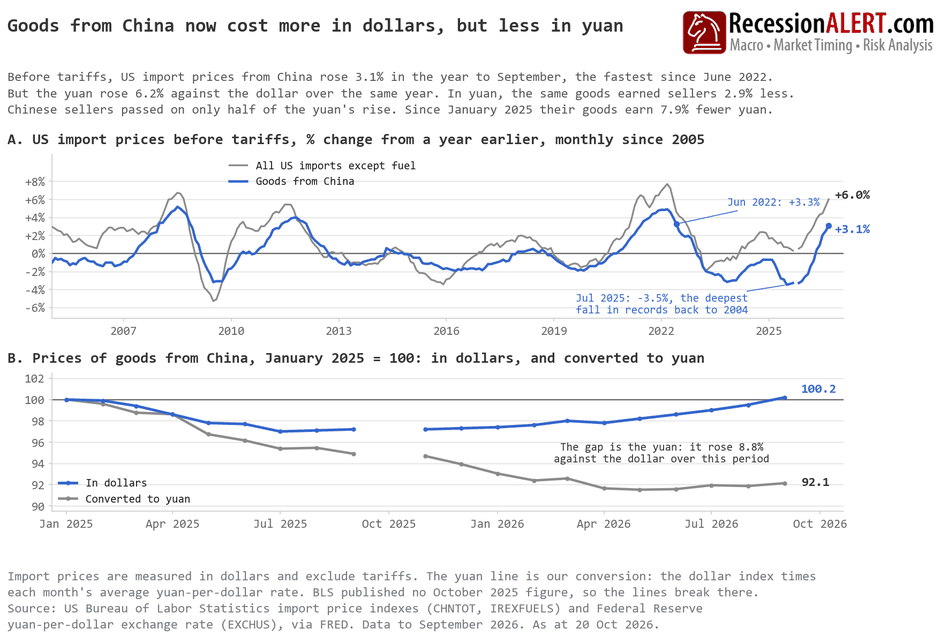
Over the past year Chinese sellers charged America more in dollars and earned fewer yuan. Prices of goods from China, before tariffs, rose 3.1%, the fastest since June 2022, and the rise is broad: plastics +8.6%, apparel +6.6%, machinery +5.3%. But it belongs to the currency. Most of this trade is priced in dollars, so when the yuan climbed 6.2% a factory that held its dollar price brought home roughly 6% fewer yuan per sale; to stand still in its own currency it needed to lift that price by the full 6.2%. Sellers lifted it by half and took the rest as a cut in their own revenue, consistent with an economy growing 4.5%, at the bottom of Beijing’s target, though the figures cannot show the motive. That discounting stopped in late spring: converted to yuan, prices have edged up 0.7% since May, and over the last three months sellers raised dollar prices by more than the yuan’s rise. Even so, China is not the source of America’s goods inflation. All imports except fuel rose 6.0%, about twice as fast, and prices of goods in US shops, excluding food and energy, rose 5.9%. Through 2025 falling Chinese prices helped hold down America’s import bill; for a Fed that raised rates in September, that help is over. Over the year the yuan explains the whole climb — over the summer, it no longer does.
What it means: Shoppers can no longer count on goods from China to hold prices down. At the border, before tariffs, they rose as fast as other imports over the past three months. For the economy, that removes a force that helped hold goods prices down through 2025, just as the Fed tries to pull 3.7% inflation back toward its 2% goal. Watch the next two import-price reports. If across them Chinese sellers go back to raising dollar prices by less than the yuan’s rise, the summer was a pause, not a turn.
Market Intelligence Brief (MIB) Ver. 19.85
For professional investors only. Not investment advice.
© 2026 RecessionALERT.com

Comments are closed.