
MARKET INTELLIGENCE BRIEF (MIB)
Wednesday, September 9, 2026
Brent closed above $100 for the first time since July as Iran fired ballistic missiles at a US base in Jordan — ten of eleven sectors fell, Energy alone gained. Yields rose as stocks fell, the 10-year at 4.850%. Retail diesel set an all-time record two days before CPI. Trump banned Canadian alcohol, dairy and motorcycles. Marvell lifted its two-year outlook to $30bn; Alphabet bought 22 years of Finnish nuclear power. Fed hike odds for next week’s meeting: 61%.
TABLE OF CONTENTS
A. EXECUTIVE SUMMARY
B. MARKET DATA
C. HIGH-IMPACT STORIES (5)
D. MODERATE-IMPACT STORIES (7)
E. ECONOMY WATCH (5)
F. EARNINGS WATCH (0)
G. WHAT’S NEXT
H. CHART OF THE DAY
A. EXECUTIVE SUMMARY -> TOP
The S&P 500 fell 0.48% to 7,636.36 in a session whose defining feature was not the size of the decline but its composition: crude up 3.9%, equities down, and the 10-year up 4.6bp to 4.850% — the stagflationary signature of a supply shock rather than a growth scare. What separates this escalation from the tanker exchanges of recent weeks is the target set: a strike near Kharg Island touches Iran’s export infrastructure itself, and Iran’s ballistic answer at a base on Jordanian soil widens the conflict beyond the Gulf. The market priced it as an inflation event, not a flight to safety — the dollar was flat at +0.04% and gold managed only +0.13%, which is why duration found no bid. Breadth was uniformly poor: ten of eleven sectors fell, Industrials worst at -1.84% and Consumer Cyclical -1.50%, with Energy’s +0.95% the lone gain and Technology’s -0.05% the shallowest decline — a macro flush rather than a rotation.
• Brent broke $100 on the 194th day of the conflict. Brent settled $101.61 (+3.77%), its first close above $100 since July 23; WTI $96.67 (+3.91%). CENTCOM destroyed five Iranian tankers late Tuesday, one near Kharg Island; Iran answered with a ballistic salvo at the Al-Azraq base in Jordan, where 18 of 20 missiles were intercepted and no casualties were reported.
• US retail diesel set an all-time record at $5.9424/gal. Gasoline rose 7.31 cents in a day to $4.2245, against $3.1930 a year ago. The EIA published its September Short-Term Energy Outlook the same morning forecasting Brent near $91 for 2026 and $74 in 2027 — but the modelling closed September 3, before this week’s escalation, and its $5.07 retail diesel forecast already sits 87 cents below the pump.
• Five Section 338 proclamations ban Canadian alcohol, dairy and motorcycles from September 29 — replacing the 50% tariffs rather than stacking on them. A prohibition is a quantity of zero, so the tariff revenue goes with the trade. A scope modification lands September 15, and the President directed removal of Canadian goods from $50 billion of federal procurement schedules with no effective date stated. The proclamation texts have not yet reached the Federal Register.
• The AI-silicon complex decoupled from the tape. Marvell +4.26% to $235.01 after CEO Matt Murphy lifted the combined two-year revenue outlook to $30bn from $23.5bn in December, with more than $15bn of FY27 from data centres against roughly $2bn in 2023. AMD +3.04%, Micron +2.75%. The equipment names went the other way — KLA -3.21%, Lam Research -1.43% — pricing this as AI demand, not a broad capex cycle.
• The 10-year auction drew its strongest demand since 2016 at a 19-year-high yield. Treasury’s $39bn reopening cleared at 4.834% with a 2.71 bid-to-cover and indirect bidders at a near-record 79.2%, stopping through by 1.5bp. That complicates the supply-glut explanation for rising yields — buyers turned up. The 10-year still closed at 4.850%, and the MBA’s 30-year mortgage rate rose to 6.85% with applications down 2.7%.
• The Fed debate is unusually wide one week out. CME FedWatch put September 16 hike odds at 61.4%, up from roughly 50% a month ago, while Pantheon expects core goods at just +0.18% MoM on Friday and the Fed on hold through year-end. Atlanta Fed GDPNow still tracks Q3 at 4.7%. Hawkish pricing, resilient growth, and a supply shock a rate hike cannot fix.
1. The shipping war has become a Federal Reserve problem, and Friday decides which kind. — Diesel is the input price for freight, agriculture and construction rather than a discretionary consumer cost, so a record at the pump propagates into goods prices with a lag measured in weeks. That gives the Fed a supply shock it cannot drill its way out of, two days before August CPI and one week before a decision the market prices at better-than-even odds of a hike. The two forecasts on the table are irreconcilable: the EIA’s baseline says $74 Brent next year on rising US and OPEC supply, the physical market is printing records today. Whichever is right determines whether next Wednesday’s FOMC is looking at a transitory energy spike or an embedded one — and the answer is not available before it has to decide.
2. AI is being priced off a different variable from everything else — and the binding constraint is migrating from silicon to electrons. — On a session when crude broke $100 and ten of eleven sectors fell, Technology finished at -0.05% and the Nasdaq 100 at -0.29%, the two best showings after Energy. Three separate transactions today show how the buildout is being funded and what it now requires: Marvell’s $6.5bn two-year revision, Alphabet’s €13bn Finnish commitment paired with a 22-year offtake for half the Loviisa nuclear plant’s output, and Amazon’s first-ever sterling bond — £4bn placed against more than £12bn of demand, including a 19-year tranche. All three are long-duration commitments that do not reverse if demand disappoints. Alphabet’s is the one to watch: a hyperscaler balance sheet is now the reason a piece of European baseload generation exists past 2030.
3. The sell side has started writing 2027 models on the assumption that this rate level persists rather than mean-reverts. — Six banks relaunched or initiated whole sectors in the first post-Labor-Day session, and the two bearish clusters share one variable. Wells Fargo cut US building materials on higher interest rates and constrained public budgets; Bernstein and Evercore cut Home Depot and Lowe’s on affordability and a delayed recovery. The tell is Martin Marietta, which was upgraded and fell 1.76% anyway — the group is being sold on the theme regardless of the relative call. With the 10-year at 4.850% and mortgages at 6.85%, rate-sensitive cyclicals are re-rating on the multiple rather than on earnings, and Treasury’s first above-floor buyback of the programme — $6bn in the 10-to-20-year sector on Thursday — says the long end’s liquidity is being actively managed at the top of the range, not the bottom.
 — Leading economic indicators. Accurate market forecasts. Apply for membership at join.recessionalert.com
B. MARKET DATA -> TOP
Crude’s surge past $100/bbl on escalating U.S.-Iran strikes near the Strait of Hormuz drove a broad risk-off session — 10 of 11 S&P sectors fell, with Energy the lone gainer (+0.95%). The Russell 2000 led index declines (-1.32%) as small-caps absorbed the brunt of the flight from risk, while the Nasdaq 100’s relative resilience (-0.29%) reflected two offsets: Meta’s +6.55% surge on its new Muse AI agent and a Marvell-led semiconductor read-through rally. Yields rose alongside falling equities — the 10-year’s 4.6bp climb to a fresh multi-month high is a stagflationary signature, not a growth read. Dutch TTF’s 4.2% jump against Henry Hub’s 3.8% decline confirmed the gas disruption is regional: Europe’s Gulf-LNG exposure, not a domestic supply story.
CLOSING PRICES – September 9, 2026:
MAJOR INDICES
All six gauges fell, but unevenly: Russell 2000 (-1.32%) led losses as small-caps bore the risk-off brunt, while Nasdaq 100 (-0.29%) held up best on Meta’s and the chip complex’s idiosyncratic strength. Dow and Transports moved together (-0.77%/-1.09%), confirming broad-based pressure rather than a sector-specific unwind. NYSE Composite’s -0.66% sits between the extremes, consistent with breadth-wide, not concentrated, selling.
| Index | Close | Change | %Move | Why It Moved |
|---|---|---|---|---|
| S&P 500 | 7,636.36 | -37.16 | -0.48% | Broad risk-off as crude topped $100/bbl on escalating U.S.-Iran strikes near the Strait of Hormuz. |
| Dow Jones | 52,380.66 | -405.41 | -0.77% | Tracked the broad risk-off; Industrials and Consumer Cyclical led sector declines. |
| DJ Transportation | 20,573.88 | -226.82 | -1.09% | Fell with Industrials amid the broad risk-off; no transport-specific catalyst identified. |
| Nasdaq 100 | 29,421.55 | -86.15 | -0.29% | Cushioned by Meta’s +6.55% AI-agent launch and a Marvell-led chip rally offsetting broad risk-off selling. |
| Russell 2000 | 2,921.23 | -38.97 | -1.32% | Underperformed as small-caps bore the brunt of the flight from risk. |
| NYSE Composite | 24,311.15 | -161.91 | -0.66% | Broad-based decline consistent with the session’s risk-off tone. |
VOLATILITY & TREASURIES
VIX’s 4.71% jump alongside rising yields — not falling — is an inflation-fear signature, not recession fear: a supply-shock oil spike raises growth-and-inflation risk premia rather than triggering a flight-to-duration bid. The 10-year’s 4.6bp rise outpaced the 2-year’s 3.6bp, a mild bear-steepening consistent with markets pricing sustained inflation risk over near-term Fed action. DXY was essentially flat (+0.04%), confirming the dollar is sitting this one out as a safe-haven asset.
| Instrument | Level | Change | Why It Moved |
|---|---|---|---|
| VIX | 16.46 | +0.74 (+4.71%) | Spiked on the Iran-driven oil shock and broad equity selloff. |
| 10-Year Treasury Yield | 4.850% | +4.6 bps | Rose to its highest level in over 100 sessions as the oil shock lifted inflation-risk premia. |
| 2-Year Treasury Yield | 4.434% | +3.6 bps | Rose in step with the long end on the same inflation-risk repricing. |
| US Dollar Index (DXY) | 98.82 | +0.04 (+0.04%) | Essentially flat; the dollar did not play a safe-haven role today. |
COMMODITIES
Gold’s muted +0.13% shows it sitting out today’s flight from risk — rising yields are capping its safe-haven bid even as equities fall. Silver (+1.31%) and Platinum (+2.67%) outpaced gold by a wide margin, a split that reads as industrial/PGM-specific strength rather than a precious-metals safe-haven trade. Bitcoin’s -0.18% was directionless, tracking neither the equity selloff nor the metals complex.
| Asset | Price | Change | %Move | Why It Moved |
|---|---|---|---|---|
| Gold | $4,444.84/oz | +$5.84 | +0.13% | Muted move as rising yields capped safe-haven demand. |
| Silver | $67.881/oz | +$0.881 | +1.31% | Outpaced gold on industrial/PGM-linked strength. |
| Copper | $6.8543/lb | +$0.0308 | +0.45% | Modest gain, in line with broader industrial-metals firmness. |
| Platinum | $1,902.65/oz | +$49.45 | +2.67% | Led precious metals higher on industrial/PGM-specific demand. |
| Bitcoin | $78,401.0 | -$140.0 | -0.18% | Modest decline; tracked neither equities nor the metals complex. |
ENERGY
WTI and Brent moved in near-lockstep (+3.91%/+3.77%), confirming the Strait of Hormuz disruption is a global supply shock, not a regional one. Natural gas split sharply along geography: Henry Hub fell 3.77% on ample domestic supply and mild weather, while Dutch TTF jumped 4.19% on Europe’s exposure to disrupted Gulf LNG cargoes. Oil rising against falling equities is the stagflationary signature of a supply-side shock, not demand-led growth.
| Asset | Price | Change | %Move | Why It Moved |
|---|---|---|---|---|
| Crude Oil (WTI) | $96.67/bbl | +$3.64 | +3.91% | Topped $96 on escalating U.S.-Iran strikes near the Strait of Hormuz. |
| Crude Oil (Brent) | $101.61/bbl | +$3.69 | +3.77% | Broke back above $100/bbl for the first time since July on the same Hormuz-linked supply threat. |
| Natural Gas (Henry Hub) | $2.806/MMBtu | -$0.110 | -3.77% | Fell on ample domestic supply and mild-weather demand, decoupling from the global crude spike. |
| Natural Gas (Dutch TTF) | $26.92/MMBtu | +$1.08 | +4.19% | Jumped on Europe’s exposure to disrupted Gulf LNG cargoes tied to the Iran conflict. |
S&P 500 SECTORS
Energy was the session’s lone gainer (+0.95%) and also the strongest sector on every longer horizon (+11.28% 3-month, +46.74% 12-month) — today’s oil shock extends, not creates, its leadership. Industrials led declines (-1.84%) despite a +9.66% YTD gain, marking a pullback within an uptrend rather than a trend reversal. The 10-of-11 red sweep confirms a broad macro flush rather than sector rotation.
| Sector | 1-Day | 1-Week | 1-Month | 3-Month | 6-Month | YTD | 12-Month |
|---|---|---|---|---|---|---|---|
| Energy | +0.95% | +0.87% | +6.75% | +11.28% | +14.88% | +41.89% | +46.74% |
| Technology | -0.05% | +2.50% | +1.69% | +5.19% | +29.02% | +25.60% | +33.65% |
| Basic Materials | -0.19% | +1.45% | +2.21% | +7.97% | +3.13% | +19.82% | +32.17% |
| Communication Services | -0.45% | +0.82% | -2.65% | -3.76% | -0.05% | -1.76% | +4.32% |
| Healthcare | -0.51% | -2.87% | -1.69% | +7.32% | +7.95% | +6.87% | +19.41% |
| Financial | -0.74% | +0.27% | -1.06% | +8.97% | +14.93% | +7.69% | +13.32% |
| Consumer Defensive | -0.97% | -2.07% | -3.00% | -2.50% | -4.73% | +4.65% | +2.34% |
| Real Estate | -1.06% | -1.48% | -2.49% | -2.68% | +1.29% | +6.84% | +2.24% |
| Utilities | -1.25% | +0.76% | -1.04% | -3.21% | -7.99% | -0.44% | +4.58% |
| Consumer Cyclical | -1.50% | -1.56% | -6.27% | -2.00% | -0.83% | -6.64% | -6.10% |
| Industrials | -1.84% | +0.64% | -5.50% | -5.05% | -0.33% | +9.66% | +13.59% |
TOP MEGA-CAP MOVERS:
GAINERS
| Company | Ticker | Close | Change | Why It Moved |
|---|---|---|---|---|
| Meta Platforms | META | $653.69 | +6.55% | Launched Muse, a paid AI agent (subscription tiers at $20/$100) — a new AI monetization stream that drew strong investor enthusiasm. |
| Marvell Technology | MRVL | $235.01 | +4.26% | CEO Matt Murphy raised revenue targets (combined two-year outlook to $30B from $23.5B) in a Tuesday-evening CNBC interview, citing accelerating hyperscaler/data-center demand. |
| IBM | IBM | $239.94 | +3.38% | No discrete same-day catalyst identified. |
| Advanced Micro Devices | AMD | $521.09 | +3.04% | Read-through strength from Marvell’s guidance raise lifted the AI-chip complex broadly; no company-specific catalyst identified. |
| Micron Technology | MU | $1,027.77 | +2.75% | Read-through strength from Marvell’s guidance raise and the broader AI-memory rally; no company-specific catalyst identified. |
DECLINERS
| Company | Ticker | Close | Change | Why It Moved |
|---|---|---|---|---|
| Space Exploration Technologies | SPCX | $147.55 | -3.86% | Today marks SpaceX’s third major post-IPO share lock-up expiration, adding to sell pressure. |
| KLA Corp | KLAC | $182.91 | -3.21% | No discrete same-day catalyst identified; semiconductor-equipment names diverged from the AI-memory rally elsewhere in Technology. |
| GE Aerospace | GE | $325.42 | -2.83% | Fell despite announcing an $11.75B acquisition of Consolidated Precision Products — the market read the deal as a dilution/integration-risk negative. |
| Alphabet (Class A) | GOOGL | $330.65 | -2.28% | A federal appeals court allowed roughly 2,400 youth-safety lawsuits against Google and peers to proceed; also faced competitive pressure from Meta’s new AI agent. |
| Alphabet (Class C) | GOOG | $328.38 | -2.09% | Same drivers as GOOGL — youth-safety litigation risk and AI-competition pressure from Meta’s Muse launch. |
— Institutional-grade intelligence for serious investors. Apply for membership at join.recessionalert.comC. HIGH-IMPACT STORIES -> TOP
BEARISH
1. Iran Answers the Tanker Strikes With Ballistic Missiles at a US Base in Jordan and a Claimed Attack on Ten Ships — Brent Closes Above $100 for the First Time Since July
The core facts:US Central Command destroyed five Iranian oil tankers late Tuesday — the M/T Kaviz, Charminar, Horizon 1, Riesco and Derya — four in the Gulf of Oman and one near Kharg Island, Iran’s principal crude export terminal. CENTCOM said crews were directed to abandon ship before the vessels were struck and described the targets as part of a shadow network funding the IRGC. Iran retaliated on Wednesday: ballistic missiles were fired at the Al-Azraq base in Jordan, where Jordan’s military said it engaged 20 missiles and intercepted 18, with two falling in unpopulated areas and no casualties. The IRGC separately claimed it attacked ten ships — two American vessels and eight tankers — attempting to cross what it called a prohibited area of the Strait of Hormuz; that ten-ship figure is an Iranian claim and the damage has not been independently confirmed. Secretary of State Rubio, quoted in copy published Wednesday, said: “Iran continues to try to hit US naval ships, and for every time they do that or try to do that, they’re going to lose tankers.” Brent settled at $101.61/bbl, up 3.77%, its first close above $100 since July 23; WTI settled at $96.67, up 3.91%. This is the 194th day of the conflict. Separately, Ukrainian drones struck the Novorossiysk fuel oil terminal overnight, damaging at least one storage tank at a facility handling roughly 4 million tonnes a year.
Why it matters:Crude and equities moved in opposite directions and yields rose alongside falling stocks — the stagflationary signature of a supply shock rather than a demand impulse. Ten of eleven S&P sectors fell, Energy the lone gainer at +0.95%, and the Russell 2000’s -1.32% led index declines as small-caps absorbed the risk-off. What distinguishes this escalation from the tanker exchanges of the past fortnight is the target set on both sides. Kharg Island handles the overwhelming majority of Iran’s crude exports, so striking a vessel there moves the conflict from interdicting a shadow fleet to touching export infrastructure itself. Iran’s answer — a ballistic salvo at a base on sovereign Jordanian territory — widens the geography beyond the Gulf and draws in a third country’s air defences. Note what the market did not do: the dollar was flat at +0.04% and gold managed only +0.13%, so this was priced as an inflation event rather than a flight to safety, which is precisely why the 10-year rose 4.6bp to 4.850% instead of catching a duration bid. Do not conflate this with the September 5 strike on three tankers — that is a separate, earlier event with its own count.
What to watch:Whether any Iranian retaliation touches a Gulf loading terminal or transit lane rather than a military base — that is the step that would reprice tanker rates and insurance rather than headline crude. Thursday’s EIA weekly petroleum status report at 12:00 ET, postponed from its normal slot by the Labor Day closure, is the first hard inventory read since the escalation.
BEARISH
2. US Retail Diesel Sets an All-Time Record and Gasoline Posts Its Biggest One-Day Gain of the Run — While the EIA, Publishing the Same Morning, Forecasts Brent Back at $91
The core facts:AAA’s national average for diesel printed $5.9424 a gallon on Wednesday, which AAA itself flags as the highest recorded average price for the fuel. Regular gasoline printed $4.2245 against $4.1514 the previous day — a one-day rise of 7.31 cents. The comparatives on the same page are steeper than the daily move suggests: gasoline stood at $4.1203 a week ago, $4.0121 a month ago and $3.1930 a year ago; diesel at $5.6879 a week ago, $5.3082 a month ago and $3.7048 a year ago. The EIA published its September Short-Term Energy Outlook the same morning, and it points the other way. The forecast — completed on September 3, six days before publication, and therefore before this week’s escalation — has Brent averaging around $90/bbl through the second half of 2026, $91/bbl for the year as a whole, and $74/bbl in 2027, falling to $67/bbl by the second half of that year. It has US crude production rising from 13.8 million b/d in 2026 to 14.3 million b/d in 2027, and OPEC liquid fuels recovering from 23.6 to 29.4 million b/d, against 5.7 million b/d of anticipated fourth-quarter shut-ins. Global inventories drew an average 3.9 million b/d in the second quarter with further draws of 3.0 and 1.7 million b/d forecast for the third and fourth, and builds resuming only in the second half of 2027. Month-on-month, the EIA raised its 2026 distillate crack spread 11.6% to $0.94/gal and retail diesel 4.4% to $5.07/gal.
Why it matters:This is the channel through which a Gulf shipping war becomes a Federal Reserve problem, and it is running two days ahead of Friday’s August CPI. Diesel is the input price for freight, agriculture and construction rather than a discretionary consumer cost, so a record here propagates into goods prices with a lag measured in weeks rather than quarters — and the EIA’s own retail diesel forecast, at $5.07 for 2026, already sits 87 cents below where the pump actually is. The juxtaposition is the analytical point: the government’s baseline says this is a spike that mean-reverts to $74 Brent next year on rising US and OPEC supply, while the physical market is printing records today. One of those is wrong, and which one decides whether next week’s FOMC is facing a transitory energy shock or an embedded one. Treat the EIA numbers as a pre-escalation baseline rather than a live view — the modelling closed on September 3, before the five-tanker strike and the Jordan salvo.
What to watch:Friday’s August CPI at 08:30 ET for whether energy pass-through has begun showing up in the print, and the October STEO for whether the EIA revises its $74 Brent 2027 forecast once the September escalation is inside the modelling window.
BEARISH
3. Trump Signs Five Section 338 Proclamations Banning Canadian Alcohol, Dairy and Motorcycles — and the Bans Replace the 50% Tariffs Rather Than Stacking on Them
The core facts:Five proclamations signed Tuesday evening prohibit the importation of a broad list of Canadian goods effective September 29: malt beer, wines, cider, whiskies, vodka and other spirits, non-alcoholic beer, whey products, molasses, and larger-capacity motorcycles and mopeds. The legal authority is Section 338 of the Tariff Act of 1930, which permits the exclusion of goods from countries the administration finds are maintaining or increasing discriminatory practices against US commerce. USTR Ambassador Greer called it a “natural consequence of Canada’s continued discriminatory treatment of crucial American exports.” Three further limbs accompany the bans. Goods already imported but not consumed before September 29 remain dutiable at 50% under Proclamation 11046 rather than falling under the prohibition. A scope modification to the July 20 Section 338 list takes effect September 15, adding and removing products — the added list is not yet reconcilable across sources and should be treated as unsettled until the proclamation texts publish. And the President directed the removal of Canadian-origin products from federal procurement schedules covering $50 billion in federal procurement, conditioned on Canada restoring what the fact sheet calls “full and fair reciprocity for American Farmers and Companies,” with no effective date stated. The proclamation texts are not yet public; as of Wednesday’s session no Canada or Section 338 proclamation had reached the Federal Register.
Why it matters:The replace-rather-than-stack construction is the part the coverage keeps flattening, and it inverts the read for anyone modelling the revenue line. A 50% tariff is a price; a prohibition is a quantity of zero. Substituting the second for the first removes the tariff revenue entirely while eliminating the trade, so this is not an escalation of the same instrument but a switch to a different one — and it is the instrument the USITC conceded last week it has no established practice for operating. Section 338 has sat effectively dormant since 1930, which means there is no body of administrative precedent governing exclusion requests, scope rulings or the mechanics of enforcement at the border. The procurement limb is the more consequential half by dollar value and the vaguer half by drafting: $50 billion of federal purchasing, with a condition for removal but no date for imposition. Arriving the day after Canada’s own $27.6 billion retaliatory tariffs took effect, this closes the loop on a bilateral spiral that now runs in both directions with three weeks before the bans bite.
What to watch:Federal Register publication of the five proclamations, which is what will settle the scope-modification product list and the procurement effective date. September 15 for the scope modification and September 29 for the bans themselves.
BULLISH
4. Marvell’s CEO Lifts the Two-Year Revenue Outlook to $30 Billion From $23.5 Billion — and the AI-Silicon Complex Decouples From a Session in Which Ten of Eleven Sectors Fell
The core facts:Chairman and CEO Matt Murphy told CNBC’s Jim Cramer on Tuesday evening that Marvell now expects roughly $12 billion of revenue this year and $18 billion in fiscal 2027, with more than $15 billion of next year’s total coming from data centres — against roughly $2 billion from that segment in 2023. The comparison that gives the raise its scale is Murphy’s own: in December the company expected about $10 billion this year and $13.5 billion in 2027, so the combined two-year outlook has moved from $23.5 billion to $30 billion in nine months. Murphy described Marvell as “the Switzerland of this entire market” on the grounds that it works across GPU and XPU platforms rather than being tied to one, adding “We work with everybody.” Marvell closed at $235.01, up 4.26%. The read-through carried the complex: AMD closed +3.04% at $521.09 and Micron +2.75% at $1,027.77, with no company-specific catalyst identified for either. Marvell’s multi-year custom-chip supply agreement with Google, reached in August, is context for the outlook rather than part of Tuesday’s news.
Why it matters:The tape is the argument here. On a session when crude broke $100, ten of eleven sectors fell and the Russell 2000 dropped 1.32%, Technology finished at -0.05% and the Nasdaq 100 at -0.29% — the two best showings on the board after Energy. A macro shock that leaves one complex flat is telling you that complex is being priced off a different variable, and a $6.5 billion upward revision to a two-year outlook is that variable. The composition matters more than the headline: data centre revenue going from ~$2 billion to more than $15 billion in four years is a change in what the company is, not a cyclical upturn in what it was. The “Switzerland” framing is also a competitive claim with teeth, because the custom-silicon market’s central question is whether hyperscalers will consolidate on one merchant partner or spread the work — and Marvell winning Google, long regarded as Broadcom’s most important custom-chip customer, is evidence for the second. Note the divergence inside Technology that this leaves behind: semiconductor-equipment names went the other way, with KLA down 3.21% and Lam Research down 1.43%, so the rally is being priced as demand for AI silicon rather than as a broad capex cycle.
What to watch:Whether the equipment names close the gap to the AI-silicon names or the divergence persists — that is the cleanest read on whether the market believes this is a demand story or a capex story. Oracle’s cloud commentary after the bell on Thursday is the first management view of the same question from the compute side.
BULLISH
5. Alphabet Commits €13 Billion to Finland and Buys Half a Nuclear Plant’s Output for 22 Years — Its Largest European Investment and Its First Nuclear Deal Outside the US
The core facts:Announced in the European morning and timestamped 03:24 ET, Alphabet committed €13 billion — about $15.1 billion — to Finnish AI infrastructure over two years, covering new data centres at Kajaani, Muhos and Vaala plus expansion of the existing Hamina site, alongside electricity grid upgrades, clean energy projects and battery infrastructure. Ruth Porat, Alphabet and Google president and chief investment officer, described it as the company’s largest single investment in Europe. In the same announcement Google signed a 22-year power purchase agreement with Fortum covering up to 50% of the output of the Loviisa nuclear plant — starting in 2028 at reduced capacity and at the full 50% for 2030 through 2049. Loviisa runs two VVER-440 units of 507MW each, employs around 580 people and supplies roughly 10% of Finland’s electricity; the contract underwrites approximately €1 billion of Fortum life-extension capital expenditure and, on Fortum’s account, is what allows the plant to run past 2030 at all. It is Google’s first nuclear energy agreement outside the United States. Fortum shares rose on the announcement. Alphabet’s own shares fell on the session, GOOGL closing at $330.65 (-2.28%) and GOOG at $328.38 (-2.09%).
Why it matters:The power contract is the more consequential half and it is the half that will be copied. A 22-year offtake for half a reactor’s output is not a procurement decision, it is a financing decision — it converts a plant that had no economic case beyond 2030 into one with a funded life to 2050, which means a hyperscaler’s balance sheet is now the reason a piece of European baseload generation continues to exist. That is a different relationship between compute and the grid than the renewables PPAs of the past decade, where the buyer took output from an asset that was going to be built anyway. For a portfolio manager the read-through runs two ways: it puts a floor under the utilities and nuclear operators that can offer twenty-year firm output, and it sets a precedent for how AI capex will be recognised, because a €13 billion two-year commitment with an embedded twenty-two-year power liability is not a line item that reverses if demand disappoints. Note the tension against the session’s other AI story — Marvell’s outlook raise says the silicon demand is real, and this says the constraint is increasingly electrons rather than transistors.
What to watch:Whether Microsoft, Amazon or Meta announce a comparable non-US nuclear offtake in the next two quarters — that is what turns this from a Finnish deal into a template. Alphabet’s next capital expenditure guidance for how much of the €13 billion lands inside the current guide.
— Quantifying recession risk so you don’t have to guess. Apply for membership at join.recessionalert.comD. MODERATE-IMPACT STORIES -> TOP
BEARISH
6. EU General Court Upholds the Prohibition of Booking’s €1.63 Billion eTraveli Deal in Its Entirety — and Rejects the Argument That US and UK Clearance Should Have Mattered
The core facts:The EU General Court, sitting in extended formation of five judges, dismissed Booking Holdings’ action against the European Commission’s 2023 prohibition of its €1.63 billion acquisition of eTraveli in its entirety. On the reported account of the judgment, the Court endorsed the Commission’s “reverse leveraging” theory of harm — that adding eTraveli’s flight online travel agency to Booking’s dominant hotel OTA would build an ecosystem rivals could not contest — and agreed that Booking’s proposed remedy of displaying rival hotel offers at flight check-out was neither sufficient nor enforceable. Booking’s argument that the UK Competition and Markets Authority and the US Federal Trade Commission had both cleared the transaction was rejected. Booking closed at $173.43, down 3.81%, having traded near $171.13 and about 5.1% lower intraday; market capitalisation is $130.31 billion. The judgment text itself has not been read for this report — the characterisation of the reasoning rests on secondary reports and a case note, and should be treated as provisional until the text is available.
Why it matters:The rejected argument is the transferable part. A US acquirer that clears both the FTC and the CMA and is still blocked in Brussels, with the Court declining to treat those clearances as relevant, is being told that transatlantic deal risk does not net out across regulators — each jurisdiction prices independently and the binding constraint is whichever is strictest. That raises the discount applied to any large US platform acquisition with European revenue, and it does so at a moment when the same companies are being asked to fund AI capital expenditure through acquisitions rather than internal build. The ecosystem theory is the second transferable element: the harm the Commission identified was not overlap in a market but the accumulation of adjacent positions, which is a theory that reaches almost any platform bolt-on. Note that the sunk cost here is already three years old — the practical question for Booking is not this deal but what the ruling implies about the next one.
What to watch:Whether Booking appeals to the Court of Justice, which would set a two-to-three year clock on a final answer, and whether the Commission cites the reverse-leveraging endorsement in its next platform-acquisition review.
UNCERTAIN
7. Amazon Prices Its First-Ever Sterling Bond — £4 Billion Across Four Tranches Against More Than £12 Billion of Demand
The core facts:Amazon priced a four-part sterling bond totalling £4 billion, about $5.43 billion, with roughly £1 billion in each of the 3-, 6-, 12- and 19-year tranches. Reported demand exceeded £12 billion. Initial price guidance ran from around 70 basis points over gilts at three years to around 110 basis points at nineteen. The prospectus supplement filed with the SEC confirms four series of sterling notes with semi-annual coupons beginning in 2027, and a pricing term sheet was filed the same day. Amazon closed at $252.40, down 1.78%, with a market capitalisation of $2.72 trillion. Two pieces of context bear on how this is read and neither is part of Wednesday’s news: the mandate was reported on Tuesday, and Amazon’s July 2026 statement that it would not issue further debt in 2026 referred specifically to the US investment-grade market.
Why it matters:The July statement is what makes this interesting rather than routine. A company that told the market it was finished issuing in dollars this year has opened a new currency instead, which is a distinction that only matters if you were modelling the funding requirement rather than the venue — and three times’ oversubscription says the sterling market was happy to be the venue. This is the hyperscaler-issuance question that has been running through the rates discussion all week, viewed from the supply side: the argument that Treasury and hyperscaler issuance rather than the Fed is what is pushing yields higher gains a data point here, and simultaneously loses one, because the demand was plainly there at these spreads. The 19-year tranche is the one worth noting — a nineteen-year sterling liability from a US technology company is a duration bet on AI infrastructure economics holding up for two decades, which is the same wager Alphabet made in Finland this morning through a power contract rather than a bond.
What to watch:Whether Microsoft, Alphabet or Meta follow into sterling or euro issuance before year-end, which would confirm that the constraint on hyperscaler funding is US market capacity rather than total appetite.
UNCERTAIN
8. Enbridge Buys Tallgrass’s Crude Transportation Arm From Blackstone for $2.55 Billion and Funds It the Same Day With a C$2.6 Billion Bought Deal — Blackstone Falls 3.66%
The core facts:Enbridge agreed to acquire Tallgrass’s crude transportation business from Blackstone for US$2.55 billion in cash: 75% of the Pony Express Pipeline, a 1,050-mile Rockies-to-Cushing crude system with direct access to roughly 500,000 barrels per day of refining capacity, and 51% of the Powder River Gateway system, together around 240,000 b/d. On the same day Enbridge launched a C$2.6 billion bought-deal common share offering — 38,900,000 shares at C$66.85, with a 15% over-allotment option that would take it to about C$3.0 billion, closing expected on or about September 14. The preliminary prospectus states that proceeds will partly fund announced acquisitions. Enbridge closed at $50.15, down 0.65%, market capitalisation $110.49 billion; Blackstone closed at $129.07, down 3.66%, market capitalisation $160.54 billion. One figure in the prospectus belongs to an earlier step and not to this one: the Salt Creek Midstream crude gathering acquisition at US$600 million was announced on August 26.
Why it matters:Buying the asset and printing the equity to pay for it on the same morning removes the financing uncertainty that usually sits between announcement and close, and it also removes any ambiguity about who bears the dilution — at C$66.85 the issue is being placed at a discount into a market that had crude up 3.9% on the day, which is about as favourable a tape as a midstream equity raise gets. The strategic logic is direct: Pony Express delivers Rockies barrels into Cushing, which is where Enbridge’s existing Mainline system does not reach, so this buys a corridor rather than incremental capacity on one it already owns. Blackstone’s 3.66% decline on the day it monetised an infrastructure position is the more curious half and no company-specific catalyst was established for it — read it as a sector move rather than a verdict on the sale, since the broader financial sector fell 0.74% and the tape was risk-off throughout.
What to watch:Closing of the bought deal on or about September 14, and whether Enbridge’s next guidance absorbs the acquisition within existing leverage targets or signals a further equity requirement.
BEARISH
9. Six Banks Relaunch Whole Sectors in One Post-Labor-Day Session — Building Materials and Athletic Softlines Both Re-Rated Bearish on the Same Day
The core facts:At least six banks relaunched, transferred or initiated coverage of entire sectors on Wednesday: UBS in life-science tools, BMO in softlines, Piper Sandler in power and renewables, Wells Fargo in building materials, Scotiabank in ride-hail and delivery, and Leerink in generics and specialty pharma. Two clusters carried a stated shared rationale. Wells Fargo re-rated US building materials on an “increasingly cautious” 2027 view citing leaner government spending, higher interest rates, constrained state budgets, uncertain federal infrastructure funding and limited data-centre benefit: Vulcan Materials went to Underweight from Equal Weight with the target cut to $254 from $305, Martin Marietta to Overweight from Equal Weight with the target raised to $609 from $581, and Eagle Materials and Amrize both to Equal Weight from Overweight. Vulcan closed at $249.89, down 3.26% — through the new target — and Martin Marietta, the upgraded name, fell with the group at $502.99, down 1.76%. Separately, Bernstein cut Home Depot to $344 from $354 and Lowe’s to $254 from $261 on a delayed home-improvement recovery and homeowner affordability, with Evercore ISI cutting Lowe’s to $220 from $230 the same day; Home Depot closed -1.04% and Lowe’s -1.10%. BMO launched softlines bearish on athletic, initiating Nike, Lululemon, Deckers and Dick’s all at Underperform, with Nike given a $30 target implying roughly 20% downside against its $37.35 close. The one clear upgrade of the day came from UBS, which relaunched life-science tools under Doug Schenkel and raised Thermo Fisher to Buy from Neutral with the target to $730 from $540, saying the company is “positioned for a durable return to 5%-6%-plus organic growth in 2027.” One widely syndicated version of the Wells Fargo call reported Vulcan, Eagle Materials and Amrize as all cut to Underweight; three independent surfaces agree only Vulcan went to Underweight, and that version should not be used.
Why it matters:Coverage relaunches cluster after Labor Day for calendar reasons, so the timing is not a signal — but the direction is, because it is the first time the sell side has repriced whole sectors with a 2027 view in hand rather than a 2026 one. The two bearish clusters share a variable, and it is the same variable: rates. Building materials are cut on higher interest rates and constrained public budgets, home improvement on affordability and a delayed recovery, and BMO’s Westlake downgrade the same day cites mortgage rates at new highs explicitly. With the 10-year at 4.850% and the 30-year mortgage rate at 6.85%, the sell side is now writing next year’s models on the assumption that this level persists rather than mean-reverts. Note what happened to Martin Marietta: it was upgraded and still fell 1.76%, which says the group is being sold on the theme regardless of relative calls — the cheapest evidence available that the market is trading the rate view rather than the stock view.
What to watch:Whether other banks follow Wells Fargo into 2027 building-materials cuts over the next fortnight, and Thursday’s 30-year bond auction for whether the long-end level these models now assume is itself stable.
UNCERTAIN
10. Treasury Announces Its First Long-End Buyback Above the $4 Billion Floor — a $6 Billion Liquidity-Support Operation for Thursday
The core facts:Treasury’s tentative schedule of buyback operations, published Wednesday, sets a liquidity-support operation for Thursday between 13:40 and 14:00 ET with settlement on Friday, covering nominal coupons from 10 to 20 years across a maturity range of September 11, 2036 to September 10, 2046, with a maximum purchase of $6 billion. That is the first operation above the $4 billion floor. The floor itself, the two-sector structure and the “effective September 9 through November 4, 2026” window were all set out in Treasury’s August 19 release and are context for Wednesday’s announcement rather than facts established by it. Two claims circulating alongside this should not be carried: that the Treasury Secretary “executed” an intervention on Wednesday — this is an announcement of a Thursday operation, not an operation — and that the market found the size disappointing and that this drove the day’s rise in yields, which is uncorroborated. Separately, and on a different instrument, Treasury ran a $12.5 billion cash-management buyback in short coupons during Wednesday’s session, but that operation was announced on Tuesday.
Why it matters:Liquidity-support buybacks are a plumbing tool rather than a policy one — Treasury repurchases off-the-run issues to improve secondary-market functioning, not to influence the level of yields — but the size is a disclosure about conditions in the 10-to-20 year sector, which is the part of the curve that has been under the most pressure. Going above the floor for the first time in the programme’s window is Treasury saying that segment needs more support than the minimum, and it arrives on a day when the 10-year closed at 4.850%, up 4.6bp, at its highest level in more than a hundred sessions. The temptation is to read this as a response to Wednesday’s move; resist it, because the schedule is published on a set cadence and the operation was sized before the session’s close. What it does establish, with no inference required, is that the long end’s liquidity is being actively managed at the top of the announced range rather than the bottom, one week before an FOMC meeting the market gives better-than-even odds of delivering a hike.
What to watch:Thursday’s operation results for how much of the $6 billion maximum is actually taken up, and Thursday’s 30-year bond auction at 13:00 ET, which lands the same afternoon.
BULLISH
11. Analog Devices Agrees to Buy Alif Semiconductor for Up to $1.6 Billion — Buying Edge-AI Silicon Rather Than Building It
The core facts:Analog Devices agreed to acquire Alif Semiconductor, a maker of AI-native microcontrollers and fusion processors, for $1.35 billion in upfront cash plus up to $200 million of contingent consideration — a headline value of $1.6 billion. Both boards have approved and the close is expected in the fourth quarter of calendar 2026, subject to expiry of the Hart-Scott-Rodino waiting period. Analog Devices closed at $365.07, up 0.51%, with a market capitalisation of $176.90 billion; the deal was announced through the company’s own newsroom.
Why it matters:The interesting thing about this deal is where it sits relative to the day’s other AI news. Marvell’s outlook raise and Alphabet’s Finnish build are both about the data centre — training and inference at hyperscale, measured in billions of dollars and gigawatts. This is the opposite end: microcontrollers that run inference on the device, in the sensor, at the industrial edge, which is Analog Devices’ existing customer base rather than a new one. Paying $1.6 billion to buy that capability rather than develop it says the incumbent analogue and mixed-signal franchises judge they are behind on the digital-AI layer and that the window to catch up internally has closed. For a sector that has spent two years being valued almost entirely on data-centre exposure, a credible edge-AI attach rate is the second leg of the thesis, and it is the leg with far more units and far lower average selling prices. The contingent structure — $200 million of the consideration held back — is worth noting as a signal about how much of the value is in shipped product versus roadmap.
What to watch:Expiry of the HSR waiting period and a Q4 close, and whether Texas Instruments, STMicroelectronics or NXP respond with edge-AI acquisitions of their own.
BULLISH
12. Apple Puts Quest Diagnostics Lab Ordering Inside the Health App at $119 a Panel
The core facts:Apple and Quest Diagnostics agreed to make laboratory testing orderable directly inside the Apple Health app. Users will be able to buy a Quest panel covering more than 50 biomarkers for $119, fulfilled at approximately 2,000 Quest patient service centres across the United States, with results returned into Apple Health and third-party clinician review included at no additional charge. The service is due to launch later in 2026. Apple’s market capitalisation is $4.602 trillion; Quest’s is $25.98 billion.
Why it matters:Apple has spent a decade accumulating health data from sensors it manufactures. This is the first time it is selling a clinical service through the app, which changes the category from device feature to transaction — and it does so without Apple taking on any laboratory, phlebotomy or regulatory infrastructure of its own. The $119 price point is the number to hold onto: it is set well below what an uninsured consumer typically pays for a comparable panel and it is a cash-pay product, which routes around insurers entirely. That is the same disintermediation pattern that direct-to-consumer testing companies have pursued for years without distribution; Apple supplies distribution at a scale none of them could reach. For Quest the arithmetic is volume against price, and for the diagnostics sector the question is whether cash-pay consumer testing at this price becomes the reference point that insured pricing has to answer to. Note the regulatory adjacency: the FTC rescinded its 2021 policy statement on breaches by health apps and connected devices the same day, on the basis that its 2024 Health Breach Notification Rule already covers them.
What to watch:The launch later in 2026 and whether the panel list expands beyond 50 biomarkers, and whether LabCorp announces a comparable arrangement with Google or Samsung.
— Separating signal from noise since 2007. Apply for membership at join.recessionalert.comE. ECONOMY WATCH -> TOP
Oil’s push back above $100/bbl on the Strait of Hormuz conflict reopened the Fed’s stagflation dilemma a week before its September 16 decision: a rate hike cannot produce more oil, yet Moody’s and Goldman have pushed recession odds toward 50% and 30% respectively even as CME FedWatch prices a 61.4% chance of a hike. The signals cut every way — Atlanta Fed’s GDPNow still tracks a robust 4.7% for Q3, today’s 10-year auction drew the strongest foreign demand since 2016 despite a 19-year-high yield, and Pantheon still expects Friday’s CPI to keep the Fed on hold. Mortgage rates climbed to 6.85% regardless, and API data confirmed oil’s surge is risk premium, not a supply crunch.
Oil’s Return Above $100 Reopens Fed’s Stagflation Dilemma as Recession Odds Climb (Multiple Outlets, Sept 9, 2026)
What they’re saying:WTI and Brent both surged more than 3.7% Wednesday, with Brent breaking back above $100/bbl for the first time since July, as U.S.-Iran strikes near the Strait of Hormuz threaten regional oil flows. Moody’s Analytics now puts 12-month U.S. recession odds near 50%, while Goldman Sachs has raised its own estimate to roughly 30%.
The context:A rate hike cannot produce more oil from a blockaded strait, but the Fed’s inflation mandate is complicated by a supply-driven price shock — the dilemma Chair Warsh flagged at Jackson Hole. CME FedWatch data put the odds of a 25-basis-point hike at the September 16 meeting at 61.4% Wednesday, up from roughly 50% a month ago, even as Atlanta Fed’s GDPNow model tracks a still-robust 4.7% for Q3 — a split between hawkish market pricing and resilient growth data that leaves no consensus read heading into next week’s decision.
What to watch:The September 16 FOMC decision and accompanying Summary of Economic Projections; Friday’s August CPI print for whether energy pass-through shows up in the inflation data.
10-Year Treasury Auction Draws Strongest Demand Since 2016 as Yield Hits 19-Year High (Multiple Outlets, Sept 9, 2026)
What they’re saying:The Treasury’s $39 billion reopening of the 10-year note drew a bid-to-cover ratio of 2.71 — the highest since April 2016 — with indirect bidders (foreign central banks and institutions) taking a near-record 79.2% of the offering. The auction cleared at 4.834%, a level the 10-year hasn’t touched since August 2007, and “stopped through” the pre-auction when-issued yield by 1.5 basis points.
The context:Strong demand at a multi-decade-high yield complicates yesterday’s narrative that heavy Treasury and hyperscaler issuance is the primary force pushing yields higher — today’s result shows buyers still willing to absorb supply even as the 10-year closed the session at 4.850%, up 4.6 bps, per today’s market data.
What to watch:Thursday’s 30-year bond auction for whether demand strength extends across the curve.
Pantheon: Softer Core CPI Should Keep the Fed on Hold Despite Hawkish Market Pricing (Pantheon Macroeconomics via Seeking Alpha, Sept 9, 2026)
What they’re saying:Pantheon Macroeconomics expects Friday’s August CPI to show core goods prices rising a modest 0.18% month-over-month — Apple’s hardware price increases a factor — offset by continued softness in services, including a projected 1.5% drop in airfares and a 1.0% decline in accommodation prices. The firm expects the Fed to hold rates steady through year-end.
The context:The forecast sits at odds with market pricing that has pushed September hike odds to roughly 61-74% (per CME FedWatch and Polymarket) and with Deutsche Bank’s call yesterday for two more hikes to 4.1% — underscoring how unsettled the inflation outlook remains one week before the Fed’s decision.
What to watch:Friday’s August CPI release (core and headline expected +0.2% and +0.4% MoM respectively) for whether goods or services inflation dominates the print.
30-Year Mortgage Rate Climbs to 6.85% as 10-Year Yield Hits Fresh Multi-Month High (MBA, Sept 9, 2026)
What they’re saying:The MBA’s average 30-year fixed mortgage rate rose to 6.85% for the week ended September 5, up from 6.79% the prior week, tracking the 10-year Treasury yield’s climb to 4.850% (+4.6 bps) on today’s oil-driven flight from risk, per today’s market data. Mortgage applications fell 2.7% on the week.
The context:Higher borrowing costs compound an already soft housing backdrop — the MBA’s own purchase index eased to 157.5 from 157.8 — and arrive just as Thursday’s Existing Home Sales data (expected 3.98M) will show whether affordability pressure is denting closings.
What to watch:Thursday’s Existing Home Sales report; whether mortgage rates track higher still if the 10-year continues climbing on oil-shock inflation risk.
API Reports Smaller-Than-Expected Crude Draw, Underscoring Oil’s Rally Is Risk Premium, Not Fundamentals (API, Sept 9, 2026)
What they’re saying:The API reported a 300,000-barrel draw in U.S. crude inventories for the week ended September 5, well short of the 1.3 million-barrel draw expected and a much smaller drawdown than the prior week’s 2.6 million barrels.
The context:A smaller-than-expected inventory draw would typically pressure crude prices lower, yet WTI closed up 3.91% to $96.67/bbl today, per today’s market data — confirmation that today’s oil surge is a geopolitical risk-premium event tied to the Strait of Hormuz conflict, not a fundamentals-driven supply squeeze.
What to watch:Thursday’s EIA weekly petroleum status report — the more closely watched government data series — for confirmation of the inventory picture.
— Know the probability before the market prices in the risk. Apply for membership at join.recessionalert.comF. EARNINGS WATCH -> TOP
YESTERDAY AFTER THE BELL (Markets Reacted Today)
No major earnings yesterday after the bell from companies with >$100B market cap. The largest after-hours reporter on Tuesday, September 8 was Casey’s General Stores (CASY) at a $23.28B market capitalisation, roughly a quarter of the inclusion threshold, followed by ServiceTitan ($5.45B), Braze ($2.67B), Braveheart Bio ($2.21B), InnovAge ($1.50B), Mission Produce ($1.19B) and Apnimed ($1.17B). The prior trading day’s calendar was re-fetched live for this report and returned eighteen rows against the fifteen recorded at the time; every name that arrived late sits below $2.3B, so no reporter appeared near the threshold after the fact. The two ADRs on the date, Waterdrop ($286.30M) and Canaan ($221.82M), fail the size test independently, so nothing was excluded on ADR grounds.
TODAY BEFORE THE BELL (Markets Already Reacted)
No major earnings before the bell from companies with >$100B market cap. The largest morning reporter was Sunbelt Rentals Holdings (SUNB) at $30.10B, which beat on both lines and closed up 5.91%, followed by SailPoint ($9.97B), Chewy ($8.50B, -10.83%), Core & Main ($8.05B) and Jersey Mike’s Subs ($7.11B).
TODAY AFTER THE BELL (Markets React Tomorrow)
No major earnings after the bell from companies with >$100B market cap. The largest after-hours reporter was Cooper Companies (COO) at $12.38B, followed by AeroVironment ($7.16B), Navan ($6.58B), American Eagle Outfitters ($2.83B) and Wealthfront ($1.41B). No name at or above $100B reports in either bucket today, and no ADR reached the threshold, so nothing was excluded on ADR grounds. The week’s qualifying reporters arrive tomorrow after the close.
WEEK AHEAD PREVIEW:
Q2 2026 earnings season is effectively complete at 97% reported. The next five business days — September 10, 11, 14, 15 and 16 — were each fetched individually for this report, and they contain exactly two reporters at or above $100 billion, both after Thursday’s close.
Oracle (ORCL) — AMC, Thursday September 10 — $465.57B market cap; consensus $1.74 EPS on $19.13B revenue. Key focus: FY2027 guidance of 34% constant-currency revenue growth with Q1 cloud revenue guided up 58-64%, and the RPO and OCI gross-margin disclosures. Oracle sits on the compute side of the software-versus-silicon split that has run through this week’s tape, with a foot in both camps, which makes Thursday’s cloud commentary the first management view of that divergence. Sell-side positioning into the print is unusually split: Scotiabank cut its target to $215 from $241 on Wednesday while keeping Sector Outperform, and Citizens JMP reiterated Market Outperform at $285 the same day.
Adobe (ADBE) — AMC, Thursday September 10 — $101.31B market cap; consensus $6.08 EPS on $6.69B revenue. A borderline name, 1.31% above the $100B floor after a fourth consecutive session of market-cap decline. Key focus: Creative freemium monthly active users above 90 million and Firefly ARR near $300 million against a 10.2% FY2026 ending-ARR growth target. This is the first print since Adobe named Anil Chakravarthy president and chief executive effective December 1, announced September 3, with Shantanu Narayen moving to executive chair — nine days before the report and with the stock inside an active enterprise-software de-rating. Stifel raised its target to $225 from $200 on Wednesday while keeping Hold, a target that still sits roughly 12% below the $254.86 close.
No company above $100 billion market capitalisation reports on Friday September 11 (largest: Kroger at $34.58B, alongside the August CPI print), Monday September 14 (largest: Kestra Medical at $1.41B), Tuesday September 15 (largest: Trip.com ADR at $25.46B, the first day of the FOMC meeting) or Wednesday September 16 (largest: Lennar at $19.41B, FOMC decision day). Q3 2026 earnings season begins in mid-October.
— US market commentary trusted by family offices and institutions. Apply for membership at join.recessionalert.comG. WHAT’S NEXT -> TOP
UPCOMING RELEASES:
| Date | Event | Why It Matters |
|---|---|---|
| Thu, Sep 10 | PPI MoM (exp. +0.4%, prior 0%); Core PPI MoM (exp. +0.3%, prior +0.2%) | The first inflation print of the week and the one that sees energy pass-through earliest — producer prices absorb diesel and crude before consumer prices do. A hot headline against a contained core would support the transitory read; both hot puts the September 16 hike case beyond argument. |
| Thu, Sep 10 | EIA Weekly Petroleum Status Report, 12:00 ET (crude prior -4.45M; gasoline prior -1.173M) | The first hard government inventory read since the escalation, delayed from its usual slot by the Labor Day closure. API reported only a 300,000-barrel draw against 1.3 million expected — if EIA confirms, it establishes that this rally is risk premium rather than a physical squeeze, which is the difference between a spike that fades and one that does not. |
| Thu, Sep 10 | 30-Year Bond Auction, 13:00 ET; Treasury liquidity-support buyback, 13:40–14:00 ET ($6bn max, 10–20yr) | Today’s 10-year drew a 2.71 cover and 79.2% indirect participation at a 19-year-high yield; the 30-year tests whether that demand extends to the long end. The buyback is the first of the programme above the $4bn floor, so the take-up is a direct disclosure about liquidity conditions in the sector under most pressure. |
| Thu, Sep 10 | Existing Home Sales (exp. 3.98M, prior 4.06M); Initial Jobless Claims (exp. 205K, prior 206K) | Housing is the cleanest read on whether 6.85% mortgages are denting closings rather than just applications — the MBA purchase index has already eased and Wells Fargo cut building materials on exactly this thesis today. Claims remain the highest-frequency check on whether the labour market is absorbing the shock. |
| Fri, Sep 11 | August CPI, 08:30 ET — Headline MoM exp. +0.4% (prior +0.1%), YoY exp. 3.4%; Core MoM exp. +0.2%, Core YoY exp. 2.4% (prior 2.5%) | The most consequential release before the FOMC and the arbiter of the week’s central disagreement. Pantheon models core goods at just +0.18% with airfares -1.5% and accommodation -1.0% offsetting, and expects a hold; the market prices a 61% hike. Note the expected headline-core gap: a +0.4% headline against a +0.2% core is an energy print, and how the Fed weights that split is the whole question. |
| Fri, Sep 11 | Michigan Consumer Sentiment, prelim (exp. 51.0, prior 51.7) | The first sentiment reading taken with gasoline at $4.22 and diesel at a record. The inflation-expectations components matter more than the headline this month — an un-anchoring there is the argument for the Fed acting against a supply shock rather than looking through it. |
| Tue, Sep 15 | Section 338 scope modification takes effect (not a calendar release) | The July 20 Section 338 product list changes on this date, adding and removing goods. The added list is not yet reconcilable across sources and the proclamation texts have not reached the Federal Register — publication is what will settle scope, and it lands two weeks before the Canadian import bans bite on September 29. |
| Tue, Sep 15 | NY Empire State Manufacturing Index (prior 20.60); ADP Weekly Employment Change | Empire is the first regional survey covering the escalation period and its prices-paid subindex is an early read on how quickly input costs are moving through manufacturing. Prior at 20.60 leaves ample room to disappoint if the energy shock is already biting. |
| Wed, Sep 16 | FOMC Rate Decision, Summary of Economic Projections and Press Conference (prior 3.75%) | The event the week is built around. CME FedWatch prices a 25bp hike at 61.4%, up from roughly 50% a month ago, against GDPNow tracking Q3 at 4.7% and Pantheon calling a hold through year-end. The SEP dots matter more than the decision itself: they are the first published view of whether the Committee treats the oil shock as transitory. |
| Wed, Sep 16 | Retail Sales MoM (prior -0.6%); Control Group MoM (prior -0.4%); Ex-Autos MoM (prior -0.3%) | Lands the same morning as the Fed decision, and follows a negative print. Consumer Cyclical was the second-worst sector today at -1.50%; a second consecutive contraction with gasoline at $4.22 would say the energy shock is already crowding out discretionary spending rather than merely threatening to. |
| Wed, Sep 16 | NAHB Housing Market Index (prior 35); MBA 30-Year Mortgage Rate (prior 6.85%) | Builder sentiment at 35 is already well below the neutral 50 line. With the 10-year at a multi-decade-high yield, the mortgage series is the transmission channel to watch — it is the variable behind both the building-materials and home-improvement downgrades issued today. |
KEY QUESTIONS:
1. If Friday’s CPI delivers the expected split — a +0.4% headline against a +0.2% core — does the Committee hike into an energy shock on Wednesday, or does the core reading give it the cover to hold and let the supply side resolve itself?
2. Today’s 10-year auction drew its strongest demand since 2016 at a 19-year-high yield, and Treasury simultaneously scheduled its first above-floor buyback in the 10-to-20-year sector. Is the long end well bid or is it being supported? Thursday’s 30-year auction and the buyback take-up answer that in the same afternoon.
3. AI silicon rallied while semiconductor equipment fell, on a day the rest of the tape was flushed. Does that divergence close — confirming a broad capex cycle — or does it persist, meaning the market is paying only for demand that is already booked?
— US market commentary trusted by family offices and institutions. Apply for membership at join.recessionalert.comH. CHART OF THE DAY -> TOP
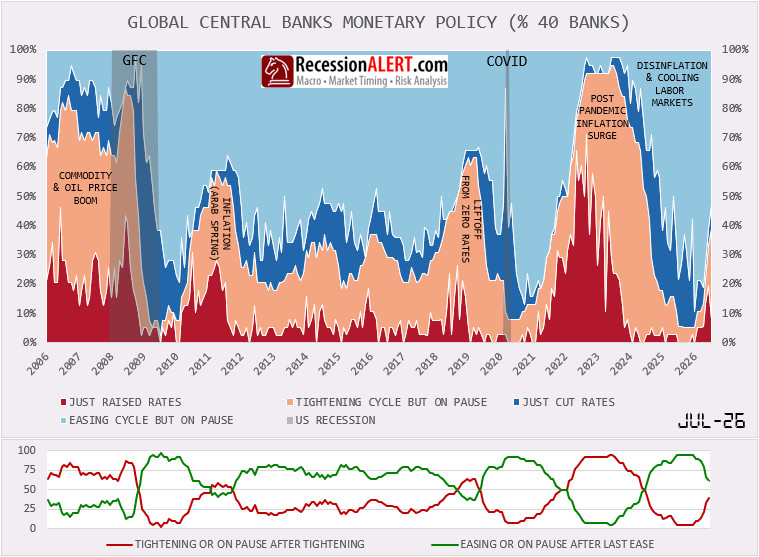
Money that once had little reason to stay home is starting to get one, and that is what changes for an American portfolio. Cash in Frankfurt paid zero from 2016 to 2022 and in Tokyo it paid less than zero — anyone with savings there had a reason to look abroad. That direction has reversed, and not from Washington. The European Central Bank raised in June to 2.25%, its first increase since September 2023, and the Bank of Japan raised to 1.00%, the most it has charged since August 1995. The Federal Reserve’s last move was a cut, in December 2025, and it has held at every meeting since. The gap narrowed from the far end. Notice what the chart does not say. The tightening side — banks that have just raised, plus those waiting after raising — is 38.9%, fourteen of thirty-six reporting banks. Twenty-two are still easing or waiting after a cut, 61.1%, and the Fed sits among them, alongside Britain, China, India and Canada. Seven raised in June, the biggest cluster since September 2023, and the tightening side has climbed 33.6 points in six months — a six-month move only 2022 has beaten. But these are quarter-point steps, from ground never taken back to zero. Same speed, shorter strides, higher start. Nothing changed in Washington. The reason to leave home did.
What it means: a change in the setup, not a trade. Japan is the piece that actually moved — savers there were paid almost nothing for thirty years and now get 1.00%. The euro area’s 2.25% is still exactly half its 2023 peak. The American side gets its own reading next Wednesday, when the Fed publishes fresh projections; if Tokyo starts cutting again, this reverses.
Market Intelligence Brief (MIB) Ver. 19.59
For professional investors only. Not investment advice.
© 2026 RecessionALERT.com

Comments are closed.