
MARKET INTELLIGENCE BRIEF (MIB)
Wednesday, November 18, 2026
Fed hawks spoke in unison: Waller floated a half-point December hike to “shock people,” and October minutes showed a couple of officials open to more than 25 bps. The dollar hit a 19-month high, per Reuters, as gold sank 3.52% below $3,800 and copper fell 5.27%. UNH plunged 10.21% on the CMS audit proposal, dragging the Dow down 1.11%. Pending home sales fell 4.7%, more than double forecasts. Anthropic priced its IPO at $83, above range, ahead of Thursday’s debut.
TABLE OF CONTENTS
A. EXECUTIVE SUMMARY
B. MARKET DATA
C. HIGH-IMPACT STORIES (6)
D. MODERATE-IMPACT STORIES (6)
E. ECONOMY WATCH (5)
F. EARNINGS WATCH (4)
G. WHAT’S NEXT
H. CHART OF THE DAY
A. EXECUTIVE SUMMARY -> TOP
Three Fed officials and the October minutes pointed toward further hikes, moving the December debate from whether to hike to how much, yet CME FedWatch puts only a 7.3% chance on the half-point move Governor Waller floated, leaving the front end room to reprice. The pressure showed in a 2-year up 1.5 bps against a 10-year down 3.7 bps, a tightening-style flattening, and in the dollar’s highest close since at least April 15, which sent gold, silver, copper and platinum to their lowest closes over that span. Health policy, not the Fed, did the most index damage: UnitedHealth’s 10.21% slide on the CMS audit proposal cut the Dow 1.11%, while the S&P 500 slipped 0.23% for a fifth straight loss. Breadth was split rather than weak, with six of 11 sectors up, led by Consumer Cyclical (+1.77%), while Energy (-3.09%), Basic Materials (-2.87%) and Healthcare (-1.82%) each fell on its own shock: oil inventories, the dollar and Medicare audits.
• Fed hawks in unison: Waller said the Fed may need to “shock people” with a 50 bp December hike; Barr and Daly also backed further increases. October minutes showed almost all officials expect more hikes and a couple open to more than 25 bps. FedWatch’s half-point odds rose to 7.3% from 3.1%; the 2-year rose 1.5 bps to 4.804% and the dollar index rose 0.30% to 103.80.
• Metals rout: Gold -3.52% to $3,728.15, silver -4.99%, copper -5.27% and platinum -4.31%, all at their lowest closes since at least April 15. Basic Materials fell 2.87%, taking its one-week loss to 8.87%.
• Managed-care selloff: UNH -10.21%, Humana -13.0%, Elevance -7.6% and CVS -5.2% on a second day of losses over the CMS “CRUSH” audit proposal; UNH accounted for nearly half the Dow’s 561-point drop, per Barron’s. Comments close January 19, 2027.
• Oil glut: WTI -2.98% to $82.13 and Brent -1.49% to $91.75 after the EIA reported a 3.38 million-barrel crude build against a 58,000-barrel forecast. Energy was the worst sector at -3.09%, with CVX -4.74% and XOM -3.97%.
• Housing cracks: Starts rose 9.9% but permits fell 7.4% to 1.295 million and pending home sales fell 4.7% against a forecast 2.0% decline, with the MBA 30-year rate at 7.35%. GDPNow fell to 3.2% from 3.4% for Q4 as its residential investment nowcast dropped to -7.9%.
• AI deals and drama: Anthropic priced its IPO at $83, above its $70-$78 range, reportedly valuing it near $1.5 trillion; it trades as “ANT” on Nasdaq Thursday. Microsoft named Intel Foundry for EMIB packaging of its in-house chips, while NVDA fell 2.96% as Arm’s Rene Haas was reportedly approached for the CEO role.
1. December is now about size, and the market has barely started pricing it — Waller, Barr and Daly differ only on pace, and the minutes show Waller’s larger-move case already had support in October, when Cook and Hammack voted to hike. The Atlanta Fed’s business survey gives the hawks more evidence: firms expect 4.2% price increases over the next year, up from 3.7% in August, even as sales and margins weaken, the pass-through pattern that keeps inflation sticky. With half-point odds at only 7.3%, the 2-year and the dollar carry the repricing risk into the October PCE release on November 25, the last major inflation read before the December 8-9 meeting.
2. Rates are overriding every other signal — Gold fell 3.52% on a day Iran struck at Kuwait and Bahrain and CENTCOM widened its blockade to ship-to-ship transfers, so the rising path of real short rates is outweighing the hedge case. Crude also fell despite the escalation, as US inventory builds and a shut export arbitrage widened the WTI-Brent spread to $9.62, which leaves energy exposed to a sudden repricing if a Gulf loading is disrupted. The same rate pressure is feeding through to housing: with mortgage rates at 7.35%, pending sales are down 16.7% on the year and permits are falling, a drag on Q4 growth that a faster Fed would deepen.
3. AI is getting a public price just as its financing draws scrutiny — Anthropic priced above its range with orders covering about six times the shares on offer, so Thursday’s debut becomes a market price for frontier AI that does not depend on Nvidia’s results, and supply on that scale can pull money from the existing AI leaders. The same day, the minutes flagged AI-linked debt built through “complex and opaque financing structures” as a stability concern, and Nvidia could not hold a post-earnings gain as its CEO search and planned Senate testimony kept political risk in view. Thursday stacks the ANT debut on Trump-Xi talks and a new chip export rule.
 — Leading economic indicators. Accurate market forecasts. Apply for membership at join.recessionalert.com
B. MARKET DATA -> TOP
A hawkish Fed day split the tape: Governor Waller’s call for more aggressive tightening and October minutes showing a couple of officials open to a larger-than-usual December hike lifted the dollar to its highest close since at least April 15 and set off a metals rout, while the S&P 500 fell for a fifth straight session. The Dow dropped 1.11%, with UnitedHealth’s 10.21% slide on a CMS audit proposal accounting for nearly half the decline, per Barron’s, even as the Nasdaq 100 and Russell 2000 edged higher. Gold, silver, copper and platinum all closed at their lowest since at least April 15. The curve flattened as the 2-year rose and the 10-year fell, and crude dropped after the EIA reported inventory builds.
CLOSING PRICES – Wednesday, November 18, 2026:
MAJOR INDICES
A sharply split session: the price-weighted Dow (-1.11%) and the NYSE Composite (-1.06%) fell hard while the Nasdaq 100 and Russell 2000 gained 0.42% and 0.46%. That gap puts the damage in healthcare, energy and materials rather than in tech. The S&P 500’s fifth straight decline left it at its lowest close since July 29, and the Dow’s close is its lowest since June 10.
| Index | Close | Change | %Move | Why It Moved |
|---|---|---|---|---|
| S&P 500 | 7,323.63 | -16.90 | -0.23% | Fifth straight decline and lowest close since July 29; healthcare, energy and materials losses outweighed consumer cyclical gains as Fed hike bets firmed. |
| Dow Jones | 50,198.17 | -561.25 | -1.11% | UnitedHealth (-10.21%) accounted for nearly half the drop, per Barron’s; lowest close since June 10. |
| DJ Transportation | 20,390.91 | +53.88 | +0.26% | No discrete same-day catalyst identified; held up against the Dow’s 1.11% drop. |
| Nasdaq 100 | 27,116.26 | +114.47 | +0.42% | Strength in chips and cybersecurity software offset Nvidia’s 2.96% post-earnings decline. |
| Russell 2000 | 2,714.31 | +12.44 | +0.46% | No discrete same-day catalyst identified; edged up from Tuesday’s lowest close since at least April 15. |
| NYSE Composite | 23,559.61 | -253.49 | -1.06% | Broad weakness in energy, materials, healthcare and financials; lowest close since October 1. |
VOLATILITY & TREASURIES
The curve flattened by about 5 bps as the 2-year rose on Waller’s call for tighter policy and the 10-year fell for a third straight session. Front-end pressure with long-end relief is the signature of rate-hike pricing, not of a growth scare, and the dollar’s climb to its highest close since at least April 15 fits that read. The VIX eased to 24.56 despite the S&P’s decline.
| Instrument | Level | Change | Why It Moved |
|---|---|---|---|
| VIX | 24.56 | -0.90 (-3.53%) | Eased despite the S&P’s decline; held near 25 ahead of Anthropic’s Thursday market debut. |
| 10-Year Treasury Yield | 5.067% | -3.7 bps | Third straight decline; the curve flattened as the 2-year rose. |
| 2-Year Treasury Yield | 4.804% | +1.5 bps | Rose after Governor Waller said on CNBC the Fed needs more aggressive action, either a half-point December hike or guidance toward further hikes, per Reuters; the October minutes showed a couple of officials open to a larger-than-usual December hike. |
| US Dollar Index (DXY) | 103.80 | +0.31 (+0.30%) | Highest close since at least April 15; Reuters reported a 19-month high on Waller’s hawkish remarks. |
COMMODITIES
A metals rout: gold, silver, copper and platinum all closed at their lowest since at least April 15, with Investing.com tying gold’s slide to hawkish Fed signals and the firmer dollar. Precious and industrial metals fell together, so this was not a safe-haven-versus-growth split. Bitcoin’s 2.98% drop kept it in step with the risk-off tone outside tech.
| Asset | Price | Change | %Move | Why It Moved |
|---|---|---|---|---|
| Gold | $3,728.15/oz | $-136.05 | -3.52% | Lowest close since at least April 15; below $3,800 for the first time in more than a year, per Investing.com, which ties the slide to hawkish Fed signals and the stronger dollar. |
| Silver | $44.995/oz | $-2.362 | -4.99% | Fell with gold; lowest close since at least April 15. |
| Copper | $5.6705/lb | $-0.3155 | -5.27% | No discrete same-day catalyst identified; fell with the wider metals complex to its lowest close since at least April 15. |
| Platinum | $1,364.95/oz | $-61.55 | -4.31% | Fell with gold; lowest close since at least April 15. |
| Bitcoin | $62,442.0 | $-1,920.0 | -2.98% | No discrete same-day catalyst identified. |
ENERGY
WTI fell twice as far as Brent, widening the spread to $9.62 from $9.08; an analyst quoted by Reuters pointed to WTI export arbitrage being shut to Asia and Northwest Europe. Henry Hub went the other way, up 5.95% to its highest close since at least April 15, while Dutch TTF fell 5.26%: a sharp split between US and European gas.
| Asset | Price | Change | %Move | Why It Moved |
|---|---|---|---|---|
| Crude Oil (WTI) | $82.13/bbl | $-2.52 | -2.98% | Fell after the EIA reported a 3.4 million-barrel crude build and a 5.2 million-barrel gasoline build, per Reuters. The table quotes the January contract; Reuters reported the expiring December contract settled at $83.26, down $2.75. |
| Crude Oil (Brent) | $91.75/bbl | $-1.39 | -1.49% | Same EIA report; settled $91.95, down $1.19, per Reuters. Strait of Hormuz shipping risks gave only limited support, per an analyst quoted by Reuters. |
| Natural Gas (Henry Hub) | $3.399/MMBtu | $+0.191 | +5.95% | No discrete same-day catalyst identified; highest close since at least April 15. |
| Natural Gas (Dutch TTF) | $26.08/MMBtu | $-1.45 | -5.26% | Eased as ample European storage offset escalating Iranian attacks, per Investing.com (not independently confirmed). |
S&P 500 SECTORS
Six of 11 sectors rose, led by Consumer Cyclical (+1.77%), but the losses ran deeper: Energy (-3.09%), Basic Materials (-2.87%) and Healthcare (-1.82%). Basic Materials’ slide deepened its 3-month loss to -15.74%, though it is still up 11.22% over 12 months. Technology’s +0.18% barely dented an -11.19% month.
| Sector | 1-Day | 1-Week | 1-Month | 3-Month | 6-Month | YTD | 12-Month |
|---|---|---|---|---|---|---|---|
| Consumer Cyclical | +1.77% | -1.79% | +1.59% | -0.27% | -1.42% | -3.25% | -0.20% |
| Real Estate | +0.28% | -2.03% | +2.60% | -4.53% | -2.40% | +6.10% | +5.60% |
| Communication Services | +0.23% | -3.18% | -10.31% | -8.48% | -16.84% | -11.11% | -5.94% |
| Utilities | +0.23% | -1.23% | +2.82% | -0.80% | -3.83% | +0.60% | -3.27% |
| Industrials | +0.19% | -3.11% | -1.32% | -6.54% | -6.96% | +4.80% | +9.53% |
| Technology | +0.18% | -6.57% | -11.19% | -10.45% | -7.62% | +9.45% | +10.17% |
| Consumer Defensive | -0.44% | -0.19% | +3.91% | +9.31% | +4.58% | +16.29% | +18.41% |
| Financial | -1.28% | -4.24% | -0.70% | -3.47% | +5.37% | +2.80% | +10.07% |
| Healthcare | -1.82% | -4.35% | +0.60% | +2.35% | +17.79% | +13.52% | +16.21% |
| Basic Materials | -2.87% | -8.87% | -9.09% | -15.74% | -10.92% | +0.72% | +11.22% |
| Energy | -3.09% | -3.81% | -10.82% | -6.26% | -2.54% | +30.14% | +28.87% |
TOP MEGA-CAP MOVERS:
GAINERS
| Company | Ticker | Close | Change | Why It Moved |
|---|---|---|---|---|
| Palo Alto Networks | PANW | $341.93 | +10.55% | No discrete same-day catalyst identified; rallied into its fiscal Q1 report, due after Wednesday’s close, rebounding from Tuesday’s decline. The KeyBanc upgrade cited by Investing.com is dated November 13. |
| CrowdStrike | CRWD | $237.03 | +7.95% | No discrete same-day catalyst identified; rebounded from a four-session slide alongside Palo Alto and the chip complex after Nvidia’s Tuesday results, per Investing.com (unverified). |
| Advanced Micro Devices | AMD | $530.14 | +5.31% | Rebounded with chipmakers after Nvidia’s after-the-bell results on Tuesday, following a drop of more than 13% over the prior two sessions, per Investing.com; no AMD-specific same-day catalyst identified. |
| Walt Disney | DIS | $122.36 | +4.63% | No discrete same-day catalyst identified; continuation of Tuesday’s earnings-driven gain, after the November 17 fiscal Q4 report and a 33% dividend increase. |
| Arista Networks | ANET | $193.94 | +4.03% | No discrete same-day catalyst identified; rose with AI-networking names after Nvidia’s Tuesday results. Arista launched its R4 AI platforms on November 17. |
DECLINERS
| Company | Ticker | Close | Change | Why It Moved |
|---|---|---|---|---|
| UnitedHealth Group | UNH | $349.91 | -10.21% | No discrete same-day catalyst identified; the managed-care selloff extended Monday’s CMS proposal to toughen audits and recover improper payments (the “CRUSH” rule), per Yahoo Finance, with Humana and CVS also lower. Accounted for nearly half the Dow’s drop, per Barron’s. |
| Chevron | CVX | $205.88 | -4.74% | Fell with the energy sector as crude dropped. Investing.com also cites an ex-dividend adjustment for its $1.78 quarterly payout and reports of a roughly $5 billion Beacon Offshore Energy deal; neither was independently confirmed. |
| ExxonMobil | XOM | $160.58 | -3.97% | Fell with the energy sector (-3.09%) as crude dropped after Wednesday’s EIA report showed inventory builds. |
| Merck | MRK | $137.78 | -3.90% | Followed Merck’s November 17 release discontinuing its nemtabrutinib (BELLWAVE) blood-cancer program after a Phase 3 data-monitoring review; the release time was not established, so whether this is the first trading reaction is unconfirmed. |
| Amgen | AMGN | $443.76 | -3.09% | No discrete same-day catalyst identified; the healthcare sector fell 1.82%. |
— Institutional-grade intelligence for serious investors. Apply for membership at join.recessionalert.comC. HIGH-IMPACT STORIES -> TOP
BEARISH
1. Waller Says the Fed May Need to “Shock People” With a Half-Point December Hike, as Barr and Daly Also Call for Further Increases
The core facts:Fed Governor Christopher Waller told CNBC on Wednesday morning, “I’m very, very concerned about inflation. It’s kind of headed in the wrong direction, and it’s spreading out,” adding, “You might need to, like, shock people.” He argued the committee would have to “go 50 [basis points] in December” unless it signals a January move very clearly, and said the Fed would first have to “take back the three insurance cuts we put in last year.” Governor Michael Barr said in afternoon remarks at the New York Fed that “inflation is too high” and that “I expect it will be appropriate to raise rates further” if the economy evolves as he forecasts. San Francisco Fed President Mary Daly also said further increases are needed to put inflation on a gradual path back to 2%, though with a measured approach, per Bloomberg. The 2-year Treasury yield rose 1.5 bps to 4.804%, while the dollar index gained 0.30% to 103.80, its highest close since at least April 15 and a 19-month high per Reuters.
Why it matters:Three officials spoke on one day, and all three expect more hikes; they differ only on pace, with Waller calling for a half-point move and Daly preferring a measured one. That moves the December question from whether to hike to how much. CME FedWatch put the probability of a half-point December move at 7.3%, up from 3.1% a day earlier, so the market has barely begun to price Waller’s case and has room to reprice if other officials join him. The pressure fell on the front end and the dollar: the 2-year rose while the 10-year fell for a third straight session, and the 5 bp flattening of the curve fits tightening expectations rather than a growth scare. A firmer dollar and higher real short rates are a direct headwind for metals and for dollar-sensitive multinationals.
What to watch:Waller speaks again Friday, November 20 at 08:25 ET and Governor Cook at 12:15 ET. Watch whether either names a size for December, and whether FedWatch’s 50 bp probability moves into double digits before the December 8-9 meeting.
BEARISH
2. October Minutes Put a Larger-Than-Usual Hike on the Table for December and Flag AI-Linked Debt as a Financial-Stability Concern
The core facts:Minutes of the October 27-28 meeting, released at 14:00 ET, showed that “a couple of participants” said an increase of more than 25 basis points “could warrant consideration” at the next meeting, and that almost all participants saw further increases as likely appropriate. The committee had held the range at 3.75% to 4% on a 10-2 vote, with Governor Lisa Cook and Cleveland’s Beth Hammack dissenting in favour of a hike. Most participants flagged debt tied to the AI buildout growing through complex and opaque financing structures. The detail of the minutes is covered in Section E. The 2-year yield and the dollar both closed higher on the day.
Why it matters:The minutes show Waller’s half-point case already had support inside the committee in October, so it is not one governor’s view. Two officials had already voted to hike when the committee held, so the hawkish wing is already acting, not just talking. The AI-debt language matters for credit as well as rates. The Fed is treating the off-balance-sheet financing behind the chip and data-center buildout as a financial-stability question, which raises the bar for issuers relying on those structures as tightening proceeds. Polymarket puts the odds of another hike in 2026 at 98%, so the open question for portfolios is the size of the hike and how far the cycle runs.
What to watch:The October PCE release on Wednesday, November 25 is a key inflation print before the December 8-9 meeting; a hot core reading would strengthen the case for 50 bp.
UNCERTAIN
3. Anthropic Prices Its IPO at $83, Above the $70-$78 Range, Reportedly Valuing the Company at About $1.5 Trillion Ahead of Thursday’s Nasdaq Debut
The core facts:Anthropic priced its initial public offering at $83 a share on Wednesday, above its guided range of $70 to $78, and increased the size of the offering from a planned roughly 825 million shares amid strong demand, according to Bloomberg and the Wall Street Journal, citing people familiar with the matter. Fortune reported that the price values the company at $1.5 trillion. Orders covered about six times the shares on offer, and about 20% of the deal was set aside for retail investors, per Seeking Alpha. Reuters reported that the company’s annualized revenue run rate reached $81 billion as of October 31, according to its IPO filing. The shares begin trading on Nasdaq under the ticker “ANT” on Thursday, November 19. The company had not confirmed the pricing on its own newsroom at the time of writing.
Why it matters:This is the first listing of a major frontier AI model developer and one of the largest US IPOs on record, so its trading will act as a public price for AI that does not depend on Nvidia’s results. At the original 825 million shares, $83 implies roughly $68.5 billion of proceeds before the upsizing (our arithmetic, not a reported figure). Supply on that scale can draw money out of the existing AI mega-caps as funds make room for it. Pricing above the range after five straight declines in the S&P 500 shows that demand for AI growth is intact even as Fed hike bets firm. A weak debut would undercut that signal.
What to watch:Thursday’s opening trade against the $83 offer price, and whether the Nasdaq 100’s AI leaders lose ground as “ANT” opens. The final share count and proceeds will be in the closing filing.
BEARISH
4. Metals Rout: Gold Falls 3.52% Below $3,800 and Copper Drops 5.27% as the Dollar Climbs on Fed Hike Bets
The core facts:Gold fell 3.52% to $3,728.15 an ounce, silver dropped 4.99% to $44.995, copper slid 5.27% to $5.6705 a pound and platinum lost 4.31% to $1,364.95. All four closed at their lowest since at least April 15; Reuters described gold’s level as a more-than-one-year low, and Kitco reported December copper futures at their lowest since March 31. Investing.com, Reuters and Kitco all tied the selloff to hawkish Fed signals and the stronger dollar. Basic Materials was the second-worst sector, down 2.87%, extending its one-week loss to 8.87% and its three-month loss to 15.74%. Erste Group cut Freeport-McMoRan to Hold from Buy on the same day.
Why it matters:Precious and industrial metals fell together, so this was not a flight from growth into safety. It was a rate-and-dollar repricing across the whole complex. Gold is meant to hedge geopolitical risk, yet it fell 3.52% on a day of fresh Iranian attacks on Gulf states, which shows how strongly a rising path for real short rates now dominates. Copper’s 5.27% drop also hits a market that had been pricing AI and grid demand, and it marks miners and materials as among the clearest losers from a faster Fed.
What to watch:Whether gold holds above its intraday low near $3,720 and whether the dollar index extends above 104. A further rise in the 2-year yield would likely keep pressure on the whole metals complex.
BEARISH
5. Managed-Care Rout Deepens: UnitedHealth Falls 10.21% and Humana 13% on a Second Day of Losses Over the CMS “CRUSH” Audit Proposal
The core facts:UnitedHealth Group fell 10.21% to $349.91 and accounted for nearly half of the Dow’s 561-point drop, per Barron’s. Per StockAnalysis, Humana fell 13.0%, Elevance Health 7.6%, CVS Health 5.2% and Cigna 3.0% on the second day of losses for Medicare Advantage insurers. The selloff follows Monday’s CMS proposal for tougher audits and the recovery of improper payments across Medicare, Medicaid and the ACA marketplaces, known as the CRUSH rule, which CMS says would save nearly $90 billion. Barron’s also tied the week’s selloff to a renewed push for Medicare for All. No new regulatory action was identified on Wednesday. The rule is not final, and CMS is taking public comments until January 19, 2027. Healthcare was the third-worst sector, down 1.82%. Argus upgraded Elevance to Buy from Hold with a $510 target on the same day.
Why it matters:The market is repricing Medicare Advantage as a policy risk to the business, not a headline that will fade. The losses accelerated two days after the proposal, which suggests investors are working through how far back the audit recoveries could reach. Analysts cited by StockAnalysis expect most of the savings to come from clawing back past payments, concentrated in 2028 through 2030. They also expect insurers to pass the added cost into future bids rather than absorb it, which would make the hit to earnings smaller and later than the share prices now imply. UnitedHealth’s weight also makes this an index event: it turned a modest S&P 500 decline into a 1.11% fall in the Dow.
What to watch:Company or trade-group estimates of how much past payment the audits could reach, and any change to the proposal before comments close on January 19, 2027.
BEARISH
6. WTI Falls 2.98% and Energy Is the Worst Sector After the EIA Reports a 3.4 Million-Barrel Crude Build Against a Near-Flat Forecast
The core facts:The EIA’s weekly report for the week ended November 13 showed commercial crude stocks up 3.38 million barrels against a Reuters poll forecast of a 58,000-barrel rise. Gasoline rose 5.2 million barrels against a forecast 1.6 million, distillates rose 1.6 million, and total commercial inventories rose 9.2 million barrels. Crude exports jumped by 1.03 million barrels a day to 4.49 million, and the Strategic Petroleum Reserve fell 3.17 million barrels to 276.4 million. WTI (January contract) closed at $82.13, down 2.98%, and Brent closed at $91.75, down 1.49%, widening the spread to $9.62 from $9.08. Energy was the worst sector, down 3.09%, with Chevron down 4.74% and ExxonMobil down 3.97%. Investing.com also cited an ex-dividend adjustment for Chevron.
Why it matters:The build was concentrated in the US. Sparta’s June Goh told Reuters that “WTI arbitrage trades have been shut to Asia and Northwest Europe,” which is why the US benchmark fell twice as far as Brent. Barrels that cannot be exported clear at a wider discount at home, which hurts US producers’ realised prices more than global prices. For consumers the direction helps: AAA’s national average for regular gasoline fell to $3.7502 on Wednesday, from $3.9429 a week ago and $4.2988 a month ago. That eases one of the inflation pressures Waller cited, though it is not enough to change the Fed’s December decision.
What to watch:Next week’s EIA report on Wednesday, November 25: a second large gasoline build would confirm demand softness, and a narrowing WTI-Brent spread would signal the export arbitrage reopening.
— Quantifying recession risk so you don’t have to guess. Apply for membership at join.recessionalert.comD. MODERATE-IMPACT STORIES -> TOP
UNCERTAIN
7. Iran Strikes at Kuwait and Bahrain After the US Raid on Qeshm, and CENTCOM Extends the Iran Blockade to Ship-to-Ship Transfers
The core facts:Iran’s army said its drones targeted Patriot systems at Kuwait’s Ali Al Salem Air Base overnight, after the US strike on Qeshm Island. Bahrain said it fended off Iranian attacks early Wednesday, its fourth in six days. No damage or casualties were reported. The Gulf Cooperation Council asked the UN Security Council to act, Kuwait invoked Article 51 of the UN Charter, Saudi Arabia and the UAE condemned the attacks, and Qatar called them “a dangerous escalation.” Separately, US Central Command said a ship that takes on cargo at sea from a vessel loaded in Iran “may be considered to be evading the blockade” even if it never enters Iranian waters, and that such ships “may be stopped, boarded, diverted, captured.” ADNOC said one crew member is missing and 11 were injured after an attack on one of its vessels in the Strait of Hormuz on Tuesday evening.
Why it matters:The conflict is widening to Gulf states that host US forces, and the blockade now reaches beyond Iranian ports and waters to cargo transfers at sea. In principle that raises supply risk. In practice crude fell anyway: Reuters said the attacks only limited the decline after the EIA builds (Story 6), and Iran’s exports have been near a standstill for months. The market is treating escalation as a risk premium that can be faded, which leaves energy exposed to a sudden repricing if an attack disrupts Gulf loadings or a boarding turns into a confrontation.
What to watch:The first reported CENTCOM boarding under the expanded rule, and UKMTO advisories on attacks near Khasab and Musandam.
BEARISH
8. Nvidia’s Board Search Reportedly Approaches Arm CEO Rene Haas, as Huang and Lutnick Agree to Testify Publicly Before Senate Banking
The core facts:Bloomberg reported on Wednesday that Arm Holdings CEO Rene Haas has been approached about the Nvidia CEO role by the recruitment firm working for Nvidia’s board. Seeking Alpha, citing a report, named the firm as Heidrick & Struggles. Separately, a source in Senate Banking Chair Tim Scott’s office told Yahoo Finance that Jensen Huang and Commerce Secretary Howard Lutnick have agreed to testify publicly before the committee. Scott said on CNBC he wants the testimony “before Christmas”; timing is still being negotiated. Huang and general counsel Tim Teter have separately agreed to closed-door House interviews on December 1 and 2. Nvidia shares fell 2.96%, giving up an early gain after Tuesday’s results (Section F).
Why it matters:An outside search, and an approach to the head of a key supplier, confirm the board’s statement on Tuesday that it does not intend to reinstate Huang, so the leadership question will not resolve quickly. Public testimony by Huang and Lutnick together keeps the export-control and Megaspeed questions in view through December. That keeps political risk on Nvidia in the weeks before the Fed meets. It helps explain why a record quarter could not hold a gain, and why analyst targets moved both ways after the report.
What to watch:A hearing date from Senate Banking (Scott had earlier asked for December 3 for Huang and December 10 for Lutnick), and any response from Arm or Nvidia to the Haas report.
BULLISH
9. Microsoft Signs a Long-Term Azure Deal With Intel: Multi-Year Xeon Supply and Intel Foundry’s EMIB Packaging for Microsoft’s Own Chips
The core facts:Microsoft and Intel announced a long-term agreement on Wednesday, in a joint release, that confirms “multi-year Intel Xeon supply capacity” for Azure, including instances on next-generation “Diamond Rapids” processors. Microsoft is the first announced customer for Intel Foundry’s EMIB advanced packaging, which it will use for Azure’s own first-party silicon. The deal also covers CXL memory, QuickAssist and confidential computing. No dollar value or term was disclosed. The technology sector rose 0.18%.
Why it matters:This is the first named hyperscaler customer for Intel Foundry’s packaging, which is the commercial test of Intel’s turnaround under CEO Lip-Bu Tan. Advanced packaging has been one of the tightest bottlenecks in AI hardware, so a second source matters to every hyperscaler building custom chips. For Microsoft, locking in multi-year CPU supply while securing packaging capacity reduces its dependence on a single supply chain for its in-house accelerators, at a time when AI capacity rather than demand is the constraint.
What to watch:Whether other hyperscalers name Intel Foundry as a packaging partner, and any volume or revenue disclosure in Intel’s next quarterly report.
BULLISH
10. Pfizer In-Licenses Starna Therapeutics’ In Vivo CAR-T Programs for $330 Million Upfront and Up to $2.63 Billion Before Royalties
The core facts:Pfizer said on Wednesday morning that it has taken exclusive rights, outside Greater China and with an option on that territory, to three pre-IND in vivo CAR-T programs from Starna Therapeutics for autoimmune disease, plus platform rights in immunology, inflammation and oncology. Pfizer pays $330 million upfront, with up to $2.3 billion in milestones, for a total of up to $2.63 billion before royalties. It is a licensing agreement, not an acquisition. Healthcare was the third-worst sector, down 1.82%, mainly on the managed-care selloff (Story 5).
Why it matters:In vivo CAR-T engineers the patient’s own T cells inside the body rather than in a lab. It is one of the most contested deal areas in biopharma because it could turn a costly, hospital-bound cancer therapy into an off-the-shelf treatment for common autoimmune diseases. Pfizer faces a large patent cliff later this decade, and the small upfront payment buys an early option on a large market at little balance-sheet cost.
What to watch:The first IND filing and first-in-human data from the licensed programs, and whether rivals answer with deals of their own in in vivo cell therapy.
UNCERTAIN
11. Trump Arrives in Shenzhen for APEC and Meets Carney With No Canada Deal; Trump-Xi Talks Are Set for Thursday
The core facts:President Trump arrived in Shenzhen on Wednesday and was greeted by Xi Jinping. Trump, Xi and Vladimir Putin met at the APEC welcome banquet, where Xi’s toast spoke of leaders discussing how to “expand mutual opening up,” per CNBC. No trade announcements were made. Bilateral Trump-Xi talks are scheduled for Thursday, November 19. Trump also met Canadian Prime Minister Mark Carney, who said they “agreed to continue the work and to stay in close contact,” but no deal was announced and no tariff changed. The 50% Section 338 tariffs on Canadian goods have been in place since August 22, and the US-China tariff truce runs to January 10, 2027.
Why it matters:Thursday’s meeting is the main trade catalyst left in the year. The Commerce Department’s remote-access chip rule publishes the same day, putting export controls on the table alongside tariffs. A visible extension of the truce would lower one tail risk for multinationals and semiconductors on a day already crowded by Anthropic’s debut. No progress with Canada leaves the 50% tariff on a top US trading partner in place, a continuing cost for autos, energy and industrial supply chains.
What to watch:Thursday’s Trump-Xi readouts for any extension of the January 10, 2027 truce or easing of chip export controls.
BULLISH
12. Take-Two Rises 6.22% as “Grand Theft Auto VI” Begins Its Rollout
The core facts:Take-Two Interactive closed up 6.22% at $216.61 on Wednesday as “Grand Theft Auto VI” began a staggered international rollout ahead of its official release on Thursday, November 19. Early reviews gave the game a 99 score on Metacritic, per TradingView. Reuters reported that the shares were down 19% this year through Tuesday’s close. The company’s fiscal 2027 bookings projection is about $8 billion.
Why it matters:Take-Two’s whole fiscal 2027 projection rests on this one title, so launch reviews and first sales are the main fundamental variable for the stock, and the year’s decline had priced in execution risk. A strong launch also tests discretionary spending on games going into the holidays. That reads across to console makers and to the retailers reporting this week.
What to watch:First sell-through figures from Take-Two after Thursday’s full release, and whether it raises its fiscal 2027 bookings projection.
— Separating signal from noise since 2007. Apply for membership at join.recessionalert.comE. ECONOMY WATCH -> TOP
The October minutes showed a Fed preparing to tighten again just as housing buckles under the rates it already faces. Almost all participants saw further increases ahead under their baseline outlooks, a couple said a move larger than 25 basis points could warrant consideration, and Atlanta Fed survey firms raised their expected 12-month price increase to 4.2% from 3.7% in August. Housing pointed the other way: permits fell 7.4%, pending home sales dropped 4.7% against a 2.0% expected decline, and a sharp cut to the residential investment nowcast took GDPNow down to 3.2%. With the 30-year mortgage rate at 7.35%, the December 8-9 decision turns on whether the inflation signal outweighs a weakening housing sector.
FOMC Minutes: Almost All Officials See Further Hikes, and a Couple Float a Move Larger Than 25 Basis Points (Federal Reserve, Nov 18)
What they’re saying:Minutes of the October 27-28 meeting, at which the Committee held the target range at 3-3/4 to 4 percent with Cook and Hammack dissenting in favour of a 25-basis-point increase, show that “some participants favored an increase of 25 basis points” at that meeting while “most participants expressed support for maintaining the target range.” Almost all participants judged that, under their baseline outlooks for inflation and the labor market, further increases in the target range would be needed, and “a couple of participants noted that an increase of more than 25 basis points could warrant consideration.”
The context:Staff saw “risks to the inflation projection” as “skewed to the upside” and projected inflation of about 2 percent only in 2028. Most participants also observed that AI-related debt “had grown rapidly,” much of it “through complex and opaque financing structures.” The minutes landed with Polymarket pricing a 98% chance of another Fed rate hike in 2026; on the day the 2-year yield rose 1.5 bps to 4.804% and the dollar index closed at 103.80, its highest close since at least April 15, while the 10-year fell 3.7 bps to 5.067%. Governor Waller also discussed the December decision in a CNBC interview on Wednesday morning.
What to watch:The October core PCE price index on Wednesday, Nov 25 (prior 0.3% month on month), the last major inflation read before the December 8-9 meeting; Hammack speaks Thursday, Nov 19 and Waller Friday, Nov 20.
Housing Starts Jump 9.9% While Building Permits Fall 7.4% to 1.295 Million (U.S. Census Bureau, Nov 18)
What they’re saying:Housing starts rose 9.9% in October to a seasonally adjusted annual rate of 1.309 million, above the 1.25 million consensus, from a revised 1.191 million in September. Building permits fell 7.4% to 1.295 million against 1.38 million expected and were 8.7% below a year earlier; single-family permits dropped 8.7% to 772,000.
The context:The two halves point in opposite directions, and the weaker one carries more weight: the Census Bureau’s confidence interval on the starts gain (±16.8%) includes zero, while permits, which lead starts, fell and single-family authorisations fell just as fast. The Atlanta Fed’s GDPNow read the release as negative, cutting its fourth-quarter residential investment nowcast to -7.9% from -3.3%.
What to watch:October new home sales on Wednesday, Nov 25 (prior 0.676 million), and the S&P/Case-Shiller home price index on Tuesday, Nov 24 (prior 2.7% year on year).
Pending Home Sales Fall 4.7% in October, More Than Twice the Expected Decline (NAR, Nov 18)
What they’re saying:Pending home sales fell 4.7% in October against a consensus decline of 2.0%, after a 7.2% drop in September, and were down 16.7% from a year earlier, compared with an 11.3% annual decline in September. The MBA 30-year mortgage rate rose to 7.35% in the week to November 14 from 7.21%.
The context:Pending sales track contract signings and lead existing-home closings by one to two months, so two consecutive large declines set up weak closings into year-end. The annual decline deepened by more than five percentage points in a month, as mortgage rates moved higher with the Fed expected to keep raising its policy rate.
What to watch:The MBA 30-year mortgage rate on Wednesday, Nov 25 (prior 7.35%), alongside October new home sales the same morning (prior 0.676 million).
Atlanta Fed GDPNow Cut to 3.2% as the Residential Investment Nowcast Drops to -7.9% (Atlanta Fed, Nov 18)
What they’re saying:The GDPNow model estimates fourth-quarter real GDP growth at a 3.2% annual rate as of Nov 18, down from 3.4% on Nov 17. After the morning’s housing starts release, the nowcast of fourth-quarter real residential investment growth decreased to -7.9% from -3.3%.
The context:This is the second downgrade in two days and the entire revision came from housing, so the sector is now a visible drag on the quarter even as overall tracking growth stays well above trend. The estimate stood at 3.5% on Nov 9.
What to watch:Wednesday, Nov 25 brings October durable goods orders (prior 1.8%), personal spending (prior 0.5%) and the third-quarter GDP second estimate (consensus 3.4%).
Atlanta Fed Survey: Firms Expect 4.2% Price Increases Over the Next Year, Up From 3.7% in August (Atlanta Fed, Nov 18)
What they’re saying:In the Atlanta Fed’s November Business Inflation Expectations survey, firms reported a mean 5.0% price increase over the past 12 months and a mean 4.2% expected increase over the next 12 months, both up from August’s 4.5% and 3.7%. Year-ahead unit cost expectations stood at 2.5%, year-over-year unit cost growth increased to 2.7%, and sales levels and profit margins compared with normal decreased.
The context:Firms are planning larger price increases even as their sales and margins weaken, which is the pass-through pattern that keeps inflation sticky. The survey covers businesses in the Atlanta Fed’s Sixth District, and its rise in expected prices lines up with the upside inflation risks the FOMC minutes described on the same day.
What to watch:The October PCE price index on Wednesday, Nov 25 (prior 3.6% year on year).
— Know the probability before the market prices in the risk. Apply for membership at join.recessionalert.comF. EARNINGS WATCH -> TOP
YESTERDAY AFTER THE BELL (Markets Reacted Today)
UNCERTAIN
13. NVIDIA (NVDA): -2.96% | Revenue Doubles to $115.8 Billion and Guidance Beats, but the Shares Give Up an Early Gain
The Numbers:Released: Tuesday, November 17, 2026, AMC. Fiscal third-quarter 2027 revenue was $115.8 billion, up 103% from a year earlier, against a consensus of about $109.3 billion. Data Center revenue was $107.6 billion, up 110%. Adjusted EPS was $2.68 against an estimate of $2.49. Fourth-quarter revenue guidance of $127.4 billion to $132.6 billion is above the roughly $125.3 billion consensus. This was the first report under Interim CEO Colette Kress.
The Problem/Win:The win was scale: Data Center revenue of $107.6 billion came close to the consensus for the whole company, and guidance implies another record quarter. The problems were China and leadership. Kress said on Tuesday’s call that Nvidia has halted licensed Hopper (H200) shipments to China, a $2.4 billion line in the quarter that is no longer modelled going forward. Nvidia also did not file its 10-Q with the results. With an outside CEO search reportedly under way (Story 8), the shares closed down 2.96% after an early gain.
The Ripple:The results lifted the rest of the AI complex even as Nvidia fell: AMD rose 5.31%, Arista Networks 4.03% and CrowdStrike 7.95%, and the Nasdaq 100 gained 0.42%. Analyst targets moved both ways. Jefferies cut its target to $250 from $300 and Piper Sandler to $230 from $300, while Wedbush raised its target to $293 from $275, per Everhint.
What It Means:Demand for AI compute is not the question; governance, export policy and China are. That makes Nvidia a discount-rate and policy story more than an earnings story until the CEO and the Senate questions are settled.
What to watch:The delayed 10-Q filing “in the coming weeks”, Huang’s closed-door House interview on December 1, and a Senate Banking hearing date.
TODAY BEFORE THE BELL (Markets Already Reacted)
BULLISH
14. TJX Companies (TJX): +8.05% | Comparable Sales Rise 4%, Above Plan, and the Full-Year Comp Outlook Moves Up to 4%
The Numbers:Released: Wednesday, November 18, 2026, BMO. Net sales were $15.95 billion, up 6%, against an estimate of $15.82 billion. Consolidated comparable sales rose 4%, against guidance of 2% to 3%. Diluted EPS was $1.39, including a $0.05 net benefit from IEEPA tariff refunds; adjusted EPS was $1.34, in line with the $1.34 estimate and above the company’s plan. Fourth-quarter guidance is for comparable sales up 2% to 3% and adjusted EPS of $1.42 to $1.45. Full-year comparable sales are now expected to rise 4%, and full-year adjusted EPS $5.17 to $5.20. TJX now plans about $3.0 billion of buybacks this fiscal year.
The Problem/Win:The win was breadth and a Marmaxx recovery. Comparable sales rose 5% at HomeGoods, 6% at TJX Canada and 8% at TJX International, and Marmaxx improved to 2% against a 6% comparison; CEO Ernie Herrman said the company expects “further improvement at Marmaxx in the fourth quarter.” The weak spot was freight and fuel, which cut adjusted gross margin by 0.5 points to 32.1%. Herrman also said unseasonably warm weather has been holding back demand in some categories.
The Ripple:TJX’s gain helped Consumer Cyclical to the day’s best sector performance (+1.77%), and it supports the off-price share-gain story for Ross Stores, which reports Thursday after the close.
What It Means:Value-focused retail is still taking share from full-price retailers, and TJX’s international and home businesses give it a cushion if US apparel demand stays soft. The holiday guide looks conservative against a 4% year-to-date comparable gain.
What to watch:Walmart’s results on Thursday, November 19 for a read on lower-income spending, and the effect of fuel costs on fourth-quarter margins.
UNCERTAIN
15. Lowe’s (LOW): +1.05% | Comparable Sales Rise 1.8% and the Sales Outlook Is Raised, but the Margin Guide Is Trimmed
The Numbers:Released: Wednesday, November 18, 2026, BMO. Total sales were $22.8 billion, up 9.3%, against an estimate of $22.39 billion. Comparable sales rose 1.8%, with online sales up 17.4%. Adjusted EPS was $3.10 against an estimate of $2.88, but this includes a $0.34 benefit from IEEPA tariff refunds of about $250 million before tax. Diluted EPS was $2.98. The full-year outlook was raised to about $92.5 billion of sales (from $92.0 billion) and comparable sales of about +0.5% (from flat). Adjusted operating margin was trimmed to about 11.5% (from 11.6%), with adjusted EPS of about $12.25.
The Problem/Win:The win was a sixth straight quarter of positive comparable sales, led by Pro customers, online sales and home services. CEO Marvin Ellison cited “the resiliency of our Total Home strategy.” The problem was underlying profit: without the $0.34 tariff refund, adjusted EPS would have been below the estimate, and the company lowered its margin outlook on cost pressures.
The Ripple:Lowe’s comparable gain trailed Home Depot’s 2.2% on Tuesday. Both reports arrive against soft housing turnover: pending home sales fell 4.7% in October (Section E) and builder sentiment is at a 14-year low.
What It Means:Home improvement is growing through acquisitions and the Pro channel rather than through housing activity, and one-off tariff refunds flatter this year’s earnings. With rates set to rise further, the housing recovery that would lift the category is being pushed further out.
What to watch:Lowe’s plans for its remaining tariff refunds, which Seeking Alpha reports it will reinvest in the fourth quarter, and mortgage rates as the Fed moves toward a December hike.
TODAY AFTER THE BELL (Markets React Tomorrow)
BULLISH
16. Palo Alto Networks (PANW): +7.58% AH | Revenue Up 39%, NGS ARR Beats, Guidance Raised, and a $4.5 Billion Applied Compute Deal
The Numbers:Released: Wednesday, November 18, 2026, 16:05 ET. Fiscal first-quarter 2027 revenue was $3.44 billion, up 39%, against an estimate of $3.31 billion. Non-GAAP EPS was $1.05 against an estimate of $0.97, and GAAP EPS was $0.57. Next-Generation Security ARR rose 66% to $9.73 billion, against guidance of $9.54 billion to $9.56 billion, and remaining performance obligations rose 35% to $21.0 billion. Second-quarter guidance is revenue of $3.530 billion to $3.550 billion and non-GAAP EPS of $1.01 to $1.03. Full-year revenue guidance is $14.52 billion to $14.57 billion, which TradingView reports is an increase.
The Problem/Win:The win was ARR, which CEO Nikesh Arora called “one of our highest NGS ARR beats ever” amid “an unprecedented threat environment.” Palo Alto also agreed to buy Applied Compute, a post-training and inference platform for open-weight AI models, for $4.5 billion in stock. The deal is expected to close in fiscal Q3 2027, subject to regulatory clearance. The watch item is GAAP operating income, which fell to $96 million from $309 million a year earlier.
The Ripple:The shares had already risen 10.55% in the regular session ahead of the report, and CrowdStrike rose 7.95%. A clean beat on top of that rally supports the rest of security software into Thursday.
What It Means:Security spending is accelerating as AI widens the attack surface. Palo Alto is using its stock to buy its way into securing enterprise AI models, which makes it one of the clearer software beneficiaries of the AI buildout.
What to watch:Whether the after-hours gain (+7.58%, as of about 17:20 ET) holds at Thursday’s open, and dilution and regulatory timing on the Applied Compute deal.
WEEK AHEAD PREVIEW:
Q3 2026 earnings season is nearly complete, with 91% of the S&P 500 reported as of November 13, per FactSet. The next five sessions carry five in-scope reporters above $100 billion: Walmart on Thursday, November 19; Dell Technologies, Analog Devices and Medtronic on Tuesday, November 24; and Deere on Wednesday, November 25.
Walmart (WMT) — BMO, Thursday, November 19 — consensus EPS $0.64 and about $187.4 billion of revenue, against company guidance of $0.62 to $0.64; key focus: Walmart U.S. comparable sales after the second quarter’s 2.6% gain missed expectations, fuel costs it expects to exceed its original plan by more than $2 billion this fiscal year, and whether TJX’s above-plan quarter carries over to value spending at the low end.
Dell Technologies (DELL) — AMC, Tuesday, November 24 — consensus EPS $6.60 and about $49.25 billion of revenue, against company guidance of $49 billion, plus or minus $500 million; key focus: AI server revenue against a fiscal 2027 outlook of $74 billion, the AI server backlog after Nvidia’s beat, and GPU and high-bandwidth memory costs as supply stays tight.
Analog Devices (ADI) — BMO, Tuesday, November 24 — consensus EPS $3.89 and about $4.32 billion of revenue, against company guidance of about $4.3 billion; key focus: whether demand that strengthened across regions in the third quarter holds into the first-quarter outlook, and how much of this year’s price increases reach margins.
Medtronic (MDT) — BMO, Tuesday, November 24 — consensus EPS about $1.33 and about $9.48 billion of revenue, against company guidance of $1.32 to $1.34; key focus: organic revenue growth against fiscal 2027 guidance of 7.25% to 7.75%, the timing of the diabetes business separation, and Hugo robotic procedure volumes.
Deere (DE) — BMO, Wednesday, November 25 — consensus EPS about $4.03 and revenue of about $10.3 billion to $10.4 billion; key focus: whether the fiscal 2027 outlook confirms fiscal 2026 as the trough of the farm-equipment downturn.
Excluded as ADRs: Alibaba Group ($209.89 billion) and PDD Holdings ($110.24 billion), both BMO on Thursday, November 19. Intuit ($83.71 billion, AMC Thursday, November 19) is below the threshold. No in-scope company above $100 billion reports on Friday, November 20 or Monday, November 23.
— US market commentary trusted by family offices and institutions. Apply for membership at join.recessionalert.comG. WHAT’S NEXT -> TOP
UPCOMING RELEASES:
| Date | Event | Why It Matters |
|---|---|---|
| Thu, Nov 19 | Initial Jobless Claims, w/e Nov 14 (expected 196K, prior 200K) and Philadelphia Fed Manufacturing Index, Nov (expected 20.6, prior 20.9) | Claims near 200K would confirm a labor market tight enough to carry a larger December hike; a firm Philly Fed print would add to the case that growth can absorb tighter policy. |
| Thu, Nov 19 | Fed speakers: Hammack (8:50 AM ET), Goolsbee (12:30 PM), Barr (2:15 PM), Barkin (4:00 PM), Paulson (6:30 PM) | Hammack dissented for a hike in October and Barr said on Wednesday he expects further increases; watch whether anyone names a size for December after Waller’s half-point case. |
| Thu, Nov 19 | Trump-Xi bilateral talks at APEC in Shenzhen | The main trade catalyst left this year: any extension of the January 10, 2027 truce or easing of chip export controls would lower a tail risk for semiconductors and multinationals, on the day Commerce’s remote-access chip rule publishes. |
| Fri, Nov 20 | Fed speakers: Waller (8:25 AM ET) and Cook (12:15 PM) | Waller follows up his call for a 50 bp hike and Cook dissented for a hike in October; a second voice backing 50 bp would push FedWatch’s 7.3% half-point probability higher. |
| Fri, Nov 20 | University of Michigan Consumer Sentiment, final Nov (expected 52) | The survey’s inflation expectations matter as much as the headline, after the Atlanta Fed found firms expecting 4.2% price increases over the next year. |
| Tue, Nov 24 | Conference Board Consumer Confidence, Nov (prior 91.7) and S&P/Case-Shiller Home Price Index, Sep (prior 2.7% YoY) | A read on households facing higher rates going into the holidays, and on whether home prices are softening after weak permits and two large drops in pending sales. |
| Wed, Nov 25 | Core PCE Price Index, Oct (prior 0.3% MoM; headline PCE prior 3.6% YoY), with Personal Income (prior 0.2%) and Spending (prior 0.5%) | The last major inflation read before the December 8-9 FOMC; a hot core print would strengthen the case for a 50 bp hike. |
| Wed, Nov 25 | Q3 GDP, second estimate (consensus 3.4%) and Durable Goods Orders, Oct (prior 1.8%) | Released alongside PCE in a holiday-compressed morning ahead of the Thanksgiving market closure on Thu, Nov 26; strong growth leaves the Fed free to tighten faster. |
| Wed, Nov 25 | New Home Sales, Oct (prior 0.676M), MBA 30-Year Mortgage Rate (prior 7.35%) and EIA weekly petroleum inventories | Tests whether housing weakness has spread to new homes as GDPNow’s residential nowcast sits at -7.9%; a second large EIA gasoline build would confirm softer fuel demand. |
KEY QUESTIONS:
1. Will Waller’s Friday remarks or Wednesday’s core PCE push the market’s 7.3% probability of a half-point December hike into double digits before the December 8-9 meeting?
2. Does Anthropic open above its $83 offer price on Thursday, and does the supply of new AI stock pull money out of the existing AI mega-caps?
3. Will Thursday’s Trump-Xi talks extend the January 10, 2027 truce or ease chip export controls, and can metals find a floor if the dollar index pushes above 104?
— US market commentary trusted by family offices and institutions. Apply for membership at join.recessionalert.comH. CHART OF THE DAY -> TOP
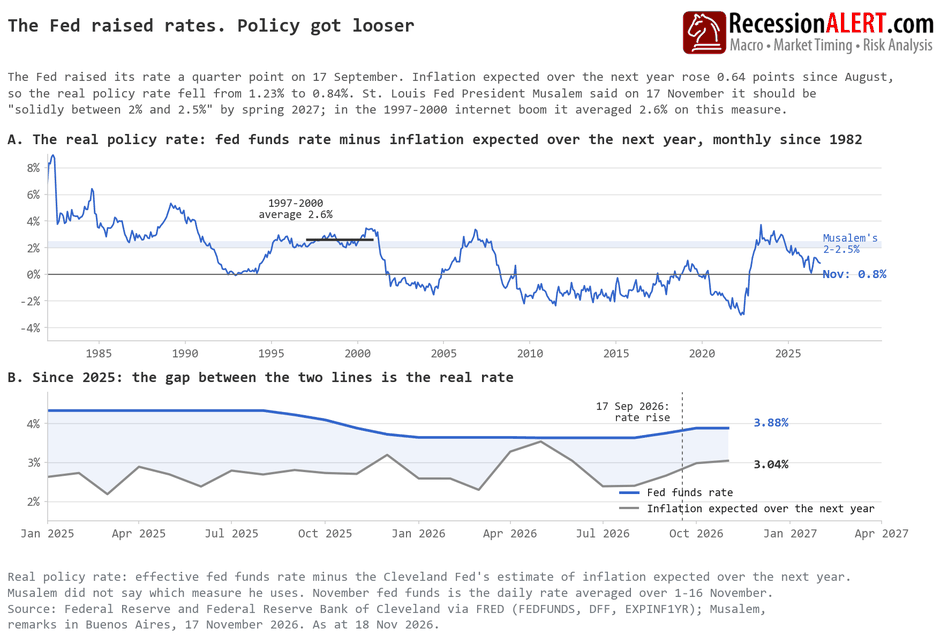
The Fed raised its rate on 17 September, and by the measure that does the work, policy got looser. What restrains borrowing and spending is the interest rate after expected inflation, not the rate on the screen. Effective fed funds rose from 3.63% in August to 3.88% in November, but inflation expected over the next year rose faster, from 2.40% to 3.04%, so on our measure the real policy rate fell from 1.23% to 0.84%. A quarter point of tightening was outrun by 0.64 points of expectations. That is the race St. Louis Fed President Alberto Musalem described on 17 November: “Moving sooner, while inflation expectations are anchored, has a better chance of succeeding.” Each month expectations outpace the rate, the distance to his “solidly between 2% and 2.5%” before spring 2027 grows, and the same destination needs more rises later. From 0.84% it is 1.16 to 1.66 points, roughly five to seven quarter-point rises on our arithmetic, and only if expected inflation holds still. Markets price one, a quarter point on 9 December at 95.7% odds. In the meantime the loosening is real for households: savers earn less on cash after expected inflation than before the rise, and borrowers’ real cost of credit has fallen. The race can also run the other way: a retreat in expectations toward July’s 2.39% would lift the real rate without a further move. The market is pricing a step; Musalem is describing a staircase.
What it means: For households, cash earns less after expected inflation than before September’s rise, and loan rates would have to climb further if expectations keep rising. For stock investors, Musalem’s path implies more rises than the single December move markets price, so shares that depend on cheap borrowing would face more repricing if the Fed follows. For the economy, a real rate below 1% puts less brake on spending than in August. The read changes if expected inflation falls far enough to lift the real rate above 1.5%, last seen in August 2025, before the Fed moves again.
Market Intelligence Brief (MIB) Ver. 20.08
For professional investors only. Not investment advice.
© 2026 RecessionALERT.com

Comments are closed.