
MARKET INTELLIGENCE BRIEF (MIB)
Wednesday, October 21, 2026
A New Mexico judge ordered Meta to pay $25 billion plus 15% annual interest; Meta will appeal. Nvidia unveiled capacity deals with six suppliers at GTC Berlin as chipmakers lifted the Nasdaq 100 1.13% on a narrow tape where six of 11 sectors fell. Washington ordered non-emergency staff out of Saudi Arabia as Houthi attacks escalate. The EIA crude draw nearly quadrupled forecasts. Mortgage applications fell 5.3% despite lower rates. CrowdStrike jumped 5.26% as leaked PHP flaws lifted cybersecurity stocks.
TABLE OF CONTENTS
A. EXECUTIVE SUMMARY
B. MARKET DATA
C. HIGH-IMPACT STORIES (5)
D. MODERATE-IMPACT STORIES (7)
E. ECONOMY WATCH (5)
F. EARNINGS WATCH (17)
G. WHAT’S NEXT
H. CHART OF THE DAY
A. EXECUTIVE SUMMARY -> TOP
A narrow, AI-hardware-led advance lifted the Nasdaq 100 1.13% and the S&P 500 0.58% after Super Micro raised its revenue outlook, while Nvidia used GTC Berlin to lock in substrate, packaging and test capacity with six suppliers, framing the AI build-out as constrained by supply rather than demand. Bonds did not join the rally: the 2-year rose 2.5 bps while the 10-year added 1.0 bp, flattening 2s10s to 31.5 bps, even as mortgage applications fell 5.3% and ADP’s weekly hiring pace slowed to 18,500. Gulf risk moved closer to supply at the source when Washington ordered non-emergency staff out of Saudi Arabia, an order that landed after crude settled; Brent closed up 1.05% at $109.93 while WTI slipped 0.11%. Breadth was poor, with six of 11 sectors lower and the Russell 2000 up only 0.27%: Industrials (+1.94%) and Technology (+1.65%) led while Communication Services (-1.20%) and Real Estate (-0.94%) lagged, a concentrated AI trade rather than broad risk appetite.
• Meta (META +0.47%) was ordered to pay New Mexico $25 billion plus 15% annual interest under the state’s Unfair Practices Act and will appeal; the penalty is about 1.4% of its market value. After hours, Meta narrowed its 2026 capital-spending range to $135-145 billion.
• Nvidia (NVDA +2.54%) is expanding supply-chain capacity with six partners, including a $1.1 billion advance to King Yuan for US testing facilities; AMD rose 3.36%, Dell gained 5.27% and SpaceX jumped 7.79% on earnings.
• EIA crude stocks fell 3.1 million barrels against a forecast 0.8 million draw, and gasoline stocks fell 3.0 million; the IEA put Gulf-to-Asia VLCC freight above $37 a barrel, more than five times pre-war.
• Mortgage applications fell 5.3% even as the 30-year rate eased to 7.41%, with purchases 18% below last year; unit cost growth among Atlanta Fed survey firms rose to 2.6% as sales and margins slipped below normal.
• Cybersecurity rallied after critical “PHP2Shell” flaws in the PHP runtime leaked before release: CrowdStrike (CRWD) rose 5.26% and Zscaler gained 7.84%.
• Netflix (NFLX) fell 5.31% on earnings; Abbott (ABT) fell 1.89% on plans to spin off its $8.5 billion Nutrition business by end-2027; Alphabet (GOOGL) fell 1.62% with no catalyst established, on the day OpenAI said its models are coming to Google Cloud.
1. The AI trade is being priced as a supply problem, and narrowly — Nvidia’s capacity advances and reservations with substrate, packaging and test suppliers hardwire volume expectations through 2028 and widen the trade beyond the chip designer, while OpenAI’s move onto Google Cloud shows distribution loosening around the model makers. But the rally sat almost entirely in AI hardware: six of 11 sectors fell and small caps barely moved. Positioning that leans on the supply chain still needs the demand side to confirm it, and Meta’s narrowed capex range tonight is the first piece of that evidence before Alphabet and Microsoft guide on Wednesday, October 28.
2. Gulf energy risk is moving from transit to source, and from crude into products and freight — Tehran ties any Hormuz reopening to an understanding its own officials do not expect before November 3, and Washington’s Saudi departure order puts producing infrastructure in the frame. The pressure is showing up beyond the crude benchmark: freight above $37 a barrel, Asian refining margins on Middle East crude that turned negative in September, distillates 9% below their five-year average and a Brent premium over WTI of about $12.20. Washington’s diesel measures, about 615,000 barrels combined, are small next to that, leaving Russia-Ukraine diplomacy as the main offset in the oil price.
3. The Fed meets into demand cooling faster than costs — Housing is weakening with the 10-year above 5% and hiring is slowing on ADP’s weekly gauge, yet firms report rising unit costs and Brent sits near $110. Long-run cost expectations held at 2.8%, which keeps the inflation story anchored, but Polymarket still prices a better-than-99% chance of a rate hike in 2026, and today’s front-end-led flattening is consistent with the 2-year carrying that risk into the October 27-28 meeting.
 — Leading economic indicators. Accurate market forecasts. Apply for membership at join.recessionalert.com
B. MARKET DATA -> TOP
AI hardware and chip stocks led a tech-driven advance, with the Nasdaq 100 leading the major indices after SpaceX’s earnings-driven jump and Super Micro’s raised revenue outlook lifted AI supply-chain stocks. The gains were narrow: six of 11 sectors closed lower, and the Russell 2000 and NYSE Composite lagged, reversing Tuesday’s broad-based pattern. Communication Services was the weakest sector as Netflix slid on earnings and Alphabet fell, even as the Dow reached its highest close since September 4. In rates, the 2-year rose more than the 10-year and the curve flattened, while Henry Hub natural gas fell sharply and Dutch TTF rose.
CLOSING PRICES – Wednesday, October 21, 2026:
MAJOR INDICES
Leadership narrowed back to mega-cap tech: the Nasdaq 100 outran the S&P 500 while the Russell 2000 and NYSE Composite lagged. Dow Theory bull confirmation extends into a second session, with the Dow at a 10-session high and transports within 0.92% of theirs. The S&P 500 has still outperformed the Nasdaq 100 by 3.7 points over the past 10 sessions, a broadening rotation now in its sixth session, although today’s tape ran the other way.
| Index | Close | Change | %Move | Why It Moved |
|---|---|---|---|---|
| S&P 500 | 7,757.17 | +44.60 | +0.58% | Technology (+1.65%) and Industrials (+1.94%) led as AI-hardware and chip stocks rallied; six of 11 sectors still closed lower |
| Dow Jones | 52,856.09 | +360.21 | +0.69% | Gains in Goldman Sachs (+2.25%) and IBM (+3.94%, reporting after the close) led; highest close since September 4 |
| DJ Transportation | 19,922.56 | +37.06 | +0.19% | Lagged the Dow; no discrete catalyst identified |
| Nasdaq 100 | 29,822.52 | +332.23 | +1.13% | Chipmakers led (AMD +3.36%, Nvidia +2.54%) after Super Micro raised its revenue outlook; the Philadelphia Semiconductor Index rose 1.97% with 29 of 30 members higher, per TradingKey. Tesla gained 3.41% after Musk said SpaceX and Tesla committees are discussing a possible merger |
| Russell 2000 | 2,781.02 | +7.60 | +0.27% | Small caps lagged as gains concentrated in mega-cap tech; no discrete catalyst identified |
| NYSE Composite | 24,253.12 | +62.51 | +0.26% | The broad index lagged the tech-led headline gains as defensive and rate-sensitive sectors fell |
VOLATILITY & TREASURIES
The bond market did not join the equity rally: yields edged higher as the VIX fell, with the 2-year up 2.5 bps against 1.0 bp for the 10-year, flattening 2s10s to 31.5 bps from 33.0 bps. The front end led a week before the October 27-28 FOMC meeting; no discrete rates catalyst was identified. The dollar was essentially flat, so there was no haven bid behind the lower VIX.
| Instrument | Level | Change | Why It Moved |
|---|---|---|---|
| VIX | 16.68 | -0.63 (-3.64%) | Fell as equities rose on the tech-led rally |
| 10-Year Treasury Yield | 5.123% | +1.0 bps | Edged higher; no discrete rates catalyst identified |
| 2-Year Treasury Yield | 4.808% | +2.5 bps | Front end rose more than the long end ahead of the October 27-28 FOMC meeting; no discrete catalyst identified |
| US Dollar Index (DXY) | 101.78 | +0.08 (+0.08%) | Essentially flat; no discrete catalyst identified |
COMMODITIES
Metals split: gold and silver firmed while platinum and copper fell, so the industrial metals did not confirm the equity rally’s growth signal. Bitcoin rose alongside the tech-led equity tape, with no crypto-specific catalyst identified.
| Asset | Price | Change | %Move | Why It Moved |
|---|---|---|---|---|
| Gold | $4,159.50/oz | $+16.90 | +0.41% | Firmer; no discrete same-day catalyst identified |
| Silver | $58.110/oz | $+0.110 | +0.19% | Edged up with gold; no discrete same-day catalyst identified |
| Copper | $6.5763/lb | $-0.0272 | -0.41% | Eased; no discrete same-day catalyst identified |
| Platinum | $1,636.00/oz | $-20.50 | -1.24% | Fell against gold and silver’s gains; no discrete same-day catalyst identified |
| Bitcoin | $84,839.00 | $+1,866.00 | +2.25% | Rose alongside the tech-led equity rally; no crypto-specific catalyst identified |
ENERGY
Brent outpaced WTI, widening the spread to about $12.20 from $10.86, while US and European gas split sharply: Henry Hub fell 6.34% as Dutch TTF rose 2.87%. Reuters said crude settled little changed as a larger-than-expected EIA crude draw was weighed against Putin’s agreement to resume US-mediated talks with Ukraine.
| Asset | Price | Change | %Move | Why It Moved |
|---|---|---|---|---|
| Crude Oil (WTI) | $97.71/bbl | $-0.11 | -0.11% | Settled $97.15, down 67 cents, per Reuters, after giving back an early gain of more than $2; the EIA reported a 3.06 million-barrel crude draw against an expected 820,000 barrels |
| Crude Oil (Brent) | $109.93/bbl | $+1.14 | +1.05% | Settled $108.82, up 3 cents, per Reuters, as lower US stockpiles and Iran’s statement that the US could not expect dialogue were weighed against Russia-Ukraine talks; firmed further after the settlement |
| Natural Gas (Henry Hub) | $2.78/MMBtu | $-0.19 | -6.34% | No discrete same-day catalyst identified; the EIA storage report is due Thursday |
| Natural Gas (Dutch TTF) | $28.807/MMBtu | $+0.803 | +2.87% | Rose against Henry Hub’s decline; no discrete same-day catalyst identified |
S&P 500 SECTORS
Tuesday’s defensive rotation reversed: Industrials and Technology led while Healthcare (-0.31%) and Consumer Defensive (-0.70%) gave back ground, and rate-sensitive Real Estate (-0.94%) fell alongside higher yields. Only five of 11 sectors finished higher. Communication Services was the weakest again, extending a 3.05% weekly loss.
| Sector | 1-Day | 1-Week | 1-Month | 3-Month | 6-Month | YTD | 12-Month |
|---|---|---|---|---|---|---|---|
| Industrials | +1.94% | +1.42% | -1.24% | -3.88% | -3.93% | +8.46% | +9.01% |
| Technology | +1.65% | -0.45% | -4.26% | +5.71% | +14.86% | +25.20% | +22.31% |
| Financial | +0.71% | +2.37% | -0.00% | -0.56% | +7.17% | +4.53% | +10.39% |
| Utilities | +0.36% | +0.81% | +3.16% | -8.65% | -7.33% | -1.95% | -7.96% |
| Energy | +0.31% | +1.05% | +8.39% | +10.52% | +13.85% | +46.55% | +51.80% |
| Consumer Cyclical | -0.09% | +2.89% | +1.57% | +5.32% | -3.51% | -4.81% | -4.54% |
| Basic Materials | -0.17% | +1.55% | -5.41% | +3.06% | -6.70% | +10.36% | +15.27% |
| Healthcare | -0.31% | +3.14% | +3.27% | +7.40% | +16.50% | +12.47% | +19.03% |
| Consumer Defensive | -0.70% | +1.16% | +5.42% | +5.70% | +4.04% | +11.42% | +9.45% |
| Real Estate | -0.94% | +1.14% | -2.45% | -7.93% | -4.06% | +2.35% | -1.99% |
| Communication Services | -1.20% | -3.05% | -4.45% | +4.39% | -4.59% | -1.72% | +2.03% |
TOP MEGA-CAP MOVERS:
GAINERS
| Company | Ticker | Close | Change | Why It Moved |
|---|---|---|---|---|
| SpaceX | SPCX | $159.31 | +7.79% | Earnings-driven; Q3 results reported after Tuesday’s close. Musk also said special committees at SpaceX and Tesla are discussing a possible merger |
| Dell Technologies | DELL | $485.88 | +5.27% | Rose with AI-server peer Super Micro, which raised its fiscal first-quarter revenue outlook to $18.5-19.5 billion after Tuesday’s close; the sympathy link is per an Investing.com explainer |
| CrowdStrike | CRWD | $239.34 | +5.26% | Announced an expanded AI-security collaboration with Nvidia, and cybersecurity stocks rallied after PHP issued emergency patches for two critical “PHP2Shell” flaws, both per Investing.com |
| Palantir Technologies | PLTR | $201.72 | +4.74% | No discrete same-day catalyst identified |
| GE Vernova | GEV | $925.92 | +4.00% | An Investing.com explainer cited a Bank of America pre-earnings preview (Buy, $1,310 target) published Tuesday evening and a gas-turbine order for a Côte d’Ivoire power plant (unverified against either source); reports October 28 |
DECLINERS
| Company | Ticker | Close | Change | Why It Moved |
|---|---|---|---|---|
| Netflix | NFLX | $65.04 | -5.31% | Earnings-driven; Q3 results reported after Tuesday’s close |
| Alphabet | GOOGL | $334.76 | -1.62% | No discrete same-day catalyst identified; an Investing.com explainer cited caution ahead of October 28 Q3 results (unverified) |
| Procter & Gamble | PG | $156.84 | -1.56% | Fell with Consumer Defensive (-0.70%) ahead of Thursday’s pre-market results; no discrete same-day catalyst identified |
| Oracle | ORCL | $129.13 | -1.53% | No discrete same-day catalyst identified; fell against a 1.65% Technology-sector gain |
— Institutional-grade intelligence for serious investors. Apply for membership at join.recessionalert.comC. HIGH-IMPACT STORIES -> TOP
UNCERTAIN
1. New Mexico Judge Orders Meta to Pay $25 Billion, Plus 15% Annual Interest, Under the State’s Unfair Practices Act; Meta Will Appeal
The core facts:First Judicial District Judge Francis Mathew in Santa Fe on Wednesday ordered Meta Platforms to pay New Mexico $25 billion in civil penalties under the state’s Unfair Practices Act, with interest accruing at 15% a year until the penalty is paid, Source NM reported. The ruling follows a Santa Fe jury’s finding in late September that Facebook committed close to 44 million violations, siding with the state on 31 of 34 counts, including misrepresentations about users’ ability to control their data, its efforts against hate speech and misinformation, and its investigation after the Cambridge Analytica scandal. The state had requested up to $40 billion against a statutory ceiling of close to $220 billion. Attorney General Raúl Torrez called it “a historic day for New Mexico and for consumers across the country.” Meta said it will appeal.
Why it matters:At about 1.4% of Meta’s roughly $1.78 trillion market value, the penalty is absorbable, and the stock closed up 0.47% before rising after hours on its third-quarter report. The more durable signal is the method: a state consumer-protection statute applied per violation produced a penalty about 44 times the $567 million New Mexico child-safety judgment against Meta in August, giving other states a template for privacy litigation against platform companies. That liability sits outside the capital-spending and advertising-growth debate that drives Meta’s valuation, and it was not the only legal item in Meta’s numbers today: its quarterly GAAP earnings carried a separate charge tied to its teen mental-health settlement.
What to watch:Meta’s appeal filing and any bond required to stay enforcement; at 15%, interest on $25 billion accrues at about $3.75 billion a year while the appeal runs.
BULLISH
2. “Capacity Is the Constraint”: Nvidia Funds Supply-Chain Expansion With Six Partners at GTC Berlin as Chipmakers Lead the Nasdaq 100 Up 1.13%
The core facts:Nvidia announced at GTC Berlin on Wednesday that it is working with six supply-chain partners to expand capacity in substrates, advanced packaging, testing and optical engines. The commitments include a $1.1 billion capacity-reservation advance to King Yuan Electronics for new US testing facilities targeting high-volume production in April 2027, a multibillion-dollar advance for IBIDEN’s Ono plant in Japan, Samsung Electro-Mechanics joining its substrate supply chain from Sejong and Busan, a capacity-reservation agreement with Unimicron, Amkor’s plan for a more than 300% increase in Korean interposer wafer capacity by the end of 2028 under what Amkor called a new $1.3 billion agreement, and a 15-fold increase in SPIL’s co-packaged-optics capacity by mid-2027. Nvidia said substrate capacity for its products will rise 2.5 times over three years and testing capacity will double from 2026 to 2027. Chipmakers led the market: Nvidia rose 2.54%, AMD 3.36%, the Technology sector 1.65% and the Nasdaq 100 1.13% to 29,822.52.
Why it matters:Jensen Huang’s framing, “Capacity is the constraint,” locates the bottleneck in the AI build-out on the supply side, not in demand, and Nvidia is now using its balance sheet to prepay suppliers for that capacity. That widens the AI trade from the chip designer to packaging, substrate and test vendors, and it hardwires multi-year volume expectations into suppliers’ plans through 2028. The advance was narrow, however: six of 11 sectors fell, the Russell 2000 rose only 0.27%, and Treasury yields edged higher, so the session was a concentrated bet on AI hardware rather than a broad risk-on move. Nvidia disclosed no total for the package beyond the $1.1 billion King Yuan advance.
What to watch:Capital-spending guidance from Alphabet and Microsoft on Wednesday, October 28, the demand side of the capacity Nvidia is reserving; Meta tonight narrowed its 2026 range to $135 billion-$145 billion.
UNCERTAIN
3. Araghchi Says Hormuz Stays Closed Until an Understanding Is Reached as Talks Continue Through Pakistan and Qatar; Treasury Hits Iran’s Shadow Fleet Again
The core facts:Iranian Foreign Minister Abbas Araghchi said in an interview with Iraqi state television aired Wednesday that “until an agreement or understanding is reached regarding this strait, it will not be open to everyone,” The National reported, while indirect talks with Washington continue through Pakistan and Qatar; Qatar said communication between the two sides had “not stopped.” Iranian officials told Reuters they see little prospect of a breakthrough before the US elections. Separately, Treasury sanctioned four entities, five individuals and nine vessels in Iran’s shadow-fleet network under “Operation Economic Outcast,” and FinCEN issued its first administrative subpoena under the Bank Secrecy Act’s Section 5318(k) to investigate a Greek bank’s potential ties to Iran. “Either you are with us or against us,” Treasury Secretary Scott Bessent said. WTI closed at $97.71, down 0.11%, after giving back an early gain of more than $2, per Reuters, while Brent closed at $109.93, up 1.05%.
Why it matters:Tehran’s position ties any reopening of the strait to a deal, and its own officials expect none before November 3, so the Hormuz premium is likely to stay in crude through the midterms. That WTI finished little changed despite an EIA crude draw nearly four times the forecast (see Economy Watch) shows diplomacy headlines are offsetting physical tightness for now, but the seaborne benchmark is carrying more of the risk: Brent’s premium over WTI widened to about $12.20. With Brent near $110, energy remains a live input to the inflation picture the Fed weighs at its October 27-28 meeting.
What to watch:Any announcement of direct US-Iran talks or a Hormuz understanding, and the Fed’s decision on Wednesday, October 28, at 2:00 p.m. ET.
BEARISH
4. US Orders Non-Emergency Staff Out of Saudi Arabia as Houthi Attacks Escalate; Drone Debris Kills Two Near the Shaybah Oil Field
The core facts:The State Department on Wednesday ordered all non-emergency US government employees and their families to leave Saudi Arabia. “Iranian-supported Houthis have increasingly engaged in hostilities against Saudi Arabia, including attacks on civilian airports and other critical infrastructure resulting in civilian casualties and severe travel disruptions,” spokesperson Tommy Pigott said, CBS News reported. Saudi Arabia’s energy ministry said debris from an intercepted drone targeting the Shaybah oil field near the UAE border killed two people and injured two others; it did not say who launched the drone, AFP reported. Fox News, citing two US officials, reported that the USS Theodore Roosevelt carrier strike group and the 13th Marine Expeditionary Unit are heading to the region, which would make it the third US carrier there; the deployment has not been officially confirmed. The order came after crude had settled.
Why it matters:The risk is moving from shipping lanes to Saudi infrastructure itself. An attack aimed at a producing field, and Washington judging the kingdom unsafe for non-essential personnel, raise the chance of supply loss at the source rather than delay in transit, at a time when the Strait of Hormuz remains closed (Story 3). Because the departure order landed after the settlement, Thursday’s session is the first full test of how much of it crude prices in; Brent had already firmed after the settlement to close at $109.93.
What to watch:Thursday’s crude open, any Houthi claim for the Shaybah attack, and confirmation of the Theodore Roosevelt deployment.
UNCERTAIN
5. Putin Tells Witkoff Russia Is Ready “in Principle” to Resume Trilateral Ukraine Talks After November 10; Moscow Frees a US Detainee
The core facts:US envoy Steve Witkoff met President Vladimir Putin in St. Petersburg on Wednesday for about three hours, the Kremlin said. Kremlin aide Yuri Ushakov said Putin agreed “in principle” to resume trilateral talks with Ukraine and the United States after November 10, the Associated Press reported; CBS News reported his account as early November. Ukrainian President Volodymyr Zelenskyy has said the talks should take place no later than early November. Russia released American Stephen Hubbard, 74, before the meeting, Axios reported. Ushakov said the earlier Oslo talks “didn’t contain much that was useful,” and the AP noted no suggestion of an imminent breakthrough. Reuters cited Russia’s agreement as one reason crude gave back an early gain of more than $2.
Why it matters:The market channel is energy. A credible path back to negotiations lowers the tail risk of further disruption to Russian supply and is the counterweight crude traders set against the Gulf escalation in Stories 3 and 4. It is also bound up with Washington’s diesel policy: the first Russian diesel cargo for the US is due to sail Thursday (Story 8), and US and European lawmakers argue that arrangement funds Russia’s war. A date for the talks would firm the diplomatic discount in oil; another stall would remove it.
What to watch:Whether a date and venue are set for a trilateral round after November 10, and whether the first Russian diesel tanker sails on Thursday as Moscow says.
— Quantifying recession risk so you don’t have to guess. Apply for membership at join.recessionalert.comD. MODERATE-IMPACT STORIES -> TOP
BULLISH
6. “PHP2Shell”: Critical Flaws in the PHP Runtime Leak Before Their Official Release, and Cybersecurity Stocks Rally With CrowdStrike Up 5.26%
The core facts:Two vulnerabilities in the PHP runtime, CVE-2026-109618 and CVE-2026-109619, were disclosed on Wednesday by Calif.io, Wiz, OpenAI and Quarkslab. They affect PHP 5.4 and later and allow denial of service, remote code execution or data exposure through specially crafted web traffic. Cloudflare said the flaws leaked before the official release date, that it observed attack traffic against customers, and that it had switched on default protections for all its web-application-firewall plans from 03:02 UTC, about nine hours before public disclosure. “These flaws are in the PHP runtime, so updating website code or a plugin(s) alone does not fix these vulnerabilities,” Cloudflare wrote. CrowdStrike rose 5.26% to $239.34, also announcing an expanded AI-security collaboration with Nvidia, and Zscaler rose 7.84%; Investing.com tied the sector’s rally to the emergency patches.
Why it matters:A flaw in the language runtime rather than in an application puts the patching burden on every server operator and hosting provider at once, and a pre-release leak with live attack traffic removes the usual grace period. Investing.com put the exposure at an estimated 70% of websites. Events of this kind pull security spending forward and reinforce the case for managed edge and endpoint protection. It is also notable that OpenAI is among the discoverers: AI labs are now finding vulnerabilities at the infrastructure layer, which cuts both ways for defenders.
What to watch:Reports of mass exploitation over the coming days, and Fortinet’s results on Wednesday, October 28, for the first read on whether the incident shows up in demand.
UNCERTAIN
7. OpenAI Will Sell Its Frontier Models and Codex Through Google Cloud as European Regulators Query Google Over Tuesday’s Outage; Alphabet Falls 1.62%
The core facts:OpenAI said on Wednesday that its frontier models and Codex agentic workflows are coming to Google Cloud’s Model Garden, purchased through the Google Cloud Marketplace, and that enterprises with Google Cloud spend commitments will be able to draw them down on OpenAI purchases. The models will also come to Google Antigravity and the Gemini Agent; general availability is planned in the coming weeks, and OpenAI said Microsoft remains its primary cloud partner. Separately, the European Banking Authority said it had contacted Google Cloud to understand Tuesday’s outage, which left bank customers without key services for hours, and the UK Treasury Committee is seeking regulators’ response, Reuters reported. Alphabet fell 1.62% to $334.76; no catalyst for the decline was established.
Why it matters:Google Cloud is now reselling the models of Gemini’s closest competitor, a bet that owning the enterprise relationship and the committed spend is worth more than model exclusivity. Letting customers draw down existing commitments on OpenAI purchases makes those commitments more valuable and harder to move. For Microsoft, it is another step away from exclusive distribution of OpenAI, following a similar arrangement with Oracle in June. The regulatory query is a reminder that concentration in a handful of cloud providers is becoming a supervisory issue for banks.
What to watch:Alphabet’s and Microsoft’s results on Wednesday, October 28, where cloud growth and any comment on the OpenAI arrangement will be in focus.
UNCERTAIN
8. Washington Moves on Diesel: DOE Offers to Loan a Third of the Northeast Heating Oil Reserve as the First Russian Diesel Cargo for the US Prepares to Sail
The core facts:The Energy Department said it will loan up to 315,000 barrels, about one-third of the one-million-barrel Northeast Home Heating Oil Reserve, as an exchange: borrowers must return the volume plus a premium before the 2027-28 heating season. Bids are due Tuesday, October 27, from sites in Boston, South Portland and New Haven, with releases to finish by November 13, Fox Business reported. Energy Secretary Chris Wright called it “a temporary measure to solve a temporary supply disruption,” and Sen. Susan Collins said it would add about 13% to New England’s home heating oil supply, where prices are up about 70% in a year. Separately, Russian Deputy Prime Minister Alexander Novak said “the first tanker, as planned, will leave the port tomorrow,” carrying a reported 40,000 metric tons, about 300,000 barrels, of diesel bound for the US, according to TASS via Bloomberg.
Why it matters:Both moves are aimed at diesel and heating-oil prices before the November 3 midterms, but they are small: together about 615,000 barrels, roughly a sixth of a single day’s US distillate demand on the EIA’s latest weekly figures. Analysts quoted by Bloomberg said the Russian deal is too limited to move prices before the vote. The administration is reaching for supply levers because distillate is where the squeeze shows, with inventories below their five-year average (see Economy Watch) and Gulf disruption lifting delivered fuel costs (Story 9).
What to watch:The reserve bids on Tuesday, October 27; the Russian tanker’s departure on Thursday; and Novak’s stated plan to raise exports to as much as 3.5 million tons a month by year-end.
BEARISH
9. IEA: Gulf Tanker Freight Tops $37 a Barrel, More Than Five Times Pre-War, Pushing Asian Refiners’ Margins on Middle East Crude Below Zero
The core facts:Shipping a barrel of crude by VLCC from the Middle East Gulf to Asia cost more than $37 by mid-October, over five times the pre-war level, with charter rates above $1.3 million a day, IEA analysts Daniel Gymer and David Martin wrote in a commentary published Wednesday. Suezmax rates from West Africa to Europe exceeded $22 a barrel, more than four times pre-conflict levels, and US Gulf Coast cargoes cost about $33 a barrel to ship to Singapore and $24 to Europe. Higher delivered costs pushed Asian refiners’ margins on Middle Eastern crude into negative territory in September. The IEA concluded that “a full reopening of the Strait of Hormuz will be essential to easing the disruption to oil markets.”
Why it matters:Freight is now a large, separate layer of the oil price that consumers pay, on top of Brent near $110. The IEA warned that refiners facing negative margins may pay more for crude, switch to less suitable grades or cut runs, and run cuts would tighten diesel and other product supplies, the same pressure behind Washington’s diesel measures (Story 8). For US exporters the wedge cuts both ways: it erodes netbacks on Gulf Coast cargoes even as Brent trades about $12 above WTI.
What to watch:VLCC rates and Asian refinery run rates, and any Hormuz understanding (Story 3), the single factor the IEA says would ease freight.
UNCERTAIN
10. OCC Issues the First Final Rule Under the GENIUS Act, Effective January 18, 2027; Existing Stablecoin Rewards Programs Get No Presumption of Compliance
The core facts:The Office of the Comptroller of the Currency on Wednesday issued a final rule implementing the GENIUS Act, setting requirements for permitted and foreign payment-stablecoin issuers under its jurisdiction and for certain custody activities, effective January 18, 2027. Bank Secrecy Act, anti-money-laundering and sanctions requirements will follow in a separate rulemaking with Treasury, and the OCC will announce separately when it begins accepting applications. According to CoinDesk, the rule declines to presume that rewards programs predating the Act comply, leaving them to case-by-case review, and replaces reserve-diversification limits with a principles-based approach plus daily liquidity minimums. Comptroller Jonathan Gould said the OCC is providing “a clear, practical framework for payment stablecoin innovation.”
Why it matters:Rewards are the economic heart of the stablecoin business model and the core of banks’ objection that stablecoins compete for deposits. Denying them a safe harbor shifts that fight from Congress to supervisors, and creates uncertainty for platforms that pay holders yield on dollar tokens. The rule is the first of several: the FDIC, the Fed and Treasury have yet to finish theirs, so issuers face a staggered rulebook through the effective date.
What to watch:The OCC’s announcement on opening applications, and the companion FDIC, Fed and Treasury rules before January 18.
UNCERTAIN
11. Abbott to Spin Off Its $8.5 Billion Nutrition Business, Home of Similac and Ensure, by the End of 2027; Shares Fall 1.89%
The core facts:Abbott Laboratories said on Wednesday it plans to separate its Nutrition business into an independent public company through a distribution to shareholders intended to be tax-free. The new company would have about $8.5 billion in annual sales, about 16,000 employees and 14 manufacturing sites, with brands including Similac, PediaSure, Pedialyte, Glucerna and Ensure, and would be led by Daniel Salvadori. Abbott would retain about $42 billion in sales, focused on cardiovascular and neuromodulation devices, biowearables, diagnostics and established medicines. Completion is expected by the end of 2027, subject to regulatory approvals, an effective Form 10 and final board approval; the combined dividend is expected to equal Abbott’s at separation, and the move does not affect 2026 guidance. “This separation will benefit both companies, setting each one up for maximum success in its respective market,” said CEO Robert Ford. The shares fell 1.89% to $100.51.
Why it matters:The separation removes Abbott’s slowest-growing large segment: in the third quarter, comparable nutrition sales grew 4.9% against 7.8% for medical devices, so the remaining company becomes a purer devices and diagnostics growth story. It follows the healthcare-conglomerate break-up template of recent years, but the long timetable and as-yet-unquantified one-time charges leave investors with two years of execution risk, which helps explain why the stock fell on a day it also reported in-line quarterly earnings (Story 20).
What to watch:The Form 10 filing and the size of one-time separation charges, and Abbott’s 2027 guidance in January.
UNCERTAIN
12. Carney and Trump Speak on Trade as the US Embassy Accuses Canadian Officials of Election Interference; Ottawa and Ontario Unveil About C$9 Billion for Tariff-Hit Industries
The core facts:Prime Minister Mark Carney said he spoke with President Trump on Wednesday morning and that they addressed “issues around trade,” along with Iran, Ukraine and the Middle East, adding that Canada is “ready to sit down and negotiate,” BNN Bloomberg reported. No deal has been reached since talks broke down in August. The same day, US officials released a fact sheet citing Canadian officials, including Industry Minister Mélanie Joly, as examples of interference in American politics, among them her comments that Canada’s counter-tariffs target products that most affect Republican states. Carney said the US “initiated these trade actions,” and Ontario Premier Doug Ford said he has “no interest at all” in interfering in US elections. Carney and Ford also announced about C$9 billion in support for industries hit by the trade war, which the federal backgrounder puts at C$8.7 billion across steel, autos and critical minerals.
Why it matters:The call is the first leader-level contact on trade reported since the August breakdown, but the embassy’s charge moves the dispute from tariffs into domestic politics two weeks before the midterms, which makes concessions from either side harder before November 3. Canada’s support package is defensive spending to sustain industries through a long standoff, not a signal of an imminent deal, so US companies with Canadian supply chains in steel and autos should plan for current tariffs to persist.
What to watch:A White House readout of the call and any scheduling of formal negotiations after November 3.
— Separating signal from noise since 2007. Apply for membership at join.recessionalert.comE. ECONOMY WATCH -> TOP
Restrictive rates are now cooling demand faster than they are cooling costs. Mortgage applications fell 5.3% in the week to October 16 even as the 30-year rate eased to 7.41%, with purchases 18% below last year, and ADP’s weekly pulse showed private hiring slowing to 18,500 a week from 26,000. On the cost side, crude and gasoline stocks drew far more than forecast and now sit 3% and 5% below their five-year averages, while Atlanta Fed survey firms reported unit cost growth rising to 2.6% alongside below-normal sales and margins. With the Fed in its pre-meeting blackout and Polymarket pricing a better-than-99% chance of a rate hike in 2026, the October 27-28 meeting must weigh softening demand against sticky input costs.
Crude Draw of 3.1 Million Barrels Nearly Quadruples Forecast as Gasoline Stocks Fall 3.0 Million (EIA, Oct 21)
What they’re saying:U.S. commercial crude inventories fell 3.1 million barrels to 412.5 million in the week ending October 16, nearly four times the 0.8 million-barrel draw expected, leaving stocks 3% below the five-year average, the Energy Information Administration reported. Gasoline inventories fell 3.0 million barrels against an expected 0.4 million and now sit 5% below the five-year average, while distillates rose 1.7 million barrels but remain 9% below it. Refineries ran at 93.4% of capacity.
The context:Demand is not the weak link: total products supplied averaged 21.1 million barrels a day over the past four weeks, up 3.2% from a year earlier, with gasoline supplied up 1.5%. The draw confirmed Tuesday evening’s American Petroleum Institute estimate of a 4.93 million-barrel decline, yet WTI settled at $97.15, down 67 cents, per Reuters, after giving back an early gain of more than $2 as the larger draw was weighed against Russia’s agreement to resume US-mediated talks with Ukraine. Product stocks running below normal with Brent above $108 keep energy a live input to the inflation picture the Fed weighs next week.
What to watch:The API inventory estimate on Tuesday, October 27, and the next EIA report on Wednesday, October 28. Another large gasoline draw would widen the product-stock deficit heading into winter.
ADP Weekly Pulse: Private Hiring Slows to 18,500 a Week from 26,000 (ADP, Oct 20)
What they’re saying:Private employers added an average of 18,500 jobs per week over the four weeks ending October 3, down from 26,000 in the prior four-week period, according to ADP’s preliminary weekly estimate released October 20. ADP said simply that hiring “decelerated from the previous week.”
The context:The estimate covers a period ending more than two weeks before its release, so it is a direction-of-travel gauge rather than a real-time read. A step down of nearly 30% in the weekly pace adds a softer labor signal to a week in which housing data have already weakened, and it arrives with Fed officials in their blackout ahead of the October 27-28 meeting.
What to watch:Initial jobless claims on Thursday, October 22 (consensus 200,000 vs. 199,000 prior), and the next ADP weekly estimate on Tuesday, October 27.
Mortgage Applications Drop 5.3% Even as 30-Year Rate Eases to 7.41%; Purchases Run 18% Below Last Year (MBA, Oct 21)
What they’re saying:Mortgage applications fell 5.3% in the week ending October 16, the Mortgage Bankers Association said, with the seasonally adjusted Purchase Index down 7% and the Refinance Index down 2%. The average 30-year fixed contract rate eased to 7.41% from 7.50%, its first decline in over two months, but unadjusted purchase applications ran 18% below the same week a year ago and refinancing 59% below.
The context:“It is very clear that the higher mortgage rate environment has cooled the housing market this fall,” said MBA Deputy Chief Economist Joel Kan. The release follows September’s 7.3% plunge in pending home sales, a 5.2% drop in housing starts and a 14-year low in builder sentiment, making housing the clearest channel through which 10-year Treasury yields above 5% are reaching the real economy.
What to watch:September new home sales and the S&P/Case-Shiller home price index on Tuesday, October 27, followed by the next MBA survey on Wednesday, October 28.
Atlanta Fed Business Survey: Unit Cost Growth Rises to 2.6% as Sales and Margins Slip Below Normal (Atlanta Fed, Oct 21)
What they’re saying:Firms in the Atlanta Fed’s October Business Inflation Expectations survey reported that year-over-year unit cost growth increased to 2.6% on average, while sales levels and profit margins compared with normal both decreased. Their five-to-10-year unit cost expectations held at 2.8%, unchanged from June.
The context:Rising current costs alongside softer sales and thinner margins point to a squeeze rather than pricing power: firms are absorbing higher costs as demand cools. The unchanged long-run reading suggests business expectations remain anchored, a distinction that matters to a Fed weighing whether persistent cost pressure or softening demand is the larger risk.
What to watch:The University of Michigan’s final October consumer sentiment reading on Friday, October 23 (consensus 46.3), and the Fed’s rate decision on Wednesday, October 28, at 2:00 p.m. ET.
Getty Images Files Prepackaged Chapter 11 With Liabilities Estimated at $1 Billion to $10 Billion (Quartz/Bloomberg, Oct 21)
What they’re saying:Getty Images Holdings commenced Chapter 11 proceedings in Delaware on Wednesday to implement a prepackaged restructuring that would take it private, estimating both assets and liabilities at $1 billion to $10 billion, according to Bloomberg. Getty family entities and Koch Equity Development affiliates have pledged up to $533 million of new equity and would own 100% of the reorganized company, with a Koch affiliate providing up to $143 million of financing; Class A shareholders would receive nothing.
The context:The filing follows a skipped September 1 interest payment on unsecured notes and the board’s decision, about three months earlier, to terminate a planned $3.7 billion merger with Shutterstock, with Bloomberg citing customers’ shift toward AI image tools. The case is idiosyncratic rather than systemic, but it is a large filing tied directly to AI displacement of an incumbent business model.
What to watch:Confirmation of the prepackaged plan; Getty expects to complete the restructuring before year-end, subject to regulatory approvals.
— Know the probability before the market prices in the risk. Apply for membership at join.recessionalert.comF. EARNINGS WATCH -> TOP
YESTERDAY AFTER THE BELL (Markets Reacted Today)
BULLISH
13. SpaceX (SPCX): +7.79% | Revenue Up 161% to $14.58 Billion as the Super Intelligence Segment Overtakes Starlink
The Numbers:Released: Tuesday, October 20, AMC. Revenue $14.58 billion vs. $12.87 billion consensus (+161% YoY); adjusted EPS $0.45 vs. $0.13 expected, per CNBC and LSEG; net income $4.4 billion. Shares closed at $159.31.
The Problem/Win:Revenue from the Super Intelligence segment, previously reported as AI, rose about 830% to $7.56 billion, overtaking Starlink connectivity revenue of $5.2 billion (+69%). The segment earned $431 million from operations against a $1.7 billion loss a year earlier, and about $1.6 billion excluding $1.2 billion of stock compensation tied to the Cursor acquisition. Starlink consumer subscribers reached 13.6 million from 12.0 million in June.
The Ripple:Tesla rose 3.41% after Musk said on the call that special committees at both companies are weighing a merger. AT&T fell 6.45% after its own results, with Starlink’s mobile competition among the concerns cited (Story 23). JPMorgan raised its SpaceX target to $500 from $240.
What It Means:At a $2.16 trillion market value, SpaceX is now being priced as an AI compute and services business with a satellite network attached, which makes its numbers a read-through for AI demand alongside the hyperscalers.
What to watch:Any formal step by the SpaceX and Tesla special committees; Musk said Tesla would need a 50% vote of all its shares.
UNCERTAIN
14. Netflix (NFLX): -5.31% | EPS Beat Overshadowed by Cuts to the Ad-Revenue, Free-Cash-Flow and Fourth-Quarter Outlooks
The Numbers:Released: Tuesday, October 20, AMC. EPS $0.87 vs. $0.82 consensus; revenue $12.87 billion, in line. Fourth-quarter guidance of $13.44 billion in revenue and $0.67 in EPS came in below consensus; full-year 2026 revenue trimmed to $51.1 billion; free cash flow cut to about $12.0 billion from $12.5 billion; 2026 ad revenue cut to about $2.7 billion from roughly $3 billion.
The Problem/Win:Netflix blamed the ad cut on a slower-than-expected rollout of some ad-product capabilities, and attributed the free-cash-flow cut to a real-estate purchase expected to close in the fourth quarter. Its lowest revenue growth rate in three years put the focus on stagnating viewership and competition from YouTube.
The Ripple:Needham downgraded the stock to Hold from Buy, and most banks cut targets. Communication Services was the weakest S&P 500 sector, down 1.20%, with Alphabet also lower.
What It Means:Advertising was meant to be Netflix’s next growth engine; cutting that forecast mid-year resets the multiple toward a mature subscription business until the ad stack proves itself.
UNCERTAIN
15. Intuitive Surgical (ISRG): -2.26% | Procedure Growth Beats, but a 3%-5% Instrument Pricing Cut and a $450 Million Settlement Weigh
The Numbers:Released: Tuesday, October 20, AMC. Adjusted EPS $3.00 vs. $2.65 consensus; revenue $3.05 billion (+22%) vs. $2.91 billion; GAAP EPS $1.49, reflecting a $450 million charge to resolve an antitrust class action over third-party servicing. Total procedures +15%, da Vinci +14%, Ion +31%; 546 da Vinci placements. 2026 da Vinci procedure growth narrowed to 14%-15% from 13.5%-15.5%; non-GAAP gross margin guidance raised to 68.7%-69.3%.
The Problem/Win:Management expects instruments and accessories revenue per procedure to fall about 3%-5% once pricing actions and China policy changes are in place, and US da Vinci procedure growth slowed to 10% against a tough comparison, while international growth ran at 20%.
The Ripple:Healthcare fell 0.31% as Tuesday’s defensive rotation reversed. Erste Group upgraded the stock to Buy.
What It Means:Volume growth is intact; the debate has shifted to how much per-procedure pricing Intuitive gives up to defend share, which caps the earnings leverage the market had priced.
UNCERTAIN
16. Chubb (CB): -0.78% | Record Core EPS of $7.66 as Catastrophe Losses Lift the Combined Ratio to 84.1%
The Numbers:Released: Tuesday, October 20, AMC. Core operating EPS $7.66 vs. $6.77 consensus; net EPS $7.30; revenue $15.14 billion vs. $15.71 billion; net premiums written $15.1 billion (+1.9%). P&C combined ratio 84.1% vs. 81.8% a year earlier; catastrophe losses $705 million vs. $285 million; favorable prior-period development $511 million; record adjusted net investment income of $1.89 billion; book value per share $191.43 (+5.1%).
The Problem/Win:The record EPS rested on investment income and reserve releases rather than underwriting, which declined to $2.06 billion from $2.26 billion as catastrophe losses more than doubled. Premium growth of 1.9% is slow for a company of Chubb’s franchise.
The Ripple:Financials rose 0.71% overall; the result sets a high bar for investment income across property-casualty insurers with the 10-year yield above 5.1%.
What It Means:High yields are carrying insurer earnings while the underwriting cycle softens; the stock’s decline on a record quarter shows investors pricing the latter.
BULLISH
17. Capital One (COF): +2.53% | Adjusted EPS Beats by 21% as Card Charge-Offs Fall and Discover Synergies Run Ahead
The Numbers:Released: Tuesday, October 20, AMC. Adjusted EPS $6.69 vs. $5.53 consensus; GAAP EPS $5.61 on net income of $3.5 billion; revenue $16.34 billion vs. $16.25 billion. Net interest margin 8.41%, up 40 basis points; domestic card net charge-off rate 3.98%, down 73 basis points from the prior quarter and 65 basis points from a year earlier; a $225 million reserve release.
The Problem/Win:Credit improved and integration savings arrived early: management cited about $1.8 billion of annualized Discover synergies achieved year to date. The soft spot was legacy Discover card loans, down about 3%.
The Ripple:Card lenders and consumer-credit names gained; American Express reports on Friday.
What It Means:The largest US card book shows no consumer-credit cracking despite 7.41% mortgage rates and a 10-year yield above 5%, a counterpoint to the softening housing and hiring data in Economy Watch.
TODAY BEFORE THE BELL (Markets Already Reacted)
UNCERTAIN
18. Philip Morris International (PM): -1.22% | Record Adjusted EPS, but Operating Growth Points to the Lower Half and ZYN Spending Stays High
The Numbers:Released: Wednesday, October 21, BMO. Adjusted EPS $2.36 (+5.4%; $2.37 vs. $2.30 consensus on the calendar’s basis); revenue $11.44 billion (+5.5%) vs. $11.32 billion. Full-year adjusted EPS guidance held at $8.29-$8.44; organic operating income growth seen in the middle or lower half of its 7%-9% range.
The Problem/Win:US ZYN shipments rose 4.2% to 3.2 billion pouches, a deceleration, and the company expects fourth-quarter ZYN profitability around break-even or slightly negative as investment stays elevated. IQOS heated-tobacco shipments rose 1.5% to 41.5 billion units. Management cited geopolitical cost pressures for the lower-half pointing.
The Ripple:Consumer Defensive fell 0.70%, with Procter & Gamble down 1.56% ahead of its own report Thursday.
What It Means:The smoke-free transition is on track, but the growth asset, ZYN, is now costing profit to defend share; the stock will trade on evidence that the spending stabilises US volumes.
BULLISH
19. Thermo Fisher Scientific (TMO): +0.97% | Raises Full-Year Guidance After Revenue Tops Its Own Forecast by More Than $200 Million
The Numbers:Released: Wednesday, October 21, BMO. Revenue $12.14 billion (+9%; organic +6%) vs. $11.95 billion consensus; adjusted EPS $6.68 (+15%) vs. $6.40. Full-year guidance raised to $47.7 billion-$48.2 billion in revenue and $25.13-$25.43 in adjusted EPS; full-year organic growth now 4%, from a prior midpoint of 3%; free cash flow raised to $7.0 billion-$7.5 billion.
The Problem/Win:Pharma services activity was weighted toward the third quarter, so fourth-quarter organic growth guidance stays at 4%. Weak spots: Specialty Diagnostics revenue fell 6% and Life Sciences Solutions grew only 1% organically.
The Ripple:Life-science tools rallied with Danaher, up 4.29% on its own beat and raise (Story 21).
What It Means:Biopharma customers are spending again on outsourced services and bioprocessing; academic and diagnostics demand remains the drag.
UNCERTAIN
20. Abbott Laboratories (ABT): -1.89% | In-Line EPS and 7% Comparable Growth, with Guidance Reaffirmed and a Nutrition Spin-Off Announced
The Numbers:Released: Wednesday, October 21, BMO. Adjusted EPS $1.42 vs. $1.42 consensus; sales about $13.0 billion (+14.5% reported, +7.0% comparable) vs. $12.99 billion. Full-year adjusted EPS guidance $5.50-$5.55; fourth-quarter $1.62-$1.67.
The Problem/Win:Medical devices grew 7.8% on a comparable basis, led by electrophysiology (+15.5%) and rhythm management (+10.0%); diagnostics grew 6.4%, with cancer diagnostics up 13.8%. The Exact Sciences acquisition inflates reported growth. Nutrition grew 4.9% and is being separated (Story 11).
The Ripple:Healthcare lagged the market, down 0.31%.
What It Means:A clean but unspectacular quarter paired with a two-year separation gave investors little to buy on the day.
BULLISH
21. Danaher (DHR): +4.29% | Beat and Raise: Full-Year EPS Lifted to $8.57-$8.62 as Bioprocessing Orders Grow in the Mid-Teens
The Numbers:Released: Wednesday, October 21, BMO. Adjusted EPS $2.11 vs. $1.92 consensus; revenue $6.55 billion vs. $6.56 billion. Full-year adjusted EPS guidance raised to $8.57-$8.62 from $8.45-$8.60; a preliminary 2027 framework of 4%-5% core growth excluding respiratory, with formal guidance in January.
The Problem/Win:Bioprocessing core revenue grew toward the upper end of mid-single digits, with orders up in the mid-teens on upstream consumables and resins; management left the full-year bioprocessing outlook at mid-single-digit growth. The shares fell about 3.7% before the open, then reversed to close higher.
The Ripple:Supports the bioprocessing recovery read from Thermo Fisher (Story 19).
What It Means:Mid-teens orders growth is the leading indicator investors wanted; the conservative bioprocessing guide leaves room to raise again.
UNCERTAIN
22. NextEra Energy (NEE): -0.74% | Adjusted EPS Up 9.7% to $1.24 and Backlog Reaches 36.7 GW, but Revenue Misses
The Numbers:Released: Wednesday, October 21, BMO. Adjusted EPS $1.24 (+9.7%) vs. $1.20 consensus; revenue $8.09 billion vs. $8.47 billion. 2026 adjusted EPS range of $3.92-$4.02 kept, with the company targeting the high end; 8%+ annual adjusted EPS growth targeted through 2032.
The Problem/Win:NextEra added 3.7 GW of renewables and storage to its backlog, 2.4 GW of it battery storage, bringing the total to 36.7 GW. Management described active discussions on large-load data-center hubs, and the Dominion combination awaits regulatory orders.
The Ripple:Utilities rose 0.36%, one of only five sectors higher.
What It Means:The earnings compounding is intact; the stock’s sensitivity is to financing costs with the 10-year above 5.1%, not to demand.
BEARISH
23. AT&T (T): -6.45% | Beats and Lifts EPS Guidance to About $2.40, but Slower Wireless Adds and Starlink Competition Drive a Sell-Off
The Numbers:Released: Wednesday, October 21, BMO. Adjusted EPS $0.65 vs. $0.60 consensus; revenue $32.32 billion (+5.3%) vs. $31.69 billion; GAAP EPS $0.13, including a $0.41 Mexico impairment. Free cash flow $5.0 billion, with the $18 billion-plus full-year target held; full-year adjusted EPS guidance raised to about $2.40.
The Problem/Win:Postpaid phone net additions slowed to 379,000 from 432,000 in the second quarter and churn rose to 0.92% from 0.86%. Broadband was strong, with a record 696,000 advanced home internet net additions (416,000 fiber and 280,000 Internet Air), but fiber revenue per user fell 4% on introductory pricing and bundle discounts.
The Ripple:Coverage cited competition from SpaceX’s Starlink mobile service, a day after SpaceX’s results (Story 13). Verizon reports Monday and T-Mobile on Wednesday, October 28.
What It Means:The market is pricing a structural threat to wireless pricing power from satellite-to-phone service, and is ignoring a guidance raise to do it.
What to watch:Verizon’s postpaid phone net additions and churn on Monday, October 26.
BULLISH
24. CME Group (CME): +0.16% | Record Third-Quarter Revenue of $1.74 Billion on 29.4 Million Contracts a Day
The Numbers:Released: Wednesday, October 21, BMO. Adjusted EPS $3.02 vs. $2.99 consensus; revenue $1.74 billion (+13%) vs. $1.71 billion. Average daily volume a third-quarter record 29.4 million contracts (+16%); market data revenue a record $243 million (+20%). Returned $465 million in dividends and $524 million in buybacks. Market cap $106.4 billion, close to the $100 billion threshold.
The Problem/Win:Volatility in rates and energy is driving hedging activity, and international volume grew fastest, with EMEA up 20% and APAC up 28%. CME Securities Clearing launches in December, aligned with the SEC’s Treasury clearing mandate.
The Ripple:Exchanges and market-structure names benefit from the same December-hike and crude-volatility backdrop.
What It Means:CME is a clean way to own the volatility regime; its earnings rise with uncertainty about the Fed and oil.
TODAY AFTER THE BELL (Markets React Tomorrow)
BULLISH
25. Meta Platforms (META): +2.09% AH | Record $64.6 Billion Revenue Beats; Capex Floor Raised to $135 Billion; New Non-Voting Class C Shares
The Numbers:Released: Wednesday, October 21, AMC. Revenue $64.60 billion vs. $63.34 billion consensus, up from $51.2 billion a year earlier; GAAP EPS $3.83, cut by a legal charge tied to its teen mental-health settlement, and $7.40 excluding it, against a calendar consensus of $6.54. The midpoint of fourth-quarter revenue guidance was above the Street, per CNBC. 2026 capital-expenditure range narrowed to $135 billion-$145 billion from $130 billion-$145 billion. After-hours move as of 7:05 p.m. ET.
The Problem/Win:Engagement hit records: global time spent per user on Instagram reached an all-time high, and Threads time spent rose 20%. Zuckerberg said Reality Labs’ operating loss should fall to about $15 billion next year and trend toward profitability. Meta also announced a non-voting Class C share, one for each Class A share held, to begin trading in late January 2027, allowing equity funding of the AI build-out without diluting Zuckerberg’s control.
The Ripple:A raised capex floor supports the AI-hardware complex that led today’s session (Story 2), and sets a marker for Alphabet and Microsoft next Wednesday. The $25 billion New Mexico penalty (Story 1) landed the same day.
What It Means:Advertising is funding the AI spend with room to spare, which is what the market needed after the second-quarter selloff; the share-class change signals more equity issuance ahead.
What to watch:Record and distribution dates for the Class C shares, and Meta’s first 2027 capex framework.
UNCERTAIN
26. Tesla (TSLA): -2% AH | EPS Beats as Services Offset a 3% Auto Revenue Decline; Net Income Falls 29% on AI and Robotics Spending
The Numbers:Released: Wednesday, October 21, AMC. Adjusted EPS $0.48 vs. $0.45 consensus; revenue $28.05 billion, in line with the calendar’s $28.06 billion and above LSEG’s $27.88 billion. Automotive revenue -3% to $20.56 billion; energy -16% to $2.88 billion; services and other +33% to $4.61 billion. Net income attributable to shareholders -29% to $787 million; capex more than doubled to $3.73 billion; free cash flow -62% to $1.53 billion.
The Problem/Win:Tesla blamed lower average selling prices and battery-supply constraints for weak auto results. Active FSD subscriptions rose 67% to 1.74 million; the company plans to give some customer cars FSD (Unsupervised) around the second quarter of 2027, and Musk said robotaxi revenue becomes noticeable in the second quarter of next year.
The Ripple:Musk added nothing on the SpaceX merger beyond Tuesday’s remarks: “I think I said everything that should be said yesterday.” The shares had risen 3.41% in the regular session.
What It Means:The car business is shrinking while AI capex rises; the valuation rests on FSD, robotaxi and a possible SpaceX combination, none of which moves earnings before 2027.
UNCERTAIN
27. Lam Research (LRCX): -5%+ AH | Record Revenue and an Above-Consensus Guide Fail to Clear a High Bar
The Numbers:Released: Wednesday, October 21, AMC. EPS $2.20 vs. $2.18 consensus; revenue $8.22 billion vs. $8.14 billion, a record, with non-GAAP operating margin of 40.2%. December-quarter guidance: revenue $8.60 billion plus or minus $400 million vs. $8.53 billion expected; adjusted EPS $2.33 plus or minus $0.15 vs. $2.31.
The Problem/Win:Management said supply-chain constraints limited what could have been a stronger December-quarter outlook, and the guide was only modestly above consensus after a strong run for chip-equipment stocks.
The Ripple:KLA reports on Wednesday, October 28; the after-hours drop tests the semiconductor rally that led today’s session (Story 2).
What It Means:Demand is not the constraint for wafer-fab equipment either; supply is, which caps upside surprises in the near term.
BULLISH
28. Texas Instruments (TXN): AH: n/a | Revenue Up 28% to $6.06 Billion and a Fourth-Quarter Guide Above Seasonal Norms
The Numbers:Released: Wednesday, October 21, AMC. EPS $2.62 vs. $2.44 consensus, including a 1-cent reduction not in original guidance; revenue $6.06 billion (+28% YoY) vs. $5.94 billion; net income $2.43 billion. Fourth-quarter guidance: revenue $5.80 billion-$6.30 billion and EPS $2.45-$2.79.
The Problem/Win:Growth came from industrial, automotive and data-center markets. The revenue guide’s $6.05 billion midpoint implies a slight sequential decline, which management said is better than typical seasonal patterns.
The Ripple:A read-through for analog and microcontroller peers on the industrial cycle, which had lagged the AI-led chip names.
What It Means:The analog recovery is broadening beyond data centers into industrial and auto demand.
UNCERTAIN
29. IBM (IBM): -3% AH | Software Growth Accelerates to 8% and the Free-Cash-Flow Outlook Rises, but the Shares Reverse After Hours
The Numbers:Released: Wednesday, October 21, AMC. Adjusted EPS $2.95 vs. $2.85 consensus; revenue $17.10 billion (+5%, +6% at constant currency) vs. $16.82 billion. Software $7.8 billion (+8%) vs. $7.66 billion expected; consulting $5.3 billion, flat; infrastructure $3.7 billion (+4%). Full-year software growth now about 7%-8%, from 6%-8%; revenue growth of 4%-5% kept; free cash flow now expected to rise by more than $1 billion from last year.
The Problem/Win:Hybrid cloud, including Red Hat, grew 11%, and OpenShift annual recurring revenue growth accelerated to more than 30%. Analysts noted that some software strength came from deferred deals closing, and consulting gross margin narrowed to 27.4%. The shares swung in extended trading, popping first before falling.
The Ripple:IBM had risen 3.94% in the regular session, one of the Dow’s leading gainers, which raised the bar for the print.
What It Means:The software acceleration is real but partly timing-driven, and consulting is not yet benefiting from AI demand.
WEEK AHEAD PREVIEW:
Q3 2026 earnings season reaches its peak, with 28 companies above $100 billion reporting over the next five sessions, culminating in Alphabet and Microsoft on the afternoon of the Fed’s October 28 decision.
Procter & Gamble (PG) — BMO, Thursday, October 22 — Consensus EPS $1.88. Key focus: volume versus pricing and input-cost pressure from higher energy prices; -1.56% today, among the session’s top mega-cap decliners.
Union Pacific (UNP) — BMO, Thursday, October 22 — Consensus EPS $3.47. Key focus: freight volumes and fuel surcharges with diesel near record highs.
Blackstone (BX) — BMO, Thursday, October 22 — Consensus EPS $1.26. Key focus: real-estate marks and fundraising with the 10-year above 5.1%.
Lockheed Martin (LMT) — BMO, Thursday, October 22 — Consensus EPS $7.52. Key focus: missile and munitions production as a third US carrier group is reported heading to the Middle East.
Valero Energy (VLO) — BMO, Thursday, October 22 — Consensus EPS $21.12. Key focus: refining margins and diesel cracks as Washington moves to add distillate supply.
Spotify Technology (SPOT) — BMO, Thursday, October 22 — Consensus EPS $3.14; market cap $108.2 billion (US-listed ordinary shares, not an ADR). Key focus: subscriber growth and gross margin.
Western Digital (WDC) — AMC, Thursday, October 22 — Consensus EPS $4.11. Key focus: storage pricing and AI data-center demand after Seagate’s target raises.
Newmont (NEM) — AMC, Thursday, October 22 — Consensus EPS $1.96. Key focus: margins with gold near $4,160 an ounce, and all-in sustaining costs.
American Express (AXP) — BMO, Friday, October 23 — Consensus EPS $4.50. Key focus: billed-business growth against its raised 10% full-year revenue growth guidance, and card credit after Capital One’s lower charge-offs.
Verizon Communications (VZ) — BMO, Monday, October 26 — Consensus EPS $1.27. Key focus: postpaid phone net additions and churn after AT&T’s slowdown and Starlink-competition sell-off.
Welltower (WELL) — AMC, Monday, October 26 — Consensus EPS $0.64. Key focus: senior-housing occupancy and same-store NOI growth against a full-year normalised FFO midpoint of $6.40, raised in July.
Visa (V) — AMC, Tuesday, October 27 — Consensus EPS $3.44. Key focus: cross-border volume growth, which ran at 13% in the fiscal third quarter, and fiscal 2027 net revenue guidance.
Coca-Cola (KO) — BMO, Tuesday, October 27 — Consensus EPS $0.88. Key focus: organic revenue growth and price/mix against full-year guidance of about 5% organic growth and 9%-10% comparable EPS growth.
Boeing (BA) — BMO, Tuesday, October 27 — Consensus EPS -$0.25. Key focus: a first 737-10 delivery date after the FAA certification, 737 production rates and cash burn.
S&P Global (SPGI) — BMO, Tuesday, October 27 — Consensus EPS $4.43. Key focus: ratings revenue as debt issuance holds up, in its first quarter excluding the spun-off Mobility business.
Corning (GLW) — BMO, Tuesday, October 27 — Consensus EPS $0.88. Key focus: optical communications growth from AI data centers and progress toward its Springboard sales targets.
Seagate Technology (STX) — AMC, Tuesday, October 27 — Consensus EPS $7.42. Key focus: nearline supply allocated into 2028 and the HAMR ramp, after BofA raised its target to $1,200.
Alphabet (GOOGL) — AMC, Wednesday, October 28 — Consensus EPS $3.03. Key focus: Google Cloud growth after 82% in the second quarter, 2026 capex guidance of $195 billion-$205 billion, and the new OpenAI distribution deal; -1.62% today, among the session’s top mega-cap decliners.
Microsoft (MSFT) — AMC, Wednesday, October 28 — Consensus EPS $4.71. Key focus: Azure growth against guidance of about 45% at constant currency, and fiscal first-quarter capex of about $50 billion.
GE Vernova (GEV) — BMO, Wednesday, October 28 — Consensus EPS $3.99. Key focus: gas-turbine orders and slot reservations against a target of at least 125 GW by year-end, and the backlog, $176 billion in the second quarter; +4.00% today, among the session’s top mega-cap gainers.
KLA (KLAC) — AMC, Wednesday, October 28 — Consensus EPS $1.18. Key focus: results against guidance of $4.0 billion in revenue, and wafer-fab equipment demand after Lam Research’s after-hours drop.
Amphenol (APH) — BMO, Wednesday, October 28 — Consensus EPS $0.72. Key focus: IT datacom sales driven by AI data centers and record orders, and the CommScope integration.
T-Mobile US (TMUS) — AMC, Wednesday, October 28 — Consensus EPS $2.89. Key focus: postpaid account additions, now its headline metric after it stopped reporting phone net adds, and competition from satellite-to-phone service.
ServiceNow (NOW) — AMC, Wednesday, October 28 — Consensus EPS $1.02. Key focus: subscription revenue against guidance of about 20.5% growth, and AI monetisation through Now Assist.
UBS Group (UBS) — BMO, Wednesday, October 28 — Consensus EPS $0.91 (no ADR label; NYSE-listed shares). Key focus: the pace of its $3 billion buyback under proposed Swiss capital reforms, and wealth-management net new assets.
Fortinet (FTNT) — AMC, Wednesday, October 28 — Consensus EPS $0.86. Key focus: billings against guidance of $2.25 billion-$2.35 billion and the firewall refresh cycle, after Arete’s double downgrade to Sell.
Automatic Data Processing (ADP) — BMO, Wednesday, October 28 — Consensus EPS $2.77. Key focus: US pays per control, which grew just 1% last quarter, as a read on payroll growth, and interest income on client funds.
Phillips 66 (PSX) — BMO, Wednesday, October 28 — Consensus EPS $11.74. Key focus: refining margins after record crack spreads in the second quarter, and refinery utilization in the mid-90% range.
HCA Healthcare (Tuesday, October 27) has slipped to a $99.5 billion market cap, below the $100 billion threshold. The Fed’s decision on October 28 lands in the middle of the season’s peak, followed by the Q3 GDP advance estimate and September PCE on October 29.
— US market commentary trusted by family offices and institutions. Apply for membership at join.recessionalert.comG. WHAT’S NEXT -> TOP
UPCOMING RELEASES:
| Date | Event | Why It Matters |
|---|---|---|
| Thu, Oct 22 | Initial Jobless Claims (expected 200K, prior 199K) | The first official labor read since ADP’s weekly pace slowed to 18,500 from 26,000; a rise would add to the case that restrictive rates are cooling demand ahead of the FOMC. |
| Thu, Oct 22 | First Russian diesel cargo for the US due to sail (about 300,000 barrels) | Tests whether Moscow delivers on Novak’s statement; analysts quoted by Bloomberg call the deal too limited to move prices before the November 3 midterms, but US and European lawmakers argue it funds Russia’s war. |
| Fri, Oct 23 | Michigan Consumer Sentiment, Final (expected 46.3, prior 48.1) | The last consumer read before the Fed decision, with consensus below the prior reading; a miss would line up with weakening housing and hiring as fuel costs stay elevated. |
| Mon, Oct 26 | Chicago Fed National Activity Index (prior -0.04); Dallas Fed Manufacturing Index (prior 9.8) | A broad activity gauge last sitting near trend, and a regional factory read from the energy-producing Southwest, the first activity data of the Fed week. |
| Tue, Oct 27 | Durable Goods Orders (prior 0%); ex-Transportation (prior 0.3%) | A read on business equipment demand outside the AI build-out, against firms reporting below-normal sales and margins in the Atlanta Fed survey. |
| Tue, Oct 27 | New Home Sales (prior 0.684M); S&P/Case-Shiller Home Prices YoY (prior 2.5%) | Housing is the clearest channel for 10-year yields above 5%; follows a 7.3% drop in pending home sales and purchase applications running 18% below last year. |
| Tue, Oct 27 | CB Consumer Confidence (prior 81.9); ADP Weekly Employment (prior 18.5K) | The final consumer and labor readings before the FOMC opens its two-day meeting the same day. |
| Tue, Oct 27 | Bids due on DOE loan of up to 315,000 barrels from the Northeast Home Heating Oil Reserve | Shows how much demand there is for emergency heating-oil supply in New England, where prices are up about 70% in a year. |
| Wed, Oct 28 | EIA Crude and Gasoline Stocks; Advance Goods Trade Balance (prior -$132.1B) | After a 3.1 million-barrel crude draw that nearly quadrupled forecasts, another large gasoline draw would push stocks already 5% below their five-year average further down heading into winter. |
| Wed, Oct 28 | Fed Interest Rate Decision, 2:00 PM ET (expected 4.0%, prior 4.0%); Press Conference, 2:30 PM ET | Polymarket prices a better-than-99% chance of a hike in 2026; how the Fed weighs softening demand against sticky input costs and Brent near $110 sets the path for the 2-year. |
KEY QUESTIONS:
1. How much of the Saudi departure order does crude price on Thursday, the first full session since it landed after the settlement, and does Brent’s roughly $12.20 premium over WTI keep widening as freight and refining margins absorb the Gulf disruption?
2. Nvidia is reserving supplier capacity through 2028; will Alphabet’s and Microsoft’s capital-spending guidance on Wednesday, October 28, confirm the demand behind it, and can a rally in which six of 11 sectors fell broaden before then?
3. At the October 27-28 meeting, does the Fed treat rising unit costs and Brent near $110 or cooling housing and hiring as the larger risk, and does a front-end-led selloff in the 2-year continue into the decision?
— US market commentary trusted by family offices and institutions. Apply for membership at join.recessionalert.comH. CHART OF THE DAY -> TOP
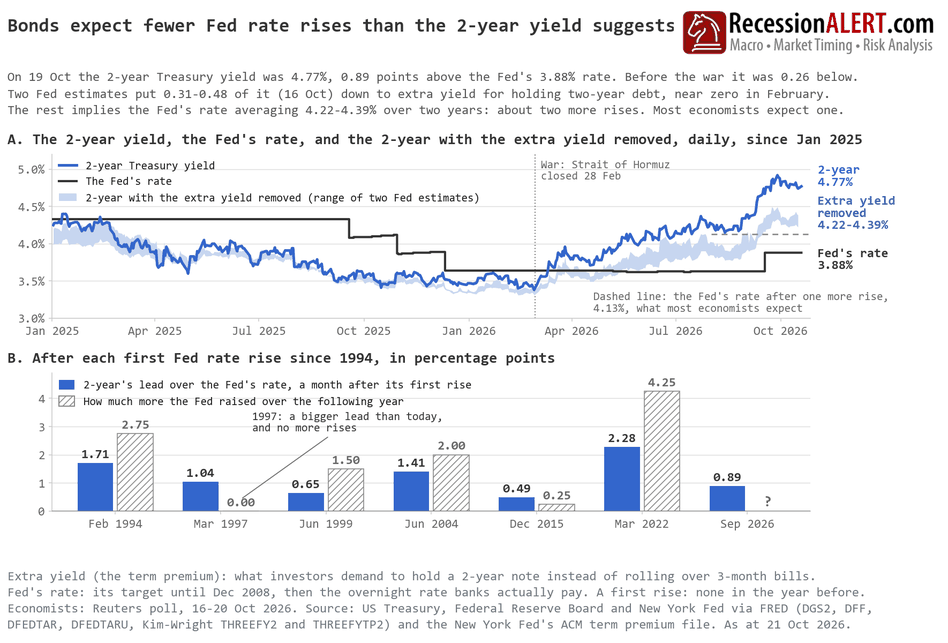
In 1997 the 2-year yield led the Fed’s rate by more than today, and the Fed went more than two years without another rise. The paradox dissolves once you split the yield into a bet and a fee. The bet is the average Fed rate investors expect; the fee is extra yield for holding the note rather than rolling over three-month bills — pay for not knowing how high rates and inflation go. Two Fed staff estimates put roughly three-quarters or more of 1997’s lead down to the fee; today, a third to over half — up from near zero before the war, consistent with doubt, with inflation at 3.7% and economists seeing no return to 2% before 2028. Strip the fee out and the bet is about two more rises — one more than most economists expect, not the four or so the raw yield implies. The lead’s size is a poor guide: in the four cycles since 1994 that ran on, the Fed added more within a year than the whole lead; in the two that stopped, less. Today’s mix looks more like 1994 and 2004 than 1997, though 1999 — nearly all fee, then 1.50 more — shows composition sorts nothing reliably. The fee skips most card and home-equity-line borrowers: their rates follow a 7.00% prime rate that reaches 7.50% only if the Fed delivers two more rises. The 1997 comparison flatters the one-and-done camp on size and deserts it on composition.
What it means: For households with card or home-equity-line debt, the question is one rise or two. That is a 7.25% or a 7.50% prime rate, and bonds, net of the fee, are pricing about two. For the wider economy, two-year borrowing will stay a third to half a point dearer than the expected rate path while investors keep charging the fee. Washington pays it on every two-year note it sells. The first test is the 28 Oct meeting: a rise there, which 94 of 100 economists do not expect, would mean the Fed is moving faster than they think.
Market Intelligence Brief (MIB) Ver. 19.86
For professional investors only. Not investment advice.
© 2026 RecessionALERT.com

Comments are closed.