
MARKET INTELLIGENCE BRIEF (MIB)
Monday, October 19, 2026
Amazon jumped 4.98% after Morgan Stanley named it a Top Pick, and the SMH chip ETF snapped a nine-session slide as the Nasdaq 100 rose 1.17%. Only three of 11 sectors gained: the 10-year yield climbed 5.5 bps to 5.145% and utilities fell 1.86%. Builder confidence hit a 14-year low. Trump waived the Graham Act’s Russia tariffs, and Houthis claimed unverified strikes on Aramco’s Yanbu site. Anthropic is reportedly in talks for about $45 billion more Nscale compute.
TABLE OF CONTENTS
A. EXECUTIVE SUMMARY
B. MARKET DATA
C. HIGH-IMPACT STORIES (5)
D. MODERATE-IMPACT STORIES (8)
E. ECONOMY WATCH (3)
F. EARNINGS WATCH (0)
G. WHAT’S NEXT
H. CHART OF THE DAY
A. EXECUTIVE SUMMARY -> TOP
The Nasdaq 100 rose 1.17% in a repositioning bounce, not a resolution: hedge funds sold a record share of tech stocks last week by Goldman’s prime-brokerage count, and CoreWeave’s failure to hold a Goldman upgrade shows credit, not equity sentiment, still sets the terms for debt-funded AI. Bonds refused the relief: the 10-year rose 5.5 bps to 5.145% with no data or Fed voice behind it, against a $1.992 trillion fiscal 2026 deficit, while builder confidence at its lowest since June 2012 shows higher rates now hitting activity. Crude slipped on profit-taking despite unverified Houthi claims of a strike on Aramco’s Yanbu site, Saudi Arabia’s route around Hormuz, but with Brent near $110 energy remains the inflation risk the Fed carries into October 28. Breadth was narrow: only Consumer Cyclical, Technology and Communication Services rose, while Utilities, Real Estate and Financials fell hardest, a sign that rates, not AI, are the binding constraint outside mega-cap tech.
• Amazon: Rose 4.98% to $262.45, the top Dow performer and the session’s largest mega-cap gain, after Morgan Stanley named it a “Top Pick” and raised its target to $350 from $335, citing AWS. American Electric Power said Amazon will fund development of a 960 MW small-modular-reactor project in Indiana, and after the close 3M disclosed a warrant giving Amazon up to 3,162,015 3M shares, fully vesting at $6 billion of cumulative purchases.
• Chips and software: The VanEck Semiconductor ETF ended a nine-session losing streak, with Marvell up 4.06% and Micron up 2.97%. JPMorgan lifted Intel to Neutral from Underweight, ending a bearish call held since November 2022, and the shares rose 2.43%, while a Bernstein upgrade to Outperform sent Datadog up 5.36%. CoreWeave closed 0.44% lower despite a Goldman Sachs upgrade to Buy.
• Rates and rate-sensitives: The 10-year yield rose 5.5 bps to 5.145% and the 2-year rose 6.1 bps to 4.776%, with no discrete catalyst identified. Utilities (-1.86%) and Real Estate (-1.24%) were the worst sectors, Wells Fargo fell 2.47%, the mortgage REIT ETF (REM) fell 3.29% to its lowest since April 2020, and a Bank of America double-downgrade sent Ameriprise down 4.07%.
• Housing and services: The NAHB builder-confidence index fell to 29 against a 32 forecast, its lowest since June 2012, with 43% of builders cutting prices as mortgage rates held above 7%. The New York Fed’s services activity index fell 12 points to -20.7 even as selling-price increases ran at their fastest pace since 2022. Fiscal 2026 closed with a $1.992 trillion deficit and a record $1.36 trillion in interest costs.
• Gulf: Yemen’s Houthis claimed strikes on Saudi targets including an Aramco site in Yanbu and the Shaybah oilfield, which Reuters could not verify, and Saudi Arabia postponed its Future Investment Initiative conference to 2027. Brent still settled 31 cents lower at $109.55 after falling more than $3 intraday, as Reuters attributed the selling to profit-taking.
• Policy and AI deals: President Trump waived the Graham Act’s tariffs of up to 100% on the largest importers of Russian crude and gas, with no fixed expiry, drawing criticism from both parties. Bloomberg reported Anthropic is in talks to buy about $45 billion more computing power from Nvidia-backed Nscale for a West Virginia campus; the talks are not final.
1. The Market Is Rewarding AI Demand and Still Punishing AI Leverage — Monday’s rally sorted the AI trade by balance sheet. Amazon, which sells compute rather than borrowing to build it, jumped 4.98% and spent the day securing power and hardware: a 960 MW nuclear project in Indiana and a 3M warrant tied to up to $6 billion of data-center purchases. CoreWeave, the centre of last week’s selloff, could not hold an early gain even after Goldman upgraded it to Buy, with its credit default swaps at distress levels and Oracle’s bonds trading close to junk territory, per CNBC. Demand signals were strong: Anthropic is in talks for about $45 billion more Nscale capacity, on top of agreements worth as much as about $44.6 billion, and JPMorgan’s Intel upgrade argues that CPU-intensive agentic AI widens the base of beneficiaries beyond accelerators. But Nscale funding a campus against one customer’s contract is the same model debt markets punished last week, so the financing question remains open. Meta, Tesla and Lam Research report after the close on Wednesday, October 21, and their capex guidance will decide whether the bounce extends.
2. Higher Rates Are Now Showing Up in Activity, Not Just Prices — Builder confidence at its lowest since June 2012, prospective buyer traffic at 18 and 43% of builders cutting prices show mortgage rates above 7% biting on housing demand, and the mortgage REIT ETF’s slide to its lowest since April 2020 carries the same stress into listed credit. The New York Fed’s services survey pairs a 12-point drop in activity with the fastest selling-price increases since 2022, the stagflationary mix that keeps the Fed from treating weaker demand as disinflation. Supply adds pressure: a $1.992 trillion deficit and record $1.36 trillion interest bill mean heavier Treasury issuance, and the 10-year reversed early declines to close 5.5 bps higher with no data or Fed commentary to push it. Credit stress is concentrated rather than systemic, since Walmart could still raise about $6.5 billion including a debut Canadian offering, but Bank of America’s double-downgrade of Ameriprise on cash-sweep pressure shows how rates are reworking financial-sector earnings. With the Fed in its blackout until the October 28 decision, only the data can cap yields this week.
3. Energy Tail Risks Are Shifting, Not Shrinking — The Graham Act waiver removes two inflationary tail risks: secondary tariffs of up to 100% on the largest buyers of Russian energy, and enforcement that could have pulled Russian barrels from a market with Brent above $109. Escalation in the Gulf pushes the other way. A confirmed hit at Yanbu, the Red Sea terminal that lets Saudi crude bypass Hormuz, would threaten the main route around the strait just as Iran claims two tankers struck mines there, and postponing FII is an implicit admission that Riyadh cannot guarantee security this month. Crude is discounting both unverified claims, so a Saudi confirmation of damage, not another claim, is the trigger to watch. China’s 4.5% third-quarter growth adds a correlated exposure: its export boom rides the same AI capex cycle US investors are questioning, so an AI slowdown would hit Chinese growth and US tech earnings together. The waiver’s lack of an end date also opens a fight with the Congress that passed the Act last month.
 — Leading economic indicators. Accurate market forecasts. Apply for membership at join.recessionalert.com
B. MARKET DATA -> TOP
The AI trade bounced after Wall Street’s worst week since late June: the Nasdaq 100 rose 1.17% as chip stocks snapped their longest losing streak since 2008 and Amazon jumped on a Morgan Stanley “Top Pick” call. The rebound was narrow — only three of 11 sectors rose and the NYSE Composite fell 0.50%, with banks and utilities sitting it out. Treasuries did not join the relief: yields reversed early declines to close higher, the 10-year up 5.5 bps to 5.145%. With last week’s worries over debt-funded AI spending unresolved, this week’s earnings from Tesla, Meta and other AI names are the real test of the bounce.
CLOSING PRICES – Monday, October 19, 2026:
MAJOR INDICES
A concentrated, tech-led bounce: the Nasdaq 100 and S&P 500 rose while the Dow finished flat and the broader NYSE Composite fell 0.50%. Over the past 10 sessions the S&P 500 has outperformed the Russell 2000 by 3.1 points — narrow mega-cap leadership with breadth deteriorating, a pattern that extends into a second session — and the Nasdaq 100 by 3.9 points, a broadening-rotation signal now in its fourth session that one day’s tech rally has not reversed.
| Index | Close | Change | %Move | Why It Moved |
|---|---|---|---|---|
| S&P 500 | 7,690.73 | +31.29 | +0.41% | Rebounded after its worst week since late June as AI and chip stocks recovered; consumer discretionary and technology led while eight of 11 sectors fell |
| Dow Jones | 51,966.03 | -36.38 | -0.07% | Near flat: Amazon (+4.98%), IBM and Nvidia led the Dow’s gainers, offset by declines in financial and healthcare shares |
| DJ Transportation | 19,701.19 | -178.64 | -0.90% | Fell against a higher S&P 500; no transport-specific catalyst identified |
| Nasdaq 100 | 29,529.34 | +341.79 | +1.17% | Chip stocks snapped their longest losing streak since 2008, and Amazon rallied on a Morgan Stanley “Top Pick” call |
| Russell 2000 | 2,728.30 | +6.93 | +0.25% | Lagged the large-cap rebound; no small-cap-specific catalyst identified |
| NYSE Composite | 23,967.07 | -121.56 | -0.50% | Fell as financials, utilities and healthcare declined; the rebound was confined to three sectors |
VOLATILITY & TREASURIES
Options markets relaxed while bonds did not: the VIX fell 7.80% as stocks rebounded, yet yields reversed early declines to close higher, the 2-year (+6.1 bps) slightly outpacing the 10-year (+5.5 bps). An equity rally with rising yields is bond-market non-participation — the bounce came with no easing in rate pressure. The dollar’s gain reflected a weaker euro amid unrest in France rather than a haven bid.
| Instrument | Level | Change | Why It Moved |
|---|---|---|---|
| VIX | 18.43 | -1.56 (-7.80%) | Eased from Friday’s highest close since July 29 as stocks rebounded |
| 10-Year Treasury Yield | 5.145% | +5.5 bps | Reversed early declines to close higher; no discrete catalyst identified, with the Fed in its blackout ahead of the October 27-28 FOMC meeting |
| 2-Year Treasury Yield | 4.776% | +6.1 bps | Rose slightly more than the 10-year, a marginal flattening; no discrete catalyst identified |
| US Dollar Index (DXY) | 102.00 | +0.16 (+0.16%) | Firmed as the euro fell on mass protests in France that added to concerns about its fiscal outlook (Reuters) |
COMMODITIES
Precious metals slipped alongside a firmer dollar and higher yields, with gold leading the decline and silver barely lower, while copper was little changed. Platinum’s gain stands apart from the rest of the complex with no identified catalyst. Bitcoin rose with the tech rebound rather than against it, acting as a risk proxy today.
| Asset | Price | Change | %Move | Why It Moved |
|---|---|---|---|---|
| Gold | $4,159.30/oz | $-21.80 | -0.52% | Slipped alongside a firmer dollar and higher yields; no discrete catalyst identified |
| Silver | $57.225/oz | $-0.080 | -0.14% | Edged lower against its prior settle; no discrete catalyst identified |
| Copper | $6.5825/lb | $+0.0090 | +0.14% | Little changed; no discrete catalyst identified |
| Platinum | $1,647.10/oz | $+14.00 | +0.86% | Rose against the rest of the metals complex; no discrete catalyst identified |
| Bitcoin | $81,994.00 | $+983.00 | +1.21% | Rose with the tech rebound; no crypto-specific catalyst identified |
ENERGY
Both crude benchmarks gave back modest ground in lockstep, Brent holding a premium of about $11 over December WTI after recovering most of an intraday slide of more than $3; Reuters attributed the selling to profit-taking after last week’s rally, even as unconfirmed Houthi claims of strikes on Saudi energy sites circulated. Henry Hub’s 2.44% drop decoupled from crude, while European TTF was little changed.
| Asset | Price | Change | %Move | Why It Moved |
|---|---|---|---|---|
| Crude Oil (WTI) | $98.35/bbl | $-0.67 | -0.68% | Now quoting the December contract, which settled 0.5% lower at $98.54 as profit-taking followed last week’s rally (Reuters); the expiring November contract rose $2.25 to $103.66 in thin trade ahead of its October 20 expiry |
| Crude Oil (Brent) | $109.40/bbl | $-0.46 | -0.42% | Settled 31 cents lower at $109.55 after falling more than $3 intraday as investors booked profits (Reuters); Houthi claims of attacks on Saudi energy sites, including Aramco’s Yanbu facility, were not confirmed by Saudi authorities |
| Natural Gas (Henry Hub) | $3.040/MMBtu | $-0.076 | -2.44% | Fell for a second session; no discrete catalyst identified |
| Natural Gas (Dutch TTF) | $28.942/MMBtu | $+0.104 | +0.36% | Edged higher, with the euro’s decline trimming the dollar-terms gain; no discrete catalyst identified |
S&P 500 SECTORS
Last week’s order flipped: Technology, the week’s worst sector (-4.86%), led a narrow bounce while Consumer Defensive, the week’s leader (+3.63%), slipped. Only three of 11 sectors rose — Consumer Cyclical, Technology and Communication Services the holdouts. Utilities and Real Estate fell hardest as yields rose, deepening three-month slides of -7.80% and -9.59%.
| Sector | 1-Day | 1-Week | 1-Month | 3-Month | 6-Month | YTD | 12-Month |
|---|---|---|---|---|---|---|---|
| Consumer Cyclical | +2.05% | +1.18% | +2.31% | -0.99% | -4.88% | -5.44% | -3.39% |
| Technology | +1.28% | -4.86% | -2.44% | +2.70% | +15.54% | +23.35% | +21.63% |
| Communication Services | +0.19% | -2.06% | -0.45% | -0.35% | -2.97% | +0.10% | +5.88% |
| Basic Materials | -0.24% | -0.65% | -3.33% | +3.78% | -7.76% | +10.63% | +14.85% |
| Healthcare | -0.30% | +1.56% | +2.21% | +5.48% | +12.79% | +10.10% | +18.21% |
| Industrials | -0.32% | -2.70% | -2.41% | -5.22% | -7.31% | +6.30% | +8.07% |
| Consumer Defensive | -0.50% | +3.63% | +6.96% | +5.02% | +4.33% | +11.88% | +11.06% |
| Energy | -0.72% | +2.38% | +4.75% | +12.22% | +15.98% | +45.85% | +53.01% |
| Financial | -0.86% | -0.46% | -2.74% | -2.89% | +3.95% | +2.74% | +10.44% |
| Real Estate | -1.24% | -0.88% | -2.54% | -9.59% | -7.19% | +1.49% | -1.36% |
| Utilities | -1.86% | -0.69% | +1.06% | -7.80% | -10.31% | -3.42% | -9.51% |
TOP MEGA-CAP MOVERS:
GAINERS
| Company | Ticker | Close | Change | Why It Moved |
|---|---|---|---|---|
| Amazon.com Inc | AMZN | $262.45 | +4.98% | Morgan Stanley named it a “Top Pick” and raised its price target to $350 from $335, citing AWS growth |
| Palantir Technologies | PLTR | $194.15 | +4.36% | Announced a partnership with Knox Systems to speed software deployment into high-security federal environments, alongside the AI-software rebound; how much of the move the partnership explains is unverified |
| Marvell Technology | MRVL | $237.09 | +4.06% | Rebounded with chip stocks after a sharp Friday selloff; no discrete same-day catalyst identified (a supportive GF Securities note was published Friday, October 16) |
| Tesla Inc | TSLA | $368.06 | +3.76% | No single confirmed catalyst; rose with the tech rebound ahead of Wednesday’s Q3 report. Commentary citing a same-day proxy filing (re-election of Musk, Denholm and Straubel) as the driver is unverified |
| Arista Networks | ANET | $182.95 | +3.37% | No discrete same-day catalyst identified; part of a rebound in AI networking hardware, with Ciena up about 4% |
DECLINERS
| Company | Ticker | Close | Change | Why It Moved |
|---|---|---|---|---|
| Wells Fargo & Co | WFC | $81.80 | -2.47% | No discrete same-day catalyst identified; the weakest of the big banks as financials sat out the rebound, leaving it down more than 12% year to date (CNBC) |
| Citigroup Inc | C | $121.69 | -2.07% | No discrete same-day catalyst identified; fell with the bank group (its October 13 Q3 results had drawn a sell-the-news reaction on weaker investment-banking fees) |
| Philip Morris International | PM | $201.05 | -2.02% | No discrete same-day catalyst identified; Q3 results are due Wednesday, October 21, before the open |
| JPMorgan Chase & Co | JPM | $333.53 | -1.82% | No discrete same-day catalyst identified; fell with the bank group as financials sat out the rebound |
| Amgen Inc | AMGN | $424.94 | -1.75% | No discrete same-day catalyst identified; no company release since September 22, and large drugmakers broadly fell (Lilly -1.33%, Merck -1.59%) |
— Institutional-grade intelligence for serious investors. Apply for membership at join.recessionalert.comC. HIGH-IMPACT STORIES -> TOP
BULLISH
1. AI Trade Bounces After the Worst Week Since June: Nasdaq 100 Rises 1.17% as Chip Stocks End a Nine-Session Slide, but Only Three Sectors Join In
The core facts:The Nasdaq 100 rose 1.17% to 29,529.34 and the S&P 500 gained 0.41% to 7,690.73, recovering part of last week’s loss of nearly 2% in the S&P 500, its biggest weekly decline since late June, and a 4.5% drop in the Nasdaq Composite. Chip stocks led: the VanEck Semiconductor ETF (SMH) came off nine consecutive losing days, and among the largest names Marvell rose 4.06%, Arista Networks 3.37%, Micron 2.97%, Intel 2.43%, Broadcom 1.78% and AMD 1.76%. Technology gained 1.28%. The rebound was narrow: only three of 11 sectors rose (Consumer Cyclical, Technology and Communication Services), the Dow slipped 0.07% and the NYSE Composite fell 0.50%. CoreWeave, the centre of last week’s selloff after a drop of more than 25%, reversed early gains to close 0.44% lower at $61.12 despite Goldman Sachs upgrading it to Buy from Neutral with a $106 target, cut from $139.
Why it matters:This was a repositioning bounce, not a resolution. Goldman’s prime-brokerage data showed hedge funds sold the largest percentage of technology stocks on record last week, so a light-positioning rebound was available on any absence of bad news. The question that drove last week, whether debt-funded AI infrastructure can be financed at today’s rates, is unanswered: CoreWeave’s credit default swaps sit at distress levels and Oracle’s bonds trade close to junk territory, according to CNBC, and CoreWeave’s failure to hold an upgrade-driven gain shows credit, not equity sentiment, still sets the tone for the neocloud complex. A tech rally alongside eight falling sectors and a 5.5 bp rise in the 10-year yield is concentration, which leaves the index exposed to this week’s AI earnings.
What to watch:Wednesday’s after-the-close reports from Meta, Tesla and Lam Research. Capex guidance and any commentary on AI financing will decide whether Monday’s bounce extends.
BULLISH
2. Amazon Jumps 4.98% to Lead the Dow After Morgan Stanley Names It a Top Pick; It Also Backs a 960 MW Nuclear Project and Takes a Warrant in 3M
The core facts:Morgan Stanley analyst Brian Nowak named Amazon a “Top Pick” and raised his price target to $350 from $335 with an Overweight rating, citing the growth runway at Amazon Web Services. The shares closed up 4.98% at $262.45, the session’s largest gain among mega-caps and the top performer in the Dow, and helped Consumer Cyclical to a 2.05% rise, the best of the 11 sectors. Separately, American Electric Power said at 8:30 ET that Amazon will fund the development of a 960 MW small-modular-reactor project in Sullivan County, Indiana: 12 X-energy Xe-100 reactors of 80 MW each at the former Breed coal plant site, with Amazon intending to buy the output under a long-term contract. The project is at the feasibility stage and needs a final investment decision, and no cost or funding amount was disclosed. After the close, 3M disclosed in an 8-K an expanded commercial relationship with an Amazon subsidiary, including a warrant for up to 3,162,015 3M shares at $164.89 over seven years; 85% vests with Amazon’s payments for optical connectivity and other data-center products, fully at $6 billion of cumulative purchases.
Why it matters:A single analyst call lifted a $2.8 trillion company 5% because it gave investors a way back into the AI trade through the cloud provider, which sells compute rather than borrowing to build it, on the morning after a week dominated by AI-financing fears. The day’s two deals show where that spending lands. Amazon is securing power directly, at gigawatt scale and years out, and it is locking in data-center hardware supply with equity warrants, a structure it has also used with suppliers including Generac and STMicroelectronics. For 3M, the warrant ties up to $6 billion of purchases to a single hyperscaler, giving an industrial conglomerate direct AI data-center exposure.
What to watch:3M’s third-quarter report before Tuesday’s open, for the size and timing of the Amazon revenue; then the AWS growth rate in Amazon’s own third-quarter results.
UNCERTAIN
3. Trump Waives the Graham Act’s Russia and Iran Tariffs and Sanctions Days Before They Took Effect, Drawing Bipartisan Backlash
The core facts:The White House released an executive order late on Friday, October 16, waiving the duties in sections 112 and 113 of the Lindsey O. Graham Sanctioning Russia and Iran Act of 2026, together with a list of its sanctions provisions, days before they were due to take effect. The Act, signed into law last month, would have imposed tariffs of up to 100% on goods from the five largest importers of Russian crude oil or gas. The order rests on a presidential certification that the waiver “is in the national interests of the United States”, sets no fixed expiry, and directs the US Trade Representative to monitor countries’ purchases of Russian crude and gas and their help in evading sanctions. Existing Russia sanctions under earlier executive orders are unaffected. Secretary of State Marco Rubio said on Saturday that the waiver gives the president time to “study” how the sanctions would affect the global economy. President Zelensky condemned it, and lawmakers from both parties criticised it. Crude edged lower on Monday, with Brent down 0.42% to $109.40 and December WTI down 0.68% to $98.35.
Why it matters:The waiver removes two tail risks in a market already strained by Gulf disruption: secondary tariffs of up to 100% on the largest buyers of Russian energy, which would have fed into US import prices, and enforcement that could have pulled Russian barrels from a market with Brent above $109. Both channels lean disinflationary at the margin, a modest offset for a Fed still facing energy-driven price pressure. The cost is credibility, because a waiver with no end date and no stated rationale signals that the administration will not use the Act’s main enforcement tool. That weakens Western leverage on Moscow and opens a fight with a Congress that passed the bill last month.
What to watch:Whether Congress moves to restrict the waiver authority, and whether the USTR’s monitoring reports show Russian crude purchases by the largest importers rising.
UNCERTAIN
4. Gulf Escalation Widens as Houthis Claim Strikes on Aramco’s Yanbu Site, Iran Says Tankers Hit Mines in Hormuz and Saudi Arabia Postpones FII; Brent Still Slips on Profit-Taking
The core facts:Yemen’s Houthis said on Monday they had attacked Saudi energy, airport and military targets, including an Aramco site in Yanbu, the Shaybah oilfield, King Khalid International Airport in Riyadh and Abha airport. There was no immediate Saudi confirmation, and Reuters could not verify the claims. On Saturday, Iran’s Revolutionary Guards said two crude tankers carrying about 2 million barrels had struck mines while crossing the Strait of Hormuz on a route Iran had not authorised; there was no independent confirmation. Saudi Arabia postponed its flagship Future Investment Initiative conference, scheduled for October 26-29 in Riyadh, to 2027, after a surge in Houthi attacks on the kingdom. Crude did not price in the escalation: Brent settled 31 cents lower at $109.55 after falling more than $3 intraday, and December WTI settled 0.5% lower at $98.54, as Reuters attributed the selling to profit-taking after last week’s rally. The Energy sector fell 0.72%.
Why it matters:The market is discounting unverified claims, and with Brent near $110 there is little complacency to remove. The location still matters: Yanbu is the Red Sea terminal that lets Saudi crude bypass Hormuz, so a confirmed hit there would threaten the main route around the strait just as Iran claims control over traffic through it. Postponing FII, the kingdom’s main forum for courting foreign capital, is an implicit admission that it cannot guarantee security in Riyadh this month. For US portfolios the channel is energy-driven inflation, with crude feeding into the price pressure the Fed carries into its October 27-28 meeting.
What to watch:Any Saudi confirmation or denial of damage at Yanbu or Shaybah, and Tuesday’s expiry of November WTI, which rose $2.25 to $103.66 in thin trade on Monday while December fell.
BEARISH
5. Bonds Sit Out the Bounce: 10-Year Yield Climbs 5.5 bps to 5.145% as Utilities, Real Estate and Banks Lead Eight Sectors Lower
The core facts:Treasury yields slipped in the morning, with the 10-year near 5.085%, then reversed to close higher. The 10-year rose 5.5 bps to 5.145%, its highest close since October 14, and the 2-year rose 6.1 bps to 4.776%. No discrete catalyst was identified, and with the Fed in its communications blackout ahead of the October 27-28 meeting, no official addressed the move. Rate-sensitive sectors took the hit: Utilities fell 1.86%, the worst of the 11 sectors, Real Estate fell 1.24% and Financials 0.86%. The big banks sat out the rally, with Wells Fargo down 2.47% (more than 12% lower this year), Citigroup down 2.07%, JPMorgan down 1.82% and Bank of America down nearly 2%, with no company-specific catalyst identified for any of them. The backdrop is a fiscal 2026 deficit of $1.992 trillion with record interest costs, reported on Friday.
Why it matters:An equity rally with rising yields means the bond market did not share the relief. Rate pressure, not AI sentiment, is the binding constraint on the broader market: the sectors priced off the discount rate fell while long-duration tech rose on its own flows. The 10-year remains below the 5.315% it closed at on October 5, but it reversed all of Monday’s early relief without any data or Fed commentary to push it. The 2-year rose slightly more than the 10-year, so this was a broad repricing that included the policy-sensitive front end, not just pressure from long-end supply. With no Fed voice permitted until the October 28 decision, nothing will cap yields in the meantime except the data.
What to watch:The 2-year yield’s reaction to Thursday’s jobless claims, the last major labour reading before the October 28 decision.
— Quantifying recession risk so you don’t have to guess. Apply for membership at join.recessionalert.comD. MODERATE-IMPACT STORIES -> TOP
BULLISH
6. JPMorgan Lifts Intel to Neutral From Underweight, Citing Better Execution Under CEO Lip-Bu Tan and CPU-Hungry Agentic AI; Shares Rise 2.43%
The core facts:JPMorgan analyst Harlan Sur upgraded Intel to Neutral from Underweight, saying the risk/reward is now “much more balanced”, and kept his $85 target, below Monday’s $92.03 close. Intel shares are about 36% below their June peak, against a 20%-25% decline for the broader chip group. Sur noted that since JPMorgan’s November 2022 downgrade Intel’s server x86 CPU revenue share has fallen from 77% to 53% and its PC share from 81% to 68%, and he expects a few more quarters of share loss, especially in servers. He credited improved execution under CEO Lip-Bu Tan in client and data-center compute and in next-generation manufacturing, while noting external foundry revenue of barely $1 billion annualised in the first half of 2026, against $150 billion for TSMC. He also wrote that agentic AI workloads, which are CPU-intensive, together with very tight leading-edge supply, “should drive continued positive EPS revisions” through 2027. Intel closed 2.43% higher.
Why it matters:Ending a bearish call that has run since late 2022 matters more than the rating, because the target sits below the share price: JPMorgan is not calling for upside but withdrawing a short thesis on a $484 billion company. The rationale is the more useful signal for the sector. If agentic AI shifts incremental demand toward general-purpose CPUs, AI capex spreads beyond accelerators, which widens the base of beneficiaries at a time when investors are questioning concentrated AI spending.
BULLISH
7. Bernstein Upgrades Datadog to Outperform and Lifts Its Target to $350 From $237; Shares Jump 5.36%
The core facts:Bernstein raised Datadog to Outperform from Market Perform before Monday’s open and lifted its price target to $350 from $237. The shares closed up 5.36% at $260.36, giving the observability-software company a market value of about $93 billion. The upgrade came on a day when software rebounded with the wider AI trade, with Palantir up 4.36% and Atlassian up 3.33%.
Why it matters:The new target implies roughly 34% upside from Monday’s close, a large call on a software name after a week in which AI-exposed software was sold alongside the chip and neocloud complex. Monitoring and observability spending grows with the volume of AI workloads running in production rather than with model training budgets, so a bullish call here bets that AI usage keeps rising even if infrastructure financing tightens. It is the clearest single-name sign on Monday that some analysts saw last week’s software selloff as indiscriminate.
BEARISH
8. BofA Double-Downgrades Ameriprise to Underperform on Adviser Departures and Cash-Sweep Pressure; Shares Fall 4.07%
The core facts:Bank of America analyst Craig Siegenthaler cut Ameriprise Financial two notches, to Underperform from Buy, and lowered his price target to $445 from $570. The bank said several large teams of financial advisers have left Ameriprise and that the company’s cash sweep rate “weighs on profit growth”. The shares fell 4.07% to $480.41, leaving the wealth manager with a market value of about $42 billion, as Financials fell 0.86% for the session.
Why it matters:A move from Buy straight to Underperform is rare and signals a change in thesis rather than in valuation. Both reasons reach beyond Ameriprise. Adviser attrition erodes the asset base that wealth platforms earn fees on, and cash-sweep economics were a major profit source for the sector while rates were rising. If brokers have to pay clients more on idle cash to keep advisers and assets, that margin shrinks across wealth managers, even with policy rates still high.
What to watch:Ameriprise’s third-quarter adviser count, client net flows and cash-sweep balances, and whether peers report similar adviser movement.
BEARISH
9. Mortgage REIT ETF Sinks 3.29% to Its Lowest Since April 2020 as Builder Confidence Drops to a 14-Year Low
The core facts:The iShares Mortgage Real Estate Capped ETF (REM) fell 3.29% to $16.73 after touching $16.71, its lowest level since April 6, 2020, and is now down more than 24% this year. Armour Residential, Starwood Property, Dynex, Blackstone Mortgage and Annaly led the decline, all at 52-week lows. The selloff coincided with the NAHB builder-confidence index falling to its lowest since June 2012, with 43% of builders cutting prices, and with the 10-year Treasury yield rising 5.5 bps to 5.145%. Real Estate was the S&P 500’s second-worst sector, down 1.24%.
Why it matters:Mortgage REITs fund long-dated mortgage assets with short-term borrowing, so a 10-year yield above 5% hits their book values while weaker housing activity limits new production. A move to six-year lows says the market now treats elevated rates as persistent rather than temporary. It follows Friday’s report that mortgage-bond sales were postponed as investors demanded more yield, so the stress in mortgage credit is now visible in both primary issuance and listed equity.
What to watch:Whether REM holds above Monday’s $16.71 low, and third-quarter book-value updates from Annaly and the other large mortgage REITs.
UNCERTAIN
10. Walmart Taps Bond Markets for About $6.5 Billion, Including a Debut C$5 Billion Canadian Offering
The core facts:Walmart is set to raise about $6.5 billion from US and Canadian dollar bonds, Bloomberg reported, citing people familiar with the matter. The retailer launched a C$5 billion ($3.55 billion) offering, its first sale of Canadian notes, and priced $3 billion of US dollar bonds, as it seeks to diversify its funding sources amid a spending spree.
Why it matters:On a day when mortgage bonds and neocloud credit were under strain, the highest-quality corporate borrowers could still raise large sums, which shows credit stress is concentrated rather than systemic. A debut in a second currency is also a funding-cost decision. With the 10-year Treasury at 5.145%, tapping Canadian investors widens the buyer base and may lower the all-in cost for a company that is borrowing to invest rather than to refinance. Heavy top-tier issuance adds to the supply the bond market has to absorb in the same week its benchmark yield rose.
BULLISH
11. FDA Grants Accelerated Approval to GSK’s Jemperli as the First US Immunotherapy for MSI-H/dMMR Locally Advanced Rectal Cancer, Ahead of Its PDUFA Date
The core facts:The FDA granted accelerated approval to GSK’s Jemperli (dostarlimab) for adults with stage II or III MSI-H/dMMR locally advanced rectal cancer, which GSK called the first and only immunotherapy approved in the US for this population. The decision came ahead of the PDUFA date, after Priority Review with a National Priority Voucher. In the single-arm Phase II AZUR-1 trial, 68% of patients (98 of 144) had a clinical complete response at 12 months on investigator assessment; by independent central review, the primary measure, the rate was 47% (54 of 116), with data still maturing. In an exploratory analysis, 76% had no evidence of cancer a year or more after treatment.
Why it matters:The approval moves a checkpoint inhibitor earlier, into stage II and III disease where a complete response can mean no cancer a year or more after treatment, a larger and longer-duration market than late-line therapy. The early approval also shows the National Priority Voucher programme shortening review times in practice, which is relevant for any large-cap drugmaker holding one. The gap between the investigator and central-review response rates is what confirmatory data must close.
What to watch:The full interim AZUR-1 data at ESMO, which opens October 23.
BULLISH
12. Anthropic in Talks to Buy About $45 Billion More AI Computing Power From Nvidia-Backed Nscale for a West Virginia Campus
The core facts:Nscale, the Nvidia-backed AI cloud and data-center developer, is in talks to sell computing power to Anthropic in a deal that could be worth about $45 billion, Bloomberg reported on Monday afternoon, citing people familiar with the negotiations. The capacity would come from a second facility at Nscale’s Monarch data-center campus in West Virginia. It would be a second major agreement between the two companies: Anthropic already has infrastructure agreements with Nscale worth as much as about $44.6 billion, according to the regulatory filing for Nscale’s planned IPO. The talks are not final.
Why it matters:A potential doubling of an existing $45 billion commitment cuts against last week’s narrative of slowing AI demand. The buyer is a leading model developer still adding capacity on a large scale, and the build is on US soil. The counterparty structure is the risk: a neocloud funding a large campus against one customer’s contract is the same model whose debt markets punished CoreWeave last week. The talks therefore support the demand side of the AI trade while adding to its financing exposure.
What to watch:Whether a signed agreement is disclosed in an update to Nscale’s IPO filing, and how the deal is financed.
UNCERTAIN
13. China’s Third-Quarter Growth Picks Up to 4.5% on an AI-Driven Export Boom, but Property Investment Is Down More Than 20%
The core facts:China’s economy grew 4.5% in the third quarter, up from the previous quarter’s three-year low but below the 5% recorded in January-March, and at the bottom of Beijing’s 4.5%-5% annual target, the National Bureau of Statistics said on Monday. Sales of high-tech goods rose 14.3%, and output of batteries and industrial robots grew by more than 29%. Property investment fell by more than 20% in the first nine months from a year earlier. China’s trade surplus is on track to exceed last year’s record of $1.2 trillion as global demand for AI data-centre components lifts exports.
Why it matters:China’s growth now depends on a single external engine, exports, which Moody’s Analytics flagged, and much of that rests on the same AI capex cycle US investors are questioning. A slowdown in AI building would therefore hit China’s growth as well as US tech earnings, a correlated risk for global cyclicals. A record surplus also sharpens trade frictions with the US just as Washington softens its Russia-related tariff threats, and leaves Beijing exporting disinflation in goods while US prices are being pushed up by energy.
What to watch:The APEC meetings in Shenzhen on November 18-19 for any US-China trade talks, and Beijing’s response to the property drag beyond September’s support measures.
— Separating signal from noise since 2007. Apply for membership at join.recessionalert.comE. ECONOMY WATCH -> TOP
Higher rates are now showing up in activity as well as in prices. Builder confidence fell to 29 in October, its lowest since June 2012, with 43% of builders cutting prices as mortgage rates held above 7%, and the New York Fed’s regional services gauge dropped 12 points to -20.7 even as selling-price increases ran at their fastest pace since 2022. Fiscal 2026 closed with a $1.992 trillion deficit, the largest in five years, and record interest costs of $1.36 trillion, while the 10-year yield rose 5.5 bps today to 5.145%. Softening demand alongside firm pricing is the stagflationary mix the Fed carries into its October 27-28 meeting.
Builder Confidence Falls to 29 in October, Missing the 32 Forecast and Hitting Its Lowest Level Since June 2012 (NAHB, Oct 19)
What they’re saying:The NAHB/Wells Fargo Housing Market Index fell three points to 29 in October against a consensus of 32, its lowest reading since June 2012. All three components declined: current sales conditions fell 2 points to 33, sales expectations for the next six months fell 5 points to 32, and prospective buyer traffic fell 5 points to 18, its lowest since April 2012 excluding April 2020. 43% of builders cut prices, the highest share since 2020, with the average cut steady at 6%, and 65% used sales incentives.
The context:NAHB tied the decline to mortgage rates that have “climbed well above 7% in recent weeks,” along with higher energy and material costs and worsening labor and lot availability; Freddie Mac’s 30-year average stood at 7.4% in the week to October 16. Weakness was broad, with the West’s three-month average down 2 points to 26 and the South’s down 1 point to 30. There was no relief on financing costs today: the 10-year yield rose 5.5 bps to 5.145%, and real estate was the S&P 500’s second-worst sector, down 1.24%.
What to watch:Tuesday’s September housing starts (expected 1.31M vs 1.275M prior), building permits (expected 1.40M) and pending home sales (expected -0.5%); Wednesday’s MBA 30-year mortgage rate (prior 7.5%).
New York Fed Services Activity Index Drops 12 Points to -20.7, Lowest Since March, as Selling-Price Gains Hit Fastest Pace Since 2022 (New York Fed, Oct 16)
What they’re saying:The New York Fed’s Business Leaders Survey headline business activity index fell twelve points to -20.7 in October, from -8.7 in September, its lowest level since March. The business climate index was little changed at -35.0, and the future business activity index fell 10 points to -5.1 as firms “became somewhat pessimistic about the outlook for the next six months.” Employment held steady at 0.0, capital spending slipped to -4.2, and the prices received index rose 3 points to 36.3.
The context:The survey pairs falling activity with faster pricing: the New York Fed said “the pace of input price increases remained sharp, and selling price increases picked up to the fastest pace since 2022.” That makes the services slowdown a poor disinflation signal, coming a day after a 1.3% producer-price jump. It also diverges from the region’s factories, where the Empire State manufacturing index rose to 25.5 on Thursday, leaving services as the weaker half of the regional economy.
What to watch:Thursday’s initial jobless claims (expected 200K vs 199K prior) for any spillover into hiring, and Friday’s final University of Michigan sentiment for October (expected 46.3 vs 48.1 prior).
Fiscal 2026 Deficit Widens to $1.992 Trillion, Largest in Five Years, as Interest Costs Reach a Record $1.36 Trillion (U.S. Treasury, Oct 16)
What they’re saying:The September Monthly Treasury Statement closed fiscal 2026 with a deficit of $1.992 trillion, up about 12% from $1.775 trillion in fiscal 2025 and the largest in five years. September alone showed a $27 billion deficit against a $29 billion forecast, compared with a $198 billion surplus a year earlier, as outlays rose to $585 billion from $346 billion while receipts rose to $558 billion from $544 billion. Gross interest on the debt reached a record $1.36 trillion for the year, up $144 billion, or 12%.
The context:Year-ago September comparisons are distorted by payment timing, so the full-year total is the cleaner signal: the Congressional Budget Office’s preliminary tally had revenue up 3% and outlays up 6%, with interest among the largest sources of spending growth. Corporate tax collections fell 16% for the year, and in September $19.36 billion of customs refunds offset most of $25.27 billion in gross collections, leaving net customs receipts of $5.91 billion. A near-$2 trillion gap means heavier Treasury issuance into a market where the 10-year yield closed today at 5.145%.
What to watch:Whether the 10-year yield holds above 5.1% as deficit financing continues; the October Monthly Treasury Statement in November will show whether customs refunds keep eroding tariff revenue.
— Know the probability before the market prices in the risk. Apply for membership at join.recessionalert.comF. EARNINGS WATCH -> TOP
YESTERDAY AFTER THE BELL (Markets Reacted Today)
No major earnings yesterday after the bell from companies with >$100B market cap.
TODAY BEFORE THE BELL (Markets Already Reacted)
No major earnings before the bell from companies with >$100B market cap.
TODAY AFTER THE BELL (Markets React Tomorrow)
No major earnings after the bell from companies with >$100B market cap.
WEEK AHEAD PREVIEW:
Q3 2026 earnings season moves into its heaviest stretch, with 30 companies above $100 billion reporting over the next five sessions, led by SpaceX on Tuesday and Meta and Tesla on Wednesday, the first real test of whether the AI trade’s rebound can hold.
SpaceX (SPCX) — AMC, Tuesday, October 20 (per the earnings calendar; some trackers list early November and the date was not confirmed by the company in sources reviewed) — Second report as a public company; consensus EPS about $0.13. Key focus: progress toward its stated $100 billion annualised revenue run-rate target by year-end, and the capital-spending trajectory.
GE Aerospace (GE) — BMO, Tuesday, October 20 — Consensus EPS $2.01. Key focus: commercial engine deliveries and aftermarket services pricing as airlines contend with jet fuel costs tied to Brent near $110.
RTX (RTX) — BMO, Tuesday, October 20 — Consensus EPS $1.78. Key focus: defence backlog and missile production capacity; Monday’s $215 million Army award to the Raytheon/Lockheed Javelin joint venture adds to the munitions pipeline.
Netflix (NFLX) — AMC, Tuesday, October 20 — Consensus EPS $0.82. Key focus: advertising-tier revenue and engagement, and management commentary after a reported film-division leadership change and layoffs.
Intuitive Surgical (ISRG) — AMC, Tuesday, October 20 — Consensus EPS $2.65. Key focus: da Vinci procedure growth and system placements.
Chubb (CB) — AMC, Tuesday, October 20 — Consensus EPS $6.79. Key focus: catastrophe losses, commercial pricing and investment income at higher yields.
Capital One (COF) — AMC, Tuesday, October 20 — Consensus EPS $5.50. Key focus: card credit quality and charge-offs, with the big banks lagging Monday’s rally.
Meta Platforms (META) — AMC, Wednesday, October 21 — Consensus EPS $6.66. Key focus: 2027 capital-spending guidance and how it is financed, the central question for an AI trade coming off its worst week since June; Morgan Stanley raised its target to $820 from $775 on Monday.
Tesla (TSLA) — AMC, Wednesday, October 21 — Consensus EPS $0.45. Key focus: automotive margins and deliveries, and AI and robotics spending; +3.76% on Monday, among the session’s top mega-cap gainers.
Lam Research (LRCX) — AMC, Wednesday, October 21 — Consensus EPS $2.18. Key focus: memory and leading-edge wafer-fab equipment orders after the chip index’s losing streak, and China revenue exposure.
Texas Instruments (TXN) — AMC, Wednesday, October 21 — Consensus EPS $2.43. Key focus: the industrial and automotive analog recovery and fourth-quarter guidance.
IBM (IBM) — AMC, Wednesday, October 21 — Consensus EPS $2.85. Key focus: software growth, consulting demand and AI bookings.
Philip Morris International (PM) — BMO, Wednesday, October 21 — Consensus EPS $2.30. Key focus: smoke-free volumes (IQOS, ZYN); -2.02% on Monday, among the session’s top mega-cap decliners.
Thermo Fisher Scientific (TMO) — BMO, Wednesday, October 21 — Consensus EPS $6.40. Key focus: bioprocessing and pharma services demand, and academic and government funding.
Abbott Laboratories (ABT) — BMO, Wednesday, October 21 — Consensus EPS $1.42. Key focus: medical devices growth, led by diabetes care.
NextEra Energy (NEE) — BMO, Wednesday, October 21 — Consensus EPS $1.19. Key focus: renewables backlog and data-center power contracts, with utilities the worst sector on Monday as yields rose and Barclays cut its target to $84 from $91.
AT&T (T) — BMO, Wednesday, October 21 — Consensus EPS $0.60. Key focus: postpaid phone and fibre net additions and free-cash-flow guidance.
Danaher (DHR) — BMO, Wednesday, October 21 — Consensus EPS $1.92. Key focus: the bioprocessing recovery and China diagnostics.
CME Group (CME) — BMO, Wednesday, October 21 — Consensus EPS $2.98; market cap $105.6 billion, close to the $100 billion threshold. Key focus: interest-rate and energy futures volumes after heavy rate and crude volatility.
Procter & Gamble (PG) — BMO, Thursday, October 22 — Consensus EPS $1.88. Key focus: volume versus pricing and input-cost pressure from higher energy prices.
Union Pacific (UNP) — BMO, Thursday, October 22 — Consensus EPS $3.47. Key focus: freight volumes and fuel surcharges, with the Dow Transports down 0.90% on Monday.
Blackstone (BX) — BMO, Thursday, October 22 — Consensus EPS $1.27. Key focus: real-estate marks and fundraising as rates rise; Piper Sandler cut its target to $125 from $130 on Monday.
Lockheed Martin (LMT) — BMO, Thursday, October 22 — Consensus EPS $7.52. Key focus: missile and munitions production, including the Javelin award shared with RTX.
Valero Energy (VLO) — BMO, Thursday, October 22 — Consensus EPS $21.07. Key focus: refining margins with crude above $98 and Russian product flows after the Graham Act waiver.
Spotify Technology (SPOT) — BMO, Thursday, October 22 — Consensus EPS $3.15; market cap $106.8 billion, close to the threshold (US-listed ordinary shares, not an ADR). Key focus: subscriber growth and gross margin.
Western Digital (WDC) — AMC, Thursday, October 22 — Consensus EPS $4.09. Key focus: storage pricing and AI data-center demand after last week’s storage selloff.
Newmont (NEM) — AMC, Thursday, October 22 — Consensus EPS $1.94. Key focus: margins with gold near $4,160 an ounce, and all-in sustaining costs.
American Express (AXP) — BMO, Friday, October 23 — Consensus EPS $4.58. Key focus: billed-business growth against its raised 10% full-year revenue growth guidance, and card credit.
Verizon Communications (VZ) — BMO, Monday, October 26 — Consensus EPS $1.27. Key focus: postpaid phone net additions against full-year guidance of 750,000 to 1 million, churn, and adjusted EPS guidance of $4.95-$4.99.
Welltower (WELL) — AMC, Monday, October 26 — Consensus EPS $0.65. Key focus: senior-housing occupancy and same-store NOI growth against a full-year normalised FFO midpoint of $6.40, raised in July.
The following week brings the Fed’s October 27-28 decision; in earnings, the season’s peak runs through the end of the month as most remaining mega-caps report.
— US market commentary trusted by family offices and institutions. Apply for membership at join.recessionalert.comG. WHAT’S NEXT -> TOP
UPCOMING RELEASES:
| Date | Event | Why It Matters |
|---|---|---|
| Tue, Oct 20 | Housing Starts and Building Permits, Sep (expected 1.31M and 1.40M; prior 1.275M and 1.403M) | Builder confidence just fell to 29, its lowest since June 2012, with prospective buyer traffic at 18. Starts show whether that gloom is already cutting construction, and permits are the forward-looking half. |
| Tue, Oct 20 | Pending Home Sales, Sep (expected -0.5%, prior 0.3%) | Contract signings measure buyer demand with Freddie Mac’s 30-year average at 7.4%. A miss would extend the housing slowdown that sent the mortgage REIT ETF to its lowest since April 2020. |
| Tue, Oct 20 | Atlanta Fed GDPNow, Q3 (prior 3.6%) and November WTI expiry | GDPNow folds in the housing data; an estimate near 3.6% would leave the Fed no growth reason to look past firm prices. The expiring November WTI contract rose $2.25 to $103.66 in thin trade Monday while December fell. |
| Wed, Oct 21 | MBA 30-Year Mortgage Rate (prior 7.5%); EIA Crude and Gasoline Stocks (prior crude -8.557M, gasoline +3.518M; API on Tue, Oct 20, prior -11.1M) | The MBA rate shows whether Monday’s 10-year rise to 5.145% is pushing borrowing costs further above 7.5%. Another large crude draw would add domestic tightness to Gulf supply risk with Brent near $110. |
| Thu, Oct 22 | Initial Jobless Claims (expected 200K, prior 199K) | The last major labour reading before the October 28 decision. The New York Fed’s services employment index held at 0.0 while activity fell to -20.7; claims show whether that weakness is reaching layoffs. |
| Fri, Oct 23 | University of Michigan Consumer Sentiment, Final Oct (expected 46.3, prior 48.1) | How households are absorbing Brent near $110 and mortgage rates above 7%, and whether inflation expectations are firming after the New York Fed reported the region’s fastest services selling-price increases since 2022. |
| Mon, Oct 26 | Chicago Fed National Activity Index, Sep (prior -0.04); Dallas Fed Manufacturing Index, Oct (prior 9.8) | The last activity reads before the Fed meets. The Dallas survey covers the energy-heavy Texas economy, a test of whether crude near $100 is lifting regional manufacturing while housing weakens. |
| Tue, Oct 27 – Wed, Oct 28 | FOMC Meeting (decision Wed, Oct 28) | The Fed meets with softening activity in housing and services set against firm selling prices and energy-driven inflation, a stagflationary mix. The blackout means no official can push back on yields before the decision. |
KEY QUESTIONS:
1. Will Meta, Tesla and Lam Research, reporting after the close on Wednesday, October 21, hold their AI capital-spending plans and say how they will be financed, or does a capex pullback turn Monday’s light-positioning bounce back into last week’s selloff?
2. With the 10-year at 5.145%, builder confidence at its lowest since June 2012 and New York Fed services selling prices rising at their fastest pace since 2022, are higher rates now slowing activity faster than they are cooling prices, and how does the Fed weigh that on Wednesday, October 28?
3. Can crude keep discounting Gulf escalation if Saudi Arabia confirms damage at Yanbu, its Red Sea route around Hormuz, and will Congress move to restrict the Graham Act waiver that removed the threat of secondary tariffs on Russian energy buyers?
— US market commentary trusted by family offices and institutions. Apply for membership at join.recessionalert.comH. CHART OF THE DAY -> TOP
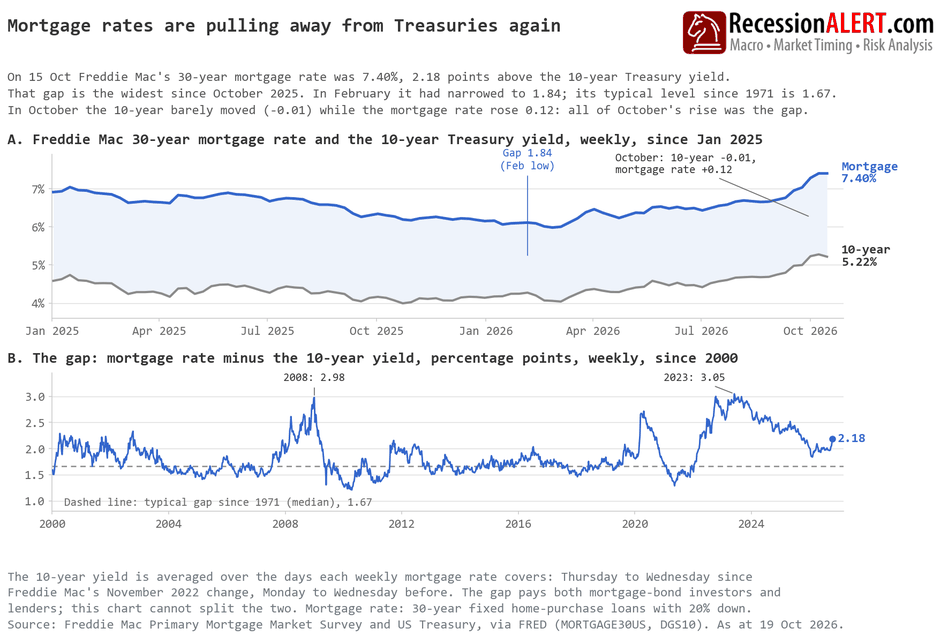
Treasury yields stood still in October, yet borrowers paid more anyway. Over the days Freddie Mac’s survey covers, the 10-year moved -0.01 while the 30-year mortgage rate rose 0.12 to 7.40%, so every bit of the rise was the gap — now 2.18 points, the widest in a year. That reverses the cushion of mid-2025 to February, when the gap narrowed to 1.84; since then it has given back 0.35, a quarter of the rate’s 1.29-point climb. The likely reason lies in what a mortgage bond is: a loan the homeowner can repay early at any time. When rates fall, borrowers refinance and the investor is repaid just when reinvesting pays less; when rates rise, nobody refinances and the investor is stuck longer with the lower-yielding loan. The wilder the swings, the worse that one-sided deal gets, and the 10-year’s day-to-day swings hit their 2026 high on 15 Oct. On Friday a growing list of lenders held off on mortgage-bond sales as investors demanded more compensation “amid turbulence in rates markets” — a symptom of buyers’ reluctance to take that deal, not its cause. This gap would have looked mild in 2008 or 2023; the trouble is its direction, not its level. Still, its 0.51 above the typical 1.67 costs about $141 a month on a $400,000 loan, and until it narrows borrowers keep paying that whatever Treasuries do. The relief they need is calmer rates, not merely lower ones.
What it means: Homebuyers now need two things to come down, Treasury yields and the gap. The gap alone, back at February’s 1.84, would take about $95 a month off a $400,000 loan at today’s 10-year yield. For stock investors, homebuilders stay the exposed group, since their sales turn on what buyers pay each month rather than on what Treasuries yield. For the economy, housing feels higher borrowing costs first, and a widening gap will squeeze home buying beyond what Treasury yields alone would. The signal to watch is the gap back below 2.0, where it sat until mid-September.
Market Intelligence Brief (MIB) Ver. 19.85
For professional investors only. Not investment advice.
© 2026 RecessionALERT.com

Comments are closed.