
MARKET INTELLIGENCE BRIEF (MIB)
Thursday, September 17, 2026
Markets un-priced Wednesday’s Fed hike in one session — VIX -12.82%, the 10-Year -6.7bps to 4.937%, S&P 500 +1.14%. Chip and AI-infrastructure names took all five top mega-cap gainer slots: Intel +7.62%, AMD +6.30%, Micron +5.50%. Jobless claims fell to 196K; housing missed across the board. The Bank of England held at 3.75% and paused gilt sales for six months. The SEC opened a five-year path for tokenized stocks. CoreWeave fell 4.16% raising $3bn; private rival Crusoe’s $3.9bn round was oversubscribed.
TABLE OF CONTENTS
A. EXECUTIVE SUMMARY
B. MARKET DATA
C. HIGH-IMPACT STORIES (7)
D. MODERATE-IMPACT STORIES (7)
E. ECONOMY WATCH (5)
F. EARNINGS WATCH (0)
G. WHAT’S NEXT
H. CHART OF THE DAY
A. EXECUTIVE SUMMARY -> TOP
Every instrument that had priced Wednesday’s rate hike reversed in a single session: the VIX collapsed 12.82% to 15.44, the 10-Year eased 6.7bps to 4.937% and snapped an eight-session run of higher closes begun September 4, and the S&P 500 added 1.14% to 7,637.76. The shape argues unwind rather than reappraisal — the 2-Year fell less than the 10-Year, and the Nasdaq 100’s 1.73% gain against the Russell 2000’s 0.55% advance put the bid in mega-cap technology rather than the rate-sensitive small-caps a genuine dovish rethink lifts first. Today’s data gave that optimism only partial cover: jobless claims fell to 196K, but housing starts, permits and pending home sales all missed consensus, and July’s net long-term securities flows swung to a $27.9 billion outflow. Breadth was real but uneven — ten of eleven sectors rose, led by Technology’s 2.33%, with only Consumer Defensive (-0.19%) giving back Wednesday’s safety bid.
• Wednesday’s hike is un-priced in one session — VIX -12.82% to 15.44, the largest percentage move on the tape; 10-Year -6.7bps to 4.937%, ending an eight-session rising run that began September 4; 2-Year -5.4bps to 4.673%; DXY unchanged at 100.25
• Chips and AI infrastructure take every top gainer slot — Intel (INTC) +7.62%, AMD +6.30%, Sandisk (SNDK) +6.21%, Micron (MU) +5.50%, Oracle (ORCL) +5.19%; Technology +2.33% led all sectors, but no fresh same-day catalyst could be established for any of the five
• Bank of England holds at 3.75% on a 6-3 vote and pauses gilt sales — active sales suspended for six months with QT holdings targeted at zero by 2034; inflation now seen “slightly over 4%” in early 2027 against 3.2% previously; Bank of Japan expected to hike Friday
• Labour firm, housing soft — initial claims fell to 196K vs. 208K expected and continuing claims to 1.730M; housing starts -2.6% to 1.275M on a roughly 21.7% multifamily collapse (single-family +7.6%), permits -2.7% to 1.394M, pending home sales +0.3% vs. ~+2% and -4.7% year-on-year
• SEC opens a five-year door to tokenized US equities — Release 2026-90 exempts Tokenized Securities Venues from exchange registration, conditional on equivalent shareholder rights, auditable public smart contracts, halt-with-the-underlying and an issuer objection right; Coinbase (COIN) +~5% and Robinhood (HOOD) +~2.8% intraday
• Private credit still has no agreed default rate — Fitch reads a record 6.3% across ~1,300 borrowers, Proskauer 2.51% for Q2, other measures 1% and as high as 19%; Moody’s puts distressed restructurings at ~65% of all private-credit defaults, which largely decides where a measure lands
1. Positioning has been cleared out one session into a tightening cycle — Read the reversal by its composition, not its size. Both ends of the curve fell with the front end falling less, which is a market fading a hawkish surprise rather than repricing the terminal rate, and the leadership was thin — Nasdaq 100 +1.73% against the Russell 2000’s +0.55% and NYSE Composite’s +0.65%, and Technology’s +2.33% sat more than half a point clear of the next sector. Volatility crushed, the long end retreating and breadth narrow together describe an unwind of Wednesday’s hedges, not a considered view that the Fed stops at one hike. The asymmetry is that it happened during a communications blackout in which no official could push back. That ends at 23:59 ET tonight, and Bowman at 09:30 ET Friday is the first chance to lean against it.
2. Three central banks are turning in seventy-two hours, into a term-premium problem that is already visible — The Fed hiked Wednesday, the Bank of England signalled Thursday and the Bank of Japan is expected to move Friday, so the global stock of duration that must clear at higher policy rates is rising across three issuers at once. July TIC flows say the marginal buyer was already stepping back before any of it: net long-term securities flows swung to a $27.9 billion outflow from a revised $174.4 billion inflow, a $202 billion reversal against a $146.3 billion consensus, on data that lands two months late. The eight-session run to 5.021% happened while nobody knew that; today’s buyers took the same duration back at 4.937%. The counterweight is honest — one heavily-revised month is not a trend, and the two-month average stays comfortably positive.
3. The market is paying up for AI supply and charging hard for the balance sheet that buys it — Memory and silicon were bid without news: Micron +5.50% and Sandisk +6.21% on a structural-shortage narrative that does not need a daily catalyst. Financing the capacity went the other way in the same session. CoreWeave fell 4.16% launching $3.0 billion of 2033 convertibles alongside a 35 million-share at-the-market programme and capped calls — three dilutive sources at once, with capital spent on the cap table rather than on GPUs — while privately held Crusoe closed an oversubscribed $3.9 billion round at a $30.9 billion valuation. Private credit’s undefined default rate sits underneath all of it, at the front end of the curve the Fed has just moved for the first time since 2023. Own the supply; underwrite the funding structures one at a time.
 — Leading economic indicators. Accurate market forecasts. Apply for membership at join.recessionalert.com
B. MARKET DATA -> TOP
Equities staged a broad relief rally the session after the Fed’s first rate hike since 2023, with the S&P 500 (+1.14%) and a chip-led Nasdaq 100 (+1.73%) outpacing the Dow (+0.61%) and Russell 2000 (+0.55%) — narrow, tech-driven leadership rather than broad participation. Ten of eleven S&P sectors closed higher; only Consumer Defensive (-0.19%) lagged, a classic unwind of yesterday’s flight-to-safety bid. Intel (+7.62%), AMD (+6.30%) and Micron (+5.50%) led gainers on SK Hynix Ohio memory-deal talk and an AI-demand-driven rally across the memory complex, while Verizon (-2.87%) and defense names like RTX (-1.67%) lagged on midterm-related policy risk. The VIX collapsed 12.82% as the 10-year yield snapped an eight-session rising streak, falling to 4.937%, even as oil slipped further.
CLOSING PRICES – September 17, 2026:
MAJOR INDICES
Nasdaq 100’s 1.73% surge on a chip-sector rally dwarfed the Dow’s 0.61% gain and Russell 2000’s 0.55% advance — a narrow, mega-cap-tech-led bounce rather than a broad risk-on move. NYSE Composite breadth (+0.65%) confirmed a genuine, if uneven, advance across the tape. No Dow Theory divergence: DJIA (+0.61%) and DJ Transportation (+0.54%) moved together, both consistent with the broader relief rally.
| Index | Close | Change | %Move | Why It Moved |
|---|---|---|---|---|
| S&P 500 | 7,637.76 | +85.95 | +1.14% | Broad relief rally the day after the Fed’s first hike since 2023 |
| Dow Jones | 51,778.04 | +316.14 | +0.61% | Gains trailed tech-heavy peers; blue-chips rose in line with the tape |
| DJ Transportation | 20,184.06 | +108.65 | +0.54% | Tracked the broader relief rally; no divergence from DJIA |
| Nasdaq 100 | 29,446.98 | +501.92 | +1.73% | Led gains on a chip-sector rally (SK Hynix/Intel deal talk, AI memory demand) |
| Russell 2000 | 2,874.63 | +15.82 | +0.55% | Modest gain, lagged mega-cap tech — narrow leadership |
| NYSE Composite | 24,089.55 | +155.41 | +0.65% | Broad advance, but trailed the tech-heavy indices |
VOLATILITY & TREASURIES
VIX collapsed 12.82% to 15.44 as the 10-year yield eased 6.7bps to 4.937% — a retreat that snaps an eight-session streak of higher closes dating to September 4 — a fear-unwind signature, not fresh risk. The 2-year eased a smaller 5.4bps to 4.673%, a modest bull-flattening consistent with markets fading Wednesday’s hawkish shock rather than pricing new inflation risk. DXY held flat at 100.25, showing no fresh dollar reaction to the Fed decision.
| Instrument | Level | Change | Why It Moved |
|---|---|---|---|
| VIX | 15.44 | -2.27 (-12.82%) | Fear unwind the day after the Fed’s hawkish hike |
| 10-Year Treasury Yield | 4.937% | -6.7 bps | Snapped an eight-session rising streak as the post-Fed shock faded |
| 2-Year Treasury Yield | 4.673% | -5.4 bps | Eased in tandem with the long end |
| US Dollar Index (DXY) | 100.25 | 0.00 (0.00%) | Flat; no fresh reaction to the Fed decision |
COMMODITIES
Gold slipped a modest 0.11% after a sharper morning pullback, while silver (+1.32%) and copper (+1.60%) pushed higher — industrial metals decoupling from the safe-haven complex on the day’s risk-on tone. Platinum (-0.43%) lagged its precious-metals peers. Bitcoin’s muted 0.57% gain tracked the broader equity rally rather than showing an independent crypto-specific catalyst.
| Asset | Price | Change | %Move | Why It Moved |
|---|---|---|---|---|
| Gold | $4,382.84/oz | -$4.66 | -0.11% | Pared a sharper morning pullback; roughly flat on the session |
| Silver | $65.78/oz | +$0.86 | +1.32% | Industrial-demand bid outpaced gold’s safe-haven read |
| Copper | $6.6133/lb | +$0.1043 | +1.60% | Firm on the day’s broad risk-on industrial-metals bid |
| Platinum | $1,778.25/oz | -$7.65 | -0.43% | Lagged its precious-metals peers; no discrete same-day catalyst identified |
| Bitcoin | $76,656 | +$431 | +0.57% | Tracked the broader equity rally; no independent catalyst identified |
ENERGY
WTI (-1.13%) and Brent (-1.62%) fell in tandem, the spread compressing slightly, while Henry Hub (-0.86%) and Dutch TTF (-1.21%) declined alongside crude — a broad energy-complex pullback rather than a benchmark-specific move. The EIA’s weekly storage report printed a tighter-than-expected 44 Bcf injection (vs. 49 Bcf forecast), a supply signal that did not translate into a natural-gas bounce today.
| Asset | Price | Change | %Move | Why It Moved |
|---|---|---|---|---|
| Crude Oil (WTI) | $101.27/bbl | -$1.16 | -1.13% | Fell alongside Brent; reinforced disinflation optimism behind today’s rally |
| Crude Oil (Brent) | $104.12/bbl | -$1.71 | -1.62% | Moved with WTI; no benchmark-specific catalyst identified |
| Natural Gas (Henry Hub) | $2.866/MMBtu | -$0.025 | -0.86% | EIA storage printed a tighter-than-expected 44 Bcf build (vs. 49 Bcf forecast); did not lift price |
| Natural Gas (Dutch TTF) | $25.91/MMBtu | -$0.32 | -1.21% | Declined alongside the broader energy complex |
S&P 500 SECTORS
Ten of eleven S&P sectors closed higher — only Consumer Defensive (-0.19%) held back — a textbook unwind of yesterday’s flight-to-safety bid. Technology (+2.33%) led and extended its multi-week climb (+31.51% 6-month, +25.33% YTD), while Basic Materials (+1.79%) also outperformed alongside firmer industrial-metals prices. Utilities (+0.99%) rallying on a broad up-day, despite its steep 3-month (-6.63%) and 6-month (-10.61%) slide, is notable — a rate-sensitive sector moving with, not against, today’s tape.
| Sector | 1-Day | 1-Week | 1-Month | 3-Month | 6-Month | YTD | 12-Month |
|---|---|---|---|---|---|---|---|
| Technology | +2.33% | +1.09% | +1.80% | +3.33% | +31.51% | +25.33% | +29.15% |
| Basic Materials | +1.79% | -0.79% | +1.02% | -0.19% | +7.19% | +15.46% | +27.24% |
| Consumer Cyclical | +1.16% | -0.45% | -4.10% | -2.07% | +1.40% | -7.55% | -9.74% |
| Utilities | +0.99% | -1.74% | -5.05% | -6.63% | -10.61% | -3.22% | -0.18% |
| Healthcare | +0.98% | +1.91% | -0.98% | +10.35% | +13.89% | +8.14% | +21.76% |
| Industrials | +0.72% | +0.04% | -5.95% | -9.75% | +2.00% | +8.80% | +12.13% |
| Energy | +0.54% | -1.07% | +1.27% | +14.94% | +7.47% | +39.81% | +40.48% |
| Communication Services | +0.38% | +2.82% | +3.85% | +0.30% | +5.32% | +1.24% | +3.61% |
| Real Estate | +0.31% | -0.75% | -4.48% | -2.13% | +1.88% | +5.07% | +0.58% |
| Financial | +0.23% | -1.28% | -2.45% | +3.68% | +16.22% | +5.50% | +9.57% |
| Consumer Defensive | -0.19% | +0.50% | -2.76% | -1.43% | -0.78% | +5.25% | +3.83% |
TOP MEGA-CAP MOVERS:
GAINERS
| Company | Ticker | Close | Change | Why It Moved |
|---|---|---|---|---|
| Intel Corp | INTC | $108.75 | +7.62% | SK Hynix reportedly in talks to build memory chips at Intel’s Ohio complex; Tigress Financial raised its target to $145 from $118 on AI-turnaround/18A execution |
| Advanced Micro Devices Inc | AMD | $544.78 | +6.30% | Rode the broad AI/data-center chip-demand rally; no discrete company-specific catalyst identified |
| Sandisk Corp | SNDK | $1,614.39 | +6.21% | Memory-chip rally on AI storage demand; fresh aggressive price-target hike from Lynx Research |
| Micron Technology Inc | MU | $977.50 | +5.50% | Same memory/AI-demand rally and Lynx Research target hike; anticipation ahead of Sept. 30 fiscal Q4 earnings |
| Oracle Corp | ORCL | $150.59 | +5.19% | Rose on OpenAI funding-related news flow — Oracle is a key AI-infrastructure partner to OpenAI |
DECLINERS
| Company | Ticker | Close | Change | Why It Moved |
|---|---|---|---|---|
| Verizon Communications Inc | VZ | $48.33 | -2.87% | No discrete same-day catalyst identified; extends Wednesday’s technical/valuation-driven pullback |
| Berkshire Hathaway Inc | BRK-B | $509.20 | -2.04% | No discrete same-day catalyst identified |
| RTX Corp | RTX | $193.54 | -1.67% | Defense stocks slid on investor positioning for potential Democratic midterm gains and funding-delay risk |
| Netflix Inc | NFLX | $75.30 | -1.45% | No discrete same-day catalyst identified |
| Texas Instruments Inc | TXN | $258.11 | -0.98% | No discrete same-day catalyst identified; diverges from its own sector’s (+2.33%) rally |
— Institutional-grade intelligence for serious investors. Apply for membership at join.recessionalert.comC. HIGH-IMPACT STORIES -> TOP
BULLISH
1. Markets Un-Price Wednesday’s Hawkish Shock in a Single Session as the VIX Collapses 12.82% and the 10-Year Snaps an Eight-Session Rising Streak
The core facts:The session after the Federal Reserve’s first rate increase since 2023, every instrument that had priced Wednesday’s shock reversed. The VIX fell 12.82% to 15.44 — the largest single percentage move anywhere on the day’s tape. The 10-year Treasury yield eased 6.7 basis points to 4.937%, ending eight consecutive sessions of higher closes that had carried it from 4.784% on September 4 to 5.021% on September 16. The 2-year eased a smaller 5.4 basis points to 4.673%, a modest bull-flattening. The S&P 500 rose 1.14% to 7,637.76 and the Nasdaq 100 1.73% to 29,446.98, outpacing the Dow (+0.61%) and the Russell 2000 (+0.55%). Ten of eleven S&P sectors closed higher; only Consumer Defensive (-0.19%) fell, unwinding Wednesday’s flight-to-safety bid. The dollar index was unchanged at 100.25.
Why it matters:The reversal’s shape matters more than its size. Both ends of the curve fell with the front end falling less, which is a market fading a hawkish surprise rather than one pricing a policy error or fresh inflation risk — a genuine repricing of the terminal rate would have moved the 2-year most. Equity leadership was narrow: the Nasdaq 100’s 1.73% against the Russell 2000’s 0.55% and the NYSE Composite’s 0.65% says the bid concentrated in mega-cap technology, not in the rate-sensitive small-cap complex a real dovish reappraisal would lift first. That combination — volatility crushed, the long end retreating, breadth thin — describes an unwind of Wednesday’s hedges rather than a considered view that the Fed will stop at one hike. The risk is asymmetric. Positioning has been cleaned out one session into a tightening cycle, and it has been cleaned out during a communications blackout in which no official could push back.
What to watch:The FOMC communications blackout ends at 23:59 ET tonight and Vice Chair for Supervision Bowman speaks at 09:30 ET on Friday, September 18 — the first scheduled Board speaker after the decision and the first opportunity to lean against today’s unwind. Watch whether the 10-year holds below 5.00%.
UNCERTAIN
2. Bank of England Holds at 3.75% on a 6-3 Vote, Pauses All Active Gilt Sales for Six Months and Says Inflation Could Top 4%
The core facts:The Monetary Policy Committee voted 6-3 to hold Bank Rate at 3.75%, in line with July and with the Reuters poll median. Chief Economist Huw Pill and external members Megan Greene and Catherine Mann again voted for a quarter-point rise; this time Governor Andrew Bailey and deputies Sarah Breeden, Clare Lombardelli and Dave Ramsden all signalled they could back one. The surprise was on the balance sheet. The committee paused active gilt sales for six months and opened a longer-term overhaul of how it shrinks its holdings, aiming to cut gilts held for monetary policy purposes to zero by 2034, selling 2035-2049 maturities back to the government with full plans due before April 2027 and holding short-dated gilts to maturity — effectively leaving the Debt Management Office in control of secondary-market issuance. The Bank said inflation, 3.1% in August, could “now reach slightly over 4% in early 2027” against a previous peak forecast of 3.2% in late 2026, and raised its Q3 growth estimate to 0.4% from 0.1%. It added that it was “not appropriate to wait too long for evidence of such effects before responding with policy.”
Why it matters:Three major central banks are turning in the same direction inside seventy-two hours — the Fed hiked Wednesday, the Bank of England signalled Thursday, and the Bank of Japan is expected to raise rates Friday. For a US portfolio that is a term-premium story rather than a sterling one: the global stock of duration that has to clear at higher policy rates is rising across all three issuers simultaneously, at a moment when the foreign bid for US long-dated paper has already turned negative (story 14). The gilt-sale pause cuts the other way and is the more interesting half. A central bank that suspends active sales while signalling hikes has decided its policy rate should do the tightening and its balance sheet should stop competing with the sovereign’s own issuance calendar — and that handing secondary-market control back to the debt office is worth more than the QT signal it gives up. If that framing travels, it changes what quantitative tightening is understood to be for, at exactly the point the Fed’s own balance sheet becomes a live question again.
What to watch:The Bank of Japan’s decision on Friday, September 18. Market pricing is near four quarter-point Bank of England hikes over the coming year, which Bailey called too uncertain to judge; BNP Paribas expects an “insurance hike” in November.
BULLISH
3. SEC Grants a Five-Year “Innovation Exemption” Letting Tokenized Securities Venues Trade Tokenized NMS Stock Without Registering as an Exchange
The core facts:The Commission issued an order and request for comment, Release 2026-90, granting conditional relief from the Exchange Act’s “exchange” definition for Tokenized Securities Venues trading tokenized NMS stock through automated market makers and AMM liquidity pools, plus parallel relief from the “dealer” definition for liquidity providers using proprietary capital. The conditions, read off the SEC’s own release: tokenized stock must carry rights equivalent to the underlying including dividends and voting; smart contracts must be auditable, public and deployed on permissionless distributed ledgers; trading must halt concurrently with any stoppage in the underlying NMS stock; venues must give public notice of operations and trading activity and meet books-and-records and technology safeguards; and issuers must receive written notice and an opportunity to object to third-party tokenization of their stock. Chairman Paul Atkins: “The Innovation Exemption, while temporary, would allow TSVs to trade tokenized NMS stock in a permissioned environment today while the Commission considers further changes.” The relief runs five years from publication. Symbol-count and volume limits are referred to in the release but are not quantified in it. Robinhood (HOOD) rose roughly 2.8% and Coinbase (COIN) roughly 5% intraday.
Why it matters:This is the first US regulatory path for tokenized equities to trade onshore. Coinbase, Robinhood, Gemini and Kraken have all launched tokenized-equity offerings offshore and none has offered them to US customers; the exemption is the door in. The structural point is the one to hold onto. The relief is from exchange registration, which means an automated market maker can host price discovery in an NMS stock without carrying the obligations a registered exchange does — a parallel venue for the same security, operating under a different rulebook, for five years. That is a genuine liquidity opportunity and a genuine fragmentation risk, and which one it turns out to be depends on conditions the order has not yet quantified. The issuer-objection right is the load-bearing condition and the one to follow: it hands companies a veto over third-party tokenization of their own shares, which is where the resistance will come from if it comes at all.
What to watch:The comment period on Release 2026-90, whose length the SEC did not state, and the first issuer to exercise the objection right. HOOD and COIN are the cleanest listed reads.
BEARISH
4. Trump Threatens “Very Serious Tariffs” on the EU Over Its Offer of Associate Membership to Canada; Brussels, Paris, Madrid and Dublin Reject the Framing
The core facts:Speaking to reporters while travelling late Wednesday, President Trump called the European Commission’s offer of “associate member” status to Canada “laughable”, said “Canada has been a terrible trade partner”, and warned that “if I think it’s at all a hostile act, I will put very serious tariffs or stop trading with Europe on many things.” A second formulation: “If it’s a good intention, that’s fine. If it’s a bad intention, we’ll put very heavy tariffs on Europe.” No rate, product scope, instrument or legal authority was named. The earliest documented publication is CNBC at 20:52 ET on September 16, and the remarks broke into circulation through Thursday’s session. Brussels rejected the framing on Thursday, Commission spokesperson Olof Gill saying the proposed partnership with Canada “is not against anyone else, but for our common strength.” French Foreign Minister Jean-Noël Barrot: “Sovereignty is like borders, it is like democracy: it is not negotiable.” Ireland and Spain endorsed the proposal. Prime Minister Mark Carney addressed the European Parliament in Strasbourg at about 05:30 ET, welcoming the ambition while narrowing it — “Canada is not in a position nor seeking to become a full member” — and saying “tariffs are being used as a means of pressure.” A Canada-EU summit is set for Montreal in late October.
Why it matters:The market did not price this — equities rallied and the dollar closed unchanged — and that is the more useful observation than the threat itself. A conditional verbal warning with no rate, no product list and no statutory vehicle is not a tariff, and traders have learned to discount the genre. But the sequence is now three steps deep in four days: the presidential memorandum removing Canadian-origin goods from federal civil procurement on Wednesday, this threat the same evening, and Canada spending Thursday in Strasbourg while announcing a fourth India CEPA round and ASEAN ministerial dates explicitly framed as reducing US dependence. Each step is individually small and the direction is not. The structural detail that bounds the risk is that “associate member” is not an existing category under the EU treaties and would require creation and member-state ratification — so the thing being threatened over may take years to exist. That makes escalation cheap for both sides and makes this a slow-burning tail risk rather than a near-term earnings input.
What to watch:The Canada-EU summit in Montreal in late October, and whether any of this reaches a Section 232 or Section 301 instrument — no tariff proclamation reached the Federal Register on September 17. The existing EU-US framework caps most EU exports at 15%.
BEARISH
5. Private Credit Default Rates Read 1%, 6% or 19% Depending on the Measure, With Fitch at a Record 6.3%
The core facts:Fitch Ratings puts the US private credit default rate at a record 6.3% for the twelve months through August, measured across roughly 1,300 borrowers. Proskauer’s Private Credit Default Index, covering senior secured and unitranche loans, recorded 2.51% for the second quarter of 2026 across 716 loans representing $195.6 billion. Other measures run as low as 1%, and the widest reading in circulation is 19%. The dispersion is definitional rather than a data problem: Moody’s has estimated that distressed restructurings — debt exchanges and maturity extensions agreed under pressure rather than outright payment failures — account for roughly 65% of all private credit defaults, so whether a measure counts them largely decides where in that range it lands.
Why it matters:The stress signal here is not the level but the absence of an agreed level. Public credit has a default rate because it has a default definition; private credit has several, and the spread between them is wider than the range most allocators stress-test against. Two consequences follow for a US portfolio. Banks and insurers with private-credit exposure are marking against measures they selected, so a fund reporting 1% and a rating agency reporting 6.3% can both be describing the same book honestly — which means cross-institution comparison is not currently possible and concentration cannot be aggregated. And a 65% distressed-restructuring share means the modal private-credit “default” is an amend-and-extend, which suppresses the headline rate precisely when maturity pressure is building and defers the loss rather than resolving it. That arithmetic is set at the front end of the curve, which the Fed has just moved higher for the first time since 2023.
What to watch:Fitch’s next monthly private-credit default reading and Proskauer’s Q3 index. Business development company discounts to net asset value are the cleanest public read on whether the private marks are believed.
UNCERTAIN
6. Chips and Memory Lead the Tape With Technology Up 2.33% and Every One of the Day’s Five Largest Mega-Cap Gainers — on Catalysts That Predate the Session
The core facts:Technology was the day’s strongest S&P sector at +2.33%, and all five of the largest mega-cap gainers were semiconductor or AI-infrastructure names: Intel +7.62% to $108.75, Advanced Micro Devices +6.30% to $544.78, Sandisk +6.21% to $1,614.39, Micron +5.50% to $977.50 and Oracle +5.19% to $150.59. No fresh same-day company-specific catalyst could be established for any of them within this report’s verification limit. The two events most often cited are both older than the session: the report that SK Hynix is in talks to build memory chips at Intel’s Ohio complex is dated September 16 and was carried in yesterday’s edition, and Tigress Financial’s target increase to $145 from $118 is dated September 15. Two searches and two per-ticker analyst records returned no rating or target action on Intel inside the session. What did land on the day were capacity and supply commitments rather than demand news — GlobalFoundries and Marvell expanded a multi-year silicon-germanium capacity agreement at Burlington, Vermont, and Applied Materials committed $5 billion to India over the next decade alongside Micron’s Gujarat assembly and test facility.
Why it matters:A 2.33% sector move with no identifiable same-day trigger is a positioning event rather than an information event, and the distinction changes what it predicts. The memory complex has been running on a structural shortage narrative — AI demand against constrained DRAM and NAND supply — that does not need daily news to keep bidding, and a session in which the Fed shock unwound handed leveraged AI exposure its first clean day in four. That is a real explanation and it is also a fragile one, because moves resting on flow rather than fact reverse on flow. The narrower reading is the one to carry forward: Intel added 7.62% on a story the market had already held for a day, which says the September 16 report is being re-underwritten upward rather than newly discovered. Re-underwriting runs in both directions once a concrete term sheet, or its absence, emerges — and no party has confirmed one.
What to watch:Micron’s fiscal Q4 results on September 30 — the first hard demand datapoint the memory complex has had inside this move, and the number that can settle whether the shortage narrative is fact or positioning.
UNCERTAIN
7. Crude Falls a Second Session Despite a Fresh Ukrainian Strike on the Yaroslavl Refinery, as Kpler Puts the Hormuz Transit Premium Near $10 a Barrel
The core facts:WTI fell 1.13% to $101.27 and Brent 1.62% to $104.12, a second consecutive decline, with Henry Hub (-0.86%) and Dutch TTF (-1.21%) falling alongside them. Ukraine’s General Staff confirmed an overnight drone strike on the Yaroslavl (Slavneft-YANOS) refinery, saying it “caused a fire and damaged the AVT-3 primary crude oil processing unit”; the plant’s capacity is around 15 million metric tons a year, roughly 300,000 barrels per day. No operator statement on post-strike run rates has surfaced. Kpler published a quantified read-across from the Yanbu outage the same day: no crude has loaded from Yanbu since September 11 against pre-attack throughput of about 5.5 million b/d, of which roughly 4.5 million b/d of crude was exported; Yanbu terminal inventories cover only three to five days of loadings at normal rates; Johan Sverdrup has traded at premiums of up to $20/bbl over North Sea Dated; and Middle East Gulf-to-Asia VLCC rates of roughly $30/bbl against about $20/bbl from the Gulf of Oman imply a roughly $10/bbl Hormuz transit-risk premium. Kpler puts the global crude deficit at only one to two million b/d. Separately, the EIA reported a 44 Bcf natural-gas injection against a 49 Bcf consensus — a tighter print that did not lift Henry Hub.
Why it matters:Two sessions of declines against an accelerating supply-disruption backdrop tells you where the market thinks the binding constraint actually sits. The IEA published on the same day that Russian refinery throughput ran at 3.8 million b/d in June — which it calls the lowest in more than twenty years and about 30% below a year earlier — with Ukrainian drones striking refineries on average once every three days across the first eight months of 2026, and crude still fell. The reason is in Kpler’s own arithmetic: a one-to-two million b/d deficit with Yanbu offline is a product and freight dislocation more than a crude one, which is why the premium has migrated into tanker rates and diesel cracks rather than into flat price. For a US portfolio that matters because it locates the inflation transmission in refined products and shipping rather than in the WTI print — and today’s soft crude was read straight through into the disinflation leg of the equity rally, which is a conclusion the freight market does not support.
What to watch:Whether Slavneft confirms a run-rate cut at Yaroslavl, and the resumption of Yanbu loadings — Saudi Aramco is targeting full East-West pipeline capability roughly six weeks from mid-September. Diesel cracks remain the cleaner inflation read than flat crude.
— Quantifying recession risk so you don’t have to guess. Apply for membership at join.recessionalert.comD. MODERATE-IMPACT STORIES -> TOP
BEARISH
8. Salesforce Falls 3.07% Into Eight Same-Day Target Revisions After Its Dreamforce Investor Day
The core facts:Eight banks published target revisions on Salesforce, six of them increases: Stifel’s Parker Lane to $300 from $275 (Buy); Guggenheim’s John Difucci to $300 from $270 (Buy); Canaccord’s David Hynes to $300 from $270 (Buy); BMO’s Keith Bachman to $285 from $260 (Outperform); Freedom Broker’s Egor Tolmachev to $295 from $230 (Buy); and Citi’s Tyler Radke to $263 from $233 (Neutral), with RBC’s Rishi Jaluria and Cantor’s Matthew Vanvliet holding $250 and $300 unchanged. The shares closed down 3.07% at a $199.87 billion market capitalisation. The figures the notes respond to were published at Wednesday’s investor day rather than today: a greater-than-$63 billion FY30 revenue target against consensus of $59.2 billion (LSEG) and $61.4 billion (Bloomberg), a greater-than-11% FY26-FY30 compound growth rate, a $25 billion accelerated share repurchase and $60 billion of cumulative buyback authority. The $63 billion figure was itself first published in February 2026.
Why it matters:The stock fell 3.07% on a day the Nasdaq 100 rose 1.73% and six of eight covering analysts raised their targets — a roughly five-point relative move against its own sell side. That gap is the story rather than any of the individual calls. It says the investor day’s headline number was already in the price, and that what moved holders is something the targets do not capture: a four-year revenue target implying low-double-digit growth, from a company the market has historically paid a premium software multiple for, presented alongside a $25 billion accelerated buyback. A repurchase of that size against a $199.87 billion capitalisation is management stating where it believes the best return on capital sits, and it is not in the business. The detail that sharpens this is the target’s age — restating a February figure at a September investor day and collecting a de-rating for it is a harder signal than a miss would have been.
What to watch:Whether the relative weakness persists into the next quarterly print, and whether any bank connects Wednesday’s global service outage — covered in yesterday’s edition — to the FY30 seat assumptions underpinning these targets.
UNCERTAIN
9. Bernstein Re-Rates Cybersecurity in a Single Note — Palo Alto Cut to Market Perform With Its Target Raised to $351
The core facts:Bernstein’s Peter Weed published a US software industry note arguing that AI-driven cybersecurity demand remains strong but that sector valuations have expanded to at or above fair value after 2026’s gains. Four names moved on one note. Palo Alto Networks was cut from Outperform to Market Perform with its price target raised to $351 from $253; the $306.80 billion name closed down 0.16%. Okta took the same shape — Outperform to Market Perform, target raised to $174 from $143 — and closed up 1.01%. Zscaler was kept at Outperform with its target raised to $298 from $224 and closed up 3.07%, the one name Bernstein still sees material upside in. Cloudflare was held at Market Perform with its target raised to $181 from $164, and closed up 2.86% at $333.94 — leaving the new target roughly 46% below the price and far below the $299 average across 26 analysts, an anomaly confirmed exactly as written at the bank’s per-ticker price-target record.
Why it matters:A downgrade accompanied by a 39% target increase is not a call on the business, and reading it as one is the error the tape appears to have avoided — Palo Alto closed essentially flat and two of the four names rose. What Bernstein is saying is that the earnings power is intact and the multiple has already collected the reward for it. That is a different and more awkward claim for a sector that has been a consensus overweight, because it cannot be refuted by good results. The Cloudflare line deserves attention rather than dismissal: a $181 target against a $333.94 close is either a carry-forward the bank has not refreshed or a genuine 46% downside view published by a firm that has just declared the group at fair value, and only one of those readings is comfortable to hold.
What to watch:Whether a second bank follows Bernstein on valuation rather than fundamentals. Zscaler is the tell — it is the name Bernstein excluded from the de-rating, so relative weakness there would say the note is being read as a sector call after all.
BEARISH
10. Defense Slides on Midterm Positioning as Lockheed and the Department of War Sign an AIM-260 Acceleration Framework
The core facts:RTX fell 1.67% to $193.54 and was among the day’s largest mega-cap decliners as defense names sold off on investor positioning for potential Democratic gains at the November 3 midterms, which traders read as raising the odds of protracted budget negotiations and Pentagon funding delays. Lockheed Martin, Northrop Grumman and RTX have fallen between 13% and 26% since the Iran conflict began. On the same day, Lockheed Martin and the Department of War signed a framework agreement to “rapidly accelerate the production and delivery” of the AIM-260 Joint Advanced Tactical Missile, the classified long-range air-to-air weapon carried by the F-22 and F-35. No dollar value, production rate or quantity was disclosed by either party; Lockheed calls it “the foundational agreement for a multiyear procurement contract, pending Congressional approval”, and officials described it as a demand signal to Lockheed and its suppliers rather than an order. Tim Cahill, president of Lockheed Martin Missiles and Fire Control: “We will deliver JATM at the speed our nation and allies demand while providing value for taxpayers and our shareholders.” Lockheed closed up 0.16% at $538.09.
Why it matters:The two facts sit directly against each other and the market chose the political one. A framework agreement on a flagship munitions programme moved Lockheed 0.16% while the group sold off on an election seven weeks away — a sector trading on appropriations risk rather than on backlog. That is the correct read of the mechanism rather than a mispricing: the JATM agreement is explicitly contingent on Congressional approval and carries no rate and no value, so it converts into revenue only through the same budget process the midterm trade is questioning. The genuine anomaly is the drawdown itself. Defense equities have fallen 13% to 26% through a shooting war, which says the constraint being priced is production capacity, contracting timelines and cost recovery — not demand, which is the one thing the past two years have removed all doubt about.
What to watch:The November 3 midterms, and whether the AIM-260 framework converts into a definitised multiyear contract with a disclosed value. Australia’s roughly US$520 million JATM purchase announced on August 6, and the March approval of a potential sale of up to 450 missiles valued at $3.16 billion, are earlier and separate transactions.
BEARISH
11. CoreWeave Launches $3.0 Billion of 2033 Convertibles Plus a 35 Million-Share At-the-Market Programme; Shares Fall 4.16%
The core facts:CoreWeave launched a $3.0 billion private offering of convertible senior notes due April 1, 2033, with a $500 million initial-purchaser option taking it to as much as $3.5 billion. Price talk at launch — not final terms — was a 2.375% to 2.875% coupon and a 22.5% to 27.5% conversion premium; no pricing release has been found. Concurrently the company entered an equity distribution agreement with Deutsche Bank Securities, Goldman Sachs, J.P. Morgan Securities and Morgan Stanley among others to sell up to 35 million Class A shares at the market. Part of the proceeds funds capped-call transactions intended to limit conversion dilution. The shares closed at $79.88, down 4.16%, at a $44.06 billion market capitalisation. Separately the same day, privately held Crusoe closed a $3.9 billion Series F at a $30.9 billion post-money valuation, co-led by Atreides Management, Mubadala Capital and Valor Equity Partners, with NVIDIA among roughly forty participants and the round described as oversubscribed.
Why it matters:Two AI-infrastructure financings landed on one day for $6.9 billion of primary capital between them, and the listed one fell 4.16% while the private one was oversubscribed. That asymmetry is the signal. A convertible plus an at-the-market equity programme plus capped calls is a company reaching for three dilutive funding sources simultaneously, and the equity’s response says public markets are now pricing the funding of AI capacity rather than the demand for it. Read the structure literally: capped calls exist to buy back the dilution the converts create, which is capital spent on the cap table rather than on GPUs, and an at-the-market programme on a stock that fell 4.16% is issuance into weakness. The contrast within the same session is the sharpest version of the point — Micron and Sandisk both rose more than 5% on the tape. The market is happy to own the supply of memory and is charging hard for the balance sheet that buys it.
What to watch:Final pricing on the convertible against the 2.375%-2.875% talk — a print at the wide end says demand was thin — and how much of the 35 million-share programme is actually drawn.
BULLISH
12. FAA Waives Emissions Rules to Let Boeing Sell 35 Additional 777F Freighters Through 2030
The core facts:The FAA granted Boeing a waiver allowing it to sell — not deliver — another 35 777F freighters for three years after new emissions rules take effect on January 1, 2028, that is, through 2030. Boeing requested the approval in December 2025, citing customer demand and a delay in the next-generation aircraft’s certification. The 777F is the only large widebody freighter currently in production, and its replacement, the 777-8F, is not expected in service until approximately 2029. The FAA said the waiver provides “flexibility and accommodating uncertainty in the certification timeline”, and stated that the 35 aircraft could raise freighter operations by about 2% and fuel burn by about 8% relative to 2024 global freighter operations. The figures of more than $15 billion in lost US exports and $440 million per aircraft of trade-balance contribution at list price are Boeing’s own claims. Boeing did not immediately comment.
Why it matters:This closes a three-year production gap that had no commercial answer. With the 777-8F not expected until around 2029 and the emissions rules biting from 2028, Boeing faced a window in which it could build the only large freighter on the market and not sell it — and 35 widebody airframes at list price is a material slice of a backlog. The read-through runs to air-freight capacity rather than to Boeing’s near-term earnings: sales are not deliveries, and these aircraft convert to revenue across the back end of the decade. The FAA’s own arithmetic is the honest counterweight and is the number to carry — an 8% increase in global freighter fuel burn against a 2% increase in operations is the efficiency cost of keeping an older airframe in production, and it is precisely the figure a future administration would reopen this on.
What to watch:Firm orders placed against the 35-unit allowance, and the 777-8F certification timeline — a further slip past 2029 puts Boeing back at the same door with a weaker case.
BULLISH
13. Costco and DoorDash Launch Nationwide US Warehouse Delivery, Ending Nearly a Decade of Instacart Exclusivity
The core facts:DoorDash will deliver groceries, household essentials, electronics and other items from all US Costco warehouses — its first nationwide US Costco arrangement — restricted to Costco members who link their membership to their DoorDash account. Costco has 81 million members worldwide. DoorDash said Costco was among the most-searched retailers not yet on its US platform; Costco had previously offered delivery through Instacart for nearly a decade. Costco closed at $893.93, up 0.02%, at a $396.44 billion market capitalisation; DoorDash closed at $194.56, down 1.12%, at $84.30 billion. A separate Uber Eats expansion from 17 to 47 states was announced on Wednesday and is not part of today’s step.
Why it matters:The membership-linking requirement is the whole design, and it is why this is not a distribution deal in the ordinary sense. Costco’s economics run through the annual fee rather than the basket — through the first three quarters of fiscal 2026 membership fees totalled $4.06 billion against $7.88 billion of operating income — so a third-party channel that cannot be used without an active membership converts delivery convenience into renewal support rather than into margin leakage. That matters more than usual at this moment: US and Canada renewal rates have drifted from 93.0% in fiscal Q2 2025 to 92.1% in fiscal Q2 2026, with the most recent quarter showing a first sign of stabilisation. For DoorDash the arithmetic runs the other way and the shares fell 1.12% — winning the largest remaining US grocery holdout, on terms that gate every customer behind someone else’s membership, is volume bought at a strategic discount.
What to watch:Costco’s fiscal Q4 results after the close on Thursday, September 24 — specifically the membership renewal rate and the e-commerce comparable, which reached +21.5% in fiscal Q3.
BEARISH
14. Foreign Investors Turned Net Sellers of Long-Term US Treasuries in July, a $202 Billion Swing From June
The core facts:Net long-term Treasury International Capital flows swung to -$27.9 billion in July from +$174.4 billion in June, against a consensus of +$146.3 billion — the sharpest one-month reversal in the series this year. Section E carries the release in full.
Why it matters:TIC reports on a two-month lag, so this is a photograph of the foreign bid taken well before the Fed’s first hike since 2023 — which is what makes it awkward rather than stale. The eight-session run that carried the 10-year from 4.784% on September 4 to 5.021% on September 16 happened while nobody knew the foreign bid had already gone negative in July, and the market spent today buying that duration back at 4.937%. If the July reversal reflects price-sensitive selling rather than reserve management, the August and September prints land into a higher policy rate and a heavier supply calendar, and the term-premium concern in story 2 stops being an abstraction about foreign central banks. The counterweight is real and should be stated: one month is not a trend, TIC is heavily revised, and a June print of +$174.4 billion leaves the two-month average comfortably positive.
What to watch:The August TIC release in mid-October, and bid-to-cover ratios plus indirect-bidder shares at the next 10-year and 30-year auctions — the cleanest real-time read on whether foreign demand is actually absent.
— Separating signal from noise since 2007. Apply for membership at join.recessionalert.comE. ECONOMY WATCH -> TOP
The first full data day after the Fed’s initial hike since 2023 delivered a split verdict on housing: single-family starts rebounded 7.6% even as multifamily construction collapsed roughly 22%, dragging the headline below consensus, while building permits and pending home sales both undershot expectations. Labor held firm — jobless claims fell to 196K versus 208K expected — but the Philadelphia Fed’s headline beat masked a sharp drop in its employment component and rising prices paid. Adding a financing-side wrinkle, foreign investors swung to net sellers of long-term U.S. securities in July, just as higher-for-longer rates raise the government’s borrowing needs.
Housing starts miss on multifamily collapse as single-family rebounds (U.S. Census Bureau/HUD, Sept 17, 2026)
What they’re saying:Privately-owned housing starts fell 2.6% in August to a 1.275M annualized rate, below the 1.31M consensus and July’s 1.309M. The headline miss masked a sharp split: single-family starts jumped 7.6% to 918K, while multifamily starts plunged roughly 21.7%. Building permits, a forward-looking indicator, fell 2.7% for the month to 1.394M, also below the 1.41M expected.
The context:The divergence matters because single-family construction is the larger, more durable component of residential investment, while multifamily activity is more sensitive to financing costs. The permits decline suggests builders are pulling back on future supply as 30-year mortgage rates sit near their highest level in over a year, one day after the Fed’s first rate hike since 2023.
What to watch:September’s NAHB Housing Market Index and October’s Building Permits print for confirmation of whether the multifamily slide is a one-month air pocket or a trend.
Pending home sales inch up but miss consensus, still down 4.7% annually (National Association of Realtors, Sept 17, 2026)
What they’re saying:NAR’s Pending Home Sales Index rose 0.3% in August to a reading of 71.2, well below the roughly 2% gain expected and a sharp deceleration from July. Contract signings remain 4.7% below August 2025 levels. Regionally, the West (+3.0%) and South (+2.3%) gained while the Northeast (-4.2%) and Midwest (-1.6%) fell.
The context:NAR chief economist Lawrence Yun attributed the sluggishness to elevated mortgage rates offsetting job and income gains, with contract signings roughly 30% below pre-pandemic norms. This is the first housing-demand data point to print since Wednesday’s rate hike pushed borrowing costs higher still.
What to watch:October’s Pending Home Sales release for whether the post-hike mortgage-rate increase further slows contract signings.
Jobless claims fall to 196K, layoffs stay historically low (U.S. Department of Labor, Sept 17, 2026)
What they’re saying:Initial jobless claims fell to a seasonally adjusted 196,000 for the week ended September 12, below the 208,000 consensus and down from 206,000 the prior week. Continuing claims also improved, falling to 1.730 million from 1.769 million and coming in below the 1.78 million expected.
The context:The data shows the labor market holding firm as the Fed begins tightening, supporting the case that Wednesday’s hike will not immediately damage employment. A sustained low-claims trend backs the “hard landing risk is contained” premise embedded in the Fed’s own projections.
What to watch:Next Thursday’s claims print (week of Sept 19) and the October jobs report for confirmation the labor market isn’t cracking under higher rates.
Philly Fed manufacturing index beats headline but internals soften (Federal Reserve Bank of Philadelphia, Sept 17, 2026)
What they’re saying:The Philadelphia Fed’s Manufacturing Business Outlook Survey headline index came in at 37.8 for September, above the 30.5 consensus, though down from August’s 47.4. Beneath the headline, the employment component fell sharply to 11.8 from 27.9, new orders slipped to 29.2 from 30.1, and prices paid climbed to 48.6 from 40.9.
The context:The composition is the story: a still-expansionary headline sitting alongside a fading employment component and rising input costs suggests factory activity is holding up on paper while margin and hiring pressure builds underneath — a pattern that complicates the soft-landing read the Fed’s own projections lean on.
What to watch:Next month’s Philly Fed release and the early-October ISM Manufacturing PMI for whether the employment softening is a regional blip or shows up nationally.
Foreign investors turn net sellers of long-term U.S. securities in July (U.S. Department of the Treasury, Sept 16, 2026)
What they’re saying:The Treasury’s Net Long-term TIC Flows measure swung to -$27.9 billion in July, reversing June’s revised $174.4 billion inflow and missing the $146.3 billion consensus by a wide margin — the sharpest one-month swing in the series this year.
The context:The TIC report tracks cross-border transactions in long-term securities and is a proxy for foreign appetite for U.S. debt and equities. A swing this size, arriving the same week as the Fed’s first hike since 2023 and a federal deficit running near record levels for the fiscal year, raises the question of whether foreign demand can keep absorbing growing Treasury issuance at current yields.
What to watch:August’s TIC data (due mid-October) for whether the July reversal was a one-off or the start of a trend, alongside upcoming Treasury auction bid-to-cover ratios.
— Know the probability before the market prices in the risk. Apply for membership at join.recessionalert.comF. EARNINGS WATCH -> TOP
Scorecard note: beat rates and blended growth rest on a sample of two reporters and are not yet meaningful. The figures are carried unchanged from FactSet Earnings Insight dated September 11, 2026; the next scheduled refresh is Friday, September 18.
YESTERDAY AFTER THE BELL (Markets Reacted Today)
No major earnings yesterday after the bell from companies with >$100B market cap. The September 16 calendar was re-fetched at this session’s runtime and returned the same six rows recorded yesterday, with no late arrivals at or above the threshold. The largest after-the-bell reporter was Lennar (LEN) at a $19.15 billion market capitalisation, well below the floor; its now-complete figures were EPS of $1.19 against $1.28 expected (-6.91%) and revenue of $8.05 billion against $8.32 billion expected (-3.28%), with the shares up 1.71%. No name at or above $100B was excluded on ADR grounds.
TODAY BEFORE THE BELL (Markets Already Reacted)
No major earnings before the bell from companies with >$100B market cap. The September 17 calendar carried three rows in total; the largest before-the-bell reporter was Innate Pharma ADR (IPHA) at a $213.35 million market capitalisation, which fails both the size and the ADR tests. No name at or above $100B was excluded on ADR grounds.
TODAY AFTER THE BELL (Markets React Tomorrow)
No major earnings after the bell from companies with >$100B market cap. The largest after-the-bell reporter was Upexi (UPXI) at an $83.03 million market capitalisation, far below the floor. No name at or above $100B was excluded on ADR grounds.
WEEK AHEAD PREVIEW:
Q3 2026 earnings season has barely begun, with roughly 0.4% of the S&P 500 reported. Each of the next five business days was fetched individually, and exactly one company at or above the $100 billion threshold reports across them — the first such name to enter the forward window in six consecutive sessions.
Costco Wholesale (COST) — AMC, Thursday, September 24 — $396.44 billion market capitalisation; consensus EPS of $6.53 on revenue of $94.86 billion, against $86.16 billion a year earlier. Key focus: the US and Canada membership renewal rate, which has drifted from 93.0% in fiscal Q2 2025 to 92.1% in fiscal Q2 2026 and showed a first sign of stabilisation last quarter; membership fees, which totalled $4.06 billion across the first three quarters against $7.88 billion of operating income; the e-commerce comparable after a +21.5% fiscal Q3; and the first commentary on today’s nationwide DoorDash delivery agreement and this week’s Uber Eats expansion, both of which follow nearly a decade of Instacart exclusivity.
No other reporter across Friday, September 18 through Thursday, September 24 clears the $100 billion floor, and none comes within 5% of it. Friday, September 18 returned no scheduled reporters at all. The largest names below the threshold are Cintas (CTAS, $79.22 billion, BMO Wednesday, September 23), AutoZone (AZO, $46.43 billion, BMO Tuesday, September 22), Paychex (PAYX, $41.48 billion, BMO Wednesday, September 23), Darden Restaurants (DRI, $23.47 billion, BMO Thursday, September 24) and TD Synnex (SNX, $21.14 billion, BMO Thursday, September 24). Q3 2026 reporting broadens from mid-October.
— US market commentary trusted by family offices and institutions. Apply for membership at join.recessionalert.comG. WHAT’S NEXT -> TOP
UPCOMING RELEASES:
| Date | Event | Why It Matters |
|---|---|---|
| Fri, Sep 18 | Fed Vice Chair for Supervision Bowman speech, 09:30 ET | The FOMC communications blackout ends at 23:59 ET tonight, making Bowman the first scheduled Board speaker after Wednesday’s decision and the first opportunity to lean against today’s un-pricing of it. Watch whether the 10-Year holds below 5.00%. |
| Fri, Sep 18 | Bank of Japan policy decision (hike expected) | Would make three major central banks turning in the same direction inside seventy-two hours, after the Fed’s hike and the Bank of England’s signal. For a US portfolio this is a term-premium story rather than a yen one: the global stock of duration that must clear at higher policy rates rises across all three issuers at once. |
| Fri, Sep 18 | Industrial Production MoM (expected +0.3%) | Cross-checks the split signal in today’s Philly Fed survey, where a 37.8 headline beat the 30.5 consensus while the employment component fell to 11.8 from 27.9 and prices paid rose to 48.6 from 40.9. |
| Mon, Sep 21 | Fed Goolsbee speech; Chicago Fed National Activity Index | Goolsbee is the first regional-bank voice on the path after the hike. The CFNAI aggregates a broad set of monthly indicators into a single above-or-below-trend read, which is the cleanest test of whether growth is holding up as the Fed’s projections assume. |
| Tue, Sep 22 | Fed Williams and Jefferson speeches; ADP weekly employment change | The New York Fed president and the Vice Chair carry more signal than most on whether one hike was the whole move, and both speak before any hard post-hike data lands. ADP’s weekly series is the highest-frequency labour read available and would crack first if today’s 196K claims print proves to be the last good one. |
| Wed, Sep 23 | President Trump – President Xi summit (HIGH) | The week’s only high-impact scheduled item. It lands with the administration threatening “very serious tariffs” on the EU over its associate-membership offer to Canada, days after a memorandum removing Canadian-origin goods from federal civil procurement. Tariff risk is currently being priced off rhetoric alone, and a summit is where it either escalates or de-escalates. |
| Wed, Sep 23 | MBA 30-Year Mortgage Rate | First read on how far Wednesday’s hike has passed through to mortgage rates already near their highest in over a year — the transmission channel behind today’s triple housing miss on starts, permits and pending sales. |
| Wed, Sep 23 | EIA Crude Oil and Gasoline Stock Changes | With no crude loaded from Yanbu since September 11 and Kpler’s freight arithmetic implying roughly a $10/bbl Hormuz transit-risk premium, US inventories are where a dislocation currently sitting in tanker rates and product cracks would show up in domestic balances. |
| Thu, Sep 24 | Initial Jobless Claims | Confirms or breaks today’s 196,000 print, which came in below the 208,000 consensus. A sustained low-claims trend is what the Fed’s own projections rest on when they assume tightening will not damage employment. |
| Thu, Sep 24 | New Home Sales (Aug) and New Home Sales MoM | The demand-side companion to today’s starts and permits misses, and the last major housing print before October’s data arrives fully post-hike. Single-family starts jumped 7.6% in August while multifamily plunged roughly 21.7% — new home sales says which of those the buyer actually supports. |
| Thu, Sep 24 | Fed Hammack and Paulson speeches; Current Account (Q2) | Two more policy voices into a week with no release large enough to settle the October question. The current-account print pairs with July’s swing to a $27.9 billion net long-term securities outflow as the external-financing side of the term-premium debate. |
KEY QUESTIONS:
1. Was today’s reversal an unwind of hedges or a genuine view that the Fed stops at one hike? Positioning was cleared out during a blackout in which no official could push back. That blackout ends at 23:59 ET tonight and Bowman speaks Friday morning — if the 10-Year cannot hold below 5.00% once officials can speak again, the answer is positioning.
2. If July’s swing to a $27.9 billion net long-term securities outflow was price-sensitive selling rather than reserve management, who clears the August and September supply calendar? Those prints land into a higher policy rate and into a week where the Fed, the Bank of England and the Bank of Japan are all tightening or signalling into the same duration.
3. Does the memory complex’s bid survive contact with hard demand data? Technology rose 2.33% and chip and AI-infrastructure names took all five top mega-cap gainer slots, with no same-day catalyst establishable for any of them, which makes the move flow rather than fact — and flow reverses on flow. Micron’s fiscal Q4 on September 30 is the first number that can settle it.
— US market commentary trusted by family offices and institutions. Apply for membership at join.recessionalert.comH. CHART OF THE DAY -> TOP
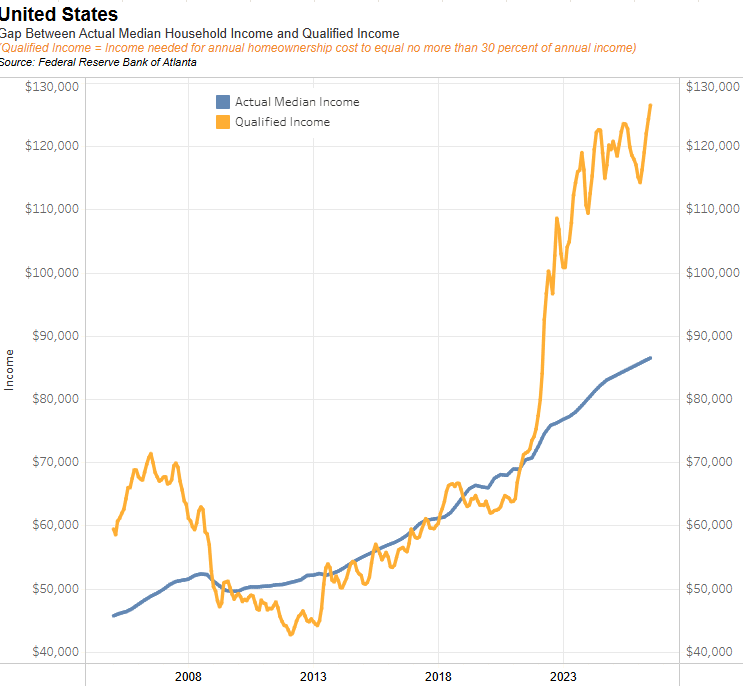
Owning the median American home costs roughly twice what it did in December 2020, and rates built only half of that. The monthly bill rose from $1,594 to $3,162 while median household income grew 26%. About half the increase came from the mortgage rate climbing from roughly 2.7% to 6.5%; the other half came from a median price up some 43%, to near $409k. Price also lifts property tax and mortgage insurance, the premium paid when a buyer puts down under 20%. Homeowners insurance is the fastest-growing line, up 73%, yet its roughly $93 rise explains only about 6% of the jump. That near-even split between rate and price is why neither lever works alone. At the 2020 rate, today’s median home would still need about $92.5k of income, above the $86.5k median, and a one-point cut closes only about a quarter of the $40k gap. Meanwhile $826 a month of property tax, homeowners insurance and mortgage insurance, worth about $33k of required income, does not respond to the rate. The past year showed it: higher incomes and a slightly lower rate were cancelled by prices, taxes and insurance, leaving affordability essentially unchanged from last July. Watch whether household incomes outgrow prices for several months running. Falling rates can undo, at most, the half of the bill that rising rates built — the other half is a price level incomes have not caught.
What it means: Rate cuts alone will not bring the typical buyer back. A one-point cut in mortgage rates recovers only about a quarter of the shortfall. Lenders, brokers and builders that live on home sales need prices to rise more slowly than incomes. The answer changes if the monthly cost falls below 40% of median income in a summer month, last seen in August 2022.
Market Intelligence Brief (MIB) Ver. 19.70
For professional investors only. Not investment advice.
© 2026 RecessionALERT.com

Comments are closed.