
MARKET INTELLIGENCE BRIEF (MIB)
Friday, September 18, 2026
The 10-Year climbed back to 4.998% as the 2-Year jumped 6.4bps and Bank of America warned of a “2022 redux.” The Bank of Japan hiked to 1.25%, a 31-year high — and the yen weakened. WTI fell 2.35% to $99.52 while AAA’s national diesel average hit a record $6.4476. Warren Buffett stepped down as Berkshire chairman at 96. Bitcoin jumped 6.15% above $80,000; Netflix fell 4.67% on a Wells Fargo downgrade. August industrial production stalled as manufacturing output fell 0.3%.
TABLE OF CONTENTS
A. EXECUTIVE SUMMARY
B. MARKET DATA
C. HIGH-IMPACT STORIES (5)
D. MODERATE-IMPACT STORIES (8)
E. ECONOMY WATCH (5)
F. EARNINGS WATCH (0)
G. WHAT’S NEXT
H. CHART OF THE DAY
A. EXECUTIVE SUMMARY -> TOP
Equities closed the week of the Fed’s hike barely changed — the S&P 500 +0.17% on the day and -0.08% for the week — while bonds kept repricing the path: the 2-Year rose 6.4bps, outrunning the 10-Year’s 5.1bps climb to 4.998%, as Bank of America argued swaps now imply three more quarter-point hikes. Abroad, the Bank of Japan’s hike to 1.25% weakened the yen and lowered the JGB yield, easing rather than adding to pressure on Treasuries, and WTI’s third straight decline, to $99.52, priced Saudi Arabia’s export rerouting even as AAA’s national diesel average set a record. At a forward P/E of 19.1, the S&P 500’s roughly 5.2% earnings yield sits within about 25bps of the 10-Year, leaving equities almost no premium for the rate risk bonds are pricing. Breadth was thin: Technology was the only one of eleven sectors higher, on memory and chip equipment, while yield-sensitive Utilities (-1.27%) and Real Estate (-0.87%) were among the weakest.
• The front end leads Treasuries back toward 5% — 2-Year +6.4bps to 4.754%, 10-Year +5.1bps to 4.998%, 2s10s near 24bps; BofA’s Cabana and Swiber warn of a “2022 redux” with swaps implying three more hikes; Kansas City Fed’s Schmid, first to speak after the blackout: “I supported this decision,” with no guidance on the next move
• Bank of Japan hikes 25bps to 1.25%, a 31-year high, on a 7-2 vote — two dissents for a hold; the yen weakened about 0.45% to 156.64 per dollar and the 10-year JGB yield fell 4.9bps to 2.947% as the market read the move as dovish; Ueda named no terminal rate
• Crude and diesel split — WTI -2.35% to $99.52 and Brent -1.56% to $103.19, a third straight decline, as Saudi Arabia reroutes exports around its damaged East-West pipeline; AAA’s national diesel average set a record $6.4476 with US distillate stocks 13% below their five-year average; Kpler counted four Hormuz transits Thursday against a ~16 ten-day average
• Hard data softens as the Fed tightens — August industrial production flat vs. +0.3% expected, manufacturing -0.3% and capacity utilization 76.3%; the Conference Board LEI fell 0.1% to 99.5, its first decline since March; Freddie Mac’s 30-year mortgage rate jumped 19bps to 6.95%
• Crypto squeezes higher — Bitcoin +6.15% to $81,095 amid roughly $238M of short liquidations and no confirmed single catalyst, with Coinbase (COIN) +11.7% and Strategy (MSTR) +16.4% per CoinDesk; the OCC gave stablecoin issuer Bastion conditional approval for a national trust charter
• Buffett hands the Berkshire chair to his son — Howard Buffett elected chairman, Greg Abel remains CEO, announced at 15:51 ET; elsewhere Sandisk (SNDK) +10.99% led a chip-equipment rebound (Lam Research +6.98%), while Netflix (NFLX) -4.67% on a Wells Fargo cut to Underweight with a Street-low $57 target
1. Bonds are pricing a second hike; equities are pricing nothing — Thursday’s rally reversed with the 2-Year outrunning the 10-Year, a bear-flattening that says the market is adding policy tightening rather than term premium alone — the repricing Bank of America is arguing for, and the one Thursday’s hedge unwind had taken out. The equity tape did not agree: the VIX fell a second straight session to 14.81. With the 10-Year near 5% on four of the last five closes and the S&P 500’s earnings yield around 5.2%, the equity risk premium is close to zero, tolerated only because third-quarter earnings are expected to grow 28.9%. Schmid’s endorsement leaned neither toward a pause nor a second hike, so next week’s speakers — Williams, Jefferson and Barkin Tuesday, Barr Wednesday, Hammack Thursday and Friday — set the path. One side of this gap has to give, and the 10-Year’s September 16 close of 5.021% is the line to watch.
2. The inflation risk has moved from crude to diesel, where tightening cannot reach it — WTI back below $100 is pricing a Saudi operational plan — shuttle vessels through a strait where tankers are still being struck and transits run at a quarter of their recent average — not a settled supply picture. Diesel is the price that is not falling: a record national average on distillate stocks 13% below normal, and diesel moves trucking, rail and farm costs into core goods with a lag. The New York Fed’s DSGE model already lifted its 2026 core PCE forecast to 3.3% from 3.1%, Schmid put inflation “trending above 3 percent,” and CNBC’s Fed Survey respondents doubted that rate hikes can curb fuel-driven inflation. A Fed tightening into a supply-driven price shock risks more of the output damage visible in August’s flat industrial production and falling LEI without the inflation relief. Watch AAA diesel, not WTI.
3. With the 10-Year near 5%, the market is repricing duration inside equities — Wells Fargo’s Netflix case took more value from the multiple — 21 times forward earnings cut to 15 — than from the estimates, a question about what investors will pay for long-dated growth. CoreWeave upsized its convertible to $3.7 billion but conceded at the top of the coupon range and the bottom of the conversion-premium range, so AI capital is available in size but on the buyers’ terms. Inside technology the split is sharp: memory and wafer-equipment names were bought for a second session without an identifiable catalyst, while spending-dependent names — Dell, Palo Alto, CrowdStrike, IBM, and Accenture on a Guggenheim downgrade — were sold. On a triple-witching and S&P 100 rebalance day, Monday’s session is the test of whether the chip bid is conviction or flow.
 — Leading economic indicators. Accurate market forecasts. Apply for membership at join.recessionalert.com
B. MARKET DATA -> TOP
Equities ended the week of the Fed’s first rate hike in three years narrowly split: the S&P 500 (+0.17%) and Nasdaq 100 (+0.67%) edged higher while the Dow (-0.18%) and Russell 2000 (-0.50%) slipped, with Technology the only one of eleven sectors to finish green. The 10-year yield rose 5.1 bps to 4.998%, on the doorstep of 5%, even as the VIX fell 4.08% — bonds declined to confirm the equity calm. Netflix (-4.67%) fell on a Wells Fargo downgrade, WTI slid for a third straight session (-2.35%) as Saudi supply fears eased, and Bitcoin jumped 6.15% above $80,000.
CLOSING PRICES – September 18, 2026:
MAJOR INDICES
Nasdaq 100 (+0.67%) rose while the Dow (-0.18%), Russell 2000 (-0.50%) and NYSE Composite (-0.38%) fell — a narrow, mega-cap-tech-led advance with no support from small-caps or broad NYSE breadth. For the week, the Nasdaq 100 gained 0.94% against losses of 0.08% for the S&P 500, 1.69% for the Dow and 1.50% for the Russell 2000. DJIA and DJ Transportation fell together, so no Dow Theory divergence.
| Index | Close | Change | %Move | Why It Moved |
|---|---|---|---|---|
| S&P 500 | 7,650.50 | +12.74 | +0.17% | Edged higher on a Technology-only advance (one of eleven sectors green) on quarterly triple-witching expiration day |
| Dow Jones | 51,682.64 | -95.40 | -0.18% | Slipped with ten of eleven sectors lower; lagged the tech-heavy Nasdaq 100 |
| DJ Transportation | 20,079.10 | -104.96 | -0.52% | Fell alongside the Dow; no Dow Theory divergence |
| Nasdaq 100 | 29,644.17 | +197.19 | +0.67% | Led the majors on chip-equipment and memory gains, offsetting declines in Netflix, Dell and cybersecurity names |
| Russell 2000 | 2,860.40 | -14.23 | -0.50% | Small-caps did not join the Technology-led advance |
| NYSE Composite | 23,998.89 | -90.66 | -0.38% | Broad weakness beneath the headline Technology gain |
VOLATILITY & TREASURIES
VIX fell 4.08% to 14.81, extending its retreat from Wednesday’s 17.71, while the 10-year yield rose 5.1 bps to 4.998%, on the doorstep of 5% — bonds declined to confirm the equity calm, pointing to rate-path uncertainty after Wednesday’s Fed hike rather than easing risk aversion. The 2-year rose more (+6.4 bps), flattening the 2s10s spread to about 24 bps; DXY was little changed at 100.20.
| Instrument | Level | Change | Why It Moved |
|---|---|---|---|
| VIX | 14.81 | -0.63 (-4.08%) | Extended its retreat from Wednesday’s 17.71 as index moves stayed narrow |
| 10-Year Treasury Yield | 4.998% | +5.1 bps | Climbed to the edge of 5%; coverage attributes it to continued repricing of the Fed’s Wednesday hike and its signal of further tightening (unverified), and no discrete same-day data trigger was identified |
| 2-Year Treasury Yield | 4.754% | +6.4 bps | Rose more than the 10-year, flattening the curve |
| US Dollar Index (DXY) | 100.20 | -0.05 (-0.05%) | Little changed; no fresh dollar reaction to the higher yields |
COMMODITIES
Every metal rose, with silver (+1.01%) and copper (+0.77%) modestly ahead of platinum (+0.57%) and gold (+0.38%) — an industrial-led firming rather than a safe-haven split. Bitcoin’s 6.15% jump above $80,000 outran an equity tape that was barely higher; ether and Solana reportedly rose more than 7% and crypto-linked stocks jumped by double digits, marking a crypto-specific rally rather than an equity-risk proxy.
| Asset | Price | Change | %Move | Why It Moved |
|---|---|---|---|---|
| Gold | $4,416.35/oz | +$16.65 | +0.38% | Firmer despite higher yields; no discrete same-day catalyst identified |
| Silver | $66.77/oz | +$0.67 | +1.01% | Outpaced gold; no discrete same-day catalyst identified |
| Copper | $6.7125/lb | +$0.0510 | +0.77% | Firmed with silver; no discrete same-day catalyst identified |
| Platinum | $1,804.60/oz | +$10.30 | +0.57% | Rose with the precious-metals complex; no discrete same-day catalyst identified |
| Bitcoin | $81,095 | +$4,695 | +6.15% | Broke above $80,000 in a broad crypto rally; no single confirmed catalyst identified, and the move came despite the reported failure of the Clarity Act crypto bill in the Senate |
ENERGY
WTI (-2.35%) fell more than Brent (-1.56%), widening the Brent-WTI spread to about $3.67 as crude slid for a third straight session; Henry Hub was flat (-0.07%) while Dutch TTF rose 4.05%, decoupling from crude. Reports tie crude’s decline to easing fears over Saudi East-West pipeline supply; European gas is being supported by low winter storage.
| Asset | Price | Change | %Move | Why It Moved |
|---|---|---|---|---|
| Crude Oil (WTI) | $99.52/bbl | -$2.39 | -2.35% | Third straight decline; reports attribute it to easing fears of a lasting Saudi East-West pipeline outage, with Saudi Arabia reportedly aiming to restore about half the line’s capacity within days |
| Crude Oil (Brent) | $103.19/bbl | -$1.63 | -1.56% | Fell less than WTI, reportedly on the same Saudi-supply reassurance; fresh Houthi-Saudi fighting did not lift prices |
| Natural Gas (Henry Hub) | $2.899/MMBtu | -$0.002 | -0.07% | Essentially unchanged; no discrete same-day catalyst identified |
| Natural Gas (Dutch TTF) | $26.72/MMBtu | +$1.04 | +4.05% | Rose with European winter storage reported near 68% full and Gulf LNG supply constrained; no single same-day trigger identified |
S&P 500 SECTORS
Ten of eleven sectors closed lower even as the S&P 500 edged up — Technology (+0.84%) was the lone green sector, masking broad weakness beneath the headline. Yield-sensitive Utilities (-1.27%; -11.35% over six months) and Real Estate (-0.87%) were among the weakest, consistent with the 10-year’s climb toward 5%. Technology’s +32.42% six-month gain remains the standout trend.
| Sector | 1-Day | 1-Week | 1-Month | 3-Month | 6-Month | YTD | 12-Month |
|---|---|---|---|---|---|---|---|
| Technology | +0.84% | +0.82% | +3.37% | +1.20% | +32.42% | +26.39% | +30.90% |
| Industrials | -0.01% | -1.26% | -4.83% | -10.05% | +2.48% | +8.80% | +12.56% |
| Consumer Cyclical | -0.05% | -1.57% | -6.12% | -3.63% | +2.56% | -7.59% | -9.89% |
| Financial | -0.12% | -2.22% | -1.69% | +3.90% | +16.17% | +5.36% | +8.60% |
| Healthcare | -0.42% | +1.58% | -4.61% | +10.59% | +13.61% | +7.69% | +21.07% |
| Energy | -0.46% | -1.55% | +0.92% | +16.01% | +5.28% | +39.17% | +39.79% |
| Consumer Defensive | -0.59% | -0.69% | -4.03% | -1.55% | -0.64% | +4.64% | +2.39% |
| Communication Services | -0.74% | +0.75% | +2.46% | -1.43% | +5.20% | +0.49% | +2.75% |
| Basic Materials | -0.87% | -1.96% | -3.36% | +0.05% | +9.27% | +14.45% | +26.47% |
| Real Estate | -0.87% | -2.27% | -6.27% | -2.98% | +1.37% | +4.16% | -0.27% |
| Utilities | -1.27% | -2.67% | -6.27% | -8.38% | -11.35% | -4.45% | -1.70% |
TOP MEGA-CAP MOVERS:
GAINERS
| Company | Ticker | Close | Change | Why It Moved |
|---|---|---|---|---|
| Sandisk Corp | SNDK | $1,791.82 | +10.99% | Rose ahead of joining the S&P 100 before Monday’s open (with Dell, Palo Alto and Arista); coverage cites index-inclusion momentum, unverified as the driver, and the announcement date is not confirmed |
| Lam Research Corp | LRCX | $288.11 | +6.98% | Chip-equipment rebound after a month-long slide (about -13% over the prior month per 24/7 Wall St.); no discrete same-day catalyst identified |
| Applied Materials Inc | AMAT | $444.57 | +6.51% | Moved with Lam Research in the chip-equipment rebound; no discrete same-day catalyst identified |
| KLA Corp | KLAC | $176.99 | +4.74% | Moved with Lam Research in the chip-equipment rebound; no discrete same-day catalyst identified |
| Micron Technology Inc | MU | $1,015.80 | +3.92% | Rose with the memory and chip-equipment complex; no discrete same-day catalyst identified |
DECLINERS
| Company | Ticker | Close | Change | Why It Moved |
|---|---|---|---|---|
| Netflix Inc | NFLX | $71.79 | -4.67% | Wells Fargo cut the stock to Underweight from Equal Weight and its target to $57 from $80, citing “worrying” engagement trends and a weaker second-half originals slate |
| Dell Technologies Inc | DELL | $568.06 | -3.46% | No discrete same-day catalyst identified; coverage links AI-hardware weakness this week to worries about moderating AI-model progress and data-center spending (unverified as a driver) |
| International Business Machines Corp | IBM | $229.55 | -3.45% | No discrete same-day catalyst identified; the $1 billion CHIPS award to its Anderon quantum foundry was finalized Sept. 16, so it is not a fresh trigger |
| Crowdstrike Holdings Inc | CRWD | $237.65 | -3.28% | No discrete same-day catalyst identified; moved with Palo Alto Networks in cybersecurity |
| Palo Alto Networks Inc | PANW | $363.58 | -3.06% | No discrete same-day catalyst identified; moved with CrowdStrike in cybersecurity |
— Institutional-grade intelligence for serious investors. Apply for membership at join.recessionalert.comC. HIGH-IMPACT STORIES -> TOP
BEARISH
1. The 10-Year Returns to 4.998% as BofA Warns of a “2022 Redux” Above 5% and a Fed President Says He Backed the Hike
The core facts:Thursday’s bond rally reversed in a single session. The 10-year yield rose 5.1 basis points to 4.998% and the 2-year a larger 6.4 basis points to 4.754%, a bear-flattening that left the 2s10s spread near 24 basis points. The 10-year had closed above 5% on September 15 (5.006%) and September 16 (5.021%), so this is a return to the level rather than a first approach. Bank of America rates strategists Mark Cabana and Meghan Swiber wrote that swaps now imply three more quarter-point hikes, taking the effective fed funds rate to 4.5%-4.75%, warned of a “2022 redux” in which the Fed revisits the prior cycle’s highs of up to 5.5%, and urged clients to position for higher 2-year yields (Bloomberg, 11:21 ET). Kansas City Fed President Jeffrey Schmid, speaking in Vail on the first day after the blackout ended at 23:59 ET Thursday, said of Wednesday’s increase, “I supported this decision,” and described inflation as “trending above 3 percent”; his posted text carries no guidance on the next move, and he is not a 2026 voter. The New York Fed’s September DSGE run raised its 2026 Q4/Q4 core PCE forecast to 3.3% from 3.1% in June. The rate-sensitive sectors took the hit — Utilities fell 1.27% and Real Estate 0.87% — while the VIX eased 4.08% to 14.81.
Why it matters:The front end led, and that is the part to read. A 10-year rising on term premium alone would have steepened the curve; a 2-year outrunning it says the market is adding policy tightening, which is exactly the repricing BofA is arguing for and exactly what Thursday’s hedge unwind had taken out. The equity tape never agreed: volatility fell for a second session while yields rose, so either bonds are wrong about the policy path or equities are carrying no premium for it. FactSet’s September 18 update puts the S&P 500’s forward P/E at 19.1, an earnings yield of roughly 5.2% — within about 25 basis points of a 10-year that has now closed near 5% on four of the last five sessions. That is an equity risk premium close to zero, and it is being tolerated because earnings are expected to grow 28.9% this quarter. Schmid’s endorsement matters less for what it says than for what it does not: the first post-meeting remarks on the decision leaned neither toward a pause nor toward a second hike, which leaves next week’s speakers to set the path.
What to watch:A 10-year close above 5.021%, the September 16 high, and next week’s Fed speakers — Williams, Jefferson and Barkin on Tuesday, Barr on Wednesday and Hammack on Thursday and Friday — for any explicit guidance on a second hike.
UNCERTAIN
2. Bank of Japan Lifts Its Policy Rate to 1.25%, a 31-Year High, on a 7-2 Vote — and the Yen Weakens
The core facts:The Bank of Japan raised its short-term policy rate by 25 basis points to around 1.25% in a decision announced in Tokyo on Friday, after the cutoff for yesterday’s edition. The complementary deposit rate rises to 1.25% and the basic loan rate to 1.5%, effective September 24. The vote was 7-2: board members Toichiro Asada and Ayano Sato, seen as reflationists appointed this year under Prime Minister Sanae Takaichi, dissented in favour of a hold, Asada citing core inflation below 2%. The market read the decision as dovish. The yen weakened about 0.45% to 156.64 per dollar after the announcement and the 10-year Japanese government bond yield fell 4.9 basis points to 2.947%. Governor Kazuo Ueda declined to name a neutral or terminal rate and would not rule out either back-to-back moves or a 50-basis-point step: “We’re in a phase where we need to look at various data carefully. But that doesn’t mean we can move slowly.” The dollar index closed little changed at 100.20.
Why it matters:This completes three central-bank tightening signals in seventy-two hours — the Fed’s hike on Wednesday, the Bank of England’s hawkish hold on Thursday, and now Tokyo. But a hike that weakens the currency and lowers the domestic bond yield has been read as a ceiling rather than a floor, and the two dissents explain why: a board split on political lines is a board that will find it hard to keep going. For a US portfolio the transmission runs through the carry trade and the Treasury bid. A softer yen and a lower JGB yield keep yen-funded carry intact rather than forcing it to unwind, and they leave a roughly 205-basis-point gap between 10-year Treasuries and JGBs — the spread that decides whether Japanese institutions, among the largest foreign holders of Treasuries, buy US duration or bring money home. On Friday’s evidence that gap is not closing from the Japanese side, which is modest relief for a US long end that was otherwise sold.
What to watch:Any sign of Ministry of Finance intervention as the yen weakens — Bloomberg reported the yen pared losses after the Nikkei reported a rate check — and whether the 10-year JGB holds below 3% as the new rate takes effect on Thursday, September 24.
UNCERTAIN
3. Crude Falls a Third Straight Session, Back Below $100, as Saudi Arabia Reroutes Exports Through Hormuz — While Iran Claims a Tanker Strike and US Diesel Sets a Record
The core facts:WTI fell 2.35% to $99.52 and Brent 1.56% to $103.19, crude’s third consecutive decline, widening the Brent-WTI spread to about $3.67. The move followed reports that Saudi Arabia is targeting restoration of about half the capacity of its damaged East-West pipeline within days, with full operations expected within about six weeks, and is rerouting some crude through the Strait of Hormuz using shuttle vessels that carry cargoes out to tankers waiting beyond it, limiting their exposure. One outlet, OilPrice, reports that Aramco re-oriented all loadings to the Persian Gulf and halted sales to Europe; that is not corroborated. The strait itself remained contested. Iran’s Revolutionary Guard said it struck the Togo-flagged tanker Trend for an “illegal attempt” to transit and that the vessel “came to a halt after catching fire” — a claim not independently confirmed — and UKMTO separately reported a tanker hit by an “unknown projectile,” with the fire out and the crew safe. Kpler counted just four commodity-vessel transits of Hormuz on Thursday against a ten-day average of about 16. At the pump, AAA’s national average for diesel reached a record $6.4476 a gallon, from $6.3956 a day earlier and $5.4677 a month ago, and the EIA put US distillate inventories 13% below their five-year average. Dutch TTF gas rose 4.05%.
Why it matters:Flat price and refined products are now moving in opposite directions, and that divergence is the story for US inflation. Crude is falling because the market believes Saudi barrels will find a way out; diesel is setting records because the barrels that do get out are not arriving as product fast enough, and a US distillate stock 13% below normal has no cushion. Saudi Arabia’s workaround is itself a wager — routing exports through the one strait where tankers are being struck, with transits running at a quarter of their recent average — so the crude decline is pricing an operational plan, not a settled supply picture. For a US portfolio the transmission is through freight: diesel moves trucking, rail and agricultural costs, and those reach core goods prices with a lag that a sub-$100 WTI print does not capture. Energy equities fell 0.46% with crude, which treats the sector as a flat-price play at the moment refining margins are doing the work.
What to watch:Confirmation that half of East-West pipeline capacity is back, and whether daily Hormuz transits recover toward the 16-vessel ten-day average; until they do, AAA diesel is the cleaner inflation read than WTI.
BULLISH
4. Bitcoin Jumps 6.15% Back Above $80,000 in a Short-Covering Rally, Lifting Coinbase and Strategy by Double Digits
The core facts:Bitcoin rose 6.15% to $81,095, back above $80,000, trading between roughly $76,200 and $81,300 over the day according to CoinGecko. The move was broad across the complex — ether rose about 7.3% and Solana about 12.7% — and crypto equities rose further: CoinDesk reported Coinbase up 11.7% and Strategy up 16.4% at the close. No single catalyst has been confirmed. Coverage describes a relief rally in which roughly $238 million of short positions were liquidated and spot bitcoin ETFs returned to net inflows; the SEC’s “innovation exemption” for tokenized stock, often cited alongside it, was issued on September 17 and is background rather than a trigger. Two regulatory steps did land on the day: the OCC granted stablecoin issuer Bastion conditional approval for a national trust bank charter (Wall Street Journal), and the CFTC’s crypto market-structure rulemaking was reported to be at White House regulatory review, with its receipt date there not firmly established. The rally came three days after the Senate failed to advance the CLARITY Act and two days after a Fed hike.
Why it matters:This was not a liquidity trade. Bitcoin rallied on a day the 2-year yield rose 6.4 basis points and the S&P 500 barely moved, which rules out the usual reading of crypto as a leveraged proxy for falling rates or equity risk appetite. What is left is positioning: a market that had shorted the legislative failure and the Fed hike was forced to cover once both passed without further damage. That is a durable-looking price on a fragile foundation, and the equity multipliers — Strategy moving more than two and a half times bitcoin — show how much of the move is leverage on leverage. The regulatory drip is the steadier signal. A national trust charter for a stablecoin issuer and a CFTC rulebook reaching White House review are the agency route to the market structure Congress declined to legislate, and that route does not need sixty Senate votes.
What to watch:Whether spot bitcoin ETF inflows persist into next week, and publication of the CFTC’s proposed rules once White House review concludes; Coinbase and Strategy remain the cleanest listed reads.
BULLISH
5. Fed’s Bowman: Supervisors “Knew, or Should Have Known” of SVB’s Vulnerabilities by March 2022 — and the Final Stress-Test Overhaul Goes to a Board Vote Within Weeks
The core facts:Vice Chair for Supervision Michelle Bowman gave two speeches at the Lord Mayor’s luncheon at Mansion House in London. The first presented initial findings of an independent review of Silicon Valley Bank’s supervision by Starling Advisory Group: “our supervisory staff knew, or should have known, about these vulnerabilities as early as March 2022.” The review found the bank failed on a confluence of weaknesses — unrealized securities losses larger than its capital, 94% uninsured deposits and poor discount-window readiness — and that the delays in supervisory action “were not caused by” the 2018 regulatory tailoring law. It described a risk-averse culture in which “Staff believed it was personally safer to take no action unless they were certain the action was exactly right,” and found, via Charles River Associates, that social media did not trigger the run. No individuals were named; remedies include monthly escalation reports from examination teams and expanded supervisory tools. In the second speech Bowman said two final stress-test rules and a further proposal will go to a Board vote “in the coming weeks,” covering disclosure of model equations and assumptions and averaging the stress capital buffer over the two most recent tests, with Basel capital and GSIB surcharge rules to be finished by year-end: “We will finally close the book on an opaque and unnecessarily unpredictable framework.” Financials fell 0.12% on the day.
Why it matters:The two speeches are one argument. The review’s most consequential finding is a negative one — that the 2018 tailoring law did not cause the delays — and it removes the principal objection to the capital and stress-test relief the second speech then scheduled. If SVB was a failure of supervisory will rather than of rules, the case for loosening rules survives the case study most often used against it. For the large banks the practical output is predictability: averaging the stress capital buffer across two years damps the year-to-year swings that force banks to hold excess capital against the test itself, and published models let them plan to the number. Capital that no longer has to sit against an unpredictable buffer becomes available for buybacks and lending, and a year-end finish on Basel and the GSIB surcharge puts a date on that. The counterweight is the culture finding itself: a supervisory regime that failed through inaction is being asked to supervise less, on the promise that it will act faster.
What to watch:The Board vote on the final stress-test rules in the coming weeks, and the year-end Basel capital and GSIB surcharge finals — the numbers that set large-bank buyback capacity for 2027.
— Quantifying recession risk so you don’t have to guess. Apply for membership at join.recessionalert.comD. MODERATE-IMPACT STORIES -> TOP
UNCERTAIN
6. Warren Buffett Steps Down as Berkshire Hathaway Chairman at 96; Howard Buffett Is Elected Chairman as Greg Abel Remains CEO
The core facts:Berkshire Hathaway announced that Warren Buffett has been named Chairman Emeritus, effective immediately, and will remain a director. The board elected his son Howard G. Buffett, a Berkshire director since 1993, as Chairman; Greg Abel remains Chief Executive Officer and Susan Decker remains Lead Independent Director. In a letter to shareholders dated September 18, Buffett wrote that Abel “has been making the decisions that matter for some time now” and that “the timing is right to complete the transition,” describing the split of roles directly: “Greg runs the company; Howard will guard its culture and values.” He closed: “Father Time always wins. He has, however, been generous with me.” The release was reported at 15:51 ET, leaving little of the session to react; Berkshire’s class B shares were about 0.4% higher in afternoon trading, per AOL; a closing reaction was not established.
Why it matters:This is the last formal step of a succession the market has been pricing for years, and its design is more informative than its timing. Separating the chair from the chief executive at a roughly $1 trillion company gives Abel sole authority over capital allocation — the function investors have always paid a premium for at Berkshire — while placing the culture, and by implication the decentralised operating model, under a chairman whose stated role is to guard it rather than run it. Buffett’s own letter says the decisions have already been Abel’s for some time, which means the change in who allocates Berkshire’s capital has in substance already happened; what ends is the reassurance that Buffett could overrule it. Whether a key-person premium was still embedded in the shares is the question Monday’s session answers, since Friday’s session had barely an hour left to absorb it.
What to watch:Berkshire’s first full session under the new structure on Monday, September 21, and any change to repurchase or dividend policy in the third-quarter report due in early November.
BEARISH
7. Netflix Falls 4.67% as Wells Fargo Cuts It to Underweight With a Street-Low $57 Target on “Worrying” Engagement
The core facts:Wells Fargo’s Steven Cahall downgraded Netflix to Underweight from Equal Weight and cut his price target to $57 from $80, the lowest on the Street. He expects Netflix viewing to fall about 4% year over year in the second half of 2026 and hours spent on its top-100 originals to fall more than 20%, sees churn risk rising into 2027, cut the multiple he applies to 15 times forward earnings from 21, and set 2027 and 2028 EPS estimates of $3.77 and $4.52. The shares fell 4.67% to $71.79, the largest decline among $200 billion-plus stocks on the day, and Communication Services fell 0.74%. Evercore ISI raised its target to $110 earlier in the week, so the sell side is now split by almost a factor of two.
Why it matters:The downgrade goes after the input rather than the output. Netflix’s revenue and margins have been strong; Cahall’s case is that engagement — hours watched — is the leading indicator of both churn and advertising inventory, and that it is rolling over now while the income statement still looks fine. That is a harder argument to refute with a good quarter, because it predicts one. The multiple cut is the larger lever: moving from 21 to 15 times forward earnings takes more value out of the target than the estimate changes do, which says Wells Fargo is questioning what the market will pay for Netflix’s growth rather than the growth itself. With the 10-year near 5%, long-duration growth equities are the ones most exposed to exactly that question.
What to watch:Third-party engagement data for September and Netflix’s next quarterly report, where total viewing hours and advertising-tier growth test the thesis directly.
UNCERTAIN
8. Sandisk Jumps 10.99% and Chip-Equipment Names Rebound as Technology Is the Only Sector Higher — While the Other S&P 100 Additions Fall
The core facts:Technology rose 0.84%, the only one of eleven S&P 500 sectors to finish higher. Sandisk led the mega-cap gainers, up 10.99% to $1,791.82, followed by Lam Research (+6.98%), Applied Materials (+6.51%), KLA (+4.74%) and Micron (+3.92%). No company-specific catalyst has been identified for the equipment names; Lam had fallen about 13% over the prior month. Sandisk joins the S&P 100 before Monday’s open alongside Dell, Palo Alto Networks and Arista Networks, replacing Nike, Honeywell Aerospace, Simon Property and Colgate-Palmolive — a change S&P Dow Jones Indices announced on September 4 and which takes effect with Friday’s close, a quarterly triple-witching session in which roughly $7 trillion of options expired. Two of Sandisk’s fellow additions fell on the day: Dell dropped 3.46% and Palo Alto 3.06%. CrowdStrike (-3.28%) and IBM (-3.45%) also declined.
Why it matters:Index inclusion cannot be the explanation for Sandisk when two of the three other additions fell 3% on the same day, so the move is about memory, not about the index. That makes this the second straight session in which the semiconductor and memory complex led the tape without a fresh, identifiable trigger — Thursday’s leaders were also running on catalysts that predated the session. A sector that rises on positioning rather than on information is vulnerable to the same flows reversing, and a triple-witching expiry combined with a quarterly rebalance is precisely the kind of session in which mechanical flows can masquerade as conviction. The more durable read is the split inside technology: hardware tied to memory supply and wafer fabrication is being bought, while the parts of the AI trade that depend on spending decisions — servers, cybersecurity and services — are being sold.
What to watch:Whether the equipment rebound holds on Monday, September 21, the first session after the rebalance and options expiry, and Micron’s fiscal fourth-quarter report later this month as the first hard demand datapoint for the memory move.
BEARISH
9. Accenture Falls About 4% as Guggenheim Downgrades It Ahead of Results, the Same Day It Signs an AI-Safety Partnership With Anthropic
The core facts:Guggenheim’s Jonathan Lee downgraded Accenture to Neutral from Buy and removed his price target. He argued that the shares’ 52% rebound from their June lows has not been matched by a corresponding improvement in demand in his channel checks, that large deals show little urgency and decision cycles remain extended, and that a roughly $400 million Middle East revenue impact has yet to normalise. The shares fell about 4%. Separately, Accenture and Anthropic announced a partnership to place “embedded evaluators” inside Anthropic for red-teaming, alignment assessment and safeguard testing through Accenture’s Faculty unit, with each company expecting to invest at least $1 billion over five years in AI safety; the arrangement is non-exclusive and Anthropic said it will name other evaluators in the coming weeks. Chief Executive Julie Sweet: “Safety requires both deep technical expertise and a clear understanding of how AI is used in the real world.”
Why it matters:Accenture is the bellwether for whether corporate AI spending flows through the IT-services layer or around it, and the two announcements pull in opposite directions on that question. The downgrade says the stock has priced a demand recovery the channel does not show; the partnership says the model builders need the services firms for exactly the work — evaluation, deployment, safeguarding — that is hardest to automate. The market weighted the first, and on the numbers that is defensible: a $1 billion commitment over five years is small against Accenture’s revenue base, while a rally without a demand recovery is exposed at the next print. The broader signal sits with Thursday and Friday’s tape, where services, software and cybersecurity names were sold while memory and chip equipment were bought.
What to watch:Accenture’s fiscal fourth-quarter results on Thursday, October 1 — new bookings and generative-AI bookings in particular — and its investor day on October 14.
UNCERTAIN
10. CoreWeave Upsizes Its Convertible to $3.7 Billion but Prices It at the Expensive End of Both Ranges
The core facts:CoreWeave priced $3.7 billion of 2.875% convertible senior notes due April 1, 2033, upsized from the $3.0 billion launched on Thursday, with an option for initial purchasers to buy a further $500 million. The initial conversion price is about $97.85 a share, a 22.5% premium to Thursday’s last sale of $79.88. Net proceeds are about $3.64 billion, or about $4.14 billion if the option is exercised in full, of which about $498.8 million funds capped-call transactions intended to limit dilution on conversion; the remainder is for general corporate purposes. The coupon priced at the top of the 2.375%-2.875% talk and the conversion premium at the bottom of the 22.5%-27.5% talk. The shares rose about 1.85% to $81.36, according to stockanalysis. The 35 million-share at-the-market programme announced on Thursday remains in place.
Why it matters:The size and the price tell different stories, and the price is the more honest one. Upsizing by $700 million says there was demand for the paper; pricing the coupon at the top of the range and the conversion premium at the bottom says that demand came on the buyers’ terms — more interest now, a lower bar for converting later. For an issuer the two outcomes that matter are cost and dilution, and CoreWeave conceded on both to raise more. That fits the week’s pattern: capital for AI infrastructure is available in size, but the market is charging for it, and it is charging more as long-dated Treasury yields press against 5%. The shares’ rise after Thursday’s 4.16% fall suggests holders are relieved the funding is done rather than persuaded by its terms.
What to watch:Exercise of the $500 million purchaser option and how much of the 35 million-share at-the-market programme is drawn — issuance into a stock below the $97.85 conversion price is dilution the capped calls do not cover.
BULLISH
11. FDA Approves Lilly’s Inluriyo With Verzenio for ESR1-Mutated Advanced Breast Cancer
The core facts:Eli Lilly said at 13:54 ET that the FDA approved Inluriyo (imlunestrant) in combination with Verzenio (abemaciclib) for adults with ER-positive, HER2-negative, ESR1-mutated advanced or metastatic breast cancer whose disease progressed after at least one line of endocrine therapy. Inluriyo was first approved as a monotherapy in September 2025. In the ESR1-mutated subgroup of the EMBER-3 trial, the combination produced median progression-free survival of 11.1 months against 5.5 months, a hazard ratio of 0.53. Guardant Health’s Guardant360 CDx was approved as the companion diagnostic. Lilly disclosed no pricing, and its share move on the day was not established; Healthcare fell 0.42%.
Why it matters:The approval pairs Lilly’s newer oral drug with its established CDK4/6 inhibitor, which makes it a franchise-extension decision more than a single-product one: every patient started on the combination is also a Verzenio patient, deeper into the treatment sequence than before. A hazard ratio of 0.53 — roughly halving the risk of progression in a biomarker-defined population — is the kind of result that shifts prescribing rather than merely adding an option. The companion-diagnostic approval matters on its own terms, because ESR1 mutations are found through liquid-biopsy testing, and every approval that requires the test widens the tested population for Guardant.
What to watch:Pricing, and whether the combination’s uptake shows in Verzenio’s sales line in Lilly’s next quarterly report.
UNCERTAIN
12. CMS Says 40 States and Puerto Rico Have Signed Its Most-Favored-Nation Medicaid Drug-Pricing Model
The core facts:The Centers for Medicare & Medicaid Services named the participants in its GENEROUS model, which ties Medicaid drug payments to prices paid in other countries: 40 states plus Puerto Rico have signed, all 50 states, the District of Columbia and Puerto Rico applied, and the remainder have until September 30 to finalise. CMS estimates $5.2 billion a year in taxpayer savings. The release names no participating drug manufacturers. Health Secretary Robert F. Kennedy Jr.: “Americans should pay the same low prices for prescription drugs that other countries pay.” CMS Administrator Dr. Mehmet Oz: “Medicaid programs will get the best possible price for drugs.”
Why it matters:State sign-up was never the constraint; manufacturer participation is, and it is the half of the model the release leaves blank. Near-universal state enrollment tells drug makers that the Medicaid channel will run on international reference prices wherever they choose to participate, which turns the choice into a negotiation over how much of that channel they are willing to price down. For the large pharmaceutical companies the direct Medicaid exposure is manageable; the precedent is not, because a most-favored-nation benchmark that works in Medicaid is the template for extending it elsewhere. Until the manufacturer list is published, $5.2 billion is a government estimate of savings rather than a measured transfer from anyone’s income statement.
What to watch:The September 30 deadline for the remaining states and, more importantly, the first disclosure of which manufacturers have agreed to the model’s pricing terms.
BEARISH
13. South Korea’s President Lee Says the $350 Billion US Investment Deal Has Stalled and Its First Project Is on Hold
The core facts:At a press conference in Seoul on Friday, President Lee Jae-myung said the $350 billion investment package agreed with the United States has stalled and that its first project is on hold. The unresolved points are the “commercial reasonableness” terms — cost recovery, the split of returns and the treatment of losses — and the structure of the special-purpose investment vehicle. Lee gave no timetable: “I was told we were close to an agreement, but from what I saw in the details, there were some parts that were difficult to agree on.” A briefing to Korea’s parliament has been moved to Tuesday, September 22. The package, divided into $200 billion and $150 billion components, was the counterpart to the US cut in tariffs on Korean goods to 15% from 25%.
Why it matters:The investment commitments are what the administration’s bilateral trade deals were paid for with, and this is the first public admission from a partner government that one of them cannot be executed as written. That matters beyond Korea because the same design — tariff relief now, investment pledged through vehicles whose economics are settled later — underpins the administration’s other bilateral frameworks, and a partner that finds the terms unworkable invites a tariff snapback as the enforcement tool. The timing adds weight: it lands six days before the Trump-Xi summit, in a week when the administration has already moved against Canada and threatened the EU. For US equities the exposure is concentrated in the sectors the Korean capital was meant to fund — shipbuilding, semiconductors, batteries and energy infrastructure.
What to watch:The parliamentary briefing on Tuesday, September 22, and any US response that links the stalled investment to the 15% tariff rate.
— Separating signal from noise since 2007. Apply for membership at join.recessionalert.comE. ECONOMY WATCH -> TOP
Two days after the Fed’s first rate hike in three years, the data pointed to softer momentum: industrial production was flat against a +0.3% forecast, manufacturing output fell 0.3%, and the Conference Board’s leading index slipped for the first time since March. Tighter policy is already reaching households, with the 30-year mortgage rate up 19 bps to 6.95% and the 10-year Treasury closing at 4.998%, a hair below 5%. CNBC Fed Survey respondents put 12-month recession odds near 29%, while Polymarket prices 9% by year-end. Next week’s durable goods and new home sales are the next hard-data tests.
Industrial production stalls in August as manufacturing output falls 0.3% (Federal Reserve G.17, Sept 18)
What they’re saying:Total industrial production was unchanged in August against a +0.3% consensus, after a 0.2% gain in July, and stood 1.4% above its year-earlier level. Manufacturing output fell 0.3%, with durable manufacturing down 0.5% and declines broad-based across durable categories; nondurable output was flat. Mining rose 0.1% and utilities rose 1.8%, and the utilities gain offset the manufacturing decline in the total.
The context:Total capacity utilization held at 76.3%, 3.1 percentage points below its 1972-2025 average, while manufacturing utilization slipped 0.3 points to 75.7%. The week’s regional factory surveys sent opposite signals: the Empire State index fell to 7.6 from 20.6 (14.75 expected) on Sept 15, while the Philadelphia Fed headline jumped to 37.8 (30.5 expected) on Sept 17 even as its employment sub-index dropped to 11.8 from 27.9. The hard-data miss arrives two days after the FOMC raised the target range 25 bps to 3.75%-4.00% by a 12-0 vote.
What to watch:August durable goods orders on Friday, Sept 25 (-0.5% expected against +1.1% prior) for confirmation of factory demand, and whether the survey-versus-output gap narrows in September.
Conference Board Leading Economic Index slips 0.1% in August, first decline since March (The Conference Board, Sept 18)
What they’re saying:The US LEI fell 0.1% to 99.5 (2016=100) from 99.6 in July. Four of ten components declined, led by consumer expectations and building permits, and the diffusion index dropped to 55.0 from 75.0 in July. The six-month growth rate was -0.1% for February-August, a smaller decline than the -0.6% of the prior six months. Justyna Zabinska-La Monica, Senior Manager, Business Cycle Indicators at The Conference Board, said consumer expectations remained “a significant strain on the Index.”
The context:The permits decline echoes Thursday’s Census report, in which permits fell 2.7% to 1.394M. The Conference Board says the economy is still expanding but describes a less certain outlook, and forecasts 1.9% real GDP growth in 2026, with its 2027 forecast trimmed to 1.8% from 1.9%. That sits against the Atlanta Fed’s GDPNow, which stood at 5.1% for the third quarter as of Sept 16, a divergence between leading and tracking measures.
What to watch:The final September Michigan sentiment reading on Friday, Sept 25 (47.8 expected against 51.7 prior) and Thursday’s initial jobless claims (196K prior) for evidence on whether weak expectations are reaching spending and hiring.
CNBC Fed Survey: majority sees at least two more rate hikes within a year, recession odds unchanged near 29% (CNBC, Sept 15)
What they’re saying:A majority of respondents to the CNBC Fed Survey forecast at least two rate hikes over the next year, and a third expect three or more. The average probability of a recession over the next 12 months was 29%, unchanged from the prior survey. Average CPI forecasts rose to near 3.5% for 2026 and 2.85% for 2027, and several respondents were skeptical that rate hikes can curb fuel-driven inflation.
The context:The survey was published the day before the FOMC delivered the first of those hikes, raising the target range 25 bps to 3.75%-4.00% on Sept 16. Prediction markets are far less worried about growth: Polymarket prices a US recession by the end of 2026 at 9% (10% on Sept 17), though the horizons differ, and puts the odds of even one Fed rate cut in 2026 at about 5%.
What to watch:Fed speakers next week: Williams (Tuesday, Thursday and Friday), Jefferson and Barkin (Tuesday), Barr (Wednesday) and Hammack (Thursday and Friday), for signals on the pace of further hikes.
30-year mortgage rate jumps 19 bps to 6.95% in Fed-hike week (Freddie Mac, Sept 17)
What they’re saying:Freddie Mac’s Primary Mortgage Market Survey put the 30-year fixed rate at 6.95%, up from 6.76% a week earlier and 6.26% a year ago; the 15-year rose to 6.26% from 6.09% (5.41% a year ago). Chief Economist Sam Khater said the 30-year rate “continues to fluctuate as markets assess economic data.” The Mortgage Bankers Association’s weekly survey for the week ended Sept 12 had the 30-year at 6.97%, up from 6.85%.
The context:The jump landed in the week of the Fed’s hike, with the 10-year Treasury closing Friday at 4.998% after closing above 5% on Sept 15 and Sept 16 (5.021%); the Freddie Mac release itself does not attribute the move. Housing demand indicators were already soft: pending home sales rose 0.3% in August against roughly 2% expected, and the NAHB Housing Market Index fell to 32 on Sept 16.
What to watch:The MBA weekly mortgage rate on Wednesday, Sept 23 (6.97% prior) and August new home sales on Thursday, Sept 24 (0.61M expected against 0.607M prior, after a 10.5% monthly drop).
10-year Treasury yield closes at 4.998% as BofA says a terser Fed restores credibility but lifts term premium (Treasury market close; Bank of America Securities, Sept 18)
What they’re saying:The 10-year yield rose 5.1 bps to 4.998% and the 2-year rose 6.4 bps to 4.754%, flattening the 2s10s spread to about 24 bps, even as the VIX fell 4.08% to 14.81 and the S&P 500 gained 0.17%. According to a Seeking Alpha summary of a Bank of America Securities note, Fed Chair Kevin Warsh’s Sept 16 policy statement was the shortest since 2007, which BofA reads as an end to over-communication that restores Fed credibility but raises the risk premium bond investors demand.
The context:The 10-year first traded above 5% intraday on Sept 14, its first move over that level since 2023, before paring the rise, and Bloomberg noted that a move past 5.02% would be its highest level since July 2007. The front end rising faster than the long end is a bear-flattening move, a pattern consistent with repricing of near-term policy alongside the term-premium argument.
What to watch:Whether the 10-year closes above 5% next week, with the Trump-Xi summit on Thursday, Sept 24 and the Fed speakers on Tuesday and Thursday as potential catalysts.
— Know the probability before the market prices in the risk. Apply for membership at join.recessionalert.comF. EARNINGS WATCH -> TOP
YESTERDAY AFTER THE BELL (Markets Reacted Today)
No major earnings yesterday after the bell from companies with >$100B market cap. The largest after-the-bell reporter on Thursday was Upexi (UPXI) at a $93.65 million market capitalisation.
TODAY BEFORE THE BELL (Markets Already Reacted)
No major earnings before the bell from companies with >$100B market cap. The only scheduled reporter was BlossomHill Therapeutics (BLSM) at a $788.76 million market capitalisation.
TODAY AFTER THE BELL (Markets React Tomorrow)
No major earnings after the bell from companies with >$100B market cap.
WEEK AHEAD PREVIEW:
Q3 2026 earnings season has barely begun — three S&P 500 companies have reported, per FactSet’s September 18 update — and one name above $100B reports over the next five business days.
Costco Wholesale (COST) — AMC, Thursday, September 24 — $397.05B market cap; consensus EPS $6.53 on revenue of about $94.86B against $86.16B a year earlier. Key focus: the US/Canada membership renewal rate (92.1% in fiscal Q2 2026, from 93.0% a year earlier), membership-fee income, the e-commerce comparable after +21.5% in fiscal Q3, and first commentary on the nationwide DoorDash delivery agreement, which requires a linked Costco membership.
No other reporter from Monday, September 21 through Friday, September 25 clears $100B, and none comes within 5% of it; Friday, September 25 has no scheduled reporters. The largest names below the threshold are Cintas (CTAS, $79.19B, BMO Wednesday), AutoZone (AZO, $46.61B, BMO Tuesday) and Paychex (PAYX, $41.34B, BMO Wednesday). Q3 2026 reporting broadens from mid-October.
— US market commentary trusted by family offices and institutions. Apply for membership at join.recessionalert.comG. WHAT’S NEXT -> TOP
UPCOMING RELEASES:
| Date | Event | Why It Matters |
|---|---|---|
| Mon, Sep 21 | Fed Goolsbee speech (6:30 AM ET); Chicago Fed National Activity Index, Aug (prior -0.08) | The first full session after triple witching and the S&P 100 rebalance, and Berkshire’s first under Howard Buffett as chairman; the CFNAI tests whether August’s flat industrial production was a one-month miss or broad weakness |
| Tue, Sep 22 | Fed Williams (10:05 AM ET), Jefferson (10:20 AM ET) and Barkin (1:00 PM ET) speeches; South Korea parliamentary briefing on the stalled $350B US investment deal | Three policymakers in one day, including New York Fed President Williams, after a hike Schmid backed without guidance — any explicit guidance on a second hike either validates or pushes back on the three further hikes BofA says swaps imply; the Korea briefing shows whether the tariff-for-investment framework can be repaired |
| Wed, Sep 23 | MBA 30-year mortgage rate (prior 6.97%); Fed Barr speech (10:05 AM ET); EIA crude and gasoline inventories (crude prior -0.64M) | Mortgage rates are tracking a 10-Year at 4.998%, with Freddie Mac’s 30-year already up 19bps to 6.95%; EIA data will show whether low US product stocks are easing while diesel sits at a record |
| Thu, Sep 24 | Trump-Xi summit, Washington (Xi arrives Wed, Sep 23); new home sales, Aug (exp. 0.61M; prior 0.607M); initial jobless claims (prior 196K); Fed Hammack, Barkin, Williams and Paulson speeches; BoJ’s 1.25% rate takes effect | The summit lands days after Korea said its investment deal had stalled, putting the administration’s bilateral trade frameworks under scrutiny; new home sales follow a 10.5% monthly drop and a 6.95% mortgage rate; a 10-year JGB held below 3% keeps the Treasury bid from Japan intact |
| Fri, Sep 25 | Durable goods orders, Aug (exp. -0.5%; prior +1.1%); Michigan consumer sentiment final, Sep (exp. 47.8; prior 51.7); Fed Hammack speech (2:00 PM ET) | Durable goods is the confirmation test for August’s 0.5% drop in durable manufacturing output; Michigan checks whether the consumer-expectations drag that led the LEI’s decline is reaching spending |
KEY QUESTIONS:
1. Will Tuesday’s Fed speakers — Williams, Jefferson and Barkin — endorse the second hike the 2-Year is now pricing, and if they do, can equities keep carrying an earnings yield within about 25bps of a 10-Year near 5%?
2. Does Saudi Arabia’s rerouting through a contested Strait of Hormuz lift daily transits back toward the ~16-vessel average fast enough to take diesel off its record before freight costs reach core goods prices?
3. With South Korea’s $350 billion investment pledge stalled, does Thursday’s Trump-Xi summit steady the administration’s trade frameworks — or does the week bring a tariff snapback threat against a partner that cannot deliver?
— US market commentary trusted by family offices and institutions. Apply for membership at join.recessionalert.comH. CHART OF THE DAY -> TOP
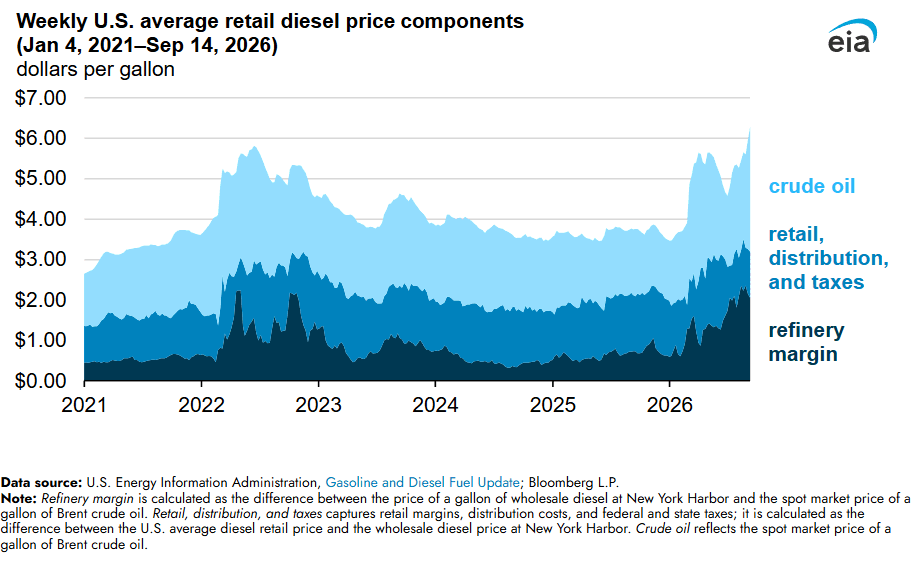
Diesel hit an all-time record this week while regular gasoline, refined from the same crude, sits about 11% below its own 2022 peak. AAA had diesel at $6.45 on September 18 against $4.47 for regular, and most of that near-$2 gap is not oil but the refinery margin — what wholesale diesel sells for minus the crude inside it, a gauge of how scarce refining is. It built quietly, masked while crude was falling. From April to late August crude’s cost per gallon fell about a dollar while the margin rose roughly $1.40, so the pump barely moved; then crude jumped back on top of a margin still near $2, lifting EIA’s September 14 average to $6.29, the highest nominal price since its records began in 1994. That margin is about a third of the pump price, against a sixth in 2025, and has held above $1.50 for about 12 weeks where 2022’s longest run was roughly seven. The squeeze is abroad, in reduced refining across Russia, China and the Middle East; US plants run at 97% with their highest distillate output since 2019, yet stocks sit 13% below normal, so cheaper crude would trim only the top layer. That matters beyond the pump: diesel moves freight, and truck surcharges are commonly indexed to EIA’s weekly price. Households read the gasoline sign; the economy runs on the other one.
What it means: Don’t count on cheaper oil to bring diesel down. From April to August crude fell about a dollar a gallon and the pump price barely moved. Farms and stores that ship by truck pay for it through fuel surcharges. This view is wrong if the refining margin falls back under $1 a gallon before winter.
Market Intelligence Brief (MIB) Ver. 19.70
For professional investors only. Not investment advice.
© 2026 RecessionALERT.com

Comments are closed.