
Iran declared the Strait of Hormuz “completely open,” sending WTI oil crashing 11.4% in the largest single-day drop since the war began. S&P 500 closed above 7,100 for the first time (+1.20%); Nasdaq’s winning streak hit 13 sessions — longest since 1992. Netflix (NFLX −9.72%) tanked on weak Q2 guidance and Reed Hastings’ board exit. Fed’s Waller: rate cuts viable if Hormuz stays open. A $127B IEEPA tariff refund portal launches Monday.
TABLE OF CONTENTS
A. EXECUTIVE SUMMARY
B. MARKET DATA
C. HIGH-IMPACT STORIES (5)
D. MODERATE-IMPACT STORIES (5)
E. ECONOMY WATCH (6)
F. EARNINGS WATCH (2)
G. WHAT’S NEXT
H. CHART OF THE DAY
A. EXECUTIVE SUMMARY -> TOP
MARKET SNAPSHOT:
All major US equity indices hit simultaneous record closes as Iran’s Foreign Minister declared the Strait of Hormuz “completely open,” triggering WTI crude oil’s second-largest single-day collapse since the conflict began — down 11.4% to $83.85. The S&P 500 surpassed 7,100 for the first time (+1.20%), the Dow surged 868 points (+1.79%), and the Russell 2000 led all benchmarks at +2.10% as small-cap stocks repriced the energy windfall fastest. The rally was genuinely broad: 10 of 11 S&P 500 sectors advanced, with Consumer Cyclicals (+2.11%) and Industrials (+2.00%) pacing the tape while Energy alone fell (-3.17%) — confirming this was a geopolitical risk unwind, not a narrow tech-led multiple expansion. Netflix’s 9.72% plunge — on weak Q2 guidance and co-founder Reed Hastings’ board departure — was the tape’s sole major exception to an otherwise historic day.
TODAY AT A GLANCE:
• Iran FM Araghchi declared Strait of Hormuz “completely open” — WTI oil collapsed 11.4% to $83.85, Brent fell 9% to ~$91.57, heating oil dropped 13%, and gasoline futures fell 7%; the strait carries ~20% of global oil and LNG supply.
• S&P 500 above 7,100 for the first time (+1.20% to 7,126.03); Nasdaq’s consecutive winning streak reached 13 sessions — longest since 1992; Dow added 868 points; Russell 2000 +2.10% also hit a record.
• $127B IEEPA tariff refund portal launches Monday, April 20 — the Supreme Court’s February ruling that IEEPA tariffs were illegally collected begins its cash distribution phase; 56,497 registered importers eligible across retail, tech hardware, and auto parts.
• Fed Governor Waller placed rate cuts squarely back on the table for H2 2026 given a swift Hormuz resolution; the May FOMC (May 5–6) is now pivotal, with markets pricing ≥1 cut at 66.5% probability.
• Netflix (NFLX −9.72%) — Q1 EPS headline beat distorted by a one-time WBD termination fee; soft Q2 revenue growth guidance and Reed Hastings’ June board exit triggered a sharp sell-off in extended trading.
• US recession odds fell to 26–28% on Polymarket/Kalshi (from 40–45% earlier in April), though GDPNow still tracks Q1 at just 1.3% and Scaramucci warned the US is “already in a recession” that data revisions will confirm later this year.
KEY THEMES:
1. Energy De-escalation Resets the Macro Playbook — The Strait reopening removes the single most inflationary tail risk of 2026. If WTI sustains below $90, CPI energy components flip from headwind to tailwind over the next 60 days, clearing a path for the Fed to cut rates in H2. The critical caveat: ceasefire durability is unverified, and Iran’s announcement lacked implementation specifics — any military incident or renewed closure would snap oil back toward $100+, instantly reversing today’s relief rally and the recession-odds repricing.
2. Fed Policy Is Now Hostage to the Oil Price — Waller’s explicit two-scenario framework makes the rate path entirely conditional on Hormuz durability. With Powell’s Chair term expiring May 15 and nominee Warsh’s confirmation hearing set for April 21, the Fed faces a simultaneous geopolitical and institutional inflection point. Markets have repriced aggressively; the Fed’s response at the May FOMC will determine whether today’s rate-cut enthusiasm was warranted or premature.
3. A $127B Tariff Refund Is an Asymmetric Sector Catalyst — The IEEPA portal launch on Monday is a poorly understood inflection point. Large US importers — Apple, Walmart, Target, Costco — will receive material cash inflows over 60–90 days, while domestic manufacturers (steel, aluminum, auto parts) face the return of foreign competition. This is a simultaneous earnings upgrade and downgrade catalyst depending on supply chain positioning; portfolio managers need to map their tariff exposure before refunds begin hitting corporate treasuries.
 — Leading economic indicators. Accurate market forecasts. Apply for membership at join.recessionalert.com
B. MARKET DATA -> TOP
Iran’s foreign minister declared the Strait of Hormuz “completely open” to commercial shipping, detonating a broad geopolitical risk unwind that lifted all major indices to record territory while crude oil collapsed more than 10% — its second-largest single-day drop since the conflict began. The rally was near-universal with 10 of 11 S&P 500 sectors advancing, small-caps outpacing mega-caps (+2.10% vs. +1.20%) as growth expectations repriced fastest at the margin. The Nasdaq notched its 13th consecutive winning session — the longest streak since 1992 — though Netflix (-9.72%) was the tape’s glaring outlier, cratering on weak Q2 guidance and co-founder Reed Hastings’ departure as Executive Chairman. Whether this relief rally holds hinges on ceasefire durability: Iran’s announcement lacked specifics, and oil analysts quickly flagged skepticism about whether the passage will reopen in practice.
CLOSING PRICES – April 17, 2026:
MAJOR INDICES
| Index | Close | Change | %Move | Why It Moved |
|---|---|---|---|---|
| S&P 500 | 7,126.03 | +84.75 | +1.20% | Iran declared Strait of Hormuz open; geopolitical risk premium unwound; oil -10% eased stagflation fears and removed a key equity tail risk |
| Dow Jones | 49,447.43 | +868.71 | +1.79% | Cyclical and industrial heavyweights surged on geopolitical relief; Hormuz reopening removed the energy supply constraint that had weighed on economic growth expectations |
| Nasdaq 100 | 26,672.43 | +339.43 | +1.29% | 13th consecutive Nasdaq gain — longest winning streak since 1992; tech rallied as yields fell 6 bps and geopolitical war premium deflated |
| Russell 2000 | 2,776.79 | +57.19 | +2.10% | Small-caps outpaced large-caps as rate expectations eased (2Y -7.4 bps) and domestic growth outlook improved on lower energy prices |
| NYSE Composite | 23,197.74 | +242.15 | +1.05% | Broad risk-on across the full exchange; 10 of 11 S&P 500 sectors advanced; only Energy declined on the oil price collapse |
VOLATILITY & TREASURIES
| Instrument | Level | Change | Why It Moved |
|---|---|---|---|
| VIX | 17.47 | -0.47 (-2.62%) | Geopolitical fear premium collapsed on Hormuz reopening; market confidence in near-term equity stability rebounded sharply |
| 10-Year Treasury Yield | 4.247% | -6.4 bps | Oil crash eased inflation expectations; partial flight-to-safety unwind as equity risk appetite surged; Treasuries still attracted modest buying |
| 2-Year Treasury Yield | 3.704% | -7.4 bps | Fed rate path expectations shifted dovish as lower energy prices reduce near-term inflation pressure; rate cut timing repriced earlier |
| US Dollar Index (DXY) | 98.21 | 0.00 (0.00%) | Risk-on rally and safe-haven demand reduction offset each other; dollar unchanged as geopolitical repricing was equity- and oil-specific |
COMMODITIES
| Asset | Price | Change | %Move | Why It Moved |
|---|---|---|---|---|
| Gold | $4,851.85/oz | +$43.55 | +0.91% | Safe-haven demand held despite broad risk-on; gold maintained its floor as ceasefire durability uncertainty kept residual geopolitical bid intact |
| Silver | $80.945/oz | +$2.235 | +2.84% | Industrial/monetary hybrid gained on dual tailwinds: risk-on equity rally lifted industrial demand outlook while gold’s monetary bid provided a floor |
| Copper | $6.0805/lb | +$0.0040 | +0.07% | Essentially flat; global industrial demand outlook unchanged; Hormuz relief did not materially alter copper’s macro supply-demand picture |
| Platinum | $2,116.00/oz | +$3.80 | +0.18% | Minimal move; no specific catalyst; modest sympathy gain alongside gold and silver |
| Bitcoin | $77,352.00 | +$2,129.00 | +2.83% | Risk-on sentiment boosted crypto alongside equities; Bitcoin tracking the broad geopolitical relief rally |
ENERGY
| Asset | Price | Change | %Move | Why It Moved |
|---|---|---|---|---|
| Crude Oil (WTI) | $85.18/bbl | -$9.51 | -10.04% | Iran FM declared Strait of Hormuz open to all commercial shipping; global supply disruption fear evaporated; second-largest single-day drop since the conflict began |
| Crude Oil (Brent) | $91.57/bbl | -$7.82 | -7.87% | Same Hormuz catalyst as WTI; international crude repriced sharply on restoration of the ~20% of global seaborne oil trade that flows through the strait |
| Natural Gas (Henry Hub) | $2.675/MMBtu | +$0.028 | +1.06% | Modest domestic demand gain; Henry Hub insulated from Hormuz/crude dynamics given primarily land-based US production and distribution |
| Natural Gas (Dutch TTF) | $13.37/MMBtu | -$1.28 | -8.74% | European gas prices dropped sharply alongside crude; Hormuz reopening eased broader Middle East energy supply fears that had elevated European LNG import risk premium |
S&P 500 SECTORS
Energy’s structural leadership is fracturing: the YTD top sector (+25.16%) and 3-month runaway leader (+18.92%) was today’s sole loser (-3.17%), deepening a weekly slide of -3.85% as the Hormuz reopening drained its accumulated geopolitical risk premium. Consumer Cyclicals reversed course — the quarter’s laggard (-2.89% 3M) topped the tape today (+2.11%) as growth expectations revived on lower energy prices.
| Sector | 1-Day | 1-Week | 1-Month | 3-Month | 6-Month | YTD | 12-Month |
|---|---|---|---|---|---|---|---|
| Consumer Cyclical | +2.11% | +6.53% | +9.61% | -2.89% | +1.52% | +0.07% | +26.73% |
| Industrials | +2.00% | +1.72% | +6.93% | +5.36% | +15.46% | +14.27% | +42.99% |
| Technology | +1.69% | +7.73% | +11.70% | +5.29% | +5.25% | +6.31% | +50.57% |
| Real Estate | +1.59% | +3.87% | +5.79% | +5.05% | +5.38% | +8.92% | +11.87% |
| Healthcare | +1.56% | +1.94% | +3.68% | -3.33% | +5.74% | -1.48% | +14.47% |
| Consumer Defensive | +1.40% | +0.04% | +1.40% | +2.11% | +6.25% | +7.57% | +6.55% |
| Basic Materials | +1.37% | +1.19% | +11.37% | +7.72% | +25.02% | +20.08% | +59.38% |
| Financial | +1.18% | +3.53% | +8.74% | -1.89% | +3.17% | -1.20% | +21.35% |
| Communication Services | +0.81% | +6.41% | +8.30% | +3.43% | +9.85% | +4.14% | +49.62% |
| Utilities | -0.33% | -1.27% | +0.45% | +6.14% | +1.56% | +8.94% | +23.01% |
| Energy | -3.17% | -3.85% | -3.79% | +18.92% | +29.67% | +25.16% | +43.98% |
TOP MEGA-CAP MOVERS:
Selection criteria: US-listed companies with market cap above $200 billion that moved ±1.5% or more during the session. Movers are ranked by percentage change and capped at 5 gainers and 5 decliners. On muted trading days when fewer than 3 names meet the threshold, the largest moves are shown regardless. Moves driven by earnings, M&A, analyst actions, sector rotation, or macro catalysts are prioritized over low-volume or technical moves.
GAINERS
| Company | Ticker | Close | Change | Why It Moved |
|---|---|---|---|---|
| Home Depot | HD | $349.40 | +3.63% | Consumer cyclical sector led the tape on Hormuz relief; lower oil prices reduce transportation and supply chain costs, directly supporting Home Depot’s thin-margin big-box model |
| KLA Corporation | KLAC | $1,791.44 | +3.26% | Semiconductor equipment names outperformed within tech; geopolitical tension easing reduces chip export restriction overhang; broader semi rally as war risk deflated |
| Merck & Co. | MRK | $119.07 | +3.13% | Healthcare sector rotation on broad risk-on day; MRK outperformed sector peers (+1.56%) with no specific catalyst — geopolitical relief lifted the sector’s YTD laggard status |
| Tesla | TSLA | $400.62 | +3.01% | Consumer cyclical participation in the broad Hormuz-driven relief rally; lower oil prices reinforce EV cost advantage narrative versus ICE vehicles |
| Texas Instruments | TXN | $229.82 | +3.01% | Semiconductor sector participation in tech rally on geopolitical relief; risk-on environment lifted the chip space broadly as war premium deflated |
DECLINERS
| Company | Ticker | Close | Change | Why It Moved |
|---|---|---|---|---|
| Netflix | NFLX | $97.31 | -9.72% | Q2 revenue guidance came in below analyst expectations; co-founder Reed Hastings stepped down as Executive Chairman; EPS and revenue beat but forward outlook disappointed, triggering a sharp sell-off |
| Exxon Mobil | XOM | $146.44 | -3.65% | WTI crude -10.04% on Iran’s Strait of Hormuz declaration; Exxon’s upstream earnings directly tied to oil prices; energy sector worst performer of the day at -3.17% |
| Chevron | CVX | $183.99 | -2.21% | Same crude oil collapse catalyst as XOM; Chevron’s integrated operations heavily exposed to realized crude prices; muted decline relative to XOM reflects slightly lower upstream concentration |
— Institutional-grade intelligence for serious investors. Apply for membership at join.recessionalert.comC. HIGH-IMPACT STORIES -> TOP
BULLISH
1. Iran Declares Strait of Hormuz “Completely Open” — WTI Oil Plunges 11.4% in Largest Single-Day Drop Since War Began
The core facts:Iran’s Foreign Minister Abbas Araghchi announced Friday that the Strait of Hormuz is “completely open” to all commercial vessels for the duration of the ceasefire. WTI crude oil collapsed 11.4% to $83.85/bbl — the second-largest single-day decline since the war began — while Brent fell 9% to approximately $90/bbl, heating oil dropped 13%, and gasoline futures fell over 7%. Oil had traded above $120/bbl at the peak of the crisis. The strait handles approximately 20% of global oil and LNG supply.
Why it matters:The Hormuz closure had been the primary driver of the energy-inflation shock that has kept the Fed on hold, pushed March CPI to 3.3%, and placed a recession risk premium on every US consumer-facing sector. With the waterway open, the near-term oil supply pathway is restored, easing gasoline prices and freight costs across the economy. The relief in energy prices directly improves the consumer spending outlook, reduces the risk of embedded inflation, and revives the possibility of Fed rate cuts in H2 2026. For equity investors, it unwinds a core bear thesis — that the Iran conflict would sustain an energy-driven margin squeeze through year-end.
What to watch:Monitor whether Iran’s declaration holds — any military incident or renewed closure threat would spike oil back toward $100+. Watch WTI crude $80/bbl as the next technical support level. OPEC+ is expected to reassess production policy at its next scheduled meeting.
BULLISH
2. S&P 500 Closes Above 7,100 for First Time; Nasdaq Extends Winning Streak to 13 Sessions — Longest Since 1992; Dow Adds 868 Points
The core facts:US equity markets surged to fresh all-time highs across the board on Friday. The S&P 500 rose 1.2% to close at 7,126.06 — its first-ever close above 7,100. The Nasdaq Composite gained 1.52% to 24,468.48, extending its consecutive winning-session streak to 13 — the longest such streak since 1992. The Dow Jones Industrial Average surged 868.71 points (+1.79%) to 49,447.43, setting a new record. The small-cap Russell 2000 outperformed with a +2.1% gain, also reaching a fresh all-time high. The primary catalyst was the Strait of Hormuz reopening and corresponding oil price collapse.
Why it matters:Simultaneous record closes across the S&P 500, Dow, and Russell 2000 signal a broad-based repricing of the geopolitical risk premium — not a narrow, tech-driven rally. The Nasdaq’s 13-session streak is historically rare and reflects sustained institutional accumulation. Russell 2000 leading is particularly meaningful: small caps are more exposed to domestic energy costs, consumer spending, and credit conditions — their outperformance indicates the market is pricing in genuine economic relief, not just multiple expansion for mega-caps. The S&P 500 clearing 7,100 removes a key technical resistance level and opens room toward 7,200+.
What to watch:Watch whether the S&P 500 holds above 7,100 next week — a close below would signal a failed breakout. Monitor VIX for any re-escalation spike from the Middle East. Advance/decline breadth data next week will confirm whether the rally’s broad participation is sustained.
UNCERTAIN
3. Fed Governor Waller: Iran War Keeps Inflation Elevated — Rate Cuts Only Viable If Conflict Ends Swiftly
The core facts:Speaking at Auburn University, Fed Governor Christopher Waller stated that the Middle East war will likely push near-term inflation higher. He presented two explicit scenarios: (1) Swift Hormuz resolution — Fed looks past the energy spike, focuses on the labor market, and rate cuts remain possible in 2026; (2) Prolonged closure — energy-driven inflation becomes more broadly embedded, making cuts much harder to justify. The Fed funds rate remains at 3.50–3.75%, where it has been held since the March 17–18 FOMC meeting. March CPI stands at 3.3%. Waller separately flagged labor market risk — businesses are caught between ongoing worker scarcity and deepening economic uncertainty that could “snap quickly” into mass layoffs.
Why it matters:Friday’s Hormuz announcement puts Waller squarely in Scenario 1 territory — meaning his speech effectively served as a green light for rate-cut repricing if the strait reopening holds. However, Waller’s explicit warning about back-to-back inflationary episodes (tariff shock followed by energy shock) complicates the narrative: even if oil retreats, the compounding effect on inflation expectations may be harder to unwind than a single supply disruption. His labor market concern is also notable — a soft labor market print in the coming weeks could force the Fed to choose between its inflation and employment mandates simultaneously.
What to watch:May FOMC meeting (May 5–6) for updated rate path signals; watch CME FedWatch for probability shifts as the oil decline is absorbed into breakeven inflation readings. Next CPI print (May 12, covering April) will be the first data point showing any benefit from today’s oil collapse.
UNCERTAIN
4. $127 Billion IEEPA Tariff Refund Portal Launches Monday — Supreme Court-Ordered Refunds Begin as 56,497 Companies Scramble to Register
The core facts:CBP’s electronic tariff refund portal goes live at 8:00 AM EDT Monday, April 20. The Supreme Court ruled in February 2026 that tariffs imposed under the International Emergency Economic Powers Act (IEEPA) were illegally collected. Up to $166 billion total is eligible; approximately $127 billion covering 56,497 registered importers will begin processing immediately. Valid refunds are expected within 60–90 days of claim acceptance. Companies are scrambling to complete registrations ahead of the Monday deadline, with the number of registered importers having grown substantially in recent days.
Why it matters:This represents the largest single tariff refund event in US history and a fundamental reversal of the trade policy architecture deployed in late 2025. The winners are clear: large US importers in retail (Walmart, Target, Costco), technology hardware (Apple), and automotive parts face dramatically lower landed costs once refunds are processed. However, domestic manufacturers who had been sheltered by IEEPA tariff protection now face renewed foreign competition — a net negative for US industrial producers. The reversal also creates lasting uncertainty about the legal durability of unilateral executive tariff authority, complicating long-term supply chain planning even as near-term costs fall.
What to watch:Monitor retail sector stocks (WMT, TGT, COST, AMZN) on Monday as refund economics are absorbed into forward margin guidance. Watch for any Congressional response to legislate replacement tariff authority; any injunction attempt by domestic manufacturing interests could delay or block refund payments.
UNCERTAIN
5. Energy Sector Reverses 2026’s Top Trade — Oil Plunge Triggers Sharp Rotation Into Airlines and Consumer Stocks as Year’s Best Sector Reprices
The core facts:The energy sector — up approximately 30% YTD through April 16 and 2026’s best-performing sector by a wide margin — reversed sharply as WTI oil plunged 11.4%. On prior ceasefire precedent (April 7–8), ExxonMobil and Chevron fell 5%+, while Occidental Petroleum, Devon Energy, Diamondback Energy, and ConocoPhillips each fell between 5% and 7.5%. The Vanguard Energy ETF (VDE) had surged 38%+ YTD through March. On the other side of the rotation: airlines surged, with United, Delta, and American Airlines each gaining over 7% on lower fuel cost projections. Verizon (VZ) was the top Dow gainer at +3.9%. The Russell 2000 small-cap index led all major benchmarks at +2.1%, with small caps disproportionately benefiting from lower energy input costs.
Why it matters:Energy’s 2026 run was built almost entirely on the Iran war risk premium. A meaningful and sustained Hormuz opening compresses that premium rapidly — meaning a significant portion of energy sector gains are structurally at risk, not merely cyclical. For portfolio managers, this is a forced rotation event: energy was heavily overweight in most value-oriented strategies, and the reversal triggers rebalancing. The beneficiaries — airlines, consumer discretionary, homebuilders, and small caps — had been 2026’s laggards, creating significant catch-up potential if the oil price decline is sustained. The risk: energy Q1 earnings from Exxon (May 2) and Chevron (May 3) will now be the first major test of whether management guides down FY2026 assumptions.
What to watch:Watch XLE and VDE for stabilization levels — if energy stocks find a floor quickly, the rotation may be short-lived. Upcoming Q1 earnings from ExxonMobil (May 2) and Chevron (May 3) will be key for FY guidance revisions; any sharp FY cut would confirm the repricing is structural rather than temporary.
— Quantifying recession risk so you don’t have to guess. Apply for membership at join.recessionalert.comD. MODERATE-IMPACT STORIES -> TOP
UNCERTAIN
6. San Francisco Fed’s Daly: Oil Shock Has Extended the Inflation Timeline — But Falling Energy Prices Could Ultimately Boost Consumer Spending
The core facts:San Francisco Fed President Mary Daly said the oil shock stemming from the Hormuz closure has extended the timeline for reaching the Fed’s 2% inflation target, keeping the central bank in a “wait-and-see” stance. She added that if oil prices sustain their current decline following the strait’s reopening, it could eventually boost consumer spending power and support a soft landing. Separately, a briefing noted that incoming Fed Chair nominee Kevin Warsh “will have ideas” and the economy may deliver surprises — suggesting the Fed is managing a delicate transition as Powell’s May 15 term expiry approaches.
Why it matters:Daly’s optimistic framing of lower oil as a consumer spending tailwind represents a shift in tone from the recent Fed consensus of pure caution. If WTI crude stabilizes in the $80–90 range, the mathematical reduction in CPI energy components over the next two months could allow the Fed to shift from “on hold” to “evaluating” at the May FOMC — a meaningful change that would benefit rate-sensitive sectors (homebuilders, REITs, utilities). The Fed’s messaging coordination matters here: the more governors echo Daly’s framing, the more rate cut expectations will be pulled forward.
What to watch:May FOMC meeting May 5–6 for tone shift; watch for other Fed governor comments next week; April retail sales (May 15) will be the first data point on whether lower gas prices are translating to consumer spending.
UNCERTAIN
7. Dollar Index Falls to Pre-War Lows — Cumulative Two-Week Drop of 2.5% Is Largest in a Year as Safe-Haven Demand Unwinds
The core facts:The US dollar index (DXY) fell 0.49% to 97.73 on Friday — its lowest level since February 27, the day before the Iran conflict escalated and the Hormuz crisis began. The index is now down approximately 2.5% over the past two weeks, its largest two-week decline in a year, and is on track for a second consecutive weekly loss. The US 2-year Treasury note yield eased to 3.78% as lower energy prices reduced near-term inflation expectations.
Why it matters:The dollar retracing to pre-war levels signals that financial markets are unwinding the safe-haven premium built into the currency during the Hormuz crisis — a bullish signal for global risk appetite and US multinationals with overseas revenue. However, dollar weakness is a double-edged sword: a sustained 2–3% decline adds roughly 0.2–0.3 percentage points to import price inflation over the following months, which would partially offset the deflationary benefit from lower oil. For portfolio managers, dollar weakness favors international equities, emerging markets, and commodities priced in USD.
What to watch:DXY 97.50 is the next technical support level; a break below could accelerate the decline. Watch for any Fed commentary that reasserts rate-hold conviction — that would be the primary catalyst for a dollar rebound.
UNCERTAIN
8. Senate Sets April 21 Hearing for Fed Chair Nominee Kevin Warsh — Democrats Push to Delay as Powell’s May 15 Term Expiry Creates Leadership Gap Risk
The core facts:The Senate Banking Committee has formally scheduled Kevin Warsh’s Fed Chair confirmation hearing for Tuesday, April 21. All 11 committee Democrats made a final push to delay the hearing, citing incomplete financial disclosures. Warsh reported assets valued between $131M and $209M, including stakes in SpaceX and Polymarket; his wife Jane Lauder (Estée Lauder family) has a Forbes-estimated net worth of approximately $1.9 billion. Senator Thom Tillis (R-NC) has separately threatened to block final floor confirmation until a federal criminal probe into current Fed Chair Powell is resolved. Powell’s term as Chair expires May 15, leaving a narrow 24-day window from the April 21 hearing to confirmation.
Why it matters:Warsh is widely viewed as more hawkish than Powell and has expressed skepticism about the Fed’s current pace of balance sheet management. A confirmation-hearing stumble, a Republican defection, or any procedural delay past May 15 creates a leadership vacuum at the Fed during one of the most consequential monetary policy moments in years — the Hormuz de-escalation is repricing inflation expectations in real time, and the May FOMC (May 5–6) will occur before Warsh can even be confirmed. Any perception of Fed politicization undermines market confidence in the institution’s independence and may revive dollar and Treasury volatility.
What to watch:April 21 Senate Banking Committee hearing — watch for Republican unity and any surprise objections; Fed Governor Adriana Kugler or Vice Chair Philip Jefferson would serve as acting Chair if Powell departs without a confirmed successor.
UNCERTAIN
9. UK CMA Opens Public Comment on $25B AkzoNobel-Axalta Merger — Creating World’s Largest Coatings Company; US Antitrust Review Next
The core facts:The UK Competition and Markets Authority (CMA) invited public comment on the proposed $25 billion merger between AkzoNobel (Dutch maker of Dulux and Sikkens paints) and US-listed Axalta Coating Systems (AXTA), a major automotive and industrial coatings supplier. The CMA public comment phase is a formal precursor to a full Phase 1 review. The combined entity would become the world’s largest coatings company by revenue. US DOJ/FTC review is expected to follow the UK process.
Why it matters:Axalta (AXTA) is US-listed with approximately $5B in annual revenue and strong exposure to automotive refinish coatings globally — a sector with oligopolistic pricing dynamics. A merger approval would create a dominant supplier to US automakers and collision repair networks, raising competitive concerns that the DOJ may scrutinize closely under the current administration’s M&A posture. If cleared, it would be among the largest European-US cross-border deals of 2026 and a signal that the M&A market is reopening for complex industrial transactions. AXTA shareholders are currently pricing in a deal premium; any regulatory uncertainty would compress that premium.
What to watch:Watch AXTA stock for merger arb premium signals; monitor DOJ/FTC filing timeline; EU Directorate-General for Competition review expected to follow the CMA process.
UNCERTAIN
10. US-Mexico USMCA Bilateral Trade Talks Resume Monday — Canada Pushes to Roll Sectoral Tariffs Into Broader Framework
The core facts:US-Mexico bilateral trade negotiations are scheduled to resume Monday, April 20. Canada is pushing to consolidate current sectoral tariffs — covering steel, aluminum, and autos — into the broader USMCA framework review process rather than being negotiated in separate bilateral tracks. The USMCA formal review window falls in 2026. The trade discussions come one day before the CBP tariff refund portal launch and coincide with a broader recalibration of US trade posture following the Supreme Court’s IEEPA ruling.
Why it matters:USMCA governs approximately $1.8 trillion in annual US trade with Canada and Mexico combined. Any sectoral tariff rollback tied to the USMCA review would directly impact US steel and aluminum producers (US Steel, Nucor, Steel Dynamics) and automotive OEMs (GM, Ford, Stellantis) whose supply chains are deeply integrated with Mexican manufacturing. Canada’s push to join the bilateral track introduces complexity — if the US resists, Canada may escalate with its own retaliatory posture. The timing alongside the IEEPA refund portal launch creates a busy Monday for trade-exposed sectors.
What to watch:Watch for any joint US-Mexico statement early next week; steel (X, NUE, STLD) and auto (GM, F) stocks for sector implications; whether Canada secures a seat at the negotiating table will be a key signal for the USMCA review trajectory.
— Know the probability before the market prices in the risk. Apply for membership at join.recessionalert.comF. EARNINGS WATCH -> TOP
Selection criteria: This section covers only market-moving earnings from large-cap companies (>$50B market cap) with sector significance or systemic implications. The S&P 500 scorecard above tracks all 500 index components, but individual stories below focus on names large enough to move markets and provide economic signals relevant to US large-cap portfolio managers. On any given day, 30-80+ companies may report earnings, but MIB filters for the 2-5 names most relevant to institutional investors.
YESTERDAY AFTER THE BELL (Markets Reacted Today)
UNCERTAIN
11. Netflix (NFLX): Fell ~8% | Q1 EPS and Revenue Beat, But Soft Q2 Guidance and Reed Hastings’ Board Departure Weigh on Shares
The Numbers:Revenue: $12.25B vs. $12.18B est. (+0.6% beat); EPS: $1.23 vs. $0.76 est. — however, the EPS comparison is significantly inflated by a one-time termination fee from the failed Warner Bros. Discovery deal. Operating margin: 32.3%. Full-year guidance maintained at $50.7–$51.7B revenue; Q2 guidance called for 13% revenue growth, which came in below street consensus. Released: April 16, AMC.
The Problem/Win:The surface-level EPS beat was distorted by the WBD termination fee, masking the true underlying profitability picture. The soft Q2 revenue growth guidance (13% vs. analyst expectations for higher) raised questions about whether Netflix’s content spending is translating efficiently to subscriber revenue growth. Reed Hastings, Netflix’s co-founder and current board chairman, confirmed he will exit the board in June when his term expires — a significant governance signal about Netflix’s transition from founder-led culture to fully institutionalized management. Shares fell approximately 9% in extended trading on April 16 and continued lower in regular session April 17.
The Ripple:The earnings miss on an adjusted basis and guidance concerns weighed on streaming peers. Netflix remains the dominant global streaming platform with 325M+ paid subscribers and $3B advertising revenue target for 2026 (doubling YoY), but the market’s reaction signals that investors had priced in a cleaner beat. The stock’s decline pressured the broader consumer discretionary sector in a session otherwise dominated by energy-driven upside.
What It Means:Netflix’s sell-off on otherwise solid fundamentals reflects the market’s growing sensitivity to forward guidance quality over backward-looking beats. With the WBD fee distorting the headline EPS, investors are appropriately discounting the reported beat and focusing on the organic growth trajectory — which the Q2 guide suggests is moderating.
What to watch:Q2 earnings (July) for advertising revenue trajectory toward the $3B target; monitor whether Reed Hastings’ June board departure triggers any further management restructuring; next subscriber/engagement metrics disclosure.
TODAY BEFORE THE BELL (Markets Already Reacted)
BULLISH
12. Truist Financial (TFC): +2.31% | EPS and Revenue Both Beat; Net Income +25% YoY as Wholesale Lending and Investment Banking Drive Strong Q1
The Numbers:EPS: $1.09 vs. $1.00 est. (+9.3% beat); Revenue: $5.20B vs. $5.16B est. (+0.6% beat). Net income available to common shareholders: $1.4B (+25% YoY, +9% QoQ). ROTCE: 13.8% (up 150 bps YoY). CET1 capital ratio: 10.8%. $1.8B returned to shareholders via dividends and buybacks. Released: BMO, April 17.
The Problem/Win:The win was broad-based: wholesale lending drove loan growth with average wholesale loans up 9% YoY and deposits up 2%; investment banking and trading revenue growth contributed to noninterest income expansion; and wealth management income also improved. Revenue on an annual basis grew 5.1% YoY, though it dipped 1.9% QoQ due to lower sequential net interest income. Truist is tracking closer to its stated 2027 ROTCE target of 15%, having gained 150 basis points of ROTCE improvement YoY.
The Ripple:Truist’s results add to the growing evidence from the Q1 banking cohort that large regional banks are sustaining earnings momentum despite the uncertain macro environment. Wholesale lending growth of 9% YoY signals that corporate borrowers remain active, which contradicts the recession-scenario narrative. The stock’s +2.31% gain was consistent with peers that beat expectations this week.
What It Means:Truist’s clean beat across EPS, revenue, and ROTCE reinforces that the US regional banking sector entered Q1 2026 in solid condition, with credit quality intact and capital deployment accelerating. The key question for H2 is whether the current rate environment (3.50–3.75% Fed funds) supports further NII expansion or whether cuts would compress margins.
What to watch:ROTCE trajectory toward the 2027 target of 15%; Q2 NII guidance in light of the Hormuz-driven yield curve shift; watch for any Fed rate cut signal at May FOMC that could pressure net interest margins.
TODAY AFTER THE BELL (Markets React Tomorrow)
No major earnings after the bell from companies with >$50B market cap.
WEEK AHEAD PREVIEW:
Q1 2026 earnings season is in early stages, with 10% of S&P 500 companies reported. The bulk of results arrive over the next three weeks, culminating in the heaviest reporting week of the season (the week of April 28) when over $10 trillion in combined market cap reports within 72 hours.
No companies above $50B market cap are currently on the reporting calendar for Monday, April 20. The calendar for Tuesday, April 21 through Thursday, April 23 is similarly light for large-cap names.
Tesla (TSLA) — AMC Tuesday, April 22 — Key focus areas: Q1 EV delivery volumes (already reported at a multi-quarter low), China demand trajectory, automotive gross margins under pressure from price competition and tariff-related input costs, and the timeline for commercial autonomous robotaxi deployment. Management commentary on AI strategy and the energy storage division will also be closely watched.
Alphabet (GOOGL) — AMC week of April 28 — Key focus: AI Overviews impact on core Search advertising revenue; Google Cloud growth vs. Microsoft Azure; YouTube advertising health; Q2 capex guidance and ROI commentary on AI infrastructure spending.
Microsoft (MSFT) — AMC week of April 28 — Key focus: Azure AI demand acceleration; Copilot monetization progress; hyperscaler capex ROI; any guidance on AI workload mix and margin implications.
Meta Platforms (META) — ~April 29 — Key focus: Q1 ad ARPU from AI-driven targeting improvements; Q2 capex guidance on the company’s $135B AI infrastructure commitment; Llama reasoning model update; Superintelligence model development timeline.
The week of April 28 represents the single most consequential 72-hour window of Q1 2026 earnings season, with Alphabet, Microsoft, Meta, and Amazon all expected to report within a compressed timeframe.
— Separating signal from noise since 2007. Apply for membership at join.recessionalert.comE. ECONOMY WATCH -> TOP
The day’s dominant story was an energy-shock reversal — Iran’s reopening of the Strait of Hormuz sent Brent crude down 13% and WTI down 14%, instantly easing the stagflation scenario that had gripped markets for weeks; the S&P 500 hit a new record and prediction markets held recession odds at 26%. Yet the relief sits uneasily alongside a 1.3% GDPNow Q1 estimate, a $5B QVC bankruptcy flagging consumer stress, and Scaramucci’s blunt assertion that the US is already in recession. Fed officials Waller and Daly welcomed the oil drop but emphasized the policy path depends entirely on whether the Strait stays open — with Retail Sales (Tue, Apr 21) as the next hard read on whether the energy windfall is reaching households.
Iran Reopens Strait of Hormuz — Oil Plunges 11–13%, S&P 500 Hits Record (BNN Bloomberg / Axios, April 17)
What they’re saying:Iran’s Foreign Minister Abbas Araghchi declared the Strait of Hormuz open to all commercial shipping traffic on April 17. Brent crude futures fell $12.87 (–12.95%) to $86.52/barrel; WTI dropped $13.50 (–14.26%) to $81.19/barrel — one of the largest single-day oil price moves in years. The S&P 500 climbed 0.8% to a new record, the Nasdaq 100 gained 0.7%, and the DJIA rose 1.4% on the news.
The context:The Strait of Hormuz carries roughly 20% of global oil trade; its closure earlier in the conflict had been the primary driver of stagflation fears that pushed recession odds to 40–45% in early April. The energy shock reversal removes the most acute inflation tail risk and shifts the macro narrative — sharply — toward rate cut feasibility. If oil prices hold near current levels, the Fed’s dual-mandate calculus changes materially: inflation pressure eases and growth risk becomes the dominant concern.
What to watch:Strait of Hormuz remains open or closes again; weekly EIA crude oil inventory data (Wed, Apr 22); Baker Hughes rig count for any supply-side response; Brent crude holding below $90 is the key threshold for sustained disinflation narrative.
Fed’s Waller and Daly: Swift War End Could Revive Rate Cuts — But Fed Stays in Wait-and-See Mode (Reuters / Fed.gov, April 17)
What they’re saying:Fed Governor Christopher Waller (Auburn University speech) warned that the Iran conflict is likely to drive up near-term inflation through elevated energy prices and supply-chain disruptions, but added that a swift resolution could keep the door open for rate cuts later in 2026. San Francisco Fed President Mary Daly was more cautious, noting that while Middle East conflict resolution may slow inflation’s progress, it is unlikely to stall it entirely — and that lower oil prices, if sustained, could eventually boost consumer spending.
The context:Both officials are essentially reacting to the same event — the Strait reopening — in real time. Their tone reflects the Fed’s core dilemma: the energy shock that had embedded stagflation fears is now partially reversing, but the Fed needs sustained data confirmation before pivoting. Markets have moved aggressively to price in more cuts (≥1 cut probability now 66.5% on Polymarket, up from 59.6% yesterday); the Fed’s messaging is attempting to temper that repricing.
What to watch:Fed Chair Powell speech or press conference for confirmation of updated rate-cut signaling; FOMC minutes for prior meeting language on energy-shock scenarios; Retail Sales (Tue, Apr 21) as first hard consumer data since Strait reopening.
Wall Street Declares Recession Risk Over; Prediction Markets Hold at 26% (The Guardian / MSN / Kobeissi Letter, April 17)
What they’re saying:The Guardian reports that Wall Street has “largely decided the immediate recession risk from the energy shock is over,” as evidenced by the S&P 500 hitting record highs on Friday despite ongoing geopolitical tensions. Prediction markets (Polymarket, Kalshi) now price a US recession by end-2026 at 26–28%, down sharply from 40–45% earlier in April. The Kobeissi Letter noted this as one of the fastest recession-odds reversals seen in current prediction market data.
The context:The recession probability drop is driven almost entirely by the Strait reopening removing the worst-case energy shock scenario. However, the underlying growth picture remains soft: GDPNow still tracks Q1 at 1.3% (the weakest in three years), jobless claims ticked up on continuing basis (1.818M), and corporate bankruptcies are elevated. Prediction markets are pricing out the tail risk, not pricing in strength — a meaningful distinction for portfolio managers.
What to watch:Retail Sales (Tue, Apr 21) and ADP Employment (Tue, Apr 21) as first hard evidence of consumer/labor market direction post-Strait reopening; Polymarket recession odds — watch for rebound if Strait status reverses.
QVC Group Files Chapter 11, Restructures $5B+ in Debt — 16,900 Jobs at Risk (Retail Dive / Bloomberg, April 16)
What they’re saying:QVC Group — operator of the QVC and HSN television shopping networks — announced it will file for Chapter 11 bankruptcy in the Southern District of Texas, seeking to restructure more than $5 billion in debt. The company employs approximately 16,900 full-time and part-time workers and serves 6.6 million US customers. Revenue fell nearly 8% in 2025 to $8.3 billion; the 2025 net loss exceeded $2.1 billion, more than doubling the prior year. The company aims to emerge from bankruptcy within 90 days while continuing normal operations.
The context:QVC’s collapse is a structural casualty of cord-cutting accelerating well beyond the company’s ability to adapt — TV shopping is a legacy model with no clear digital equivalent at scale. The $5B debt load, $2.1B annual loss, and 8% revenue decline signal the filing was unavoidable, not cyclical. For retail sector watchers, QVC joins a growing list of large-format consumer-facing bankruptcies in 2025–26, consistent with a consumer spending environment under pressure from elevated financing costs and shifting demographics.
What to watch:QVC Group Nasdaq delisting timeline; bankruptcy court proceedings in Houston; whether restructuring plan wins creditor approval within 90-day target; impact on HSN brand operations and streaming pivot.
Scaramucci: “We Are Already in a Recession” — Data Revisions Will Confirm It Later This Year (Europe Says / Yahoo Finance, April 16)
What they’re saying:SkyBridge Capital’s Anthony Scaramucci, a 37-year Wall Street veteran, stated flatly that the US is “already in a recession,” attributing it to the combined drag of Trump administration tariffs, the Iran military blockade, and energy price shocks. He noted that lower and middle-income household spending has contracted significantly, and predicted that data revisions later in 2026 will confirm the recession that current real-time indicators are masking.
The context:Scaramucci’s assertion runs counter to today’s market euphoria but aligns with the lagged-data risk: GDPNow at 1.3% Q1, corporate bankruptcies elevated, and consumer stress signals accumulating in credit and retail data. The key tension is that GDP revisions — which can move 1–2 percentage points — could retroactively push a near-zero quarter into negative territory. The NBER’s formal recession dating always occurs well after the fact; by the time it’s confirmed, the market has already moved.
What to watch:Q1 2026 advance GDP estimate (expected late April); BEA revision cycle; consumer credit delinquency data for Q1; Retail Sales (Tue, Apr 21) for first direct read on household spending momentum.
Powell Standoff: Fed Chair Intends to Stay Past May 15 Despite Trump Removal Threats (Kentucky Lantern / Reuters, April 17)
What they’re saying:Fed Chair Jerome Powell has publicly stated his intention to remain as Chair after his term expires on May 15, 2026, if a confirmed successor is not yet in place. This comes amid continued presidential threats of removal. Powell’s position is that the Federal Reserve Act protects Fed officials from at-will removal, though this legal protection has never been definitively tested in a removal scenario for a Fed Chair.
The context:Fed independence is a foundational assumption built into US Treasury yields, dollar pricing, and credit spreads globally. A contested removal or a successor widely seen as politically compromised would inject institutional uncertainty into monetary policy at precisely the moment the Fed needs maximum credibility to manage the post-Strait stagflation/disinflation trade-off. Economists broadly agree that any erosion of perceived Fed independence adds a durable risk premium to long-duration assets.
What to watch:White House announcement of Powell successor nominee; Senate confirmation timeline; 10-year Treasury yield reaction to any escalation in the Powell removal standoff; legal proceedings if removal is attempted.
— US market commentary trusted by family offices and institutions. Apply for membership at join.recessionalert.comG. WHAT’S NEXT -> TOP
UPCOMING RELEASES:
| Date | Event | Why It Matters |
|---|---|---|
| Tue, Apr 21 | Retail Sales MoM — March (prior: +0.6%) | First hard read on household spending ahead of the Hormuz crisis; a weak number confirms consumer softness despite energy relief; a strong number revives soft-landing hopes ahead of May FOMC |
| Tue, Apr 21 | Retail Sales Ex Autos MoM — March (prior: +0.5%) | Strips out volatile auto sales to reveal underlying consumer momentum; critical context alongside the headline figure for the Fed’s assessment of demand durability |
| Tue, Apr 21 | Retail Sales Control Group MoM — March (prior: +0.5%) | Feeds directly into GDP calculations — the Fed’s most closely watched retail sub-component; a miss here would reinforce Scaramucci’s recession-already-underway thesis |
| Tue, Apr 21 | ADP Employment Change Weekly (prior: 39K) | Weekly labor market proxy; Waller flagged labor conditions could “snap quickly” into layoffs — any sharp deterioration here accelerates the Fed’s dual-mandate dilemma and pulls forward cut timing |
| Tue, Apr 21 | Pending Home Sales MoM — March (prior: +1.8%) | Rate-sensitive sector; lower 10Y yields following the Hormuz relief could begin flowing into mortgage demand — a positive read here would add to the soft-landing narrative |
| Wed, Apr 22 | MBA 30-Year Mortgage Rate (prior: 6.42%) | Tracks real-time mortgage market response to this week’s 6.4 bps 10Y yield decline; a meaningful drop would confirm housing sector relief is beginning to materialize |
| Wed, Apr 22 | EIA Crude Oil Stocks Change (week ending Apr 18) | First inventory read after the Hormuz reopening; a large build would confirm supply normalization is underway and support sustained WTI below $90; a draw would signal the market is not yet fully rebalanced |
KEY QUESTIONS:
1. Will the Strait of Hormuz remain open through next week — and if WTI sustains below $90, how quickly does the energy component flip from a CPI headwind to a tailwind that gives the Fed political cover to cut at or after the May 5–6 FOMC?
2. Does Tuesday’s Retail Sales data confirm that consumers were spending ahead of the Hormuz crisis, or does a weak print validate Scaramucci’s recession claim and force a rethink of the record equity highs celebrated today?
3. Can Kevin Warsh navigate the April 21 Senate confirmation hearing without a Republican defection — and if the timeline slips past May 15, who runs monetary policy during the most consequential rate-setting moment of the year?
— US market commentary trusted by family offices and institutions. Apply for membership at join.recessionalert.comH. CHART OF THE DAY -> TOP
Compelling chart witnessed by our team either on social media, the internet or from our own models.
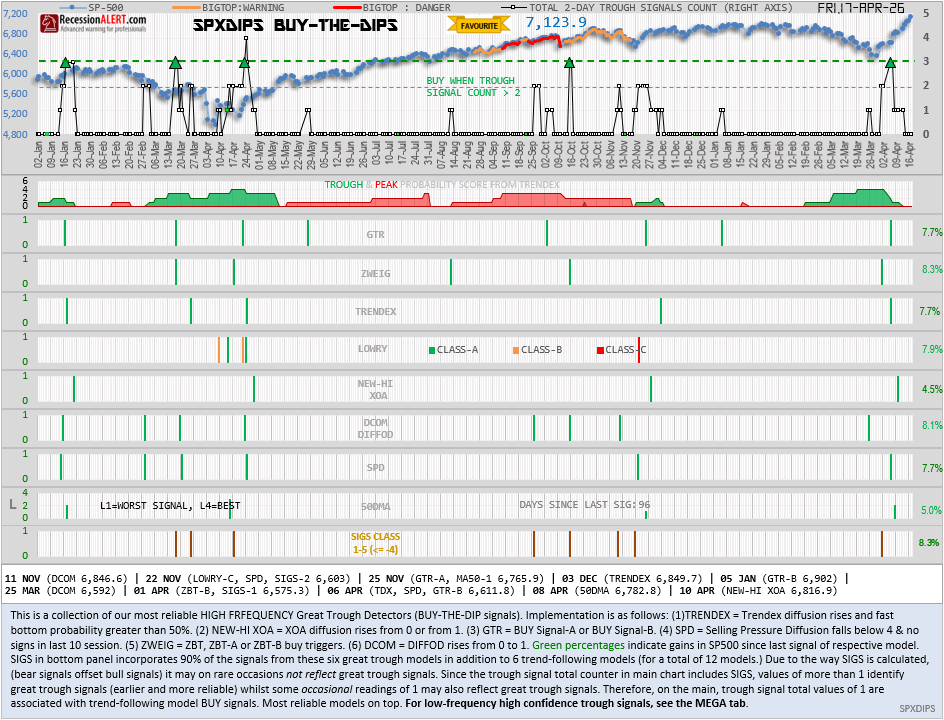
Chart of the Day: The SPXDIPS (DIPS tab in the Dashboard) short-term rapid buy-the-dip model triggered a signal on 6 April when the diffusion — counting the number of rapid models presenting signals in the last two days — rose above two. The models that fired in that cluster (SPX = 6,611) were TRENDEX (TDX), Selling Pressure Diffusion (SPD), and Great Trough B-Signal (GTR). These are stalwart models from our founding days and are perennial favourites among our clients. Another favourite, 50DMA, fired on 8 April, and a further model (NEW-HI XOA) fired on 10 April. Whilst these high frequency models work well in bull markets they are prone to bull-traps in serious bear-market corrections and so normally we switch to other models in the dashboard when corrections hit double digit percentages.
Market Intelligence Brief (MIB) Ver. 17.8
For professional investors only. Not investment advice.
© 2026 RecessionALERT.com

Comments are closed.