
Israel-Lebanon 10-day ceasefire triggers global risk-on rally, erasing Iran war equity losses worldwide. AMD surged +7.80% as TSMC’s 58% profit surge and 30%-plus AI chip demand guidance lit up the semiconductor sector. NFLX crushed Q1 EPS (+62%) but Q2 guidance disappointed and Reed Hastings stepped down as chairman. PLD beat by 30% as data centers now represent 40% of its development pipeline. US claims fell to 207K; industrial production missed badly at -0.5%.
TABLE OF CONTENTS
A. EXECUTIVE SUMMARY
B. MARKET DATA
C. HIGH-IMPACT STORIES (5)
D. MODERATE-IMPACT STORIES (5)
E. ECONOMY WATCH (9)
F. EARNINGS WATCH (5)
G. WHAT’S NEXT
H. CHART OF THE DAY
A. EXECUTIVE SUMMARY -> TOP
MARKET SNAPSHOT:
Markets closed broadly higher on April 16 as two synchronized catalysts converged: TSMC’s record Q1 results — 58% profit surge and 30%-plus full-year revenue growth guidance driven by AI chip demand — triggered a broad semiconductor rally, while the Trump-brokered Israel-Lebanon ceasefire removed the Iran war risk premium that had weighed on global equities for 40 days. The S&P 500 (+0.26%) notched a fresh record close, the Nasdaq 100 (+0.49%) led major indices, and global equity markets fully erased all Iran war losses — Japan’s Nikkei 225 hit an all-time record high. Energy (+1.69%) led sector gains on a massive 9.13-million-barrel crude inventory draw that dwarfed the 154K-barrel consensus, pushing WTI crude +2.34% to $93.43, while the 10-year Treasury yield edged up 3 basis points to 4.31% as risk appetite moderated bond demand. Seven of 11 sectors advanced, with Healthcare (-0.73%) deepening its multi-month deterioration (-5.58% over three months) as the session’s clear laggard — broad sector participation confirms this was a macro repricing event, not a narrow tech-driven move.
TODAY AT A GLANCE:
• AMD +7.80% on TSMC AI validation: TSMC’s record Q1 — 58% profit surge, 30%-plus full-year revenue growth guidance — confirmed the AI chip supercycle; sector halo lifted INTC (+5.48%), ORCL (+5.02%), and ANET (+4.33%).
• Israel-Lebanon 10-day ceasefire: Trump-brokered truce triggered a synchronized global risk-on rally — Nikkei 225 hit an all-time record; global equities have now fully erased 40 days of Iran war losses.
• Claims fell to 207K: Biggest weekly drop since February, well below the 215K consensus — resilient labor undermines the imminent-recession narrative and cements an FOMC hold at the April 28-29 meeting (100% probability per market pricing).
• Industrial production -0.5% miss: First hard-data confirmation that tariff uncertainty is translating to factory-floor contraction; capacity utilization dropped to 75.7%, 3.7 points below its long-run average — bears watching alongside GDPNow’s 1.3% Q1 estimate.
• Q1 earnings mixed: PLD beat by 30% (data centers now 40% of pipeline), PEP reaffirmed FY guidance, BK hit a 52-week high on +42% EPS growth — but NFLX’s Q2 guidance disappointed and Reed Hastings stepped down as chairman; markets react Friday.
• GE Aerospace (GE -4.98%) worst mega-cap decliner: IRGC threats against 18 US defense/tech firms compounded Iran war disruptions to Middle East civil aviation; Morgan Stanley (MS -2.24%) reversed premarket gains in a classic “sell the news” after record Q1 results.
KEY THEMES:
1. War Premium Compression — But the Truce Is Fragile — The ceasefire removes Q1 2026’s dominant market overhang, triggering broad rotation from safe havens (energy, defense, gold) into growth and cyclicals. But the 10-day truce does not reopen the Strait of Hormuz, restore the 10.1 mb/d supply disruption, or guarantee comprehensive peace. The April 26 deadline creates a binary inflection: extension is bullish for equities and bearish for oil; collapse snaps energy and defense premiums back immediately. This is a ceasefire trade, not a peace trade.
2. Stagflationary Distortion Building in Manufacturing — Today’s data delivered a paradox: Philly Fed surged to 26.7 (vs. 10.0 estimate) while industrial production fell -0.5%. The explanation is tariff front-running — firms rushing to place orders in soft surveys while actual production decelerates. With Prices Paid accelerating and the Philly Fed employment subindex contracting, the classical stagflation combination is assembling in the manufacturing pipeline. The Fed sees it, Williams said so explicitly, and equity investors in industrials and cyclicals should model a potential demand reversal in Q2 once the pull-forward exhausts.
3. Q1 Earnings: Financials and REITs Lead, Tech Guidance Mixed — BNY Mellon, Prologis, PepsiCo, and the broader financial cohort (MS, TRV, USB, SCHW) validated Q1 2026’s +12.6% YoY EPS growth narrative. But Netflix’s Q2 guide miss and Abbott’s diluted EPS guidance introduce the first cracks in growth durability. The critical test arrives the week of April 28, when over $10 trillion in combined hyperscaler market cap reports in a 72-hour window — Alphabet, Microsoft, and Meta guidance on AI capex and revenue will define the trajectory of the S&P 500 for the remainder of Q2.
 — Leading economic indicators. Accurate market forecasts. Apply for membership at join.recessionalert.com
B. MARKET DATA -> TOP
Markets edged broadly higher on April 16 as US-Iran peace deal hopes and TSMC’s blockbuster Q1 report — 58% profit surge with AI chip demand guiding 30%-plus revenue growth for full-year 2026 — fueled broad risk appetite and pushed the S&P 500 to a fresh record close. The Nasdaq 100 (+0.49%) led major indices as semiconductors and AI infrastructure names surged, while the Dow (+0.24%) and S&P 500 (+0.26%) advanced more modestly; the NYSE Composite closed virtually unchanged (+0.00%), reflecting offsetting pressures from declining healthcare and financial names. Seven of 11 sectors gained, with Energy leading at +1.69% — notably reversing a -0.59% weekly skid on a massive crude inventory draw and renewed Iran deal uncertainty — while Technology (+0.49%) consolidated its powerful +6.63% weekly rally; Healthcare (-0.73%) deepened its multi-month deterioration (-5.58% over three months) as the session’s clear laggard. AMD surged +7.80% as TSMC’s AI chip demand validation directly benefited its largest customer, while GE Aerospace fell -4.98% after the IRGC issued threats against 18 US defense and tech firms, compounding Iran war disruptions to Middle East civil aviation. WTI crude jumped +2.34% to $93.43 on a 9.1-million-barrel US inventory draw that far exceeded expectations, while gold slipped -0.28% as the dollar firmed modestly and the 10-year Treasury yield rose 3 basis points to 4.31%.
CLOSING PRICES – April 16, 2026:
MAJOR INDICES
| Index | Close | Change | %Move | Why It Moved |
|---|---|---|---|---|
| S&P 500 | 7,041.09 | +18.14 | +0.26% | Record close driven by TSMC AI demand results and US-Iran peace deal hopes; broad sector participation offset by healthcare and financial weakness |
| Dow Jones | 48,578.60 | +114.88 | +0.24% | Moderate gains as energy and tech components rose; industrial and healthcare components capped upside |
| Nasdaq 100 | 26,333.00 | +128.42 | +0.49% | Led indices as TSMC’s record AI chip demand and 30%-plus revenue growth guidance triggered broad semiconductor and AI infrastructure rally |
| Russell 2000 | 2,718.54 | +4.88 | +0.18% | Small-caps underperformed large-caps as macro uncertainty and rate pressure capped domestic risk appetite |
| NYSE Composite | 22,955.59 | +0.02 | +0.00% | Broad index essentially flat as energy and tech gains were offset by healthcare, financial, and industrial declines across the wider market |
VOLATILITY & TREASURIES
| Instrument | Level | Change | Why It Moved |
|---|---|---|---|
| VIX | 17.94 | -0.23 (-1.27%) | Fear gauge declined as US-Iran peace deal hopes and strong corporate earnings reduced near-term tail risk |
| 10-Year Treasury Yield | 4.312% | +3 bps | Yields rose modestly as risk appetite improved and bond demand softened; inflation concerns from oil price surge added modest pressure |
| 2-Year Treasury Yield | 3.778% | +1 bps | Short end held near recent levels; Fed officials’ hawkish tilt kept rate-cut expectations subdued |
| US Dollar Index (DXY) | 98.22 | +0.11 (+0.12%) | Dollar firmed modestly as risk-on appetite competed with haven demand; EUR/USD slipped -0.15% on dollar resilience |
COMMODITIES
| Asset | Price | Change | %Move | Why It Moved |
|---|---|---|---|---|
| Gold | $4,809.89/oz | -$13.71 | -0.28% | Haven demand eased slightly on peace deal optimism and modest dollar strength; remains near all-time highs |
| Silver | $78.52/oz | -$1.108 | -1.39% | Industrial demand concerns weighed; followed gold lower with amplified move typical of silver’s higher beta |
| Copper | $6.0407/lb | -$0.0442 | -0.73% | Tariff uncertainty and demand skepticism weighed on the industrial bellwether; global growth concerns persisted |
| Platinum | $2,099.50/oz | -$31.00 | -1.46% | Precious metals broadly under pressure; auto-catalyst demand uncertainty amid EV transition headwinds |
| Bitcoin | $75,065.00 | +$235.00 | +0.31% | Modest gains alongside broad risk-on tone; limited directional momentum as macro macro drivers dominated |
ENERGY
| Asset | Price | Change | %Move | Why It Moved |
|---|---|---|---|---|
| Crude Oil (WTI) | $93.43/bbl | +$2.14 | +2.34% | US crude inventory draw of 9.13M barrels — vastly exceeding the 154K-barrel forecast — combined with renewed doubts over US-Iran negotiations sent prices sharply higher |
| Crude Oil (Brent) | $98.00/bbl | +$3.07 | +3.23% | Strait of Hormuz disruption fears and near-record physical crude prices ($150/bbl in spot markets) amplified the futures rally; Iran war supply shock ongoing |
| Natural Gas (Henry Hub) | $2.668/MMBtu | +$0.058 | +2.22% | Natural gas advanced in sympathy with crude; mild weather offset by LNG export demand and geopolitical energy risk premium |
| Natural Gas (Dutch TTF) | $14.65/MMBtu | +$0.33 | +2.31% | European gas benchmark rose in tandem with crude; Strait of Hormuz supply risk and LNG re-routing concerns drove geopolitical premium higher |
S&P 500 SECTORS
| Sector | 1-Day | 1-Week | 1-Month | 3-Month |
|---|---|---|---|---|
| Energy | +1.69% | -0.59% | -0.42% | +21.84% |
| Real Estate | +0.80% | +2.49% | +2.52% | +4.15% |
| Technology | +0.49% | +6.63% | +8.42% | +4.33% |
| Utilities | +0.47% | -1.07% | -0.10% | +7.58% |
| Communication Services | +0.45% | +5.29% | +6.10% | +2.00% |
| Basic Materials | +0.26% | +0.77% | +6.08% | +6.63% |
| Consumer Defensive | +0.22% | -2.54% | -2.58% | +0.62% |
| Consumer Cyclical | -0.04% | +4.66% | +4.95% | -4.43% |
| Financial | -0.33% | +1.62% | +6.06% | -2.58% |
| Industrials | -0.43% | -0.50% | +3.81% | +4.47% |
| Healthcare | -0.73% | -0.85% | +0.32% | -5.58% |
TOP MEGA-CAP MOVERS:
Selection criteria: US-listed companies with market cap above $200 billion that moved ±1.5% or more during the session. Movers are ranked by percentage change and capped at 5 gainers and 5 decliners. On muted trading days when fewer than 3 names meet the threshold, the largest moves are shown regardless. Moves driven by earnings, M&A, analyst actions, sector rotation, or macro catalysts are prioritized over low-volume or technical moves.
GAINERS
| Company | Ticker | Close | Change | Why It Moved |
|---|---|---|---|---|
| Advanced Micro Devices | AMD | $278.26 | +7.80% | TSMC’s record Q1 profit (+58%) and 30%-plus full-year revenue growth guidance validated AI chip demand; AMD as TSMC’s largest AI customer was the primary beneficiary |
| Intel | INTC | $68.50 | +5.48% | Semiconductor sector halo from TSMC results; Intel benefiting from AI chip demand tailwinds and foundry services opportunity rerating |
| Oracle | ORCL | $178.34 | +5.02% | AI cloud infrastructure demand surge; TSMC results confirmed sustained hyperscaler capex cycle supporting Oracle’s cloud and AI data center buildout |
| Arista Networks | ANET | $161.01 | +4.33% | AI data center networking demand; beneficiary of hyperscaler capex acceleration confirmed by TSMC’s AI demand commentary |
| T-Mobile US | TMUS | $197.12 | +3.64% | Morgan Stanley initiated at Overweight with substantial upside target, citing mid-single-digit revenue growth and double-digit free cash flow growth; named as a top pick |
DECLINERS
| Company | Ticker | Close | Change | Why It Moved |
|---|---|---|---|---|
| GE Aerospace | GE | $298.29 | -4.98% | IRGC issued threats against 18 US defense and tech firms; Iran war disruptions to Middle East civil aviation weigh on commercial engine demand outlook ahead of Q1 results (due April 21) |
| Morgan Stanley | MS | $187.32 | -2.24% | “Sell the news” after record Q1 results ($20.6B revenue, +29% profit, 27.1% ROTCE) — shares had surged premarket but reversed by close on valuation concerns and macro uncertainty |
| Merck & Co. | MRK | $115.46 | -2.07% | Healthcare sector deepening its multi-month decline (-5.58% over 3 months); drug pricing policy risks and pipeline concerns weigh |
| Citigroup | C | $129.34 | -1.78% | Financial sector under pressure; bank stocks facing macro uncertainty and loan demand concerns as Morgan Stanley’s “sell the news” dynamic spread across the cohort |
| Johnson & Johnson | JNJ | $234.54 | -1.73% | Healthcare sector weakness; J&J faces ongoing drug pricing headwinds and Iran-related pharmaceutical supply chain concerns |
C. HIGH-IMPACT STORIES -> TOP
BULLISH
1. Trump Announces 10-Day Israel-Lebanon Ceasefire; War Premium Exits Global Markets
The core facts:President Trump announced April 16 that Israel and Lebanon agreed to a 10-day ceasefire beginning at 5:00 PM ET, as part of the broader Iran war conflict. Israeli PM Netanyahu confirmed that Israeli forces will remain in southern Lebanon and that Israel retains the right to carry out defensive strikes at any time. Lebanese PM Nawaf Salam welcomed the agreement. The deal commits both parties to US-facilitated direct negotiations toward a comprehensive peace arrangement. Global equities surged broadly on the news, erasing all losses accumulated during the 40-day Iran war.
Why it matters:The ceasefire is the most consequential market event of Q1 2026. The Iran war had imposed a massive war premium across global equities, commodities, and credit markets — its partial removal triggered a synchronized global risk-on rally. The 10-day window creates a binary inflection: if negotiations extend into a broader deal, the war premium continues to deflate (bullish for equities, bearish for oil); if talks collapse, oil and defense war premiums snap back immediately. The deal also reduces near-term US recession risk by capping the inflation channel from oil — Brent had been trading near record highs above $150/barrel earlier in the conflict.
What to watch:The April 26 ceasefire deadline — whether US-facilitated talks produce an extension or comprehensive deal. Monitor Strait of Hormuz tanker traffic as a leading indicator of actual supply normalization and the IEA’s updated oil supply estimates.
BULLISH
2. Weekly Jobless Claims Fall to 207,000 — Biggest Weekly Drop Since February
The core facts:Initial jobless claims fell 11,000 to 207,000 for the week ended April 11 — the biggest one-week drop since February — materially below the Dow Jones consensus of 215,000. Continuing claims rose 31,000 to 1.818 million for the week ending April 4. The Labor Department released the data Thursday morning. The Easter holiday may have contributed to some week-to-week volatility.
Why it matters:A 207,000 print with accelerating Iran war and tariff uncertainty implies US employers are stubbornly refusing to lay off workers despite significant macro headwinds. This result meaningfully undermines the imminent-recession narrative. It also reinforces the Fed’s patience argument — strong labor sustains wage inflation and reduces pressure on Powell to cut rates. For equity investors, resilient employment supports durable corporate revenue visibility, which is particularly important heading into the heaviest week of Q1 earnings season.
What to watch:April 30 ADP private payrolls and the May 1 BLS payrolls report — the definitive test of whether tariff and geopolitical disruption is beginning to crack the US labor market.
BEARISH
3. Industrial Production Drops 0.5% in March, Badly Missing +0.1% Estimate — First Hard-Data Tariff Crack
The core facts:The Federal Reserve’s G.17 report released April 16 showed US industrial production fell 0.5% in March, badly missing the consensus estimate of +0.1%. Manufacturing output declined. The reading follows February’s upwardly revised +0.7% surge. Factory, mining, and utility output all softened. The March report represents the most current read on actual US industrial activity.
Why it matters:The March IP miss is one of the first hard-data confirmations that tariff uncertainty is translating into actual factory-floor contraction — not just survey anxiety. The result is particularly troubling given the simultaneous Philly Fed surge to 26.7, which suggests firms are front-loading orders in soft surveys while actual production decelerates. Combined with the IEA’s warning of the largest oil supply disruption in global history, US manufacturers face dual pressure: demand pullback and rising input costs. Negative for industrials, cyclicals, and manufacturing-heavy sectors.
What to watch:April industrial production (released mid-May) — if weakness persists, it confirms tariff drag is a trend, not a one-month blip. Watch Q1 earnings guidance from industrial bellwethers for additional confirmation.
UNCERTAIN
4. Philly Fed Surges to 26.7 vs. 10.0 Estimate — But Employment Contracts and Prices Accelerate
The core facts:The Philadelphia Fed’s April manufacturing general activity index surged to 26.7 from 18.1 in March — its fourth consecutive monthly increase — far exceeding the consensus estimate of 10.0. New orders jumped 24 points to 33.0 and shipments rose 12 points to 34.0, signaling firms are pulling forward orders ahead of anticipated tariff increases. However, the employment subindex turned negative, indicating headcount contraction. Both current and future price indexes rose for the second consecutive month, reflecting escalating input cost pressures.
Why it matters:The headline is deceptively bullish. The underlying internals reveal a textbook tariff front-running pattern: firms rushing to place orders before tariff implementation while simultaneously reducing headcount and absorbing rising cost inflation. This is not organic demand growth — it is a distortion that will likely reverse sharply once tariffs fully bite. The simultaneous combination of rising prices and employment contraction mirrors stagflation dynamics that the Fed explicitly fears. The disconnect between the Philly Fed’s bullish headline (+26.7) and today’s industrial production miss (-0.5%) reinforces the distorted nature of the current demand signal.
What to watch:May Philly Fed survey for evidence of front-running demand reversal; April PCE inflation print (April 30) to confirm whether tariff cost pressures are passing through to consumer prices.
UNCERTAIN
5. Fed’s Williams: War Slowing Growth, Inflation Elevated; Monetary Policy “Well Positioned” — Read: No Cuts
The core facts:New York Fed President John Williams said April 16 that geopolitical tensions — specifically the Iran war — will slow global growth and aggravate US domestic inflation. He noted PCE inflation is currently near 3%, with tariffs contributing an estimated 0.5–0.75 percentage points. Williams described the current monetary policy stance as “well positioned” — standard Fed language for an extended hold. He cited elevated uncertainty around oil prices and global trade as justification for a wait-and-see approach.
Why it matters:Williams is one of the FOMC’s most hawkish members and his views carry significant weight. The Israel-Lebanon ceasefire announced today could partially alleviate his war-inflation concern by reducing near-term oil price pressure — but critically, the Strait of Hormuz remains constrained and the 10-day truce is fragile. His 3% PCE reference and tariff contribution estimate, combined with Beige Book language of “slight to moderate growth,” collectively signal a Fed that sees no rate cuts in the near-term. Markets pricing relief in late 2026 must discount a higher-for-longer trajectory than previously hoped.
What to watch:FOMC May 7 statement for any shift in “well positioned” language; next PCE inflation print (April 30) for confirmation of tariff-driven inflation persistence above the 2% target.
— Quantifying recession risk so you don’t have to guess. Apply for membership at join.recessionalert.comD. MODERATE-IMPACT STORIES -> TOP
BULLISH
6. Morgan Stanley: “Time to Buy” Meta — Superintelligence Team is Underpriced by the Market
The core facts:Morgan Stanley analyst Brian Nowak reiterated an Overweight rating on Meta Platforms (META) with a $775 price target (bull case: $1,000), naming it his top pick in the internet sector. The core thesis: investors are materially undervaluing Meta’s Superintelligence team, with a frontier AI model expected this spring — trained on Blackwell chips — that could unlock new long-term revenue streams and push Meta toward a 27x bull-case earnings multiple. Nowak said investor fear about Meta’s $135 billion capex commitment has peaked and “it’s time to buy.” META shares rose approximately 2% on the session.
Why it matters:A top-ranked Morgan Stanley analyst publicly calling Meta his top pick at a time when investors remain skeptical of AI capex ROI is a significant institutional sentiment signal. Meta carries a 7%+ weighting in major S&P 500 indices, meaning even modest institutional rotation amplifies market moves. The “Superintelligence” framing signals Meta is positioning itself as a direct competitor to OpenAI and Google in AGI development — a potential structural re-rating catalyst if the spring model release impresses.
What to watch:Meta Q1 earnings (approximately April 29) for AI revenue commentary, capex guidance, and any Superintelligence product detail; any spring frontier model announcement from Meta ahead of the earnings call.
BULLISH
7. Madison Air (MAIR) IPO Surges 19% on Day One, Raising $2.2 Billion — IPO Window Reopens
The core facts:Madison Air Solutions (MAIR), an indoor air ventilation and filtration supplier, surged approximately 19% to ~$32 on its first day of NYSE trading after pricing at $27/share late Wednesday April 15, raising approximately $2.2 billion. The debut marks one of the largest US IPOs launched during the Iran war market volatility period.
Why it matters:IPO windows reliably slam shut in geopolitical crises and reopen as investor confidence recovers. MAIR’s 19% first-day pop and $2.2B raise in the middle of the Iran war signals that institutional investors are actively re-engaging with new issuance — a leading indicator of broader market confidence recovery. Investment banks with large 2026 IPO pipelines benefit directly. The air quality/ventilation sector also benefits from building safety and air filtration tailwinds accelerated by the Iran war’s proximity to major oil infrastructure.
What to watch:MAIR trading stability over the next 2–3 weeks; whether additional large IPOs ($500M+) emerge in the April–May window as a confirmation of the primary market reopening.
BEARISH
8. Energy Sector (XLE) Falls 2%+ as Ceasefire Deflates War Premium — XOM and CVX Lead Losses
The core facts:The Energy Select Sector SPDR (XLE) fell over 2% as investors unwound Iran war premium positions. Brent crude steadied near $94–$95/barrel. ExxonMobil (XOM) and Chevron (CVX) faced selling pressure as war-driven margin windfalls began to reverse. Physical market cargoes, previously trading $20–$30 above futures benchmarks due to Strait of Hormuz disruption, began normalizing. The IEA had warned this week that the war caused the largest oil supply disruption in the history of the global oil market — a 10.1 million barrel/day decline to 97 mb/d.
Why it matters:Energy was the only major US equity sector with sustained outperformance during the Iran war. Today’s 2%+ sector decline reflects the ceasefire’s war premium removal — but critically, the 10-day truce does NOT reopen the Strait of Hormuz or restore the 10.1 mb/d of global supply that went offline. Investors are selling on peace hopes before peace is secured. A ceasefire collapse would trigger a violent energy sector snap-back. The energy/equity divergence story is not over — it is merely paused.
What to watch:Strait of Hormuz tanker traffic data; Brent crude behavior around the $90/barrel support level; XLE technical structure if ceasefire fails to extend past April 26.
BEARISH
9. Defense Stocks (LMT, RTX, NOC) Slide as Ceasefire Removes Near-Term Demand Catalyst
The core facts:Lockheed Martin (LMT), Raytheon Technologies (RTX), and Northrop Grumman (NOC) traded lower following the Israel-Lebanon ceasefire announcement, extending a multiday softening that began when US-Iran ceasefire talks first surfaced. The Iran war had significantly accelerated near-term demand for missile interceptors, UAVs, and precision munitions — a war-premium bid that is now unwinding.
Why it matters:Defense spending remains structurally elevated — the FY27 budget calls for a record jump, and Congress has already authorized $838.7 billion for FY26 — but near-term war premium fades with the ceasefire. Today’s selling is tactical, not structural: investors are rotating defense allocation into growth and cyclicals that benefit from the war premium exit. The pattern of broad defensive selloff — utilities, consumer staples, AND defense contractors — confirms the market is making a decisive risk-on rotation, not a temporary move.
What to watch:Congressional FY27 defense budget progress as the structural demand floor; LMT and RTX Q1 earnings (late April) for commentary on near-term order pipeline; any ceasefire breakdown that would reactivate the conflict premium.
BULLISH
10. Global Equity Rally: Nikkei 225 Hits All-Time Record; World Markets Fully Erase Iran War Losses
The core facts:Japan’s Nikkei 225 rose 2.43% to a new all-time record high on April 16, led by technology, consumer cyclicals, and financials. European indices similarly surged. Global equities have now fully erased all losses accumulated during the 40-day Iran war. Risk-on sentiment is synchronized across major developed markets, with the rally tracking the US-facilitated ceasefire progress and broader war premium compression.
Why it matters:A synchronized global equity rally at record levels signals the Iran war premium has unwound across every major asset class worldwide. For US equities, this matters on three dimensions: (1) US multinationals with significant international revenue benefit from improved global demand outlook; (2) the dollar’s safe-haven bid softens, easing financial conditions for international borrowers; (3) the breadth of the global rally — 30+ markets at or near records — confirms this is a structural repricing event, not a head-fake bounce. Global risk-on has historically been a durable tailwind for US large-cap equities.
What to watch:DXY (dollar index) for further safe-haven retreat as a signal of sustained global risk appetite; whether the ceasefire holds through April 26 to sustain the global equity momentum.
— Know the probability before the market prices in the risk. Apply for membership at join.recessionalert.comF. EARNINGS WATCH -> TOP
Selection criteria: This section covers only market-moving earnings from large-cap companies (>$50B market cap) with sector significance or systemic implications. The S&P 500 scorecard above tracks all 500 index components, but individual stories below focus on names large enough to move markets and provide economic signals relevant to US large-cap portfolio managers. On any given day, 30-80+ companies may report earnings, but MIB filters for the 2-5 names most relevant to institutional investors.
YESTERDAY AFTER THE BELL (Markets Reacted Today)
No major earnings yesterday after the bell from companies with >$50B market cap.
TODAY BEFORE THE BELL (Markets Already Reacted)
BULLISH
11. PepsiCo (PEP): Shares Rose | Beat on Revenue and EPS; Guidance Reaffirmed Despite Tariff Uncertainty
The Numbers:Revenue $19.44B vs. $18.95B est. (+2.6%); Core EPS $1.61 vs. $1.54 est. (+4.3%); GAAP EPS $1.70 vs. $1.54 est. (+10.7%). Organic revenue growth +2.6%. FY2026 guidance reaffirmed: organic revenue growth 2%–4%, core constant-currency EPS growth 4%–6%. Released: BMO April 16.
The Problem/Win:Frito-Lay North America (FLNA) delivered volume growth of 2% and 300 million new consumption occasions year over year — a direct result of PepsiCo’s affordability and innovation initiatives rolling back years of post-pandemic shrinkflation. North American food and beverage segments showed sequential improvement. CFO Stephen Schmitt acknowledged tariff-driven inflation as a “material uncertainty” but expressed confidence the company can mitigate its impact through the year. The guidance reaffirmation despite tariff ambiguity is the headline positive.
The Ripple:Positive read-through for consumer staples broadly — Kraft Heinz (KHC), Campbell’s (CPB), and Conagra (CAG) should benefit from evidence that consumers are responding to price rollbacks. However, the rotation out of defensives on ceasefire day limits the sector’s price appreciation even on strong results.
What It Means:PepsiCo’s Q1 beat and guidance maintenance demonstrates that a large-cap consumer staples company can navigate tariff uncertainty with disciplined pricing and cost management — a key test case for the sector heading into a difficult tariff environment. Bullish for consumer staples as a resilience trade.
What to watch:Q2 guidance from PEP (July report) for evidence of whether tariff cost pass-through is sustainable or erodes margins; peer results from KO (Coca-Cola, typically late April).
BULLISH
12. BNY Mellon (BK): Hit 52-Week High | EPS +42% YoY, Revenue +13% — Dominant Custody Beat
The Numbers:Revenue $5.41B vs. $5.18B est. (+4.4%); EPS $2.24 vs. $1.94 est. (+15.6%); Net income +36% YoY to $1.56B; Diluted EPS growth +42% YoY. Fee revenue +11%; Net interest income (NII) +18%. Assets under custody/administration: $59.4T. Assets under management (AUM): $2.1T. Pre-tax operating margin: 37%. ROTCE: 29.3%. Released: BMO April 16.
The Problem/Win:The win is comprehensive. BNY Mellon delivered its strongest quarterly performance in years, driven by higher fee revenue from elevated market volatility (custody banks generate fee income on transaction volume — the Iran war paradoxically boosted BK’s revenue through heightened trading and rebalancing activity). NII growth of 18% reflects the benefit of the current rate environment. The $59.4T in assets under custody is a record, reflecting institutional clients’ continued reliance on BK as a back-office infrastructure provider during geopolitical uncertainty.
The Ripple:Positive read-through for State Street (STT) and Northern Trust (NTRS) as custody banking peers. Strong NII growth signal for the broader financial sector heading into the most active earnings reporting week. Stock hitting 52-week high on broad market rally amplifies the positive signal.
What It Means:BNY Mellon’s blowout quarter confirms that market volatility — even from a geopolitical crisis — is structurally profitable for custody and asset servicing businesses. As the war premium exits and markets stabilize, transaction volume may moderate, but AUM growth and rate environment benefits persist. Bullish for financials broadly.
BULLISH
13. Prologis (PLD): Shares Rose | EPS Beats by 30%; Data Center Buildout Accelerates to 40% of Starts
The Numbers:EPS $1.05 vs. $0.81 est. (+30.2%); Core FFO $1.50/share; Same-store NOI growth +6.1% net effective, +8.8% cash; Occupancy: 95.3% (above internal expectations); 64M sq ft of leasing signings; FY2026 guidance: Core FFO $6.07–$6.23/share; Development starts increased to $4.5–$5.5B (owned and managed basis), with approximately 40% allocated to data center build-to-suits. Released: BMO April 16.
The Problem/Win:The 30% EPS beat is the largest quarterly earnings surprise in the S&P 500 today. Prologis’ occupancy at 95.3% with same-store NOI growth of 8.8% cash demonstrates industrial real estate’s pricing power even in a geopolitically uncertain environment. The key strategic signal: PLD is now allocating 40% of its $4.5–$5.5B development pipeline to data center build-to-suits — a direct play on AI infrastructure buildout. Logistics warehousing demand remains tight as reshoring and inventory rebuilding continues.
The Ripple:Bullish for industrial REIT peers — EastGroup Properties (EGP), and Rexford Industrial (REXR). Data center allocation validates the land-and-develop thesis for AI infrastructure plays including Digital Realty (DLR) and Equinix (EQIX). Strong industrial real estate fundamentals positive for logistics operators (UPS, FedEx, Amazon).
What It Means:PLD’s aggressive data center pivot validates that hyperscaler AI demand is pulling industrial real estate into a new multi-year growth cycle. For institutional investors, PLD is evolving from pure logistics REIT to a hybrid logistics-AI infrastructure vehicle. Bullish for the industrial REIT sector and AI infrastructure broadly.
What to watch:Hyperscaler AI capex guidance (Microsoft, Google, Amazon late April) as the demand signal for PLD’s data center build-to-suit pipeline; industrial vacancy rates in Q2 as reshoring and tariff dynamics reshape logistics demand.
UNCERTAIN
14. Abbott Laboratories (ABT): Shares Mixed | Revenue and Core EPS Beat — But Guidance Lowered on Exact Sciences Dilution
The Numbers:Revenue $11.16B vs. $11.00B est. (+1.4%); Core EPS $1.15 vs. $1.14 est. (+0.5%); GAAP EPS $0.61 vs. $0.86 est. (-29.3% — acquisition dilution). Full-year adjusted EPS guidance updated to $5.38–$5.58 (includes $0.20 dilution from Exact Sciences acquisition finalized March 23). Q2 2026 adjusted EPS guidance: $1.25–$1.31. Released: BMO April 16.
The Problem/Win:The win: core EPS and revenue beat, with medical devices continuing as the primary growth engine. The Exact Sciences acquisition (completed March 23) adds approximately $3 billion in incremental cancer diagnostics sales for 2026, expanding ABT’s oncology diagnostics capability significantly. The problem: the acquisition carries $0.20 dilution to full-year EPS, causing GAAP EPS to miss badly (-29.3%). Investors expected this dilution, but the magnitude of the GAAP miss alongside downwardly revised full-year guidance (reflecting acquisition integration costs) tempered enthusiasm.
The Ripple:Neutral-to-mixed read-through for diagnostics peers — the Exact Sciences integration signals ABT’s conviction in liquid biopsy and cancer screening demand, positive for diagnostics sector long-term. Medical device fundamentals remain solid, positive for Medtronic (MDT), Boston Scientific (BSX), and Edwards Lifesciences (EW).
What It Means:ABT’s Q1 is a mixed picture driven entirely by the Exact Sciences deal — the underlying business is healthy, but near-term EPS is diluted by a transformative acquisition. Long-term investors will see this as a buy-the-dip opportunity in healthcare diagnostics; near-term traders will focus on the guidance cut. Uncertain near-term, constructive long-term.
What to watch:ABT Q2 results (July) for evidence that Exact Sciences integration is tracking to the $3B incremental revenue target; medical device volume trends as a leading indicator of US healthcare utilization.
TODAY AFTER THE BELL (Markets React Tomorrow)
UNCERTAIN
15. Netflix (NFLX): Fell in Extended Trading | EPS $1.23 Crushes $0.76 Est. — But Q2 Guidance Disappoints; Hastings Exits as Chairman
The Numbers:Revenue $12.25B vs. $12.18B est. (+0.6%); EPS $1.23 vs. $0.76 est. (+61.8%); Operating income $3.96B; Operating margin 32.3%. Q2 2026 guidance: below analyst expectations (details from earnings call). Co-founder Reed Hastings stepped down as Executive Chairman. Released: AMC April 16 — markets react April 17.
The Problem/Win:The win: EPS beat was extraordinary at +62% above consensus — driven by stronger membership trends, pricing execution, and operational discipline supporting a 32.3% operating margin. Revenue beat modestly. The problem: Q2 guidance fell short of analyst expectations, raising concerns that the subscriber and revenue growth acceleration is front-loaded. The leadership change — Reed Hastings stepping down as Executive Chairman — adds governance uncertainty at a critical juncture when Netflix is pushing into advertising and AI content personalization. Stock fell in extended trading on the guide-down and Hastings news.
The Ripple:Mixed read-through for streaming peers — Disney+ (DIS) and Warner Bros. Discovery (WBD) investors will note the Q2 guidance miss as a potential signal of streaming growth moderation. However, Netflix’s 32.3% operating margin is well above peers and signals operational efficiency advantage. NFLX’s ad-tier targeting $3B in annual ad revenue — a signal for digital advertising broadly.
What It Means:Netflix’s Q1 EPS blowout (+62%) masks a softer Q2 growth trajectory. The Hastings exit introduces leadership continuity risk at a company undergoing its biggest strategic transformation (advertising, AI). For institutional investors, the debate shifts from “will Netflix beat?” to “can Netflix sustain its 32% operating margin while investing in advertising infrastructure?” Uncertain near-term given the Q2 guide miss.
What to watch:April 17 market open reaction to NFLX; Q2 results (July) for evidence that subscriber and revenue growth re-accelerates; advertising revenue trajectory toward the $3B annual target.
WEEK AHEAD PREVIEW:
Q1 2026 earnings season accelerates sharply next week, with Tesla kicking off the mega-cap tech reporting cycle and the hyperscaler cohort dominating the final week of April. Additional April 16 BMO reporters above the $50B threshold — Travelers Companies (TRV, $65B, EPS beat +9.1%), U.S. Bancorp (USB, $86B, EPS beat +3.2%), and Charles Schwab (SCHW, $161B, EPS beat +2.4%) — all beat or met consensus, extending the pattern of broad financial sector strength in Q1 2026.
Tesla (TSLA) — AMC April 22 — EV delivery volumes, China demand trends, autonomous driving progress, and margin impact from ongoing price competition and tariff-related cost pressures; management commentary on AI robotaxi timeline.
Alphabet (GOOGL) — AMC week of April 28 — AI Overviews impact on Search ad revenue; Google Cloud growth vs. Microsoft Azure; YouTube ad market health; capex guidance for 2026 AI buildout.
Microsoft (MSFT) — AMC week of April 28 — Azure AI demand growth rate; Copilot enterprise monetization traction; whether the hyperscaler capex cycle is delivering revenue at scale.
Meta Platforms (META) — approximately April 29 — Superintelligence model reveal potential; ad ARPU lift from AI targeting; Q2 capex guidance for 2026’s $135B AI commitment; any update on the Llama reasoning model release.
The week of April 28 will be the heaviest of Q1 2026 earnings season — over $10 trillion in combined market cap reports in a 72-hour window. Guidance quality from the hyperscalers will set the tone for the S&P 500 for the remainder of the quarter.
— Separating signal from noise since 2007. Apply for membership at join.recessionalert.comE. ECONOMY WATCH -> TOP
Tracking U.S. economic indicators and commentary from the past 3 days.
Initial Jobless Claims Fall to 207K — Biggest Weekly Drop Since February (DOL, April 16)
What they’re saying:Initial jobless claims fell to 207,000 for the week ending April 11, well below the 215,000 consensus estimate and prior week’s 218,000. The decline was the sharpest weekly drop since February. Continuing claims rose 31,000 to 1.818 million for the week ending April 4, slightly above the 1.810 million estimate.
The context:The data reinforces a picture of labor market resilience despite geopolitical headwinds from the Iran conflict and elevated energy prices. With the unemployment rate holding at 4.3% in March and ADP private payrolls up 62,000, the claims beat suggests layoffs remain contained — a key support for consumer spending and a reason the Fed sees no urgency to cut.
What to watch:Weekly claims for week ending April 18 (due April 24); March nonfarm payroll revisions; any deterioration in continuing claims toward the 1.9M threshold, which would signal absorption difficulty for displaced workers.
Philadelphia Fed Manufacturing Index Surges to 26.7 in April, Crushing 10.0 Estimate (Philly Fed, April 16)
What they’re saying:The Philadelphia Fed’s general activity diffusion index jumped to 26.7 in April from 18.1 in March — the highest reading since January 2025 — against a consensus estimate of 10.0. New orders surged to 33.0 from 8.6, and the Prices Paid component rose to 59.3 from 44.7, signaling stronger demand but also building cost pressures.
The context:The result stands in sharp contrast to today’s national industrial production data showing a 0.5% MoM decline. The regional divergence suggests manufacturers in the Mid-Atlantic may be front-loading orders ahead of anticipated supply chain disruptions or tariff adjustments tied to the Iran conflict. The elevated Prices Paid reading reinforces Williams’ warning that energy and supply shocks are feeding through to producer costs.
What to watch:April ISM Manufacturing PMI (early May); other regional Fed manufacturing surveys (Dallas, Richmond, Kansas City) for confirmation of national trend direction.
Industrial Production Falls 0.5% in March; Capacity Utilization Drops to 75.7%, Below Expectations (Federal Reserve, April 16)
What they’re saying:The Federal Reserve’s G.17 report showed industrial production declined 0.5% month-over-month in March, reversing February’s 0.7% gain and missing the +0.1% consensus. Capacity utilization fell to 75.7% — below the 76.3% estimate and prior month’s 76.1% — and now stands 3.7 percentage points below its 1972–2025 long-run average. Manufacturing production slipped 0.1% against expectations of +0.1%.
The context:Capacity utilization running well below its historical average indicates significant slack in the industrial economy — a bearish signal for capital spending and corporate earnings in the manufacturing sector. Combined with the Atlanta Fed’s GDPNow Q1 estimate of just 1.3%, the March production decline reinforces concern that the economy was slowing even before the full weight of the Iran conflict-driven energy shock materialized.
What to watch:April industrial production (May 15); March durable goods orders; whether the Philly Fed’s new orders surge translates to a national production recovery in April.
Atlanta Fed GDPNow Holds at 1.3% for Q1 2026 — Dramatic Slowdown from 3%+ Initial Estimates (Atlanta Fed, April 16)
What they’re saying:The Atlanta Fed’s GDPNow real-time tracker is holding at 1.3% annualized growth for Q1 2026 — a sharp deceleration from estimates above 3% when the quarter began. The tracker now incorporates all major Q1 data including trade, retail, manufacturing, and labor market releases.
The context:At 1.3%, Q1 2026 growth would be the weakest quarterly performance since Q1 2023 and undershoots the Fed’s own longer-run neutral rate assumptions. A 1.3% Q1 reading followed by any Q2 deceleration puts the technical recession definition (two consecutive negative quarters) in the outer range of risk scenarios — the exact dynamic Ken Griffin and the IMF flagged today. The BEA’s advance Q1 estimate will provide the official first read.
What to watch:BEA advance Q1 GDP estimate (expected ~April 30); March retail sales (April 21) as the final major Q1 consumption data point; April high-frequency indicators for Q2 trajectory.
NY Fed’s Williams: War Is Already Driving Inflation Higher; Rates “Well Positioned” But Path Uncertain (Reuters/CNBC, April 16)
What they’re saying:NY Fed President John Williams warned at a Federal Home Loan Bank of New York speech that the ongoing Middle East conflict is already transmitting into higher inflation through energy price shocks. He projects headline inflation will end 2026 between 2.75% and 3%, reaching the 2% target only in 2027. Williams said monetary policy is “well positioned” but declined to commit to a future rate path, calling the outlook “highly uncertain.” Markets currently price a 100% probability of a hold at the April 28–29 FOMC meeting.
The context:Williams’ comments align with yesterday’s Beige Book, which flagged the Iran war as “a major source of uncertainty” and described hiring as “wait-and-see.” Fed Governor Miran separately called for shrinking the Fed’s $6.7 trillion balance sheet by reducing the financial system’s demand for high liquidity levels. Together, the speeches signal a Fed on hold for longer, with a higher inflation tolerance threshold before any rate cuts materialize.
What to watch:April 28–29 FOMC meeting statement and press conference; April CPI (expected May 14); Fed speakers next week — Barkin (Apr 17) and Waller (Apr 17).
NAHB: US Recession Risk Rises to 40% on 6.4% Mortgage Rates and Fragile Iran Ceasefire (NAHB, April 16)
What they’re saying:The National Association of Home Builders reported that near-term recession probability has risen to 40%, citing the combination of a 6.4% average 30-year mortgage rate and the uncertain durability of the Iran ceasefire. NAHB economists noted that sustained mortgage rates above 6% are suppressing affordability and new-home demand in ways that historically correlate with broader economic contraction.
The context:The NAHB’s 40% recession risk reading is distinct from yesterday’s Builder Confidence Index of 34. Housing is one of the most rate-sensitive sectors of the economy and a leading indicator of consumer balance sheet stress. At 6.4%, mortgage rates are holding affordability near multi-decade lows — a drag on residential investment that will weigh on both GDP and consumer sentiment if the Iran conflict keeps energy prices elevated.
What to watch:Pending home sales MoM (April 21); 30-year mortgage rate weekly update (Freddie Mac, Thursdays); any Iran ceasefire developments that could allow energy prices — and thus mortgage rates — to ease.
Ken Griffin: Strait of Hormuz Closure Would Make Global Recession “Inevitable”; S&P 500 at Risk of 32% Decline (Motley Fool, April 16)
What they’re saying:Citadel CEO Ken Griffin warned that if the Strait of Hormuz remains closed for another six to twelve months, a global recession would be inevitable. Griffin noted that the S&P 500 — currently near record highs — typically falls an average of 32% during recession episodes, representing a material downside risk that markets are currently ignoring.
The context:Griffin’s warning highlights the growing divergence between equity market complacency and the underlying geopolitical tail risk. Polymarket recession odds fell today to 26% — a 3-point improvement from yesterday — suggesting markets are pricing the base case (ceasefire holds) rather than the scenario Griffin outlines. The 32% average S&P drawdown in prior recessions would translate to roughly a 1,700-point decline from current levels on a 5,400 index.
What to watch:Strait of Hormuz oil transit data; crude oil futures curve; Polymarket recession odds for further movement; whether other major investors make similar public statements.
IMF Cuts 2026 Global Outlook, Warns of Recession Risk if Iran Conflict Worsens (IMF/Globe and Mail, April 16)
What they’re saying:The IMF warned that the world economy could sink into recession if the Iran conflict is not resolved soon. The fund projects 2% US GDP growth for 2026 — above most private forecasters — but flagged that a prolonged war and sustained oil price shock represent the primary downside scenario. The IMF cut its global growth outlook in the updated World Economic Outlook, citing energy market disruption as the leading systemic risk.
The context:The IMF’s 2% US growth projection sits above consensus but the tail-risk framing matters: the fund is effectively saying the US base case is fine but the downside scenario carries recession-level implications. This aligns with Williams’ “large supply shock” warning and Griffin’s Hormuz closure scenario. Notably, the IMF’s caution is in tension with equity markets hitting record highs today — a divergence that historically resolves in one direction or another within 2–3 quarters.
What to watch:Full IMF World Economic Outlook report; crude oil price trajectory; Q1 US GDP advance estimate (~April 30) as the first hard read on growth momentum entering the conflict period.
Saks Global Secures $500M Exit Financing, Targets Summer Emergence from $3.4B Chapter 11 (Reuters/CTV, April 16)
What they’re saying:Saks Global — the luxury retail company formed by the merger of Saks Fifth Avenue and Neiman Marcus — secured $500 million in exit financing from senior secured bondholders and expects to emerge from Chapter 11 by Summer 2026. The company has been navigating a $3.4 billion bankruptcy process, representing one of the largest retail restructurings in recent history.
The context:The $500M exit financing signals that senior creditors see sufficient going-concern value in the combined Saks/Neiman entity to fund a restructured emergence. High-end retail has faced a bifurcated consumer environment — ultra-wealthy spending holding up while aspirational luxury buyers pulled back amid elevated mortgage rates and energy costs. A successful emergence would consolidate two of the most recognized luxury department store brands under a single restructured balance sheet.
What to watch:Bankruptcy court approval of the exit financing plan; emergence timeline confirmation; impact on luxury retail sector including Nordstrom and other department store competitors.
— US market commentary trusted by family offices and institutions. Apply for membership at join.recessionalert.comG. WHAT’S NEXT -> TOP
UPCOMING RELEASES:
| Date | Event | Why It Matters |
|---|---|---|
| Fri, Apr 17 | Fed Speakers: Barkin (12:15 PM) and Waller (2:00 PM) | First Fed commentary since the ceasefire announcement — any deviation from Williams’ “well positioned” (no cuts) language, or fresh commentary on the war-inflation trade-off, could shift near-term rate expectations |
| Tue, Apr 21 | Retail Sales MoM (expected +0.6%); Retail Sales Ex Autos MoM (expected +0.5%) | March consumption data — the final major Q1 input before the BEA’s advance GDP estimate (~April 30); a miss would deepen GDPNow’s 1.3% Q1 concern and raise recession risk; a beat signals consumer resilience despite the energy shock |
| Tue, Apr 21 | Pending Home Sales MoM (expected +1.8%) | With 30-year mortgage rates at 6.4% and NAHB citing 40% recession risk, a pending sales miss would confirm housing is a sustained drag on Q2 GDP; a beat would provide rare positive confirmation from the rate-sensitive sector |
KEY QUESTIONS:
1. Can the Israel-Lebanon ceasefire hold through April 26, and if talks extend, how quickly does the Strait of Hormuz supply disruption normalize — and what does that mean for oil prices, the Energy sector, and the Fed’s inflation trajectory?
2. Does NFLX’s Q2 guidance miss signal broader streaming growth moderation heading into Q2, or is it a company-specific execution issue complicated by the Hastings leadership transition?
3. With industrial production contracting and the Philly Fed front-running signal building, will Tuesday’s retail sales data and the April 30 Q1 GDP advance estimate confirm the tariff-stagflation dynamic that today’s hard data is beginning to reveal?
— US market commentary trusted by family offices and institutions. Apply for membership at join.recessionalert.comH. CHART OF THE DAY -> TOP
Compelling chart witnessed by our team either on social media, the internet or from our own models.
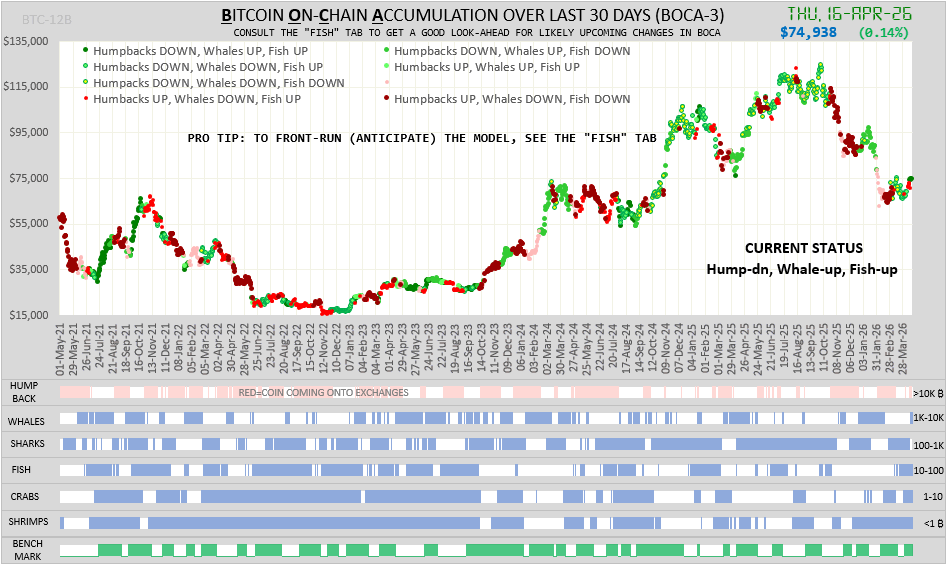
Chart of the Day: The Bitcoin On-Chain Accumulation model has been indicating a buying opportunity more recently, with a dark green (max bullish) signal for the last 2 days.
Market Intelligence Brief (MIB) Ver. 15.5
For professional investors only. Not investment advice.
© 2026 RecessionALERT.com

Comments are closed.