
S&P 500 (+0.80%) and Nasdaq 100 (+1.95%) hit fresh records as Intel (+23.6%) blew out Q1 — best day since 1987 — dragging AMD (+13.9%) and NVDA (+4.3%, back above $5T). But the rally was narrow: Dow (-0.16%), Transports (-0.94%), NYSE Composite all red. DOJ dropped its Powell probe, clearing Warsh’s path; 10Y slipped to 4.31%. UMich sentiment crashed to a record-low 49.8 with 1-year inflation expectations spiking to 4.7%. Mega-cap tech earnings loom next week.
TABLE OF CONTENTS
A. EXECUTIVE SUMMARY
B. MARKET DATA
C. HIGH-IMPACT STORIES (5)
D. MODERATE-IMPACT STORIES (5)
E. ECONOMY WATCH (5)
F. EARNINGS WATCH (2)
G. WHAT’S NEXT
H. CHART OF THE DAY
A. EXECUTIVE SUMMARY -> TOP
A semiconductor-only rally drove the S&P 500 (+0.80%) and Nasdaq 100 (+1.95%) to fresh record closes, but the tape was the narrowest of 2026 — Dow (-0.16%), DJ Transports (-0.94%), and NYSE Composite (-0.08%) all finished red with only 5 of 11 sectors advancing. Intel’s +23.6% post-earnings rip — a CPU-cycle validation that dragged AMD (+13.9%) and Nvidia (+4.3%, back through $5T) — overpowered the macro backdrop of record-low UMich sentiment (49.8) and 1-year inflation expectations at 4.7%. Gold, silver, and Brent simultaneously held haven/supply-risk bids while equities printed highs — a stagflationary split that identifies today as an AI-concentration trade rather than broad risk-on, leaving the index almost entirely levered to next week’s mega-cap capex validation.
• Intel (INTC) +23.6% — best day since 1987 on Q1 blowout; Data Center & AI revenue +22% YoY; Q2 guide well above consensus.
• Nvidia (NVDA) reclaimed $5T market cap (+4.3%); AMD +13.9% on Stifel upgrade ($320 PT); PHLX Semi index up 18 straight sessions.
• DOJ dropped Powell criminal probe — clears Senate path for Warsh confirmation; 10Y yield fell 2 bps to 4.305%, 2Y down 4.2 bps to 3.78%.
• UMich Consumer Sentiment 49.8 (final April) — all-time low since 1952; 1-yr inflation expectations jumped to 4.7%, 5-yr to 3.5%.
• P&G (PG) +1.70% on Q3 beat with volume returning to growth (+2 pts); Q4 deceleration guide tempers upside.
• Hormuz standoff persists — Witkoff/Kushner travel to Pakistan Saturday for direct US-Iran talks; Brent held $106.20, WTI slipped to $94.96.
1. Semiconductor Single-Trade Risk — The entire index advance rests on 4-5 chip names. Mega-cap earnings April 28-30 (MSFT/GOOGL/META/AMZN) must validate the ~$520B 2026 AI-capex consensus; anything below $500B risks a sharp unwind given how narrow participation is.
2. Fed Transition Paradox — The DOJ-Powell resolution cleared the institutional overhang (bullish yields today), but Warsh’s hawkish balance-sheet regime change now becomes the next catalyst once confirmed. Duration’s relief rally may reverse as personnel risk is replaced by policy risk.
3. Record-High Equity vs Record-Low Sentiment — S&P at all-time highs while UMich prints its lowest reading ever. Either sentiment bottoms and rebounds or equities mean-revert; sustained divergence is historically rare and has typically resolved within 1-2 quarters. March PCE on April 30 is the referee.
 — Leading economic indicators. Accurate market forecasts. Apply for membership at join.recessionalert.com
B. MARKET DATA -> TOP
A semiconductor-fueled melt-up drove the S&P 500 (+0.80%) and Nasdaq 100 (+1.95%) to fresh record closes, but the rally was narrow — the Dow (-0.16%), DJ Transports (-0.94%), and NYSE Composite (-0.08%) all finished red as only five of eleven sectors gained. Technology (+2.64%) ran away from the tape while Healthcare (-1.06%), Industrials (-0.86%), and Consumer Defensive (-0.39%) were sold, a classic AI-concentration trade rather than broad risk-on. Intel’s 23.6% post-earnings surge — its best day since 1987 after an AI/Data Center beat — dragged AMD (+13.91%), KLAC (+6.59%), and NVDA (+4.32%) higher, with Nvidia reclaiming the $5T market-cap mark. Treasuries caught a modest bid (10Y -2 bps to 4.305%, 2Y -4.2 bps to 3.783%) as the DOJ dropped its Powell probe, easing Fed-independence worries, while Brent (+1.08% to $106.20) held firm on Iran-supply risk even as WTI slipped 0.93% and Henry Hub tumbled 3.56% on an oversupplied storage picture.
CLOSING PRICES – April 24, 2026:
MAJOR INDICES
The S&P/Nasdaq record close masked an unusually narrow tape: the Dow, NYSE Composite, and DJ Transports all closed red, and Russell 2000 (+0.37%) barely participated — this was a semiconductor story, not a market-wide advance. Dow Theory flashes non-confirmation — DJIA sits within 1% of its 7-session high while Transports are 12.7% below their own, transport weakness declining to validate industrial strength. Growth/broad and small/large relative spreads remained inside thresholds.
| Index | Close | Change | %Move | Why It Moved |
|---|---|---|---|---|
| S&P 500 | 7,165.01 | +56.61 | +0.80% | Record close on Intel-led semi rally; AI trade reignited post-earnings |
| Dow Jones | 49,230.71 | -79.61 | -0.16% | Blue-chip laggards RTX, MRK, PM dragged despite tech strength |
| DJ Transportation | 20,892.00 | -198.90 | -0.94% | Transports lagged on industrial-demand concerns; crude above $100 pressures airlines |
| Nasdaq 100 | 27,303.67 | +521.04 | +1.95% | Record; PHLX semi index up 17 straight days; Nvidia reclaimed $5T cap |
| Russell 2000 | 2,785.40 | +10.21 | +0.37% | Modest gain as lower yields supported domestic small-caps |
| NYSE Composite | 22,934.55 | -18.19 | -0.08% | Broad-market gauge finished red; confirms the rally was concentrated in tech |
VOLATILITY & TREASURIES
Yields fell across the curve with the 2Y outpacing the 10Y (-4.2 bps vs -2.0 bps), a mild bull-steepening as the DOJ dropping the Powell probe removed a Fed-independence overhang and cleared the runway for Warsh’s confirmation. VIX drifted 3.2% lower but remains elevated near 19 given the Iran backdrop — options desks are not yet buying the record-equity narrative. DXY softened on the same Fed-clarity bid; the cross-asset picture is consistent with duration demand rather than risk-off hedging.
| Instrument | Level | Change | Why It Moved |
|---|---|---|---|
| VIX | 18.69 | -0.62 (-3.21%) | Eased on Powell-probe news and US-Iran ceasefire, but elevated vs pre-conflict |
| 10-Year Treasury Yield | 4.305% | -2.0 bps | Modest duration bid; Warsh Fed-chair path clearer after DOJ drops Powell probe |
| 2-Year Treasury Yield | 3.783% | -4.2 bps | Front-end led the rally; dovish repricing as Fed-independence overhang lifts |
| US Dollar Index (DXY) | 98.52 | -0.25 (-0.25%) | Softer as yields eased; EUR/USD +0.31% on euro-area gas-supply steadiness |
COMMODITIES
Precious and industrial metals split — gold and silver stayed firm near records on the Iran-risk bid, while copper and platinum fell, a pattern consistent with geopolitical/monetary hedging rather than a broad reflation trade. Bitcoin drifted 0.36% lower, declining to confirm the equity-record narrative — crypto is treating this as a thin, tech-only risk episode rather than a risk-on regime shift. The metals/equities disconnect is the day’s quietest tell: haven demand persists even as headline indices print new highs.
| Asset | Price | Change | %Move | Why It Moved |
|---|---|---|---|---|
| Gold | $4,722.44/oz | -$1.56 | -0.03% | Essentially flat at record territory; haven bid intact on Iran backdrop |
| Silver | $75.817/oz | +$0.313 | +0.42% | Tracked gold higher despite weaker industrial metals tape |
| Copper | $6.0300/lb | -$0.0515 | -0.85% | Industrial demand concerns after weak China PMI prints this week |
| Platinum | $2,019.35/oz | -$19.05 | -0.93% | Auto-demand weakness dragged; split from gold’s safe-haven bid |
| Bitcoin | $77,673 | -$279 | -0.36% | Decoupled from equity record; low-conviction crypto tape |
ENERGY
WTI and Brent diverged — Brent +1.08% to $106.20 on continuing Iran supply-risk premium, WTI -0.93% as ample US inventories capped domestic barrels — widening the spread toward $11 and signaling a regional rather than global disruption. Natural gas tumbled 3.56% to 2½-year lows on 103 Bcf storage injection and benign weather, decoupling entirely from crude’s geopolitical bid. Rising Brent against red equity breadth and stagnant gas is the stagflationary read here — supply-shock cost pressure without demand confirmation.
| Asset | Price | Change | %Move | Why It Moved |
|---|---|---|---|---|
| Crude Oil (WTI) | $94.96/bbl | -$0.89 | -0.93% | Ample US inventories capped domestic barrel; spread to Brent widened |
| Crude Oil (Brent) | $106.20/bbl | +$1.13 | +1.08% | Iran supply-risk premium held global benchmark firm above $100 |
| Natural Gas (Henry Hub) | $2.521/MMBtu | -$0.093 | -3.56% | 103 Bcf storage injection, mild weather; inventories 7% above normal |
| Natural Gas (Dutch TTF) | $15.283/MMBtu | +$0.047 | +0.31% | TTF flat in euro terms; $/MMBtu lifted by weaker dollar (EUR/USD +0.31%) |
S&P 500 SECTORS
Technology extended its regime leadership (+2.64% today, +15.89% 1M, +57.85% 1Y) while Healthcare’s rout deepened — today’s -1.06% laggard is also the 3M (-7.17%) and YTD (-4.96%) worst, structural weakness driven by GLP-1 competitive pressure, not a tactical wobble. Energy paused (-0.35%) after leading 3M (+18.43%) and YTD (+29.17%) — profit-taking as WTI slipped below $95 even with Brent firm. Only five of eleven sectors advanced — rotation within an uptrend, not broad participation.
| Sector | 1-Day | 1-Week | 1-Month | 3-Month | 6-Month | YTD | 12-Month |
|---|---|---|---|---|---|---|---|
| Technology | +2.64% | +3.39% | +15.89% | +9.68% | +9.04% | +9.91% | +57.85% |
| Consumer Cyclical | +1.12% | -1.31% | +7.94% | -4.23% | -0.76% | -1.25% | +23.69% |
| Communication Services | +0.70% | -1.08% | +10.71% | +2.35% | +8.85% | +3.02% | +47.10% |
| Basic Materials | +0.67% | -2.02% | +8.40% | +0.85% | +27.80% | +17.63% | +54.67% |
| Utilities | +0.19% | +0.16% | +3.03% | +7.81% | +4.36% | +9.09% | +22.03% |
| Real Estate | -0.16% | -1.40% | +7.95% | +4.60% | +2.73% | +7.34% | +8.49% |
| Energy | -0.35% | +3.20% | -4.01% | +18.43% | +32.36% | +29.17% | +44.60% |
| Financial | -0.38% | -2.44% | +5.05% | -2.81% | +2.13% | -3.61% | +16.24% |
| Consumer Defensive | -0.39% | +0.61% | +2.61% | +1.76% | +6.22% | +8.22% | +5.94% |
| Industrials | -0.86% | -0.64% | +5.51% | +5.37% | +15.27% | +13.53% | +41.87% |
| Healthcare | -1.06% | -3.51% | +0.03% | -7.17% | +0.49% | -4.96% | +10.76% |
TOP MEGA-CAP MOVERS:
GAINERS
| Company | Ticker | Close | Change | Why It Moved |
|---|---|---|---|---|
| Intel Corp | INTC | $82.54 | +23.60% | Blowout Q1: non-GAAP EPS $0.29 vs $0.02; Data Center & AI $5.05B (+22% YoY); best day since 1987; cleared 2000 peak |
| Advanced Micro Devices | AMD | $347.81 | +13.91% | AI-chip halo from Intel beat; reaffirmed data-center GPU share-taking narrative |
| KLA Corp | KLAC | $1,935.00 | +6.59% | Semi equipment bid on Intel capex read-through; PHLX semi index up 17 straight sessions |
| NVIDIA Corp | NVDA | $208.27 | +4.32% | Reclaimed $5T market cap on record close; broad AI-compute rally |
DECLINERS
| Company | Ticker | Close | Change | Why It Moved |
|---|---|---|---|---|
| Eli Lilly & Co | LLY | $883.96 | -3.67% | Weekly IQVIA script data showed Zepbound/Foundayo lagging Novo’s Wegovy; Q1 reports Apr 30 |
| Philip Morris Int’l | PM | $164.20 | -2.95% | Soft Q2 EPS guide vs consensus; ZYN regulatory pressure weighed despite Q1 beat |
| RTX Corp | RTX | $174.26 | -2.81% | Aerospace/defense profit-taking after strong YTD run; industrials sector -0.86% |
| Merck & Co | MRK | $111.96 | -2.37% | Swept lower with healthcare (-1.06%); GLP-1 competitive overhang across pharma |
— Institutional-grade intelligence for serious investors. Apply for membership at join.recessionalert.comC. HIGH-IMPACT STORIES -> TOP
BULLISH
1. S&P 500 and Nasdaq Hit Fresh Record Highs as Semiconductor Strength Extends to 18 Straight Sessions
The core facts:The S&P 500 closed at a record 7,165.08 (+0.80%) and the Nasdaq Composite at a record 24,836.60 (+1.63%) on Friday, lifted by a powerful semiconductor rally that extended chip-sector gains to an 18th consecutive session. The Dow Jones Industrial Average was the laggard, slipping roughly 0.2%, as defensive sectors lost ground to mega-cap tech. Intel (+23.6%), AMD (+13.9%), and Nvidia (+~5%) drove the bulk of the index advances.
Why it matters:The market is decisively choosing AI capital-spending exposure over macro caution — even as consumer sentiment hits record lows and oil sits near $100. Breadth is narrow (Dow flat, semis carrying everything), which historically marks late-cycle rallies but can persist for quarters when the dominant theme is structural capex. With mega-cap tech earnings due next week (GOOGL, MSFT, META, AMZN), the index path now hinges almost entirely on whether their cloud/AI capex commentary validates this melt-up.
What to watch:SOX (PHLX Semiconductor) breaking its 18-session streak would be the first concrete signal of fatigue. Equally critical: the cumulative AI capex number announced across MSFT/GOOGL/META/AMZN earnings April 28–30 — the consensus print is ~$520B for 2026 across the four; anything below $500B risks a sharp unwind.
BULLISH
2. Nvidia Reclaims $5 Trillion Market Cap as AMD Surges 12% on Stifel Upgrade and Intel CPU Read-Through
The core facts:Nvidia (NVDA) closed at a record after gaining as much as 5.2% intraday, pushing market capitalization back above $5.12 trillion — adding roughly $260 billion in value in a single session and re-establishing a $1 trillion lead over second-place Alphabet. AMD jumped nearly 12% after Stifel raised its price target to $320 from $280 (Buy maintained), with analyst Gil Luria noting Intel’s blowout results “indicate the CPU is reinserting itself as an indispensable foundation of the AI era.” A separate Nvidia/Oklo/Los Alamos National Laboratory partnership announced this week to develop AI models for nuclear-fuel validation added a second leg to the move.
Why it matters:The semiconductor complex is now functioning as a single trade — beat one chipmaker, all chipmakers rally. Intel’s data-center surprise (+22% YoY in DC&AI) read across to AMD’s CPU franchise and to Nvidia’s accelerator dependency on host CPUs, validating bullish AI-infrastructure capex assumptions in one stroke. With Nvidia again the world’s most valuable company by a $1T margin, the AI trade has zero competition for marginal flows; any rotation away from this complex would have to find an equally large narrative, which currently does not exist.
What to watch:Watch whether NVDA holds $5T on a closing basis through next week’s mega-cap earnings — a slip back below $5T as MSFT/META/GOOGL/AMZN report would be a clear “buy the rumor, sell the news” signal. AMD’s next earnings report (early May) is now the key validation event for the bullish CPU thesis.
UNCERTAIN
3. DOJ Drops Powell Probe, Clearing Senate Path for Warsh Fed Chair Confirmation; 10Y Yield Falls to 4.31%
The core facts:The U.S. Department of Justice abandoned its criminal investigation into Federal Reserve Chair Jerome Powell on Friday, removing the political overhang that had stalled the Senate’s confirmation vote on Kevin Warsh as Powell’s successor. The 10-year Treasury yield fell to 4.306%, and the 2-year yield dropped more than 4 bps to 3.78%. Warsh, who completed contentious Senate Banking testimony on April 21 — vowing not to be Trump’s “sock puppet” — has telegraphed an inflation-framework “regime change” featuring trimmed-mean preferences, balance-sheet reduction, and reduced forward guidance.
Why it matters:Yields fell on relief that the institutional crisis is resolving, not on dovish policy expectations. Warsh remains a hawkish pick — his preference for radical balance-sheet reduction would mechanically raise term premiums and tighten credit. The bond market is now in a transition window: short-term, removing political tail risk supports Treasuries; medium-term, a confirmed Warsh chair could reverse this rally as markets begin to price his regime change. Equities benefit from clarity either way, but the duration trade may face headwinds once the personnel uncertainty is replaced by policy uncertainty.
What to watch:Senate Banking Committee vote schedule on Warsh — expected as early as next week. If confirmed, watch the 10Y for a spike back above 4.50% within his first 30 days as markets reprice balance-sheet runoff acceleration.
BEARISH
4. UMich Consumer Sentiment Hits Record Low of 49.8 (Final April); One-Year Inflation Expectations Spike to 4.8%
The core facts:The University of Michigan’s final April Consumer Sentiment Index printed 49.8 — a fresh all-time low, beneath both Great Recession and COVID lockdown troughs. The headline is down 6.6% month-over-month and 4.6% year-over-year. The inflation component is the more alarming line: one-year-ahead inflation expectations jumped from 3.8% in March to 4.8% in April, the largest one-month increase since April 2025 and well above the 4.2% consensus. The decline was broad-based across all age, income, and political-affiliation groups.
Why it matters:Inflation expectations becoming unanchored is the single development a Fed policymaker fears most — it forces tightening reflexively, regardless of growth. With Brent crude near $105 and WTI in the mid-$90s, the consumer is beginning to extrapolate sustained energy-driven inflation, which historically becomes self-fulfilling through wage demands. The disconnect between record-low confidence and record-high equity prices is now extreme: the S&P 500 is at all-time highs while the household sector is signaling distress. Either equities have to mean-revert or sentiment has to bottom and rebound; sustained divergence is rare.
What to watch:The April PCE print (due April 30) is now the critical data point — if year-over-year core PCE accelerates above 3%, the inflation-expectations spike becomes validated and the Fed loses its rate-hold optionality. Also watch the Conference Board Consumer Confidence release April 28 for confirmation.
UNCERTAIN
5. Strait of Hormuz Standoff Persists; Witkoff and Kushner Travel to Pakistan Saturday for Direct US-Iran Talks
The core facts:Brent crude closed little changed at $105.33/bbl while WTI lost more than 1% to $94.40, with both benchmarks whipsawing intraday on news that US special envoy Steve Witkoff and Jared Kushner will travel to Pakistan Saturday morning for direct talks with Iranian counterparts. The IEA continues to warn of the “largest oil-supply disruption in history” with Hormuz traffic slowed to a trickle, and JPMorgan estimates global supply disruptions reached 13.7 mbd in April (nearly double March), with Saudi Arabia and the UAE jointly shutting in roughly 9.1 mbd. Year-to-date, Brent is up 75% and WTI 69%.
Why it matters:Markets are simultaneously pricing two opposite outcomes — a diplomatic resolution this weekend (would collapse oil 15-20% on a successful Pakistan handshake) and an escalation (could spike Brent above $130 if Hormuz shuts entirely). With the consumer sentiment data showing inflation expectations already de-anchoring on energy, a sustained $100+ oil regime past mid-May would force the Fed’s hand even if growth weakens, reviving stagflation pricing. The Pakistan talks are the highest-stakes single weekend event since the conflict began.
What to watch:Brent’s Sunday-evening open in Asia will tell the entire story. A gap below $95 = breakthrough; a gap above $115 = breakdown. Either move >5% will dictate Monday’s US session.
— Quantifying recession risk so you don’t have to guess. Apply for membership at join.recessionalert.comD. MODERATE-IMPACT STORIES -> TOP
UNCERTAIN
6. Meta Confirms 8,000 Layoffs (10% of Workforce); Doubles 2026 AI Spending to ~$135 Billion
The core facts:Meta Platforms (META) sent an internal memo Thursday (April 23) confirming the elimination of approximately 8,000 jobs — roughly 10% of its workforce — with the cuts effective May 20. The company will also forgo hiring for 6,000 open roles. Meta plans to roughly double 2026 AI spending to approximately $135 billion (from $72B in 2025), explicitly linking the workforce reduction to financing the AI capex acceleration.
Why it matters:The cost-cut/capex-spike trade-off is the new template across mega-cap tech. Wall Street has rewarded similar moves at MSFT and GOOGL with multiple expansion, but Meta’s $135B capex is now the highest in the sector and raises the bar for ROI demonstrations. With Meta reporting earnings the week of April 28, management commentary on Reality Labs efficiency and AI revenue traction is now the swing factor — a layoff alone is not a thesis-changer, but layoffs plus a $63B capex jump need a clear monetization narrative to avoid multiple compression.
What to watch:Meta’s Q1 earnings call commentary on AI revenue contribution and Reality Labs operating loss trajectory. Specifically: any guide-up to the $135B capex figure would be a red flag; any guide-down or specific monetization milestone would re-anchor the thesis.
BULLISH
7. Regeneron Wins Landmark FDA Approval for Otarmeni — First Gene Therapy for Genetic Hearing Loss
The core facts:The FDA on April 23 granted accelerated approval to Regeneron’s (REGN) Otarmeni (lunsotogene parvec-cwha) — the first and only gene therapy for OTOF-gene-related severe-to-profound sensorineural hearing loss. In the registrational study, 80% of evaluable patients showed improved hearing and 42% achieved normal hearing including ability to hear whispers. The approval came under the FDA Commissioner’s National Priority Voucher program (only the second NME approved through this pathway). Regeneron will provide the therapy free in the US given the ultra-rare patient population (~50 newborns per year).
Why it matters:Although Otarmeni’s commercial revenue contribution is essentially zero by design, the approval is a category-defining validation of Regeneron’s gene-therapy platform and dramatically de-risks pipeline candidates targeting larger indications. The approval also signals the National Priority Voucher pathway is operational and accessible — a positive read-across for biotech regulatory timelines broadly. REGN’s franchise value re-rating will be the first-derivative trade; pipeline read-throughs to BLUE, CRSP, and other gene-therapy names is the second.
What to watch:REGN’s commentary on broader gene-therapy pipeline timelines on its next earnings call. Watch the XBI biotech ETF for sector-wide rerating in the coming sessions.
BULLISH
8. Morgan Stanley Upgrades Phillips 66 to Overweight, Raises Price Target to $174
The core facts:Morgan Stanley upgraded Phillips 66 (PSX) to Overweight from Equal Weight and lifted its price target to $174 from $147 (an 18% PT bump). The note cited strong chemicals-segment performance, attractive valuation relative to integrated peers, operational improvements at the refining footprint, and the company’s commitment to return more than 50% of cash from operations to shareholders.
Why it matters:The upgrade lands precisely as elevated crude prices ($95+ WTI) drive refining-margin expansion and as the chemicals cycle troughs. Morgan Stanley’s call is essentially a vote of confidence in the durability of the energy-cycle setup created by the Iran conflict — implicitly pricing that even a partial diplomatic de-escalation does not collapse the refining margin. The PSX upgrade is a tradable signal for energy-sector relative strength, with read-through to MPC, VLO, and broader XLE positioning.
What to watch:PSX’s Q1 earnings (week of April 28) will validate or refute Morgan Stanley’s chemical-segment thesis. Watch the 3-2-1 crack spread for refining-margin direction.
BEARISH
9. MoffettNathanson Downgrades DraftKings to Neutral; PT Cut to $27 from $38 on Prediction-Market Threat
The core facts:MoffettNathanson cut DraftKings (DKNG) to Neutral from Buy and slashed its price target to $27 from $38 — a 29% PT reduction. The firm explicitly identified prediction-market platforms (Kalshi, Polymarket and similar) as a competitive overhang it can “no longer dismiss,” directly linking the call to evidence that prediction markets are eroding sports-betting share-of-wallet faster than previously modeled.
Why it matters:This is the first major sell-side capitulation on the prediction-market disruption thesis, and it carries cross-sector implications: if prediction markets are real competition for sports betting, similar erosion is plausible for online casino (FLUT/PENN) and even traditional sportsbook channels. The downgrade also signals analyst consensus is shifting from “DKNG dominant duopoly” to “DKNG facing structural headwinds” — typically a multi-quarter de-rating event.
What to watch:DKNG’s next quarterly active-user and revenue-per-user disclosures — any sequential weakness will validate the thesis. Watch peer FLUT and PENN for sympathetic moves over the next two weeks.
BULLISH
10. Nvidia, Oklo and Los Alamos Form AI-Nuclear Partnership; HSBC Initiates Oklo at Buy with $96 PT
The core facts:Nvidia, nuclear-startup Oklo (OKLO), and Los Alamos National Laboratory announced a three-way collaboration to develop AI models for nuclear-fuel validation and to study power generation for AI-data-center deployments. HSBC simultaneously initiated coverage of Oklo with a Buy rating and $96 price target, citing the company’s owner-operator model for next-generation small modular reactors. Oklo shares gained ~5% Friday after rallying ~16% Thursday on the news; the stock now trades near $80.
Why it matters:The partnership is the most concrete evidence yet that AI-data-center power demand is being matched with new nuclear capacity at the developer-by-developer level — moving beyond the 2024–25 “long-dated PPA” announcements into actual technical collaboration. For Nvidia, this is a subtle but important signal that power constraints (not chip supply) are the next binding constraint on AI capex. For the broader nuclear/SMR complex (CCJ, BWXT, SMR), the validation lifts the entire group.
What to watch:Power-grid commentary from MSFT, GOOGL, META, AMZN on next week’s earnings calls — any explicit nuclear-supply line items would validate this thesis at scale. Watch the Solactive Nuclear Energy ETF (NUKZ) and uranium-spot for sector confirmation.
— Separating signal from noise since 2007. Apply for membership at join.recessionalert.comE. ECONOMY WATCH -> TOP
The week’s data locked in a textbook stagflation signal. Michigan consumer sentiment (49.8 final) printed the lowest reading on records back to 1952, while 1-year inflation expectations surged to 4.7% and the 5-year to 3.5% — both multi-decade highs. Flash PMI showed the paradox cleanly: manufacturing output at a 47-month high, but selling prices rising at the sharpest pace since mid-2022. GDPNow slipped to 1.2% for Q1, Fed official Miran is openly rethinking his cut path, and Moody’s Zandi reset recession odds to 49% with BofA arguing the war-driven stagflation risk is under-priced. The soft-landing narrative and the institutional voices are visibly pulling apart.
Michigan Consumer Sentiment Final 49.8 — Lowest on Record; Inflation Expectations Surge (University of Michigan / Bloomberg, April 24)
What they’re saying:The final April Michigan Consumer Sentiment Index registered 49.8 versus 48.0 expected, revised up from the 47.6 preliminary but still the lowest reading in data back to 1952 and well below March’s 53.3. 1-year inflation expectations jumped from 3.8% to 4.7% — the largest monthly increase since April 2025 — while 5-year expectations climbed to 3.5%, the highest since October 2025. Current Conditions printed 52.5, Expectations 48.1.
The context:The survey field window ran March 24 to April 20 — capturing both sides of the April 8 Iran ceasefire, and the reading still hit an all-time low. Unmoored 5-year inflation expectations are the metric the Fed watches most closely when judging whether to deliver cuts; a jump to 3.5% complicates the “inflation is transitory from the oil shock” framing Powell has favored.
What to watch:March PCE (due April 30) — the Fed’s preferred gauge. Consensus expects +0.3% core MoM; anything north of 0.4% paired with this sentiment print becomes a live stagflation data set.
GDPNow Slashes Q1 2026 Tracking Estimate to 1.2% — Weakest Since 2023 (Atlanta Fed, April 21)
What they’re saying:The Atlanta Fed’s GDPNow model marked Q1 2026 real GDP growth at 1.2% on April 21, down from 1.3% on April 9. While personal consumption tracking rose from 1.1% to 1.4%, that upside was more than offset by downward revisions to private investment (6.3% → 5.6%) and government expenditures (1.5% → 1.1%).
The context:1.2% would be the weakest Q1 print since 2023 and a meaningful step down from the 2.3% pace averaged through 2025. Critically, the deceleration is broadening — investment and government are joining consumption on the downtrend rather than offsetting it. This lines up with the “compounding shocks” narrative RBC and others have flagged for the Fed’s sidelined stance.
What to watch:BEA advance Q1 2026 GDP release April 30 — gap between GDPNow and the official print will recalibrate recession probability models. A sub-1% official reading would likely move yields sharply lower.
S&P Global Flash PMI — Manufacturing at 47-Month High but Output Prices Spike (S&P Global, April 23)
What they’re saying:The April flash US Manufacturing PMI rose to 54.0 from 52.3 (47-month high), with the Manufacturing Output Index at 55.7 — a 48-month high. Services PMI climbed to 51.3 from 49.8, and the Composite output index hit 52.0 vs 50.3 prior. But S&P Global flagged output prices rising at the sharpest rate since mid-2022, explicitly linking the price acceleration to war-driven input costs.
The context:The headline strength is real — a rebound from March near-stagnation — but the composition is deeply uncomfortable for the Fed. Tariff front-running (firms building inventory ahead of policy uncertainty) plus pass-through of higher energy costs is exactly the pattern that made the Volcker Fed squeeze in 1979-81 necessary. Strong output + accelerating prices is not a cut signal; it’s a hold-longer signal.
What to watch:ISM Manufacturing (May 1) for confirmation — if both ISM and S&P PMI show the same pattern, the Fed’s “wait-and-see” extends well into H2.
Fed Governor Miran Pulls Back on Rate-Cut Outlook — “I Haven’t Made Up My Mind” (Motley Fool / Washington Forum, April 23)
What they’re saying:Governor Stephen Miran — the most reliably dovish voice on the current FOMC — told a Washington economic forum April 23 he is revisiting his prior path of six 2026 cuts: “I might have three, I might have four. I haven’t made up my mind.” Miran explicitly credited the Iran war for the rethink. CME FedWatch now puts the next cut no earlier than June 2027.
The context:Miran’s rethink matters because he anchored the lower end of the SEP dot plot — if his dots move from six cuts to three, the median dot moves as well when the June SEP is published. Polymarket’s ≥1-cut-in-2026 probability has slipped to 59% from 60% yesterday, with 0-cut probability now 41% and climbing. Rate-cut pricing is gradually being re-anchored around “one or none” for this year.
What to watch:FOMC meeting May 6-7 (widely expected to be Powell’s last as Chair) — SEP isn’t due, but any language shift on “patient” or “data-dependent” will move the curve materially.
Institutional Recession Odds Keep Climbing — Zandi 42-48.6%, Wilmington 45%, FRED Smoothed 48% (Moody’s / Wilmington Trust / St. Louis Fed, April 24)
What they’re saying:Moody’s Analytics chief economist Mark Zandi today described recession risk as “uncomfortably high” at ~42%, with Moody’s internal ML models running as high as 48.6%, citing nearly all data “softening since end-2025.” Wilmington Trust today pegged odds at 45%, warning they “could rapidly rise” if Strait of Hormuz disruptions worsen. The St. Louis Fed’s FRED smoothed recession probability now sits at 48% on February data — the highest reading since the 2020 pandemic. Goldman holds 30%, Bloomberg consensus 30%, JPMorgan 35-40%.
The context:The institutional spread (Goldman 30% → JPM 35-40% → Wilmington 45% → Moody’s 48.6% → FRED smoothed 48%) averages ~40% — materially above Polymarket’s 26%. The counter-signal: the NY Fed’s Treasury-spread model still prints just 18.8% for March 2027, having ticked lower this month. The gap between the bottom-up bank models (softer data, oil shock, deteriorating consumer) and the yield-curve model (which remains the historically most accurate single signal) is the cleanest way to frame the current disagreement. When bank houses and prediction markets disagree by 20 points, the bank side has historically been early rather than wrong.
What to watch:NY Fed Household Debt & Credit Report (due early May) — delinquency transition rates on credit cards and auto loans will confirm or refute the “consumer deterioration” thesis Zandi and Wilmington are leaning on. Next FRED smoothed update: April 30.
— Know the probability before the market prices in the risk. Apply for membership at join.recessionalert.comF. EARNINGS WATCH -> TOP
YESTERDAY AFTER THE BELL (Markets Reacted Today)
BULLISH
11. Intel (INTC): +23.6% | Q1 Blowout — Data Center & AI Drives Massive Beat, Q2 Guide Above Consensus (Released: AMC April 23)
The Numbers:Non-GAAP EPS $0.29 vs $0.01 consensus (massive beat); Revenue $13.6B vs $12.36B est. Data Center & AI segment $5.05B (+22% YoY) crushed $4.41B consensus. Q2 revenue guide $13.8B–$14.8B, well above Street. GAAP loss reported on a $4.1B Mobileye goodwill impairment (non-recurring). Sixth consecutive quarter of beating financial targets.
The Problem/Win:The Data Center segment’s 22% YoY growth is the single most important number — it confirms enterprise CPU refresh cycles are accelerating to host AI workloads, not being cannibalized by GPU-only architectures. Gross margin and EPS both exceeded the upper end of guidance. Revenue, gross margin, and EPS all came in above the high end of company guidance.
The Ripple:AMD +13.9% on direct read-through; Nvidia +~5% (host CPU dependency); broader SOX +18th consecutive session. Stifel raised AMD PT to $320 from $280; D.A. Davidson said “the CPU is reinserting itself as an indispensable foundation of the AI era.”
What It Means:The CPU is no longer a melting ice cube — it is a complement to the AI accelerator stack and is participating in the same capex super-cycle. Intel is now investable on fundamentals alone for the first time in years, and the broader semiconductor complex has gained a second growth narrative beyond Nvidia.
What to watch:Q2 Data Center revenue trajectory — if the segment maintains 20%+ YoY growth in the next print, the structural thesis is confirmed. Watch AMD’s early-May earnings for cross-confirmation.
TODAY BEFORE THE BELL (Markets Already Reacted)
BULLISH
12. Procter & Gamble (PG): +1.70% | Q3 FY26 Beats on Top and Bottom; Volume Returns to Growth (Released: BMO April 24)
The Numbers:EPS $1.59 vs $1.56 consensus (+2.2% beat); Revenue $21.24B vs $20.53B est (+3.4% beat); GAAP EPS $1.63 vs $1.54 est (+5.6% beat). Net sales rose 7% YoY. Organic sales +3%, with volume +2 points (first volume growth in a year), pricing +1 point, mix flat. North America organic +4% with volume +3 points; Europe +2%; Greater China +3%. Outlook: Q4 organic sales “somewhat lower than Q3” due to inventory timing and incremental cost headwinds. Market cap: $344B.
The Problem/Win:The volume return is the headline — PG had been delivering revenue growth via pricing alone for over a year, raising sustainability concerns. Volume +2 points across the company, with NA volume +3 points, signals the consumer is accepting current price points and demand is intact. Skin and Personal Care led with high-single-digit growth.
The Ripple:Positive read-through to consumer-staples peers (CL, KMB, CHD) — if the largest player is seeing volume return, the category-wide pricing-vs-volume mix issue may be resolving. Defensive-rotation flows could find support here as a hedge against the narrow tech-led rally.
What It Means:PG remains a high-quality defensive holding, but the explicit Q4 deceleration warning (citing Iran-war input-cost risk and consumer spending uncertainty) caps near-term upside. The bull case requires the volume recovery to extend; the bear case is a single soft Q4 print that breaks the multi-year pricing power narrative.
What to watch:Q4 organic sales print (late July). Also watch Colgate-Palmolive’s earnings (April 25) and Kimberly-Clark for category-wide volume confirmation.
TODAY AFTER THE BELL (Markets React Tomorrow)
No major earnings after the bell from companies with >$100B market cap. (HCA Healthcare and SLB reported earlier today but both are below the $100B threshold for inclusion.)
WEEK AHEAD PREVIEW:
Q1 2026 earnings season accelerates dramatically next week, with the four largest hyperscalers all reporting and providing the critical AI-capex validation event for the broader market.
Verizon Communications (VZ) — BMO Monday April 27 — telecom bellwether ($196B cap); watch postpaid net adds, broadband subscriber trends, and 2026 capex/free-cash-flow guidance.
Cadence Design Systems (CDNS) — AMC Monday April 27 — chip-design EDA bellwether ($92B cap, just below mega-cap line but a key AI-adjacent read); watch design-IP backlog as a leading indicator of semi-cycle durability.
Alphabet (GOOGL) — week of April 28 — Google Cloud growth and AI-infrastructure capex; Cloud margin trajectory; Search ad-monetization commentary in light of generative-AI competition.
Microsoft (MSFT) — week of April 28 — Azure capacity/capex; impact of voluntary buyout on cost structure; AI-revenue contribution to Intelligent Cloud segment.
Meta Platforms (META) — week of April 28 — Updated 2026 AI capex guidance vs the announced $135B figure; justification for the 8,000-job cut; Reality Labs operating-loss trajectory.
Amazon (AMZN) — week of April 28 — AWS revenue growth; Anthropic commercial milestones; cloud-margin trajectory; retail-margin pass-through of any tariff or input-cost pressures.
Apple (AAPL), Eli Lilly (LLY), Mastercard (MA), Caterpillar (CAT), Merck (MRK), and ConocoPhillips (COP) are also scheduled for April 30 — Q1 2026 earnings season is now in full swing.
— US market commentary trusted by family offices and institutions. Apply for membership at join.recessionalert.comG. WHAT’S NEXT -> TOP
UPCOMING RELEASES:
| Date | Event | Why It Matters |
|---|---|---|
| Mon, Apr 27 | Dallas Fed Manufacturing Index (prior -0.2) | Regional activity read ahead of ISM; further weakness would reinforce the GDPNow 1.2% Q1 softening and validate the bank-house recession narrative. |
| Tue, Apr 28 | CB Consumer Confidence Apr (prior 91.8) | Key cross-check against UMich’s record-low 49.8. Confirmation of consumer distress puts PCE (April 30) squarely in the spotlight and pressures the Fed’s hold stance. |
| Tue, Apr 28 | S&P/Case-Shiller Home Price YoY Feb (prior 1.2%) | Housing-cycle deceleration signal; sub-1% print would confirm mortgage-rate sensitivity is biting and feed into the broader growth-slowdown narrative. |
| Tue, Apr 28 | Richmond Fed Manufacturing Apr (prior 0) | Second regional composite read of the week — if both Dallas and Richmond print sub-zero, the PMI strength looks increasingly like inventory front-running rather than genuine demand. |
KEY QUESTIONS:
1. Does next week’s mega-cap capex guide (MSFT/GOOGL/META/AMZN) validate the ~$520B 2026 AI-capex consensus, or does a soft print trigger a semi unwind given how narrow this rally has become?
2. Can the DOJ-Powell resolution survive Warsh’s confirmation vote without yields reversing higher as the market begins to price his hawkish balance-sheet regime change?
3. Will Saturday’s Witkoff-Kushner talks in Pakistan produce a tradable Hormuz outcome, or extend the $100+ oil regime into the April 30 PCE print and lock in the stagflation frame?
— US market commentary trusted by family offices and institutions. Apply for membership at join.recessionalert.comH. CHART OF THE DAY -> TOP
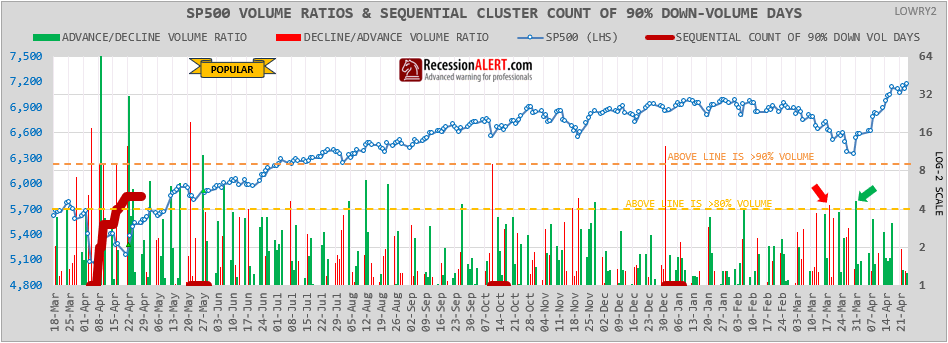
Chart of the Day: For a near 10% correction, the selling pressure was remarkably absent. All we saw was one Lowry 80% down-volume day (declining volume exceeding advancing volume by > 4 times). This is what was witnessed in the baby correction of 18 Nov 2025. Normally there is at least ONE 90% down-volume day in these medium sized corrections. The subsequent 80% Lowry up-volume day (marked with green arrow) signalled a 80/80 Lowry buy the dip signal, one of the “weakest” signals one can get. They are frequent but have much lower efficacy than the 90/80 or 90/90 signals. This is a classic case of no matter how good a model, always diversify your models as not every model works every time. You can follow this chart daily from the DAILY CHARTS menu in the LOWRY tab.
Market Intelligence Brief (MIB) Ver. 17.30
For professional investors only. Not investment advice.
© 2026 RecessionALERT.com

Comments are closed.