
MIB WEEKLY DIGEST
Week of Apr 20–24, 2026
Records on a stagflation tape. The S&P 500 (+0.55% WoW) and Nasdaq 100 (+2.37%) closed at fresh highs only because Intel’s Q1 blowout (Data Center +22% YoY) detonated a Friday semi rip — INTC +23.6%, AMD +13.9%, NVDA back through $5T — while the Dow (-0.44%), NYSE Composite (-1.13%), Healthcare (-3.51%), and Russell 2000 (essentially flat) refused to confirm. Underneath, the macro deteriorated every session: Brent +16% above $100 on the Hormuz standoff, Cleveland Fed CPI nowcast at 3.7%, and Friday’s UMich crashing to a record-low 49.8 with 1-year inflation expectations un-anchoring to 4.7%. Polymarket cut-odds slipped 7.5 pp as Fed Governor Miran openly rethought his cut path. The index is now levered to next week’s GOOGL/MSFT/META/AMZN capex prints validating the consensus ~$520B AI-spend.
TABLE OF CONTENTS
A. WEEK AT A GLANCE
B. WEEK IN MARKETS
C. WEEK’S TOP STORIES (10)
D. WEEK IN THE ECONOMY (5)
E. WEEK IN EARNINGS (5)
F. NEXT WEEK SETUP
G. CHART OF THE WEEK
A. WEEK AT A GLANCE -> TOP
MARKET SNAPSHOT
A semiconductor-only week. The S&P (+0.55% WoW) and Nasdaq 100 (+2.37%) closed at fresh records on Friday’s Intel-detonated semi rip, while the Dow (-0.44%), NYSE Composite (-1.13%), and Healthcare (-3.51%) all finished red — the narrowest tape of 2026. Underneath, the macro backdrop deteriorated every session: Brent +15.98% above $100 on the Hormuz standoff, the Cleveland Fed CPI nowcast climbed to 3.7%, and Friday’s UMich sentiment crashed to a record-low 49.8 with 1-year inflation expectations un-anchoring to 4.7%. Yields rose +5.8 bps WoW and Polymarket cut-odds slipped 7.5 pp — records on a stagflation tape, with the index now levered entirely to the hyperscaler capex cluster Apr 28–30.
THIS WEEK AT A GLANCE
• Intel +20.5% wk on Q1 blowout — Data Center & AI revenue +22% YoY; Friday’s +23.6% session was the stock’s best day since 1987; AMD +24.94% wk topped the weekly mover board.
• Brent +15.98% to $106.20 — oil sustained above $100 every session as the Hormuz saga ran from Mon tanker seizure to Wed indefinite ceasefire to Thu shoot-and-kill order to Fri Pakistan talks; WTI +11.48%, Henry Hub -5.76% (cleanest US-vs-global energy split of 2026).
• UMich sentiment 49.8 record low (Fri) — lowest reading since 1952; 1-yr inflation expectations spiked from 3.8% to 4.7%, 5-yr to 3.5%; Cleveland Fed CPI nowcast climbed to 3.7%.
• Polymarket cut-odds -7.5 pp WoW (66.5% → 59%) — Fed Governor Miran openly rethought his cut path mid-week; Moody’s Zandi reset recession risk to 42–48.6%; Wilmington 45%; FRED smoothed 48% (highest since 2020).
• ServiceNow -18% Thu snapped XLK’s 16-day streak on a margin-guide cut; IBM -8.48% wk; four of five top decliners (RTX, IBM, GE, TSLA) DELIVERED earnings beats yet sold off — the “beat-but-not-enough” signature.
• DOJ dropped Powell criminal probe Friday — clearing Warsh’s Senate confirmation path after Tillis blocked the floor vote Wed; 10Y -2 bps Friday but +5.8 bps net WoW.
• Apple CEO Tim Cook to step down Sept 1 — John Ternus named successor; largest CEO transition in US-equity history three weeks before Apr 30 earnings.
KEY THEMES
1. Semiconductor Single-Trade Risk — Tech +3.39% topped B3 only because of AMD and INTC; strip those two and the sector is roughly flat. The S&P record now rests on hyperscaler capex commentary Apr 28–30 validating the consensus ~$520B 2026 print.
2. Stagflation Pulse Replaces Soft-Landing Narrative — Hot inflation prints (Cleveland 3.7%, Reuters PCE Q2 3.7%, UMich 4.7% expectations, PMI output prices spike) arrived alongside softening growth (GDPNow 1.2%, recession-odds inflection). Yields rising AND VIX rising AND gold falling is the inflation-fear, not recession-fear, signature.
3. AI-Capex Bifurcation: Hardware Wins, Software Cracks — Intel/TXN/GEV/AMD/NVDA all crushed on capex-beneficiary status the same week ServiceNow -18% / IBM -8% / Meta 8K layoffs / Microsoft 7% buyout signaled software margins are absorbing the capex bill. The trade is no longer “AI”; it’s capex-bearer vs capex-beneficiary.
 — Leading economic indicators. Accurate market forecasts. Apply for membership at join.recessionalert.com
B. WEEK IN MARKETS -> TOP
The week’s central catalyst was Intel’s after-hours Q1 blowout Thursday — Data Center & AI revenue +22% YoY — which detonated a Friday semi rally that lifted INTC +23.6%, AMD +13.9% and reclaimed Nvidia’s $5T cap, dragging the S&P 500 to a fresh record (+0.55% WoW) on the narrowest tape of 2026. Underneath, the macro tape darkened all week: Brent held above $100 every session as the Hormuz standoff escalated into a US “shoot and kill” order, the Cleveland Fed CPI nowcast climbed to 3.7%, and Friday’s UMich sentiment crashed to a 49.8 record low with 1-year inflation expectations spiking to 4.7%. The Dow (-0.44%), NYSE Composite (-1.13%) and Healthcare (-3.51%) all closed red while Technology (+3.39%) carried the index — record highs on a stagflation tape, with breadth visibly fraying into next week’s mega-cap earnings cluster.
FRIDAY CLOSE & WEEK-ON-WEEK CHANGE — Fri, Apr 24, 2026:
MAJOR INDICES
The week was a record print on a fractured base. S&P (+0.55%) and Nasdaq 100 (+2.37%) closed at fresh all-time highs while the Dow (-0.44%) and NYSE Composite (-1.13%) finished red — the cleanest possible breadth-narrowness tell in modern records-on-records data. DJ Transportation closed Friday 12.7% below its own 7-session high while DJIA sits within 1% of its peak: a textbook intra-week Dow Theory non-confirmation that says cyclicals are not validating the mega-cap melt-up. Russell 2000 (+0.31%) participated only marginally, refusing to confirm the AI-led rally as broad.
| Index | Fri Close | WoW Change | WoW % | Why It Moved (Week) |
|---|---|---|---|---|
| S&P 500 | 7,165.01 | +38.98 | +0.55% | Fresh record on Friday’s semi-led rip; net WoW gain held despite breadth narrowing across all 5 sessions and Dow / NYSE Comp closing red. |
| Dow Jones | 49,230.71 | -216.72 | -0.44% | Blue-chip laggards (RTX -11.3% wk, GE -6.4%, MRK -6.0%) on earnings disappointment dragged the price-weighted index even as its tech components ripped Friday. |
| DJ Transportation | 20,892.00 | N/A | N/A | Last-Friday baseline unavailable; Friday alone closed -0.94% with cyclicals lagging on Brent > $100 every session of the week — transports declining to confirm the records. |
| Nasdaq 100 | 27,303.67 | +631.24 | +2.37% | Single-trade week — INTC +20.5% / AMD +24.9% / NVDA +>5% on Friday alone after the Intel print; PHLX SOX extended to 18 straight sessions. |
| Russell 2000 | 2,785.40 | +8.61 | +0.31% | Marginal gain — small-caps refused to confirm the mega-cap rally as Brent above $100 and yields rising squeezed the domestic-rate-sensitive complex. |
| NYSE Composite | 22,934.55 | -263.19 | -1.13% | Broad-market gauge fell every session ex-Friday; the cleanest evidence that the S&P/Nasdaq records were a 4-5-name semi event, not a market-wide advance. |
VOLATILITY & TREASURIES
Yields backed up across the curve (10Y +5.8 bps, 2Y +7.9 bps) WHILE VIX climbed +6.98% and gold fell -2.67% — the textbook inflation-fear signature, not the recession-fear pattern (where yields fall as bonds catch a bid). The 2Y led the move on Wednesday’s flash PMI input-price spike and Friday’s UMich 1-year inflation expectations un-anchoring to 4.7%. DXY firmed +0.32% as gold ceded the haven bid back to the dollar — the conflict premium expressed in cash, not bullion. Friday’s DOJ-Powell relief drop in yields partially offset; the net week is unmistakably hawkish repricing.
| Instrument | Fri Level | WoW Change | Why It Moved (Week) |
|---|---|---|---|
| VIX | 18.69 | +1.22 (+6.98%) | Vol bid persisted all week on Hormuz tape; Friday DOJ-Powell relief eased it -3.2% but failed to break below 18. |
| 10-Year Treasury Yield | 4.305% | +5.8 bps | Cross-pressure week — Wednesday flash PMI input prices and Friday UMich expectations un-anchoring drove yields up; Friday DOJ-Powell relief partially offset. |
| 2-Year Treasury Yield | 3.783% | +7.9 bps | Front-end led the bear move as Polymarket cut-odds slipped 7.5pp WoW (66.5% → 59%); Miran’s mid-week rethink to “3 or 4” cuts compounded. |
| US Dollar Index (DXY) | 98.52 | +0.31 (+0.32%) | Dollar caught the safe-haven bid normally taken by gold — conflict premium priced in cash, not bullion. |
COMMODITIES
Every precious metal fell despite Hormuz escalation and oil through $100 — gold -2.67%, silver -6.33%, platinum -4.57% — as the safe-haven bid migrated to DXY (+0.32%) rather than bullion. The pattern reads conflict premium as a contained-shock cost-push, not a systemic-crisis hedge. Bitcoin (+0.42%) drifted sideways, refusing to confirm the S&P record — crypto treating the rally as thin tech-only, not broad risk-on. Copper’s -0.83% slip aligns with the week’s GDPNow drift to 1.2% — industrial demand softening into the supply premium.
| Asset | Fri Price | WoW Change | WoW % | Why It Moved (Week) |
|---|---|---|---|---|
| Gold | $4,722.44/oz | -$129.41 | -2.67% | Lost the haven bid to DXY despite Hormuz escalation — conflict premium priced in cash, not bullion. |
| Silver | $75.817/oz | -$5.128 | -6.33% | Industrial-monetary hybrid hit hardest of the metals as gold ceded haven leadership and copper softened on China PMI weakness. |
| Copper | $6.0300/lb | -$0.0505 | -0.83% | Industrial-demand softness consistent with the week’s GDPNow drift to 1.2% Q1. |
| Platinum | $2,019.35/oz | -$96.65 | -4.57% | Auto-demand weakness compounded the metals split from gold’s safe-haven peer group. |
| Bitcoin | $77,673 | +$321 | +0.42% | Drifted sideways, refusing to confirm the S&P record — crypto reading the rally as thin tech-only, not broad risk-on. |
ENERGY
Brent (+15.98%) outran WTI (+11.48%) widening the spread to ~$11 — regional Hormuz disruption, not global demand. The US-vs-global energy split was the cleanest of the year: Henry Hub -5.76% (storage 7% above normal) decoupled entirely from crude’s geopolitical bid, while Dutch TTF +14.31% tracked Brent on European LNG-substitution exposure. Crude rose against red equity breadth (Dow and NYSE Composite both negative) — the stagflation signature. Hormuz catalysts compounded each session: Monday tanker seizure, Wednesday indefinite ceasefire amid ship seizures, Thursday shoot-and-kill order, Friday Pakistan talks teed up.
| Asset | Fri Price | WoW Change | WoW % | Why It Moved (Week) |
|---|---|---|---|---|
| Crude Oil (WTI) | $94.96/bbl | +$9.78 | +11.48% | Hormuz tape kept WTI above $90 every session; ample US inventories capped versus Brent and widened the spread. |
| Crude Oil (Brent) | $106.20/bbl | +$14.63 | +15.98% | Hormuz blockade kept Brent above $100 every session; Mon tanker seizure, Wed shoot-and-kill order, Thu IEA “largest energy security threat” declaration compounded the supply premium. |
| Natural Gas (Henry Hub) | $2.521/MMBtu | -$0.154 | -5.76% | Storage 7% above normal; mild weather and 103 Bcf injection Friday decoupled Henry Hub entirely from crude’s geopolitical bid. |
| Natural Gas (Dutch TTF) | $15.283/MMBtu | +$1.913 | +14.31% | European gas tracked Brent on LNG-substitution exposure; Hormuz disruption raises European import-risk pricing. |
S&P 500 SECTORS — WEEKLY ROTATION
Technology (+3.39%) extended its regime leadership — top sector on 1W AND a 1Y leader (+57.85%) — but the gain was emphatically single-name driven: AMD (+24.94% wk) and INTC (+20.50% wk) sit atop the weekly gainers list; strip those two and Tech’s lift collapses to roughly flat. Healthcare (-3.51%) is the structural laggard 3M-deepening signal — worst sector on 1W AND 3M (-7.17%) AND YTD (-4.96%) — not a tactical wobble. Energy (+3.20%) paused behind Tech despite Brent +16% on the week — profit-taking after leading 3M and YTD.
| Sector | 1-Week | 1-Month | 3-Month | 6-Month | YTD | 12-Month |
|---|---|---|---|---|---|---|
| Technology | +3.39% | +15.89% | +9.68% | +9.04% | +9.91% | +57.85% |
| Energy | +3.20% | -4.01% | +18.43% | +32.36% | +29.17% | +44.60% |
| Consumer Defensive | +0.61% | +2.61% | +1.76% | +6.22% | +8.22% | +5.94% |
| Utilities | +0.16% | +3.03% | +7.81% | +4.36% | +9.09% | +22.03% |
| Industrials | -0.64% | +5.51% | +5.37% | +15.27% | +13.53% | +41.87% |
| Communication Services | -1.08% | +10.71% | +2.35% | +8.85% | +3.02% | +47.10% |
| Consumer Cyclical | -1.31% | +7.94% | -4.23% | -0.76% | -1.25% | +23.69% |
| Real Estate | -1.40% | +7.95% | +4.60% | +2.73% | +7.34% | +8.49% |
| Basic Materials | -2.02% | +8.40% | +0.85% | +27.80% | +17.63% | +54.67% |
| Financial | -2.44% | +5.05% | -2.81% | +2.13% | -3.61% | +16.24% |
| Healthcare | -3.51% | +0.03% | -7.17% | +0.49% | -4.96% | +10.76% |
TOP WEEKLY MOVERS:
Earnings season shaped the leaderboard, not macro. Three of five gainers are semis (AMD, TXN, INTC, all up >20%) on the same week INTC reported Apr 23 and TXN beat Apr 22 — the Tech sector topping B3 was those three names alone. AMD and INTC also extend multi-year leadership (AMD +297% 3Y / +8617% 10Y; INTC +178% 3Y) — momentum continuation, not reversal. UNH (+9.33%) is a counter-trend bounce off a -27% 3Y collapse on a beat-and-raise. Four of five decliners (RTX, IBM, GE, TSLA) DELIVERED earnings beats yet sold off — the “beat-but-not-enough” reaction is the week’s quieter signal: the bar is rising into next week’s hyperscaler cluster.
TOP 5 WEEKLY GAINERS
| Ticker | Week | YTD | Year | Why It Moved |
|---|---|---|---|---|
| AMD | +24.94% | +62.41% | +268.17% | Stifel raised PT to $320 (from $280) Apr 20; Friday rip on Intel Q1 read-through with D.A. Davidson upgrading Neutral → Buy and lifting PT $220 → $375. Markets read INTC’s Data Center +22% YoY as confirming a structural CPU/GPU AI-capex super-cycle. |
| TXN | +20.59% | +59.74% | +70.94% | Q1 blowout Apr 22 AMC — EPS $1.68 vs $1.36 est, revenue $4.83B vs $4.52B; Data Center +90% YoY, Industrial +30% YoY. Eighth consecutive sequential growth quarter. Q2 guide $5.0–5.4B above Street; Silicon Labs acquisition announced same week. |
| INTC | +20.50% | +123.69% | +284.00% | Q1 blowout Apr 23 AMC — non-GAAP EPS $0.29 vs $0.01 est, revenue $13.6B vs $12.36B; Data Center & AI $5.05B (+22% YoY) crushed $4.41B consensus. Q2 guide $13.8–14.8B well above Street. Friday +23.6% — best day since 1987. |
| GEV | +14.60% | +75.83% | +218.79% | Q1 earnings Apr 22 — Electrification booked $2.4B in Q1 data-center orders (more than all of 2025); backlog $163B. 2026 outlook raised to $44.5–45.5B post Prolec acquisition; $200B backlog target pulled forward to 2027. |
| UNH | +9.33% | +7.52% | -16.34% | Q1 earnings Apr 21 — EPS $7.23 (+10% beat), MCR improved to 83.9%, FY guide raised to >$18.25 (from $17.75). Multiple analyst upgrades (Argus Hold → Buy, Goldman PT $435, TD Cowen $337). Counter-trend bounce off a -27% 3Y / -16% 1Y drawdown. |
TOP 5 WEEKLY DECLINERS
| Ticker | Week | YTD | Year | Why It Moved |
|---|---|---|---|---|
| RTX | -11.28% | -4.98% | +42.87% | Q1 earnings Apr 21 — EPS $1.78 vs $1.52, sales $22.1B (+9% YoY), FY EPS guide raised to $6.70–6.90. Stock fell -4.4% on day despite beat-and-raise as investors re-priced 2027 commercial-aftermarket risk under sustained-$100 oil; Friday -2.81% on aerospace/defense profit-taking. |
| IBM | -8.48% | -21.68% | +1.16% | Q1 earnings Apr 22 AMC — revenue $15.92B (+9%, beat), non-GAAP EPS $1.91 vs $1.81. But guidance MAINTAINED rather than raised; stock -8.25% Apr 23 amid software-sector contagion (NOW -18%). Management cited macroeconomic and geopolitical headwinds. |
| GE | -6.42% | -7.61% | +44.17% | GE Aerospace Q1 earnings Apr 21 — EPS $1.86 vs $1.60 beat, revenue $11.61B in line. Op margin compressed to 20.2% (vs 22% prior year) on installed-engine growth and GE9X shipments. Stock -5.56% on flat FY guidance; weaker flight-growth assumptions cited. |
| TSLA | -6.07% | -16.33% | +45.00% | Q1 earnings Apr 22 AMC — EPS $0.41 beat ($0.37 est), revenue $22.39B miss ($22.64B est); deliveries 358,023 missed by 7,600; 50K+ inventory build; energy storage 8.8 GWh (-38% QoQ) far below 12–14 consensus. Capex guide raised to $25B (from $20B). |
| MRK | -6.02% | +6.31% | +40.16% | Healthcare sector worst on the week (-3.51%); Merck/Eisai RCC combo missed Phase 3 endpoints Apr 21; GLP-1 competitive overhang ahead of Apr 30 earnings. Friday -2.37% with Healthcare -1.06%; Bernstein maintained Hold. |
— Institutional-grade intelligence for serious investors. Apply for membership at join.recessionalert.comC. WEEK’S TOP STORIES -> TOP
BEARISH
1. Hormuz Saga: US Tanker Seizure → Indefinite Ceasefire → Shoot-and-Kill Order → Pakistan Talks — Brent Closes the Week +16% Above $100
The core facts:The Hormuz standoff dominated every session. Monday: US Navy seized an Iranian cargo ship and oil surged 5–6% as the ceasefire teetered. Wednesday: Trump extended the ceasefire indefinitely while Iran seized two ships and the EIA reported a surprise 1.9 mb crude build — yet Brent still settled at $101.82. Thursday: Trump issued a Navy “shoot and kill” order against Iranian boats, the IEA declared the closure the “largest energy security threat” in history, and Brent spiked to $105 with JPMorgan estimating 13.7 mbd in April global supply disruptions. Friday: Brent closed at $106.20 (+15.98% WoW); Witkoff and Kushner travelled to Pakistan Saturday for direct US-Iran talks.
Why it matters:Brent above $100 every session of the week is the macro datum that locked in the stagflation frame. The Cleveland Fed CPI nowcast climbed to 3.7%, Q2 PCE forecasts jumped to 3.7% (Reuters poll of 103 economists), and Friday’s UMich 1-year inflation expectations un-anchored to 4.7%. Polymarket cut-odds slipped 7.5pp WoW (66.5% → 59%) as Fed Governor Miran openly rethought his cut path mid-week (see B1 Vol & Treasuries; D2 Polymarket WoW). Brent +16% with Henry Hub -5.76% is the cleanest US-vs-global energy split of 2026 (see B1 Energy; Energy sector +3.20% see B3).
What to watch:Brent’s Sunday-evening Asia open after the Pakistan talks: a gap below $95 = breakthrough, above $115 = breakdown. April PCE Apr 30 will reveal whether the energy pass-through is showing in the Fed’s preferred gauge. ISM Manufacturing May 1 confirms or refutes the Flash PMI input-price spike.
BULLISH
2. Intel’s Best Day Since 1987 Detonates a Semi Mega-Rally — SOXX Extends to 18 Straight Sessions, Nvidia Reclaims $5 Trillion
The core facts:The week’s biggest single catalyst arrived Thursday after-hours: Intel reported Q1 non-GAAP EPS of $0.29 vs $0.01 consensus, revenue $13.6B vs $12.36B, and Data Center & AI of $5.05B (+22% YoY) crushing the $4.41B consensus. Q2 guidance ($13.8–14.8B) printed well above Street. Friday delivered the read-through: INTC +23.6% (best day since 1987), AMD +13.91% on Stifel’s PT raise to $320 plus D.A. Davidson’s Neutral → Buy / $375 PT, KLAC +6.59%, and NVDA +4.32% reclaiming $5T market cap. The PHLX Semiconductor index extended its winning streak to 18 consecutive sessions. The S&P 500 (+0.80%) and Nasdaq 100 (+1.95%) closed at fresh records; AMD +24.94% and INTC +20.50% led the weekly mover board (see B4).
Why it matters:Intel’s Data Center +22% YoY validated the bullish AI-capex thesis at the CPU layer — the missing link that had kept the rally Nvidia-only. The semiconductor complex is now functioning as a single trade: beat one chipmaker, all chipmakers rally. But the rally was emphatically narrow — Tech (+3.39%) topped B3 only because of AMD and INTC; strip those two and Tech is roughly flat (see B3 single-name dominance). Dow (-0.44% WoW), NYSE Composite (-1.13%), and DJ Transports all closed red. The index is now almost entirely levered to whether MSFT/GOOGL/META/AMZN validate the consensus ~$520B 2026 AI-capex print next week.
What to watch:Hyperscaler capex commentary the week of Apr 28 (GOOGL/MSFT/META/AMZN) is now the swing factor for Q2. A cumulative print below $500B risks a sharp semi unwind. SOXX breaking the 18-session streak would be the first concrete fatigue signal. AMD’s early-May earnings will validate or refute the bullish CPU thesis.
UNCERTAIN
3. Warsh–Powell Saga: From “Stay in Its Lane” Hearing Mon, to Tillis Block Wed, to DOJ Drops Powell Probe Fri — Yields Round-Trip
The core facts:Monday: Kevin Warsh released his Senate hearing remarks — the Fed must “stay in its lane” on independence. Tuesday: Warsh testified before Senate Banking, vowing not to be Trump’s “sock puppet” while pledging “regime change” (trimmed-mean preferences, balance-sheet runoff, reduced forward guidance). Wednesday: Senator Tillis blocked the Senate floor vote until DOJ resolved the Powell criminal probe; earliest vote pushed to week of May 11. Friday: DOJ abandoned its Powell investigation, clearing Warsh’s confirmation path; the 10Y fell -2 bps to 4.305% and 2Y -4.2 bps to 3.78% on the relief. Net WoW: 10Y +5.8 bps, 2Y +7.9 bps — the relief partially offset, not reversed, the week’s hawkish repricing.
Why it matters:Personnel risk has been replaced by policy risk. Warsh remains a hawkish pick — his preferred balance-sheet-runoff regime would mechanically raise term premiums and tighten credit. Friday’s yield drop was a relief on institutional resolution, NOT dovish policy expectations; the bond market is now in transition. Polymarket ≥1-cut-2026 odds slipped 7.5pp WoW (see D2). Powell’s term as Chair expires May 15 — the runway from confirmation to handover is now narrow.
What to watch:Senate Banking Committee Warsh vote (expected next week). FOMC May 6–7 (likely Powell’s last as Chair) — any language shift on “patient” or “data-dependent.” If confirmed, watch the 10Y for a spike back above 4.50% within Warsh’s first 30 days as markets reprice balance-sheet runoff acceleration.
UNCERTAIN
4. Records on the Narrowest Tape of 2026: S&P/Nasdaq Hit ATHs Wed, Reverse Sharply Thu, Fresh Records Fri — Dow and NYSE Composite Both Red on the Week
The core facts:The S&P 500 and Nasdaq notched simultaneous all-time records Wednesday on Trump’s indefinite ceasefire extension; reversed sharply Thursday off intraday ATHs as Trump’s shoot-and-kill order, ServiceNow -18%, and Microsoft buyout news triggered a software sell-off; then printed fresh records Friday on Intel-led semis. Net WoW: S&P +0.55%, Nasdaq 100 +2.37%, Dow -0.44%, NYSE Composite -1.13%, DJ Transports closed Friday 12.7% below its 7-session high while DJIA sat within 1% of peak (Dow Theory non-confirmation). Only 5 of 11 sectors finished green for the week.
Why it matters:The cleanest possible breadth-narrowness tell in modern records-on-records data — the index is a 4-5 mega-cap tech story while cyclicals, defense, healthcare, and small-caps refused to confirm. JPMorgan raised its S&P year-end target to 7,600 Tuesday on AI-earnings strength, but the bar for breadth confirmation is now extreme. Historically, sustained record-equity / record-low-sentiment divergences resolve within 1–2 quarters — either sentiment bottoms or equities mean-revert.
What to watch:Whether DJ Transports re-confirms the DJIA next week (Dow Theory). NYSE Composite re-pricing back above its prior week close = breadth restoration. Russell 2000 break above its prior all-time-high = small-cap participation confirmation.
UNCERTAIN
5. Mega-Cap Tech Layoff Wave Funds AI-Capex Acceleration: Meta 8,000 Cuts + $135B Capex; Microsoft Voluntary Buyout for Up to 7% of US Workforce
The core facts:Wednesday/Thursday brought twin announcements that crystallized the Big Tech reset. Meta confirmed approximately 8,000 layoffs (~10% of workforce, effective May 20) plus 6,000 unfilled roles — explicitly to fund a doubling of 2026 AI spending to ~$135B (from $72B in 2025). Microsoft launched its first-ever voluntary buyout program targeting up to 7% of its US workforce. Friday’s formal Meta announcement re-confirmed the $135B figure. Both companies report earnings the week of Apr 28.
Why it matters:The cost-cut/capex-spike trade-off is now the explicit Big Tech template. Meta’s $135B is the highest in the sector and lifts the bar for ROI demonstrations. Markets initially reacted negatively (Thu software sell-off; XLK’s 16-day winning streak snapped) before the Friday Intel halo lifted everything. The bigger signal: even structurally-profitable mega-caps believe the AI-capex environment requires headcount cuts to fund.
What to watch:META and MSFT earnings calls week of Apr 28 — commentary on AI revenue contribution, Reality Labs operating loss trajectory (Meta), Azure capex (Microsoft). Any guide-up to $135B+ would be a red flag; specific monetization milestones would re-anchor the thesis.
UNCERTAIN
6. Q1 Mega-Cap Earnings Tour Bifurcates: AI-Capex Names Crush (UNH, GEV, INTC, TXN, PG); “Beat-but-Not-Enough” Names Punished (IBM, RTX, GE, TSLA, NOW, AXP, TMO, BX)
The core facts:Q1 reporting accelerated dramatically. Winners: UNH +6.96% Tue (beat + raised FY guide to >$18.25), GE Vernova +13.75% Wed (Electrification booked $2.4B in Q1 data-center orders, raised 2026 outlook), Boeing +5.53% Wed (record $695B backlog), Intuitive Surgical +7% Wed, Comcast +7.73% Thu, Union Pacific +8.77% Thu, Texas Instruments Q1 beat Apr 22 (+20% next-day), Procter & Gamble +1.70% Fri (volume +2 pts — first growth in a year), Intel Q1 blowout. Losers despite earnings beats: RTX -4.40% Tue, GE Aerospace -5.56% Tue, IBM -8.25% Wed (maintained guide), Tesla AMC mixed (50K inventory, energy storage -38% QoQ), ServiceNow -18% Thu (margin guide cut triggered software sell-off), American Express -4.31% Thu, Thermo Fisher -9.20% Thu, Blackstone -5.70% Thu, Capital One -6% Wed (NIM compression).
Why it matters:The Q1 reporting universe so far is delivering 88% EPS beat / 84% revenue beat / +13.2% YoY blended growth. But four of the week’s top 5 decliners (RTX, IBM, GE, TSLA — see B4) DELIVERED earnings beats and were sold anyway. The market is rewarding only one specific pattern: AI-capex-aligned beat-and-raise. Everything else — even genuine beats — gets repriced for guidance disappointment, NIM compression, or 2027 risk.
What to watch:Hyperscaler week (Apr 28–30) brings GOOGL, MSFT, META, AMZN, AAPL, LLY, MA, CAT, MRK, COP. The reaction asymmetry — how cleanly are beat-and-raise prints rewarded vs beat-and-maintain prints punished? — is the cleanest read on whether the Q1 narrative is durable.
BEARISH
7. ServiceNow -18% Snaps XLK’s 16-Day Win Streak in Software Sector Sell-Off — First AI-Capex-ROI Crack of the Cycle
The core facts:Thursday Apr 23 brought the week’s sharpest single-name move: ServiceNow (NOW) plunged 18% after cutting its margin guidance, citing higher-than-expected AI infrastructure investment costs. The disclosure ricocheted across the software complex — XLK’s 16-day winning streak snapped, IBM -8.25% (maintained guidance only), and software peers sold broadly. The S&P and Nasdaq reversed sharply off intraday ATHs to close lower on the day — the only red day for indices on the week.
Why it matters:The first concrete crack in the AI-spending narrative. NOW disclosed that the AI-build-out is compressing software margins faster than top-line revenue can offset — the thesis-killer scenario for SaaS multiples. Notably the SOXX index continued higher Thursday on hardware/chip demand strength even as software cracked — the AI trade is bifurcating into “capex beneficiaries” (semis, power, data-center infra) and “capex bearers” (software). Friday’s Intel print masked but did not erase the warning.
What to watch:MSFT and GOOGL margin commentary the week of Apr 28 (do hyperscalers show the same NOW-style margin compression?); CRM, ORCL, ADBE forward guides over the next 2 weeks; XLK relative to SOXX as the bifurcation indicator.
UNCERTAIN
8. Apple CEO Tim Cook to Step Down September 1 — John Ternus Named Successor at the World’s Largest US Company
The core facts:Tuesday Apr 21 brought the largest CEO transition in US-equity history: Tim Cook will step down as Apple CEO effective September 1, with John Ternus (currently SVP Hardware Engineering) named successor. The transition is being framed as planned succession rather than a sudden departure. Apple reports Q1 earnings Apr 30. BNP Paribas had upgraded AAPL to Outperform on Monday on the AI-monetization thesis — the upgrade positioning landed against very different leadership context one day later.
Why it matters:Apple is roughly 7% of S&P 500 weight; CEO transitions at this scale historically generate 6–12 months of multiple-volatility regardless of fundamentals. Ternus is a hardware specialist taking over at the moment Apple needs to credibly accelerate its AI software / Apple Intelligence narrative. The succession announcement timed three weeks before the Apr 30 earnings call ensures management commentary will be the next inflection.
What to watch:AAPL Q1 earnings Apr 30 — transition commentary, AI-product roadmap, capex commitment. Other mega-cap CEO transitions in the queue (succession activity tends to cluster). Sympathetic moves in MSFT, GOOGL, META leadership-stability narratives.
BULLISH
9. Amazon Commits Up to $25 Billion More to Anthropic — The Year’s Largest AI Infrastructure Deal
The core facts:Monday/Tuesday Amazon committed up to an additional $25B to Anthropic, deepening the AI-infrastructure partnership and locking in long-term AWS Bedrock workload commitments. The deal lands as the year’s largest single AI investment and signals AWS’s intent to match Microsoft-OpenAI commercial scale. Amazon reports Q1 earnings the week of Apr 28.
Why it matters:Reinforces the cumulative ~$520B 2026 hyperscaler-capex consensus that the index now requires next week to validate. The Amazon-Anthropic / Microsoft-OpenAI / Google-internal triumvirate is committing Big-Tech balance sheets to AI infrastructure at unprecedented scale — the question shifts from “will hyperscalers spend?” to “will the spending generate ROI faster than ServiceNow-style margin compression eats it?” (see story 7).
What to watch:AMZN Q1 earnings — AWS revenue growth, AI-revenue contribution, Anthropic commercial milestones. Whether MSFT/GOOGL announce comparable counter-commitments next week.
BEARISH
10. CUSMA / USMCA Trade Talks at Risk: USTR Greer Calls Resolution “Unlikely” by July 1; Carney Signals Tough Canadian Stance
The core facts:The trade-policy backdrop deteriorated through the week. Monday: the US weighed tougher auto-import content rules that could impose an effective 10% USMCA tariff. Tuesday: USTR signaled tariffs are “here to stay” in USMCA talks with Mexico. Wednesday: Greer testified to Congress that USMCA renegotiation is “unlikely” to resolve by July 1, saying US-Canada trade systems “don’t fit together very well.” Thursday: Canadian PM Mark Carney signaled a tough Canadian stance ahead of US trade renegotiation. Separately, Commerce finalized steel/aluminum tariff exemption procedures Thursday.
Why it matters:Three weeks ago the consensus was a clean USMCA renewal by July 1. The week reset that view: tariffs as the new baseline, with auto, steel, and aluminum sectors carrying multi-quarter tariff overhang. Combined with a CBP $166B IEEPA tariff-refund portal opening Monday for previously-collected unconstitutional duties, the trade-policy regime is increasingly fragmented — a tax on supply chains that compounds the Hormuz oil shock on Q1 GDP.
What to watch:Auto-sector earnings (GM, F, STLA, TSLA) commentary on tariff scenarios; Mexico/Canada negotiator statements; whether the July 1 deadline slips with a stand-still or escalates.
— Separating signal from noise since 2007. Apply for membership at join.recessionalert.comD. WEEK IN THE ECONOMY -> TOP
The week was a textbook stagflation pulse — hot inflation prints arrived alongside softening growth indicators in the same five sessions. The Cleveland Fed CPI nowcast climbed to 3.7% on Brent above $100, Reuters’ PCE Q2 forecast jumped to 3.7%, Wednesday’s Flash PMI showed manufacturing at a 47-month high but output prices rising at the fastest pace since mid-2022, and Friday’s UMich sentiment crashed to a record-low 49.8 with 1-year inflation expectations un-anchoring to 4.7%. Yields backed up (10Y +5.8 bps WoW, see B1) AND VIX rose +6.98% AND gold fell -2.67% — the inflation-fear signature, not recession-fear. Polymarket cut-odds slipped 7.5 pp WoW (66.5% → 59%, see D2) as Fed Governor Miran openly rethought his cut path and Moody’s Zandi reset recession odds to 42–48.6%. Tuesday’s CPI is no longer the next inflection — PCE Apr 30 is, and it will resolve whether the Cleveland nowcast and UMich expectations are the new trend or a one-month wobble.
POLYMARKET ODDS — WEEK-ON-WEEK SHIFT:
| Market | Last Friday | This Friday | Δ |
|---|---|---|---|
| US Recession by end-2026 | 27% | 26% | -1 pp |
| Fed rate hike in 2026 | N/A | N/A | N/A |
| Fed rate cuts ≥1 in 2026 | 66.5% | 59% | -7.5 pp |
BEARISH
UMich Consumer Sentiment Final 49.8 — Lowest on Record Since 1952; 1-Year Inflation Expectations Spike to 4.7% (UMich, Fri Apr 24)
What they’re saying:Final April Consumer Sentiment 49.8 vs 48.0 expected, revised up from the 47.6 preliminary, but still the lowest reading in data back to 1952 — below both Great Recession and COVID lockdown troughs. 1-year inflation expectations jumped to 4.7% (from 3.8% March) — largest monthly increase since April 2025. 5-year expectations climbed to 3.5%, the highest since October 2025. Headline -6.6% MoM, -4.6% YoY; broad-based decline across all age, income, and political-affiliation groups.
The context:Inflation expectations becoming unanchored is the single development a Fed governor fears most — it forces tightening reflexively. The disconnect with markets is now extreme: S&P at all-time highs (see B1) WHILE the household sector signals distress reading. Yields rose +5.8 bps WoW and Polymarket cut-odds fell -7.5 pp (see D2 above) — the market read the print as inflation-firm, not consumer-broken. Field window captured both sides of the April 8 ceasefire and the reading still hit ATL.
What to watch:March PCE Apr 30 is now the critical data point — if YoY core PCE accelerates above 3%, the inflation-expectations spike becomes validated and the Fed loses its rate-hold optionality. Conference Board Consumer Confidence Apr 28 for cross-confirmation.
BEARISH
Cleveland Fed CPI Nowcast Climbs to 3.7%; Reuters Poll Lifts Q2 PCE Forecast to 3.7% (Cleveland Fed, Mon Apr 20 / Reuters, Wed Apr 22)
What they’re saying:The Cleveland Fed’s April CPI nowcast climbed from 3.28% (April 1) to 3.58% on Apr 20 and 3.7% later in the week — a 42-bp move in three weeks. On Wednesday a Reuters poll of 103 economists lifted the Q2 PCE forecast to 3.7% and pushed the first Fed cut to no sooner than September.
The context:Brent settled above $100 every session of the week (Brent +15.98% WoW — see B1 Energy), and the Cleveland nowcast and Reuters poll are mechanically pricing the energy pass-through into headline inflation. The 2Y rose +7.9 bps WoW and Polymarket cut-odds fell -7.5 pp (D2) — markets agree the Fed is being squeezed off its dovish path.
What to watch:Official BLS April CPI mid-May. April PCE Apr 30 (Fed’s preferred gauge). If Brent stays above $95/bbl through end-April, expect further nowcast upticks.
UNCERTAIN
S&P Global Flash PMI: Manufacturing 47-Month High but Output Prices Spike to Sharpest Pace Since 2022 (S&P Global, Thu Apr 23)
What they’re saying:April Flash US Manufacturing PMI 54.0 (from 52.3) — a 47-month high. Manufacturing Output Index 55.7 — a 48-month high. Services PMI 51.3 (from 49.8). Composite output 52.0 (from 50.3). But output prices rose at the sharpest pace since mid-2022, explicitly linked to war-driven input costs.
The context:The headline strength is real but the composition is uncomfortable for the Fed: tariff front-running plus energy pass-through is exactly the pattern that made the Volcker squeeze necessary in 1979–81. Strong output AND accelerating prices is not a cut signal; it’s a hold-longer signal — consistent with the 2Y +7.9 bps WoW move (see B1). Initial jobless claims printed 214K Thursday (continuing 1,821K), confirming labor still firm.
What to watch:ISM Manufacturing May 1 — if both ISM and S&P PMI show the same pattern, the Fed’s “wait-and-see” extends well into H2. Dallas Fed (Mon Apr 27) and Richmond Fed (Tue Apr 28) regional reads provide the next cross-check.
UNCERTAIN
March Retail Sales Surge 1.7% — Strongest in 3+ Years, but Record Gas Station Receipts (+15.5%) Mask Modest Core Spending (Census, Tue Apr 21)
What they’re saying:March retail sales +1.7% MoM — the strongest monthly gain since 2022. Headline boosted by a record 15.5% spike in gas-station receipts (oil-price pass-through). Core control group +0.7% vs +0.2% expected — modest beat but materially below the headline. ADP’s monthly employment improved for the fifth time. Pending home sales +1.5%, triple consensus.
The context:The headline is misleading — gas-station inflation does not equal real demand strength. The signal: nominal consumer-spending resilience has paradoxically become bearish for equity valuations because it gives the Fed zero cover to cut (see story 5 in C). The +0.7% control-group does feed GDPNow constructively, but Atlanta Fed’s tracking nonetheless slipped to 1.2% later in the week as investment and government revisions offset.
What to watch:BEA advance Q1 GDP Apr 30 — the gap to GDPNow 1.2% will recalibrate recession-probability models. Next retail-sales print mid-May for whether gas-station inflation persists.
BEARISH
Recession-Narrative Inflection: Miran Pulls Back on Cuts; Moody’s 42–48.6%, Wilmington 45%, FRED 48% — Polymarket Cuts -7.5 pp WoW (Multiple, Apr 23–24)
What they’re saying:Wednesday’s Reuters poll lifted Q2 PCE forecasts to 3.7% and pushed the first cut to September. Thursday Fed Governor Miran told a Washington forum he is revisiting his prior six-cut path: “I might have three, I might have four. I haven’t made up my mind” — explicitly citing the Iran war. Friday Moody’s Zandi reset recession risk to “uncomfortably high” ~42% (internal ML 48.6%); Wilmington Trust 45%; FRED smoothed 48% (highest since 2020); Goldman 30%; JPMorgan 35–40%. Polymarket ≥1-cut-2026 odds: 66.5% → 59% (-7.5 pp WoW).
The context:Miran’s rethink matters because he anchored the SEP dot plot’s lower end — if his dots move from six to three, the median moves with him. Institutional house spread (Goldman 30 → Moody’s 48.6) averages ~40% vs Polymarket’s 26% — the gap between bottom-up models and prediction markets is now 14 pp. Historically when bank houses and prediction markets disagree by >15 pp, the bank side has been early rather than wrong.
What to watch:FOMC May 6–7 (Powell’s last as Chair) — any language shift on “patient” or “data-dependent” will move the curve materially. NY Fed Household Debt & Credit Report (early May) for delinquency-transition rates. Next FRED smoothed update Apr 30.
— Know the probability before the market prices in the risk. Apply for membership at join.recessionalert.comE. WEEK IN EARNINGS -> TOP
TOP EARNINGS OF THE WEEK
BULLISH
1. Intel (INTC): +20.5% wk | Q1 Blowout — Data Center & AI +22% YoY, Q2 Guide Above Street, Best Day Since 1987
The Numbers:Q1 non-GAAP EPS $0.29 vs $0.01 consensus (+2,800% surprise). Revenue $13.6B vs $12.36B est (+10% beat). Data Center & AI segment $5.05B (+22% YoY) crushed $4.41B consensus. Q2 revenue guide $13.8–14.8B (consensus $13.07B); Q2 non-GAAP EPS guide $0.20 (consensus $0.09). Sixth consecutive quarter beating financial targets. Reported AMC Apr 23.
The Problem/Win:Margins and EPS came in above the upper end of guidance — not a one-line surprise but broad-based execution. The Data Center +22% YoY decisively confirms enterprise CPU refresh cycles are accelerating to host AI workloads, not being cannibalized by GPU-only architectures. Mobileye goodwill impairment ($4.1B) is non-recurring noise.
The Ripple:Friday triggered an industry-wide repricing — AMD +13.91%, KLAC +6.59%, NVDA +4.32% (back through $5T cap), PHLX SOX 18 straight sessions. Stifel raised AMD PT $280 → $320; D.A. Davidson upgraded AMD Neutral → Buy with $375 PT, citing “the magnitude of Intel’s Q1 beat indicating a structural increase in CPU demand.”
What It Means:The CPU is no longer melting ice; it is a complement to the AI accelerator stack, participating in the same capex super-cycle. Intel is investable on fundamentals for the first time in years. The print landed at the moment hyperscaler capex commentary becomes the index swing factor next week.
What to watch:Q2 Data Center trajectory — if the segment maintains 20%+ YoY in the next print, the structural thesis is confirmed. AMD’s early-May earnings for cross-confirmation.
BULLISH
2. UnitedHealth (UNH): +9.33% wk | Q1 Beat with FY Guide Raised >$18.25; MCR 83.9%; Multiple Sell-Side Upgrades
The Numbers:Q1 EPS $7.23 (+10% beat). Revenue $111.7B (+1.9% YoY). Earnings from operations $9.0B. Medical Care Ratio improved to 83.9% (key turnaround metric). FY26 adjusted profit guide raised to >$18.25 (from $17.75). Reported BMO Apr 21; +6.96% on day.
The Problem/Win:The MCR improvement to 83.9% is the headline — a multi-quarter trend reversal proving the cost-management initiative is working ahead of schedule. UNH separately announced a $1.5B 2026 AI investment program (Avery chatbot, Optum Real platform).
The Ripple:Argus upgraded Hold → Buy citing MCR improvement; Goldman PT $435; TD Cowen $337; Piper Sandler $420. Healthcare sector still finished the week worst (-3.51%, see B3) — UNH’s rally was idiosyncratic, not sector-wide. Bouncing off a -16% 1Y / -27% 3Y drawdown (see B4 Year column).
What It Means:Counter-trend bounce off washed-out positioning. The MCR trajectory and AI cost-take-out story give UNH idiosyncratic upside even as the broader Healthcare sector remains the structural laggard 3M-deepening signal.
What to watch:Q2 MCR trajectory; whether peers (HUM, CI, CVS) post similar cost-management progress to validate the sector inflection.
BULLISH
3. GE Vernova (GEV): +14.6% wk | Electrification Books $2.4B in Q1 Data-Center Orders Alone — More Than All of 2025; FY Outlook Raised
The Numbers:Q1 revenue $9.34B; net income $4.75B; basic EPS $17.65. Backlog grew to $163B (+$13B sequential). FY26 outlook raised to $44.5–45.5B (post Prolec GE acquisition). $200B backlog target pulled forward to 2027 (from prior). Reported Apr 22; +13.75% on day.
The Problem/Win:The single number that mattered: Electrification booked $2.4B in Q1 data-center orders, more than the segment booked in all of 2025. AI-data-center power demand has migrated from announcement-stage to balance-sheet-stage commitment.
The Ripple:Validates the AI-power-grid thesis that motivated Friday’s NVDA-Oklo-Los Alamos partnership and HSBC’s Oklo Buy/$96 PT initiation. Sets up positive read-through to Eaton (ETN), Vistra (VST), Constellation Energy (CEG), Quanta Services (PWR) as power-grid buildout pure-plays. GEV is now +75.83% YTD per B4.
What It Means:Power constraints, not chip supply, are now the binding constraint on AI capex. GEV (and adjacent industrials) becomes the second-derivative trade if hyperscaler capex commentary next week confirms the spending arc.
What to watch:Hyperscaler capex calls Apr 28–30 for explicit nuclear/grid line-items. ETN, PWR earnings in coming weeks for sector confirmation.
UNCERTAIN
4. IBM (IBM): -8.48% wk | Solid Beat on Top and Bottom, but FY Guidance Maintained Rather Than Raised — Software-Sector Contagion
The Numbers:Revenue $15.92B (+9% YoY) vs $15.62B consensus. Non-GAAP EPS $1.91 vs $1.81. FY revenue growth maintained at >5% constant currency; FY free cash flow guide kept at +$1B YoY. No upward revision despite the beat. Reported AMC Apr 22; -8.25% Apr 23.
The Problem/Win:The print itself was clean — double-beat with constructive segment commentary. Management framed the unchanged guide as “prudent” given macro / geopolitical headwinds. The market read it as either confidence-deficit signal or front-of-house caution about Q2 / H2.
The Ripple:IBM’s -8% reaction landed the same day as ServiceNow -18% on margin-guide cut, snapping XLK’s 16-day winning streak (see C story 7). Investors generalized: “beat-and-maintain” in software is a sell. IBM is now -21.68% YTD per B4. Notably the SOXX index continued higher Thursday on the chip side — the AI bifurcation between hardware and software hardened.
What It Means:The market is no longer crediting beat-and-maintain; it requires beat-and-raise to compensate for AI-build-out margin compression risk. Mega-cap software (CRM, ORCL, ADBE) faces an elevated bar through next earnings cycle.
What to watch:MSFT and ORCL forward guides; whether IBM management offers a Q2 raise on the next print.
BEARISH
5. Tesla (TSLA): -6.07% wk | EPS Beat Masks 7,600-Unit Delivery Miss, 50K Inventory Buildup, Energy Storage -38% QoQ, Capex Raised to $25B
The Numbers:Q1 adjusted EPS $0.41 vs $0.37 consensus (+11% beat). Revenue $22.39B vs $22.64B miss. Deliveries 358,023 vs 365,645 consensus (miss by 7,600 units, but +6.3% YoY). Production exceeded deliveries by >50,000 units — significant inventory build. Energy storage 8.8 GWh vs 12–14 GWh consensus — 38% drop from Q4 2025’s record 14.2 GWh; Energy segment revenue $2.41B (-12% YoY). 2026 capex raised to $25B (from $20B prior). Reported AMC Apr 22; -2% Apr 23.
The Problem/Win:Three structural concerns surfaced in one print: (1) the 50K inventory build signals demand-not-logistics issue; (2) energy-storage halving breaks the “Tesla-as-AI-power” narrative just as GEV demonstrates the data-center-power thesis; (3) capex raise of $5B mid-year is unusual and stresses cash conversion.
The Ripple:TSLA -16.33% YTD per B4 vs S&P +0.55% WoW. The energy-storage miss is the most damaging cross-read — competitors GEV (+13.75% Wed) booked $2.4B in data-center orders the same week TSLA disclosed energy storage halving. Consumer Cyclical sector finished -1.31% on the week (see B3).
What It Means:Tesla’s growth-stock multiple compresses if both auto demand AND energy-narrative falter simultaneously. The “optionality on AI/energy/robotics” thesis that supported the multiple is being tested.
What to watch:Q2 deliveries (early July); whether inventory clears or grows further; energy-storage rebound in Q2 or sustained decline.
WEEK AHEAD PREVIEW:
Q1 2026 earnings season accelerates dramatically next week, with the four largest hyperscalers all reporting and providing the critical AI-capex validation event for the broader market.
Verizon Communications (VZ) — BMO Monday April 27 — telecom bellwether ($196B cap); watch postpaid net adds, broadband subscriber trends, and 2026 capex/free-cash-flow guidance.
Cadence Design Systems (CDNS) — AMC Monday April 27 — chip-design EDA bellwether ($92B cap, just below mega-cap line but a key AI-adjacent read); watch design-IP backlog as a leading indicator of semi-cycle durability.
Alphabet (GOOGL) — week of April 28 — Google Cloud growth and AI-infrastructure capex; Cloud margin trajectory; Search ad-monetization commentary in light of generative-AI competition.
Microsoft (MSFT) — week of April 28 — Azure capacity/capex; impact of voluntary buyout on cost structure; AI-revenue contribution to Intelligent Cloud segment.
Meta Platforms (META) — week of April 28 — Updated 2026 AI capex guidance vs the announced $135B figure; justification for the 8,000-job cut; Reality Labs operating-loss trajectory.
Amazon (AMZN) — week of April 28 — AWS revenue growth; Anthropic commercial milestones; cloud-margin trajectory; retail-margin pass-through of any tariff or input-cost pressures.
Apple (AAPL), Eli Lilly (LLY), Mastercard (MA), Caterpillar (CAT), Merck (MRK), and ConocoPhillips (COP) are also scheduled for April 30 — Q1 2026 earnings season is now in full swing.
— US market commentary trusted by family offices and institutions. Apply for membership at join.recessionalert.comF. NEXT WEEK SETUP -> TOP
UPCOMING RELEASES:
| Date | Event | Why It Matters |
|---|---|---|
| Mon, Apr 27 | Dallas Fed Manufacturing Index (prior -0.2) | Regional activity read ahead of ISM; further weakness would reinforce the GDPNow 1.2% Q1 softening and validate the bank-house recession narrative. |
| Tue, Apr 28 | CB Consumer Confidence Apr (prior 91.8) | Key cross-check against UMich’s record-low 49.8. Confirmation of consumer distress puts PCE (April 30) squarely in the spotlight and pressures the Fed’s hold stance. |
| Tue, Apr 28 | S&P/Case-Shiller Home Price YoY Feb (prior 1.2%) | Housing-cycle deceleration signal; sub-1% print would confirm mortgage-rate sensitivity is biting and feed into the broader growth-slowdown narrative. |
| Tue, Apr 28 | Richmond Fed Manufacturing Apr (prior 0) | Second regional composite read of the week — if both Dallas and Richmond print sub-zero, the PMI strength looks increasingly like inventory front-running rather than genuine demand. |
WHAT TO WATCH NEXT WEEK:
1. Does the cumulative hyperscaler capex print clear $520B? The S&P/Nasdaq records are now levered to GOOGL/MSFT/META/AMZN AI-capex commentary Apr 28–30. Consensus is ~$520B for 2026; below $500B risks a sharp semi-rally unwind given how narrow Friday’s leadership was. Above $540B and the AI-power thesis (GEV, OKLO, ETN) gets a second leg.
2. Does April PCE Apr 30 validate the Cleveland nowcast and UMich expectations spike, or fade them? Core PCE above 3% YoY paired with the 4.7% 1-year UMich expectations un-anchors the Fed’s hold optionality. Sub-3% with cool services keeps Polymarket cut-odds from sliding further from this week’s 59% level.
3. Will the Senate Banking Warsh confirmation vote hand the bond market its next inflection? Warsh confirmed within the week opens the door to balance-sheet-runoff regime change repricing — expect 10Y back above 4.50% within 30 days if confirmation lands cleanly. A second Tillis-style block extends the personnel-risk window into the May FOMC.
4. Did Saturday’s Witkoff-Kushner Pakistan talks produce a tradable Hormuz outcome? Brent’s Sunday-evening Asia open is the cleanest single signal: a gap below $95 = breakthrough (collapses the Cleveland nowcast story); above $115 = breakdown (locks the stagflation tape into the PCE print).
5. Does the “beat-but-not-enough” reaction pattern persist, or do hyperscaler beat-and-raise prints reset it? Four of the week’s top 5 decliners delivered earnings beats and were sold anyway (RTX, IBM, GE, TSLA — see B4). Whether GOOGL/MSFT/META/AMZN can both raise guidance AND defend margins through AI capex compression determines whether the Q1 reaction asymmetry was a tell or noise.
— US market commentary trusted by family offices and institutions. Apply for membership at join.recessionalert.comG. CHART OF THE WEEK -> TOP
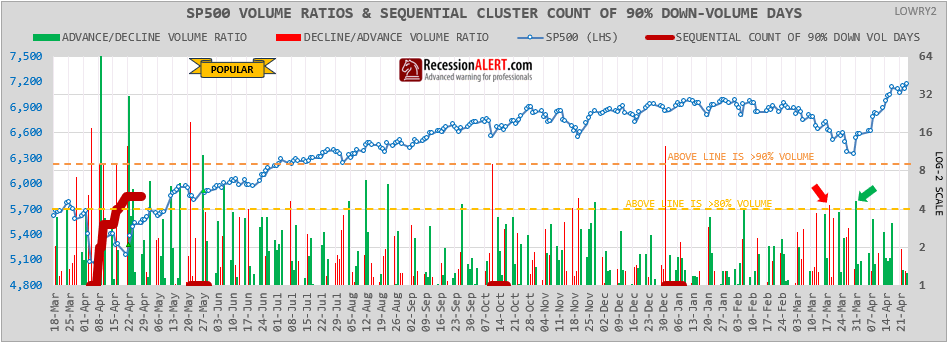
Chart of the Week: Lowry’s breadth study captures the week’s defining tension — the S&P 500 closed at fresh records yet the recent 10% pullback never produced a single 90% down-volume day, and the rebound relied on only an 80/80 buy-the-dip signal (the weakest variety in the Lowry framework). Pair this with the Dow / NYSE Composite both finishing the week red, DJ Transports declining to confirm the DJIA, and breadth narrowing into Friday’s semi-only rip, and the chart underwrites the question that defines next week: are records on this thin a foundation durable through the hyperscaler capex test?
MIB Weekly Digest Ver. 1.28
For professional investors only. Not investment advice.
© 2026 RecessionALERT.com

Comments are closed.