
MARKET INTELLIGENCE BRIEF (MIB)
Thursday, November 5, 2026
AI stocks crashed on fears a Democratic Congress will slow the data-center buildout: the S&P 500 fell 4.36% and the Nasdaq 100 fell 6.36%, the worst day since April 2025. Micron (-17.46%) and AMD (-17.26%) led the Philadelphia Semiconductor index’s 12.25% plunge. The VIX jumped 69% to 28.15; the 2-year yield fell 11.7 bps. Fed hawks held their tightening line even as Polymarket odds of another 2026 hike fell to 64%. Brent rose 4.65% on fresh Hormuz tanker attacks.
TABLE OF CONTENTS
A. EXECUTIVE SUMMARY
B. MARKET DATA
C. HIGH-IMPACT STORIES (5)
D. MODERATE-IMPACT STORIES (6)
E. ECONOMY WATCH (6)
F. EARNINGS WATCH (9)
G. WHAT’S NEXT
H. CHART OF THE DAY
A. EXECUTIVE SUMMARY -> TOP
Thursday turned the Democratic sweep into a policy risk for the market’s earnings engine: the S&P 500 fell 4.36% and the Nasdaq 100 fell 6.36%, the worst session since April 2025 per Reuters, as chipmakers sank on fears that a Democratic Congress will slow the AI data-center buildout. Bonds read the rout as a reason for the Fed to hike less rather than as a growth scare: the 2-year yield fell 11.7 bps, twice the 10-year’s 5.7 bp drop, and Polymarket’s odds of another 2026 hike fell to 64% from 78%, even as claims fell to 189,000, productivity beat and Barkin and Hammack held to a tightening path. Breadth was total but uneven: all 11 sectors fell, with Technology (-7.57%) worst and Consumer Defensive (-0.55%) and Utilities (-0.78%) falling least, while the NYSE Composite fell 2.96%, less than half the Nasdaq 100’s drop, marking a targeted exit from AI leadership rather than a wholesale flight from equities.
• Chip rout puts the Nasdaq in correction: Micron (MU) fell 17.46%, AMD fell 17.26%, Lam Research (LRCX) fell 16.36% and Dell (DELL) fell 14.89% as the Philadelphia Semiconductor index dropped 12.25%. The Nasdaq Composite closed more than 10% below its October 6 record, per Reuters; Technology has lost 12.78% in a week and 17.85% in a month.
• Fear gauge spikes, havens bid: The VIX jumped 69.48% to 28.15, its highest close since at least April 15. The 2-year yield fell 11.7 bps to 4.464%, steepening 2s10s by 6.0 bps to 37.2 bps; gold rose 0.66% to $4,099.80, the dollar index was little changed at 101.60 and Bitcoin fell 5.20% to $76,081.
• Labor and productivity data stay firm: Initial claims fell to 189,000 against a 196,000 forecast, and Q3 productivity rose 3.6% against 2.8% expected as unit labor costs fell 0.7%. Challenger’s 43,994 announced October job cuts were the lowest October total since 2023, though “economic conditions” now leads the reasons.
• Fed hawks unmoved by the selloff: Cleveland’s Hammack said policy “will need to move to a restrictive stance,” preferring “more frequent smaller adjustments”; Richmond’s Barkin said “the path on policy is straightforward, the issue is pace.” Polymarket’s odds of another 2026 hike, which settle at the December 8-9 FOMC, fell to 64% from 78%.
• Political and demand risk hit tech names: Tesla (TSLA) fell 10.77% and SpaceX about 9% as investors priced post-midterm scrutiny of Musk’s companies. Morgan Stanley cut Cisco (CSCO) to Equal Weight on pull-forward demand and the stock fell 7.56%, and the FT reported Microsoft declined a 700 MW expansion option at Nscale’s Texas site.
• Oil rebounds, BoE hikes: Brent rose 4.65% to $99.02 and WTI rose 3.46% to $91.17 as Iran reported three more tankers damaged in the Strait of Hormuz, yet Energy stocks fell 2.61%. The Bank of England raised Bank Rate to 4% in an 8-1 vote, its first increase in three years, citing Middle East energy prices.
1. The election trade flipped from relief to regulation — Wednesday priced the Democratic sweep as good news for health care and bonds; Thursday priced it as a threat to the AI buildout that has carried earnings. Control of both chambers from January removes the obstacle facing measures such as the Sanders-Ocasio-Cortez AI Data Center Moratorium Act, although any law still needs the President’s signature, and Tesla and SpaceX lost the premium they carried for political alignment. Demand doubts arrived on the same day: Morgan Stanley’s pull-forward call on Cisco and Microsoft’s decision to pass on a 700 MW Nscale option both question how durable AI hardware orders are. The one offset came after the close, when Commerce extended the suspension of its Affiliates Rule export controls to January 10, 2027. With Technology down 17.85% in a month, the AI trade was already unwinding before the regulation fear arrived; AI hardware exposure now carries policy risk on top of valuation risk.
2. Markets and the Fed are pricing opposite paths — Traders cut the odds of another 2026 hike to 64% from 78% and drove the 2-year yield down 11.7 bps, while Hammack and Barkin described a tightening path and the Bank of England hiked into an energy shock. The data sided with the hawks on demand, with claims at 189,000 and job cuts low, but productivity gave the market its best counterargument: output rose 3.7% on hours up just 0.1%, and unit labor costs fell 0.7%. If the gap closes on the Fed’s terms, front-end yields reprice higher into an equity market that has just lost its leadership. Friday’s October payrolls, expected at +65,000, and Tuesday’s October CPI, after September’s 3.7% headline, will decide which side gives way.
3. The stress is in AI equities, not in funding or defensives — The haven bid went to Treasuries and gold rather than the dollar, Bitcoin fell 5.20% as a risk asset, and Consumer Defensive (-0.55%) and Utilities (-0.78%) fell least. Credit stayed open: Apple’s roughly $7 billion bond sale drew about $31 billion of orders, and Bloomberg reported investors would accept lower rates than in recent Microsoft, Meta and Oracle sales, borrowers that are funding AI capex programs. That separates a sector repricing from a systemic one, but a VIX near 28 raises hedging costs and tends to force systematic deleveraging, which can spread selling beyond the names that started it.
 — Leading economic indicators. Accurate market forecasts. Apply for membership at join.recessionalert.com
B. MARKET DATA -> TOP
Wall Street had its worst session since April 2025, per Reuters, as chipmakers and AI-infrastructure names sank on fears that Democrats’ capture of Congress, including wins in states where opposition to new data centers has mounted, will bring tougher AI regulation and slow the buildout. The damage was concentrated rather than indiscriminate: the Nasdaq 100 fell more than twice as far as the NYSE Composite, every sector closed lower with Technology leading the way, and the Nasdaq Composite confirmed a correction. The VIX jumped 69% to its highest close since at least April 15 while Treasuries rallied, the 2-year falling 11.7 bps. Crude ran the other way, rebounding more than 3% as fresh tanker attacks in the Strait of Hormuz revived supply worries.
CLOSING PRICES – Thursday, November 5, 2026:
MAJOR INDICES
A concentrated rout: the Nasdaq 100 fell more than twice as far as the NYSE Composite as AI-linked tech carried the losses, while the Dow and the transports fell nearly in step, leaving no Dow Theory split. Over ten sessions the S&P 500 has beaten the Nasdaq 100 by 4.0 points, now in its fourth session, and the Russell 2000 has beaten the S&P by 2.1 points, an entrenched eight-session pattern; both reflect how heavily the damage has landed on mega-cap tech.
| Index | Close | Change | %Move | Why It Moved |
|---|---|---|---|---|
| S&P 500 | 7,353.73 | -334.89 | -4.36% | Worst day since April 2025, per Reuters, as chipmakers sank on fears of tougher AI regulation after Democrats won control of Congress; all 11 sectors fell |
| Dow Jones | 51,523.06 | -1,833.06 | -3.44% | Fell with the broad selloff, giving back all of Wednesday’s post-election gain |
| DJ Transportation | 20,088.97 | -742.01 | -3.56% | Fell with the broad selloff; no transport-specific catalyst identified |
| Nasdaq 100 | 26,629.81 | -1,807.36 | -6.36% | Chipmakers and AI-infrastructure stocks led the rout; the Philadelphia Semiconductor index fell 12.25% and the Nasdaq Composite closed in correction, more than 10% below its Oct 6 record, per Reuters |
| Russell 2000 | 2,729.89 | -127.06 | -4.45% | Fell in line with the S&P 500, reversing Wednesday’s post-election small-cap gain |
| NYSE Composite | 23,955.98 | -730.15 | -2.96% | Fell least of the six indices, with losses concentrated in Technology (-7.57%) |
VOLATILITY & TREASURIES
Options and bonds sent the same message: the VIX jumped 69% while yields fell across the curve, a risk-off signature rather than an inflation scare. The 2-year fell twice as far as the 10-year, steepening 2s10s by 6.0 bps to 37.2 bps in a front-end-led rally. The dollar barely moved, so the haven bid went to Treasuries and gold rather than the greenback.
| Instrument | Level | Change | Why It Moved |
|---|---|---|---|
| VIX | 28.15 | +11.54 (+69.48%) | Highest close since at least April 15; Reuters said the gauge logged its biggest intraday jump in more than 18 months as chip and data-center stocks slid |
| 10-Year Treasury Yield | 4.836% | -5.7 bps | Fell for a second session; Investing.com cited ANZ tying the dip in longer-dated yields to expectations that a Democratic Congress will constrain proposed tax cuts and spending |
| 2-Year Treasury Yield | 4.464% | -11.7 bps | Fell twice as far as the 10-year during the equity rout; no discrete same-day catalyst identified for the front-end move |
| US Dollar Index (DXY) | 101.60 | +0.03 (+0.03%) | Steadied after Wednesday’s slide, per Investing.com |
COMMODITIES
Gold and copper split sharply: gold edged higher as yields fell, while copper dropped alongside the AI selloff. Silver slipped even as gold and platinum rose, breaking from the precious complex. Bitcoin’s 5.20% drop tracked equities, behaving as a risk asset rather than a haven.
| Asset | Price | Change | %Move | Why It Moved |
|---|---|---|---|---|
| Gold | $4,099.80/oz | $+26.80 | +0.66% | Extended Wednesday’s rally as Treasury yields dipped and the dollar steadied, per Investing.com |
| Silver | $51.835/oz | $-0.447 | -0.85% | Slipped as gold rose; no discrete same-day catalyst identified |
| Copper | $6.2045/lb | $-0.2245 | -3.49% | Fell alongside the AI-infrastructure selloff; no discrete same-day catalyst identified |
| Platinum | $1,519.55/oz | $+21.35 | +1.43% | Rose with gold; no discrete same-day catalyst identified |
| Bitcoin | $76,081.0 | $-4,177.0 | -5.20% | Tracked the equity rout as the post-midterm rally faded, per Investing.com |
ENERGY
WTI and Brent rebounded together after Wednesday’s 8%-plus plunge, with Brent outpacing WTI to widen the spread by about $1.35 to $7.85. Henry Hub slipped while Dutch TTF rose. Oil rose while equities fell, and Energy stocks (-2.61%) did not follow crude higher.
| Asset | Price | Change | %Move | Why It Moved |
|---|---|---|---|---|
| Crude Oil (WTI) | $91.17/bbl | $+3.05 | +3.46% | Rebounded as new attacks on tankers fed supply worries, with Iran reporting three more tankers damaged in the Strait of Hormuz; settled $90.52, up $2.40, per Reuters |
| Crude Oil (Brent) | $99.02/bbl | $+4.40 | +4.65% | Same driver as WTI; settled $98.29, up $3.67, per Reuters |
| Natural Gas (Henry Hub) | $2.939/MMBtu | $-0.020 | -0.68% | Thursday’s EIA report showed a 77 Bcf storage build against an 81 Bcf forecast, which does not explain the dip; no discrete same-day catalyst identified |
| Natural Gas (Dutch TTF) | $29.47/MMBtu | $+0.48 | +1.66% | Firmed by the European close; no discrete gas-specific catalyst identified |
S&P 500 SECTORS
All 11 of 11 sectors fell, a full breadth flush with no holdouts; Consumer Defensive (-0.55%) and Utilities (-0.78%) fell least. Technology (-7.57%) has now lost 12.78% in a week and 17.85% in a month, while Energy (-2.61%) fell despite crude’s rebound, extending a -10.08% week.
| Sector | 1-Day | 1-Week | 1-Month | 3-Month | 6-Month | YTD | 12-Month |
|---|---|---|---|---|---|---|---|
| Consumer Defensive | -0.55% | +4.12% | +12.30% | +8.13% | +6.92% | +16.91% | +19.56% |
| Utilities | -0.78% | +0.37% | +4.19% | -1.49% | -5.65% | +0.38% | -2.88% |
| Communication Services | -1.65% | +1.16% | -12.37% | -11.17% | -18.54% | -11.01% | -5.81% |
| Real Estate | -1.68% | +2.50% | +8.12% | -3.07% | -1.01% | +7.70% | +6.40% |
| Basic Materials | -2.17% | -0.73% | -1.38% | -7.20% | -7.07% | +8.20% | +22.10% |
| Energy | -2.61% | -10.08% | -2.98% | +3.61% | +4.27% | +32.88% | +36.32% |
| Financial | -2.67% | +0.52% | +4.08% | -2.60% | +8.83% | +5.74% | +11.76% |
| Healthcare | -2.81% | +0.08% | +8.33% | +7.94% | +21.18% | +14.92% | +20.65% |
| Consumer Cyclical | -3.30% | +1.63% | +3.54% | -3.27% | -4.02% | -3.86% | -5.33% |
| Industrials | -4.87% | -6.15% | -7.23% | -12.45% | -11.19% | +1.54% | +3.14% |
| Technology | -7.57% | -12.78% | -17.85% | -12.17% | -4.44% | +9.59% | +5.86% |
TOP MEGA-CAP MOVERS:
GAINERS
| Company | Ticker | Close | Change | Why It Moved |
|---|---|---|---|---|
| Costco Wholesale | COST | $1,065.59 | +1.83% | Rose after its October sales update, which Investing.com reported showed net sales up 12.6% year on year, alongside a JPMorgan target raise to $1,150; neither was confirmed against the company release or the broker |
| Coca-Cola | KO | $95.73 | -0.07% | Nearly flat as Consumer Defensive (-0.55%) was the session’s strongest sector |
| Procter & Gamble | PG | $167.10 | -0.13% | Nearly flat as Consumer Defensive (-0.55%) was the session’s strongest sector |
| Walmart | WMT | $127.72 | -1.12% | Fell with the market but far less than the S&P 500; Consumer Defensive (-0.55%) was the session’s strongest sector |
| Berkshire Hathaway | BRK-B | $572.33 | -1.17% | No discrete same-day catalyst identified; fell 1.5 points less than the Financial sector (-2.67%) |
DECLINERS
| Company | Ticker | Close | Change | Why It Moved |
|---|---|---|---|---|
| Micron Technology | MU | $656.39 | -17.46% | Led the chip rout on AI-regulation fears after the Democratic sweep; an Investing.com report citing Bloomberg said work on its Taiwan Fab 11E had halted amid a union dispute, which could not be independently confirmed |
| Advanced Micro Devices | AMD | $404.40 | -17.26% | Among the large tech stocks down by double digits, per Reuters, as chipmakers sank on fears of tougher AI regulation after Democrats won Congress |
| Lam Research | LRCX | $185.20 | -16.36% | Chip-equipment maker fell with the semiconductor rout; Investing.com also tied the drop to Qualcomm’s weaker outlook, which Reuters said sent Qualcomm down 9.5% |
| Dell Technologies | DELL | $316.91 | -14.89% | Fell on fears that Democratic wins in states opposed to new data centers could slow the AI buildout, per Reuters; Investing.com’s report of pledged construction pauses by new governors was not independently confirmed |
| Applied Materials | AMAT | $319.25 | -13.58% | Chip-equipment maker fell with the semiconductor rout on fears of tougher AI regulation after the Democratic sweep |
— Institutional-grade intelligence for serious investors. Apply for membership at join.recessionalert.comC. HIGH-IMPACT STORIES -> TOP
BEARISH
1. AI Stocks Crash on Fears a Democratic Congress Will Rein In the Data-Center Buildout; S&P 500 Falls 4.36% and the Nasdaq Composite Enters a Correction
The core facts:The S&P 500 fell 4.36% to 7,353.73 and the Nasdaq 100 6.36% to 26,629.81 in what Reuters called Wall Street’s worst session since April 2025. Reuters put the Philadelphia Semiconductor index down 12.25% and said the Nasdaq Composite closed more than 10% below its October 6 record, confirming a correction. Micron fell 17.46%, AMD 17.26%, Lam Research 16.36%, Dell 14.89% and Applied Materials 13.58%. Technology dropped 7.57% and all 11 S&P 500 sectors closed lower. Reuters tied the selloff to fears that Democrats’ capture of Congress, including wins in states where opposition to new data centers has mounted, will bring tougher AI regulation and slow the AI infrastructure buildout.
Why it matters:Wednesday’s post-election rally priced the sweep as good news for health care and bonds; Thursday’s session priced it as a policy risk to the market’s dominant earnings engine. The threat is not new: Senator Bernie Sanders and Representative Alexandria Ocasio-Cortez introduced an AI Data Center Moratorium Act on March 25, a bill one outlet said faced “an uphill battle” in a Republican-controlled Congress. That obstacle goes when Democrats take both chambers in January, although any such law would still need the President’s signature. The damage was concentrated rather than general: the NYSE Composite fell 2.96%, less than half the Nasdaq 100’s drop, and Consumer Defensive (-0.55%) and Utilities (-0.78%) held up best. Technology has now lost 12.78% in a week and 17.85% in a month, so the AI trade was already unwinding before the regulation fear arrived.
What to watch:Cisco and Applied Materials report after the close on Thursday, November 12, the first read on AI hardware demand since the rout; any statement on data-center permitting from incoming Democratic committee chairs.
BEARISH
2. VIX Jumps 69% to 28.15, Its Highest Close Since at Least April 15, as Treasuries Rally and the 2-Year Yield Falls 11.7 bps
The core facts:The VIX closed at 28.15, up 11.54 points or 69.48%, its highest close since at least April 15; Reuters said the gauge logged its biggest intraday jump in more than 18 months as chip and data-center stocks slid. Treasuries rallied across the curve: the 2-year yield fell 11.7 bps to 4.464% and the 10-year 5.7 bps to 4.836%, its second straight decline, steepening the 2s10s curve by 6.0 bps to 37.2 bps. Gold rose 0.66% to $4,099.80 an ounce, the dollar index was little changed at 101.60 (+0.03%), and Bitcoin fell 5.20% to $76,081.
Why it matters:A front-end-led rally on a day of strong labor data is a repricing of Fed risk, not of growth: the 2-year fell twice as far as the 10-year, consistent with the drop in prediction-market odds of a December hike covered in Economy Watch. Investing.com cited ANZ tying the dip in longer-dated yields to expectations that a Democratic Congress will constrain proposed tax cuts and spending, a second, fiscal channel through which the election reaches the bond market. The haven bid went to Treasuries and gold rather than the dollar, and Bitcoin traded as a risk asset. A VIX near 28 raises hedging costs and tends to force systematic deleveraging, which can extend selling beyond the names that started it.
What to watch:Friday’s October payrolls at 8:30 AM ET, expected at +65,000; a firm print would test how much of the 2-year’s 11.7 bp rally survives.
BEARISH
3. Fed Hawks Hold Their Line Through the Rout: Barkin Says the Path to Higher Rates Is “Straightforward” as Hammack Calls for a Restrictive Stance
The core facts:Richmond Fed President Tom Barkin, interviewed on CNBC at the Richmond Fed’s CFO Summit, said “the path on policy is straightforward, the issue is pace,” that a gradual pace “makes sense,” and that policy is “somewhere around neutral,” according to investingLive’s summary of his remarks. He added that “AI is a big part of current strong demand.” Earlier, Cleveland Fed President Beth Hammack, a 2026 voter, said policy “will need to move to a restrictive stance” and that she prefers getting there through “more frequent smaller adjustments” (her remarks are covered in Economy Watch).
Why it matters:The market and the Fed moved in opposite directions on the same day. Two regional presidents described a tightening path while traders cut hike bets and drove the 2-year yield down 11.7 bps. If the gap closes on the Fed’s terms, front-end yields reprice higher into an equity market that has just lost its leadership. Barkin’s remark that AI is a big part of current demand cuts both ways: the same AI spending he sees supporting the economy is what investors sold, so a sustained AI pullback would ease the demand pressure the hawks are leaning against. Hammack’s preference for smaller, more frequent moves also signals that a December hike need not be the last.
What to watch:Dallas Fed President Lorie Logan, a 2026 voter, speaks at 7:00 PM ET tonight; Williams, Musalem and Bowman follow on Friday, ahead of the December 8-9 FOMC.
UNCERTAIN
4. Crude Rebounds as Iran Reports More Tankers Damaged in the Strait of Hormuz; Brent Rises 4.65% to $99.02
The core facts:WTI closed at $91.17, up 3.46%, and Brent at $99.02, up 4.65%, recovering part of Wednesday’s 8%-plus plunge. Reuters tied the rebound to new attacks on tankers, with Iran reporting three more tankers damaged in the Strait of Hormuz on Thursday; Arab News, citing AFP, tallied Iranian statements describing five tankers and a tugboat on fire in and around the strait, which no maritime authority had confirmed. Separately, the UK Maritime Trade Operations agency reported a tanker struck by two unidentified projectiles about 50 nautical miles north of Madinat ash Shamal, Qatar. A senior Iranian official told Reuters that Tehran had sent Washington a nuclear proposal via Qatar.
Why it matters:Wednesday’s selloff priced an earlier end to the Iran war after the Democratic sweep; Thursday’s incidents showed the physical risk to Gulf shipping has not gone away while diplomacy is pending. With Brent back near $99, energy remains a live input to inflation at the moment Fed officials are arguing for a restrictive stance, and the Bank of England cited Middle East energy prices in raising rates the same day. Energy equities did not follow crude higher, falling 2.61%, which suggests investors are treating the rebound as noise inside a downtrend rather than a new leg up.
What to watch:Whether Brent reclaims $100, and any US response to Iran’s proposal via Qatar; OPEC+ meets on November 29.
BEARISH
5. Tesla Falls 10.77% and SpaceX About 9% as Investors Price Political Risk Into Musk’s Companies After the Midterms
The core facts:Tesla fell 10.77% and SpaceX about 9%, extending their post-midterm losses. Reuters said investors worried that Democratic wins could slow data-center build-outs, an area SpaceX has leaned into, and bring tougher scrutiny of Musk’s businesses; Democrats won Texas’s Senate, governor and attorney-general races, and Musk spent nearly half a billion dollars backing Republicans. The slide comes two weeks after Musk said on October 21 that the two companies had formed special committees to explore a merger, with no terms, valuation or timeline agreed.
Why it matters:Musk’s companies carried a premium for political alignment with the governing party, and the sweep removes it at the congressional level. Oversight hearings, regulatory scrutiny and state-level resistance to data centers all bear on the AI ambitions that underpin both valuations. A Tesla-SpaceX combination, which needs a majority Tesla shareholder vote by Musk’s own account, now has to be argued against a weaker share price and a less friendly Congress.
What to watch:Any update from the Tesla and SpaceX special committees on the merger, and early committee assignments in the new Congress that bear on autos, space and AI.
— Quantifying recession risk so you don’t have to guess. Apply for membership at join.recessionalert.comD. MODERATE-IMPACT STORIES -> TOP
BEARISH
6. Morgan Stanley Downgrades Cisco to Equal Weight a Week Before Earnings, Citing Pull-Forward Demand; Shares Fall 7.56%
The core facts:Morgan Stanley cut Cisco to Equal Weight from Overweight with a $120 price target before Thursday’s open. CNBC quoted the note as “cautious of degree of pull forward ahead of pricing increases and margin profile of cloud business.” Cisco fell 7.56% to $95.78. The company reports fiscal first-quarter results after the close on November 12, against its own guidance of $1.32 to $1.34 in adjusted EPS.
Why it matters:The call goes to the quality of AI-era networking demand rather than its size: if customers ordered ahead of announced price increases, recent order strength overstates the run-rate and the next quarters absorb the payback. Landing on the day AI hardware sold off broadly, the downgrade removed one of the few large-cap tech names that had been seen as a lower-risk way to own the buildout.
What to watch:Cisco’s November 12 order growth and gross-margin guidance, and any comment on demand pulled ahead of price increases.
UNCERTAIN
7. Bank of England Raises Rates to 4%, Its First Increase in Three Years, With One Member Voting for a Half-Point Move
The core facts:The Bank of England’s Monetary Policy Committee voted 8-1 to raise Bank Rate by 0.25 percentage points to 4%; Catherine Mann voted for a 0.5-point rise to 4.25%. UK CPI inflation was 3.5% in September and the Bank projects it rising to around 5% by the middle of 2027. The summary said global energy prices “have continued to rise from an already elevated level,” with Brent averaging $108 a barrel over the period, 38% above the July Report, as the Middle East conflict runs into its ninth month. The Committee said policy “is not on a pre-set path”; Megan Greene said “additional hikes will likely be required,” while Alan Taylor cautioned “this is not the start of a hiking cycle.”
Why it matters:A G7 central bank tightening in response to an energy shock reinforces the case Fed hawks are making in the US, and narrows the room for markets to price an early end to tightening. The split within the Committee, from a half-point vote to an explicit warning against reading a cycle into one move, mirrors the uncertainty in US pricing. For US investors, the transmission runs through global term premia and the dollar’s cross-rates against sterling.
What to watch:UK October CPI, and whether gilt-led moves in global yields offset Thursday’s rally in US Treasuries.
BULLISH
8. Apple Launches a Seven-Part Bond Sale of About $7 Billion, Its First Since May 2025, Drawing Roughly $31 Billion of Orders
The core facts:Apple filed a prospectus with the SEC for a seven-series bond offering with maturities from 2028 to 2036. Bloomberg reported that it is targeting about $7 billion and drew about $31 billion of orders, and that investors would accept lower interest rates than in recent Microsoft, Meta and Oracle sales. Proceeds are for general corporate purposes, which may include buybacks, dividends, acquisitions and debt repayment; the filing does not mention AI. Apple’s last bond sale, in May 2025, raised $4.5 billion on about $10 billion of orders.
Why it matters:Investment-grade demand for top-tier tech credit held up on the worst equity session since April 2025, so the funding channel for the largest companies remains open even as their shares sell off. Apple joins a heavy run of tech issuance: Microsoft sold $25 billion the prior week, its first bond since 2017, Meta raised $15 billion in the US and about €9 billion in Europe, and Alphabet sold €6 billion this week. Unlike those borrowers, Apple is not funding an AI capex program, and the tighter pricing investors accepted reflects that difference.
What to watch:Final size and coupons in Apple’s pricing filing, and whether spreads on recent AI-linked tech issues widen relative to Apple’s.
BEARISH
9. Microsoft Declined an Option on a 700 MW Expansion at Nscale’s Texas Site, the FT Reports
The core facts:Microsoft declined an option on a second, 700-megawatt phase at Nscale’s Barstow, Texas data-center site that would have been available from late 2027, the Financial Times reported, citing people familiar with the matter. The FT said the extra capacity could have been worth “tens of billions of dollars” to Nscale, and that Microsoft decided months before Nscale filed for its New York IPO in September. The existing contract, under which Nscale is due to deliver about 104,000 Nvidia GB300 chips to Microsoft at the site, stays in place. Nscale is asking investors to value it at up to $35 billion. Neither company commented.
Why it matters:The report shows the largest buyer of AI capacity being selective about new commitments, the second Nscale arrangement Microsoft has stepped back from after it pulled out of a separate Essex deal in October. It lands on the same day investors sold AI infrastructure on regulatory fears, and it bears directly on the neocloud model, whose valuations rest on hyperscaler expansion options being exercised.
What to watch:Pricing and demand for Nscale’s IPO, and any change to capex guidance from Microsoft or other hyperscalers.
BULLISH
10. Amazon and Uber Launch $0 Uber Eats Delivery for Prime Members
The core facts:Amazon and Uber announced on Thursday that US Prime members get a $0 delivery fee on Uber Eats restaurant orders of $25 or more placed through Amazon, in nearly ten thousand cities and towns. New users get $20 off each of their first two qualifying orders within 14 days, and Prime Visa cardmembers earn 5% back on Uber Eats orders through December 5, 2026. Amazon’s release gives no financial terms. “Prime’s new Uber Eats membership benefit makes getting dinner delivered even easier,” said Jamil Ghani, Amazon’s vice president of Prime.
Why it matters:The deal puts Uber Eats in front of Amazon’s Prime base inside Amazon’s own app, a distribution advantage in a market where delivery platforms compete on fees. Amazon’s 2022 Prime perk with Grubhub hit rival delivery stocks on announcement, and this one raises the same competitive question for DoorDash. For Amazon, it adds a recurring-use benefit to Prime without building a delivery network.
What to watch:Uber’s commentary on Prime-driven order volume, and any response from DoorDash on membership pricing.
BULLISH
11. Commerce Extends the Suspension of Its “Affiliates Rule” Export Controls to January 10, 2027, Days Before It Was Due to Lapse
The core facts:The Commerce Department’s Bureau of Industry and Security filed a final rule extending its suspension of the “Expansion of End-User Controls to Cover Affiliates of Certain Listed Entities” rule, known as the Affiliates Rule. The suspension “was set to end November 9, 2026”; the rule extends it “through January 10, 2027,” effective November 9. The filing was made public on Thursday afternoon after the cash close and is scheduled for publication in the Federal Register on November 9. It states no reason for the extension.
Why it matters:The Affiliates Rule would extend export restrictions on listed entities to companies they own, widening the set of Chinese customers that US chip-equipment and semiconductor makers could not serve without a license. Letting it lapse on November 9 would have reimposed that exposure on the sector that fell hardest on Thursday. The new end date matches the January 10, 2027 date to which the US-China trade truce was extended in September, so the rule now moves with the broader truce rather than on its own clock.
What to watch:US-China talks ahead of the January 10, 2027 deadline, and China-revenue commentary in Applied Materials’ November 12 results.
— Separating signal from noise since 2007. Apply for membership at join.recessionalert.comE. ECONOMY WATCH -> TOP
Thursday’s data told a supply-side story the Fed’s hawks are not yet buying. Third-quarter productivity jumped 3.6% against a 2.8% forecast and unit labor costs fell 0.7%, while initial claims dropped to 189,000 and announced layoffs were the lowest for any October since 2023: firm employment, cheaper labor per unit of output. Cleveland’s Beth Hammack, a 2026 voter, still said policy “will need to move to a restrictive stance,” citing headline PCE inflation at 3.6%. Prediction markets leaned the other way, cutting the odds of another 2026 hike to 64% from 78% as the S&P 500 fell 4.36%. Friday’s October payrolls and Tuesday’s October CPI will test which reading holds.
Q3 Productivity Jumps 3.6%, Beating 2.8% Forecast, as Unit Labor Costs Fall 0.7% (BLS, Nov 5)
What they’re saying:Nonfarm business labor productivity rose at a 3.6% annual rate in the third quarter, ahead of the 2.8% consensus, as output grew 3.7% while hours worked rose just 0.1%. Unit labor costs fell 0.7%, with hourly compensation up 2.9%. Second-quarter productivity was revised up to 2.1% from 1.4%.
The context:Output growing faster than hours is the disinflationary mix the Fed wants: firms produced more without paying more per unit of output. Year over year, productivity is up 2.1% and unit labor costs 2.4%, well below the 4.5% rise in hourly compensation. Two caveats temper the read: second-quarter unit labor costs were revised up to 1.9% from 1.2%, and manufacturing productivity rose only 0.3% in the quarter.
What to watch:Average hourly earnings in Friday’s October jobs report (8:30 AM ET), expected at 0.3% month on month and 2.9% year on year, then October CPI on Tuesday, November 10.
Initial Jobless Claims Fall to 189,000, Below the 196,000 Forecast (Labor Department, Nov 5)
What they’re saying:Seasonally adjusted initial claims fell 6,000 to 189,000 in the week ending October 31, against a 196,000 consensus; the prior week was revised up to 195,000. The four-week average fell 2,250 to 194,750. Continuing claims rose 23,000 to 1,718,000 in the week ending October 24, with the insured unemployment rate unchanged at 1.1%.
The context:Layoffs remain scarce, with the four-week average below 200,000, consistent with the low October job-cut count reported by Challenger the same morning. The rise in continuing claims points to slower re-employment rather than more dismissals. Treasury yields fell across the curve on the day regardless, the 2-year down 11.7 bps to 4.464%, as equities sold off.
What to watch:Friday’s October nonfarm payrolls, expected at +65,000 after +29,000, with unemployment expected at 4.2%; next weekly claims on Thursday, November 12.
October Job Cuts Lowest for the Month Since 2023, but “Economic Conditions” Now Leads the Reasons (Challenger, Gray & Christmas, Nov 5)
What they’re saying:US employers announced 43,994 job cuts in October, up 2% from September’s 43,281 but down 71% from 153,074 a year earlier, the lowest October total since 2023. Year-to-date cuts of 617,189 are down 44%. Hiring plans reached 444,692, the highest October total since at least 2009, led by Amazon’s 300,000 seasonal hires.
The context:The mix is shifting even as the level stays low. Market/economic conditions led all reasons for a second month, cited for 16,407 cuts (37%), and has overtaken AI as the top reason for 2026; demand downturn has been cited for 21,347 cuts this year, up 145%. “That is a more cautious signal, though the overall pace of cutting remains low,” said Andy Challenger. Microsoft’s voluntary exit offers to 60,000 employees are not counted; Challenger said such offers “tend to signal more layoffs to come.”
What to watch:Friday’s October payrolls, for whether hiring that is “largely short-term, seasonal work” shows up in the headline count.
Fed’s Hammack: Policy “Will Need to Move to a Restrictive Stance” as Inflation Moves “in the Wrong Direction” (Cleveland Fed, Nov 5)
What they’re saying:Speaking in Zurich, Cleveland Fed President Beth Hammack, a 2026 FOMC voter, said “inflation has moved in the wrong direction,” citing September headline PCE inflation of 3.6% and core of 3.1%. “I expect that monetary policy will need to move to a restrictive stance to bring inflation back to 2 percent in a timely manner,” she said, adding that she prefers “getting to that stance through more frequent smaller adjustments when possible.”
The context:Hammack described the pressures as “relatively broad based, reflecting both supply and demand,” and noted inflation has been above goal “for nearly six years.” Her preference for smaller, more frequent moves, she said, would “reduce the risk of having policy fall behind.” Richmond Fed President Tom Barkin also spoke Thursday, and Dallas Fed President Lorie Logan is scheduled at 7:00 PM ET.
What to watch:Friday remarks from the New York Fed’s John Williams (4:30 AM ET), St. Louis’s Alberto Musalem (9:10 AM) and Governor Michelle Bowman (12:15 PM), then Chicago’s Austan Goolsbee on Monday at 10:00 AM.
Odds of Another 2026 Fed Hike Fall to 64% From 78% (Polymarket, Nov 5)
What they’re saying:Polymarket’s “Another Fed rate hike in 2026?” market, which settles at the December 8-9 FOMC meeting, priced a hike at 64%, down 14 points from 78% a session earlier. Odds of at least one rate cut in 2026 rose to 3% from 2%, and odds of a recession by the end of 2026 eased to 5% from 6%.
The context:The repricing came on a risk-off day rather than on softer data: claims and productivity both beat forecasts. The 2-year Treasury yield fell 11.7 bps to 4.464%, twice the 10-year’s 5.7 bp decline, as the S&P 500 fell 4.36% and the VIX jumped to 28.15. A hike remains the majority outcome, and the same day Hammack argued for moving policy to a restrictive stance.
What to watch:October CPI on Tuesday, November 10 (8:30 AM ET), after September’s 3.7% year-on-year headline rate.
30-Year Mortgage Rate Eases to 7.18% From 7.24% (Freddie Mac, Nov 5)
What they’re saying:The 30-year fixed rate in Freddie Mac’s weekly survey averaged 7.18%, down from 7.24% a week earlier; the 15-year fell to 6.57% from 6.60%. Freddie Mac said rates “continued their downward trajectory this week.”
The context:The relief is marginal against the year-ago level: the 30-year averaged 6.22% and the 15-year 5.50% at this point in 2025, so affordability remains strained. The MBA’s 30-year contract rate showed a similar small easing in its latest week, to 7.30% from 7.37%.
What to watch:The MBA 30-year mortgage rate on Wednesday, November 11, and October existing home sales on Thursday, November 12, after a 3.99 million annual pace.
— Know the probability before the market prices in the risk. Apply for membership at join.recessionalert.comF. EARNINGS WATCH -> TOP
YESTERDAY AFTER THE BELL (Markets Reacted Today)
UNCERTAIN
12. Qualcomm (QCOM): -9.49% | Revenue Beat and a $5 Billion Data-Center Target Outweighed by Margin Pressure and a Soft Outlook
The Numbers:Released: AMC, Wednesday, November 4. Fiscal fourth-quarter non-GAAP revenue of $10.44 billion vs $10.12 billion expected; non-GAAP EPS of $2.17, one cent above consensus. Gross margin contracted 160 bps sequentially to 52.4%, per Rosenblatt. Benzinga reported first-quarter GAAP EPS guidance below estimates. Qualcomm set a data-center revenue target of $5 billion for fiscal 2027 and $15 billion for fiscal 2029.
The Problem/Win:Cost pressure and handset headwinds offset a data-center business that JPMorgan said exited fiscal 2026 at an annualized run rate of about $8 billion, against expectations near $7 billion. Rosenblatt cut its fiscal 2027 EPS estimate to $9.54 from $10.42 and its target to $205 from $235; JPMorgan cut its target to $200 from $215, flagging “elevated margin pressure and the potential for a more pronounced handset slowdown.”
The Ripple:The weaker outlook added to pressure on chip stocks on a day the Philadelphia Semiconductor index fell 12.25%, per Reuters; Investing.com tied part of Lam Research’s 16.36% drop to it.
What It Means:Qualcomm’s diversification story is real but supply-constrained, and Rosenblatt described the data-center target as “customer-derived,” with two hyperscalers including AWS underpinning most of it. Until handset margins stabilize, the core business sets the multiple.
What to watch:Data-center revenue progress against the $5 billion fiscal 2027 target, and memory-driven handset build cuts.
BULLISH
13. McKesson (MCK): +0.24% | Beat and Raised Full-Year Outlook Holds Wednesday’s Gain
The Numbers:Released: 3:10 PM ET, Wednesday, November 4, before the close. Fiscal second-quarter adjusted EPS of $11.68 vs $10.72 expected; revenue of $110.96 billion vs $109.90 billion. Full-year adjusted EPS guidance raised. Shares rose 6.98% in Wednesday’s regular session and added 0.24% on Thursday.
The Problem/Win:A 9% EPS beat on a 1% revenue beat shows margin leverage in the distribution model. Segment detail and the new guidance range could not be confirmed from available coverage.
The Ripple:Held its gain while Healthcare fell 2.81%, a relative-strength signal for defensive health-care distribution in a risk-off session.
What It Means:Drug distribution remains one of the steadiest compounders in large-cap health care, and the market’s reaction was already priced in Wednesday’s session.
BULLISH
14. AppLovin (APP): +31.04% | Record Quarter and a Fourth-Quarter Guide Above Consensus Defy the Tech Rout
The Numbers:Released: AMC, Wednesday, November 4. Third-quarter revenue of $2,185 million, up 55% year on year, vs $2.07 billion expected; diluted EPS of $4.30 vs $4.03. Net income rose 72% to $1.44 billion and adjusted EBITDA 59% to $1.84 billion, an 84% margin. Fourth-quarter guidance: revenue of $2,365 million to $2,395 million and adjusted EBITDA of $1,995 million to $2,025 million. Included at a $119.17 billion market cap on Thursday’s calendar, up from about $91 billion before the report.
The Problem/Win:The fourth-quarter revenue range sits above the roughly $2.31 billion consensus that one aggregator listed before the report, and the board raised the buyback authorization by $3.2 billion to $3.6 billion. The company repurchased and withheld 4.1 million shares for $1.4 billion in the quarter.
The Ripple:Analysts lifted targets, including BTIG to $450 from $396 and Wedbush to $600 from $560. The 31% gain came on a day the Nasdaq 100 fell 6.36%.
What It Means:Software that monetizes AI through advertising, rather than spending on AI infrastructure, was rewarded on the day infrastructure was punished, a distinction investors are now drawing sharply.
What to watch:Whether AppLovin holds above $100 billion in market value as the AI selloff plays out.
TODAY BEFORE THE BELL (Markets Already Reacted)
UNCERTAIN
15. ConocoPhillips (COP): -1.08% | Beat on Higher Realized Prices, but Middle East Disruption Cuts Output Year on Year
The Numbers:Released: BMO, Thursday, November 5. Adjusted EPS of $3.27 vs $3.05 expected; revenue of $20.06 billion vs $18.59 billion. Production of about 2,302 thousand barrels of oil equivalent per day, inside the 2.29 to 2.32 million range guided before the quarter and about 97,000 below a year earlier. Realized price of $61.40 per barrel of oil equivalent vs $46.44 a year earlier.
The Problem/Win:Lower 48 output reached 1,517 thousand barrels of oil equivalent per day, but that growth was more than offset by the Middle East conflict’s effects on Qatar and higher Surmont royalties. Operating cash flow of $7.2 billion funded $3.1 billion of capital spending, $2.4 billion of buybacks and $1.0 billion of ordinary dividends.
The Ripple:Fell less than the Energy sector’s 2.61% even as crude rebounded.
What It Means:The quarter shows how much of the war’s price windfall is offset by lost Gulf volumes for diversified producers; shareholder returns remain well covered by cash flow.
BULLISH
16. Parker-Hannifin (PH): -1.97% | Record Quarter, 11.5% Organic Growth and Higher Full-Year Guidance
The Numbers:Released: BMO, Thursday, November 5. Fiscal first-quarter sales of $5.99 billion, up 18% with 11.5% organic growth, vs $5.81 billion expected; adjusted EPS of $8.90, a record and up 23%, vs $8.21. Adjusted segment operating margin of 28.6%, up 120 bps. Record backlog of $13.7 billion. Fiscal 2027 adjusted EPS guidance of $36.45 to $37.25, now including the Filtration Group acquisition, above the $34.25 to $35.25 range cited in pre-report previews.
The Problem/Win:Every segment grew organically: Aerospace Systems 13.9% with a 30.7% adjusted margin, International 11.6% with Asia-Pacific up 23%, and North America 9.4%. Rolling 12-month orders rose 13%.
The Ripple:Fell less than the Industrials sector’s 4.87% decline.
What It Means:Broad industrial and aerospace demand is accelerating rather than fading, a counterweight to the growth fears in the AI complex.
BULLISH
17. Southern Company (SO): +0.24% | Adjusted EPS of $1.94 Beats Comfortably on Weather and Usage
The Numbers:Released: BMO, Thursday, November 5. Adjusted EPS of $1.94 vs $1.71 expected and $1.60 a year earlier; reported EPS of $1.77. Revenue of $8.84 billion vs $8.38 billion, up 13%.
The Problem/Win:The company attributed the gain to warmer weather, increased usage, customer growth and higher commercial and industrial revenue. Updated data-center load and full-year guidance could not be confirmed from available coverage.
The Ripple:One of two utilities in this section to close higher while Utilities fell 0.78%.
What It Means:Regulated utilities with data-center load exposure held up on a day AI infrastructure sold off, suggesting investors still see their growth as contracted rather than speculative.
What to watch:Any shift in Georgia data-center permitting after the elections, and updates to Southern’s large-load contract pipeline.
BULLISH
18. Duke Energy (DUK): +0.38% | Beat and Lifts the Bottom of Its 2026 Guidance Range
The Numbers:Released: BMO, Thursday, November 5. Reported and adjusted EPS of $1.99 vs $1.86 expected and $1.81 a year earlier; revenue of $9.10 billion vs $8.91 billion. 2026 adjusted EPS guidance narrowed to $6.70 to $6.80 from $6.55 to $6.80, with management pointing toward the top end.
The Problem/Win:Recovery of infrastructure investment in growing jurisdictions and favorable weather, partly offset by higher depreciation, interest expense and tax rate. Duke reiterated plans to add 16 gigawatts of capacity by 2031.
The Ripple:Rose while Utilities fell 0.78%.
What It Means:A visible, regulated earnings path is being rewarded in a volatile market; the open question is the pace of signed data-center agreements, which had slowed at midyear.
BULLISH
19. Canadian Natural Resources (CNQ): -1.45% | Record Thermal and Conventional Liquids Output Drive an EPS Beat
The Numbers:Released: BMO, Thursday, November 5. EPS of $1.18 vs $1.04 expected; revenue of $8.80 billion vs $8.79 billion. Adjusted net earnings of C$3.4 billion, or C$1.67 a share. Total production of 1,651,720 barrels of oil equivalent per day vs 1,620,261 a year earlier, including a planned turnaround at Horizon.
The Problem/Win:Thermal in situ output reached a record of about 300,000 barrels a day and conventional E&P liquids a record of about 358,000. Realized crude and NGL prices of C$95.93 a barrel were 9% below the second quarter. Since the turnaround ended, oil sands mining has averaged about 640,000 barrels a day.
The Ripple:Fell less than the Energy sector’s 2.61% decline.
What It Means:Long-life Canadian supply outside the Gulf is gaining volume while Middle East output is disrupted, which supports the company’s low-decline growth case.
TODAY AFTER THE BELL (Markets React Tomorrow)
UNCERTAIN
20. Airbnb (ABNB): AH: pending | Third-Quarter Results After the Close Against a $4.75 Billion Revenue Estimate
The Numbers:Released: AMC, Thursday, November 5, with a 5:00 PM ET webcast. Consensus EPS of $2.85 and revenue of $4.75 billion; Airbnb guided in August to third-quarter revenue of $4.69 billion to $4.77 billion. Results and the after-hours reaction were not available when this report was compiled.
The Problem/Win:In the second quarter Airbnb raised its outlook to at least mid-teens revenue growth, with revenue up 17% to $3.6 billion; the test is whether that pace held through peak summer travel.
The Ripple:Read-through for Booking Holdings and Expedia on consumer travel demand.
What It Means:A clean print would show consumer travel demand intact despite $4-plus gasoline and an equity drawdown.
What to watch:Fourth-quarter revenue guidance against the roughly $3.17 billion analyst estimate, and nights-and-experiences booked growth.
WEEK AHEAD PREVIEW:
Q3 2026 earnings season is past its midpoint (60% of the S&P 500 reported as of October 30), and AI hardware takes the spotlight again next Thursday after Thursday’s semiconductor rout.
Enbridge (ENB) — BMO, Friday, November 6 — consensus EPS $0.34; key focus: Mainline throughput, gas-transmission demand from power generation, and leverage against the dividend.
Brookfield Corporation (BN) — BMO, Thursday, November 12 — consensus EPS $0.69 ($102.40 billion market cap, just above the line); key focus: distributable earnings growth against its 15-20% long-term target and progress on combining with its insurance business.
Cisco Systems (CSCO) — AMC, Thursday, November 12 — consensus EPS $1.32, against company guidance of $1.32 to $1.34; key focus: whether orders were pulled forward ahead of price increases, as Morgan Stanley warned in Thursday’s downgrade, and cloud-business margins.
Applied Materials (AMAT) — AMC, Thursday, November 12 — -13.58% today; consensus EPS $4.06 and about $10.3 billion of revenue per one preview; key focus: China’s share of sales (28% last quarter) and export-control exposure, and whether equipment orders hold after Thursday’s chip selloff.
No name above $100 billion reports Monday, November 9 through Wednesday, November 11. Moderna (Friday, November 6, BMO) now sits at $96.40 billion, below the line.
— US market commentary trusted by family offices and institutions. Apply for membership at join.recessionalert.comG. WHAT’S NEXT -> TOP
UPCOMING RELEASES:
| Date | Event | Why It Matters |
|---|---|---|
| Fri, Nov 6 | October Nonfarm Payrolls (expected +65K, prior +29K); Unemployment Rate (expected 4.2%); Average Hourly Earnings (expected 0.3% MoM, 2.9% YoY), 8:30 AM ET | The first test of Thursday’s repricing: a firm print would challenge how much of the 2-year yield’s 11.7 bp rally survives, with Polymarket’s odds of another 2026 hike already cut to 64% from 78%. Wages matter as much as jobs after Q3 unit labor costs fell 0.7%. |
| Fri, Nov 6 | Fed speakers: Williams (4:30 AM ET), Musalem (9:10 AM ET), Bowman (12:15 PM ET) | Shows whether Williams, Musalem and Bowman echo Hammack’s call for a restrictive stance after the worst equity session since April 2025, following Logan’s remarks at 7:00 PM ET tonight. |
| Fri, Nov 6 | University of Michigan Consumer Sentiment, Prel. November (expected 48, prior 48.0), 10:00 AM ET | A read on household mood after the midterms and the equity rout; the inflation expectations within it bear directly on the hawks’ case. |
| Mon, Nov 9 | Fed Goolsbee speech, 10:00 AM ET; Atlanta Fed GDPNow Q4 update (prior 3.4%), 11:00 AM ET | The first Q4 tracking update since Friday’s jobs report, a check on whether growth is holding up as the AI capex trade unwinds. |
| Tue, Nov 10 | October CPI (prior 3.7% YoY, 0.6% MoM; core prior 2.6% YoY, 0.3% MoM), 8:30 AM ET | A key inflation read ahead of the December 8-9 FOMC. With Brent back near $99, a firm headline would strengthen Hammack’s restrictive-stance argument against the market’s lower hike odds. |
| Tue, Nov 10 | EIA Short-Term Energy Outlook, 12:00 PM ET | Updates the official oil price path while Iran reports further tanker damage in the Strait of Hormuz and Brent has rebounded 4.65% in a session. |
| Wed, Nov 11 | Monthly Budget Statement, October (prior -$27B), 2:00 PM ET | Relevant to the fiscal channel ANZ cited for Thursday’s dip in longer-dated yields: expectations that a Democratic Congress will constrain proposed tax cuts and spending. |
| Thu, Nov 12 | Initial Jobless Claims (w/e Nov 7), 8:30 AM ET; Existing Home Sales, October (prior 3.99M), 10:00 AM ET | Claims at 189,000 show layoffs remain scarce; home sales test whether the 30-year mortgage rate’s easing to 7.18% is enough to lift demand. |
KEY QUESTIONS:
1. Will Friday’s payrolls and Tuesday’s CPI close the gap between a Fed whose hawks want a restrictive stance and a market that cut its odds of another 2026 hike to 64% in a single session?
2. Is the AI selloff a lasting repricing of policy risk under a Democratic Congress, whose legislation would still need the President’s signature, or a flush in a Technology sector now down 17.85% in a month?
3. With Brent near $99 and the Bank of England hiking into an energy shock, can US inflation, which Hammack says has moved “in the wrong direction,” turn back toward target while Hormuz shipping risk persists alongside Iran’s nuclear proposal via Qatar?
— US market commentary trusted by family offices and institutions. Apply for membership at join.recessionalert.comH. CHART OF THE DAY -> TOP
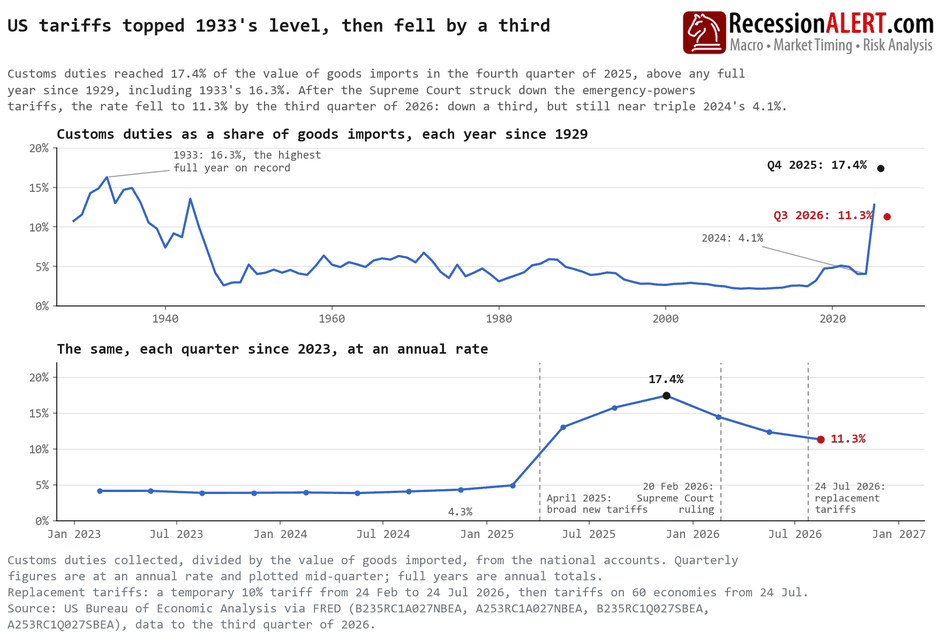
The tariff rate did not drift down after the Supreme Court ruling; it was rebuilt smaller, twice. After the court struck down the emergency-powers tariffs on 20 February, a temporary flat 10% replaced them. From 24 July came duties of 10% or 12.5% on 60 economies, excluding goods already under the national-security tariffs on steel, cars and timber, so the two do not stack. The measured rate followed. Duties came to 17.4% of goods imports in late 2025, one quarter at an annual rate but above any full year since 1929, and to 11.3% by the third quarter. So the Democrats’ promised rollback starts from 11%, not 17%, and from a rate still close to triple 2024’s. What remains rests on existing law and needs no vote, so repeal takes a bill facing a veto the projected majorities lack the seats to override. A ruling could arrive first: the trade court heard the challenge to the 24 July tariffs on 30 September and has yet to decide. The smaller structure still raises about $275bn a year, roughly 8% of federal tax receipts and near a seventh of the $1.99tn fiscal 2026 deficit. Unless spending or other taxes moved, whatever goes would have to be borrowed, by a Treasury that has just pledged to hold its auction sizes steady. The court knocked the wall down; the administration chose how much of it to rebuild.
What it means: For households, the new Congress cannot lower the tariff on imported goods on its own; relief needs the courts or the president’s signature. For stock investors, the date to watch is the trade court’s ruling on the July tariffs, not the first rollback vote. For the economy, the tariffs raise about $275bn a year; losing them without spending cuts means more borrowing, at auction sizes Treasury has pledged to hold. This reading changes if the court strikes down the July tariffs, or if Treasury raises its auction sizes in February.
Market Intelligence Brief (MIB) Ver. 20.03
For professional investors only. Not investment advice.
© 2026 RecessionALERT.com

Comments are closed.