
MARKET INTELLIGENCE BRIEF (MIB)
Monday, August 24, 2026
Samsung’s record $65-80bn payout still disappointed and took the US memory complex with it: SanDisk -6.49%, Micron -5.85%, the chip index into a bear market. Trump threatened 50% tariffs on Canadian autos and parts from 2027; Detroit sold off. Alibaba raised $10.2bn for AI at an 8.4% discount and fell 9.67%. Treasury’s broadest-ever Iran sanctions somehow knocked crude down 2.4%, though diesel still runs 52% above last year. Money hid in payments; Visa hit a 52-week high. Nvidia reports Wednesday.
TABLE OF CONTENTS
A. EXECUTIVE SUMMARY
B. MARKET DATA
C. HIGH-IMPACT STORIES (6)
D. MODERATE-IMPACT STORIES (8)
E. ECONOMY WATCH (3)
F. EARNINGS WATCH (0)
G. WHAT’S NEXT
H. CHART OF THE DAY
A. EXECUTIVE SUMMARY -> TOP
Monday was a rotation, not a retreat: the S&P 500 slipped 0.28% to 7,652.86 and the Nasdaq 0.97% while the Dow rose 0.26%, as a memory shock — Samsung’s record but underwhelming KRW 90-110 trillion payout, plus reporting that Apple may qualify Chinese DRAM and NAND — pushed the Philadelphia Semiconductor Index roughly 3.5% lower and some 23% below its high. The bid went to what the day’s two dominant stories cannot touch: payment networks and consumer staples, with Visa printing a 52-week high. Underneath, policy turned in equities’ favour, as a report that Treasury may tap its roughly $950 billion cash account to fund bond buybacks took roughly 4 bps off the 30-year Kashkari had spent Sunday defending. Breadth was narrow rather than weak — Consumer Defensive +1.69%, Financials +0.84%, Utilities +0.81% against Technology at -1.71%, with the NYSE Composite flat at -0.01%.
• Memory broke on a capital-return decision, not a demand miss — SanDisk -6.49% to $1,492.56 and Micron -5.85% to $910.18 after Samsung’s record KRW 90-110 trillion return fell short of SK Hynix-set expectations; the chip index sits ~23% below its 52-week high, 48 hours before Nvidia reports.
• Canada cut both ways in a single session — Trump threatened 50% tariffs on autos, parts and steel from January 1, 2027 (Ford -4%, Stellantis -4%, GM -2%, Tesla -3.81%), while Greer revealed the collapsed deal would have halved Section 232 metals duties; US steel rallied on that cut being priced out (Cleveland-Cliffs ~+7%, Nucor and Steel Dynamics ~+4%). Ottawa retaliates September 8.
• The broadest Iran sanctions yet, and crude fell anyway — Bessent’s “Operation Economic Outcast” brought five sectoral determinations and 60+ entity designations, but no Chinese bank; WTI closed -2.39% at $84.98 and Brent -2.48% at $90.37, even as Iran blacklisted 45 tankers and a Houthi missile set a Saudi VLCC alight off Yanbu.
• Two of the largest non-US AI spenders funded themselves on visibly worse terms — Alibaba priced a record $10.2 billion Hong Kong placement at an 8.4% discount entirely for AI and closed -9.67%, with Michael Burry exiting the name; SoftBank plans a record ¥1 trillion retail bond at an indicative 4.3-4.9% to fund its OpenAI commitments.
• Defensives and payments absorbed the shock — Mastercard +3.31% to $599.86 and Visa +3.06% to $382.41 led the mega-caps, with Walmart +2.73%, Costco +2.50% and UnitedHealth +2.22%; the VIX still rose 4.69% to 15.84 even as the 10-year fell 3.4 bps to 4.704%.
• The macro backdrop softened into a heavy data week — the Chicago Fed National Activity Index slipped to -0.08 in July with its three-month average turning negative for the first time since spring, while AAA’s national gasoline average set a record for the date at $4.0991 and diesel ran 52.3% above last year, all landing ahead of Wednesday’s Core PCE and second-estimate GDP.
1. The AI Trade Repriced on Funding, Not on Demand — Every one of Monday’s three AI-adjacent shocks was a price on capital rather than a read on end demand. Samsung’s payout was funded by a memory boom that remains intact and still disappointed, which says the trade was positioned for more than the cycle can deliver. Alibaba paid a 9.67% share-price penalty and an 8.4% pricing discount to raise $10.2 billion of AI capex it could have borrowed. SoftBank is paying close to 5% for seven-year retail money and pledging its OpenAI stake against a margin loan. The cheap-capital phase of this build-out is behind us, and Nvidia’s Wednesday print can confirm the demand case without touching the funding one.
2. Trade Headlines Are Now Trading Backwards — Check Whether a Meeting Is on the Calendar — US steel rallied because a tariff cut was priced out, which makes the domestic complex a functional short position on a US-Canada deal and inverts how trade news normally trades for the sector. Meanwhile a reported 7.5% Section 301 overcapacity tariff would restore China duties to roughly 20%, a level Beijing has called truce-compatible, ahead of the September 24 Xi-Trump summit. Escalation where no meeting is scheduled, ceiling-setting where one is. Position by the diary rather than by the headline’s tone, and treat the single-sourced China report as the weaker of the two.
3. Long-End Relief Came From Plumbing, Not From Disinflation — The 10-year fell 3.4 bps to 4.704% and the 30-year eased toward 5.23% on a report that Treasury may draw on its roughly $950 billion General Account to fund an already-doubled buyback programme, with Kashkari insisting the market is “functioning as it should.” That is microstructure repair, not an inflation signal. The inflation inputs pointed the other way: diesel 52.3% above last year, pump prices at a record for the date, and a refining crack widening even as crude fell 2.4%. Rate relief bought with balance-sheet mechanics is reversible in a way that relief bought with a soft Core PCE print on Wednesday would not be.
 — Leading economic indicators. Accurate market forecasts. Apply for membership at join.recessionalert.com
B. MARKET DATA -> TOP
AI-adjacent chip weakness dragged the Nasdaq 100 down 0.97% and the Russell 2000 down 0.76%, while the Dow edged up 0.26% as investors rotated into payment networks and consumer defensives ahead of Wednesday’s Nvidia earnings and this week’s Jackson Hole symposium. Samsung’s disappointing shareholder-return plan (KRW90-110T) rattled the memory complex — SanDisk fell 6.49%, Micron 5.85% — compounded by reports Apple may shift DRAM/NAND sourcing to Chinese suppliers. Tesla dropped 3.81% on a fresh 50% Canadian auto tariff threat and a 2.98-million-vehicle China recall. Crude sank over 2% ahead of an expected U.S. sanctions rollout on Iran, while gold and the dollar firmed modestly.
CLOSING PRICES – August 24, 2026:
MAJOR INDICES
NYSE Composite closed essentially flat (-0.01%) while the Nasdaq 100 sank 0.97% and Russell 2000 fell 0.76% — a narrow, tech-led pullback rather than a broad risk-off day. The Dow’s 0.26% gain confirms blue-chips absorbed the chip-sector shock; this was a semiconductor and growth story, not a market-wide selloff.
| Index | Close | Change | %Move | Why It Moved |
|---|---|---|---|---|
| S&P 500 | 7,652.86 | -21.51 | -0.28% | Tech-led pullback on chip-sector selloff and Iran-sanctions/tariff jitters |
| Dow Jones | 53,417.16 | +140.15 | +0.26% | Blue-chip resilience; rotation into payments/defensives offset chip weakness |
| DJ Transportation | 21,431.16 | -139.10 | -0.64% | Tracked broader tariff-related industrial softness |
| Nasdaq | 29,023.18 | -285.68 | -0.97% | Chip-sector selloff (Samsung dividend disappointment, memory contagion) led losses |
| Russell 2000 | 2,995.08 | -22.79 | -0.76% | Small-caps tracked broad tech/growth weakness |
| NYSE Composite | 24,726.64 | -2.03 | -0.01% | Broad market held roughly flat, masking narrow tech-led weakness |
VOLATILITY & TREASURIES
VIX rose 4.69% even as the 10Y yield fell 3.4bps — a modest safety bid rather than an inflation scare, consistent with equity weakness concentrated in growth/semis rather than broad macro risk. The 2Y ticked up slightly, flattening the curve marginally. DXY’s 0.21% gain adds a mild risk-off confirmation.
| Instrument | Level | Change | Why It Moved |
|---|---|---|---|
| VIX | 15.84 | +0.71 (+4.69%) | Chip-sector selloff and Iran-sanctions uncertainty lifted hedging demand |
| 10-Year Treasury Yield | 4.704% | -3.4 bps | Mild safe-haven bid on equity weakness |
| 2-Year Treasury Yield | 4.238% | +0.4 bps | Essentially flat; front end little changed |
| US Dollar Index (DXY) | 99.00 | +0.20 (+0.21%) | Modest safe-haven bid alongside risk-off tape |
COMMODITIES
Precious metals split — gold firmed 0.55% on the day’s mild safe-haven bid while silver fell 0.96%, consistent with softer industrial-demand sentiment as chip stocks sold off. Copper’s modest 0.22% gain and Bitcoin’s 1.69% rise against a risk-off equity tape suggest crypto traded its own narrative rather than tracking broader sentiment today.
| Asset | Price | Change | %Move | Why It Moved |
|---|---|---|---|---|
| Gold | $4,706.56/oz | $+25.96 | +0.55% | Mild safe-haven bid amid equity weakness |
| Silver | $68.860/oz | $-0.670 | -0.96% | Softer industrial-demand read tracking chip-sector weakness |
| Copper | $6.6013/lb | $+0.0143 | +0.22% | Little changed on the day |
| Platinum | $1,889.00/oz | $-6.70 | -0.35% | Tracked broader industrial-metals softness |
| Bitcoin | $78,742.0 | $+1,307.0 | +1.69% | Decoupled from the risk-off equity tape; own-narrative move |
ENERGY
WTI and Brent fell in near lockstep (-2.39%/-2.48%) as traders positioned ahead of Monday’s expected U.S. sanctions rollout on Iran — a supply-side story, not a demand read, since equities were only modestly lower. Henry Hub sat out the move while Dutch TTF jumped 3.98%, underscoring the divergence is US crude/geopolitics specific rather than a broad energy repricing.
| Asset | Price | Change | %Move | Why It Moved |
|---|---|---|---|---|
| Crude Oil (WTI) | $84.98/bbl | $-2.08 | -2.39% | Positioning ahead of expected U.S. Iran sanctions rollout |
| Crude Oil (Brent) | $90.37/bbl | $-2.30 | -2.48% | Positioning ahead of expected U.S. Iran sanctions rollout |
| Natural Gas (Henry Hub) | $2.803/MMBtu | $-0.008 | -0.28% | Little changed; sat out the crude-led move |
| Natural Gas (Dutch TTF) | $23.44/MMBtu | $+0.90 | +3.98% | European gas-specific strength, decoupled from US crude/gas |
S&P 500 SECTORS
Consumer Defensive (+1.69% today) bounced despite a deeply negative 6-month trend (-4.38%), while Technology — today’s biggest laggard (-1.71%) — remains the year’s clear leader (+23.51% 6-month, +20.24% YTD), marking a single-day pause rather than a trend reversal. Financials and Utilities also outperformed, confirming a defensive tilt beneath the tech-led headline weakness.
| Sector | 1-Day | 1-Week | 1-Month | 3-Month | 6-Month | YTD | 12-Month |
|---|---|---|---|---|---|---|---|
| Consumer Defensive | +1.69% | +1.77% | +2.44% | +0.10% | -4.38% | +9.12% | +5.18% |
| Communication Services | +0.86% | +1.04% | +4.82% | -7.03% | +2.23% | -0.89% | +13.21% |
| Financial | +0.84% | +0.02% | +2.42% | +10.65% | +12.72% | +8.28% | +15.03% |
| Utilities | +0.81% | -2.27% | -6.59% | -5.93% | -8.48% | +0.13% | +2.17% |
| Real Estate | +0.54% | +1.07% | -1.68% | +2.60% | +4.20% | +11.60% | +8.76% |
| Basic Materials | +0.18% | +6.13% | +14.31% | +8.05% | +0.29% | +23.10% | +42.36% |
| Consumer Cyclical | -0.13% | +0.92% | +7.96% | -1.27% | +2.28% | -2.26% | +3.53% |
| Healthcare | -0.16% | +4.06% | +6.59% | +14.88% | +9.35% | +12.20% | +26.67% |
| Energy | -0.86% | +0.74% | +3.85% | +3.57% | +13.97% | +37.64% | +43.39% |
| Industrials | -1.00% | -5.04% | -0.84% | -1.34% | -1.59% | +11.81% | +16.86% |
| Technology | -1.71% | -4.85% | +3.05% | +0.25% | +23.51% | +20.24% | +31.72% |
TOP MEGA-CAP MOVERS:
GAINERS
| Company | Ticker | Close | Change | Why It Moved |
|---|---|---|---|---|
| Mastercard Incorporated | MA | 599.86 | +3.31% | Rotation into payment networks; sector-wide credit-services strength alongside Visa’s analyst upgrade |
| Visa Inc | V | 382.41 | +3.06% | Hit a 52-week high; Piper Sandler raised PT to $430 on AI-driven growth outlook |
| Walmart Inc | WMT | 106.53 | +2.73% | No discrete same-day catalyst identified; rebound within broad defensive-sector rotation following last week’s post-earnings selloff |
| Costco Wholesale Corp | COST | 971.40 | +2.50% | Broad Consumer Defensive rotation (sector +1.69%) |
| Unitedhealth Group Inc | UNH | 398.76 | +2.22% | No discrete same-day catalyst identified; continuation of post-Q2-earnings re-rating (Optum margin recovery) |
DECLINERS
| Company | Ticker | Close | Change | Why It Moved |
|---|---|---|---|---|
| Sandisk Corp | SNDK | 1,492.56 | -6.49% | Samsung’s disappointing FY26 shareholder-return plan (KRW90-110T) dragged the memory sector |
| Micron Technology Inc | MU | 910.18 | -5.85% | Samsung shareholder-return disappointment plus reports Apple may source DRAM/NAND from Chinese suppliers |
| Tesla Inc | TSLA | 349.03 | -3.81% | Fresh 50% Canadian auto tariff threat (effective Jan 2027) and a 2.98-million-vehicle China recall |
| Advanced Micro Devices Inc | AMD | 456.74 | -3.49% | No discrete same-day catalyst identified; part of broader memory/semiconductor pullback |
| Marvell Technology Inc | MRVL | 229.21 | -3.30% | No discrete same-day catalyst identified; part of broader memory/semiconductor pullback ahead of Aug 27 earnings |
— Institutional-grade intelligence for serious investors. Apply for membership at join.recessionalert.comC. HIGH-IMPACT STORIES -> TOP
BEARISH
1. Samsung’s Record Payout Still Disappoints and Takes the US Memory Complex Down With It — SanDisk -6.49%, Micron -5.85%, the Chip Index Into a Bear Market
The core facts:Samsung Electronics’ board approved a FY26 shareholder return of KRW 90-110 trillion (roughly $65-80 billion) — about five times its previous record of KRW 20.3 trillion set in 2020, and the largest ever by a Korean company. The package includes a cash dividend of around KRW 30 trillion for the third quarter and a KRW 15 trillion buyback running in the open market from August 24 to November 21. Samsung shares nonetheless fell about 9% in Seoul, the plan having been judged short of expectations set by SK Hynix’s prior buyback. The selling carried straight into US memory names: SanDisk closed down 6.49% at $1,492.56 and Micron down 5.85% at $910.18, the two worst performers in their respective indices. Separate reporting that the administration may allow Apple to source DRAM from China’s ChangXin Memory Technologies and NAND from Yangtze Memory Technologies compounded the move. The Philadelphia Semiconductor Index fell about 3.5% on the session per session reports, leaving it roughly 23% below its 52-week high. The Nasdaq closed -0.97% and the S&P 500 -0.28%, with Technology the day’s worst sector at -1.71%.
Why it matters:The trigger is a capital-return decision, not a demand signal — Samsung’s payout is funded by an AI memory boom that remains intact. What broke was positioning. A record distribution that still disappoints tells you the memory trade was priced for more than the cycle can deliver, and that is a different and more fragile condition than a demand miss, because it can be repeated by any peer whose next announcement is merely very good. The Apple sourcing report is the more durable threat: if a US mega-cap customer can qualify Chinese DRAM and NAND, the pricing power that underwrites Micron’s and SanDisk’s multiples acquires a ceiling that did not previously exist. With Technology still +23.51% over six months and +20.24% year to date, Monday reads as a repricing inside an intact uptrend rather than a break — but it lands 48 hours before Nvidia reports, the single event most capable of confirming or refuting the AI-memory demand case.
What to watch:Nvidia’s results after the close on Wednesday, August 26 (consensus $2.09 EPS on $92.16B revenue) and any commentary on memory supply agreements; and confirmation or denial from Apple or its suppliers on Chinese DRAM and NAND qualification.
BEARISH
2. Trump Threatens 50% Tariffs on Canadian Autos, Parts and Steel From January 1, 2027 — Detroit Reprices a Cost Sixteen Months Away
The core facts:In a Truth Social post on Monday, President Trump wrote that “On January First, 2027, Tariffs on all Cars, Trucks, both large and small, Automotive Parts, and Steel, will be increased to 50%,” adding “Build in the U.S. and there are ZERO TARIFFS” and “WE DON’T NEED CANADA, THEY NEED US!” The escalation is real in the auto line: the current rate is 25% applied only to non-US content, and auto parts were previously untaxed. Detroit sold off — Ford fell about 4% to $13.87 and Stellantis about 4% to $5.19 in Monday trading, with General Motors down about 2% to $86.28 — while Tesla closed down 3.81% at $349.03, the session’s third-largest mega-cap decline, compounded by a separate recall of roughly 2.98 million vehicles in China. No proclamation or Federal Register action accompanied the post. The steel element is less clear than the headline: Section 232 steel duties already stand at 50%, so an “increase to 50%” does not obviously apply to that line.
Why it matters:The market is pricing an announced future cost rather than a current one, and that distinction defines the risk. Sixteen months of runway is sixteen months of negotiation, modification or reversal — the same announce-first, paper-later pattern that produced last week’s beef-tariff waiver with no executive order behind it. But the direction of travel is now unambiguous, and the parts line is the one that bites: components crossing the border untaxed today would face 50%, and North American vehicle assembly is built on parts crossing that border repeatedly. For a US portfolio the transmission is margin compression at Ford, GM and Stellantis against 2027 estimates rather than 2026, which is precisely why Monday’s moves were mid-single-digit rather than violent. Tesla’s larger decline reflects a second, unrelated catalyst stacked on the same day.
What to watch:Whether a proclamation or Federal Register notice follows the post — without one this remains an intent rather than a rule; and any carve-out language for USMCA-qualifying content, which the August 22 Section 338 duties notably did not include.
UNCERTAIN
3. Greer Reveals the US Offered to Halve Section 232 Metals Duties — and US Steelmakers Rallied Because Canada Walked Away From It
The core facts:US Trade Representative Jamieson Greer said on CNBC Monday at 08:32 ET that the collapsed US-Canada package would have “cut tariffs in half on steel, on aluminum,” with extensive reductions on autos and softwood lumber, summarising the breakdown as “They wanted more.” Prime Minister Mark Carney had suspended talks late Friday, and at a Saturday press conference said Canada “will match those tariffs dollar for dollar to protect our workers and businesses,” naming steel, dairy, appliances, agricultural equipment, pulp and paper, and electronics as target sectors, effective September 8. The size of Canada’s package is not settled — Bloomberg reports $20 billion while Fox Business and NBC report $28 billion, and no source states the currency; Ottawa has published no product list. US steel equities rallied on the news that the metals-rate cut is off the table, with Cleveland-Cliffs up roughly 7% and Nucor and Steel Dynamics roughly 4% each in Monday trading, after all three fell last week on expectations a deal was close. Carney responded Monday that Washington “wants to destroy” Canada’s steel, aluminium and auto industries, while saying Canada would return to the table given “the right attitude toward our industry.”
Why it matters:This is the cleanest read-through of the week and it inverts the intuitive one. The steel rally is not about a new tariff — it is about a tariff cut being priced out. Domestic producers had been marked down on the expectation that Section 232 protection would be halved; Canada’s walkout restored it, and the equities recovered the discount. That makes the US steel complex a functional short position on a US-Canada deal, and it means every constructive negotiating headline from here is a headwind for the sector rather than a tailwind — the reverse of how trade news normally trades. The September 8 retaliation date is the near-term problem: it lands before either side has an obvious incentive to settle, and with no published product list, US exporters into the six named sectors cannot yet quantify their exposure.
What to watch:Ottawa’s product list for the September 8 counter-tariffs, still unpublished; and whether the reported package size resolves to $20 billion or $28 billion, a spread wide enough to change the sector math.
UNCERTAIN
4. Treasury Launches “Operation Economic Outcast,” the Broadest Iran Sanctions Campaign Yet — and Crude Fell 2.4%
The core facts:Treasury Secretary Scott Bessent announced Monday what he called “an economic D-Day,” with OFAC issuing five new sectoral determinations — digital assets, technology, gold, aviation and shipping — and designating roughly 25 individuals and more than 60 entities and vessels. The designations include five tankers described as moving Iranian crude to China and Southeast Asia, plus shipping brokers and bunkering providers in the UAE, Singapore and Hong Kong. Foreign financial institutions were warned they face being “cut off from the U.S. financial system,” and Treasury, State and military teams are being dispatched to set country-by-country deadlines for ending Iran-related activity. Bessent separately framed the action as a “warning shot”: no major Chinese bank was designated and no penalty was imposed on any third country. Crude fell hard on the announcement rather than rallying — WTI closed at $84.98/bbl, down 2.39%, and Brent at $90.37/bbl, down 2.48%, after Brent had gained more than 6% the prior week on the sanctions threat.
Why it matters:The price is the verdict. A package this broad would normally carry a supply premium; instead the market took the “warning shot” framing at face value and sold a two-week rally. What the tape is saying is that enforcement, not designation, is the binding constraint — and the one designation that would have mattered, a major Chinese bank, did not happen. China takes roughly 90% of Iran’s oil exports, which makes Beijing’s response the transmission channel that decides whether any of this bites; no official Chinese reaction had surfaced by Monday’s close. Note also that the same OFAC action set rescinded Syria’s State Sponsor of Terrorism designation and removed Hay’at Tahrir al-Sham from the SDN list. Iran tightened and Syria loosened in one afternoon, which describes a policy of leverage rather than one of isolation — and leverage is negotiable in a way that isolation is not.
What to watch:An official Chinese government response, and specifically whether any Chinese refiner or bank appears in a follow-on tranche — that is the difference between a warning shot and a supply event.
BEARISH
5. Iran Blacklists 45 Tankers and a Houthi Missile Sets a Saudi VLCC Alight — the Hormuz Workaround Is Now a Target
The core facts:Late Sunday, Iran’s newly created Persian Gulf Strait Authority published a list of 45 tankers accused of violating Hormuz transit rules, threatening fines, detention and cargo confiscation; named vessels include ships owned by the UAE’s ADNOC and Saudi Arabia’s Bahri. Iran further warned that any third-party vessel conducting ship-to-ship cargo transfers with a listed tanker would itself face punitive measures. Separately on Monday, a Houthi missile and drone attack set fire to the main deck of the Bahri-owned VLCC Amzan 63 nautical miles west of Yanbu in the Red Sea; all crew were reported safe with no environmental impact, and Houthi spokesman Yahya Saree described the strike as part of a “siege for siege” operation against Saudi Arabia. The Strait of Hormuz stands at day 177 of effective closure to commercial traffic, with war-risk insurance for a VLCC passage running roughly $10 million — about 40 times pre-crisis levels — and some 355 vessels holding position away from berth.
Why it matters:Saudi Arabia has been routing crude through the Red Sea specifically to bypass Hormuz. Striking a Saudi VLCC off Yanbu attacks the workaround rather than the original chokepoint, and it does so in the same 48 hours that Iran extended its enforcement claim to third-party vessels performing ship-to-ship transfers. Taken together the two actions narrow the set of routes that can be insured at any price, and the ship-to-ship provision carries the clearer freight-rate and premium transmission because it reaches vessels that never enter the strait at all. That crude fell 2.4% in the same session is the market’s judgement that US enforcement will be soft — it is not a judgement that the physical risk has eased, and those two readings can only diverge for so long before one of them is corrected violently.
What to watch:Oman’s foreign minister visits Tehran on Tuesday, August 25 to discuss a temporary Hormuz routing arrangement — the highest-leverage forward event in the energy complex; and war-risk premium quotes for Red Sea transits following the Amzan strike.
UNCERTAIN
6. Alibaba Prices a Record $10.2 Billion Hong Kong Placement Entirely for AI — the Stock Falls 9.67% and Michael Burry Exits
The core facts:Alibaba priced 710 million new shares at HK$112.70 on Sunday Hong Kong time, raising HK$80 billion (about $10.2 billion) — the largest primary follow-on ever by a Hong Kong-listed issuer and the third-largest primary follow-on globally in 2026, behind Alphabet and Intel. The pricing was an 8.4% discount to Friday’s Hong Kong close of HK$123, and 100% of net proceeds are earmarked for “full stack” AI: chips, infrastructure, model development and deployment. The offering was made offshore under Regulation S and was not registered under US securities law, so US holders could not participate. The Hong Kong line opened down 8.04% and closed down 9.67% at HK$111.10, its lowest since July 30; the US ADRs closed down about 3%. Separately, Michael Burry disclosed in a Sunday Substack post that he had exited Alibaba entirely and built a JD.com position, arguing return on invested capital was likely to keep declining and that the shares would need to roughly halve before he would buy again. That is a stated position change, not a 13D or 13F filing.
Why it matters:A $10.2 billion equity raise, sold at an 8.4% discount, for AI capital expenditure, by a company that generates cash, is the clearest price yet on what the AI build-out costs the existing shareholder. Alibaba could have funded this with debt; it chose dilution, and the market charged nearly 10% for it. That is the signal a US portfolio manager should extract, because the same question is live at every hyperscaler: at what point does AI capital intensity stop reading as a growth story and start reading as a claim on equity. The timing sharpens it — this priced into the same session in which a record Samsung payout disappointed and the chip index fell into a bear market, two days ahead of Nvidia’s print. Burry’s exit matters less for its size than for its reasoning, which is a returns-on-capital argument rather than a valuation one, and returns-on-capital arguments generalise across the sector in a way that price targets do not.
What to watch:Whether the discount demanded on Alibaba’s placement is repeated by the next large AI-capex equity raise; and Nvidia’s Wednesday commentary on how customers are financing data-centre build-outs.
— Quantifying recession risk so you don’t have to guess. Apply for membership at join.recessionalert.comD. MODERATE-IMPACT STORIES -> TOP
UNCERTAIN
7. SoftBank Plans a Record ¥1 Trillion Retail Bond to Fund Its OpenAI Commitments — Japanese Households Underwrite the AI Trade
The core facts:SoftBank Group plans a ¥1 trillion (about $6.3 billion) retail bond offering — the largest retail bond ever by a Japanese issuer, and nearly double its own prior record of ¥600 billion set in April 2025. The paper is seven-year, with an indicative coupon range of 4.3% to 4.9%; final pricing is expected on September 4, the offer period runs September 7-16, issue is September 17 and maturity September 16, 2033. Proceeds are earmarked for AI-related investment and for refinancing existing bonds. SoftBank has committed more than $60 billion to OpenAI and has separately sought a $10 billion margin loan secured against its stake in the company.
Why it matters:The funding mix is the story. SoftBank’s AI commitments are increasingly financed with borrowed money — retail bonds at 4.3-4.9% and a margin loan pledged against an illiquid private holding — rather than with realised gains. That converts an equity-style bet into a leveraged one with fixed coupon obligations, and it places a meaningful slice of the risk with Japanese retail investors buying a household name rather than a considered OpenAI exposure. For US investors the read-through is to the marginal cost of AI capital generally: when the most aggressive allocator in the space is paying close to 5% for seven-year money and pledging its crown-jewel stake alongside it, the cheap-capital phase of this cycle is behind us. Read against Alibaba’s dilutive raise the same session, two of the largest AI spenders outside the US mega-caps funded themselves on visibly worse terms than a year ago.
What to watch:Final pricing on September 4 and where in the 4.3-4.9% range the coupon lands — the top of the range would signal retail demand is thinner than the record size implies.
BEARISH
8. US Pump Prices Set a Record for the Date and Diesel Runs 52% Above Last Year — the War Premium Reaches the Consumer
The core facts:AAA’s daily national average for regular gasoline printed at $4.0991 on Monday, against $4.0986 a day earlier, $4.0636 a week ago and $3.1533 a year ago — a 30.0% year-over-year increase. Diesel printed at $5.6134, up from $5.6074 a day earlier and $5.4454 a week ago, a 3.1% weekly rise, and against $3.6862 a year ago — a 52.3% year-over-year increase. AAA separately noted that the August 20 print of $4.10 was the highest ever recorded on that calendar date. The figures are read from AAA’s own daily table. Crude moved the other way on the session, with WTI down 2.39% to $84.98 and Brent down 2.48% to $90.37; the Dow Jones Transportation Average closed down 0.64% at 21,431.16.
Why it matters:Diesel, not gasoline, is the number that reaches earnings. A 52% year-over-year move in the fuel that moves freight, runs agricultural equipment and powers rail is a cost input that surfaces in transport margins, food prices and industrial logistics with a lag of one to two quarters, and it is a far more mechanical pass-through than the consumer-sentiment channel gasoline runs through. The divergence between falling crude and rising pump prices is the refining crack widening, which means the pass-through will not reverse simply because Brent gives back 2.5% on a sanctions headline. It also complicates the inflation path into Wednesday’s Core PCE print, at precisely the moment the Fed is weighing a September hold against three July dissents that wanted an immediate hike.
What to watch:Wednesday’s Core PCE for July, consensus +0.2% month-over-month and 3.3% year-over-year; and the weekly EIA petroleum status report at 10:30 ET Wednesday for distillate inventories.
BEARISH
9. TD Cowen and Raymond James Cut Airline Targets Across the Board in a Single Session — Ratings Held, Numbers Slashed
The core facts:TD Cowen cut its Delta Air Lines target to $105 from $112 while maintaining Buy, and Raymond James cut Delta to $98 from $104 while maintaining Outperform. TD Cowen also cut United Airlines to $192 from $205 at Buy, alongside American Airlines to $16 from $24, Alaska Air to $46 from $59, Southwest to $48 from $53 and JetBlue to $5 from $6, while raising SkyWest to $123 from $115. Raymond James cut Alaska to $52 from $60, Southwest to $54 from $60 and Copa to $185 from $195. The American Airlines cut, a reduction of one third, is the sharpest of the set. The Delta and United actions are confirmed on Benzinga’s per-issuer ratings histories as August 24 actions rather than carried over from an earlier cluster.
Why it matters:Two houses cutting nearly an entire sector’s targets on the same day while leaving every rating constructive is a specific and readable signal: the analysts are marking down earnings power, not conviction. The dispersion is where the information sits. The deepest cut landed on the most leveraged balance sheet — American, down a third — while the one raise went to a regional carrier whose contract-flying model largely insulates it from fuel. That is analysts sorting carriers by their ability to pass through cost, which is what happens when fuel rather than demand is the swing variable, and it sits directly against a distillate complex running 52% above last year. Airlines are also the sector where a fuel shock and a consumer-discretionary slowdown would arrive through the same line item, making them a useful early read on both.
What to watch:Whether a third house follows with a sector-wide reset this week; and jet fuel crack spreads, which have been tracking the distillate complex rather than crude.
BULLISH
10. Payment Networks and Consumer Defensives Lead a Rotation Out of Chips — Visa Trades to a 52-Week High
The core facts:With Technology the day’s worst sector at -1.71%, money moved into the defensive complex: Consumer Defensive rose 1.69%, Communication Services 0.86%, Financials 0.84% and Utilities 0.81%. Mastercard was the session’s best-performing mega-cap at +3.31% to $599.86, with Visa alongside it at +3.06% to $382.41 after touching $383.42 intraday — a fresh 52-week high, and the top of its 293.89-383.42 annual range. Walmart added 2.73%, Costco 2.50% and UnitedHealth 2.22%, with no discrete same-day catalyst identified for the Walmart or UnitedHealth moves. The Dow closed up 0.26% at 53,417.16 while the Nasdaq fell 0.97% and the Russell 2000 0.76%; the NYSE Composite finished essentially unchanged at -0.01%. The VIX rose 4.69% to 15.84 even as the 10-year yield fell 3.4 basis points to 4.704%.
Why it matters:The shape of the day matters more than its magnitude. A 0.28% S&P decline with the Dow higher, defensives bid and semiconductors in a bear market is not a risk-off session — it is a rotation, and rotations are how bull markets absorb a sector shock without breaking. The destination is informative: payment networks are transaction-volume linked and largely immune both to the tariff escalation and to the memory-pricing question, which makes them the natural place to hide from the day’s two dominant stories. The caution is duration. Consumer Defensive remains -4.38% over six months against Technology’s +23.51%, so Monday was a bounce inside a losing trend, and the sector needs a second and third session before it reads as anything more than a hedge being put on ahead of Wednesday.
What to watch:Whether the defensive bid persists through Nvidia’s Wednesday print — a rotation that survives good chip news is a real rotation; one that reverses on it was a hedge.
UNCERTAIN
11. Bloomberg Reports a 7.5% China Overcapacity Tariff Is Being Prepared Ahead of the September 24 Xi-Trump Summit
The core facts:Bloomberg reported Monday at 10:53 ET, citing people familiar with the matter, that the administration is preparing to impose a 7.5% tariff on Chinese goods arising from the Section 301 excess-capacity investigation launched in March 2026, with officials hoping to publish the report before Trump and Xi meet in Washington on September 24. The reported rate would restore second-term US duties on China to roughly 20%, a level Beijing has previously described as consistent with the existing truce. Reuters, carrying the story, stated explicitly that it could not independently verify Bloomberg’s report; exact rates have not been finalised and the overcapacity report is described as legally difficult to complete. No official confirmation has come from USTR or the White House, and USTR published no press release or Federal Register document in the window.
Why it matters:Treat the level, not the report, as the information. If 20% is where the administration intends to land, and Beijing has already signalled that 20% is truce-compatible, this reads as a negotiated pre-summit ceiling rather than an escalation — the opposite of how a new-tariff headline first scans. That interpretation deserves to be held lightly: the sourcing is a single outlet on an unannounced action, and Reuters declining to confirm is a meaningful qualifier rather than a formality. What makes it worth carrying is the contrast with Canada, where the same administration is escalating with no summit on the calendar and no negotiating channel open. Two trading partners, two directions, one week — and the difference between them appears to be whether a meeting is scheduled.
What to watch:Publication of the Section 301 excess-capacity report, which officials want out before September 24; and any USTR Federal Register notice, which would convert this from a report into a rule.
BULLISH
12. FTC Unwinds the $100 Million Zillow-Redfin Rental-Listings Deal on the Eve of Trial — Redfin Must Re-Enter the Market It Was Paid to Leave
The core facts:The FTC, joined by five states, notified the court on Monday that it will file a stipulated order resolving its antitrust suit over the Zillow-Redfin rental agreement. The order eliminates the central term of the 2025 deal, under which Zillow paid Redfin $100 million to shut down its internet listing services business, exclusively repost Zillow apartment listings, transition its customers to Zillow, and stay out of the ILS market for up to nine years. Under the order Redfin must re-enter the ILS market within six months of finalisation, commit enforceable investments of “millions of dollars,” and faces financial penalties for missing the restart schedule. The proposed order runs ten years. Zillow Group closed at $37.95, up 3.18%, on a market capitalisation of $8.53 billion; Rocket Companies, Redfin’s parent, closed at $14.09, up 1.15%, at $39.90 billion.
Why it matters:Both stocks rose on a settlement that costs them a valuable contract term, which is the market pricing the removal of trial risk above the value of the exclusivity being surrendered. That is usually the right trade. What is unusual here is the shape of the remedy: a ten-year order that does not merely prohibit conduct but compels Redfin to fund a competitor to itself on a schedule, with penalties for slipping it. For a portfolio the read-through is to the pay-a-rival-to-exit structure generally, which is common in digital marketplaces and has now, on the eve of trial, proved expensive enough that the agency extracted a re-entry mandate rather than a fine. Structural remedies are harder to model than fines because they change the competitive landscape rather than the cash flow statement.
What to watch:Final entry of the stipulated order by the court, which starts the six-month re-entry clock; and whether Redfin’s required ILS investment is quantified in the filed papers.
BEARISH
13. California’s Attorney General Cancels the Paramount Settlement Meeting Over the Warner Bros. Discovery Merger, Alleging Bad Faith
The core facts:California Attorney General Rob Bonta’s office cancelled a settlement meeting with Paramount Skydance scheduled for Monday under a mandated mediation procedure, saying Paramount broke confidentiality over a Friday meeting and “misrepresented” the substance of settlement discussions. Paramount responded that it had “assured” the office it was not the source of the leaks and “remain[s] hopeful and stand[s] ready to continue good faith discussions.” A separate Monday report indicated California is expected to seek cable-channel divestitures and studio separation as the price of approval. The underlying transaction is $31.00 per share in cash, roughly $81 billion of equity value and $110-111 billion of enterprise value; it carries DOJ approval, faces a blocking suit filed in July 2026 by twelve state attorneys general, and is set for trial in March in federal court in Oakland, with closing deferred to the earlier of five days after a ruling or June 1, 2027. Warner Bros. Discovery closed at $28.70, up 0.53%, at a $72.06 billion market capitalisation; Paramount Skydance closed at $10.35, at $11.61 billion.
Why it matters:The deal already had federal clearance and a twelve-state blocking suit against it; what changed Monday is that the negotiated path narrowed. A cancelled mediation session over alleged bad faith is not a ruling, but mediation is the only mechanism by which this closes before a March trial, and the reported California ask — cable divestitures plus studio separation — is structural rather than behavioural, which means it is not the kind of demand that gets split down the middle. WBD’s near-flat close against a $31.00 offer is the arbitrage spread doing the talking: at $28.70 the market assigns meaningful probability to the deal not closing on current terms, and Monday did nothing to narrow it.
What to watch:Whether mediation resumes before the March trial date; and any filing that specifies California’s demanded remedies, which would let the spread be priced against a concrete cost.
UNCERTAIN
14. The FDIC Closes Tioga-Franklin Savings Bank — the Fifth US Bank Failure of 2026
The core facts:The Pennsylvania Department of Banking and Securities took possession of Tioga-Franklin Savings Bank of Philadelphia on Friday evening and named the FDIC receiver. Second Federal Savings and Loan Association of Philadelphia assumed all deposits and purchased substantially all assets, and the branch reopened Monday under the Second Federal name. As of June 30, 2026 the bank held $68 million in total assets and $67 million in total deposits, and the FDIC estimates the cost to the Deposit Insurance Fund at approximately $5.5 million. This is the fifth US bank failure of 2026. The FDIC does not publish a clock time on the release; a Friday-evening announcement is standard resolution practice and is consistent with deposits transferring overnight and a Monday reopening.
Why it matters:At $68 million in assets this is systemically trivial — the whole institution is smaller than the rounding on a mid-cap regional’s quarterly provision, and no depositor lost access for a business day. The number worth tracking is the count, not the size. This is the fifth resolution of 2026, and it lands with the 10-year at 4.704% and the 30-year near 5.23%, close to two-decade highs — the rate environment that turns held-to-maturity securities marks into capital problems at institutions too small to hedge them. Any individual thrift fails for idiosyncratic reasons and no single one of these is evidence of anything; a count is the only form in which this kind of stress becomes legible at all, which is precisely why it is worth logging while it is still trivial rather than after it is not.
What to watch:The FDIC’s failed-bank list for a sixth 2026 resolution; and unrealised securities losses in the next FDIC Quarterly Banking Profile, the mechanism most likely to convert rate levels into small-bank stress.
— Separating signal from noise since 2007. Apply for membership at join.recessionalert.comE. ECONOMY WATCH -> TOP
Monday’s data was thin ahead of a data-heavy week: the Chicago Fed’s National Activity Index slipped to -0.08 in July from +0.06, a soft signal but nowhere near its recession threshold. Fed officials worked to calm bond-market nerves — Minneapolis’s Kashkari called Treasury liquidity “functioning as it should” despite yields near multi-year highs, and a CNBC report that Treasury may tap its roughly $1 trillion cash account to fund bond buybacks pulled the 10-year and 30-year yields down 4 bps apiece. The real test arrives Wednesday, when Core PCE, the GDP second estimate, and Personal Income/Spending all print alongside Nvidia’s earnings, ahead of Warsh’s Friday Jackson Hole keynote.
Chicago Fed National Activity Index Slips to -0.08 in July, Signaling Below-Trend Growth (Federal Reserve Bank of Chicago, Aug 24, 2026)
What they’re saying:The Chicago Fed’s National Activity Index eased to -0.08 in July from an upwardly revised +0.06 in June, released Aug 24. The three-month moving average (CFNAI-MA3) slipped to -0.04 from +0.01, its first negative reading since spring.
The context:A single negative monthly print is unremarkable and sits nowhere near the -0.70 three-month-average threshold historically associated with recession, but it adds to a run of softer summer prints ahead of this week’s heavier releases, including Wednesday’s Core PCE and second GDP estimate.
What to watch:Wednesday’s Core PCE Price Index and GDP Growth Rate second estimate for confirmation of the slowdown; the next CFNAI print in mid-September.
Fed’s Kashkari Downplays Treasury Yield Surge, Says Bond Market “Functioning as It Should” (CBS Face the Nation, Aug 23, 2026)
What they’re saying:Minneapolis Fed President Neel Kashkari said on Face the Nation that the Treasury market is “functioning as it should” despite the recent yield surge, with the 10-year at 4.73% and the 30-year at 5.28% — near its highest since 2007 — as of Aug 21. He said liquidity remains intact, letting the Fed focus on the fed funds rate as its primary policy tool.
The context:The comments push back on growing market anxiety over Treasury market stress and the $40 trillion debt milestone, but Kashkari also voiced concern that inflation isn’t returning to the 2% target quickly enough — a mixed signal for the rate path into the September FOMC meeting.
What to watch:Fed Chair Warsh’s Jackson Hole keynote Friday, Aug 28, for a fuller read on the committee’s tolerance for elevated long-end yields.
Treasury Weighs Tapping Near-$1 Trillion Cash Account to Fund Bond Buybacks, Yields Fall on Report (CNBC, Aug 24, 2026)
What they’re saying:CNBC reported Monday, citing two Treasury officials, that the department is weighing using its roughly $950 billion Treasury General Account to help fund its expanded bond-buyback program. The report pushed the 10-year yield down 4 bps to 4.70% and the 30-year down 4 bps to 5.23%, while gold jumped and the yield curve flattened.
The context:This extends last week’s disclosure that Treasury doubled its long-end buyback capacity to at least $4 billion per operation. Tapping the TGA would mark the most direct intervention yet in easing the “very poor” 30-year liquidity Secretary Bessent flagged, and it helped major indices pare early tech-led losses Monday morning.
What to watch:Confirmation of the TGA drawdown amount and any additional detail in upcoming Treasury refunding communications.
— Know the probability before the market prices in the risk. Apply for membership at join.recessionalert.comF. EARNINGS WATCH -> TOP
YESTERDAY AFTER THE BELL (Markets Reacted Today)
No major earnings yesterday after the bell from companies with >$100B market cap. This subsection covers the whole market-closed span since Friday’s report — Friday after the bell plus Saturday and Sunday. A refetch of the Friday, August 21 calendar confirms the largest reporter in either bucket was Ubiquiti (UI) at $33.48B, a factor of three below the threshold, and the Saturday and Sunday calendars returned no rows at all. Berkshire Hathaway, the recurring Saturday reporter, released its Q2 results on Saturday, August 8 and is not a factor here.
TODAY BEFORE THE BELL (Markets Already Reacted)
No major earnings before the bell from companies with >$100B market cap. One name cleared the size test and was excluded on ADR grounds: PDD Holdings Inc ADR (PDD), $123.94B, which reported before the open with EPS of $2.88 against a $2.73 estimate on revenue of $16.72B against $17.07B expected, and closed down 1.48%. The largest non-ADR reporter of the session in either bucket was PicS NV at $1.41B.
TODAY AFTER THE BELL (Markets React Tomorrow)
No major earnings after the bell from companies with >$100B market cap. The largest after-the-bell reporter on the August 24 calendar was Woodside Energy Group Ltd ADR (WDS) at $45.16B, which is both below the threshold and an ADR.
WEEK AHEAD PREVIEW:
Q2 2026 earnings season is 88% complete, but the calendar back-loads its two most consequential prints into the next three sessions — Nvidia on Wednesday and Marvell on Thursday — alongside the entire Canadian bank complex, which reports into a bilateral trade rupture that began over the weekend.
Bank of Montreal (BMO) — BMO, Tuesday, August 25 — consensus $2.72 EPS on $7.01B revenue, $121.71B market cap. First of the Canadian banks to report into the tariff escalation; watch provisions for credit losses and any commentary on cross-border commercial exposure.
Bank of Nova Scotia (BNS) — BMO, Tuesday, August 25 — consensus $1.51 EPS on $7.18B revenue, $107.06B market cap. International segment mix and Latin American exposure are the differentiators against domestic-heavy peers.
Intuit (INTU) — AMC, Tuesday, August 25 — consensus $3.58 EPS on $4.27B revenue, $101.19B market cap. Fiscal Q4 and full year; the AI-agent monetisation narrative and small-business seat growth are the focus.
NVIDIA (NVDA) — AMC, Wednesday, August 26 — consensus $2.09 EPS on $92.16B revenue, $5,045.22B market cap. The most consequential print of the quarter and the direct test of Monday’s memory-complex selloff; data-centre revenue, gross margin guidance and any commentary on memory supply and customer financing all matter more than the headline beat.
CrowdStrike (CRWD) — AMC, Wednesday, August 26 — consensus $0.29 EPS on $1.44B revenue, $194.16B market cap. Net new ARR and module-attach rates are the metrics that move the stock, not EPS.
Salesforce (CRM) — AMC, Wednesday, August 26 — consensus $3.27 EPS on $11.33B revenue, $171.22B market cap. Agentforce contribution and current remaining performance obligation growth; BTIG reiterated Buy at an unchanged $255 target on Monday.
Royal Bank of Canada (RY) — BMO, Thursday, August 27 — consensus $2.94 EPS on $13.12B revenue, $282.89B market cap. The largest Canadian bank by market value and the cleanest read on domestic credit conditions as counter-tariffs approach.
Toronto-Dominion (TD) — BMO, Thursday, August 27 — consensus $1.78 EPS on $10.81B revenue, $196.91B market cap. US retail segment performance carries more weight here than at any Canadian peer.
Marvell Technology (MRVL) — -3.30% — AMC, Thursday, August 27 — consensus $0.93 EPS on $2.72B revenue, $200.80B market cap. Options imply a move of roughly 14%. Wells Fargo reiterated Overweight and raised its target to $310 from $240 on Monday while Morgan Stanley held Equal-Weight at $224, up from $195 — a widening dispersion into a print that follows Nvidia by one day.
Canadian Imperial Bank of Commerce (CM) — BMO, Thursday, August 27 — consensus $1.83 EPS on $5.81B revenue, $106.50B market cap. Completes the Canadian bank slate.
Friday, August 28 and Monday, August 31 carry no mega-cap reporters — the largest names on those calendars are Hafnia at $3.95B and Frontline at $9.81B respectively. Friday does bring Fed Chair Warsh’s first Jackson Hole keynote at 10:00 a.m. ET and the next FactSet earnings scorecard update.
— US market commentary trusted by family offices and institutions. Apply for membership at join.recessionalert.comG. WHAT’S NEXT -> TOP
UPCOMING RELEASES:
| Date | Event | Why It Matters |
|---|---|---|
| Tue, Aug 25 | Oman’s foreign minister visits Tehran on a temporary Hormuz routing arrangement | The highest-leverage forward event in the energy complex. Hormuz is at day 177 of effective closure with VLCC war-risk cover near $10 million a passage; any routing agreement would reprice freight and premiums faster than a sanctions tranche. |
| Tue, Aug 25 | CB Consumer Confidence (exp. 91.2); New Home Sales (exp. 0.62M); S&P/Case-Shiller Home Price YoY (exp. 1.7%) | The first consumer read since gasoline set a record for the date. Housing is the cleanest transmission of a 30-year yield near 5.23%, and a soft confidence print would sharpen the growth half of the Fed’s problem before Wednesday’s inflation half. |
| Tue, Aug 25 | Fed’s Barkin speaks twice (8:00 AM and 4:00 PM ET) | Three scheduled Barkin appearances in two days ahead of Core PCE is unusual density. Watch whether he echoes Kashkari’s “functioning as it should” line on the long end or leans toward the July dissenters who wanted an immediate hike. |
| Wed, Aug 26 | Personal Income & Outlays: Core PCE MoM (exp. 0.2%), PCE MoM (exp. 0.1%), Personal Income (exp. 0.3%), Personal Spending (exp. 0.2%) | The week’s decisive print and the Fed’s preferred gauge. A 0.2% core would keep a September hold defensible; anything hotter hands the July dissenters their argument, with the fuel pass-through from a 52% year-over-year diesel move still ahead rather than in the data. |
| Wed, Aug 26 | GDP Growth Rate QoQ, 2nd estimate (exp. 1.5%); GDP Price Index (exp. 6.3%); Corporate Profits QoQ prelim | Confirms or refutes the softening the Chicago Fed index flagged Monday, with its three-month average turning negative for the first time since spring. The corporate profits line is the underappreciated one, arriving as tariff costs begin to appear in margins. |
| Wed, Aug 26 | Durable Goods Orders MoM (exp. 0.7%); ex-transport (exp. 0.5%) | The cleanest available read on whether the tariff overhang is deferring capital spending. Ex-transport is where a 50% duty threat on autos, parts and steel would show up first if manufacturers are pausing orders rather than absorbing costs. |
| Wed, Aug 26 | EIA Petroleum Status Report — crude and gasoline stocks (10:30 AM ET) | Distillate inventories are the number to read, not crude. Diesel is 52.3% above last year and the refining crack is widening even as Brent falls, so tight distillate stocks would confirm the pass-through into transport and industrial margins is structural rather than a sanctions headline. |
| Wed–Fri, Aug 26–28 | Jackson Hole Economic Symposium | Runs concurrently with the heaviest data of the week, so commentary will be reactive to Core PCE rather than scripted around it. The long-end tolerance question that Kashkari and Treasury’s buyback expansion have both been circling is the live subject. |
| Thu, Aug 27 | Initial Jobless Claims (exp. 208K); Advance Goods Trade Balance (exp. -$99B) | Claims remain the highest-frequency check on a labour market the Fed is balancing against inflation. The advance trade balance carries added weight this week as front-running ahead of announced 2027 auto duties begins to distort import timing. |
| Fri, Aug 28 | Fed Chair Warsh — Jackson Hole keynote | The single most important scheduled event of the week and Warsh’s fullest read yet on the committee’s tolerance for a 30-year near 5.23%. Delivered two days after Core PCE, so it will be a response to the data rather than a preview of it. |
| Fri, Aug 28 | Non-Farm Payrolls annual benchmark revision, preliminary | A large downward revision would retroactively rewrite the labour-market strength that has underwritten the case against cuts. Prior preliminary benchmarks have moved by hundreds of thousands of jobs and repriced the front end within the session. |
| Fri, Aug 28 | Chicago PMI (exp. 57); Michigan Consumer Sentiment final (exp. 51.0) | A 51.0 sentiment reading against a 57 manufacturing print is the gap that has defined this cycle: firms are busier than households feel. Watch the Michigan inflation expectations components against a record pump price. |
| Mon, Aug 31 | Dallas Fed Manufacturing Index | The first regional survey to capture reaction to Monday’s 50% Canadian tariff threat, and a Texas panel that will register both the energy complex and border-exposed manufacturing in the same print. |
KEY QUESTIONS:
1. Does Wednesday’s Core PCE arrive too early to matter? Consensus is +0.2% month-over-month for July, but the fuel shock now running through the system — diesel 52.3% above last year, a record pump price for the date, a widening refining crack — reaches consumer prices with a one-to-two-quarter lag. A benign July print would validate a September hold on data that predates the shock, which is a different thing from validating it on the merits.
2. Was Monday’s defensive bid a rotation or a hedge? Mastercard +3.31% and Visa at a 52-week high held the Dow positive through a semiconductor bear market, but Consumer Defensive is still -4.38% over six months against Technology’s +23.51%. If the bid survives Nvidia’s Wednesday result it is a genuine reallocation; if it unwinds on a strong print, it was insurance bought for one event.
3. Does the Canadian escalation acquire legal form before Ottawa’s September 8 retaliation lands? Monday’s 50% threat came with no proclamation and no Federal Register notice, and Canada has published no product list against the six sectors it named. Until either side files paper, US steel remains a functional short position on a deal — and every constructive negotiating headline is a headwind for the sector rather than a tailwind.
— US market commentary trusted by family offices and institutions. Apply for membership at join.recessionalert.comH. CHART OF THE DAY -> TOP
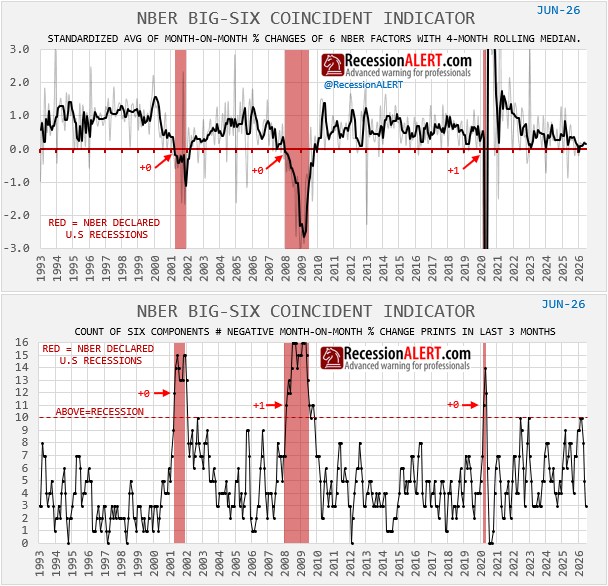
The quietest breadth reading in nearly two years is describing an economy that has already moved on. June’s 3-of-18 negative count is real, and it is also a photograph — one taken before payrolls turned. Three of the four July components already on the tape print negative: payrolls -23,000 from a June peak of 158,881,000, real retail sales -0.655%, household employment -87,000. The index cannot see any of it until the BEA closes the month on Wednesday. The July count arrives at 4 at minimum, arithmetic already banked, before the two outstanding components are even opened. A second limitation survives the lag: this gauge scores direction, not force. June nonfarm payrolls added 20,000 jobs — +0.0126% — and were scored as a positive print, identical to a half-percent month. Breadth counts noses. Which is why the top panel disagrees with the bottom one: the 4-month median sits at +0.167 against an expansion-months mean of +0.715, a level only 32 of 384 expansion months have matched or undercut. Wide participation, negligible thrust. Nothing here is a recession call — the trigger is above 10, and July lands near 4 to 6. But the reader’s edge is the two-month gap between what the economy did and what the chart admits. Coincident indicators are honest. They are just late, and lateness compounds.
What it means: the economy is still growing, but only just, and the reassuring number here describes June, not now. That argues against paying up for cyclical or consumer-facing risk on a resilient-growth story until Wednesday morning, when the government’s income and spending report adds July. The reading that would genuinely signal trouble, more than ten negative prints across the six, has not happened since 2020.
Market Intelligence Brief (MIB) Ver. 19.26
For professional investors only. Not investment advice.
© 2026 RecessionALERT.com

Comments are closed.