
MARKET INTELLIGENCE BRIEF (MIB)
Monday, August 3, 2026
Trump called off strikes on Iran and crude cratered — WTI -5.52% to $80 — but Tehran denies talking to Washington and Hormuz stays shut. The Dow closed at a record 53,178.41, and this time breadth came along: 8 of 11 sectors green, Russell +1.72%. ISM manufacturing hit a post-2022 high and GDPNow leapt to 6.2%; bonds rallied anyway. Williams says the Fed hikes if inflation stalls. AstraZeneca-Bristol Myers weighed a $400bn merger; AZN fell 9%. Amazon topped $3 trillion.
TABLE OF CONTENTS
A. EXECUTIVE SUMMARY
B. MARKET DATA
C. HIGH-IMPACT STORIES (6)
D. MODERATE-IMPACT STORIES (8)
E. ECONOMY WATCH (6)
F. EARNINGS WATCH (2)
G. WHAT’S NEXT
H. CHART OF THE DAY
A. EXECUTIVE SUMMARY -> TOP
Equities rallied broadly as President Trump’s decision to hold off on strikes against Iran sent WTI down 5.52% to $80.00, delivering the quarter’s single largest disinflationary impulse and carrying the Dow 1.32% higher to a record 53,178.41 close. The bond market’s response is the session’s real tell: Treasuries rallied, with the 10-year down 6.2 basis points to 4.683%, despite an ISM Manufacturing print at a post-2022 high that lifted the Atlanta Fed’s Q3 GDPNow nowcast to 6.2% — the curve chose the inflation input over the growth input on the same morning John Williams said a hike remains on the table. That trade rests on a de-escalation neither Washington nor Tehran has confirmed to the other. Breadth reversed Friday’s two-stock tape — eight of eleven sectors green, the Russell 2000 up 1.72% — but leadership rotated away from semiconductors, with the SOX down 1.9% and Energy the worst sector at -1.26%.
• Crude’s 5%+ collapse had three legs, not one — the Iran pause, a completed OPEC+ increase of 188,000 b/d for September, and weak China PMI data. Two of the three do not depend on the talks holding, but Iran’s foreign ministry says it is negotiating with Oman over the strait, not with the United States, and Hormuz remains closed after five months.
• The hawkish case advanced again, from a more senior voice — Williams said a hike would be appropriate if inflation is not tracking to 2% by 2028, citing June PCE at 3.7%. Q2 Employment Cost Index at 0.9% beat consensus, and prediction markets hold 68% odds of a 2026 hike and 88.8% odds of no cut this year.
• Growth data ran hot across the board — ISM Manufacturing 55.6% (highest since May 2022) with Employment back in expansion at 52.8; GDPNow to 6.2% from 5.0%; Michigan sentiment revised up to 55.2; Polymarket recession odds down five points to 8%. Prices Paid at 71.1 was the one uncomfortable detail.
• Pharma consolidation arrived at the top of the sector — AstraZeneca and Bristol Myers Squibb held talks on a roughly $400 billion merger; AZN closed down close to 9% while BMY gained about 6% premarket. Lilly (-2.39%), AbbVie (-2.33%) and Merck (-1.87%) all de-rated and Healthcare finished red.
• Amazon crossed $3 trillion for the first time, up 4.58% to $284.02 on target raises tied to a $25 billion annualised custom-silicon run rate — on the same session the SOX fell 1.9% and Texas Instruments dropped 2.43%. Oracle (+9.26%), CrowdStrike (+6.12%), Meta (+6.02%) and Dell (+5.89%) led.
• Five definitive deals signed in one session — KKR/Integer at a $5.7bn EV (above Friday’s reported $4.3bn), Prysmian/Atkore, Curium/Lantheus, Indivior/Supernus and AmFam/Bowhead. Separately, 25 states sued over the Section 301 forced-labor tariffs, and SpaceX reports Tuesday with options implying a ~$204 billion swing.
1. The rally borrowed its discount rate from oil, not from the data — A 6.2% growth nowcast and a multi-year-high manufacturing survey are, on any conventional reading, a hawkish combination, and the same session produced the FOMC vice chair openly discussing hikes. Yields fell anyway because the crude collapse landed the same morning and the market judged the inflation input to be the binding constraint on policy. That is a coherent judgement, not a certainty, and it is the single most consequential assumption embedded in today’s tape. If oil merely stabilises here rather than falling further, the growth data does not go away — and the curve will have to price it while equity multiples that have not yet absorbed Williams’ 2028 timeline sit on top of a 6.2bp move that oil, not policy, supplied.
2. Breadth genuinely broadened, but leadership changed hands underneath it — Friday’s session was the precise inverse: the S&P rose while eight of eleven sectors fell and two stocks did the index’s work. Today small caps outperformed, the NYSE Composite advanced, eight sectors participated, bonds rallied alongside equities and the dollar was unchanged — the advance was not funded by a duration selloff or a currency move. The important nuance is where the money went. The semiconductor complex, the transmission mechanism for every prior AI-era advance, fell 1.9% while its largest customer made an all-time high. The market is separating the companies that sell AI capacity from those that buy it, and paying more for the buyers; anyone holding semis as the liquid proxy for AI participation has now held the wrong instrument for two consecutive sessions.
3. Two dissents from the risk-on story deserve more weight than their size suggests — The Dow Jones Transportation Average rose only 0.91%, trailing every major average on the exact session its dominant cost line fell more than 5%, and it remains over 6% below its ten-session high while the industrials set a record — a third session of Dow Theory non-confirmation, now with the catalyst designed to help it already delivered. Meanwhile healthcare’s largest incumbents signalled that scale must be bought rather than built, and three of the day’s five definitive deals were in healthcare. Cheap financing clearing at a 4.683% ten-year is a real positive for credit; incumbents conceding organic growth is not, and both were priced in the same session.
 — Leading economic indicators. Accurate market forecasts. Apply for membership at join.recessionalert.com
B. MARKET DATA -> TOP
Equities rallied broadly as Trump’s decision to pause military action against Iran and pursue a diplomatic reopening of the Strait of Hormuz sent WTI and Brent crashing over 5% in lockstep, easing both inflation and geopolitical risk premia; the Dow closed at a record 53,178.41. This was broad risk-on with a communication-services/tech tilt — Oracle, CrowdStrike, Meta and Microsoft each rose 5-9% — while chips lagged as the Philadelphia Semiconductor Index fell 1.9% on Texas Instruments’ guidance-driven slide. The sharpest divergence: Energy, the year’s best-performing sector (+31.40% YTD), was today’s lone notable laggard (-1.26%), reversing hard on the oil collapse it otherwise rode higher all year. Treasury yields fell alongside a declining VIX — bonds and equities rallying together confirms genuine risk-on rather than a rotation.
CLOSING PRICES – August 3, 2026:
MAJOR INDICES
Communication Services (+3.82%) and Industrials (+2.45%) led a broadly participating rally — 8 of 11 sectors green — while the Dow’s record 53,178.41 close came alongside a Dow Theory non-confirmation: DJ Transportation sits over 6% below its 10-session high even as the industrials average sets fresh records, the classic transports-lagging warning that industrial strength isn’t yet being confirmed by the shipping-sensitive average. Large-cap/small-cap and growth/broad leadership stayed within 2% of each other — no breadth-narrowing signal fired.
| Index | Close | Change | %Move | Why It Moved |
|---|---|---|---|---|
| S&P 500 | 7,600.49 | +110.77 | +1.48% | Broad risk-on rally as the oil crash on Iran de-escalation lifted sentiment |
| Dow Jones | 53,178.41 | +693.38 | +1.32% | Record close; broad participation lifted by oil-driven cost relief |
| DJ Transportation | 21,231.1 | +191.8 | +0.91% | Rose on the day but remains over 6% below its 10-session high |
| Nasdaq 100 | 28,776.80 | +502.61 | +1.78% | Tech/comms rally (Oracle, Meta, Microsoft) offset chip-sector weakness |
| Russell 2000 | 2,981.73 | +50.39 | +1.72% | Broad participation with large caps; no breadth-narrowing signal |
| NYSE Composite | 24,255.53 | +147.99 | +0.61% | Broad-based advance across the exchange |
VOLATILITY & TREASURIES
VIX fell 0.81% alongside declining yields — 10Y down 6.2bps, 2Y down 4.5bps — a genuine risk-on session where bonds rallied with equities rather than diverging. The curve flattened marginally as the long end outpaced the short end’s decline. DXY was essentially flat, suggesting the move is growth/de-risking driven rather than a dollar story.
| Instrument | Level | Change | Why It Moved |
|---|---|---|---|
| VIX | 15.86 | -0.13 (-0.81%) | Risk-on tape with the fear gauge easing alongside oil |
| 10-Year Treasury Yield | 4.683% | -6.2 bps | Yields fell with equities rallying — genuine risk-on, not rotation |
| 2-Year Treasury Yield | 4.246% | -4.5 bps | Tracked the 10Y lower; curve flattened marginally |
| US Dollar Index (DXY) | 99.90 | +0.01 (+0.01%) | Essentially flat; move not dollar-driven |
COMMODITIES
Gold sat nearly flat (+0.11%) while copper (+1.29%) and silver (+0.98%) advanced with equities — an industrial-demand read, not a safe-haven bid. Platinum bucked the pack, falling 1.15%. Bitcoin’s 0.71% gain tracked the broader risk-on tape rather than decoupling into its own narrative.
| Asset | Price | Change | %Move | Why It Moved |
|---|---|---|---|---|
| Gold | $4,111.50/oz | $4.50 | +0.11% | Little-changed; risk-on tape left safe-haven demand muted |
| Silver | $58.353/oz | $0.566 | +0.98% | Tracked industrial metals higher with copper |
| Copper | $6.5488/lb | $0.0833 | +1.29% | Industrial-demand read alongside the equity rally |
| Platinum | $1,639.70/oz | -$19.00 | -1.15% | Bucked the metals complex, falling on its own |
| Bitcoin | $63,979.0 | $453.0 | +0.71% | Tracked the broader risk-on tape, no decoupling |
ENERGY
WTI and Brent moved in lockstep, both crashing over 5% after Trump paused plans for military action against Iran and opted to pursue a diplomatic reopening of the Strait of Hormuz — a global supply-risk unwind, not a regional one. Natural gas sat out entirely (Henry Hub +0.76%, Dutch TTF -2.15%), confirming the move is geopolitical crude risk rather than a broad energy repricing. Oil falling alongside a rallying tape reads as risk-on, not stagflationary.
| Asset | Price | Change | %Move | Why It Moved |
|---|---|---|---|---|
| Crude Oil (WTI) | $80.00/bbl | -$4.67 | -5.52% | Trump paused Iran military action, pursuing Strait of Hormuz reopening talks |
| Crude Oil (Brent) | $83.53/bbl | -$4.40 | -5.00% | Moved in lockstep with WTI on the same Iran de-escalation |
| Natural Gas (Henry Hub) | $2.768/MMBtu | $0.021 | +0.76% | Sat out the crude slide; domestic-driven, unaffected by Iran news |
| Natural Gas (Dutch TTF) | $19.49/MMBtu | -$0.46 | -2.32% | Modest decline; European gas didn’t share crude’s magnitude of move |
S&P 500 SECTORS
Energy’s -1.26% session is the story: the YTD leader (+31.40%) and best 1-year performer (+35.49%) reversed sharply on the oil collapse, breaking a trend that had carried it higher across every horizon. Healthcare, the 3-month standout (+9.70%), also cooled today (-0.34%) alongside Consumer Defensive (-0.41%) — both quality/defensive names lagging a cyclical, risk-on tape.
| Sector | 1-Day | 1-Week | 1-Month | 3-Month | 6-Month | YTD | 12-Month |
|---|---|---|---|---|---|---|---|
| Communication Services | +3.82% | +7.19% | +2.03% | -4.05% | -0.75% | +2.93% | +19.53% |
| Industrials | +2.45% | +0.03% | -5.03% | -0.66% | +5.22% | +13.20% | +16.60% |
| Consumer Cyclical | +2.35% | +8.22% | +3.37% | +0.18% | -2.28% | -1.05% | +6.08% |
| Technology | +1.58% | +2.46% | -0.18% | +7.48% | +19.33% | +18.45% | +27.76% |
| Basic Materials | +1.13% | +0.25% | -2.01% | -5.24% | -2.79% | +8.40% | +33.00% |
| Financial | +0.86% | +1.07% | +3.37% | +11.15% | +8.45% | +8.20% | +16.88% |
| Real Estate | +0.22% | -1.47% | +0.75% | +3.00% | +8.49% | +11.51% | +10.10% |
| Utilities | +0.05% | -2.64% | -3.03% | -6.26% | +0.70% | +3.66% | +6.59% |
| Healthcare | -0.34% | -1.06% | -2.61% | +9.70% | +3.75% | +4.57% | +24.70% |
| Consumer Defensive | -0.41% | -0.29% | -0.25% | -1.47% | +0.47% | +7.84% | +7.67% |
| Energy | -1.26% | +1.57% | +10.71% | -1.55% | +16.36% | +31.40% | +35.49% |
TOP MEGA-CAP MOVERS:
GAINERS
| Company | Ticker | Close | Change | Why It Moved |
|---|---|---|---|---|
| Oracle Corp | ORCL | $141.90 | +9.26% | Led the sector-wide tech rally amid cloud/AI infrastructure demand optimism |
| Crowdstrike Holdings Inc | CRWD | $202.54 | +6.12% | Rallied with the broader software/cybersecurity complex on the tech rally |
| Meta Platforms Inc | META | $590.11 | +6.02% | Gained with mega-cap tech/comms leaders as Amazon crossed a $3T market cap |
| Dell Technologies Inc | DELL | $429.23 | +5.89% | Tracked the hardware/AI infrastructure rally alongside peers |
| Space Exploration Technologies Corp | SPCX | $114.53 | +5.68% | Rallied ahead of its first public earnings report as a listed company (due Aug. 4) |
DECLINERS
| Company | Ticker | Close | Change | Why It Moved |
|---|---|---|---|---|
| Texas Instruments Inc | TXN | $269.04 | -2.43% | Weighed down by broader chip-sector guidance concerns; Philadelphia Semiconductor Index fell 1.9% |
| Lilly (Eli) & Co | LLY | $1,121.36 | -2.39% | Pharma sector pulled back amid renewed Medicare drug-pricing negotiation concerns |
| Abbvie Inc | ABBV | $245.10 | -2.33% | Tracked the pharma sector’s pricing-policy-driven pullback |
| Merck & Co Inc | MRK | $127.77 | -1.87% | Tracked the pharma sector’s pricing-policy-driven pullback |
| Chevron Corp | CVX | $193.18 | -1.85% | Energy major fell with crude prices on the Iran de-escalation-driven oil crash |
— Institutional-grade intelligence for serious investors. Apply for membership at join.recessionalert.comC. HIGH-IMPACT STORIES -> TOP
UNCERTAIN
1. Trump Calls Off “Massive” Strikes on Iran and Talks Begin — but Tehran Says It Is Not Negotiating With Washington, and Hormuz Is Still Closed
The core facts:President Trump held off on the massive strikes he had threatened against Iran, saying talks to wind down the war and revive cargo traffic through the Strait of Hormuz would begin Monday afternoon. The decision followed appeals from Gulf allies including Saudi Arabia. Iran’s foreign ministry immediately complicated the picture: it stated there are currently no negotiations with the United States, and that the discussions actually under way are with Oman over management of the strait. Foreign Minister Abbas Araghchi said those Oman talks are in their final stages. The strait has been largely blocked since February 28, 2026; roughly one-fifth of all traded oil and natural gas transited it before the war. Crude repriced violently on the news, with WTI closing at $80.00 a barrel, down 5.52%, and Brent at $83.53, down 5.00%.
Why it matters:The market has priced a de-escalation that neither principal has actually confirmed to the other. What exists is a US decision not to strike, and a separate Iran-Oman channel on strait management that Tehran describes as nearly complete — two facts that are compatible with a settlement and equally compatible with a pause. The distinction matters because the entire $4.67 move in WTI rests on the assumption that these are the same process. They are not, and the party that would have to reopen the waterway has publicly denied talking to the party whose strikes were called off. For a US portfolio the practical exposure is asymmetric. A genuine reopening is worth far less to equities from here than a collapse in the talks would cost them, because the disinflationary benefit has already been taken in a single session while the risk premium has been removed from the price. Six months of blockade have not ended; only the expectation of escalation has. That is a thinner foundation than today’s tape implies, and it is being supplied by an indirect intermediary rather than by either belligerent. The constructive reading is that Oman has brokered Gulf maritime arrangements before and that Gulf allies applying pressure on Washington is itself a meaningful signal of where the regional consensus now sits.
What to watch:Whether any vessel traffic actually resumes through Hormuz — tanker transit counts, not diplomatic statements, are the only confirmation that matters. Watch for a direct US-Iran channel being acknowledged by both sides, which would convert this from a pause into a process.
BULLISH
2. Crude Collapses More Than 5% on a Three-Part Catalyst — the Single Largest Disinflationary Impulse of the Quarter Arrives in One Session
The core facts:WTI fell 5.52% to $80.00 a barrel and Brent 5.00% to $83.53, moving in near-lockstep. Three separate forces landed together. The geopolitical leg was Trump’s decision to hold off on strikes and pursue a Hormuz reopening. The supply leg was OPEC+, where Saudi Arabia, Russia and five other key members agreed on Sunday to add 188,000 barrels per day for September, completing the phased rollback of their voluntary cuts. The demand leg was China, where disappointing manufacturing PMI data and reduced refinery run rates over the prior 48 hours raised concern about the world’s largest crude importer. Natural gas conspicuously sat out — Henry Hub rose 0.76% and Dutch TTF fell only 2.32% — confirming this was a crude-specific risk unwind rather than a broad energy repricing. Energy was the day’s only materially negative S&P sector at -1.26%, despite remaining the year’s best performer at +31.40% year-to-date.
Why it matters:Friday’s report identified a 23% monthly advance in Brent as the largest identifiable upward contribution to the forward inflation path, and as the constraint on the Fed’s room for manoeuvre. That contribution has now been partially reversed in a single session, and the bond market responded exactly as the transmission mechanism predicts: the 10-year yield fell 6.2 basis points to 4.683% and the 2-year 4.5 basis points to 4.246%, while equities rose and the VIX fell. Bonds and stocks rallying together, with the dollar unchanged at 99.90, is the signature of a genuine easing in the inflation constraint rather than a rotation between asset classes. The composition is what makes this durable rather than a headline pop. A move driven only by diplomacy would be one unverified statement from reversal; this one carries a completed OPEC+ supply increase that is now fact, and a demand-side deterioration in China that operates independently of the Middle East entirely. Two of the three legs do not depend on the talks holding. That said, the sector arithmetic cuts against the index: Energy is the largest year-to-date contributor in the S&P and it fell today, meaning the disinflationary benefit accrues to the other ten sectors at the direct expense of the one that has carried the market since January.
What to watch:Whether WTI holds below $80 — Friday’s report flagged $85 Brent as the line separating the war premium from the prior range, and Brent has now closed decisively through it at $83.53. Watch the EIA inventory report on August 5, the first hard supply data since the OPEC+ decision.
BULLISH
3. The Dow Closes at a Record 53,178.41 and This Time the Whole Market Comes With It — Breadth Reverses Friday’s Two-Stock Tape
The core facts:The Dow rose 693.38 points, or 1.32%, to a record close of 53,178.41. The S&P 500 gained 1.48% to 7,600.49, the Nasdaq 100 1.78% to 28,776.80, the Russell 2000 1.72% to 2,981.73 and the NYSE Composite 0.61% to 24,255.53. Eight of eleven S&P sectors finished green, led by Communication Services at +3.82%, Industrials at +2.45% and Consumer Cyclical at +2.35%. The three decliners were Energy (-1.26%), Consumer Defensive (-0.41%) and Healthcare (-0.34%). Oracle rose 9.26%, CrowdStrike 6.12%, Meta 6.02% and Dell 5.89%. The VIX fell 0.81% to 15.86 and both Treasury yields declined.
Why it matters:Friday’s session was the precise inverse of this one: the S&P rose 0.70% while eight of eleven sectors fell, the Russell declined and two stocks did the index’s work. This report characterised that as a narrow and therefore fragile tape. Today answers the question that framing posed. Small caps outperformed the S&P, the NYSE Composite advanced, eight sectors participated and the three that fell did so for identifiable idiosyncratic reasons — Energy on the oil crash, and the two defensive sectors on rotation out of safety. That is a genuine broadening, not a repeat of the concentration problem in a different costume. The internal evidence supports treating this as real rather than mechanical. Bonds rallied with equities and the dollar was unchanged, so the advance was not funded by a duration selloff or a currency move. Volatility fell. The leadership rotated away from the semiconductor complex that has driven every previous AI-era advance and toward software, industrials and rate-sensitives — the parts of the market that benefit from lower yields and lower input costs rather than from the capex narrative alone. A rally that changes leadership while broadening participation is a healthier configuration than the one that produced Friday’s record-adjacent close, and it happened on the first session of a new month with the oil constraint easing.
What to watch:Whether the S&P 500 takes out its own record — it closed roughly 0.1% below it and is the last major average yet to confirm the Dow. Watch the Russell 2000 for a second consecutive session of outperformance, which would mark the breadth improvement as a trend rather than a one-day oil trade.
UNCERTAIN
4. The Strongest Manufacturing Print Since 2022 Sends GDPNow to 6.2% — and the Bond Market Rallies Anyway
The core facts:Today’s ISM Manufacturing PMI beat expectations and the Atlanta Fed’s GDPNow nowcast for Q3 jumped to 6.2% from 5.0% just days earlier as a direct consequence — Section E carries the survey composition and the nowcast detail in full. The market-relevant layer is the reaction: rather than selling off on evidence of an economy running far above trend, Treasuries rallied, with the 10-year yield falling 6.2 basis points to 4.683% and the 2-year 4.5 basis points to 4.246%. Industrials was the second-best sector at +2.45%, Basic Materials rose 1.13% and the Russell 2000 outperformed the S&P at +1.72%.
Why it matters:A 6.2% growth nowcast alongside a manufacturing survey at multi-year highs is, on any conventional reading, a hawkish combination — it is the kind of data that argues for the restraint three FOMC members voted for last week and that Barkin publicly advocated on Friday. The curve did the opposite, and the reason is that the oil collapse landed the same morning. The bond market chose the inflation input over the growth input, which tells you what it currently believes the binding constraint on policy to be. That is a coherent judgement, but it is a judgement rather than a certainty, and it is the single most consequential assumption embedded in today’s rally. The uncomfortable version of this print is that it hands the hawks their strongest argument yet. Growth at these levels does not require accommodation, and a Fed already debating whether to reverse 2025’s cuts now has a nowcast that makes the case for it without reference to inflation at all. Today the disinflationary impulse from crude was large enough to dominate; if oil stabilises here rather than falling further, the growth data does not go away and the curve will have to price it. The equity read is genuinely two-sided: cyclical strength justified today’s rotation into industrials, materials and small caps, and simultaneously raises the probability that the discount rate applied to all of it moves higher before year-end.
What to watch:Whether the 10-year holds below 4.70% now that it has broken back under it — a reversal above Friday’s 4.716% close with oil stable would signal the growth data reasserting itself. Watch ISM Services later this week as the confirmation or contradiction of the manufacturing signal.
BEARISH
5. Williams Says the Fed Will Raise Rates if Inflation Does Not Ease — and Puts a Date on It: 2028
The core facts:In a Reuters interview, New York Fed President John Williams said policy is “well positioned” and that he expects inflation to cool in the second half and reach 2% by 2028 — but that the Fed will raise rates if price pressures fail to ease. He cited June PCE at 3.7% year-over-year, well above target. Williams said he does not expect the Middle East conflict to keep pushing inflation higher, and that a resolution combined with reopened shipping lanes could improve conditions rapidly. Section E carries the policy detail; prediction markets currently price roughly 68% odds of a 2026 hike and 88.8% odds of no cut this year. The federal funds upper bound stands at 3.75%.
Why it matters:Williams is the Vice Chair of the FOMC and the permanent voter who runs the desk that implements policy. When Barkin argued on Friday for reversing part of 2025’s cuts, that was a regional president adding weight to a dissenting minority. When Williams says a hike is what happens if inflation does not cooperate, the centre of the committee has moved, and the distribution of outcomes for the front end no longer has a cut in it at all. That is the third consecutive session in which the hawkish case has been advanced by a more senior voice than the one before it. The 2028 date is the detail with the longest reach. Williams is not describing a policy error to be corrected in months; he is describing a five-quarter-minimum path back to target, which is an implicit acknowledgement that the current stance is not restrictive enough to do the job faster. Markets that are pricing near-4% into year-end and holding there through mid-2027 have already absorbed this — but equity multiples have not, and today’s rally was built on a 6.2 basis point decline in the 10-year that was supplied by oil rather than by anything Williams said. The one genuinely dovish element is his explicit linkage of the inflation path to the shipping lanes, which makes today’s Hormuz development directly relevant to the policy outlook rather than merely to the energy complex.
What to watch:The next PCE print against the 3.7% June reading Williams cited — a fourth consecutive month above 3.5% would make his conditional hike language operative rather than hypothetical. Watch whether prediction-market hike odds hold above 60% now that oil has fallen sharply.
UNCERTAIN
6. AstraZeneca and Bristol Myers Squibb Held Talks on a $400 Billion Merger — and the Acquirer’s Shareholders Hated It
The core facts:The Financial Times reported that AstraZeneca and Bristol Myers Squibb have held talks on a merger that would value the combined company at roughly $400 billion, creating the world’s fourth-largest drugmaker by market capitalisation. The discussions have run for several months and could produce a deal soon, though sources cautioned the process may not result in any agreement. The market reaction was starkly asymmetric: AstraZeneca fell as much as 7% and closed down close to 9% in London, while Bristol Myers gained roughly 6% in US premarket trading. Analysts were described as “perplexed” by the strategic logic. Both companies declined to comment. The combined oncology portfolio would be the industry’s broadest, with AstraZeneca stronger in solid tumours and Bristol Myers concentrated in blood cancers and cell therapies — an overlap that would attract significant antitrust scrutiny.
Why it matters:A transaction of this size would be among the largest corporate combinations ever attempted in any sector, and the market’s verdict on it was delivered immediately and unambiguously: the buyer was punished harder than the target was rewarded. That pattern is the classic signature of shareholders who believe the acquirer is paying up to solve a problem rather than to capture an opportunity — in this case, the patent-cliff arithmetic facing large-cap pharma over the second half of the decade. Buying scale in oncology does not manufacture new molecules; it consolidates two pipelines under one cost base and buys time. The read-through extends well beyond the two names. Friday’s report noted three sizeable private-equity acquisitions of healthcare manufacturers inside a short window and framed public-market apathy toward healthcare as the source of private-market appetite. A $400 billion strategic combination on top of that changes the character of the observation: this is no longer sponsors picking off cheap cash flows, it is the sector’s largest incumbents concluding that organic growth will not close the gap. For a US portfolio holding large-cap pharma, that raises the probability of further consolidation and lowers confidence in standalone pipeline economics simultaneously. The critical caveat is that this is a report of talks, not an announcement — no terms exist, no board has approved anything, and the sources themselves flagged that no agreement may result.
What to watch:Whether either company confirms or denies the talks — continued silence from both boards after a move of this magnitude is itself informative. Watch whether AstraZeneca recovers the 9% decline, the cleanest measure of whether shareholders will tolerate the deal being pursued at all.
— Quantifying recession risk so you don’t have to guess. Apply for membership at join.recessionalert.comD. MODERATE-IMPACT STORIES -> TOP
BEARISH
7. The Semiconductor Complex Sits Out a 1.78% Nasdaq Rally — the SOX Falls 1.9% While Every Other Corner of Tech Advances
The core facts:The Philadelphia Semiconductor Index fell 1.9% on a session when the Nasdaq 100 rose 1.78% and the Technology sector gained 1.58%. Texas Instruments was the day’s worst mega-cap decliner at -2.43%, closing at $269.04 on chip-sector guidance concerns, with Micron and Broadcom also retreating. The divergence was stark against the software and infrastructure complex on the same tape: Oracle rose 9.26%, CrowdStrike 6.12%, Meta 6.02% and Dell 5.89%. Technology’s advance was therefore delivered entirely by non-semiconductor constituents.
Why it matters:For most of the AI era the semiconductor complex has been the transmission mechanism for the entire trade — chips led, everything else followed. Today the sector fell while the trade it supposedly leads had one of its best sessions of the quarter, and that inversion has now persisted across multiple sessions. Friday delivered the same signal from a different angle, with Micron down 5.90% while its Korean peers went limit-up on memory scarcity. The consistent thread is that the market has begun to separate the companies that sell AI capacity from the companies that buy it, and to pay more for the buyers. That reordering has direct portfolio consequences. An investor who has used semiconductor exposure as the liquid proxy for AI participation has been holding the wrong instrument for at least two sessions, and today’s leadership — enterprise software, cloud infrastructure, hardware integrators — captured the upside instead. The counter-argument is that memory cost inflation, the same force that lifted SK Hynix and pressured Apple’s margins, is a rising-price problem rather than a falling-demand one, and rising input prices eventually accrue to the suppliers’ revenue. But two sessions of the tape voting the other way is data, and the hyperscaler capex commitments that underwrite the sector remain guidance rather than orders.
What to watch:AMD’s report tomorrow after the close, with the Street modelling $11.31 billion of revenue and attention on MI350 GPU and data-centre demand — the cleanest read on whether chip weakness is sentiment or fundamentals. Watch whether the SOX can post a positive session while the Nasdaq is also positive, which has not happened in the last two sessions.
BEARISH
8. Big Pharma De-Rates on the Broadest Up Day in Weeks — Lilly, AbbVie and Merck All Fall Roughly 2% as Healthcare Finishes Red
The core facts:Eli Lilly fell 2.39% to $1,121.36, AbbVie 2.33% to $245.10 and Merck 1.87% to $127.77, on a session when the S&P 500 rose 1.48% and eight of eleven sectors advanced. Healthcare closed down 0.34%, one of only three negative sectors alongside Energy and Consumer Defensive. The declines coincided with the report of $400 billion merger talks between AstraZeneca and Bristol Myers Squibb, which sent AstraZeneca down close to 9%. Healthcare remains the standout three-month performer at +9.70% and is up 24.70% over twelve months, making today’s underperformance a reversal of recent leadership rather than an extension of weakness.
Why it matters:Two forces are working on the sector simultaneously and they are easy to conflate. The first is ordinary rotation: on a day when crude collapsed, growth data surprised to the upside and small caps outperformed, capital moved out of defensive quality and into cyclicals. Consumer Defensive fell 0.41% for exactly the same reason, and none of that says anything about pharma fundamentals. The second force is more specific and more important. The market has just been shown its two largest peers contemplating a $400 billion combination, and it has drawn the obvious inference about what that implies for organic growth prospects across the whole cohort. When the sector’s incumbents signal that scale must be bought rather than built, every standalone pipeline in the group is repriced against that admission. The distinction matters for positioning because the two forces have opposite durations. Rotation out of defensives reverses the moment the cyclical impulse fades, and healthcare’s three-month leadership suggests the underlying bid is intact. A structural re-rating of pipeline economics does not reverse on a change in the tape. Today’s move is too small to distinguish between them, but the sector now carries a consolidation overhang it did not have on Friday, and that overhang cuts both ways — it depresses standalone multiples while embedding a takeover option in the mid-cap names.
What to watch:Merck and Pfizer both report tomorrow before the bell, with Merck carrying a negative consensus EPS estimate — management commentary on business development appetite will be the first direct read on whether peers are contemplating similar moves. Watch whether healthcare underperforms again on a second cyclical up day, which would separate rotation from re-rating.
BULLISH
9. Five Definitive Deals Land in a Single Session — and KKR’s Integer Bid Comes in $1.4 Billion Above Friday’s Reported Price
The core facts:Five definitive transactions were announced in one session. KKR agreed to acquire Integer Holdings at $127 per share for a $5.7 billion enterprise value; Prysmian agreed to acquire Atkore at $95 per share for roughly $3.8 billion; Curium agreed to acquire Lantheus for up to $114.50 per share, structured as $102.50 in cash plus a $12 contingent value right; Indivior and Supernus signed a definitive merger agreement; and American Family Insurance agreed to buy Bowhead at $34 per share for roughly $1.2 billion. Friday’s report carried the KKR-Integer transaction as a Wall Street Journal report of a deal “nearing” at approximately $4.3 billion — today it is definitive at a $5.7 billion enterprise value.
Why it matters:No individual target here is large enough to matter to a US large-cap portfolio — all five sit below the $25 billion threshold. The cluster is the signal. Five definitive agreements executed on the same day, across medical devices, electrical infrastructure, radiopharmaceuticals, specialty pharma and insurance, means five separate financing packages cleared at current rates. With the 10-year at 4.683% and a Fed whose vice chair spent the day discussing hikes, that is a more useful read on credit availability than any spread series. Friday’s report used the KKR bid to argue that the financing market for quality mid-cap cash flow was functioning; today it upgraded that from a report to a signed agreement, at a materially higher enterprise value than first reported. The sector composition reinforces the pattern this report has been tracking for several sessions. Integer is medical-device outsourcing, Lantheus is radiopharmaceuticals, Indivior-Supernus is specialty pharma — three of the five are healthcare, on the same day the sector’s two giants were reported in merger talks and healthcare finished as one of only three red sectors. Public-market indifference and private-market appetite are diverging in the same sector at the same time, and Atkore’s acquisition by Prysmian adds the electrical-infrastructure leg that sits directly downstream of hyperscaler capex.
What to watch:Whether the pace holds through the week — a second cluster of definitive agreements would establish August as a genuine reopening of the M&A calendar rather than a month-start coincidence. Watch remaining listed medical-device and radiopharmaceutical names for sympathy re-rating on the embedded takeover option.
UNCERTAIN
10. Twenty-Five Democratic-Led States Sue Over the Section 301 Forced-Labor Tariffs — the Second Legal Challenge in Ten Days
The core facts:Twenty-five Democratic-led states filed suit Monday in the US Court of International Trade in New York, challenging the 10% and 12.5% tariffs the administration imposed on July 24 on 60 trading partners including the European Union. The duties were levied under Section 301 over allegations that those partners failed to stop imports of forced-labor goods. The filing follows a small-business class action lodged the day the duties took effect. Separately, an additional 50% duty on roughly $20 billion of Canadian goods across 554 tariff lines takes effect on August 19 under three Section 338 proclamations signed July 20 — a measure that applies even to USMCA-originating goods, departing from prior actions where a valid certificate of origin conferred exemption.
Why it matters:The market has largely stopped pricing tariff headlines, and this filing is a reason to reconsider that habit rather than confirm it. Twenty-five state attorneys general acting jointly in the Court of International Trade is a materially different proposition from a trade-association complaint: it is the venue with exclusive jurisdiction, the plaintiffs have standing that is difficult to contest, and the challenge goes to the statutory authority itself rather than to the application of the rate. A ruling that Section 301 does not reach forced-labor allegations against 60 partners simultaneously would unwind a duty regime that importers have already embedded in cost structures and pricing. The practical exposure runs in both directions, which is why this reads as uncertain rather than negative. Companies that have absorbed these duties face refund upside if the challenge succeeds and continued margin drag if it fails; companies that have repriced to pass them through face the opposite. Neither outcome is currently in consensus estimates because the litigation timeline is unknown. The Canadian Section 338 duties compound the picture on a fixed date — August 19 is close enough to matter for third-quarter guidance, and the removal of the USMCA certificate-of-origin exemption is the detail that makes it a genuine change in regime rather than a rate adjustment.
What to watch:Whether the Court of International Trade grants any preliminary injunction, which would suspend collection while the case proceeds and force immediate re-estimation across import-heavy sectors. Watch August 19 as the hard date for the Canadian duties and for any USMCA carve-out announced before it.
BULLISH
11. A Broad Analyst Reshuffle Puts Industrials on the Upgrade List and Semis on the Downgrade List — the Sell Side Ratifies the Day’s Rotation
The core facts:An unusually broad set of ratings changes landed across industrials, semiconductors and autos. Upgrades: BNP Paribas raised Boeing to Outperform from Underperform, a two-notch move; Evercore ISI raised Eaton to Outperform; JPMorgan raised LyondellBasell to Overweight; Truist raised Corning to Buy; Stifel raised Ingersoll-Rand to Buy; and Melius raised Starbucks to Hold from Sell. Downgrades: UBS cut NXP Semiconductors, Stellantis and Philips to Neutral. Initiations: Compass Point started Charles Schwab at Buy and Guggenheim started Sherwin-Williams at Buy. No price targets were disclosed in the source. Industrials closed as the second-best sector at +2.45%.
Why it matters:The direction of the reshuffle maps almost exactly onto the day’s sector performance, and that alignment is the point. Six upgrades concentrated in industrials, materials and electrical equipment, against three downgrades of which one is a semiconductor and two are European cyclicals — the sell side is repositioning toward the same cost-relief-and-capex trade that the tape expressed today. Boeing moving two notches from Underperform to Outperform is the single most aggressive call in the set, and it arrives with jet fuel collapsing alongside crude. Eaton’s upgrade deserves separate attention because this report has repeatedly used its order book as the cleanest available confirmation that hyperscaler capital spending is actually landing in the physical economy rather than remaining a guided number. An upgrade there, alongside Ingersoll-Rand and the Prysmian-Atkore transaction in the same session, is three independent data points pointing at electrical and industrial infrastructure on the same day. The honest limitation is that analyst actions are lagging indicators dressed as forward calls, and a set of upgrades published into a 2.45% sector rally tells you as much about where the stocks already are as about where they are going. The NXP downgrade, however, is a genuine addition to the semiconductor caution accumulating elsewhere in today’s report.
What to watch:Caterpillar’s report tomorrow before the bell, where AI-related data-centre construction demand is the stated focus — the direct fundamental test of the industrial upgrade thesis. Watch whether further semiconductor downgrades follow the NXP cut, which would mark a sell-side turn rather than a single call.
BEARISH
12. Fuel Costs Collapse 5.5% and the Transports Still Lag — a Third Session of Dow Theory Non-Confirmation on the Day the Dow Sets a Record
The core facts:The Dow Jones Transportation Average rose 191.8 points, or 0.91%, to 21,231.1 — an advance, but one that trailed the Dow Industrials’ 1.32% gain, the S&P 500’s 1.48% and the Russell 2000’s 1.72% on a session when WTI fell 5.52%. The transports remain more than 6% below their ten-session high even as the industrial average closed at a record 53,178.41. This extends a non-confirmation that this report first flagged two sessions ago, when the Transportation Average fell 0.24% against a rising Dow. Fuel is the single largest variable expense for airlines, cruise operators, trucking fleets and delivery networks.
Why it matters:This is the cleanest natural experiment the tape has offered in weeks. The transport complex received an unambiguous, quantified windfall — its dominant cost line fell more than 5% in a single session — and it still underperformed every major average, including the small-cap index that has no such tailwind. When a sector fails to outperform on the exact catalyst designed to help it, the explanation is rarely the catalyst; it is that something else is constraining the demand side. Dow Theory formalises this intuition for a reason. An industrial average making new highs without confirmation from the average that moves industrial output has historically been a caution signal, and the version on display here is more pointed than the classic setup because the transports had a specific reason to lead today and did not. The 6% gap to the ten-session high is the measure of how much ground would need to be recovered before the non-confirmation resolves. Two honest counterweights: the transports did rise, so this is relative rather than absolute weakness, and one session of cheaper fuel does not flow into earnings until it flows through hedging programmes that often blunt the first move. But the pattern is now three sessions old and it sits directly against today’s broad-participation narrative — the one average whose job is to confirm the industrial economy is the one that will not.
What to watch:Whether the Transportation Average closes back above its ten-session high, which would resolve the non-confirmation and validate the Dow’s record. Watch airline and parcel volume commentary for evidence that the constraint is demand rather than cost.
UNCERTAIN
13. SpaceX Rallies 5.68% Into Its First Public Earnings Report — Options Are Pricing a Swing of Roughly $204 Billion in Market Value
The core facts:Space Exploration Technologies rose 5.68% to $114.53, one of the five largest mega-cap gainers of the session, ahead of its first earnings report as a listed company after the close on Tuesday, August 4. The options market is pricing a post-earnings move of roughly $204 billion in market value against a capitalisation of approximately $1.52 trillion. Consensus looks for a loss of $0.23 per share on revenue of $6.83 billion. An insider share unlock follows on August 6. The company listed on June 12. Friday’s session saw the stock fall 3.41% to $108.37, near its 52-week low and roughly 30% below its debut price, on a day when its thematic neighbourhood rallied hard.
Why it matters:Friday this report noted that SpaceX could not participate in the best AI-infrastructure session of the quarter, and read that as the market declining to pay for narrative in the absence of demonstrated earnings power. Today’s 5.68% rally does not contradict that reading — it is a pre-event repositioning into the release that will supply the missing information, and it recovers only a portion of the post-listing decline. The stock is still well below its debut. What makes this the most consequential single-name event of the week is the arithmetic of the implied move. A roughly $204 billion swing on a $1.52 trillion capitalisation is a double-digit percentage repricing of one of the largest companies in the index, and it will land two days before insiders can sell. The sequencing is the risk: a disappointing print followed by an unlock on August 6 compresses two distinct sources of supply into seventy-two hours, and the stock is already trading near its 52-week low with no reporting history against which the market can calibrate. Nothing about the setup is directional — the same mechanics produce an outsized gain on a strong Starlink subscriber number — but the uncertainty is genuinely two-sided and unusually large for an index constituent of this size.
What to watch:Starlink subscriber growth and the associated economics in Tuesday’s release — the single disclosure that determines whether the 30% discount to the debut price is justified. Watch price action into the August 6 insider unlock, which follows the print by only two sessions.
BULLISH
14. Amazon Crosses $3 Trillion for the First Time as Analysts Raise Targets on a $25 Billion AI Chip Run Rate
The core facts:Amazon shares rose 4.58%, or $12.44, to close at $284.02, pushing the company’s market capitalisation above $3 trillion for the first time in its history and setting a fresh all-time high. The move followed price-target increases from Morgan Stanley and Roth Capital tied to a roughly $25 billion annualised run rate in the company’s AI and custom-silicon business. The advance extends the post-earnings surge that began Thursday, when the company guided 2026 capital expenditure to approximately $220 billion, up from a prior $200 billion, with management attributing the increase specifically to higher memory costs. Communication Services led all sectors at +3.82% and Consumer Cyclical rose 2.35%.
Why it matters:The milestone is symbolic, but the analyst rationale behind today’s move is not. Friday’s report characterised Amazon’s capex raise as a weaker signal than it appeared, because the increase was driven by memory cost inflation rather than incremental compute — capacity purchased at a higher price rather than more capacity. Today’s target increases cite a different line entirely: a $25 billion annualised custom-silicon run rate, which is revenue and margin the company captures internally rather than pays away to a merchant vendor. That reframes the capex number materially. If a meaningful share of the $220 billion is spent on silicon Amazon designs itself, the return on that spending accrues internally and the memory cost inflation is partially offset rather than purely absorbed. It also explains the day’s most conspicuous divergence — the semiconductor index falling 1.9% while the largest buyer of semiconductors made an all-time high. Vertical integration by the hyperscalers is simultaneously bullish for the buyer and structurally bearish for the merchant suppliers, and today the tape priced both sides of that trade correctly for the first time. The caution is concentration: a $3 trillion constituent making new highs is once again a large share of the index’s daily work, and the breadth improvement documented elsewhere today is the reason this reads as participation rather than dependence.
What to watch:Whether the custom-silicon run rate is disclosed or quantified by the company rather than estimated by the sell side — that would convert a modelled figure into a reported one. Watch merchant semiconductor names for continued underperformance against hyperscaler customers, the clearest expression of the vertical-integration trade.
— Separating signal from noise since 2007. Apply for membership at join.recessionalert.comE. ECONOMY WATCH -> TOP
Growth data surprised broadly to the upside: ISM Manufacturing jumped to 55.6 (highest since May 2022) as Chicago PMI corroborated with a 57.6 print, and Atlanta Fed’s GDPNow nowcast leapt to 6.2% for Q3 from 5.0% just days earlier. Consumer sentiment and the labor market told a similarly resilient story, but wage costs (ECI +0.9%, above forecast) and NY Fed’s Williams reaffirming the Fed would hike again if inflation doesn’t cool kept rate-cut hopes in check. Polymarket’s recession odds fell five points to 8% on the back of the data, while Fed-hike odds held near 68%. The tension for PMs: strong growth is good for earnings but bad for the “cuts are coming” narrative.
ISM Manufacturing PMI Hits Highest Reading Since May 2022 as Factory Activity Accelerates (ISM/Yahoo Finance, August 3, 2026)
What they’re saying:The ISM Manufacturing PMI rose to 55.6% in July, up from 53.3% in June and above the 54.0% consensus — the strongest reading since May 2022 and a seventh straight month of sector expansion. The Employment Index jumped to 52.8 from 49.7, moving back into expansion territory, while New Orders held firm at 56.7. Regional data corroborated the strength: the Chicago Business Barometer climbed to 57.6, beating the 56.0 estimate and topping June’s 56.7 print.
The context:The beat signals broadening momentum in the industrial economy after a soft patch earlier in the year, and it directly fed into the Atlanta Fed’s sharply higher GDPNow nowcast (see below). The one caveat: the Prices Paid sub-index came in at 71.1, above the 70.3 forecast, showing input-cost pressure has not fully abated even as output accelerates.
What to watch:ISM Services PMI, due Wednesday, August 5, and August’s manufacturing print due September 1.
Atlanta Fed’s GDPNow Nowcast Jumps to 6.2% for Q3, Up From 5.0% Days Earlier (Atlanta Fed, August 3, 2026)
What they’re saying:The Atlanta Fed’s GDPNow model now tracks Q3 2026 real GDP growth at 6.2% (seasonally adjusted annual rate), up sharply from the initial 5.0% estimate published July 30. The revision followed this morning’s Census Bureau and ISM releases, which lifted the nowcasts for real personal consumption growth to 4.6% (from 3.3%) and real private domestic investment growth to 17.9% (from 15.9%).
The context:GDPNow is a mechanical tracking estimate, not a forecast, and tends to be volatile early in a quarter — but the size of today’s revision underscores how much the manufacturing beat moved the growth picture. A Q3 print anywhere near 6% would mark a sharp re-acceleration from Q2’s 1.5% growth.
What to watch:The next GDPNow update following Friday’s employment report, and the Q3 advance GDP release in late October.
Employment Cost Index Rises 0.9% in Q2, Topping Forecasts as Wage Growth Accelerates (BLS, July 31, 2026)
What they’re saying:The Employment Cost Index rose 0.9% in Q2, above the 0.8% consensus, with annual compensation growth holding at 3.4%. Private-sector wages and salaries accelerated to a 0.9% quarterly gain from 0.7% in Q1, while benefits costs rose 1.0%.
The context:The Fed treats the ECI as its most reliable read on labor-cost-driven inflation because it strips out compositional shifts in the workforce. A beat here reinforces the case Fed officials like Williams have been making for holding — or even raising — rates rather than cutting, since persistent wage growth complicates the path back to 2% inflation.
What to watch:August’s average hourly earnings inside Friday’s jobs report, and the Q3 ECI print due in late October.
NY Fed’s Williams Says Rate Hikes Remain on the Table if Inflation Doesn’t Cool (CNBC/Benzinga, August 3, 2026)
What they’re saying:New York Fed President John Williams said he expects inflation to ease further in the second half of 2026 and reiterated support for the FOMC’s decision to hold its policy rate at 3.50%-3.75% for a fifth straight meeting. But he added it would be “appropriate” for the Fed to hike again if inflation isn’t on track to reach 2% by 2028.
The context:Williams is walking a middle line — endorsing the current hold while keeping a hike explicitly on the table — a stance that lines up with Polymarket’s elevated 68% odds of a 2026 hike and near-89% odds of zero cuts this year. Today’s strong ISM and GDPNow data give the hawkish wing of the committee more cover.
What to watch:The next FOMC meeting and any shift in Polymarket’s hike/cut odds following Friday’s jobs report.
Consumer Sentiment Revised Higher in July’s Final Print as Inflation Expectations Ease (University of Michigan, July 31, 2026)
What they’re saying:The University of Michigan’s Consumer Sentiment Index was revised up to 55.2 in the final July reading, from a preliminary 54.0 — the highest level since February. Year-ahead inflation expectations eased to 4.2% from 4.6% in June, while long-run expectations held steady at 3.3%.
The context:Sentiment improved across all income, age, education, and political groups, and the five-year outlook for business conditions hit a 12-month high — though the index remains 11% below year-ago levels, a reminder that several years of elevated prices are still weighing on households.
What to watch:August’s preliminary Michigan sentiment reading, due mid-month.
Polymarket Recession Odds Fall Five Points to 8% as Growth Data Surprises to the Upside (Polymarket, August 3, 2026)
What they’re saying:Polymarket’s “US recession by end of 2026” contract now prices an 8% probability of Yes, down from 13% in the prior session — a five-point drop. Fed rate-hike odds for 2026 held roughly steady at 68%, and the probability of zero rate cuts this year edged up to 88.8%.
The context:The decline in recession pricing lines up with today’s data flow — a stronger-than-expected ISM print and a sharply higher GDPNow nowcast both point away from imminent contraction. But the same data reinforces the hawkish side of the Fed debate, which is why hike/no-cut odds didn’t move materially even as recession fears eased.
What to watch:Polymarket’s odds around Friday’s jobs report, historically one of the largest single-day movers for the recession contract.
— Know the probability before the market prices in the risk. Apply for membership at join.recessionalert.comF. EARNINGS WATCH -> TOP
YESTERDAY AFTER THE BELL (Markets Reacted Today)
No major earnings yesterday after the bell from companies with >$100B market cap.
TODAY BEFORE THE BELL (Markets Already Reacted)
No major earnings before the bell from companies with >$100B market cap.
TODAY AFTER THE BELL (Markets React Tomorrow)
BULLISH
15. Palantir Technologies (PLTR): +12% AH | US Commercial Revenue Grows 149% and Full-Year Guidance Is Raised by Half a Billion Dollars
The Numbers:Released: AMC. Revenue of $1.935 billion against a $1.81 billion estimate, up 93% year-over-year. Adjusted EPS of $0.41 against a $0.34 estimate. Net income of $1.07 billion, or $0.41 per share, against roughly $329 million and $0.13 per share a year earlier. US commercial revenue grew 149% year-over-year. Full-year 2026 revenue guidance raised to $8.15-8.16 billion from $7.65-7.66 billion, and US commercial guidance raised to more than $3.42 billion from $3.22 billion, implying 134% growth. Market cap $301.22 billion.
The Problem/Win:The win is the commercial book, not the government one. US commercial revenue growing 149% while total revenue grows 93% means the fastest-growing segment is also the one that removes the company’s long-standing dependence on federal contracting — the single most persistent bear argument against the name. Raising full-year revenue guidance by roughly $500 million mid-year is not a rounding adjustment; it implies the second half is tracking materially above the plan the company set in April. CEO Alex Karp told CNBC the growth “looks like this is going to go on for at least another 18 months.”
The Ripple:This is the first genuine enterprise-AI monetisation print of the reporting round, and it lands on the same session that the semiconductor index fell 1.9% while software names led the tape — Oracle +9.26%, CrowdStrike +6.12%. Palantir’s result supplies the fundamental justification for that rotation: demand for AI is showing up in application-layer revenue rather than only in chip orders. Expect read-through to the enterprise software complex ahead of the remaining Q2 reports.
What It Means:Palantir has converted the AI narrative into audited commercial revenue at a scale no peer has matched, and the guidance raise says management believes the curve steepens rather than flattens. The valuation debate is unresolved, but the growth debate is now settled for at least two quarters.
What to watch:Whether the +12% after-hours move holds through tomorrow’s regular session — post-earnings gap-fills have been common in this name. Watch US commercial customer count and net dollar retention in the filing for evidence the 149% is broadening rather than concentrating in a few large accounts.
UNCERTAIN
16. Vertex Pharmaceuticals (VRTX): AH: n/a | Journavx Ramps 71% Sequentially While Full-Year Guidance Is Left Unchanged
The Numbers:Released: AMC. Consensus called for EPS of $4.74 and revenue of $3.23 billion. The company reported Journavx revenue of $50 million, up 71% sequentially and more than quadruple the year-ago period, and reiterated full-year 2026 revenue guidance of $12.95-13.1 billion. Headline EPS and total revenue actuals were not available in published sources at the time of writing, and the after-hours move could not be confirmed. Market cap $119.47 billion.
The Problem/Win:Journavx is the entire investment case beyond cystic fibrosis, and 71% sequential growth off a small base is the trajectory bulls needed to see — the non-opioid pain franchise is scaling rather than stalling. The offsetting fact is the reiterated guidance. A company whose newest growth driver quadrupled year-over-year and which left the full-year range untouched is signalling that the ramp is running inside plan, not ahead of it, with the cystic fibrosis franchise still carrying the revenue base.
The Ripple:The result lands on a session when Healthcare finished down 0.34% as one of only three negative sectors, Lilly fell 2.39%, AbbVie 2.33% and Merck 1.87%, and the sector absorbed a report of $400 billion merger talks between AstraZeneca and Bristol Myers Squibb. Vertex is the counterexample the sector needs — a large-cap with a genuinely novel franchise scaling organically rather than through consolidation.
What It Means:The Journavx ramp is real and accelerating, but unchanged guidance caps the upside this print can deliver until the headline numbers and management’s second-half commentary are digested. The name remains a pipeline story trading on cystic fibrosis cash flows.
What to watch:Journavx prescription volumes and payer coverage commentary on the call — the two variables that determine whether the 71% sequential rate is sustainable. Watch whether guidance is raised at the Q3 report, the signal that the ramp has outrun the plan.
WEEK AHEAD PREVIEW:
Q2 2026 earnings season is roughly 61% complete, and Tuesday, August 4 delivers the single heaviest mega-cap slate of the week — eleven qualifying reporters spanning semiconductors, industrials, pharma, travel and the year’s largest new listing.
Caterpillar (CAT) — BMO, Tuesday August 4 — consensus $6.22 EPS on $19.34 billion revenue. Key focus: whether AI-related data-centre construction demand continues to support growth, the direct fundamental test of today’s industrials rally and the Evercore/Stifel upgrade cycle.
Merck & Co (MRK) — -1.87% today — BMO, Tuesday August 4 — consensus is a loss of $0.27 per share on $16.37 billion revenue, a negative estimate that reflects charges rather than operating deterioration. Key focus: business development appetite in the wake of the AstraZeneca-Bristol Myers report, and whether healthcare can keep attracting both defensive and growth capital.
McDonald’s (MCD) — BMO, Tuesday August 4 — consensus $3.32 EPS on $7.13 billion revenue. Key focus: quick-service restaurant traffic and value-seeking consumer behaviour, the cleanest single read on whether the household stress visible in real wage data is showing up in transaction counts.
Pfizer (PFE) — BMO, Tuesday August 4 — consensus $0.68 EPS on $14.40 billion revenue. Key focus: product pipeline updates and oncology franchise sales, with the sector’s consolidation question now hanging over every large-cap pharma call.
Spotify Technology (SPOT) — BMO, Tuesday August 4 — consensus $3.19 EPS on $5.50 billion revenue. Key focus: the only mega-cap consumer-subscription name in Tuesday’s slate, and therefore the session’s cleanest test of pricing power against a consumer whose real wages are falling.
Space Exploration Technologies (SPCX) — +5.68% today — AMC, Tuesday August 4 — consensus is a loss of $0.23 per share on $6.83 billion revenue, in the company’s first report as a listed entity. Key focus: Starlink subscriber growth and unit economics, with options pricing a swing of roughly $204 billion in market value and an insider unlock following on August 6.
Advanced Micro Devices (AMD) — AMC, Tuesday August 4 — consensus $1.62 EPS on $11.31 billion revenue. Key focus: MI350 GPU shipments, EPYC processor share, data-centre demand and AI guidance — the decisive read on whether today’s 1.9% decline in the semiconductor index reflects sentiment or fundamentals.
Arista Networks (ANET) — AMC, Tuesday August 4 — consensus $0.89 EPS on $2.83 billion revenue. Key focus: cloud-titan order growth against the $720-745 billion of 2026 hyperscaler capital spending guided last week — Arista is the purest listed read on whether that spend is converting into networking orders.
Amgen (AMGN) — AMC, Tuesday August 4 — consensus $5.62 EPS on $9.43 billion revenue, an EPS decline of roughly 7% year-over-year. Key focus: obesity-treatment pipeline updates, the franchise on which the growth case rests.
Gilead Sciences (GILD) — AMC, Tuesday August 4 — consensus is a loss of $7.26 per share on $7.40 billion revenue, against $2.01 of earnings on $7.08 billion a year ago. Key focus: the composition of the charge driving the loss estimate, and whether underlying HIV and oncology revenue growth is intact beneath it.
Booking Holdings (BKNG) — AMC, Tuesday August 4 — consensus $2.43 EPS on $7.19 billion revenue, against $2.22 on $6.80 billion a year ago. Key focus: room-night growth and forward booking commentary, and whether the collapse in fuel costs is feeding through to travel demand rather than only to carrier margins.
HSBC, Toyota and BP also report Tuesday but are excluded as ADRs; Duke Energy reports at a $96.9 billion market cap, below the coverage threshold. The remainder of the week carries the balance of the Q2 calendar, with the next FactSet Earnings Insight update due Friday, August 7.
— US market commentary trusted by family offices and institutions. Apply for membership at join.recessionalert.comG. WHAT’S NEXT -> TOP
UPCOMING RELEASES:
| Date | Event | Why It Matters |
|---|---|---|
| Tue, Aug 4 | JOLTS Job Openings (Jun, prior 7.594M) | The first labor-market read of the week and the cleanest measure of demand for workers. With Q2 ECI wages accelerating to 0.9%, a firm openings print would reinforce the labor-cost pressure Williams cited as the reason a hike stays on the table. |
| Tue, Aug 4 | Balance of Trade (Jun, prior -$77.6B) and Imports (Jun, prior $395.3B) | Net exports feed directly into the Atlanta Fed’s GDPNow model, which jumped to 6.2% today. Import data also carries the first clean read on how the July 24 Section 301 duties on 60 trading partners are affecting trade flows. |
| Tue, Aug 4 | Factory Orders MoM (Jun, prior -1.3%) | Hard data against today’s ISM survey strength. A rebound from June’s -1.3% would corroborate the manufacturing acceleration; a second negative print would suggest the survey is running ahead of actual orders. |
| Wed, Aug 5 | ISM Services PMI (Jul, prior 54.0) | The confirmation or contradiction of today’s manufacturing signal, and the larger share of the economy by far. Its Prices Paid sub-index is the more relevant inflation read, particularly against manufacturing’s uncomfortable 71.1. |
| Wed, Aug 5 | ADP Employment Change (Jul, expected 70K, prior 98K) | The private-payroll preview ahead of Friday’s official jobs report. A print near the expected 70K would mark a step down from June and complicate a growth picture that GDPNow currently tracks at 6.2%. |
| Wed, Aug 5 | Treasury Refunding Announcement | Sets issuance sizes across the curve. With the 10-year having just broken back below 4.70% on the oil move, any shift in long-end supply is the most direct mechanical risk to that level holding. |
| Wed, Aug 5 | Fed Governor Cook speech | The next voice in a three-session sequence in which the hawkish case has been advanced by progressively more senior officials — Barkin, then Williams. Whether Cook endorses or pushes back on the hike language matters for where the committee’s centre actually sits. |
| Wed, Aug 5 | EIA Weekly Petroleum Status Report | The first hard supply data since OPEC+ agreed to add 188,000 b/d for September. Today’s entire disinflationary impulse rests on a crude price that has yet to be tested against actual inventory numbers. |
| Fri, Aug 7 | July Employment Report, including average hourly earnings | The week’s dominant catalyst. Average hourly earnings is the monthly companion to the Q2 ECI beat, and this release has historically been the largest single-day mover in Polymarket’s recession contract — currently at 8% after today’s five-point drop. |
KEY QUESTIONS:
1. If crude stabilises near $80 rather than falling further, does the 10-year hold below 4.70% — or does a 6.2% GDPNow nowcast and a Fed vice chair discussing hikes reassert themselves in the curve before Friday’s payroll print?
2. Does any vessel traffic actually resume through the Strait of Hormuz, given that Tehran says it is negotiating with Oman rather than Washington — and how much of today’s 5.52% decline in WTI survives if tanker transit counts do not move?
3. Is the semiconductor complex’s underperformance a rotation or a re-rating? AMD reports Tuesday after the close and Caterpillar before the bell — the first tests of whether the market is right to pay more for the buyers of AI capacity than for its sellers.
— US market commentary trusted by family offices and institutions. Apply for membership at join.recessionalert.comH. CHART OF THE DAY -> TOP
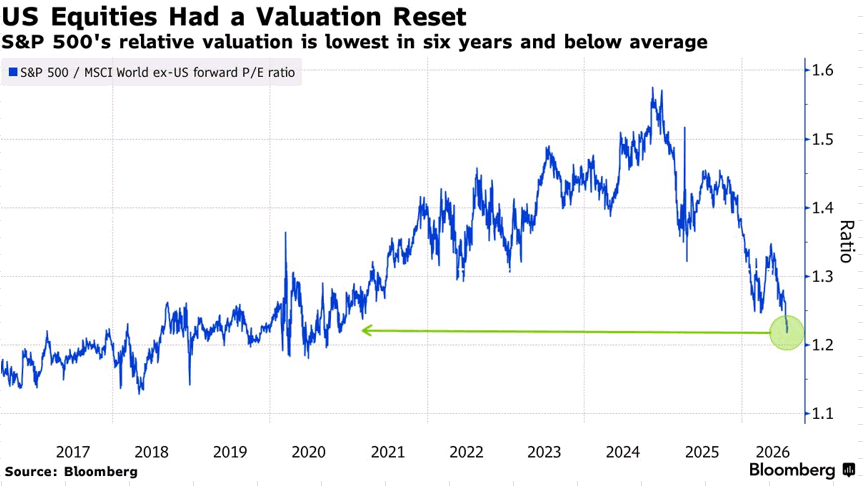
A valuation reset usually costs you money. This one paid 9.9%. The S&P is up that much since January and its forward multiple fell anyway — 20.4 at June 30, 19.6 by late July. Nothing got marked down; the denominator outran the price, with consensus compounding CY2026 earnings at 27.3%. But a ratio never tells you which leg moved, and the relative version moved from the other side entirely. At 19.6x the S&P sits below its own 19.9x five-year average, which is not a discount, and a 1.21 quotient implies roughly 16x for World ex-US — rich against its own history, with J.P. Morgan marking Europe ex-UK at the same handle. The rest of the world got expensive; America didn’t get cheap. Nor did the dollar do this: FX largely cancels inside a P/E, since price and earnings share a currency, so DXY’s -9.4% in 2025 flattered international returns without touching this multiple by a tick. So buying the reset means paying up abroad and funding it by selling the only market whose E is actually running. And the ratio’s own average is contaminated — it carries four years, 2021 to 2024, of a premium the US had never held before. A mean that contains a bubble isn’t a benchmark, it’s a memory of one.
Market Intelligence Brief (MIB) Ver. 18.47
For professional investors only. Not investment advice.
© 2026 RecessionALERT.com

Comments are closed.