
MARKET INTELLIGENCE BRIEF (MIB)
Monday, November 2, 2026
Crude plunged 7.44% to $96.37 after Trump said there is “no rush” to resume fighting Iran. Oracle (ORCL) fell 8.76% on a $20 billion stock-and-bond raise, and Marvell (MRVL) sank 12.72% on its $115 billion all-stock Lumentum deal. The Nasdaq 100 fell 1.39%, ending 10.4% below its October 6 close, while the Dow rose 0.41%. ISM manufacturing beat at 55.5 and GDPNow rose to 3.7%, keeping December hike odds at 76%. Anthropic’s IPO filing showed $895 billion of purchase commitments.
TABLE OF CONTENTS
A. EXECUTIVE SUMMARY
B. MARKET DATA
C. HIGH-IMPACT STORIES (5)
D. MODERATE-IMPACT STORIES (5)
E. ECONOMY WATCH (5)
F. EARNINGS WATCH (4)
G. WHAT’S NEXT
H. CHART OF THE DAY
A. EXECUTIVE SUMMARY -> TOP
Monday split along the two fault lines running through this market. Crude fell 7.44% to $96.37 as President Trump said there is “no rush” to resume the Iran war, while Oracle’s $20 billion stock-and-bond raise and Marvell’s $115 billion all-stock bid for Lumentum put the cost of financing the AI build-out at the center of a renewed tech selloff, leaving the S&P 500 down 0.51% and the Nasdaq 100 down 1.39% as the Dow rose 0.41%. Cheaper oil bought no policy relief: a 55.5 ISM print and a 3.7% GDPNow estimate kept December hike odds at 76% and lifted the 2-year yield 0.6 bps. Breadth was wide but rotational, with seven of 11 sectors higher, led by Consumer Cyclical (+2.22%) and Consumer Defensive (+1.99%), while Energy (-4.00%) and Technology (-2.47%) lagged, a sign that money is leaving AI hardware rather than equities.
• Energy: WTI fell 7.44% to $96.37 and Brent fell 8.08% to $104.27 after Trump told Axios there is “no rush” on Iran and a Qatari mediator returned to Tehran; gCaptain says Hormuz traffic remains significantly below prewar levels.
• AI financing: Oracle (ORCL) fell 8.76% after launching $10 billion of stock and $10 billion of notes; Intel fell 8.80%, AMD fell 7.52% and Dell fell 7.43%, and Technology’s one-month loss deepened to 11.91%.
• Deal: Marvell (MRVL) fell 12.72% and Lumentum (LITE) fell 18.59% on an all-stock deal at 4.5 Marvell shares per Lumentum share, implying a $115 billion enterprise value; at Monday’s close the ratio valued Lumentum about 32% below the headline price.
• Data: ISM manufacturing rose to 55.5 against 54.6 expected and GDPNow raised its fourth-quarter estimate to 3.7% from 3.2%, but construction spending fell 1.9% as private residential dropped 5.5%.
• Rates: fed funds futures price 76% odds of a December hike, per CME data cited by Yahoo Finance; the 2-year yield rose 0.6 bps to 4.596% and the 10-year fell 1.2 bps to 4.911%.
• Rotation and AI demand: DJ Transportation rose 1.54% to its highest close in 10 sessions as United Airlines gained 4.8% and Carnival 4.2%; Anthropic’s amended IPO filing showed nearly $17 billion of third-quarter revenue and $895.4 billion of purchase commitments.
1. The AI Build-Out’s Bill Is Reaching the Equity Market — Oracle selling $10 billion of stock alongside its bonds, and Marvell paying for Lumentum entirely in its own shares, both point to the cost of financing the build-out rather than to demand for it, with Morgan Stanley estimating AI-related borrowing at almost $500 billion through September, up from $100 billion a year earlier. The demand side arrived the same day: Anthropic’s filing lists $895.4 billion of purchase commitments, about $70 billion of them due in the next 12 months. The market’s question is therefore who funds the capacity and at what dilution, not whether it is wanted. With the Nasdaq 100 at 27,989.82, 10.4% below its October 6 close, while nearly seven in ten S&P 500 members rose, the exposure that matters is cap-weighted AI concentration, and AMD’s report after Tuesday’s close is the next test.
2. Cheaper Oil Is Not Cheaper Money — A 7% fall in crude should ease inflation expectations, yet the 2-year yield rose and December hike odds held at 76%, with Finimize’s reading of CME FedWatch at 77%, down only from 80% a week earlier. Growth is supplying the hawks’ argument: ISM production at its highest since November 2021, GDPNow at 3.7%, and the ISM Prices Index still at 75.2. The cost is landing on rate-sensitive borrowers, as construction spending fell on a 5.5% drop in private residential and the Fed’s loan officer survey showed weaker loan demand from businesses and home buyers and tighter standards for nonbank lenders, citing their “deteriorating financial strength.” Housing and private-credit exposure carry the bill for a Fed that growth keeps on course, and Friday’s payrolls (65K expected) and October CPI on November 10 are the last major prints before the December 8-9 FOMC.
3. The Oil Slide Prices Diplomacy, Not Flows — Energy (-4.00%) and transports (+1.54%) traded on the negotiating track, but the strait is not reopened: the Joint Maritime Information Center counts 18 confirmed attacks since October 6 with its threat level at “SEVERE,” and a tanker was struck late on November 1. The supply side gives some cushion, with combined Saudi, UAE, Iraqi and Kuwaiti crude exports up 10% to 15.53 million barrels a day in October and OPEC+’s core seven holding December output, which limits oil’s upside if talks stall, though not if they collapse. With Tuesday’s midterms widely seen as the decision point and Axios describing three camps around the President, Monday’s airline, cruise and consumer gains carry event risk into Wednesday.
 — Leading economic indicators. Accurate market forecasts. Apply for membership at join.recessionalert.com
B. MARKET DATA -> TOP
Two trades pulled in opposite directions: crude collapsed more than 7% on reports that Washington wants to give diplomacy with Iran another chance, while the AI-hardware selloff resumed once a morning rebound faded. The result was a split tape. The Dow and DJ Transportation rose and nearly seven in ten S&P 500 members gained, per AP, but chip and hardware losses left the Nasdaq 100 down 1.39% and the S&P 500 down 0.51%. Oracle (-8.76%) was the sharpest single-name signal, falling after filing to raise $20 billion in bonds and stock to fund its AI build-out. Energy (-4.00%) was the weakest sector as Brent fell 8.08%, while gold rebounded 1.41% and the 10-year yield barely moved.
CLOSING PRICES – Monday, November 2, 2026:
MAJOR INDICES
Blue chips, transports and the NYSE Composite rose while the Nasdaq 100 fell 1.39%: a tech-and-chips story, not a broad selloff. A Dow Theory bull confirmation emerges today, with DJ Transportation at its 10-session high and the Dow within 2% of its own. Over the past 10 sessions the Russell 2000 has outrun the S&P 500 by 4.8 points, an entrenched 5-session pattern of broad participation, and the S&P 500 has outrun the Nasdaq 100 by 3.3 points, a broadening rotation toward value and cyclicals.
| Index | Close | Change | %Move | Why It Moved |
|---|---|---|---|---|
| S&P 500 | 7,541.40 | -38.67 | -0.51% | Erased an early 1.1% gain, per AP, as losses in Oracle, Intel and AMD outweighed gains in nearly seven in ten members. |
| Dow Jones | 51,983.98 | +213.67 | +0.41% | Investors rotated out of tech into consumer cyclical, financial and consumer defensive stocks, per Yahoo Finance. |
| DJ Transportation | 20,642.92 | +313.59 | +1.54% | Airlines rallied as crude fell more than 7%: United +4.8% and Southwest +3.6%, per AP. |
| Nasdaq 100 | 27,989.82 | -395.03 | -1.39% | Chip losses in Intel, AMD and Micron as the AI-hardware selloff resumed after a morning rebound faded. |
| Russell 2000 | 2,805.88 | -5.97 | -0.21% | Slipped as the morning rally faded; no discrete catalyst identified. |
| NYSE Composite | 24,372.07 | +78.98 | +0.33% | Broad gains outside tech; nearly seven in ten S&P 500 stocks rose, per AP. |
VOLATILITY & TREASURIES
The VIX jumped 9.01% even as the Dow rose, so the stress sat in tech rather than across the market, a day before the midterm elections. A crude collapse of more than 7% moved the 10-year yield only 1.2 bps lower while the 2-year edged up, flattening the 2s10s curve to about 31.5 bps from 33.3 bps. Markets still price 76% odds of a December hike, per CME data cited by Yahoo Finance, and the dollar barely moved.
| Instrument | Level | Change | Why It Moved |
|---|---|---|---|
| VIX | 21.17 | +1.75 (+9.01%) | Rose as the tech selloff resumed, ahead of Tuesday’s midterm elections. |
| 10-Year Treasury Yield | 4.911% | -1.2 bps | Edged lower as crude fell; no discrete Treasury catalyst identified. |
| 2-Year Treasury Yield | 4.596% | +0.6 bps | Little changed; fed funds futures price 76% odds of a December quarter-point hike, per CME data cited by Yahoo Finance. |
| US Dollar Index (DXY) | 101.75 | -0.11 (-0.11%) | Slipped modestly; no discrete catalyst identified. |
COMMODITIES
Gold, silver and platinum all rebounded from Friday’s lowest closes since at least April 15, with silver (+2.66%) outpacing gold (+1.41%). Copper rose 0.84%, so the metals moved up together rather than splitting along safe-haven and industrial lines. Bitcoin fell 1.38%, moving with tech rather than with the broader tape.
| Asset | Price | Change | %Move | Why It Moved |
|---|---|---|---|---|
| Gold | $3,954.05/oz | $+55.15 | +1.41% | Rebounded from Friday’s lowest close since at least April 15; no discrete same-day catalyst identified. |
| Silver | $50.585/oz | $+1.309 | +2.66% | Rebounded from Friday’s lowest close since at least April 15; no discrete same-day catalyst identified. |
| Copper | $6.5365/lb | $+0.0545 | +0.84% | No discrete same-day catalyst identified. |
| Platinum | $1,447.30/oz | $+11.30 | +0.79% | Rebounded modestly from Friday’s lowest close since at least April 15; no discrete same-day catalyst identified. |
| Bitcoin | $76,858.00 | $-1,078.00 | -1.38% | No discrete same-day catalyst identified; continued pressure after Thursday’s roughly $6.3 billion Binance hack. Binance said Monday it had covered about 95% of affected funds, per Yahoo Finance. |
ENERGY
Brent fell harder than WTI, narrowing the spread to $7.90 from $9.31 at Friday’s settlements, and Dutch TTF dropped almost 10% in dollar terms alongside crude. Henry Hub fell only 1.24%. Yahoo Finance tied crude’s slide, and Trading Economics tied European gas’s, to renewed hopes for US-Iran diplomacy.
| Asset | Price | Change | %Move | Why It Moved |
|---|---|---|---|---|
| Crude Oil (WTI) | $96.37/bbl | $-7.75 | -7.44% | Fell on hopes of a US-Iran diplomatic breakthrough after Axios reported that President Trump wants to give diplomacy with Tehran another shot, per Yahoo Finance. |
| Crude Oil (Brent) | $104.27/bbl | $-9.16 | -8.08% | Same driver as WTI; the larger drop narrowed the Brent premium. |
| Natural Gas (Henry Hub) | $2.862/MMBtu | $-0.036 | -1.24% | No discrete same-day catalyst identified; fell far less than crude and European gas. |
| Natural Gas (Dutch TTF) | $30.65/MMBtu | $-3.35 | -9.85% | Fell about 10% to roughly €93/MWh as renewed hopes for US-Iran negotiations eased concerns over Middle East energy supplies, per Trading Economics. |
S&P 500 SECTORS
Seven of 11 sectors rose; the four decliners were Energy (-4.00%), Technology (-2.47%), Healthcare (-0.42%) and Communication Services (-0.06%). Energy, the 12-month leader at +46.10%, gave back the most as crude collapsed, while Technology’s one-month slide deepened to -11.91%. Consumer Defensive (+1.99%) extended a run now at +13.52% over one month.
| Sector | 1-Day | 1-Week | 1-Month | 3-Month | 6-Month | YTD | 12-Month |
|---|---|---|---|---|---|---|---|
| Consumer Cyclical | +2.22% | +2.43% | +5.04% | -3.17% | -2.53% | -4.07% | -3.37% |
| Consumer Defensive | +1.99% | +3.38% | +13.52% | +7.46% | +7.00% | +16.06% | +18.46% |
| Basic Materials | +1.62% | +1.07% | -2.38% | -2.70% | -3.77% | +8.23% | +17.58% |
| Financial | +1.54% | +1.64% | +3.87% | -2.87% | +9.51% | +5.56% | +11.71% |
| Industrials | +1.37% | +0.80% | -2.48% | -7.46% | -4.76% | +7.12% | +7.25% |
| Real Estate | +1.19% | +1.88% | +5.62% | -4.62% | -1.16% | +6.30% | +5.14% |
| Utilities | +0.59% | +2.37% | +8.13% | -1.74% | -7.20% | +0.98% | -3.32% |
| Communication Services | -0.06% | -6.45% | -12.97% | -15.79% | -18.34% | -12.65% | -9.46% |
| Healthcare | -0.42% | +2.76% | +9.27% | +10.49% | +21.16% | +14.65% | +20.09% |
| Technology | -2.47% | -5.41% | -11.91% | -5.36% | +6.04% | +16.95% | +10.38% |
| Energy | -4.00% | -3.27% | +5.66% | +10.36% | +6.92% | +43.81% | +46.10% |
TOP MEGA-CAP MOVERS:
GAINERS
| Company | Ticker | Close | Change | Why It Moved |
|---|---|---|---|---|
| GE Aerospace | GE | $315.78 | +4.63% | No discrete same-day catalyst identified; rose with airline stocks as crude fell more than 7%. A link to lower fuel costs is plausible but unconfirmed. |
| Home Depot | HD | $341.15 | +3.63% | No discrete same-day catalyst identified; Consumer Cyclical was the day’s strongest sector in a rotation out of tech. |
| Walmart | WMT | $127.69 | +3.38% | No discrete same-day catalyst identified; consumer defensive stocks gained in the rotation out of tech, per Yahoo Finance. |
| Mastercard | MA | $658.10 | +3.15% | No discrete same-day catalyst identified; card networks rose together (Visa +2.88%, American Express +2.78%) as financials gained. |
| Wells Fargo | WFC | $85.89 | +2.99% | No discrete same-day catalyst identified; rose with financials in the rotation out of tech. |
DECLINERS
| Company | Ticker | Close | Change | Why It Moved |
|---|---|---|---|---|
| Intel | INTC | $59.97 | -8.80% | Earnings-driven: extended Friday’s 28.58% drop after its October 29 after-close report and Friday’s BofA downgrade; no new same-day catalyst identified. |
| Oracle | ORCL | $119.22 | -8.76% | Filings showed plans to raise $20 billion through bond and share sales to fund its AI and cloud build-out, per Reuters; Bloomberg put it at $10 billion of bonds and a similar amount of stock. |
| Advanced Micro Devices | AMD | $466.84 | -7.52% | No discrete company catalyst identified; fell with the AI-hardware complex as the tech selloff resumed, a day before its Q3 report after Tuesday’s close. |
| Dell Technologies | DELL | $392.78 | -7.43% | No discrete company catalyst identified; fell with AI hardware as the tech selloff resumed. |
| Micron Technology | MU | $833.59 | -5.78% | No discrete company catalyst identified; fell with chip stocks as the AI selloff resumed. |
— Institutional-grade intelligence for serious investors. Apply for membership at join.recessionalert.comC. HIGH-IMPACT STORIES -> TOP
BULLISH
1. Crude Plunges More Than 7% as Trump Says There Is “No Rush” to Resume the Iran War and Qatar’s Mediator Returns to Tehran
The core facts:WTI closed at $96.37, down 7.44%, and Brent at $104.27, down 8.08% or $9.16, while Dutch TTF fell 9.85%. In a phone interview with Axios on Monday, President Trump said he is “in no rush” to decide whether to resume fighting: “One way or the other, we will do something, but there is no rush,” adding of the talks, “We are talking to them. It’s going fine.” Axios reported that Qatari mediators have drafted a three-day sequence of confidence-building measures aimed at restarting direct US-Iran negotiations, and that Qatari mediator Ali al-Thawadi travelled to Tehran on Monday. Iranian Foreign Minister Araghchi said exchanges “have become very intensive” and that negotiations will resume if Washington accepts Tehran’s conditions for reopening the Strait of Hormuz. Hours after the interview, Trump posted that oil was “down almost $10 a Barrel, A RECORD”; the record claim could not be verified. The strait itself is not reopened: gCaptain reported a tanker struck by two projectiles 72 nautical miles east of Ras Al Khafji late on November 1, about 490 vessels waiting outside the strait, and the Joint Maritime Information Center counting 18 confirmed attacks since October 6 with its threat level held at “SEVERE”.
Why it matters:The market priced the diplomatic track, not the physical one. Energy was the weakest sector at -4.00% and transports rose 1.54%, yet gCaptain says commercial traffic through Hormuz “remains significantly below prewar levels”, so the move rests on expectations rather than restored flows. Axios describes three camps around the President: Vance and Witkoff pressing for a deal, Netanyahu and Hegseth for renewed strikes, and Bessent, Ratcliffe and Rubio for a “no war, no deal” economic squeeze. With Tuesday’s midterms widely seen as the decision point, a breakdown would leave Brent exposed to a sharp reversal of Monday’s $9.16 fall. The rates market was unmoved: the 10-year yield fell only 1.2 bps and the 2-year rose 0.6 bps, so lower oil has not yet loosened the December hike case.
What to watch:Any decision on resuming strikes after Tuesday’s midterms, and whether US-facilitated transits through Hormuz rise from the 119 recorded between October 29 and 31.
UNCERTAIN
2. Marvell Agrees to Buy Lumentum in a $115 Billion All-Stock Deal; Marvell Falls 12.72% and Lumentum 18.59%
The core facts:Marvell announced a definitive agreement before Monday’s open to acquire Lumentum for a fixed 4.500 Marvell shares per Lumentum share, worth about $1,132 a share at announcement and a premium of roughly 23.9% to Lumentum’s unaffected October 28 close. The deal implies an enterprise value of $115 billion for Lumentum and leaves Marvell holders with about 67% of the combined company. Marvell cites line of sight to more than $1 billion of annual run-rate cost synergies and expects to close in the first half of calendar 2028, subject to both shareholder votes and regulatory approvals. Matt Murphy remains chairman and CEO, and three Lumentum directors, including CEO Michael Hurlston, join the board. Marvell also narrowed its preliminary fiscal third-quarter revenue range to plus or minus 2% around an unchanged midpoint. Marvell closed at $171.41 and Lumentum at $684.40; at Marvell’s close the fixed ratio valued Lumentum at about $771 a share, roughly 32% below the headline price. Lumentum separately reported quarterly EPS of $4.57 against a $4.22 estimate before the open.
Why it matters:Friday’s report that a deal would be all stock with no big premium is now confirmed, and both sets of holders sold: Marvell’s for the dilution and a close almost two years away, Lumentum’s because the currency they are being paid in kept falling. Murphy frames the deal as a bet that “AI infrastructure is undergoing a fundamental architectural shift toward optical connectivity”, which makes it a $115 billion bet on optics inside the AI build-out. It lands in the middle of an AI-hardware selloff, with Technology down 2.47% on the day and 11.91% over a month, so the market is pricing execution and duration risk rather than the strategic logic.
What to watch:The gap between Lumentum’s price and 4.5 times Marvell’s, the market’s running estimate of deal risk, and Marvell’s Form S-4 filing.
BEARISH
3. Oracle Launches $10 Billion of Stock and $10 Billion of Bonds, Falling 8.76% as AI Financing Moves Into Equity
The core facts:Oracle filed a preliminary prospectus supplement dated November 2 for $10 billion of common stock, assuming 76,528,659 shares at $130.67, its October 30 close, with BofA Securities as global coordinator and a 60-day lock-up. A concurrent $10 billion senior notes offering runs alongside it, and neither closing depends on the other. Net proceeds are for general corporate purposes and may fund capital expenditures, debt repayment, investments or acquisitions, and dividends or buybacks. Oracle closed at $119.22, down 8.76% and about 9% below the price the filing assumes. The same day Alphabet launched its second euro bond sale of 2026, and Semafor reported Morgan Stanley’s estimate that AI-related borrowing reached almost $500 billion through September, up from $100 billion a year earlier.
Why it matters:A hyperscaler selling $10 billion of stock alongside its bonds says debt alone is no longer enough to carry the AI build-out at the pace planned, and that is a different signal from a bond deal. Equity issuance dilutes existing holders and puts a ceiling on the share price while the deal is marketed, which is why the stock fell harder than the AI-hardware complex. It also feeds directly into the debate weighing on the sector: if the largest buyers of AI capacity need fresh equity, investors will question how long current capex plans can run.
What to watch:Final pricing of both offerings: the share count against the 76.5 million assumed at $130.67, and the new-issue spread on the six-tranche notes.
BEARISH
4. The AI-Hardware Selloff Resumes: the Nasdaq 100 Falls 1.39% While the Dow Rises and Seven of 11 Sectors Gain
The core facts:The S&P 500 closed at 7,541.40, down 0.51%, after erasing an early 1.1% gain, per AP, and the Nasdaq 100 fell 1.39% to 27,989.82. The Dow rose 0.41% to 51,983.98 and the NYSE Composite 0.33%, while nearly seven in ten S&P 500 members gained, per AP. Technology fell 2.47%, taking its one-week loss to 5.41% and its one-month loss to 11.91%. AMD fell 7.52%, Dell 7.43% and Micron 5.78%, with no company-specific catalyst identified for any of them; Intel extended its post-earnings slide by 8.80% and Oracle fell 8.76% on its capital raise. The VIX rose 9.01% to 21.17.
Why it matters:An index falling while most of its members rise is a concentration problem, not a broad selloff. Over the past 10 sessions the Russell 2000 has outrun the S&P 500 by 4.8 points and the S&P 500 has outrun the Nasdaq 100 by 3.3 points, so money is leaving AI hardware for the rest of the market rather than leaving equities. That rotation flatters breadth but is a drag on cap-weighted indices, where AI names carry the most weight. The day’s two largest corporate events, Oracle’s equity raise and Marvell’s paper-funded deal, both pointed to the cost of financing the build-out rather than to demand for it.
What to watch:AMD’s third-quarter report after Tuesday’s close, the first major AI-hardware print since Intel’s collapse.
BEARISH
5. Strong Factory and GDP Readings Keep a December Hike Priced as the 2-Year Yield Rises on a Day Crude Fell 7%
The core facts:Monday’s ISM manufacturing beat and the Atlanta Fed’s lift of its fourth-quarter GDPNow estimate to 3.7% (both detailed in Economy Watch) left fed funds futures pricing 76% odds of a December quarter-point hike, per CME data cited by Yahoo Finance. Finimize’s reading of CME FedWatch put the odds at 77%, down from 80% a week earlier, and tied the easing to the oil slump. The 2-year yield rose 0.6 bps to 4.596% and the 10-year fell 1.2 bps to 4.911%, flattening the 2s10s curve to about 31.5 bps from 33.3 bps.
Why it matters:Two forces cancelled. A 7% fall in crude should lower inflation expectations, and the hike odds slipped only a few points; growth data strong enough to lift the GDP nowcast by half a point, with the ISM Prices Index still at 75.2, gives the Fed’s hawks the growth argument they lacked. A 2-year yield that rises on a day crude collapses shows the front end treating December as a live meeting, which keeps pressure on rate-sensitive sectors and on the long-duration growth stocks already under strain.
What to watch:October payrolls on Friday, November 6 (65K expected), and October CPI on November 10, the last two major prints before the December 8-9 FOMC.
— Quantifying recession risk so you don’t have to guess. Apply for membership at join.recessionalert.comD. MODERATE-IMPACT STORIES -> TOP
UNCERTAIN
6. Anthropic’s Amended IPO Filing Shows Nearly $17 Billion of Quarterly Revenue and $895 Billion of Purchase Commitments
The core facts:Anthropic filed an amended IPO prospectus on Monday ahead of a planned Nasdaq listing under the ticker “ANT” before the end of November, according to The Next Web, citing Bloomberg. Third-quarter revenue was nearly $17 billion, about 12 times a year earlier, and nine-month revenue $33.2 billion. The third-quarter net loss was $23.3 billion, mostly a non-cash charge from revaluing convertible notes largely held by Amazon, which convert at the IPO; the operating loss was about $567 million, after an operating profit of about $974 million in the second quarter. Purchase commitments total $895.4 billion, almost all for computing power and infrastructure, with about $448 billion due by the end of 2030 and roughly $70 billion in the next 12 months. Investors have discussed a valuation of $1.4 trillion to $1.5 trillion.
Why it matters:The commitments are the demand side of the AI-hardware trade the market sold today: close to $900 billion of contracted compute is a concrete counterweight to fears that AI capex is about to roll over. The cost is visible too, with the business swinging to an operating loss in the third quarter, and a listing of this size would compete for the same AI allocation that is already rotating out of hardware names. No move in listed AI stocks was attributed to the filing.
What to watch:The price range and raise size in the next amendment, ahead of a listing planned before the end of November.
BULLISH
7. Airlines, Transports and Consumer Stocks Rally as Crude’s Plunge Drives a Rotation Out of Tech
The core facts:DJ Transportation rose 1.54% to 20,642.92, its highest close in 10 sessions, as United Airlines gained 4.8%, Southwest 3.6% and Carnival 4.2%, per AP. Consumer Cyclical was the strongest sector at +2.22%, followed by Consumer Defensive (+1.99%), Basic Materials (+1.62%), Financials (+1.54%) and Industrials (+1.37%). Among mega-caps, GE Aerospace rose 4.63%, Home Depot 3.63%, Walmart 3.38%, Mastercard 3.15% and Wells Fargo 2.99%, none on a company-specific catalyst; Yahoo Finance described the session as a rotation out of tech into consumer cyclical, financial and consumer defensive stocks.
Why it matters:Fuel is the swing cost for airlines and cruise lines, so a 7% fall in crude flows quickly into their earnings estimates. Transports at a 10-session high with the Dow within 2% of its own is the kind of confirmation Dow Theory followers look for, and it came on a day the Nasdaq 100 fell. Consumer Defensive is now up 13.52% over a month, so part of the rotation is defensive rather than a bet on growth.
What to watch:Whether airline gains hold if crude rebounds after Tuesday’s midterms, and Booking Holdings’ travel-demand read after Tuesday’s close.
BULLISH
8. Trump Says the US and Canada Have “the Concept of a Very Good Deal” as Carney Promises One “in the Coming Weeks”
The core facts:Prime Minister Carney said on Sunday he had a “constructive conversation” with President Trump, who said they spoke on Saturday, and that “Our teams will now be working in the coming weeks to deliver that outcome.” Speaking in Iowa, Trump said “We have the concept of a very good deal with Canada” and “Part of the agreement is that our farmers will have to pay no tariffs”, adding that the negotiations involved building the Keystone XL pipeline and that “we are now very close to having a deal.” No agreement or details have been announced. The talks cover possible relief from US tariffs on Canadian steel and automobiles; the US has imposed 50% tariffs on roughly $20 billion of Canadian goods, and Canada retaliated.
Why it matters:Autos and steel are the industries where cross-border supply chains run deepest, so any relief there feeds directly into North American manufacturers’ costs. A farm-tariff concession and Keystone XL point to a broader package than a tariff truce. Both leaders’ language is about intent rather than terms, and with the midterms on Tuesday, how much of this survives the week is the real question.
What to watch:Whether formal negotiations resume this week, and any change to the Section 232 steel and auto tariffs applied to Canada.
BULLISH
9. OPEC+ Core Seven Hold December Output Steady as Gulf Arab Crude Exports Return to Pre-War Rates
The core facts:Meeting online on Sunday, November 1, Saudi Arabia, Russia, Iraq, Kuwait, Kazakhstan, Algeria and Oman “decided to maintain September 2026 required production for December 2026”, OPEC said, and will meet again on November 29. Separately, Bloomberg reported on Monday that combined crude exports from Saudi Arabia, the United Arab Emirates, Iraq and Kuwait rose 10% to 15.53 million barrels a day in October, roughly in line with levels at the start of the year, a tide of supply it said has helped temper prices.
Why it matters:The supply picture now supports the diplomacy-driven fall in crude: the producers that matter most are shipping at close to pre-war rates and OPEC+ is not adding a cut to offset it. That limits the upside for oil if talks stall, though not if they collapse. It sits alongside gCaptain’s report that commercial traffic through Hormuz remains well below prewar levels; the route by which the Gulf barrels are moving was not stated in the portion of Bloomberg’s report that could be read.
What to watch:The OPEC+ seven’s November 29 meeting on January output, and November tanker-tracking export tallies.
UNCERTAIN
10. SpaceX Is in Talks to Buy EchoStar’s Boost Mobile or Use Its Network, the Washington Post Reports; T-Mobile Slips
The core facts:The Washington Post reported on Monday, as carried by Reuters, that SpaceX is in talks to buy EchoStar’s Boost Mobile or gain access to its network, which EchoStar leases from AT&T and T-Mobile. Elon Musk met EchoStar chairman Charlie Ergen last month. Because Boost’s leasing agreements may not transfer to a new owner, a deal may need the carriers’ consent. EchoStar had 7.38 million wireless subscribers at the end of the second quarter. SpaceX and EchoStar did not immediately respond to Reuters. Before the open, EchoStar rose about 3.4%, T-Mobile fell about 2%, and AT&T and Verizon edged lower.
Why it matters:Boost would give SpaceX a ready-made terrestrial customer base for the hybrid satellite-and-ground network it is building through Starlink Mobile, turning it from a supplier of coverage into a direct competitor to the three national carriers. That threat is already being priced: Communication Services is down 12.97% over the past month. This is a report of talks, not a deal, and the carriers’ leases give AT&T and T-Mobile a say in the outcome.
What to watch:Any statement from EchoStar or SpaceX, and whether AT&T or T-Mobile signal they would consent to transferring Boost’s network leases.
— Separating signal from noise since 2007. Apply for membership at join.recessionalert.comE. ECONOMY WATCH -> TOP
Monday’s data split factories from the rate-sensitive economy. ISM manufacturing beat at 55.5 with production at its highest since November 2021, and the Atlanta Fed’s GDPNow lifted its fourth-quarter estimate to 3.7% from 3.2%. But construction spending fell 1.9% as private residential dropped 5.5%, and the Fed’s loan officer survey found tighter standards for commercial real estate and nonbank lenders alongside weaker loan demand from businesses and home buyers. With the ISM Prices Index still at 75.2 and fed funds futures pricing 76% odds of a December hike, growth strong enough to keep the Fed tightening is now visibly squeezing housing and credit.
ISM Manufacturing Beats at 55.5 as Production Hits Highest Since November 2021 (ISM, Nov 2)
What they’re saying:The ISM Manufacturing PMI rose to 55.5 in October from 54.5 in September, ahead of the 54.6 consensus and the 10th straight month of expansion. The Production Index jumped 2.3 points to 59, its highest since November 2021, and New Orders edged up 0.2 point to 55.5. The Employment Index slipped 0.3 point to 52.4.
The context:The Prices Index eased 2.7 points to 75.2 from 77.9 but remains deep in “increasing” territory, so the beat adds growth without relieving the inflation pressure behind the Fed’s tightening bias. Backlogs fell 1.8 points to 54.6, and Supplier Deliveries showed slowing for an 11th month at 59.1. Fed funds futures still price 76% odds of a December quarter-point hike, per CME data cited by Yahoo Finance.
What to watch:ISM Services PMI on Wednesday, Nov 4 (54.8 expected vs. 54.9 prior), and October nonfarm payrolls on Friday, Nov 6 (65K expected vs. 29K prior).
Construction Spending Drops 1.9% in September as Private Residential Falls 5.5% (Census Bureau, Nov 2)
What they’re saying:Total construction spending fell 1.9% in September to a $2,186.1 billion annual rate, from a revised $2,227.4 billion in August, and was 2.7% below a year earlier. Private residential spending dropped 5.5% to $848.8 billion. Private nonresidential rose 1.1% to $790.6 billion, and public spending was little changed at $546.8 billion (-0.1%).
The context:Housing accounts for the whole decline: residential spending fell about $49 billion at an annual rate, more than the $41 billion drop in the total, while nonresidential building grew. With the MBA 30-year mortgage rate at 7.37% in its latest weekly survey, and the Fed’s loan officer survey reporting weaker demand across all residential mortgage categories except home equity lines, housing is where tighter policy is biting hardest.
What to watch:The MBA 30-year mortgage rate on Wednesday, Nov 4 (7.37% prior).
Atlanta Fed GDPNow Lifts Fourth-Quarter Estimate to 3.7% From 3.2% (Atlanta Fed, Nov 2)
What they’re saying:The Atlanta Fed’s GDPNow model now estimates fourth-quarter real GDP growth at a 3.7% annual rate, up from 3.2% on October 29. After Monday’s Census Bureau and ISM releases, the nowcast for fourth-quarter real consumer spending growth rose to 2.9% from 2.7%, and real private investment growth to 11.1% from 9.0%.
The context:The model’s first fourth-quarter estimate came alongside the advance third-quarter GDP print of 3.4%, so the tracker now points to slightly faster growth than last quarter rather than a slowdown. A 3.7% pace leaves the Fed little growth argument for stepping back from tightening while inflation gauges such as the ISM Prices Index remain elevated.
What to watch:The next GDPNow update on Wednesday, Nov 4, after the September trade balance (-$108B expected) and ISM Services.
Fed Loan Officer Survey: Tighter Standards for Commercial Real Estate and Nonbank Lenders, Weaker Loan Demand (Federal Reserve, Nov 2)
What they’re saying:The Fed’s October Senior Loan Officer Opinion Survey, covering roughly the third quarter, found banks tightened standards for all commercial real estate categories and for every type of loan to nondepository financial institutions it asked about. Standards for business loans to large and middle-market firms were basically unchanged, while small-firm standards tightened. Demand was weaker for business loans from firms of all sizes, for all commercial real estate categories and for all residential mortgage categories except home equity lines.
The context:Banks cited a less favorable or more uncertain economic outlook and the “deteriorating financial strength” of nonbank borrowers as the main reasons for tightening to nondepository lenders, a direct read-through to private credit. Credit card demand was stronger, most often because of customers’ spending needs as prices rose, while banks became less likely to approve subprime card applicants. Weaker demand across business and housing credit shows policy restraint working through bank lending ahead of a possible December hike.
What to watch:Whether weaker business borrowing shows up in October payrolls on Friday, Nov 6 (65K expected).
Treasury Sees $618 Billion in Fourth-Quarter Borrowing and $800 Billion in Early 2027 (U.S. Treasury, Nov 2)
What they’re saying:Treasury expects to borrow $618 billion in privately-held net marketable debt in the October-December quarter, assuming an end-of-December cash balance of $850 billion. That is $10 billion below its August estimate, mainly because the quarter began with a higher-than-assumed cash balance; excluding that, the estimate is $24 billion higher. For January-March 2027 it expects to borrow $800 billion, assuming an end-of-March cash balance of $1.000 trillion.
The context:The underlying financing need rose rather than fell: the $10 billion cut reflects a larger starting cash cushion, and the first-quarter estimate builds the cash balance $150 billion above December’s assumed level. That supply meets a 10-year yield at 4.911% and a 2-year at 4.596%, with the 2s10s curve flattened to about 31.5 bps.
What to watch:Treasury’s quarterly refunding statement on Wednesday, Nov 4, for any change to coupon auction sizes or issuance guidance.
— Know the probability before the market prices in the risk. Apply for membership at join.recessionalert.comF. EARNINGS WATCH -> TOP
YESTERDAY AFTER THE BELL (Markets Reacted Today)
No major earnings yesterday after the bell from companies with >$100B market cap.
TODAY BEFORE THE BELL (Markets Already Reacted)
BULLISH
11. Marriott International (MAR): +4.26% | RevPAR Up 6.5%, Well Above Guidance, and the Full-Year Outlook Is Raised
The Numbers:Released: BMO. Adjusted EPS $3.02 vs. $2.84 estimate, up 22% from $2.47; revenue $7.01B vs. $6.93B estimate. Worldwide RevPAR +6.5% (US & Canada +7.4%, international +4.4%) against a 3.5%-4% guide. Adjusted EBITDA $1,512M, up 12%; gross fee revenues $1,522M, up 14%. Full-year RevPAR outlook raised to 4.5%-5.0% from the 3%-3.5% set in August; full-year adjusted EPS $12.07-$12.14 and capital return of at least $4.8B.
The Problem/Win:US demand did the work: RevPAR growth almost doubled the top of guidance, led by a 7.4% gain in the US and Canada. Marriott said the Middle East conflict still weighed on that region but trends improved meaningfully from the second quarter. The pipeline reached a record 4,209 properties and more than 634,000 rooms, and the company bought back 3.5 million shares for $1.3B in the quarter. CEO Anthony Capuano cited “continued momentum across our business.”
The Ripple:Consumer Cyclical was the day’s strongest sector at +2.22%, and airlines and cruise lines rallied with transports (+1.54%) as crude fell. Booking Holdings reports after Tuesday’s close and Airbnb on Thursday.
What It Means:Higher-end US travel demand is accelerating even as rates rise, which supports the consumer-cyclical rotation out of tech.
What to watch:Booking’s room-night growth after Tuesday’s close, against Marriott’s full-year RevPAR guide of 4.5%-5.0%.
TODAY AFTER THE BELL (Markets React Tomorrow)
BULLISH
12. Apple (AAPL): +0.02% AH | Revenue Up 12% on a 17% iPhone Gain, but Services Slows Below 10%
The Numbers:Released: AMC, fiscal fourth quarter ended September 26. Revenue $114.48B vs. $113.40B estimate, up 12%; diluted EPS $2.10 vs. $1.99 estimate, up 14%. iPhone $57.58B (+17%), Mac $10.79B (+24%), Services $31.57B (+10%), iPad $6.23B (-10%), Wearables, Home and Accessories $8.30B (-8%). Gross margin 47.9%, including a roughly one-point benefit from tariff refunds. Dividend $0.27. The release gave no December-quarter guidance.
The Problem/Win:The iPhone and Mac carried the quarter, with CEO John Ternus calling it the close of “our best fiscal year ever.” Services grew 9.8%, below the double-digit pace investors are used to, and iPad and wearables both fell. CFO Kevan Parekh said Apple generated $28 billion in operating cash flow and returned $28 billion to shareholders in the quarter. Stripping out the tariff refunds, gross margin was about 46.9%.
The Ripple:The shares closed down 1.83% at $338.32 before the report, in the tech selloff, and were flat after hours as the call began. Memory-chip makers are the read-through: Micron fell 5.78% on the day, and memory costs are the main threat to Apple’s margin.
What It Means:Hardware demand is strong; the stock’s direction now rests on December-quarter guidance and how much memory costs eat into margin once tariff refunds fade.
What to watch:December-quarter revenue and gross-margin guidance from the call, then Qualcomm’s handset read after Wednesday’s close.
BULLISH
13. Palantir Technologies (PLTR): -1.31% AH | Revenue Nearly Doubles and Guidance Rises, but Contract Value Grows Just 6%
The Numbers:Released: AMC. Revenue $2.313B vs. $2.18B estimate, up 96%; EPS $0.44 vs. $0.41 estimate. US commercial revenue $984M (+148%), US government $953M (+96%). Adjusted operating margin 62%; Rule of 40 score 158%. Fourth-quarter revenue guide $2.649B-$2.653B. Full-year revenue guidance raised to $8.530B-$8.534B from $8.15B-$8.158B in August; US commercial revenue now more than $3.559B, growth of at least 143%; adjusted free cash flow $4.8B-$5.0B.
The Problem/Win:Revenue keeps accelerating, led by US commercial, but bookings did not keep pace: total contract value was $2.918B, up only 6%, and US commercial contract value $1.463B, up 11%. That gap between revenue growth near 100% and bookings growth in single digits is the likeliest reason the shares slipped after hours despite the raise.
The Ripple:Palantir closed down 3.13% at $178.34 before the report as Technology fell 2.47%. As the largest AI-software reporter of the week, it offers a read on whether AI demand is shifting from hardware to applications.
What It Means:The demand story is intact in reported revenue; the question for a stock priced for perfection is whether slowing deal value foreshadows slower growth in 2027.
What to watch:Management’s explanation of contract-value growth on the call, and whether the after-hours dip extends into Tuesday’s session.
UNCERTAIN
14. Vertex Pharmaceuticals (VRTX): +0.78% AH | Revenue Beats and Guidance Rises as Alyftrek Takes Over From Trikafta; EPS Misses
The Numbers:Released: AMC. Revenue $3.44B vs. $3.42B estimate, up 12%; non-GAAP EPS $4.76 vs. $4.82 estimate ($4.80 a year earlier). GAAP EPS $2.56 included about $500M of costs tied to the Crinetics acquisition, which closed September 1. Trikafta/Kaftrio $2.44B (down from $2.65B), Alyftrek $706M (from $247M), Casgevy $99M, Journavx $58M, and Palsonify $10M in its first contribution. Full-year revenue guidance raised to $13.15B-$13.25B from $13.1B-$13.2B.
The Problem/Win:The cystic fibrosis franchise is shifting patients from Trikafta to the newer Alyftrek as planned, and the newer launches are growing from small bases. The EPS miss reflects higher spending: combined non-GAAP operating expense guidance rose to about $6.0B from $5.65B-$5.75B with Crinetics now consolidated.
The Ripple:Vertex closed down 1.03% at $553.15 before the report, with Healthcare down 0.42%. A $50M raise to the revenue guide is a modest signal for large-cap biotech.
What It Means:Top-line growth is holding while Vertex spends to diversify beyond cystic fibrosis, so the near-term catalyst is regulatory rather than financial.
What to watch:The November 30 FDA decision date for povetacicept in IgA nephropathy.
WEEK AHEAD PREVIEW:
Q3 2026 earnings season was 60% complete as of FactSet’s October 30 update; the next four sessions bring 20 names above $100 billion, led by AMD on Tuesday, with Monday, November 9 carrying none.
Shopify (SHOP) — BMO, Tuesday, November 3 — EPS est $0.47; gross merchandise volume heading into the holiday quarter.
Pfizer (PFE) — BMO, Tuesday, November 3 — EPS est $0.74; full-year guidance and the obesity pipeline.
Eaton (ETN) — BMO, Tuesday, November 3 — EPS est $3.54; data-centre electrical orders, now tested by Oracle’s equity raise and the AI-capex funding debate.
Marathon Petroleum (MPC) — BMO, Tuesday, November 3 — EPS est $25.37; refining margins, and its outlook after crude’s 7% fall.
AMD (AMD) -7.52% — AMC, Tuesday, November 3 — EPS est $1.95; data-centre GPU revenue and PC exposure, the first major AI-hardware test since Intel’s report, after Monday’s sell-off.
Amgen (AMGN) — AMC, Tuesday, November 3 — EPS est $5.79; obesity pipeline updates and the base business.
Arista Networks (ANET) — AMC, Tuesday, November 3 — EPS est $1.08; AI networking orders from hyperscalers, now read alongside Marvell’s bet on optical connectivity.
Booking Holdings (BKNG) — AMC, Tuesday, November 3 — EPS est $4.49; room-night growth, against Marriott’s raised RevPAR outlook.
McDonald’s (MCD) — BMO, Wednesday, November 4 — EPS est $3.38; US comparable sales and low-income consumer traffic.
Uber Technologies (UBER) — BMO, Wednesday, November 4 — EPS est $0.86; delivery growth and its response to the DoorDash-Instacart deal.
CVS Health (CVS) — BMO, Wednesday, November 4 — EPS est $1.65; medical cost trends and PBM economics.
Qualcomm (QCOM) — AMC, Wednesday, November 4 — EPS est $2.16; handset chip demand and memory-cost pressure on phone makers, after Apple’s 17% iPhone gain.
McKesson (MCK) — AMC, Wednesday, November 4 — EPS est $10.72; drug distribution volumes, including GLP-1 drugs.
ConocoPhillips (COP) — BMO, Thursday, November 5 — EPS est $3.05; production against its 2.29-2.32 million BOE/d third-quarter guide and cash returns now that WTI is back below $100.
Parker-Hannifin (PH) — BMO, Thursday, November 5 — EPS est $8.21; aerospace orders and backlog.
Canadian Natural Resources (CNQ) — BMO, Thursday, November 5 — EPS est $1.04; oil sands production growth and capital returns.
Southern Company (SO) — BMO, Thursday, November 5 — EPS est $1.71; data-centre load growth and contracted large-load demand.
Duke Energy (DUK) — BMO, Thursday, November 5 — EPS est $1.86; market cap $100.10B; signed data-centre electric service agreements, which stood at 7.8 gigawatts at midyear, and the $103 billion five-year capital plan.
Airbnb (ABNB) — AMC, Thursday, November 5 — EPS est $2.85; market cap $102.46B; revenue against a $4.69B-$4.77B guide and whether the expected dip in adjusted EBITDA margin is only investment timing.
Enbridge (ENB) — BMO, Friday, November 6 — EPS est $0.34; the $41 billion secured capital backlog and the timing of Mainline Optimization Phase 2.
Excluded as ADRs: Arm ($210.17B) and Novo Nordisk ($135.34B) on November 4, Toyota ($231.90B) and Sony ($149.81B) on November 5. Duke Energy and Airbnb cleared $100 billion since last week’s preview; Cloudflare ($94.42B, November 5) remains below it.
— US market commentary trusted by family offices and institutions. Apply for membership at join.recessionalert.comG. WHAT’S NEXT -> TOP
UPCOMING RELEASES:
| Date | Event | Why It Matters |
|---|---|---|
| Tue, Nov 3 | Midterm elections; JOLTS job openings Sep (expected 7.13M, prior 7.079M); factory orders Sep (expected 1.2%, prior 0.1%) | The vote is widely seen as the decision point on resuming strikes on Iran, which leaves Brent exposed to a reversal of Monday’s $9.16 fall; JOLTS gives the first labor-demand read of the week before payrolls. |
| Wed, Nov 4 | ISM Services PMI Oct (expected 54.8, prior 54.9); ADP employment Oct (expected 65K, prior 90K); trade balance Sep (expected -$108B); MBA 30-year mortgage rate (prior 7.37%); Treasury quarterly refunding statement; GDPNow update | Tests whether services prices are as sticky as manufacturing’s Prices Index at 75.2, and whether Treasury changes coupon auction sizes after its underlying fourth-quarter borrowing need rose $24 billion, with the 10-year at 4.911%. |
| Thu, Nov 5 | Initial jobless claims (expected 195K, prior 194K); nonfarm productivity Q3 prelim (expected 2.5%, prior 1.4%); Fed’s Hammack, Barkin and Logan speak | Three Fed officials get their first chance to weigh Monday’s ISM beat against the 7% fall in crude, with fed funds futures pricing 76% odds of a December hike. |
| Fri, Nov 6 | October payrolls (expected 65K, prior 29K), unemployment rate (expected 4.2%), average hourly earnings (expected 0.3% MoM, 2.9% YoY); Michigan sentiment prelim (expected 48.2, prior 48.0); Fed’s Williams, Musalem and Bowman speak | The main data test before the December 8-9 FOMC, and the first check on whether the weaker business loan demand in the Fed’s loan officer survey is reaching hiring. |
| Mon, Nov 9 | Fed’s Goolsbee speaks; GDPNow update | The first Fed reaction to payrolls and a refreshed growth nowcast from 3.7%, the day before October CPI on November 10. |
KEY QUESTIONS:
1. Does the Iran decision after Tuesday’s midterms confirm the diplomatic track the oil market priced on Monday, or does a breakdown reverse Brent’s $9.16 fall while Hormuz traffic remains below prewar levels?
2. With the Nasdaq 100 now 10.4% below its October 6 close, can AMD’s report after Tuesday’s close steady AI hardware, or will Oracle’s equity raise and Marvell’s paper-funded deal keep investors focused on how the build-out is financed?
3. Can Friday’s payrolls and Wednesday’s ISM Services shift a December hike priced at 76%, or does growth strong enough to lift GDPNow to 3.7% keep the Fed on course while housing and bank lending weaken?
— US market commentary trusted by family offices and institutions. Apply for membership at join.recessionalert.comH. CHART OF THE DAY -> TOP
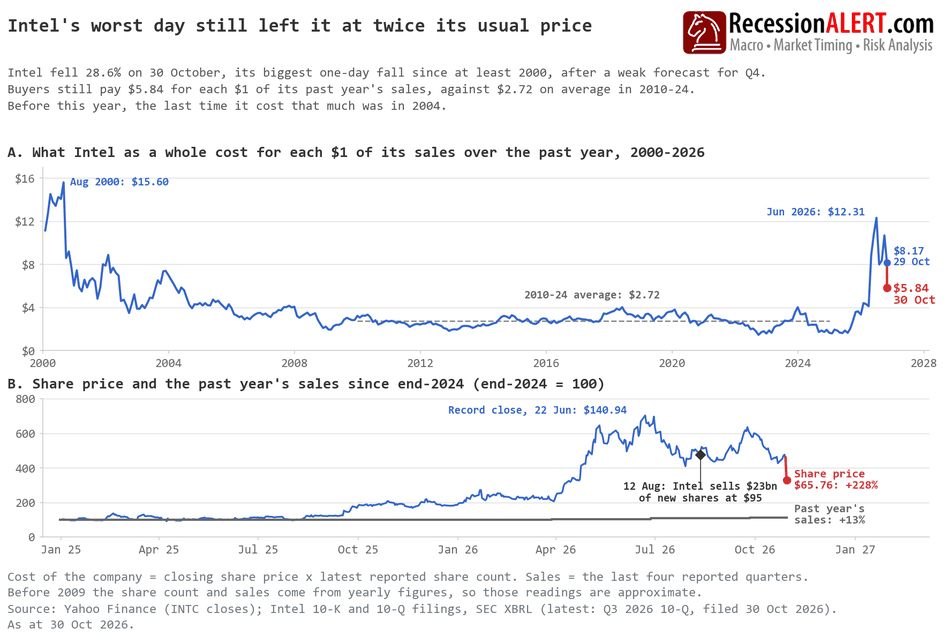
Intel would need about $128bn of yearly sales for its price to look ordinary, even after Friday’s 28.6% fall. That is arithmetic, not a forecast: what would restore Intel’s 2010-24 average of $2.72 per $1 of sales at a $350bn company value, 63% above the $79bn record of 2021. The price did the work, not the business: since end-2024 the shares are +228% and sales +13%. Friday took back part of that rise without undoing it: at $5.84, buyers still pay twice the norm. Such a price trades on the direction of sales, so a quarter that beat guidance could not protect it. Q4 revenue is forecast at $15-16bn against Q3’s $16.5bn, with gross margin, what Intel keeps after production costs, sliding from 43% to 37.1%. How does a business with data-centre sales +78% guide down? Intel says server chips are limited by supply, which arrives on a factory’s timetable. The drags do not wait: PC chips, the larger business, are -5%, with the slowdown seen lasting through at least mid-2027, and a plant accident in Israel carries costs Intel cannot yet estimate. The high price has also turned into cash: in August Intel raised $23bn selling shares at $95, and those buyers are down 31%; the same sum would now take about 350m shares, not 242m. Demand Intel cannot yet fill pays later; everything else bills now — and buyers are still paying double.
What it means: Households will feel this mainly through index funds and retirement accounts. The Nasdaq 100 fell 3.46% on Friday, so another weak forecast from a big chip maker would reach them quickly. For stock investors, shares priced for growth will be judged on what companies forecast, not what they just reported, and a good quarter may offer little protection. For the economy, a soft PC market into 2027 would mean less spending on computers, while server demand should keep data-centre building going. This reading changes if Intel’s Q4 revenue comes in above the top of its $15-16bn forecast.
Market Intelligence Brief (MIB) Ver. 19.98
For professional investors only. Not investment advice.
© 2026 RecessionALERT.com

Comments are closed.