
MARKET INTELLIGENCE BRIEF (MIB)
Friday, November 13, 2026
Three Fed presidents (Williams, Daly and Logan) backed further tightening as December hike odds hit 90% after October PPI, and Treasury Secretary Bessent publicly pushed back. Chips extended the Nvidia fallout: AMD fell 8.75%, Broadcom dropped 4.87% on a downgrade, and HSBC cut Nvidia to Hold. PPI’s 0.3% headline missed, but prices ex-food, energy and trade jumped 0.5%. The dollar closed at its highest since at least April 15. After the close, the FAA grounded departures nationwide.
TABLE OF CONTENTS
A. EXECUTIVE SUMMARY
B. MARKET DATA
C. HIGH-IMPACT STORIES (5)
D. MODERATE-IMPACT STORIES (5)
E. ECONOMY WATCH (1)
F. EARNINGS WATCH (2)
G. WHAT’S NEXT
H. CHART OF THE DAY
A. EXECUTIVE SUMMARY -> TOP
The S&P 500 fell 0.40% and the Nasdaq 100 dropped 1.22% while the Dow edged up 0.10%, as AI hardware was de-rated as a group: AMD and Broadcom fell harder than Nvidia, whose succession remains open and whose customer checks Treasury Secretary Bessent publicly questioned. Rate pricing firmed alongside: Williams, Daly and Logan all leaned toward further tightening, December hike odds rose to 90% despite a headline PPI miss, and the 10-year climbed 2.2 bps to 5.155% while the 2-year slipped. Bessent’s objection to hiking into an energy supply shock opens a Treasury-Fed split, and the IEA’s view that the shortage has shifted from crude to diesel gives each side its evidence. Breadth beat the index: seven of 11 sectors rose, led by Consumer Defensive (+1.37%) and Energy (+0.82%), with losses confined to Technology (-1.67%), Basic Materials, Industrials and Consumer Cyclical, a rotation toward defensives rather than a broad flight from risk.
• Fed hawks align: Williams, Daly and Logan all signalled more tightening; December hike odds rose to 90% from 85% on CME FedWatch, and Bloomberg reported a quarter-point hike priced at each of the December, January and March meetings.
• October PPI: final demand rose 0.3% against 0.4% expected, but the measure ex-food, energy and trade climbed 0.5% and the annual rate rose to 6.5% from 6.3%; truck freight (+3.9%) drove more than 80% of the services gain.
• Chips sold off: AMD fell 8.75% (worst in the S&P 500), Broadcom dropped 4.87% on a Redburn downgrade, and Nvidia slipped 2.01% after HSBC cut it to Hold; the FT reports Nvidia’s board approached Arm CEO Rene Haas as a possible successor to Huang.
• Dollar up, metals down: the dollar index rose 0.20% to 103.38, its highest close since at least April 15, while gold fell 0.24% to $3,876.05 and silver dropped 2.88%, each at its lowest close over that span; Bitcoin fell 4.12%.
• Fed Financial Stability Report: AI was the top-cited risk among market contacts; advanced-computing debt issuance passed $680 billion by October, about five times 2023’s $130 billion, and the largest bank holding companies hold close to $1 trillion of related exposure.
• After the bell: the FAA ordered a nationwide ground stop after a communication failure hit all en-route air traffic control centers, with airlines yet to trade on it.
1. A Hiking Cycle With a Political Fault Line — Three regional presidents, including FOMC vice chair Williams, spoke in terms of a move rather than a condition, and futures now price hikes at three straight meetings. Bessent counters that falling crude will deliver benign numbers, and the data support both readings: October PPI missed at the headline while transportation and warehousing prices jumped 2.0%, and the IEA sees crude returning to surplus even as European diesel sits 77% above pre-war levels. The cost is landing at the long end, where the 10-year rose to 5.155% as the curve steepened and the Fed’s own stability report noted a term premium notably above its historical median. Duration and rate-sensitive equities stay exposed into Wednesday’s FOMC minutes.
2. AI Hardware Risk Has Become a Sector and Supervisory Story — The Nvidia shock spread to AMD, Broadcom, Dell and Arista rather than rewarding rivals, and Bessent’s questions about Nvidia’s customer checks raise the odds of export-control action that would reach the whole supply chain. The same day, the Fed put a number on the debt behind the buildout and on the banks’ share of it. Equity investors and supervisors are now looking at the same risk, which argues for caution on AI-capex beneficiaries until Nvidia’s results on Tuesday and a permanent CEO appointment reduce the uncertainty.
3. A Firm Dollar and a Defensive Bid — Consumer Defensive led and extended its 3-month gain to 10.25%, while gold, silver and Bitcoin all fell as the dollar firmed and real yields rose. Higher rates are also hitting housing first, with mortgage rates above 7%, October existing-home sales at their lowest pace since August 2010 and Stifel cutting Lowe’s to Sell. Monday opens with two weekend risks already visible, the FAA ground stop and an unverified Iranian report of two more tankers hitting mines in the Strait of Hormuz.
 — Leading economic indicators. Accurate market forecasts. Apply for membership at join.recessionalert.com
B. MARKET DATA -> TOP
A chip-led selloff pulled the Nasdaq 100 down 1.22% while the Dow and NYSE Composite edged higher, making this a narrow tech story rather than a broad retreat. Semiconductors extended the turmoil that followed Jensen Huang’s November 12 exit as Nvidia CEO: AMD (-8.75%) gave back part of its recent run and Broadcom (-4.87%) fell after a Rothschild Redburn downgrade, while seven of 11 sectors rose. December rate-hike odds rose to 90% on CME FedWatch after the October PPI release, per Kiplinger, and the 10-year added 2.2 bps to 5.155% while the 2-year slipped, steepening the curve. The dollar posted its highest close since at least April 15, and gold and silver their lowest.
CLOSING PRICES – Friday, November 13, 2026:
MAJOR INDICES
This was a concentrated tech selloff, not a broad retreat: the Nasdaq 100 fell 1.22% while the Dow, DJ Transportation and NYSE Composite all closed higher. The S&P 500’s 0.40% loss masked gains in seven of 11 sectors, with the damage concentrated in chipmakers. Dow Theory bull confirmation is now in its third session, with both the Dow and the transports within 2% of their 10-session highs.
| Index | Close | Change | %Move | Why It Moved |
|---|---|---|---|---|
| S&P 500 | 7,561.67 | -30.73 | -0.40% | Fell as chip stocks extended their slide after Jensen Huang’s November 12 resignation as Nvidia CEO; AMD (-8.75%) was the worst S&P 500 stock of the day, per Kiplinger |
| Dow Jones | 52,347.55 | +50.46 | +0.10% | Edged higher despite Dow component Cisco’s 6.24% earnings-driven drop, per Kiplinger; blue-chips held up better than the tech-heavy indices |
| DJ Transportation | 20,594.07 | +55.15 | +0.27% | No discrete same-day catalyst identified; rose alongside the Dow, keeping Dow Theory bull confirmation in force for a third session |
| Nasdaq 100 | 27,943.74 | -345.45 | -1.22% | Chipmakers led the decline: AMD -8.75%, Broadcom -4.87% after a Rothschild Redburn downgrade (per Investing.com) and Nvidia -2.01% in the wake of Huang’s exit |
| Russell 2000 | 2,790.41 | -8.65 | -0.31% | No discrete same-day catalyst identified; small caps slipped on a day December rate-hike odds rose to 90% on CME FedWatch, per Kiplinger |
| NYSE Composite | 24,520.88 | +53.91 | +0.22% | The broad NYSE gauge rose as seven of 11 sectors gained, with losses concentrated in technology |
VOLATILITY & TREASURIES
The curve steepened: the 10-year rose 2.2 bps while the 2-year slipped 1.9 bps, widening the 2s10s spread to about 29 bps, on a day December hike odds rose to 90% after the PPI release, per Kiplinger. The dollar’s highest close since at least April 15 moved with that firmer rate pricing. The VIX’s 3.16% rise stayed modest beside a 1.22% Nasdaq 100 drop, consistent with a sector-specific rather than market-wide scare.
| Instrument | Level | Change | Why It Moved |
|---|---|---|---|
| VIX | 19.29 | +0.59 (+3.16%) | Rose as tech stocks slid in the afternoon after an early gain for the indices, per Kiplinger |
| 10-Year Treasury Yield | 5.155% | +2.2 bps | Rose after the October PPI release as December rate-hike odds climbed to 90% from 85% on CME FedWatch, per Kiplinger |
| 2-Year Treasury Yield | 4.865% | -1.9 bps | Slipped even as December hike odds rose; no discrete same-day catalyst identified for the front end |
| US Dollar Index (DXY) | 103.38 | +0.21 (+0.20%) | Highest close since at least April 15; firmed as December rate-hike odds rose after the PPI release |
COMMODITIES
Precious metals slid together: gold posted its lowest close since at least April 15 and silver fell 2.88% to its own lowest, as the dollar firmed and rate-hike odds rose. Copper’s 2.11% drop and Bitcoin’s 4.12% slide came on a risk-off day for tech, with no specific catalyst identified for either.
| Asset | Price | Change | %Move | Why It Moved |
|---|---|---|---|---|
| Gold | $3,876.05/oz | $-9.25 | -0.24% | Lowest close since at least April 15; slipped as the dollar firmed and December rate-hike odds rose |
| Silver | $48.625/oz | $-1.440 | -2.88% | Lowest close since at least April 15; no discrete same-day catalyst identified |
| Copper | $6.0650/lb | $-0.1310 | -2.11% | No discrete same-day catalyst identified |
| Platinum | $1,491.80/oz | $-28.60 | -1.88% | No discrete same-day catalyst identified; fell with silver |
| Bitcoin | $68,594.0 | $-2,950.0 | -4.12% | No discrete same-day catalyst identified; fell alongside the tech selloff |
ENERGY
Crude edged higher in lockstep, with Brent (+0.47%) slightly outpacing WTI (+0.30%), while both natural gas benchmarks fell about 3%. Oil held its ground as equities slipped. No discrete same-day catalyst was identified for either gas benchmark.
| Asset | Price | Change | %Move | Why It Moved |
|---|---|---|---|---|
| Crude Oil (WTI) | $89.01/bbl | $+0.27 | +0.30% | Edged higher; Reuters reported the US plans to keep its blockade of Iran in place, while the IEA said the oil market is returning to surplus |
| Crude Oil (Brent) | $96.27/bbl | $+0.45 | +0.47% | Moved with WTI; no discrete same-day catalyst identified beyond the Iran blockade and IEA surplus reports |
| Natural Gas (Henry Hub) | $3.241/MMBtu | $-0.099 | -2.96% | No discrete same-day catalyst identified; gave back most of Thursday’s gain |
| Natural Gas (Dutch TTF) | $28.929/MMBtu | $-0.963 | -3.22% | No discrete same-day catalyst identified |
S&P 500 SECTORS
Seven of 11 sectors rose, with losses confined to Technology (-1.67%), Basic Materials, Industrials and Consumer Cyclical. Consumer Defensive led the day and extended its 3-month gain to 10.25%, while Technology’s 1-month slide deepened to -8.85% despite a positive week. Communication Services rose on the day but remains down 14.69% over six months.
| Sector | 1-Day | 1-Week | 1-Month | 3-Month | 6-Month | YTD | 12-Month |
|---|---|---|---|---|---|---|---|
| Consumer Defensive | +1.37% | +2.31% | +6.52% | +10.25% | +7.11% | +18.22% | +19.09% |
| Energy | +0.82% | +4.04% | -3.54% | +1.04% | +3.74% | +37.98% | +36.25% |
| Financial | +0.64% | +2.50% | +4.31% | -0.38% | +12.11% | +7.88% | +10.80% |
| Healthcare | +0.37% | +1.62% | +6.11% | +9.44% | +24.07% | +16.89% | +16.97% |
| Utilities | +0.34% | +1.73% | +4.90% | -0.47% | -0.88% | +2.07% | -2.65% |
| Communication Services | +0.27% | +3.13% | -9.48% | -5.83% | -14.69% | -7.82% | -4.17% |
| Real Estate | +0.05% | +0.39% | +4.86% | -2.67% | +1.55% | +7.55% | +5.02% |
| Consumer Cyclical | -0.24% | +1.58% | +4.30% | +1.00% | +0.46% | -2.20% | -3.20% |
| Industrials | -0.47% | +3.58% | -0.17% | -9.32% | -5.37% | +6.68% | +7.64% |
| Basic Materials | -0.64% | -1.46% | -2.86% | -7.53% | -5.73% | +7.58% | +13.98% |
| Technology | -1.67% | +2.55% | -8.85% | -9.63% | -3.07% | +14.31% | +11.04% |
TOP MEGA-CAP MOVERS:
GAINERS
| Company | Ticker | Close | Change | Why It Moved |
|---|---|---|---|---|
| Meta Platforms Inc | META | 641.98 | +2.95% | No discrete same-day catalyst identified; Investing.com cited completion of a 9 billion euro senior notes offering, which looks too small to explain a move this size (unverified) |
| Coca-Cola Co | KO | 99.25 | +1.86% | Touched an all-time high after BofA raised its price target to $100, among several target increases today, per Investing.com |
| Chevron Corp | CVX | 219.89 | +1.64% | No discrete same-day catalyst identified; Energy (+0.82%) was the second-best sector with crude modestly higher |
| Walmart Inc | WMT | 128.13 | +1.54% | No discrete same-day catalyst identified; moved with Consumer Defensive, the day’s best sector (+1.37%) |
DECLINERS
| Company | Ticker | Close | Change | Why It Moved |
|---|---|---|---|---|
| Advanced Micro Devices Inc | AMD | 534.06 | -8.75% | No discrete same-day catalyst identified; gave back part of a roughly 45% five-session run that followed Jensen Huang’s November 12 resignation as Nvidia CEO, per Investing.com; worst S&P 500 stock of the day, per Kiplinger |
| Dell Technologies Inc | DELL | 344.53 | -7.18% | Fell after a Bloomberg report, cited by Investing.com, that Dell-built servers containing restricted Nvidia chips were diverted to a Shanghai data center (unverified; Dell said it halted sales to the reseller in February 2025) |
| Cisco Systems Inc | CSCO | 95.64 | -6.24% | Earnings-driven; fiscal first-quarter results were released after Thursday’s close |
| Broadcom Inc | AVGO | 346.63 | -4.87% | Rothschild Redburn downgraded it to Neutral from Buy and cut its price target to $398 from $595, citing AI-financing exposure, per Investing.com; the stock also gave back part of a roughly 25% five-session rally |
| Arista Networks Inc | ANET | 197.29 | -4.52% | No discrete same-day catalyst identified; fell with the session’s broad semiconductor and AI-hardware selloff |
— Institutional-grade intelligence for serious investors. Apply for membership at join.recessionalert.comC. HIGH-IMPACT STORIES -> TOP
BEARISH
1. Williams, Daly and Logan Line Up Behind Further Tightening as Treasury Secretary Bessent Warns Against Hiking “Too Much Into an Energy Supply Shock”
The core facts:New York Fed President John Williams said on Thursday evening that “inflation is far too high and it continues to be high even in the latest data,” and that “we still have work to do in terms of getting monetary policy to the right place.” On Friday, San Francisco Fed President Mary Daly told a University of Nevada, Las Vegas forecasting event that “we’re going to need to, in all likelihood, raise rates,” that services inflation excluding housing is “not moving in the correct direction,” and that “I will deliberate this with my colleagues in December at our meeting,” per Reuters. Dallas Fed President Lorie Logan said in prepared remarks that “inflation is currently trending too high” and that “it is necessary to make policy more restrictive, not less,” while proposing that the Fed open the discount window on weekends and holidays. Treasury Secretary Scott Bessent pushed back on CNBC: “I think that to hike too much into an energy supply shock when it’s coming down — these are very noisy numbers,” adding that “the Fed’s supposed to look into the future, not look in the rearview mirror.”
Why it matters:Three regional presidents in roughly 18 hours, including the New York Fed president who serves as the FOMC’s vice chair, used the language of an imminent move rather than a conditional one. CME FedWatch priced a 90% probability of a December quarter-point hike after Friday’s producer price release, up from 85% a day earlier, per Kiplinger, and Bloomberg reported futures pricing a quarter-point hike at each of the December, January and March meetings. Bessent’s public objection opens a visible split between the Treasury and the Fed: he argues that falling gasoline and crude prices will produce a “benign number likely next week,” while the officials who set policy are pointing to services inflation and resilient consumer spending. For portfolios, that split adds political risk to a hiking cycle the market already treats as nearly certain.
What to watch:The minutes of the October 27-28 FOMC meeting on Wednesday, November 18 at 2:00 p.m. ET, for how many officials already favoured a hike, ahead of the December 8-9 decision.
BEARISH
2. The Dollar Posts Its Highest Close Since at Least April 15 and Gold Its Lowest as December Hike Odds Reach 90% After the October PPI
The core facts:Today’s October producer price report showed a softer-than-expected headline but firmer underlying prices, and rate pricing moved further toward a hike: December odds rose to 90% from 85% on CME FedWatch, per Kiplinger. The 10-year Treasury yield rose 2.2 bps to 5.155% while the 2-year slipped 1.9 bps to 4.865%, widening the 2s10s spread to about 29 bps. The dollar index closed at 103.38, up 0.20% and its highest close since at least April 15. Gold closed at $3,876.05, down 0.24% and its lowest close since at least April 15, and silver fell 2.88% to $48.625, also its lowest close over that span. Bitcoin dropped 4.12% to $68,594 and the Russell 2000 slipped 0.31%.
Why it matters:A headline miss that tightened conditions anyway shows how little room the market sees for a pause: traders read the stronger core measures, not the headline. The move came at the long end while the 2-year slipped, a steepening consistent with investors demanding more to hold longer-dated debt rather than pricing additional near-term hikes. A firmer dollar and a 10-year above 5.1% together tighten financial conditions for multinationals and emerging-market borrowers, and precious metals are losing their bid as real yields rise. That is a headwind for long-duration equities on the same day technology led the losses.
What to watch:October retail sales, import prices and industrial production on Tuesday, November 17, and whether the dollar index holds above 103 into the FOMC minutes on Wednesday.
BEARISH
3. Chip Stocks Extend the Nvidia Fallout: AMD Drops 8.75%, Broadcom Falls 4.87% on a Redburn Downgrade, HSBC Cuts Nvidia to Hold, and Bessent Questions Nvidia’s Customer Checks
The core facts:Technology was the worst S&P 500 sector, down 1.67%, and the Nasdaq 100 fell 1.22% while the Dow rose 0.10% and seven of 11 sectors gained. AMD fell 8.75% to $534.06, the worst S&P 500 stock of the day per Kiplinger. Broadcom fell 4.87% to $346.63 after Rothschild & Co Redburn downgraded it to Neutral from Buy and cut its price target to $398 from $595, per The Fly. HSBC’s Frank Lee cut Nvidia to Hold from Buy and its target to $170 from $365, saying “we believe the uncertainties will prevail until a permanent succession plan is laid out”; Nvidia fell 2.01%. Dell (-7.18%) and Arista Networks (-4.52%) also fell. On CNBC, Treasury Secretary Scott Bessent said “the real story here should be: Did NVIDIA know their client,” and that Treasury, War, USTR and State had favoured putting Megaspeed on the entity list “for months. But Commerce has the pin — Commerce BIS has the pin.”
Why it matters:Thursday’s trade, selling Nvidia and buying the rivals expected to take share, reversed: AMD and Broadcom fell harder than Nvidia itself. The selloff hit AI hardware broadly rather than one company, which points to a sector de-rating. Bessent’s remarks move the official focus from Huang’s conduct to Nvidia’s compliance controls, which raises the odds of export-control penalties, tighter licensing and an entity-list action that would hit the whole supply chain. Because AI hardware carries so much index weight, a de-rating here pulled the S&P 500 down 0.40% even on a day when most sectors rose.
What to watch:Nvidia’s third-quarter results after the close on Tuesday, November 17, the first under interim CEO Colette Kress, and any Commerce Department entity-list action on Megaspeed.
UNCERTAIN
4. IEA Says the Oil Market Is Returning to Surplus as Gulf Supply Recovers, but Calls Diesel Tightness the “Overriding Concern”
The core facts:The International Energy Agency’s November Oil Market Report sees “tentative signs of rebalancing” and expects a return to surplus in the fourth quarter, with a larger build in 2027. It forecasts 2026 demand falling 2.7 mb/d to 102.3 mb/d before a 2 mb/d rebound in 2027. Global supply rose 2.3 mb/d to 105.4 mb/d in October, OPEC+ crude output climbed to 37.72 mb/d from 35.71 mb/d, and observed inventories rose 52 million barrels, the first increase since June, although OECD stocks fell 47 million barrels. Gulf exports excluding Oman reached 18.4 mb/d, still 26% below pre-war levels. The agency said Dated Brent fell 32% from an early-October high of $136 to about $93, while European diesel near $180 a barrel is 77% above pre-war levels. WTI closed at $89.01, up 0.30%, and Brent at $96.27, up 0.47%. After the settlement, Iranian state television said two more tankers hit sea mines in the Strait of Hormuz, a claim that could not be independently verified.
Why it matters:A forecast surplus caps crude, but the shortage has moved from crude to refined products, and diesel is what feeds trucking and goods prices. That is why Bessent can point to “crude down $20” while October producer prices still showed transportation and warehousing up 2.0%. For the Fed, falling crude supports the Treasury’s argument for patience, while sticky diesel supports the officials who want to hike. Energy equities rose 0.82%, the second-best sector. The new mine claims are a risk for Monday’s session.
What to watch:Weekend shipping incidents in the Strait of Hormuz, and whether Brent holds above $95 when trading resumes Sunday evening.
BEARISH
5. FAA Orders a Rare Nationwide Ground Stop After a Communication Failure Hits All En-Route Air Traffic Control Centers
The core facts:After the close on Friday, the Federal Aviation Administration halted departing flights at US airports “due to extraordinary circumstances and for reasons of safety,” per CBS News. Transportation Secretary Sean Duffy said the order followed “a communication issue impacting all Air Route Traffic Control Centers” and that FAA technicians were investigating. The Air Traffic Control System Command Center said departures should remain grounded until further notice, with inbound international flights handled case by case. About 3,100 aircraft bound for US airports were airborne when the stop began, according to FlightRadar24, and FlightAware listed at least 8,000 delays and 400 cancellations shortly afterwards. The Homeland Security secretary said there was “no indication, as of yet, that this was a nefarious act against us.” CBS’s 5:15 p.m. ET update did not report the stop being lifted.
Why it matters:A failure across every en-route center, not one airport, is a systemic outage of the national airspace system, and it hit on a Friday evening with thousands of flights in the air. Because it began after the close, airlines, air-freight carriers and travel stocks have not yet traded on it, and their exposure on Monday depends on how long the stop lasts and how many crews and aircraft end up out of position over the weekend. It also adds to the debate over the condition of the FAA’s ageing air traffic control equipment.
What to watch:When the FAA lifts the stop and identifies the cause, and Monday’s opening moves in Delta, United, American and Southwest.
— Quantifying recession risk so you don’t have to guess. Apply for membership at join.recessionalert.comD. MODERATE-IMPACT STORIES -> TOP
UNCERTAIN
6. Nvidia’s Board Approached Arm CEO Rene Haas as a Possible Successor to Jensen Huang, the Financial Times Reports
The core facts:Nvidia’s board has approached Arm Holdings CEO Rene Haas as a potential successor to Jensen Huang, the Financial Times reported on Friday, citing people familiar with the matter. Haas is among several candidates being considered. Reuters said it could not independently verify the report; Arm declined to comment and Nvidia did not immediately respond. During the session, Reuters reported Arm’s US-listed shares down more than 5% and Nvidia down more than 3%; Nvidia closed 2.01% lower. Chief financial officer Colette Kress has been interim CEO since Huang stepped down on Thursday.
Why it matters:The report is the first sign that the board is moving quickly toward a permanent leader, which is exactly the uncertainty HSBC cited the same day in cutting the stock to Hold. Haas would bring chip-architecture and licensing credibility, but Arm’s decline shows investors pricing the cost to Arm of losing its chief executive. A fast, credible appointment would reduce one of the two overhangs on the world’s largest company; the export-compliance questions raised by Washington would remain.
What to watch:Any comment on the CEO search on Nvidia’s earnings call on Tuesday, November 17.
UNCERTAIN
7. The Fed’s Financial Stability Report Names AI the Top-Cited Risk and Puts AI-Related Debt Issuance Above $680 Billion
The core facts:The Federal Reserve’s November 2026 Financial Stability Report, released Friday, says that in a survey of 23 market contacts in September and October “AI was the top-cited risk, with responses noting concerns around elevated equity valuations, AI-enabled cyberattacks, and complex forms of AI-related financing.” Respondents also widely cited a correction in risk assets and a further rise in long-dated Treasury yields; cyberattacks and fiscal debt sustainability were seen as having the most severe potential consequences. The report puts advanced computing–related debt issuance at more than $680 billion by October 2026, about five times the $130 billion issued in all of 2023, says the largest US bank holding companies have close to $1 trillion of exposure to large technology firms, data center developers and related vehicles, and notes that large technology firms are rapidly increasing lease commitments and backstop guarantees. It also says the Treasury term premium rose notably above its historical median.
Why it matters:The Fed is now putting a number on how far the AI buildout is financed with debt and off-balance-sheet commitments, and on how much of that risk sits with the banks. That moves AI financing from a market worry to a supervisory one, which can mean closer scrutiny in stress tests and higher capital costs for lenders to data center projects. It landed on a day AI hardware led the market lower, and the report’s warning about rising long-term yields came as the 10-year closed at 5.155%.
What to watch:Whether Fed officials cite the report’s AI-financing findings in remarks next week, and new investment-grade issuance by large technology companies.
UNCERTAIN
8. CFTC Sues Arkansas to Defend Its Jurisdiction Over Prediction Markets as a Louisiana Court Bars Robinhood, Coinbase and Kalshi From the State
The core facts:The Commodity Futures Trading Commission said on Friday it has sued Arkansas, which is pursuing a state-court enforcement action against Kalshi, to block the state from halting event-contract trading and from imposing civil penalties of up to hundreds of millions of dollars on CFTC-registered exchanges. Chairman Michael Selig said the agency “will continue to defend its sole jurisdiction over these federally regulated markets as granted by Congress” and “will not let state interference thwart its regulatory efforts and destroy federally regulated markets.” Separately, Judge Jeffrey Johnson of Louisiana’s 21st Judicial District Court signed an ex parte temporary restraining order on Thursday, posted that evening, barring 31 entities across 13 brands, including Robinhood Markets, Coinbase Global, Kalshi, Polymarket and Crypto.com, from offering sports, election and awards event contracts in Louisiana and requiring them to geofence the state, per Legal Sports Report. A preliminary-injunction hearing is set for November 30.
Why it matters:The federal regulator is now in court against a state, so the question of who regulates prediction markets is headed for a ruling, probably on appeal. Until then, the listed brokers that have built event-contract businesses, Robinhood and Coinbase among them, face a growing patchwork of state bans that can switch off revenue state by state with little notice. A federal win would protect a fast-growing product line; a string of state wins would turn it into a compliance liability.
What to watch:The Louisiana preliminary-injunction hearing on Monday, November 30, and whether the court in the Arkansas case grants an injunction first.
BULLISH
9. SEC Proposes a Rewrite of Executive-Pay Disclosure, Cutting Named Executives to Two and Raising the Perquisite Threshold to $150,000
The core facts:The Securities and Exchange Commission on Friday proposed changes to executive and director compensation disclosure under Item 402 of Regulation S-K (Release 2026-114). Named executive officers would be limited to the principal executive and principal financial officers, usually two people instead of five or more. Four summary tables would be replaced by three: Earned Compensation, Granted Compensation and Status of Equity Awards. The perquisite reporting threshold would rise to $150,000 from $10,000. Pay-versus-performance disclosure would use fewer measures and replace “Compensation Actually Paid” with total earned compensation, and the pay-ratio median employee would be drawn only from US full-time staff, determined every five years. Chairman Paul Atkins said the proposal “aims to elicit more informative disclosure rooted in materiality.” Comments are open for 60 days after Federal Register publication.
Why it matters:This is the largest proposed change to proxy pay disclosure since the pay-versus-performance rule, and it continues the Atkins SEC’s push to cut reporting costs for public companies. For every S&P 500 issuer it means lower compliance costs and shorter proxies. Governance-focused investors and proxy advisers lose some of the data they use to judge pay against performance, so expect pushback during the comment period.
What to watch:Federal Register publication, which starts the 60-day comment clock, and responses from large asset managers and proxy advisers.
UNCERTAIN
10. Stifel Cuts Lowe’s to Sell and Gordon Haskett Cuts TJX to Hold Ahead of Next Week’s Reports, While KeyBanc Upgrades Palo Alto Networks
The core facts:Stifel downgraded Lowe’s to Sell from Hold and cut its price target to $190 from $195 ahead of the company’s fiscal third-quarter report, per The Fly. Gordon Haskett downgraded TJX Companies to Hold from Accumulate. KeyBanc upgraded Palo Alto Networks to Overweight from Sector Weight with a $380 price target. All three companies report on Wednesday, November 18: Lowe’s and TJX before the open, Palo Alto Networks after the close.
Why it matters:A Sell call on a home-improvement leader days before it reports is a bet that the housing slump is now reaching results. Existing-home sales fell to a 3.75 million annual pace in October, the lowest since August 2010, per the National Association of Realtors, and mortgage rates remain above 7%. The TJX downgrade questions whether off-price retail can keep outgrowing a slowing consumer. The Palo Alto upgrade points the other way for security software, on a day AI hardware sold off.
What to watch:Home Depot’s comparable sales on Tuesday, November 17, as the first read on whether Stifel’s Lowe’s call is right.
— Separating signal from noise since 2007. Apply for membership at join.recessionalert.comE. ECONOMY WATCH -> TOP
A softer-than-expected headline producer price print did nothing to loosen the Fed’s path toward a December hike. October PPI rose 0.3% against a 0.4% forecast, but prices excluding food, energy and trade climbed 0.5% and the annual rate reached 6.5%, so pipeline inflation is still running hot even as September’s 1.4% surge faded. December hike odds rose to 90% from 85% on CME FedWatch after the release, per Kiplinger, and the 10-year yield closed at 5.155%. With October CPI, claims and housing data already in hand, next week’s retail sales and FOMC minutes are the remaining tests before the December 9 decision.
October PPI Rises 0.3%, Below the 0.4% Forecast, but Prices Excluding Food, Energy and Trade Climb 0.5% and the Annual Rate Reaches 6.5% (BLS, Nov 13)
What they’re saying:The Producer Price Index for final demand rose 0.3% in October, below the 0.4% consensus and down from 1.4% in September, the Bureau of Labor Statistics reported. Core PPI excluding food and energy rose 0.3%, in line with forecasts, after 0.8% the prior month, while the narrower measure excluding food, energy and trade services climbed 0.5%. Final demand prices are up 6.5% over 12 months (not seasonally adjusted), from 6.3% in September; goods rose 0.5% and services 0.2%, with food up 1.3% and energy down 0.1%.
The context:The cooler headline owes much to trade margins, which fell 0.2%; transportation and warehousing prices jumped 2.0%, and truck freight (+3.9%) accounted for more than 80% of the services increase, per BLS. The softer headline did not ease rate pricing: December hike odds rose to 90% from 85% on CME FedWatch after the release, per Kiplinger, the 10-year yield closed up 2.2 bps at 5.155% while the 2-year slipped 1.9 bps, and the dollar index posted its highest close since at least April 15.
What to watch:October import prices, retail sales and industrial production on Tuesday, November 17, and the FOMC minutes on Wednesday, November 18, ahead of the December 9 decision.
— Know the probability before the market prices in the risk. Apply for membership at join.recessionalert.comF. EARNINGS WATCH -> TOP
YESTERDAY AFTER THE BELL (Markets Reacted Today)
BULLISH
11. Cisco Systems (CSCO): -6.24% | Shares Fall Despite Record Revenue and a Raised Fiscal 2027 Outlook; Gross Margin Narrowed to 65.6%
The Numbers:Released: AMC, Thursday, November 12. Fiscal first-quarter revenue of $18.5 billion, up 24%, against the $18.12 billion consensus; non-GAAP EPS of $1.40 against $1.33 expected; GAAP EPS $1.14. Second-quarter guidance: revenue of $18.0 billion to $18.2 billion and non-GAAP EPS of $1.34 to $1.36. Fiscal 2027 guidance raised to revenue of $74.8 billion to $75.8 billion and non-GAAP EPS of $5.47 to $5.53, from $72.2 billion to $73.4 billion and $5.05 to $5.11 in August. The shares closed down 6.24% at $95.64 on Friday, after trading 1.66% lower in extended trading on Thursday.
The Problem/Win:The win was volume: product revenue rose 32%, Networking 43%, and Cisco raised its expectation for AI infrastructure revenue from hyperscalers to $9 billion in fiscal 2027. The weak line was profitability: non-GAAP gross margin fell to 65.6% from 68.1% a year earlier, and second-quarter revenue guidance sits below the $18.5 billion just delivered. The regular-session decline was far larger than the after-hours move.
The Ripple:Cisco is a Dow component; the Dow still closed up 0.10% despite its drop, per Kiplinger. Networking peer Arista fell 4.52% in the same session, as AI hardware sold off broadly.
What It Means:Investors are paying for AI networking growth only when it comes without margin dilution, and this quarter it did not. A raised full-year outlook was not enough to offset a falling gross margin in a market that is de-rating AI hardware.
What to watch:Whether second-quarter gross margin holds near the first quarter’s 65.6%.
BULLISH
12. Applied Materials (AMAT): -2.74% | Record $10.41 Billion Revenue and an $11.1 Billion First-Quarter Outlook Fail to Lift the Shares in a Chip Selloff
The Numbers:Released: AMC, Thursday, November 12. Fiscal fourth-quarter revenue of $10.41 billion, up 53%, against the $10.30 billion consensus; non-GAAP EPS of $4.16 against $4.06 expected; GAAP EPS $3.40. Non-GAAP gross margin 50.6%. Fiscal 2026 revenue of $34.45 billion, up 21%. First-quarter guidance: revenue of $11.1 billion, plus or minus $500 million, and non-GAAP EPS of $4.35, plus or minus $0.20. The shares fell 2.74% on Friday after trading 0.21% higher in extended trading on Thursday.
The Problem/Win:Semiconductor Systems revenue reached $8.00 billion and Applied Global Services $1.90 billion, and China fell to 25% of revenue from 28% the prior quarter, reducing exposure to export controls. The first-quarter midpoint implies about 7% sequential growth. The decline came on a day technology was the worst sector, down 1.67%.
The Ripple:The outlook shows chipmakers are still ordering equipment for leading-edge capacity, supportive for Lam Research and KLA over the medium term, but it did not shield the group from Friday’s selling.
What It Means:The fundamentals are intact; the stock traded with the sector rather than the report. Equipment makers sell to the whole industry rather than to one chip designer, which makes them the less exposed way to hold AI semiconductors while Nvidia’s leadership and export questions are unresolved.
What to watch:Nvidia’s results on Tuesday, November 17, as the next test of AI capital spending plans, and whether China’s share holds near 25%.
TODAY BEFORE THE BELL (Markets Already Reacted)
No major earnings before the bell from companies with >$100B market cap.
TODAY AFTER THE BELL (Markets React Tomorrow)
No major earnings after the bell from companies with >$100B market cap.
WEEK AHEAD PREVIEW:
Q3 2026 earnings season is nearly complete, with 91% of the S&P 500 reported as of November 13, per FactSet. The next five sessions carry seven in-scope reporters above $100 billion: Nvidia, Home Depot and Disney on Tuesday, November 17; Palo Alto Networks, TJX and Lowe’s on Wednesday, November 18; and Walmart on Thursday, November 19.
NVIDIA (NVDA) — AMC, Tuesday, November 17 — consensus EPS $2.47 and about $108.9 billion of revenue, against company guidance of $108.0 billion, plus or minus 2%; key focus: the first report under interim CEO Colette Kress after HSBC cut the stock to Hold on succession uncertainty, any comment on the CEO search following the report that the board approached Arm’s Rene Haas, data-center revenue after $89.0 billion (+117%) last quarter, and China exposure as the Treasury Secretary questions whether Nvidia knew its customers.
Home Depot (HD) — BMO, Tuesday, November 17 — consensus EPS $3.84 and about $42.8 billion of revenue; key focus: whether comparable sales build on the second quarter’s 1.7% gain against full-year guidance for comparable sales flat to up 2%, with existing-home sales at their lowest since August 2010 and the 10-year yield above 5.1%.
Walt Disney (DIS) — BMO, Tuesday, November 17 — consensus EPS $1.68 and about $25.2 billion of revenue; key focus: delivery on guidance for about $4.9 billion of fourth-quarter segment operating income, softer domestic streaming advertising, weaker Asian park attendance, and the first fiscal 2027 outlook.
Palo Alto Networks (PANW) — AMC, Wednesday, November 18 — consensus EPS $0.97 and about $3.31 billion of revenue, in line with company guidance; key focus: Next-Generation Security ARR against guidance of $9.54 billion to $9.56 billion, AI-driven security demand and margins, after KeyBanc upgraded the stock to Overweight on Friday.
TJX Companies (TJX) — BMO, Wednesday, November 18 — consensus EPS $1.34 and about $15.8 billion of revenue; key focus: third-quarter comparable sales against guidance of up 2% to 3%, after a 4% second-quarter gain, and whether growth at the Marmaxx division has steadied, after Gordon Haskett cut the stock to Hold on Friday.
Lowe’s (LOW) — BMO, Wednesday, November 18 — consensus EPS $2.89 and about $22.4 billion of revenue; key focus: comparable sales against a roughly flat full-year outlook, the drag from weak housing activity, and Pro demand as the Foundation Building Materials acquisition is integrated, after Stifel cut the stock to Sell on Friday; read it against Home Depot’s figures from the previous day.
Walmart (WMT) — BMO, Thursday, November 19 — +1.54% today; consensus EPS $0.64 and about $187.3 billion of revenue, against company guidance of $0.62 to $0.64 and net sales growth of 3% to 3.75% in constant currency; key focus: Walmart U.S. comparable sales after the second quarter’s 2.6% gain missed expectations, fuel costs the company expects to exceed its original plan by more than $2 billion this fiscal year, and the drag from drug-pricing rules.
Excluded as ADRs: Alibaba Group (BABA, $234.79 billion) and PDD Holdings (PDD, $112.41 billion), both BMO on Thursday, November 19, and today’s three largest reporters, Mitsubishi UFJ Financial ($245.71 billion, AMC), Sumitomo Mitsui Financial ($156.25 billion, BMO) and Mizuho Financial ($124.55 billion, AMC). No in-scope company above $100 billion reports on Monday, November 16 or Friday, November 20. Intuit ($91.31 billion, AMC Thursday, November 19) is below the threshold.
— US market commentary trusted by family offices and institutions. Apply for membership at join.recessionalert.comG. WHAT’S NEXT -> TOP
UPCOMING RELEASES:
| Date | Event | Why It Matters |
|---|---|---|
| Sat-Sun, Nov 14-15 | FAA ground stop and Strait of Hormuz shipping (no scheduled time) | How long the nationwide ground stop lasts sets airlines’ and air-freight carriers’ exposure at Monday’s open; any confirmed tanker mine strikes would test Brent’s hold above $95 when trading resumes Sunday evening. |
| Mon, Nov 16 | NY Empire State Manufacturing Index (Nov; prior 25.5) | First November read on factory activity and input prices, after October PPI showed transportation and warehousing costs up 2.0%. |
| Tue, Nov 17 | Retail Sales (Oct; expected 0.0%, prior 0.8%; ex-autos expected 0.4%) | The high-impact release of the week before the minutes: firm spending would back the officials pointing to resilient consumer demand and harden December hike odds, already at 90%. |
| Tue, Nov 17 | Import Prices (Oct; prior 1.1%) and Export Prices (Oct; prior 2.2%) | A direct test of Bessent’s case that falling crude will soon show up as softer inflation. |
| Tue, Nov 17 | Industrial Production (Oct; expected 0.1%, prior 0.7%) and NAHB Housing Market Index (Nov; prior 29) | Output momentum after September’s 0.7% gain, and builder sentiment with mortgage rates above 7% and existing-home sales at their lowest pace since August 2010. |
| Wed, Nov 18 | Housing Starts (Oct; expected 1.23M, prior 1.221M) and Building Permits (Oct; prior 1.398M) | Shows whether the housing slump is reaching construction, the read-through Stifel is betting on with its Sell call on Lowe’s. |
| Wed, Nov 18 | EIA Crude Oil Stocks (week to Nov 14; prior 4.657M) | Checks the IEA’s call that the crude market is returning to surplus while diesel stays tight. |
| Wed, Nov 18 | FOMC Minutes, October 27-28 meeting (2:00 PM ET) | The week’s key event: how many officials already favoured a hike in October, three weeks before the December 8-9 decision and days after Williams, Daly and Logan argued for more tightening. |
| Thu, Nov 19 | Initial Jobless Claims (expected 200K, prior 200K), Philadelphia Fed Manufacturing (Nov; prior 20.9) and a speech by the Fed’s Hammack (8:50 AM ET) | Claims holding near 200K would give the Fed no labour-market reason to pause, and Hammack is a scheduled Fed voice the day after the minutes. |
| Fri, Nov 20 | Michigan Consumer Sentiment, Final (Nov; expected 51.0, prior 48.0) | A gauge of how households are absorbing rising rates and fuel costs, and of their inflation expectations ahead of December. |
KEY QUESTIONS:
1. Will Wednesday’s minutes show a hiking majority already forming in October, or will Bessent’s warning against hiking into an energy supply shock find support inside the committee before the December 8-9 decision?
2. Will Tuesday’s import prices and retail sales support the Treasury’s view that falling crude will cool inflation, or the regional presidents’ focus on services prices and diesel-driven freight costs?
3. Can Nvidia’s results on Tuesday and progress toward a permanent CEO halt the AI-hardware de-rating, or will a Commerce entity-list action on Megaspeed widen it across the supply chain?
— US market commentary trusted by family offices and institutions. Apply for membership at join.recessionalert.comH. CHART OF THE DAY -> TOP
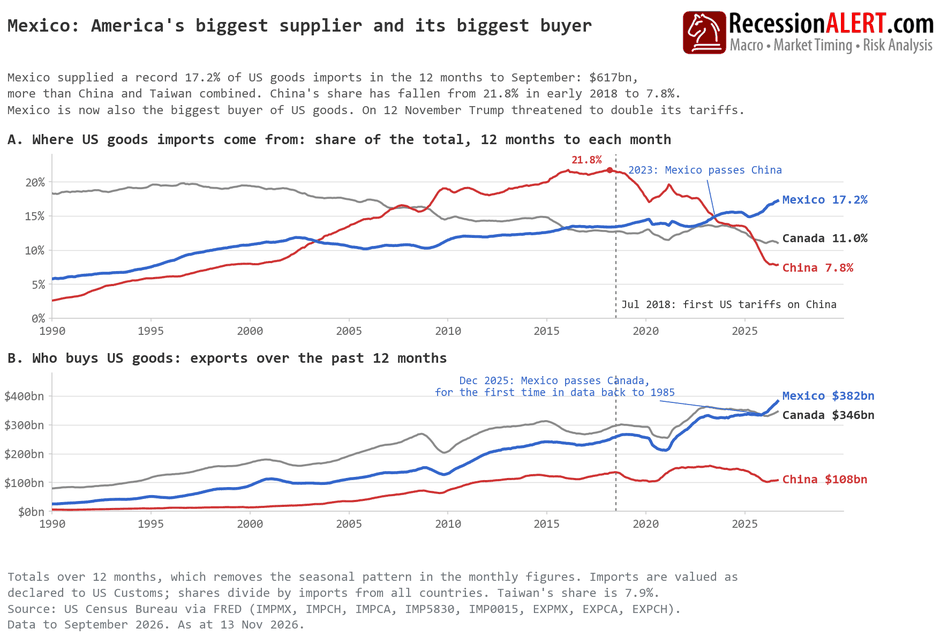
Trump has threatened to double tariffs on the one country that now sells America more goods than any other and buys more from it too. After the 2018 tariffs, most of the share China lost went to Taiwan and Vietnam, but Mexico gained the most in dollars, about $291bn a year more than in mid-2018, and it is still accelerating: September imports from Mexico were a record $62.2bn, 40% above a year earlier. Why Mexico? A door the tariffs left open. Goods that meet the rules of USMCA, the US-Mexico-Canada trade pact, enter duty-free, and by July 2025 about 80% of imports from the two neighbours claimed that exemption, up from roughly half of Mexico’s before. His threat named no tariff, though, and doubling a rate that qualifying goods do not pay would change little for them; the real exposure is the exemption itself, and he declined in July to extend the pact. If that door shut, the cost would fall first on US households and factories, which buy more from Mexico than from anywhere else, then on the farms and plants selling Mexico $382bn a year, more than three times what China buys and squarely in the line of any retaliation. Against China, a tariff taxed the seller; against Mexico, it would tax the customer too.
What it means: For households, Mexico is now the largest single source of goods Americans buy. A tariff reaching its duty-free trade would touch more of the shopping basket than any tariff on China now can. For stock investors, the line to watch is the trade-pact exemption, not the headline rate: companies that make or buy goods in Mexico face this threat mainly through it. For the economy, US farms and factories sell Mexico $382bn a year and would bear any retaliation. The read changes if an order names the exemption, or if a new trade deal locks it in.
Market Intelligence Brief (MIB) Ver. 20.05
For professional investors only. Not investment advice.
© 2026 RecessionALERT.com

Comments are closed.