
MARKET INTELLIGENCE BRIEF (MIB)
Tuesday, November 3, 2026
Chips snapped a four-session slide on Election Day, lifting the Nasdaq 100 0.68% back above 28,000 even as eight of 11 sectors fell, and AMD rose 7.49% after hours on a roughly $17 billion fourth-quarter guide. Job openings beat at 7.52 million and the 10-year yield rose 5.5 bps to 4.966%. Brent swung more than $6 on unconfirmed US-Iran reports, then closed down 0.33%. Meta (META) talked 30-year bonds nearly 90 bps wider than April. Midterm results land overnight.
TABLE OF CONTENTS
A. EXECUTIVE SUMMARY
B. MARKET DATA
C. HIGH-IMPACT STORIES (5)
D. MODERATE-IMPACT STORIES (6)
E. ECONOMY WATCH (3)
F. EARNINGS WATCH (11)
G. WHAT’S NEXT
H. CHART OF THE DAY
A. EXECUTIVE SUMMARY -> TOP
Election Day brought a narrow, chip-led rebound: the Nasdaq 100 rose 0.68% back above 28,000 and the S&P 500 gained 0.36%, but the Dow fell 0.38%, and the bond market did not share the calm, with the 10-year yield up 5.5 bps to 4.966% even as the VIX eased 1.61% to 20.81. September job openings of 7.52 million beat the 7.10 million consensus and factory orders rose 1.8%, undercutting the weak-labor case the Fed would need to skip a December hike and pressing on the long-duration tech names that led. Crude’s war premium proved headline-driven: Brent swung more than $6 on unconfirmed US-Iran reports after a US strike on Qeshm Island failed to lift it. Breadth was poor, with only Technology, Industrials and Communication Services higher and Consumer Defensive, the month’s leader, down 1.88%, a one-day reversal of leadership rather than an end to the rotation out of mega-cap tech.
• Chips bounce from oversold: The Philadelphia Semiconductor Index rose nearly 3%, its first gain in five sessions, after falling 15% since late September. GE Vernova (GEV) rose 6.49%, Oracle (ORCL) 5.85% and Amphenol (APH) 5.45%; AMD rose 3.65% in the session and 7.49% after hours on a roughly $17 billion fourth-quarter revenue guide.
• Bear steepening: The 10-year rose 5.5 bps to 4.966% and the 2-year 3.7 bps to 4.633%, widening 2s10s to about 33 bps. JOLTS openings of 7.52 million beat 7.10 million, quits climbed to 3.4 million, and factory orders rose 1.8% against a 1.2% forecast. CME FedWatch had December hike odds at 77% before the open.
• Oil whipsaw: Brent fell from $107.24 to an intraday low of $100.80 on unconfirmed reports of US-Iran progress, then closed at $104.42, down 0.33%; WTI closed at $96.81, up 0.36%. After the settle, the API reported a 5.27 million-barrel crude draw against an expected 2.1 million-barrel build.
• AI financing gets dearer: Meta (META) launched a $20 billion-plus bond sale, its 30-year talked at about 2.5 points over Treasuries, nearly 0.9 points wider than in April. Oracle priced its $10 billion share sale at $116, about 11% below its October 30 close.
• Semis under pressure from two sides: BofA and TD Cowen downgraded Marvell (MRVL) over Lumentum deal dilution, and Cantor cut its target to $225. The FT reported, unconfirmed by Nvidia (NVDA), that it requires cloud partners to sell at least 51% of their services to non-Chinese customers.
• Midterms after the close: Polls and analysts expect Democrats to win the House, with the Senate uncertain. Deutsche Bank notes the S&P 500 has been higher a year after every midterm since 1946, by an average of 14.4%.
1. The AI Build-Out Is Still Funded, but at a Higher Price — Meta is paying almost 90 basis points more on 30-year money than six months ago, and Oracle had to sell about 9.7 million more shares than its prospectus assumed to raise the same $10 billion. Marvell’s downgrades turn on years of dilution, and Nvidia’s reported customer-mix rule would cap one source of compute demand. With the 10-year near 5%, rising capital costs squeeze the return on hyperscaler spending, so today’s chip bounce from an oversold base needs AMD’s after-hours gain, and Qualcomm and Arm after Wednesday’s close, to prove it is more than short covering.
2. The Data Are Not Giving the Fed a Reason to Skip December — Job openings beat by about 420,000, quits rose to 3.4 million and factory orders posted a third straight gain, all at odds with September’s 29,000 payroll gain. The bond market heard it: the long end led a bear steepening while equity volatility eased. Energy adds to the pressure, with September CPI inflation at 3.7% and crude’s premium now hostage to diplomacy. Friday’s October payrolls (65,000 expected) are the next test, and a strong print would put a 10-year close above 5% in play.
3. A Week of Stacked Event Risk, Priced for Calm — Midterm results overnight, Treasury’s refunding statement on Wednesday, payrolls on Friday, October CPI on November 10 and the Russia-Ukraine-US talks in Abu Dhabi on November 10-11 all land between now and November 11. The VIX easing to 20.81 on Election Day suggests investors are not positioned for a disorderly outcome, while Brent’s $6 swing on unconfirmed reports shows oil can reprice sharply in either direction on a single headline.
 — Leading economic indicators. Accurate market forecasts. Apply for membership at join.recessionalert.com
B. MARKET DATA -> TOP
The AI trade snapped back on midterm Election Day: chip stocks posted their first gain in five sessions, per Investing.com, and the Nasdaq 100 closed back above 28,000, while the Dow and NYSE Composite slipped — a narrow, tech-led tape with only three of 11 sectors higher. The past month’s defensive leaders gave up the most ground, with Consumer Defensive down 1.88%, and Apple’s earnings-driven decline cut against the rally in AI hardware. The bond market did not share the calm: the VIX eased but the 10-year yield rose 5.5 bps. Metals sold off broadly, platinum to its lowest close since at least April 15, while crude settled lower on hopes for talks to end the Iran and Ukraine wars, per Reuters.
CLOSING PRICES – Tuesday, November 3, 2026:
MAJOR INDICES
A narrow, tech-led advance: the Nasdaq 100 reclaimed 28,000 and the S&P 500 rose, while the Dow and the NYSE Composite slipped — breadth did not follow the headline. Over 10 sessions the Russell 2000 has outperformed the S&P 500 by 3.3 points, now a six-session pattern of broad participation, and the S&P 500 has beaten the Nasdaq 100 by 2.6 points, a broadening rotation that extends into a second session and that today’s chip rebound only dented.
| Index | Close | Change | %Move | Why It Moved |
|---|---|---|---|---|
| S&P 500 | 7,568.92 | +27.52 | +0.36% | Rose on a rebound in AI and chip stocks on midterm Election Day; the Philadelphia Semiconductor Index gained nearly 3%, its first advance in five sessions, per Investing.com. |
| Dow Jones | 51,786.72 | -197.26 | -0.38% | Fell as gains were confined to chips and AI hardware while defensive and consumer sectors declined; no single catalyst identified. |
| DJ Transportation | 20,599.68 | -43.24 | -0.21% | Slipped after Monday’s gain; no discrete same-day catalyst identified. |
| Nasdaq 100 | 28,180.26 | +190.44 | +0.68% | Led on the AI and chip rebound and closed back above 28,000, from 27,989.82 on Monday. |
| Russell 2000 | 2,812.45 | +6.57 | +0.23% | Edged higher; no discrete same-day catalyst identified. |
| NYSE Composite | 24,307.04 | -65.03 | -0.27% | Fell as eight of 11 sectors closed lower; gains were limited to technology, industrials and communication services. |
VOLATILITY & TREASURIES
Equity volatility eased but Treasuries sold off, with the 10-year rising more than the 2-year — a bear steepening that widened the 2s10s spread to about 33 bps. The bond market did not share the equity calm on Election Day; the session’s data were a 1.8% rise in September factory orders and little-changed JOLTS openings. The dollar was barely changed.
| Instrument | Level | Change | Why It Moved |
|---|---|---|---|
| VIX | 20.81 | -0.34 (-1.61%) | Eased alongside the AI-stock rebound on Election Day; no discrete catalyst identified. |
| 10-Year Treasury Yield | 4.966% | +5.5 bps | Rose; no single confirmed driver. Same-day data: September factory orders +1.8% (Census) and JOLTS openings little changed at 7.5 million (BLS). |
| 2-Year Treasury Yield | 4.633% | +3.7 bps | Rose less than the 10-year, steepening the curve; no single confirmed driver. |
| US Dollar Index (DXY) | 101.86 | +0.11 (+0.11%) | Little changed; no discrete catalyst identified. |
COMMODITIES
Metals sold off across the complex while equities rose: copper, platinum and silver each fell more than twice as hard as gold, so industrial and precious metals moved together rather than splitting. Platinum closed at its lowest since at least April 15. Bitcoin instead tracked the tech rebound.
| Asset | Price | Change | %Move | Why It Moved |
|---|---|---|---|---|
| Gold | $3,937.42/oz | $-32.18 | -0.81% | No discrete same-day catalyst identified; ING cited expectations for higher interest rates and selling tied to the tech-stock retreat, per Investing.com. |
| Silver | $49.818/oz | $-1.070 | -2.10% | No discrete same-day catalyst identified; fell with the broad metals selloff. |
| Copper | $6.4090/lb | $-0.1585 | -2.41% | No discrete same-day catalyst identified. |
| Platinum | $1,419.05/oz | $-35.35 | -2.43% | Lowest close since at least April 15; no discrete same-day catalyst identified. |
| Bitcoin | $77,985.00 | $+1,099.00 | +1.43% | Rose alongside the tech rebound; no discrete crypto catalyst identified. |
ENERGY
Both crude benchmarks settled lower on hopes for talks to end the Iran and Ukraine wars, per Reuters, then recovered after the settle, leaving WTI slightly higher and Brent slightly lower at the late print; the WTI–Brent spread compressed. Gas split by region, with Henry Hub higher and Dutch TTF lower.
| Asset | Price | Change | %Move | Why It Moved |
|---|---|---|---|---|
| Crude Oil (WTI) | $96.81/bbl | $+0.35 | +0.36% | Settled $96.09, down 37 cents, per Reuters, on hopes that talks will end the Iran and Ukraine wars, despite overnight U.S. strikes on Iran’s Qeshm Island; recovered after the settle. |
| Crude Oil (Brent) | $104.42/bbl | $-0.35 | -0.33% | Settled $103.60, down $1.17, per Reuters, on the same peace-talk hopes; Qatar said the U.S. and Iran remain committed to mediation. |
| Natural Gas (Henry Hub) | $2.906/MMBtu | $+0.050 | +1.75% | No discrete same-day catalyst confirmed; Goldman Sachs raised its natural gas price forecasts Tuesday, citing supply and weather uncertainty, per Investing.com (unverified as the driver). |
| Natural Gas (Dutch TTF) | $30.20/MMBtu | $-0.90 | -2.88% | Fell to about €92/MWh; no discrete same-day catalyst identified for the decline. |
S&P 500 SECTORS
The session inverted the past month: Technology (-11.46% 1M) and Communication Services (-13.33% 1M), the two worst monthly performers, were among only three sectors higher, while Consumer Defensive, the month’s leader at +10.60%, fell the most. Eight of 11 sectors closed lower; Industrials (+1.24%) was the third holdout.
| Sector | 1-Day | 1-Week | 1-Month | 3-Month | 6-Month | YTD | 12-Month |
|---|---|---|---|---|---|---|---|
| Technology | +1.28% | -5.69% | -11.46% | -3.86% | +5.95% | +18.46% | +11.85% |
| Industrials | +1.24% | +1.16% | -2.38% | -4.76% | -4.80% | +8.41% | +8.09% |
| Communication Services | +0.77% | -5.78% | -13.33% | -13.07% | -17.94% | -11.98% | -8.62% |
| Real Estate | -0.07% | +2.63% | +6.08% | -4.75% | -1.63% | +6.20% | +4.89% |
| Healthcare | -0.11% | +2.45% | +8.33% | +9.10% | +20.57% | +14.57% | +19.69% |
| Consumer Cyclical | -0.25% | +0.98% | +4.04% | -3.03% | -3.10% | -4.32% | -6.39% |
| Utilities | -0.50% | +1.08% | +7.07% | -1.23% | -7.84% | +0.48% | -3.18% |
| Financial | -0.56% | +1.25% | +2.53% | -3.72% | +8.55% | +4.97% | +10.86% |
| Energy | -0.64% | -2.19% | +3.87% | +11.86% | +6.10% | +42.86% | +44.78% |
| Basic Materials | -1.64% | -2.67% | -4.52% | -6.71% | -6.56% | +6.61% | +16.60% |
| Consumer Defensive | -1.88% | +2.34% | +10.60% | +5.29% | +3.91% | +13.94% | +16.74% |
TOP MEGA-CAP MOVERS:
GAINERS
| Company | Ticker | Close | Change | Why It Moved |
|---|---|---|---|---|
| GE Vernova | GEV | $918.20 | +6.49% | No single confirmed catalyst. Argus kept its Buy while cutting its target to $1,100 and Bernstein reiterated Buy, per Investing.com; neither is proportionate to the move. |
| Oracle | ORCL | $126.19 | +5.85% | No discrete catalyst for the gain identified; rose with the AI-infrastructure rebound after pricing a $20 billion equity and debt offering late Monday (86.2 million shares at $116), per Investing.com. |
| Amphenol | APH | $84.19 | +5.45% | No discrete same-day catalyst identified; follows Goldman Sachs adding it to its US Conviction List and Bernstein raising its target to $102, both on Monday, per Investing.com. |
| Dell Technologies | DELL | $408.40 | +3.98% | Rebounded with AI hardware after a roughly 17% two-session drop that followed Intel’s PC-demand warning, per Investing.com; no discrete same-day catalyst confirmed. |
| Advanced Micro Devices | AMD | $483.90 | +3.65% | Rose with the chip rebound ahead of its quarterly results after the close. |
DECLINERS
| Company | Ticker | Close | Change | Why It Moved |
|---|---|---|---|---|
| Merck & Co. | MRK | $144.67 | -2.49% | No discrete same-day catalyst identified; Merck’s only release Tuesday was the start of a Phase 3 trial of Ohtuvayre in COPD exacerbations. |
| Walmart | WMT | $124.86 | -2.22% | Fell with Consumer Defensive, the session’s weakest sector; no discrete catalyst confirmed (an unnamed “Strong Sell” research note cited by Investing.com is unverified). |
| Home Depot | HD | $333.66 | -2.20% | No discrete same-day catalyst identified. |
| Costco Wholesale | COST | $1,019.26 | -2.05% | Fell with Consumer Defensive, the session’s weakest sector; no discrete same-day catalyst identified. |
| Apple | AAPL | $331.90 | -1.90% | Earnings-driven, after fiscal fourth-quarter results released after Monday’s close. |
— Institutional-grade intelligence for serious investors. Apply for membership at join.recessionalert.comC. HIGH-IMPACT STORIES -> TOP
UNCERTAIN
1. Chip Stocks Rebound on Election Day, Lifting the Nasdaq 100 0.68% Back Above 28,000 While Eight of 11 Sectors Fall
The core facts:The Nasdaq 100 rose 0.68% to 28,180.26, back above 28,000 from 27,989.82 on Monday, and the S&P 500 gained 0.36% to 7,568.92, while the Dow fell 0.38% to 51,786.72 and the NYSE Composite 0.27%. The Philadelphia Semiconductor Index rose nearly 3%, its first gain in five sessions, per Investing.com. Only three of 11 sectors closed higher: Technology (+1.28%), Industrials (+1.24%) and Communication Services (+0.77%). Consumer Defensive, the past month’s best sector at +10.60%, fell the most, down 1.88%, and Basic Materials lost 1.64%. Among mega-caps, GE Vernova rose 6.49%, Oracle 5.85%, Amphenol 5.45%, Dell 3.98% and AMD 3.65% ahead of its results, while Merck fell 2.49%, Walmart 2.22%, Home Depot 2.20%, Costco 2.05% and Apple 1.90%. Metals sold off across the complex: copper fell 2.41%, silver 2.10% and platinum 2.43% to $1,419.05, its lowest close since at least April 15. The VIX eased 1.61% to 20.81.
Why it matters:The bounce started from a deeply oversold base. Before the open, Schwab noted that the semiconductor index had fallen 15% since late September to its lowest level since late April, breaking below its 200-day moving average, and that the Nasdaq 100 was in a correction, 10% below its October 6 peak. But this was a narrow rally. Eight sectors fell, and the session reversed the past month’s leadership rather than extending a recovery. Over the past 10 sessions the Russell 2000 has still beaten the S&P 500 by 3.3 points, and the S&P 500 has beaten the Nasdaq 100 by 2.6 points, so one day’s chip gain has not undone the rotation out of mega-cap tech. The test of whether this was more than a short-covering bounce came after the close: AMD guided fourth-quarter revenue to about $17 billion and traded 7.49% higher after hours (see Section F).
What to watch:Whether AMD’s and Arista’s after-hours gains carry the semiconductor index to a second straight gain on Wednesday, with Qualcomm and Arm reporting after Wednesday’s close.
UNCERTAIN
2. Brent Swings More Than $6 Intraday on Unconfirmed Reports of US-Iran Progress, Then Closes Down 0.33% Despite US Strikes on Qeshm Island
The core facts:The US carried out overnight strikes on Iran’s Qeshm Island. A US official said they targeted surface-to-air missiles and appeared limited, per Reuters. Brent then fell from $107.24 to an intraday low of $100.80, per Oilprice. The first leg of the drop began just before a Bloomberg-attributed headline that Iran’s supreme leader had authorized negotiations on issues previously off the table. A second leg came around 8:20 a.m. ET, near an Al Jazeera report that Washington had approved a draft agreement presented through Qatari mediators. Qatar said both sides were reviewing proposals and that no agreement had been announced, and Brent recovered to about $104 shortly after 10 a.m. ET. Separately, the Kremlin confirmed three-way Russia-Ukraine-US talks in Abu Dhabi on November 10-11, per Reuters. Both benchmarks settled lower, per Reuters, then recovered: Brent closed at $104.42, down 0.33%, and WTI at $96.81, up 0.36%. Dutch TTF gas fell 2.88% to about €92/MWh, and Energy was down 0.64%.
Why it matters:A $6 intraday range on headlines that no government confirmed shows how much of crude’s war premium now depends on diplomacy rather than physical supply. A US military strike on Iranian territory failed to lift prices, while two unverified reports of progress took 6% off Brent within hours. That leaves oil exposed in both directions. A confirmed agreement could remove a large part of the premium quickly, while a collapse in talks would put back what this morning’s reports took out. Energy prices feed directly into the December rate-hike debate, with September consumer inflation already at 3.7%, so the diplomatic track now matters to rates as well as to crude.
What to watch:Any official US or Iranian confirmation of the Qatari draft, and Brent’s reaction to the Russia-Ukraine-US talks in Abu Dhabi on November 10-11.
BEARISH
3. Treasuries Sell Off on Election Day, the 10-Year Rising 5.5 bps to 4.966%, While Firm Job Openings Support the Case for a December Hike
The core facts:The 10-year Treasury yield rose 5.5 bps to 4.966% and the 2-year 3.7 bps to 4.633%, a bear steepening that widened the 2s10s spread to about 33 bps. The dollar index edged up 0.11% to 101.86. The session’s main data point was September job openings of 7.52 million against a 7.10 million consensus (see Section E). Before the open, the CME FedWatch tool put the odds of a December rate hike at 77%, per Schwab, and Polymarket priced 75% odds of another Fed hike in 2026. No source was found confirming what drove the yield move.
Why it matters:Yields rose even though equity volatility eased, and the long end led, so the bond market’s message differed from the stock market’s. Stronger labor demand alongside September’s 29,000 payroll gain makes it harder to argue the job market is cracking, which is the main condition that would let the Fed skip a December hike. The long end leading the move is also consistent with supply concerns ahead of Wednesday’s quarterly refunding, after Treasury said Monday it expects $618 billion of fourth-quarter borrowing, although no source tied today’s move to that. For equities, a 10-year near 5% is a direct valuation headwind for the long-duration tech names that led today’s rebound.
What to watch:Treasury’s refunding statement at 8:30 a.m. ET on Wednesday, November 4, then October payrolls on Friday (65,000 expected); a 10-year close above 5% would be the first test of equity valuations at that level.
UNCERTAIN
4. Meta Launches a $20 Billion-Plus Bond Sale at Wider Spreads Than in April as Oracle Prices Its $10 Billion Share Sale at $116
The core facts:Meta began selling at least $15 billion of US dollar bonds on Tuesday, a deal expected to reach at least $20 billion with a first euro-denominated note that could be sold as soon as Wednesday, per The Next Web, citing Bloomberg. It is Meta’s first debt sale in six months. The 30-year bonds were discussed at about 2.5 percentage points over Treasuries, nearly 0.9 points wider than early pricing on a similar bond Meta sold in April. Ross Pamphilon of Impax Asset Management said, “We see no need to chase it in the new issue market.” Separately, Oracle priced its $10 billion common stock offering at $116 a share, or 86.2 million shares, after Monday’s close, per Investing.com. The price is about 11% below the stock’s October 30 close of $130.67, the price Monday’s preliminary prospectus assumed for 76.5 million shares. The concurrent $10 billion notes offering was raised Monday. Oracle closed up 5.85% at $126.19.
Why it matters:The cost of financing the AI build-out is rising. Meta is paying almost 90 basis points more on 30-year money than it did six months ago, and Oracle had to sell about 9.7 million more shares than its prospectus assumed to raise the same $10 billion. Investors are still funding hyperscaler capital expenditure, but at higher prices, which squeezes the return on that spending. Oracle’s 5.85% gain the day after pricing is consistent with the end of an offering overhang, but no catalyst for the move was confirmed. A heavy calendar of high-grade tech supply is also landing as Treasury yields rise, which tightens financing conditions for the whole sector.
What to watch:Meta’s final dollar spreads and the size of its debut euro tranche, possibly as soon as Wednesday, and whether Oracle holds above its $116 offering price.
UNCERTAIN
5. Americans Vote in Midterm Elections With Both Chambers of Congress in Play; Results Arrive After the Close
The core facts:Control of both the House and the Senate is at stake in Tuesday’s midterm elections. Polls and nonpartisan analysts expect Democrats to win the House, with the Senate uncertain, per Reuters. Michael Townsend, Schwab’s managing director of legislative and regulatory affairs, said the elections “likely will return the House to Democratic control while late momentum has moved Democrats to a slight favorite to capture the majority in the Senate as well.” Deutsche Bank’s Jim Reid noted that the S&P 500 has been higher a year after every midterm since 1946, by an average of 14.4%, per Investing.com. Results arrive after the close. The VIX eased 1.61% to 20.81 during the session.
Why it matters:A Democratic House would end one-party control of Congress, making new tax or spending legislation much harder to pass before 2029. Tariff and trade policy, which has largely been made by executive action, would be less directly affected. Losing both chambers would add oversight and appropriations fights to an already crowded policy calendar. The VIX easing on Election Day suggests investors are not positioned for a disorderly outcome. Schwab’s Nathan Peterson said there “could be a ‘buy on the news’ response, regardless of the outcome,” but a contested or delayed count would be the scenario markets have priced least.
What to watch:Overnight House and Senate calls, and the VIX and S&P 500 futures at Wednesday’s open; any races left undecided for days would be the signal of a longer period of uncertainty.
— Quantifying recession risk so you don’t have to guess. Apply for membership at join.recessionalert.comD. MODERATE-IMPACT STORIES -> TOP
BEARISH
6. Marvell Is Downgraded by BofA and TD Cowen, and Cantor Cuts Its Target to $225, as Analysts Weigh Dilution From the Lumentum Deal
The core facts:BofA’s Vivek Arya cut Marvell to Neutral from Buy and lowered his price target to $225 from $400. He said “about $1 billion in cost cuts is not enough” to offset a roughly 50% rise in the share count from the all-stock Lumentum acquisition, and cut his target multiple to 20 times calendar 2028 earnings from 33 times, per Benzinga. Cantor Fitzgerald’s C.J. Muse kept a Neutral rating, cut his target to $225 from $350, and said the shares sit “in deal purgatory for at least the next 5-7 quarters.” He flagged a $3.2 billion reverse termination fee if regulators block the deal and named China’s approval as the main unknown. TD Cowen also cut Marvell to Hold from Buy, lowering its target to $175 from $350, according to Tuesday’s analyst-ratings reports. The stock had lost 31.9% over the three prior sessions, its worst three-day stretch since October 2000, and traded 2.4% higher at $175.60 on Tuesday morning, per Benzinga.
Why it matters:Downgrades after a stock has already fallen by almost a third show that analysts see the deal resetting Marvell’s earnings power, not just causing a one-day sell-off. Using BofA’s figures, the combined company’s 2028 earnings per share would be 4.9% below standalone Marvell, so the market is being asked to pay for Lumentum’s optical franchise with years of dilution and regulatory risk. The 2.4% morning bounce despite three downgrades suggests much of that is now priced in, but the “deal purgatory” framing points to a stock with little scope to re-rate until China rules.
What to watch:Any filing with China’s competition regulator and Lumentum’s own results on Thursday, November 5.
UNCERTAIN
7. Nvidia Reportedly Requires Cloud Partners to Sell at Least 51% of Their Services to Non-Chinese Customers
The core facts:Nvidia has told cloud providers that use its AI chips to direct at least 51% of their services to non-Chinese customers, the Financial Times reported, citing five people familiar with the matter. According to Techzine’s account of the report, two of the sources said the requirement applies to Nvidia customers worldwide, not only to data centers in Asia. It covers future contracts but not existing leases, and was passed on verbally through sales and regional teams rather than in writing. Nvidia had previously set no requirements on where providers’ customers come from. A Singapore-based group said “it is difficult to find enough non-Chinese customers outside the U.S.” No Nvidia statement was found, and the report could not be independently confirmed.
Why it matters:If accurate, this is Nvidia policing an export-control gap itself: Chinese companies renting Nvidia compute through offshore clouds rather than buying restricted chips. A rule imposed by Nvidia rather than by a regulator is aimed at heading off tougher US restrictions, but it also caps demand from one of the fastest-growing groups of AI compute buyers outside the US. The cost falls mainly on neocloud and Asian data-center operators, which may have to re-price capacity or carry idle racks. For Nvidia, it trades some near-term revenue for less regulatory risk ahead of its results later this month.
What to watch:Any confirmation or denial from Nvidia, and whether listed GPU-cloud operators address customer mix in their upcoming results.
BULLISH
8. CFTC Chairman Selig Says Perpetual Futures on Individual Stocks Can Begin Trading on US Exchanges
The core facts:In a statement on Tuesday, CFTC Chairman Selig said “perpetual futures contracts on individual equity securities (the ‘Equity Perps’) can begin trading for the first time.” Trading is limited to designated contract markets that are also notice-registered with the SEC as national securities exchanges for security futures. Selig said the products let American investors trade “within the protections of the CFTC’s proven regulatory framework,” and that “The CFTC and SEC have turned the page on that era.” He cited SEC Chairman Paul Atkins’ description of the agencies’ earlier stand-off as a regulatory “no man’s land.” The statement names no venue and no launch date.
Why it matters:Perpetual futures, contracts with no expiry and a periodic funding payment, have been one of the highest-volume products on offshore crypto venues. Allowing single-stock versions onshore opens a new product category for US exchange operators and retail-heavy brokers that hold the required dual registrations, and brings activity back from unregulated platforms. It also adds a new source of leverage on individual equities, which could amplify moves in heavily traded names, so the final margin and position-limit rules will determine how much risk the product brings into the market.
What to watch:The first exchange to file listing terms for single-stock perpetuals, and the margin and position limits the SEC and CFTC attach to them.
UNCERTAIN
9. NextEra and Dominion Accept 114 of 117 Proposed Conditions and Add Financial Safeguards to Win Virginia Approval of Their Merger
The core facts:In rebuttal testimony filed with Virginia’s State Corporation Commission, released at 7:00 a.m. ET Tuesday, NextEra Energy and Dominion Energy said they accepted 101 of the 117 conditions proposed by Commission Staff and the Consumer Counsel as proposed, and 13 more with modifications. The new safeguards include stronger financial separation of Dominion Energy Virginia from affiliated businesses, added independent oversight, greater Virginia representation on the utility’s board, and measures to protect the utility’s financial strength while keeping its access to NextEra’s capital. Earlier commitments include $100 million for EnergyShare, $100 million for workforce development and up to $5 billion of spending over five years through a Virginia supplier program. The companies still expect to close in the second half of 2027. NextEra CEO John Ketchum said: “Virginia should not have to choose between relief on electric bills today and affordable, reliable power tomorrow.”
Why it matters:The Virginia commission is the main regulatory hurdle for the largest utility merger in the sector, and this filing concedes nearly everything staff asked for, which suggests the companies would rather give up terms than risk a rejection. Ring-fencing Dominion Energy Virginia limits how freely NextEra can use the utility’s cash flows to fund its national build-out, so the deal’s financial benefits shrink as the conditions grow. Dominion Energy Virginia serves one of the largest data-center markets in the world, so the terms set here will shape how its rising power demand is financed.
What to watch:The hearing examiner’s report and the commission’s response to the 3 conditions the companies did not accept.
UNCERTAIN
10. IEA Warns the Global Gas Crunch Could Last Well Into Next Year as Europe Enters Winter With Its Lowest Storage in Over a Decade
The core facts:The International Energy Agency’s Global Gas Security Review 2026, released Tuesday, found that LNG loadings from Qatar and the UAE fell by more than 60 bcm between March and October. LNG output outside the Gulf rose 14%, or more than 40 bcm year on year, offsetting about two-thirds of the loss, and global LNG output fell 6%, about 20 bcm. The IEA expects global LNG supply to fall 3% in 2026, “the steepest yearly decline on record,” assuming Hormuz flows stay largely disrupted through year-end. It said Europe enters the heating season with “the lowest levels of gas in storage in over a decade,” and that the need to refill storage through summer 2027 “could extend global market tightness well into the coming year,” per Oilprice. Henry Hub rose 1.75% to $2.906/MMBtu while Dutch TTF fell 2.88% to about €92/MWh.
Why it matters:The review extends the gas shock beyond this winter and into next summer’s storage refill, which supports demand for US LNG cargoes and the contracts of US exporters. It also keeps the gap between cheap US gas and European prices wide, an advantage for US gas-intensive manufacturers. The risk runs the other way for European industry and for any inflation forecast that assumes energy costs will ease in 2027. TTF’s fall on Tuesday shows the market is still trading diplomacy headlines day to day, while the IEA is describing a structural shortage that a ceasefire would not quickly fix.
What to watch:The EIA’s natural gas storage report on Thursday, November 5, and European storage drawdowns as heating demand rises through November.
BULLISH
11. CrowdStrike Agrees to Buy Fiddler AI to Add AI-Agent Monitoring to Its Falcon Platform
The core facts:CrowdStrike signed a definitive agreement to acquire Fiddler AI, a company that monitors and explains the behavior of AI agents, announcing the deal at its Fal.Con Europe conference. The price was not disclosed. It is “contemplated to be paid predominantly in cash,” with a portion in stock subject to vesting, and the deal is expected to close in CrowdStrike’s fourth fiscal quarter of 2027. Fiddler will be sold as Falcon Observe. CEO George Kurtz said: “Fiddler is the flight recorder for every agent: the observability to explain exactly what an agent did and why.” At the same conference CrowdStrike announced that EY is building its AI and cyber-resilience business on the Falcon platform across more than 20 member firms.
Why it matters:Enterprise security spending is moving toward governing AI agents, not just protecting endpoints. By adding a product that records and explains what agents did, CrowdStrike aims to own the compliance layer that auditors and boards will ask for as agents take on real work. It is a small tuck-in by value but a clear signal of where large security platforms see the next budget line. That puts pressure on standalone AI-observability vendors to partner or sell.
What to watch:Whether CrowdStrike gives Falcon Observe pricing or a revenue contribution on its next earnings call, and whether rival security platforms answer with acquisitions of their own.
— Separating signal from noise since 2007. Apply for membership at join.recessionalert.comE. ECONOMY WATCH -> TOP
Election Day’s data argued against a cooling economy: September job openings jumped to 7.52 million against a 7.10 million consensus, and factory orders rose 1.8%, topping forecasts for a third straight monthly gain. Quits climbed to 3.4 million, typically read as a sign of worker confidence, even though September payroll growth slowed to 29,000. The 10-year Treasury yield rose 5.5 bps to 4.966%, with no single driver confirmed, and Polymarket priced 75% odds of another Fed rate hike in 2026. Friday’s October payrolls report (65,000 expected) will test whether the firm openings data or the weak payroll trend better describes the labor market.
JOLTS Openings Jump to 7.52 Million in September, Beating 7.10 Million Forecast as Quits Climb to 3.4 Million (BLS, Nov 3)
What they’re saying:Job openings rose to 7.523 million in September from an upwardly revised 7.190 million in August, beating the 7.10 million consensus; the openings rate was 4.5%. Quits increased to 3.4 million from 3.0 million, hires were little changed at 5.4 million (a 3.4% rate), and layoffs and discharges were little changed at 1.6 million (1.0%). Over the year, total nonfarm quits rose by 375,000.
The context:The Labor Department called the openings level “little changed,” but the print beat consensus by about 420,000 and August was revised up by 111,000. Hires and quits gains were concentrated in accommodation and food services (+158,000 hires, +197,000 quits). Firmer labor demand sits awkwardly beside September payroll growth of just 29,000, and it strengthens the case for tighter policy, with Polymarket pricing 75% odds of another Fed rate hike in 2026.
What to watch:October ADP employment on Wednesday, November 4 (69,000 expected); initial jobless claims on Thursday, November 5 (196,000 expected); and October nonfarm payrolls on Friday, November 6 (65,000 expected, after 29,000), with unemployment expected at 4.2%.
Factory Orders Rise 1.8% in September, Topping 1.2% Forecast; Durable Goods Revised Up to 1.9% (Census Bureau, Nov 3)
What they’re saying:New orders for manufactured goods rose $12.2 billion, or 1.8%, to $677.2 billion in September, beating the 1.2% consensus for a third consecutive monthly gain; August was revised to +0.3%. Durable goods orders were revised up to +1.9% ($345.7 billion) from the previously published 1.8%, led by transportation equipment, +4.6% to $119.9 billion, while nondurable goods orders rose 1.8% to $331.6 billion.
The context:Shipments rose 1.3% to $668.5 billion, unfilled orders rose 0.9% to $1,623.8 billion (up in 26 of the last 27 months), and inventories rose for a 12th straight month, +0.4% to $976.0 billion, as the inventories-to-shipments ratio eased to 1.46 from 1.47. The figures are not adjusted for price changes, and shipments of petroleum and coal products rose 5.2%, so part of the nondurable strength is nominal. The release corroborates Monday’s 55.5 ISM Manufacturing reading.
What to watch:The October ISM Services PMI and the September trade balance (-$108 billion expected) on Wednesday, November 4; preliminary third-quarter productivity on Thursday, November 5 (2.5% expected).
API Reports a 5.27 Million-Barrel Crude Draw Against an Expected 2.1 Million-Barrel Build (American Petroleum Institute, Nov 3)
What they’re saying:The American Petroleum Institute reported a 5.267 million-barrel draw in U.S. crude inventories for the week ending October 31, against a consensus for a 2.1 million-barrel build. It follows a 2.031 million-barrel draw the prior week. The figures were released at 4:30 PM ET, after crude futures settled.
The context:A second straight draw lands with crude already elevated: WTI settled at $96.09, down 37 cents, per Reuters, on hopes for talks to end the Iran and Ukraine wars, and closed at $96.81 in late trading. Tighter stocks would add to energy-price pressure at a time when September CPI inflation stood at 3.7% year over year. The API is an industry survey, and the government’s EIA count follows on Wednesday.
What to watch:EIA crude and gasoline inventories on Wednesday, November 4 at 10:30 AM ET (prior: crude -1.892 million barrels, gasoline +3.87 million); the EIA Short-Term Energy Outlook and October CPI on Tuesday, November 10.
— Know the probability before the market prices in the risk. Apply for membership at join.recessionalert.comF. EARNINGS WATCH -> TOP
YESTERDAY AFTER THE BELL (Markets Reacted Today)
UNCERTAIN
12. Apple (AAPL): -1.90% | Beats Across the Board, but a Memory-Cost Margin Squeeze Sends Shares Lower
The Numbers:Released: AMC, Monday, November 2. Fiscal fourth-quarter revenue of $114.48 billion (+12%) beat the $113.40 billion estimate, and EPS of $2.10 beat $1.99. iPhone revenue of $57.6 billion and services revenue of $31.6 billion both topped estimates, per Schwab. Apple guided December-quarter gross margin to 45%-46%, below the 46.5% analysts expected, citing high memory-chip prices. Shares closed down 1.90% at $331.90.
The Problem/Win:The beat was broad, but the margin guide set the tone. Rising memory prices are the same AI-driven input cost now squeezing PC and handset makers, and Apple’s guide shows that even its pricing power does not fully offset it.
The Ripple:Apple fell 1.90% on a day the Nasdaq 100 rose 0.68%. The weakness was confined to Apple and the consumer complex, while memory and chip names were among the morning’s gainers, per Schwab, which fits the read-through that higher memory prices benefit suppliers at the expense of device makers.
What It Means:Demand is not the problem; input costs are. A 50-100 basis-point margin shortfall on a business this size is a meaningful hit to earnings, and it matters most for a stock priced on its margin stability.
What to watch:Contract memory-price trends into December and whether Apple raises device prices in response.
UNCERTAIN
13. Palantir (PLTR): -1.65% | Revenue Up 96% and Guidance Raised, but Slower Contract Bookings Cap the Stock
The Numbers:Released: AMC, Monday, November 2. Revenue of $2.31 billion (+96%) beat the $2.18 billion estimate, and EPS of $0.44 beat $0.41. Full-year revenue guidance was raised to $8.530-$8.534 billion. Total contract value rose only 6%. Shares fell 6.6% early, per Schwab, and closed down 1.65%.
The Problem/Win:Growth accelerated and commercial revenue topped government revenue for the first time, per Schwab, but CNBC reported a slowdown in US commercial total contract value bookings, the forward-looking metric investors use to judge whether this pace can last.
The Ripple:Analysts largely raised targets anyway, including Citi to $265 from $250, per 24/7 Wall St., and the stock recovered most of its early loss as the software and AI complex rebounded.
What It Means:At this valuation, a 96% growth quarter is the minimum expected; a soft bookings number is what moves the stock. The intraday recovery suggests buyers still treat dips as entry points.
What to watch:US commercial contract value in the fourth quarter as the test of whether the bookings slowdown was a one-quarter gap.
UNCERTAIN
14. Vertex Pharmaceuticals (VRTX): -4.05% | Raises Revenue Guidance but Misses on EPS; Analysts Lift Targets Anyway
The Numbers:Released: AMC, Monday, November 2. Revenue of $3.44 billion beat the $3.42 billion estimate, but non-GAAP EPS of $4.76 missed the $4.82 consensus. Full-year revenue guidance was raised to $13.15-$13.25 billion. Shares closed down 4.05%.
The Problem/Win:The top line held up and guidance went up, but the earnings miss showed higher spending absorbing the revenue gains, the kind of trade-off investors are least willing to accept from a large-cap biotech priced for steady compounding.
The Ripple:The sell-side disagreed with the share-price reaction: almost all of Tuesday’s price-target changes on the stock were raises, according to analyst-ratings roundups. Healthcare overall was nearly flat, down 0.11%.
What It Means:The decline looks like a reaction to the EPS miss rather than a change in the long-term story, which analysts’ target raises reinforce.
TODAY BEFORE THE BELL (Markets Already Reacted)
UNCERTAIN
15. Shopify (SHOP): -8.74% | Revenue Up 32% but a Slight Miss and Slower Gross-Profit Guidance Send Shares Sharply Lower
The Numbers:Released: BMO. Third-quarter revenue of $3.74 billion (+32%) was just short of the $3.75 billion estimate. EPS of $0.49 beat $0.47. GMV was $119 billion and the free cash flow margin was 22%. Shopify guided fourth-quarter revenue growth to a “low-thirties percentage rate” and gross profit dollar growth to a “high-twenties percentage rate.” Shares fell as much as 15% early, per Schwab, and closed down 8.74%.
The Problem/Win:Growth was strong in absolute terms, but the stock was priced for a beat. A fractional revenue miss, together with guidance for gross profit to grow more slowly than revenue, signals some margin dilution in the mix.
The Ripple:Shopify fell nearly 9% on a day Technology rose 1.28%, making it one of the session’s clearest examples of richly valued growth stocks being punished for small misses.
What It Means:The business is not weakening; expectations were too high. With gross profit growth guided below revenue growth, investors will need margin evidence before re-rating the stock.
What to watch:Holiday GMV trends through Black Friday and Cyber Monday as the first read on fourth-quarter guidance.
BULLISH
16. Pfizer (PFE): -2.18% | Beats and Raises Full-Year Guidance as Eliquis Offsets the COVID Decline
The Numbers:Released: BMO. Revenue of $16.58 billion beat the $15.85 billion estimate and was roughly flat year over year operationally. Adjusted EPS of $0.87 beat $0.74. Full-year revenue guidance rose to $62.0-$64.0 billion from $60.5-$62.5 billion, and adjusted EPS guidance to $2.95-$3.05 from $2.80-$3.00, including a roughly $0.10 charge for the Innovent Biologics licensing deal. Shares closed down 2.18%.
The Problem/Win:Excluding Comirnaty and Paxlovid, revenue grew 7% operationally, and launched and acquired products grew 32%. Eliquis rose 25% on higher US net pricing and the Vyndaqel family 12%, offsetting a 63% drop in Paxlovid and a 29% decline in Comirnaty. The company also named Cecile Guegan chief financial officer.
The Ripple:The stock fell despite the guidance raise, in line with the session’s rotation out of defensive sectors. Healthcare overall was down only 0.11%.
What It Means:The quarter showed that Pfizer’s post-COVID base is now growing on its own. The share price reaction reflects sector flows more than the results.
What to watch:Any update on most-favored-nation drug pricing, which Pfizer’s release mentions only in its risk factors.
BULLISH
17. Eaton (ETN): +7.00% | Record Quarter With Sales Up 28% and Guidance Raised on Data-Center Orders
The Numbers:Released: BMO. Adjusted EPS of $3.68 beat the $3.54 estimate, and revenue of $8.95 billion beat $8.53 billion. Sales rose 28%, with organic growth of 19% above the top of guidance. Eaton raised its organic growth guidance and set full-year adjusted EPS at $13.70-$13.80, up from $13.40-$13.60. Shares rose 7.00%.
The Problem/Win:Twelve-month rolling organic orders rose 39% in Electrical Americas, 51% in Electrical Global and 20% in Aerospace, with order dollars at records in all three segments. Eaton also agreed to acquire COL Group, a European company that adds data-center and utility power-distribution capacity.
The Ripple:Eaton’s gain helped Industrials rise 1.24%, one of only three sectors higher. Peers in power infrastructure joined the rally, led by GE Vernova at +6.49%, although no catalyst was confirmed for GE Vernova’s move.
What It Means:Orders rising faster than sales mean the data-center power build-out is still accelerating at the equipment level, even as investors question hyperscalers’ financing.
What to watch:Eaton’s fourth-quarter order growth, and whether the AI financing strains in Section C begin to show up in its backlog.
BULLISH
18. Marathon Petroleum (MPC): -0.71% | Adjusted EPS of $26.93 on Wartime Refining Margins; Sells Two Mid-Con Refineries and Raises the Dividend 10%
The Numbers:Released: BMO. Adjusted EPS of $26.93 beat the $25.37 estimate, and revenue of $56.49 billion beat $46.60 billion. Net income was $7.4 billion and adjusted EBITDA $11.7 billion, against $3.2 billion a year earlier. MPC returned $3.3 billion of capital and raised its quarterly dividend 10%. Shares closed down 0.71%.
The Problem/Win:Adjusted EBITDA more than tripled, and revenue rose on higher refined-product prices and sales volumes. MPC also announced the sale of its Mid-Con assets; per CVR Energy’s release, CVR will buy the St. Paul Park, Minnesota and Mandan, North Dakota refineries for about $4.2 billion plus working capital. MPC said it will reinvest primarily on the Gulf Coast, and its board approved an incremental $5 billion share repurchase authorization.
The Ripple:MPLX raised its distribution 12.5%. Energy fell 0.64% as crude settled lower, which helps explain why record numbers left the stock slightly lower.
What It Means:MPC is using a windfall-margin year to sell inland assets at a good price and buy back stock, which locks in some of the gain before any peace deal compresses margins.
What to watch:HSR clearance of the CVR sale, targeted to close by the end of 2026.
TODAY AFTER THE BELL (Markets React Tomorrow)
BULLISH
19. Advanced Micro Devices (AMD): +7.49% AH | Data Center Nearly Doubles and Fourth-Quarter Guidance Jumps to About $17 Billion
The Numbers:Released: AMC. Revenue of $13.38 billion (+45%) beat the $13.10 billion estimate. Non-GAAP EPS was $2.09 (+74%) against a $1.95 estimate, and non-GAAP gross margin was 56%. Data Center revenue was a record $8.55 billion (+97%); Client and Gaming fell 8% to $3.72 billion, and Embedded rose 29% to $1.11 billion. AMD guided fourth-quarter revenue to about $17 billion, plus or minus 3%, with gross margin around 55%. Shares rose 7.49% to $520.16 after hours, having closed up 3.65%.
The Problem/Win:The guide is the story: about $17 billion implies roughly 27% sequential growth from a $13.4 billion quarter. CEO Lisa Su said: “Demand for our Instinct and EPYC products continued to strengthen.”
The Ripple:A large step-up in AI accelerator revenue undercuts the AI-spending slowdown narrative that drove the semiconductor sell-off since late September. Watch Nvidia, Broadcom and the memory names at Wednesday’s open.
What It Means:Hyperscaler financing may be getting more expensive (Section C), but AMD’s order book says the spending is still arriving, at least through year-end.
What to watch:Whether the after-hours gain holds through Wednesday’s session, and the gross-margin dip to about 55% as the Instinct mix rises.
BULLISH
20. Arista Networks (ANET): +12.53% AH | Revenue Beats by 10% and Fourth-Quarter Guidance Reaches $3.9-$4.0 Billion
The Numbers:Released: AMC. EPS of $1.20 beat the $1.08 estimate, and revenue of $3.66 billion beat $3.33 billion. Arista guided fourth-quarter revenue to $3.9-$4.0 billion, with a non-GAAP operating margin of 48%-49% and EPS of $1.26-$1.30. Shares rose 12.53% to $191.20 after hours, having closed up 3.52%.
The Problem/Win:Arista beat its own roughly $3.3 billion guidance by about 10% and guided another step up, a sign that AI back-end networking spending is still accelerating.
The Ripple:Together with AMD’s guide, the result gives networking and optical names a positive read-through, including Marvell and Lumentum after their deal-driven sell-off (Section D).
What It Means:Two AMC reports pointing the same way give the chip rebound its first fundamental support in weeks.
BULLISH
21. Amgen (AMGN): -1.44% AH | Beats on Revenue and EPS and Raises Full-Year Revenue Guidance
The Numbers:Released: AMC. Revenue of $10.37 billion beat the $10.07 billion estimate. Non-GAAP EPS was $6.45 against a $5.79 estimate, per finviz. Full-year 2026 revenue guidance was raised to $38.9-$39.7 billion from $38.2-$39.4 billion, with GAAP EPS guidance of $18.34-$19.28. Shares fell 1.44% after hours, having closed down 0.90%.
The Problem/Win:The base business beat and guidance moved up. Amgen will start two more Phase 3 studies of its obesity drug MariTide in people with type 2 diabetes in the fourth quarter, and a Phase 2b liver-fat study has completed enrollment.
The Ripple:The after-hours dip on a beat-and-raise suggests investors are looking past the current quarter to the MariTide data, the main driver of the stock’s value.
What It Means:A solid quarter that does not change the investment debate, which centres on whether Amgen can establish a place in obesity treatment.
UNCERTAIN
22. Booking Holdings (BKNG): -1.52% AH | Room Nights Up 7% and EPS Beats, but Reported Revenue Misses
The Numbers:Released: AMC. EPS of $4.66 beat the $4.49 estimate, but revenue of $8.89 billion missed the $9.55 billion estimate. Reported revenue fell 1% year over year while adjusted revenue grew 9%. Room nights rose 7% to 345 million and gross bookings 10%, about 11% in constant currency. Shares fell 1.52% after hours, having closed up 1.25%.
The Problem/Win:Demand beat the company’s own guidance of 3%-5% room-night growth and 4%-6% gross bookings growth, despite the war’s effects on air travel. The gap between reported and adjusted revenue drove the headline miss.
The Ripple:Strong underlying bookings support online travel peers, though the reported revenue miss limits the read-through until the adjustment is explained.
What It Means:Operating demand was the strongest in several quarters; the miss is an accounting question rather than a demand question.
What to watch:Management’s explanation of the reported-versus-adjusted revenue gap on the call, and Airbnb’s results on Thursday.
WEEK AHEAD PREVIEW:
Q3 2026 earnings season is past its midpoint (60% of the S&P 500 reported as of October 30), with ten more names above $100 billion due over the next five sessions.
McDonald’s (MCD) — BMO, Wednesday, November 4 — consumer health at the low end, after Consumer Defensive led Tuesday’s declines; same-store sales and value-menu traffic.
Uber Technologies (UBER) — BMO, Wednesday, November 4 — gross bookings growth, autonomous-vehicle partnerships and fuel-cost pressure on drivers.
CVS Health (CVS) — BMO, Wednesday, November 4 — medical cost trends at Aetna and pharmacy-benefit pricing.
Qualcomm (QCOM) — AMC, Wednesday, November 4 — handset demand under rising memory costs (the issue behind Apple’s margin guide) and data-center diversification.
McKesson (MCK) — AMC, Wednesday, November 4 — drug distribution volumes and GLP-1 demand.
ConocoPhillips (COP) — BMO, Thursday, November 5 — production and capital returns with WTI near $97.
Parker-Hannifin (PH) — BMO, Thursday, November 5 — aerospace and industrial order trends after Eaton’s record orders.
Canadian Natural Resources (CNQ) — BMO, Thursday, November 5 — heavy-oil realizations and Canadian crude price differentials.
Southern Company (SO) — BMO, Thursday, November 5 — data-center load growth and capital spending plans.
Enbridge (ENB) — BMO, Friday, November 6 — pipeline volumes and gas infrastructure demand.
Near the $100 billion line: Duke Energy (DUK, BMO Thursday, $98.64B) and Airbnb (ABNB, AMC Thursday, $99.97B) both slipped just below the threshold on Tuesday’s calendar. No name above $100 billion reports on Monday, November 9.
— US market commentary trusted by family offices and institutions. Apply for membership at join.recessionalert.comG. WHAT’S NEXT -> TOP
UPCOMING RELEASES:
| Date | Event | Why It Matters |
|---|---|---|
| Wed, Nov 4 | Midterm election results (House and Senate calls overnight) | Democrats are expected to win the House with the Senate uncertain; a contested or delayed count is the outcome markets have priced least, with the VIX at 20.81. |
| Wed, Nov 4 | Treasury Quarterly Refunding statement, 8:30 AM ET | Lands with the 10-year at 4.966% after a long-end-led selloff and Monday’s $618 billion fourth-quarter borrowing estimate; larger coupon sizes would add supply pressure near 5%. |
| Wed, Nov 4 | ADP Employment Change, October (expected 69K, prior 90K) | First private read on October hiring after job openings beat at 7.52 million; a firm number strengthens the case for a December hike. |
| Wed, Nov 4 | ISM Services PMI, October (expected 54.8, prior 54.9) | Follows Monday’s 55.5 ISM Manufacturing and Tuesday’s 1.8% factory-orders gain; another strong reading would leave little sign of the slowdown the Fed would need to pause. |
| Wed, Nov 4 | EIA Crude Oil Stocks, 10:30 AM ET (prior -1.892M) | Tests the API’s 5.27 million-barrel draw against an expected build; a confirmed draw would add physical support to a crude market now trading on diplomacy headlines. |
| Thu, Nov 5 | Initial Jobless Claims (expected 196K, prior 194K) and Q3 Productivity, preliminary (expected 2.5%, prior 1.4%) | Claims near 196,000 would keep layoffs low going into Friday’s payrolls; stronger productivity would ease the inflation read of firm labor demand. |
| Thu, Nov 5 | Fed speakers: Hammack, Barkin, Logan | First Fed commentary after the JOLTS beat, with CME FedWatch pricing about 77% odds of a December hike before Tuesday’s open. |
| Fri, Nov 6 | October Nonfarm Payrolls (expected 65K, prior 29K); Unemployment Rate (expected 4.2%); Average Hourly Earnings (expected 0.3% MoM) | The week’s decisive test of whether strong openings or weak payroll growth describes the labor market; a strong print could push the 10-year through 5%. |
| Fri, Nov 6 | Michigan Consumer Sentiment, preliminary November (expected 48, prior 48.0) | A read on household mood with energy prices elevated and September CPI inflation at 3.7%. |
| Tue, Nov 10 | October CPI (prior 3.7% YoY headline, 0.6% MoM; core prior 0.3% MoM) | A key inflation print ahead of the December decision; another hot energy-driven headline would harden hike pricing. |
| Tue, Nov 10 | Russia-Ukraine-US talks in Abu Dhabi begin (November 10-11) | With US-Iran progress still unconfirmed, the talks are the next diplomatic catalyst for a crude war premium that moved Brent more than $6 on Tuesday. |
KEY QUESTIONS:
1. Does Friday’s October payrolls report confirm the firmness in September’s 7.52 million job openings or the weak 29,000 payroll trend, and does the answer take the 10-year through 5%?
2. Can Tuesday’s chip rebound become a second straight gain on Wednesday, once AMD’s after-hours move meets rising AI financing costs and Qualcomm and Arm report after Wednesday’s close?
3. Will Washington or Tehran confirm the Qatari-mediated draft before the Abu Dhabi talks on November 10-11, and which way does crude’s headline-driven war premium break when they do?
— US market commentary trusted by family offices and institutions. Apply for membership at join.recessionalert.comH. CHART OF THE DAY -> TOP
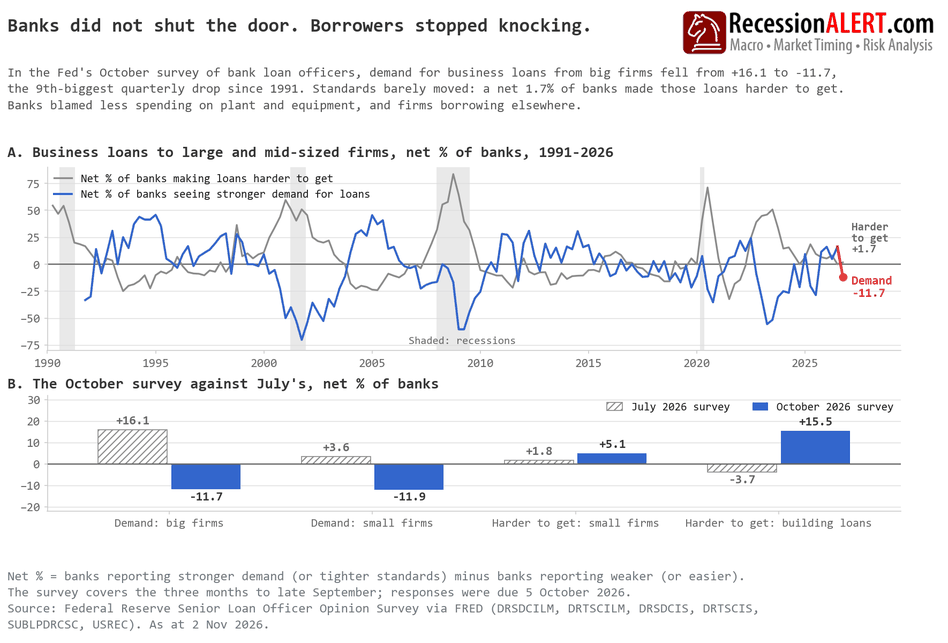
The most telling number in the Fed’s October survey of loan officers is the one that barely moved. A net 1.7% of banks (those tightening minus those easing) made business loans to big firms harder to get, up from zero in July. On the same net basis, demand from those firms fell 27.8 points to -11.7, the 9th-biggest quarterly drop in 140 surveys since 1991. That is 2022-23 run backwards: then, banks tightened first and demand followed them down. But this time the borrower walked away, and banks say why. Customers are spending less on plant and equipment, and they are borrowing from other banks or nonbank lenders on better terms. Set that beside the Atlanta Fed GDPNow model’s estimate of 11.1% growth in fourth-quarter private investment. The two cover different quarters, so this is a tension rather than a contradiction, but it hints that investment may be concentrated in firms that fund themselves outside bank loans. Some credit may also be moving one step removed: private credit and private equity funds asked banks for more, even on tighter terms. Real tightening lands where there are fewer doors to try. Standards on building and land loans jumped to +15.5 from -3.7, the 4th-biggest rise since 2013, and small firms saw standards firm to +5.1 as their own demand fell too. A credit crunch begins with a bank saying no; this one began with borrowers saying no thanks.
What it means: For households, banks left mortgage and car-loan standards largely unchanged but saw weaker demand for both. That points to fewer home and car purchases rather than credit being cut off. For stock investors, the strain would fall unevenly: big firms can raise money elsewhere, while banks that lend heavily to builders and small businesses would see slower loan growth. For the economy, the risk is that the cut in spending on plant and equipment outlasts the quarter it was reported in. This reading changes if January’s survey shows big-firm loan demand back above zero.
Market Intelligence Brief (MIB) Ver. 19.98
For professional investors only. Not investment advice.
© 2026 RecessionALERT.com

Comments are closed.