
MARKET INTELLIGENCE BRIEF (MIB)
Tuesday, August 25, 2026
Crude cratered nearly 5% — the Iran sanctions were weaker than feared and Oman is brokering a Hormuz corridor. AMD jumped 4.91% on a Strong Buy upgrade, carrying semis into Nvidia’s Wednesday print. Consumer Expectations fell to 68.2, below the Conference Board’s own recession line; the market bought chips anyway. Canada retaliates dollar-for-dollar on C$27.6bn from September 8. Dick’s fell 30.68% and took Nike and Lululemon with it. Discount-rate minutes show four district boards wanted a hike.
TABLE OF CONTENTS
A. EXECUTIVE SUMMARY
B. MARKET DATA
C. HIGH-IMPACT STORIES (5)
D. MODERATE-IMPACT STORIES (7)
E. ECONOMY WATCH (5)
F. EARNINGS WATCH (3)
G. WHAT’S NEXT
H. CHART OF THE DAY
A. EXECUTIVE SUMMARY -> TOP
Equities closed broadly higher — the S&P 500 rose 0.32% to 7,677.28, the Nasdaq 100 0.64%, and all six major indices finished green with the NYSE Composite’s +0.17% confirming breadth extended past mega-cap tech. The driver was geopolitical rather than economic: the new Iran sanctions arrived as economic coercion rather than military escalation, and with Oman brokering a phased Hormuz corridor, WTI fell 4.92% to $80.83 and the 10-year shed 7.9 basis points to 4.625% — a disinflationary impulse landing one day before Wednesday’s Core PCE. What the tape ignored matters more: the Conference Board’s Expectations Index fell to 68.2, under the 80 line its own publisher calls a recession marker, and Canada signed dollar-for-dollar retaliation on C$27.6 billion of US goods effective September 8. Breadth favoured cyclicals over defensives — Basic Materials +1.14% and Technology +1.04% led while Consumer Defensive -0.73% and Energy -1.50% lagged — a tape positioned for easier policy, not for a weakening consumer.
• Crude collapsed because the sanctions were weaker than positioned for — WTI -4.92% to $80.83 and Brent -5.26% to $85.78, both one-week lows, after Bessent set country-by-country wind-down deadlines rather than immediate penalties and Oman outlined a phased Strait of Hormuz corridor with Tehran. Energy was the only sizable sector decliner at -1.50% (Exxon -2.09%, Chevron -1.57%).
• Semiconductors carried the tape into Nvidia — AMD +4.91% to $479.18 on the session’s only mega-cap rating change, Raymond James to Strong Buy with a $641 target; Marvell +4.84%, Dell +4.12%. Nvidia reports Wednesday after the close at a $5.16 trillion market capitalisation against consensus of $2.09 EPS on $92.27 billion of revenue.
• The consumer data was the softest of the cycle and the market ignored it — Conference Board Confidence fell to 89.4, a seven-month low, with the Expectations Index at 68.2 against the sub-80 level its own publisher flags as a recession marker; New Home Sales fell 10.5% to a 607,000 annualised rate, the weakest since January.
• Canada signed its retaliation rather than threatening it — C$27.6 billion of US goods across roughly 700 tariff lines at 15%, 25% and 50% from September 8, with steel and aluminium doubled to 50%, paired with a C$7.5 billion domestic relief package. Industrials closed +0.01% and Consumer Cyclical -0.19%.
• The Fed’s hawkish bloc is one district wider than the dissent tally showed — discount-rate minutes released at 14:00 ET record four Reserve Bank boards seeking 4.00% at the July 23 votes — Cleveland, Minneapolis, Kansas City and Dallas — against three FOMC dissents. Yields fell anyway: the 10-year -7.9bps to 4.625%, 2s10s bull-flattening to roughly 44.5bps.
• Retail cracked on somebody else’s guidance while healthcare made a new high — Dick’s Sporting Goods -30.68% after cutting every line of full-year guidance on its Foot Locker division, dragging Nike -3% and Lululemon -4%; Merck +3.84% to a 52-week high on two same-day target raises for the Keytruda cancer-vaccine combination, with Moderna +13.89%.
1. The Disinflation Is in Crude; the Inflation Has Moved Into Distillates — Cheap oil is only half the energy story and it is the half that flatters the print. Ukrainian drones took roughly 290,000 b/d of Russian refining offline overnight — the Afipsky and Novoshakhtinsky plants plus an Astrakhan gas-processing facility — and strikes on refineries destroy conversion capacity, not production. The result is more crude looking for a buyer and fewer barrels of diesel: the crack sits at a record $99.125/bbl, up 264% year on year, and widens with each successive strike. Moscow may extend its producer diesel export ban past August 31, though that remains a single-sourced report rather than a decision. For a US portfolio the read is uncomfortable: headline CPI energy gets the relief while freight, agriculture and industrial margins pay the bill. A 4.92% fall in WTI is not a clean disinflation trade.
2. The Bond Market and the Survey Agree With Each Other; the Equity Market Agrees With Neither — The Expectations Index at 68.2 is below the Conference Board’s own recession threshold, New Home Sales fell 10.5% to the weakest pace since January, and the 10-year dropped 7.9bps with a bull-flattening curve. Equities responded by bidding semiconductors and selling staples, with Consumer Defensive the second-worst sector at -0.73%. Two readings are available and they lead to opposite positions: either confidence surveys have overstated household distress all cycle and falling yields are correctly pricing easier policy, or the survey is early and the bond market is discounting a demand problem equities have not marked. Today cannot arbitrate, because the crude collapse and the chip rally handed the tape two unrelated reasons to rise. Wednesday’s Core PCE is the first print that separates a disinflationary soft landing from a demand shortfall.
3. Policy Risk Is Being Discounted at Roughly Zero on Two Fronts at Once — A signed, scheduled, item-by-item 50% tariff wall between the two largest trading partners in the world moved Industrials +0.01% and Consumer Cyclical -0.19%. Simultaneously, four of twelve Reserve Bank boards asked for a 4.00% primary credit rate by July 23 — one district wider than the 9-3 FOMC dissent disclosed — heading into a September 15-16 meeting the market treats as a formality, with a VIX at 15.45 and the Nasdaq near highs. Neither position is unreasonable on its own; holding both while paying 15 vols for protection is the exposure. Warsh’s first Jackson Hole keynote on Friday is the only scheduled opportunity to see whether the Board reads the widening director bloc as signal or noise, and September 8 is when the Canadian duties stop being a headline and become a cost inside the current quarter.
 — Leading economic indicators. Accurate market forecasts. Apply for membership at join.recessionalert.com
B. MARKET DATA -> TOP
A broad risk-on session, led by semiconductors and mega-cap tech (AMD +4.91%, Marvell +4.84%) ahead of Wednesday’s Nvidia earnings, with all six major indices closing higher and falling Treasury yields (10Y -1.68%, 2Y -1.32%) plus a retreating VIX (-2.52%) reinforcing the rally. Crude oil bucked the tape, sinking as traders judged the newly announced US sanctions on Iran less disruptive to supply than a military escalation would have been (WTI -4.92%, Brent -5.26%), dragging Energy to the session’s lone sizable sector loser (-1.50%) even as broader indices advanced. Retail was the other soft spot: Dick’s Sporting Goods slid 30.68% on a guidance cut tied to its Foot Locker unit, pulling Nike and Lululemon lower in sympathy. Cheaper oil, lower yields, and a tech-led bid into a heavy earnings week reads as constructive for risk assets.
CLOSING PRICES – Tuesday, August 25, 2026:
MAJOR INDICES
Breadth was genuinely broad — all six indices closed higher, with the NYSE Composite’s +0.17% confirming gains extended beyond mega-cap tech. Nasdaq 100’s +0.64% outpaced the Dow’s +0.30% by a modest margin, a mild growth-over-value tilt rather than a narrow story. Transports lagged industrials slightly (+0.11% vs +0.30%), a soft but non-threatening Dow Theory divergence with no confirmation signal in force either way.
| Index | Close | Change | %Move | Why It Moved |
|---|---|---|---|---|
| S&P 500 | 7,677.28 | +24.42 | +0.32% | Broad risk-on; tech-led gains, falling yields and oil supportive |
| Dow Jones | 53,577.40 | +160.24 | +0.30% | Blue-chips tracked the broader rally with modest gains |
| DJ Transportation | 21,455.62 | +24.46 | +0.11% | Lagged industrials slightly; cheaper oil a mixed read for carriers |
| Nasdaq 100 | 29,209.23 | +186.05 | +0.64% | Led by the semiconductor rally (AMD, Marvell) ahead of Nvidia earnings |
| Russell 2000 | 3,009.96 | +14.88 | +0.50% | Small-caps participated broadly, tracking falling yields |
| NYSE Composite | 24,768.42 | +41.78 | +0.17% | Confirmed breadth beyond mega-cap tech |
VOLATILITY & TREASURIES
Yields and volatility fell together — the 10Y dropped 1.68% and the VIX slid 2.52%, a classic risk-on combination rather than a recession-fear signal. The 2Y-10Y spread narrowed marginally to roughly 44.5bps from 46.6bps, a mild bull-flattening consistent with rate-cut optimism rather than growth alarm. DXY was essentially flat (-0.10%), suggesting the dollar isn’t yet pricing a policy shift.
| Instrument | Level | Change | Why It Moved |
|---|---|---|---|
| VIX | 15.45 | -0.40 (-2.52%) | Falling alongside yields, confirming risk-on rather than defensive positioning |
| 10-Year Treasury Yield | 4.625% | -7.9 bps | Yields retreated broadly; risk-on despite lower rates |
| 2-Year Treasury Yield | 4.180% | -5.6 bps | Tracked the 10Y lower; curve modestly flattened |
| US Dollar Index (DXY) | 98.90 | -0.10 (-0.10%) | Essentially flat, no clear dollar signal |
COMMODITIES
Precious and industrial metals diverged from the safe-haven script: gold’s modest +0.54% and silver’s +0.42% look tepid next to copper’s +1.59%, suggesting today’s move reflects growth optimism more than geopolitical hedging despite the Iran-driven oil shock. Platinum was the lone metals decliner, down 0.94%. Bitcoin sat out the rally entirely, essentially flat at -0.20%.
| Asset | Price | Change | %Move | Why It Moved |
|---|---|---|---|---|
| Gold | $4,723.21/oz | $+25.41 | +0.54% | Modest gain, muted safe-haven bid despite Iran tensions |
| Silver | $68.880/oz | $+0.286 | +0.42% | Tracked gold’s modest gain |
| Copper | $6.7103/lb | $+0.1052 | +1.59% | Outpaced precious metals; industrial-demand optimism |
| Platinum | $1,871.45/oz | $-17.75 | -0.94% | Lone metals decliner; no clear catalyst |
| Bitcoin | $78,804.0 | $-157.0 | -0.20% | Essentially flat, decoupled from the equity rally |
ENERGY
Oil cratered as the new US sanctions on Iran landed softer than the market had positioned for: Bessent set country-by-country wind-down deadlines rather than immediate penalties, and de-escalation signals stacked up alongside, including Oman-brokered talks on a temporary Hormuz corridor. Brent’s -5.26% outpaced WTI’s -4.92% — a widening premium-to-benchmark spread pointing to a global rather than US-centric supply read. Natural gas sat out entirely (Henry Hub +0.46%), confirming the move is crude-specific. Falling oil alongside rising equities reads as a disinflationary tailwind, not a stagflationary one.
| Asset | Price | Change | %Move | Why It Moved |
|---|---|---|---|---|
| Crude Oil (WTI) | $80.83/bbl | $-4.18 | -4.92% | Sank as the new US Iran sanctions landed softer than positioned for; Hormuz de-escalation signals |
| Crude Oil (Brent) | $85.78/bbl | $-4.76 | -5.26% | Fell more than WTI on the same Iran de-escalation catalyst |
| Natural Gas (Henry Hub) | $2.848/MMBtu | $+0.013 | +0.46% | Decoupled from crude weakness; domestic supply/demand-driven |
| Natural Gas (Dutch TTF) | $22.72/MMBtu | $-0.63 | -2.69% | European gas fell alongside crude, diverging from Henry Hub |
S&P 500 SECTORS
Basic Materials led both today (+1.14%) and the week (+8.95%), extending its trend cleanly. Technology’s +1.04% today reverses a -1.37% weekly slide — a single-session bounce inside an otherwise soft week. Energy’s -1.50% today is a one-day pullback against a resilient 38.58% one-year gain, consistent with the crude-driven story rather than a trend change.
| Sector | 1-Day | 1-Week | 1-Month | 3-Month | 6-Month | YTD | 12-Month |
|---|---|---|---|---|---|---|---|
| Basic Materials | +1.14% | +8.95% | +15.29% | +6.62% | +0.11% | +24.51% | +40.83% |
| Technology | +1.04% | -1.37% | +5.07% | -0.42% | +22.97% | +21.47% | +30.85% |
| Healthcare | +0.64% | +3.28% | +6.73% | +16.39% | +10.23% | +12.87% | +25.94% |
| Communication Services | +0.52% | +2.15% | +3.74% | -7.47% | +2.33% | -0.39% | +11.70% |
| Financial | +0.44% | +0.59% | +1.91% | +10.73% | +12.88% | +8.76% | +13.57% |
| Utilities | +0.44% | -1.33% | -5.09% | -5.87% | -9.04% | +0.56% | +1.89% |
| Real Estate | +0.19% | +1.64% | -1.27% | +2.30% | +4.06% | +11.83% | +6.95% |
| Industrials | +0.01% | -3.28% | -0.96% | -3.21% | -2.90% | +11.82% | +14.67% |
| Consumer Cyclical | -0.19% | +1.17% | +6.58% | -1.82% | +0.72% | -2.45% | +0.02% |
| Consumer Defensive | -0.73% | +0.07% | +0.13% | +0.82% | -5.82% | +8.32% | +4.66% |
| Energy | -1.50% | -1.85% | +4.82% | +4.42% | +11.97% | +35.57% | +38.58% |
TOP MEGA-CAP MOVERS:
GAINERS
| Company | Ticker | Close | Change | Why It Moved |
|---|---|---|---|---|
| Advanced Micro Devices | AMD | $479.18 | +4.91% | Broad semiconductor rally ahead of Wednesday’s Nvidia earnings and falling yields |
| Marvell Technology | MRVL | $240.38 | +4.84% | Same semiconductor rally; no discrete company-specific catalyst identified |
| Dell Technologies | DELL | $451.02 | +4.12% | No discrete same-day catalyst identified; broader tech/semiconductor rally |
| Merck & Co | MRK | $156.45 | +3.84% | Wolfe Research raised its target to $180 from $155 and Argus to $170 from $145, both today, on the INTerpath-001 Keytruda/intismeran data |
| Netflix | NFLX | $82.23 | +2.77% | No discrete same-day catalyst identified; part of the broader tech advance |
DECLINERS
| Company | Ticker | Close | Change | Why It Moved |
|---|---|---|---|---|
| Palo Alto Networks | PANW | $339.90 | -3.13% | No discrete same-day catalyst identified; unverified pullback ahead of Sept 1 earnings |
| ExxonMobil | XOM | $160.62 | -2.09% | Tracked the broader energy-sector decline as crude oil sank |
| Palantir Technologies | PLTR | $172.73 | -1.80% | No discrete same-day catalyst identified; unverified profit-taking after PLTR’s +46% August rally |
| GE Vernova | GEV | $926.00 | -1.71% | No discrete same-day catalyst identified; unverified pullback from record-high levels |
| Chevron | CVX | $199.91 | -1.57% | Tracked the broader energy-sector decline as crude oil sank |
— Institutional-grade intelligence for serious investors. Apply for membership at join.recessionalert.comC. HIGH-IMPACT STORIES -> TOP
BULLISH
1. Crude Falls Nearly 5% Because the Iran Sanctions Were Weaker Than Feared — and Oman Is Brokering a Hormuz Corridor
The core facts:WTI settled at $80.83/bbl, down $4.18 (-4.92%), and Brent at $85.78/bbl, down $4.76 (-5.26%) — a one-week low for both. The move was not caused by the sanctions themselves but by their inadequacy relative to positioning: traders had braced for a military escalation and instead received economic coercion, with Treasury Secretary Bessent setting country-by-country wind-down deadlines rather than immediate penalties. Three de-escalation signals stacked up in the same session. Omani Foreign Minister Sayyid Badr Albusaidi met Iranian Foreign Minister Abbas Araghchi in Tehran and outlined a “phased framework” for a temporary Strait of Hormuz navigation corridor plus a joint demining project — an account corroborated across six independent outlets. President Trump declared at 10:44 ET that all mines in Hormuz international waters had been “removed or detonated,” with zero tolerance for any attempt to lay new ones. And the State Department was reported to be preparing the return of diplomats to evacuated Middle East embassies. Energy was the session’s only sizable sector decliner at -1.50%, with ExxonMobil -2.09% and Chevron -1.57%. Dutch TTF gas fell 2.69% while Henry Hub rose 0.46%, confirming a crude-and-Europe story rather than a domestic one.
Why it matters:The causation runs the opposite way to the intuitive read, and getting it backwards inverts the trade. Sanctions that restrict supply raise crude; sanctions that substitute for bombing lower it. What repriced today was the tail — the probability that Hormuz closes rather than merely gets expensive — and that tail is what the entire war premium has been built on. For a US portfolio this is the cleanest disinflationary impulse available: crude down 5% while the S&P gained 0.32%, the 10-year fell 7.9bps to 4.625% and the VIX slid to 15.45. Cheaper energy feeds directly into the goods-inflation channel the Fed is still waiting on, and it arrives one day before Wednesday’s Core PCE print. The counter-current is unresolved and should not be dismissed: an oil tanker was disabled by an unknown projectile 9 nautical miles northeast of Ash Shishah, Oman, with the UKMTO advisory (Warning 120-26) circulating during today’s session and no party claiming responsibility. A corridor that is being negotiated is not a corridor that exists, and the residual premium in crude says the market knows it.
What to watch:Whether Oman and Iran actually announce the temporary Hormuz corridor — Albusaidi said he was “hopeful” of an imminent announcement, and the gap between that and a signed arrangement is where the next $5 of crude sits. API inventories land tonight at 16:30 ET (consensus +1.9M against a prior -3.28M), with the EIA weekly status report Wednesday at 10:30 ET.
UNCERTAIN
2. The Fed’s Discount-Rate Minutes Show the Hawkish Bloc Doubled From Two Reserve Banks to Four in Nine Days — One District Wider Than the FOMC Dissent Revealed
The core facts:The Federal Reserve Board published the minutes of its July 20 and July 29 discount-rate meetings at 14:00 ET — the only Board press release of any category dated today. At the July 20 meeting, ten Reserve Bank boards sought to hold the primary credit rate at 3.75% and two — Cleveland and Minneapolis, voting July 16 — sought 4.00%. Nine days later, on the July 23 director votes recorded for the July 29 joint Board/FOMC meeting, four boards sought 4.00%: Cleveland and Minneapolis were joined by Kansas City and Dallas, both of which had voted for 3.75% as recently as July 9. Only New York, Richmond and Atlanta are recorded voting to hold on July 23. The Board took no action either time, holding the primary credit rate at 3.75% and maintaining IORB at 3.65% effective July 30, with no dissent among Chairman Warsh, Vice Chair Jefferson, Vice Chair for Supervision Bowman and Governors Powell, Waller, Cook and Barr. Director commentary cited “stable economic conditions,” employment “steady across most Districts,” “continuing artificial intelligence investments,” and “elevated inflation” with consumers “increasingly price conscious” — and noted that “most directors cited rising fuel prices and surcharges stemming from global events.”
Why it matters:The July 28-29 FOMC vote was 9-3, with Hammack (Cleveland), Kashkari (Minneapolis) and Logan (Dallas) dissenting toward tighter policy. The discount-rate record shows the Kansas City board also wanted a hike while President Schmid voted with the FOMC majority — meaning the regional hawkish camp is one full district wider than the dissent tally disclosed, and it widened while the meeting was in progress. None of this appears in the FOMC minutes released August 19. The reason it is graded uncertain rather than bearish is that the market gave it nothing: yields fell across the curve, the 2s10s spread bull-flattened to roughly 44.5bps from 46.6bps, and equities closed higher on the day it landed. Reserve Bank directors do not set policy and their requests are advisory. But the direction of travel is what a positioning-driven market is worst at pricing — a September FOMC that arrives with four of twelve district boards having asked for a hike, into an inflation print the market is treating as a formality, is a meaningfully different meeting from the one currently discounted.
What to watch:Fed Chair Warsh’s Jackson Hole keynote on Friday, August 28 at 10:00 ET — his first, and the only scheduled opportunity before the September 15-16 FOMC to see whether the Board reads the widening director bloc as signal or noise.
BEARISH
3. Canada Retaliates Dollar-for-Dollar on C$27.6 Billion of US Goods From September 8, and Doubles Its Steel Tariff to 50%
The core facts:Finance Minister François-Philippe Champagne announced that Canada will match the new US tariffs “dollar for dollar, rate for rate,” applying duties of 15%, 25% and 50% to roughly 700 tariff lines covering C$27.6 billion of US imports, effective September 8, 2026. Named categories include steel and aluminum at 50% — doubled from 25% — plus dairy, appliances, agricultural equipment, pulp and paper, plastics and electronics, with press reporting of the schedule adding furniture, clothing, perfume and cosmetics, smartphones, tableware, plywood, doors and windows and cutlery at 50%, and seafood, large kitchen appliances, cheese and curd, carpets and textiles at 25%. Ottawa paired the retaliation with a C$7.5 billion relief package on top of nearly C$25 billion already provided: C$3.5bn in Rapid Response Supports for Workers and Employers, a C$2bn Canada Strong Diversification Fund, C$1.5bn for a Regional Tariff Response Initiative aimed at SME liquidity, and a C$500m BDC “Pivot to Grow” cash-flow stream. This is the response to the 50% US duties on roughly C$28 billion of Canadian goods that took effect Saturday, August 22 after trade talks collapsed. The White House published a same-day rebuttal titled “President Trump Is Finally Ending Canada’s Free Ride,” citing an average annual goods deficit near $50 billion, a 22% decline in US vehicle exports to Canada over the past year and an 81% single-year collapse in US alcohol exports.
Why it matters:Yesterday’s story was a US threat aimed at January 1, 2027. Today’s is a foreign government’s signed instrument taking effect in fourteen days, with a published tariff-item schedule — the difference between rhetoric and a cost that lands inside the current quarter. Canada is the largest single-country export market for US goods, and the categories Ottawa chose are not random: appliances, agricultural equipment and electronics are concentrated in Midwest manufacturing, and the doubling of the steel and aluminum rate to 50% arrives while Basic Materials is the market’s strongest sector, up 8.95% on the week and 24.51% year to date. What is most notable is what did not happen: the S&P rose 0.32%, Industrials were flat at +0.01% and Consumer Cyclical fell only 0.19%. Equities are treating a two-way 50% tariff wall between the two largest trading partners in the world as a fourth-quarter margin problem rather than a repricing event. That gap between the policy and the discount is the risk.
What to watch:September 8, when the Canadian duties take effect, and any CBP implementation guidance in the interim — that is where exclusions, quotas and de minimis carve-outs surface, and it is the mechanism by which a headline rate becomes an actual cost.
BEARISH
4. The Consumer Expectations Index Fell Below the Conference Board’s Own Recession Threshold and the Market Bought Semiconductors
The core facts:Conference Board Consumer Confidence fell to 89.4 in August, a seven-month low, and the forward-looking Expectations Index dropped to 68.2 — below the level of 80 that the Conference Board itself flags as historically preceding a recession within twelve months. Section E carries the index detail and component breakdown. What concerns this section is the market’s response, which was to ignore it entirely: the S&P 500 closed up 0.32% at 7,677.28, the Nasdaq 100 gained 0.64%, the VIX fell 2.52% to 15.45 and all six major indices finished higher. The bid went to semiconductors and mega-cap technology, the two groups with the least defensive characteristics on the board. Consumer Defensive was the second-worst sector at -0.73% and Consumer Cyclical fell 0.19% — the only visible trace of the print anywhere in the tape.
Why it matters:An Expectations reading below 80 is not a soft datapoint; it is the specific threshold the publishing institution nominates as its own recession marker, and it has now been crossed while the equity market prices a 15-handle VIX and a Nasdaq within reach of highs. Two readings of the divergence are available and they lead to opposite positions. The benign one is that confidence surveys have systematically overstated household distress through this cycle while actual consumption held up, and that today’s 7.9bp fall in the 10-year is the market correctly pricing easier policy off a softening consumer. The malign one is that the survey is early and the market is late — that the same falling yields being read as a rate-cut tailwind are in fact the bond market discounting a demand problem the equity market has not yet marked. Today’s session cannot distinguish between them, because the crude collapse and the semiconductor rally gave equities two unrelated reasons to rise. Wednesday’s Core PCE is the first datapoint that separates a disinflationary soft landing from a demand shortfall.
What to watch:Whether Consumer Defensive keeps underperforming a rising tape. A market genuinely worried about the household would be bidding staples, not selling them at -0.73% into a -0.19% Consumer Cyclical session.
BULLISH
5. AMD Jumps 4.91% on the Session’s Only Mega-Cap Rating Change as Semis Carry the Tape Into Nvidia — While Mizuho Quietly Cuts Four Memory and Semicap Targets
The core facts:Raymond James analyst Simon Leopold upgraded AMD from Outperform to Strong Buy with a target of $641 from $565, extending the firm’s “AI Factory” framework to server CPUs, modelling a 44% five-year revenue CAGR to roughly $201 billion by CY2030 and forecasting AMD overtaking Intel in CPU share by 2027. AMD closed at $479.18, up 4.91%, and it was the only rating change on a US mega-cap all session. Marvell rose 4.84% to $240.38 on two target raises — Rosenblatt to $300 from $240 and Susquehanna to $265 from $230 — with Dell up 4.12% and Netflix up 2.77%. The same firm, on the same day, raised Nvidia to $352 from $330. Technology closed +1.04%, reversing a -1.37% week; the Nasdaq 100 gained 0.64% to 29,209.23 while the NYSE Composite’s +0.17% and the Russell 2000’s +0.50% confirmed the breadth extended past mega-cap tech. Running the other way, Mizuho cut four large-cap targets in one sweep with all ratings maintained at Outperform: Applied Materials to $590 from $650, Micron to $1,300 from $1,375, Lam Research to $365 from $370 and SanDisk to $1,875 from $1,900. No dated, name-specific catalyst for the Mizuho sweep could be established.
Why it matters:This is a positioning session, not a fundamentals session, and the two halves of the semiconductor tape are telling different stories about the same trade. The logic and accelerator names are being bid into Nvidia’s Wednesday print on multiple expansion — a $641 AMD target requires the AI capex cycle to persist through 2030 — while the memory and equipment names are having their numbers quietly trimmed by a house that will not change its ratings. That is the signature of a market that believes in the demand and is losing conviction on the pricing. It matters more than a normal sector day because of what sits on the other side of it: Nvidia reports tomorrow after the close at a $5.16 trillion market capitalisation against consensus of $2.09 EPS on $92.27 billion of revenue, which makes it a larger single-name event risk than any macro release this week. Note also that yesterday’s session ran the opposite way, with Samsung’s payout disappointment taking SanDisk down 6.49% and Micron down 5.85% and pushing the chip index into a bear market. A two-day round trip of that amplitude ahead of the print is not accumulation; it is repositioning.
What to watch:Nvidia’s data-centre revenue and forward guidance Wednesday after the close. With the Nasdaq 100 having gained 0.64% in anticipation and the chip complex having round-tripped a bear-market print in two sessions, the guidance matters more than the quarter.
— Quantifying recession risk so you don’t have to guess. Apply for membership at join.recessionalert.comD. MODERATE-IMPACT STORIES -> TOP
BEARISH
6. Nike Falls 3% and Lululemon 4% on Somebody Else’s Guidance Cut — the Athletic Complex Reprices on a Foot Locker Read-Through
The core facts:Nike closed down 3% at $39.40 and Lululemon down 4% at $118.15, neither on any company-specific news. The trigger was Dick’s Sporting Goods, which cut every line of its full-year 2026 outlook — adjusted EPS to $11.00-$12.00 from $13.50-$14.50 and net sales to $21.9-$22.2 billion from $22.1-$22.4 billion — and closed down 30.68%. Management attributed the cut to its recently acquired Foot Locker division, where proforma comparable sales fell 3.6%, explicitly citing “challenging conditions in the athletic footwear marketplace” alongside elevated promotional activity and a shift in discretionary consumer demand. The core Dick’s banner grew comparable sales 4.9%. Management said it expects the promotional environment to persist through year-end. Consumer Cyclical closed -0.19% and Consumer Defensive -0.73%, the two weakest sectors on an otherwise green board.
Why it matters:The distinction that makes this a sector story rather than a single-name one is the split inside Dick’s own results: the core banner comped +4.9% while Foot Locker comped -3.6%. That is not a weak consumer, it is a weak channel — the athletic footwear wholesale channel specifically, which is Nike’s economics. When a retailer that sells your product quantifies a promotional environment it expects to run through year-end, it has pre-announced your gross margin. Nike is already the name RBC reiterated at Sector Perform with an unchanged $45 target today, and a $39.40 share price against that target leaves the sell side with nothing to defend. The read-through also lands directly on the wider question raised by today’s Consumer Confidence print: discretionary goods demand is where a soft expectations reading shows up first, and this is the first hard corporate confirmation of it in the current tape.
What to watch:Whether other discretionary retailers echo the promotional language this week — Williams-Sonoma and Kohl’s report Wednesday before the bell, and Gap, Burlington and Best Buy on Thursday.
BULLISH
7. Merck Trades to a 52-Week High on Two Same-Day Target Raises as the Street Re-Underwrites the Keytruda Cancer-Vaccine Combination
The core facts:Merck closed at $156.45, up 3.84%, among the session’s largest mega-cap gainers and near a 52-week high. Two houses raised targets on the same day: Wolfe Research to $180 from $155 with Outperform maintained, and Argus to $170 from $145 with a Buy rating. Both cite the INTerpath-001 readout, in which Merck and partner Moderna reported a positive outcome for intismeran combined with Keytruda in melanoma. The underlying trial data was released on August 19; what is new today is the sell side marking its models to it, a 16% and a 17% target increase respectively. Healthcare closed +0.64% and is up 16.39% over three months, the strongest three-month sector performance on the board. Moderna, the partner on the vaccine, rose 13.89% on its own wave of analyst actions.
Why it matters:Merck’s problem for two years has been the Keytruda loss-of-exclusivity cliff in 2028 and the absence of a credible replacement franchise. An individualised neoantigen therapy that extends Keytruda into an adjuvant melanoma setting does not solve that arithmetic on its own, but it changes the shape of the terminal-value debate — which is exactly what a 16% target raise from a house that already rated the stock Outperform is pricing. The read-through runs to Moderna, whose mRNA platform supplies the intismeran half and whose equity has no other near-term catalyst of comparable size. Note the sequencing carefully: the trial data is six days old and stale as a trigger, but the re-rating is today’s event, and it is the re-rating that moved the stock. Healthcare’s three-month leadership has been built on precisely this kind of pipeline repricing rather than on volume or pricing.
What to watch:The pivotal ESMO presentation expected October 23-27 in Madrid, which is where the melanoma data gets its full peer scrutiny and where the adjuvant-setting commercial case is either confirmed or unwound.
UNCERTAIN
8. Ukrainian Drones Take Roughly 290,000 b/d of Russian Refining Offline the Same Night Crude Fell 5% — Crude and Products Are Now Trading Different Wars
The core facts:Ukrainian drones struck two Russian refineries and a Gazprom gas-processing plant overnight. The Afipsky refinery in Krasnodar — 180,000 b/d, operated by ForteInvest — caught fire, with Governor Veniamin Kondratiev reporting two killed and two injured by drone debris and damage to a train station and more than ten residential buildings. The Novoshakhtinsky refinery in Rostov, 110,000 b/d, suspended processing according to Governor Yuri Slyusar. The Astrakhan gas-processing plant was also struck. Kyiv’s General Staff confirmed the operation via Telegram. Combined, roughly 290,000 b/d of refining capacity went offline, and this is a distinct strike from the Novokuibyshevsk attack reported yesterday. Separately, Bloomberg reported — citing a person with knowledge of the matter, not an announced decision — that Moscow may extend its producer diesel export restrictions beyond August 31 to October 1; Deputy Prime Minister Alexander Novak had said the decision was not yet taken.
Why it matters:Crude fell 4.92% on a day that removed 290,000 b/d of refining capacity, and both facts are correct because they are about different molecules. Drone strikes on refineries destroy conversion capacity, not production — the effect is to leave more crude looking for a buyer while making diesel and gasoline scarcer. The diesel crack is already at a record $99.125/bbl, up 264% year on year, and each successive strike widens it further. For a US portfolio the implication is uncomfortable: the disinflationary impulse from cheaper crude does not pass through to the distillate complex that actually prices freight, agriculture and industrial energy costs. If Moscow does extend the diesel export ban, the product tightness compounds while the headline oil price keeps falling — a combination that flatters CPI energy and squeezes the transport and industrial margins underneath it. The extension itself remains a single-sourced report rather than policy, and should not be traded as decided.
What to watch:The August 31 expiry of Russia’s current diesel export restrictions, and the diesel crack itself — a record $99.125/bbl that keeps widening while crude falls is the clearest evidence that the refining damage, not the sanctions, is the binding constraint.
BULLISH
9. SpaceX Commits $100 Billion to “Starbase, Louisiana” — Five Launch Complexes, Ten Pads, and an $820 Million Parish Payment Stream
The core facts:SpaceX and Louisiana Economic Development jointly announced a $100 billion build-out near Pecan Island in Vermilion Parish, described as the world’s largest launch complex: five launch complexes of two pads each, on-site propellant production, dedicated power generation and worker housing. The project carries 3,000 direct jobs at an average salary of $92,600 over ten years, plus an LED-estimated 8,100 indirect positions for roughly 11,100 total. Construction begins in 2027 with a first launch targeted for 2029. The local package includes $25 million per year to Vermilion Parish for 25 years with an escalator and a $20 million upfront payment — more than $820 million in direct local payments over the life of the deal — plus a state-required $25 million charitable donation to the Community Foundation of Acadiana. The announcement was confirmed against the state’s own release and independently against CNBC and TechCrunch, all dated today. SpaceX trades publicly as SPCX with a market capitalisation comfortably above $100 billion.
Why it matters:A $100 billion single-site industrial commitment is larger than most sovereign infrastructure programmes and roughly the scale of a full year of hyperscaler capex from a single operator. The immediate read-through is to the industrial supply chain that builds it — heavy civil construction, cryogenic and propellant handling, dedicated generation capacity, and Gulf Coast electrical infrastructure — in a state whose existing industrial base is petrochemical and LNG. The second-order point is the one that matters more for a US portfolio: the capital-intensity of the space and AI-adjacent complex is now producing commitments that are underwritten against 2029 revenue, on the same balance-sheet logic driving data-centre construction. That is a duration bet on demand persisting for a decade, and the announcements keep getting larger. Construction does not start until 2027, so nothing in this announcement touches 2026 or 2027 earnings for any listed supplier.
What to watch:Contractor awards through 2027 — a project of this size will name heavy civil, power and cryogenic suppliers well before construction, and that is where the listed read-through becomes tradeable rather than thematic.
BULLISH
10. McKesson Rises 3.56% on a $2.25 Billion Move Into Clinical Research — the Session’s Largest Confirmed New US Deal
The core facts:McKesson signed a definitive agreement to acquire Precision Medicine Group for approximately $2.25 billion in consideration for the common equity, an aggregate value of roughly $2.3 billion. Precision Medicine Group, founded in 2012, provides clinical research and biopharma commercialisation services and will report inside McKesson’s Oncology and Multispecialty segment. The transaction is subject to customary closing conditions including regulatory clearances. McKesson’s own press release discloses no financing structure, no closing timeline and no EPS accretion guidance — all three were checked. Shares closed at $904.92, up 3.56%, on a market capitalisation of $105.50 billion. Across seven independent deal tapes this was the largest newly announced US transaction of the session; no US deal above $10 billion was identified, though none of those tapes is a complete register.
Why it matters:McKesson is a distributor with distributor margins, and every strategic move it has made for five years has been an attempt to buy its way up the value chain into oncology services, where the economics are structurally better. Precision Medicine Group extends that into clinical research and commercialisation — closer to the pharma customer, further from the warehouse. A 3.56% move on a $105 billion market cap for a $2.25 billion deal is roughly $3.7 billion of created value against the purchase price, which means the market is underwriting synergy the company has not yet quantified. That is a vote of confidence, but it is also an unhedged one: with no accretion guidance and no closing timeline disclosed, there is nothing to hold management to. The absence of any deal above $10 billion on the day is itself worth noting in a market at these levels — strategic activity is running through tuck-ins rather than transformational combinations.
What to watch:McKesson’s next quarterly report for the accretion and closing detail the announcement withheld — until then the 3.56% is priced on a strategic narrative with no arithmetic attached.
BULLISH
11. FDIC Says the Banking Industry Earned $90.1 Billion in Q2 With Charge-Offs Falling — Three Days After Closing Its Fifth Bank of the Year
The core facts:The FDIC published its Q2 2026 Quarterly Banking Profile. Aggregate industry net income was $90.1 billion, up $9.7 billion or 12.0% on the quarter. The net interest margin rose one basis point to 3.32%. Loans grew 1.8% quarter on quarter and 6.8% year on year. Both the past-due-and-nonaccrual rate and the net charge-off rate declined. Domestic deposits rose 0.8%, an eighth consecutive quarterly increase, and the Deposit Insurance Fund reserve ratio rose five basis points to 1.48%. The Problem Bank List count and the industry’s unrealised securities losses did not appear in the portion of the release retrieved and are not stated here. Financials closed +0.44% on the session, and are up 12.88% over six months and 8.76% year to date.
Why it matters:This is the cleanest read available on whether the credit cycle has turned, and the answer for Q2 is that it has not. Charge-offs and past-dues both falling while loan growth runs at 6.8% year on year is the combination that does not occur in a deteriorating credit environment — banks that are worried tighten underwriting first and the loan growth goes before the losses arrive. A 3.32% margin holding steady with a one-basis-point gain says the deposit-cost pressure that defined 2023-24 has fully normalised. The sharp qualification is timing: this is a June-quarter snapshot published in late August, and it sits three days after the FDIC closed Tioga-Franklin Savings Bank, the fifth US bank failure of 2026. Aggregate strength and idiosyncratic failure are not contradictory — a 1.48% DIF reserve ratio is precisely what funds the latter — but the aggregate is a lagging measure and the failures are not.
What to watch:The Problem Bank List count and the unrealised securities loss figure, neither of which was captured here — both sit in the full profile and both are the forward-looking half of a report whose headline is backward-looking.
BEARISH
12. New Home Sales Fell 10.5% in July and Homebuilders Did Not Break — the Rate-Cut Bid Is Absorbing the Housing Damage
The core facts:New home sales fell 10.5% in July to a 607,000 annualised rate, the steepest monthly drop and the weakest level since January, with sales now down in three of the last four months. Section E carries the release detail. The market response was muted to the point of absence: Real Estate closed +0.19% and Consumer Cyclical -0.19%, neither a rout, while the 10-year Treasury yield fell 7.9 basis points to 4.625% and the 2-year fell 5.6 to 4.180%. Separately, NAHB builder confidence rose one point to 35 in August; 35% of builders cut prices during the month, down from 37% in July, with an average price reduction of 6%.
Why it matters:Housing is the most rate-sensitive sector in the economy and therefore the first place a restrictive stance shows up in volumes — which is exactly what a 607,000 annualised rate with sales down in three of four months represents. What makes today’s non-reaction rational rather than complacent is the offset: a 7.9 basis point fall in the 10-year lowers the mortgage benchmark, and builders are being marked on 2027 volumes rather than July’s. The tell that the damage is real regardless is inside the NAHB detail — a builder confidence reading of 35 is deeply contractionary on a 50-neutral scale, and a third of builders are still cutting prices by an average of 6%. That is a market clearing through price, not through demand. For the wider economy this is the transmission channel that connects today’s sub-80 Consumer Expectations reading to actual activity: households that expect worse conditions defer the largest purchase they make.
What to watch:Whether the share of builders cutting prices resumes rising from 35% — the two consecutive monthly declines are the only genuinely encouraging datapoint in the housing complex, and they reverse quickly if mortgage rates back up.
— Separating signal from noise since 2007. Apply for membership at join.recessionalert.comE. ECONOMY WATCH -> TOP
Tuesday’s data leaned soft: new home sales sank 10.5% to a 607K pace — the steepest drop since January — while Consumer Confidence fell to a seven-month low of 89.4, with the Expectations Index diving to 68.2, below the 80 threshold the Conference Board ties to recession risk. Case-Shiller’s 2.1% home-price beat offered little offset, since values keep losing ground to inflation for a 13th straight month. The policy backdrop stayed cautious, not accommodative: Boston Fed’s Collins tied any rate hold to further disinflation, and Druckenmiller broke with protégé Bessent over Treasury’s expanded bond buybacks, warning the move trades credibility for yield suppression. Wednesday’s Core PCE and GDP data will test which signal — soft consumption or sticky Fed resolve — wins out.
New Home Sales Plunge 10.5% in July, Steepest Drop Since January (Census Bureau, Aug 25, 2026)
What they’re saying:New home sales fell to a seasonally adjusted annual rate of 607,000 in July, down 10.5% from June and missing the 620,000 consensus — the sharpest monthly decline and lowest sales pace since January. Sales plunged 43% in the Midwest and 13% in the South, while the median sales price slipped to $393,800, the lowest in over a year.
The context:Housing remains among the most rate-sensitive corners of the economy, and the miss extends a run of soft housing prints even as the Fed weighs how much further restrictive policy needs to bite. Supply climbed to 9.6 months at the current sales pace, a level historically consistent with continued price softness.
What to watch:Wednesday’s Core PCE and GDP second estimate, which will shape whether the Fed sees room to ease.
Case-Shiller 20-City Index Beats at 2.1% YoY, But Real Home Values Keep Falling (S&P Cotality, Aug 25, 2026)
What they’re saying:The S&P Case-Shiller 20-city composite rose 2.1% year-over-year in June, ahead of the 1.7% consensus and up from 1.6% in May; the broader National Index posted a softer 1.5% gain.
The context:With CPI running near 3.5%, nominal home-price gains continue to trail inflation — the 13th consecutive month homeowners have lost purchasing-power ground on their largest asset, even as headline price growth beat estimates.
What to watch:Whether today’s New Home Sales weakness spills into resale price momentum in the next Case-Shiller print.
Consumer Confidence Slips to 89.4, Expectations Gauge Falls Below Recession Threshold (Conference Board, Aug 25, 2026)
What they’re saying:The Conference Board’s Consumer Confidence Index fell to 89.4 in August from a downwardly revised 90.2 in July, missing the 90.2 consensus and marking a second straight monthly decline to the weakest level since January. The Expectations Index dropped 5.8 points to 68.2, more than offsetting a 6.8-point rise in the Present Situation Index to 121.2.
The context:An Expectations Index reading below 80 has historically preceded a recession within the following year, per the Conference Board’s own framework; 68.2 sits well under that line even as current-conditions sentiment improved.
What to watch:Friday’s University of Michigan Sentiment final read and next month’s Conference Board release for confirmation of the trend.
Druckenmiller Calls Bessent’s Treasury Bond Buyback Expansion a Mistake (Bloomberg, Aug 25, 2026)
What they’re saying:Stanley Druckenmiller, an early mentor to Treasury Secretary Scott Bessent, publicly criticized Treasury’s plan to double its bond buyback ceiling from $2 billion to $4 billion per operation starting September 9, calling it an attempt to suppress yields rather than manage liquidity.
The context:Druckenmiller argued the move sidesteps the real issue — a national debt that has surpassed $40 trillion — and that running the expanded buybacks through the final stretch of the midterm campaign risks politicizing debt management and spending “the credibility of the Treasury market.”
What to watch:Whether the September 9 buyback expansion proceeds as planned and how the 10-year yield reacts into that date.
Boston Fed’s Collins Ties Rate Hold to Continued Disinflation Progress (Boston Fed, Aug 25, 2026)
What they’re saying:Boston Fed President Susan Collins wrote that maintaining the current federal funds rate range “will require continued evidence that inflation is indeed coming down,” adding that restrictive policy combined with higher long-term yields should help offset inflationary pressure from strong household and business consumption.
The context:Collins is a 2026 FOMC non-voter, but her comments echo the cautious, data-dependent tone from other regional presidents ahead of the September meeting, reinforcing a hold-with-hawkish-bias base case.
What to watch:The September 15-16 FOMC meeting and Wednesday’s Core PCE print, the Fed’s preferred inflation gauge.
— Know the probability before the market prices in the risk. Apply for membership at join.recessionalert.comF. EARNINGS WATCH -> TOP
YESTERDAY AFTER THE BELL (Markets Reacted Today)
No major earnings yesterday after the bell from companies with >$100B market cap. A re-fetch of the August 24 calendar confirms the prior session’s handoff: the largest after-the-bell reporter was Woodside Energy Group Ltd ADR (WDS) at $43.34B, which fails both the size threshold and the non-ADR test. The only name above $100B anywhere on Monday’s calendar was PDD Holdings Inc ADR (PDD) at $124.90B, which reported before the bell and is excluded as an ADR.
TODAY BEFORE THE BELL (Markets Already Reacted)
BULLISH
13. Bank of Nova Scotia (BNS): +7.18% | Record Quarter in Every Segment and ROE Through the Medium-Term Target
The Numbers:EPS of $1.65 against a $1.51 estimate, a beat of 8.96%; revenue of $7.62B against $7.18B expected, a beat of 6.08%. In reporting currency, diluted EPS rose 21% year on year to C$2.28 on revenue up 12% to C$10.54 billion. Return on equity reached 14.2%, above the bank’s stated medium-term objective. International Banking net income attributable to equity holders was C$725 million against C$670 million a year earlier, up 8%, driven by favourable foreign currency translation, lower non-interest expenses, lower provision for credit losses and lower income taxes. Management characterised the result as a record quarter with earnings surpassing all medium-term objectives. Released BMO. Market cap $114.75B. Closed +7.18%.
The Problem/Win:The win is that the growth was broad rather than concentrated — all business lines contributed, which removes the usual objection to a Scotiabank beat, namely that it was carried by a single volatile segment. Clearing 14.2% ROE matters more than the EPS surprise: Scotiabank has traded at a persistent discount to the Canadian bank group precisely because its returns lagged the peer set, and the medium-term target was the number the discount was underwritten against. The market’s reaction was initially muted before the stock ran to a 7.18% close, which is the pattern of investors re-reading the release rather than trading the headline.
The Ripple:The largest single-session move in the Canadian bank complex this quarter, and it set the tone for a week in which five of the six large Canadian banks report. Bank of Montreal, reporting the same morning, closed only +0.64% — the divergence is the story, not the direction. Financials closed +0.44%.
What It Means:The Canadian bank group is entering this reporting week with credit costs falling and margins holding, against a domestic economy about to absorb a two-way 50% tariff wall. The quarter is clean; the forward risk is entirely macro and entirely on the other side of September 8.
What to watch:Royal Bank, Toronto-Dominion and CIBC all report Thursday before the bell — three prints in one session that will confirm or break the credit-cost improvement Scotiabank and BMO have just shown.
BULLISH
14. Bank of Montreal (BMO): +0.64% | Record Pre-Provision Earnings in All Four Segments, Reported Profit Down 25% on a Divestiture Charge
The Numbers:EPS of $2.86 against a $2.72 estimate, a beat of 5.28%; revenue of $7.20B against $7.01B expected, a beat of 2.64%. GAAP EPS came in at $1.72. In reporting currency, adjusted net income was C$2,859 million, up 19% from C$2,399 million, with adjusted EPS of C$3.96, up 22% from C$3.23. Pre-provision pre-tax earnings were C$4.5 billion, up 13% year on year, and set a record in all four operating segments: Canadian P&C C$980m from C$849m, US Banking C$868m from C$767m, Capital Markets C$645m from C$442m, and Wealth Management C$408m from C$392m. Total provision for credit losses fell to C$722 million from C$797 million a year earlier, with impaired provisions at their lowest level in ten quarters. The bank announced a share buyback. Reported profit fell 25% on a divestiture charge. Released BMO. Market cap $122.50B. Closed +0.64%.
The Problem/Win:The win is Capital Markets, where net income rose 46% year on year to C$645 million — the segment that has been the swing factor in BMO’s earnings volatility delivered its record, and it did so alongside records in the three stable segments rather than instead of them. Impaired provisions at a ten-quarter low is the credit read, and it is the same signal Scotiabank sent. The problem is presentational rather than operational: a 25% fall in reported profit on a divestiture charge is what a headline reader sees first, and the gap between C$3.96 adjusted and $1.72 GAAP is wide enough to require explanation. The +0.64% close reflects that ambiguity.
The Ripple:BMO’s US Banking segment earned C$868 million against C$767 million, which is the cleanest Canadian-bank read on US regional credit available this week and is consistent with the FDIC’s Q2 profile showing charge-offs declining industry-wide. The buyback announcement is the capital-return signal the group has been withholding.
What It Means:Two Canadian banks, two clean quarters, two sets of falling credit provisions — the underwriting cycle has not turned. The 6.5 percentage point gap between BNS’s close and BMO’s on similar-quality results is a reminder that positioning, not fundamentals, set today’s reaction.
What to watch:The size and pace of the announced buyback in the next quarterly filing — a record PPPT quarter that funds capital return is a different investment case from one that funds provisioning.
TODAY AFTER THE BELL (Markets React Tomorrow)
UNCERTAIN
15. Intuit (INTU): approx. -5% AH | A 13% EPS Beat Erased by Fiscal 2027 Guidance Below Consensus
The Numbers:Fiscal Q4 revenue of $4.354 billion against $4.268 billion expected, and adjusted EPS of $4.03 against a $3.58 estimate — a beat of roughly 13%. The guidance is what broke it: fiscal 2027 revenue of $23.28 billion to $23.51 billion against consensus near $23.72 billion, with adjusted EPS guided to $22.88 to $23.12. Shares fell more than 11% in the first minutes of extended trading before recovering to roughly -5% as the initial reaction was faded. Released AMC. Market capitalisation $97.78B on the session’s calendar — 2.2% below this section’s usual threshold, included because Intuit was the only meaningful after-the-bell reporter of the session and stood above the line on the prior session’s calendar at $101.19B.
The Problem/Win:The win is real and large — a 13% EPS beat with revenue ahead is not a quarter anyone can criticise. The problem is that Intuit is valued as a compounder, and a compounder that guides the coming fiscal year roughly 1% below consensus at the midpoint has told the market its growth rate is decelerating. The magnitude of the miss is small; what it does to a multiple built on double-digit growth persisting is not. That the initial -11% was faded back to -5% is the market splitting the difference between a strong quarter and a soft outlook.
The Ripple:The read-through is to enterprise and SMB software guidance generally, and it lands in the worst possible week for it: Salesforce reports Wednesday after the close, with Workday and Autodesk on Thursday. If Intuit’s caution reflects a spending environment rather than a company-specific product cycle, three more guides are exposed to the same discount within 48 hours.
What It Means:A beat-and-lower from a high-multiple software name is the classic late-cycle signature, and it arrives on the same day the Consumer Expectations Index broke below 80. Small business software spending is a direct function of small business confidence.
What to watch:Salesforce’s fiscal 2027 guidance Wednesday after the close — the single cleanest test of whether Intuit’s outlook is idiosyncratic or a sector signal.
WEEK AHEAD PREVIEW:
Q2 2026 earnings season is 88% reported and effectively complete, but the next five business days carry ten reporters above $100 billion — including the largest single-name event risk in the market.
NVIDIA (NVDA) — AMC, Wednesday, August 26 — consensus $2.09 EPS on $92.27B revenue at a $5,155.81B market cap. Key focus: data-centre revenue and forward guidance. Today’s chip tape round-tripped a bear-market print in two sessions, and the Nasdaq 100’s +0.64% was largely positioning into this number rather than a view on it.
CrowdStrike (CRWD) — AMC, Wednesday, August 26 — consensus $0.29 EPS on $1.44B revenue at a $188.76B market cap. Key focus: net new ARR and whether Falcon Flex module attach is still expanding after the platform-consolidation push.
Salesforce (CRM) — AMC, Wednesday, August 26 — consensus $3.27 EPS on $11.33B revenue at a $168.46B market cap. Key focus: fiscal 2027 guidance and Agentforce monetisation. Intuit’s soft outlook tonight sharpens this into the week’s read on enterprise software spending, not just a company print.
Royal Bank of Canada (RY) — BMO, Thursday, August 27 — consensus $2.94 EPS on $13.12B revenue at a $287.15B market cap. Key focus: whether the falling credit provisions BMO and Scotiabank reported today extend to the largest bank in the group, and any commentary on the September 8 counter-tariffs.
Marvell Technology (MRVL) — AMC, Thursday, August 27 — consensus $0.93 EPS on $2.72B revenue at a $210.52B market cap; options imply a move of roughly 14%. Key focus: custom AI silicon ramp and data-centre mix. Marvell rose +4.84% today on two target raises, so it enters the print already re-rated.
Toronto-Dominion (TD) — BMO, Thursday, August 27 — consensus $1.78 EPS on $10.81B revenue at a $201.17B market cap. Key focus: US retail segment performance and progress against the anti-money-laundering remediation programme.
Canadian Imperial Bank of Commerce (CM) — BMO, Thursday, August 27 — consensus $1.83 EPS on $5.81B revenue at a $109.65B market cap. Key focus: Canadian mortgage book credit quality into a tariff-strained domestic economy.
Dell Technologies (DELL) — AMC, Tuesday, September 1 — consensus $4.90 EPS on $44.88B revenue at a $292.70B market cap. Key focus: AI server backlog conversion and ISG margins. JPMorgan reiterated Overweight and raised its target to $565 from $550 explicitly ahead of this print; Dell closed +4.12% today.
Palo Alto Networks (PANW) — AMC, Tuesday, September 1 — consensus $0.98 EPS on $3.35B revenue at a $277.02B market cap. Key focus: platformisation progress and next-generation security ARR. JPMorgan raised its target to $384 from $326 today, keeping Overweight, while the stock fell -3.13% — the session’s largest mega-cap decline.
Medtronic (MDT) — BMO, Tuesday, September 1 — consensus $1.39 EPS on $9.55B revenue at a $116.66B market cap, for the quarter ended July 31. Key focus: the MiniMed diabetes separation, which now trades independently and reports the same morning, plus tariff cost exposure and the robotic surgery ramp.
Friday August 28 and Monday August 31 carry no reporters above $100 billion — the largest are Hafnia ($3.97B) and Frontline ($9.68B) respectively. Friday’s market event is Fed Chair Warsh’s first Jackson Hole keynote at 10:00 ET, not an earnings release.
— US market commentary trusted by family offices and institutions. Apply for membership at join.recessionalert.comG. WHAT’S NEXT -> TOP
UPCOMING RELEASES:
| Date | Event | Why It Matters |
|---|---|---|
| Wed, Aug 26 | Personal Income & Outlays: Core PCE MoM (exp. 0.2%), PCE MoM (exp. 0.1%), Personal Income (exp. 0.3%), Personal Spending (exp. 0.2%) | The decisive print of the week and the Fed’s preferred gauge. It is also the first datapoint capable of separating a disinflationary soft landing from a demand shortfall after an Expectations Index reading of 68.2. A 0.2% core keeps a September hold defensible; anything hotter hands the four district boards that asked for 4.00% their argument. |
| Wed, Aug 26 | GDP Growth Rate QoQ, 2nd estimate (exp. 1.5%); GDP Price Index (exp. 6.3%); Corporate Profits QoQ prelim | Tests whether the consumer softness now visible in confidence and housing was already present in Q2 activity. Corporate profits is the underappreciated line, arriving as the first tariff costs work into margins and two weeks before Canadian retaliation adds a second layer. |
| Wed, Aug 26 | Durable Goods Orders MoM (exp. 0.7%); ex-transport (exp. 0.5%) | The cleanest read on whether the tariff overhang is deferring capital spending. Ex-transport is where deferred orders show up first, and it now carries a dated deadline behind it: Ottawa’s duties on appliances, agricultural equipment and electronics land September 8. |
| Wed, Aug 26 | EIA Petroleum Status Report — crude, gasoline and distillate stocks (10:30 AM ET) | Read distillates, not crude. With roughly 290,000 b/d of Russian refining offline and the diesel crack at a record $99.125/bbl, tight distillate inventories would confirm that the refining damage rather than the sanctions is the binding constraint — and that cheaper crude is not passing through. API figures land tonight at 4:30 PM ET (cons. +1.9M). |
| Wed, Aug 26 | Fed’s Barkin speaks | First Fed voice after Core PCE. The specific thing to listen for is whether the Board-level calm evident in a unanimous discount-rate decision survives contact with a regional hawkish bloc that widened to four districts while the July meeting was in progress. |
| Wed–Fri, Aug 26–28 | Jackson Hole Economic Symposium | Runs concurrently with the heaviest data of the week, so commentary will be reactive to Core PCE rather than scripted around it. The live subject is how much of the disinflation the Committee is willing to credit to an oil move that may not survive a Hormuz corridor failing to materialise. |
| Thu, Aug 27 | Initial Jobless Claims (exp. 208K); Advance Goods Trade Balance (exp. -$99B); wholesale inventories (exp. 0.1%) | Claims remain the highest-frequency check on a labour market the Fed is balancing against inflation, and the one series that would corroborate a sub-80 Expectations reading with hard data. The advance trade balance carries extra weight as importers front-run the September 8 Canadian schedule. |
| Fri, Aug 28 | Fed Chair Warsh — Jackson Hole keynote (10:00 AM ET) | The single most important scheduled event of the week and Warsh’s first Jackson Hole keynote. It is the only opportunity before the September 15-16 FOMC to see whether the Board treats a hawkish director bloc that doubled from two districts to four in nine days as signal or noise. Delivered two days after Core PCE, so it responds to the data rather than previewing it. |
| Fri, Aug 28 | Non-Farm Payrolls annual benchmark revision, preliminary | A large downward revision would retroactively rewrite the labour-market strength underwriting the case against cuts. Prior preliminary benchmarks have moved by hundreds of thousands of jobs and repriced the front end inside the session. |
| Fri, Aug 28 | Chicago PMI (exp. 57); Michigan Consumer Sentiment final (exp. 51.0) | The confirmation read on today’s Conference Board miss. A 51.0 sentiment print against a 57 manufacturing print restates the gap that has defined this cycle — firms busier than households feel — and the Michigan inflation expectations components are the place a falling pump price would first show up. |
| Mon, Aug 31 | Russia’s producer diesel export restrictions expire; Dallas Fed Manufacturing Index | Reporting suggests Moscow may extend the ban to October 1, though Novak has said no decision is taken — an extension compounds distillate tightness while headline crude keeps falling. The Dallas survey is the first regional panel to capture reaction to the Canadian retaliation schedule, from a Texas sample exposed to both energy and border manufacturing. |
| Tue, Sep 1 | ISM Manufacturing PMI; ISM Manufacturing Employment; JOLTS Job Openings | The first hard September data and the first ISM captured entirely after the US 50% duties took effect on August 22. JOLTS matters more than usual here: a falling openings rate alongside a sub-80 Expectations Index is the combination that turns a survey signal into a labour signal. |
KEY QUESTIONS:
1. Does Wednesday’s Core PCE resolve the divergence, or deepen it? The Conference Board’s own recession marker has been crossed at 68.2 while the VIX sits at 15.45 and the Nasdaq trades near highs. A benign 0.2% core reads as vindication for equities and as a rate-cut case for bonds simultaneously — which is exactly the ambiguity that has let both markets be right for a month. The print that actually settles it is a soft core alongside soft personal spending, because only the spending line distinguishes disinflation from demand destruction.
2. How much of the 5% crude decline survives a corridor that has not been signed? Albusaidi said he was “hopeful” of an imminent Hormuz announcement, and the market has already paid for it. Against that: a tanker was disabled by an unidentified projectile off Ash Shishah with UKMTO Warning 120-26 circulating during the session, no party has claimed it, and 290,000 b/d of Russian refining went offline the same night. The gap between a negotiated corridor and an operating one is where the next $5 of crude sits, in either direction.
3. Does equity indifference to the tariff wall survive September 8? Industrials closed +0.01% and Consumer Cyclical -0.19% on the day a foreign government published a 700-line retaliation schedule taking effect in fourteen days, with steel and aluminium at 50% while Basic Materials leads the market. The interim test is CBP implementation guidance, where exclusions, quotas and de minimis carve-outs surface — that is the mechanism by which a headline rate becomes an actual cost, and the only thing that can justify the current discount.
— US market commentary trusted by family offices and institutions. Apply for membership at join.recessionalert.comH. CHART OF THE DAY -> TOP
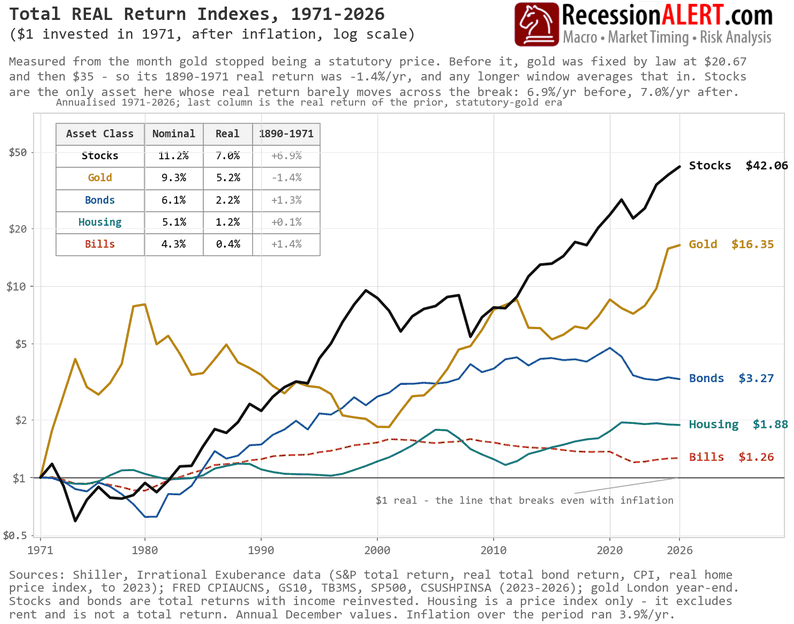
Two numbers on this chart sit eighty-one years apart and differ by eighteen hundredths of a point: stocks compounded 6.9%/yr real under the statutory-gold regime to 1971, and 7.0%/yr real across the fifty-five floating-rate years plotted here. Nothing else holds still across that break — gold swings +6.6pp, housing +1.0, bonds +0.9, bills -1.0. The mechanism is visible in the fourth inset column, the only pre-1971 data here. Gold’s -1.4%/yr real to 1971 was not failure but arithmetic: a declared parity of $20.67, then $35, held fixed while the price level compounded 2.06%/yr. Release the peg and the catch-up arrives dressed as a return, which is why 5.21% since 1971 blends a legislated number with a market one — and why the path bears no resemblance to the rate, gold peaking at $8.02 real in 1980, surrendering 88% of that gain by 2000, and not regaining the level until 2012. Equities have no peg to release; they are claims on nominal cash flows that reprice with the unit of account. The exposure is elsewhere. Bonds have given back 31.3% real since 2020 as the 30Y real yield reached 2.97%, the highest since 2001, and bills compounded 0.43%/yr real, below breakeven in ten of fifty-five years. Regimes don’t reprice production. They reprice promises.
What it means: if you hold long bonds or a big cash balance for safety, that safety is in the dollar figure, not in what it buys. Stocks have carried purchasing power through a change in the monetary system; fixed dollar promises have not. Watch the 30-year inflation-protected yield: above 3%, sustained, and a bond finally locks in a return that beats inflation.
Market Intelligence Brief (MIB) Ver. 19.26
For professional investors only. Not investment advice.
© 2026 RecessionALERT.com

Comments are closed.