
MARKET INTELLIGENCE BRIEF (MIB)
Tuesday, November 24, 2026
Chips crack as Schumer accuses Nvidia’s Huang of breaking export law: NVDA -5.86%, Micron -11.01% on BNP’s downgrade, Nasdaq 100 -1.99%. Sanofi agrees to buy Insmed for about $41 billion cash as Healthcare (+3.15%) lifts the Dow back above 50,000. Consumer confidence leaps to 103.3, highest since January 2025. Eight of 12 Reserve Banks wanted a higher discount rate by the October hold. Crude rebounds on Iranian mine claims in Hormuz, and Anthropic slips below its $83 IPO price.
TABLE OF CONTENTS
A. EXECUTIVE SUMMARY
B. MARKET DATA
C. HIGH-IMPACT STORIES (5)
D. MODERATE-IMPACT STORIES (7)
E. ECONOMY WATCH (4)
F. EARNINGS WATCH (3)
G. WHAT’S NEXT
H. CHART OF THE DAY
A. EXECUTIVE SUMMARY -> TOP
The S&P 500 fell 0.50% to 7,201.09 and the Nasdaq 100 dropped 1.99% as chipmakers gave back part of Monday’s Huang rally, while the Dow rose 0.85% to close back above 50,000. The selling had a political edge: Senate Democratic leader Chuck Schumer accused Jensen Huang of breaking export-control law, the Attorney General would not say whether Nvidia is under investigation, and Huang testifies before the Senate Banking Committee on December 3. Treasuries barely moved, with the 10-year down 0.3 bps at 4.924%, even as discount rate minutes showed eight of 12 Reserve Banks had sought a higher rate by the October hold, confirming rather than changing the 95% prediction-market odds of another hike this year. Seven of 11 sectors rose, led by Healthcare (+3.15%) on the day Sanofi agreed to buy Insmed for about $41 billion, while Technology (-3.09%) was weakest, pointing to rotation out of chips rather than broad de-risking.
• Chips reverse: Nvidia (NVDA) fell 5.86% to $155.38 a day after its 31.48% surge; Texas Instruments fell 11.25%, Micron (MU) 11.01% after BNP Paribas cut it to Neutral with a $775 target from $1,700, AMD 8.86% and Intel 8.15%.
• Biotech M&A: Sanofi agreed to buy Insmed (INSM) for $175 a share in cash, about $41.0 billion and a 46% premium to the unaffected price; Insmed rose 14.13% to $170.15, about 2.8% below the offer.
• Consumers vs. hiring: Conference Board confidence rose 11.4 points to 103.3, its highest since January 2025, against a 92.5 consensus, with 12-month inflation expectations still at 5.7%; ADP’s weekly pulse slowed to 21,000 private jobs a week.
• Commodities split: WTI rose 1.90% to $81.69 and Brent 2.15% to $88.54 as Iran claimed two more tankers hit mines near Hormuz, unconfirmed independently; silver (-5.70%), platinum (-5.04%) and copper (-4.15%) closed at their lowest since at least April 15.
• Trade: A targeted Section 301 tariff round, reportedly capped at trade-deal levels, was expected as soon as Tuesday but was not announced by the evening; China extended its suspension of the US-bound gallium, germanium and antimony export ban to January 27.
• AI paper cools: Anthropic fell 6.54% to $81.91, below its $83 IPO price, despite two bullish initiations; JPMorgan set a 2027 S&P 500 target of 8,200, below the 8,471 consensus.
1. Nvidia’s overhang moved from governance to law — Monday priced Huang’s reinstatement as the end of the story; Tuesday showed the risk is now statutory and on a calendar: a Senate leader alleging an export-control violation, a Justice Department that will neither confirm nor deny a probe, a closed-door House briefing on December 1 and public Senate testimony on December 3. BNP’s memory-oversupply call gave the reversal a fundamental argument, and Anthropic breaking its offer price shows appetite for new AI equity is thinning at the same time. With semiconductors the market’s largest earnings engine, the AI hardware complex carries headline risk into December.
2. Rotation, not de-risking — The money leaving chips stayed in equities: Healthcare led with a sweep of mega-cap pharma, the Russell 2000 rose 0.57%, the Dow regained 50,000 and the VIX closed lower at 26.36 after touching 32.38. Sanofi’s all-cash $41 billion bid puts a hard price on launched US biotech growth, and a softer dollar (-0.47%) argues against a safe-haven bid. For portfolios, breadth outside technology is intact; the concentration risk is in how much of the index still rides on the chip trade.
3. Inflation inputs are stacking ahead of a hike-priced December — Eight of 12 Reserve Banks wanted a higher discount rate by the October hold, crude rebounded as weekly Hormuz transits fell to 125 vessels from 226 in early November, a new tariff layer is pending, and consumers still expect 5.7% inflation over the next 12 months. Wednesday’s October PCE (headline expected 3.8% year over year from 3.6%), GDP, durable goods and the Beige Book all land before Thanksgiving and the FOMC blackout that begins Saturday, so the front end has little room if they run hot.
 — Leading economic indicators. Accurate market forecasts. Apply for membership at join.recessionalert.com
B. MARKET DATA -> TOP
Monday’s chip surge on Jensen Huang’s return to Nvidia partly reversed: Nvidia gave back 5.86%, Technology was the weakest sector and the Nasdaq 100 fell 1.99%, while a broad healthcare rally lifted the Dow 0.85% back above 50,000. The split was a rotation rather than a selloff: seven of 11 sectors rose, the Russell 2000 and NYSE Composite both gained, and the VIX closed lower after touching 32.38 intraday. Investing.com also cited a Wall Street Journal report that the US is preparing higher tariffs on China and dozens of other countries. Metals broke the other way: silver, platinum and copper all closed at their lowest since at least April 15, even as crude rose on new attacks on shipping near the Strait of Hormuz.
CLOSING PRICES – Tuesday, November 24, 2026:
MAJOR INDICES
A three-way split: the Dow and the broad NYSE Composite rose while the Nasdaq 100 fell nearly 2%, so the damage was concentrated in mega-cap semiconductors rather than spread across the market. The Russell 2000’s gain confirms participation outside tech. The Dow’s return above 50,000 came from Nike, Amgen and Merck, its best performers per Investing.com, while Nvidia was its worst.
| Index | Close | Change | %Move | Why It Moved |
|---|---|---|---|---|
| S&P 500 | 7,201.09 | -36.08 | -0.50% | Chipmakers gave back part of Monday’s rally on Nvidia’s reinstatement of Jensen Huang, leaving Technology (-3.09%) the weakest sector; Healthcare (+3.15%) cushioned the loss. Investing.com also cited a Wall Street Journal report that the US is preparing higher tariffs on China and dozens of other countries. |
| Dow Jones | 50,018.70 | +423.39 | +0.85% | Closed back above 50,000. Nike, Amgen and Merck were its best performers and Nvidia its worst, per Investing.com. |
| DJ Transportation | 19,974.53 | -80.02 | -0.40% | No discrete same-day catalyst identified; transports lagged the Dow. |
| Nasdaq 100 | 26,214.17 | -531.93 | -1.99% | Semiconductor shares reversed after Monday’s Huang-driven surge: Nvidia fell 5.86% and Micron 11.01% after a BNP Paribas downgrade. Goldman’s trading desk wrote that Huang’s return was not a clearing event for chip stocks, per Investing.com. |
| Russell 2000 | 2,684.94 | +15.29 | +0.57% | No discrete same-day catalyst identified; small caps rose while mega-cap tech fell. |
| NYSE Composite | 23,354.68 | +103.35 | +0.44% | Broad gain as seven of 11 sectors rose; losses were concentrated in technology, industrials and materials. |
VOLATILITY & TREASURIES
The bond market sat out the equity swing: the 10-year slipped 0.3 bps and the 2-year rose 0.4 bps, flattening 2s10s to 23.7 bps from 24.4 bps. The VIX’s lower close after a 32.38 intraday high shows the stress was absorbed within the session. A 0.47% softer dollar argues against a safe-haven bid behind the tech selling.
| Instrument | Level | Change | Why It Moved |
|---|---|---|---|
| VIX | 26.36 | -0.26 (-0.98%) | Closed lower after touching 32.38 intraday as the Nasdaq pared a loss of as much as 2.6%, per Investing.com. |
| 10-Year Treasury Yield | 4.924% | -0.3 bps | Little changed; the Conference Board’s consumer confidence index rose to a 22-month high, per Investing.com, and markets await this week’s PCE inflation release. |
| 2-Year Treasury Yield | 4.687% | +0.4 bps | Little changed; no discrete same-day catalyst identified. |
| US Dollar Index (DXY) | 103.83 | -0.49 (-0.47%) | Fell as the euro rose 0.58% to 1.0965; no discrete same-day catalyst identified. |
COMMODITIES
Metals broke lower across the complex: silver (-5.70%) and platinum (-5.04%) fell about twice as hard as gold, and copper’s -4.15% put all three at their lowest closes since at least April 15. Gold fell even as the dollar softened, so the usual dollar offset did not hold. Bitcoin’s -2.11% tracked the tech selling rather than decoupling from it.
| Asset | Price | Change | %Move | Why It Moved |
|---|---|---|---|---|
| Gold | $3,554.90/oz | $-96.50 | -2.64% | Gave back Monday’s rebound; a morning wire cited expectations of further Fed tightening ahead of this week’s inflation data, per Investing.com. The driver of the larger afternoon decline was not identified. |
| Silver | $40.713/oz | $-2.462 | -5.70% | Fell with gold; lowest close since at least April 15. No discrete same-day catalyst identified. |
| Copper | $5.4000/lb | $-0.2340 | -4.15% | Erased Monday’s rebound as broader markets retreated, per Investing.com; lowest close since at least April 15. Change measured from CME’s December settlement of $5.634. |
| Platinum | $1,257.50/oz | $-66.70 | -5.04% | Fell with precious metals; lowest close since at least April 15. No discrete same-day catalyst identified. |
| Bitcoin | $59,984 | $-1,290 | -2.11% | Fell alongside tech shares; no discrete same-day catalyst identified. |
ENERGY
Crude rose against a falling Nasdaq, with Brent (+2.15%) slightly outpacing WTI (+1.90%) and the spread widening to $6.85 from $6.46. Reuters tied the gain to new attacks on vessels in and around the Strait of Hormuz. Henry Hub’s +4.17% to its highest close since at least April 15 had no identified catalyst, and part of TTF’s dollar gain came from a firmer euro.
| Asset | Price | Change | %Move | Why It Moved |
|---|---|---|---|---|
| Crude Oil (WTI) | $81.69/bbl | $+1.52 | +1.90% | Settled at $82.05, up $1.88, per Reuters, after new attacks were reported on vessels in and around the Strait of Hormuz; WTI’s session low was its weakest since August 10. |
| Crude Oil (Brent) | $88.54/bbl | $+1.86 | +2.15% | The front-month contract settled at $91.40, up $2.03, per Reuters, on the Hormuz ship attacks; this row tracks the February contract. |
| Natural Gas (Henry Hub) | $3.670/MMBtu | $+0.147 | +4.17% | Highest close since at least April 15, on the January contract. No discrete same-day catalyst identified. |
| Natural Gas (Dutch TTF) | $29.32/MMBtu | $+0.64 | +2.25% | Up 1.66% in euro terms, plus a 0.58% firmer euro; no discrete same-day catalyst identified. |
S&P 500 SECTORS
Seven of 11 sectors rose, led by Healthcare (+3.15%) and Consumer Defensive (+1.69%), while Technology (-3.09%) gave back part of its rebound and remains the month’s worst sector at -15.04%. Healthcare’s lead extends a six-month gain of +19.15%, the strongest of any sector, while Basic Materials’ -20.09% three-month slide deepened. Defensives rising on a mixed tape point to rotation out of chips rather than broad de-risking.
| Sector | 1-Day | 1-Week | 1-Month | 3-Month | 6-Month | YTD | 12-Month |
|---|---|---|---|---|---|---|---|
| Healthcare | +3.15% | +0.45% | +3.10% | +3.85% | +19.15% | +15.03% | +15.05% |
| Consumer Defensive | +1.69% | +0.25% | +4.33% | +8.86% | +8.04% | +17.06% | +17.62% |
| Real Estate | +1.25% | -0.08% | +1.31% | -4.88% | -3.17% | +5.64% | +4.42% |
| Energy | +0.77% | -5.01% | -14.17% | -6.00% | +0.15% | +27.57% | +28.05% |
| Financial | +0.58% | -2.15% | -1.52% | -6.50% | +4.41% | +1.91% | +8.96% |
| Utilities | +0.24% | -0.37% | +1.17% | -0.99% | -5.90% | -0.07% | -2.24% |
| Consumer Cyclical | +0.17% | -0.04% | +1.53% | -1.87% | -5.66% | -4.95% | +0.42% |
| Communication Services | -0.28% | -1.36% | -5.96% | -11.30% | -19.30% | -12.52% | -8.50% |
| Basic Materials | -0.95% | -5.07% | -8.34% | -20.09% | -15.33% | -1.55% | +9.16% |
| Industrials | -1.41% | -3.34% | -4.84% | -10.39% | -12.74% | +1.11% | +6.08% |
| Technology | -3.09% | -3.85% | -15.04% | -13.82% | -13.64% | +5.07% | +9.46% |
TOP MEGA-CAP MOVERS:
GAINERS
| Company | Ticker | Close | Change | Why It Moved |
|---|---|---|---|---|
| Amgen | AMGN | $473.93 | +5.54% | No discrete same-day catalyst identified; rose with Healthcare (+3.15%), the strongest sector, and was among the Dow’s best performers. Its Opdivo biosimilar patent settlement with Bristol-Myers Squibb was reported after the close, per Investing.com. |
| Gilead Sciences | GILD | $178.29 | +4.51% | William Blair initiated coverage at Outperform on Tuesday, per Investing.com, as Healthcare rallied; whether the initiation alone explains a move this size is unverified. |
| Merck & Co | MRK | $141.57 | +4.50% | No discrete same-day catalyst identified; rose with Healthcare and was among the Dow’s best performers. Merck’s only release on Tuesday was a conference-participation notice. |
| AbbVie | ABBV | $300.28 | +4.10% | Rose with Healthcare (+3.15%); followed Monday’s FDA approval of Rinvoq for nonsegmental vitiligo, announced November 23 per Investing.com. |
| Eli Lilly | LLY | $1,407.59 | +3.15% | Moved in line with Healthcare (+3.15%); Moody’s upgraded Lilly to Aa2 on Tuesday afternoon, citing obesity-drug demand, per Investing.com. |
DECLINERS
| Company | Ticker | Close | Change | Why It Moved |
|---|---|---|---|---|
| Texas Instruments | TXN | $258.44 | -11.25% | No company-specific catalyst identified, per Investing.com; fell as Monday’s chip rally reversed, on the day analog peer Analog Devices dropped 17.37% in an earnings-driven move. The read-across to TI is unverified. |
| Micron Technology | MU | $629.79 | -11.01% | BNP Paribas cut Micron to Neutral from Outperform and its price target to $775 from $1,700 on Tuesday, citing growing memory-oversupply risk, per Investing.com; it also gave back part of Monday’s 19.04% gain. |
| Advanced Micro Devices | AMD | $413.27 | -8.86% | Fell as Monday’s Huang-driven chip rally reversed. Investing.com also cited AMD’s S-3 registration of about 337 million shares covering warrants held by OpenAI and Meta; the filing’s date is unverified. |
| Intel | INTC | $54.80 | -8.15% | No Intel-specific catalyst identified, per Investing.com; gave back part of Monday’s 16.34% gain as the chip rally reversed. |
| Applied Materials | AMAT | $323.76 | -6.66% | No discrete same-day catalyst identified; gave back part of Monday’s 14.62% gain as chip stocks reversed. |
— Institutional-grade intelligence for serious investors. Apply for membership at join.recessionalert.comC. HIGH-IMPACT STORIES -> TOP
BEARISH
1. Nvidia Gives Back 5.86% as Schumer Accuses Huang of Breaking Export Law and the Attorney General Declines to Say Whether Nvidia Is Under Investigation
The core facts:Nvidia closed down 5.86% at $155.38 a day after its 31.48% surge on the board’s reinstatement of Jensen Huang, and the Nasdaq 100 fell 1.99% as Technology (-3.09%) finished as the weakest of 11 sectors. Senate Democratic leader Chuck Schumer said in a post on X that Huang “shipped extremely advanced chips to China, violating US export control law,” per Reuters; Nvidia and the White House did not immediately comment. Asked repeatedly whether the Justice Department or FBI had investigated Huang, Attorney General Todd Blanche told reporters “I don’t know what you’re talking about,” while calling Nvidia “a good corporate citizen,” per the BBC. Criticism was bipartisan: Republican Senator Pete Ricketts said the reinstatement “doesn’t absolve Nvidia of answering for national security concerns and unaccounted-for chips,” and the top Democrats on four House committees wrote to President Trump demanding records of the administration’s communications with Nvidia’s board. Huang is due to testify at a public Senate Banking Committee hearing on Thursday, December 3, after a closed-door briefing with three House panels on Tuesday, December 1, per Reuters.
Why it matters:Monday’s rally priced Huang’s return as the end of the governance overhang; Tuesday’s trading said otherwise. Goldman’s trading desk wrote that the return was “not a clearing event” for chip stocks, per Investing.com, and the damage spread well beyond Nvidia: Micron fell 11.01%, AMD 8.86%, Intel 8.15% and Applied Materials 6.66%. The political risk is now concrete rather than reputational — a sitting Senate leader alleging a statutory violation, a Justice Department that will neither confirm nor deny a probe, and congressional testimony within ten days. The tape shows rotation, not panic: seven of 11 sectors rose, the Dow added 0.85% to close back above 50,000 and the VIX ended lower at 26.36 after touching 32.38 intraday. But with semiconductors the market’s largest earnings engine, an export-control finding against the sector’s leader would reprice the whole AI hardware complex.
What to watch:Huang’s Senate Banking testimony on December 3, and whether the Justice Department or Commerce opens any action naming Nvidia or Huang.
BULLISH
2. Sanofi Agrees to Buy Insmed for $175 a Share in Cash, About $41.0 Billion, as Healthcare Leads the S&P 500 Up 3.15%
The core facts:Sanofi agreed to acquire US respiratory drugmaker Insmed for $175 a share in cash, an equity value of approximately $41.0 billion (€37.6 billion), a premium of about 46% to Insmed’s unaffected close on November 18, the day before media reports of a possible deal, according to the companies’ release filed with the SEC. The deal is funded with debt and cash on hand under committed financing and is expected to close in the first half of 2027, subject to Insmed shareholder and regulatory approvals. Sanofi expects it to be accretive to business EPS by the end of 2028 and to have no impact on its 2026 guidance. The prize is BRINSUPRI (brensocatib), which the release says generated $1.09 billion of revenue through September 30, 2026, alongside ARIKAYCE ($433.8 million in 2025 revenue, up 19%) and the pipeline candidate TPIP. Insmed closed at $170.15, up 14.13%, below the offer price.
Why it matters:A $41 billion all-cash bid for a single launched respiratory franchise puts a hard price on late-stage US biotech assets and arrived on the day Healthcare (+3.15%) was the strongest sector, with Amgen (+5.54%), Gilead (+4.51%), Merck (+4.50%), AbbVie (+4.10%) and Eli Lilly (+3.15%) the top five mega-cap gainers. No source tied those moves to the deal directly, so the read is a sector one: large pharma with patent cliffs ahead is paying up for growth, and the group offered the market a defensive home as chips sold off. The discount of the $170.15 close to the $175 offer is about 2.8%, a spread that prices high confidence in completion.
What to watch:The Insmed-to-offer spread for any sign of regulatory doubt, and whether other large pharma names respond with bids of their own for US biotech growth assets before year-end.
UNCERTAIN
3. New Section 301 Tariffs Reported as Soon as Tuesday, Targeted by Economy and Capped at Trade-Deal Levels; No Announcement by the Evening
The core facts:The Wall Street Journal reported that the US is preparing to raise tariffs on China and dozens of other countries, and Bloomberg reported at 10:45 AM ET, citing people familiar, that President Trump’s next round “won’t surpass levels set in US trade deals” and will be “targeted for each economy rather than imposed as a blanket rate,” with an announcement coming as soon as Tuesday. The tariffs would conclude the US Trade Representative’s Section 301 investigation into structural excess manufacturing capacity, opened in March 2026 against 16 economies. USTR’s press-release listing showed no announcement when checked on Tuesday evening, so the timing, rates and country list remain unconfirmed.
Why it matters:Investing.com cited the Journal report as one of the weights on Tuesday’s tape, alongside doubts over the AI trade. Bloomberg’s detail softens the shock: a cap at trade-deal levels means partners that have signed deals would face rates they have already accepted, while the economies without deals — China above all — carry the risk of the steepest increases. That matters for an inflation picture the Fed is already treating as a hiking problem, with prediction markets putting the odds of another 2026 hike at 95%. A targeted, capped round is a smaller cost shock than a blanket one, but any new tariff layer lands on goods prices just as Wednesday’s October PCE is expected to show headline inflation rising to 3.8% year over year.
What to watch:A USTR determination or presidential proclamation, and the rate set for China against the levels in existing deals with the EU, Japan and South Korea; Beijing’s response will show whether the extension of its minerals truce (Story 10) survives.
BEARISH
4. Crude Rebounds as Iran Claims More Tankers Hit Mines in Hormuz and Its Army Chief Says the Strait “Will Become Increasingly Closed”
The core facts:WTI closed at $81.69, up 1.90%, and Brent (February) at $88.54, up 2.15%, reversing early losses. Iran’s Navy said two tankers that entered a prohibited area east of the Strait of Hormuz early Tuesday with their identification systems switched off caught fire and were disabled after striking naval mines, per the Tasnim news agency; neither vessel was named and no independent source confirmed the strikes. Army chief Major General Amir Hatami told senior commanders on Tuesday that “The Strait of Hormuz will not be reopened; it will become increasingly closed,” per the Tehran Times. Newsquawk’s settlement wrap also cited an NBC report that US officials are debating whether to target Iran’s top leaders, and Iraq’s rejection of the OPEC+ assessment of its production capacity. Transits through the strait fell to 125 vessels in the week of November 17-23 from 226 in November 1-7, per MarineTraffic data cited by Al Jazeera.
Why it matters:Monday’s 3.78% WTI drop on Libya’s restart had priced a market where supply was winning; Tuesday’s rebound is the reminder that the Gulf risk premium is only one escalation away. Iran’s stated aim of a progressively tighter strait, and a traffic count already down more than 40% in two weeks, run directly into the Fed’s inflation problem: higher crude feeds headline prices at the moment markets are pricing a 95% chance of another hike this year. The softer dollar (-0.47%) helped, but the bounce from WTI’s weakest intraday level since August 10 shows buyers stepping back in on headline risk rather than on fundamentals.
What to watch:Independent confirmation of any mine strike from CENTCOM or the UK Maritime Trade Operations centre, Wednesday’s EIA inventory report (10:30 AM ET), and the OPEC+ meeting on 2027 targets.
BEARISH
5. Discount Rate Minutes Show Two-Thirds of Reserve Banks Wanted Tighter Policy by the October Hold, Reinforcing December Hike Pricing
The core facts:Minutes of the Federal Reserve Board’s October discount rate meetings, released at 2:00 PM ET, show that by the October 28 hold eight of the 12 Reserve Banks had asked to raise the primary credit rate to 4.25%, while the Board kept it at 4%. Section E carries the full detail of the votes. Treasuries barely moved on the day: the 2-year yield rose 0.4 bps to 4.687% and the 10-year slipped 0.3 bps to 4.924%.
Why it matters:Discount rate requests come from Reserve Bank boards rather than FOMC votes, but they are the cleanest available read of how broad the appetite for tightening was across the system at a meeting that ended in a hold — and three banks moved to a higher rate in the two weeks before it. The bond market’s indifference says the minutes confirmed rather than changed the outlook: prediction markets already price a 95% chance of another hike this year, and New York Fed President Williams said on Monday that the risk to price stability is “dialed up.” What the minutes add is breadth. A December decision that has a majority of Reserve Bank boards behind it is harder for doves on the Board to resist, which keeps the front end exposed if Wednesday’s inflation data run hot.
What to watch:Wednesday’s October PCE price index (8:30 AM ET) and the Beige Book (2:00 PM ET), the last major inputs before the FOMC communications blackout begins on Saturday, November 28 ahead of the December 9 decision.
— Quantifying recession risk so you don’t have to guess. Apply for membership at join.recessionalert.comD. MODERATE-IMPACT STORIES -> TOP
BEARISH
6. Micron Falls 11.01% as BNP Paribas Downgrades It to Neutral and Cuts Its Target to $775 From $1,700 on Memory Oversupply Risk
The core facts:BNP Paribas analyst Karl Ackerman downgraded Micron to Neutral from Outperform and cut his price target to $775 from $1,700, warning that the risk of a memory-chip oversupply is growing, per Investing.com. “Growing risks to hyperscaler capacity plans in 2028 further threaten S/D fundamentals,” he wrote, also pointing to less high-bandwidth memory in Nvidia’s Vera Rubin Ultra platform. Micron closed at $629.79, down 11.01% from Monday’s $707.70, giving back more than half of Monday’s 19.04% gain.
Why it matters:The call goes at the core of the memory bull case. Memory pricing has been the most cyclical leg of the AI build-out, and a credible warning that 2028 hyperscaler capacity plans are at risk turns a supply-shortage story into a question about when supply catches up. It also compounds the day’s chip selling: Micron was the second-largest mega-cap decliner after Texas Instruments, and the downgrade gave the reversal of Monday’s Huang rally a fundamental argument rather than a purely positional one.
What to watch:Whether other memory analysts follow BNP on 2028 capacity risk, and contract DRAM and NAND price trends into Micron’s next quarterly report.
UNCERTAIN
7. Tesla and SpaceX Name Five Directors to Steer All-Stock Merger Talks, the FT Reports; SpaceX Falls 5.65%
The core facts:The Financial Times reported that Tesla and SpaceX have appointed five directors to guide two special committees negotiating a potential all-stock combination: Roelof Botha and Randy Glein from SpaceX, and Robyn Denholm, Kathleen Wilson-Thompson and Jack Hartung from Tesla, as relayed by Reuters via The Standard. Morgan Stanley and Goldman Sachs are advising SpaceX and Evercore is advising Tesla, the report said. Reuters said it could not immediately verify the FT report, and neither company responded. SpaceX shares fell 5.65% to $125.81.
Why it matters:Named negotiators and hired banks move a combination of two of the largest Musk companies from idea toward process. An all-stock deal would put Tesla shareholders in a vehicle dominated by launch and satellite economics. SpaceX’s decline suggests investors are weighing who gives up value in the exchange ratio rather than celebrating the deal.
What to watch:Any confirmation or terms from either company, and the proposed exchange ratio, which will determine whether the deal is accretive for Tesla holders.
BEARISH
8. Anthropic Falls 6.54% to Close Below Its $83 IPO Price Days After Its Debut, as Canaccord and Wedbush Initiate Bullish
The core facts:Anthropic shares fell 6.54% to $81.91, below their $83 initial public offering price, after surging as much as 34% when trading began on Thursday, per Investing.com, which cited concerns over the sustainability of debt-financed AI infrastructure spending. Canaccord initiated coverage at Buy and Wedbush at Outperform on Tuesday, per The Fly’s ratings list.
Why it matters:A large AI listing trading below its offer price within a week is a direct read on how much appetite remains for new AI equity supply. The break came on a day when chip stocks sold off and Bitcoin fell 2.11%, so it fits a broader cooling of speculative AI exposure rather than a company-specific problem. That two bullish initiations failed to hold the offer price suggests the pressure is coming from overall demand for AI paper.
What to watch:Whether underwriters defend the $83 offer price, and how other AI issuers in the queue price their deals.
UNCERTAIN
9. JPMorgan Sets a 2027 S&P 500 Target of 8,200, Below the 8,471 Consensus and the 8,700 Calls From Morgan Stanley and Goldman
The core facts:JPMorgan strategists set a 2027 year-end target of 8,200 for the S&P 500, below the 8,471 consensus compiled by Bloomberg and well below the 8,700 targets from Morgan Stanley and Goldman Sachs, Bloomberg reported at 3:55 PM ET. The team expects US stocks to advance through the end of 2027, with artificial intelligence remaining a driving force behind earnings growth. The index closed Tuesday at 7,201.09.
Why it matters:The target implies about 13.9% upside from Tuesday’s close, so JPMorgan is not bearish — but it sits below both Morgan Stanley and Goldman Sachs, and was issued as the market weighs whether AI capex earnings can survive a Fed that is still hiking. The gap to the 8,700 calls is a gap about multiples rather than direction, and it gives investors who doubt the AI trade a mainstream reference point below consensus.
What to watch:The remaining year-ahead targets from other major banks, and whether the consensus drifts toward JPMorgan’s number if December’s Fed decision is a hike.
BULLISH
10. China Extends Its Suspension of the US-Bound Export Ban on Gallium, Germanium, Antimony and Superhard Materials to January 27
The core facts:China’s Ministry of Commerce extended by two months the suspension of the clause in its December 2024 dual-use export control announcement that bars licences for shipments to the US of dual-use items related to gallium, germanium, antimony and superhard materials, keeping the suspension in effect through Wednesday, January 27, 2027, per the South China Morning Post.
Why it matters:Gallium and germanium are inputs to compound semiconductors, defense electronics and fiber optics, and antimony to munitions, so the extension keeps a supply threat to US defense and chip supply chains on hold. Its short, two-month horizon is the point: Beijing is keeping the lever within reach while Washington weighs new Section 301 tariffs (Story 3) and lawmakers push for tighter chip export controls (Story 1). The extension signals that the trade truce holds for now, but leaves China able to reimpose the ban quickly if the tariff round goes against it.
What to watch:Beijing’s response to any Section 301 announcement, and whether the suspension is extended again before January 27.
UNCERTAIN
11. Amgen Settles Opdivo Patent Litigation With Bristol-Myers Squibb and Ono, Clearing an October 2028 US Launch for Its Biosimilar
The core facts:Amgen announced after the close at 4:01 PM ET that it has settled US patent litigation with Bristol-Myers Squibb and Ono Pharmaceutical, creating a pathway to launch ABP 206, its biosimilar to the cancer immunotherapy Opdivo, in the US on October 1, 2028, subject to FDA approval. Terms are confidential. Amgen’s application has been accepted by the FDA, with action expected by the end of 2026. “This agreement creates a pathway for timely biosimilar competition,” said Murdo Gordon, Amgen’s executive vice president of global markets and policy. Amgen had closed up 5.54% before the announcement.
Why it matters:Opdivo is one of Bristol-Myers Squibb’s largest products, so a fixed US biosimilar entry date removes litigation risk in both directions: Bristol gains a known end-date for US exclusivity, and Amgen gains a defined launch into one of the largest oncology markets. A settled date also lets investors model Bristol’s late-decade revenue gap with more confidence than an open court fight allowed.
What to watch:The FDA decision on ABP 206 by the end of 2026, and Bristol-Myers Squibb’s next update on its post-Opdivo revenue plan.
UNCERTAIN
12. FDIC: Bank Net Income Falls 5.9% From the Second Quarter to $84.8 Billion but Rises 7.0% on the Year as Margins Widen
The core facts:FDIC-insured institutions reported third-quarter 2026 net income of $84.8 billion, down $5.3 billion (5.9%) from the second quarter but up $5.5 billion (7.0%) from a year earlier, the FDIC said in its Quarterly Banking Profile. Return on assets was 1.28%, the net interest margin rose 7 basis points to 3.39%, and the Deposit Insurance Fund’s reserve ratio rose 2 basis points to 1.50%. Unrealized losses on securities increased during the quarter but remained well below their 2023 peak.
Why it matters:A widening margin shows banks are still earning more from the Fed’s hikes than they are paying out on deposits, which is the main support for sector profits in a tightening cycle. The rise in unrealized securities losses is the cost on the other side: with the 10-year yield at 4.924%, further hikes push bond portfolios deeper under water, the same channel that caused the 2023 stress. Financials rose 0.58% on Tuesday, in line with a broad but modest gain outside technology.
What to watch:Unrealized securities losses and deposit costs in the fourth-quarter profile, and bank stock reaction if the December FOMC hikes again.
— Separating signal from noise since 2007. Apply for membership at join.recessionalert.comE. ECONOMY WATCH -> TOP
Tuesday’s data split along the line the Fed watches most closely: sentiment surged while hard activity cooled. The Conference Board’s index jumped 11.4 points to 103.3, 10.8 points above consensus and back to January 2025 levels on brighter job perceptions, yet ADP’s weekly pulse slowed to 21,000 jobs a week and FHFA home prices stalled in September. The hawkish signal came from inside the Fed: minutes showed eight Reserve Banks had asked to raise the discount rate to 4.25% by the October 28 hold. With Polymarket pricing a 95% chance of another hike this year, Wednesday’s holiday-compressed batch of October PCE, the Q3 GDP revision, durable goods and jobless claims is the decisive test before the December 9 decision.
Consumer Confidence Jumps 11.4 Points to 103.3, Its Highest Since January 2025, Far Above the 92.5 Consensus (The Conference Board, Nov 24)
What they’re saying:The Conference Board’s Consumer Confidence Index rose 11.4 points to 103.3 in November from 91.9 in October, against a 92.5 consensus. The Present Situation Index rose 13.7 points to 132.8 and the Expectations Index 9.9 points to 83.6, while the labor market differential (jobs “plentiful” minus “hard to get”) improved 7.6 points to +12.4%. “Consumer confidence rallied again in November, potentially due to lower uncertainty following the midterm elections,” said Fergus McCormick, Senior Economist at The Conference Board, adding that “the headline index is back to levels of confidence last seen in January 2025.”
The context:The 10.8-point beat was led by jobs: “The gain in confidence was led by stronger perceptions of present and future labor market conditions,” McCormick said. Price pressure has not left the survey. Consumers’ average 12-month inflation expectations “declined for a second consecutive month in November, but remained elevated at 5.7%,” and consumers “still expected higher interest rates over the next 12 months.” The reading sits far apart from the University of Michigan’s sentiment index, which ended November at 51.5. The results are preliminary, from a November 1-17 survey window.
What to watch:Wednesday’s October personal income and spending (8:30 AM ET, each expected +0.4%) will show whether firmer confidence is reaching spending; Michigan’s preliminary December sentiment follows on Friday, December 4.
Discount Rate Minutes: Eight Reserve Banks Had Asked to Raise the Primary Credit Rate to 4.25% by the October 28 Hold (Federal Reserve Board, Nov 24)
What they’re saying:Minutes of the Board’s October 19 and October 28 discount rate meetings, released at 2:00 PM ET, show the directors of the Boston, Cleveland, Chicago, St. Louis and Minneapolis Reserve Banks voted on October 15 to raise the primary credit rate to 4.25% from 4%. By the October 28 meeting, Richmond, Kansas City and Dallas had joined them with votes on October 22, while Atlanta’s directors voted to keep 4%. The Board left the rate at 4% at both meetings, recording that “No sentiment was expressed by the Board … for changing the primary credit rate at this time.” On October 28 the FOMC held the federal funds target range at 3-3/4 to 4 percent and interest on reserve balances at 3.90%.
The context:Richmond, Kansas City and Dallas had voted on October 8 to keep the rate at 4%, so all three switched to a higher rate in the two weeks before the October 28 meeting. That took the requests from five to eight. At the earlier meeting, directors “reported stable economic activity,” described labor conditions as “stable,” and “Several directors observed that inflation remained elevated.” Discount rate requests come from Reserve Bank boards, not FOMC votes, but they show how broad the appetite for tightening was across the system at a meeting that ended in a hold. Polymarket prices a 95% chance of another Fed hike in 2026, from 96% on Monday.
What to watch:Wednesday’s October PCE price index (8:30 AM ET; headline expected 3.8% YoY from 3.6%, core expected +0.3% MoM), the key inflation print ahead of the December 9 FOMC decision.
Home Prices Stall: FHFA Index Flat in September as Case-Shiller’s Annual Gain Misses at 2.6% (FHFA / S&P Cotality Case-Shiller, Nov 24)
What they’re saying:FHFA said its seasonally adjusted monthly house price index “for September remained unchanged from August.” In its third-quarter report, prices rose 0.7% from the second quarter and 2.5% from a year earlier. The S&P Cotality Case-Shiller home price index rose 2.6% year over year in September, below the 2.7% consensus and level with the prior month’s 2.6%.
The context:Annual home price gains of 2.5-2.6% now trail headline PCE inflation, which ran at 3.6% in September, so home prices are falling in real terms. The Atlanta Fed’s GDPNow model cut its fourth-quarter residential investment nowcast to -7.9% from -3.3% on November 18 after the housing starts release, with the MBA 30-year mortgage rate last at 7.35%. Flat prices ease future shelter inflation but erode the housing-wealth support for consumer spending.
What to watch:October new home sales on Wednesday at 10:00 AM ET (expected 0.65M, from 0.676M) and the MBA 30-year mortgage rate the same morning.
ADP Weekly Pulse: Private Hiring Slows to 21,000 Jobs a Week in the Four Weeks to November 7 (ADP, Nov 24)
What they’re saying:“For the four weeks ending November 7, 2026, U.S. private employers added an average of 21,000 jobs per week,” ADP said in its NER Pulse preliminary estimate. That is down from 23,000 for the four weeks ending October 31, revised from the 23,750 first reported. ADP said “Hiring decelerated this week,” adding that the numbers “are preliminary and could change as new data is added.”
The context:At 21,000 a week, private hiring is running at roughly 91,000 a month (21,000 × 4.33 weeks), close to ADP’s October monthly print of 86,000 and well below October’s 165,000 nonfarm payrolls. That slowing in measured hiring contrasts with the jump in consumers’ perceptions of jobs in the same day’s Conference Board survey.
What to watch:Initial jobless claims, moved to Wednesday for Thanksgiving (8:30 AM ET, expected 200K from 203K); ADP’s full November report on Wednesday, December 2 (prior 86K); November payrolls on Friday, December 4.
— Know the probability before the market prices in the risk. Apply for membership at join.recessionalert.comF. EARNINGS WATCH -> TOP
YESTERDAY AFTER THE BELL (Markets Reacted Today)
No major earnings yesterday after the bell from companies with >$100B market cap.
TODAY BEFORE THE BELL (Markets Already Reacted)
UNCERTAIN
13. Analog Devices (ADI): -17.37% | Record Quarter and 42% Growth, but a First-Quarter EPS Guide Below Q4 and Doubled Capex
The Numbers:Released: BMO, Tuesday, November 24, 2026. Fiscal fourth-quarter revenue $4.37 billion, up 42% from a year earlier, against a $4.33 billion estimate; adjusted EPS $4.06 against a $3.90 estimate. Gross margin rose 620 basis points to 69.3% and operating margin 1,200 basis points to 42.7%. Fiscal 2026 revenue was $15.18 billion, up 38%. First-quarter fiscal 2027 outlook: revenue $4.4 billion, plus or minus $150 million, and adjusted EPS $3.82, plus or minus $0.20.
The Problem/Win:The quarter was a beat on every line, but the guide points to lower earnings: adjusted EPS of $3.82 against $4.06 just reported. InvestorsHub reported the guide was below Bloomberg consensus, while Earnings Whispers called it in line and noted revenue guided above the usual seasonal decline; management cited a holiday fab shutdown and higher operating expenses. Earnings Whispers also reported fiscal 2027 capital spending of $1.6-1.9 billion, more than double fiscal 2026’s roughly $0.7 billion, as supply stays tight. CEO Vincent Roche said “more than two-thirds of our growth in fiscal 2026 came from non-AI-centric market opportunities.”
The Ripple:Texas Instruments fell 11.25%, the session’s largest mega-cap decline, with no TI-specific catalyst identified; a MarketWatch headline grouped Analog Devices with Semtech in a drop on concerns about peaks in growth rates and margins. The analog selloff added to the broader reversal of Monday’s chip rally, with Technology (-3.09%) the weakest sector.
What It Means:The market punished the combination of a record year with a lower next-quarter earnings run-rate and heavier capital spending, a sign that investors are now pricing the analog recovery on margins and cash flow rather than on revenue growth.
What to watch:Texas Instruments’ guidance at its next report for confirmation of the analog cycle’s direction, and whether ADI’s capacity spending translates into above-seasonal revenue through fiscal 2027.
UNCERTAIN
14. Medtronic (MDT): -4.56% | Revenue Misses as Growth Slows; EPS Edges Past and Fiscal 2027 Guidance Is Reiterated
The Numbers:Released: BMO, Tuesday, November 24, 2026. Fiscal second-quarter revenue $9.36 billion, up 4.5% reported and 6.5% organic, against a $9.48 billion estimate; adjusted EPS $1.34 against a $1.33 estimate. GAAP EPS of $2.20 included a $2.0 billion gain on the MiniMed diabetes separation. Fiscal 2027 guidance reiterated: organic revenue growth of 7.25% to 7.75% and adjusted EPS of $5.94 to $6.00.
The Problem/Win:Cardiovascular was the bright spot, with revenue of $3.79 billion up 10.4% organically and Cardiac Ablation Solutions up 58%, including 80% growth in the US. But revenue fell about 1.2% short of the estimate, Neuroscience grew only 3.2% organically, and Earnings Whispers headlined that a third-quarter slowdown was coming into view. Full-year guidance was reiterated rather than raised. CEO Geoff Martha said “We delivered a strong second-quarter, with broad-based performance.”
The Ripple:Medtronic fell against a Healthcare sector that rose 3.15% as the day’s strongest, so the decline was company-specific; the sector’s gains came from pharma and biotech names led by Amgen, Gilead and Merck.
What It Means:Medtronic’s ablation franchise is growing fast enough to carry the cardiovascular business, but the rest of the portfolio is not keeping pace, and a guide held flat after the diabetes separation leaves the burden of proof on the second half.
What to watch:Third-quarter organic growth against the 7.25% to 7.75% full-year range, and whether Cardiac Ablation Solutions sustains its growth rate.
TODAY AFTER THE BELL (Markets React Tomorrow)
BULLISH
15. Dell Technologies (DELL): +4.16% AH | Revenue Doubles to $54.9 Billion on AI Servers; Full-Year Outlook Raised to $202 Billion
The Numbers:Released: AMC, Tuesday, November 24, 2026. Fiscal third-quarter revenue a record $54.94 billion, up 103% from a year earlier, against a $49.32 billion estimate; non-GAAP EPS $9.45 against a $6.60 estimate. Infrastructure Solutions Group revenue $42.0 billion, up 198%, including $22.0 billion of AI-optimized servers; Client Solutions Group $12.9 billion, up 3%. Fourth-quarter guidance: revenue $56.3 billion and non-GAAP EPS $8.40. Fiscal 2027 guidance raised to revenue of $202.0 billion from $192.0 billion and non-GAAP EPS of $29.68 from $25.50. The board added $25 billion to the buyback authorization. Shares fell 11.83% in the regular session before the release.
The Problem/Win:AI demand overwhelmed every estimate: Dell booked $60.2 billion of AI orders and ended the quarter with a record AI backlog of $132.3 billion, and raised its full-year AI-optimized server revenue outlook to $78.0 billion from $74.0 billion. “We expect record full-year revenue of $202 billion, up 78%,” said Jeff Clarke.
The Ripple:The report lands after a session in which the AI hardware complex sold off, with Dell itself down 11.83% and Micron, AMD and Intel all falling more than 8%; a backlog this large is direct evidence that enterprise and cloud AI spending has not slowed.
What It Means:Dell’s order book contradicts the day’s AI-fatigue narrative and gives Wednesday’s chip trade a fundamental counterweight to the governance and memory-cycle worries that drove Tuesday’s selling.
What to watch:Wednesday’s open for Dell and AI hardware peers, and AI-server margin commentary on the earnings call given tight GPU and memory supply.
WEEK AHEAD PREVIEW:
Q3 2026 earnings season is nearly complete, with 93% of the S&P 500 reported as of November 20, per FactSet. The next five sessions carry three in-scope reporters above $100 billion: Deere on Wednesday, November 25, Marvell Technology on Tuesday, December 1, and Salesforce on Wednesday, December 2.
Deere (DE) — BMO, Wednesday, November 25 — consensus EPS about $4.03 and about $10.38 billion of revenue; key focus: whether the fiscal 2027 outlook confirms fiscal 2026 as the trough of the farm-equipment downturn, and any read on US farm exports amid the push for more Chinese agricultural purchases as new Section 301 tariffs loom.
Marvell Technology (MRVL) — AMC, Tuesday, December 1 — consensus EPS $1.10 and about $3.15 billion of revenue, in line with company guidance; key focus: data center and custom AI silicon revenue and the timing of new hyperscaler programs, now read against Dell’s $132.3 billion AI backlog and Tuesday’s chip selloff.
Salesforce (CRM) — AMC, Wednesday, December 2 — consensus EPS $3.45 and about $11.46 billion of revenue; key focus: Agentforce adoption and whether bookings are catching up with the AI narrative, and the fiscal 2027 outlook of $45.9 billion to $46.2 billion of revenue.
US markets are closed on Thursday, November 26 for Thanksgiving, and no in-scope company above $100 billion reports on Friday, November 27 or Monday, November 30. Snowflake ($95.6 billion) reports after the close on December 2, just below the $100 billion threshold.
— US market commentary trusted by family offices and institutions. Apply for membership at join.recessionalert.comG. WHAT’S NEXT -> TOP
UPCOMING RELEASES:
| Date | Event | Why It Matters |
|---|---|---|
| Wed, Nov 25 | October PCE Price Index (headline expected 3.8% YoY, prior 3.6%; core expected +0.3% MoM, prior +0.3%) | The last major inflation print before the December 9 FOMC decision; with prediction markets pricing a 95% chance of another hike this year and eight of 12 Reserve Banks having sought a higher discount rate, a hot core reading would harden December pricing. |
| Wed, Nov 25 | October Personal Income and Spending (each expected +0.4%; priors +0.2% and +0.5%) | Shows whether the jump in Conference Board confidence to 103.3 is reaching actual spending, or whether slowing hiring is the better guide to the consumer. |
| Wed, Nov 25 | Q3 GDP, Second Estimate (expected 3.4%, prior 2.2%); GDP Price Index (expected 2.3%, prior 6.1%) | Growth strong enough to absorb tighter policy argues for the hawks; the price index is a second inflation read on the same morning as PCE. |
| Wed, Nov 25 | Durable Goods Orders (expected +0.4%, prior +1.9%; ex-transportation expected +0.5%) | A read on business capital spending as tariffs and a hiking Fed raise the cost of investment. |
| Wed, Nov 25 | Initial Jobless Claims, moved up for Thanksgiving (expected 200K, prior 203K) | ADP’s weekly pulse slowed to 21,000 private jobs a week; a rise in claims from 203K would be the first sign that slower hiring is becoming layoffs. |
| Wed, Nov 25 | October New Home Sales (expected 0.65M, prior 0.676M) and MBA 30-Year Mortgage Rate (prior 7.35%) | Home prices are falling in real terms and GDPNow’s fourth-quarter residential investment nowcast is at -7.9%; another drop in sales would confirm housing as a drag on growth. |
| Wed, Nov 25 | EIA Crude Oil Inventories (prior +3.38M barrels) | Tests whether crude’s rebound on Hormuz headlines has fundamental support while weekly transits through the strait are down to 125 vessels from 226 in early November. |
| Wed, Nov 25 | Federal Reserve Beige Book (2:00 PM ET) | The districts’ own read on prices and labor, from the same Reserve Banks whose boards mostly sought a higher discount rate in October. |
| Thu, Nov 26 | US market holiday (Thanksgiving Day) | Markets closed; Wednesday’s releases are the last data before the long weekend. |
| Fri, Nov 27 | Advance Goods Trade Balance (expected -$131B, prior -$135.1B) | Arrives as a new Section 301 tariff round is pending; shows how much the existing tariffs are still changing import flows. |
| Sat, Nov 28 | FOMC communications blackout begins | No more Fed speakers before the December 9 decision, so Wednesday’s data carry the final word. |
| Tue, Dec 1 | ISM Manufacturing PMI (prior 55.5) and JOLTS Job Openings (prior 7.523M); Huang’s closed-door briefing with three House panels | ISM shows whether factory strength holds under higher rates, JOLTS whether labor demand is cooling; the Huang briefing is the first congressional step on the export-control allegations. |
| Wed, Dec 2 | ADP Employment Change for November (prior 86K) | The full monthly read after the weekly pulse slowed; sets expectations for November payrolls on Friday, December 4. |
| Thu, Dec 3 | Jensen Huang testifies at a public Senate Banking Committee hearing | The first public test of Schumer’s export-control allegation against Nvidia’s chief; anything that points toward a Justice Department or Commerce action would weigh on the whole AI hardware complex. |
KEY QUESTIONS:
1. Does Wednesday’s October PCE confirm the expected rise in headline inflation to 3.8%, and with eight of 12 Reserve Banks already seeking a higher discount rate, is there any reading soft enough to take a December 9 hike off the table?
2. Do Huang’s House briefing on Tuesday, December 1 and his Senate testimony on Thursday, December 3 contain the export-control allegations, or do they turn a political risk into a legal one for Nvidia and the chip sector?
3. When the Section 301 tariff round is announced, how far above deal-partner levels does the rate on China go, and does Beijing keep its gallium, germanium and antimony export suspension in place through January 27?
— US market commentary trusted by family offices and institutions. Apply for membership at join.recessionalert.comH. CHART OF THE DAY -> TOP
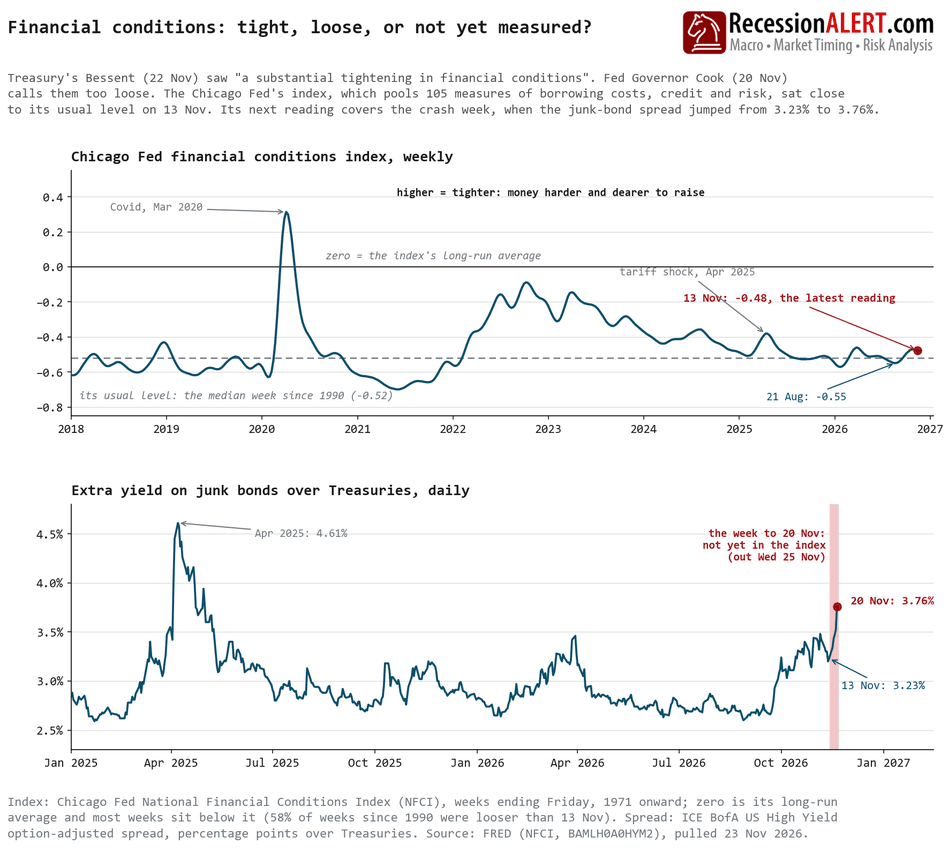
Washington is arguing about a gauge that has not yet seen the crash. Treasury Secretary Bessent cites “a substantial tightening in financial conditions over the past few months”; Fed Governor Cook, who dissented in October for another rate rise, says conditions are too loose, buoyed by stock prices. Financial conditions mean how easy and cheap it is to borrow and raise money, and the Chicago Fed’s index of 105 such measures backs neither word: at -0.48 on 13 Nov it sat close to its usual level, a shade tighter than the median week since 1990. That reading predates the week the S&P 500 fell 8.6%, when the junk-bond spread, the extra yield riskier companies pay over the US government, jumped 0.53 point to 3.76%, its highest since May 2025. Weaker-rated firms now pay more to borrow, and that is where tighter money reaches hiring and investment first. But an average of 105 measures dilutes a jolt in one corner with calm in the rest: in April 2025 the spread hit 4.61% while the index peaked at -0.38, still below zero. Some of the rest even eased: the 10-year Treasury yield fell to 4.92% on 20 Nov. Wednesday’s reading, the first to cover the crash week, lands with a December hike 95.8% priced as of 23 Nov, and a muted number would not mean a mild week. Until then, both sides are reading a thermometer taken before the fever.
What it means: For households, the 10-year Treasury yield, which mortgage rates follow, fell to 4.92% on 20 Nov. So far the squeeze has landed on riskier companies more than on the rate behind home loans. For stock investors, the most indebted companies would feel a wider junk-bond spread first, because they borrow at it. For the economy, those firms are where tighter money would cut hiring and investment first. The read changes if Wednesday’s reading tops -0.38, the April 2025 tariff-shock peak: the crash week would then have tightened conditions more than that shock did.
Market Intelligence Brief (MIB) Ver. 20.10
For professional investors only. Not investment advice.
© 2026 RecessionALERT.com

Comments are closed.