
MARKET INTELLIGENCE BRIEF (MIB)
Friday, October 30, 2026
Intel (INTC) plunged 28.58%, dragging AMD down 10.88% and leaving the Nasdaq 100 down 3.46% and 9.1% below its October 6 close. Three Fed presidents argued for more hikes, yet the 10-year yield fell 6.1 bps. Limpet mines hit a Hormuz tanker as Brent rose 1.39% to $112.34. Gold sank 3.63% and silver fell 6.20%, removing a haven. Binance’s $6.3 billion theft drew CFTC fire, and Bitcoin fell 2.50%. Global Payments jumped 12.97% on buyout talk.
TABLE OF CONTENTS
A. EXECUTIVE SUMMARY
B. MARKET DATA
C. HIGH-IMPACT STORIES (5)
D. MODERATE-IMPACT STORIES (6)
E. ECONOMY WATCH (6)
F. EARNINGS WATCH (11)
G. WHAT’S NEXT
H. CHART OF THE DAY
A. EXECUTIVE SUMMARY -> TOP
US equities fell hard but unevenly, with the S&P 500 down 1.82% and the Nasdaq 100 down 3.46%, as Intel’s warning joined two worries about the AI buildout: memory costs squeezing device demand and spending that partly depends on outside financing. Fed officials offered no cushion: two days after the hold at 3.75%-4.00%, Logan called for at least two more hikes and Musalem for firming “soon,” with CME FedWatch near 76% for a December hike and crude above $100 feeding their inflation case. Hedges were uneven too, as the 10-year yield fell 6.1 bps to 4.923% while gold lost 3.63%, leaving Treasuries to diversify alone. Breadth points to a de-rating of AI-linked leadership rather than a liquidation: the NYSE Composite fell just 0.91%, four sectors rose led by Consumer Defensive (+1.37%) and Energy (+1.33%), and Technology (-4.53%) finished last.
• Chips: Intel fell 28.58% to $65.76, AMD fell 10.88%, Qualcomm fell 11.13%, Marvell fell 10.05% and Nvidia fell 4.22%; Intel’s five-year CDS reached an all-time high of 124.75 bps, per Markit data via Reuters.
• Fed: Logan wants “at least two more” quarter-point hikes, Musalem says firming is needed “soon,” and Barkin calls the direction “pretty straightforward” with pace the open question; the 2-year yield fell 1.2 bps to 4.590%.
• Data: Chicago PMI missed at 55.3 against 56.1 expected, with Prices Paid at their highest since December 2021; the Q3 Employment Cost Index rose 0.8% as expected, while private real wages fell 0.6% over the year.
• Energy: UKMTO counted just over 30 attacks in October, about twice September’s total; Brent rose 1.39% to $112.34, WTI rose 0.91% to $102.93, and Dutch TTF rose 5.21% to its highest close since at least April 15.
• Metals and crypto: gold fell 3.63% to $3,884.97 and silver fell 6.20% to $49.13, both their lowest closes since at least April 15; Bitcoin fell 2.50% to $76,942 after the $6.3 billion Binance theft.
• Deals and earnings: Global Payments rose 12.97% on a reported CD&R take-private exploration, CNBC said a Marvell-Lumentum deal would be all stock, and earnings lifted Eli Lilly 3.19% and ExxonMobil 2.16%.
1. AI Leadership Is Being Repriced, Not the Whole Market — Intel’s report turned into a verdict on the wider buildout, with Capital Economics’ John Higgins saying investors “are becoming more nervous about the sums they are collectively investing and how they are doing it.” The monthly sector table shows this began before Friday: Technology is down 8.56% and Communication Services down 12.25% over one month, while Consumer Defensive is up 11.62% and Energy up 10.57%. For portfolios, the exposure that matters is concentration in AI-linked names rather than equities as a whole, and the Nasdaq 100’s level near 28,102, a 10% decline from its October 6 close, is the next test.
2. Falling Yields Are Not a Fed Reprieve — The 10-year rallied on equity stress while the policy message hardened: Logan’s path implies 4.25%-4.50% before any pause, and CME FedWatch stood near 76% for a December hike. The data split the argument, with Chicago’s Prices Paid supporting the hawks and the Employment Cost Index giving them no wage-price spiral, since private real wages fell 0.6% over the year. Crude above $100 keeps the inflation case alive, so one day’s duration bid should not be read as a change in the policy path before next Friday’s payrolls.
3. The Hedge List Got Shorter — Gold fell on a day when a lower dollar, lower yields and a stock selloff would normally support it, and analysts’ margin-selling and hawkish-Fed explanations remain unproven. That left Treasuries as the only traditional diversifier that worked, while the dollar also slipped. What did rise was tied to the war and to defensive demand: crude, Dutch TTF with EU storage near 75%, and the Energy and Consumer Defensive sectors. Portfolios relying on precious metals as equity protection should treat Friday as evidence that the protection can fail when it is needed.
 — Leading economic indicators. Accurate market forecasts. Apply for membership at join.recessionalert.com
B. MARKET DATA -> TOP
October closed with a chip-led rout as investors reacted to Intel’s and Amazon’s Thursday-evening earnings reports and the cost of the AI buildout, leaving the Nasdaq 100 far behind the Dow and with transports higher. Breadth read as defensive rotation rather than a market-wide flush. The session’s oddity sat in metals: gold, silver and platinum all closed at their lowest since at least April 15 even as equities sold off and the 10-year yield eased, so the usual haven bid was absent. Crude stayed firm on Iran-war supply fears, leaving an energy-price impulse beneath a growth-stock selloff.
CLOSING PRICES – Friday, October 30, 2026:
MAJOR INDICES
A concentrated tech selloff: the Nasdaq 100’s loss was nearly four times the NYSE Composite’s. Dow and DJ Transportation split by 1.56 points, with the Dow lower and transports higher; no same-day catalyst was found for transports. Over the past 10 sessions the Russell 2000 has outrun the S&P 500 by 4.4 points, now in its 4th session above the 2-point threshold, as participation broadens away from mega-caps.
| Index | Close | Change | %Move | Why It Moved |
|---|---|---|---|---|
| S&P 500 | 7,580.07 | -140.32 | -1.82% | Technology (-4.53%) led the decline after Intel’s and Amazon’s Thursday-evening earnings reports; four defensive and energy sectors rose. |
| Dow Jones | 51,770.31 | -572.25 | -1.09% | Fell less than tech-heavier gauges as the day’s selling centred on chips and AI hardware. |
| DJ Transportation | 20,329.33 | +95.85 | +0.47% | No discrete same-day catalyst identified; rose against the Dow’s decline. |
| Nasdaq 100 | 28,384.85 | -1,017.66 | -3.46% | Chip rout after Intel’s report; Reuters put the Nasdaq 100 on the brink of a correction and called the Nasdaq Composite’s drop its biggest since June. |
| Russell 2000 | 2,811.84 | -47.37 | -1.66% | No discrete same-day catalyst identified; fell with the broader market after a strong 10-session run. |
| NYSE Composite | 24,293.09 | -224.13 | -0.91% | Lost far less than the Nasdaq 100, with Consumer Defensive, Energy, Utilities and Healthcare higher on the day. |
VOLATILITY & TREASURIES
VIX jumping while the 10-year yield fell is a risk-off signature. The curve offers no clean signal: these prints show the 10-year down more than the 2-year, while Treasury’s own par curve had both down 4-5 bps. The dollar slipped despite equity stress, offering no haven bid.
| Instrument | Level | Change | Why It Moved |
|---|---|---|---|
| VIX | 19.44 | +2.24 (+13.02%) | Rose with the tech selloff; touched 23.93 intraday before fading into the close. |
| 10-Year Treasury Yield | 4.923% | -6.1 bps | No single confirmed catalyst; fell during the equity selloff. |
| 2-Year Treasury Yield | 4.590% | -1.2 bps | No single confirmed catalyst; the Q3 Employment Cost Index rose 0.8% on the quarter and 3.4% on the year (BLS). |
| US Dollar Index (DXY) | 101.88 | -0.15 (-0.15%) | Reuters tied the dollar’s slip to declining Treasury yields; the Bank of Japan held rates at 1.25%. |
COMMODITIES
Precious metals fell as a bloc, with all three at their lowest closes since at least April 15, and copper’s smaller loss marks this as a precious-led flush rather than an industrial-demand scare. Bitcoin’s decline has its own catalyst in the record Binance theft rather than simply tracking equities.
| Asset | Price | Change | %Move | Why It Moved |
|---|---|---|---|---|
| Gold | $3,884.97/oz | $-146.43 | -3.63% | Lowest close since at least April 15. Investing.com, citing ANZ on equity liquidations, also pointed to December Fed-hike expectations; attribution not independently confirmed. |
| Silver | $49.130/oz | $-3.250 | -6.20% | Lowest close since at least April 15; fell with gold, no separate catalyst identified. |
| Copper | $6.4970/lb | $-0.1055 | -1.60% | No discrete same-day catalyst identified. |
| Platinum | $1,434.40/oz | $-58.90 | -3.94% | Lowest close since at least April 15; fell with gold, no separate catalyst identified. |
| Bitcoin | $76,942.00 | $-1,969.00 | -2.50% | Record $6.3 billion theft at Binance on Thursday, per Reuters; about $3 billion has been located so far. |
ENERGY
WTI and Brent rose together while equities fell, with Brent’s premium over WTI widening and both giving back part of the day’s gain after settlement. Gas split sharply: Dutch TTF closed at its highest since at least April 15 while Henry Hub declined, keeping the European and US markets on opposite paths.
| Asset | Price | Change | %Move | Why It Moved |
|---|---|---|---|---|
| Crude Oil (WTI) | $102.93/bbl | $+0.93 | +0.91% | Settled $104.12, up $2.12, per Reuters, on Iran-escalation fears and a limpet-mine attack on a tanker in the Strait of Hormuz; later pulled back. |
| Crude Oil (Brent) | $112.34/bbl | $+1.54 | +1.39% | January contract settled $113.43, up $2.63, per Reuters, on the same drivers; the US also ordered non-emergency staff out of Saudi Arabia. |
| Natural Gas (Henry Hub) | $2.884/MMBtu | $-0.068 | -2.30% | No discrete same-day catalyst identified. |
| Natural Gas (Dutch TTF) | $33.76/MMBtu | $+1.67 | +5.21% | Highest close since at least April 15; an Investing.com headline tied October’s 40% surge to US-Iran military escalation, not independently confirmed for today’s move. |
S&P 500 SECTORS
Four of 11 sectors closed green: Consumer Defensive, Energy, Utilities and Healthcare. The rotation shows on the month too: Consumer Defensive, Energy and Healthcare are each up about 10% or more over one month, while Communication Services and Technology are down double and high-single digits, deepening a month-long reversal in AI-linked leadership.
| Sector | 1-Day | 1-Week | 1-Month | 3-Month | 6-Month | YTD | 12-Month |
|---|---|---|---|---|---|---|---|
| Consumer Defensive | +1.37% | +1.02% | +11.62% | +5.80% | +4.27% | +14.06% | +16.22% |
| Energy | +1.33% | +0.54% | +10.57% | +14.08% | +12.31% | +49.87% | +51.45% |
| Utilities | +0.36% | +1.26% | +8.05% | -2.69% | -8.09% | +0.38% | -4.40% |
| Healthcare | +0.34% | +3.34% | +9.71% | +11.03% | +21.58% | +15.14% | +20.93% |
| Real Estate | -0.05% | +1.18% | +4.74% | -5.91% | -3.04% | +5.04% | +4.27% |
| Consumer Cyclical | -0.79% | +1.21% | +3.88% | -5.29% | -5.04% | -6.16% | -7.79% |
| Communication Services | -0.91% | -7.69% | -12.25% | -15.27% | -18.73% | -12.66% | -11.40% |
| Financial | -1.19% | +0.09% | +2.51% | -3.90% | +6.78% | +3.88% | +10.05% |
| Basic Materials | -2.23% | -0.29% | -2.62% | -1.65% | -6.94% | +6.47% | +15.26% |
| Industrials | -2.35% | +0.52% | -1.92% | -6.14% | -7.16% | +5.67% | +5.05% |
| Technology | -4.53% | -1.59% | -8.56% | +1.16% | +8.66% | +19.91% | +11.56% |
TOP MEGA-CAP MOVERS:
GAINERS
| Company | Ticker | Close | Change | Why It Moved |
|---|---|---|---|---|
| Eli Lilly | LLY | $1,417.54 | +3.19% | Earnings-driven; extended the move after Lilly’s Thursday report, per Investing.com. |
| Gilead Sciences | GILD | $170.68 | +3.06% | Earnings-driven, following Thursday’s after-close report. |
| Merck | MRK | $149.52 | +2.18% | Earnings-driven; extended the move after Merck’s Thursday report, per Investing.com. |
| ExxonMobil | XOM | $187.25 | +2.16% | Earnings-driven, reported before Friday’s open; Energy sector also rose. |
| Walmart | WMT | $123.51 | +1.86% | No discrete same-day catalyst identified; rose with Consumer Defensive. Its $6 billion Symbotic automation deal was announced Thursday. |
DECLINERS
| Company | Ticker | Close | Change | Why It Moved |
|---|---|---|---|---|
| Intel | INTC | $65.76 | -28.58% | Earnings-driven, following Thursday’s after-close report; BofA cut the stock to Neutral on Friday. |
| Advanced Micro Devices | AMD | $504.80 | -10.88% | Read-through from Intel’s report, per Investing.com, as a direct x86 competitor; no company-specific news identified. |
| Dell Technologies | DELL | $424.30 | -10.77% | Reuters named PC sellers such as Dell among those exposed after Intel’s report; no company-specific news identified. |
| Arista Networks | ANET | $168.86 | -8.34% | No discrete same-day catalyst identified; fell with the AI-hardware complex ahead of its Tuesday report. |
| Applied Materials | AMAT | $390.09 | -7.49% | Fell in the semiconductor selloff after Intel’s report, per Investing.com; no company-specific news identified. |
— Institutional-grade intelligence for serious investors. Apply for membership at join.recessionalert.comC. HIGH-IMPACT STORIES -> TOP
BEARISH
1. Intel’s 28.58% Collapse Triggers a Global Chip Rout, Taking the Nasdaq 100 Down 3.46% to the Brink of a Correction
The core facts:The Nasdaq 100 fell 3.46% to 28,384.85 and the S&P 500 fell 1.82% to 7,580.07, with Technology the worst sector at -4.53%. Intel closed at $65.76, down 28.58%; Reuters had it on course for its biggest one-day decline ever and put the loss of market value above $146 billion during the session. AMD fell 10.88%, Qualcomm 11.13%, Dell 10.77%, Arm 9.97%, Arista 8.34%, Applied Materials 7.49%, Hewlett Packard Enterprise 6.42%, Broadcom 5.48%, Micron 5.30% and Nvidia 4.22%. The damage was global: ASML lost more than 6%, South Korea’s KOSPI 3.5%. The cost of insuring Intel’s debt reached an all-time high, with five-year credit default swaps at 124.75 bps, up 17.5 bps during the session, per Markit data via Reuters. BofA cut the stock to Neutral.
Why it matters:The selloff joined two separate worries about the AI buildout: soaring memory prices are squeezing device demand, and the spending is now partly dependent on outside financing. Reuters said Intel’s warning raised concern across companies reliant on consumer devices, while Capital Economics’ John Higgins said investors “are becoming more nervous about the sums they are collectively investing and how they are doing it.” The index closed 9.1% below its October 6 close of 31,224.47, the highest since at least April 15, and the Nasdaq Composite’s 2.86% drop was its biggest since June, per Reuters. Breadth was far less severe, with the NYSE Composite down 0.91% and four sectors higher, so this reads as a de-rating of AI-linked leadership rather than a market-wide liquidation. Seaport’s Jay Goldberg, who downgraded Intel, called the fall “a loss of faith in management’s credibility.”
What to watch:A Nasdaq 100 close below about 28,102, which would mark a 10% decline from the October 6 close, and reports from AMD and Arista on Tuesday, November 3.
BEARISH
2. Three Fed Presidents Argue for More Hikes Two Days After the Hold, but Treasuries Rally as Equity Stress Takes Over
The core facts:Reuters described Logan, Musalem and Barkin as making the case for further increases in the first round of commentary since Wednesday’s decision to hold at 3.75%-4.00%. The 10-year yield nonetheless fell 6.1 bps to 4.923% and the 2-year 1.2 bps to 4.590%, while the dollar index slipped 0.15% to 101.88. Neither dissenter, Governor Lisa Cook nor Cleveland’s Beth Hammack, offered a formal explanation on Friday, which Reuters called a break from what has become a common process.
Why it matters:Section E carries what each official said; the market message is that hawkish rhetoric could not lift yields on a day of equity stress. The 2-year, the part of the curve most tied to the policy path, barely moved while the 10-year fell further, which points to a flight into duration rather than a repricing of December. That leaves a poor mix for equities: financial conditions have tightened, as Musalem himself noted, and policymakers are still signalling more tightening with crude above $100. Chair Warsh gave no steer on December at his press conference, saying “you haven’t achieved price stability, you’re right about that,” so the speakers carry more of the signal than usual.
What to watch:Whether the 2-year holds near 4.59% through Monday’s ISM and the October payrolls report on Friday, November 6, ahead of the December 8-9 FOMC meeting.
BEARISH
3. Limpet Mines Hit a Tanker in Hormuz and October’s Attacks Double, as Brent Closes at $112.34 and Qatari Mediators Return to Tehran
The core facts:UK Maritime Trade Operations said a small boat attached explosive devices to a tanker in the Strait of Hormuz; maritime sources cited by Reuters called it the first known successful limpet-mine strike there since the war began in February. On Friday, Oman’s navy evacuated 25 crew from a Panama-flagged vessel on fire off Musandam, Iran claimed two tankers hit mines on an “unauthorized route,” and CENTCOM’s Adm. Brad Cooper said the southern shipping routes are clear of mines, per CBS News. UKMTO counted just over 30 attacks in October, about twice September’s total. The US Embassy in Riyadh said in a Friday security alert that non-emergency staff had been ordered to leave, with effect from October 23, citing Houthi attacks. WTI closed at $102.93, up 0.91%, and Brent at $112.34, up 1.39%. Energy rose 1.33%.
Why it matters:Limpet mines would add a new threat to merchant shipping beyond the missile and drone attacks the market already knows. Reuters said traders were pricing the risk of escalation after the midterm elections, so crude’s strength reflects a calendar as well as an incident. Diplomacy is the offset: Qatari mediators returned to Tehran with edits to a draft, a CBS source reported “indications of progress,” and a response was expected by the weekend, though a senior Iranian official called Qatar’s ideas “unacceptable.” With crude above $100, each extra week of disruption feeds the inflation case Fed officials made on Friday.
What to watch:Iran’s reply to the Qatari draft this weekend, Sunday’s OPEC+ meeting, and any US military decision around the November 3 midterms.
BEARISH
4. Gold Falls 3.63% to $3,884.97 and Silver 6.20% as the Haven Bid Disappears on a Day of Falling Yields and a Weaker Dollar
The core facts:Gold closed at $3,884.97, silver fell 6.20% to $49.13 and platinum 3.94% to $1,434.40, all three their lowest closes since at least April 15. Kitco put spot gold at its lowest since October 6, 2025. Copper fell a smaller 1.60%. Reuters said silver is down 31% for the year and gold down 10%. Basic Materials fell 2.23%.
Why it matters:Gold fell on a day when a lower dollar, lower yields and a stock selloff would normally support it, so the usual explanations do not fit. Kitco cited analysts pointing to two others: margin selling to cover equity losses, since gold is liquid, and oil-driven inflation that keeps the Fed hawkish. Neither is established as the cause. For portfolios, the session removes one diversifier at the moment equities needed it, leaving Treasuries to do that work alone. GivTrade’s Waleed Said argued that oil and the dollar, not gold, are now acting as the safe haven.
What to watch:The $3,800 level Said expects to be tested, and the 200-day moving average near $4,490 that Kitco cites as the trend marker.
UNCERTAIN
5. CNBC Says a Marvell-Lumentum Deal Would Be All Stock With No Big Premium; Marvell Falls 10.05% and Lumentum 8.57%
The core facts:CNBC’s David Faber said on Friday that a deal “is not at a big premium” for Lumentum and would be all stock, with an announcement possible as soon as the middle of next week, per Seeking Alpha. Bloomberg reported on Wednesday that the two were in advanced talks. No agreement has been announced. Marvell closed at $196.40, down 10.05%, and Lumentum at $840.70, down 8.57%, on a day the whole chip complex sold off; Lumentum’s market value is about $76 billion.
Why it matters:An all-stock structure would use no cash and would tie the value of the transaction to a sector being repriced in real time. No single cause is established for Friday’s closing moves, since the Intel rout hit the group at the same time. An AI optical supplier selling without a large premium would still be a notable signal about how targets are valuing themselves at this stage of the cycle.
What to watch:A definitive agreement around mid-week, and Lumentum’s scheduled report on Thursday, November 5.
— Quantifying recession risk so you don’t have to guess. Apply for membership at join.recessionalert.comD. MODERATE-IMPACT STORIES -> TOP
BEARISH
6. The CFTC Chair Cites Binance’s $6.3 Billion Theft as the Case for Registering Crypto Exchanges; Bitcoin Falls 2.50%
The core facts:Binance said about $6.3 billion in assets were affected by a breach on Thursday and that nearly $3 billion has been frozen; Chainalysis estimated $5.912 billion stolen and Elliptic $6.43 billion. Reuters called it the biggest crypto heist ever. TRM Labs and Chainalysis attribute it to North Korea, Elliptic urges caution and Binance has named no one. Binance says it will cover losses from its own funds. CFTC Chair Michael Selig told CNBC on Friday: “This proves our exact point in proposing regulations for crypto markets earlier this month.” Bitcoin closed at $76,942, down 2.50%.
Why it matters:Bitcoin’s loss was smaller than the Nasdaq 100’s on the day, though Coinbase fell 10.62% on a day it also reported quarterly results. The regulatory read is the more durable one: the theft hands the CFTC a concrete example for bringing offshore platforms under federal registration with cybersecurity requirements, after the Senate failed to advance the market-structure bill on September 15. Stablecoin issuers froze funds quickly, with Tether freezing more than 1.567 billion USDT and Circle about 800 million USDC, which also shows how much of the recovery rested on centralised issuers.
What to watch:Whether Binance resumes withdrawals within its 48-hour target, and how much of the roughly $3.33 billion Elliptic says cannot be frozen by an issuer moves on-chain.
BULLISH
7. CD&R Explores a Take-Private of Global Payments With GTCR, Sending the Shares Up 12.97%
The core facts:A source told Reuters that CD&R is exploring a deal to take Global Payments private, adding that talks are at an early stage and may not materialize. The Financial Times reported a joint bid with GTCR, the company’s largest shareholder, that would rank among the largest leveraged buyouts in history. Global Payments closed at $96.84, up 12.97%. CD&R and GTCR declined to comment.
Why it matters:A buyout of this size would test how much leverage credit markets will finance with the 10-year near 4.9% and the Fed signalling hikes. William Blair flagged nearly $22 billion of net debt as a possible impediment “especially in a rising rate environment,” while finding the idea credible given GTCR’s roughly 15% stake at $97. The analysts also said a deal “would likely signal another M&A wave that could leave the market devoid of public traditional fintechs,” which is why the read-through extends beyond one stock.
What to watch:A company response, and whether the shares hold near GTCR’s $97 reference price.
BEARISH
8. Dutch TTF Jumps 5.21% to Its Highest Close Since at Least April 15 While EU Storage Sits Near 75%
The core facts:Dutch TTF closed at $33.76/MMBtu, up 5.21%, while US Henry Hub fell 2.30% to $2.884. EU underground storage was about 74.6% full on Gas Infrastructure Europe’s figures, against a five-year average of 86% and more than 95% at the same point last year, per an Investing.com report carried by Hellenic Shipping News. The same report tied the rally to strikes in the Middle East, including on Ras Tanura, and to an unplanned outage at Norway’s Oseberg field, and put the contract on course for a monthly gain of about 34%.
Why it matters:Europe is heading into the heating season with storage well short of normal, so the gas premium over Henry Hub is a real supply signal rather than a brief spike. That favours US LNG exporters and adds to the inflation risk abroad. The split also shows how the war’s energy shock is falling unevenly, with US gas prices declining on the same day.
What to watch:Weekly EU storage withdrawals as the heating season begins, and any change in Gulf LNG flows following the Qatari-mediated talks.
BULLISH
9. Valero Buys LyondellBasell’s Shuttered Houston Refinery for $320.5 Million and Plans a 165,000 b/d Restart by End-2027
The core facts:Valero will pay $320.5 million for the former LyondellBasell refinery, about 700 acres beside its own Houston refinery and 13.5 million barrels of storage and logistics assets, per Oil & Gas Journal. It expects to close by year-end and restart 165,000 b/d of light sweet crude processing by year-end 2027. The plant had 268,000 b/d of capacity before it was shut in March 2025. Valero closed at $399.66, up 3.92%, though no cause is established for the move.
Why it matters:Restarting a closed refinery adds to US capacity, and with the restart more than a year away, the decision is a bet that refining margins stay attractive well into 2028. Exxon’s refining earnings more than doubled from the prior quarter in Friday’s report, which shows what the segment is currently earning.
What to watch:Refining commentary from Marathon Petroleum’s report on Tuesday, November 3.
BULLISH
10. SEC Exempts Certain Non-US and Inter-Affiliate Repo From the Treasury Clearing Mandate
The core facts:The SEC issued exemptive relief on Friday excluding from the clearing mandate certain repo transactions with non-US counterparties, subject to limits and conditions, and certain repo between a clearing-agency direct participant and affiliates that are not investment companies. Commissioner Mark Uyeda, who leads the transition, said: “Today’s targeted relief addresses practical concerns while preserving the important benefits of central clearing.”
Why it matters:Central clearing is one of the largest structural changes to the Treasury market in years, and the mandate’s reach determines how much balance sheet and margin dealers must commit to it. Narrowing the scope should reduce implementation cost for dealers and their affiliates. The relief is targeted and leaves the mandate itself in place.
BULLISH
11. Bayer Wins the First Roundup Trial Since the Supreme Court’s June Ruling, Lifting the Shares 5.46% in Germany
The core facts:A St. Louis jury ruled unanimously for Bayer’s Monsanto on Thursday in claims by three women that Roundup caused their cancer, per Reuters, in the first case to reach trial since the Supreme Court limited the claims plaintiffs can bring. Bayer closed at €50.58, up 5.46%. A separate $7.25 billion proposed settlement covering tens of thousands of other cases remains under review by a Missouri state judge.
Why it matters:Roundup is a US tort liability that has cost Bayer billions since it bought Monsanto in 2018, and this was the first real test of whether plaintiffs could still win after the court’s decision. Union Investment’s Markus Manns called it one of the most important trial wins for the company. A single verdict does not close the litigation, but it strengthens Bayer’s position while the settlement is under review.
What to watch:The Missouri court’s ruling on the $7.25 billion settlement.
— Separating signal from noise since 2007. Apply for membership at join.recessionalert.comE. ECONOMY WATCH -> TOP
The dominant tension is strong demand against inflation that will not settle, and Friday’s Fed speakers treated it as an argument about pace rather than direction. Logan called for at least two more 25-basis-point hikes, Musalem said firming is needed “soon”, and Barkin called the direction “pretty straightforward”. The data offered little relief: Chicago PMI prices paid hit their highest since December 2021 even as the headline missed, while the ECI’s 3.4% annual gain left private real wages down 0.6%, so pay is trailing inflation rather than leading it. That leaves the case for a December hike resting on prices and demand, with CME FedWatch near 76% for a quarter-point hike ahead of next week’s ISM, JOLTS and October payrolls.
Chicago PMI Misses at 55.3 While Prices Paid Hit Highest Since December 2021 (MNI Chicago Business Barometer, Oct 30)
What they’re saying:The Chicago Business Barometer fell 3.5 points to 55.3 in October from 58.8, below the 56.1 expected, and stayed in expansion for a second month. Production fell 5.2 points and New Orders edged down 0.6 points, both remaining in expansion, while Order Backlogs fell 4.4 points and stayed in contraction for a fourth month. Employment jumped 10.3 points to its highest since April 2021, and Prices Paid rose 8.9 points to their highest since December 2021.
The context:The headline miss overstates the softness, because Supplier Deliveries accounted for the largest drop, down 10.3 points to their lowest since February, and faster deliveries are not weak demand. The more policy-relevant signal is the price component, attributed to costlier chemical and petroleum-based inputs, on a day WTI closed at $102.93 and Brent at $112.34. A regional survey showing firmer hiring and hotter input costs supports the inflation concern Fed officials voiced on Friday, not a slowdown narrative.
What to watch:ISM Manufacturing PMI on Monday, November 2 (prior 54.5), especially whether its employment reading (prior 52.7) confirms Chicago’s hiring jump.
Employment Cost Index Rises 0.8% in Q3 as Expected, and Private Real Wages Fall 0.6% Over the Year (BLS, Oct 30)
What they’re saying:Compensation costs for civilian workers rose 0.8% in the three months to September, matching the 0.8% expected and down from 0.9% in the prior quarter. Wages and salaries rose 0.7% against 0.9% in the prior quarter, and benefits rose 0.9% against 1.0%. Over 12 months, civilian compensation rose 3.4%, with wages up 3.1% and benefits up 3.9%.
The context:The print gives hawks no wage-price spiral to point to: private-industry wages after inflation fell 0.6% over the year, against a 0.4% decline in June and a 0.6% gain a year earlier. Within private industry, union compensation rose 4.3% against 3.3% for nonunion workers, and health benefit costs accelerated to 6.4% from 6.0% in June. The 2-year yield closed at 4.590%, down 1.2 bps, with no single confirmed catalyst for the move.
What to watch:October average hourly earnings on Friday, November 6 (prior 0.1% on the month and 3% on the year) and Q3 nonfarm productivity on Thursday, November 5 (prior 1.4%).
Musalem: “Additional Firming of Monetary Policy Will Be Necessary, and Soon” (St. Louis Fed via CNBC, Oct 30)
What they’re saying:“I judge that additional firming of monetary policy will be necessary, and soon,” St. Louis Fed President Alberto Musalem said in prepared remarks to the Shadow Open Market Committee in New York. “Moving sooner in smaller steps while inflation expectations are anchored has a better chance of succeeding without adverse impact on the labor market or economic growth,” he said. He described the economy as “resilient”, the labor market as “remarkably stable and balanced”, financial conditions as ones that “remain accommodative”, and inflation as “too high”.
The context:These were among the first remarks from Fed presidents since Wednesday’s hold at 3.75%-4.00%, a decision Governor Lisa Cook and Cleveland Fed President Beth Hammack opposed in favor of a quarter-point hike. Musalem is not a voter this year, so his argument carries influence rather than a December vote. CME FedWatch priced roughly a 76% chance of a quarter-point hike in December, per CNBC.
What to watch:Chicago Fed President Goolsbee’s speech on Monday, November 2, and October payrolls on Friday, November 6, ahead of the December 8-9 FOMC meeting.
Logan, a Voter, Says FOMC Needs “At Least Two More” Quarter-Point Hikes After Skipping October (Dallas Fed, Oct 30)
What they’re saying:“It remains clear to me, given the current outlook, that the FOMC needs to implement at least two more 25-basis-point rate increases,” Dallas Fed President Lorie Logan said at Davidson College, adding that “skipping a meeting does not change the monetary policy destination.” She voted to hold this week and estimates the target range is “at least 50 basis points” below the level that would create “some modest restriction”. After those two moves, she said, “it would make sense in my view to pause and examine economic and financial developments.”
The context:Logan put a number on the hawkish path, implying a range of 4.25%-4.50% from today’s 3.75%-4.00% before any pause. She cited core PCE inflation of 3.1% over the 12 months through September and said the 2% goal has been missed “for nearly six years”. She also argued that higher long-term yields are not much of a drag because they mainly reflect stronger nominal growth and higher neutral-rate expectations; the 10-year closed at 4.923%, down 6.1 bps on the day.
What to watch:JOLTS job openings on Tuesday, November 3 (prior 7.079M), and the October unemployment rate on Friday, November 6 (prior 4.2%), against Logan’s view that the labor market is “balanced and perhaps tightening a bit”.
Barkin Calls Rate Direction “Pretty Straightforward”, With Pace the Open Question (Yahoo Finance, Oct 30)
What they’re saying:“What you see is inflation’s high, demand’s solid, unemployment’s relatively low, and so I think the direction of travel is pretty straightforward,” Richmond Fed President Tom Barkin said on SiriusXM Business Radio. “I think the question though is pace.” He added: “Gradual makes sense when you’re not much behind the curve where you want time to learn.”
The context:Barkin’s remarks are the softer edge of Friday’s hawkish chorus, setting no number and no date, in contrast to Musalem’s “soon” and Logan’s two hikes. Prediction markets moved the other way on the session: Polymarket’s contract on another Fed hike in 2026 stood at 70%, down from 77% a day earlier and short of a decisive repricing, while CME FedWatch stood near 76% for a December hike.
What to watch:Barkin’s scheduled speech on Thursday, November 5, the first chance to hear whether next week’s data changes his view on pace.
Treasury Sets I Bond Rate at 5.51%, With 1.40% Fixed Rate the Highest Since November 2006 (TreasuryDirect, Oct 30)
What they’re saying:Series I savings bonds issued from November 1, 2026 through April 30, 2027 will earn a composite 5.51%, up from 4.26% for the prior six months. The fixed rate rises to 1.40% from 0.90%, and the semiannual inflation rate rises to 2.04% from 1.67%.
The context:The inflation component is set by a formula, so its rise is a backward-looking record of recent consumer inflation rather than a policy signal. The fixed rate is Treasury’s own decision, and 1.40% matches the November 2006 setting as the highest in nearly 20 years. The higher fixed rate lifts the real return available to retail savers for the life of the bond, at a time when the 10-year yields 4.923%.
— Know the probability before the market prices in the risk. Apply for membership at join.recessionalert.comF. EARNINGS WATCH -> TOP
YESTERDAY AFTER THE BELL (Markets Reacted Today)
UNCERTAIN
12. Amazon (AMZN): -1.41% | AWS Grows 39%, but EPS Misses and Free Cash Flow Turns Deeply Negative
The Numbers:Released: Thursday AMC. Net sales $201.94B vs $202.22B est; EPS $1.89 vs $1.97 est. AWS revenue +39% to $46.0B. 2026 capex about $220B. Trailing twelve-month free cash flow an outflow of $42.4B. Q4 net sales guidance $240B-$247B. Closed at $240.35.
The Problem/Win:AWS accelerated, but cash generation has reversed under AI spending. Reuters said Amazon also signalled higher capital expenditures next year. The stock recovered most of the steeper after-hours loss of more than 5% to end down 1.41%.
The Ripple:The cash outflow added to the concerns about hyperscaler financing behind Friday’s AI selloff (Story 1). Reuters said Microsoft, Meta, Amazon and Alphabet fell 1% to 2% on the day.
What It Means:The market gave credit for cloud growth on a poor day for technology, but the free-cash-flow question stays open as spending rises again next year.
BEARISH
13. Intel (INTC): -28.58% | Q4 Guide Falls More Than $1 Billion Short and No Positive Cash Flow Expected This Year
The Numbers:Released: Thursday AMC. Revenue $16.51B vs $16.56B est; adjusted EPS $0.52 vs $0.41 est. Q4 revenue guidance $15B-$16B and adjusted EPS guidance $0.25, both well below consensus. Closed at $65.76.
The Problem/Win:Intel said it does not expect positive cash flow this year, per Reuters, and expects the PC market to contract again in 2027. Its PC chip business was roughly half of third-quarter revenue, while supply constraints limit what it can sell into data centres. Cash and equivalents stood at $21.84B against $46.32B of long-term debt.
The Ripple:The report set off the global chip rout covered in Story 1. The US government, Intel’s largest shareholder, faced a hit of nearly $12B on its stake during the session, per Reuters.
What It Means:After a rally that more than doubled the shares this year, a beat on the quarter could not offset a guide far below expected EPS, and the turnaround case now has a credibility problem as well as an earnings one.
What to watch:AMD’s report on Tuesday, November 3, for evidence on whether PC weakness is an Intel problem or a market one.
BULLISH
14. Gilead Sciences (GILD): +3.06% | Beats by Wide Margins and Raises Its 2026 Sales Outlook as HIV Sales Grow 18%
The Numbers:Released: Thursday AMC. Adjusted EPS $2.55 vs $2.19 est; revenue $8.30B vs $7.81B est. HIV sales $6.2B (+18%); Biktarvy $4.1B (+10%); Yeztugo $305M (+31% sequentially). 2026 product sales guidance raised to $31.0B-$31.3B. Closed at $170.68.
The Problem/Win:The HIV franchise drove the beat, and management now expects about $1B of Yeztugo sales in 2026. The one blemish was a partial clinical hold on the PALISADES-1 and -2 trials of KITE-753, which management said it is investigating over Grade 3 and 4 neurotoxicity, with no deaths reported.
The Ripple:The result fits a strong run for large-cap pharma, with Lilly and Merck also among the session’s gainers as Healthcare rose 0.34%.
What It Means:A defensive growth name delivering a beat and raise was rewarded on a day the market favoured exactly that.
What to watch:The FDA decision on once-weekly oral PrEP expected in early February 2027.
UNCERTAIN
15. Sandisk (SNDK): -13.47% | Beats on Revenue and EPS, but the Shares Fall With the AI-Hardware Complex
The Numbers:Released: Thursday AMC. Fiscal first-quarter revenue $11.03B vs $10.72B est; adjusted EPS $49.51 vs $46.67 est. Per 24/7 Wall St.: data-centre revenue $4.80B (+61% sequentially), December-quarter revenue guidance $12.2B-$12.6B, and an 8-for-1 stock split effective November 19.
The Problem/Win:The beat was clear, and no specific cause for the decline was established beyond the wider rout. Reuters described Sandisk as one of the great beneficiaries of the AI capital-spending boom.
The Ripple:Micron fell 5.30% on the day. Soaring memory prices help Sandisk, but Reuters said they are also hurting Intel’s PC business.
What It Means:A 13% fall after a beat leaves open whether fundamentals or positioning will set the price of memory stocks from here.
UNCERTAIN
16. Starbucks (SBUX): -1.74% | Global Comparable Sales Rise 7.2%; Revenue Misses on the China Transaction
The Numbers:Released: Thursday AMC. Fiscal fourth-quarter non-GAAP EPS $0.80 vs $0.72 est; revenue $9.14B vs $9.22B est, which the release attributes to the China transaction. Global comparable sales +7.2%; North America +7.9%, International +0.9%. Fiscal 2027 guidance was introduced; the figures were not established at writing.
The Problem/Win:Positive transaction growth in North America is the turnaround’s key proof point, and the revenue miss is structural rather than a demand problem.
The Ripple:Strong US comparable sales are a positive read for restaurant demand ahead of McDonald’s report on Wednesday, November 4.
What It Means:The quarter supports the comeback narrative, though a modest decline after a strong comparable-sales print suggests much of it was already in the price.
BEARISH
17. Stryker (SYK): -6.38% | Misses on Revenue and EPS and Cuts Full-Year Guidance
The Numbers:Released: Thursday AMC. Net sales $6.52B vs $6.62B est; adjusted EPS $3.52 vs $3.55 est. Full-year guidance cut to adjusted EPS of $14.80-$14.90, from $14.95-$15.10. Closed at $291.86.
The Problem/Win:CEO Kevin Lobo said the quarter “did fall short of our expectations.” Canaccord downgraded the stock to Hold on Friday, cutting its target to $300 from $385.
The Ripple:Boston Scientific fell 1.66% after TD Cowen also cut it to Hold on Friday, extending a poor week for large-cap medical technology.
What It Means:Medtech’s growth premium is under pressure even as pharma leads Healthcare higher, which makes the sector’s headline strength a poor guide to its parts.
TODAY BEFORE THE BELL (Markets Already Reacted)
BULLISH
18. ExxonMobil (XOM): +2.16% | Refining Earnings More Than Double and $20 Billion of 2027 Buybacks Are Planned
The Numbers:Released: BMO. Adjusted EPS $4.23 vs $4.12 est; GAAP EPS $3.72; revenue $106.55B vs $104.89B est. Adjusted earnings $17.5B vs $14.7B in the prior quarter. Free cash flow $19.1B. Production 4.496M boe/d. Q4 dividend $1.07.
The Problem/Win:Energy Products drove the quarter, with adjusted earnings of $9.05B vs $4.10B in the prior quarter on higher margins and 100% crude unit utilization at its US Gulf Coast refineries. Upstream adjusted earnings fell to $7.31B from $9.19B on lower prices and the accelerated Guyana entitlement impact. Guyana reached 1 billion barrels of cumulative production.
The Ripple:The margin strength fits Chevron’s record US crude throughput and Valero’s decision to buy and restart a Houston refinery (Story 9). Energy rose 1.33%.
What It Means:This quarter’s gain came through refining rather than the wellhead, so the durability of those margins matters for the $20B buyback plan.
What to watch:Marathon Petroleum on Tuesday, November 3, for confirmation that refining margins are holding into the fourth quarter.
BULLISH
19. AbbVie (ABBV): +1.41% | Skyrizi and Rinvoq Grow More Than 22% as Full-Year EPS Guidance and the Dividend Rise
The Numbers:Released: BMO. Adjusted EPS $3.82 vs $3.73 est; GAAP EPS $2.37; net revenue $17.40B vs $17.32B est (+10.3%). 2026 adjusted EPS guidance raised to $13.95-$13.99 from $13.76-$13.96. Quarterly dividend up 5.2% to $1.82.
The Problem/Win:Skyrizi rose 22.7% to $5.78B and Rinvoq 23.9% to $2.71B, while neuroscience grew 19.4% to $3.39B. Humira fell 31.2% to $683M, oncology was little changed and aesthetics slipped 1.4%.
The Ripple:The report adds to a strong large-cap pharma week, following Lilly, Merck and Bristol Myers on Thursday.
What It Means:Post-Humira growth is now well established, and the raise makes AbbVie a clean defensive holding while technology is being repriced.
BULLISH
20. Chevron (CVX): +1.75% | Adjusted EPS of $5.28 Beats by 8.5% on Record US Refinery Throughput
The Numbers:Released: BMO. Adjusted EPS $5.28 vs $4.87 est; reported earnings $9.9B ($5.06 per share); revenue $67.80B vs $61.82B est. Adjusted earnings $10.4B. Return on capital employed 18%.
The Problem/Win:Chevron reported record crude throughput at its US refineries, with crude utilization at 98%, and US production up 27% from two years ago. It also expanded its acreage in Venezuela.
The Ripple:Together with Exxon’s report, the result puts US refining at the centre of the sector’s earnings this quarter.
What It Means:Energy remains the market’s clearest earnings hedge against the war, with the sector up 49.87% year to date.
BULLISH
21. AstraZeneca (AZN): +7.02% | Beats on EPS, Reconfirms Guidance and Launches a $1.5 Billion Savings Plan
The Numbers:Released: BMO. Core EPS $2.79 vs $2.59 est (+17%); total revenue $16.21B vs $16.00B est (+7%). FY 2026 guidance reconfirmed at constant exchange rates: revenue growth in a mid-to-high single-digit percentage, with core EPS growth broadly similar.
The Problem/Win:Double-digit growth in oncology, respiratory and rare disease offset generic pressure on Farxiga, whose sales fell 25% to about $1.6B per Fierce Pharma. The new “Reshaping for Sustainable Growth” program targets $1.5B in annual savings by 2029, reinvested “principally in the pipeline,” at up to $2B in one-time costs. CFO Aradhana Sarin said: “It won’t lead to a net reduction in jobs.”
The Ripple:The plan follows similar cost programs at large pharma peers facing patent cliffs. CEO Pascal Soriot reaffirmed the $80B 2030 sales ambition.
What It Means:The shares’ move is not attributed to the plan alone, but after reports that a merger with Bristol Myers had fallen through, the company is making a case for growth without a major acquisition.
What to watch:The 23 key clinical readouts Soriot highlighted for 2027, including phase 3 data for Datroway in adjuvant breast cancer.
BULLISH
22. General Dynamics (GD): +0.48% | Revenue Up 12.9% and a 6.8-to-1 Book-to-Bill Takes Backlog to $220 Billion
The Numbers:Released: BMO. Diluted EPS $4.49 vs $4.12 est (+15.7%); revenue $14.57B vs $13.72B est. Operating margin 10.5%. Backlog $220B; cash from operations $1.7B. Market cap $100.81B, just above this section’s threshold.
The Problem/Win:All four segments grew revenue, and the book-to-bill ratio of 6.8-to-1 is the standout. Updated guidance was not established at writing.
The Ripple:The order intake is a positive read for defense demand.
What It Means:A modest share gain on a strong report shows how much backlog strength is already expected, but the orders extend revenue visibility for years.
TODAY AFTER THE BELL (Markets React Tomorrow)
No major earnings after the bell from companies with >$100B market cap.
WEEK AHEAD PREVIEW:
Q3 2026 earnings season was 60% complete as of FactSet’s October 30 update; the next five sessions bring 22 names above $100 billion, led by Apple, AMD and Palantir, in a week that also includes the November 3 midterms.
Marriott International (MAR) — BMO, Monday, November 2 — EPS est $2.84; market cap $104.12B; US RevPAR trend and travel demand amid Middle East disruption.
Apple (AAPL) — AMC, Monday, November 2 — EPS est $1.99; iPhone demand and the effect of rising memory costs on margins, now sharper after Intel’s warning on device demand.
Palantir (PLTR) — AMC, Monday, November 2 — EPS est $0.41; US commercial revenue growth, a test of AI software demand as AI-linked leadership reverses.
Vertex Pharmaceuticals (VRTX) — AMC, Monday, November 2 — EPS est $4.80; cystic fibrosis franchise growth and new-launch uptake.
Shopify (SHOP) — BMO, Tuesday, November 3 — EPS est $0.47; gross merchandise volume heading into the holiday quarter.
Pfizer (PFE) — BMO, Tuesday, November 3 — EPS est $0.73; full-year guidance and the obesity pipeline.
Eaton (ETN) — BMO, Tuesday, November 3 — EPS est $3.54; data-centre electrical orders against the AI spending concerns.
Marathon Petroleum (MPC) — BMO, Tuesday, November 3 — EPS est $25.37; refining margins, after Exxon’s Energy Products earnings more than doubled.
AMD (AMD) -10.88% — AMC, Tuesday, November 3 — EPS est $1.95; data-centre GPU revenue and PC exposure, the week’s key test after Intel’s report.
Amgen (AMGN) — AMC, Tuesday, November 3 — EPS est $5.79; obesity pipeline updates and the base business.
Arista Networks (ANET) -8.34% — AMC, Tuesday, November 3 — EPS est $1.08; AI networking orders from hyperscalers now under cash-flow scrutiny.
Booking Holdings (BKNG) — AMC, Tuesday, November 3 — EPS est $4.49; room-night growth and travel demand.
McDonald’s (MCD) — BMO, Wednesday, November 4 — EPS est $3.38; US comparable sales and low-income consumer traffic, after Starbucks’ 7.9% North America comp.
Uber Technologies (UBER) — BMO, Wednesday, November 4 — EPS est $0.86; delivery growth and its response to the DoorDash-Instacart deal.
CVS Health (CVS) — BMO, Wednesday, November 4 — EPS est $1.65; medical cost trends and PBM economics.
Qualcomm (QCOM) -11.13% — AMC, Wednesday, November 4 — EPS est $2.17; handset chip demand and memory-cost pressure on phone makers.
McKesson (MCK) — AMC, Wednesday, November 4 — EPS est $10.72; drug distribution volumes, including GLP-1 drugs.
ConocoPhillips (COP) — BMO, Thursday, November 5 — EPS est $3.05; production against its 2.29-2.32 million BOE/d third-quarter guide and cash returned at $100-plus crude.
Canadian Natural Resources (CNQ) — BMO, Thursday, November 5 — EPS est $1.04; oil sands production growth and capital returns.
Parker-Hannifin (PH) — BMO, Thursday, November 5 — EPS est $8.21; aerospace orders and backlog, now reported on a 12-month rolling basis.
Southern Company (SO) — BMO, Thursday, November 5 — EPS est $1.71; data-centre load growth and contracted large-load demand.
Enbridge (ENB) — BMO, Friday, November 6 — EPS est $0.34; the $41 billion secured capital backlog and the timing of Mainline Optimization Phase 2.
Excluded as ADRs: Arm and Novo Nordisk (Nov 4), Toyota and Sony (Nov 5). Just below the $100B threshold: Cloudflare ($99.95B, Nov 5 AMC), Duke Energy ($99.33B, Nov 5 BMO) and Airbnb ($98.43B, Nov 5 AMC).
— US market commentary trusted by family offices and institutions. Apply for membership at join.recessionalert.comG. WHAT’S NEXT -> TOP
UPCOMING RELEASES:
| Date | Event | Why It Matters |
|---|---|---|
| Sun, Nov 1 | OPEC+ meeting | Sets the supply backdrop with Brent at $112.34 and Iran’s reply to the Qatari draft expected over the same weekend. |
| Mon, Nov 2 | ISM Manufacturing PMI (prior 54.5) and Employment (prior 52.7); Fed’s Goolsbee speaks | Tests whether Chicago’s hiring jump and hotter input costs appear nationally, with a Fed official’s reaction the same morning. |
| Tue, Nov 3 | Midterm elections; JOLTS job openings (prior 7.079M) | Reuters said traders were pricing escalation risk with Iran after the vote; JOLTS tests Logan’s view that the labor market is “balanced and perhaps tightening a bit.” |
| Wed, Nov 4 | ADP employment (prior 90K); ISM Services PMI (prior 54.9); EIA crude stocks (prior -1.892M) | The first private read on October hiring, plus the services price and demand picture ahead of payrolls, with crude above $100. |
| Thu, Nov 5 | Nonfarm productivity (prior 1.4%); initial jobless claims (prior 194K); Fed’s Barkin speaks | Productivity frames the Employment Cost Index, and Barkin gets the first chance to say whether the week’s data changes his view on pace. |
| Fri, Nov 6 | October payrolls (prior 29K), unemployment rate (prior 4.2%), average hourly earnings (prior 0.1% MoM, 3% YoY); Michigan sentiment prelim (prior 48.0) | The main data test before the December 8-9 FOMC meeting, with CME FedWatch near 76% for a quarter-point hike. |
KEY QUESTIONS:
1. Does the chip rout stay a de-rating of AI-linked leaders, or does a Nasdaq 100 close below about 28,102, a 10% decline from its October 6 close, spread the selling across a market where four sectors rose on Friday?
2. Can Friday’s payrolls and Wednesday’s ISM Services shift a December hike that CME FedWatch prices near 76%, or will Logan’s “at least two more” remain the marker for the policy path?
3. Does Iran answer the Qatari draft before Tuesday’s midterms, or does the post-election escalation risk traders are pricing keep Brent above $110?
— US market commentary trusted by family offices and institutions. Apply for membership at join.recessionalert.comH. CHART OF THE DAY -> TOP
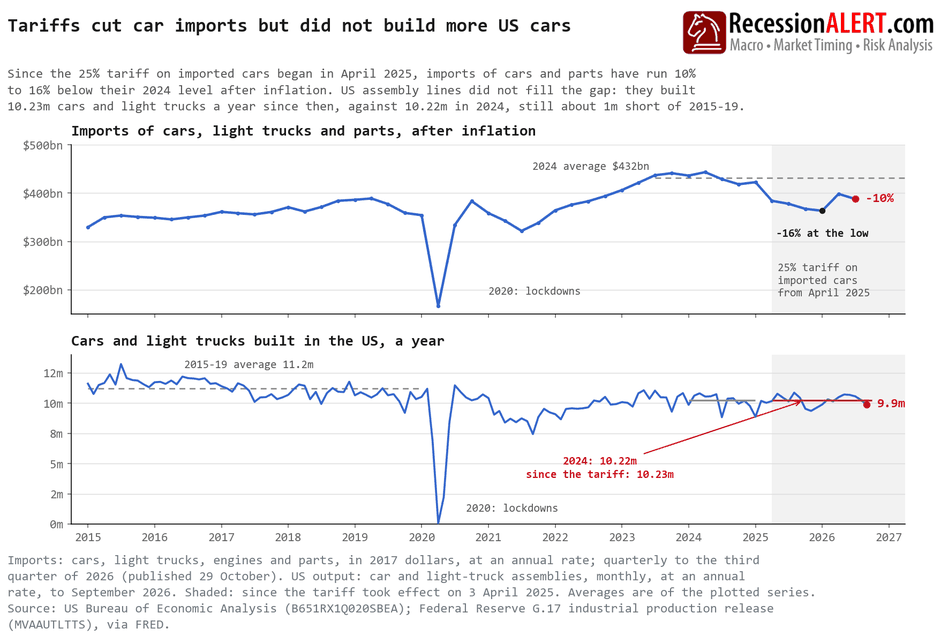
A tariff can pull car production home only by making imported cars dearer, and 18 months in, it has not. Imports of cars, light trucks and parts have run 10% to 16% below their 2024 level after inflation, yet US assembly lines have built 10.23m cars and light trucks a year since April 2025, against 10.22m in 2024 — still about 1m short of the 2015-19 average, with September’s 9.9m the weakest month since January. The missing link is the showroom sticker. New-vehicle prices are up just 0.6% since March 2025, against about 3.9% a year from 2019 to 2024, and import prices before duties rose only 1.2% in the year to September. Buyers kept coming, at about 16.5m a year. Somewhere between the dock and the dealer the cost is being absorbed, so no carmaker got the signal that justifies committing to a US plant: a home-built model earning more, an imported one losing sales. Price did not pull production home, so the tariff is turning into a bargaining chip. Thursday’s reports, citing two sources, say the administration intends to offer relief to automakers that invest here; Audi, which pays 15% on EU-built cars, is expected to get about 10%. Watch whether that reaches a proclamation, whether new-car prices finally climb, and whether output heads back toward 11m. A tariff cut for whoever builds here is a subsidy wearing a tariff’s clothes.
What it means: For households, the tariff has not yet shown up in new-car prices, which rose 0.6% in the latest year. If that pace climbs well above 1%, the cost will be reaching buyers rather than building plants. For investors, relief tied to US investment would favour carmakers that already build here or have announced plants, and leave pure importers paying full rates. For the economy, new factory jobs and spending will arrive only once plants are committed, and building one takes years. That changes if yearly US output climbs back above 11m, a level last reached in 2016.
Market Intelligence Brief (MIB) Ver. 19.98
For professional investors only. Not investment advice.
© 2026 RecessionALERT.com

Comments are closed.