
MARKET INTELLIGENCE BRIEF (MIB)
Wednesday, October 14, 2026
Hot September CPI (3.7% vs 3.6% expected, core 2.6%) roughly doubled October rate-hike odds to about 47%, and the Nasdaq 100 fell 2.02%. AI infrastructure cracked: CoreWeave’s bonds topped a 15% yield and its stock sank 15.46%, while Oracle dropped 8.83%. Barclays cut Dell to Equal Weight and it slid 11.27%. Iran admitted new tactics against Hormuz shipping; WTI rose 1.09% to $95.17, its highest close since September 24. Healthcare and staples rallied; RBC swapped tech for health care.
TABLE OF CONTENTS
A. EXECUTIVE SUMMARY
B. MARKET DATA
C. HIGH-IMPACT STORIES (5)
D. MODERATE-IMPACT STORIES (7)
E. ECONOMY WATCH (5)
F. EARNINGS WATCH (5)
G. WHAT’S NEXT
H. CHART OF THE DAY
A. EXECUTIVE SUMMARY -> TOP
The S&P 500 fell 1.11% and the Nasdaq 100 dropped 2.02% after September core CPI rose to 2.6% against 2.5% expected, lifting CME FedWatch odds of an October hike to roughly 47% from about 22%. Rate risk met a credit scare in AI infrastructure, where CoreWeave’s bonds traded above a 15% yield, while energy compounded the Fed’s problem as Iran admitted new tactics against Hormuz shipping and the Beige Book found higher oil prices in every District report. The bond market declined to follow equities: the 2-year held a 1.3 bps gain but the 10-year closed 2.7 bps lower, reading further tightening as a growth risk rather than inflation running away. Breadth was narrow and defensive, with only Consumer Defensive (+2.30%), Healthcare (+2.05%) and Energy (+0.17%) higher while Technology fell 2.95% and RBC swapped the sector for health care on valuation.
• CPI: September prices rose 3.7% year on year against 3.6% expected, and core firmed to 2.6% against 2.5%; gasoline jumped 9.1% and drove over half the monthly increase. CME FedWatch odds of an October hike rose to roughly 47% from about 22%, and Chicago’s Goolsbee called the report “discouraging.”
• AI infrastructure: CoreWeave’s bonds traded above a 15% yield and the stock fell 15.46%; Oracle dropped 8.83%, Marvell 8.72% lower and AMD down 5.73%. Barclays cut Dell, HPE and NetApp to Equal Weight on valuation, and Dell slid 11.27%, the steepest fall among US companies worth more than $200 billion.
• Energy: Iranian officials said Iran began “different offensive tactics” against Hormuz shipping, and Saudi Arabia confirmed a “limited fire” at Aramco’s Dhahran administrative building. WTI rose 1.09% to $95.17, its highest close since September 24, and the API reported an 11.1 million barrel crude draw against an expected 1.9 million barrel build.
• Defensive rotation: RBC upgraded health care to overweight and cut technology to market weight. Consumer Defensive rose 2.30% and Healthcare gained 2.05%, with UnitedHealth up 4.73% and Merck up 3.80% holding the Dow to a 0.09% loss.
• Banks: The OCC’s final debanking report found all nine of the largest national banks it supervises had policies between 2020 and September 2025 that could restrict services on political, religious or lawful-business grounds, and the CFPB opened investigations the same day. Financials fell 0.88%.
• Growth check: The Beige Book found nine of twelve Districts growing with employment little changed, and said higher oil prices “permeated all District reports.” MBA’s 30-year fixed rate hit 7.5%, its highest since November 2023, and purchase applications fell 4%.
1. Energy is feeding the Fed’s inflation problem from every direction — Gasoline drove over half of September’s CPI increase, the Beige Book found firms passing fuel surcharges along supply chains, and the IEA says the diesel market will “remain tight well into 2027.” Iran’s admission of a campaign against Hormuz shipping makes the risk premium look deliberate rather than episodic. With core also beating, October hike odds near 47% leave Thursday’s PPI and retail sales, then Chair Warsh’s remarks before the October 17 blackout, to decide whether a hike becomes the base case. Energy remains the one sector hedging both the conflict and the inflation it feeds.
2. The AI trade is being tested on financing, not demand — CoreWeave’s bonds trading above a 15% yield, a level Bloomberg associates with distress, pushed counterparty risk along the chain from chips to power: GE Vernova fell 6.20% alongside the semiconductor names, and Bloom Energy dropped 9.15% on the day AEP picked its fuel cells for a 702 MW project to power Google. Barclays’ hardware downgrades and RBC’s valuation-led cut to technology gave holders a second reason to sell. With Technology still up 25.78% year to date, even a modest reweighting moves a lot of capital, and the October 21 reports from Meta and Lam Research are the next read on AI capex.
3. The bond market is pricing a growth risk, not runaway inflation — The 2-year rose 1.3 bps while the 10-year fell 2.7 bps, flattening 2s10s by 4 bps to 38 bps. The growth evidence supports that read: unadjusted purchase applications ran 16% below a year earlier, the Beige Book found five Districts where firms are cutting or delaying hiring after investing in AI, and the IMF lists a reassessment of AI expectations among its main downside risks. A long-end rally driven by growth worry offers little cover to long-duration equities if an October hike becomes the base case.
 — Leading economic indicators. Accurate market forecasts. Apply for membership at join.recessionalert.com
B. MARKET DATA -> TOP
A hotter-than-expected September CPI (3.7% year on year against 3.6% expected) lifted CME FedWatch odds of an October rate hike to roughly 47% from about 22%, and growth stocks took the hit: the Nasdaq 100 fell 2.02% while the Dow slipped just 0.09%, held up by its healthcare components. It was a defensive rotation, with only three of eleven sectors higher, while a Barclays downgrade sank Dell 11.27%. The anomaly was the bond market: Treasuries erased their post-CPI losses and the 10-year closed 2.7 bps lower, even as the 2-year finished higher and the curve flattened. Precious metals fell hard instead, with silver down 6.26%.
CLOSING PRICES – Wednesday, October 14, 2026:
MAJOR INDICES
The damage was concentrated in growth: the Nasdaq 100 and Russell 2000 each fell about 2% while the Dow finished nearly flat and Transports edged higher. Dow Theory bull confirmation is entrenched in a fifth session, with both averages within 1% of their 10-session highs. Over the past 10 sessions the S&P 500 has outrun the Russell 2000 by 3.3 points and the Nasdaq 100 by 2.4 points, both emerging today: small-cap breadth is deteriorating even as leadership rotates away from mega-cap tech.
| Index | Close | Change | %Move | Why It Moved |
|---|---|---|---|---|
| S&P 500 | 7,718.94 | -86.51 | -1.11% | Hotter-than-expected September CPI (3.7% YoY vs 3.6% expected) lifted October rate-hike odds; technology led the decline |
| Dow Jones | 51,621.48 | -48.62 | -0.09% | Healthcare components UnitedHealth, Merck and Amgen gained 3.2-4.7%, offsetting tech weakness |
| DJ Transportation | 19,829.96 | +19.49 | +0.10% | Edged higher against the tape; no discrete same-day catalyst identified |
| Nasdaq 100 | 29,950.82 | -618.66 | -2.02% | Semiconductors led losses as rate-hike bets rose after CPI; Marvell -8.72%, AMD -5.73%, Nvidia -3.16% |
| Russell 2000 | 2,729.53 | -53.84 | -1.93% | Sold off alongside growth stocks after the CPI print; no separate small-cap catalyst identified |
| NYSE Composite | 23,865.42 | -119.58 | -0.50% | Broad decline milder than the S&P 500’s as Consumer Defensive and Healthcare gained |
VOLATILITY & TREASURIES
Treasuries erased their post-CPI selloff to close with the 10-year 2.7 bps lower, but the 2-year still finished 1.3 bps higher, flattening 2s10s by 4 bps to 38 bps. The front end kept part of the rate-hike repricing; the long end declined to confirm it. The VIX jumped 10.35% and the dollar firmed, a risk-off equity tape that longer-dated bonds did not join.
| Instrument | Level | Change | Why It Moved |
|---|---|---|---|
| VIX | 16.85 | +1.58 (+10.35%) | Rose with the tech-led selloff after the hot CPI print |
| 10-Year Treasury Yield | 5.186% | -2.7 bps | Bonds rallied in the afternoon, reversing the CPI-driven selloff to close with yields lower |
| 2-Year Treasury Yield | 4.806% | +1.3 bps | Touched its highest in over two weeks after CPI before retreating; held a small gain as October hike odds rose |
| US Dollar Index (DXY) | 102.54 | +0.36 (+0.35%) | Firmed on the day of the hot CPI print, just below Monday’s 102.59 close; no separate catalyst identified |
COMMODITIES
Gold fell 1.20% on Fed hike bets to its lowest close since August 3, and silver’s 6.26% slide to its lowest since mid-July was more than five times as steep, with no separate catalyst identified. Platinum and copper fell too, so there was no safe-haven bid anywhere in metals. Bitcoin dropped 2.20%, tracking equities rather than decoupling.
| Asset | Price | Change | %Move | Why It Moved |
|---|---|---|---|---|
| Gold | $4,127.30/oz | $-50.00 | -1.20% | Fell as the hot CPI report lifted expectations of an October Fed rate hike; lowest close since August 3 |
| Silver | $55.80/oz | $-3.73 | -6.26% | Fell with gold on the rate-hike repricing; no separate catalyst identified for the scale of the drop. Lowest close since July 16 |
| Copper | $6.6145/lb | $-0.1115 | -1.66% | No discrete same-day catalyst identified; fell with risk assets |
| Platinum | $1,607.00/oz | $-64.20 | -3.84% | Fell with the precious-metals complex; no separate catalyst identified |
| Bitcoin | $81,720 | $-1,839 | -2.20% | Tracked the risk-off equity tape; no crypto-specific catalyst identified |
ENERGY
Crude rose against falling equities, WTI up 1.09% to its highest close since September 24 and Brent up 0.40%, narrowing Brent’s premium over WTI. Reuters tied the gain to a Houthi attack on Saudi Aramco’s Dhahran headquarters and Iran’s statement that it is deploying new tactics against shipping. Natural gas barely moved on either side of the Atlantic.
| Asset | Price | Change | %Move | Why It Moved |
|---|---|---|---|---|
| Crude Oil (WTI) | $95.17/bbl | $+1.03 | +1.09% | Houthi attack on Saudi Aramco’s Dhahran headquarters and Iran’s new tactics against shipping (Reuters); highest close since September 24 |
| Crude Oil (Brent) | $106.11/bbl | $+0.42 | +0.40% | Same Gulf supply-risk drivers; settled up 37 cents at $106.06 (Reuters) |
| Natural Gas (Henry Hub) | $3.290/MMBtu | $+0.007 | +0.21% | No discrete same-day catalyst identified; near-flat session |
| Natural Gas (Dutch TTF) | $28.546/MMBtu | $+0.035 | +0.12% | Marginal gain to its highest close since at least mid-April; no discrete same-day catalyst identified |
S&P 500 SECTORS
Only three of eleven sectors rose — Consumer Defensive (+2.30%), Healthcare (+2.05%) and Energy (+0.17%) — a defensive rotation on a rate-hike scare, which RBC endorsed the same day by upgrading health care and downgrading technology. Technology’s 2.95% drop deepened a 5.63% weekly loss, a sharp reversal for the sector that still leads year to date (+25.78%).
| Sector | 1-Day | 1-Week | 1-Month | 3-Month | 6-Month | YTD | 12-Month |
|---|---|---|---|---|---|---|---|
| Consumer Defensive | +2.30% | +5.63% | +4.00% | +0.99% | +4.15% | +10.13% | +11.11% |
| Healthcare | +2.05% | +1.90% | +1.81% | +3.68% | +11.62% | +8.94% | +17.62% |
| Energy | +0.17% | +5.77% | +1.34% | +14.88% | +14.07% | +45.00% | +49.73% |
| Utilities | -0.46% | +0.98% | +1.68% | -8.02% | -10.20% | -2.74% | -7.74% |
| Financial | -0.88% | +0.53% | -4.55% | -4.55% | +3.95% | +1.97% | +8.05% |
| Real Estate | -0.93% | +1.63% | -4.10% | -10.43% | -5.01% | +1.22% | +0.22% |
| Consumer Cyclical | -1.06% | -0.33% | +0.65% | -4.88% | -5.50% | -7.47% | -6.21% |
| Industrials | -1.36% | -2.31% | -0.53% | -5.77% | -4.98% | +6.90% | +8.93% |
| Communication Services | -1.61% | -0.40% | -0.28% | -1.28% | -1.56% | +1.37% | +8.28% |
| Basic Materials | -1.98% | -0.90% | -4.98% | +2.79% | -7.95% | +8.67% | +14.02% |
| Technology | -2.95% | -5.63% | +2.83% | +6.70% | +20.62% | +25.78% | +23.60% |
TOP MEGA-CAP MOVERS:
GAINERS
| Company | Ticker | Close | Change | Why It Moved |
|---|---|---|---|---|
| UnitedHealth Group | UNH | $395.62 | +4.73% | Earnings-driven continuation after Tuesday’s Q3 report; Mizuho reiterated UNH as its top U.S. healthcare pick on Wednesday |
| Merck & Co | MRK | $147.37 | +3.80% | No discrete same-day catalyst identified; continuation after Tuesday’s ESMO Phase 3 oncology data, with the sector rotation into healthcare |
| Eli Lilly | LLY | $1,208.74 | +3.62% | No discrete same-day catalyst confirmed; rose with the healthcare rotation. A Prelude Therapeutics breast-cancer trial collaboration is cited by one outlet (unverified) |
| Walmart | WMT | $116.16 | +3.46% | No discrete same-day catalyst identified; rose with Consumer Defensive, the session’s top sector |
| AbbVie | ABBV | $283.48 | +3.32% | No discrete same-day catalyst identified; continuation after Tuesday’s Phase 3 Skyrizi data in Crohn’s disease, with the healthcare rotation |
DECLINERS
| Company | Ticker | Close | Change | Why It Moved |
|---|---|---|---|---|
| Dell Technologies | DELL | $507.93 | -11.27% | Barclays downgraded to Equal Weight from Overweight on valuation (target $574 from $603), alongside matching HPE and NetApp downgrades |
| Oracle | ORCL | $130.55 | -8.83% | No discrete same-day catalyst confirmed; fell with AI-infrastructure names in the tech selloff. Renewed attention to its credit position is cited by one outlet (unverified) |
| Marvell Technology | MRVL | $245.28 | -8.72% | No discrete same-day catalyst identified; fell with semiconductors after the hot CPI print |
| GE Vernova | GEV | $941.78 | -6.20% | Susquehanna trimmed its target to $1,270 from $1,300 while keeping a Positive rating, too small to explain the drop alone; no other same-day catalyst confirmed |
| Advanced Micro Devices | AMD | $570.82 | -5.73% | No discrete same-day catalyst identified; fell with semiconductors after the hot CPI print |
— Institutional-grade intelligence for serious investors. Apply for membership at join.recessionalert.comC. HIGH-IMPACT STORIES -> TOP
BEARISH
1. Hot September CPI Roughly Doubles October Rate-Hike Odds as Goolsbee Calls the Report “Discouraging” and Citi Now Forecasts a December Hike
The core facts:Wednesday’s September CPI, with core a tenth above forecast at 2.6% year on year, pushed CME FedWatch odds of a quarter-point hike at the October 27-28 meeting to roughly 47% from about 22% on Tuesday. A Newsquawk wrap put October pricing at 12.3 bps, up from 5.4 bps, and December at 29.8 bps from 27.6 bps, and reported that Citi now expects a 25 bp hike in December after previously forecasting a hold. Chicago Fed President Austan Goolsbee called the report “discouraging” in a Yahoo Finance interview and, per the same wrap, said “if we get more months like this … that’s totally unacceptable,” while adding “We need to get more data.” Richmond’s Thomas Barkin said the reading was higher than he would have hoped and declined to project the October outcome, saying Thursday’s PPI will inform his view. Earlier, speaking in Bangkok before the release, Vice Chair for Supervision Michelle Bowman said: “I don’t feel any urgency for taking further action at this point.” The 2-year Treasury yield closed 1.3 bps higher at 4.806%, but the 10-year reversed its post-CPI selloff to close 2.7 bps lower at 5.186%, flattening 2s10s by 4 bps to 38 bps. The S&P 500 fell 1.11%, the Nasdaq 100 2.02%, and the VIX rose 10.35% to 16.85. Gold fell 1.20% to its lowest close since August 3, and silver dropped 6.26%.
Why it matters:One print has turned October from a tail risk into close to a coin flip. That leaves the Fed, which raised its range to 3.75%-4.00% in September, with two weeks to decide whether to move again. The officials who spoke split along a recognisable line. Goolsbee and Barkin framed the data as a problem without committing to a date, and Bowman, speaking before the release, argued for patience. Market pricing is now running ahead of the committee’s public guidance. The bond market’s split reaction is the signal to weigh. The front end held part of the hike repricing while the long end rallied, which is consistent with investors reading further tightening as a growth risk rather than as inflation getting away. Equities took the other side of that read: rate-sensitive growth stocks fell hardest, and gold lost its bid as real-rate expectations rose. For a PM, the near-term question is whether October becomes the base case. If it does, the long-end rally gives little cover to long-duration equities.
What to watch:Thursday’s PPI and retail sales at 8:30 AM ET, then Cleveland’s Hammack at 4:30 PM ET and Chair Warsh at 11:30 PM ET, the last scheduled remarks before the pre-meeting blackout begins on October 17.
BEARISH
2. AI-Infrastructure Credit Scare: CoreWeave’s Bonds Trade Above a 15% Yield and the Stock Falls 15.46% as Oracle Drops 8.83% and Technology Sheds 2.95%
The core facts:CoreWeave’s corporate bond yields rose above 15%, a level Bloomberg described as typically associated with distress, and the stock closed down 15.46% at $65.78, a market value of about $36.3 billion. Elon Musk replied “yikes” to a post about the bond moves, CNBC reported. In a staff email, CEO Mike Intrator said the company’s backlog “more than supports” its debt obligations (TheFly, citing Bloomberg), and that the market can “misunderstand and act irrationally” (Reuters). The selling spread across AI infrastructure. Newsquawk’s close wrap said “AI-related stocks were sold aggressively throughout the session,” and Barron’s reported that rising bond yields were rattling GE Vernova, Vertiv and Eaton. Oracle fell 8.83%, with no discrete same-day catalyst confirmed. Marvell fell 8.72%, GE Vernova 6.20% and AMD 5.73%. Technology was the worst S&P 500 sector at -2.95%, extending its weekly loss to 5.63%, and the Nasdaq 100 fell 2.02%.
Why it matters:The AI trade has been tested before on demand. This time the test is financing. The buildout depends increasingly on debt raised by companies whose cash flows lag their commitments, and with the 10-year above 5.1%, the marginal cost of that debt is rising. When a leading neocloud’s bonds trade at distressed yields, lenders start pricing counterparty risk across the chain. That runs from the GPU lessors to the hyperscalers that contract with them and the power and equipment suppliers behind them. It explains why GE Vernova, Vertiv and Eaton fell alongside the chip names on a day with no sector-specific news. Today’s move was a credit signal reaching equities, not an earnings miss. That makes it harder to buy the dip on fundamentals until spreads stabilise.
What to watch:Whether CoreWeave’s bond yields stabilise or push further above 15%, and whether the pressure reaches Oracle’s debt. The hyperscaler and chip-equipment reports on October 21, from Meta and Lam Research, are the next test of AI capex intentions.
BEARISH
3. Iran Says It Has Begun New Tactics Against Hormuz Shipping as Saudi Arabia Confirms a Fire at Aramco’s Dhahran Headquarters, Lifting WTI to Its Highest Close Since September 24
The core facts:Iranian officials told Reuters, in a report published late Tuesday evening US time, that Iran began using “different offensive tactics” about 10 days ago against vessels it considers to be violating its restrictions in the Strait of Hormuz; they declined to give details. UKMTO reported on Tuesday that a container ship and a tanker were hit by projectiles of unknown origin in the strait. On Wednesday, Saudi Arabia’s energy ministry said a Houthi attack on an administrative building of Saudi Aramco in Dhahran caused a “limited fire,” and a separate Reuters report citing sources described the damage as extensive. WTI rose 1.09% to $95.17, its highest close since September 24, and Brent gained 0.40% to $106.11, narrowing Brent’s premium. Energy was one of only three S&P 500 sectors to rise (+0.17%), with ExxonMobil up 1.68% and Chevron up 1.98% on a down day for equities. After the close, the American Petroleum Institute reported an 11.1 million barrel crude inventory draw against an expected 1.9 million barrel build. “Iranian officials are openly admitting to undermining US efforts to keep oil prices under control,” said Priyanka Sachdeva of Phillip Nova.
Why it matters:Two separate supply threats are now active at once. One is Iran’s stated campaign against Hormuz traffic; the other is Houthi strikes reaching the corporate seat of the world’s largest oil producer. Iran’s admission matters more than any single incident, because it signals intent to keep prices elevated rather than tactical retaliation. The timing compounds the Fed problem: gasoline drove more than half of September’s CPI increase, and crude rising against falling equities is the energy-led inflation pressure that put an October hike in play. An 11.1 million barrel API draw, if confirmed, would add a domestic inventory squeeze on top of the geopolitical premium. For portfolios, energy is again working as the hedge against both the war and the inflation it feeds.
What to watch:Thursday’s EIA petroleum status report at 12:00 PM ET, to confirm or revise the API draw, and whether Brent breaks above $107.
UNCERTAIN
4. RBC Swaps Technology for Health Care as Defensives Carry a Narrow Tape: Consumer Defensive Rises 2.30% and Healthcare 2.05% While Eight of Eleven Sectors Fall
The core facts:In a note on Wednesday, RBC Capital Markets upgraded health care to overweight from market weight, downgraded technology to market weight, and cut materials to market weight from overweight. Lori Calvasina, RBC’s head of US equity strategy, said the technology downgrade is mostly about valuation. The sector now trades slightly above average on both absolute and relative median P/E against history going back to the late 1980s. She also pointed to weaker flows into developed-market tech funds and slowing earnings-estimate revisions for semiconductors and semiconductor equipment, while software valuations and revisions remain attractive. Calvasina called health care “a natural destination to look to when dialing down Tech exposure.” Only three of eleven sectors rose: Consumer Defensive (+2.30%), Healthcare (+2.05%) and Energy (+0.17%). The Dow slipped just 0.09%, supported by UnitedHealth (+4.73%), Merck (+3.80%) and Amgen, while Eli Lilly gained 3.62%, Walmart 3.46% and AbbVie 3.32%. Whether the note drove the rotation or simply described it could not be established.
Why it matters:This is the third major house in two sessions to trim its tech exposure, after Citi and BlackRock both pulled back on US stocks on Tuesday. RBC’s case is about valuation rather than a call that AI demand is breaking. That matters for how the rotation behaves: valuation-driven selling tends to be steady rather than abrupt, and it favours sectors with improving revisions over pure safety plays. Technology still leads the market year to date at +25.78%, so even a modest reweighting moves a lot of capital. The session’s narrow breadth now hands index-level risk to a handful of defensives just as the macro backdrop turns more hawkish.
What to watch:Whether healthcare’s outperformance survives the October 21 reports from Thermo Fisher, Abbott and Danaher, the first large test of the sector’s earnings revisions.
UNCERTAIN
5. OCC’s Final Debanking Report Finds All Nine of the Largest National Banks Restricted Access Through September 2025, and the CFPB Opens Investigations the Same Day
The core facts:The Office of the Comptroller of the Currency published its final report on Wednesday. It found that all nine of the largest national banks it supervises had policies between 2020 and September 2025 that could deny or limit services based on political or religious beliefs or lawful business activities. The banks are JPMorgan Chase, Bank of America, Citibank, Wells Fargo, U.S. Bank, Capital One, PNC, TD Bank and BMO. Restricted sectors included oil and gas exploration, coal, firearms and ammunition, detention facilities, tobacco and e-cigarettes, and digital asset activities. The OCC reviewed nearly 100,000 complaints and about 420,000 pages of bank documents. Comptroller Jonathan Gould said the report “provides irrefutable evidence” of the practices and that “I am not confident” the banks’ own efforts “will be enough.” He added that the OCC “will be assessing further changes” to the framework for the largest banks. The same day, the CFPB said it will investigate whether the named banks and others complied with the Equal Credit Opportunity Act, the Fair Credit Reporting Act and the UDAAP rules. Acting Director Mark Paoletta called the conduct “appalling.” Neither agency specified penalties. The Financial sector fell 0.88%.
Why it matters:The issue has moved from a supervisory finding to potential enforcement under consumer-finance law, which carries restitution and penalty exposure the OCC’s December preliminary findings did not. It lands in the middle of bank earnings week, a day after Bank of America took a $1.2 billion anti-money-laundering penalty. The forward risk is less about fines than about the business model. An OCC push against “reputation risk” in credit decisions would constrain how large banks manage exposure to energy, firearms and digital-asset clients. That is a policy shift that widens access for those sectors while narrowing banks’ discretion. Investors in the money-centre banks now carry an open-ended regulatory overhang with no stated timetable.
What to watch:Any OCC proposal to remove reputation risk from supervisory guidance, and the first CFPB investigative demands to the named banks.
— Quantifying recession risk so you don’t have to guess. Apply for membership at join.recessionalert.comD. MODERATE-IMPACT STORIES -> TOP
BEARISH
6. Barclays Cuts Dell, HPE and NetApp to Equal Weight in One Note; Dell Falls 11.27%, the Largest Decline Among Mega-Caps
The core facts:Barclays downgraded Dell Technologies, Hewlett Packard Enterprise and NetApp to Equal Weight from Overweight before Wednesday’s open, citing valuation. It cut Dell’s price target to $574 from $603 and HPE’s to $77, and kept NetApp’s at $219. Dell closed down 11.27% at $507.93, the steepest fall among US companies worth more than $200 billion. HPE fell 8.28% and NetApp 7.03%. No other Dell-specific catalyst was found, though the move came on a day of broad selling in AI-infrastructure names.
Why it matters:A single broker downgrading a whole hardware group is a sector call, not a stock call. It says the AI-server and storage rally has priced in more than enterprise demand has yet delivered. Dell had become one of the market’s largest AI beneficiaries by market value, so an 11% fall erases a large amount of value and hits the momentum funds that crowded into the trade. Coming on the same day as CoreWeave’s bond stress, the downgrade gave holders a valuation reason to sell on top of a financing reason.
What to watch:Whether other brokers follow Barclays on enterprise hardware, and whether Dell holds above $500 after its largest one-day fall among mega-caps this session.
BULLISH
7. Japan to Fund Up to $21 Billion for Two GlobalFoundries-Run Chip Fabs in New York; Commerce to Take a Roughly 4% Stake and GFS Rises 4.80%
The core facts:GlobalFoundries was selected to supply the technology for and operate two new 300mm fabs at its Malta, New York site under a US-Japan trade and investment initiative. Japan will provide up to $21 billion: about $10 billion for the first fab, which is expected to break ground this year and open in 2029, and about $10 billion for a second, later fab. Each fab is expected to add roughly 900,000 300mm wafers of annual US capacity and the project more than 1,000 jobs. Separately, the Commerce Department will take about a 4% equity stake in GlobalFoundries. The company’s CHIPS Act award is being amended to shift $955 million toward silicon photonics, silicon-germanium and advanced packaging. CEO Tim Breen called it “a bold new initiative for semiconductor manufacturing.” GlobalFoundries shares rose 4.80% to $48.94 against a 2.02% fall in the Nasdaq 100.
Why it matters:This is the first large, named project to come out of the US-Japan investment framework. Its structure is new: an ally finances the capital, a US operator runs the fabs, and Washington takes equity in that operator. For GlobalFoundries it means a major capacity expansion with little balance-sheet strain. For investors it is a template other trade-deal capital could follow into US manufacturing, with the government holding stakes in the operators it backs, as it now does here.
What to watch:Groundbreaking on the first fab later this year, and the terms of Commerce’s roughly 4% equity stake when they are published.
BULLISH
8. AEP Signs a 20-Year Deal to Power Google With 702 MW of Bloom Energy Fuel Cells in Wyoming, a Roughly $4 Billion Investment
The core facts:American Electric Power announced at 8:00 AM ET Wednesday that it will build a 702-megawatt fuel-cell generation project near Cheyenne, Wyoming. Google will buy the output under a 20-year power purchase agreement. The roughly $4 billion project will use Bloom Energy fuel cells, with carbon capture planned, and is expected to be fully operational by the end of 2028. The seller, Cheyenne Fuel Cell LLC, is about 92% owned by AEP, with funds advised by Basalt Infrastructure Partners holding nearly 8%. The deal follows Google’s separate agreements with Black Hills Corp. that took effect September 30. “AEP is bringing together new technologies and strong partnerships,” said CEO Bill Fehrman. AEP rose 0.38%. Bloom Energy fell 9.15% as AI-infrastructure names sold off, and no Bloom-specific catalyst for the fall was established.
Why it matters:Hyperscalers are now signing multi-decade contracts for on-site and near-site generation rather than waiting for grid interconnection. That shifts a meaningful slice of utility capex toward contracted, data-center-backed returns. Google is the counterparty, so the contract-backed return supports AEP’s investment case even as rising Treasury yields weigh on utilities as a bond proxy. Bloom’s 9% fall on the day it won a 702 MW order shows how far sentiment toward AI-power names has decoupled from contract news.
What to watch:Whether other hyperscalers follow with comparable multi-decade on-site generation contracts, and whether Bloom’s share price recovers once the AI-infrastructure selloff eases.
UNCERTAIN
9. Netflix Cuts About 1,000 Jobs, Roughly 6% of Its Workforce, Six Days Before Third-Quarter Results
The core facts:Netflix told employees on Wednesday morning that it is eliminating about 1,000 roles, roughly 6% of its worldwide staff, mostly in product, technology, legal and human resources. In a memo, co-CEOs Greg Peters and Ted Sarandos wrote that “Our mission — to entertain the world — is ambitious, and delivering on it requires us to be disciplined.” The company reports third-quarter results on Tuesday, October 20. Shares closed up 0.16% at $70.57.
Why it matters:A cut of this size, announced six days before the print, points to cost discipline being pulled forward. It is concentrated in corporate and technology functions rather than content. Investors will read the timing two ways: as margin support for 2027 guidance, or as a hint that revenue growth is not meeting internal plans. The flat share reaction shows the market is waiting for the numbers before deciding which.
What to watch:Netflix’s October 20 results, particularly operating-margin guidance and whether management quantifies the savings from the cuts.
BEARISH
10. FMC Proposes a $200,000 Per-Voyage Fee on Spanish-Flagged Ships and Possible Curbs on Spanish Imports Over Spain’s Port Ban on US Vessels
The core facts:The Federal Maritime Commission on Wednesday proposed a $200,000 per-voyage fee on all Spanish-flagged vessels, along with possible restrictions on imports of Spanish perfumery and cosmetics, oils and fats, ceramics, articles of stone, and sugar and confectionery. The FMC said it found “conclusive evidence” that Spain blocked US-flagged ships, including vessels carrying cargo under MARAD’s Maritime Security Program, from its ports, after an investigation opened in December 2024. The commission is seeking public comment and will offer Spain an opportunity for a hearing.
Why it matters:This opens a new trade front with an EU member using a shipping statute rather than tariff authority. That route sits outside the usual trade-negotiation channels, which makes it harder for Brussels to treat it as a bilateral irritant. The direct exposure is narrow: consumer categories such as olive oil and cosmetics, and the small number of Spanish-flag vessels calling at US ports. The risk is escalation, since the EU coordinates trade retaliation for its members. For importers and food and beauty retailers, it adds another layer of tariff-style cost uncertainty heading into the holiday quarter.
What to watch:Whether Spain requests the offered hearing, and any European Commission response on behalf of Spain.
UNCERTAIN
11. Treasury and IRS Propose Limiting ACA Premium Tax Credits to Citizens and Certain Lawfully Present Noncitizens From 2027, With New Advance-Payment Checks
The core facts:The Treasury Department and IRS on Wednesday issued proposed regulations implementing the Working Families Tax Cuts changes to the Affordable Care Act’s Premium Tax Credit. The proposal limits eligibility to US citizens, US nationals and certain lawfully present noncitizens beginning in 2027, and adds new verification criteria for advance credit payments. HHS is expected to issue separate rules on Exchange procedures. “Hardworking American taxpayers should not be forced to subsidize health care for people who are ineligible under federal law,” Treasury Secretary Scott Bessent said. The release also cited $2.2 billion of savings from an earlier CMS removal of more than 760,000 unverified enrollees, which is separate from this proposal.
Why it matters:Subsidised exchange enrollment underpins the individual-market books of insurers such as Centene, Oscar and Molina, so a narrower eligible pool and stricter payment verification point to lower 2027 enrollment and possible risk-pool deterioration as healthier marginal members drop out. The managed-care read-through cuts against the day’s healthcare rally, which was led by large diversified names rather than exchange-heavy insurers. The rule is still a proposal, so pricing for 2027 plans is where the effect will first show.
What to watch:The companion HHS Exchange rule and insurers’ commentary on 2027 exchange enrollment in their third-quarter calls.
BULLISH
12. Vertical Research Upgrades Lockheed Martin to Buy With a $600 Target; Shares Rise 3.61% on a Down Day
The core facts:Vertical Research Partners upgraded Lockheed Martin to Buy from Hold with a $600 price target on Wednesday. Lockheed closed up 3.61% at $522.23 while the S&P 500 fell 1.11%. The same morning, Goldman Sachs upgraded Trane Technologies to Buy and cut Carrier Global to Neutral in a rotation within HVAC.
Why it matters:An upgrade that draws buyers on a risk-off day suggests investors are reaching for government-funded revenue as a hedge against AI-capex volatility. With a war in the Gulf and missile attacks on Saudi infrastructure in the headlines, Lockheed offers exposure to the same geopolitical risk that is lifting crude, without the commodity beta.
What to watch:RTX’s results on October 20, the first defense-prime report of the season and a read on missile and munitions demand.
— Separating signal from noise since 2007. Apply for membership at join.recessionalert.comE. ECONOMY WATCH -> TOP
Wednesday’s data sharpened the Fed’s hiking case rather than settling it: September CPI ran 3.7% year over year against 3.6% expected, with gasoline supplying over half the monthly rise and core firming to 2.6%, and CME FedWatch odds of an October hike rose to roughly 47% from about 22%. The Beige Book found higher oil prices in every District’s report while employment was little changed, and the IMF projected steady 2.3% US growth even as it saw global inflation rising to 4.7%. Fuel and financing costs are tightening together, with the 30-year mortgage rate at 7.5%, its highest since November 2023, and the IEA expecting diesel to stay tight well into 2027. Thursday’s PPI, retail sales and Chair Warsh’s speech come next.
September CPI Rises to 3.7% Year Over Year, Above the 3.6% Forecast, as Gasoline Jumps 9.1% and Core Firms to 2.6% (BLS, Oct 14)
What they’re saying:The consumer price index rose 0.6% in September on a seasonally adjusted basis, matching forecasts, and the annual rate climbed to 3.7% from 3.4%, above the 3.6% consensus. Gasoline rose 9.1% and, according to the Bureau of Labor Statistics, accounted for “over half of the monthly all items increase,” with the energy index up 5.2%. Core CPI rose 0.3% for a second straight month against 0.2% expected, lifting the annual core rate to 2.6% from 2.4%, above the 2.5% forecast.
The context:Food was unchanged and food at home fell 0.1%, so the headline surprise was mostly energy, but the core beat and a 0.4% rise in shelter make it harder to dismiss. CME FedWatch odds of an October rate hike rose to roughly 47% from about 22%; the 2-year yield closed 1.3 bps higher at 4.806% while the 10-year reversed its post-release selloff to close 2.7 bps lower at 5.186%, flattening the curve. Chicago Fed President Austan Goolsbee, who does not vote on policy this year, called the report “discouraging” in a Yahoo Finance interview.
What to watch:September PPI on Thursday, October 15 (headline expected +0.5% month over month, core +0.3%), and Chair Warsh’s speech the same day; the FOMC decides on October 27-28.
Beige Book: Higher Oil Prices “Permeated All District Reports” as Nine of Twelve Districts Grow and Employment Holds Little Changed (Federal Reserve, Oct 14)
What they’re saying:Nine of the twelve Federal Reserve Districts reported growth since the prior Beige Book, two moderate, three modest and four slight, while three reported no significant change. “Most Districts described little or no net change in overall employment levels,” and three Districts characterized overall price growth as robust while eight called it moderate. “Higher oil prices permeated all District reports,” with firms citing elevated diesel prices and fuel surcharges passed along the supply chain.
The context:The report describes an economy still growing while passing an energy shock through to prices, the combination behind the Fed’s tightening bias. Five Districts reported firms cutting staff through attrition, delaying hiring or expecting less job creation after investing in AI, a structural drag on hiring alongside the cyclical one. Consumer spending was little changed in most Districts and concentrated among high-income households, and Dallas noted more caution among lower-income customers.
What to watch:September retail sales on Thursday, October 15 (expected +0.3% after +1.2%), the first hard read on whether the consumer caution the Districts describe is showing up in spending.
Mortgage Applications Fall 2.7% as the 30-Year Rate Hits 7.5%, Highest Since November 2023; ARM Share Climbs to 10.5% (MBA, Oct 14)
What they’re saying:Mortgage applications fell 2.7% on a seasonally adjusted basis in the week ending October 9, with the purchase index down 4% and refinancing down 0.4%. MBA’s Joel Kan said “the 30-year fixed rate was 7.5 percent, the highest rate since November 2023 and more than a percentage point higher than a year ago.” The adjustable-rate share rose to 10.5%, which Kan said was its highest level since October 2025.
The context:Unadjusted purchase applications were 16% below a year earlier and refinancing 56% lower, so higher long-term yields are now cutting into housing demand, not only into refinancing. Kan said borrowers “continue to rely more on ARM loans to help lower their monthly payments,” a shift that adds rate-reset exposure to household balance sheets. The 10-year Treasury yield closed at 5.186%.
What to watch:The NAHB housing market index on Monday, October 19, then September housing starts and building permits on Tuesday, October 20.
IMF Projects Steady 2.3% US Growth for 2026 and 2027 but Sees Global Inflation Rising to 4.7%, With Risks “Skewed to the Downside” (IMF, Oct 13)
What they’re saying:The IMF’s October World Economic Outlook projects US real GDP growth of 2.3% in both 2026 and 2027, matching 2025. It sees global growth slowing to 3.1% in 2026 from 3.5% before rebounding to 3.4% in 2027, and global headline inflation rising “notably to 4.7 percent in 2026 before easing to 4.1 percent in 2027.”
The context:The report’s message is that “growth has endured so far, but rising inflation and narrowing buffers demand policy action now,” and it names further conflict escalation, “a reassessment of expectations surrounding artificial intelligence,” renewed trade tensions and fiscal vulnerabilities as the main downside risks. The US projection runs ahead of the advanced-economy average of 2.1% for 2026, which leaves the Fed fighting inflation from a position of steady growth rather than slack.
What to watch:September industrial production on Friday, October 16 (expected +0.4%), a check on the growth half of the IMF’s projection.
IEA Says the Diesel Market Will “Remain Tight Well Into 2027” as Wholesale Prices Hit Records in the US and Europe (IEA, Oct 14)
What they’re saying:The International Energy Agency’s October Oil Market Report said “the gasoil market balance will remain tight well into 2027,” with inventory replenishment unlikely before the second half of 2027. It put wholesale diesel at all-time highs of around $220 a barrel in the United States and Europe, and OECD gasoil and diesel stocks at 565 million barrels in July, the lowest since November 2023. The agency forecast world oil demand to fall by 2.6 million barrels a day on average in 2026.
The context:Diesel is the channel both of Wednesday’s other inflation reads point to: gasoline drove more than half of September’s CPI increase, and the Beige Book found higher oil prices in every District’s report, with firms passing fuel surcharges along supply chains. A shortage lasting into 2027 makes the energy contribution to inflation harder to treat as a one-off shock, and the IEA flagged a late-season US Gulf Coast hurricane as a further tightening risk. WTI rose 1.09% to $95.17, its highest close since September 24.
What to watch:EIA weekly crude and gasoline inventories on Thursday, October 15, and September import prices on Friday, October 16 (expected +0.8%).
— Know the probability before the market prices in the risk. Apply for membership at join.recessionalert.comF. EARNINGS WATCH -> TOP
YESTERDAY AFTER THE BELL (Markets Reacted Today)
No major earnings yesterday after the bell from companies with >$100B market cap.
TODAY BEFORE THE BELL (Markets Already Reacted)
UNCERTAIN
13. ASML Holding (ASML): -3.94% | EPS Beat by 19% and a Warning That Supply Will Not Meet 2027-2028 Demand, but Shares Fall With Chips
The Numbers:Released: BMO, October 14. EPS $14.50 vs. $12.17 estimate (+19.07%); revenue $13.05B vs. $13.14B estimate (-0.69%). In euros: Q3 net sales €11.7 billion, gross margin 57.5%, net income €5.0 billion. Q4 guidance: net sales of €14.2-15.2 billion at a gross margin of about 57%. Full-year 2026 outlook: net sales of €44-45 billion at a gross margin of about 56%. ASML bought back about €4.1 billion of shares in the quarter. No bookings figure was disclosed.
The Problem/Win:CEO Christophe Fouquet said customers “continue to increase their short- and medium-term equipment demand forecasts,” driven “primarily by their views on the size and duration of AI-related investments,” and that ASML now expects “our supply as currently planned for both 2027 and 2028 will not fully meet the demand of our customers.” The order book rose again quarter on quarter. The win was in the outlook; the stock fell regardless as semiconductors sold off on the CPI print and AI-financing worries.
The Ripple:Chip equipment stayed under pressure a day after Applied Materials fell 6.69% on its investor day; Lam Research fell 4.71% and Technology was the worst sector at -2.95%. ASML’s capacity warning is constructive for the equipment group’s 2027 order books, but it did not offset the day’s macro selling.
What It Means:The equipment cycle’s demand signal is strengthening even as equity holders de-rate AI exposure on financing risk. That gap between fundamentals and price is where the next leg of the semis trade will be decided.
What to watch:Taiwan Semiconductor’s results on Thursday, October 15, for 2027 capex intentions, and Lam Research on October 21.
BEARISH
14. Bank of America (BAC): -4.76% | EPS Misses by 17% as Markets Revenue Falls 26% and Expenses Jump 14%
The Numbers:Released: BMO, October 14. EPS $0.91 vs. $1.10 estimate (-17.10%), down from $1.04 a year ago; revenue net of interest expense $29.96B vs. $30.58B estimate (-2.05%), up 3.2% year on year. Net income $6.93 billion vs. $8.33 billion a year ago. Net interest income rose 8.0% to $16.45 billion. Market-making revenue fell 26.3% to $2.36 billion, and investment banking fees fell 10.6% to $1.80 billion. Noninterest expense rose 13.8% to $19.72 billion; provision for credit losses was $1.27 billion.
The Problem/Win:The miss came from two places: trading and costs. Market-making revenue fell by more than a quarter, even as Morgan Stanley reported equity-led strength the same morning, and other general operating expense more than doubled to $2.33 billion from $0.91 billion. The quarter’s results came a day after the bank was hit with a $1.2 billion anti-money-laundering penalty; the release figures read do not itemise that charge. Net interest income, the bank’s biggest earnings driver, was the one clear positive.
The Ripple:Bank of America led the financials lower; State Street fell 4.14% on its own results, Morgan Stanley 2.75% and Citigroup 1.81%, and the Financial sector closed down 0.88%. The bank is also named in the OCC’s debanking report released the same day.
What It Means:An 8% rise in net interest income could not carry a quarter with weak trading and a cost blowout. Until expenses normalise, the stock lacks the operating leverage that has supported peers this week.
What to watch:Charles Schwab’s results on Thursday, October 15, for a read on client cash and net interest margins across the brokerage and banking complex.
UNCERTAIN
15. Morgan Stanley (MS): -2.75% | Beats on Revenue and EPS With Record Wealth Revenue and $232 Billion of Net New Assets, but Shares Slip With Banks
The Numbers:Released: BMO, October 14. EPS $3.03 vs. $2.93 estimate (+3.51%), up from $2.80 a year ago; revenue $20.34B vs. $19.93B estimate (+2.06%), up from $18.2 billion a year ago. Net income $4.9 billion; return on tangible common equity 22.6%. Wealth Management posted record revenues and added $232 billion of net new assets and $80 billion of fee-based flows; total client assets across Wealth and Investment Management reached $10.5 trillion.
The Problem/Win:CEO Ted Pick said “Institutional Securities benefited from global strength, led by our Equity franchise,” and that the firm continues “to invest for growth while delivering strong returns for shareholders.” The quarter delivered on both engines: trading-led institutional revenue and record wealth gathering. The shares fell anyway, in line with a weak day for banks and a sharp rotation out of growth.
The Ripple:The contrast with Bank of America’s 26% fall in market-making revenue suggests this quarter’s trading strength was concentrated at the investment-bank-led franchises, alongside Tuesday’s Goldman Sachs beat.
What It Means:Record net new assets of $232 billion support a recurring-fee earnings base that is less exposed to trading cycles. The share decline reflects the tape, not the quarter.
What to watch:Charles Schwab’s October 15 report on retail client flows, the closest read-across to Morgan Stanley’s wealth momentum.
BULLISH
16. BlackRock (BLK): +0.72% | Adjusted EPS Beats by 11% on $205 Billion of Net Inflows and Assets of $15.49 Trillion
The Numbers:Released: BMO, October 14. As-adjusted EPS $15.93 vs. $14.32 estimate (+11.24%), up 38% from $11.55 a year ago; GAAP EPS $10.57 vs. $13.53 GAAP estimate. Revenue $7.75B vs. $7.42B estimate (+4.51%), up 19% year on year. Total net inflows $205.5 billion, including $174.8 billion of long-term inflows; $869 billion over the last twelve months. Assets under management $15.49 trillion, up 15%. Organic base fee growth 11% annualised. Share repurchases $550 million.
The Problem/Win:“Clients entrusted us with $205 billion of net inflows this quarter, and $869 billion over the last year,” said Chairman and CEO Larry Fink, adding that “client trust is translating into higher earnings power.” The gap between GAAP and adjusted EPS is mainly a $564 million noncash charge for changes in the fair value of contingent consideration from past acquisitions, which BlackRock excludes from adjusted results.
The Ripple:BlackRock was one of the few financials to close higher on a day when the sector fell 0.88%. Its 11% organic base fee growth is a strong benchmark for listed asset managers reporting in the coming weeks.
What It Means:Double-digit organic fee growth at a $15 trillion manager confirms that the shift into ETFs, private markets and fixed income is compounding. That makes BlackRock’s earnings less dependent on market levels than its asset base suggests.
UNCERTAIN
17. Progressive (PGR): -4.23% | EPS Beats but Revenue Misses After Months of Weakening Underwriting Margins
The Numbers:Released: BMO, October 14. EPS $4.66 vs. $4.35 estimate (+7.15%); revenue $22.30B vs. $22.61B estimate (-1.37%). Segment detail from the quarterly release could not be retrieved for this report.
The Problem/Win:The earnings beat did not offset the revenue shortfall or the trend investors have been watching: Progressive’s monthly combined ratio worsened through the summer. August’s ratio of 89.3 was 6.2 points worse than a year earlier, the largest year-on-year deterioration in any month this year, with net income down 22% that month. Policies in force were 40.5 million at the end of August, up 7%.
The Ripple:The decline weighs on auto-insurance sentiment ahead of Travelers on October 16 and Chubb on October 20.
What It Means:Growth in policies is holding up, but margins are normalising from exceptional levels. The market is pricing a slower earnings path even as the quarterly number beat.
What to watch:Progressive’s September monthly combined ratio and Chubb’s October 20 results for the property-casualty pricing cycle.
TODAY AFTER THE BELL (Markets React Tomorrow)
No major earnings after the bell from companies with >$100B market cap.
WEEK AHEAD PREVIEW:
Q3 2026 earnings season moves from the big banks into industrials, healthcare and the first mega-cap technology reports. Twenty companies worth more than $100 billion report over the next five sessions, twelve of them on Wednesday, October 21.
Charles Schwab (SCHW) — BMO, Thursday, October 15 — EPS est. $1.65. Client cash balances and net interest margin, plus trading activity in a volatile quarter for retail investors.
Prologis (PLD) — BMO, Thursday, October 15 — EPS est. $0.78. Warehouse occupancy and rent growth as a read on goods demand, and progress converting sites to data centers.
GE Aerospace (GE) — BMO, Tuesday, October 20 — EPS est. $2.00. Aftermarket services growth and engine delivery rates against supply-chain constraints.
RTX (RTX) — BMO, Tuesday, October 20 — EPS est. $1.78. Missile and munitions demand linked to the Gulf conflict, and commercial aftermarket at Pratt & Whitney and Collins.
Netflix (NFLX) — AMC, Tuesday, October 20 — EPS est. $0.82. Margin guidance after Wednesday’s cut of about 6% of staff, and advertising-tier momentum.
Intuitive Surgical (ISRG) — AMC, Tuesday, October 20 — EPS est. $2.65. Procedure growth and system placements as a test of the healthcare rotation.
Chubb (CB) — AMC, Tuesday, October 20 — EPS est. $6.79. Catastrophe losses and commercial pricing, after Progressive’s revenue miss.
Capital One (COF) — AMC, Tuesday, October 20 — EPS est. $5.50. Card credit quality and consumer spending trends; Capital One is also named in the OCC’s debanking report.
Meta Platforms (META) — AMC, Wednesday, October 21 — EPS est. $6.76. Any change to 2026 AI capex plans and the build-out of Meta Compute, the first hyperscaler read since the AI-financing selloff.
Tesla (TSLA) — AMC, Wednesday, October 21 — EPS est. $0.46. Automotive gross margin after third-quarter deliveries of 486,532 beat expectations, plus Robotaxi scale-up and the Optimus commercialisation timeline.
Lam Research (LRCX) — AMC, Wednesday, October 21 — EPS est. $2.18. Wafer-fab equipment outlook and memory mix, after ASML said its 2027-2028 supply will not fully meet demand.
Philip Morris International (PM) — BMO, Wednesday, October 21 — EPS est. $2.29. Smoke-free volume growth and currency effects, after the company guided the quarter below consensus.
Texas Instruments (TXN) — AMC, Wednesday, October 21 — EPS est. $2.42. Whether analog price increases are flowing through, and automotive and industrial demand.
Thermo Fisher Scientific (TMO) — BMO, Wednesday, October 21 — EPS est. $6.40. Life-science tools demand and pharma spending, a test of RBC’s health care upgrade.
IBM (IBM) — AMC, Wednesday, October 21 — EPS est. $2.86. Whether large enterprise deals delayed in the second quarter closed in the third, and software growth.
Abbott Laboratories (ABT) — BMO, Wednesday, October 21 — EPS est. $1.42. Medical-device growth and diagnostics trends.
NextEra Energy (NEE) — BMO, Wednesday, October 21 — EPS est. $1.18. Data-center power contracting and renewables backlog, with a 10-year yield above 5.1% weighing on utilities.
Danaher (DHR) — BMO, Wednesday, October 21 — EPS est. $1.92. Core revenue growth after the company cut its 2026 core growth forecast in July.
AT&T (T) — BMO, Wednesday, October 21 — EPS est. $0.60. Wireless subscriber trends amid SpaceX competition concerns, and the agreed $2 billion sale of AT&T Mexico.
CME Group (CME) — BMO, Wednesday, October 21 — EPS est. $2.98. Futures volumes in a quarter of Fed repricing and energy volatility. Market cap $102.69B, within 5% of the $100B threshold.
Excluded as ADRs: Taiwan Semiconductor (TSM, $2,230.19B, BMO October 15) and SAP (SAP, $254.49B, AMC October 21). Below the threshold: Bank of New York Mellon ($93.39B, October 15) and Elevance Health ($92.84B, October 21). No company above $100B reports on Friday, October 16, or Monday, October 19.
— US market commentary trusted by family offices and institutions. Apply for membership at join.recessionalert.comG. WHAT’S NEXT -> TOP
UPCOMING RELEASES:
| Date | Event | Why It Matters |
|---|---|---|
| Thu, Oct 15 | PPI – Sep (exp. +0.5% MoM, prior +0.4%; core exp. +0.3%, prior +0.2%) | The last inflation print before the Fed’s blackout. Richmond’s Barkin said it will inform his October view after Wednesday’s core CPI beat. |
| Thu, Oct 15 | Retail Sales – Sep (exp. +0.3% MoM, prior +1.2%; control group exp. +0.3%, prior +1.4%) | The first hard read on whether the lower-income caution the Beige Book described is reaching spending. A firm print strengthens the case for an October hike. |
| Thu, Oct 15 | EIA Weekly Petroleum Status Report, 12:00 PM ET (crude stocks prior -3.186M bbl) | Confirms or revises the API’s reported 11.1 million barrel crude draw. A confirmed draw would add a domestic inventory squeeze to the Hormuz risk premium. |
| Thu, Oct 15 | Fed speakers: Cleveland’s Hammack (4:30 PM ET), Chair Warsh (11:30 PM ET) | The last scheduled remarks before the pre-meeting blackout begins Saturday, October 17. Warsh’s read of the CPI report is the clearest signal ahead of the October 27-28 FOMC. |
| Fri, Oct 16 | Import Prices – Sep (exp. +0.8% MoM, prior +0.7%) | Shows how far the oil shock is passing into imported goods costs, the same pass-through the Beige Book traced through fuel surcharges. |
| Fri, Oct 16 | Industrial Production – Sep (exp. +0.4% MoM, prior 0%) | A check on the growth half of the IMF’s steady 2.3% US projection, and on whether the bond market’s growth worry is showing up in output. |
| Mon, Oct 19 | NAHB Housing Market Index – Oct (prior 32) | Builder sentiment with MBA’s 30-year fixed rate at 7.5%, its highest since November 2023, and purchase applications falling. |
| Tue, Oct 20 | Housing Starts and Building Permits – Sep (prior 1.275M starts, 1.403M permits) | Shows whether higher mortgage rates are reaching construction, after unadjusted purchase applications ran 16% below a year earlier. |
KEY QUESTIONS:
1. Do Thursday’s PPI and retail sales confirm Wednesday’s core CPI beat strongly enough to make a hike at the October 27-28 meeting the base case before the blackout begins on Saturday, October 17?
2. Can AI-infrastructure stocks stabilize while CoreWeave’s bonds trade at distressed yields, or does the financing stress reach Oracle’s debt before Meta and Lam Research report on Wednesday, October 21?
3. Is the long end’s rally against a rising front end the start of a growth scare, and will Tuesday’s housing starts show 7.5% mortgage rates reaching construction?
— US market commentary trusted by family offices and institutions. Apply for membership at join.recessionalert.comH. CHART OF THE DAY -> TOP
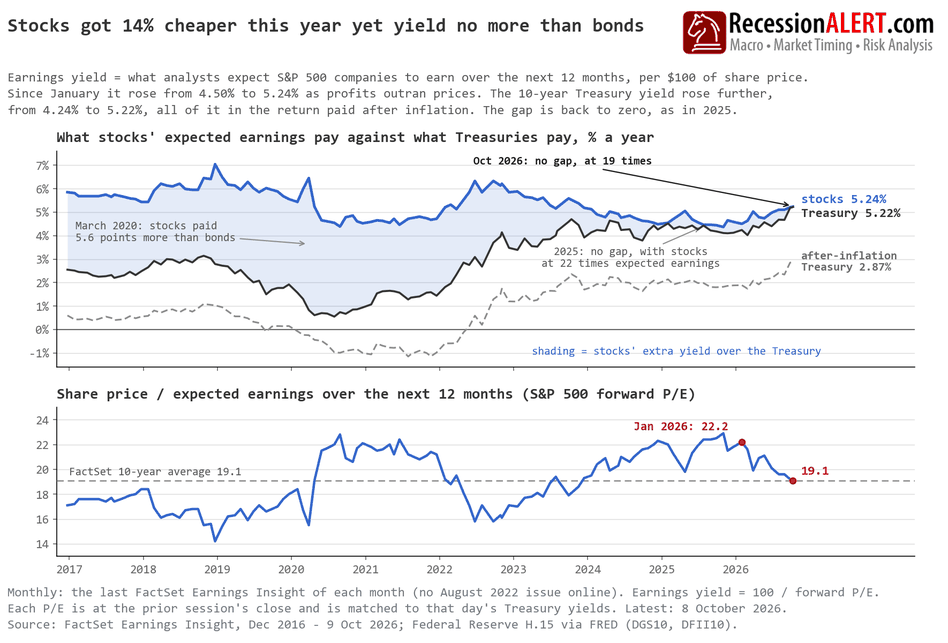
The S&P 500 got 14% cheaper this year while climbing 11.4% — earnings did the cheapening, not prices. Since late January analysts have lifted their forecast of the next 12 months’ earnings by 29.5%, so the price paid for each dollar of those earnings slid from 22.2 to 19.1, exactly its ten-year average. That should have opened a cushion over bonds; instead the 10-year Treasury rose nearly a point, all of it in the return left after inflation — 1.89% to 2.87% — with inflation expectations unmoved, under a Fed that hiked in September and is weighing another. Bonds absorbed the whole discount. Stocks’ earnings yield, expected profits per $100 of price, matched the Treasury’s in 2025 too, but stocks were dear then, at 22 times. Measured against the inflation-protected Treasury — the fairer yardstick, since profits tend to rise with prices while a bond’s coupon does not — stocks’ margin is about 2.4 points: wider, yet level with early 2025 as the thinnest in the decade charted. Parity with the ordinary Treasury rests on a forecast: on earnings companies have actually reported, stocks earn about 3.85% of their price, some 1.4 points below the 10-year, and growth is expected to slow from 32.7% in 2026 to 15.8% in 2027. Trim the forecasts and stocks slip beneath the Treasury, which has not happened once in the 118 months charted. This discount was written by analysts, not sellers — and analysts can take it back.
What it means: Savers can now lock in about 5.2% a year on a 10-year Treasury, or 2.9% above inflation on the inflation-protected kind. That matches stocks’ expected earnings per dollar, with no forecast needed. For stock investors, unless that yield falls, gains will have to come from profits arriving as forecast, not richer valuations. For the economy, the 10-year anchors long-term borrowing costs for homebuyers and companies, and nearly 3% above inflation will keep them high. The read changes if the 10-year falls toward January’s 4.2% while forecasts hold, giving stocks a cushion of about a point.
Market Intelligence Brief (MIB) Ver. 19.79
For professional investors only. Not investment advice.
© 2026 RecessionALERT.com

Comments are closed.