
MARKET INTELLIGENCE BRIEF (MIB)
Friday, September 11, 2026
Hot core CPI (+0.3% MoM) lifted September hike odds to 86%, yet stocks rallied 0.86% and the VIX fell 11.21%. Iran agreed to meet Gulf ministers on Hormuz shipping, sending crude down nearly 3% and ending Brent’s eight-session run. Oracle’s $90-95bn capex guidance detonated AI hardware, Dell +11.98% to a record, HPE +10.70%. Consumer sentiment fell to 47.8, second-lowest since 1952, with one-year inflation expectations at 4.6%. Saudi Arabia shut its only non-Hormuz export pipeline. The Fed decides Wednesday.
TABLE OF CONTENTS
A. EXECUTIVE SUMMARY
B. MARKET DATA
C. HIGH-IMPACT STORIES (6)
D. MODERATE-IMPACT STORIES (8)
E. ECONOMY WATCH (3)
F. EARNINGS WATCH (2)
G. WHAT’S NEXT
H. CHART OF THE DAY
A. EXECUTIVE SUMMARY -> TOP
Equities closed a losing week with a broad advance — S&P 500 +0.86%, Dow +0.98%, Nasdaq +0.91% — on a session whose defining feature was that a hot core CPI print and an 86% probability of a hike six days out produced a rally rather than a selloff. The market has decided the inflation impulse is an oil impulse and that the oil impulse is reversing: Iran’s agreement to meet Gulf ministers on Hormuz shipping took crude down nearly 3% and the VIX down 11.21% to 15.84, even as the 2-year rose 8.0 bps and the 2s10s gap narrowed to 34 bps. That is a bet on diplomacy priced off an announcement about scheduling, placed on the same day Saudi Arabia shut its only export route bypassing Hormuz. Breadth supported it — nine of eleven sectors higher, Industrials +1.32%, NYSE Composite +0.79% — but the Russell’s +0.45% shows the advance still ran through the mega-caps.
• The core CPI beat put a September hike at 86%. Core rose 0.3% MoM against a 0.2% consensus while headline held at 3.4% YoY; the 2-year yield rose 8.0 bps to 4.630% and the 10-year 2.8 bps to 4.972%. EY-Parthenon and BMO both switched to a hike call on the day, and no Fed official can respond — the communications blackout runs through September 17.
• Crude reversed on a scheduling announcement. Iran confirmed a Monday ministerial with Gulf neighbours in Salalah on Strait of Hormuz shipping; WTI fell 2.43% to $99.99 and Brent 2.94% to $104.47, ending eight consecutive up sessions for Brent. Both remain up roughly 9% on the week.
• Oracle’s $90-95 billion capex guidance repriced the AI-hardware complex. Dell +11.98% to a record $567.29, Hewlett Packard Enterprise +10.70%, HP Inc +10.13% to a 52-week high, with Arista +5.61%, Amphenol +4.57% and Cisco +4.37% alongside. Oracle itself fell 1.74%, and both BMO and RBC cut its target on capex intensity while keeping constructive ratings.
• Consumer sentiment collapsed to 47.8, the second-lowest reading since 1952. The preliminary September UMich index missed a 51.0 consensus, and one-year inflation expectations jumped to 4.6% from 4.0% on record September gasoline prices and Canadian retaliatory tariffs. Diesel set an all-time record at $6.0556 a gallon.
• Saudi Arabia shut the East-West pipeline, its only export route that avoids Hormuz. The roughly 7 mb/d line to Yanbu was closed after drone strikes on pump stations that Riyadh attributes to launches from Iraqi territory; no restart timeline was given, and the Kingdom is holding off on retaliation. The IEA separately cut 2026 oil demand by a further 940 kb/d to a 2.5 mb/d decline, with more than 10 mb/d of Gulf supply still shut in.
• Memory decoupled from the hardware rally. SanDisk fell 3.50% to $1,633.35 and Seagate about 4% after DeepSeek claimed its V4.1 Flash model needs a quarter of the high-bandwidth memory and an eighth of the storage of its predecessor — on a day AI-server names rose 10-12%. Cybersecurity also lagged, with Wedbush cutting Fortinet to Neutral even as it raised the target to $155.
1. The rally is a bet on oil, not a verdict on inflation — Gasoline drove over a third of the August monthly CPI increase, so a credible path to reopening Hormuz transit does more for the 2027 inflation path than Wednesday’s decision does. But the de-escalation priced today is a confirmed meeting, not an agreement, and it arrived alongside a Saudi pipeline shutdown and further Houthi advances in the Bab el-Mandeb. If crude resumes its climb, equities have discounted an inflation problem that is not solved — into a Fed that will already have tightened.
2. The AI trade has split into vendors and buyers — Oracle announced the spending and fell; the companies receiving it rose 10-12%. The market is paying a premium for the revenue and charging a penalty for the capital intensity that produces it, with industry capex estimated at $775-800 billion for 2026. The split runs inside hardware too: racks and networking were bid while memory and storage were sold, leaving the vendor complex levered to the persistence of a spending plan its own author is being punished for.
3. Tightening into a consumer at record-low confidence — A 60 bps jump in one-year inflation expectations to 4.6% undercuts the Committee’s only stated condition for looking through an energy shock, which makes the projections more hawkish than the hike itself. Meanwhile the Z.1 accounts show 84% of the quarter’s $12.8 trillion wealth gain came from equities — a mark-to-market buffer that transmits a hike faster than the credit channel would. Watch the laggards for the demand-destruction path the IEA marked down today: the Russell at +0.45%, Utilities the worst sector over six months at -9.07%.
 — Leading economic indicators. Accurate market forecasts. Apply for membership at join.recessionalert.com
B. MARKET DATA -> TOP
Stocks closed out a losing week with a broad, blue-chip-led rally after investors weighed a hotter-than-expected August CPI (core +0.3% MoM, above forecast) against a sharp pullback in crude oil. The Dow (+0.98%) and Nasdaq 100 (+0.91%) outpaced the S&P (+0.86%), while small-caps lagged (Russell +0.45%) and the VIX plunged 11.21% even as Treasury yields rose on firming Fed-hike odds (now 86% for next week’s FOMC, up from 60% a week ago). Oil was the session’s dominant driver: WTI and Brent both fell nearly 3% as Iran signaled openness to Gulf-state talks over Hormuz shipping, unwinding part of this week’s supply-shock surge. Industrials (+1.32%) led sector performance despite being the month’s worst performer, while Healthcare and Utilities were the lone laggards.
CLOSING PRICES – Friday, September 11, 2026:
MAJOR INDICES
A broad, blue-chip-led rally — the Dow (+0.98%) and Nasdaq 100 (+0.91%) paced the S&P (+0.86%), while the Russell 2000 lagged at just +0.45%, extending small-caps’ 10-session underperformance (-3.66% vs. the S&P’s -0.96%). NYSE breadth (+0.79%) confirms the advance was broad rather than narrow, though small-caps continue to lag the broader tape.
| Index | Close | Change | %Move | Why It Moved |
|---|---|---|---|---|
| S&P 500 | 7,656.98 | +65.28 | +0.86% | Falling oil offset a hotter-than-expected August CPI; Fed-hike odds for next week’s FOMC rose to 86% |
| Dow Jones | 52,573.29 | +509.19 | +0.98% | Blue-chips led the advance as oil’s pullback outweighed the CPI beat |
| DJ Transportation | 20,628.27 | +65.60 | +0.32% | Lagged the broader Dow; the group remains well off its 10-session high |
| Nasdaq | 29,368.44 | +264.93 | +0.91% | Rallied alongside the broader tape, led by a networking/AI-infrastructure rebound (Cisco, Arista) |
| Russell 2000 | 2,903.94 | +13.00 | +0.45% | Underperformed the mega-cap indices, extending small-caps’ recent lag |
| NYSE Composite | 24,331.56 | +190.92 | +0.79% | Tracked the broad-based advance; breadth confirmed the rally was not narrow |
VOLATILITY & TREASURIES
VIX plunged 11.21% to 15.84 even as both yields rose — the 10Y +2.8bps to 4.97%, the 2Y +8.0bps to 4.63% — a combination that reads as relief on oil and geopolitics rather than reduced inflation risk. Fed-hike odds for next week’s FOMC jumped to 86% from 60% on the hot core CPI, yet equities and vol both cooperated; the dollar stayed flat, signaling an oil-driven rally rather than a broad risk reassessment.
| Instrument | Level | Change | Why It Moved |
|---|---|---|---|
| VIX | 15.84 | -2.00 (-11.21%) | Plunged as the week’s losing streak snapped and oil-driven inflation fears eased |
| 10-Year Treasury Yield | 4.972% | +2.8 bps | Rose modestly as hot core CPI reinforced expectations for a Fed hike next week |
| 2-Year Treasury Yield | 4.630% | +8.0 bps | Rose more than the 10Y as short-end rates repriced for next week’s expected Fed hike |
| US Dollar Index (DXY) | 99.13 | +0.08 (+0.08%) | Little changed, reflecting a rally driven by oil rather than a broad dollar reassessment |
COMMODITIES
Precious and industrial metals were directionless — gold slipped 0.39% on firmer yields while silver, platinum and copper each edged up modestly, a split that signals no clear safe-haven or growth read-through from today’s session. Bitcoin’s muted +0.10% shows it tracking the broader tape rather than trading its own narrative today.
| Asset | Price | Change | %Move | Why It Moved |
|---|---|---|---|---|
| Gold | $4,390.00/oz | -$17.30 | -0.39% | Slipped modestly as Treasury yields firmed |
| Silver | $65.02/oz | +$0.09 | +0.14% | Edged higher, diverging slightly from gold |
| Copper | $6.56/lb | +$0.01 | +0.15% | Modestly higher, tracking the broader risk-on tone |
| Platinum | $1,801.60/oz | +$0.50 | +0.03% | Essentially flat |
| Bitcoin | $77,305.0 | +$74.0 | +0.10% | Little changed, tracking the muted broader tape rather than trading its own narrative |
ENERGY
WTI (-2.43%) and Brent (-2.94%) fell in tandem after Iran signaled openness to Gulf-state talks over Strait of Hormuz shipping, easing the acute supply-shock fears that drove Brent up 8.7% and WTI 9.4% this week alone. Natural gas barely moved, confirming the reversal is confined to crude rather than a broader energy repricing.
| Asset | Price | Change | %Move | Why It Moved |
|---|---|---|---|---|
| Crude Oil (WTI) | $99.99/bbl | -$2.49 | -2.43% | Fell as Iran signaled openness to Gulf-state talks on Hormuz shipping, unwinding part of this week’s supply-shock surge |
| Crude Oil (Brent) | $104.47/bbl | -$3.16 | -2.94% | Fell in tandem with WTI on the same Hormuz de-escalation signal, still up over 8% for the week |
| Natural Gas (Henry Hub) | $2.82/MMBtu | -$0.01 | -0.35% | Little changed; the crude selloff did not spill over into gas |
| Natural Gas (Dutch TTF) | $27.71/MMBtu | -$0.02 | -0.09% | Roughly flat in euro terms; the $/MMBtu move reflects EUR/USD drift |
S&P 500 SECTORS
A broad risk-on sweep: 9 of 11 sectors closed green, with only Healthcare (-0.09%) and Utilities (-0.32%) holding out. Industrials (+1.32%) led despite being the month’s worst performer (-6.35%), a sharp one-day reversal. Utilities’ decline extends a structural slide — down 9.07% over six months — while Healthcare’s flat session continues its worst-week showing (-4.70%).
| Sector | 1-Day | 1-Week | 1-Month | 3-Month | 6-Month | YTD | 12-Month |
|---|---|---|---|---|---|---|---|
| Industrials | +1.32% | -0.74% | -6.35% | -4.73% | +3.20% | +10.18% | +14.25% |
| Communication Services | +1.30% | -0.16% | +1.82% | -1.23% | +3.41% | -0.25% | +5.24% |
| Technology | +1.12% | +0.75% | +0.03% | +4.37% | +30.88% | +25.43% | +30.57% |
| Consumer Cyclical | +1.10% | -2.63% | -3.94% | -1.66% | +2.21% | -6.21% | -4.36% |
| Financial | +0.83% | -2.01% | -0.85% | +8.62% | +18.69% | +7.76% | +12.71% |
| Real Estate | +0.68% | -2.13% | -2.97% | -2.97% | +2.78% | +6.53% | +2.20% |
| Consumer Defensive | +0.61% | -1.79% | -2.39% | -3.06% | -2.99% | +5.37% | +3.89% |
| Basic Materials | +0.30% | -3.46% | +0.21% | +3.83% | +2.64% | +16.75% | +29.63% |
| Energy | +0.03% | +1.01% | +5.51% | +10.82% | +11.32% | +41.38% | +43.14% |
| Healthcare | -0.09% | -4.70% | -2.23% | +6.39% | +9.68% | +6.02% | +19.08% |
| Utilities | -0.32% | -1.56% | -3.91% | -4.60% | -9.07% | -1.81% | +1.02% |
TOP MEGA-CAP MOVERS:
GAINERS
| Company | Ticker | Close | Change | Why It Moved |
|---|---|---|---|---|
| Dell Technologies | DELL | 567.29 | +11.98% | Oracle CFO Hilary Maxson guided FY capex to $90-95B on Thursday’s post-close call and named Dell and HPE as recipients; the read-through drove Dell’s largest single session of the year to a fresh record close, alongside HPE (+10.70%) and HPQ (+10.13%). RBC also initiated at Outperform, PT $640 |
| Arista Networks | ANET | 199.59 | +5.61% | No discrete same-day catalyst identified; part of a sector-wide networking/AI-infrastructure rally (Cisco, Ciena, F5 also higher) |
| Amphenol Corp | APH | 83.92 | +4.57% | No discrete same-day catalyst identified; rode the same networking/AI-infrastructure sector rotation |
| Cisco Systems | CSCO | 112.13 | +4.37% | No discrete same-day catalyst identified; part of the same networking-sector rally |
| Marvell Technology | MRVL | 236.10 | +4.03% | No discrete same-day catalyst identified; part of the same AI-infrastructure/semiconductor sector rotation |
DECLINERS
| Company | Ticker | Close | Change | Why It Moved |
|---|---|---|---|---|
| SanDisk Corp | SNDK | 1633.35 | -3.50% | Fell on demand concerns after DeepSeek’s new V4.1 Flash model showed sharply reduced memory/storage requirements, plus profit-taking after the sector’s recent run |
| UnitedHealth Group | UNH | 379.09 | -2.37% | No discrete same-day catalyst identified; continuing pressure from Medicare Advantage margin concerns and technical selling ahead of the Sept 14 ex-dividend date |
| Palo Alto Networks | PANW | 330.65 | -2.32% | No new same-day catalyst identified; continuation of Wednesday’s PAN-OS critical vulnerability disclosure (CVE-2026-0310, CVSS 9.2) |
| Oracle Corp | ORCL | 150.28 | -1.74% | BMO cut its target to $195 from $220 on sequential cloud gross-margin decline and RBC to $165 from $190 on heavy data-centre capex; extends this week’s AI-capex-related derating (shares fell 5.38% Thursday) |
| Amgen Inc | AMGN | 377.35 | -1.34% | Unverified: possible read-through from Novartis’s failed Lp(a) trial (competing therapy) and a reported HSBC downgrade to Hold; dating of these to today’s session not independently confirmed |
— Institutional-grade intelligence for serious investors. Apply for membership at join.recessionalert.comC. HIGH-IMPACT STORIES -> TOP
UNCERTAIN
1. Hot Core CPI Lifts September Hike Odds to 86% and Steepens the Short End — Yet Equities Rally and the VIX Falls 11%
The core facts:This morning’s August CPI print landed above consensus on the core measure, and the rates market repriced immediately. CME FedWatch odds of a 25bp hike at the September 15-16 FOMC moved to 86%, against a prior-day figure outlets placed variously at 70-72% and roughly 60% a week ago; Polymarket’s 2026 hike contract rose to 89% from 78% on Thursday, an 11-point one-day move. The 2-year yield rose 8.0bps to 4.630% and the 10-year 2.8bps to 4.972%, steepening the short end relative to the long. Economists changed calls on the day: EY-Parthenon’s Greg Daco said “We are changing our Fed call from a hold to a 25bps hike at the FOMC meeting next week,” and BMO’s Ian Lyngen said the report “clears the path for the FOMC to hike next week.” No Fed official could respond — the communications blackout runs September 5 through September 17. Section E carries the data itself.
Why it matters:The market’s reaction is the story, not the print. A near-certain hike six days out would normally compress equity multiples, yet the S&P rose 0.86%, the Dow 0.98% and the Nasdaq 100 0.91%, while the VIX fell 11.21% to 15.84. That combination — yields up, hike odds up, volatility sharply down — is not a market that has stopped believing in the hike. It is a market that has decided the inflation impulse is an oil impulse, and that the oil impulse is reversing. Crude fell nearly 3% today on Hormuz de-escalation signals, and gasoline alone drove over a third of the monthly CPI increase. The positioning risk runs in both directions: if crude resumes its climb, the equity market has priced away an inflation problem it has not actually solved, and it will be doing so into a Fed that has already tightened. If the de-escalation holds, the September hike becomes the last one and the short end is overshooting. Note also what a hike into a decelerating labour market implies for the curve — the 2s10s gap narrowed to 34bps today, and a further 25bps at the front end leaves very little room.
What to watch:The FOMC decision at 14:00 ET on Wednesday September 16, with a Summary of Economic Projections — the dot plot will say whether 86% odds bought a one-and-done or the start of a sequence. Watch the 2-year through 4.75%.
BULLISH
2. Iran Agrees to Meet Gulf Foreign Ministers on Hormuz Shipping — Crude Reverses Nearly 3% and Brent Ends an Eight-Session Winning Run
The core facts:Iranian Foreign Ministry spokesman Esmaeil Baghaei said today that “Plans are underway for a meeting with Gulf neighbors on Monday,” confirming the first GCC-Iran ministerial since the war began. The meeting is set for Salalah, Oman, and will address Strait of Hormuz shipping; Bloomberg reports Iraq may also attend and that attendance is not yet confirmed. Crude reversed hard: WTI fell 2.43% to $99.99 and Brent 2.94% to $104.47. Measured against Phase 1’s own published tapes for each prior session, today’s decline ended a run of three consecutive up sessions for WTI and eight for Brent — Brent had risen in every session since September 1, its run beginning on August 31. Even after today, Brent is up 8.7% and WTI 9.4% on the week.
Why it matters:This was the session’s dominant driver and it is why a hot CPI print produced a rally rather than a selloff. The entire inflation impulse currently worrying the Fed is an energy impulse — gasoline drove over a third of the August monthly CPI increase and diesel set an all-time record today at $6.0556 a gallon. A credible path to reopening Hormuz transit therefore does more for the 2027 inflation path than anything the FOMC will decide next Wednesday. But note the asymmetry in what actually happened: a spokesman confirmed that a meeting is being planned, and the oil complex gave back roughly a third of a week’s supply-shock premium on it. Nothing has been agreed, no transit has resumed, and the same session brought a Saudi pipeline shutdown and a further Houthi advance in the Bab el-Mandeb. The market is pricing a diplomatic outcome off an announcement about scheduling.
What to watch:Monday September 14 in Salalah — whether the meeting convenes at all, and whether Iraq attends. A collapse or postponement puts the week’s 9% crude premium straight back on, hours before the FOMC begins.
BEARISH
3. Saudi Arabia Shuts the East-West Pipeline — Its Only Export Route Bypassing Hormuz — and Blames Drones Launched From Iraq
The core facts:The Saudi Ministry of Energy announced today that the East-West Pipeline “was shut down as a precautionary measure” following multiple attacks on pump stations in the Riyadh and Madinah regions. The line runs roughly 1,200 km from the Eastern Province oilfields to the Red Sea terminal at Yanbu, has a full pumping capacity of about 7 million barrels a day, and is the Kingdom’s only export route that does not transit the Strait of Hormuz. The attacks themselves occurred on Thursday and caused a number of injuries; today’s news is the shutdown and the attribution. The Foreign Ministry blamed drones launched from Iraqi territory and said it would hold off on retaliation at the request of Iraq’s prime minister while “reserving the right to take all necessary measures to protect its sovereignty, security and critical facilities.” Attribution is contested — earlier coverage this week pointed to the Houthis, and no restart timeline has been given.
Why it matters:This is the single most consequential physical development of the session and the tape ignored it, which is the point worth holding onto. Since Iran’s effective closure of Hormuz, the East-West line has been the mechanism by which Saudi barrels reach a customer at all — the workaround, not a supplement to it. With it down, the Kingdom’s export optionality collapses back onto the chokepoint it was built to avoid, at a moment when the Houthis have taken Mokha and, per reports the outlets themselves could not independently confirm, Perim Island inside the Bab el-Mandeb. The Red Sea outlet and the Gulf outlet are under pressure simultaneously. Equally important is the second-order signal: a strike attributed to Iraqi territory, met with deliberate non-retaliation, tells you Riyadh is managing escalation rather than answering it — which caps the tail risk in the near term and raises it later if restraint is read as weakness. For US portfolios the transmission is refined product, not crude: US diesel topped $200 a barrel in early September, 94% above pre-war levels, and the marginal barrel removed here is a medium-sour grade the global refining system is already short of.
What to watch:A Saudi announcement of a pipeline restart timeline, and whether Riyadh’s non-retaliation survives a second strike. Watch the Brent-Dubai spread and US diesel cracks rather than headline crude for the real read.
BEARISH
4. IEA Cuts 2026 Oil Demand by Another 940,000 Barrels a Day to a 2.5 Million-Barrel Decline, With More Than 10 Million Barrels of Gulf Supply Still Shut In
The core facts:The International Energy Agency’s September Oil Market Report, published today, now sees global oil demand falling 2.5 mb/d in 2026 — a downward revision of 940 kb/d from last month — with losses concentrated in middle distillates and petrochemical feedstocks, especially in Asia. World supply is seen averaging 100.7 mb/d, down 5.7 mb/d year on year, with more than 10 mb/d of Gulf output still shut in on security grounds. Observed stocks fell 95 mb in August, taking cumulative draws since February to 507 mb, or about 2.8 mb/d. August refinery throughput was 81.4 mb/d, 4.2 mb/d below a year earlier. The agency now expects a full recovery in Middle East supply in 2027 rather than 2026, with demand rebounding 2.6 mb/d and production 8 mb/d next year. From the report: “with buffers shrinking and the global refining system stretched to the limit, the need for progress in resolving the conflict in the Middle East… is greater than ever.”
Why it matters:Read the two revisions together and the message is worse than either alone. Demand destruction of 2.5 mb/d is what $100 crude and $6 diesel do to an economy, and the IEA has now had to deepen that estimate by nearly a million barrels in a single month — that is the agency telling you the price shock has moved from the energy sector into industrial activity. But supply is falling faster still, which is why 507 mb has come out of inventory in seven months with prices rising anyway. Buffers are the variable that matters now: with a tenth of world supply shut in and stocks drawn down for seven consecutive months, there is very little left to absorb the next disruption — and today produced one, in the form of the East-West pipeline. The deferral of recovery to 2027 also removes the argument that this is a spike to be looked through. For US equities the read-through is a 2027 margin problem across transport, chemicals and industrials rather than a 2026 headline-inflation problem, and it sits awkwardly against a Fed about to tighten into it.
What to watch:Whether the October OMR deepens the 2026 demand cut a second time — a further downgrade of this magnitude would be the clearest signal yet that the shock has become a demand event rather than a supply one.
BULLISH
5. Oracle’s $90-95 Billion Capex Guidance Detonates the AI-Hardware Complex — Dell +11.98% to a Record, HPE +10.70%, HP +10.13% — While Oracle Itself Falls 1.74%
The core facts:On Oracle’s post-close call Thursday evening, CFO Hilary Maxson guided full-year capital expenditure to a range of $90-95 billion and said the spending would flow to vendors supplying AI racks, cooling systems and networking equipment — naming Dell and HPE specifically. Today the complex repriced violently. Dell rose 11.98% to $567.29, a record close and its largest single-session advance of the year; Hewlett Packard Enterprise rose 10.70% to $61.13; HP Inc rose 10.13% to $36.05, a new 52-week high; Super Micro also gained. Networking and AI-infrastructure names moved with them — Arista +5.61%, Amphenol +4.57%, Cisco +4.37%, Marvell +4.03% — carrying the Nasdaq 100 to +0.91% and Technology to +1.12%. RBC separately initiated Dell at Outperform with a $640 target and HP at Sector Perform at $33; the HP target sits below where the stock closed, and HPE had no analyst action at all, which is the strongest evidence the day’s move was Oracle’s capex rather than the initiations.
Why it matters:The tell is the divergence. Oracle announced the spending and fell 1.74%, extending a week in which it dropped 5.38% on Thursday ahead of the print; the companies receiving the money rose 10-12%. That is the market cleanly separating the two halves of the AI trade — it will pay a high multiple for the revenue and charge a penalty for the capital intensity that produces it. Two analysts made the same distinction in writing today: BMO cut its Oracle target to $195 from $220 on sequential cloud gross-margin decline and disappointing SaaS growth while keeping Outperform, and RBC cut to $165 from $190 on heavy data-centre capex and delayed buildouts. For portfolio construction this matters more than the day’s returns. Hyperscaler capex is estimated at $775-800 billion industry-wide for 2026, roughly 64% above 2025, and the marginal dollar of that is now being valued as an asset on the vendor’s income statement and a liability on the buyer’s. It also means the hardware complex is levered to one variable — the persistence of a spending plan that its own author is being punished for.
What to watch:Whether Oracle’s gross margin stabilises next quarter — BMO said continued triple-digit infrastructure growth alongside stabilising margins would strengthen its Outperform thesis. A second quarter of sequential margin decline turns a vendor windfall into a capex-plan risk.
BEARISH
6. Consumer Sentiment Collapses to 47.8, the Second-Lowest Reading on Record — and One-Year Inflation Expectations Jump to 4.6%
The core facts:The University of Michigan’s preliminary September sentiment index fell to 47.8 from 51.7, missing a 51.0 consensus by a wide margin and marking the second-lowest reading in a series that begins in 1952 — behind only May 2026. The collapse was attributed to record-high September gasoline prices, themselves a function of the Hormuz oil shock, and to renewed trade tensions following this week’s Canadian retaliatory measures. One-year inflation expectations rose to 4.6% from 4.0%. Section E carries the survey detail.
Why it matters:The headline index is the part the market will discount and the expectations series is the part that should worry it. Sentiment has been a poor predictor of consumption for three years, and a reading driven by pump prices tends to mean-revert when pump prices do. A 60-basis-point jump in one-year inflation expectations is a different object. The Federal Reserve’s entire case for tolerating an energy shock rests on expectations staying anchored — that is the explicit condition under which a supply-driven price rise is “looked through.” At 4.6%, with a hike already 86% priced, the Committee arrives on Tuesday holding evidence that the anchor is dragging. That makes next week’s decision less of a close call and the projections materially more hawkish than they would otherwise have been. There is a second, uncomfortable reading: a consumer this pessimistic, facing $4.295 gasoline and $6.06 diesel, going into a tightening — that is a demand-destruction path, and it is the same one the IEA marked down global oil consumption for today. Watch discretionary retail and the Russell, which lagged again at +0.45%.
What to watch:The 5-10 year inflation expectations series in the final September reading later this month. A move there, rather than in the one-year, is what would genuinely force the Fed’s hand beyond a single hike.
— Quantifying recession risk so you don’t have to guess. Apply for membership at join.recessionalert.comD. MODERATE-IMPACT STORIES -> TOP
UNCERTAIN
7. Commerce Finalizes Solar Duties on India, Indonesia and Laos at Combined Margins Up to 234% — Closing Three of the Largest Remaining Import Channels
The core facts:The Commerce Department today issued final affirmative determinations in its antidumping and countervailing duty investigations into crystalline silicon photovoltaic cells and modules from India, Indonesia and Laos, finding dumping below fair value and countervailable subsidies in all three. Combined margins run as high as 234% for India, 178% for Indonesia and 103% for Laos. Countervailing rates alone were set at 126.09% for Indian producers, between 73.2% and 173.7% for Indonesian producers and between 82.03% and 153.67% for Lao producers. The case now goes to the International Trade Commission for a final injury vote scheduled for October 14, 2026; an affirmative vote would see Commerce issue duty orders on November 2, 2026, imposing the finalized cash-deposit rates.
Why it matters:These three countries became the dominant source of US cell and module imports precisely because the previous round of duties closed Southeast Asia, and the pattern is now repeating one tier further out. Margins at these levels are not a tariff, they are an exclusion — no supplier absorbs 234%. The split within the US solar complex is therefore sharp and immediate: domestic cell and module manufacturers get a protected domestic price, while developers, installers and the utility-scale pipeline face a module cost step-change into a year in which power demand from data centres is the sector’s entire growth story. The timing compounds a problem already visible elsewhere in this report — utilities are the worst-performing S&P sector over six months at -9.07% and fell again today — and higher module costs raise the levelised cost of exactly the generation capacity the AI buildout is counting on. The November 2 order date is the operative deadline for anyone pulling forward shipments.
What to watch:The ITC injury vote on October 14. A negative finding terminates the case and voids the duties entirely, which is the single binary event in this chain.
BULLISH
8. Boeing Receives a $13.4 Billion Ceiling Increase on an Air Force Contract, Adding Foreign Military Sales Scope Through 2035
The core facts:Today’s Department of Defense daily contracts release states that “The Boeing Co., Seattle, Washington, has been awarded a $13,400,000,000 ceiling modification (P00008) to a previously awarded contract (FA8609-19-D-0007) for the addition of Foreign Military Sales (FMS) scope of work.” The FMS scope covers Japan, Israel and future partners, with completion set for April 28, 2035; the contracting activity is the Air Force Life Cycle Management Center. The award does not appear in Thursday’s release, and DoD posts at 17:00 ET, so the modification is today’s. Boeing closed up 1.64% with a market capitalisation of $164.5 billion — but the award was posted after the close, so today’s move is not a reaction to it and the first opportunity to trade it is Monday.
Why it matters:A ceiling modification is capacity to order, not an order, and no funds were obligated at award — so this is a claim on future revenue rather than a booking, and should be valued as optionality. What makes it worth attention is its composition. Foreign Military Sales scope added for Japan and Israel, running to 2035, converts a US procurement vehicle into an allied-rearmament channel at a moment when the Middle East conflict has made that channel the most reliable demand stream in aerospace. It is also a credit story as much as an equity one: Boeing’s problem for five years has been the volatility of its commercial cash flows, and a decade-long defence ceiling of this size lengthens the duration of the stable half of the business. Note the scale against the disclosed baseline — reporting suggests the ceiling rises from $5.7 billion to $19.1 billion, though the primary release names no programme and that figure is not confirmed in it.
What to watch:Monday’s open for the delayed reaction, and subsequent DoD releases for actual task orders drawn against the new ceiling — that is what converts optionality into backlog.
BEARISH
9. Customs and Border Protection Issues the First Operational Guidance for the Section 338 Canada Duties, Effective 12:01 ET on September 15
The core facts:CBP sent entry guidance to the trade at 16:49 ET today, bulletin CSMS #69851916, the first public operational instruction implementing Proclamations 11064 and 11065 on Canadian alcoholic beverages and motor vehicles. The bulletin specifies the duties apply “on or after 12:01 a.m. eastern time on September 15, 2026.” Headings 9903.03.12, .13 and .14 remain at a 50% additional duty and 9903.03.15 and .16 remain at 0%; 122 HTSUS classifications are added and nine lines deleted. Drawback is available, and Foreign-Trade Zone guidance limits privileged foreign status. Separately, all five September 8 Canada proclamations were filed with the Federal Register today for September 14 publication — a formal step, not a new policy. The underlying policy trigger was September 8; what is new today is the implementation mechanics and the confirmed effective times.
Why it matters:Until today the Canada measures were a proclamation; now they are an entry procedure with a clock on it, and that is the point at which importers have to act rather than lobby. Two dates matter and they are different in kind. September 15 is a scope change at existing rates — manageable, and drawback availability softens it. September 29 is when the import bans on alcoholic beverages, dairy and motor vehicles take effect, and Proclamation 11063 provides that goods imported but not entered for consumption before then stay at the 50% rate. That creates a fourteen-day pull-forward window with a hard edge, and the customs and logistics load in it will be considerable. The read-through the bulletin conspicuously does not address is the one that matters most to auto supply chains — stacking with Section 232, USMCA treatment and in-transit goods are all unaddressed, and Proclamation 11064 states the Section 338 duties apply “in addition to” Section 232 duties. An unresolved stacking question on vehicles two weeks from a ban is a live cost risk for every North American assembler.
What to watch:A follow-up CSMS bulletin addressing Section 232 stacking and USMCA treatment before September 29. Its absence, not its content, is what would signal the bans are being allowed to bite at full rate.
BEARISH
10. Morgan Stanley Cuts Novo Nordisk to Underweight on the Semaglutide Patent Cliff — the ADR Falls 2.56%
The core facts:Morgan Stanley downgraded Novo Nordisk to Underweight from Equal-Weight this morning, leaving targets unchanged at DKK 250 and $40 on the US-listed ADR. Analyst Thibault Boutherin’s stated basis is concentration: semaglutide is expected to account for roughly 75% of 2026 sales, with loss of exclusivity from 2031. The ADR closed at $42.89, down 2.56%, on a market capitalisation of $189.8 billion — a decline against a tape in which nine of eleven S&P sectors rose, and within a Healthcare sector that was the day’s second-weakest at -0.09% and has fallen 4.70% on the week.
Why it matters:The downgrade is notable less for the call than for what it says about how the market is now valuing the GLP-1 franchise. An Underweight with the price target left unchanged is an analyst saying the shares have fallen to the target rather than that the business has deteriorated — the rating caught up to the price. What has changed is the willingness to underwrite terminal value. A single molecule at 75% of revenue with exclusivity running out in 2031 is a five-year duration asset being valued as a perpetuity, and once a major bank says so in print the burden shifts to management to show a pipeline that is not semaglutide. For US portfolios this is a read-through to the whole obesity complex rather than a Danish-issuer story, and it arrives in a week when Healthcare has been the worst sector on the tape. The structural question for allocators is whether GLP-1 exposure should now be sized as a patent-cliff position rather than a growth one.
What to watch:Whether Eli Lilly trades in sympathy on subsequent sessions. A divergence would confirm the market is pricing a Novo-specific concentration problem rather than a sector-wide GLP-1 de-rating.
BEARISH
11. SanDisk Falls 3.50% as DeepSeek Claims Its New Model Needs a Quarter of the Memory and an Eighth of the Storage
The core facts:DeepSeek released its V4.1 Flash model, which the company says requires only a quarter of the high-bandwidth memory and an eighth of the SSD storage of its prior generation. SanDisk closed at $1,633.35, down 3.50%, on a $238.5 billion market capitalisation — the largest decliner in the mega-cap tables on a day the S&P rose 0.86%. Seagate fell roughly 4%. Separately and unrelatedly, SanDisk disclosed after the close an amendment to its revolving credit facility, taking commitments to $1.5 billion maturing in September 2031 with JPMorgan as administrative agent; no borrowing was disclosed and this is liquidity housekeeping, not a driver of today’s move.
Why it matters:This is the same trade the market ran in January 2025 and it has the same structure: an efficiency claim from a Chinese lab, taken as evidence that algorithmic improvement can outrun hardware demand. Whether the specific claim survives scrutiny matters less than the fact that the memory and storage complex is now trading as a levered bet on the persistence of inefficiency. That is a genuinely fragile position after the run these names have had, and today’s session shows why: on a day when Oracle’s capex guidance sent AI-server hardware up 10-12%, the memory names went the other way. Demand for racks and demand for the bits inside them decoupled. The bear case is not that AI spending falls, it is that a rising fraction of it stops touching NAND — and unlike compute, storage has no scarcity premium to defend it. Note that the decline came with profit-taking after a sharp sector run, so some of the move is positioning rather than thesis.
What to watch:Independent benchmarking of V4.1 Flash’s actual memory footprint. The January 2025 analogue reversed within weeks once the efficiency claims were tested against real deployments.
UNCERTAIN
12. Wedbush Resets Cybersecurity Coverage — Fortinet Cut to Neutral Even as Its Target Rises to $155, With CrowdStrike, Palo Alto, Zscaler and Datadog at Outperform
The core facts:Wedbush reset its cybersecurity coverage today. Fortinet was downgraded to Neutral from Outperform while the price target was raised to $155 from $125; analyst Steven Wahrhaftig’s stated reason is that a roughly 100% year-to-date gain means the market is “currently baking in a best-case scenario.” Fortinet closed at $155.67, down 2.01%, essentially at the new target. In the same note the firm resumed Outperform on CrowdStrike at $250, described as one of its highest-conviction names in the group, on Palo Alto Networks at $400, Zscaler at $215 and Datadog at $275. The group did not follow the ratings: CrowdStrike fell 1.82% to $205.06, Palo Alto 2.32% to $330.65, Zscaler 0.03% and Datadog 0.81%, on a day the Technology sector rose 1.12%.
Why it matters:A downgrade accompanied by a 24% target increase is an unusual and honest construction — it separates the quality of the business from the price of the stock, and says the second has caught the first. That is the relevant signal for a group that has been one of the few reliable growth trades of 2026. The more interesting fact is the non-reaction: every name resumed at Outperform fell, and the whole group underperformed a rising tech tape. Capital rotated today into AI hardware, which is a capex story, and out of software subscriptions, which are an opex story — and an opex story is the more vulnerable one heading into a Fed that is about to tighten into a consumer at record-low confidence. Palo Alto’s decline has a company-specific overlay, continuing pressure from Wednesday’s disclosure of a critical PAN-OS vulnerability, which is context here rather than today’s trigger.
What to watch:Whether the security group keeps lagging on up-days for the Nasdaq. Two or three more sessions of that pattern would confirm a rotation out of software rather than a single-day funding move into hardware.
UNCERTAIN
13. Treasury Secretary Bessent Says “a Large Bank” Will Be Sanctioned on Monday Under the Iran Campaign
The core facts:Treasury Secretary Scott Bessent said a large bank will be designated on Monday September 14 as part of the Iran sanctions campaign. Speaking on Real America’s Voice, he said: “We’re going to do it on Monday because we want to honor the memory of our fallen citizens on 9/11. But watch this space on Monday.” He named neither the institution nor its jurisdiction and made no comment on Fed policy or rates. The remark reached wire circulation after the close of business Thursday and was carried by CNBC at 20:54 ET, placing it inside this report’s window. It should not be conflated with last month’s Operation Economic Outcast step, which covered nearly 60 entities, individuals and vessels; that figure does not attach to this announcement. OFAC listed no action on either September 10 or 11.
Why it matters:Pre-announcing a specific designation three days out is unusual and deliberate, and the deliberateness is the information. Sanctions are normally sprung to prevent asset flight; telegraphing one is a signal to counterparties rather than a strike at the target, and the audience is every correspondent bank still clearing transactions with the institution in question. That makes the practical effect front-run the designation — de-risking will happen over the weekend. For US financials the exposure is correspondent relationships and settlement rather than direct credit, and the Financial sector’s +0.83% today gives no indication the market has priced anything. The genuine uncertainty is scale. “A large bank” in the Iran campaign could mean a mid-tier regional institution in a third country or a systemically significant lender in a major economy, and those two outcomes have entirely different implications for dollar-clearing risk. Until the name is known this is a scheduled event with an unbounded range, which is precisely the sort of thing to identify before the weekend rather than after.
What to watch:OFAC’s recent actions page on Monday September 14, and the jurisdiction of the designated institution. A bank in a major trading partner rather than a sanctions-adjacent economy is the outcome that would move financials.
UNCERTAIN
14. Household Net Worth Reaches $195.9 Trillion, Up $12.8 Trillion in a Single Quarter — and the Fed Starts Counting Private Credit
The core facts:The Federal Reserve’s Z.1 Financial Accounts for the second quarter of 2026, released at 12:00 ET today, put household net worth at $195.9 trillion, an increase of $12.8 trillion in the quarter. Directly and indirectly held equities accounted for $10.7 trillion of the gain and real estate for $1.1 trillion. Domestic nonfinancial debt grew at a 5.2% annual rate — households 5.0%, nonfinancial business 4.6%, federal 5.2% and state and local 9.1%. The release also incorporates private credit lending vehicles, private credit loans and hedge funds for the first time, a structural change to the series rather than a revision to it. The release does not describe the level as a record and no record has been independently verified here.
Why it matters:Two things in this release cut against each other and both matter for next week. The first is that 84% of a $12.8 trillion quarterly wealth gain came from equities — so the wealth effect currently supporting consumption is a mark-to-market on the same AI-concentrated index that fell for four straight sessions this week before today. Wealth of that composition is not a buffer against a tightening cycle; it is the thing most exposed to one, and it is the argument for why a Fed hike next week transmits faster than the credit channel alone would suggest. The second is the private-credit inclusion. The Fed has spent two years being asked how large the opaque half of corporate lending has become, and it has now put those vehicles inside its primary balance-sheet statistics — which is how a shadow market becomes a monitored one. State and local debt growing at 9.1%, roughly double the federal rate, is the other number worth marking: municipalities are levering into a 4.97% ten-year.
What to watch:Whether the newly incorporated private credit series is referenced in next week’s Summary of Economic Projections or the Chair’s press conference. Its first citation by the Committee would mark it as a policy input rather than a statistical footnote.
— Separating signal from noise since 2007. Apply for membership at join.recessionalert.comE. ECONOMY WATCH -> TOP
August delivered a stagflation-adjacent split: core CPI ran hot at 0.3% MoM (vs. 0.2% expected), pushing next week’s FOMC hike odds to 86-89% from roughly 60-78% a week ago, even as University of Michigan sentiment collapsed to 47.8 — the second-lowest reading on record — as gas prices hit a September high and trade tensions squeezed households. The Fed faces its September 16 decision caught between accelerating prices and a demand-side warning. A narrower-than-expected $167B August deficit offered fiscal cover, though the calendar-adjusted figure actually widened $7B year-over-year, keeping the fiscal path on track to exceed all of FY2025’s deficit with a month still to come.
Hot Core CPI Cements Fed Hike Bets Ahead of Next Week’s FOMC (BLS, Sept 11, 2026)
What they’re saying:Core CPI rose 0.3% MoM in August, above the 0.2% consensus, while headline CPI matched the 0.4% MoM estimate and held YoY at 3.4% — flat versus July but a sharp acceleration from June’s 0.1% monthly pace.
The context:The core beat reinforced Fed hike expectations for next week’s FOMC meeting: odds referenced in today’s market data jumped to 86% from 60% a week ago, while Polymarket’s broader 2026 hike-probability contract rose 11 points to 89% from 78% on Thursday. Forecasters were split heading into the print — J.P. Morgan calling for a hike, Goldman Sachs calling one “very unlikely” — and today’s data tilted that balance toward tightening.
What to watch:The September 16 FOMC rate decision and press conference — Fed officials remain in their blackout period (through Sept 17) and will not comment publicly before then.
Consumer Sentiment Craters to Second-Lowest Level on Record as Gas Prices, Trade Tensions Bite (University of Michigan, Sept 11, 2026)
What they’re saying:The University of Michigan’s preliminary September sentiment index plunged to 47.8 from 51.7 in August, missing the 51.0 consensus and marking the second-lowest reading since the survey began in 1952 (behind only May 2026). One-year inflation expectations jumped to 4.6% from 4.0%, the highest since June.
The context:Gasoline prices hit their highest level ever for a September as the Hormuz-linked oil shock persists, while renewed trade tensions — including this week’s Canadian retaliatory tariffs — added to cost-of-living pressure. The reading corroborates rather than contradicts today’s hot CPI print: households are both experiencing and anticipating faster price growth.
What to watch:The final September UMich reading due later this month, and whether rising inflation expectations begin showing up in the Fed’s own consumer-expectations surveys.
August Budget Deficit Narrows to $167B, but Calendar Quirks Mask a Still-Widening Fiscal Gap (US Treasury, Sept 11, 2026)
What they’re saying:The federal budget deficit came in at $167.0 billion in August, well inside the $404 billion consensus estimate, driven by smaller outlays for illegally-collected tariff refunds, lower interest payments, and a calendar shift that pushed August 1 Social Security and Medicare payments into July (since August 1 fell on a Saturday).
The context:Adjusted for the calendar shift, the underlying August deficit was actually $248 billion, up $7 billion year-over-year — so the headline beat overstates the improvement. The fiscal year-to-date deficit is essentially flat at $1.97 trillion through 11 months, already exceeding the full $1.775 trillion FY2025 deficit with one month of data still to come.
What to watch:The final FY2026 budget figures due in October, and whether the adjusted deficit trend re-accelerates once the calendar effect unwinds.
— Know the probability before the market prices in the risk. Apply for membership at join.recessionalert.comF. EARNINGS WATCH -> TOP
Scorecard note: FactSet’s September 11 Earnings Insight has rolled the scorecard forward to Q3 2026, retiring the Q2 2026 figures carried in recent editions (97% reported, 86% EPS beat, 77% revenue beat). Only two S&P 500 companies have reported Q3 actuals, so the beat rates above rest on a sample of two and carry no signal; the estimated +28.7% growth rate is the meaningful figure, up from 26.6% on June 30 and, if realised, a third consecutive quarter above 25%. The forward 12-month P/E is 19.1, below the 5-year average of 19.8.
YESTERDAY AFTER THE BELL (Markets Reacted Today)
UNCERTAIN
15. Oracle (ORCL): -1.74% | Beat on Both Lines, Then Gave It All Back on Margin and Capex
The Numbers:Released: AMC, 16:16 ET Thursday September 10. Fiscal Q1 adjusted EPS $1.92 against $1.74 expected, a 10.41% surprise; GAAP EPS $1.56. Revenue $19.35 billion against $19.13 billion expected, up 1.10% on consensus. Full-year capital expenditure guided to $90-95 billion by CFO Hilary Maxson. Shares rose about 7% in extended trading Thursday evening, then closed today’s regular session at $150.28, down 1.74%, on a $432.9 billion market capitalisation — after falling 5.38% on Thursday ahead of the print.
The Problem/Win:A double beat that the market read as expensive. The win is infrastructure growth, which remains the strongest in the business; the problem is what it costs to deliver. BMO cut its target to $195 from $220 while keeping Outperform, flagging a sequential decline in cloud gross margins as the likely investor concern and calling SaaS growth somewhat disappointing. RBC cut to $165 from $190, warning on heavy data-centre capital expenditure and delayed buildouts. UBS moved the other way to $250 from $245, and BofA, Cantor, Oppenheimer, DA Davidson and Stephens all reiterated unchanged — an unusually wide dispersion that reflects genuine disagreement about whether capital intensity at this level is an investment or a leak.
The Ripple:The ripple was larger than the stock. Maxson’s capex guidance named Dell and HPE as recipients of the spending on AI racks, cooling and networking, and both had their biggest single session of the year today — Dell +11.98% to a record $567.29, HPE +10.70%, HP Inc +10.13%, Super Micro higher. Networking followed: Arista +5.61%, Amphenol +4.57%, Cisco +4.37%, Marvell +4.03%. Oracle was the only major name in the chain to fall.
What It Means:Oracle has become the market’s chosen expression of AI capital intensity risk, and it is being charged for spending that its suppliers are being rewarded for receiving. Owning the stock is now a bet on gross-margin stabilisation rather than on backlog growth.
What to watch:Cloud infrastructure gross margin next quarter. BMO has said explicitly that triple-digit infrastructure growth alongside stabilising margins would strengthen its thesis; a second sequential decline would not.
BULLISH
16. Adobe (ADBE): +1.37% | Record Quarter and a Raised Outlook, but the Targets Went Both Ways
The Numbers:Released: AMC Thursday September 10. Record third-quarter revenue of $6.76 billion against $6.69 billion expected, up 0.99% on consensus; adjusted EPS $6.13 against $6.08 expected, a 0.90% surprise; GAAP EPS $4.62. The full-year outlook was raised. Shares closed today at $252.23, up 1.37%, on a market capitalisation of $100.26 billion — back above the $100 billion coverage floor after reading $98.91 billion at yesterday’s capture, which is ordinary price-driven drift rather than a change in scope.
The Problem/Win:The win is durability: a record quarter, a beat on both lines and a raised full-year outlook from a company the market has spent eighteen months treating as an AI casualty. The problem is that beating by roughly one percent on each line is not the sort of quarter that re-rates a stock, and the +1.37% response says so. The analyst reaction split cleanly along that line — BMO raised to $270 from $230, Baird to $250 from $230 and UBS to $255 from $225, while Citi cut to $250 from $301 and JPMorgan to $315 from $340. Both directions are defensible, which is itself the verdict: estimates converged toward the middle rather than moving as a group.
The Ripple:Muted, and instructively so. Adobe’s print landed on the same evening as Oracle’s and produced no sector move at all, while Oracle’s moved three hardware mega-caps 10% or more. Application software was not where capital went today: the Technology sector rose 1.12% on hardware, and the cybersecurity and software complex underperformed it outright.
What It Means:Adobe has demonstrated that the AI-disruption thesis is not showing up in its numbers, and the market has responded by paying it a little more rather than re-rating it. That is a stock where execution is no longer in question and the multiple is.
What to watch:Whether Adobe holds above the $100 billion mark into the next print. It has crossed that line in both directions across four consecutive sessions, and the level now sits close enough to matter for index and mandate screens.
TODAY BEFORE THE BELL (Markets Already Reacted)
No major earnings before the bell from companies with >$100B market cap. The largest before-the-bell reporter on the September 11 calendar was Kroger (KR) at a $35.83 billion market capitalisation, which beat on EPS at $1.09 against $1.06 expected and closed up 2.70% — roughly a third of the coverage threshold.
TODAY AFTER THE BELL (Markets React Tomorrow)
No major earnings after the bell from companies with >$100B market cap. The largest after-the-bell name on the September 11 calendar was AMREP Corp (AXR) at $122.15 million — below the threshold by three orders of magnitude. No ADR at or above $100 billion reported on the date, so nothing was excluded on ADR grounds.
WEEK AHEAD PREVIEW:
Q2 2026 reporting is complete and Q3 2026 has barely begun — FactSet counts two S&P 500 companies with Q3 actuals and two more scheduled in the coming week. No company above $100 billion in market capitalisation reports on any of the next five business days, the second consecutive session with an empty forward list, and the calendar is correspondingly thin.
Monday, September 14 — largest reporter Kestra Medical Technologies (KMTS), $1.34 billion, AMC. Nothing on the day approaches the coverage threshold. The market’s attention is elsewhere: the Iran-Gulf ministerial in Salalah, the promised Treasury bank designation, and the FOMC convening the following morning.
Tuesday, September 15 — largest reporter Trip.com Group (TCOM), $25.35 billion, AMC, which is both below the threshold and an ADR. Forgent Power Solutions (FPS), $9.69 billion, reports BMO. FOMC day one, and the Section 338 Canada scope changes take effect at 12:01 ET.
Wednesday, September 16 — Lennar (LEN), $19.13 billion, AMC, consensus EPS $1.29 on revenue of $8.32 billion. Below the Section F threshold, but worth flagging for a different reason: a homebuilder reports hours after an FOMC decision priced at 86% for a hike, into a 15-month-high mortgage rate. Its order book and cancellation rate will be the cleanest same-day read available on rate transmission to housing.
Thursday, September 17 — one row on the entire calendar: Innate Pharma (IPHA) ADR, $208.88 million, BMO.
Friday, September 18 — the calendar returns no scheduled reporters at all. The date was requested twice to confirm the empty result.
Q3 2026 earnings season begins in earnest in mid-October, with the large banks first. Until then the macro calendar, not the earnings calendar, is what moves the tape.
— US market commentary trusted by family offices and institutions. Apply for membership at join.recessionalert.comG. WHAT’S NEXT -> TOP
UPCOMING RELEASES:
| Date | Event | Why It Matters |
|---|---|---|
| Mon, Sep 14 | GCC–Iran foreign ministers meet on Hormuz shipping (Salalah, Oman) | Not a calendar release, but the single event this week’s oil price is pricing. Today’s near-3% crude reversal was bought on confirmation the meeting is planned. A collapse or postponement puts the week’s 9% premium straight back on, hours before the FOMC convenes. |
| Mon, Sep 14 | Treasury sanctions designation on “a large bank” under the Iran campaign | Pre-announced by Secretary Bessent with neither the institution nor its jurisdiction named. A designation in a major trading partner rather than a sanctions-adjacent economy is the outcome that would move financials through correspondent and dollar-clearing exposure. |
| Tue, Sep 15 | NY Empire State Manufacturing Index; ADP Employment Change (weekly) | The first regional read on how the energy shock is hitting factory activity, and a labour datapoint the Committee will see on day one of its meeting. A hike into a decelerating labour market is the core of the curve debate. |
| Tue, Sep 15 | Section 338 Canada duties take effect, 12:01 ET | CBP’s bulletin adds 122 HTSUS classifications at the existing 50% rate. It opens a fourteen-day pull-forward window before the September 29 import bans on alcoholic beverages, dairy and motor vehicles, with Section 232 stacking still unaddressed. |
| Wed, Sep 16 | Retail Sales MoM (HIGH) | Released hours before the Fed decision, and the test of whether a consumer at 47.8 sentiment and $4.295 gasoline is actually cutting back. The control group is the line that feeds GDP. |
| Wed, Sep 16 | FOMC rate decision, 14:00 ET (expected 4.00%), plus Economic Projections and press conference | The week’s dominant event, with a 25 bp hike now 86% priced. The dot plot is what matters more than the decision: it will say whether this is a one-and-done against an energy shock or the start of a sequence, with one-year inflation expectations at 4.6% arguing the anchor is dragging. |
| Wed, Sep 16 | EIA Crude Oil and Gasoline Stocks Change; Import and Export Prices MoM | With more than 10 mb/d of Gulf supply shut in and global stocks drawn down 507 mb since February, the weekly inventory line is now a read on how thin the buffer has become. Import prices are the first place a de-escalation in crude would show up. |
| Thu, Sep 17 | Housing Starts and Building Permits (HIGH); Initial Jobless Claims; Philadelphia Fed Manufacturing Index | The first housing data after a hike, with the 30-year mortgage rate at a 15-month high. Claims and the Philly Fed arrive the morning after the dot plot and will be read as the first evidence for or against the Committee’s growth path. |
| Fri, Sep 18 | Industrial Production MoM; Fed Governor Bowman speech | The first Fed commentary after the blackout lifts on September 17, and the first opportunity to hear how the Committee frames its own decision. Industrial production carries the energy shock’s effect on the sector the IEA marked down demand for today. |
KEY QUESTIONS:
1. If Monday’s Salalah meeting produces nothing, does the equity market still hold a rally that was bought on the premise that the inflation impulse is reversing?
2. With one-year inflation expectations at 4.6% and the 2s10s gap down to 34 bps, does Wednesday’s dot plot signal one hike against an energy shock or the start of a sequence — and how much room does the front end have left?
3. Is the AI hardware bid a durable re-rating of the vendors, or a single-day rotation out of software and memory that reverses once Oracle’s own margin trajectory is questioned again?
— US market commentary trusted by family offices and institutions. Apply for membership at join.recessionalert.comH. CHART OF THE DAY -> TOP
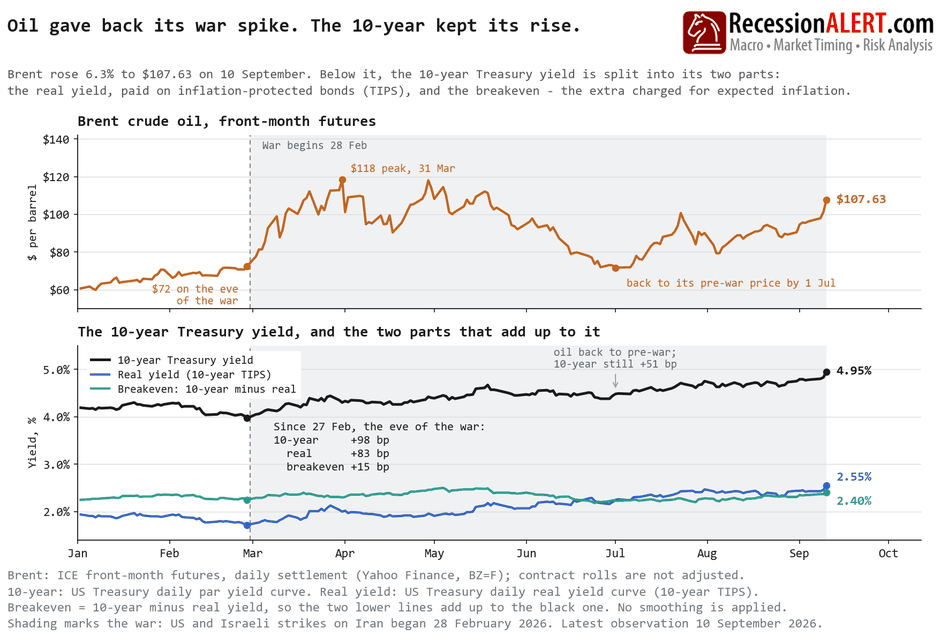
Brent fell nearly 40% from its 31 March peak to 1 July, below its pre-war price, and the 10-year Treasury yield rose 18 basis points (0.18 percentage point) anyway. Two clocks run inside that yield, and only one keeps time with oil. The breakeven, the extra yield charged for expected inflation, swings like a pendulum, moving with crude day to day and giving back its gains: the five-year measure rose 14 basis points into the March peak, fell 28 in the slide and rose 20 on the rebound. The real yield, what inflation-protected Treasuries pay, works like a ratchet, higher in every phase, including 25 basis points while oil collapsed. So of the 10-year’s 98-basis-point climb to 4.95%, its highest close since October 2023, only 15 is inflation compensation; 83 is a higher real cost of money. The evidence points to the Federal Reserve: the two-year yield, the maturity most tied to policy, is up 118 basis points since the war began, more than the 10-year, and futures give better-than-even odds of a quarter-point hike on 16 September. Households live on both clocks. Gasoline swung with the pendulum, from a $4.50 May peak to $3.78 at oil’s low; the 30-year mortgage rode the ratchet, from 5.98% before the war to 6.43% at that low and 6.76% now. A ceasefire could cut the pump price again; the spring’s slide says it would not cut the mortgage.
What it means: for households, the war’s lasting cost is the loan, not the pump. If you’re waiting for a ceasefire to buy a home or refinance, expect gasoline to fall and your mortgage rate not to — this spring showed that. Watch Wednesday’s Fed decision, not the oil headlines. This is wrong if cheaper oil brings the 30-year mortgage rate back under 6%, its pre-war level.
Market Intelligence Brief (MIB) Ver. 19.66
For professional investors only. Not investment advice.
© 2026 RecessionALERT.com

Comments are closed.