
MARKET INTELLIGENCE BRIEF (MIB)
Monday, November 23, 2026
Nvidia +31.48% after its board reinstated Jensen Huang as CEO on input from senior US officials, and the S&P 500 jumped 4.73%, its best day since April 2025, snapping seven straight losses. CrowdStrike agreed to buy Zscaler for $43.9B in stock; CRWD -8.92%, ZS +17.67%. After the close, Commerce blacklisted Megaspeed, the chip buyer at the scandal’s center. Bonds balked: the 2-year rose 3.2 bps as Polymarket’s 2026 hike odds hit 96%. WTI -3.78% on Libya’s Sharara restart.
TABLE OF CONTENTS
A. EXECUTIVE SUMMARY
B. MARKET DATA
C. HIGH-IMPACT STORIES (6)
D. MODERATE-IMPACT STORIES (6)
E. ECONOMY WATCH (4)
F. EARNINGS WATCH (1)
G. WHAT’S NEXT
H. CHART OF THE DAY
A. EXECUTIVE SUMMARY -> TOP
MARKET SNAPSHOT
Nvidia’s reinstatement of Jensen Huang lifted the S&P 500 4.73% to 7,237.17, its biggest daily gain since April 2025 per Reuters, snapping a seven-session losing streak one day after the index and the Dow confirmed corrections. The catalyst was governance rather than macro: Nvidia’s board tied the decision to input from senior US government officials, and after the close Commerce blacklisted Megaspeed, the chip buyer at the center of the affair, while the SEC accounting review behind Friday’s rout remains unresolved. Rates offered no help: the 2-year yield rose 3.2 bps and Polymarket’s odds of another Fed hike in 2026 climbed to 96% from 92%, even as Treasury Secretary Bessent warned of a “policy mistake.” Breadth was wide, but the session reads as relief inside a downtrend: ten of 11 sectors rose and Energy alone fell, yet Technology’s 9.11% surge recovered only part of an 11.04% one-month slide and the S&P 500 remains 7.44% below its October 6 close.
TODAY AT A GLANCE
• Huang returns, chips rip: NVDA +31.48% to $165.05 after the board unanimously reinstated Jensen Huang as CEO; Bernstein and Melius upgraded the stock. MU +19.04%, INTC +16.34%, AMAT +14.62%, TXN +10.40% alongside a Cantor upgrade. The Nasdaq 100 rose 6.86% to 26,746.10 and added more than $2 trillion in market value, per Reuters.
• Record cybersecurity deal: CrowdStrike agreed to buy Zscaler at 1.135 CRWD shares each, about a 34% premium and a $43.9B enterprise value, the biggest cybersecurity acquisition on record per Reuters. CRWD -8.92%; ZS +17.67%, capturing only about half the premium as investors weighed antitrust risk.
• Megaspeed blacklisted: After the close, Commerce added Megaspeed and six affiliates in Malaysia, Singapore and Thailand to the Entity List over the risk of advanced-chip diversion, with a presumption of denial. The rule names neither China nor Nvidia, so any Nvidia revenue exposure is not yet known.
• Fed pressure from both sides: Bessent said the Fed risks a “policy mistake” if it overtightens; after the close, the New York Fed’s Williams put inflation at about 3-1/2% and said the risk to price stability is “dialed up.” Polymarket’s odds of another hike in 2026 rose to 96% from 92%; the 2-year auction cleared at 4.700%.
• Activity cools at the margin: The S&P Global composite PMI fell to 54.6, a four-month low, from 55.9 as services dropped more than expected, and the Chicago Fed National Activity Index dipped to -0.06 from 0.05, signalling activity only marginally below trend.
• Crude slides, deals roll: WTI -3.78% to $80.26 as Libya restarted the Sharara pipeline, outweighing weekend Gulf tanker incidents; Energy (-0.90%) was the only sector down. Amazon is buying Decart’s AI optimization technology in a deal reported at about $7.5B, and ConocoPhillips is selling its Norway business to Vår Energi for $4.425B.
KEY THEMES
1. Washington now sits inside the AI trade — Nvidia’s board tied Huang’s return to input from senior US officials, President Trump said he spoke to the board beforehand, and the same afternoon Commerce cut off Megaspeed, the buyer at the center of the affair. Separating the executive from the sales channel removed the leadership risk that left the Nasdaq 100 within 0.2% of a bear market on Friday, but it makes the market’s largest AI weight unusually dependent on government judgement and leaves the SEC accounting review open. Tuesday is the first session to price the listing, and its cost depends on how much Nvidia revenue ran through the seven entities, which the rule does not say.
2. Equities rallied; rates did not — The 4.73% gain came with no easing in the policy outlook: the 2-year yield rose 3.2 bps, the 2s10s spread flattened 4.6 bps to 24.4 bps, and the dollar index closed at 104.31, its highest since at least April 15. Bessent’s “policy mistake” warning met Williams’s “dialed up” price-stability risk, and the bond market sided with the Fed. Growth is cooling only at the margin, with the composite PMI at a four-month low of 54.6 but still well above 50. With a December hike close to fully priced, Wednesday’s October PCE (expected 3.8% year over year, from 3.6%) will shape how hawkish the December 8-9 decision and its guidance turn out, and a rally resting on one company’s leadership reversal has no rate cushion if that print runs hot.
3. Buying capability, returning cash — CrowdStrike’s $43.9B Zscaler deal, Amazon’s reported $7.5B purchase of Decart’s technology to make its Trainium chips cheaper to run, and ConocoPhillips’s $4.425B Norway sale earmarked for 2027 buybacks share one logic: buy capability or return capital rather than build. The market discounted the largest of them, with Zscaler capturing only about half its 34% premium and CrowdStrike falling 8.92%, so deal announcements are being priced for execution and antitrust risk rather than rewarded on the headline.
 — Leading economic indicators. Accurate market forecasts. Apply for membership at join.recessionalert.com
B. MARKET DATA -> TOP
Nvidia’s reinstatement of Jensen Huang as chief executive, announced before Monday’s open, set off a violent relief rally in the AI trade one session after the S&P 500 and the Dow confirmed corrections, per Reuters. Every major index more than reversed Friday’s loss, and the S&P 500 closed back above 7,200. The rebound was tech-led but broad: ten of 11 sectors rose, and Energy alone fell as crude slid on rising Middle East supply and the restart of Libya’s Sharara pipeline. The VIX collapsed while Treasuries barely moved, and the dollar closed at its highest since at least April 15 even as gold rallied.
CLOSING PRICES – Monday, November 23, 2026:
MAJOR INDICES
A tech-led rebound with broad participation: the Nasdaq 100’s 6.86% gain more than doubled the Dow’s 3.01%, while the NYSE Composite (+2.62%) and Russell 2000 (+3.40%) confirmed the move went well beyond chips. All five broad gauges had closed Friday at their lowest since at least April 15, and each more than erased Friday’s loss. Transports (+2.19%) lagged, but no Dow Theory or relative-performance signal crossed its threshold.
| Index | Close | Change | %Move | Why It Moved |
|---|---|---|---|---|
| S&P 500 | 7,237.17 | +326.78 | +4.73% | AI relief rally after Nvidia reinstated Jensen Huang as CEO (Technology +9.11%); its biggest daily gain since April 2025, per Reuters; closed back above 7,200 |
| Dow Jones | 49,595.31 | +1,447.98 | +3.01% | Broad rebound after Nvidia’s Huang reinstatement; Reuters said the Dow and the S&P 500 had confirmed corrections on Friday |
| DJ Transportation | 20,054.55 | +429.44 | +2.19% | Joined the rebound but lagged the other indices; no transport-specific catalyst identified |
| Nasdaq 100 | 26,746.10 | +1,717.11 | +6.86% | Chipmakers led after Nvidia’s Huang reinstatement: Nvidia +31.48%, Micron +19.04%, Intel +16.34%, Applied Materials +14.62%; the index added more than $2 trillion in market value, per Reuters |
| Russell 2000 | 2,669.66 | +87.87 | +3.40% | Small caps joined the risk-on rebound; no small-cap-specific catalyst identified |
| NYSE Composite | 23,251.33 | +593.51 | +2.62% | Broad participation: ten of 11 S&P sectors rose, with Energy the only decliner |
VOLATILITY & TREASURIES
Options priced out Friday’s panic, but bonds declined to confirm the relief: the 10-year eased only 1.4 bps while the 2-year rose 3.2 bps, flattening the 2s10s spread by 4.6 bps to 24.4 bps. The dollar rose to its highest close since at least April 15, an unusual companion to a risk-on equity tape that no same-day catalyst explains.
| Instrument | Level | Change | Why It Moved |
|---|---|---|---|
| VIX | 26.61 | -9.28 (-25.86%) | Collapsed from Friday’s 35.89 as the Huang reinstatement eased the AI selloff |
| 10-Year Treasury Yield | 4.927% | -1.4 bps | Barely moved despite the equity surge; no discrete same-day catalyst identified, with the PCE report due Wednesday |
| 2-Year Treasury Yield | 4.683% | +3.2 bps | Front end rose after Friday’s 11.5 bp rally; no discrete same-day catalyst identified |
| US Dollar Index (DXY) | 104.31 | +0.50 (+0.48%) | Highest close since at least April 15 as EUR/USD fell 0.59%; no discrete same-day catalyst identified |
COMMODITIES
All four metals rebounded together from Friday’s lowest closes since at least April 15, with silver leading and platinum lagging. Gold rose even as the dollar firmed, so the move was not a currency effect. Bitcoin barely joined the equity rally, decoupling from the risk tape it had tracked lower on Friday.
| Asset | Price | Change | %Move | Why It Moved |
|---|---|---|---|---|
| Gold | $3,634.95/oz | $+119.55 | +3.40% | Rebounded from Friday’s lowest close since at least April 15 on dip-buying, per Investing.com; no discrete same-day catalyst identified |
| Silver | $42.900/oz | $+1.830 | +4.46% | Rebounded with gold from Friday’s lowest close since at least April 15; no discrete same-day catalyst identified |
| Copper | $5.6180/lb | $+0.1330 | +2.42% | Rebounded with the risk rally from Friday’s lowest close since at least April 15; no discrete same-day catalyst identified |
| Platinum | $1,314.05/oz | $+24.45 | +1.90% | Rose with the precious metals but lagged gold and silver; no discrete same-day catalyst identified |
| Bitcoin | $61,318.0 | $+290.0 | +0.48% | Lagged the equity rebound; no discrete same-day catalyst identified |
ENERGY
Crude fell in lockstep against a surging equity tape, and gas split across the Atlantic: Henry Hub dropped while Dutch TTF rose. Reuters tied crude’s slide to rising Middle East supply and the restart of Libya’s Sharara pipeline, which outweighed weekend attacks on Gulf shipping and on a Saudi refinery.
| Asset | Price | Change | %Move | Why It Moved |
|---|---|---|---|---|
| Crude Oil (WTI) | $80.26/bbl | $-3.15 | -3.78% | Rising Middle East supply and the restart of Libya’s Sharara pipeline; settled $80.17, down $3.24, per Reuters |
| Crude Oil (Brent) | $86.72/bbl | $-3.23 | -3.59% | Same drivers as WTI; the expiring January contract settled $89.37, down $3.20, per Reuters (this row quotes February) |
| Natural Gas (Henry Hub) | $3.524/MMBtu | $-0.224 | -5.98% | Milder-than-normal heating demand in the week to November 21, per Investing.com, not independently confirmed; this row now quotes the January contract |
| Natural Gas (Dutch TTF) | $29.20/MMBtu | $+0.77 | +2.71% | Rose to a one-week high as Gulf attacks escalated, per Investing.com, not independently confirmed |
S&P 500 SECTORS
Ten of 11 sectors rose; Energy (-0.90%) was the lone decliner and Consumer Defensive (+0.12%) barely held green. Technology’s 9.11% surge recovered only part of an 11.04% one-month slide, so the session reads as relief inside a downtrend. Energy, still the YTD leader at +26.62%, is now down 15.00% over the month.
| Sector | 1-Day | 1-Week | 1-Month | 3-Month | 6-Month | YTD | 12-Month |
|---|---|---|---|---|---|---|---|
| Technology | +9.11% | -1.87% | -11.04% | -10.82% | -11.27% | +8.42% | +13.04% |
| Communication Services | +4.69% | -2.32% | -6.98% | -11.73% | -18.40% | -12.25% | -6.46% |
| Basic Materials | +4.49% | -4.79% | -7.24% | -20.34% | -15.02% | -0.62% | +11.97% |
| Consumer Cyclical | +4.28% | -0.99% | +2.37% | -2.66% | -4.42% | -5.11% | +1.97% |
| Industrials | +4.11% | -2.11% | -2.42% | -8.19% | -11.36% | +2.58% | +9.11% |
| Financial | +2.19% | -4.40% | -2.11% | -7.08% | +3.13% | +1.35% | +9.74% |
| Healthcare | +1.76% | -3.80% | +0.13% | -0.25% | +15.86% | +11.58% | +14.10% |
| Utilities | +1.48% | -1.99% | +0.68% | -0.72% | -6.47% | -0.06% | -2.15% |
| Real Estate | +1.23% | -2.71% | +0.57% | -6.68% | -4.54% | +4.41% | +4.85% |
| Consumer Defensive | +0.12% | -2.54% | +2.28% | +6.63% | +7.24% | +15.18% | +16.56% |
| Energy | -0.90% | -6.13% | -15.00% | -6.54% | -2.43% | +26.62% | +27.36% |
TOP MEGA-CAP MOVERS:
GAINERS
| Company | Ticker | Close | Change | Why It Moved |
|---|---|---|---|---|
| NVIDIA | NVDA | $165.05 | +31.48% | Board reinstated Jensen Huang as CEO effective immediately, announced before Monday’s open, per Reuters; he had resigned on November 12 |
| Dell Technologies | DELL | $335.89 | +20.82% | AI-hardware rebound after Nvidia’s Huang reinstatement; no company-specific catalyst identified; reports results after Tuesday’s close |
| Micron Technology | MU | $707.70 | +19.04% | Chip rebound after Nvidia’s Huang reinstatement; no company-specific catalyst identified |
| Intel | INTC | $59.66 | +16.34% | Chip rebound after Nvidia’s Huang reinstatement; no discrete same-day catalyst identified; continuation of its November 18 announcement of a first external 18A-P foundry customer, per Investing.com |
| Applied Materials | AMAT | $346.87 | +14.62% | Chip-equipment rebound after Nvidia’s Huang reinstatement; no company-specific catalyst identified |
DECLINERS
| Company | Ticker | Close | Change | Why It Moved |
|---|---|---|---|---|
| CrowdStrike Holdings | CRWD | $208.97 | -8.92% | Agreed to buy Zscaler in a $43.9 billion all-stock deal, announced Monday alongside its quarterly results, per Reuters |
| ExxonMobil | XOM | $156.90 | -1.93% | Crude fell 3.78% on rising Middle East supply and Libya’s pipeline restart, per Reuters; Energy was the only sector to fall |
| Anthropic | ANT | $87.64 | -1.43% | No discrete same-day catalyst identified; missed the AI rebound after a Friday selloff that nearly erased its IPO gains, per Investing.com |
| Coca-Cola | KO | $95.88 | -1.14% | No discrete same-day catalyst identified; Consumer Defensive (+0.12%) lagged the rally |
| UnitedHealth Group | UNH | $336.08 | -1.11% | A CMS proposal to overhaul Medicare Advantage Star Ratings, published Friday, per Investing.com, not independently confirmed; pared a premarket loss of about 6% |
— Institutional-grade intelligence for serious investors. Apply for membership at join.recessionalert.comC. HIGH-IMPACT STORIES -> TOP
BULLISH
1. Nvidia Soars 31.48% After Its Board Reinstates Jensen Huang as CEO, Citing Input From Senior US Government Officials
The core facts:Nvidia’s board voted unanimously to reinstate Jensen Huang as President, Chief Executive Officer and a board member, effective immediately, in an announcement made before Monday’s open. Huang resigned on November 12 over revelations including a relationship with a woman US authorities suspect of spying for China, per Reuters. The board said it “received input from senior levels of the United States government” and, on that basis, is confident the reinstatement “poses no national security risk.” Colette Kress’s interim CEO role ends and she continues as CFO; Harvey C. Jones remains board chair. A committee of independent directors investigating reports that Huang was the target of a foreign intelligence effort will “proceed to conclusion,” the board said, and it has formed a new National Security and Export Control Committee and begun a search for a Chief Compliance Officer. President Trump said he spoke to Nvidia’s board before the decision, per CNN. Nvidia closed at $165.05, up 31.48%, leading the mega-cap gainers. Bernstein upgraded the stock to Outperform from Market Perform with a $200 target and Melius Research upgraded it to Buy from Hold, per MLQ.ai.
Why it matters:Nvidia is the single largest weight in the AI trade, and its leadership crisis had become the market’s dominant risk: the stock fell 14.01% on Friday and the Nasdaq 100 closed that session within 0.2% of a bear market. Monday’s gain more than reversed Friday’s fall, and the rest of the chip complex followed (Micron +19.04%, Intel +16.34%, Applied Materials +14.62%). Two things temper the read. The board explicitly tied its decision to the government’s view, which makes Nvidia’s governance unusually dependent on Washington; and the reinstatement did not resolve the SEC accounting review Reuters reported on Friday, which drove that session’s decline. The same afternoon, Commerce blacklisted Megaspeed, the chip buyer at the center of the affair (Story 4).
What to watch:Nvidia’s first session after the Megaspeed listing on Tuesday, and any disclosure of the independent committee’s conclusions.
BULLISH
2. S&P 500 Surges 4.73%, Snapping a Seven-Session Losing Streak, as Ten of 11 Sectors Rally a Day After Corrections Were Confirmed
The core facts:The S&P 500 rose 4.73% to 7,237.17, its biggest daily gain since April 2025, per Reuters, ending a run of seven straight declines from November 12 through November 20. The Nasdaq 100 jumped 6.86% to 26,746.10 and added more than $2 trillion in market value, per Reuters; the Dow gained 3.01% to 49,595.31, the Russell 2000 3.40% and the NYSE Composite 2.62%. Reuters said the S&P 500 and the Dow had confirmed corrections on Friday. Ten of 11 sectors rose, led by Technology (+9.11%); Energy (-0.90%) was the only decliner. The VIX fell 25.86% to 26.61, and gold rose 3.40% to $3,634.95.
Why it matters:The session reads as relief inside a downtrend rather than a turn. Technology’s 9.11% gain recovered only part of its 11.04% one-month slide, and the S&P 500 still closed 7.44% below its October 6 close of 7,818.93, the highest since at least April 15. Bonds did not join in: the 2-year yield rose 3.2 bps to 4.683% while the 10-year slipped 1.4 bps to 4.927%, and the dollar index closed at 104.31, its highest since at least April 15. The rally came with no easing in rate expectations, so it rests on the Nvidia leadership reversal (Story 1) rather than on any shift in the Fed outlook (Story 5).
What to watch:October PCE inflation and the second estimate of third-quarter GDP on Wednesday, November 25, the last major data before the December 8-9 FOMC meeting.
UNCERTAIN
3. CrowdStrike Agrees to Buy Zscaler in a $43.9 Billion All-Stock Deal; CrowdStrike Falls 8.92% While Zscaler Gains Half the Premium
The core facts:CrowdStrike and Zscaler announced a definitive agreement under which Zscaler holders will receive 1.135 CrowdStrike shares for each Zscaler share, valuing Zscaler at about $260.41 a share on CrowdStrike’s November 20 close, a premium of about 34%, and at an enterprise value of about $43.9 billion. Reuters called it the biggest cybersecurity acquisition on record. CrowdStrike holders will own about 84.1% of the combined company and Zscaler holders about 15.9%. The companies target about $500 million of annualized run-rate cost synergies within 18 to 24 months after closing and about $1 billion of run-rate revenue synergies within 30 months, and expect more than $10 billion of combined ARR at close. Founder Jay Chaudhry and affiliates, holding about 34% of Zscaler’s shares, signed voting agreements; Chaudhry will lead the Zscaler business and join CrowdStrike’s board. Closing is expected in the second half of CrowdStrike’s fiscal 2028, subject to Zscaler shareholder and regulatory approvals. CrowdStrike, which reported quarterly results the same morning (Section F), closed at $208.97, down 8.92%; Zscaler rose 17.67%, per finviz.
Why it matters:The deal joins endpoint security with network and zero-trust access, the largest consolidation step yet in a sector where buyers are cutting the number of vendors they use. CEO George Kurtz framed it around AI: “Today, safety is required to let AI in.” The market’s verdict was cautious. Zscaler’s 17.67% gain captured only about half of the 34% headline premium, and CrowdStrike’s own fall shrinks the stock consideration further, a spread consistent with the antitrust risk Reuters said investors were weighing. A close more than a year away leaves both stocks exposed to that review and to the AI-software sell-off for the duration.
What to watch:Whether US antitrust regulators issue a second request, and the date set for Zscaler’s shareholder vote.
UNCERTAIN
4. Commerce Adds Megaspeed, the Chip Buyer at the Center of the Nvidia Scandal, and Six Affiliates to the Entity List After the Close
The core facts:The Commerce Department’s Bureau of Industry and Security filed a rule for public inspection at 4:15 pm ET on Monday adding seven entities to the Entity List: in Malaysia, MSFusion Sdn. Bhd., PT Megaspeed International and Speedmatrix Sdn Bhd.; in Singapore, Apex Enterprise Solutions (Singapore) Private Limited, Megaspeed International Pte. Ltd. and Swiftdata Pte. Ltd.; and in Thailand, Megaspeed (Thailand) Co., Ltd. The rule cites a “significant risk of these entities being or becoming involved in the diversion of advanced computing commodities to unauthorized end uses or end users.” A license is now required for all items subject to US export rules, with a presumption of denial; shipments already en route may proceed if exported within 30 days. The rule names neither China nor Nvidia. Semafor, which first reported the listing on Monday afternoon, called Megaspeed “the company at the heart of the Nvidia scandal,” citing Huang’s relationship with a suspected Chinese spy who was an executive at the company.
Why it matters:On the day the government’s input cleared Huang’s return (Story 1), Commerce cut off the buyer at the center of the affair, separating the executive from the sales channel. The listing targets diversion of advanced chips through Malaysia, Singapore and Thailand, and it lands after Nvidia’s 31.48% gain was already priced. Because the rule does not name Nvidia or quantify any volumes, how much Nvidia revenue ran through these entities cannot be judged from the text; any disclosure Nvidia makes will set the size of the hit.
What to watch:Formal publication of the rule in the Federal Register on Wednesday, November 25, and whether Nvidia discloses any sales to the listed entities.
UNCERTAIN
5. Bessent Warns the Fed Risks a “Policy Mistake” if It Overtightens, but Williams Says Price-Stability Risk Is “Dialed Up” as Hike Odds Climb to 96%
The core facts:On CBS’s Face the Nation on Sunday, Treasury Secretary Scott Bessent said “Many people believe that they may be making a policy mistake if they overtighten,” citing “some very hawkish remarks from the Federal Reserve” and “a substantial tightening in financial conditions over the past few months.” He said the market sell-off “began as the Democrats moved ahead in the polls and then accelerated after Election Day.” After Monday’s close, New York Fed President John Williams, a permanent FOMC voter, said the risk to price stability is “dialed up” with inflation at about 3-1/2% (Section E carries the full remarks). Polymarket’s market on another Fed rate hike in 2026, which settles at the December 9 FOMC decision, rose to 96% from 92% on Friday. The 2-year Treasury yield rose 3.2 bps to 4.683%, the 2-year note auction cleared at 4.700%, and the 2s10s spread flattened by 4.6 bps to 24.4 bps.
Why it matters:The Treasury Secretary publicly questioning a tightening path two weeks before a decision is a direct challenge to the Fed, and Williams’s remarks, which CNBC said were expected to be the last major policy statement before the December 8-9 meeting, answered it without mentioning the December decision. The bond market sided with the Fed: the front end rose on a day equities surged, and hike odds firmed. That leaves December’s hike close to fully priced, so the risk for equities now lies in the size of the move and the guidance that comes with it rather than in whether the Fed acts.
What to watch:October PCE inflation on Wednesday, November 25 (expected 3.8% year over year), the final major inflation read before the December 8-9 FOMC meeting.
UNCERTAIN
6. WTI Falls 3.78% as Libya Restarts the Sharara Pipeline, Outweighing Weekend Tanker Incidents and Iran’s Threat to Break the US Blockade
The core facts:WTI crude closed at $80.26 a barrel, down 3.78%, and February Brent at $86.72, down 3.59%. Reuters tied the slide to rising Middle East supply and the restart of Libya’s Sharara pipeline. Libya’s National Oil Corporation chairman Masoud Suleiman said pumping from Sharara had resumed after an armed group closed one of its valves, a shutdown that had threatened about 350,000 barrels a day, per the Libya Observer; the Hamada pipeline remains closed, costing about 15,000 barrels a day. The decline came despite a weekend of escalation in the Gulf. On Sunday, UKMTO reported “a tanker was involved in an incident with military forces in the Gulf of Oman,” near Chabahar, and more than 14 Iranian tankers were reported to be readying off Kharg Island to run the US blockade, per Euronews. Iran’s deputy foreign minister Kazem Gharibabadi called the blockade “an act of war” and pledged “any necessary measures to break this economic siege.” The Houthis claimed strikes on Saudi Arabia’s Rabigh refinery, which Saudi authorities have not confirmed, per AGBI. Energy (-0.90%) was the only S&P 500 sector to fall, and ExxonMobil lost 1.93%.
Why it matters:Barrels actually flowing outweighed barrels threatened: a restored Libyan field and higher Middle East supply mattered more to the price than tanker incidents and rhetoric that, so far, have not removed supply. Lower crude takes some pressure off headline inflation ahead of Wednesday’s PCE report and a likely Fed hike in December (Story 5). The risk is asymmetric, however. An attempted Kharg breakout meeting US force, or a confirmed hit on Saudi infrastructure, would test a market that has priced the conflict as contained.
What to watch:Any confirmed departure of Iranian tankers from Kharg Island, and the EIA crude inventory report on Wednesday, November 25.
— Quantifying recession risk so you don’t have to guess. Apply for membership at join.recessionalert.comD. MODERATE-IMPACT STORIES -> TOP
BULLISH
7. Texas Instruments Jumps 10.40% as Cantor Fitzgerald Upgrades It to Overweight With a $385 Target
The core facts:Cantor Fitzgerald upgraded Texas Instruments to Overweight from Neutral and raised its price target to $385 from $340, per The Fly. Cantor said the company “is well-positioned from here despite potential headwinds to the narrative arising from its success” and that current levels “offer an attractive entry point.” Texas Instruments closed up 10.40%, alongside a 9.11% gain for the Technology sector.
Why it matters:Texas Instruments is an analog and industrial chipmaker rather than an AI name, so a gain of this size shows Monday’s rebound reached the broader semiconductor cycle. Because the stock rose roughly in line with its sector, the upgrade’s own contribution cannot be separated from the rally; its value is as a signal that analysts see the analog cycle supporting a re-rating rather than only a bounce.
What to watch:Analog Devices’ results before the bell on Tuesday, November 24 (Section F), the nearest read on analog and industrial chip demand.
BULLISH
8. Amazon Agrees to Buy Decart’s AI Optimization Technology and Hire Its Team in a Deal Reported at About $7.5 Billion
The core facts:Amazon said it “signed an agreement to purchase the proprietary technology behind the Decart Optimization Stack (DOS)” and will bring Decart’s co-founders and team to Amazon; it is buying the technology, not the company. Amazon disclosed no price. Calcalist reported $7.5 billion, paid in cash and stock over several installments, and Bloomberg reported about $7.5 billion, citing a person familiar with the matter, per PPC Land. Amazon said the technology helps AI models run faster and at lower cost on chips, including its Trainium accelerators. The deal is subject to customary closing conditions, including regulatory clearance.
Why it matters:The cost of running AI models now decides who wins enterprise demand, and software that squeezes more work out of in-house chips is how Amazon makes Trainium a credible alternative to Nvidia GPUs for its cloud customers. Structuring the deal as a technology purchase and hiring rather than an acquisition is a large bet on a team, made on a day the market was re-pricing the whole AI hardware chain.
What to watch:Whether US antitrust regulators review the technology-and-hiring structure, and any Trainium cost or performance figures Amazon publishes after closing.
BULLISH
9. ConocoPhillips Agrees to Sell Its Norway Business and Teesside Stake to Vår Energi for $4.425 Billion, Earmarking Proceeds for 2027 Buybacks
The core facts:ConocoPhillips agreed to sell the entire share capital of ConocoPhillips Skandinavia AS, its Norway business, and of ConocoPhillips (U.K.) Teesside Operator Limited, including a 40.25% interest in and operatorship of the UK Teesside oil terminal, to Vår Energi for total consideration of $4.425 billion, less about $0.5 billion of adjustments from the January 1, 2026 effective date. The company expects about $3.9 billion in total: net cash proceeds of about $2.5 billion plus the remaining 2026 tax liability of about $1.4 billion, payable in the first half of 2027. Closing is expected by the end of the first quarter of 2027, subject to approval by Norway’s Ministry of Energy. Proceeds are earmarked for general purposes and discretionary share repurchases in 2027. CEO Andy O’Brien called it a “win-win transaction.”
Why it matters:The sale concentrates ConocoPhillips on its US-weighted portfolio and turns a mature North Sea position into cash for buybacks, on a day crude fell 3.78% and Energy was the only S&P 500 sector to decline. Committing proceeds to 2027 repurchases signals the company is prioritizing shareholder returns over reinvestment as oil trades near $80.
What to watch:Norwegian Ministry of Energy approval ahead of the targeted end-of-first-quarter 2027 close.
BEARISH
10. Virginia and Oregon Sue SpaceX, X and xAI Over Grok-Generated Sexualized Deepfakes
The core facts:Virginia Attorney General Jay Jones and Oregon Attorney General Dan Rayfield filed parallel lawsuits on Monday against SpaceX and its subsidiaries X Corp. and xAI over sexualized deepfakes generated by the Grok chatbot, per FOX 5 DC. Virginia filed in the Circuit Court for the City of Richmond and Oregon in Multnomah County Circuit Court, both under state consumer-protection laws. The states seek an injunction, restitution, disgorgement of profits, civil penalties of up to $2,500 per willful violation and up to $1,000 per violation in investigative costs. “Companies that deploy powerful tools don’t get to ignore consumer safety and call it innovation,” Jones said.
Why it matters:Per-violation penalties make exposure scale with the volume of generated content, and state consumer-protection suits need no new federal law, so other attorneys general can follow the same template. For SpaceX, now a public company that owns X and xAI, the suits put AI content liability onto a balance sheet investors price, and they test whether generative-AI providers can be held responsible for what their models produce.
What to watch:Whether other state attorneys general file similar suits, and any request for a preliminary injunction against Grok’s image tools.
UNCERTAIN
11. Labor Department Proposes ERISA Rule Requiring Retirement Plan Fiduciaries to Invest Solely for Financial Return, Ending the ESG Question
The core facts:The Labor Department’s Employee Benefits Security Administration proposed amendments to its investment duties regulation on Monday that would give plan fiduciaries “an affirmative expression of their duty of loyalty”: to act solely in the interest of participants and beneficiaries and for the exclusive purpose of providing their retirement benefits. The department said the proposal seeks to end “the 32-year uncertainty” over whether ERISA allows fiduciaries to consider non-financial factors, including environmental, social and governance factors. It would also place a heightened focus on how fiduciaries handle proxy voting and shareholder engagement. “Our proposed rule makes clear that retirement plan fiduciaries must make investment decisions solely in the financial interests of workers and retirees, not to advance political or social agendas,” said Labor Secretary Keith Sonderling.
Why it matters:ERISA governs employer retirement plans holding trillions of dollars, so the rule sets the terms on which ESG funds can stay on 401(k) menus and how asset managers and proxy advisers vote plan shares. A stricter loyalty standard raises the legal risk of offering funds marketed on non-financial goals, which could shift flows toward conventional index products and weaken a channel shareholder activists use.
What to watch:The proposal’s publication in the Federal Register, which starts the public comment period, and responses from large asset managers and proxy advisers.
BULLISH
12. FDA Approves Roche’s Wilserdly as the First New Hormone Therapy for Early-Stage Breast Cancer in More Than 20 Years
The core facts:The FDA approved Wilserdly (giredestrant), from Roche’s Genentech unit, as a standalone treatment after surgery for adults with ER-positive, HER2-negative stage I, II or III breast cancer at intermediate to high risk of recurrence. In the lidERA trial of 4,170 adults, the drug cut the risk of invasive recurrence or death by 30% against standard hormone therapy (140 versus 196 patients with an event); at three years, 92.4% of patients on Wilserdly were alive and free of invasive breast cancer, against 89.6% on standard therapy. The FDA granted the application Priority Review and called it “the first new hormone therapy for early-stage breast cancer in more than 20 years.” It had approved Wilserdly with everolimus for advanced disease on November 16.
Why it matters:Hormone-receptor-positive disease is the most common form of breast cancer, and adjuvant therapy runs for years per patient, so a label in the early-stage setting opens a far larger market than advanced disease alone. The approval puts a next-generation oral therapy into a setting long served by older, largely generic drugs, a commercial opportunity that sits with Genentech’s US operations.
What to watch:Overall survival data from lidERA, which will shape how quickly oncologists switch from standard hormone therapy.
— Separating signal from noise since 2007. Apply for membership at join.recessionalert.comE. ECONOMY WATCH -> TOP
Monday’s data showed an economy cooling at the margin while the Fed’s inflation focus hardened. S&P Global’s composite PMI slid to a four-month low of 54.6 and the Chicago Fed’s activity index dipped just below trend at -0.06, yet New York Fed President Williams said the risk to price stability is “dialed up” with inflation at “about 3-1/2 percent.” The bond market sided with the Fed rather than the equity rebound: the 2-year yield rose 3.2 bps, the curve flattened, and Polymarket’s odds of another 2026 hike rose to 96% from 92%. Wednesday’s PCE inflation and GDP releases are the next test ahead of the December 8-9 FOMC.
S&P Global Composite PMI Slides to 54.6, a Four-Month Low, as Services Drop More Than Expected (S&P Global, Nov 23)
What they’re saying:S&P Global’s U.S. composite PMI slid to 54.6 in November, its lowest level in four months, from 55.9 in October, with the services index dropping more than expected. The reading remains above the 50 mark that separates expansion from contraction.
The context:The slowdown in services, the larger part of the economy, fits the “two-track” economy New York Fed President Williams described the same day, though a composite above 54 still signals solid expansion. Slower activity alongside PCE inflation of 3.6% in September is the mix the Fed has to weigh at its December 8-9 meeting.
What to watch:The Conference Board’s consumer confidence index on Tuesday, November 24 (expected 92.5, prior 91.7), and the ISM Manufacturing PMI on Tuesday, December 1 (prior 55.5).
Williams Says Inflation Is “About 3-1/2 Percent” and Risk to Price Stability Is “Dialed Up,” but Sees It Slowing to Just Above 2% Next Year (Federal Reserve Bank of New York, Nov 23)
What they’re saying:In remarks titled “The Economic Mixdown” at the University of Mount Saint Vincent, New York Fed President John Williams said “inflation is currently about 3-1/2 percent, well above the FOMC’s definition for price stability of 2 percent,” and that “it is imperative that we restore inflation to our 2 percent target in a timely manner and on a sustained basis.” He said “the risk to maximum employment is dialed down, but the risk to achieving price stability is dialed up,” and called the economy “strong and resilient, despite large shocks and elevated uncertainty.”
The context:Williams did not address the December meeting or the policy rate directly, saying he will “continue to study the totality of the data.” He projected real GDP growth of about 2-3/4 percent this year, unemployment edging down to about 4 percent over the next year, and inflation slowing “to just above 2 percent next year” before reaching 2 percent in 2028, and described the labor market as “remarkably solid” in “a low-fire, low-hire environment.” The remarks came after the close; Polymarket’s market on another Fed rate hike in 2026, which settles at the December 9 FOMC, stood at 96%, up from 92% Friday.
What to watch:October PCE inflation on Wednesday, November 25 (expected 3.8% year over year, prior 3.6%; core expected 0.3% month over month).
Chicago Fed National Activity Index Dips to -0.06 in October, Reversing September’s Gain (Federal Reserve Bank of Chicago, Nov 23)
What they’re saying:The Chicago Fed National Activity Index fell to -0.06 in October from 0.05 in September, reversing the prior month’s increase. The index is a monthly gauge of overall U.S. economic activity and related inflationary pressure.
The context:The Chicago Fed associates a zero reading with the economy expanding at its historical trend rate and negative values with below-average growth, so October’s print signals activity running only marginally below trend. The bank ties an increasing likelihood of recession to a three-month average below -0.70 following an expansion, far below October’s single-month reading.
What to watch:The Chicago PMI (prior 55.3) and the Dallas Fed Manufacturing Index (prior 13.4) on Monday, November 30, and the ISM Manufacturing PMI on Tuesday, December 1.
Two-Year Yield Rises 3.2 Basis Points as Bonds Sit Out the Equity Rebound; 2s10s Curve Flattens to 24.4 Basis Points (Treasury Market, Nov 23)
What they’re saying:The 2-year Treasury yield rose 3.2 basis points to 4.683%, recovering part of Friday’s 11.5 basis-point drop, while the 10-year slipped 1.4 basis points to 4.927%, flattening the 2s10s spread by 4.6 basis points to 24.4 basis points. The Treasury’s 2-year note auction cleared at 4.700%, and the dollar index rose 0.48% to 104.31, its highest close since at least April 15.
The context:Bonds barely confirmed the equity relief rally, in which the S&P 500 rose 4.73% and the VIX fell 25.86% to 26.61: the front end rose while the long end held, a move consistent with firmer pricing of a December hike, as Polymarket’s market on another Fed rate hike in 2026 rose to 96% from 92% Friday.
What to watch:October PCE inflation and the second estimate of third-quarter GDP (expected 3.4%) on Wednesday, November 25, both released ahead of the Thanksgiving holiday.
— Know the probability before the market prices in the risk. Apply for membership at join.recessionalert.comF. EARNINGS WATCH -> TOP
YESTERDAY AFTER THE BELL (Markets Reacted Today)
No major earnings yesterday after the bell from companies with >$100B market cap.
TODAY BEFORE THE BELL (Markets Already Reacted)
BULLISH
13. CrowdStrike (CRWD): -8.92% | Record Net New ARR and a Raised Outlook, Overshadowed by the Zscaler Deal
The Numbers:Released: BMO, Monday, November 23, 2026, for the third quarter of fiscal 2027, ended October 31. Revenue $1.58 billion, up 28% year over year, against a $1.53 billion estimate; subscription revenue $1.50 billion, up 29%. Non-GAAP EPS $0.34 against a $0.31 estimate; GAAP EPS $0.02, against a loss of $0.03 a year earlier. Ending ARR $6.26 billion, up 27%, with record net new ARR of $419.2 million, up 58%. Record operating cash flow of $665.2 million and free cash flow of $474 million. Fourth-quarter guidance: revenue $1,638.1 million to $1,644.1 million and non-GAAP EPS $0.36; full-year fiscal 2027 revenue $6,078.1 million to $6,084.1 million, non-GAAP EPS $1.28 and ending ARR of $6,712.2 million to $6,716.2 million. Net new ARR growth guidance for fiscal 2027 raised by 1,060 basis points to 45% at the midpoint.
The Problem/Win:ARR growth accelerated for a fifth straight quarter as customers consolidated on the Falcon platform through its Falcon Flex licensing, and the company said Falcon Guardian, which secures AI agents, crossed $100 million in ARR in its first year. “Q3 was the best quarter in CrowdStrike’s history,” said CEO George Kurtz.
The Ripple:The results shared the morning with CrowdStrike’s all-stock agreement to buy Zscaler (Story 3), whose shares rose 17.67% while CrowdStrike’s fell 8.92%.
What It Means:On its own, the quarter was a beat with raised guidance and accelerating ARR. Released alongside a deal that hands about 15.9% of the combined company to Zscaler holders, Monday’s 8.92% decline cannot be read as a verdict on the quarter alone.
What to watch:Fourth-quarter delivery against the $6.71 billion ending-ARR guide, and the timetable for Zscaler’s shareholder vote and regulatory review.
TODAY AFTER THE BELL (Markets React Tomorrow)
No major earnings after the bell from companies with >$100B market cap.
WEEK AHEAD PREVIEW:
Q3 2026 earnings season is nearly complete, with 93% of the S&P 500 reported as of November 20, per FactSet. The next five sessions carry five in-scope reporters above $100 billion: Analog Devices, Medtronic and Dell Technologies on Tuesday, November 24, Deere on Wednesday, November 25, and Marvell Technology on Tuesday, December 1.
Analog Devices (ADI) — BMO, Tuesday, November 24 — consensus EPS $3.90 and about $4.33 billion of revenue; key focus: whether demand that strengthened across regions in the third quarter holds into the first-quarter outlook, how much of this year’s price increases reach margins, and any comment on China demand as US chip export controls tighten. Texas Instruments’ 10.40% gain on a Cantor upgrade on Monday raises the bar for the analog group.
Medtronic (MDT) — BMO, Tuesday, November 24 — consensus EPS about $1.33 and about $9.48 billion of revenue; key focus: organic revenue growth against fiscal 2027 guidance of 7.25% to 7.75%, the timing of the diabetes business separation, and Hugo robotic procedure volumes.
Dell Technologies (DELL) +20.82% — AMC, Tuesday, November 24 — consensus EPS $6.62 and about $49.3 billion of revenue; key focus: AI server revenue against a fiscal 2027 outlook of $74 billion and the AI server backlog, plus GPU and high-bandwidth memory costs as supply stays tight. Monday’s 20.82% rebound with the AI hardware complex raises expectations going into the print.
Deere (DE) — BMO, Wednesday, November 25 — consensus EPS about $4.03 and about $10.38 billion of revenue; key focus: whether the fiscal 2027 outlook confirms fiscal 2026 as the trough of the farm-equipment downturn, and any read on US farm exports after the Trump-Xi push for more Chinese agricultural purchases.
Marvell Technology (MRVL) — AMC, Tuesday, December 1 — consensus EPS $1.10 and about $3.15 billion of revenue, in line with company guidance of $3.15 billion, plus or minus 5%; key focus: data center and custom AI silicon revenue and the timing of new hyperscaler programs, after analyst Ming-Chi Kuo said on November 20 that Google cut 2027 orders for Broadcom-designed TPU chips.
US markets are closed on Thursday, November 26 for Thanksgiving, and no in-scope company above $100 billion reports on Friday, November 27 or Monday, November 30.
— US market commentary trusted by family offices and institutions. Apply for membership at join.recessionalert.comG. WHAT’S NEXT -> TOP
UPCOMING RELEASES:
| Date | Event | Why It Matters |
|---|---|---|
| Tue, Nov 24 | CB Consumer Confidence (expected 92.5, prior 91.7); S&P/Case-Shiller Home Prices YoY (expected 2.7%, prior 2.7%) | The first household read after a seven-session equity slide and a services-led drop in the composite PMI to a four-month low; a weak print would test Williams’s “strong and resilient” description of the economy. |
| Wed, Nov 25 | October PCE Price Index YoY (expected 3.8%, prior 3.6%); Core PCE MoM (expected 0.3%, prior 0.3%) | The last major inflation read before the December 8-9 FOMC. With Polymarket’s odds of another hike in 2026 at 96%, the print bears on the size of the move and its guidance rather than whether the Fed acts. |
| Wed, Nov 25 | Q3 GDP Second Estimate (expected 3.4%); Personal Income and Spending MoM (both expected 0.4%) | Williams projects about 2-3/4% growth this year; a firm revision alongside hot PCE would strengthen the hawkish case Bessent pushed back on. |
| Wed, Nov 25 | Durable Goods Orders MoM (expected 0.4%, prior 1.9%); Initial Jobless Claims (expected 200K, prior 203K); New Home Sales (expected 0.65M) | A capex check after the AI hardware chain’s sell-off and rebound, and a labor read in the “low-fire, low-hire” market Williams described, all compressed into the session before the holiday. |
| Wed, Nov 25 | EIA Crude Oil Stocks (prior +3.38M); Federal Register publication of the Commerce Entity List rule on Megaspeed and six affiliates | Inventories follow a 3.78% WTI drop on Libya’s Sharara restart while Iranian tankers are reported readying off Kharg Island to run the US blockade; formal publication of the export rule is the next point at which Nvidia could disclose any exposure to the listed buyers. |
| Thu, Nov 26 | US market holiday (Thanksgiving Day) | Markets closed, so Wednesday carries the week’s full data load with no session to digest it before Friday. |
| Fri, Nov 27 | Advance Goods Trade Balance (expected -$131B, prior -$135.1B); Wholesale Inventories MoM Adv (expected 0.7%) | Early inputs to fourth-quarter GDP tracking, landing in the post-holiday session. |
| Mon, Nov 30 | Chicago PMI (prior 55.3); Dallas Fed Manufacturing Index (prior 13.4) | Regional checks on whether November’s slowdown in the S&P Global PMI and October’s dip in the Chicago Fed National Activity Index to -0.06 are broadening. |
| Tue, Dec 1 | ISM Manufacturing PMI (prior 55.5); JOLTS Job Openings (prior 7.523M) | Factory activity and labor demand one week before the December 8-9 FOMC, the final read on whether growth is cooling enough to temper the hike path. |
KEY QUESTIONS:
1. Does Nvidia hold Monday’s 31.48% gain once Tuesday’s session prices the Megaspeed listing, and will it disclose how much revenue ran through the seven blacklisted entities?
2. If Wednesday’s October PCE prints at or above the expected 3.8%, does the December 8-9 FOMC deliver a larger hike or signal more to come, with the 2-year yield already rising on a 4.73% equity rally?
3. Was Monday a turn or relief inside a downtrend: can the S&P 500 close more of its 7.44% gap to the October 6 close in a holiday-shortened week, with the dollar at its highest since at least April 15?
— US market commentary trusted by family offices and institutions. Apply for membership at join.recessionalert.comH. CHART OF THE DAY -> TOP
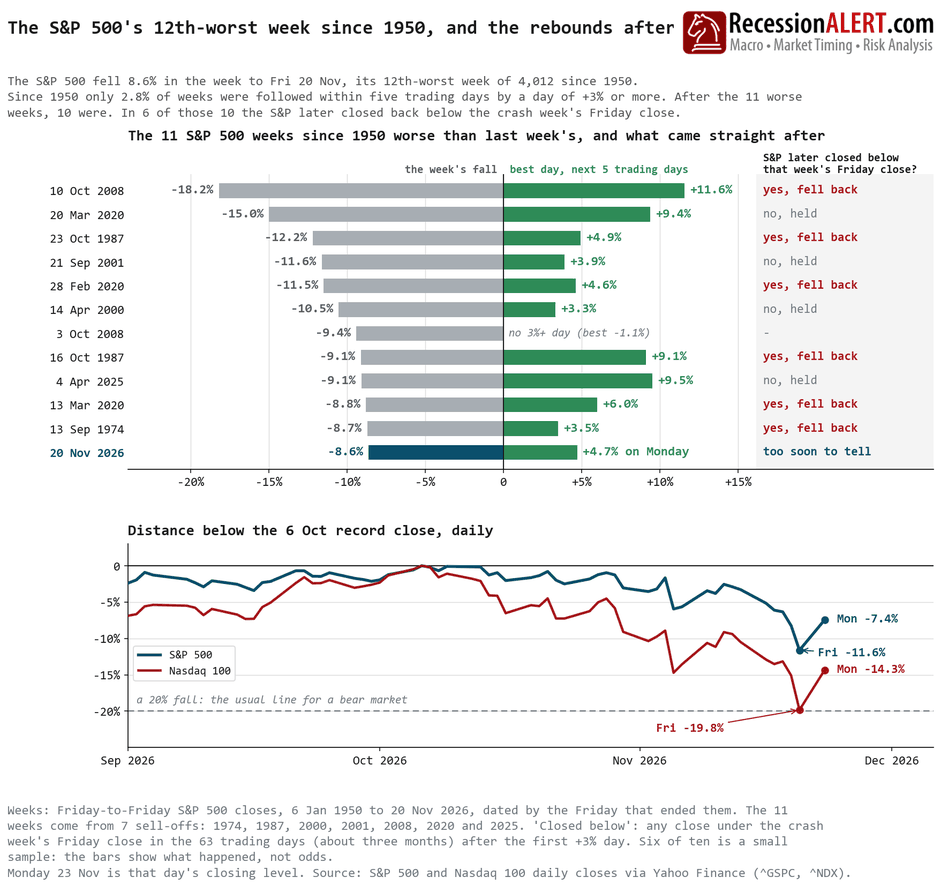
The stock market’s best days live inside its worst weeks. Since 1950 only 2.8% of S&P 500 weeks were followed within five trading days by a one-day gain of 3% or more; after the 11 weeks worse than last week’s -8.6%, 10 were. Monday’s +4.7% is that pattern repeating, not a verdict. The reason is mechanical: the fear and wide price swings that let an index lose 8% in five days do not pick a direction. Volatility clusters, so big moves follow big moves, both ways. The swings were widest where the rally had been: the Nasdaq 100, the tech-heavy index that led this year’s gains, closed Friday 0.16 point short of the 20% fall that usually marks a bear market, then jumped 6.9% on Monday. That two-way violence is also why a bounce settles little. In 6 of the 10 earlier rebounds the S&P later closed back below the crash week’s Friday close within three months, in 2008 sinking 25% beneath the rally day, and the four that held had rallied about as hard. Two of those four coincided with a policy reversal, while on Friday Fed Governor Lisa Cook argued the other way, calling equity prices part of financial conditions (how easy money is to come by) that are too loose. This week’s line is Friday’s 6,910.39. Monday’s leap is not the storm passing – it is the storm’s other half.
What it means: For households, an S&P 500 index fund up 14% for the year at the 6 Oct record ended Monday up less than 6%. With the index moving nearly 5% in a day, that gain can still swing a long way by year-end. For stock investors, Friday’s close of 6,910 is the line: a close below it would put this week with the six that fell back. For the economy, a lasting fall in share prices would make households and companies spend more cautiously. The read changes if the S&P holds above 6,910 through late February.
Market Intelligence Brief (MIB) Ver. 20.10
For professional investors only. Not investment advice.
© 2026 RecessionALERT.com

Comments are closed.