
MARKET INTELLIGENCE BRIEF (MIB)
Friday, November 6, 2026
Chips led a narrow rebound from Thursday’s AI rout: AMD jumped 11.04% and the Nasdaq 100 rose 1.35%; the Dow fell 0.46%. October payrolls rose 165,000, far above forecasts, lifting CME December hike odds to 78% as 2-year yields rose 4.8 bps. Fed’s Daly expects policy will have to tighten further. Brent headed for its largest weekly drop since 2020 on US-Iran talks. Microsoft is reportedly winding down Oracle compute rentals. Tesla (+4.23%) will wind down Cybertruck output for Cybercab.
TABLE OF CONTENTS
A. EXECUTIVE SUMMARY
B. MARKET DATA
C. HIGH-IMPACT STORIES (5)
D. MODERATE-IMPACT STORIES (5)
E. ECONOMY WATCH (4)
F. EARNINGS WATCH (3)
G. WHAT’S NEXT
H. CHART OF THE DAY
A. EXECUTIVE SUMMARY -> TOP
Friday’s gains looked like short covering in the most-sold AI names rather than a reversal: the Nasdaq 100 rose 1.35% on a 4.2% chip rally, but the Dow fell 0.46%, the S&P 500 rose just 0.31% and still ended the week 2.68% lower, and a VIX of 25.63 says options markets do not see the repricing as finished. The bigger signal came from rates, where 165,000 October payrolls and 0.4% wage growth drove a bear flattener, the 2-year up 4.8 bps against 2.0 bps for the 10-year and the dollar up 0.75%, as markets moved toward a December hike and San Francisco Fed President Daly said she expects further tightening. Stocks are now rebounding against a rising rate path, with oil’s slide on US-Iran diplomacy the main disinflationary offset. Breadth split six sectors to five: Technology (+1.73%) and Industrials (+1.58%) led, while Consumer Defensive (-1.37%) gave back its safe-haven bid, a rotation that reflects positioning rather than conviction.
• Labor market beats decisively: October payrolls rose 165,000, far above forecasts, with August and September revised up a combined 84,000. Unemployment fell to 4.1% from 4.2% and average hourly earnings rose 0.4%, against 0.3% expected.
• Hike odds rebound: CME FedWatch put a December 8-9 hike at 78.0%, up from 66.9% on Thursday, and Polymarket’s odds of another 2026 hike rose to 77% from 64%. The 2-year yield rose 4.8 bps to 4.512% and the 10-year rose 2.0 bps to 4.856%; the dollar index gained 0.75% and gold fell 0.94% to $4,074.87.
• Chips bounce inside a downtrend: AMD rose 11.04% to $449.04, Lam Research (LRCX) rose 8.23% and Intel (INTC) rose 7.71%. Technology gained 1.73% on the day but is still down 7.06% on the week and 14.80% on the month; the VIX fell 9.05% to 25.63, against 16.57 on November 4.
• AI demand questions persist: Microsoft is winding down its rental of AI computing capacity from Oracle, Bloomberg reported. Oracle (ORCL) recovered from a 4% intraday drop to close up 0.82%, while Microsoft (MSFT) fell 0.99%.
• Oil caps a historic weekly drop: WTI closed up 0.08% at $90.59 and Brent fell 0.32% to $97.98, on course for its largest weekly percentage drop since 2020 on US-Iran diplomacy. Energy fell 11.45% on the week, the worst of the 11 sectors.
• Consumers steadier, but borrowing: Michigan sentiment rose to 51.0 against a 48 forecast and year-ahead inflation expectations fell to 4.3% from 4.7%. Consumer credit rose $27.8 billion in September, more than double forecasts, with revolving credit growing at a 14.5% annual rate.
1. A bounce against a rising rate path — Equities and rates pointed in opposite directions on Friday. Chips recovered on positioning, while a strong jobs report, upward revisions and firmer wages pushed the front end higher and December hike odds to 78%. Daly called the technology selloff “painful” but “orderly,” which tells investors the Fed sees no reason to cushion it at these levels. A rally built on short covering is exposed if Tuesday’s October CPI confirms the hike.
2. AI demand is now the market’s central question — Thursday’s rout was about who funds the data-center buildout, and Friday added evidence that the largest buyer of third-party compute is getting more selective: Microsoft is winding down its Oracle rental a day after reports it declined a 700 MW expansion at Nscale’s Texas site. With Technology down 14.80% on the month and the VIX at 25.63, rebounds in AI hardware rest on positioning rather than on new evidence of demand.
3. Oil is easing headline inflation, not the pressures behind the hike debate — Brent closed $14.36 below last Friday’s $112.34 on US-Iran diplomacy, and Michigan’s year-ahead inflation expectations eased to 4.3%. But 0.4% wage growth and card balances growing at a 14.5% annual rate keep the services side of inflation firm, and new, unverified IRGC claims of tanker strikes in the Strait of Hormuz show how quickly the oil discount could reverse if talks stall.
 — Leading economic indicators. Accurate market forecasts. Apply for membership at join.recessionalert.com
B. MARKET DATA -> TOP
Chip stocks led a partial rebound from Thursday’s AI rout, lifting the Nasdaq 100 1.35% as the semiconductor index rose 4.2%, per Reuters, but the recovery was narrow: the Dow fell 0.46% and the NYSE Composite closed flat. A stronger October payrolls report (165,000 jobs, with August and September revised up a combined 84,000) did little for equities and lifted the front end of the curve instead, the 2-year rising 4.8 bps against the 10-year’s 2.0 bps. Consumer Defensive was the weakest sector as Walmart and Philip Morris slipped. The dollar’s 0.75% gain and gold’s 0.94% decline fit that firmer-rates backdrop, while the VIX fell 9.05% to 25.63 but stayed far above its 16.57 close of November 4.
CLOSING PRICES – Friday, November 6, 2026:
MAJOR INDICES
The bounce was a technology story, not a broad one: the Nasdaq 100 gained while the Dow and DJ Transportation fell and the NYSE Composite finished flat. Over the past 10 sessions the Russell 2000 (-0.78%) has outperformed the S&P 500 (-3.24%) by 2.5 points, an entrenched pattern driven by small caps falling less rather than rallying. The S&P 500 has also beaten the Nasdaq 100 (-6.79%) by 3.6 points, now a 5-session broadening signal. Neither Dow average sits within 2% of its 10-session high, so no Dow Theory confirmation is in force.
| Index | Close | Change | %Move | Why It Moved |
|---|---|---|---|---|
| S&P 500 | 7,376.86 | +23.13 | +0.31% | Technology-led rebound from Thursday’s AI selloff; the stronger October payrolls report had little direct equity impact, per wire coverage |
| Dow Jones | 51,285.73 | -237.33 | -0.46% | Lagged the tech rebound as consumer and defensive shares fell; Consumer Defensive was the session’s weakest sector |
| DJ Transportation | 19,774.87 | -314.10 | -1.56% | No discrete same-day catalyst identified; fell on a day crude was essentially unchanged |
| Nasdaq 100 | 26,989.99 | +360.18 | +1.35% | Semiconductors rebounded after Thursday’s rout (semiconductor index +4.2%, per Reuters), led by AMD, Lam Research and Intel |
| Russell 2000 | 2,754.11 | +24.22 | +0.89% | Rose with the broader rebound; keeps its 10-session relative strength against the S&P 500 |
| NYSE Composite | 23,950.37 | -5.60 | -0.02% | Flat; breadth split, with six of 11 S&P sectors higher and five lower |
VOLATILITY & TREASURIES
Payrolls hit the front end hardest: the 2-year rose 4.8 bps against 2.0 bps for the 10-year, flattening 2s10s to about 34 bps. A bear flattener alongside a 0.75% dollar gain is a firmer-policy signal, not a growth scare. The VIX fell 9.05%, but at 25.63 the options market is still pricing far more turbulence than before the election, so it is not treating Friday’s bounce as the end of the AI-driven volatility.
| Instrument | Level | Change | Why It Moved |
|---|---|---|---|
| VIX | 25.63 | -2.55 (-9.05%) | Eased from Thursday’s 28.18 as technology stabilised; still well above the 16.57 close of November 4 |
| 10-Year Treasury Yield | 4.856% | +2.0 bps | Rose after October payrolls came in at 165,000 (about 59,000 expected, per Investing.com), with August and September revised up 84,000; traded as high as 4.898% intraday |
| 2-Year Treasury Yield | 4.512% | +4.8 bps | Led the move higher after payrolls; the 2s10s spread flattened to about 34 bps |
| US Dollar Index (DXY) | 102.30 | +0.76 (+0.75%) | Firmed alongside front-end yields after the payrolls report; EUR/USD fell 0.70% |
COMMODITIES
Gold and silver fell together alongside a firmer dollar and higher yields, while platinum went the other way and copper barely moved. Bitcoin finished flat near $75,800 and did not join the rebound in technology, so it is not trading as a risk proxy this session.
| Asset | Price | Change | %Move | Why It Moved |
|---|---|---|---|---|
| Gold | $4,074.87/oz | $-38.63 | -0.94% | Fell alongside a firmer dollar and higher yields after the payrolls report |
| Silver | $51.935/oz | $-0.441 | -0.84% | Followed gold lower |
| Copper | $6.2595/lb | $-0.0105 | -0.17% | Little changed; no discrete same-day catalyst identified |
| Platinum | $1,534.30/oz | $+11.90 | +0.78% | No discrete same-day catalyst identified |
| Bitcoin | $75,823.0 | $+24.0 | +0.03% | Flat; did not join the technology rebound |
ENERGY
Crude was flat to slightly lower and took no direction from the equity rebound, closing out a week in which Brent was on course for its largest weekly percentage drop since 2020, per LSEG data cited by Reuters, on hopes of a US-Iran detente after the midterms. Henry Hub rose while Dutch TTF fell sharply, a European move with no counterpart in US gas.
| Asset | Price | Change | %Move | Why It Moved |
|---|---|---|---|---|
| Crude Oil (WTI) | $90.59/bbl | $+0.07 | +0.08% | Essentially unchanged in choppy trade as markets weighed post-midterm hopes of a US-Iran detente against continued tanker attacks, per Investing.com |
| Crude Oil (Brent) | $97.98/bbl | $-0.31 | -0.32% | Edged lower; on course for its largest weekly percentage drop since 2020, per LSEG data cited by Reuters |
| Natural Gas (Henry Hub) | $2.980/MMBtu | $+0.033 | +1.12% | No discrete same-day catalyst identified |
| Natural Gas (Dutch TTF) | $28.072/MMBtu | $-1.744 | -5.85% | No discrete same-day catalyst identified; the dollar figure includes a 0.70% fall in EUR/USD |
S&P 500 SECTORS
Six of 11 sectors rose and five fell. Technology (+1.73%) led, but it is still down 7.06% on the week and 14.80% on the month: a bounce inside a downtrend. Consumer Defensive (-1.37%), up 8.44% over the month, was the weakest sector, a reversal of the defensive bid that carried it through the selloff. Energy’s 11.45% weekly loss is the worst of any sector.
| Sector | 1-Day | 1-Week | 1-Month | 3-Month | 6-Month | YTD | 12-Month |
|---|---|---|---|---|---|---|---|
| Technology | +1.73% | -7.06% | -14.80% | -9.80% | -4.95% | +11.48% | +7.50% |
| Industrials | +1.58% | -2.37% | -5.19% | -11.00% | -9.85% | +3.11% | +4.01% |
| Basic Materials | +0.68% | +2.19% | -1.04% | -7.12% | -7.89% | +8.94% | +21.28% |
| Communication Services | +0.53% | +2.58% | -11.90% | -11.26% | -18.02% | -10.51% | -6.58% |
| Healthcare | +0.15% | -0.12% | +9.08% | +6.69% | +22.25% | +15.09% | +20.15% |
| Consumer Cyclical | +0.11% | +2.55% | +3.94% | -3.40% | -4.27% | -3.75% | -6.29% |
| Utilities | -0.19% | -0.18% | +4.20% | -0.41% | -5.29% | +0.20% | -3.31% |
| Energy | -0.22% | -11.45% | -5.63% | -0.21% | +4.66% | +32.59% | +35.34% |
| Real Estate | -0.55% | +1.98% | +6.75% | -2.31% | -1.85% | +7.14% | +5.77% |
| Financial | -0.65% | +1.09% | +2.91% | -3.26% | +8.27% | +5.06% | +10.47% |
| Consumer Defensive | -1.37% | +1.29% | +8.44% | +7.11% | +5.60% | +15.55% | +18.20% |
TOP MEGA-CAP MOVERS:
GAINERS
| Company | Ticker | Close | Change | Why It Moved |
|---|---|---|---|---|
| Advanced Micro Devices | AMD | $449.04 | +11.04% | Led the chip rebound after Thursday’s 17.3% slide, per Investing.com; no new company catalyst confirmed for the session (Q3 results were reported November 3) |
| Space Exploration Technologies | SPCX | $134.27 | +8.62% | Partial rebound after falling more than 9% Thursday on post-midterm political-risk worries; Deutsche Bank reiterated Buy with a $250 target Friday, per Investing.com |
| Lam Research | LRCX | $200.44 | +8.23% | Rebounded with chip equipment after Thursday’s steep drop; the company announced a $25 billion buyback authorization on Thursday, November 5 |
| Intel | INTC | $56.28 | +7.71% | Rose with the broad semiconductor rebound; no discrete same-day catalyst identified |
| Arista Networks | ANET | $170.80 | +7.31% | Rose with the AI-hardware rebound; no discrete same-day catalyst identified |
DECLINERS
| Company | Ticker | Close | Change | Why It Moved |
|---|---|---|---|---|
| Netflix | NFLX | $63.41 | -3.28% | No discrete same-day catalyst identified |
| Cisco Systems | CSCO | $93.85 | -1.95% | No discrete same-day catalyst identified; continuation after Morgan Stanley’s downgrade to Equalweight on Thursday, November 5 |
| Home Depot | HD | $343.47 | -1.85% | No discrete same-day catalyst identified |
| Philip Morris International | PM | $197.88 | -1.80% | Fell with Consumer Defensive, the session’s weakest sector; no company-specific catalyst identified |
| Walmart | WMT | $125.52 | -1.72% | Fell with Consumer Defensive, the session’s weakest sector; Investing.com reported no company-specific trigger |
— Institutional-grade intelligence for serious investors. Apply for membership at join.recessionalert.comC. HIGH-IMPACT STORIES -> TOP
UNCERTAIN
1. Chips Lead a Narrow Rebound From Thursday’s AI Rout: Nasdaq 100 Rises 1.35% While the Dow Falls 0.46%
The core facts:Semiconductors bounced after Thursday’s post-midterm AI selloff, with the semiconductor index up 4.2%, per Reuters. AMD rose 11.04% to $449.04, Lam Research 8.23% and Intel 7.71%, with Arista Networks up 7.31%. The Nasdaq 100 gained 1.35% to 26,989.99 and the S&P 500 0.31% to 7,376.86, but the Dow fell 0.46%, DJ Transportation 1.56% and the NYSE Composite closed flat. Technology rose 1.73% and Industrials 1.58%, while Consumer Defensive fell 1.37%, the weakest of the 11 sectors, as Walmart and Philip Morris slipped. The VIX eased 9.05% to 25.63.
Why it matters:This was a bounce inside a downtrend, not a reversal. Technology is still down 7.06% on the week and 14.80% on the month, and the S&P 500 ended the week 2.68% below last Friday’s close of 7,580.07, the Nasdaq 100 4.91% lower. Breadth was split six sectors to five, and the rotation out of defensives that had sheltered investors through the selloff suggests short covering in the most-sold names rather than fresh conviction. A VIX at 25.63, against 16.57 on November 4, says the options market is not treating Friday as the end of the AI repricing; the questions behind Thursday’s drop, about who funds the data-center buildout and whether a Democratic Congress constrains it, were not answered by anything that happened on Friday.
What to watch:Applied Materials and Cisco report after the close on Thursday, November 12, the first hard read on AI hardware demand since the rout; a VIX close back below 20 would signal the volatility shock is fading.
BEARISH
2. Strong October Payrolls Lift December Hike Odds to 78% on CME FedWatch as the 2-Year Yield Rises 4.8 bps
The core facts:Friday’s October jobs report beat forecasts by a wide margin, with upward revisions and firmer wages (details in Economy Watch). CME FedWatch put the probability of a 25 bp hike at the December 8-9 FOMC meeting at 78.0%, up from 66.9% a day earlier and 70.7% a week earlier; the odds of no change fell to 22.0% from 33.1%. The 2-year yield rose 4.8 bps to 4.512% and the 10-year 2.0 bps to 4.856%, flattening the 2s10s spread to about 34 bps, and the dollar index gained 0.75% to 102.30. Gold fell 0.94% to $4,074.87.
Why it matters:Thursday’s rout had briefly persuaded markets that a weaker equity market might stay the Fed’s hand; one strong jobs report undid most of that within a day. The bear flattener, with the front end rising more than twice as fast as the 10-year alongside a firmer dollar, is a policy signal, not a growth scare: investors are pricing a Fed that tightens into a stable labor market. Equities largely ignored the data, with the session’s gains coming from chips, which leaves stocks rebounding against a rising rate path rather than with one. For portfolio managers, a December hike from a 3.75%-4.00% target is now the base case, and a strong CPI print would make it close to certain.
What to watch:October CPI on Tuesday, November 10 at 8:30 AM ET; a FedWatch December-hike probability above 85% would mean the market has closed the door on a hold.
BEARISH
3. Fed’s Daly: “We’re Going to Have to Tighten Policy Further,” Calling the Tech Selloff “Painful” but “Orderly”
The core facts:San Francisco Fed President Mary Daly told CNBC on Friday, “My expectation is, we’re going to have to tighten policy further,” adding that more is likely to be needed but that exactly when and how much is not yet clear, Reuters reported. She called the repricing of technology stocks “painful” but “orderly” and said she is prepared to act “if that’s what the economy calls for.” Earlier, in Frankfurt, New York Fed President John Williams, the FOMC’s vice chair and a 2026 voter, said “Inflation is absolutely too high. It’s been too high for too long,” while describing inflation expectations as well anchored and giving no rate signal, according to wire reports. St. Louis Fed President Alberto Musalem said people “remain concerned about inflation at the current level,” per FXStreet relaying Bloomberg.
Why it matters:Daly explicitly looked through Thursday’s equity drop, which is the important signal: the Fed is treating the AI selloff as an orderly repricing rather than a financial-stability event, so there is no “Fed put” under technology stocks at these levels. Coming a day after Cleveland’s Hammack called for a restrictive stance and Richmond’s Barkin called the path to higher rates “straightforward,” and alongside Williams’ insistence that inflation must return to 2% “in a timely manner,” the message across the committee’s center and its hawks is consistent. Daly is a 2026 alternate, so her view counts more as a gauge of where the center sits than as a vote.
What to watch:Hammack, Daly and Williams all speak again on Thursday, November 12, after Tuesday’s CPI; any of them calling for a half-point move would mark an escalation.
UNCERTAIN
4. Crude Ends Flat as US-Iran Diplomacy Offsets New Tanker Claims; Brent Heads for Its Largest Weekly Drop Since 2020
The core facts:WTI closed at $90.59, up 0.08%, and Brent at $97.98, down 0.32%, in choppy trade. Trump said on Friday the US is doing well in its talks with Iran, telling reporters “We have beaten Iran,” and Bloomberg reported the two sides were moving closer to a potential breakthrough, with Tehran willing to discuss nuclear issues it had previously kept off the table. Qatar’s prime minister said no comprehensive agreement had been reached and urged a practical deal rather than a “perfect” one. Against that, Iran’s IRGC Navy said two more tankers hit mines and caught fire in the Strait of Hormuz, claims Splash247 described as unverified. Brent was on course for its largest weekly percentage drop since 2020, per LSEG data cited by Reuters, and Energy fell 11.45% on the week, the worst of any sector.
Why it matters:The oil market has moved from pricing a closed strait to pricing a negotiated reopening: Brent closed $14.36 below last Friday’s $112.34. That is the largest single disinflationary force in the outlook, and it reaches consumers through gasoline prices within weeks. But a market that has given back this much on diplomacy is exposed if talks stall while tanker attacks continue, and Friday’s flat close despite fresh deal headlines suggests the easy part of the decline is done. For the Fed, cheaper oil helps headline inflation but does little for the wage and services pressures driving the hike debate.
What to watch:Any confirmed reopening timetable for the Strait of Hormuz, and the OPEC+ ministerial meeting on November 29.
UNCERTAIN
5. Bessent and Greer Press China’s He Lifeng to Implement Its Busan Commitments “Fully and Immediately”
The core facts:Treasury Secretary Scott Bessent and US Trade Representative Jamieson Greer held a videoconference on Friday with Chinese Vice Premier He Lifeng. USTR’s readout said Greer stressed that China must take “concrete actions to fully implement its past commitments,” especially on agricultural purchases, rare earths and other critical minerals, and that the US will keep monitoring compliance. Treasury’s readout said Bessent stressed the importance of “China fully and immediately implementing its commitments made in Busan,” “raised concerns about recent Chinese actions” without naming them, and “underscored that continued progress depends on concrete results.” Both sides reaffirmed “the value of maintaining direct and candid communication.”
Why it matters:The tone has hardened. Both readouts frame the call around Chinese compliance rather than progress, and Treasury’s reference to unnamed “recent Chinese actions” signals a specific grievance. Rare earths and critical minerals are named explicitly, and they are the pressure point for semiconductor, defense and auto supply chains already shaken by Thursday’s selloff: any sign that China is slowing those flows would reintroduce a supply risk the market had stopped pricing. Agricultural purchases are the other test, and the one most visible to the administration’s farm-state constituency after the midterms.
What to watch:A Chinese-side readout of the call, and any statement from China’s Commerce Ministry on rare-earth export licensing.
— Quantifying recession risk so you don’t have to guess. Apply for membership at join.recessionalert.comD. MODERATE-IMPACT STORIES -> TOP
UNCERTAIN
6. Microsoft Is Winding Down Its Rental of AI Computing Capacity From Oracle, Bloomberg Reports; Oracle Recovers to Close Up 0.82%
The core facts:Bloomberg News reported on Friday that Microsoft is winding down an arrangement to rent AI computing capacity from Oracle, as part of a broader reassessment of its cloud partnerships, according to people familiar with the matter. An Oracle spokesperson told Reuters that demand for Oracle Cloud Infrastructure’s AI capacity “remains strong, including for earlier-generation GPUs.” Oracle fell as much as 4% intraday before recovering to close up 0.82% at $116.10; Microsoft closed down 0.99% at $530.62.
Why it matters:This is the second report in two days of Microsoft tightening its grip on AI capacity it rents from others, after Thursday’s reports that it declined an option on a 700 MW expansion at Nscale’s Texas site. The pattern matters more than this one contract: the largest buyer of third-party AI compute is becoming more selective, which is exactly the demand question that drove Thursday’s selloff. Oracle’s intraday recovery shows the market is not yet treating one non-renewal as a broken demand story, but providers whose revenue rests on a few hyperscaler leases are the most exposed if the reassessment widens.
What to watch:Any confirmation from Microsoft of which partnerships fall within its reassessment, and Oracle’s next update on remaining performance obligations.
UNCERTAIN
7. Tesla to Wind Down Cybertruck Production in Texas Next Year to Make Room for Cybercab; Shares Rise 4.23%
The core facts:Elon Musk said Tesla will wind down Cybertruck production at its Texas factory next year to “make room” for more Cybercab production, without saying whether output will end entirely or move elsewhere, the BBC reported. Lead engineer Wes Morrill wrote on X that the Cybertruck “lives on through Cybercab,” and Musk replied “true” to a user describing it as discontinued, adding that the existing fleet “will be around for a long time.” Tesla sold 20,237 Cybertrucks in 2025, down from 38,965 a year earlier, according to Kelley Blue Book. Tesla closed up 4.23% at $358.22, partly recovering Thursday’s drop of more than 10%, and SpaceX rose 8.62% after falling more than 9% on Thursday.
Why it matters:Retiring a low-volume, high-profile model to free capacity for the robotaxi is a capital-allocation signal: Tesla is concentrating its Texas manufacturing on autonomy, the business its valuation rests on, rather than defending a vehicle that sold roughly a twelfth of Musk’s original 250,000-a-year forecast. How much of Friday’s gain reflects the decision rather than the broad rebound is not established, and both Musk companies closed below Wednesday’s levels after Thursday’s political-risk selloff.
What to watch:A Cybercab production timetable or volume target for Gigafactory Texas, which would show whether the freed capacity is being put to use.
UNCERTAIN
8. Treasury Cuts Crypto Exchange MEXC Global Off From the US Financial System, Citing at Least $16 Billion of Illicit Flows
The core facts:FinCEN issued an order on Friday, under section 9714(a) of the Combating Russian Money Laundering Act, barring US financial institutions from processing any funds transfers to or from MEXC Global, effective 30 days after Federal Register publication. Treasury described MEXC as a top-20 global crypto exchange processing over $1 billion a day with about $5 billion in reserves, and alleged at least $16 billion of funds tied to sanctions evasion, cybercrime and other illicit activity from May 2021 to May 2026, including about $1 billion with more than 40 Iranian exchangers and nearly $1.5 billion linked to Russian sanctions evasion. Bessent said: “Financial institutions cannot have it both ways.” Bitcoin closed flat at $75,823, up 0.03%.
Why it matters:The order works through the banking system rather than against the exchange itself, which puts the compliance burden on US banks and payment firms that touch crypto flows. It was issued under Treasury’s Iran-focused “Operation Economic Outcast,” and Bessent framed it around Iran’s use of digital assets to evade sanctions, a sign that crypto channels are now a front line of Iran enforcement. The flat Bitcoin close suggests the market sees it as targeted enforcement rather than a sector-wide crackdown.
What to watch:Federal Register publication of the order, which starts the 30-day clock, and whether Treasury names further exchanges under the same authority.
BULLISH
9. Lilly and Hims & Hers Expand Access to Zepbound and Foundayo at Lilly’s Self-Pay Prices; Hims Shares Rise 8.06%
The core facts:Eli Lilly and Hims & Hers said on Friday morning that patients who receive a prescription from a provider on the Hims & Hers platform can buy Lilly’s obesity drugs at the same self-pay prices available to any patient, from $149 a month for the oral Foundayo and $299 a month for the Zepbound injectable pen, with home delivery. Hims & Hers said it has never offered compounded copies of Lilly’s GLP-1 medicines and committed not to do so. Hims & Hers closed up 8.06% at $26.00; Lilly closed down 0.79% at $1,354.00.
Why it matters:Lilly is extending its direct-to-consumer cash-pay model into the largest telehealth weight-loss channel, on condition that the platform stays out of compounded copies, which turns a former competitor in the compounding market into a distributor. For Lilly the deal widens reach for an oral drug priced to win volume at $149 a month; for the obesity market it is another step toward cash-pay, platform-led distribution that bypasses insurers and pharmacy benefit managers.
What to watch:Whether Novo Nordisk responds with a matching platform arrangement for its own oral and injectable GLP-1s.
BULLISH
10. Commerce Issues Antidumping Orders on Solar Cells From India, Indonesia and Laos, With Margins Up to 123%
The core facts:The Commerce Department’s antidumping duty orders on crystalline silicon solar cells and modules from India, Indonesia and Laos went on public inspection at the Federal Register on Friday, for publication on November 9, after the US International Trade Commission found on November 2 that the imports injure a domestic industry. Margins are 123.04% for India (a 107.17% cash deposit after subsidy offsets) and 94.36% for Indonesia. Commerce also corrected a ministerial error in its Laos determination, setting the Laos margin at 65.76% (65.36% cash deposit). Duties apply to entries from April 28, 2026, with cash deposits resuming on publication of the ITC’s final determination. First Solar closed up 2.75%.
Why it matters:These orders close the latest routes by which Asian-made panels reached the US market after earlier duties on Southeast Asian producers, shifting more demand toward domestic manufacturers. The cost falls on developers and utility-scale projects that rely on imported modules, so higher panel prices are likely to feed into project economics and power-purchase prices just as electricity demand from data centers is rising.
What to watch:Federal Register publication of the ITC’s final determination, which restarts cash-deposit collection on all three countries.
— Separating signal from noise since 2007. Apply for membership at join.recessionalert.comE. ECONOMY WATCH -> TOP
The labor market answered the week’s question decisively. October payrolls rose 165,000 against a 65,000 forecast, August and September were revised up a combined 84,000, and unemployment slipped to 4.1%, while hourly earnings rose a hotter-than-expected 0.4%. Consumers look steadier too: Michigan sentiment rose to 51.0 and year-ahead inflation expectations eased to 4.3%, though a 14.5% annualized jump in revolving credit suggests some spending is going on cards. The policy read flipped back within a day, with Polymarket’s odds of another 2026 hike rebounding to 77% from 64% as the 2-year yield rose 4.8 bps. Tuesday’s October CPI is the next test for a December hike.
Payrolls Jump 165,000 in October, Far Above 65,000 Forecast; Unemployment Falls to 4.1% (BLS, Nov 6)
What they’re saying:Nonfarm payrolls rose 165,000 in October against a 65,000 consensus, and the unemployment rate fell to 4.1% from 4.2%. August was revised to +186,000 from +133,000 and September to +60,000 from +29,000, a combined 84,000 more jobs than previously reported. Average hourly earnings rose 0.4% to $38.00, above the 0.3% forecast, and 3.1% over the year against 2.9% expected.
The context:With the revisions, payroll growth has averaged 137,000 a month over the past three months. Gains were led by professional and business services (+70,000), health care (+42,000) and transportation and warehousing (+25,000), with manufacturing adding 19,000. Participation edged up to 61.9%. The 2-year yield rose 4.8 bps to 4.512% and the dollar index gained 0.75% after the report, a firmer-policy reaction.
What to watch:October CPI on Tuesday, November 10 (8:30 AM ET), with core expected at 0.2% month on month, and weekly jobless claims on Thursday, November 12, after 189,000.
Michigan Sentiment Rises to 51.0, Beating 48 Forecast, as Year-Ahead Inflation Expectations Ease to 4.3% (University of Michigan, Nov 6)
What they’re saying:The preliminary November consumer sentiment index rose to 51.0 from 48.0, against a consensus of 48. Current conditions rose to 51.0 from 46.7 and expectations to 50.9 from 48.8. Year-ahead inflation expectations fell to 4.3% from 4.7%, the lowest since August, and long-run expectations to 3.4% from 3.5%.
The context:Survey director Joanne Hsu cited “modest improvements in multiple domains, including expected personal finances and business conditions.” The gain was uneven: sentiment rose for lower- and middle-wealth consumers but “fell 5% for those with the largest stock portfolios.” Hsu said AI worries “were dwarfed by cost of living concerns,” and long-run expectations of 3.4% remain above the 2.8%-3.2% range of 2024.
What to watch:October CPI on Tuesday, November 10, with headline expected at 0.3% month on month after September’s 0.6%.
Consumer Credit Jumps $27.8 Billion in September, More Than Double the $12 Billion Forecast (Federal Reserve, Nov 6)
What they’re saying:Consumer credit rose $27.84 billion in September against a $12 billion consensus, a 6.4% annual rate after 1.9% in August. Revolving credit, mostly credit cards, grew at a 14.5% annual rate and nonrevolving credit at 3.6%. Total consumer credit outstanding reached $5.224 trillion.
The context:Borrowing at that pace supports spending heading into the holidays, but the mix matters: card balances are growing about four times as fast as auto and student loans, at a time when Michigan’s survey says cost of living is consumers’ dominant concern. Strong borrowing alongside a firm labor market adds to the case for tighter policy rather than against it.
What to watch:October CPI on Tuesday, November 10, for whether card-financed demand is showing up in prices.
Odds of Another 2026 Fed Hike Rebound to 77% From 64% (Polymarket, Nov 6)
What they’re saying:Polymarket’s “Another Fed rate hike in 2026?” market, which settles at the December 8-9 FOMC meeting, priced a hike at 77%, up 13 points from 64% a session earlier. Odds of at least one rate cut in 2026 fell to 2% from 3%, and odds of a recession by the end of 2026 held at 5%.
The context:The rebound reverses almost all of Thursday’s 14-point drop and came on the day payrolls and wages both beat forecasts. The front end moved with it: the 2-year yield rose 4.8 bps to 4.512%, more than twice the 10-year’s 2.0 bp rise to 4.856%, flattening 2s10s to about 34 bps, and the dollar index gained 0.75%.
What to watch:October CPI on Tuesday, November 10 and PPI on Friday, November 13 (expected at 0.4% month on month), plus a heavy slate of Fed speakers including Logan and Schmid on Tuesday and Hammack, Daly and Williams on Thursday.
— Know the probability before the market prices in the risk. Apply for membership at join.recessionalert.comF. EARNINGS WATCH -> TOP
YESTERDAY AFTER THE BELL (Markets Reacted Today)
BULLISH
11. Airbnb (ABNB): +11.67% | Bookings Accelerate, Full-Year Outlook Raised and a New $12 Billion Buyback
The Numbers:Released: Thursday, November 5, after the close. Q3 revenue $4.87 billion, up 19% (16% in constant currency), against a $4.75 billion estimate and above the company’s own $4.69-$4.77 billion guidance; diluted EPS $3.16 against $2.85 expected; net income $1.89 billion; adjusted EBITDA $2.51 billion, a 52% margin; free cash flow $1.43 billion. Nights and Seats Booked 155.0 million, up 16%, and gross booking value $27.7 billion, up 21%. Q4 revenue guidance $3.22-$3.28 billion, up 16%-18%. Market cap $113.76 billion.
The Problem/Win:Volume, not price, drove the beat: nights growth of 16% was an acceleration, and gross bookings grew faster still. Airbnb raised its full-year 2026 outlook to revenue growth in the high teens and an adjusted EBITDA margin of about 36%, and authorized a new share repurchase program of up to $12 billion on top of $2.7 billion remaining at the end of September; it bought back $0.7 billion in the quarter.
The Ripple:Consumer Cyclical edged up 0.11% on a day Consumer Defensive fell 1.37%. Accelerating travel bookings on a 16% nights increase are one of the cleaner reads that discretionary spending held up into the fourth quarter.
What It Means:A beat, a raise and a buyback worth roughly a tenth of the company’s market value give Airbnb one of the season’s strongest consumer prints. The guide for “at least low double-digit” nights growth in Q4 sets a lower bar than Q3’s 16%, which leaves room for another beat.
What to watch:Q4 nights growth against the “at least low double-digit” guide, and the pace of repurchases under the new authorization.
TODAY BEFORE THE BELL (Markets Already Reacted)
UNCERTAIN
12. Enbridge (ENB): -2.54% | Small Beat, 2026 Guidance Reaffirmed
The Numbers:Released: BMO, Friday, November 6. EPS $0.35 against a $0.34 estimate, per the finviz earnings calendar. In Canadian dollars, Q3 adjusted EBITDA was C$4.4 billion against C$4.3 billion a year earlier, and adjusted earnings were C$1.1 billion, or C$0.49 per share, against C$0.46. Enbridge reaffirmed its 2026 guidance of C$20.2-C$20.8 billion of adjusted EBITDA and C$5.70-C$6.10 of distributable cash flow per share. Market cap $106.33 billion.
The Problem/Win:A steady, in-line quarter from a business built on contracted pipeline fees: EBITDA grew modestly and full-year guidance was held rather than raised.
The Ripple:Energy fell 0.22% on the day and 11.45% on the week, the worst sector, as crude priced a possible US-Iran deal. Enbridge’s decline is in line with that sector move rather than a reaction to anything specific in the results.
What It Means:Enbridge’s earnings are largely insulated from crude prices, so a reaffirmed outlook keeps it a yield holding; the share decline reflects sector flows more than the quarter.
BULLISH
13. Moderna (MRNA): +5.27% | Surprise Profit and a Raised Revenue Outlook
The Numbers:Released: BMO, Friday, November 6. Q3 revenue $1.31 billion, up 29%, against an $890 million estimate; GAAP diluted EPS $0.38 against an expected loss of $1.10; GAAP net income $0.2 billion. 2026 revenue growth outlook raised to 15%-25% from up to 10%; operating-expense outlook improved by about $0.2 billion; year-end cash now expected at $8.1-$8.3 billion. Market cap $101.48 billion, included because it now reads above $100 billion; Moderna sat at $96.40 billion a day earlier and moved above the line on Friday’s gain.
The Problem/Win:Revenue beat estimates by roughly 47% and produced a profit where analysts expected a loss. The company also said the FDA approved mFLUSIVA, its fifth approved product globally, and reported positive Phase 3 data for intismeran in melanoma.
The Ripple:Healthcare rose 0.15% on the day and is up 9.08% over the month, the best monthly showing of any sector, as investors have rotated toward defensive growth during the technology selloff.
What It Means:A raised outlook, lower costs and a new approval move Moderna from a cash-burn story toward one of growth; the size of the beat suggests consensus had not caught up with its broader product line.
What to watch:Whether full-year revenue lands in the upper half of the new 15%-25% growth range, which would confirm the fourth quarter is carrying the momentum.
TODAY AFTER THE BELL (Markets React Tomorrow)
No major earnings after the bell from companies with >$100B market cap.
WEEK AHEAD PREVIEW:
Q3 2026 earnings season is in its final stretch, with 88% of the S&P 500 reported as of November 6. Next week’s large-cap calendar is concentrated on Thursday, when AI hardware gets its first test since the post-midterm rout.
Brookfield Corporation (BN) — BMO, Thursday, November 12 — consensus EPS $0.69 ($101.47 billion market cap, just above the line); key focus: distributable earnings growth against its 15%-20% long-term target and progress on combining with its insurance business.
Cisco Systems (CSCO) — AMC, Thursday, November 12 — -1.95% today; consensus EPS $1.32, against company guidance of $1.32 to $1.34; key focus: whether orders were pulled forward ahead of price increases, as Morgan Stanley warned in its downgrade on November 5, and cloud-business margins.
Applied Materials (AMAT) — AMC, Thursday, November 12 — consensus EPS $4.06 and about $10.3 billion of revenue per one preview; key focus: China’s share of sales (28% last quarter) and export-control exposure, and whether equipment orders held through the chip selloff.
No company above $100 billion reports Monday, November 9 through Wednesday, November 11, or on Friday, November 13. The largest names on those days are Constellation Energy ($88.56 billion, Monday) and KKR ($86.60 billion, Monday), both below the line.
— US market commentary trusted by family offices and institutions. Apply for membership at join.recessionalert.comG. WHAT’S NEXT -> TOP
UPCOMING RELEASES:
| Date | Event | Why It Matters |
|---|---|---|
| Mon, Nov 9 | Fed Goolsbee (10:00 AM ET) and Barkin (12:15 PM ET) speeches; Atlanta Fed GDPNow Q4 update (prior 3.4%) | The first Fed reaction to Friday’s strong payrolls; Barkin called the path to higher rates “straightforward” on Thursday, and a firm GDPNow would reinforce the case for tightening into a growing economy. |
| Tue, Nov 10 | October CPI, 8:30 AM ET: headline expected 0.3% m/m (prior 0.6%; 3.7% y/y prior), core expected 0.2% m/m (prior 0.3%; 2.6% y/y prior) | The decisive test for a December hike now priced at 78.0% on CME FedWatch. A hot core print would make the hike close to certain; a soft one is the only near-term route back toward a hold. |
| Tue, Nov 10 | Fed Logan (9:35 AM ET) and Schmid (1:30 PM ET) speeches; EIA Short-Term Energy Outlook (12:00 PM ET) | The first Fed reads on the CPI print, and the EIA’s updated oil-price path after Brent’s largest weekly percentage drop since 2020 on US-Iran diplomacy. |
| Wed, Nov 11 | MBA 30-year mortgage rate, w/e Nov 7 (prior 7.3%); Monthly Budget Statement, October (prior -$27B) | Shows how much of the rise in Treasury yields, with the 10-year at 4.856%, is reaching mortgage borrowers ahead of Thursday’s existing home sales. |
| Thu, Nov 12 | Initial jobless claims, w/e Nov 7 (prior 189K); existing home sales, October (expected 3.98M, prior 3.99M) | Claims test whether October’s payroll strength is holding into November; home sales show whether housing is absorbing mortgage rates above 7%. |
| Thu, Nov 12 | Fed speeches: Hammack (9:00 AM ET), Goolsbee (11:30 AM ET), Daly (1:10 PM ET), Williams (6:30 PM ET) | Hammack and Daly, who both leaned hawkish this week, speak again after CPI; Williams, the FOMC vice chair, called inflation “too high for too long” on Friday but gave no rate signal. Any call for a half-point move would mark an escalation. |
| Fri, Nov 13 | October PPI, 8:30 AM ET: headline expected 0.4% m/m (prior 1.3%), core expected 0.3% m/m (prior 0.7%); Fed Daly speech (12:00 PM ET) | Pipeline inflation after September’s 1.3% headline jump. With oil sharply lower, a cooler print is expected, so an upside surprise would point to price pressure broadening beyond energy. |
KEY QUESTIONS:
1. Does Tuesday’s October CPI confirm the December hike that FedWatch now prices at 78%, or can a soft core print reopen the case for a hold after Friday’s strong jobs and wage data?
2. Is Friday’s chip rebound the start of a recovery or a bounce inside a downtrend, and will any hard evidence on AI hardware demand emerge before Microsoft’s capacity pullback becomes a pattern across hyperscalers?
3. With Brent $14.36 below last Friday on US-Iran diplomacy, how much of that disinflationary relief survives if talks stall while claims of tanker strikes in the Strait of Hormuz keep coming?
— US market commentary trusted by family offices and institutions. Apply for membership at join.recessionalert.comH. CHART OF THE DAY -> TOP
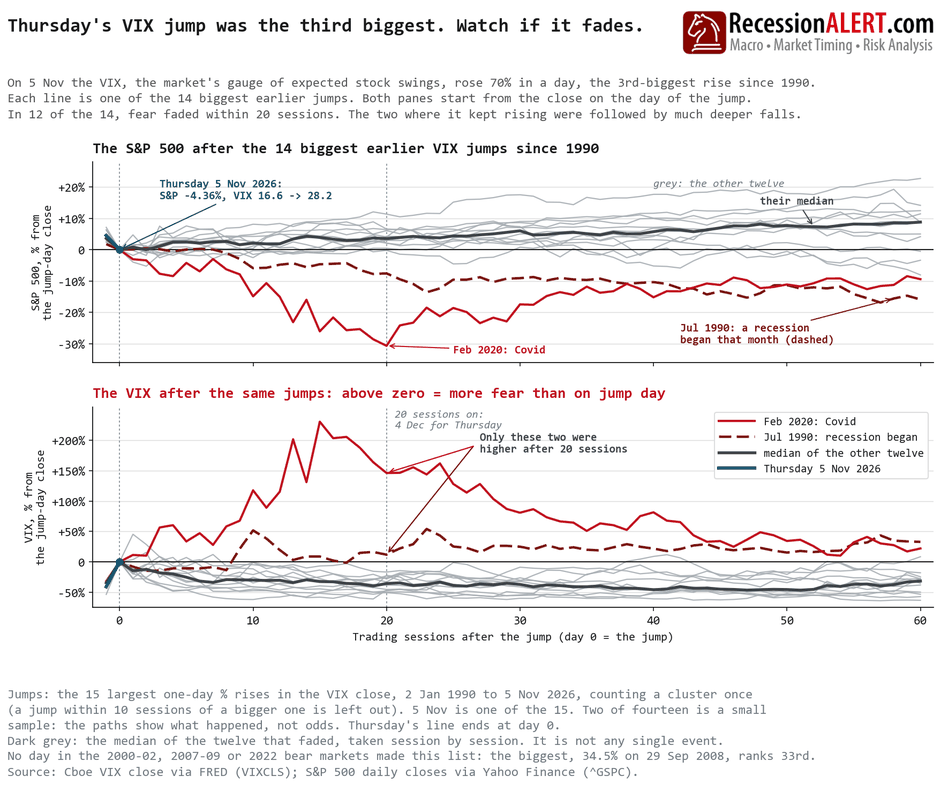
Thursday’s VIX spike will be judged less by its size than by whether it fades. Of the fourteen biggest earlier one-day jumps since 1990, twelve saw the VIX — Wall Street’s gauge of expected stock swings — back below its jump-day close within 20 sessions. Most fade because they are shocks to positioning, not profits: crowded bets forced out, as when funds betting on calm markets blew up in February 2018 or traders who had borrowed cheap yen to buy higher-yielding assets were flushed out in August 2024. Selling like that is violent but finite; once the forced sellers are out, the scramble for protection ends and fear drains. The two still higher after 20 sessions, July 1990 and February 2020, had real-economy damage arriving behind the panic — a recession, a pandemic — and the S&P 500 went on to fall 17% and 31%. Thursday had the profile of a crowded exit — semiconductors -12.25% against -2.96% for the broad NYSE Composite — and the verdict comes on 4 December: is the VIX still above 28.18? But a fade is not an all-clear. November 2021’s jump faded on schedule, yet the S&P was 8% lower within 60 sessions and the 2022 bear market followed as a grind; like 2000-02 and 2007-09, it never produced a day big enough for this list, and in 2008 the VIX climbed from 23 to 80.86 without one. A fade can acquit the jump; it cannot acquit the grind.
What it means: For households saving in stocks, history argues against selling into days like Thursday: the S&P 500 was higher a month later in 11 of 14 cases. The date to watch is 4 December. A VIX back below 28.18 by then would fit a crowded exit from chip and AI stocks, a problem for those shares rather than the whole market. A VIX still above it would turn the question to the economy, as in 1990 and 2020. Neither answer rules out a slow slide: the two worst bear markets since 1990 crept in rather than leapt.
Market Intelligence Brief (MIB) Ver. 20.03
For professional investors only. Not investment advice.
© 2026 RecessionALERT.com

Comments are closed.