
MARKET INTELLIGENCE BRIEF (MIB)
Wednesday, November 4, 2026
Democrats sweep Congress and the Dow jumps 3.03%, its best day since at least April 15, as the VIX sinks 20%. Crude plunges more than 8% on bets the Iran war ends sooner, the 10-year falls 7.3 bps and gold climbs 3.34%. The AI trade splits: Microsoft and Amazon surge, Vistra sinks 13.83%. Centene soars 12.64% on Medicaid hopes; CVS plans a split. Yet ADP beats and ISM prices hold at 73, keeping another Fed hike priced.
TABLE OF CONTENTS
A. EXECUTIVE SUMMARY
B. MARKET DATA
C. HIGH-IMPACT STORIES (5)
D. MODERATE-IMPACT STORIES (7)
E. ECONOMY WATCH (5)
F. EARNINGS WATCH (9)
G. WHAT’S NEXT
H. CHART OF THE DAY
A. EXECUTIVE SUMMARY -> TOP
The Democratic sweep of Congress set off a relief rally (Dow +3.03%, S&P 500 +1.58%) that investors priced policy by policy: a divided Washington reads as a check on fiscal expansion, the Iran war and the AI build-out. Bonds rallied on bets of less borrowing, with the 10-year down 7.3 bps; crude fell more than 8% on hopes of an earlier end to the war; and Big Tech gained while AI-power and hardware suppliers sold off on data-center permitting risk. The relief ran against firm data rather than with it: ADP beat, ISM services prices held at 73 and Polymarket still prices another Fed hike this year at 78%, so Friday’s payrolls and Tuesday’s CPI decide whether it lasts. Breadth was wide, with nine of 11 sectors higher and Healthcare (+3.15%) leading on Medicaid and ACA hopes, while Energy (-4.48%) and Industrials (-1.54%), where defense and AI-power names fell, absorbed the losses.
• Biggest Dow gain since at least April 15: The Dow rose 3.03% to 53,356.12, its largest one-day gain since at least April 15, and the S&P 500 rose 1.58% to 7,688.62; the Russell 2000 gained 1.58% and the Nasdaq 100 0.91%, while the VIX fell 20.45% to 16.57. NBC projects Democrats at about 255 House seats, short of the 290 needed to override a veto.
• Oil’s war premium cut: WTI fell 8.38% to $88.04 and Brent fell 8.67% to $94.62, its lowest close since August 31, on bets a Democratic Congress hastens an end to the Iran war. The selling overrode EIA draws of 0.865 million barrels in crude and 3.565 million in distillates; Energy fell 4.48%.
• Bonds and gold rally together: The 10-year yield fell 7.3 bps to 4.893% and the 2-year fell 5.2 bps to 4.581%, flattening 2s10s to about 31 bps. The dollar index fell 0.35% and gold rose 3.34% to $4,072.20, its best day since August 19. Treasury held next week’s refunding at $125 billion.
• The AI trade splits: Microsoft (MSFT) rose 6.68%, Amazon (AMZN) 6.12% and Apple (AAPL) 5.31% to a record, while Vistra (VST) fell 13.83% after a Democrat won the Texas governorship on tighter data-center rules. GE Vernova (GEV) fell 9.30% and Dell (DELL) fell 8.82%.
• Healthcare up, defense down: Centene (CNC) rose 12.64% and HCA (HCA) 10.34% on Medicaid and ACA hopes, while Lockheed Martin (LMT) fell 6.88% on fears of tighter Pentagon budgets. CVS (CVS) fell 12.53% on plans to split in two despite beating and raising guidance; 3M (MMM) rose 9.55% on a $7.35 billion PFAS settlement.
• The data stay warm: ADP private payrolls of 86,000 beat the 69,000 forecast. ISM services eased to 54.5, but prices held at 73 and backlogs rose to their highest since July 2022. Polymarket prices another Fed hike in 2026 at 78%, ahead of Friday’s payrolls (65,000 expected).
1. The market priced a set of checks, not a program — About 255 House seats is well short of a veto-proof majority, so investors priced constraint rather than new law: less federal borrowing (a long-end bond rally and a weaker dollar), an earlier end to the Iran war and less defense spending (crude down more than 8%, Lockheed down 6.88%), and better odds for Medicaid and ACA funding (Centene, HCA). A Democratic Senate also checks Fed Board confirmations, with Senator Warren likely to chair Banking. Each of these trades rests on a negotiation with the White House that has not begun, which leaves them exposed to the first sign that the President will not sign.
2. The AI build-out is being repriced from a capacity race to incumbency — If new data centers become harder to permit, existing capacity grows scarcer and hyperscalers may spend less, which helps their free cash flow and hurts the suppliers that depend on new construction: merchant power, turbines, servers and memory. Oracle’s reported cancellation of a roughly $7 billion AI-chip lease with Tencent under US pressure adds a second policy risk, on overseas capacity. For portfolios, the AI trade is no longer one trade: ownership of capacity and dependence on new builds now point in opposite directions, with Vistra reporting Friday and Constellation Monday.
3. The election has not changed the Fed math — The rally ran against firm data: private hiring beat, ISM services prices sit at 73 with respondents saying more pass-through is coming, and GDPNow still tracks fourth-quarter growth at 3.4%. An $8 drop in crude eases the energy part of inflation, but another hike this year remains priced at 78%. Friday’s payrolls and Tuesday’s October CPI (prior 3.7% year on year) now matter more to the December 9 meeting than Tuesday’s vote did.
 — Leading economic indicators. Accurate market forecasts. Apply for membership at join.recessionalert.com
B. MARKET DATA -> TOP
A Democratic sweep of both chambers of Congress set off a broad relief rally, with the Dow up 3.03% and the S&P 500 up 1.58% as investors cheered the removal of midterm uncertainty. The rally split the AI trade: Microsoft, Amazon and Apple surged on bets that curbs on new data-center construction would entrench the incumbents, while AI power and hardware names sold off, led by GE Vernova (-9.30%) and Dell (-8.82%). Energy (-4.48%) was the weakest sector after crude fell more than 8% on bets that a Democratic Congress could hasten an end to the US-Israeli war with Iran. Treasuries rallied, the dollar slipped, gold rose 3.34% and the VIX fell 20.45%.
CLOSING PRICES – Wednesday, November 4, 2026:
MAJOR INDICES
The Dow’s 3.03% gain far outran the Nasdaq 100’s 0.91%, as losses in semiconductors and AI hardware held back the tech-heavy index while the advance ran broad elsewhere; the NYSE Composite (+1.56%) and Russell 2000 (+1.58%) matched the S&P 500. Dow Theory bull confirmation is in force, with both the Dow and the transports closing above their 10-session highs, though transports lagged the Dow by 1.91 points on the day. Over the past 10 sessions the Russell 2000 has beaten the S&P 500 by 3.6 points and the S&P 500 has beaten the Nasdaq 100 by 3.8, signalling broad participation and a broadening rotation away from concentrated tech leadership.
| Index | Close | Change | %Move | Why It Moved |
|---|---|---|---|---|
| S&P 500 | 7,688.62 | +119.70 | +1.58% | Democratic sweep of Congress removed election uncertainty; nine of 11 sectors rose while AI data-center names lagged |
| Dow Jones | 53,356.12 | +1,569.40 | +3.03% | Strongest of the major indices as investors cheered the end of midterm uncertainty |
| DJ Transportation | 20,830.98 | +231.30 | +1.12% | Rose with the relief rally but lagged the Dow by 1.91 points; no single driver identified for the gap |
| Nasdaq 100 | 28,437.17 | +256.90 | +0.91% | Gains in Microsoft, Amazon and Apple were partly offset by losses in semiconductors and AI hardware |
| Russell 2000 | 2,856.95 | +44.50 | +1.58% | Small caps matched the S&P 500 in the post-election relief rally |
| NYSE Composite | 24,686.13 | +379.08 | +1.56% | Broad participation, with nine of 11 S&P sectors higher |
VOLATILITY & TREASURIES
Volatility collapsed as the election event risk cleared, and the bond market confirmed rather than fought the rally: the 10-year fell 7.3 bps and the 2-year 5.2 bps, flattening 2s10s to about 31 bps in a long-end-led rally. The dollar’s slide alongside lower yields fits the read that a divided Washington will borrow less, and Treasury’s refunding language also opened the door to future cuts in longer-dated auction sizes.
| Instrument | Level | Change | Why It Moved |
|---|---|---|---|
| VIX | 16.57 | -4.26 (-20.45%) | Collapsed as the midterm result removed a major event risk |
| 10-Year Treasury Yield | 4.893% | -7.3 bps | Treasuries rallied on bets a divided Washington will borrow less; Treasury’s refunding statement signalled possible future cuts to longer-dated auction sizes (Reuters) |
| 2-Year Treasury Yield | 4.581% | -5.2 bps | Fell with the broader Treasury rally after the midterm sweep, but less than the 10-year |
| US Dollar Index (DXY) | 101.51 | -0.36 (-0.35%) | Slipped as traders weighed the policy implications of the Democratic sweep |
COMMODITIES
Precious metals jumped as the dollar slid, with silver (+5.17%) and platinum (+4.93%) outpacing gold, while copper barely moved, so the metals bid reads as currency-driven rather than a growth signal. Bitcoin rose 4.16% in step with equities, tracking risk appetite rather than a crypto-specific catalyst.
| Asset | Price | Change | %Move | Why It Moved |
|---|---|---|---|---|
| Gold | $4,072.20/oz | $+131.80 | +3.34% | Rose as the dollar slid after the Democratic sweep; heading for its best day since August, per Investing.com |
| Silver | $52.325/oz | $+2.572 | +5.17% | Rallied with gold on the weaker dollar |
| Copper | $6.4110/lb | $+0.0090 | +0.14% | Barely moved; no discrete same-day catalyst identified |
| Platinum | $1,500.45/oz | $+70.45 | +4.93% | Rallied with the precious-metals complex on the weaker dollar |
| Bitcoin | $80,711.0 | $+3,220.0 | +4.16% | Tracked the broader risk rally after the midterm sweep, rebounding from Tuesday’s one-month low (Investing.com) |
ENERGY
WTI and Brent fell more than 8% in lockstep, with the Brent-WTI spread narrowing by about $1, as Reuters tied the drop to bets that a Democratic Congress could hasten an end to the US-Israeli war with Iran. Dutch TTF fell alongside crude while Henry Hub rose, leaving US gas out of the move. Oil fell while equities rallied.
| Asset | Price | Change | %Move | Why It Moved |
|---|---|---|---|---|
| Crude Oil (WTI) | $88.04/bbl | $-8.05 | -8.38% | Plunged after Republicans lost Congress, on bets the shift in power could hasten an end to the US-Israeli war with Iran; settled $88.12, down $7.97, per Reuters |
| Crude Oil (Brent) | $94.62/bbl | $-8.98 | -8.67% | Same driver as WTI; settled $94.62, down $8.98, per Reuters |
| Natural Gas (Henry Hub) | $2.950/MMBtu | $+0.055 | +1.90% | No discrete same-day catalyst identified; the EIA storage report is due Thursday |
| Natural Gas (Dutch TTF) | $27.98/MMBtu | $-2.07 | -6.88% | Fell alongside crude; no discrete gas-specific catalyst confirmed |
S&P 500 SECTORS
Nine of 11 sectors rose in a true breadth flush, and the two holdouts show where the day’s losses landed: Energy (-4.48%) on the oil slide, and Industrials (-1.54%), where defense names and AI-power suppliers fell. Technology (+0.06%) barely held green as chip and hardware losses offset mega-cap gains, leaving its 1-month loss at -11.57%, while Healthcare (+3.15%) added to the strongest 3-month run of any sector (+12.32%).
| Sector | 1-Day | 1-Week | 1-Month | 3-Month | 6-Month | YTD | 12-Month |
|---|---|---|---|---|---|---|---|
| Consumer Cyclical | +3.90% | +4.91% | +6.92% | +1.37% | -1.08% | -0.58% | -3.94% |
| Basic Materials | +3.80% | +0.86% | -1.46% | -2.54% | -6.75% | +10.66% | +22.01% |
| Financial | +3.52% | +4.60% | +5.75% | -0.10% | +10.91% | +8.64% | +14.93% |
| Consumer Defensive | +3.16% | +6.08% | +13.00% | +8.83% | +6.92% | +17.55% | +20.78% |
| Healthcare | +3.15% | +5.15% | +12.33% | +12.32% | +23.70% | +18.21% | +23.76% |
| Real Estate | +3.14% | +6.53% | +8.43% | -0.86% | +0.02% | +9.54% | +8.25% |
| Communication Services | +3.04% | -3.11% | -10.87% | -9.88% | -17.08% | -9.50% | -5.79% |
| Utilities | +0.69% | +2.62% | +4.89% | -0.11% | -6.32% | +1.18% | -2.63% |
| Technology | +0.06% | -6.56% | -11.57% | -3.84% | +3.03% | +18.52% | +11.53% |
| Industrials | -1.54% | -0.30% | -4.71% | -6.09% | -8.40% | +6.75% | +6.97% |
| Energy | -4.48% | -7.09% | -1.16% | +5.22% | +5.18% | +36.44% | +38.47% |
TOP MEGA-CAP MOVERS:
GAINERS
| Company | Ticker | Close | Change | Why It Moved |
|---|---|---|---|---|
| Microsoft Corp | MSFT | 555.80 | +6.68% | Big Tech rallied after the Democratic sweep, as investors bet curbs on new data-center construction would entrench incumbents’ computing capacity and ease pressure on cash flows (Reuters) |
| Home Depot Inc | HD | 355.44 | +6.53% | No discrete same-day catalyst identified; rose as Treasury yields fell and rate-sensitive Real Estate gained 3.14% |
| Amazon.com Inc | AMZN | 266.03 | +6.12% | Led the post-midterm Big Tech rally to a three-month high, per Reuters, on the same data-center-curbs reasoning |
| Apple Inc | AAPL | 349.51 | +5.31% | Joined the post-midterm Big Tech rally, reaching a record high, per Reuters |
| Arista Networks Inc | ANET | 178.48 | +5.04% | Earnings-driven, after third-quarter results released after Tuesday’s close |
DECLINERS
| Company | Ticker | Close | Change | Why It Moved |
|---|---|---|---|---|
| GE Vernova Inc | GEV | 832.83 | -9.30% | No company-specific same-day catalyst confirmed; fell on the day AI-power names sold off after Democratic wins, including Texas’s governor race, raised data-center development risk (Vistra -13.83% on a KeyBanc downgrade), though no source ties GE Vernova to that move (unverified) |
| Dell Technologies Inc | DELL | 372.36 | -8.82% | No company-specific same-day catalyst confirmed; fell as AI data-center stocks sold off on the prospect of tighter AI oversight after the sweep (Reuters, which does not name Dell; link unverified) |
| Micron Technology Inc | MU | 795.23 | -7.00% | No company-specific same-day catalyst confirmed; fell on the day the AI data-center complex sold off after the midterm sweep (link unverified) |
| Arm Holdings Plc ADR | ARM | 191.80 | -5.28% | Fell with chip stocks during the session ahead of its fiscal second-quarter report after the close; no discrete same-day catalyst identified for the regular-session move |
| Caterpillar Inc | CAT | 591.30 | -5.23% | No discrete same-day catalyst identified; continuation of the slide since its October 29 earnings, with Industrials down 1.54% |
— Institutional-grade intelligence for serious investors. Apply for membership at join.recessionalert.comC. HIGH-IMPACT STORIES -> TOP
BULLISH
1. Democrats Win Both Chambers of Congress, and the Dow Jumps 3.03% in Its Biggest One-Day Gain Since at Least April 15
The core facts:Democrats won majorities in both the House and the Senate in Tuesday’s midterm elections. NBC News projected Democratic control of the House in a report published at 10:08 PM ET Tuesday, after the market close, and projected that Democrats would also flip the Senate; it puts the party on course for about 255 House seats, a provisional count. In the first session after the result, the Dow rose 1,569.40 points, or 3.03%, to 53,356.12, the S&P 500 gained 1.58% to 7,688.62, the Russell 2000 rose 1.58% and the Nasdaq 100 added 0.91%. Nine of 11 S&P sectors rose, and the VIX fell 20.45% to 16.57. House Democratic leader Hakeem Jeffries’ priorities, as NBC listed them, are reversing the Medicaid cuts, extending the Affordable Care Act credits, restoring congressional authority over tariffs and stopping the war with Iran. President Trump told Fox News on election night, “I think it’s the gasoline price,” while Vice President Vance wrote on X that the war was the reason Republicans lost.
Why it matters:The rally was a release of event risk rather than a bet on new policy. The Dow’s gain and the VIX’s drop were each the largest one-day moves since at least April 15, and the Dow and the transports both closed above their highs of the prior 10 sessions. A divided Washington lowers the odds of further fiscal expansion, which the bond market read as less borrowing (Story 3), and it gives Congress leverage over the Iran war, tariffs and health spending that the market priced sector by sector: crude, defense and AI-power names fell while insurers, hospitals and Big Tech rose. The limits matter as much as the win. About 255 seats is well short of the 290 needed to override a veto, so any tariff rollback or Medicaid reversal still needs President Trump’s signature or Republican votes.
What to watch:Friday’s October payrolls report (consensus 65,000) and Tuesday’s October CPI, which return the market’s focus to the December 9 FOMC, where a rate hike is the base case; and whether the Dow can hold above 53,000.
BULLISH
2. Crude Plunges More Than 8% as Traders Bet a Democratic Congress Will Hasten an End to the Iran War; Brent Closes at Its Lowest Since August 31
The core facts:WTI closed at $88.04 a barrel, down 8.38%, and Brent closed at $94.62, down 8.67%, its lowest close since August 31. Reuters tied the drop to bets that the shift in power in Congress could hasten an end to the US-Israeli war with Iran, after both President Trump and Vice President Vance linked the Republican losses to the war and gasoline prices. Trump told the Financial Times that Washington had no immediate plans to strike Iran, per Oilprice.com. A report by the Qatari outlet Al-Jadeed of significant progress in US-Iran negotiations was dismissed by a senior Iranian official, and prices recovered some of their losses. The selling overrode a bullish inventory report: EIA data showed commercial crude stocks fell 0.865 million barrels to 409.76 million in the week to October 30, and distillate stocks fell 3.565 million barrels to 99.26 million. Energy was the worst S&P 500 sector, down 4.48%. The national average for regular gasoline was $4.12 a gallon on Wednesday, per AAA.
Why it matters:The war premium in crude is now trading on political odds rather than physical flows. Inventories are tightening, distillates are below 100 million barrels, and Iran’s Revolutionary Guard claimed overnight that four tankers struck mines south of Hormuz, a claim no one has independently confirmed. Yet the market took more than $8 off Brent in a day. That leaves oil exposed to a sharp reversal if talks stall: Enverus’ Carl Larry warned that “an escalation in Iran could come before a resolution.” For the Fed, an $8 drop in crude eases the energy component of inflation just as the ISM services survey shows prices paid at 73 and a December hike is the base case, so a sustained move lower would take some pressure off the hike case.
What to watch:Whether Brent holds above its August 31 close of $90.71; any confirmation from Washington or Tehran of progress in talks; and October CPI on Tuesday, November 10, for how much of the energy shock has already reached consumer prices.
BULLISH
3. Treasuries Rally and the Dollar Slides After the Sweep, With the 10-Year Down 7.3 bps; Gold Posts Its Best Day Since August 19
The core facts:The 10-year Treasury yield fell 7.3 basis points to 4.893% and the 2-year fell 5.2 bps to 4.581%, flattening the 2s10s curve to about 31 bps in a rally led by the long end. The dollar index fell 0.35% to 101.51. Gold rose 3.34% to $4,072.20 an ounce, its largest one-day gain since August 19, while silver rose 5.17% and platinum 4.93%; copper was nearly flat. Investing.com attributed the bond rally to bets that a divided Washington will borrow less. The rally came on the morning of Treasury’s quarterly refunding, which kept next week’s auctions at $125 billion and said Treasury anticipates maintaining coupon auction sizes “for the next several quarters.” That wording no longer says “at least,” which Reuters reported as the change in the guidance.
Why it matters:Bonds rallied with stocks, which marks the day as relief over fiscal risk rather than a growth scare. They rallied despite firm data: ADP’s private payrolls beat forecasts and the ISM services prices index held at 73, and a December hike remains priced at 78% on Polymarket. Dropping “at least” loosens Treasury’s commitment to hold coupon sizes without signalling which way they might move; the statement says only that Treasury “continues to evaluate potential future changes.” A weaker dollar lifted the precious metals, and copper’s flat session suggests the move was about the currency rather than growth.
What to watch:Next week’s 3-year ($58 billion, November 9), 10-year ($42 billion, November 10) and 30-year ($25 billion, November 12) auctions, which will test demand at lower yields, alongside October CPI on November 10.
UNCERTAIN
4. The Sweep Splits the AI Trade: Microsoft, Amazon and Apple Surge While Vistra Sinks 13.83% on the Texas Governor’s Race
The core facts:Microsoft rose 6.68% to $555.80, Amazon 6.12% to $266.03 and Apple 5.31% to a record $349.51. Reuters reported that Big Tech surged on bets that potential curbs on new data-center construction would cement the incumbents’ grip on computing power and ease pressure on their cash flows; Amazon reached a three-month high. AI-power and hardware stocks fell. Vistra closed down 13.83% at $120.29 after Democrat Gina Hinojosa won the Texas governorship on a platform of tighter data-center restrictions, per Investing.com, and KeyBanc cut the stock to Sector Weight. GE Vernova fell 9.30%, Dell 8.82% and Micron 7.00%, though no company-specific catalyst was confirmed for any of the three. The Nasdaq 100 rose only 0.91%, and Technology barely held positive at +0.06%. MarketWatch reported that some analysts warned of an “excessive knee-jerk” reaction in Vistra and other energy stocks.
Why it matters:The market is repricing the AI build-out from a race to add capacity everywhere to a contest that favors those who already own it. If new data centers become harder to permit, existing capacity becomes scarcer and more valuable, and the hyperscalers’ capital spending may slow, which helps their free cash flow. The same logic hurts the suppliers whose growth depends on new construction: merchant power generators, turbine makers and server and memory vendors. Technology’s 1-month loss of 11.57% shows the sector was already under pressure; this election adds a policy risk to the AI supply chain where the market had priced none.
What to watch:Vistra’s third-quarter results on Friday, November 6, and Constellation Energy’s on Monday, November 9, for management commentary on data-center contracts in Texas and elsewhere; and the incoming Texas administration’s first statements on permitting.
BULLISH
5. Health Insurers and Hospital Operators Rally on Medicaid and ACA Hopes, With Centene Up 12.64% and HCA Up 10.34%
The core facts:Medicaid-focused insurers and hospital operators rallied after the Democratic win. Centene closed up 12.64% at $76.01 and HCA Healthcare up 10.34% at $510.70. Reuters reported early-trading gains in Molina, Tenet and Universal Health Services as well, on expectations that a Democratic Congress could delay the Medicaid-reducing provisions of the One Big Beautiful Bill Act and improve the prospects of extending enhanced Affordable Care Act subsidies. The Healthcare sector rose 3.15%, extending the strongest 3-month gain of any sector to 12.32%. CVS Health was the exception, falling 12.53% on the day it announced plans to split into two companies (Story 8).
Why it matters:The sweep removes much of the policy discount on the companies most exposed to Medicaid enrollment and subsidized ACA coverage, the two programs Jeffries named as priorities. Hospitals benefit twice, because fewer uninsured patients mean less uncompensated care. But the rally prices a change in probabilities, not a change in law: a Democratic Congress can pass a Medicaid delay or a subsidy extension only with the President’s signature, so the gains rest on a negotiation that has not begun.
What to watch:Any early bill from the incoming House leadership on ACA credits or the Medicaid timetable, and whether managed-care companies revise their 2027 enrollment assumptions at upcoming investor conferences.
— Quantifying recession risk so you don’t have to guess. Apply for membership at join.recessionalert.comD. MODERATE-IMPACT STORIES -> TOP
BEARISH
6. Defense Stocks Fall on Fears of a Tighter Pentagon Budget, With Lockheed Martin Down 6.88%
The core facts:Lockheed Martin closed down 6.88% at $595.04. Reuters reported that L3Harris fell 6.9% and RTX 3.1%, with General Dynamics and Northrop Grumman also lower, as investors bet that future defense funding may not be as robust as President Trump’s proposed $1.5 trillion 2027 budget implied. The selloff came on the same day Guggenheim initiated coverage of Lockheed at Buy with a $735 price target. Industrials fell 1.54%, one of only two S&P sectors lower on the day.
Why it matters:Congress controls appropriations, and a Democratic majority that has named stopping the Iran war as a priority is unlikely to approve defense spending at the scale the administration proposed. The move takes some of the war premium out of the sector at the same time crude lost its own (Story 2). Defense contracts are multi-year, so near-term revenue is largely set; the market is cutting the growth it had priced for 2027 and beyond.
What to watch:The fiscal 2027 appropriations calendar and any early statements from incoming Democratic committee chairs on defense and war funding.
BULLISH
7. 3M Jumps 9.55% After a $7.35 Billion Settlement of “Forever Chemicals” Personal-Injury Claims
The core facts:3M reached a broad resolution of personal-injury litigation over AFFF firefighting foam, a $7.35 billion pre-tax nominal commitment paid over nine years with a present value of $5.8 billion. It covers about 99% of current personal-injury claims inside and outside the AFFF multidistrict litigation, involving about 115,000 to 120,000 eligible plaintiffs, and includes a $680 million reserve fund. Payments are back-loaded: $50 million in 2026, nothing in 2027 and about 20% in the final two years. 3M will take a $5.8 billion pre-tax charge in the fourth quarter as a special item, and said the charge does not change its 2026 guidance. The agreement is not an admission of liability, and some payments depend on plaintiffs joining. The release was issued Tuesday evening, with an investor call at 8:30 AM ET Wednesday. Shares closed up 9.55% at $193.95, among the largest contributors to the Dow’s gain.
Why it matters:PFAS liability has been the largest unquantified risk in 3M’s valuation for years. Putting a number and a schedule on almost all current personal-injury claims turns that open-ended risk into a known cost. The payment schedule also matters: with almost nothing due before 2028, near-term free cash flow and the dividend are protected. CEO William Brown said the settlement “substantially reduces litigation uncertainty.”
What to watch:Plaintiff participation rates, since 3M may terminate the settlement if participation falls below a level it has not disclosed.
UNCERTAIN
8. CVS Health Plans to Split Into Two Public Companies, Separating Aetna and Caremark From Its Retail Pharmacies; Shares Fall 12.53%
The core facts:CVS Health announced plans to separate into two independent public companies. A healthcare solutions company, under the interim name CVS Health, will hold Aetna, CVS Caremark, CVS Specialty, Oak Street Health and Signify Health, led by current Chairman and CEO David Joyner. CVS Pharmacy will hold about 9,000 pharmacies, the mail pharmacy, MinuteClinic and the Health100 technology business, led by Group President Prem Shah. The separation is intended to be tax-free to shareholders and is expected to be completed in the first half of 2028, subject to final board approval, an effective Form 10 registration and confirmation of the tax treatment. The release gives no figures for separation costs, debt allocation or buybacks. CVS announced the plan alongside third-quarter results that beat estimates and raised guidance (Story 19). Shares closed down 12.53%.
Why it matters:The split unwinds the vertical model CVS built by buying Aetna, separating the insurance and benefits business from a retail pharmacy chain that has been shrinking its store count. Joyner said “we plan to create two focused companies.” The market’s reaction, a drop on a day insurers rallied and the company raised guidance, suggests investors doubt the split creates value on these terms. The timeline is long, the costs are unstated, and the deal needs a Form 10 that will show how debt is divided.
What to watch:The Form 10 filing and the naming of each company’s board and leadership, which will show the split of debt and the dividend for each.
UNCERTAIN
9. A Democratic Senate Puts a Check on Fed Board Appointments, With Senator Warren Likely to Chair the Banking Committee
The core facts:Democratic control of the Senate gives the party “a major guardrail against Trump landing any more allies at the central bank,” Reuters reported, because the Senate confirms Fed Board nominees. The next Senate Banking Committee chair “will likely be Democratic Senator Elizabeth Warren of Massachusetts, a harsh Warsh critic,” replacing Tim Scott, and she could investigate Chair Kevin Warsh’s “opaque disposition of hundreds of millions of dollars in assets.” JPMorgan’s Michael Feroli said the result “increased the odds his term will end with Democratic control of the Senate.” The administration’s effort to remove Governor Lisa Cook continues, with a White House procedure expected in the coming weeks. Democratic committee control could also complicate the agenda of Vice Chair for Supervision Michelle Bowman, including stablecoin rules under the Genius Act and the consolidation of the Fed’s bank supervision. No Fed official commented.
Why it matters:The confirmation check lowers the risk that the Board’s composition shifts further toward the White House, which the market has treated as a threat to Fed independence. That supports the case for the Fed setting policy on the data alone, and the data currently point to a December hike. A Warren-led Banking Committee also raises the oversight risk for bank deregulation and for the crypto rulemaking that has helped the sector this year.
What to watch:Governor Bowman’s scheduled remarks on Friday, November 6, and the White House’s next step on Governor Cook.
UNCERTAIN
10. Oracle Cancels a Roughly $7 Billion AI-Chip Lease With Tencent After US Government Pressure, the FT Reports
The core facts:Oracle has cancelled its roughly $7 billion agreement to lease AI chips to Tencent, the Financial Times reported, citing people familiar with the matter. Per the FT, US officials approached Oracle to raise concerns about the deal, and Guangdong officials asked Tencent to support domestic Chinese chips. The report first circulated shortly before 1:00 AM ET Wednesday. Oracle, Tencent and the White House did not respond to Reuters, which could not verify the report. Oracle shares closed down 1.95% at $123.73.
Why it matters:If confirmed, the cancellation shows US export policy reaching beyond chip sales to the rental of computing capacity, the route Chinese firms have used to get advanced AI hardware without buying it. It follows Tuesday’s report that Nvidia requires cloud partners to sell at least 51% of their services to non-Chinese customers, and together they point to tighter enforcement on overseas AI capacity. For Oracle, it removes a large contract from its backlog at a time when investors are already questioning the financing of AI data centers.
What to watch:Confirmation from Oracle or the administration, and whether the Commerce Department formalizes rules on remote access to US AI chips by Chinese companies.
BULLISH
11. AstraZeneca Made a Roughly $10 Billion Approach for Obesity Drugmaker Rhythm Pharmaceuticals, Sending Rhythm Up 28%
The core facts:AstraZeneca made an offer of about $10 billion for Rhythm Pharmaceuticals, Reuters reported Wednesday. The Wall Street Journal reported a $124-per-share offer made last month, while Reuters reported a non-binding proposal of as much as $134 a share including milestone payments. An AstraZeneca spokesperson declined to comment and Rhythm did not respond. Rhythm closed up 28% at $110.68. Rhythm sells Imcivree, whose use the FDA expanded in March to a rare form of obesity caused by brain damage.
Why it matters:Large drugmakers without a leading obesity franchise are paying up for differentiated assets, and rare genetic obesity is a niche that the GLP-1 leaders do not dominate. A deal at about $124 a share would sit well above Wednesday’s close, which suggests the market is pricing some doubt that a deal is reached at the reported terms. It also supports biotech M&A sentiment on a day healthcare led the market.
What to watch:Whether AstraZeneca makes a formal offer and how Rhythm’s board responds.
BULLISH
12. SpaceX Picks Qualcomm to Supply Base Stations for Starlink Mobile’s Nationwide US 5G Network, Lifting Qualcomm 5.33%
The core facts:SpaceX selected Qualcomm’s Dragonwing QRU100 and QDU100 platforms and Layer 1 software for the terrestrial base stations of Starlink Mobile’s US nationwide 5G network, Qualcomm announced Wednesday morning. The multi-year agreement covers tens of thousands of sites, with US deployment set to begin in 2027, using Massive MIMO radio units with 64 transmit and 64 receive paths. No dollar value was disclosed. Starlink Senior Vice President Michael Nicolls said Starlink is building “the first fully-integrated nationwide satellite and terrestrial network.” Qualcomm closed up 5.33% at $173.19 in the regular session, before its fiscal fourth-quarter report after the close (Story 20).
Why it matters:The deal gives Qualcomm a large, multi-year infrastructure customer outside handsets, the business where growth has been slowing. For the US wireless market, it confirms that SpaceX is building a terrestrial network to complement its satellites, which would make it a direct competitor to the incumbent carriers from 2027.
What to watch:The deployment schedule and spectrum plans SpaceX discloses for Starlink Mobile, and the carriers’ responses.
— Separating signal from noise since 2007. Apply for membership at join.recessionalert.comE. ECONOMY WATCH -> TOP
Wednesday’s data described an economy still running warm, with inflation pressure building in the pipeline rather than fading. Private hiring beat forecasts (ADP 86,000 against 69,000 expected), and the ISM services survey had all 10 of its indexes in expansion for the first time since February, with prices paid at 73 and order backlogs at their highest since July 2022. Growth is cooling only at the margin: GDPNow eased to 3.4% for the fourth quarter from 3.7%. That leaves a December rate hike as the market’s base case, priced at 78% on Polymarket, going into Friday’s payrolls report and Tuesday’s October CPI.
Private Employers Add 86,000 Jobs in October, Topping the 69,000 Forecast (ADP, Nov 4)
What they’re saying:ADP’s National Employment Report showed private employers added 86,000 jobs in October, above the 69,000 consensus and close to September’s 90,000. ADP said hiring showed solid growth for a second month and that employers of all sizes were hiring, while professional and business services lost jobs for the third straight month. Chief economist Nela Richardson said job-changers were drawn by bonuses, overtime and more hours as well as higher base pay, and that “earnings growth for these workers hit its fastest pace since March 2024.”
The context:A second solid month of private hiring, with pay gains firming for job-switchers, cuts against the labor-cooling case, a day after September JOLTS openings also beat. It strengthens the argument for further Fed tightening: Polymarket priced a 78% chance of another rate hike in 2026, up from 75% the prior session. The release did not move bonds against the day’s trend. The 2-year Treasury yield closed down 5.2 bps at 4.581% in a session dominated by the midterm result.
What to watch:Initial jobless claims on Thursday, November 5 (196,000 expected), then October nonfarm payrolls on Friday, November 6, where consensus is 65,000 after September’s 29,000, with unemployment expected at 4.2% and average hourly earnings at +0.3% month on month.
ISM Services Slips to 54.5 as New Orders Cool, but Prices Hold at 73 and Backlogs Hit a Four-Year High (ISM, Nov 4)
What they’re saying:The ISM Services PMI eased to 54.5 in October from 54.9, a shade below the 54.8 forecast and the 28th straight month of expansion. New orders fell 3.9 points to 55.9 and business activity fell 2.7 points to 53.8, while employment rose to 51.4, its second month above 50. The Prices Index was 73.0, above 70 for the seventh time in eight months, and the Backlog of Orders Index rose to 58.0, its highest since July 2022. For the first time since February 2026, all 10 indexes were in expansion territory.
The context:The headline miss is small, and the detail matters more. Demand growth is slowing, but cost pressure is not. No commodity was reported down in price, and tariffs and fuel costs were the most-cited supply-chain issues. ISM chair Steve Miller said many respondents have not yet passed those costs to customers, which “indicates that more pricing pressure is on the way if oil and tariff cost impacts are not mitigated.” ISM said the 54.5 reading corresponds to a 2-percentage-point annualized rise in real GDP.
What to watch:October CPI on Tuesday, November 10, against a prior headline rate of 3.7% year on year and 0.6% month on month, for evidence that the services pipeline pressure ISM describes is reaching consumer prices.
Trade Deficit Narrows to $105.0 Billion in September, Smaller Than the $108 Billion Expected (BEA/Census, Nov 4)
What they’re saying:The US goods and services trade deficit narrowed to $105.0 billion in September from a revised $105.7 billion in August, against a consensus of $108 billion. Exports rose to $321.5 billion from $315.2 billion and imports rose to $426.6 billion from $420.8 billion. The goods deficit narrowed by $0.7 billion to $135.9 billion, and the services surplus was little changed at $30.9 billion.
The context:The deficit narrowed because exports grew more than imports: a $6.3 billion gain against $5.8 billion. Both sides of the ledger expanded, so the narrowing reflects stronger exports rather than weaker domestic demand. Imports still rising points to firm US spending on foreign goods, consistent with the day’s services and hiring data.
What to watch:The Atlanta Fed’s next GDPNow update on Monday, November 9, which will fold in the trade figures alongside Friday’s payrolls; BEA’s October trade report is scheduled for December 8.
GDPNow Trims Fourth-Quarter Growth Tracking to 3.4% from 3.7% (Atlanta Fed, Nov 4)
What they’re saying:The Atlanta Fed’s GDPNow model put fourth-quarter real GDP growth at a 3.4% annualized rate on November 4, down from 3.7% on November 2. After the day’s releases from the Census Bureau, BEA and ISM, the model’s nowcast for real consumer spending growth fell to 2.6% from 2.9%, and for real private investment growth to 10.6% from 11.1%.
The context:The trim is modest and leaves fourth-quarter tracking well above trend, so the signal is a slight cooling from a strong pace rather than a turn. The softer consumer and investment nowcasts line up with ISM’s slowdown in services new orders, while a growth rate above 3% with services prices at 73 offers the Fed little reason to ease its tightening bias.
What to watch:The next GDPNow update on Monday, November 9, after Friday’s October payrolls and the preliminary November Michigan consumer sentiment reading (48 expected).
Treasury Holds Refunding at $125 Billion and Keeps Coupon Sizes Steady “for the Next Several Quarters” (US Treasury, Nov 4)
What they’re saying:Treasury will sell $125 billion of 3-, 10- and 30-year securities next week ($58 billion, $42 billion and $25 billion), refunding about $97 billion of maturing debt and raising about $28 billion in new cash. It said that “based on current projected borrowing needs, Treasury anticipates maintaining nominal coupon and FRN auction sizes” for “the next several quarters,” that current sizes leave it “well positioned to address potential changes to the fiscal outlook,” and that it “continues to evaluate potential future changes.” Treasury also plans up to $70 billion of liquidity buybacks over the quarter and will move the 7-year note to a quarterly new-issue cycle from March 2027.
The context:With no increase in longer-dated supply, the bond market has one fewer source of term-premium pressure, on the same morning the midterm result shifted expectations for fiscal policy. The 10-year yield fell 7.3 bps to 4.893% in a rally led by the long end. Treasury said it expects to raise bill sizes across the curve in January, so near-term financing will lean on bills rather than coupons.
What to watch:The October Monthly Budget Statement on Wednesday, November 11, for the starting point of the new fiscal year’s deficit (September’s result was a $27 billion deficit); the next refunding announcement is February 3, 2027.
— Know the probability before the market prices in the risk. Apply for membership at join.recessionalert.comF. EARNINGS WATCH -> TOP
YESTERDAY AFTER THE BELL (Markets Reacted Today)
BULLISH
13. Advanced Micro Devices (AMD): +1.01% | Data Center Revenue Nearly Doubles and the Fourth-Quarter Guide Points to About $17 Billion, but Shares Give Back Most of a 7.49% After-Hours Gain
The Numbers:Released: AMC, Tuesday, November 3. Revenue $13.38 billion (+45% year on year) against a $13.10 billion estimate; non-GAAP EPS $2.09 against $1.95; GAAP EPS $1.46. Data Center revenue was a record $8.55 billion, up 97%. Fourth-quarter guidance calls for revenue of about $17 billion, plus or minus 3%, with a gross margin of about 55%.
The Problem/Win:Record sales of Instinct GPUs and EPYC CPUs drove the Data Center beat. CEO Lisa Su said growth will “accelerate further in the fourth quarter as we scale Helios and ‘Venice’ production,” and the guide implies sequential revenue growth of about 27%.
The Ripple:The 7.49% after-hours gain faded to a 1.01% rise in Wednesday’s session, as chip and AI-hardware stocks sold off after the midterm result: Micron fell 7.00% and Arm 5.28%. Analysts’ price-target changes were split, with cuts from BofA and Mizuho and raises from Piper Sandler and JPMorgan, per Benzinga’s ratings listings.
What It Means:AMD’s AI accelerator ramp is now showing up at scale in reported revenue. But the faded rally shows that strong results are not enough to offset a sector-wide policy risk for AI hardware.
What to watch:Nvidia’s next quarterly results, for confirmation that AI accelerator demand is holding up across suppliers.
BULLISH
14. Amgen (AMGN): +3.73% | Beats on Revenue and EPS, Raises Its 2026 Revenue Guide and Adds Two MariTide Phase 3 Studies
The Numbers:Released: AMC, Tuesday, November 3. Revenue $10.37 billion against a $10.07 billion estimate; non-GAAP EPS $6.45 against $5.79. Full-year 2026 revenue guidance raised to $38.9 billion to $39.7 billion, from $38.2 billion to $39.4 billion, with GAAP EPS guidance of $18.34 to $19.28.
The Problem/Win:A broad beat and a higher revenue range, plus a pipeline step: Amgen will start two more Phase 3 studies of MariTide, its GLP-1 receptor agonist and GIPR antagonist, in people with type 2 diabetes in the fourth quarter.
The Ripple:Shares fell 1.44% after hours on Tuesday and then rose 3.73% on Wednesday, as Healthcare gained 3.15%. At least ten analysts raised their price targets, per Benzinga’s ratings listings.
What It Means:Amgen’s established franchises are funding an expanding obesity program, and the market rewarded the raised outlook once the broader healthcare rally took hold.
BULLISH
15. Arista Networks (ANET): +5.04% | Revenue Beats by Nearly 10% and the Fourth-Quarter Guide Tops $3.9 Billion
The Numbers:Released: AMC, Tuesday, November 3. Revenue $3.66 billion against a $3.33 billion estimate, a 9.68% surprise; non-GAAP EPS $1.20 against $1.08. Fourth-quarter guidance calls for revenue of $3.9 billion to $4.0 billion and EPS of $1.26 to $1.30.
The Problem/Win:Revenue rose from $3.04 billion in the second quarter, the company’s first quarter above $3 billion, to $3.66 billion, and the guide points to further sequential growth, consistent with continued spending on AI data-center networking.
The Ripple:Shares rose 12.53% after hours on Tuesday but closed up 5.04% on Wednesday, the fifth-largest gain among mega-caps, as AI hardware stocks such as Dell (-8.82%) sold off. Price-target changes were mixed, with raises from JPMorgan and Piper Sandler and cuts from Barclays and Wells Fargo, per Benzinga’s ratings listings.
What It Means:Networking demand from the largest cloud builders remains strong, and Arista held more of its gain than other AI hardware names, which suggests investors see its customers as the incumbents that benefit if new construction slows.
UNCERTAIN
16. Booking Holdings (BKNG): +9.83% | EPS Beats and Bookings Grow 10%, While a $900 Million FTC Item Pushes Reported Revenue Below Estimates
The Numbers:Released: AMC, Tuesday, November 3. Adjusted EPS $4.66 (+17%) against a $4.49 estimate; GAAP EPS $3.61. Reported revenue $8.89 billion (-1% year on year) against a $9.55 billion estimate; adjusted revenue $9.8 billion (+9%). Room nights 345 million (+7%); gross bookings $54.5 billion (+10%).
The Problem/Win:The revenue shortfall is an accounting item, not a demand miss. Booking recorded a $900 million reduction in revenue and accrued a $100 million loss related to a Federal Trade Commission matter, both excluded from its adjusted figures, and gross bookings were not affected.
The Ripple:Shares fell 1.52% after hours on Tuesday and then rose 9.83% on Wednesday, as Consumer Cyclical led all sectors with a 3.90% gain. The rise came even as at least ten analysts cut their price targets, per Benzinga’s ratings listings.
What It Means:Underlying travel demand is growing near 10%, and once the FTC item was looked through, investors treated the quarter as solid.
What to watch:Airbnb’s results after the close on Thursday, November 5, for a read on whether travel demand is holding up across platforms.
TODAY BEFORE THE BELL (Markets Already Reacted)
UNCERTAIN
17. McDonald’s (MCD): +6.53% | EPS Beats by 5.6% While Revenue Falls Short of Estimates
The Numbers:Released: BMO, Wednesday, November 4. Non-GAAP EPS $3.57 against a $3.38 estimate (+5.62%); GAAP EPS $3.51 against $3.39. Revenue $7.16 billion against a $7.28 billion estimate (-1.75%).
The Problem/Win:Profit beat while revenue fell short. Segment detail, including US comparable sales and value-menu traffic, could not be confirmed for this report.
The Ripple:The 6.53% gain came on a day Consumer Cyclical rose 3.90% and Consumer Defensive 3.16%.
What It Means:Investors rewarded margin delivery over top-line growth, though the size of the move owes as much to the day’s consumer rally as to the print.
BULLISH
18. Uber Technologies (UBER): +4.91% | Gross Bookings Rise 20% to $59.8 Billion and Uber Targets About 700 Driverless Vehicles by Year-End
The Numbers:Released: BMO, Wednesday, November 4. Non-GAAP EPS $0.88 (+35%) against a $0.86 estimate; revenue $14.77 billion against $14.66 billion. Gross bookings $59.8 billion, up 20% in constant currency and within the $58.25 billion to $60.25 billion guidance range. Trips 4.1 billion (+16%). Adjusted EBITDA $3.0 billion (+31%); non-GAAP operating income $2.3 billion, or 3.9% of gross bookings. GAAP EPS was $0.25.
The Problem/Win:Growth was broad: Mobility bookings rose 17%, Delivery 23% and Freight 35%, all in constant currency. Uber said it is moving autonomous driving into commercial execution, expecting about 700 fully driverless vehicles on its platform by year-end and more than 2,000 in 2027.
The Ripple:The 4.91% gain came as Consumer Cyclical rose 3.90%, and lower crude prices ease fuel costs for drivers.
What It Means:Uber is growing bookings at 20% while expanding margins, and the autonomous targets give investors a timeline for the partnership model it has chosen over building its own fleet.
UNCERTAIN
19. CVS Health (CVS): -12.53% | A 27% EPS Beat and Raised Guidance Are Overshadowed by the Plan to Split the Company
The Numbers:Released: BMO, Wednesday, November 4. Revenue $108.4 billion (+5.4% year on year) against a $104.72 billion estimate; adjusted EPS $2.09 against $1.65 (+26.59%); GAAP EPS $1.68. Full-year 2026 adjusted EPS guidance raised to at least $8.20, from $7.90 to $8.10; GAAP EPS guidance at least $6.98; cash flow from operations guidance at least $15.5 billion, from at least $11.5 billion.
The Problem/Win:Adjusted EPS rose from $1.60 a year earlier, driven by higher adjusted operating income in Health Care Benefits as Aetna’s margin recovery plan continued. The result was overshadowed by the separation announced the same morning (Story 8).
The Ripple:CVS fell 12.53% while Medicaid-focused insurers rallied, with Centene up 12.64%, so the drop reads as company-specific rather than a judgment on managed care.
What It Means:The operating recovery at Aetna is on track; the share price is now a referendum on the split, which will be judged on details not yet disclosed.
TODAY AFTER THE BELL (Markets React Tomorrow)
UNCERTAIN
20. Qualcomm (QCOM): -7.06% AH | Fiscal Fourth Quarter Tops Estimates, but Coverage Says the First-Quarter Earnings Outlook Falls Short
The Numbers:Released: AMC, Wednesday, November 4. Non-GAAP EPS $2.17 against a $2.16 estimate; revenue $10.44 billion against $10.12 billion; GAAP EPS $1.17 against $1.37. Shares closed the regular session up 5.33% at $173.19 and traded at $160.97 after hours, down 7.06%, as of 7:50 PM ET.
The Problem/Win:Headline coverage said the first-quarter earnings outlook fell short of estimates and that handset revenue missed while costs rose; the guidance figures themselves could not be confirmed for this report. After the release, Qualcomm announced a long-term custom AI silicon deal with Amazon Web Services and a target of more than $650 million of data-center revenue next quarter and about $5 billion a year by fiscal 2027, per headline coverage.
The Ripple:The after-hours drop reverses the gain from Wednesday’s SpaceX base-station deal (Story 12). Arm, which also reported after the close, slipped after hours on a lack of blowout guidance, per Investing.com.
What It Means:Diversification into data centers, autos and infrastructure is advancing, but the handset business still sets the near-term earnings path.
What to watch:Thursday’s open, to see whether the AWS announcement offsets the guidance disappointment.
BULLISH
21. McKesson (MCK): -1.72% AH | Beats and Raises Its Full-Year Adjusted EPS Guidance; Shares Rose 6.98% in the Regular Session
The Numbers:Released: 3:10 PM ET, Wednesday, November 4, before the close. Fiscal second-quarter 2027 adjusted EPS $11.68 against a $10.72 estimate (+8.97%); revenue $110.96 billion against $109.90 billion. McKesson raised its full-year adjusted EPS guidance. Shares closed up 6.98% at $1,069.44 and traded at $1,051.00 after hours, down 1.72%, as of 7:41 PM ET.
The Problem/Win:A clear beat on both lines and a higher outlook from the largest US drug distributor, with headline coverage citing accelerating pharmaceutical distribution.
The Ripple:Because the results came out before the close, most of the reaction is already in Wednesday’s 6.98% gain, which came alongside the 3.15% rise in Healthcare.
What It Means:Drug distribution volumes remain strong, and the after-hours move is small next to the regular-session gain that followed the release.
WEEK AHEAD PREVIEW:
Q3 2026 earnings season is past its midpoint (60% of the S&P 500 reported as of October 30), with eight more names above $100 billion due over the next five sessions, all on Thursday and Friday.
ConocoPhillips (COP) — BMO, Thursday, November 5 — production and capital-return plans after WTI fell 8.38% to $88.04 on Wednesday.
Parker-Hannifin (PH) — BMO, Thursday, November 5 — aerospace and industrial order trends, with defense names under pressure after the midterms.
Southern Company (SO) — BMO, Thursday, November 5 — data-center load growth and capital spending, after Wednesday’s selloff in AI-power stocks.
Canadian Natural Resources (CNQ) — BMO, Thursday, November 5 — heavy-oil realizations and Canadian crude price differentials at lower crude prices.
Duke Energy (DUK) — BMO, Thursday, November 5 — load growth and rate-case outlook; at $101.04 billion it is back above the threshold after sitting just below it on Tuesday.
Airbnb (ABNB) — AMC, Thursday, November 5 — travel demand after Booking’s 10% gross-bookings growth; at $105.61 billion it is back above the threshold.
Enbridge (ENB) — BMO, Friday, November 6 — pipeline volumes and gas infrastructure demand.
Moderna (MRNA) — BMO, Friday, November 6 — revenue beyond COVID-19 vaccines, progress toward its 2028 cash-breakeven target and the oncology pipeline; newly above $100 billion at $103.15 billion after Wednesday’s healthcare rally.
No name above $100 billion reports on Monday, November 9, Tuesday, November 10, or Wednesday, November 11. Excluded as ADRs: Toyota and Sony (Thursday BMO).
— US market commentary trusted by family offices and institutions. Apply for membership at join.recessionalert.comG. WHAT’S NEXT -> TOP
UPCOMING RELEASES:
| Date | Event | Why It Matters |
|---|---|---|
| Thu, Nov 5 | Initial Jobless Claims w/e Oct 31 (expected 196K, prior 194K); Q3 Nonfarm Productivity, preliminary (expected 2.5%, prior 1.4%) | The last labor read before Friday’s payrolls, after ADP’s 86,000 beat. Productivity matters for the inflation case: stronger output per hour lets pay rise without lifting unit labor costs, a partial offset to the cost pressure ISM services reported at 73. |
| Thu, Nov 5 | Fed speakers: Hammack, Barkin, Logan | No Fed official commented on the midterm result on Wednesday. These are the first chances to hear whether an $8 drop in crude and lower yields change anyone’s view of a December hike. |
| Fri, Nov 6 | October Nonfarm Payrolls (expected 65K, prior 29K); Unemployment Rate (expected 4.2%); Average Hourly Earnings (expected +0.3% m/m, 2.9% y/y) | The key data point before the December 9 FOMC, with another hike this year priced at 78% on Polymarket. A firm print with steady wage growth would return the market’s focus from the election to the Fed. |
| Fri, Nov 6 | Michigan Consumer Sentiment, preliminary November (expected 48, prior 48.0); Fed speakers: Williams, Musalem, Bowman | The first sentiment read since the election and crude’s slide, with regular gasoline at $4.12 a gallon. Bowman speaks as Vice Chair for Supervision after a Democratic Senate raised the oversight risk for her agenda, including stablecoin rules under the Genius Act. |
| Mon, Nov 9 | Atlanta Fed GDPNow Q4 update (prior 3.4%); 3-year note auction ($58 billion) | GDPNow folds in Friday’s payrolls and Wednesday’s trade report after easing from 3.7%. The 3-year opens refunding week and tests demand at lower yields after the 2-year fell 5.2 bps to 4.581%. |
| Tue, Nov 10 | October CPI (prior 3.7% y/y, 0.6% m/m); Core CPI (prior 2.6% y/y, 0.3% m/m); 10-year note auction ($42 billion) | The main inflation test before December 9, showing how much of the energy shock reached consumer prices before crude’s 8% drop; ISM’s chair warned more pricing pressure is on the way if oil and tariff costs are not mitigated. The 10-year auction the same day tests the long-end rally that took the yield to 4.893%. |
| Wed, Nov 11 | October Monthly Budget Statement (prior -$27B) | The starting point for the new fiscal year’s deficit, and the first hard number behind the less-borrowing case the bond market bought after the sweep. |
| Thu, Nov 12 | 30-year bond auction ($25 billion) | Closes the $125 billion refunding. The long end led Wednesday’s rally, so weak demand here would be the first test of the divided-government borrowing thesis. |
KEY QUESTIONS:
1. Can a rally built on political relief survive the data? Friday’s payrolls and Tuesday’s CPI arrive with another Fed hike priced at 78%, and a strong pair would test whether lower yields can hold with a December hike still the base case.
2. Is crude’s war premium gone or only deferred? Brent lost more than $8 on political odds while US inventories tightened and a senior Iranian official dismissed reports of progress in talks. Does Brent hold above its August 31 close of $90.71 if negotiations stall?
3. Does the AI split widen or reverse? With Vistra reporting Friday and Constellation Monday, will management commentary on Texas data-center contracts confirm the permitting risk the market priced, or support the analysts who called Wednesday’s move an excessive knee-jerk reaction?
— US market commentary trusted by family offices and institutions. Apply for membership at join.recessionalert.comH. CHART OF THE DAY -> TOP
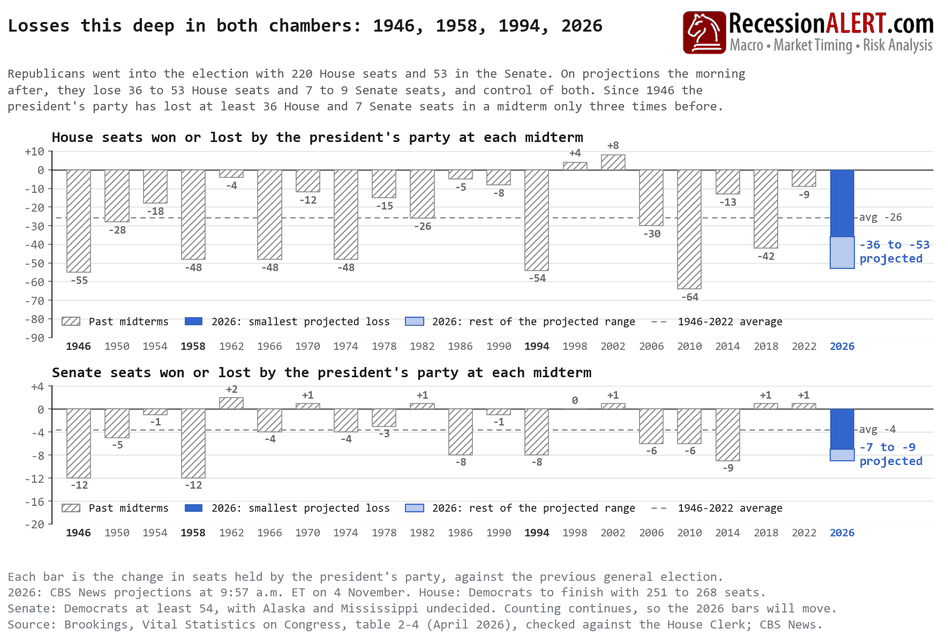
A midterm loss seen only three times since 1946 has bought the winners a brake, not a steering wheel. What makes it rare is the Senate. Only a third of its seats face voters at once, which usually blunts a wave: 1966 and 1974 each lost 48 House seats but only 4 senators. This time Republicans are projected to lose at least 7, about twice the usual, while the House toll of 36 to 53 could rank as high as fourth post-war. Yet Democrats’ projected 251 to 268 House and 54 to 56 Senate seats fall well short of the 290 and 67 needed to override a veto. Any bill the president opposes faces a veto they cannot overturn, including one to end tariffs that never needed a vote of Congress. That gridlock is what stocks bid for on Wednesday morning: by late morning the Dow was up 2.5%, the VIX gauge of expected volatility down 16% and the dollar softer, since tax cuts and stimulus get harder to pass. Inside the rally, chipmakers and data-centre builders fell, as Democratic wins in states such as Texas raised questions about restrictions that could slow the AI build-out. Opposition congresses have used two levers, and these seat counts leave only one. The 1946 Congress rewrote labour law over Truman’s veto; the 1994 Congress fought Clinton over spending through two shutdowns. On these seat counts, 2026 can only do the second.
What it means: For households, new tax cuts or stimulus payments look less likely from January, while the tariffs that raise the prices of imported goods stay in place. For stock investors, gridlock lowers the odds of sweeping new laws, but companies building data centres face fresh questions in states such as Texas. For the economy, the risk moves to the spending bills: if a funding fight ends the way 1995’s did, parts of the government shut down. This reading changes if a bill ending the tariffs wins two-thirds of both chambers in the new Congress.
Market Intelligence Brief (MIB) Ver. 20.00
For professional investors only. Not investment advice.
© 2026 RecessionALERT.com

Comments are closed.