
MARKET INTELLIGENCE BRIEF (MIB)
Tuesday, October 6, 2026
The S&P 500 topped 7,800 for its first record close since August (+0.58%), even with the 10-year at 5.274%. Constellation Energy jumped 12.25% on a 20-year Google nuclear deal, lifting Utilities 2.79%. Marvell rose 5.81% after setting a $70-90B fiscal 2031 revenue goal. Fed’s Daly named AI demand alongside oil and tariffs as shocks that could force more hikes if they compound. The August trade deficit widened to $105.6B. Skydance began trading after closing its Warner Bros. Discovery deal.
TABLE OF CONTENTS
A. EXECUTIVE SUMMARY
B. MARKET DATA
C. HIGH-IMPACT STORIES (5)
D. MODERATE-IMPACT STORIES (7)
E. ECONOMY WATCH (4)
F. EARNINGS WATCH (0)
G. WHAT’S NEXT
H. CHART OF THE DAY
A. EXECUTIVE SUMMARY -> TOP
The S&P 500’s first record close since August 13 (+0.58% to 7,818.93) came with the 10-year still at 5.274%, down only 4.1 bps from Monday’s 24-year closing high, so the record rests on AI-hardware earnings expectations rather than relief in discount rates. That AI spending is now named inside the Fed as an inflation shock: San Francisco Fed President Daly said further hikes depend on whether tariff, oil and AI shocks compound, and a $58 billion 3-year auction cleared at 4.932%, 46 bps above September, ahead of the September FOMC minutes. Crude offered no relief, with Brent rising 0.78% to $101.10 even as Saudi Arabia said its Hormuz-bypass pipeline was back at 5.8 million barrels a day. Sector breadth was wide, with ten of 11 rising led by Utilities (+2.79%) on Google’s Constellation nuclear deal, but size breadth was not: the Russell 2000 (-0.59%) and transports (-0.45%) fell, and Technology rose just 0.19% as chip-equipment losses offset AI-hardware gains.
• AI power: Constellation Energy jumped 12.25% to $300.40 after Google signed a 20-year agreement for 890 MW of new nuclear capacity from uprates at 11 Constellation units, plus a 15-year supply deal for 2,700 MW from its existing PJM fleet; Constellation will invest more than $4.3 billion, and Utilities led all 11 sectors (+2.79%).
• AI networking: Marvell rose 5.81% to $287.01 after raising its fiscal 2028 revenue target to about $20 billion from about $18 billion and setting a first fiscal 2031 goal of $70-90 billion; Cisco gained 4.54%, Arista rose 4.09% and Broadcom added 3.67%, while chip-equipment makers KLA fell 4.54% and Lam Research lost 3.44%. AMD rose 2.80% to a record $649.42 as Citi lifted its target to $800.
• Fed and funding: Daly said whether more hikes are needed depends on whether the tariff, oil and AI shocks fade or compound; the $58 billion 3-year auction cleared at 4.932% against 4.474% in September, with indirect bidders taking 57.6% versus 62.1%, though the 2-year yield still eased 2.3 bps to 4.793%.
• Oil: Brent rose 0.78% to $101.10 and WTI rose 0.48% to $89.86 as Saudi Arabia said its East-West pipeline was back at 5.8 million barrels a day despite Houthi strikes on Saudi airports; the EIA raised its 2027 Brent forecast to $84 from $74 and sees Middle East flows constrained through the fourth quarter.
• Macro: The August trade deficit widened to $105.6 billion against $102 billion expected as imports rose 4.3%; the Logistics Managers’ Index rose 3.6 points to 70.2, with transportation prices up to 92.7 while transportation capacity fell to 34.4.
• Deals and credit: Paramount Skydance closed its Warner Bros. Discovery acquisition and Skydance Corp. (SKYD) began trading on the NYSE; McKesson and CD&R agreed to buy Option Care Health for $32.05 a share (about $5.8 billion including debt); JPMorgan counts $65 billion of deeply distressed leveraged loans, the most since March 2020, with technology the biggest sector under pressure.
1. AI Is Both the Rally and the Rate Risk — Every leg of the record ran through AI: Marvell’s $70-90 billion fiscal 2031 target, AMD at a record with Citi’s target at $800, and Google underwriting 890 MW of new nuclear capacity on a 20-year contract. On the same day, Daly listed AI-driven demand beside tariffs and oil as a shock that could make inflation more persistent and further hikes necessary. With the 10-year still above 5.25%, equity investors are paying for AI earnings that a Fed official now treats as a reason to keep tightening. Wednesday’s minutes will show how widely that view is held on the Committee.
2. The AI Trade Is Narrowing to Contracted Exposure — Money moved into AI networking and AI power while chip-equipment makers fell and Technology as a whole rose just 0.19%; small caps and transports declined on a record day for the S&P 500. Beneath the equity surface, JPMorgan’s $65 billion of deeply distressed leveraged loans, with technology the largest sector, shows where floating-rate borrowers are absorbing a Fed that is still hiking. The market is rewarding AI exposure backed by contracts and hyperscaler order books, such as a 20-year power agreement or a raised five-year revenue target, over leveraged or cyclical technology.
3. The Energy Shock Is Moving Into the Cost Base — Brent held above $100 even with the Saudi bypass pipeline back near capacity, and the EIA’s $10 increase to its 2027 Brent forecast points to energy pressure lasting into next year. The pass-through is visible in freight: the Logistics Managers’ Index shows transportation prices at 92.7 while capacity contracts, with diesel averaging $6.832 a gallon in the last week of September, the second-highest reading ever. The policy responses so far, a G7 reserve release and a diesel excise deferral rather than a cut, address prices rather than supply, which supports Daly’s case that these shocks may persist.
 — Leading economic indicators. Accurate market forecasts. Apply for membership at join.recessionalert.com
B. MARKET DATA -> TOP
The S&P 500 closed at a record for the first time since August, its first close above 7,800, as AI-hardware strength met a pullback in Treasury yields from Monday’s 24-year closing high. It was a cap-weighted advance: the Russell 2000 (-0.59%) and DJ Transportation (-0.45%) fell even as the Nasdaq 100 posted its highest close since at least mid-April. Utilities (+2.79%) led all sectors after Google signed a 20-year nuclear power deal with Constellation Energy, while inside technology Marvell’s investor-day outlook lifted AI-networking names and chip-equipment stocks sold off. Brent held above $100 as rising Middle East exports and the G7 reserve release balanced Houthi attacks on Saudi airports.
CLOSING PRICES – Tuesday, October 6, 2026:
MAJOR INDICES
The S&P 500, Dow, Nasdaq 100 and NYSE Composite all rose about half a percent while the Russell 2000 and DJ Transportation slipped, so the record rested on large caps rather than broad participation. The S&P’s first close above 7,800 came alongside the Nasdaq 100’s highest close since at least mid-April. Dow Theory bull confirmation is now in its third session, with both the Dow and the transports still within 2% of their 10-session highs despite today’s transport dip.
| Index | Close | Change | %Move | Why It Moved |
|---|---|---|---|---|
| S&P 500 | 7,818.93 | +44.98 | +0.58% | Record close, the first since August; AI-chip strength (Nvidia and AMD at record highs) as Treasury yields eased |
| Dow Jones | 51,521.28 | +253.38 | +0.49% | Blue-chip gains alongside easing yields; Dow Theory bull confirmation in force for a third session |
| DJ Transportation | 19,701.76 | -89.80 | -0.45% | No discrete same-day catalyst identified; transports lagged the large-cap advance |
| Nasdaq 100 | 31,224.47 | +148.03 | +0.48% | Highest close since at least mid-April; Marvell’s investor-day outlook, AMD and Broadcom led AI hardware higher |
| Russell 2000 | 2,830.30 | -16.84 | -0.59% | No discrete same-day catalyst identified; small caps did not participate in the large-cap record |
| NYSE Composite | 23,921.67 | +133.06 | +0.56% | Ten of 11 sectors rose, led by Utilities; Healthcare was the lone decliner |
VOLATILITY & TREASURIES
Yields fell across the curve while the VIX dropped and equities set records, a risk-on pairing rather than a flight to safety. The 10-year fell more than the 2-year, flattening the 2s10s spread by about 2 bps to 48 bps after Monday’s 24-year closing high at the long end. The dollar slipped 0.31% as the euro firmed 0.33%.
| Instrument | Level | Change | Why It Moved |
|---|---|---|---|
| VIX | 15.01 | -0.51 (-3.29%) | Fell as the S&P 500 closed at a record |
| 10-Year Treasury Yield | 5.274% | -4.1 bps | Eased from Monday’s 5.315% close, its highest close in 24 years; no discrete same-day catalyst identified |
| 2-Year Treasury Yield | 4.793% | -2.3 bps | Fell less than the 10-year as the long end led the decline |
| US Dollar Index (DXY) | 101.85 | -0.32 (-0.31%) | Slipped from Monday’s highest close in 120 sessions as the euro firmed 0.33% and yields fell |
COMMODITIES
Gold and silver rose together while copper barely moved and platinum slipped, so the metals bid was a precious-metals move, not an industrial-demand signal. Bitcoin was flat on a record day for US equities, sitting out the risk-on tape entirely.
| Asset | Price | Change | %Move | Why It Moved |
|---|---|---|---|---|
| Gold | $4,191.80/oz | $+35.00 | +0.84% | Rose with yields and the dollar both lower; no discrete same-day catalyst identified |
| Silver | $61.675/oz | $+0.375 | +0.61% | Followed gold higher; no discrete same-day catalyst identified |
| Copper | $6.6598/lb | $+0.0188 | +0.28% | Edged higher; no discrete same-day catalyst identified |
| Platinum | $1,715.80/oz | $-7.90 | -0.46% | Slipped against the gold and silver advance; no discrete same-day catalyst identified |
| Bitcoin | $85,716.0 | $-60.0 | -0.07% | Flat despite the equity record; no discrete same-day catalyst identified |
ENERGY
WTI and Brent rose modestly together, with Brent holding above $100 and the Brent-WTI spread little changed near $11. Reuters attributed the near-flat settlement to rising Middle East exports and the G7’s planned reserve release offsetting Houthi attacks on Saudi airports. Henry Hub (+1.73%) and Dutch TTF (+3.02%) both outpaced crude.
| Asset | Price | Change | %Move | Why It Moved |
|---|---|---|---|---|
| Crude Oil (WTI) | $89.86/bbl | $+0.43 | +0.48% | Settled up one cent at $89.44 (Reuters) as rising Middle East exports and the G7’s 100-million-barrel reserve release offset Houthi attacks on Saudi airports; firmer after the settlement |
| Crude Oil (Brent) | $101.10/bbl | $+0.78 | +0.78% | Settled up 26 cents at $100.58 (Reuters) on the same balance of rising Middle East exports against Houthi supply risk; held above $100 |
| Natural Gas (Henry Hub) | $3.119/MMBtu | $+0.053 | +1.73% | No discrete same-day catalyst identified; the National Hurricane Center put Gulf of Mexico cyclone formation odds at 100% over seven days (Reuters), a production risk not confirmed as the driver |
| Natural Gas (Dutch TTF) | $24.91/MMBtu | $+0.73 | +3.02% | Rose 2.68% in euro terms and a firmer euro added to the dollar-equivalent gain; no discrete same-day catalyst identified |
S&P 500 SECTORS
Ten of 11 sectors rose, with Healthcare (-0.50%) the lone decliner. Utilities led (+2.79%) on Constellation Energy’s Google nuclear deal, a sharp one-day rebound for a sector still down 10.53% over six months. Technology gained only 0.19% despite record Nasdaq indices, as chip-equipment losses offset AI-hardware gains.
| Sector | 1-Day | 1-Week | 1-Month | 3-Month | 6-Month | YTD | 12-Month |
|---|---|---|---|---|---|---|---|
| Utilities | +2.79% | +3.72% | -3.43% | -8.52% | -10.53% | -3.53% | -6.23% |
| Consumer Cyclical | +1.10% | +2.77% | -2.56% | -2.32% | +4.43% | -7.06% | -8.12% |
| Consumer Defensive | +0.98% | -0.02% | -2.00% | -3.03% | -1.02% | +4.18% | +5.01% |
| Real Estate | +0.89% | -1.25% | -6.67% | -7.65% | -1.09% | +0.99% | -2.80% |
| Industrials | +0.85% | +3.44% | +0.44% | -2.93% | +4.66% | +12.04% | +12.72% |
| Basic Materials | +0.57% | +1.22% | -6.40% | +6.60% | -0.72% | +12.21% | +18.92% |
| Energy | +0.38% | +3.22% | -0.56% | +11.63% | +2.31% | +38.15% | +39.12% |
| Financial | +0.35% | -0.12% | -6.28% | -1.01% | +10.38% | +2.66% | +6.34% |
| Technology | +0.19% | +3.59% | +6.78% | +11.96% | +40.86% | +33.94% | +32.10% |
| Communication Services | +0.18% | +0.94% | +2.78% | +0.09% | +7.61% | +1.74% | +7.90% |
| Healthcare | -0.50% | -2.36% | -3.68% | -0.24% | +10.79% | +5.64% | +11.00% |
TOP MEGA-CAP MOVERS:
GAINERS
| Company | Ticker | Close | Change | Why It Moved |
|---|---|---|---|---|
| Marvell Technology | MRVL | $287.01 | +5.81% | Raised its fiscal 2028 revenue outlook to about $20 billion, roughly 67% growth, at its investor day today |
| Cisco Systems | CSCO | $117.94 | +4.54% | No discrete same-day catalyst identified; rose with AI-networking peers on the day Marvell raised its interconnect and switching market forecasts (read-through unverified) |
| Arista Networks | ANET | $215.36 | +4.09% | No discrete same-day catalyst identified; rose with AI-networking peers on Marvell’s investor-day market forecasts (read-through unverified) |
| GE Vernova | GEV | $1,029.21 | +3.96% | No discrete same-day catalyst identified; rose as the power complex rallied on Constellation Energy’s Google nuclear deal (link unverified) |
| Dell Technologies | DELL | $574.00 | +3.93% | Mizuho reportedly raised its price target to $650 from $600 today (unverified); AI-hardware names broadly higher |
DECLINERS
| Company | Ticker | Close | Change | Why It Moved |
|---|---|---|---|---|
| KLA Corp | KLAC | $197.46 | -4.54% | Morgan Stanley reportedly cut its price target to $227 from $253 on valuation today (unverified); chip-equipment peers also fell with no discrete group catalyst identified |
| Lam Research | LRCX | $333.89 | -3.44% | No discrete same-day catalyst identified; fell with chip-equipment peers KLA and Applied Materials |
| Intel | INTC | $112.50 | -3.18% | No discrete same-day catalyst identified; continuation of Monday’s slide, which was tied to a report on TSMC (unverified) |
| Thermo Fisher Scientific | TMO | $656.58 | -2.98% | No discrete same-day catalyst identified; no company release today, and Healthcare was the session’s only declining sector |
| Sandisk | SNDK | $1,660.46 | -2.56% | No discrete same-day catalyst identified; memory peer Micron also fell 1.73% |
— Institutional-grade intelligence for serious investors. Apply for membership at join.recessionalert.comC. HIGH-IMPACT STORIES -> TOP
BULLISH
1. The S&P 500 Closes Above 7,800 for the First Time, Its First Record Since August 13, as Yields Retreat From a 24-Year High and Small Caps Sit Out
The core facts:The S&P 500 rose 0.58% to 7,818.93, a record close that tops the 7,799.19 set on August 13 and is the index’s first close above 7,800. The Dow gained 0.49% to 51,521.28 and the Nasdaq 100 rose 0.48% to 31,224.47, while the Russell 2000 fell 0.59% and the Dow Jones Transportation Average 0.45%. Ten of the 11 S&P sectors rose, led by Utilities (+2.79%), with Healthcare (-0.50%) the lone decliner. Marvell (+5.81%) led the mega-caps after its investor day and AMD rose 2.80% to a record. The 10-year Treasury yield fell 4.1 basis points to 5.274% from Monday’s 5.315%, its highest close in 24 years, and the VIX slipped 3.29% to 15.01.
Why it matters:The record was set with the 10-year yield still above 5.25%, so it is being carried by earnings expectations for AI hardware rather than by any meaningful relief in discount rates. The breadth signal is the caution: the most rate-sensitive parts of the market, small caps and transports, fell on the day the large-cap index broke out, and Technology itself rose only 0.19% because chip-equipment and memory stocks sold off while AI networking and compute rallied. That leaves the advance resting on a narrow group of names at a time when Fed officials are still openly weighing further rate hikes.
What to watch:Wednesday’s 2:00 PM ET release of the September FOMC minutes; a 10-year close back above Monday’s 5.315% would test whether the record can hold without help from rates.
BULLISH
2. Google Signs a 20-Year Deal for 890 MW of New Nuclear Capacity From Constellation, Which Jumps 12%, and Utilities Lead the Market
The core facts:Google and Constellation Energy announced a 20-year power purchase agreement to bring 890 megawatts of new nuclear capacity onto the PJM grid through uprates at 11 Constellation-owned units in Illinois, Pennsylvania and New Jersey, plus a 15-year energy supply agreement for a further 2,700 MW from Constellation’s existing PJM fleet. Constellation will make more than $4.3 billion of new investment, with the first uprate expected by 2028, and selected Google Cloud and Gemini Enterprise under an expanded five-year technology alliance. Constellation shares rose 12.25% to $300.40, and Utilities led all 11 S&P sectors with a 2.79% gain.
Why it matters:Uprating existing reactors is the fastest route to new firm, carbon-free capacity, and a hyperscaler underwriting it on a 20-year contract converts AI power demand into contracted utility revenue rather than a forecast. The 2,700 MW supply leg matters as much as the new capacity, because it pays to keep existing plants running in a grid that is short of reliable supply. The rally lands on a sector still down 10.53% over six months, so the deal is a reminder that the AI build-out has a utility leg the market had been discounting. GE Vernova rose 3.96% with the power complex, though no company-specific link was confirmed.
What to watch:Whether Utilities extend their leadership beyond one session; a follow-through would mark a rotation toward contracted AI-power names rather than a one-day squeeze in a sector down 10.53% over six months.
BULLISH
3. Marvell Raises Its Fiscal 2028 Revenue Target to About $20 Billion and Sets a First $70-90 Billion Goal for Fiscal 2031; Shares Lead Mega-Caps With a 5.8% Gain
The core facts:At its investor day in New York, Marvell Technology raised its fiscal 2028 revenue target to about $20 billion from about $18 billion previously, above a consensus of roughly $18.2 billion, and introduced a first fiscal 2031 revenue target of $70 billion to $90 billion. The shares closed at $287.01, up 5.81%, the largest gain among US companies above $200 billion in market value. AI-networking names rose alongside it: Cisco gained 4.54%, Arista 4.09% and Broadcom 3.67%, though no company-specific catalyst was identified for Cisco or Arista.
Why it matters:A guidance raise outside an earnings report, with a five-year target several times current revenue, is a statement of visibility on custom AI silicon and data-center interconnect orders from hyperscalers. The market treated it as a read-through for the networking layer of AI spending, not for semiconductors as a whole: chip-equipment makers KLA (-4.54%) and Lam Research (-3.44%) fell the same day. That split is the more useful signal for positioning, because investors are paying up for exposure to AI data-center traffic while trimming the capital-equipment names that depend on broader fab spending.
What to watch:Whether Marvell holds above $287 in the next sessions as analysts reset fiscal 2028 estimates toward the new $20 billion target.
UNCERTAIN
4. Saudi Arabia Says Its Hormuz-Bypass Pipeline Is Back at 5.8 Million Barrels a Day, While Houthi Strikes on Saudi Airports Keep Brent Above $100
The core facts:Saudi Energy Minister Prince Abdulaziz bin Salman told the GCC 2026 Forum in Manama on Tuesday that the East-West pipeline, which carries crude to the Red Sea and around the Strait of Hormuz, was “back up to 5.8 million barrels” a day “as of this morning,” against a capacity of about 7 million and August flows of about 2 million (Al Jazeera). Brent rose 0.78% to $101.10 and WTI 0.48% to $89.86. Reuters put the settlements at $100.58 and $89.44, with rising Middle East exports and the G7’s 100-million-barrel reserve release weighed against Houthi attacks on Saudi airports in Jazan and Najran on Monday evening. The EIA also raised its Brent price forecasts in its October outlook, detailed in Economy Watch.
Why it matters:The bypass pipeline is the market’s main physical cushion against a disruption in Hormuz, and its return near full capacity is why crude barely moved on a day of new attacks on Saudi territory. But the cushion is the point of vulnerability as well: the line has been halted twice since September, and Brent holding above $100 even with exports recovering shows how little spare buffer the market believes it has. For US portfolios the transmission is inflation rather than energy equities, which rose only 0.38%: crude near $100 keeps pressure on fuel costs and on a Fed whose officials now cite oil as one of the shocks that could require further rate increases.
What to watch:Wednesday’s 10:30 AM ET EIA weekly petroleum report and any new strike on the East-West line; a Brent settlement back below $100 would signal the recovering exports are winning.
UNCERTAIN
5. Fed’s Daly Says More Hikes Depend on Whether Tariff, Oil and AI Shocks Compound, as a 3-Year Auction Clears at 4.932% Ahead of Wednesday’s Minutes
The core facts:San Francisco Fed President Mary Daly said she supported September’s rate hike and that whether more are needed depends on whether the shocks pushing up inflation fade or compound. “If the shocks that we’ve experienced — tariffs, oil prices from the Middle East conflict, and then AI — if they prove to be conventional shocks … then we may not need more. And I still have some probability on that,” she told Axios (Reuters). A second round of tariffs “would be a second shock on top of a first shock,” she said, and rising AI-related chip demand could make the shocks more persistent. Daly does not vote this year. Separately, the Treasury sold $58 billion of 3-year notes at 4.932%, up from 4.474% at the September sale, with weaker demand from indirect bidders, as detailed in Economy Watch. Yields still fell: the 2-year eased 2.3 basis points to 4.793%.
Why it matters:Daly’s framing puts the burden of proof on the shocks fading rather than on inflation falling, which leaves further hikes as the default if oil and tariffs persist. Naming AI demand as an inflation shock is the notable part for equity investors: the same AI spending that carried the S&P 500 to a record is now being cited inside the Fed as a reason rates may need to go higher. The auction cleared nearly half a point above September’s level with less foreign participation, a reminder of how much more the Treasury is paying to finance itself even on a day the secondary market rallied.
What to watch:The September FOMC minutes on Wednesday at 2:00 PM ET, for how many officials saw further hikes as likely, and demand at this week’s 10-year and 30-year auctions.
— Quantifying recession risk so you don’t have to guess. Apply for membership at join.recessionalert.comD. MODERATE-IMPACT STORIES -> TOP
UNCERTAIN
6. Paramount Skydance Completes Its Acquisition of Warner Bros. Discovery; the Combined Skydance Corp. Begins Trading on the NYSE
The core facts:Paramount Skydance closed its acquisition of Warner Bros. Discovery on Tuesday. WBD shareholders received about $31.02 a share in cash, WBD stopped trading on Nasdaq, and the combined company, renamed Skydance Corporation, began trading on the NYSE under the ticker SKYD. David Ellison is chairman and CEO and Ynon Kreiz co-CEO. The company cites combined revenue of nearly $70 billion, a target of more than $6 billion in run-rate synergies within three years and free cash flow above $10 billion by 2030; Bank of America, Citigroup and Apollo led the debt financing.
Why it matters:The deal puts HBO Max and Paramount+ under one owner and creates a studio and streaming group with the scale to compete with Netflix and Disney on content spending. The $6 billion synergy target implies deep cost cuts across overlapping studios, cable networks and streaming operations, and the debt-financed structure makes the new company a large leveraged credit at a time when long-term borrowing costs sit near multi-decade highs. How quickly it can cut costs while servicing that debt will set the tone for the rest of the media consolidation wave.
What to watch:Skydance’s first combined-company guidance on synergy timing and leverage, and any streaming-bundle or price changes for HBO Max and Paramount+.
BULLISH
7. McKesson and CD&R Agree to Buy Option Care Health for $32.05 a Share, About $5.8 Billion Including Debt
The core facts:Private-equity firm CD&R and McKesson signed a definitive agreement to acquire home and alternate-site infusion provider Option Care Health for $32.05 a share in cash, an enterprise value of about $5.8 billion and a premium of about 37% to Monday’s close. CD&R will hold about 51% and McKesson about 49% through a $1.4 billion investment, with a framework for McKesson to acquire CD&R’s stake later, subject to conditions. Closing is expected in the first half of 2027, subject to a shareholder vote and regulatory approvals. Option Care withdrew its financial guidance and will not hold a live call with its third-quarter results on November 4.
Why it matters:McKesson is buying a path into specialty therapies delivered at or near patients’ homes, one of the faster-growing and higher-margin channels in drug distribution, without taking the full balance-sheet load up front. The minority-stake structure with an option to buy the rest is a template for large distributors to expand into care delivery while limiting regulatory and financing risk. It also confirms that private-equity buyers are still writing large healthcare cheques despite borrowing costs near their highest levels in decades.
What to watch:The terms of McKesson’s path to full ownership, which the company has not detailed, and any antitrust review of its combined distribution and infusion footprint.
BULLISH
8. Becton Dickinson Commits $19 Billion of US Investment in Exchange for Relief From Coming Section 232 Medical-Device Tariffs
The core facts:Becton Dickinson announced a partnership with the US government under which it will make $19 billion of capital, operational and supply-chain investments over several years, including $3 billion to expand US manufacturing. It plans to add about 5 billion medical consumables a year to US production, raise its domestically supplied share of consumables to roughly 80% and make all BD needles used in America domestically with American-made steel. In return BD receives relief from future Section 232 tariffs on covered products and inputs, subject to the final scope of those tariffs and BD meeting agreed milestones. BD said it is not quantifying the financial impact because tariff rates, product scope and timing have not been set.
Why it matters:This is the first look at how Section 232 tariffs on medical devices are likely to work in practice: a headline tariff paired with company-by-company exemptions bought with domestic investment pledges. That shifts the risk for medtech investors from the tariff rate itself to each company’s ability to negotiate a deal, and favours manufacturers with the scale to commit billions to US capacity. Healthcare was the only S&P sector to fall on Tuesday (-0.50%), so the template arrives with the group already under pressure.
What to watch:The final Section 232 medical-device tariff rates and product scope, and whether other large device makers announce similar investment-for-relief agreements.
BULLISH
9. Fed’s Bowman Begins Restructuring Bank Supervision Into Five Regions and Flags Asset-Threshold and Tailoring Reforms Later This Year
The core facts:Fed Vice Chair for Supervision Michelle Bowman told a community banking conference in St. Louis that “today, we begin to restructure” the Fed’s supervision function into five regions drawn along state lines rather than Reserve Bank district boundaries, each with a regional leader accountable for all supervisory activity, while examiners stay at the Reserve Banks. She said the change addresses “a mismatch between authority for decisionmaking and accountability for supervisory decisions.” Later this year, the Board will consider indexing fixed-dollar asset thresholds with a five-year adjustment mechanism and broader reforms to the large-bank tailoring framework, including the $10 billion community-bank threshold. The speech carried no monetary-policy content.
Why it matters:Indexing asset thresholds is the market-relevant piece: thresholds fixed in dollar terms pull banks into tougher regimes as they grow with inflation, and resetting them would lower compliance costs for regional and mid-sized lenders that sit just below or just above those lines. Together with a supervision structure built around clear accountability, it extends the regulatory easing that has supported bank capital return. Financials rose 0.35% on Tuesday, so the announcement is a slow-burn positive rather than a same-day catalyst.
What to watch:The Board’s asset-threshold and tailoring proposals, which Bowman said would come later this year, for the specific dollar levels that would move regional banks between regimes.
UNCERTAIN
10. Trump Signs the Diesel Tax Relief Order, Allowing Tax-Free Dyed Diesel on Highways and Deferring the 24.4-Cent Federal Excise Tax Through Year-End
The core facts:President Trump signed the executive order at a rally in Grand Island, Nebraska on Monday evening, after reports earlier that day that it was being prepared. According to the White House, it temporarily authorizes highway use of tax-free dyed diesel and defers the 24.4-cent-per-gallon federal diesel excise tax through the end of 2026, with no interest or penalties on the deferred tax. The White House estimates federal savings of about $60 per 250-gallon fill, and up to $100 where states take matching action, and attributed high diesel prices to supply constraints from the Russia-Ukraine conflict and insufficient global refining capacity.
Why it matters:The relief is a deferral rather than a cut, so it improves cash flow for truckers and farmers this quarter but leaves the tax owed unless it is later forgiven. At about 24 cents a gallon it is small against diesel prices near last month’s record, and it does nothing about the refining and supply constraints driving them. For investors the order is a signal that the administration is prepared to use fiscal levers to cap fuel-driven inflation ahead of a heavy freight season, at a cost to federal highway revenue.
What to watch:Treasury and IRS implementation guidance, and whether states announce matching fuel-tax relief.
BEARISH
11. JPMorgan: Deeply Distressed US Leveraged Loans Reach $65 Billion, the Most Since March 2020, With Technology the Biggest Sector Under Pressure
The core facts:JPMorgan Chase strategists wrote on Tuesday that the value of US leveraged loans trading below 60 cents on the dollar, the deeply distressed tail of the market, rose to $65 billion from $40 billion a year ago, the highest since March 2020, with technology the single biggest sector under pressure (Bloomberg).
Why it matters:Loans priced below 60 cents are being valued for recovery rather than repayment, so a rising distressed tail is an early indicator of defaults ahead. The concentration in technology is the uncomfortable contrast with the equity market: while AI-hardware leaders set records, leveraged technology borrowers are where credit stress is building. Floating-rate borrowers are also carrying the full weight of a Fed that is still raising rates, which makes this a slow-moving risk for banks, CLOs and private-credit funds rather than a one-day event.
What to watch:Credit-quality and leveraged-lending commentary when JPMorgan, Goldman Sachs, Wells Fargo and Citigroup report third-quarter results on Tuesday, October 13.
BULLISH
12. Evercore ISI Upgrades Procter & Gamble to Outperform; Citi Lifts Its AMD Target to $800 and Mizuho to $705 on Agentic-AI Demand
The core facts:Evercore ISI upgraded Procter & Gamble to Outperform from In Line and raised its price target to $166 from $161, citing the company’s execution and structural progress; P&G shares rose 1.69% to $148.41, helping Consumer Defensive gain 0.98%. Citi raised its AMD price target to $800 from $575, citing the potential impact of agentic AI on computing demand, and Mizuho raised its target to $705 from $580 on agentic-AI demand tailwinds. AMD closed at a record $649.42, up 2.80%.
Why it matters:The two calls cover opposite ends of the market. Citi’s new AMD target sits well above the stock’s record close and reflects a view that AI agents, which run many tasks for each user, will raise demand for general-purpose server processors as well as accelerators. The P&G upgrade is a vote for defensive consumer staples with pricing power at a time when high fuel costs are squeezing household budgets and the Fed may still raise rates.
What to watch:AMD’s third-quarter results on November 3, and P&G’s results on October 22, for whether volume trends support Evercore’s call.
— Separating signal from noise since 2007. Apply for membership at join.recessionalert.comE. ECONOMY WATCH -> TOP
Tuesday’s releases pointed the same way: demand is strong and costs are rising with it. Imports jumped 4.3% to widen the August trade deficit to $105.6 billion, more than forecast, yet GDPNow held third-quarter growth at 3.7% as consumption and investment offset the trade drag. The cost side showed in freight, where the Logistics Managers’ Index reached 70.2 with transportation prices at 92.7, in the EIA’s higher Brent path of $84 for 2027 from $74, and in a three-year auction clearing at 4.932% on thinner indirect demand. Wednesday’s FOMC minutes are the next read on how the Committee weighs firm growth against persistent supply-driven price pressure.
U.S. Trade Deficit Widens to $105.6 Billion in August, Wider Than Expected, as Imports Jump 4.3% (BEA, Oct 6)
What they’re saying:The U.S. goods and services deficit widened to $105.6 billion in August, up $12.7 billion from a revised $92.8 billion in July and wider than the $102 billion consensus. Imports rose 4.3% to $420.8 billion, led by a $9.1 billion increase in industrial supplies including crude oil and gold and a $6.2 billion increase in capital goods, chiefly semiconductors, while exports rose 1.4% to $315.2 billion. The goods deficit widened $12.8 billion to $136.6 billion, and the services surplus was little changed at $31.0 billion.
The context:Net trade is now the largest drag on third-quarter growth: after the release, the Atlanta Fed’s GDPNow model lowered its estimate of net exports’ contribution to -2.69 percentage points from -2.59, yet held its growth estimate at 3.7% as its consumption and investment nowcasts rose to 3.4% and 21.5%. July’s deficit was also revised wider from an initially reported $88.6 billion. Year to date the deficit remains $138.2 billion, or 19.9%, below the same period of 2025, so the August jump reverses part of an improvement rather than setting a new trend.
What to watch:Preliminary October University of Michigan sentiment on Friday, October 9 (expected 47.6 vs. 48.1 prior) and initial jobless claims on Thursday, October 8 (expected 200,000 vs. 197,000 prior), for whether the domestic demand behind the import surge is holding up.
Logistics Managers’ Index Jumps to 70.2, Its Second-Highest in Four Years, as Transportation Prices Reach 92.7 (LMI, Oct 6)
What they’re saying:The Logistics Managers’ Index rose 3.6 points to 70.2 in September from 66.6 in August, its second-highest reading in four years behind only June’s 71.1. Transportation Prices rose 2.7 points to 92.7, above 90 for the fifth time in six months, and Inventory Costs rose 1.3 points to 79.9. Capacity moved the other way: Transportation Capacity fell 5.6 points to 34.4 and Warehousing Capacity fell 14.2 points to 39.3.
The context:Prices expanding while capacity contracts is the combination that passes cost increases through the supply chain. The report attributes the price gains to fuel, transportation services and the cost of goods, citing average diesel of $6.832 a gallon in the last week of September, the second-highest reading ever, and says U.S. consumers “have remained strong in the face of inflationary pressures.” Respondents’ forward-looking index stands at 68.6, pointing to elevated activity rather than a quick cooling.
What to watch:EIA weekly crude and gasoline inventory data at 10:30 AM ET on Wednesday, October 7, and the FOMC minutes at 2:00 PM ET the same day, for how the Committee weighs supply-driven cost pressures.
EIA Raises Brent Forecasts to $96 for 2026 and $84 for 2027, Sees Middle East Oil Flows Constrained Through Year-End (EIA, Oct 6)
What they’re saying:The Energy Information Administration’s October Short-Term Energy Outlook raised its Brent price forecast to an average $96 a barrel for 2026 from $91, and to $84 for 2027 from $74. It lifted its U.S. retail gasoline forecast to $3.91 a gallon for 2026 and $3.56 for 2027, from $3.84 and $3.35. The agency said oil flows from the Middle East “will remain constrained through Q4 2026” and that East Coast distillate inventories were 32% below their five-year seasonal average in September.
The context:The 2027 revision carries more weight than the 2026 one: a $10 increase in next year’s Brent path points to energy remaining a source of headline inflation pressure into next year rather than fading this quarter. Brent closed at $101.10 a barrel on Tuesday. The forecast was completed October 1, so its price path does not include the G7’s planned reserve release announced October 2. The EIA projects U.S. crude production at 13.9 million barrels a day in 2026, rising to 14.3 million in 2027.
What to watch:EIA weekly crude and gasoline inventory data at 10:30 AM ET on Wednesday, October 7, with distillate stocks in focus given the East Coast shortfall.
Three-Year Treasury Auction Clears at 4.932%, Up 46 Basis Points From September, on Softer Indirect Demand (Treasury Auction Results, Oct 6)
What they’re saying:The Treasury sold $58 billion of three-year notes at a high yield of 4.932%, up from 4.474% at the September 8 auction and, per TFTC’s auction tracker, the highest for the tenor since May 2006. The bid-to-cover ratio slipped to 2.62 from 2.72, and indirect bidders took 57.6% versus 62.1% in September, while direct bidders rose to 31.7% from 26.9% and primary dealers took 10.7%.
The context:The 46-basis-point rise in the clearing yield since September follows the Fed’s September rate increase and raises the government’s cost of rolling short-term debt. Indirect participation ran 8.3 percentage points below its six-auction average, but demand softened rather than failed: dealers took no more than in September, and the 2-year yield closed 2.3 bps lower at 4.793% on a day the 10-year eased 4.1 bps from Monday’s 24-year closing high.
What to watch:The FOMC minutes at 2:00 PM ET on Wednesday, October 7, and the September Monthly Budget Statement at 2:00 PM ET on Monday, October 12, for the scale of the financing need.
— Know the probability before the market prices in the risk. Apply for membership at join.recessionalert.comF. EARNINGS WATCH -> TOP
YESTERDAY AFTER THE BELL (Markets Reacted Today)
No major earnings yesterday after the bell from companies with >$100B market cap.
TODAY BEFORE THE BELL (Markets Already Reacted)
No major earnings before the bell from companies with >$100B market cap.
TODAY AFTER THE BELL (Markets React Tomorrow)
No major earnings after the bell from companies with >$100B market cap.
WEEK AHEAD PREVIEW:
Q3 2026 earnings season is just beginning (1.8% of the S&P 500 reported). PepsiCo reports Thursday, and the large banks open the season in earnest on Tuesday, October 13, alongside Johnson & Johnson and UnitedHealth.
PepsiCo (PEP) — BMO, Thursday, October 8 — Consensus EPS $2.29 on revenue of $24.95 billion. Key focus: North American snack and beverage volumes against price increases as high fuel costs squeeze consumer budgets, and whether input-cost inflation from energy and freight pressures margin guidance.
JPMorgan Chase (JPM) — BMO, Tuesday, October 13 — Consensus EPS $5.90 on revenue of $51.19 billion. Key focus: net interest income guidance with the 10-year yield near its highest levels in more than two decades, trading and investment-banking revenue, and credit commentary after its own strategists flagged the most deeply distressed leveraged loans since March 2020.
Johnson & Johnson (JNJ) — BMO, Tuesday, October 13 — Consensus EPS $2.69 on revenue of $25.37 billion. Key focus: medtech exposure to the coming Section 232 device tariffs after Becton Dickinson’s investment-for-relief deal, and pharmaceutical growth guidance for 2027.
UnitedHealth Group (UNH) — BMO, Tuesday, October 13 — Consensus EPS $4.12 on revenue of $111.31 billion. Key focus: medical cost trends and margin guidance for 2027, the first read on managed-care cost pressure this season.
Goldman Sachs (GS) — BMO, Tuesday, October 13 — Consensus EPS $13.30 on revenue of $16.86 billion. Key focus: advisory and underwriting fees in an active quarter for large mergers, and equities and fixed-income trading revenue.
Wells Fargo (WFC) — BMO, Tuesday, October 13 — Consensus EPS $1.84 on revenue of $22.31 billion. Key focus: loan growth and net interest income with long-term yields elevated, and consumer credit quality.
Citigroup (C) — BMO, Tuesday, October 13 — Consensus EPS $2.65 on revenue of $23.71 billion. Key focus: markets and services revenue, card credit costs, and progress on its return-on-equity targets.
No company above $100 billion reports on Wednesday, October 7, Friday, October 9 or Monday, October 12.
— US market commentary trusted by family offices and institutions. Apply for membership at join.recessionalert.comG. WHAT’S NEXT -> TOP
UPCOMING RELEASES:
| Date | Event | Why It Matters |
|---|---|---|
| Wed, Oct 7 | FOMC Minutes, September meeting (2:00 PM ET) | The first detailed record of the September hike. The key read is how many officials saw further increases as likely, after Daly said more depends on whether the tariff, oil and AI shocks compound; a hawkish count would test a record S&P 500 that is resting on AI earnings rather than lower yields. |
| Wed, Oct 7 | EIA Weekly Petroleum Status: crude stocks (prior +0.922M) and gasoline stocks (prior -1.684M), 10:30 AM ET | With Brent at $101.10 and the EIA reporting East Coast distillate inventories 32% below their five-year seasonal average in September, distillate stocks matter as much as crude for diesel costs and the freight-price pressure in the Logistics Managers’ Index. |
| Thu, Oct 8 | Initial Jobless Claims (expected 200K, prior 197K) | Claims near 200,000 give the Fed no labor-market reason to stop tightening, and test whether the domestic demand behind August’s 4.3% import jump is holding up. |
| Thu, Oct 8 | Fed’s Musalem speaks (1:40 PM ET) | The first Fed remarks after the minutes are public; any signal on whether oil and tariff pressures warrant another hike will be read against Daly’s conditional case. |
| Fri, Oct 9 | Michigan Consumer Sentiment, preliminary October (expected 47.6, prior 48.1) | Sentiment is already depressed while import data point to strong spending; a further drop with diesel near record prices would sharpen the split between how households feel and what they buy. |
| Fri, Oct 9 | Fed’s Collins speaks (4:00 PM ET) | Closes a week of Fed commentary after the minutes, and lands at the 4:00 PM close, so any shift in tone on further hikes carries into Monday’s open. |
| Tue, Oct 13 | Existing Home Sales, September (prior 3.98M, -2% MoM) | The first housing read with the 10-year near a 24-year high and the MBA 30-year rate at 7.3% in the prior week’s survey; another decline would show rate pressure spreading into household balance sheets. |
KEY QUESTIONS:
1. Will Wednesday’s minutes show a majority of officials expecting further hikes, and can the S&P 500 hold above 7,800 if the 10-year closes back above Monday’s 5.315%?
2. With Saudi Arabia’s East-West pipeline back at 5.8 million barrels a day, why is Brent still above $100, and would one more strike on the line, which has been halted twice since September, reprice the Hormuz risk?
3. Will the $65 billion distressed leveraged-loan tail, concentrated in technology, surface in credit commentary when JPMorgan, Goldman Sachs, Wells Fargo and Citigroup report on Tuesday, October 13?
— US market commentary trusted by family offices and institutions. Apply for membership at join.recessionalert.comH. CHART OF THE DAY -> TOP
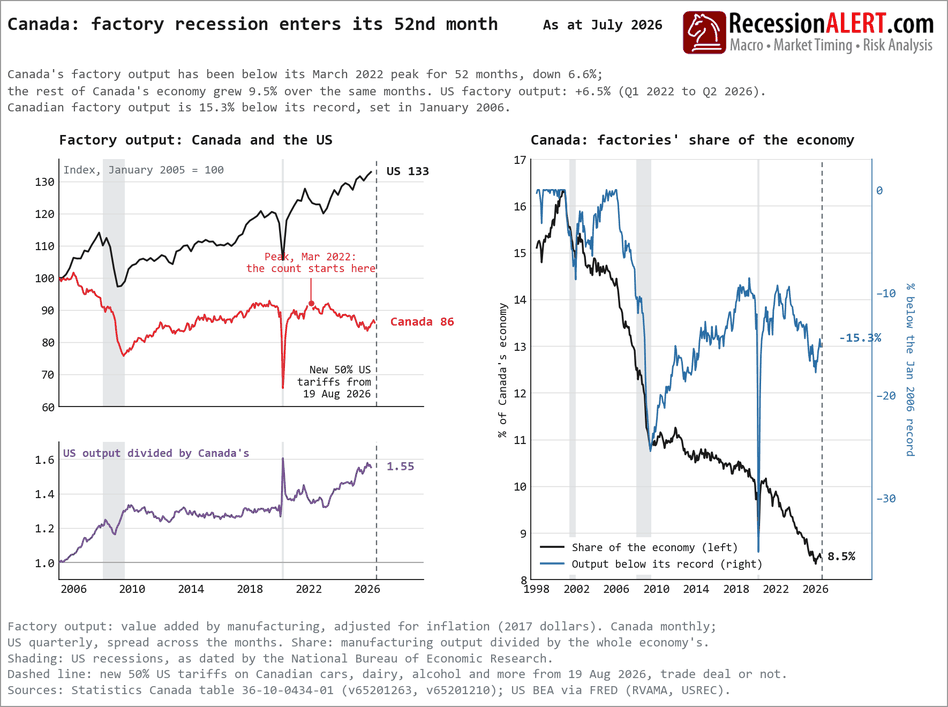
Canada’s factory rebound looks like resilience. It was a lull. Output rose about 4% from January to June as auto plants restarted and machinery and pharmaceuticals grew. Then a dormant 1930 law put 50% tariffs on Canadian vehicles, alcohol and dairy from 19 August, piercing the US-Mexico-Canada trade agreement’s tariff exemption, and September added more goods and import bans. The chart ends before any of it. September’s factory survey still shows growth, at 51.5, but export orders fell a fourth month on weaker US demand. The lull sat on an older slide: a factory recession in an economy whose other industries have grown 9.5% since March 2022. Output fell 4.4% before this trade war’s first tariff, as auto plants retooled and refining and chemicals slipped, then 5.2% as tariffs arrived: ending them could undo the second leg, not the first. Nor is the damage visibly America’s gain: US factory growth since early 2025 rides durable goods and the AI build-out, and taxing Canadian cars, whose plants move with US production, bills both ends of one assembly line. Unless Canada drops the auto, liquor and dairy measures the tariffs cite, the likelier path is worse before better: over 75% of exports go south, and Ottawa’s own target for doubling the rest is 2035. A tariff bites in a month; a new customer takes a decade. The gap is the forecast.
What it means: For US car buyers, the tariff falls on vehicles from a shared assembly line, so prices of Canadian-built models are where it can show up first. For stock investors, carmakers that build on both sides of the border will pay it on their own output until they move production or the tariff lifts. For the US economy, the bill is friction with its second-largest goods trading partner, which has announced retaliation. What would change this: export orders rising again in Canada’s October factory survey, due in early November.
Market Intelligence Brief (MIB) Ver. 19.79
For professional investors only. Not investment advice.
© 2026 RecessionALERT.com

Comments are closed.