
MARKET INTELLIGENCE BRIEF (MIB)
Friday, August 7, 2026
July payrolls contracted 23,000 against +83,000 expected — and the S&P 500 closed at a record 7,757.46 anyway, capping its best week since April. September hike odds collapsed from above 50% to 40%. Gold ripped 2.31% to $4,398.87; copper fell 1.87%. Energy was the only sector down more than 1% as crude surrendered Thursday’s Hormuz spike. Trump’s polysilicon tariff sent First Solar up 9%. And the White House restarted its bid to remove Fed Governor Lisa Cook.
TABLE OF CONTENTS
A. EXECUTIVE SUMMARY
B. MARKET DATA
C. HIGH-IMPACT STORIES (5)
D. MODERATE-IMPACT STORIES (6)
E. ECONOMY WATCH (6)
F. EARNINGS WATCH (1)
G. WHAT’S NEXT
H. CHART OF THE DAY
A. EXECUTIVE SUMMARY -> TOP
The S&P 500 closed at a record 7,757.46, up 0.62%, after a 23,000 contraction in July payrolls removed a September rate hike from the near-term distribution — prediction markets cut those odds from above 50% to roughly 40%. The composition of the move is what distinguishes a policy repricing from a growth scare: the 2-year fell twice as far as the 10-year, the dollar softened 0.32% and the VIX declined to 14.89, none of which happens if the market is discounting demand destruction. Breadth confirmed it, with eight of eleven sectors green and the rate-sensitive complex that had traded defensively all week — Utilities, Real Estate and the Russell 2000 — leading rather than lagging. The dissent came from the commodity tape: copper fell 1.87% and Energy dropped 1.09% as the only sector down more than a point, pricing the same print as a demand signal rather than a policy one.
• July payrolls fell 23,000 versus a +83,000 consensus — government jobs shed 53,000, unemployment ticked down to 4.1% only because participation slipped to 61.4%, and average hourly earnings growth cooled to 3.2% year-over-year, the weakest since May 2021.
• Record close caps the best week since April — S&P 500 +3.6% on the week, Nasdaq Composite +5.2%, the iShares Semiconductor ETF +7%; the Russell 2000 (+1.05%) outpaced the Dow (+0.28%) nearly four to one on the session.
• The metals complex split monetary from industrial — gold +2.31% to $4,398.87 and silver +3.33% on a falling dollar and a 4.8bp drop at the front end, while copper fell 1.87% to $6.58; Basic Materials led all sectors at +2.71%.
• Energy was the day’s only sector down more than 1% (-1.09%, -3.66% on the week) as WTI slipped to $77.15 and Brent to $82.27, surrendering the whole of Thursday’s 4.72% Hormuz spike even though Iran’s transit draft has yet to clear parliament.
• Trump signed a Section 232 polysilicon proclamation pairing a 15% tariff with minimum import prices ($21/kg polysilicon, $0.38/watt modules) effective December 4; First Solar traded up 8.95% pre-market, with SolarEdge, Sunrun and Enphase higher.
• The White House revived its removal bid against Fed Governor Lisa Cook — a 21-day response letter dated August 5 puts a determination window immediately ahead of the September FOMC; markets showed no visible reaction. Elsewhere, Mastercard (-2.26%) and Visa (-2.15%) were the session’s worst mega-caps on no catalyst, and Nielsen agreed to take DoubleVerify private for $2.15B at a 30% premium.
1. The market read a job loss as a policy input, not a demand input — and that choice, not the print itself, is what a record close is built on. Everything that had been discounted for a September hike reversed at once: Utilities +0.54%, Real Estate +0.55%, small-caps leading, the dollar and the VIX both lower. The trade works only while labour weakness stays confined to hiring. Copper and Energy took the other side of that bet today, and both readings cannot be right indefinitely.
2. Growth and hiring have decoupled by the widest margin of the cycle — the Atlanta Fed’s GDPNow has Q3 tracking at 5.8%, revised up from 5.0% on July 30, on the same week payrolls went negative. Consumer credit beat at $14.17B with revolving balances expanding at a 6.0% annual rate while wage growth hit a five-year low, which is the same divergence viewed from the household side. Spending data and hiring data are telling opposite stories, and the Fed’s own committee is split accordingly — Musalem argued this week for a July hike that never came.
3. Washington is now setting prices at the sector level, and re-opened a question the market had closed — a polysilicon price floor that cannot be absorbed the way a tariff can, $58M of EXIM critical-minerals lending paired with new S&P Global pricing benchmarks, and a reported move to restrict foreign-made robots all landed inside one session. The Cook letter is the tail risk within that pattern: Fed independence is priced into the long end and the dollar as an assumption rather than a variable, and assumptions of that kind reprice discontinuously. Watch the 30-year and the dollar, not the front end.
 — Leading economic indicators. Accurate market forecasts. Apply for membership at join.recessionalert.com
B. MARKET DATA -> TOP
A surprise 23,000-job decline in July payrolls reinforced Fed-on-hold expectations, powering broad risk-on gains led by growth and small-caps rather than blue-chips. Nasdaq 100’s 1.19% advance and Russell 2000’s 1.05% pop outpaced the Dow’s modest 0.28% rise, with 8 of 11 S&P sectors green. Gold’s 2.31% surge alongside falling yields underscores investors reading the jobs miss as disinflationary rather than recessionary. Energy was the lone notable laggard, down 1.09% as crude slipped, while payments giants Mastercard and Visa extended a regulatory-driven slide against the tape.
CLOSING PRICES – August 7, 2026:
MAJOR INDICES
NYSE Composite’s 0.45% gain sits between the Dow’s modest 0.28% advance and Nasdaq 100’s 1.19% surge — confirmation the rally was broad but growth-tilted. Russell 2000 outpacing the Dow signals small-caps participating alongside mega-cap tech, not a narrow AI-only move. DJ Transportation’s 0.38% gain roughly tracked the Dow, showing no Dow Theory divergence today.
| Index | Close | Change | %Move | Why It Moved |
|---|---|---|---|---|
| S&P 500 | 7,757.46 | +47.50 | +0.62% | Rallied on a surprise 23K July payrolls loss, reinforcing Fed-on-hold expectations. |
| Dow Jones | 54,036.52 | +151.42 | +0.28% | Lagged the broader rally as blue-chips underparticipated in the growth-led move. |
| DJ Transportation | 21,506.00 | +81.90 | +0.38% | Modest gain roughly tracked the Dow — no Dow Theory divergence. |
| Nasdaq 100 | 29,722.30 | +348.97 | +1.19% | Led index gains as growth/tech benefited most from a lower-for-longer rate read. |
| Russell 2000 | 3,033.18 | +31.63 | +1.05% | Small-caps outpaced blue-chips, broadening the rally beyond mega-cap tech. |
| NYSE Composite | 24,595.24 | +111.18 | +0.45% | Broad-market gain landed between the Dow and Nasdaq, confirming a wide but growth-tilted advance. |
VOLATILITY & TREASURIES
VIX’s drop alongside falling yields is the growth-friendly signature — investors reading the weak payrolls print as opening room for Fed cuts, not as a recession warning. The 2Y’s steeper decline (-1.13%) versus the 10Y (-0.49%) is the tell: front-end pricing is doing the work, curve steepening on rate-cut odds. DXY’s parallel slide confirms the dollar is pricing the same dovish repricing.
| Instrument | Level | Change | Why It Moved |
|---|---|---|---|
| VIX | 14.89 | -0.26 (-1.72%) | Volatility eased alongside falling yields — a growth-friendly, not fear-driven, signal. |
| 10-Year Treasury Yield | 4.647% | -2.3 bps | Yields fell as the weak jobs print reinforced Fed rate-cut expectations. |
| 2-Year Treasury Yield | 4.197% | -4.8 bps | Front-end yields fell more than the 10Y, steepening the curve on rate-cut odds. |
| US Dollar Index (DXY) | 99.61 | -0.32 (-0.32%) | Dollar softened in tandem with the dovish repricing of Fed policy. |
COMMODITIES
Gold, silver, and platinum rallied in lockstep — a monetary/rate-cut trade, not a fear trade, given equities also gained. Copper’s 1.87% drop breaks from precious metals entirely, confirming the move is about lower-rate expectations rather than industrial-demand optimism. Bitcoin’s modest 0.79% gain lagged both equities and gold, tracking risk sentiment without adding a distinct narrative.
| Asset | Price | Change | %Move | Why It Moved |
|---|---|---|---|---|
| Gold | $4,398.87/oz | +$99.27 | +2.31% | Rallied as investors priced in a more dovish Fed path after the jobs miss. |
| Silver | $63.66/oz | +$2.05 | +3.33% | Outpaced gold, tracking the same rate-cut-driven precious metals bid. |
| Copper | $6.58/lb | -$0.13 | -1.87% | Fell despite the broader commodities rally — an industrial-demand read diverging from the monetary trade in precious metals. |
| Platinum | $1,754.10/oz | +$16.20 | +0.93% | Gained alongside gold and silver in a broad precious-metals rally. |
| Bitcoin | $64,974.00 | +$509.00 | +0.79% | Modest gain tracked general risk-on sentiment without a distinct catalyst. |
ENERGY
WTI and Brent slipped in near-lockstep, keeping the spread flat — a demand-side read tied to the weak jobs print, not a supply disruption. Henry Hub’s 1.14% gain moved opposite crude entirely, confirming natural gas is trading its own domestic dynamics. Oil falling while equities rallied is a mild demand-growth-scare signal beneath an otherwise risk-on tape.
| Asset | Price | Change | %Move | Why It Moved |
|---|---|---|---|---|
| Crude Oil (WTI) | $77.15/bbl | -$0.14 | -0.18% | Slipped modestly, tracking a soft demand read from the weak jobs data. |
| Crude Oil (Brent) | $82.27/bbl | -$0.22 | -0.27% | Moved in tandem with WTI — spread held flat, no supply-side story. |
| Natural Gas (Henry Hub) | $2.670/MMBtu | +$0.030 | +1.14% | Rose independent of crude, trading its own domestic supply/demand dynamics. |
| Natural Gas (Dutch TTF) | $18.80/MMBtu | -$0.03 | -0.15% | Declined slightly, consistent with a quiet European gas session. |
S&P 500 SECTORS
Basic Materials’ 1D/1W/1M sweep atop a flat 3-month base (+0.16%) marks a sharp recent acceleration in an otherwise dormant sector. Energy’s slide (-1.09% today, -3.66% week) is a reversal within a YTD leader (+28.61%) — profit-taking, not a trend break. Communication Services remains the quarter’s laggard (-8.17% 3M) despite a flat session.
| Sector | 1-Day | 1-Week | 1-Month | 3-Month | 6-Month | YTD | 12-Month |
|---|---|---|---|---|---|---|---|
| Basic Materials | +2.71% | +8.87% | +9.00% | +0.16% | +4.19% | +16.58% | +39.21% |
| Industrials | +1.89% | +5.40% | +0.00% | +1.62% | +6.67% | +16.33% | +20.67% |
| Consumer Cyclical | +1.35% | +2.71% | +3.00% | -0.82% | +1.37% | -0.75% | +6.39% |
| Technology | +1.22% | +6.92% | +2.48% | +8.89% | +32.13% | +24.59% | +34.10% |
| Healthcare | +1.14% | +2.24% | +0.87% | +12.65% | +7.42% | +7.37% | +28.17% |
| Real Estate | +0.55% | -0.26% | +1.28% | +2.10% | +7.83% | +10.98% | +9.23% |
| Utilities | +0.54% | -1.23% | -3.19% | -4.84% | -0.30% | +2.40% | +4.97% |
| Consumer Defensive | +0.10% | +0.02% | +2.13% | -0.90% | -3.31% | +8.34% | +5.35% |
| Financial | -0.16% | +1.17% | +3.52% | +11.69% | +9.24% | +8.44% | +17.35% |
| Communication Services | -0.23% | +1.18% | -1.73% | -8.17% | +0.24% | +0.32% | +15.36% |
| Energy | -1.09% | -3.66% | +4.99% | +1.12% | +13.14% | +28.61% | +34.16% |
TOP MEGA-CAP MOVERS:
GAINERS
| Company | Ticker | Close | Change | Why It Moved |
|---|---|---|---|---|
| Space Exploration Technologies Corp | SPCX | $133.11 | +15.83% | Extended rally, absorbing the first tranche of a ~$100B post-IPO insider lock-up expiration without meaningful selling pressure. |
| Palantir Technologies Inc | PLTR | $172.01 | +10.32% | Continued momentum from this week’s earnings beat — 12th straight quarter of accelerating revenue growth — plus a defense contract extension. |
| Dell Technologies Inc | DELL | $453.77 | +3.68% | Rode the broad AI/tech-hardware rally alongside the Nasdaq 100’s 1.19% advance. |
| Crowdstrike Holdings Inc | CRWD | $214.42 | +3.39% | Tracked the day’s tech-sector strength (+1.22%) amid renewed cybersecurity/AI demand optimism. |
| Tesla Inc | TSLA | $328.58 | +2.83% | Participated in the broad growth/small-cap rally following the weak jobs print. |
DECLINERS
| Company | Ticker | Close | Change | Why It Moved |
|---|---|---|---|---|
| Mastercard Incorporated | MA | $562.95 | -2.26% | Extended slide tied to ongoing DOJ/interchange-fee regulatory overhang on card networks. |
| Visa Inc | V | $362.50 | -2.15% | Fell alongside Mastercard on the same regulatory pressure affecting card-network economics. |
| Arista Networks Inc | ANET | $188.67 | -1.90% | Profit-taking after its recent AI-networking rally, diverging from broader tech-sector strength. |
| Caterpillar Inc | CAT | $842.19 | -1.72% | Gave back part of its recent post-earnings surge despite a strong industrials-sector session. |
| Chevron Corp | CVX | $186.56 | -1.41% | Tracked crude oil’s modest slide (-0.18% WTI, -0.27% Brent) in an otherwise risk-on tape. |
— Institutional-grade intelligence for serious investors. Apply for membership at join.recessionalert.comC. HIGH-IMPACT STORIES -> TOP
BULLISH
1. Payrolls Contract and the Hike Trade Unwinds — the S&P 500 Closes at a Record 7,757.46 With the Front End Leading and Small-Caps Outpacing the Dow
The core facts:July nonfarm payrolls contracted 23,000 against a consensus of roughly +80,000 to +83,000; Section E carries the release and its composition in full. The market-impact layer is the story here. The S&P 500 rose 47.50 points, or 0.62%, to a record close of 7,757.46, taking out the all-time high set on Tuesday. The Nasdaq 100 gained 1.19% to 29,722.30 and the Russell 2000 1.05% to 3,033.18, while the Dow Jones Industrial Average added only 0.28% to 54,036.52 and the NYSE Composite 0.45% to 24,595.24. The front end of the curve did the work: the 2-year yield fell 4.8 basis points to 4.197% against the 10-year’s 2.3 basis points to 4.647%, a 2.5 basis-point steepening. The dollar index fell 0.32% to 99.61 and the VIX declined 1.72% to 14.89. Eight of eleven S&P sectors closed green, led by Basic Materials at +2.71%, Industrials at +1.89% and Consumer Cyclical at +1.35%. On the week the S&P 500 gained 3.6% and the Nasdaq Composite 5.2%, its best week since April, with the iShares Semiconductor ETF up 7%.
Why it matters:A negative payroll print can be read two ways, and the tape is unusually explicit about which reading won. Small-caps outpacing the Dow by nearly four to one, the 2-year falling twice as far as the 10-year, the dollar softening and volatility declining is the signature of a market pricing policy relief. A genuine growth scare produces the mirror image: the long end rallies harder than the front as the terminal rate collapses, the dollar bids as a haven, small-caps underperform because they carry the most cyclical and financing risk, and volatility rises. Not one of those four things happened. This resolves a question this report has been tracking all week. Prediction-market odds of a September hike had been running between 48% and 67% across recent sessions, and the entire complex of rate-sensitive assets had been trading defensively against that possibility — Utilities and Real Estate were the two weakest sectors on Thursday. A single print removed the hike from the near-term distribution, and everything that had been discounted for it reversed at once: Utilities +0.54%, Real Estate +0.55%, and the Russell 2000, the most rate-sensitive equity index in the market, leading the majors. The caution is that the same print is also the strongest argument against the rally, and the market simply chose not to price it. Payrolls have now gone negative, and the honest reading is that a labour market shedding jobs is not a labour market that supports 50%-plus blended earnings growth indefinitely. The market is currently treating the print as purely a policy input, which works only for as long as the weakness stays confined to hiring rather than reaching demand. And the Federal Reserve is not uniformly convinced: St. Louis Fed President Alberto Musalem argued this week that the committee should have raised rates 25 basis points in July, remarks Section E carries in full. A record close built on a job loss is a market that has bet the Fed reads the data the way it does.
What to watch:The 2s10s spread, which steepened 2.5 basis points today — continued steepening driven by the front end confirms a policy repricing, while a flattening back would mean the market is re-introducing hike risk. Watch whether the Russell 2000 holds its leadership over the Dow next week, since small-cap outperformance is the cleanest single test of whether the rate-relief trade has legs.
BEARISH
2. Energy Is the Only Sector to Fall More Than 1% on a Record Day as the Hormuz Reopening Trade Reasserts — Crude Gives Back Thursday’s Entire Spike
The core facts:WTI crude fell $0.14, or 0.18%, to $77.15 a barrel and Brent $0.22, or 0.27%, to $82.27 — surrendering the last of the 4.72% Brent spike driven by Iran’s restrictive Hormuz transit draft on Thursday. Energy was the weakest S&P sector at -1.09%, the only sector to fall more than 1% on a session the index closed at a record, and -3.66% for the week against the S&P 500’s +3.6%. Chevron fell 1.41% to $186.56, the largest decline among the session’s mega-cap movers. The fresh development is procedural: the Iran-Oman shipping arrangement has still not cleared Iran’s parliament, and the draft under parliamentary review is tougher than markets first priced, even as the administration continues to signal a pact that would release millions of barrels back into supply. No agreement is signed. Baker Hughes reported the US oil rig count at 454 for the week, up from 451 and above a 452 expectation, with total rigs unchanged at 588. Natural gas moved the other way, Henry Hub rising 1.14% to $2.670 per MMBtu.
Why it matters:Yesterday this report argued that Iran’s draft had repriced the terms of a Hormuz reopening rather than cancelled it, and that the asymmetry had shifted against a market positioned for a clean reopening. One session later the market has taken the opposite side of that argument and taken it decisively. The seven-percentage-point gap between the S&P’s weekly gain and Energy’s weekly loss is the cleanest available measure of how completely the supply-risk premium has drained out of the complex, and it happened without a single barrel actually moving through the strait. That is what makes this a repricing of probability rather than of physical supply, and it cuts both ways. The parliamentary hurdle is genuinely new information and it points toward delay, not resolution — yet crude fell anyway. A market that receives a negative headline on the reopening timeline and sells the commodity regardless has decided that reopening is the base case and that the remaining question is timing rather than outcome. That is a considerably more confident position than the evidence supports, given that the strait has been largely blocked since February and no agreement has been signed. The rig count is the corroborating detail and it is the one that matters for the medium term. US producers added rigs into a week when crude fell roughly 7%, which says drilling economics still work at these levels and that domestic supply is not the constraint. Combined with a reopening that the market now treats as inevitable, the setup for energy equities is a squeeze from both ends — more domestic supply arriving into a tape that has already priced the return of blocked barrels. Energy remains the year’s second-strongest sector at +28.61% year to date, so this is a reversal within a leadership position rather than a break in trend. But a sector that cannot rally on a record day, and cannot rally on a bearish headline for the reopening it fears, has lost the marginal buyer.
What to watch:Whether Brent can hold $80 — a break below would confirm the market is pricing the reopening as done rather than pending, and would put the sector’s +28.61% year-to-date lead under real pressure. Watch for the Iranian parliament’s vote on the transit draft, which is now the specific gate between a negotiated framework and an actual reopening.
BEARISH
3. The White House Revives Its Bid to Remove Fed Governor Lisa Cook — a 21-Day Letter Puts the June Supreme Court Ruling Back in Play
The core facts:Deputy White House Chief of Staff Daniel Scavino sent Federal Reserve Governor Lisa Cook a letter, dated August 5 and disclosed publicly today, demanding she answer allegations that she made false statements on mortgage applications and giving her 21 days to submit evidence or argument to the White House. The allegations originated with William Pulte, the Trump ally who oversees Fannie Mae and Freddie Mac. The procedural posture traces directly to June, when the Supreme Court ruled 5-4 that the Federal Reserve occupies a special place in government and that a president may remove a governor only for cause — expressly leaving it to the lower courts to determine whether these particular allegations meet that standard. The ruling was widely reported at the time as blocking the removal; it did not, it constrained the method. The letter is the administration constructing the notice-and-opportunity record the Chief Justice’s opinion required. Coverage was confirmed by the Washington Post and NPR affiliates. Markets showed no visible reaction: the 2-year yield fell 4.8 basis points, the dollar index declined 0.32% and gold rose 2.31%.
Why it matters:The market treated the June ruling as the end of this story, and that is the misreading this letter corrects. What the Court held was not that Cook is unremovable but that she is entitled to process, and that whether the mortgage allegations constitute cause is a question for the lower courts. The administration has now started the clock on exactly that process. Twenty-one days from August 5 places a White House determination inside the window running up to the September FOMC meeting — a meeting the market spent this week repricing from a possible hike to a hold. A contested removal proceeding against a sitting governor overlapping with that decision is a materially different institutional backdrop than the one currently priced. The mechanism that matters for portfolios is not who occupies the seat. It is that Federal Reserve independence is priced into the long end of the Treasury curve and into the dollar as a standing assumption, not as a variable, and assumptions of that kind reprice discontinuously rather than gradually. The market’s non-reaction today is genuine evidence and should be weighted — participants have seen versions of this before and have concluded, so far correctly, that it resolves without changing the composition of the committee. But the standing evidence for that view was the June ruling, and the June ruling has just turned out to permit precisely the outcome its interpreters said it foreclosed. The counterweight is that this remains a procedural step with no determination made, Cook has three weeks to respond, and any adverse decision faces immediate litigation in the lower courts the Supreme Court pointed to. Nothing about the September meeting’s composition is settled by a letter. What has changed is that a question the market had closed is open again, on a defined timetable that runs into a live policy decision.
What to watch:The 21-day response deadline, which falls in late August and immediately precedes the September FOMC meeting — a White House determination inside that window is the escalation that would force a market reaction. Watch the 30-year yield and the dollar rather than the front end, since institutional-credibility risk prices in term premium and the currency, not in the near-term policy path.
BULLISH
4. Trump Signs a Section 232 Polysilicon Proclamation Pairing a 15% Tariff With Minimum Import Prices — and Solar Rips
The core facts:The proclamation “Adjusting Imports of Polysilicon and its Derivatives into the United States” published on whitehouse.gov dated August 6, after Thursday’s close; the equity reaction ran through Friday’s session. The action pairs a 15% ad valorem tariff with minimum import price floors across the supply chain — reported levels include $21 per kilogram for polysilicon and $0.38 per watt for solar modules, with separate minimums for wafers and cells — and is framed under Section 232 as protection for US polysilicon production against Chinese dominance of both the solar and semiconductor feedstock chains. The measures take effect at 12:01 a.m. Eastern on December 4, 2026. First Solar rose 7.73% in Thursday’s after-hours session and traded up 8.95% at $266 in Friday’s pre-market, with SolarEdge, Sunrun and Enphase also higher. First Solar chief executive Mark Widmar called it “one of the most strategically significant trade measures in decades,” citing the combination of a minimum import price, an ad valorem tariff and enforcement mechanisms designed to close loopholes exploited by China-linked supply chains. Technology closed +1.22% and Basic Materials led all sectors at +2.71%.
Why it matters:The headline 15% rate is the least important number in this action. The minimum import price is the operative mechanism, and it is a fundamentally different instrument from a tariff. An ad valorem duty can be absorbed — through margin compression, currency, transshipment or under-invoicing — and Chinese solar supply chains have spent a decade demonstrating exactly that against successive US trade actions. A price floor cannot be absorbed, because it does not tax the price, it sets it. At $0.38 per watt for modules and $21 per kilogram for polysilicon, the floor removes the ability to compete on price below a defined level regardless of cost structure, which is why the domestic producer with the most integrated US manufacturing base reacted the way it did. This is also a semiconductor story that has been reported as a solar one. Polysilicon is the feedstock for wafers, and Section 232 is a national-security statute — invoking it here places solar and chip feedstock in the same category as steel and aluminium, which signals that the buildout of domestic semiconductor capacity is now being treated as a supply-chain security problem rather than a subsidy problem. That framing tends to persist across administrations in a way that tax credits do not. The constraint on reading this as unambiguously good runs through the cost side of the energy transition, and it is real. Every imported module gets more expensive from December 4, and the largest incremental buyer of US utility-scale solar is the data-centre complex, which is already the most capital-intensive construction programme in the market. Raising the input cost of power generation for that buildout at the same moment the market is scrutinising AI capital intensity is a genuine offset to the domestic-manufacturer gain. The four-month lead time also invites a pull-forward of imports into the fourth quarter, which will flatter volumes now and depress them later.
What to watch:The December 4 effective date and whether module import volumes spike into the fourth quarter — a large pull-forward would pull demand out of the first half of 2027 and complicate the read on domestic manufacturers’ order books. Watch whether utility-scale solar developers begin flagging higher project costs in guidance, which is where the tariff’s cost side first becomes visible.
UNCERTAIN
5. Gold Adds 2.31% to $4,398.87 and Silver 3.33% While Copper Falls 1.87% — the Metals Complex Splits Monetary From Industrial on the Same Session
The core facts:Gold rose $99.27, or 2.31%, to $4,398.87 an ounce. Silver gained 3.33% to $63.66 and platinum 0.93% to $1,754.10. Copper moved the other way, falling $0.13, or 1.87%, to $6.58 a pound. Basic Materials was the day’s strongest S&P sector at +2.71%, and is now +8.87% on the week and +9.00% on the month against a three-month base of just +0.16% — a sharp recent acceleration in a sector that had been dormant. The dollar index fell 0.32% to 99.61 and the 2-year Treasury yield 4.8 basis points to 4.197%. Equities rose across every major index on the same session, with the S&P 500 closing at a record and the VIX falling 1.72% to 14.89.
Why it matters:Precious metals rising more than 2% while copper falls nearly 2% on the same session is an unusually clean separation, and it settles what would otherwise be an ambiguous signal. Gold up 2.31% on a day equities set a record and volatility fell cannot be a fear trade — fear does not bid gold and stocks and sell volatility simultaneously. The falling dollar and the 4.8 basis-point drop at the front end supply the mechanism directly: gold is a zero-coupon asset whose opportunity cost is the short real rate, and both the nominal front end and the currency moved in its favour at once. Copper is the control variable that makes this readable. It shares gold’s dollar sensitivity and none of its monetary role, so when the two diverge this sharply the move is monetary rather than a general commodity or reflation bid. What keeps this uncertain is that copper’s decline is itself information, and it is not comfortable information. Copper is the market’s most reliable real-time read on industrial demand, and it fell on the same session that payrolls contracted 23,000. The bullish framing of today’s tape is that a weak labour print is a policy input; copper is pricing it as a demand input. Both readings cannot be right indefinitely, and the metals complex has effectively taken each side of the argument in the same session. The second constraint is positioning. Basic Materials has added roughly 9% in a month off a three-month base that was flat, which means nearly the entire move is recent and concentrated. Sectors that travel that far that fast are carrying crowded positioning by definition, and gold specifically has now run in a straight line through a stretch in which the case for it — dovish repricing, a softer dollar, and a live challenge to Federal Reserve independence documented in Story 3 — has been consistently reinforced. That is a strong fundamental case and a fragile technical one at the same time.
What to watch:The gold-copper ratio rather than either metal alone — continued divergence confirms a monetary trade, while copper turning up alongside gold would mean the market has switched to a reflation read. Watch whether gold holds above $4,300 if the dollar stabilises, which is the test of whether this is rate-driven or something more structural.
— Quantifying recession risk so you don’t have to guess. Apply for membership at join.recessionalert.comD. MODERATE-IMPACT STORIES -> TOP
BEARISH
6. Mastercard and Visa Are the Only Mega-Caps to Fall More Than 2% on a Record-Close Session — the Card Networks Sell Off on No News at All
The core facts:Mastercard fell 2.26% to $562.95 and Visa 2.15% to $362.50 — the two largest declines among the session’s mega-cap movers, on a day the S&P 500 closed at a record and eight of eleven sectors finished green. Financials was one of only three red sectors at -0.16%. No dated catalyst emerged for the move. The overhang is standing and runs on four fronts: the Department of Justice’s antitrust suit alleging Visa illegally maintains a monopoly over the debit network and uses that dominance to suppress cheaper alternatives; the revised interchange settlement before Judge Brian Cogan, which proposes trimming posted credit interchange by 10 basis points for five years and capping standard consumer-card interchange at 1.25% for eight years, and which merchant groups and consumer groups have both attacked as inadequate; the Credit Card Competition Act, which would mandate routing choice; and continuing stablecoin disruption concerns. Year to date Visa is down 6.56% and Mastercard 13.19% against a broadly flat S&P 500.
Why it matters:The absence of a catalyst is the observation, not a gap in the reporting. These are two of the highest-quality compounders in the index — duopoly network economics, operating margins above 55%, and volume that grows with nominal GDP — and they fell more than 2% on a session when the market rewarded almost everything else. A stock that declines on a strong day is telling you the marginal holder is using strength to exit, which is a different and more durable condition than a stock that falls on bad news. The year-to-date numbers corroborate it: Mastercard down 13.19% while the index is flat is not a reaction, it is a de-rating in progress. What is being de-rated is the durability of the interchange pool rather than current earnings, and that distinction explains why the selling persists without headlines. Each of the four pressures attacks the same variable from a different direction — the DOJ suit at the network layer, the Cogan settlement at the posted rate, the CCCA at routing, stablecoins at the rails themselves — and none of them requires a specific event to advance. A multiple built on the assumption that this fee pool is permanent has to compress as that assumption weakens, regardless of what the current quarter prints. The case against over-reading it is that these overhangs have been live for years and have repeatedly failed to change the economics: the settlement is still unapproved and contested from both sides, the CCCA has not passed, and stablecoin volumes remain immaterial against card volume. Card networks have absorbed every previous regulatory assault with margins intact. But the sequencing has changed. Previously the market discounted these risks and bought the dips; now it is selling the rallies.
What to watch:Judge Cogan’s decision on the revised interchange settlement — approval sets a rate ceiling for eight years and converts the overhang into a known quantity, while rejection reopens litigation on worse terms. Watch whether the two names underperform on further up-days, which is the specific pattern that distinguishes a de-rating from ordinary rotation.
BULLISH
7. Washington Funds, Prices and Convenes the Critical-Minerals Supply Chain on a Single Day
The core facts:Three separate critical-minerals actions landed today. The US Export-Import Bank is lending $58 million to three critical-mineral companies, including an $8 million loan to 5E Advanced Materials to expand boron production at its California project, slated for commercial production in 2028; boron was added to the US critical-minerals list last year and is used in nuclear energy, body armour and defence applications. The financing was timed to President Trump’s Friday meeting in Washington with executives from some of the world’s largest mining companies, alongside a White House fact sheet titled “President Donald J. Trump Announces Billions in New Deals and Investments to Power American Mining” and $180 million in grants for mining education. Separately, US Trade Representative Jamieson Greer issued a same-day statement welcoming S&P Global’s release of critical-minerals pricing benchmarks. Basic Materials led every S&P sector on the session at +2.71%.
Why it matters:The pricing-benchmark leg is the one worth extracting, and it is the one that got the least attention. The reason Western capital has not funded non-Chinese critical-mineral supply is not primarily geology or permitting — it is that most of these materials trade bilaterally with no transparent reference price, which makes it impossible to underwrite an offtake agreement, hedge a project, or model a debt schedule. Lenders cannot finance against a price that does not publicly exist. A recognised benchmark is the precondition for project finance in a way that a subsidy is not, because it changes what a bank can put in a credit memo rather than what a developer can put in a pitch deck. That the USTR chose to issue a statement welcoming a private data provider’s benchmark launch tells you the administration understands this as infrastructure rather than as commerce. Taken together the three actions describe a coherent structure — capital through EXIM, price discovery through the benchmarks, and political convening through the mining summit — which is a more considered approach than the tariff-first pattern that has characterised most of this administration’s supply-chain policy, including the polysilicon action in Story 4. The proportion needs stating plainly, and it argues for restraint. Fifty-eight million dollars is immaterial as capital; a single mid-scale mine costs multiples of it, and 5E’s boron project does not reach commercial production until 2028. The $180 million education grant operates on a decade-long horizon. None of this changes a supply picture in which China’s processing share is measured in the high double digits across most of the list. The signalling value is real and the sequencing is right, but investors should not confuse a well-designed framework with deployed capital. Today’s Basic Materials leadership was driven by precious metals, as Story 5 sets out, not by this.
What to watch:Whether the S&P Global benchmarks begin appearing as the reference price in announced offtake agreements — that is the specific evidence that price transparency is unlocking project finance rather than just publishing numbers. Watch for follow-on EXIM commitments at materially larger scale, since $58 million across three borrowers is a pilot rather than a programme.
BEARISH
8. A Federal Judge Calls Coinbase’s Prediction-Market Preemption Defence “Applesauce”
The core facts:A federal judge in Michigan rejected Coinbase’s bid to block state enforcement against its planned sports event contracts, offered through its partnership with Kalshi. Coinbase argued that the contracts fall under federal commodities law and the Commodity Futures Trading Commission’s exclusive jurisdiction rather than state gambling rules, and that complying with both federal derivatives law and Michigan’s Lawful Sports Betting Act is impossible. The court rejected that claim, writing that the assertion was “applesauce” and that higher costs or operational difficulty do not establish legal impossibility. This is a denial of preliminary relief, not a final judgment. Thirty-three federally recognised Indian tribes and the City of Detroit filed amicus briefs supporting Michigan, arguing that a Coinbase win would undermine tribal gaming sovereignty and Detroit’s casino tax base. Coinbase has brought parallel suits against Michigan, Illinois and Connecticut.
Why it matters:Federal preemption is not one argument among several for prediction markets — it is the entire operating model. The economics of event contracts depend on a single federal registration supporting nationwide distribution; if each state can apply its own gambling statute, the business becomes fifty separate licensing regimes with fifty sets of tax and compliance costs, which is precisely the structure that makes sports betting a low-margin business rather than a high-margin exchange. The court did not merely decline relief, it dismissed the impossibility argument in language that signals how it views the merits, and it did so on the reasoning that cost and operational burden are not the same as legal conflict. That reasoning generalises to the other jurisdictions Coinbase has sued. The amicus composition is the underappreciated detail and it is the one that makes this durable. Tribal gaming interests and a municipal casino tax base are not ordinary regulatory opponents — they are constituencies with statutory standing, revenue at stake, and considerable political durability at the state level, and they have now organised across thirty-four filings in a single case. That coalition does not dissolve on appeal. The case for restraint is genuine and should be applied carefully. This is preliminary relief only, decided on likelihood of success rather than on the merits, in one of three parallel actions, and a different circuit could reach the opposite conclusion and force the question upward. The regulatory direction of travel at the federal level has been broadly permissive toward event contracts. But Coinbase chose these venues, and losing the first one on the threshold legal theory — in this language — is a materially worse start than the market has priced into a business line that has been treated as a growth option rather than a legal question.
What to watch:The parallel Illinois and Connecticut rulings — a second adverse decision on the same preemption theory would establish a pattern and effectively force the question to the appellate courts. Watch whether the CFTC intervenes or files a statement of interest supporting the exclusive-jurisdiction reading, which is the single development that would most change the odds.
UNCERTAIN
9. Nielsen Takes DoubleVerify Private for $2.15 Billion at a 30% Premium — the Session’s Only Announced Deal
The core facts:Nielsen entered a definitive agreement to acquire DoubleVerify in an all-cash transaction at an enterprise value of approximately $2.15 billion, with DoubleVerify shareholders receiving $13.60 per share — a 30% premium to the company’s 60-trading-day volume-weighted average price as of August 5. Bloomberg had reported advanced talks on Thursday; the signed agreement was announced today. Both boards have approved, and the transaction is expected to close by the first quarter of 2027, subject to DoubleVerify shareholder approval, regulatory clearance and customary conditions. DoubleVerify rose roughly 12%. The company provides software that verifies media quality, optimises ad performance and measures campaign outcomes; Nielsen framed the deal as combining audience measurement with independent verification across viewability, invalid-traffic detection, brand suitability and media delivery. This was the only announced M&A transaction of the session. Communication Services was one of only three red sectors at -0.23%.
Why it matters:The timing is what makes this worth attention beyond its size. A 30% take-private premium for an ad-verification business landed on the same session that The Trade Desk fell 22% on a revenue miss and multiple firms cut it to Neutral, Sell and Underperform. Two very different valuations of adjacent assets cleared on the same day: the public market marked down independent ad-tech as a growth story, and a strategic buyer marked up independent ad-tech as infrastructure. The reconciliation is that verification and measurement are not growth businesses at all — they are toll-takers whose value rises with the complexity and fragmentation of the channels they measure, which means they benefit from precisely the conditions that make demand-side platforms harder to run. Nielsen is buying the audit layer, not the trading layer, and paying a control premium for it while the trading layer de-rates. The read for portfolios is about the M&A environment rather than about these two names. A financial-sponsor-backed private company committing $2.15 billion in all cash with a Q1 2027 close is a statement about financing availability and about regulatory expectations for a deal that consolidates measurement and verification under one owner — the exact combination that would have attracted scrutiny in a different antitrust posture. That this was the session’s only announced transaction is the constraint on reading it too broadly. One deal is a datapoint, not a cycle, and at $2.15 billion the target sits well below the scale at which a transaction moves index-level assumptions. The advertisers and agencies who rely on Nielsen and DoubleVerify as independent referees now face a single vendor holding both roles, which is a real customer-concentration objection and the most plausible source of regulatory or client friction before close.
What to watch:Whether advertiser or agency groups formally object to the loss of an independent verification vendor, which is the most likely route to regulatory delay before the Q1 2027 close. Watch for follow-on take-private activity in mid-cap ad-tech, which would turn one deal into the sector consolidation this implies.
UNCERTAIN
10. The Friday Analyst Tape Rewards Post-Earnings Winners and Marks Down Ad-Tech, Staples and Airlines
The core facts:A broad set of ratings changes landed. Upgrades: JPMorgan raised Etsy to Overweight from Neutral with a $100 target from $85; Wedbush raised Airbnb to Outperform; BofA raised Atlassian to Buy from Neutral; Morgan Stanley raised Roche to Overweight from Equal Weight, target $63 from $46; KeyBanc raised Quanta Services to Overweight from Sector Weight with an $807 target; Argus raised eBay to Buy; BNP Paribas raised Instacart to Neutral from Underperform, target $56; Argus raised SpaceX to Buy from Hold with a $160 target; and Unity was upgraded to Buy by HSBC, BofA, Benchmark and Deutsche Bank on the same day. Downgrades: BMO cut HubSpot to Market Perform from Outperform, target $215 from $230; Argus cut Procter & Gamble to Hold from Buy; Wells Fargo cut Allstate to Underweight from Equal Weight and Gap to Equal Weight; Citi cut JetBlue to Sell from Neutral, stating a preference for Delta, United and American among the majors; Bernstein cut Stellantis to Underperform; Seaport and Guggenheim both cut Roku; and The Trade Desk was hit with multiple cuts to Neutral, Sell and Underperform.
Why it matters:The skew is the signal and it is unusually clean today. Every upgrade of consequence went to a company that had just reported well — Atlassian, Airbnb, Instacart and Etsy all sit in the post-earnings winners’ column — and the downgrades concentrated in ad-tech, consumer staples and airlines. That is not a set of independent analytical judgements; it is the sell side extrapolating from a single reporting season, and it means the ratings tape is following price rather than leading it. The one call that carries genuine macro information is Argus cutting Procter & Gamble to Hold. Downgrading the largest consumer staple on the session small-caps outperformed and rate-sensitives rallied is a coherent risk-posture call rather than a company call, and it says the sell side is now positioning for the same policy relief the bond market priced today. The ad-tech cluster is the part with real read-through, and it corroborates Story 9 from the opposite direction. The Trade Desk taking cuts to Neutral, Sell and Underperform simultaneously, alongside two Roku downgrades, marks a coordinated de-rating of the demand-side and connected-television complex on the same day a strategic buyer paid a 30% premium for the verification layer. The sell side is not calling advertising down; it is calling the trading and inventory layer down while the measurement layer gets bid. The standing limitation applies at full force. Ratings changes are lagging indicators presented as forward calls, and today’s example is close to a caricature of the problem: Argus upgraded SpaceX to Buy with a $160 target on a session the stock rose 15.83% to $133.11, having already reversed off its lows two days earlier. Four separate firms upgrading Unity on the same morning tells you a disclosure occurred, not that four independent analytical processes converged. A cluster of same-day actions after a price move is the sell side catching up, and it is worth reading for what it says about consensus positioning rather than for direction.
What to watch:Whether the ad-tech downgrades broaden from single names into sector-level calls next week, which would mark the sell side moving from event response to a view on advertising demand. Watch for further staples downgrades, since a second and third cut in that group would confirm Argus’s Procter & Gamble call was a positioning signal rather than a stock-specific view.
UNCERTAIN
11. Unitree Prices China’s First Humanoid-Robot IPO at $9 Billion as Washington Moves to Restrict Foreign-Made Robots
The core facts:Unitree priced a 6.1 billion yuan offering, roughly $900 million, valuing the company at about 61 billion yuan, or $9.04 billion — making it China’s first publicly listed humanoid-robot maker. Revenue more than quadrupled to 1.7 billion yuan in 2025, and humanoids at 867.8 million yuan overtook quadrupeds as the largest business line. Unitree’s own prospectus warns that US tariffs, limits on government purchases, export controls or the loss of existing approvals could impair overseas growth and disrupt its supply of imported parts. The listing prices into a reported US move to restrict new foreign-made robots. AgiBot is lining up a Hong Kong listing next year, indicating a broader China robotics IPO pipeline is opening.
Why it matters:Humanoid robotics has been financed in the West primarily inside large diversified balance sheets, where the spending is a line item inside a broader capital budget and is not separately valued. Unitree’s listing changes that by establishing a public comparable at $9 billion on 1.7 billion yuan of revenue, which is roughly a thirty-eight-times sales multiple on a business whose largest line only became the largest line last year. Public pricing at that level pulls capital toward the category on both sides of the Pacific and gives Chinese competitors a currency — listed equity — for acquisitions and hiring that private status denied them. That is the durable consequence, and it operates regardless of whether this specific company succeeds. The prospectus disclosure is the part a US portfolio manager should read most carefully, because it is the issuer conceding the thesis. A company raising capital has every incentive to minimise regulatory risk in its risk factors, and Unitree instead names tariffs, government-purchase limits and export controls as material threats to overseas growth and to its own imported-parts supply. That last item cuts against the standard framing: the supply-chain dependency runs in both directions, and a restriction regime that blocks Chinese robots from US buyers also plausibly blocks US components from Chinese builders. The reason this reads uncertain rather than as a clean positive for domestic robotics is a timing problem. Restricting foreign-made robots protects US manufacturers from the lowest-cost competitor at a moment when domestic humanoid capacity at commercial scale does not meaningfully exist, which converts a competitive advantage into a supply constraint for the American industrial buyers who would otherwise be automating. Protection granted before capacity exists raises the cost of automation rather than accelerating it, and the beneficiaries are equity holders in domestic robotics rather than the industrial base the policy is meant to serve.
What to watch:Whether the reported US restriction on foreign-made robots is issued as a formal action with a defined scope and effective date, which is what converts it from a headline into a procurement constraint. Watch AgiBot’s Hong Kong listing terms next year as the test of whether Unitree’s multiple holds or was a scarcity premium on the first listed name.
— Separating signal from noise since 2007. Apply for membership at join.recessionalert.comE. ECONOMY WATCH -> TOP
July’s jobs report delivered the labor market’s first negative payroll print in months — down 23,000 against a forecast +83,000 gain, with government payrolls the biggest drag — while the Atlanta Fed’s GDPNow tracker simultaneously firmed to 5.8% for Q3, the widest growth-versus-hiring gap of the cycle. Treasury yields fell and September hike odds cooled from over 50% to roughly 40% as markets read the miss as disinflationary, landing one day after St. Louis Fed’s Musalem argued for tighter policy on a labor market he called “stabilized” — a read the data just contradicted. Consumer signals stayed mixed but broadly resilient: credit growth beat estimates, inflation expectations eased, and wages kept outpacing home prices.
July Payrolls Unexpectedly Fall 23,000, First Drop in Months as Fed Hike Odds Cool (CNBC/BLS, August 7, 2026)
What they’re saying:Nonfarm payrolls fell by 23,000 in July, badly missing the Dow Jones consensus forecast for an 83,000 gain, driven by a 53,000 drop in government jobs alongside softness in retail, leisure/hospitality, and slower healthcare hiring. The unemployment rate ticked down to 4.1% from 4.2%, largely because fewer people were working or looking for work as the participation rate slipped to 61.4%. Average hourly earnings growth slowed to 3.2% year-over-year, the weakest pace since May 2021.
The context:Treasury yields fell on the release — the 2-year note dropped 8 basis points to 4.16% and the 10-year fell 6 basis points to 4.61% — as traders priced out imminent Fed tightening; September rate-hike odds fell from above 50% to roughly 40%. Richmond Fed’s Barkin, speaking hours after the release, called the 4.1% unemployment rate “neither loose nor tight” but flagged “cause for caution” if the deterioration continues; the White House attributed the weakness in part to World Cup disruption and government spending cuts.
What to watch:The August employment report, due September 4, and whether the September FOMC meeting reflects the market’s reduced hike expectations.
St. Louis Fed’s Musalem Argues for More Restrictive Policy, Citing Above-Target Inflation (Seeking Alpha, August 6, 2026)
What they’re saying:St. Louis Fed President Alberto Musalem said inflation remains well above the FOMC’s 2% target even as growth has stayed resilient and the labor market “stabilized,” arguing for tighter monetary policy at a Center for Public Policy Debate event.
The context:The remarks landed one day before Friday’s payrolls report showed the labor market anything but stabilized, with a rare negative headline print. Musalem’s hawkish framing — built on a pre-jobs-report read of a resilient economy — is now in tension with the data, underscoring the split among policymakers over whether inflation or labor risk deserves priority.
What to watch:Whether Musalem or other hawks walk back the “stabilized labor market” framing ahead of the September FOMC meeting.
Atlanta Fed’s GDPNow Q3 Tracking Estimate Holds Near 5.8% (Atlanta Fed, August 6, 2026)
What they’re saying:The Atlanta Fed’s GDPNow model pegs Q3 2026 real GDP growth at 5.8%, up sharply from its initial 5.0% estimate on July 30 and driven by upward revisions to nowcasts of Q3 consumption and private domestic investment.
The context:A GDP-tracking estimate this strong sits awkwardly against the same-day jobs miss — GDPNow reflects hard spending and investment data rather than payrolls, and the divergence is the widest of the current cycle between growth momentum and hiring. Treat the nowcast as provisional pending the July jobs report’s downstream effect on consumption assumptions.
What to watch:The next GDPNow update and whether it is revised down to reflect the weaker labor backdrop.
Consumer Credit Surges Past Forecasts in June, Revolving Balances Accelerate (Federal Reserve G.19, August 7, 2026)
What they’re saying:Total consumer credit rose $14.17 billion in June, beating the $10.5 billion consensus and reversing May’s $1.08 billion decline; the Fed’s G.19 release showed overall credit expanding at a 3.3% annual rate, with revolving (credit-card) balances up at a 6.0% annual pace against 2.3% for nonrevolving credit.
The context:Renewed appetite for revolving credit can reflect either confident consumers or households leaning on cards as wage growth cools — average hourly earnings growth just slowed to a five-year low in the same week’s data, making the credit build worth watching rather than an unambiguous positive.
What to watch:Delinquency rates in the next quarterly household debt report and whether revolving growth persists alongside slowing wage gains.
NY Fed Survey Shows Consumer Inflation Expectations Ease to 3.6% (New York Fed, August 7, 2026)
What they’re saying:The New York Fed’s Survey of Consumer Expectations showed one-year-ahead inflation expectations easing to 3.6% in July from June’s 3.7% reading, which had itself been the highest since September 2023.
The context:The pullback interrupts two straight months of rising short-term inflation expectations and gives the Fed some room to weigh the labor-market miss without an inflation-expectations complication; it follows June’s survey showing improved job-finding expectations and declining job-loss expectations, though those figures pre-date Friday’s weak payrolls print.
What to watch:Whether the softer near-term reading holds in August’s survey, especially given the fresh jobs miss.
Wage Growth Outpaces Home Prices for a Fourth Straight Year (Seeking Alpha/WisdomTree, August 2026)
What they’re saying:Wage growth has outpaced existing home-price appreciation every year since 2023, according to WisdomTree’s Jeff Weniger; wages are on pace to grow roughly 3.4% in 2026, outrunning projected home-price growth by about 1.2 percentage points.
The context:The trend is gradually repairing housing affordability after the 2022 peak, when the home-price-to-income ratio hit 5.2; it now sits near 4.9, still above the 2017-2019 norm of 4.1. It’s a slow-moving structural tailwind rather than a single-day catalyst, but it reinforces the case that consumer balance sheets aren’t uniformly deteriorating even as labor cools.
What to watch:Q3 home-price indices (Case-Shiller, FHFA) against Q3 wage data for confirmation the gap is holding.
— Know the probability before the market prices in the risk. Apply for membership at join.recessionalert.comF. EARNINGS WATCH -> TOP
YESTERDAY AFTER THE BELL (Markets Reacted Today)
BULLISH
12. Cloudflare (NET): +13% | AI Agent Traffic Crosses Half the Network as a Beat-and-Raise Lifts the Full Year
The Numbers:Released AMC Thursday, August 6. Second-quarter revenue of $696.1 million rose 36% year over year and beat the $664.67 million consensus by roughly 4.7%. Adjusted EPS of $0.29 beat the $0.27 estimate. Non-GAAP income from operations was $96.1 million, or 13.8% of revenue. Full-year 2026 revenue guidance was raised to $2.86-$2.87 billion from $2.80-$2.81 billion, and full-year adjusted EPS guidance to $1.25-$1.26 from $1.19-$1.20. The stock traded up 16.2% at $330.51 ahead of Friday’s open and closed the session up roughly 13%.
The Problem/Win:The milestone that drove the move was not the beat. Automated traffic generated by AI agents surpassed 50% of Cloudflare’s total network volume for the first time, and management tied the raised second-half outlook directly to that shift. A beat of 4.7% on revenue is respectable but ordinary; a structural change in what the network carries is not, and it is what allowed the company to raise both revenue and earnings guidance rather than only revenue.
The Ripple:TD Cowen raised its price target to $355 from $300 while maintaining a Buy, citing unprecedented year-over-year net customer additions across every large customer segment. Cloudflare was part of an enterprise-software cluster that made the group the day’s strongest complex — Atlassian rose 35% and Twilio 23% on their own results — and Technology closed +1.22%, second only to the cyclical sectors leading the tape.
What It Means:Cloudflare has spent this cycle being valued as a security and content-delivery vendor competing on price against larger clouds. The AI-traffic milestone reframes it as a toll on agent activity, which is a volume business that grows with AI adoption rather than with seat count — a materially better position than most of the software complex, which is being marked down on exactly the question of whether AI expands or replaces its revenue base.
What to watch:Whether the AI-traffic share keeps climbing in the third quarter and, critically, whether it converts into revenue per customer rather than into uncompensated bandwidth — the monetisation gap is the bear case. Watch Cisco’s report on Wednesday, August 12 for the network-layer read on whether AI traffic growth is showing up in infrastructure orders.
TODAY BEFORE THE BELL (Markets Already Reacted)
No major earnings before the bell from companies with >$100B market cap.
TODAY AFTER THE BELL (Markets React Tomorrow)
No major earnings after the bell from companies with >$100B market cap.
WEEK AHEAD PREVIEW:
Q2 2026 earnings season is 88% complete, and today’s calendar was empty of mega-caps — the largest reporter was Vistra Corp at $47.4 billion. Next week reopens with the index’s single largest company and then turns to the AI infrastructure chain.
Berkshire Hathaway (BRK.B) — BMO, Monday, August 10 — the week’s only mega-cap on Monday’s calendar at a $1.01 trillion market capitalisation, with consensus of $5.04 per share on $96.52 billion of revenue; broader estimates look for a roughly 12.9% year-over-year earnings decline on 4.3% revenue growth. Key focus: what Greg Abel does with a record $397.4 billion cash and short-term investment position in his second full quarter as chief executive — buybacks versus acquisitions is the question the market is actually asking — plus insurance underwriting income and float in a softening market. Results are filed over the weekend, so Monday’s session is the first opportunity to price them.
Cisco Systems (CSCO) — AMC, Wednesday, August 12 — expectations are for mid-teens revenue growth on AI networking orders, with gross margin guided to contract roughly two percentage points year over year. Key focus: whether AI order growth is large enough to offset the margin compression it costs, and the read-through to Cloudflare’s agent-traffic thesis in Story 12.
Applied Materials (AMAT) — AMC, Thursday, August 13 — consensus of $3.39 per share, up 36.7% year over year, on revenue of $9.01 billion, up 23.4%. Key focus: the cleanest available read on whether semiconductor capital-equipment orders match the spending the hyperscalers have guided to, which is the central unresolved question in the AI capital-intensity debate.
Deere & Co (DE) — BMO, later in the week — calendar sources conflict between Thursday, August 13 and Friday, August 14, so the day should be confirmed before positioning. Key focus: agricultural capital-goods demand and dealer inventory, the cleanest read available on farm-sector credit conditions.
With 88% of the index reported and blended growth running at +50.4%, next week is the season’s last cluster of consequence; the remaining calendar thins materially thereafter.
— US market commentary trusted by family offices and institutions. Apply for membership at join.recessionalert.comG. WHAT’S NEXT -> TOP
UPCOMING RELEASES:
| Date | Event | Why It Matters |
|---|---|---|
| Tue, Aug 11 | Existing Home Sales (Jul) — prior 4.09M; MoM also released | The front end fell 4.8bp today on payrolls; housing is where a lower policy path transmits first. With wage growth outrunning home-price appreciation for a fourth year, sales volume is now the test of whether affordability repair is reaching transactions. |
| Tue, Aug 11 | Total Household Debt (Q2) — prior $18.8T | June consumer credit beat at $14.17B with revolving balances growing at a 6.0% annual rate while wage growth hit a five-year low. The delinquency detail in this report is the direct test of whether that credit build is confidence or substitution. |
| Wed, Aug 12 | CPI (Jul) — headline prior 3.5% YoY / -0.4% MoM; core prior 2.6% YoY / 0% MoM | The week’s most consequential release. Today’s rally priced a September hike out of the distribution on labour data alone; a hot core print reintroduces the hawkish case that Musalem made this week and puts the front-end repricing directly at risk. |
| Wed, Aug 12 | Monthly Budget Statement (Jul) — prior -$120B | Deficit trajectory feeds Treasury issuance and term premium. It matters more than usual with a contested Fed-governor removal proceeding running into September, since institutional-credibility risk prices in the long end rather than the front. |
| Thu, Aug 13 | PPI (Jul) — headline prior -0.3% MoM / 5.5% YoY; core prior 0.2% MoM / 4.7% YoY | Headline PPI at 5.5% year-over-year sits far above CPI, and that gap is a margin story. Confirmation or reversal the day after CPI determines whether pipeline pressure is still building behind consumer prices. |
| Thu, Aug 13 | Initial Jobless Claims (week of Aug 8) — prior 199K; Continuing Claims prior 1,801K | Claims at 199K are not consistent with a payroll contraction. The first weekly reading after today’s print is the earliest check on whether July’s job loss reflects genuine deterioration or a composition distortion in government and seasonal hiring. |
| Thu, Aug 13 | Fed speakers: Hammack and Barkin | Both speak after CPI and PPI. Barkin called 4.1% unemployment “neither loose nor tight” today while flagging caution; whether the hawkish wing walks back the “stabilized labor market” framing is the clearest available read on the September FOMC. |
KEY QUESTIONS:
1. Does Wednesday’s CPI let the market keep reading a negative payroll print as a policy input? A firm core reading would force equities to price the same data as a demand problem — the reading copper and Energy already took today.
2. Can growth and hiring stay decoupled? GDPNow has Q3 tracking at 5.8% while payrolls contract; either the nowcast revises down toward the labour data or hiring re-accelerates, and Thursday’s claims figure is the first evidence either way.
3. How does the market price a contested Fed-removal proceeding overlapping a live policy decision? Cook’s 21-day window closes in late August, immediately before the September FOMC, and the non-reaction so far rested on a June ruling that has turned out to permit exactly this.
— US market commentary trusted by family offices and institutions. Apply for membership at join.recessionalert.comH. CHART OF THE DAY -> TOP
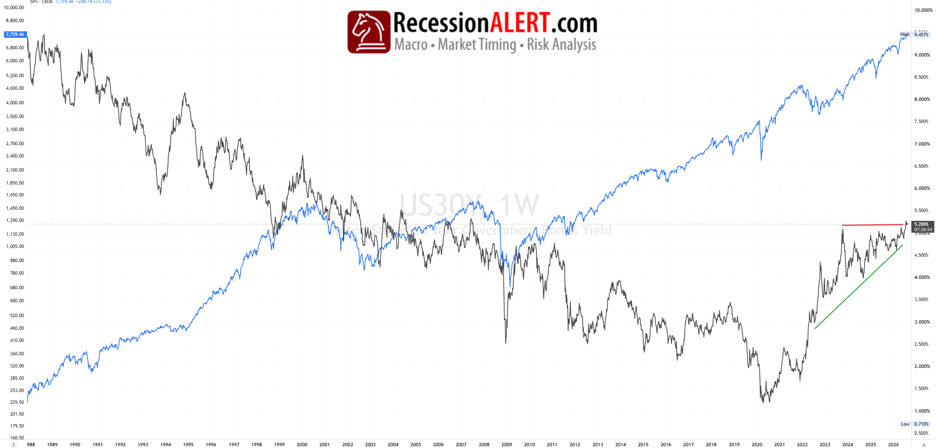
The Chair said the right words, and the long bond sold off. On 29 July, Kevin Warsh told markets there is no soft inflation target, only 2%. The 30-year yield rose 12bp during those remarks. The 2-year fell 4bp. The front end took him at his word. The back end did not. The disbelief has a price. The 30-year TIPS yield now pays 2.96% real, the highest real return the long bond has offered since the crisis. That is compensation for doubt rather than for policy. Investors want three points above inflation for thirty years. The deficit runs at 5.8% of GDP, and the supply itself rebuilds the premium. That real yield is also the rate every distant equity cash flow is discounted at. For three decades that yield fell, 875 basis points in all, and a falling discount rate did much of the work. The engine now runs in reverse and the index is at a record anyway. Earnings growth is outrunning the hurdle, not escaping it. A policy rate mean-reverts. A term premium need not. Easing would leave the back end untouched, or lift it — so the 30-year mortgage stops waiting on the funds rate. Watch the dissenters: if the Fed actually hikes, the long bond should rally. A weekly close back under 5.2% would make four years of failure the story again. The front end still answers to the Fed. The back end has stopped asking.
What it means: a Fed cut will not rescue housing or rate-sensitive equities, because their discount rate is set at the back end. Take policy relief in short duration, and reprice long-dated assets at 3% real.
Market Intelligence Brief (MIB) Ver. 18.53
For professional investors only. Not investment advice.
© 2026 RecessionALERT.com

Comments are closed.