
For over 2 years now, our commentary has made the point that the labor market – more particularly Payroll Employment and the Employment Level household surveys – were the “last man standing” in a sea of negative or weak leading data. For this reason, the NBER coincident models (all 3 of them) were not confirming recession.
However the latest Friday BLS downward revisions, on top of countless before them, are becoming the straw that could break the camels’ back.
The latest NBER report, published on Friday December 20th, incorporates labor revisions into two of the four factors (or six, depending on the model). This has brought both NBER BIG 4 models — the original and the triple-syndrome counting model — to just below zero growth, with recession probabilities escalating to over 20%, painting the picture of an economy on the brink of recession if there is no improvement.
The newer NBER BIG 6 model, now favoured alongside GDP by the NBER themselves when proclaiming recessions, is less pessimistic, as the two labor components represent a smaller share among six total factors rather than four.”
All three models are now displayed below:
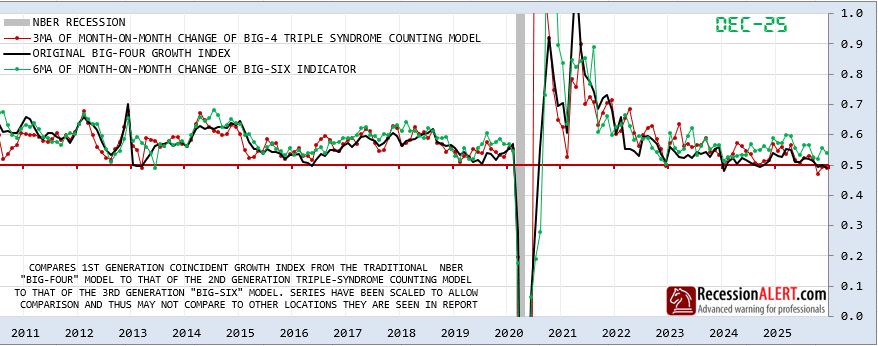
We feel there is a need to temper these bearish readings however.
1. The Government Shutdown Distortion
The most compelling reason to temper the bearish readings is the distorting effect of the October 2025 government shutdown — the longest in US history at 43 days. The CBO estimated it shaved roughly 1.5 percentage points off annualised Q4 GDP growth, while also disrupting the flow of data from federal agencies. This means the labour revisions now feeding into the NBER models are at least partly a statistical artefact of an extraordinary one-off event, rather than purely organic economic deterioration. Crucially, the rebound — estimated at around 2.2 percentage points of annualised growth in Q1 2026 — had not yet fully materialised when the December data was captured.
2. A Labour Market That Defies the Usual Script
The underlying labour market also tells a more nuanced story than the headline indicators suggest. The current cycle is historically unusual in that unemployment has risen gradually without triggering the cascading layoffs and credit contraction that typically define a recession. For those in employment, wages are still outpacing inflation, and layoffs remain low by historical standards. The rise in unemployment, while sustained, has been the slowest on record for a cycle of this length without tipping into recession — now extending to 33 months. Importantly, much of the rise in unemployment has been driven by increased labour force participation rather than mass job losses — a very different dynamic to the one that typically precedes a downturn, and a distinction that matters when interpreting the NBER labour components.
There is also a structural consumption factor that prior cycles simply did not have. The Baby Boomer generation — the wealthiest retired cohort in history — is providing a spending floor that decouples consumption from labour market conditions in a historically novel way. We discuss this and other factors at length in our latest research note. In previous cycles, labour market softness of this apparent degree would have fed fairly directly into consumer retrenchment as income stress spread. But Boomer wealth in property, equities, and pension income is sustaining spending independently of what the employment data shows. Combined with the immigration baseline shift, this represents a second structural reason why the traditional relationships between labour indicators and economic outcomes may not hold with the same force in the current cycle.
3. The Immigration Baseline Has Shifted
There is a further structural reason to be cautious about taking the labour components at face value. The dramatic decline in immigration has fundamentally changed what constitutes healthy job growth — with fewer immigrants entering the labour force, the economy now needs far fewer new jobs each month to maintain balance. Monthly payroll growth that in prior cycles would have signalled a labour market in distress may simply reflect the new sustainable pace in a structurally lower-immigration environment. This means the NBER labour components may be measuring current conditions against a baseline that no longer applies, and that the apparent deterioration is at least partly a function of an outdated benchmark rather than genuine weakness. It is a structural reframing rather than a cyclical excuse, and it is one of the more analytically credible arguments currently being made.
4. Corporate Earnings, Industrial Production, and Consumer Spending Tell a Different Story
Crucially, not all of the NBER BIG 6 components are flashing the same warning. Corporate earnings have remained not just resilient but actively strong — earnings beats for the most recent reporting season have come in at historically elevated rates, with both the proportion of companies beating estimates and the magnitude of those beats running well above long-run averages. Perhaps most compelling, economy-wide after-tax corporate profit margins for the domestic non-financial sector are currently sitting at approximately 16% — near their highest level in data stretching all the way back to 1947. This is not a narrow market phenomenon flattered by buybacks or index composition; it is the broad economy-wide picture drawn from Federal Reserve, BEA, BLS, and Census Bureau data. In every prior recession visible in that historical record, margins contracted sharply well before or during the downturn — making the current near-peak reading historically difficult to square with an economy genuinely on the cusp of contraction. Industrial production, while unspectacular, has likewise avoided the kind of sustained decline that would corroborate the signal coming from the labour components. Perhaps most reassuringly, real personal consumption expenditures and retail sales — both direct measures of what households are actually spending — have remained benign, suggesting that whatever stress exists in the labour data has not yet transmitted into a meaningful pullback in consumer behaviour. This is significant because consumer retrenchment is typically the mechanism through which labour market weakness becomes a recession, and that mechanism does not yet appear to be engaged. The overall picture across the non-labour components of the BIG 6 is therefore one of divergence rather than corroboration — and when the components of a composite model are pulling in different directions, the aggregate reading demands more scrutiny, not less.
5. GDPNow: The Most Timely Rebuttal
Perhaps the most immediate counterpoint to the NBER models is the Atlanta Fed’s GDPNow tracker, which — having previously undershot earlier estimates — has now recovered back toward trend. Unlike the NBER indicators, which by their nature incorporate lagged data, GDPNow is a real-time, high-frequency model that updates continuously with incoming datapoints. Its rebound is therefore arguably the most current picture of economic momentum available. It is also worth placing the NBER probability readings in historical context: a recession probability of 20–25% is meaningfully elevated relative to normal, but it also implies that the base case, at roughly 75–80%, remains no recession.
Taken together, the bull case is not that the economy is in robust health, but that the current indicators are capturing the worst of a distorted period — and that Q1 2026 data will be the real test of whether the underlying trajectory is as grim as the models now suggest.
6. Deeper Dive
This analysis builds on our December 2025 research paper, Structural Economic Changes Yield Challenges for Leading Indicators, which documented in detail how post-pandemic structural shifts — from the Peak 65 retirement wave to immigration volatility, AI-driven wealth concentration, and deteriorating data quality — have systematically distorted traditional recession indicators since 2021. Several of the arguments below draw directly on that analysis. Readers seeking the full evidential foundation for these arguments are encouraged to read that paper alongside this commentary.

Comments are closed.