
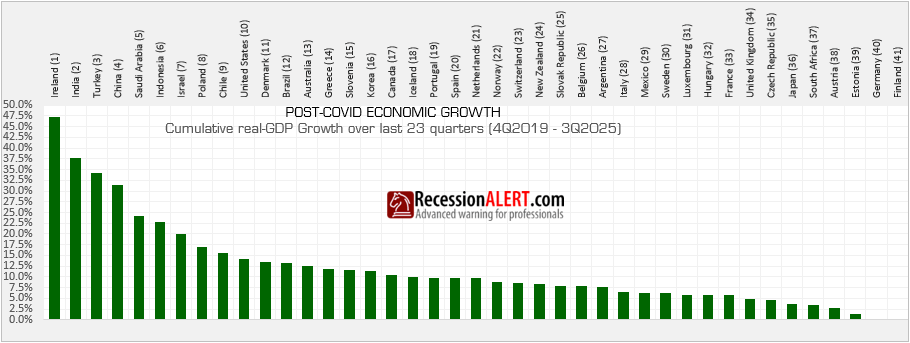
Almost six years after COVID-19 upended the global economy, a striking pattern has emerged: the world has split into distinct recovery tracks. While India sustained 5.8% annual growth and China posted 4.9%, Germany’s economy has barely budged—growing just 0.03% annually since the fourth quarter of 2019. Finland, once a beacon of Nordic prosperity, has flatlined entirely.
An analysis of cumulative real GDP growth across 41 major economies reveals more than just winners and losers. It exposes fundamental shifts in the global economic order, with profound implications for investors, policymakers, and businesses seeking to position themselves for the decade ahead.
Key Data Points (Post-COVID Growth: 4Q2019 to 3Q2025)
| Country | Real Cumulative GDP Growth | CAGR |
|---|---|---|
| Ireland | 47.2% | 6.9% |
| India | 37.8% | 5.8% |
| Turkey | 34.2% | 5.3% |
| China | 31.4% | 4.9% |
| United States | 14.2% | 2.3% |
| Canada | 10.4% | 1.7% |
| … | ||
| Japan | 3.7% | 0.6% |
| South Africa | 3.4% | 0.6% |
| Austria | 2.8% | 0.5% |
| Germany | 0.2% | 0.03% |
| Finland | 0.02% | 0.00% |
Source: OECD National Accounts data, 4Q2019 to 3Q2025 (23 quarters)
The data tells a story of three distinct worlds, each with its own trajectory, challenges, and investment characteristics.
The Breakaway Leaders: High-Growth Economies
At the top of the rankings, a select group has achieved compound annual growth rates exceeding 5%—a remarkable feat over five years that included a global pandemic. Ireland leads at 6.9%, though its position requires an asterisk: the country’s GDP figures are heavily distorted by multinational profit-booking—the so-called “leprechaun economics” effect—particularly in technology and pharmaceuticals. Nonetheless, the underlying strength of its FDI-driven model remains impressive.
More telling is the performance of major emerging markets. India’s 5.8% annual growth reflects a genuinely transformative period—digital infrastructure expansion, manufacturing sector deepening, and sustained domestic consumption despite global headwinds. Turkey posted 5.3% growth through heterodox monetary policy and aggressive fiscal stimulus, though questions about sustainability linger. China, despite property sector challenges and regulatory crackdowns, maintained 4.9% growth, demonstrating the resilience of its state-directed economy.
What unites this diverse group? Each either possesses significant scale advantages (China, India), underwent structural transformation (Ireland’s tech hub status), or pursued aggressive counter-cyclical policies (Turkey). For investors, these markets offered—and may continue to offer—outsized returns, albeit with commensurate volatility and governance risks.
The Middle Tier: Solid Performers
A cohort of roughly a dozen economies achieved what might be considered “normal” post-crisis recovery—annual growth between 1.7% and 4%. This group includes the United States (2.3%), Saudi Arabia (3.8%), Indonesia (3.7%), Australia (2.1%), and Canada (1.7%).
The American performance deserves particular attention. Despite higher interest rates than most peers and without the boost of major structural reforms, the U.S. significantly outpaced other advanced economies. This reflects genuine strengths: flexible labor markets, technological dynamism, energy independence, and resilient consumer spending. The contrast with Europe is stark and consequential.
Commodity exporters populate this tier—Saudi Arabia and Indonesia benefited from elevated energy and raw material prices. Yet their inclusion here, rather than at the top, suggests resource wealth alone doesn’t guarantee exceptional growth. Structural diversification efforts, particularly Saudi Arabia’s Vision 2030 initiatives, provided additional momentum beyond commodity windfall gains.
The Laggards: Europe’s Lost Half-Decade
The bottom of the rankings is dominated by European economies—and the numbers are sobering. Germany grew just 0.03% annually. Finland managed 0.00%. The United Kingdom posted 0.8%, France 1.0%, and Italy 1.1%. Even traditionally well-managed economies like Austria (0.5%) and the Netherlands (1.6%) significantly underperformed.
What explains this collective European malaise? The energy crisis following Russia’s invasion of Ukraine hit Europe hardest, particularly Germany’s industrial base built on cheap Russian gas. Aging demographics constrain labor force growth. Regulatory complexity and labor market rigidity limit adaptability. Perhaps most critically, Europe appears caught between American technological dynamism and Chinese manufacturing scale, excelling at neither.
The divergence within Europe is equally instructive. Greece (2.0%) and Poland (2.7%) outperformed the core, suggesting that catch-up growth dynamics and reform momentum can offset structural headwinds. Spain and Portugal, having undertaken painful adjustments after the Eurozone crisis, showed modest but positive growth. Meanwhile, the traditional engines—Germany, France, Italy—sputtered.
South Africa’s position near the bottom (0.6% annually) highlights how emerging markets without strong fundamentals struggled. Persistent electricity shortages, governance challenges, and structural unemployment left it unable to capitalize on the global recovery, even with recent rand appreciation.
Common Threads and Investment Implications
Several patterns emerge that transcend regional groupings. First, policy flexibility mattered enormously. Countries that could deploy aggressive monetary and fiscal responses (the U.S., Turkey, China) generally fared better than those constrained by monetary unions or fiscal rules. Second, energy security proved decisive—net exporters thrived while import-dependent economies, particularly in Europe, suffered. Third, demographic tailwinds (India, Indonesia) beat demographic drags (Japan, much of Europe).
Perhaps most significantly, the developed versus emerging market dichotomy that dominated investor thinking for decades has fractured. The top performers include both (Ireland, India), as do the laggards (Germany, South Africa). What matters now is specific country characteristics: governance quality, energy position, demographic trends, technological adoption, and policy space.
For investors, the implications are clear. Traditional safe haven assets in stagnant developed markets offer stability but limited growth. High-growth emerging markets demand higher risk tolerance but deliver corresponding returns. The middle tier—including the United States—may offer the optimal risk-adjusted returns: meaningful growth without extreme volatility.
Looking Forward
The crucial question: Are these trends temporary or structural? Some factors—particularly Europe’s energy shock—should moderate. Russian gas dependency is being unwound, renewable capacity is expanding, and supply chains are diversifying. Yet other headwinds appear more permanent: aging populations don’t reverse quickly, technological leadership takes decades to build, and institutional sclerosis resists reform.
The post-COVID recovery has exposed which economic models work in the 21st century and which don’t. Flexibility beats rigidity. Scale and demographics matter. Energy independence provides strategic advantage. Technological dynamism trumps manufacturing legacy. Countries adapting to these realities will pull further ahead; those clinging to outdated models will continue falling behind.
For capital allocators, the lesson is straightforward: the next five years will likely reinforce, not reverse, the divergences of the last six. Position accordingly.
The full list of countries appears below:

Comments are closed.