The Bureau of Economic Analysis printed Q1 2026 real GDP at 2.0% on a seasonally adjusted annual rate basis — short of the 2.3% consensus, but a genuine step-up from Q4’s 0.5%. The headline looks like a textbook recovery. The composition tells a narrower story: three transitory factors account for the bulk of the acceleration, each non-repeatable on the same terms in Q2. The market is reading the headline; the data reads the composition.
Missed 2.3% consensus — BEA, Apr 2026
The cleanest read on the genuine demand pulse
The cleanest read on the genuine pulse of the economy is real final sales to private domestic purchasers — a measure that strips out inventories and government spending to isolate what private households and businesses are actually demanding. That figure ran at 2.5% in Q1, up from 1.8% in Q4. Solid, but unspectacular — and not the 2.0% headline that market commentary has been reflexively anchoring to as evidence of broad economic health.
Beneath the acceleration, both residential and nonresidential structures contracted. New single-family construction and brokers’ commissions pulled residential investment lower; manufacturing-related projects led the nonresidential decline. The interest-rate-sensitive part of the economy is in mild contraction even as the AI economy accelerates. That divergence is the analytical story of this quarter, and it is not visible in the headline number.
A 2.0% headline built on three non-repeatable tailwinds is not a recovery — it is a borrowing. The composition underneath is steady private demand at 2.5%, a collapsing interest-sensitive sector, and a 160-basis-point single-quarter acceleration in core PCE. The question for Q2 is not whether growth holds at 2.0%. It will not. The question is whether the deceleration resolves into a managed soft landing or locks into a stagflation trap the Fed cannot address with either cuts or hikes.
Unbundling the Q4-to-Q1 acceleration reveals a story built on three drivers that do not compound. Government spending swung from a drag to a contribution on federal payroll normalisation after the Q4 shutdown — a mechanical rebound that does not repeat. Investment accelerated, led by equipment and intellectual-property products: information-processing equipment drove the equipment line, software drove the IP line. Inventories built, partly genuine demand-pull and partly tariff-driven front-running. Consumer spending decelerated. The pieces that look strong are the pieces with the shortest shelf life.
Federal Payroll. Government spending shifted from a Q4 drag to a Q1 positive on the mechanical normalisation of federal payrolls after the shutdown. This is accounting arithmetic, not economic momentum. It will not recur in Q2, and its subtraction from the Q1 contribution leaves a quarter already running lean before any other adjustments are applied.
Inventory Build. Businesses front-ran tariff actions following the Supreme Court’s February ruling that certain IEEPA — the International Emergency Economic Powers Act, which grants the president authority to impose tariffs during declared emergencies — tariff collections were unlawful and subject to refund. The resulting inventory build adds to Q1 GDP and subtracts from Q2, as goods sitting in warehouses do not need to be imported or produced again. The net-exports line reflected the same pressure: imports surged, led by computers, peripherals, and parts, and the imbalance produced a net-exports drag estimated at approximately minus 1.3 percentage points of headline growth.
AI Capex. Equipment and intellectual-property products — the two GDP categories that capture the bulk of AI-related capital spending — were the dominant positive contributors within investment. On a gross NIPA basis, software investment added 0.70 percentage points and information-processing equipment — principally data centre buildout — added 0.88 percentage points, together accounting for 1.58 pp of the 2.0% headline, or roughly 79% of the print. That arithmetic is the source of the circulating ‘AI = 75% of growth’ figure. It is directional: it counts all software and all information-processing equipment as AI-related and does not net out the import leakage this note addresses in Section III. Yale Budget Lab’s Ernie Tedeschi, netting imports, placed the genuine net contribution closer to 15% of growth for comparable 2025 data; the honest range for Q1 2026 runs from roughly 30% to 70% of the headline depending on how strictly one draws the AI perimeter and whether imports are netted. In either reading, AI capex is the swing factor in the print. The St. Louis Fed has confirmed that AI’s 2025 contribution already exceeded the IT sector’s dot-com peak contribution in both level and share-of-GDP terms.
Strip out the federal-payroll bounce and the inventory front-load, and Q1 is closer to a high-1s underlying pace — not a recovery, a maintenance run.
Consumer spending decelerated to a 1.6% SAAR pace, with the bulk carried by health-care services — hospital, nursing home, and outpatient spending — a composition consistent with a household sector running on inelastic, largely involuntary outlays rather than discretionary confidence. Goods spending was soft. The personal saving rate fell to 3.6% in March, the lowest since November 2025, as households financed the spending gap through accumulated balances rather than income growth.
U.S. growth has become unusually concentrated in a narrow capex theme funded by a handful of hyperscalers — the small group of technology companies (Microsoft, Amazon, Google, Meta) responsible for building and operating the large-scale cloud and AI infrastructure that drives the AI investment boom. Across the range of credible estimates — from roughly 30% on a net-of-imports basis to nearly 80% on the gross NIPA calculation — the concentration of quarterly growth in a single capex theme has no peacetime parallel outside the late-1990s technology build-out. Three downstream implications carry directly into the portfolio decision over the next three to six months.
BEA Table 2, Q1 2026 — before import netting
Tedeschi (Yale Budget Lab) at low end; narrows when imports netted
Concentration Risk. If hyperscaler capex guidance softens — even modestly — the GDP arithmetic reverses fast. There is no diversified second leg currently filling in for AI. Residential and manufacturing-structures sectors are already in contraction. A consumer running at 1.6% on health-care involuntary outlays is not a substitute engine. The upside scenario requires AI capex to hold; the downside scenario requires only that it softens. That asymmetry is not in the headline number.
The Wealth Effect. A meaningful share of the Q1 services spending line is being financed by equity gains in upper-income households. That is a self-reinforcing loop while the AI rally holds — and a self-reinforcing loop in reverse if it does not. Wealth-effect-dependent consumer spending is structurally fragile in a way that income-growth-dependent spending is not; it requires a continuously rising asset price for the feedback to sustain, and it unwinds faster than it builds.
Import Leakage. Because AI capex is roughly 70 to 90 percent import-intensive — chips from Taiwan and Korea, servers and networking gear from East Asian supply chains — each dollar of investment spending shows up simultaneously as an investment add and an import subtract. The net multiplier is smaller than the gross contribution — and this is precisely why the 79% gross NIPA figure overstates the genuine net AI contribution to GDP: the import subtract is embedded in the same quarter’s arithmetic, making the gross share a poor guide to what actually landed in the headline number. It also embeds U.S. GDP growth in East Asian supply-chain dynamics for as long as AI capex dominates the investment line. That dependency does not resolve quickly.
The concentration of Q1 growth in a single AI capex theme means the downside scenario does not require a recession catalyst. It requires only a moderation in hyperscaler spending guidance — a quarterly earnings revision, not an economic shock. With no diversified second leg and the interest-sensitive sector already in contraction, the asymmetry is sharp: the upside requires everything to hold; the downside requires only one thing to soften.
The PCE deflator — the personal consumption expenditures price index, the Fed’s preferred measure of inflation — moved from 2.9% in Q4 to 4.5% in Q1. Core PCE, which strips out food and energy to isolate underlying price pressure, moved from 2.7% to 4.3%. A 160-basis-point single-quarter acceleration in core PCE is the sharpest in this cycle and is broad-based rather than energy-driven. This is the real news in the Q1 report, and it is what locks the Fed into inaction.
Up from 2.9% in Q4 — BEA, Apr 2026
Ex food & energy — up from 2.7% in Q4
Energy. The Strait of Hormuz disruption pushed Brent crude into the $100-plus range. Energy’s contribution in nominal monthly PCE was outsized in March — gasoline alone added roughly $81 billion to nominal consumer spending, three times the next category. This is a direct transmission from the Hormuz constraint into the consumer price basket: molecular scarcity appearing as a PCE line item. If Hormuz remains disrupted into Q3, the energy contribution to PCE does not fade.
Tariff Pass-Through. The wedge between gross domestic purchases prices, which printed at 3.6%, and PCE prices, which printed at 4.5%, is consistent with imported-goods pressure feeding into consumer baskets. The IEEPA Supreme Court ruling ordered refunds on prior tariff collections, but that legal reversal does not undo prices already paid or disrupt the pass-through chain that has embedded itself in retail pricing. The divergence between the two price measures is the visible fingerprint of tariff transmission into the consumer basket.
Sticky Services. Health-care services pricing and shelter-related components remain firm. Core services excluding housing — the component the Fed has watched most closely as an indicator of demand-driven inflation — has not rolled over. Broad-based stickiness in services inflation means the PCE acceleration cannot be attributed to a single supply shock and dismissed as transitory on that basis alone.
The Fed is in the most awkward position it has occupied in this cycle. A 4.3% core PCE reading argues against cuts; housing-and-structures contraction plus consumer deceleration argues against any hawkish drift. The most likely outcome of the May 7 FOMC meeting is an extended hold with elevated uncertainty about the direction of the next move — a stance that carries its own cost, as real rates remain above neutral for an economy already showing interest-rate-sensitive contraction.
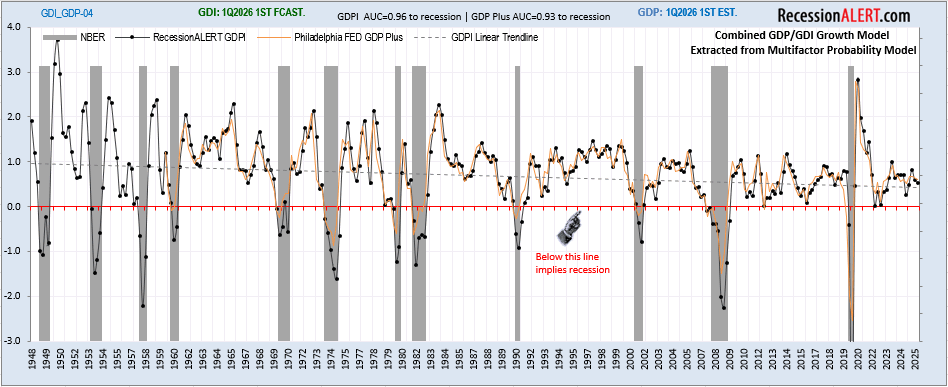
Read through the GDP composition, the Q1 data delivers one unambiguous result: the economy is not in recession. RecessionAlert’s Combined GDP/GDI Growth Model — which carries an AUC of 0.96 in identifying recessions, versus 0.93 for the Philadelphia Fed’s GDP Plus comparison series — sits above its long-run linear regression trendline on the Q1 first estimate. So does the Philadelphia Fed series. On the growth accounting alone, the recession call is premature. The disagreement is not about whether recession is here — it is about whether the Q2 deceleration that follows the borrowed Q1 tailwinds lands softly or hardens into a stagflation configuration the Fed cannot navigate.
The major statistical models and prediction markets are not in agreement, and the dispersion between them is wider than usual. The NY Fed yield-curve model implies roughly 25% probability of recession by November 2026. Prediction markets — Polymarket and Kalshi — sit in the 22-to-28 percent range, with Kalshi having spiked above 34% in early March on the Hormuz oil shock before settling back toward the high-20s. Sell-side bank desks, including JPMorgan, are placing their 12-month estimates in the 35-to-45 percent range on higher conviction for stagflation drag. The dispersion is a signal, not noise: it reflects genuine path-dependence on two binary outcomes neither group can model with confidence.
Official Statistical Signals. The Conference Board Coincident Economic Index — which measures current activity across employment, income, output, and sales — was flat in both February and March and has risen only 0.3% over six months. The Sahm Rule — an indicator that triggers at a 0.50-point rise in the three-month average unemployment rate from its 12-month low, historically a reliable recession signal — sits at approximately 0.47. Unemployment is at 4.1%; initial claims are running at 189,000. These signals are consistent with an economy decelerating, not contracting.
Leading Indicators. The Conference Board Leading Economic Index fell 0.6% in March and has declined 1.0% over six months — approaching but not yet at the level that historically triggers a recession call. The ISM manufacturing PMI — a survey-based measure of factory activity where a reading below 50 indicates contraction — has been sub-50 for five consecutive months. Residential construction is already declining. The leading signal is clear and directional; the coincident signal has not yet confirmed it. That gap is how late-cycle slowdowns look before they resolve.
Real final sales to private domestic purchasers at 2.5% is incompatible with imminent contraction. Labour data is not breaking: initial claims at 189,000 and unemployment at 4.1% sit well clear of the Sahm Rule’s 0.50 threshold. Private demand at current levels provides a floor that a traditional NBER-defined recession — requiring simultaneous broad-based decline across output, employment, income, and sales — must remove before it can establish itself. Base case: no recession through October 2026.
The wider-than-usual dispersion between sell-side estimates (35–45%) and prediction markets (22–28%) reflects genuine uncertainty about two variables: the duration of the Hormuz disruption and the resilience of AI capex guidance through Q2 earnings season. Both are binary in their near-term resolution. The recession probability looks materially different depending on which way each resolves, and the paths do not average out neatly.
The path into late-2026 recession runs through three sequential conditions: a Hormuz disruption that holds Brent above $100 into Q3, real-wage compression that takes consumer spending below 1% SAAR, and an AI capex air-pocket triggered by downward guidance from the major hyperscalers. None of these requires a new exogenous shock — only a continuation of existing pressures. If all three converge, the LEI signal converts to a CEI signal and recession risk for late-Q4 2026 through Q1 2027 rises sharply. None of the three individually constitutes a recession. All three in sequence does.

The investor who has separated the AI capex beneficiaries from the interest-rate-sensitive economy is better positioned than one treating the 2.0% headline as a uniform signal of broad strength. Energy producers with Hormuz exposure, technology hardware supply chains running through Taiwan and Korea, and real assets that hedge stagflation carry asymmetric upside given the physical constraints the PCE print reveals. The interest-rate-sensitive sector — residential builders, leveraged real estate, long-duration credit — is in mild contraction even as the headline grows. A 4.3% core PCE that the Fed cannot address with either hikes or cuts is not an environment where duration earns its risk premium.
The Q1 2026 GDP advance estimate is statistically clean and economically misleading. The three factors that account for the step-up from Q4’s 0.5% — federal payroll rebound, tariff-driven inventory surge, concentrated AI capex — are each non-repeatable on the same terms in Q2. Underlying private final demand at 2.5% is solid but not strong enough to absorb a 160-basis-point PCE acceleration, a Hormuz disruption holding Brent above $100, and a Fed boxed simultaneously out of cuts and hikes. The policy trap is real. The investment question is not whether growth holds at 2.0% — it will not — but whether the deceleration resolves into a soft landing or locks into a stagflation configuration the market has not yet priced.
The base case holds if either of two conditions resolves earlier than expected: a Hormuz normalisation before June that removes the energy contribution to PCE and restores Fed optionality, or sustained hyperscaler capex guidance through Q2 earnings season that confirms the AI-driven growth is more durable than the concentration metrics suggest. A combination of both would shift Q3 data sharply toward the consensus soft-landing scenario. That outcome is not the base case — it requires two simultaneous favourable resolutions — but the prediction markets are currently assigning it roughly one-in-three odds. That is not a number to dismiss.
The Q1 print is borrowed. The inflation is real. The Fed exit is not yet visible. The question for the next two quarters is which resolves first: the borrowed growth becomes apparent in the Q2 data, or the inflation resolves through Hormuz relief and tariff reversal. The first path leads to a deceleration debate the market is not fully pricing. The second path leads to a rate-cut window the market is not currently pricing at all. Neither outcome requires a recession. Both require the Fed to do something it currently cannot.